Grammar Unit
English 150
ACTIVE AND PASSIVE VOICE
Active and Passive Voice
 The term voice, when used in English
grammar, refers to the structure of a
sentence. There are two “voices” in
English grammar
 active voice
 passive voice.
Active Voice
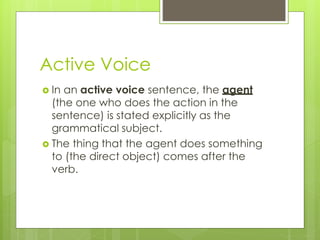
 In an active voice sentence, the agent
(the one who does the action in the
sentence) is stated explicitly as the
grammatical subject.
 The thing that the agent does something
to (the direct object) comes after the
verb.
Passive Voice
 In a passive voice sentence, the thing
that the agent does something to, is
placed as the grammatical subject of the
sentence.
 The agent (the one who does the action)
is placed after the subject, usually in a
prepositional phrase. In fact, sometimes
the agent is hidden, not even mentioned.
When to Use the Active Voice
 Use the active voice in most of the writing
you do in school and at work.
 Studies in readability indicate that active
voice sentences, where the agent is
stated first, are easier to understand than
passive voice sentences.
COMMA SPLICES
Comma Splice vs. Fused Sentence
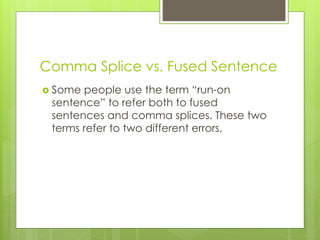
 A comma splice is a comma that joins
(splices) two independent clauses. A
clause is a group of words that has a
subject and a verb.
Independent Clauses
 Example of an Independent Clause:
 Robert ate worms.
 This is a clause. Robert is the subject, and ate
is the verb. This clause is "independent"
because it can stand alone as a sentence.
 Now let's take another independent clause:
 Mary dislikes Robert.
Comma Splices
 If you take two independent clauses and
join them with a comma, you have a
comma splice:
 Robert ate worms, Mary dislikes Robert.
 To splice means to join, and in standard
American English, you're not supposed to
use comma splices in writing. It is a formal
rule. Comma splices are easy errors for
teachers and editors to notice.
How to Fix a Comma Splice
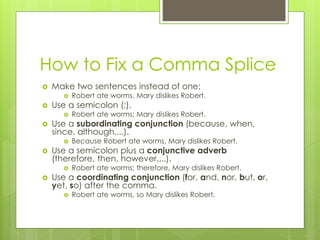
 Make two sentences instead of one:
 Robert ate worms. Mary dislikes Robert.
 Use a semicolon (;).
 Robert ate worms; Mary dislikes Robert.
 Use a subordinating conjunction (because, when,
since, although,...).
 Because Robert ate worms, Mary dislikes Robert.
 Use a semicolon plus a conjunctive adverb
(therefore, then, however,...).
 Robert ate worms; therefore, Mary dislikes Robert.
 Use a coordinating conjunction (for, and, nor, but, or,
yet, so) after the comma.
 Robert ate worms, so Mary dislikes Robert.
CONFUSING SENTENCES
Confusing Sentences
 What is a confusing sentence?
 The entire sentence lacks a certain logic.
It’s as if the writer transferred his or her
thoughts quickly to the paper and then
forgot to revise.
3 Guidelines to Clarity
 Determine who the “main character” in
the sentence is.
 The “main character” is usually the person
who does the action. Sometimes we call
this “person (or thing) who does the
action” the agent.
 Start the sentence with the person who
does the action. In other words, start the
sentence with the agent.
3 Guidelines to Clarity
 Determine what the agent is doing.
 What the agent is doing is usually stated
as the main verb.
 Look for verbs that actually say
something, strong verbs, rather than the
verb “to be.”
3 Guidelines to Clarity
 If there are embedded clauses within the
sentences, do the same with those
clauses.
DANGLING PARTICIPLES
Participles
 Participle: A verb form used as an
adjective. It usually ends in ing, en, or ed.
 Example: Laughing, Julio fell out of his
chair.
Gerunds
 Gerund: A verb form used as a noun. It
ends in ing – always.
 Example: Laughing makes me cry
sometimes.
Dangling Participles
 Dangling and misplaced participles often
give rise to absurdly humorous scenarios.
 A “dangling participle” has no noun in the
sentence to which the participle would
logically attach.
 A “misplaced participle” does have a noun,
but that noun does not come directly after
the participle, thus creating a confusing
sentence.
 For our purposes, “dangling” and “misplaced”
are equivalent.
Fixing a Dangling Participle
 Turn the Misplaced or Dangling Participle Into a Dependent Clause.
 This means that you take the ing word (the participle), give it a
subject, turn it into a verb, and attach it to the main clause. Let’s
take the example above, with Amaury’s unfortunate slip on the wet
sidewalk.
 Correct: When Amaury slipped on the wet sidewalk, the keys fell
from his pocket.
 Here we have taken the original participial phrase (Slipping on the
wet sidewalk), and we have turned it into a dependent clause. We
understand that “Amaury slipped,” not the keys.
Fixing a Dangling Participle
 Make the Thing Being Modified by the Participle, the Subject of the
Main Clause.
 This means we take what is being modified by the ing phrase and
place it first in the sentence, right after the comma. Again, let’s use
the example of Amaury’s unfortunate slip.
 Correct: Slipping on the wet sidewalk, Amaury lost his keys when
they fell from his pocket.
 Note that “Amaury,” the person, NOT “Amaury’s keys” is placed
after the comma. You may be tempted to write “Amaury’s keys,”
but then you would have the same problem. Keys, even “Amaury’s
keys,” do not slip on wet sidewalks; people, like Amaury, do.
Fixing a Dangling Participle
 Place the Participle as Close as Logically
Possible to the Noun it Modifies.
 Misplaced: Crying and screaming, Mrs.
Williams led three-year old Mindy away from
the toy store.
 Correct: Mrs. Williams led three-year old
Mindy, crying and screaming, away from the
toy store.
PARALLELISM
Parallelism
 A sentence exhibits parallelism if similar
ideas are expressed using the same
syntactic and grammatical structure.
 Writers use parallel structures to
communicate ideas that have the same
importance using the same grammatical
structure.
Parallelism
 Parallelism is most common using gerund
phrases (verb + ing) or infinitives (to +
verb).
 Faulty parallelism occurs when writers do
not use a parallel structure to
communicate a series of ideas.
Faulty Parallelism
 Faulty Parallelism:
 Without good pitching, the Marlins can be
expected to lose more than eighty games,
to draft early in next year’s draft, and
attendance will suffer greatly.
Faulty Parallelism
 What are the ideas that seem to have the
same importance?
 The Marlins will lose more than eighty
games
 The Marlins will draft early in next year’s
draft.
 The Marlins’ attendance will suffer greatly.
Correct Parallelism
 Correct Parallelism: Without good
pitching, the Marlins can be expected to
lose more than eighty games, to draft
early in next year’s draft, and to suffer
greatly in attendance.
Correlative Conjunctions
 The term parallelism also applies to using
correlative conjunctions and comparisons
properly.
 Correlative Conjunctions: both, and; not, but; not
only, but also; either, or; whether, or; neither, nor.
 These conjunctions connect words, phrases, and
clauses that have the same level of meaning in
the same sentence. Use the same grammatical
structure with both elements of the correlative.
Comparisons
 Use a parallel structure when you connect
two words, phrases, or clauses with a
comparison word, including than or as.
 Faulty Parallelism: Sharon’s grade point
average is much higher than her brother.
PRONOUN / ANTECEDENT
AGREEMENT
Agreement and Number
 In English grammar we have a term called
number, and, unlike number in math,
number in grammar means one of two
things:
 singular (only one)
 plural (more than one).
Correct Agreement
 Correct: Students lost their privileges.
 The original noun is Students, which is
plural; the possessive pronoun, their, refers
(or points back) to Students. The word
Students is the antecedent, and both
Students and their are plural in number.
No problem here.
Singular Words
Certain words are ALWAYS singular, even though
they may seem plural.
Anybody
Each
Everybody
Somebody
Someone
Solution
 Your best solution is to rewrite the
sentence and turn singular nouns into
plurals.
 That way you are grammatically correct
and you do not use sexist or clunky
language.
 Better: Students who went on the field trip
were supposed to bring their permission
form.
Omit the Pronoun
 We can also rewrite the sentence omitting the
pronoun.
 Better: Everyone who went on the field trip
was supposed to bring a permission form.
 Each method works. If you have enough
creativity, sentences can be written in many
different ways. Some ways work better than
others.
THE END

Grammar Unit

  • 1.
  • 2.
  • 3.
    Active and PassiveVoice  The term voice, when used in English grammar, refers to the structure of a sentence. There are two “voices” in English grammar  active voice  passive voice.
  • 4.
    Active Voice  Inan active voice sentence, the agent (the one who does the action in the sentence) is stated explicitly as the grammatical subject.  The thing that the agent does something to (the direct object) comes after the verb.
  • 5.
    Passive Voice  Ina passive voice sentence, the thing that the agent does something to, is placed as the grammatical subject of the sentence.  The agent (the one who does the action) is placed after the subject, usually in a prepositional phrase. In fact, sometimes the agent is hidden, not even mentioned.
  • 6.
    When to Usethe Active Voice  Use the active voice in most of the writing you do in school and at work.  Studies in readability indicate that active voice sentences, where the agent is stated first, are easier to understand than passive voice sentences.
  • 7.
  • 8.
    Comma Splice vs.Fused Sentence  A comma splice is a comma that joins (splices) two independent clauses. A clause is a group of words that has a subject and a verb.
  • 9.
    Independent Clauses  Exampleof an Independent Clause:  Robert ate worms.  This is a clause. Robert is the subject, and ate is the verb. This clause is "independent" because it can stand alone as a sentence.  Now let's take another independent clause:  Mary dislikes Robert.
  • 10.
    Comma Splices  Ifyou take two independent clauses and join them with a comma, you have a comma splice:  Robert ate worms, Mary dislikes Robert.  To splice means to join, and in standard American English, you're not supposed to use comma splices in writing. It is a formal rule. Comma splices are easy errors for teachers and editors to notice.
  • 11.
    How to Fixa Comma Splice  Make two sentences instead of one:  Robert ate worms. Mary dislikes Robert.  Use a semicolon (;).  Robert ate worms; Mary dislikes Robert.  Use a subordinating conjunction (because, when, since, although,...).  Because Robert ate worms, Mary dislikes Robert.  Use a semicolon plus a conjunctive adverb (therefore, then, however,...).  Robert ate worms; therefore, Mary dislikes Robert.  Use a coordinating conjunction (for, and, nor, but, or, yet, so) after the comma.  Robert ate worms, so Mary dislikes Robert.
  • 12.
  • 13.
    Confusing Sentences  Whatis a confusing sentence?  The entire sentence lacks a certain logic. It’s as if the writer transferred his or her thoughts quickly to the paper and then forgot to revise.
  • 14.
    3 Guidelines toClarity  Determine who the “main character” in the sentence is.  The “main character” is usually the person who does the action. Sometimes we call this “person (or thing) who does the action” the agent.  Start the sentence with the person who does the action. In other words, start the sentence with the agent.
  • 15.
    3 Guidelines toClarity  Determine what the agent is doing.  What the agent is doing is usually stated as the main verb.  Look for verbs that actually say something, strong verbs, rather than the verb “to be.”
  • 16.
    3 Guidelines toClarity  If there are embedded clauses within the sentences, do the same with those clauses.
  • 17.
  • 18.
    Participles  Participle: Averb form used as an adjective. It usually ends in ing, en, or ed.  Example: Laughing, Julio fell out of his chair.
  • 19.
    Gerunds  Gerund: Averb form used as a noun. It ends in ing – always.  Example: Laughing makes me cry sometimes.
  • 20.
    Dangling Participles  Danglingand misplaced participles often give rise to absurdly humorous scenarios.  A “dangling participle” has no noun in the sentence to which the participle would logically attach.  A “misplaced participle” does have a noun, but that noun does not come directly after the participle, thus creating a confusing sentence.  For our purposes, “dangling” and “misplaced” are equivalent.
  • 21.
    Fixing a DanglingParticiple  Turn the Misplaced or Dangling Participle Into a Dependent Clause.  This means that you take the ing word (the participle), give it a subject, turn it into a verb, and attach it to the main clause. Let’s take the example above, with Amaury’s unfortunate slip on the wet sidewalk.  Correct: When Amaury slipped on the wet sidewalk, the keys fell from his pocket.  Here we have taken the original participial phrase (Slipping on the wet sidewalk), and we have turned it into a dependent clause. We understand that “Amaury slipped,” not the keys.
  • 22.
    Fixing a DanglingParticiple  Make the Thing Being Modified by the Participle, the Subject of the Main Clause.  This means we take what is being modified by the ing phrase and place it first in the sentence, right after the comma. Again, let’s use the example of Amaury’s unfortunate slip.  Correct: Slipping on the wet sidewalk, Amaury lost his keys when they fell from his pocket.  Note that “Amaury,” the person, NOT “Amaury’s keys” is placed after the comma. You may be tempted to write “Amaury’s keys,” but then you would have the same problem. Keys, even “Amaury’s keys,” do not slip on wet sidewalks; people, like Amaury, do.
  • 23.
    Fixing a DanglingParticiple  Place the Participle as Close as Logically Possible to the Noun it Modifies.  Misplaced: Crying and screaming, Mrs. Williams led three-year old Mindy away from the toy store.  Correct: Mrs. Williams led three-year old Mindy, crying and screaming, away from the toy store.
  • 24.
  • 25.
    Parallelism  A sentenceexhibits parallelism if similar ideas are expressed using the same syntactic and grammatical structure.  Writers use parallel structures to communicate ideas that have the same importance using the same grammatical structure.
  • 26.
    Parallelism  Parallelism ismost common using gerund phrases (verb + ing) or infinitives (to + verb).  Faulty parallelism occurs when writers do not use a parallel structure to communicate a series of ideas.
  • 27.
    Faulty Parallelism  FaultyParallelism:  Without good pitching, the Marlins can be expected to lose more than eighty games, to draft early in next year’s draft, and attendance will suffer greatly.
  • 28.
    Faulty Parallelism  Whatare the ideas that seem to have the same importance?  The Marlins will lose more than eighty games  The Marlins will draft early in next year’s draft.  The Marlins’ attendance will suffer greatly.
  • 29.
    Correct Parallelism  CorrectParallelism: Without good pitching, the Marlins can be expected to lose more than eighty games, to draft early in next year’s draft, and to suffer greatly in attendance.
  • 30.
    Correlative Conjunctions  Theterm parallelism also applies to using correlative conjunctions and comparisons properly.  Correlative Conjunctions: both, and; not, but; not only, but also; either, or; whether, or; neither, nor.  These conjunctions connect words, phrases, and clauses that have the same level of meaning in the same sentence. Use the same grammatical structure with both elements of the correlative.
  • 31.
    Comparisons  Use aparallel structure when you connect two words, phrases, or clauses with a comparison word, including than or as.  Faulty Parallelism: Sharon’s grade point average is much higher than her brother.
  • 32.
  • 33.
    Agreement and Number In English grammar we have a term called number, and, unlike number in math, number in grammar means one of two things:  singular (only one)  plural (more than one).
  • 34.
    Correct Agreement  Correct:Students lost their privileges.  The original noun is Students, which is plural; the possessive pronoun, their, refers (or points back) to Students. The word Students is the antecedent, and both Students and their are plural in number. No problem here.
  • 35.
    Singular Words Certain wordsare ALWAYS singular, even though they may seem plural. Anybody Each Everybody Somebody Someone
  • 36.
    Solution  Your bestsolution is to rewrite the sentence and turn singular nouns into plurals.  That way you are grammatically correct and you do not use sexist or clunky language.  Better: Students who went on the field trip were supposed to bring their permission form.
  • 37.
    Omit the Pronoun We can also rewrite the sentence omitting the pronoun.  Better: Everyone who went on the field trip was supposed to bring a permission form.  Each method works. If you have enough creativity, sentences can be written in many different ways. Some ways work better than others.
  • 38.