SURVIVAL A2
           ENGLISH
USING GERUNDS & INFINITIVES   TO
EXPRESS LIKES & DISLIKES
FORM
FORM

A. A gerund is a verb with the –ing ending.
FORM

A. A gerund is a verb with the –ing ending.
   be
FORM

A. A gerund is a verb with the –ing ending.
   be           being
FORM

A. A gerund is a verb with the –ing ending.
   be           being
   do
FORM

A. A gerund is a verb with the –ing ending.
   be           being
   do           doing
FORM

A. A gerund is a verb with the –ing ending.
   be           being
   do           doing
   go
FORM

A. A gerund is a verb with the –ing ending.
   be           being
   do           doing
   go           going
FORM

A. A gerund is a verb with the –ing ending.
   be           being
   do           doing
   go           going
   play
FORM

A. A gerund is a verb with the –ing ending.
   be           being
   do           doing
   go           going
   play         playing
FORM

A. A gerund is a verb with the –ing ending.
   be           being
   do           doing
   go           going
   play         playing
   work
FORM

A. A gerund is a verb with the –ing ending.
   be           being
   do           doing
   go           going
   play         playing
   work         working
FORM

A. A gerund is a verb with the –ing ending.
   be           being
   do           doing
   go           going
   play         playing
   work         working
   swim
FORM

A. A gerund is a verb with the –ing ending.
   be           being
   do           doing
   go           going
   play         playing
   work         working
   swim         swimming
FORM

A. A gerund is a verb with the –ing ending.
   be           being
   do           doing
   go           going
   play         playing
   work         working
   swim         swimming
   get
FORM

A. A gerund is a verb with the –ing ending.
   be           being
   do           doing
   go           going
   play         playing
   work         working
   swim         swimming
   get          getting
USE
USE
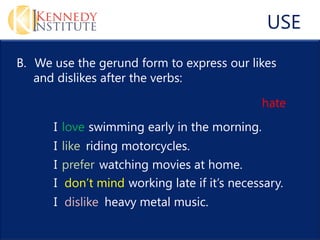
B. We use the gerund form to express our likes
   and dislikes after the verbs:
USE
B. We use the gerund form to express our likes
   and dislikes after the verbs:

love like   prefer   don’t mind   dislike   hate
USE
B. We use the gerund form to express our likes
   and dislikes after the verbs:

       like   prefer   don’t mind   dislike   hate
      I love swimming early in the morning.
USE
B. We use the gerund form to express our likes
   and dislikes after the verbs:
            prefer   don’t mind    dislike    hate
      I love swimming early in the morning.
      I like riding motorcycles.
USE
B. We use the gerund form to express our likes
   and dislikes after the verbs:
                     don’t mind    dislike    hate
      I love swimming early in the morning.
      I like riding motorcycles.
      I prefer watching movies at home.
USE
B. We use the gerund form to express our likes
   and dislikes after the verbs:
                                    dislike   hate
      I love swimming early in the morning.
      I like riding motorcycles.
      I prefer watching movies at home.
      I don’t mind working late if it’s necessary.
USE
B. We use the gerund form to express our likes
   and dislikes after the verbs:

                                              hate
      I love swimming early in the morning.
      I like riding motorcycles.
      I prefer watching movies at home.
      I don’t mind working late if it’s necessary.
      I dislike heavy metal music.
USE
B. We use the gerund form to express our likes
   and dislikes after the verbs:


      I love swimming early in the morning.
      I like riding motorcycles.
      I prefer watching movies at home.
      I don’t mind working late if it’s necessary.
      I dislike heavy metal music.
      I hate to get up early on Saturdays.
USE
C. The infinitive form (to + verb) may also be used
   after the following verbs:

    love like    prefer   hate
      I love to swim early in the morning.
      I like to ride motorcycles.
      I prefer to watch movies at home.
      I hate to get up early on Saturdays.
USE
C. The infinitive form (to + verb) may also be used
   after the following verbs:

    love like    prefer   hate
      I love to swim early in the morning.
      I like to ride motorcycles.
      I prefer to watch movies at home.
      I hate to get up early on Saturdays.

 You should not use the infinitive after “don’t
 mind” or “dislike”.
Exclusive use for:
                THE KENNEDY INSTITUTE


                       End of Presentation
No part of this presentation may be printed, downloaded, copied, stored or altered without
                    written permission of The Kennedy Institute. ®2012

2.J

  • 1.
    SURVIVAL A2 ENGLISH USING GERUNDS & INFINITIVES TO EXPRESS LIKES & DISLIKES
  • 2.
  • 3.
    FORM A. A gerundis a verb with the –ing ending.
  • 4.
    FORM A. A gerundis a verb with the –ing ending. be
  • 5.
    FORM A. A gerundis a verb with the –ing ending. be being
  • 6.
    FORM A. A gerundis a verb with the –ing ending. be being do
  • 7.
    FORM A. A gerundis a verb with the –ing ending. be being do doing
  • 8.
    FORM A. A gerundis a verb with the –ing ending. be being do doing go
  • 9.
    FORM A. A gerundis a verb with the –ing ending. be being do doing go going
  • 10.
    FORM A. A gerundis a verb with the –ing ending. be being do doing go going play
  • 11.
    FORM A. A gerundis a verb with the –ing ending. be being do doing go going play playing
  • 12.
    FORM A. A gerundis a verb with the –ing ending. be being do doing go going play playing work
  • 13.
    FORM A. A gerundis a verb with the –ing ending. be being do doing go going play playing work working
  • 14.
    FORM A. A gerundis a verb with the –ing ending. be being do doing go going play playing work working swim
  • 15.
    FORM A. A gerundis a verb with the –ing ending. be being do doing go going play playing work working swim swimming
  • 16.
    FORM A. A gerundis a verb with the –ing ending. be being do doing go going play playing work working swim swimming get
  • 17.
    FORM A. A gerundis a verb with the –ing ending. be being do doing go going play playing work working swim swimming get getting
  • 18.
  • 19.
    USE B. We usethe gerund form to express our likes and dislikes after the verbs:
  • 20.
    USE B. We usethe gerund form to express our likes and dislikes after the verbs: love like prefer don’t mind dislike hate
  • 21.
    USE B. We usethe gerund form to express our likes and dislikes after the verbs: like prefer don’t mind dislike hate I love swimming early in the morning.
  • 22.
    USE B. We usethe gerund form to express our likes and dislikes after the verbs: prefer don’t mind dislike hate I love swimming early in the morning. I like riding motorcycles.
  • 23.
    USE B. We usethe gerund form to express our likes and dislikes after the verbs: don’t mind dislike hate I love swimming early in the morning. I like riding motorcycles. I prefer watching movies at home.
  • 24.
    USE B. We usethe gerund form to express our likes and dislikes after the verbs: dislike hate I love swimming early in the morning. I like riding motorcycles. I prefer watching movies at home. I don’t mind working late if it’s necessary.
  • 25.
    USE B. We usethe gerund form to express our likes and dislikes after the verbs: hate I love swimming early in the morning. I like riding motorcycles. I prefer watching movies at home. I don’t mind working late if it’s necessary. I dislike heavy metal music.
  • 26.
    USE B. We usethe gerund form to express our likes and dislikes after the verbs: I love swimming early in the morning. I like riding motorcycles. I prefer watching movies at home. I don’t mind working late if it’s necessary. I dislike heavy metal music. I hate to get up early on Saturdays.
  • 27.
    USE C. The infinitiveform (to + verb) may also be used after the following verbs: love like prefer hate I love to swim early in the morning. I like to ride motorcycles. I prefer to watch movies at home. I hate to get up early on Saturdays.
  • 28.
    USE C. The infinitiveform (to + verb) may also be used after the following verbs: love like prefer hate I love to swim early in the morning. I like to ride motorcycles. I prefer to watch movies at home. I hate to get up early on Saturdays. You should not use the infinitive after “don’t mind” or “dislike”.
  • 29.
    Exclusive use for: THE KENNEDY INSTITUTE End of Presentation No part of this presentation may be printed, downloaded, copied, stored or altered without written permission of The Kennedy Institute. ®2012