More About Congress
A Research Activity
Gerrymandering
Gerrymandering
• Google “Gerrymandering” and open the
Wikipedia article.
• Use that article to answer the first two
questions of this assignment.
Gerrymandering
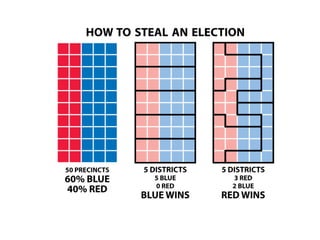
• Gerrymandering: drawing the boundaries of a
voting district to make it more likely that a
party or group will win an election.
– Every ten years, each state legislature adjusts its
Congressional boundaries to reflect population
shifts within the state.
– The political party that controls the state
legislature at the time of “redistricting” has a big
advantage because it controls the process and can
draw the boundaries in deliberate ways.
Gerrymandering
• There are two main types of gerrymandering.
– Political gerrymandering is the drawing of
electoral district lines in a manner that favors one
political party at the expense of the other.
– Political gerrymandering is “legal” (ie, rarely
successfully challenged) when district lines are
drawn to protect incumbents. (Incumbent = the
current office-holder)
Gerrymandering
– Racial gerrymandering is the drawing of electoral
district lines so that racial minorities are under-
represented.
– Tactics include "packing" targeted voters into a
given district or "cracking" them to make targeted
voters a minority across several districts.
Gerrymandering
– Technically, election districts are supposed to be
“contiguous” and “compact.”
– After every redistricting, there are numerous
court challenges.
• Political gerrymandering is occasionally, but rarely,
overturned in the Courts.
• Racial gerrymandering violates the 14th Amendment
and the Voting Rights Act of 1965.
Gerrymandering
– Gerrymandering is a practice that many people
would like to see eliminated.
• Reformers see gerrymandering as a form of political
corruption that undermines democracy.
• The John Tanner Fairness and Independence in
Redistricting Act was introduced in the 113th Congress
and again in the 114th Congress. It did not pass, but
could become the basis for future reform.
• The text of the law can be found at this link and you can
also google the topic for more information.
https://www.congress.gov/bill/114th-congress/house-
bill/1347
Gerrymandering
• Earlier this year, a federal judicial panel ruled that
North Carolina was guilty of racial gerrymandering in
its 1st and 12th congressional districts.
– The US Supreme Court has agreed to hear the case next
year (2017 session).
– Read about this case at the links below and/or conduct
your own research:
– http://thehill.com/regulation/court-battles/284990-
supreme-court-to-consider-nc-gerrymandering-case
– http://www.newsobserver.com/news/politics-
government/state-politics/article58756583.html
Filibuster
Filibuster
• At the federal level, filibustering is a rule of
debate that is possible only in the US Senate.
• (Some states allow it in their state legislatures,
others do not.)
• You will conduct some research and then
write a brief structured essay about this
device.
Write a Bill
Write a Bill
• A bill is a proposed law. Bills typically contain
several things:
– They describe the objective of the proposal.
– If the bill will be a budgeted item, they may
include authorization for funding.
– They assign enforcement to the appropriate
executive agency.
Write a Bill
Here’s an Example:
Proposal: The United States shall construct a wall along its border with
Mexico. The wall shall be unbroken, of solid construction, with a height
of no less than eighteen feet at any point. It shall extend no less than 1000
feet into the Pacific Ocean on its western end and no less than 1000 feet
into the Gulf of Mexico at its eastern end. The border wall shall be
continuously monitored using both electronic and manned surveillance.
Funding: Congress shall appropriate $25 billion for initial construction
and $1 billion annually for ongoing security.
Enforcement: Congress directs the United States Department of
Homeland Security with implementation of this bill upon its passage into
law.
Write a Bill
• Now, you realize that was somewhat tongue-
in-cheek, but it does illustrate what I want you
to do.
• Before you write your own bill, if you want to
look at some real bills to see how they are
worded, have a look at either of these sites:
https://www.govtrack.us/congress/bills
https://www.congress.gov/
Nobody Likes Congress
• Public approval for the US Congress has been
in decline for years, but seems to be
improving slightly in recent months.
– After hitting a dismal 9% about three years ago,
there has been a gradual rise.
– That said, about 80% of Americans continue to
look with disfavor on the US Congress.
– Open the article below and skim its findings:
• http://www.gallup.com/poll/195632/approval-congress-inches-
september.aspx?g_source=CONGRESS&g_medium=topic&g_campaign=til
es
Nobody Likes Congress
• Traditionally, measures of Congressional approval
have shown an interesting anomaly: when people
gave low ratings to Congress as a whole, they still
tended to give their own representatives relatively
high approval.
– “The-problem-is-not-our-guy-it’s-all-those-other-guys” was
a common sentiment.
– According to this article, that trend may be changing.
Open the article below and skim its findings.
– http://www.washingtontimes.com/news/2016/jun/19/con
gress-seeing-lowest-favorability-ratings-ever/

More About Congress

  • 1.
    More About Congress AResearch Activity
  • 2.
  • 3.
    Gerrymandering • Google “Gerrymandering”and open the Wikipedia article. • Use that article to answer the first two questions of this assignment.
  • 4.
    Gerrymandering • Gerrymandering: drawingthe boundaries of a voting district to make it more likely that a party or group will win an election. – Every ten years, each state legislature adjusts its Congressional boundaries to reflect population shifts within the state. – The political party that controls the state legislature at the time of “redistricting” has a big advantage because it controls the process and can draw the boundaries in deliberate ways.
  • 5.
    Gerrymandering • There aretwo main types of gerrymandering. – Political gerrymandering is the drawing of electoral district lines in a manner that favors one political party at the expense of the other. – Political gerrymandering is “legal” (ie, rarely successfully challenged) when district lines are drawn to protect incumbents. (Incumbent = the current office-holder)
  • 6.
    Gerrymandering – Racial gerrymanderingis the drawing of electoral district lines so that racial minorities are under- represented. – Tactics include "packing" targeted voters into a given district or "cracking" them to make targeted voters a minority across several districts.
  • 7.
    Gerrymandering – Technically, electiondistricts are supposed to be “contiguous” and “compact.” – After every redistricting, there are numerous court challenges. • Political gerrymandering is occasionally, but rarely, overturned in the Courts. • Racial gerrymandering violates the 14th Amendment and the Voting Rights Act of 1965.
  • 9.
    Gerrymandering – Gerrymandering isa practice that many people would like to see eliminated. • Reformers see gerrymandering as a form of political corruption that undermines democracy. • The John Tanner Fairness and Independence in Redistricting Act was introduced in the 113th Congress and again in the 114th Congress. It did not pass, but could become the basis for future reform. • The text of the law can be found at this link and you can also google the topic for more information. https://www.congress.gov/bill/114th-congress/house- bill/1347
  • 10.
    Gerrymandering • Earlier thisyear, a federal judicial panel ruled that North Carolina was guilty of racial gerrymandering in its 1st and 12th congressional districts. – The US Supreme Court has agreed to hear the case next year (2017 session). – Read about this case at the links below and/or conduct your own research: – http://thehill.com/regulation/court-battles/284990- supreme-court-to-consider-nc-gerrymandering-case – http://www.newsobserver.com/news/politics- government/state-politics/article58756583.html
  • 11.
  • 12.
    Filibuster • At thefederal level, filibustering is a rule of debate that is possible only in the US Senate. • (Some states allow it in their state legislatures, others do not.) • You will conduct some research and then write a brief structured essay about this device.
  • 13.
  • 14.
    Write a Bill •A bill is a proposed law. Bills typically contain several things: – They describe the objective of the proposal. – If the bill will be a budgeted item, they may include authorization for funding. – They assign enforcement to the appropriate executive agency.
  • 15.
    Write a Bill Here’san Example: Proposal: The United States shall construct a wall along its border with Mexico. The wall shall be unbroken, of solid construction, with a height of no less than eighteen feet at any point. It shall extend no less than 1000 feet into the Pacific Ocean on its western end and no less than 1000 feet into the Gulf of Mexico at its eastern end. The border wall shall be continuously monitored using both electronic and manned surveillance. Funding: Congress shall appropriate $25 billion for initial construction and $1 billion annually for ongoing security. Enforcement: Congress directs the United States Department of Homeland Security with implementation of this bill upon its passage into law.
  • 16.
    Write a Bill •Now, you realize that was somewhat tongue- in-cheek, but it does illustrate what I want you to do. • Before you write your own bill, if you want to look at some real bills to see how they are worded, have a look at either of these sites: https://www.govtrack.us/congress/bills https://www.congress.gov/
  • 17.
    Nobody Likes Congress •Public approval for the US Congress has been in decline for years, but seems to be improving slightly in recent months. – After hitting a dismal 9% about three years ago, there has been a gradual rise. – That said, about 80% of Americans continue to look with disfavor on the US Congress. – Open the article below and skim its findings: • http://www.gallup.com/poll/195632/approval-congress-inches- september.aspx?g_source=CONGRESS&g_medium=topic&g_campaign=til es
  • 18.
    Nobody Likes Congress •Traditionally, measures of Congressional approval have shown an interesting anomaly: when people gave low ratings to Congress as a whole, they still tended to give their own representatives relatively high approval. – “The-problem-is-not-our-guy-it’s-all-those-other-guys” was a common sentiment. – According to this article, that trend may be changing. Open the article below and skim its findings. – http://www.washingtontimes.com/news/2016/jun/19/con gress-seeing-lowest-favorability-ratings-ever/