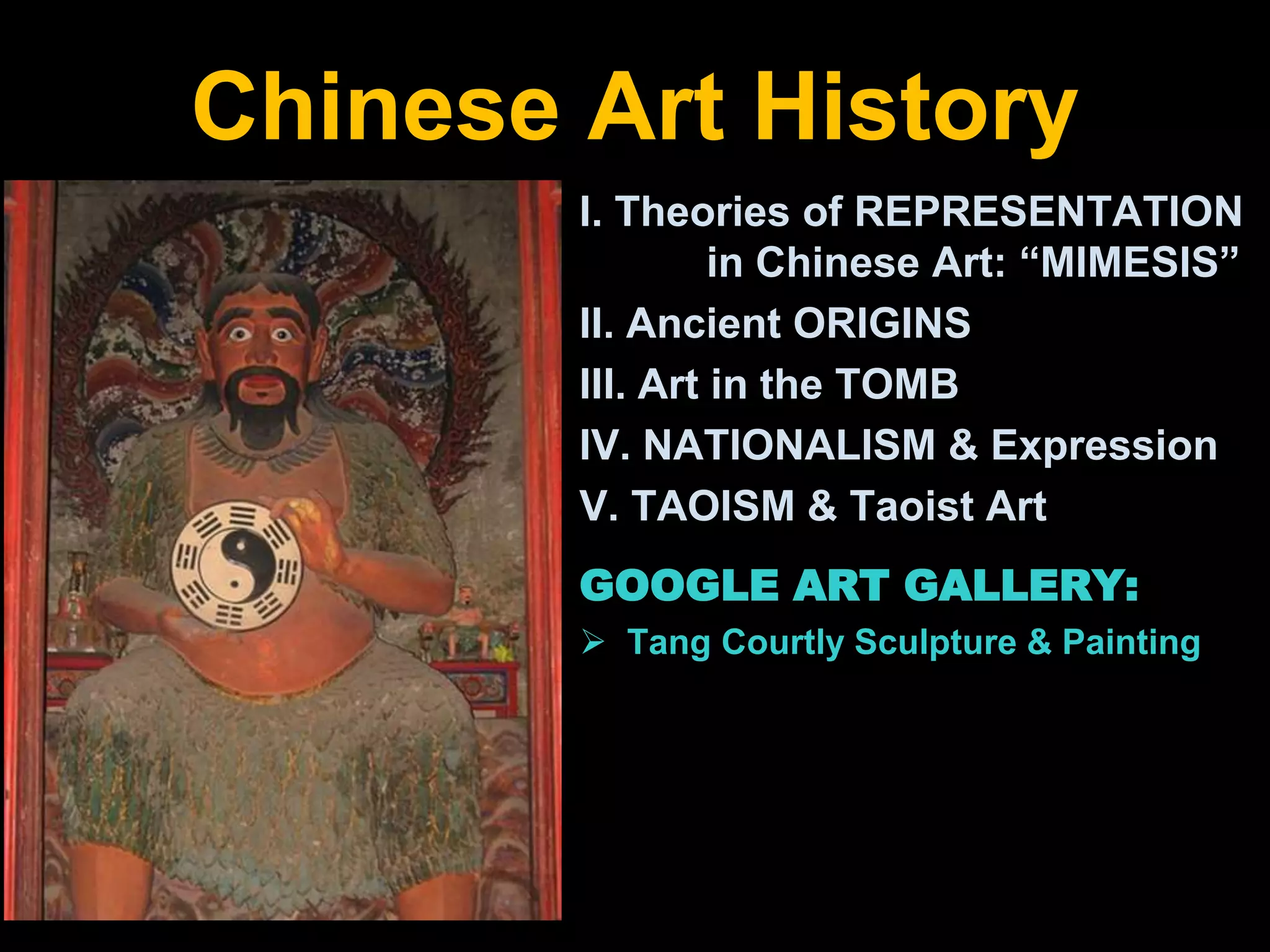
Chinese Art History
I. Theories of REPRESENTATION
in Chinese Art: “MIMESIS”
II. Ancient ORIGINS
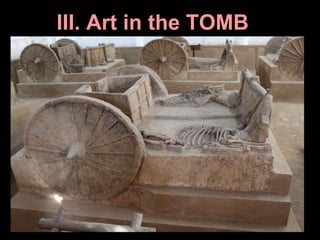
III. Art in the TOMB
IV. NATIONALISM & Expression
V. TAOISM & Taoist Art
GOOGLE ART GALLERY:
 Tang Courtly Sculpture & Painting
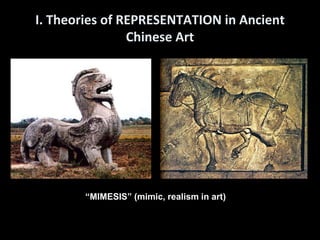
I. Theories of REPRESENTATION in Ancient
Chinese Art
“MIMESIS” (mimic, realism in art)
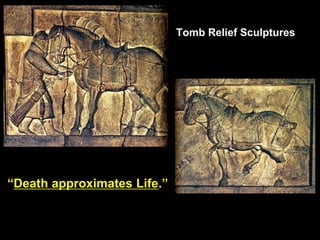
Tomb Relief Sculptures
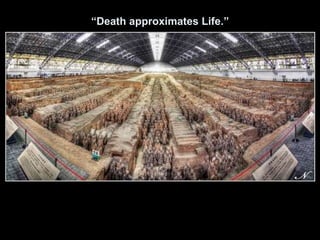
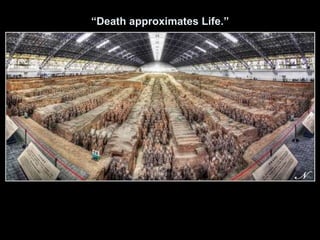
“Death approximates Life.”
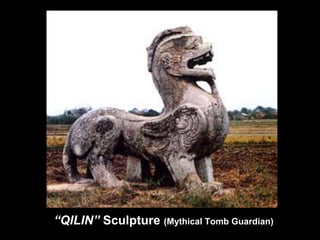
“QILIN” Sculpture (Mythical Tomb Guardian)
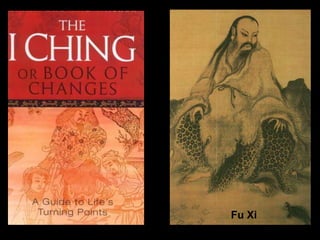
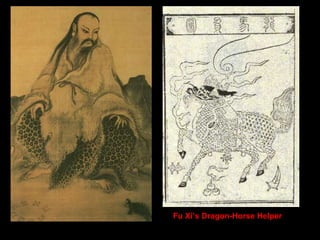
Fu Xi
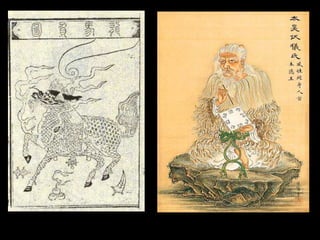
Fu Xi’s Dragon-Horse Helper
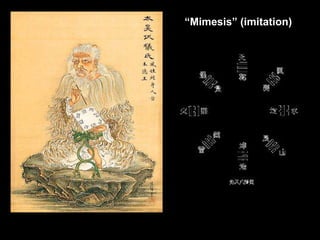
“Mimesis” (imitation)
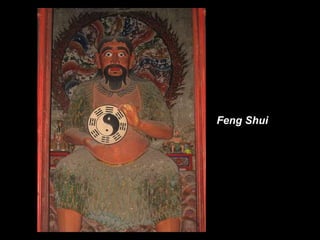
Feng Shui
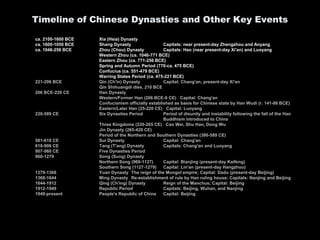
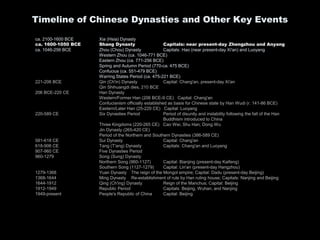
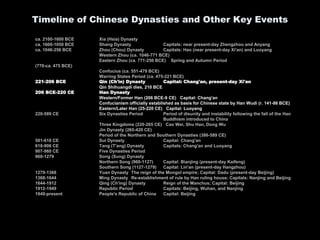
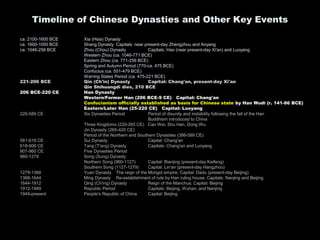
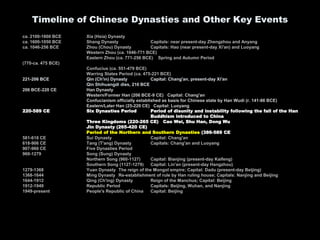
Timeline of Chinese Dynasties and Other Key Events
ca. 2100-1600 BCE Xia (Hsia) Dynasty
ca. 1600-1050 BCE Shang Dynasty Capitals: near present-day Zhengzhou and Anyang
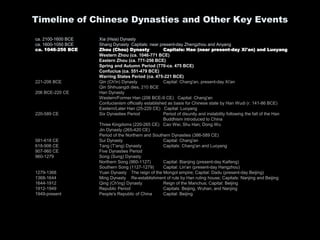
ca. 1046-256 BCE Zhou (Chou) Dynasty Capitals: Hao (near present-day Xi'an) and Luoyang
Western Zhou (ca. 1046-771 BCE)
Eastern Zhou (ca. 771-256 BCE)
Spring and Autumn Period (770-ca. 475 BCE)
Confucius (ca. 551-479 BCE)
Warring States Period (ca. 475-221 BCE)
221-206 BCE Qin (Ch'in) Dynasty Capital: Chang'an, present-day Xi'an
Qin Shihuangdi dies, 210 BCE
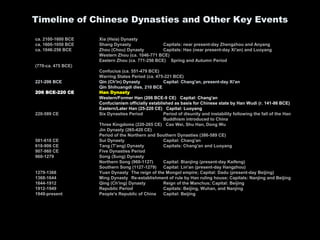
206 BCE-220 CE Han Dynasty
Western/Former Han (206 BCE-9 CE) Capital: Chang'an
Confucianism officially established as basis for Chinese state by Han Wudi (r. 141-86 BCE)
Eastern/Later Han (25-220 CE) Capital: Luoyang
220-589 CE Six Dynasties Period Period of disunity and instability following the fall of the Han
Buddhism introduced to China
Three Kingdoms (220-265 CE) Cao Wei, Shu Han, Dong Wu
Jin Dynasty (265-420 CE)
Period of the Northern and Southern Dynasties (386-589 CE)
581-618 CE Sui Dynasty Capital: Chang'an
618-906 CE Tang (T'ang) Dynasty Capitals: Chang'an and Luoyang
907-960 CE Five Dynasties Period
960-1279 Song (Sung) Dynasty
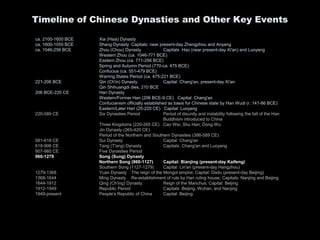
Northern Song (960-1127) Capital: Bianjing (present-day Kaifeng)
Southern Song (1127-1279) Capital: Lin'an (present-day Hangzhou)
1279-1368 Yuan Dynasty The reign of the Mongol empire; Capital: Dadu (present-day Beijing)
1368-1644 Ming Dynasty Re-establishment of rule by Han ruling house; Capitals: Nanjing and Beijing
1644-1912 Qing (Ch'ing) Dynasty Reign of the Manchus; Capital: Beijing
1912-1949 Republic Period Capitals: Beijing, Wuhan, and Nanjing
1949-present People's Republic of China Capital: Beijing
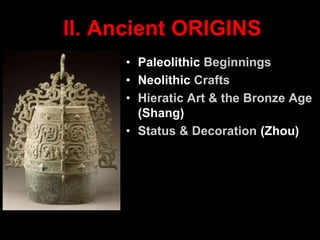
II. Ancient ORIGINS
• Paleolithic Beginnings
• Neolithic Crafts
• Hieratic Art & the Bronze Age
(Shang)
• Status & Decoration (Zhou)
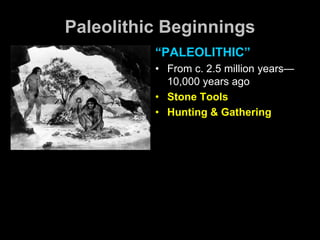
Paleolithic Beginnings
“PALEOLITHIC”
• From c. 2.5 million years—
10,000 years ago
• Stone Tools
• Hunting & Gathering
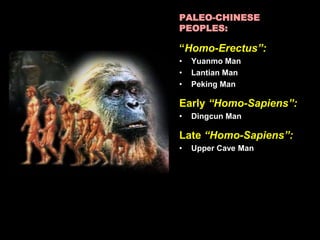
PALEO-CHINESE
PEOPLES:
“Homo-Erectus”:
• Yuanmo Man
• Lantian Man
• Peking Man
Early “Homo-Sapiens”:
• Dingcun Man
Late “Homo-Sapiens”:
• Upper Cave Man
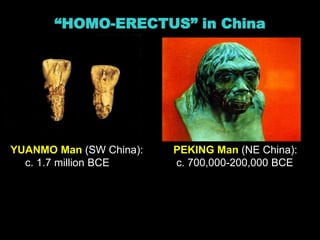
“HOMO-ERECTUS” in China
YUANMO Man (SW China): PEKING Man (NE China):
c. 1.7 million BCE c. 700,000-200,000 BCE
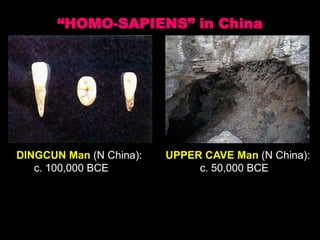
“HOMO-SAPIENS” in China
DINGCUN Man (N China): UPPER CAVE Man (N China):
c. 100,000 BCE c. 50,000 BCE
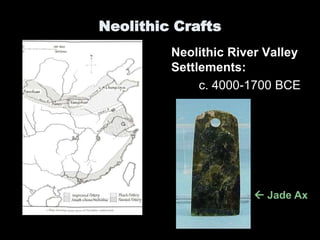
Neolithic Crafts
Neolithic River Valley
Settlements:
c. 4000-1700 BCE
 Jade Ax
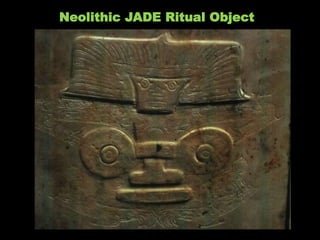
Neolithic JADE Ritual Object
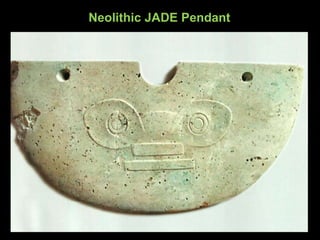
Neolithic JADE Pendant
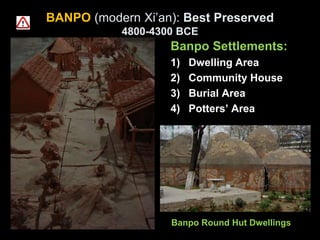
BANPO (modern Xi’an): Best Preserved
4800-4300 BCE
Banpo Settlements:
1) Dwelling Area
2) Community House
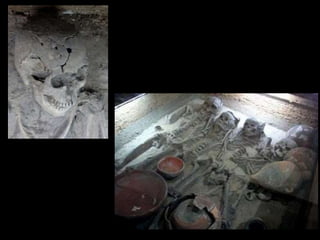
3) Burial Area
4) Potters’ Area
Banpo Round Hut Dwellings
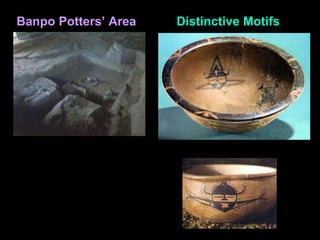
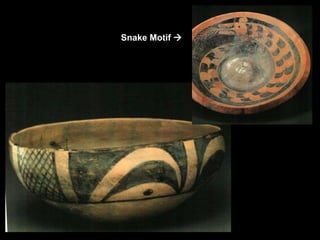
Banpo Potters’ Area Distinctive Motifs
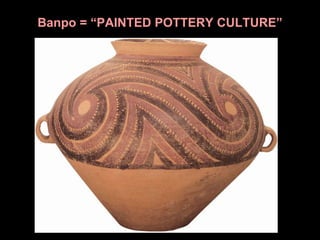
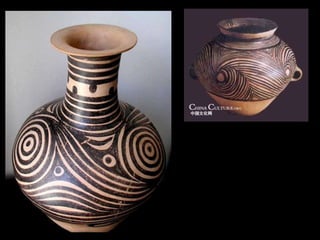
Banpo = “PAINTED POTTERY CULTURE”
Snake Motif 
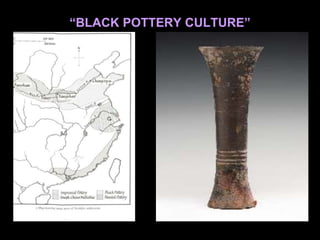
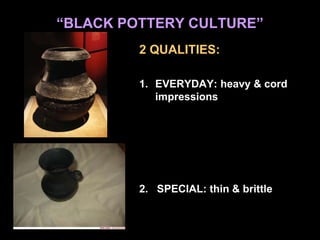
“BLACK POTTERY CULTURE”
2 QUALITIES:
1. EVERYDAY: heavy & cord
impressions
2. SPECIAL: thin & brittle
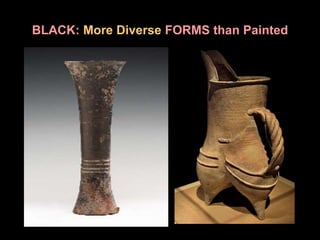
BLACK: More Diverse FORMS than Painted
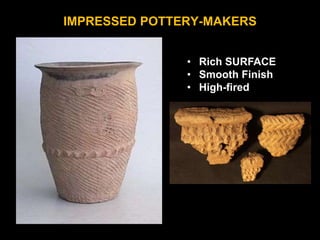
IMPRESSED POTTERY-MAKERS
• Rich SURFACE
• Smooth Finish
• High-fired
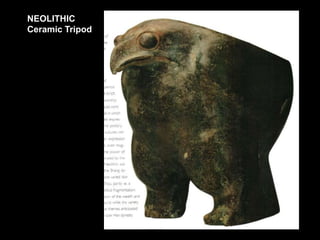
NEOLITHIC
Ceramic Tripod
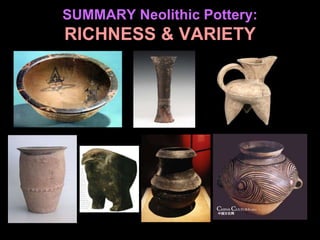
SUMMARY Neolithic Pottery:
RICHNESS & VARIETY
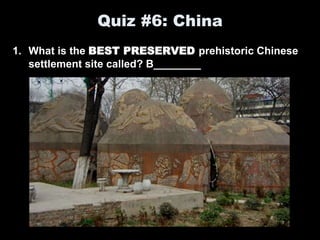
Quiz #6: China
1. What is the BEST PRESERVED prehistoric Chinese
settlement site called? B________
III. Art in the TOMB
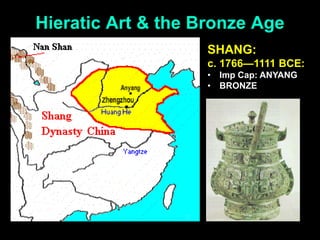
Hieratic Art & the Bronze Age
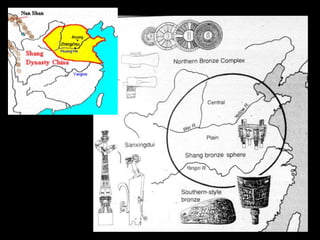
SHANG:
c. 1766—1111 BCE:
• Imp Cap: ANYANG
• BRONZE
Timeline of Chinese Dynasties and Other Key Events
ca. 2100-1600 BCE Xia (Hsia) Dynasty
ca. 1600-1050 BCE Shang Dynasty Capitals: near present-day Zhengzhou and Anyang
ca. 1046-256 BCE Zhou (Chou) Dynasty Capitals: Hao (near present-day Xi'an) and Luoyang
Western Zhou (ca. 1046-771 BCE)
Eastern Zhou (ca. 771-256 BCE)
Spring and Autumn Period (770-ca. 475 BCE)
Confucius (ca. 551-479 BCE)
Warring States Period (ca. 475-221 BCE)
221-206 BCE Qin (Ch'in) Dynasty Capital: Chang'an, present-day Xi'an
Qin Shihuangdi dies, 210 BCE
206 BCE-220 CE Han Dynasty
Western/Former Han (206 BCE-9 CE) Capital: Chang'an
Confucianism officially established as basis for Chinese state by Han Wudi (r. 141-86 BCE)
Eastern/Later Han (25-220 CE) Capital: Luoyang
220-589 CE Six Dynasties Period Period of disunity and instability following the fall of the Han
Buddhism introduced to China
Three Kingdoms (220-265 CE) Cao Wei, Shu Han, Dong Wu
Jin Dynasty (265-420 CE)
Period of the Northern and Southern Dynasties (386-589 CE)
581-618 CE Sui Dynasty Capital: Chang'an
618-906 CE Tang (T'ang) Dynasty Capitals: Chang'an and Luoyang
907-960 CE Five Dynasties Period
960-1279 Song (Sung) Dynasty
Northern Song (960-1127) Capital: Bianjing (present-day Kaifeng)
Southern Song (1127-1279) Capital: Lin'an (present-day Hangzhou)
1279-1368 Yuan Dynasty The reign of the Mongol empire; Capital: Dadu (present-day Beijing)
1368-1644 Ming Dynasty Re-establishment of rule by Han ruling house; Capitals: Nanjing and Beijing
1644-1912 Qing (Ch'ing) Dynasty Reign of the Manchus; Capital: Beijing
1912-1949 Republic Period Capitals: Beijing, Wuhan, and Nanjing
1949-present People's Republic of China Capital: Beijing
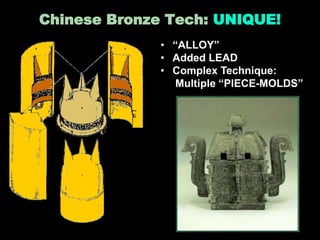
Chinese Bronze Tech: UNIQUE!
• “ALLOY”
• Added LEAD
• Complex Technique:
Multiple “PIECE-MOLDS”
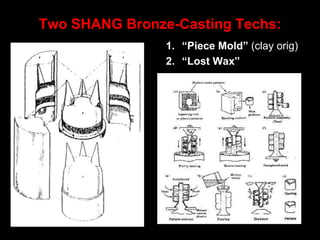
Two SHANG Bronze-Casting Techs:
1. “Piece Mold” (clay orig)
2. “Lost Wax”
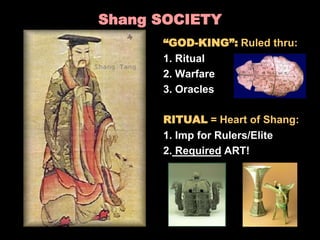
Shang SOCIETY
“GOD-KING”: Ruled thru:
1. Ritual
2. Warfare
3. Oracles
RITUAL = Heart of Shang:
1. Imp for Rulers/Elite
2. Required ART!
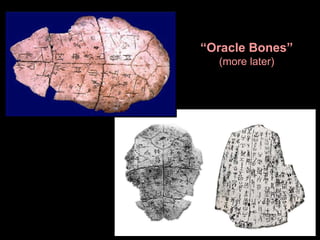
“Oracle Bones”
(more later)
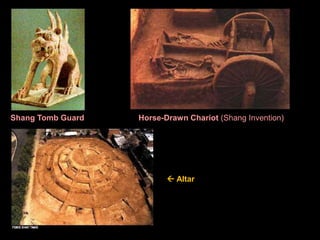
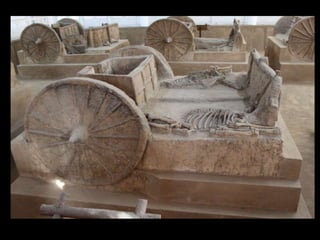
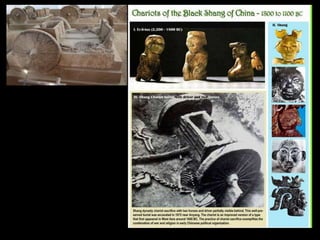
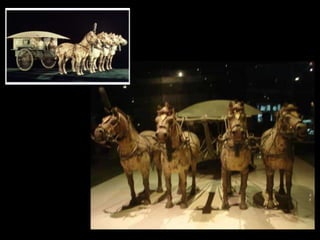
Shang Tomb Guard Horse-Drawn Chariot (Shang Invention)
 Altar
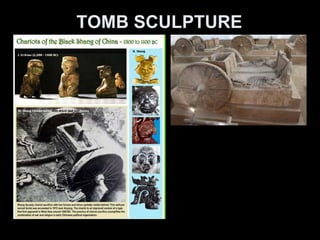
TOMB SCULPTURE
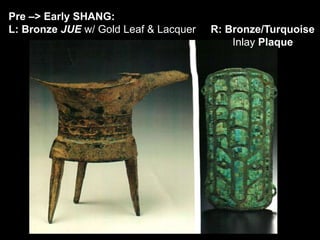
Pre –> Early SHANG:
L: Bronze JUE w/ Gold Leaf & Lacquer R: Bronze/Turquoise
Inlay Plaque
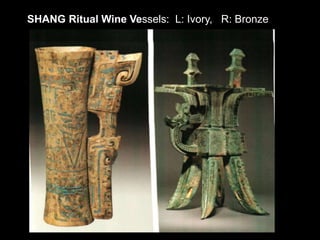
SHANG Ritual Wine Vessels: L: Ivory, R: Bronze
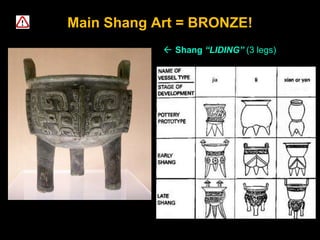
Main Shang Art = BRONZE!
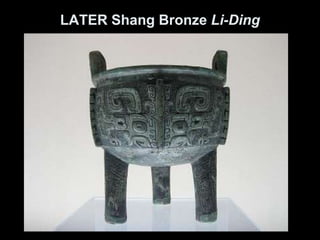
 Shang “LIDING” (3 legs)
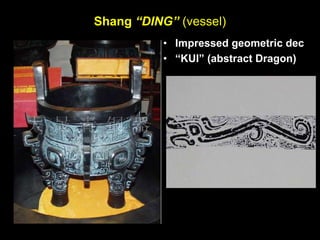
Shang “DING” (vessel)
• Impressed geometric dec
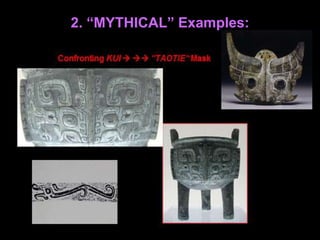
• “KUI” (abstract Dragon)
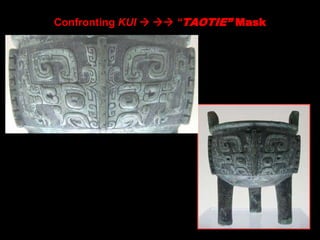
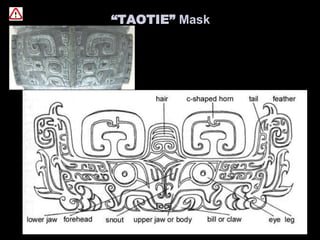
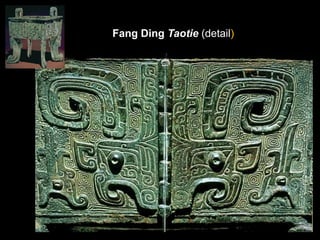
Confronting KUI   “TAOTIE” Mask
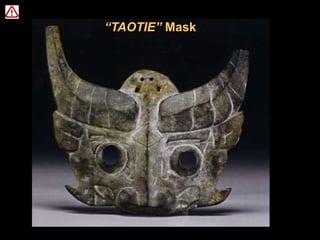
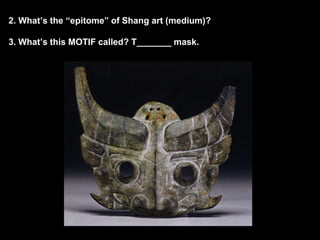
“TAOTIE” Mask
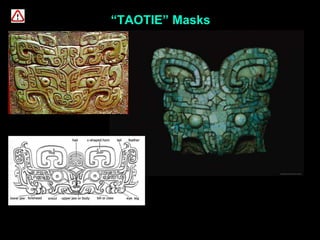
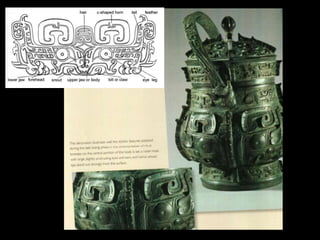
“TAOTIE” Masks
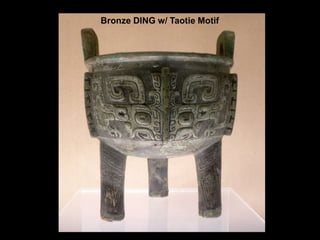
Bronze DING w/ Taotie Motif
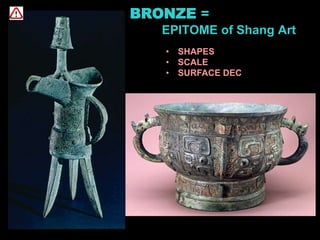
BRONZE =
EPITOME of Shang Art
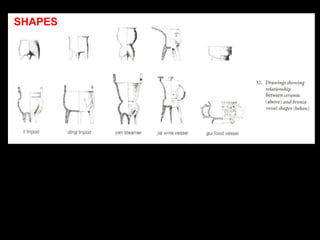
• SHAPES
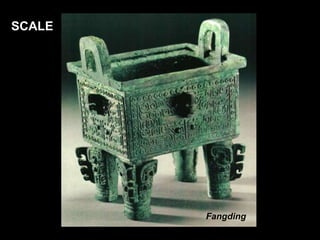
• SCALE
• SURFACE DEC
SHAPES
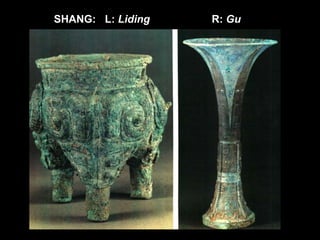
SHANG: L: Liding R: Gu
SCALE
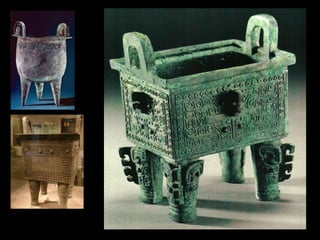
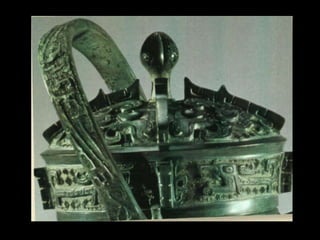
Fangding
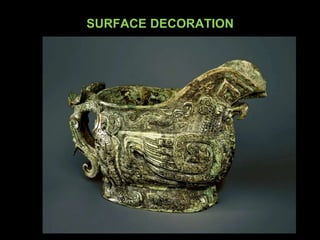
SURFACE DECORATION
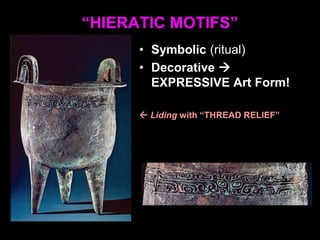
“HIERATIC MOTIFS”
• Symbolic (ritual)
• Decorative 
EXPRESSIVE Art Form!
 Liding with “THREAD RELIEF”
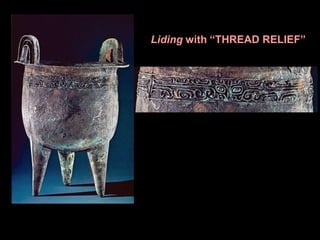
Liding with “THREAD RELIEF”
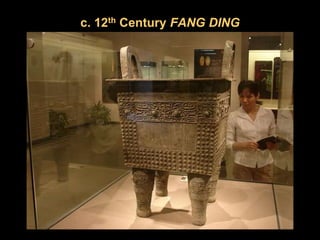
c. 12th Century FANG DING
LATER Shang Bronze Li-Ding
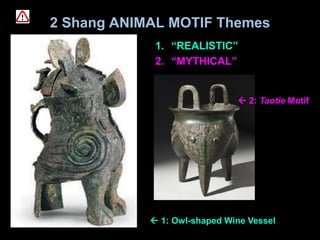
2 Shang ANIMAL MOTIF Themes
1. “REALISTIC”
2. “MYTHICAL”
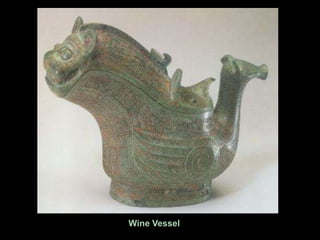
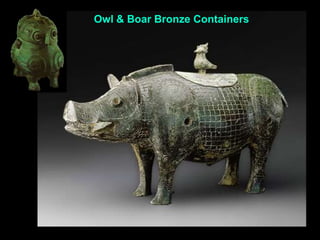
 1: Owl-shaped Wine Vessel
 2: Taotie Motif
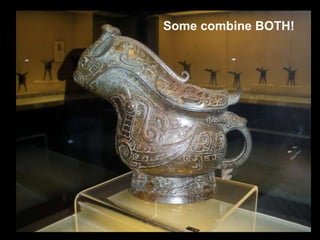
Some combine BOTH!
Wine Vessel
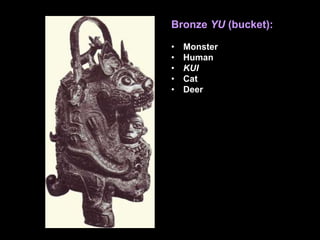
Bronze YU (bucket):
• Monster
• Human
• KUI
• Cat
• Deer
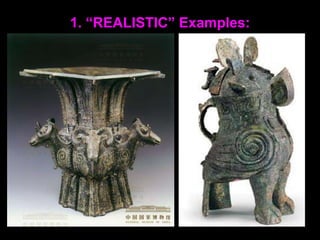
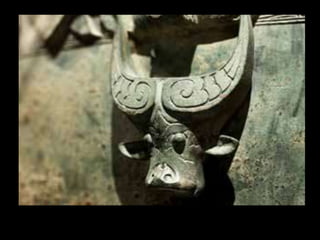
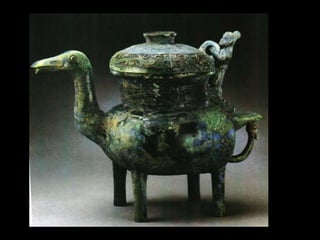
1. “REALISTIC” Examples:
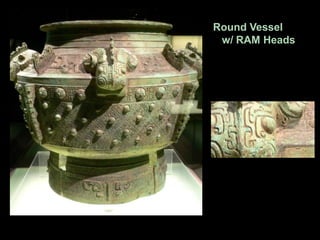
Round Vessel
w/ RAM Heads
Owl & Boar Bronze Containers
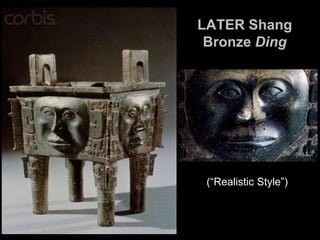
LATER Shang
Bronze Ding
(“Realistic Style”)
2. “MYTHICAL” Examples:
“TAOTIE” Mask
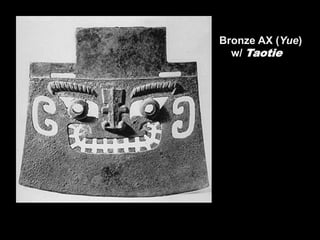
Bronze AX (Yue)
w/ Taotie
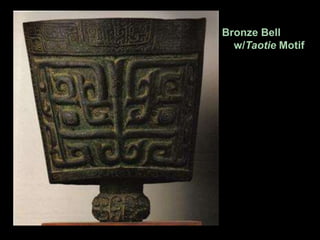
Bronze Bell
w/Taotie Motif
Fang Ding Taotie (detail)
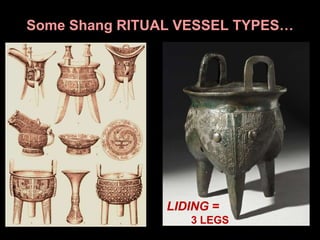
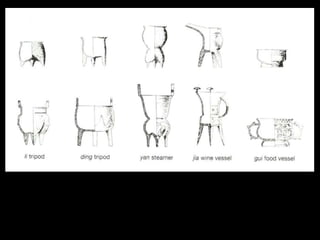
Some Shang RITUAL VESSEL TYPES…
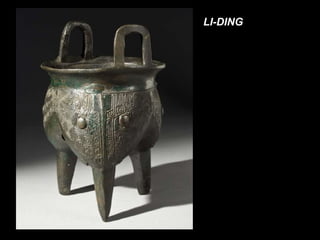
LIDING =
3 LEGS
LI-DING
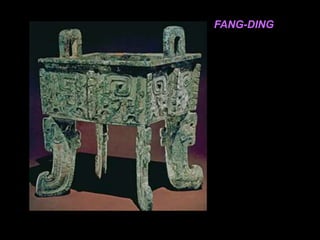
FANG-DING
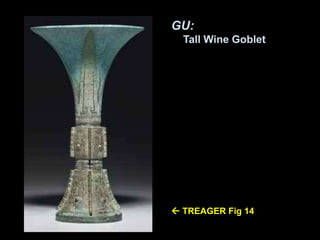
GU:
Tall Wine Goblet
 TREAGER Fig 14
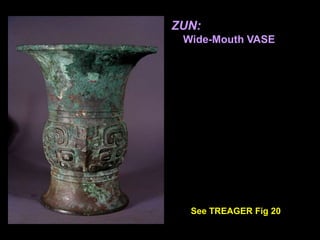
ZUN:
Wide-Mouth VASE
See TREAGER Fig 20
2. What’s the “epitome” of Shang art (medium)?
3. What’s this MOTIF called? T_______ mask.
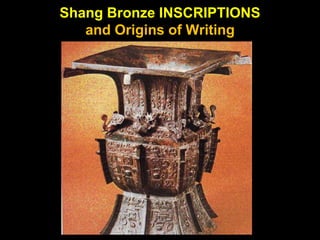
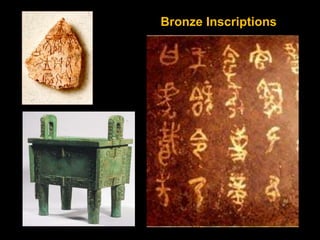
Shang Bronze INSCRIPTIONS
and Origins of Writing
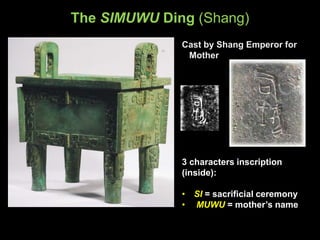
The SIMUWU Ding (Shang)
Cast by Shang Emperor for
Mother
3 characters inscription
(inside):
• SI = sacrificial ceremony
• MUWU = mother’s name
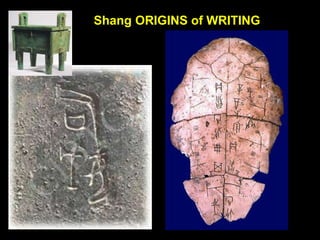
Shang ORIGINS of WRITING
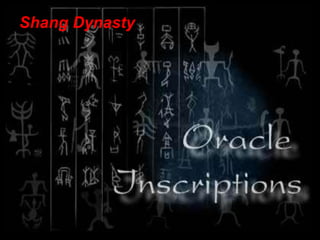
Shang Dynasty
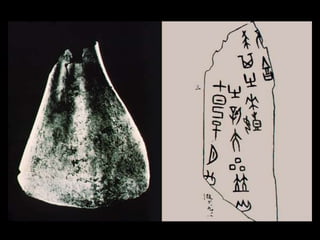
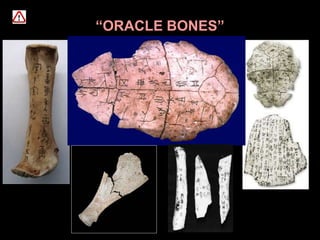
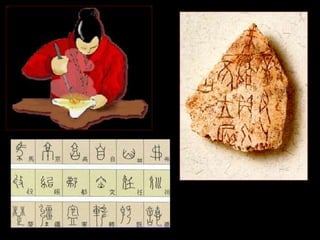
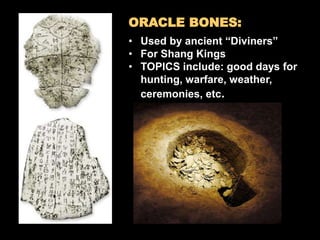
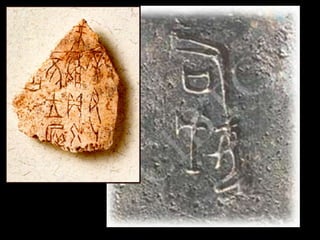
“ORACLE BONES”
ORACLE BONES:
• Used by ancient “Diviners”
• For Shang Kings
• TOPICS include: good days for
hunting, warfare, weather,
ceremonies, etc.
Bronze Inscriptions
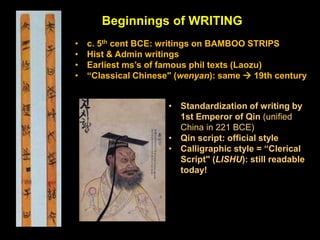
Beginnings of WRITING
• c. 5th cent BCE: writings on BAMBOO STRIPS
• Hist & Admin writings
• Earliest ms’s of famous phil texts (Laozu)
• “Classical Chinese" (wenyan): same  19th century
• Standardization of writing by
1st Emperor of Qin (unified
China in 221 BCE)
• Qin script: official style
• Calligraphic style = “Clerical
Script" (LISHU): still readable
today!
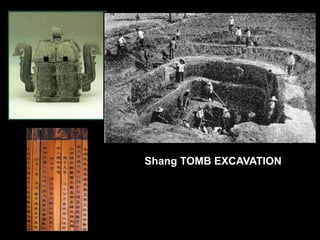
Shang TOMB EXCAVATION
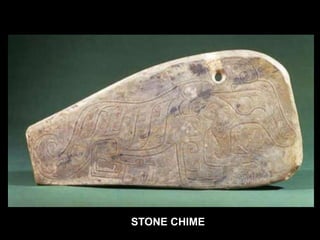
STONE CHIME
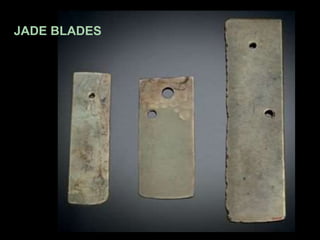
JADE BLADES
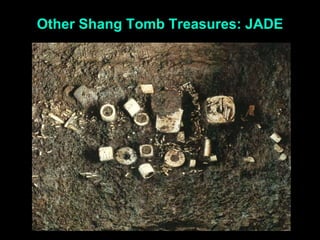
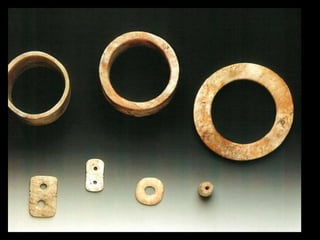
Other Shang Tomb Treasures: JADE
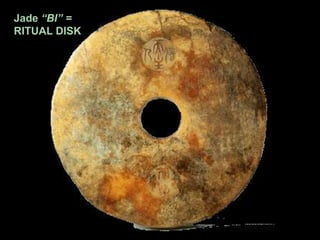
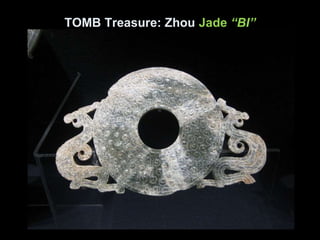
Jade “BI” =
RITUAL DISK
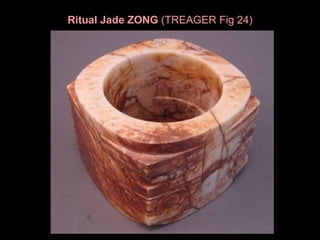
Ritual Jade ZONG (TREAGER Fig 24)
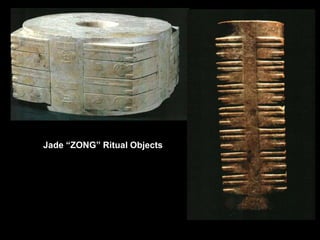
Jade “ZONG” Ritual Objects
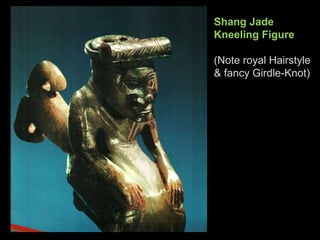
Shang Jade
Kneeling Figure
(Note royal Hairstyle
& fancy Girdle-Knot)
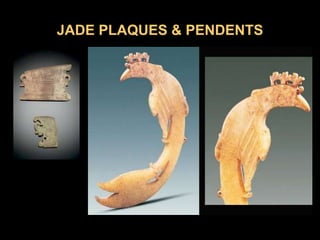
JADE PLAQUES & PENDENTS
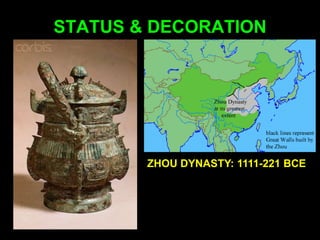
STATUS & DECORATION
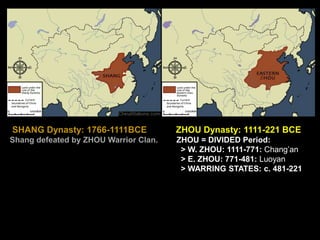
ZHOU DYNASTY: 1111-221 BCE
SHANG Dynasty: 1766-1111BCE ZHOU Dynasty: 1111-221 BCE
Shang defeated by ZHOU Warrior Clan. ZHOU = DIVIDED Period:
> W. ZHOU: 1111-771: Chang’an
> E. ZHOU: 771-481: Luoyan
> WARRING STATES: c. 481-221
Timeline of Chinese Dynasties and Other Key Events
ca. 2100-1600 BCE Xia (Hsia) Dynasty
ca. 1600-1050 BCE Shang Dynasty Capitals: near present-day Zhengzhou and Anyang
ca. 1046-256 BCE Zhou (Chou) Dynasty Capitals: Hao (near present-day Xi'an) and Luoyang
Western Zhou (ca. 1046-771 BCE)
Eastern Zhou (ca. 771-256 BCE)
Spring and Autumn Period (770-ca. 475 BCE)
Confucius (ca. 551-479 BCE)
Warring States Period (ca. 475-221 BCE)
221-206 BCE Qin (Ch'in) Dynasty Capital: Chang'an, present-day Xi'an
Qin Shihuangdi dies, 210 BCE
206 BCE-220 CE Han Dynasty
Western/Former Han (206 BCE-9 CE) Capital: Chang'an
Confucianism officially established as basis for Chinese state by Han Wudi (r. 141-86 BCE)
Eastern/Later Han (25-220 CE) Capital: Luoyang
220-589 CE Six Dynasties Period Period of disunity and instability following the fall of the Han
Buddhism introduced to China
Three Kingdoms (220-265 CE) Cao Wei, Shu Han, Dong Wu
Jin Dynasty (265-420 CE)
Period of the Northern and Southern Dynasties (386-589 CE)
581-618 CE Sui Dynasty Capital: Chang'an
618-906 CE Tang (T'ang) Dynasty Capitals: Chang'an and Luoyang
907-960 CE Five Dynasties Period
960-1279 Song (Sung) Dynasty
Northern Song (960-1127) Capital: Bianjing (present-day Kaifeng)
Southern Song (1127-1279) Capital: Lin'an (present-day Hangzhou)
1279-1368 Yuan Dynasty The reign of the Mongol empire; Capital: Dadu (present-day Beijing)
1368-1644 Ming Dynasty Re-establishment of rule by Han ruling house; Capitals: Nanjing and Beijing
1644-1912 Qing (Ch'ing) Dynasty Reign of the Manchus; Capital: Beijing
1912-1949 Republic Period Capitals: Beijing, Wuhan, and Nanjing
1949-present People's Republic of China Capital: Beijing
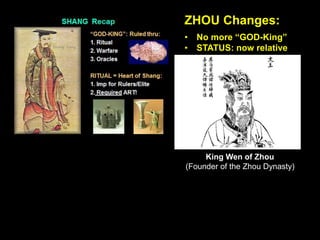
ZHOU Changes:
• No more “GOD-King”
• STATUS: now relative
King Wen of Zhou
(Founder of the Zhou Dynasty)
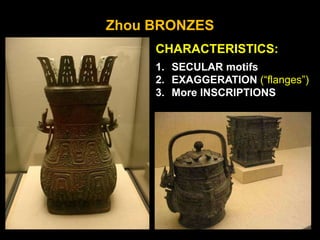
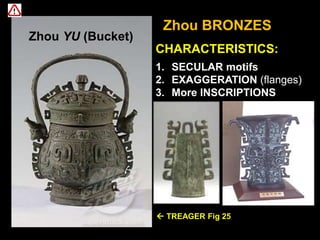
Zhou BRONZES
CHARACTERISTICS:
1. SECULAR motifs
2. EXAGGERATION (“flanges”)
3. More INSCRIPTIONS
Zhou BRONZES
CHARACTERISTICS:
1. SECULAR motifs
2. EXAGGERATION (flanges)
3. More INSCRIPTIONS
 TREAGER Fig 25
Zhou YU (Bucket)
Zhou YU (Bucket)
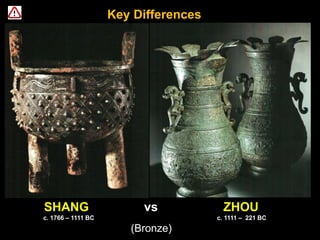
SHANG vs ZHOU
c. 1766 – 1111 BC c. 1111 – 221 BC
(Bronze)
Key Differences
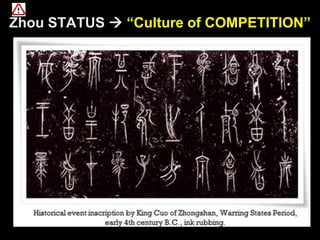
Zhou STATUS  “Culture of COMPETITION”
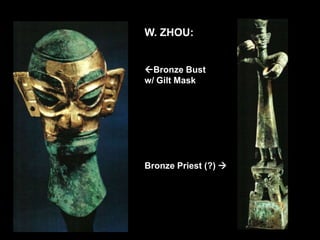
W. ZHOU:
Bronze Bust
w/ Gilt Mask
Bronze Priest (?) 
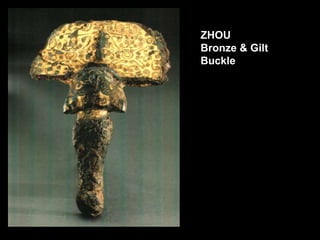
ZHOU
Bronze & Gilt
Buckle
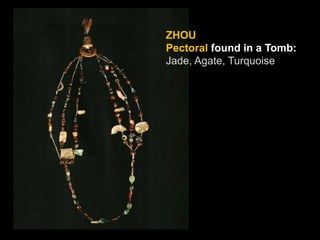
ZHOU
Pectoral found in a Tomb:
Jade, Agate, Turquoise
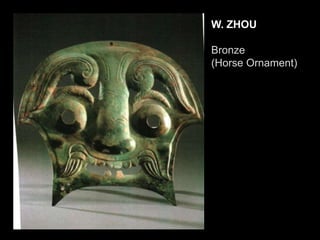
W. ZHOU
Bronze
(Horse Ornament)
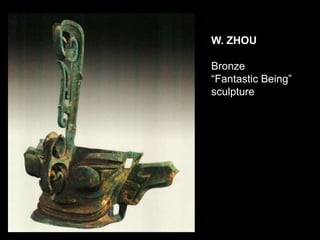
W. ZHOU
Bronze
“Fantastic Being”
sculpture
W. ZHOU
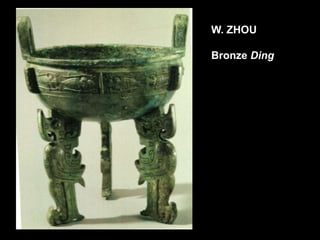
Bronze Ding
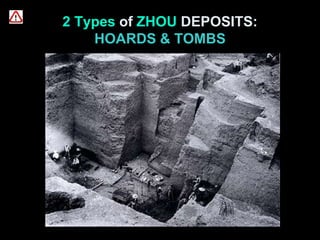
2 Types of ZHOU DEPOSITS:
HOARDS & TOMBS
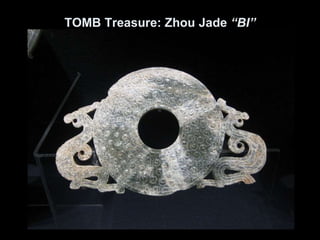
TOMB Treasure: Zhou Jade “BI”
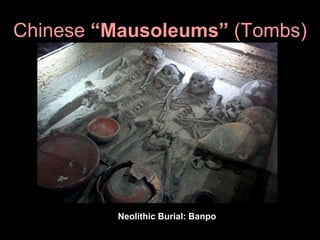
Chinese “Mausoleums” (Tombs)
Neolithic Burial: Banpo
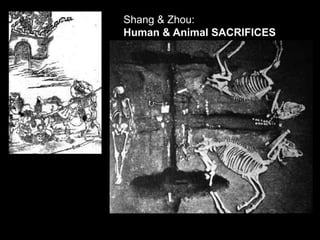
Shang & Zhou:
Human & Animal SACRIFICES
“Death approximates Life.”
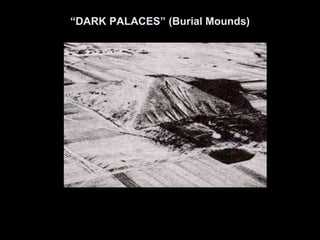
“DARK PALACES” (Burial Mounds)
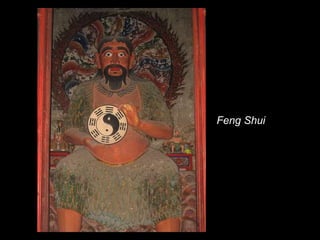
Feng Shui
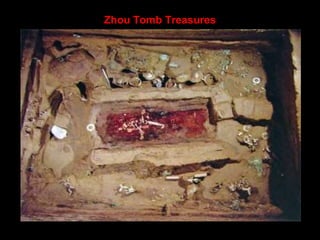
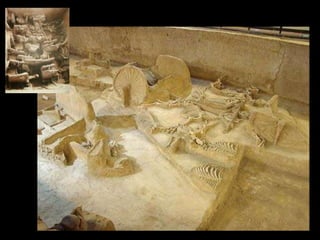
Zhou Tomb Treasures
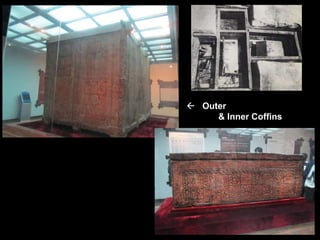
 Outer
& Inner Coffins
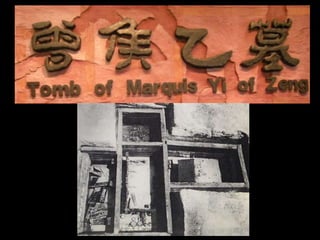
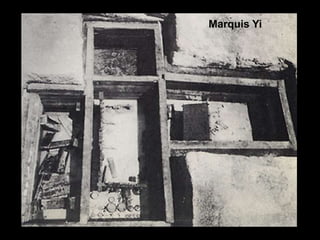
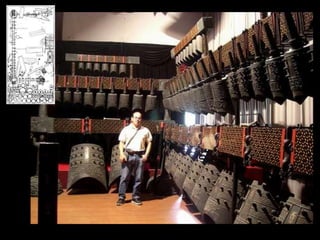
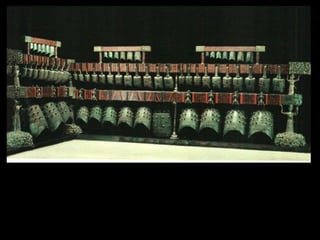
Marquis Yi
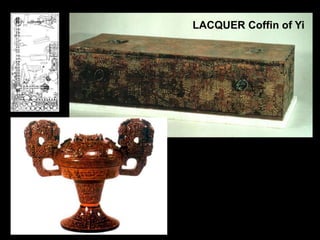
LACQUER Coffin of Yi
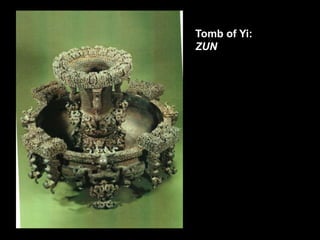
Tomb of Yi:
ZUN
TOMB Treasure: Zhou Jade “BI”
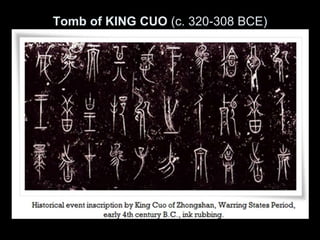
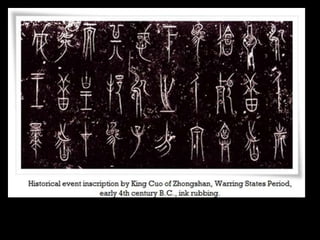
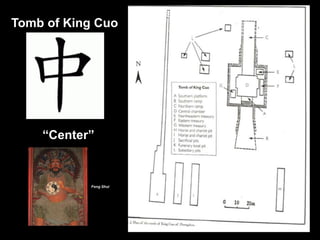
Tomb of KING CUO (c. 320-308 BCE)
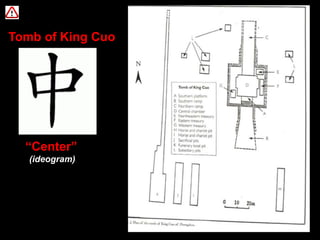
“Center”
(ideogram)
Tomb of King Cuo
“Center”
Tomb of King Cuo
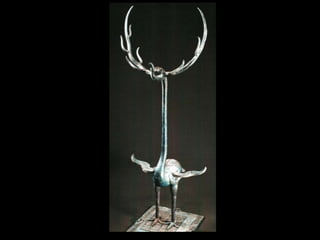
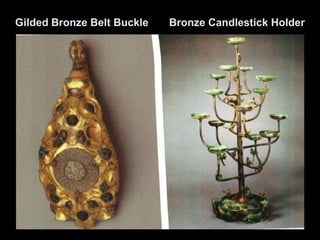
Gilded Bronze Belt Buckle Bronze Candlestick Holder
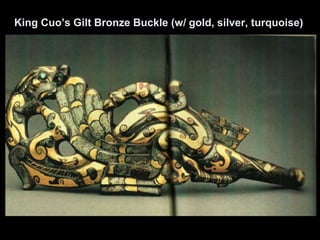
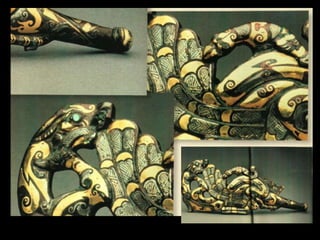
King Cuo’s Gilt Bronze Buckle (w/ gold, silver, turquoise)
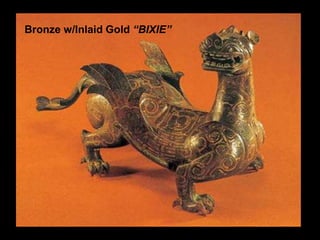
Bronze w/Inlaid Gold “BIXIE”
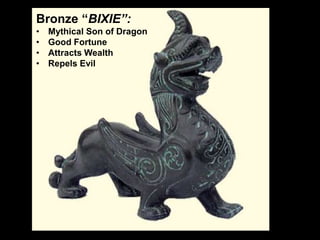
Bronze “BIXIE”:
• Mythical Son of Dragon
• Good Fortune
• Attracts Wealth
• Repels Evil
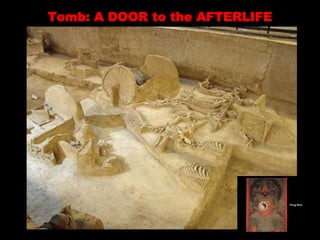
Tomb: A DOOR to the AFTERLIFE
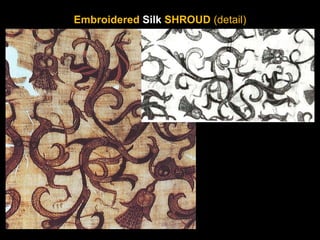
Embroidered Silk SHROUD (detail)
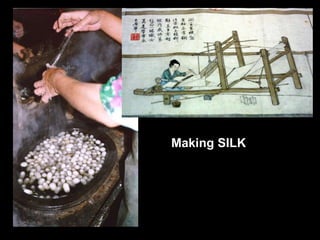
Making SILK
4. List the 2 TYPES of Zhou DEPOSITS:
a. ____________________
b. ____________________
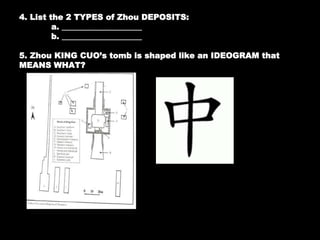
5. Zhou KING CUO’s tomb is shaped like an IDEOGRAM that
MEANS WHAT?
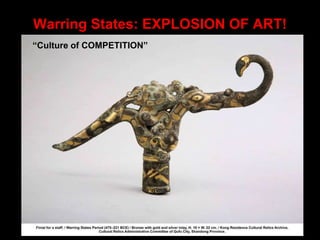
Warring States: EXPLOSION OF ART!
“Culture of COMPETITION”
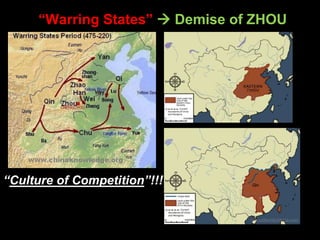
“Warring States”  Demise of ZHOU
“Culture of Competition”!!!
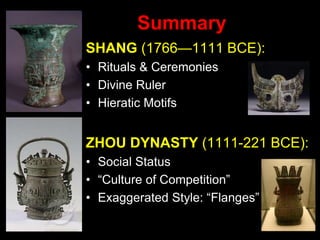
Summary
SHANG (1766—1111 BCE):
• Rituals & Ceremonies
• Divine Ruler
• Hieratic Motifs
ZHOU DYNASTY (1111-221 BCE):
• Social Status
• “Culture of Competition”
• Exaggerated Style: “Flanges”
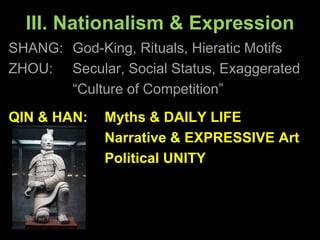
III. Nationalism & Expression
SHANG: God-King, Rituals, Hieratic Motifs
ZHOU: Secular, Social Status, Exaggerated
“Culture of Competition”
QIN & HAN: Myths & DAILY LIFE
Narrative & EXPRESSIVE Art
Political UNITY
Timeline of Chinese Dynasties and Other Key Events
ca. 2100-1600 BCE Xia (Hsia) Dynasty
ca. 1600-1050 BCE Shang Dynasty Capitals: near present-day Zhengzhou and Anyang
ca. 1046-256 BCE Zhou (Chou) Dynasty Capitals: Hao (near present-day Xi'an) and Luoyang
Western Zhou (ca. 1046-771 BCE)
Eastern Zhou (ca. 771-256 BCE) Spring and Autumn Period
(770-ca. 475 BCE)
Confucius (ca. 551-479 BCE)
Warring States Period (ca. 475-221 BCE)
221-206 BCE Qin (Ch'in) Dynasty Capital: Chang'an, present-day Xi'an
Qin Shihuangdi dies, 210 BCE
206 BCE-220 CE Han Dynasty
Western/Former Han (206 BCE-9 CE) Capital: Chang'an
Confucianism officially established as basis for Chinese state by Han Wudi (r. 141-86 BCE)
Eastern/Later Han (25-220 CE) Capital: Luoyang
220-589 CE Six Dynasties Period Period of disunity and instability following the fall of the Han
Buddhism introduced to China
Three Kingdoms (220-265 CE) Cao Wei, Shu Han, Dong Wu
Jin Dynasty (265-420 CE)
Period of the Northern and Southern Dynasties (386-589 CE)
581-618 CE Sui Dynasty Capital: Chang'an
618-906 CE Tang (T'ang) Dynasty Capitals: Chang'an and Luoyang
907-960 CE Five Dynasties Period
960-1279 Song (Sung) Dynasty
Northern Song (960-1127) Capital: Bianjing (present-day Kaifeng)
Southern Song (1127-1279) Capital: Lin'an (present-day Hangzhou)
1279-1368 Yuan Dynasty The reign of the Mongol empire; Capital: Dadu (present-day Beijing)
1368-1644 Ming Dynasty Re-establishment of rule by Han ruling house; Capitals: Nanjing and Beijing
1644-1912 Qing (Ch'ing) Dynasty Reign of the Manchus; Capital: Beijing
1912-1949 Republic Period Capitals: Beijing, Wuhan, and Nanjing
1949-present People's Republic of China Capital: Beijing
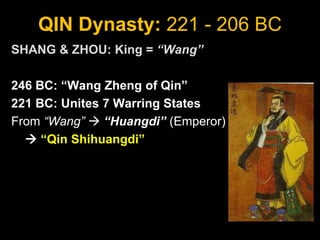
QIN Dynasty: 221 - 206 BC
SHANG & ZHOU: King = “Wang”
246 BC: “Wang Zheng of Qin”
221 BC: Unites 7 Warring States
From “Wang”  “Huangdi” (Emperor)
 “Qin Shihuangdi”
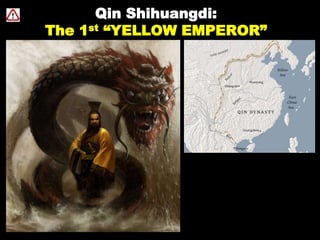
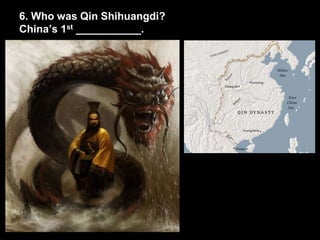
Qin Shihuangdi:
The 1st “YELLOW EMPEROR”
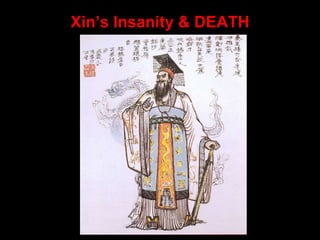
Xin’s Insanity & DEATH
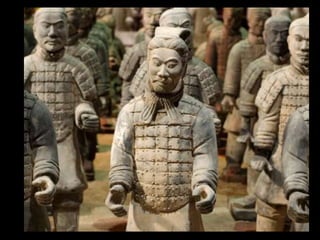
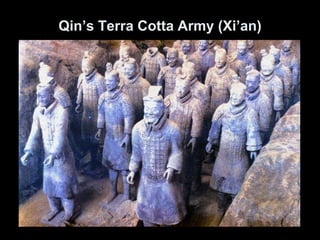
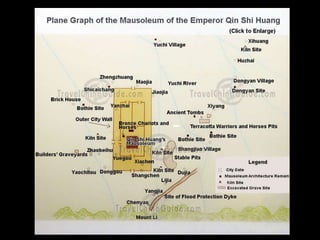
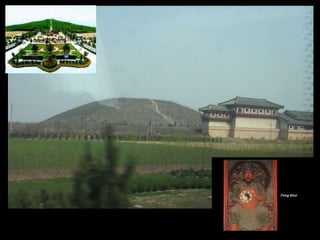
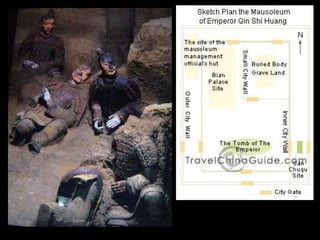
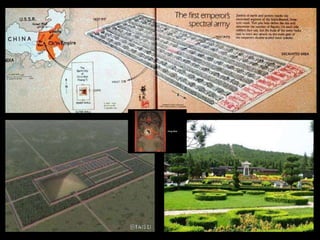
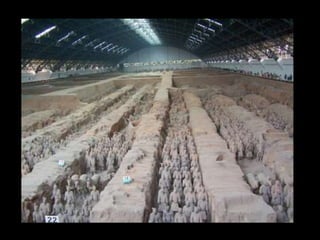
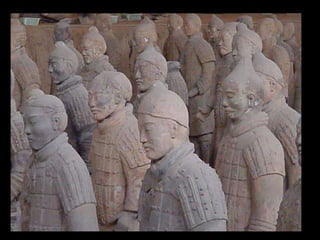
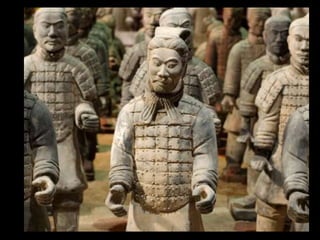
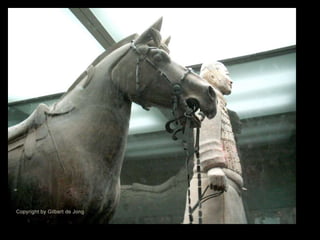
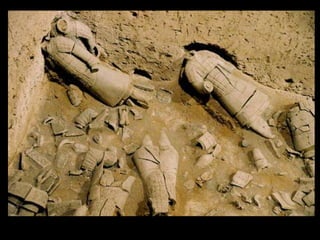
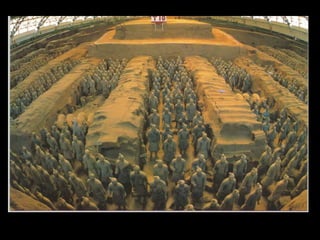
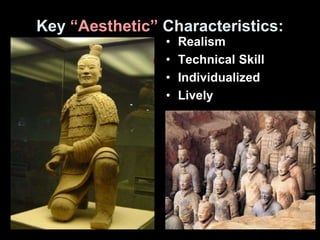
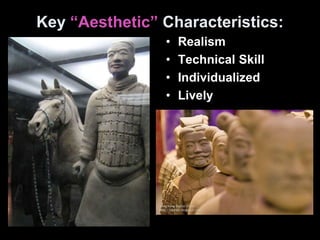
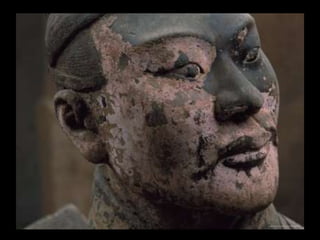
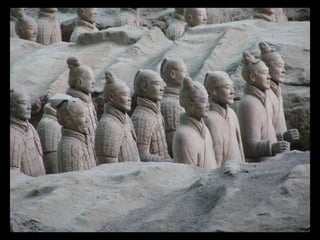
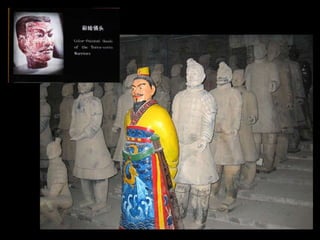
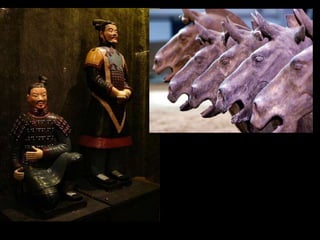
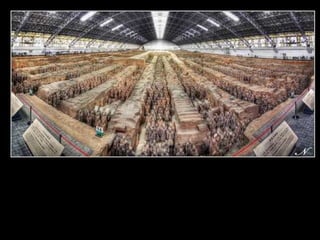
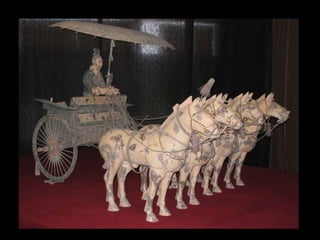
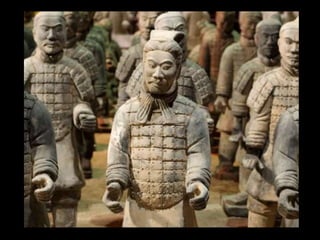
Qin’s Terra Cotta Army (Xi’an)
“Death approximates Life.”
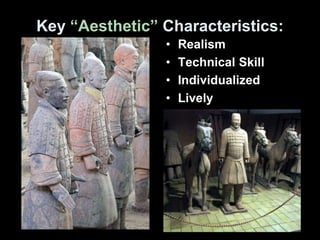
Key “Aesthetic” Characteristics:
• Realism
• Technical Skill
• Individualized
• Lively
Key “Aesthetic” Characteristics:
• Realism
• Technical Skill
• Individualized
• Lively
Key “Aesthetic” Characteristics:
• Realism
• Technical Skill
• Individualized
• Lively
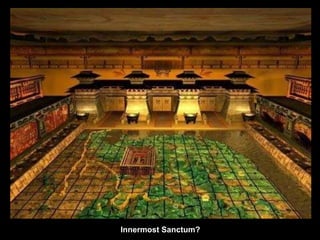
Innermost Sanctum?
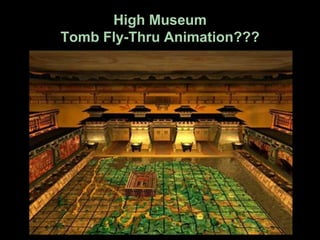
High Museum
Tomb Fly-Thru Animation???
6. Who was Qin Shihuangdi?
China’s 1st ___________.
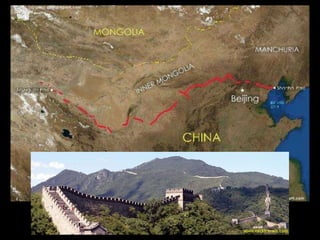
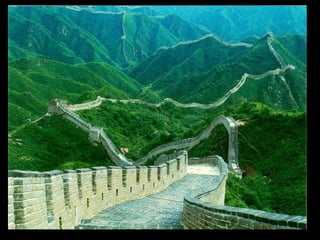
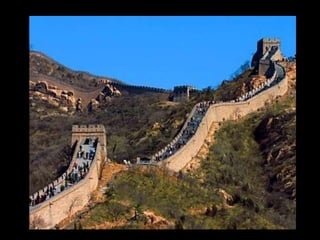
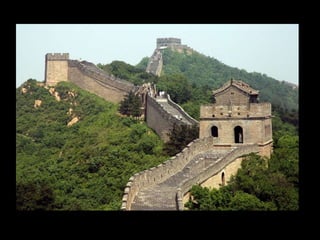
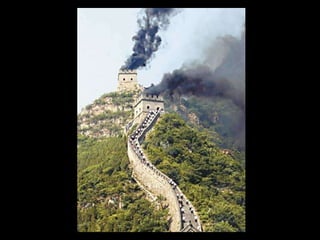
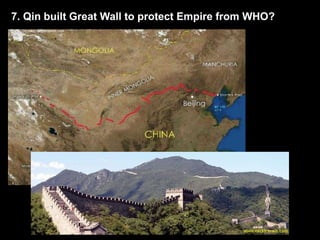
7. Qin built Great Wall to protect Empire from WHO?
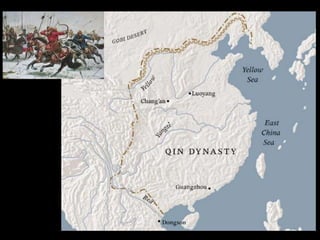
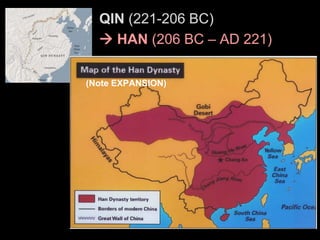
(Note EXPANSION)
QIN (221-206 BC)
 HAN (206 BC – AD 221)
Timeline of Chinese Dynasties and Other Key Events
ca. 2100-1600 BCE Xia (Hsia) Dynasty
ca. 1600-1050 BCE Shang Dynasty Capitals: near present-day Zhengzhou and Anyang
ca. 1046-256 BCE Zhou (Chou) Dynasty Capitals: Hao (near present-day Xi'an) and Luoyang
Western Zhou (ca. 1046-771 BCE)
Eastern Zhou (ca. 771-256 BCE)
Spring and Autumn Period (770-ca. 475 BCE)
Confucius (ca. 551-479 BCE)
Warring States Period (ca. 475-221 BCE)
221-206 BCE Qin (Ch'in) Dynasty Capital: Chang'an, present-day Xi'an
Qin Shihuangdi dies, 210 BCE
206 BCE-220 CE Han Dynasty
Western/Former Han (206 BCE-9 CE) Capital: Chang'an
Confucianism officially established as basis for Chinese state by Han Wudi (r. 141-86 BCE)
Eastern/Later Han (25-220 CE) Capital: Luoyang
220-589 CE Six Dynasties Period Period of disunity and instability following the fall of the Han
Buddhism introduced to China
Three Kingdoms (220-265 CE) Cao Wei, Shu Han, Dong Wu
Jin Dynasty (265-420 CE)
Period of the Northern and Southern Dynasties (386-589 CE)
581-618 CE Sui Dynasty Capital: Chang'an
618-906 CE Tang (T'ang) Dynasty Capitals: Chang'an and Luoyang
907-960 CE Five Dynasties Period
960-1279 Song (Sung) Dynasty
Northern Song (960-1127) Capital: Bianjing (present-day Kaifeng)
Southern Song (1127-1279) Capital: Lin'an (present-day Hangzhou)
1279-1368 Yuan Dynasty The reign of the Mongol empire; Capital: Dadu (present-day Beijing)
1368-1644 Ming Dynasty Re-establishment of rule by Han ruling house; Capitals: Nanjing and Beijing
1644-1912 Qing (Ch'ing) Dynasty Reign of the Manchus; Capital: Beijing
1912-1949 Republic Period Capitals: Beijing, Wuhan, and Nanjing
1949-present People's Republic of China Capital: Beijing
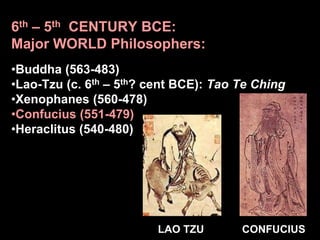
6th – 5th CENTURY BCE:
Major WORLD Philosophers:
•Buddha (563-483)
•Lao-Tzu (c. 6th – 5th? cent BCE): Tao Te Ching
•Xenophanes (560-478)
•Confucius (551-479)
•Heraclitus (540-480)
LAO TZU CONFUCIUS
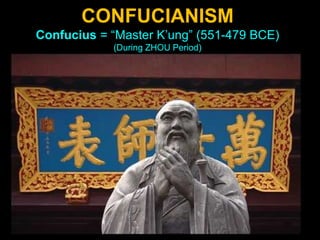
CONFUCIANISM
Confucius = “Master K’ung” (551-479 BCE)
(During ZHOU Period)
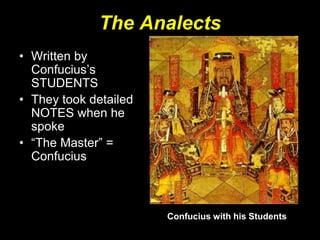
The Analects
• Written by
Confucius’s
STUDENTS
• They took detailed
NOTES when he
spoke
• “The Master” =
Confucius
Confucius with his Students
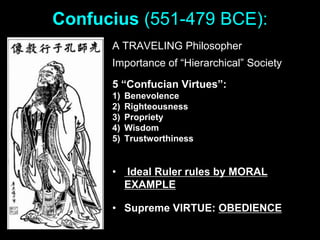
Confucius (551-479 BCE):
A TRAVELING Philosopher
Importance of “Hierarchical” Society
5 “Confucian Virtues”:
1) Benevolence
2) Righteousness
3) Propriety
4) Wisdom
5) Trustworthiness
• Ideal Ruler rules by MORAL
EXAMPLE
• Supreme VIRTUE: OBEDIENCE
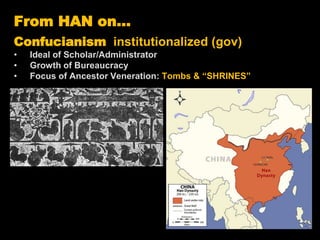
From HAN on…
Confucianism institutionalized (gov)
• Ideal of Scholar/Administrator
• Growth of Bureaucracy
• Focus of Ancestor Veneration: Tombs & “SHRINES”
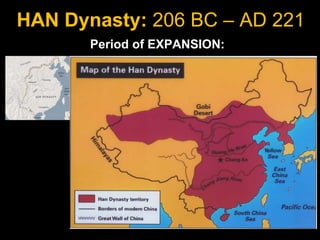
HAN Dynasty: 206 BC – AD 221
Period of EXPANSION:
Timeline of Chinese Dynasties and Other Key Events
ca. 2100-1600 BCE Xia (Hsia) Dynasty
ca. 1600-1050 BCE Shang Dynasty Capitals: near present-day Zhengzhou and Anyang
ca. 1046-256 BCE Zhou (Chou) Dynasty Capitals: Hao (near present-day Xi'an) and Luoyang
Western Zhou (ca. 1046-771 BCE)
Eastern Zhou (ca. 771-256 BCE) Spring and Autumn Period
(770-ca. 475 BCE)
Confucius (ca. 551-479 BCE)
Warring States Period (ca. 475-221 BCE)
221-206 BCE Qin (Ch'in) Dynasty Capital: Chang'an, present-day Xi'an
Qin Shihuangdi dies, 210 BCE
206 BCE-220 CE Han Dynasty
Western/Former Han (206 BCE-9 CE) Capital: Chang'an
Confucianism officially established as basis for Chinese state by Han Wudi (r. 141-86 BCE)
Eastern/Later Han (25-220 CE) Capital: Luoyang
220-589 CE Six Dynasties Period Period of disunity and instability following the fall of the Han
Buddhism introduced to China
Three Kingdoms (220-265 CE) Cao Wei, Shu Han, Dong Wu
Jin Dynasty (265-420 CE)
Period of the Northern and Southern Dynasties (386-589 CE)
581-618 CE Sui Dynasty Capital: Chang'an
618-906 CE Tang (T'ang) Dynasty Capitals: Chang'an and Luoyang
907-960 CE Five Dynasties Period
960-1279 Song (Sung) Dynasty
Northern Song (960-1127) Capital: Bianjing (present-day Kaifeng)
Southern Song (1127-1279) Capital: Lin'an (present-day Hangzhou)
1279-1368 Yuan Dynasty The reign of the Mongol empire; Capital: Dadu (present-day Beijing)
1368-1644 Ming Dynasty Re-establishment of rule by Han ruling house; Capitals: Nanjing and Beijing
1644-1912 Qing (Ch'ing) Dynasty Reign of the Manchus; Capital: Beijing
1912-1949 Republic Period Capitals: Beijing, Wuhan, and Nanjing
1949-present People's Republic of China Capital: Beijing
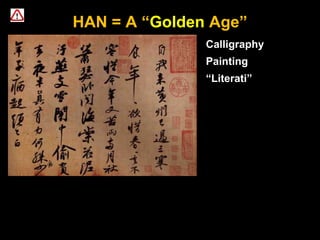
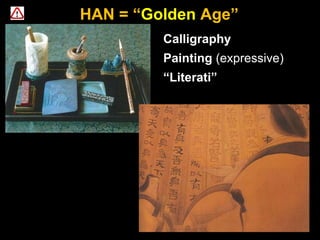
HAN = A “Golden Age”
Calligraphy
Painting
“Literati”
Calligraphy
Painting (expressive)
“Literati”
HAN = “Golden Age”
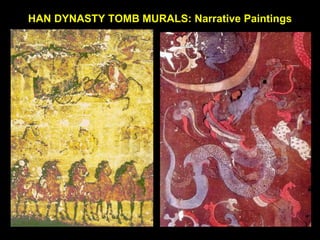
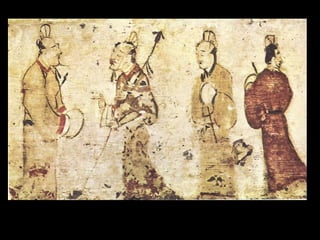
HAN DYNASTY TOMB MURALS: Narrative Paintings
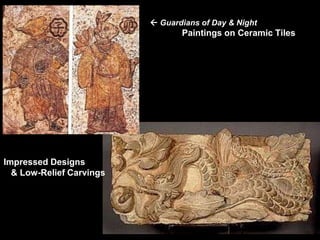
 Guardians of Day & Night
Paintings on Ceramic Tiles
Impressed Designs
& Low-Relief Carvings
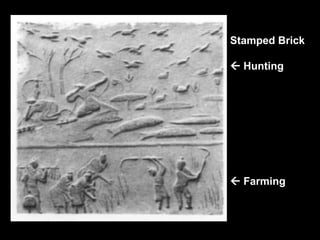
Stamped Brick
 Hunting
 Farming
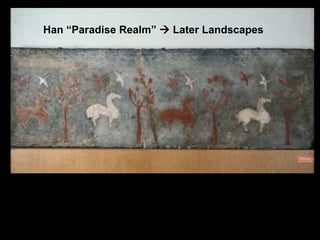
Han “Paradise Realm”  Later Landscapes
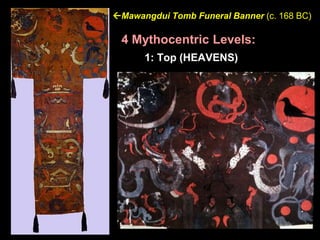
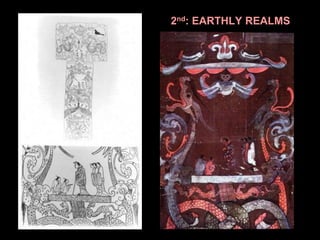
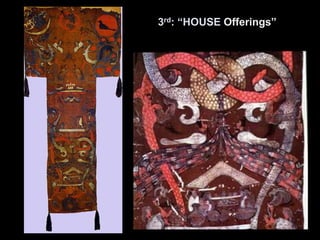
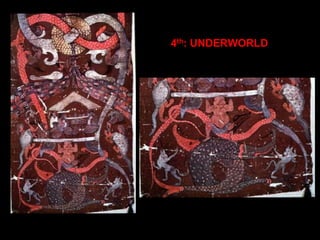
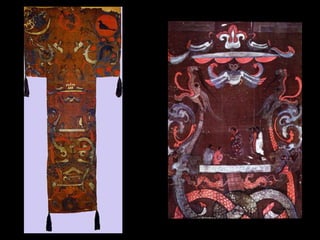
Mawangdui Tomb Funeral Banner (c. 168 BC)
4 Mythocentric Levels:
1: Top (HEAVENS)
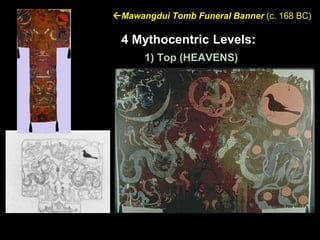
Mawangdui Tomb Funeral Banner (c. 168 BC)
4 Mythocentric Levels:
1) Top (HEAVENS)
2nd: EARTHLY REALMS
3rd: “HOUSE Offerings”
4th: UNDERWORLD
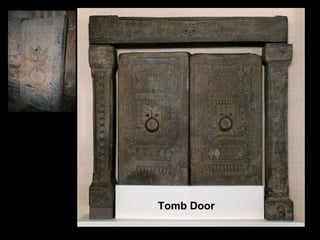
Tomb Door
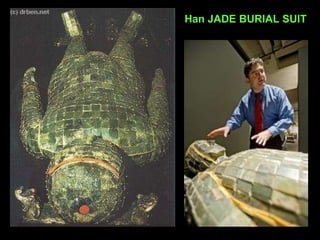
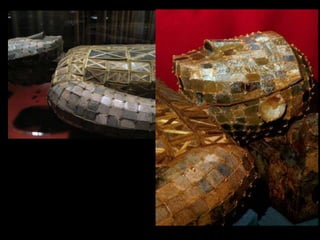
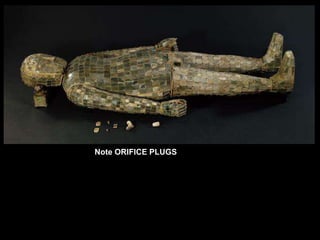
Han JADE BURIAL SUIT
Note ORIFICE PLUGS
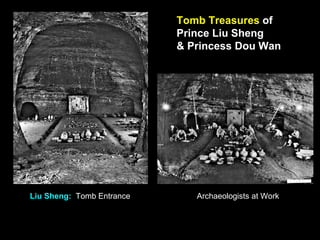
Tomb Treasures of
Prince Liu Sheng
& Princess Dou Wan
Liu Sheng: Tomb Entrance Archaeologists at Work
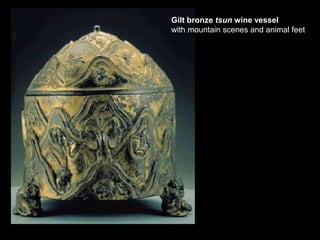
Gilt bronze tsun wine vessel
with mountain scenes and animal feet
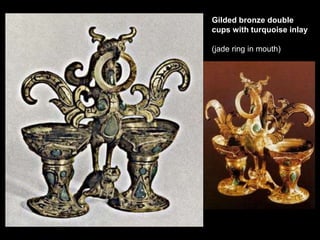
Gilded bronze double
cups with turquoise inlay
(jade ring in mouth)
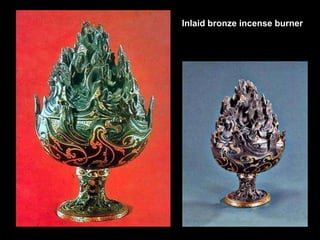
Inlaid bronze incense burner
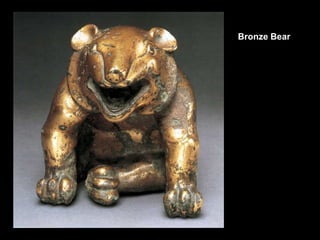
Bronze Bear
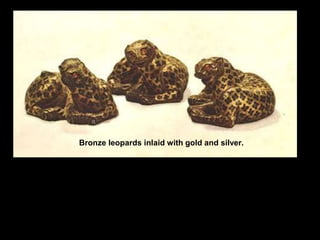
Bronze leopards inlaid with gold and silver.
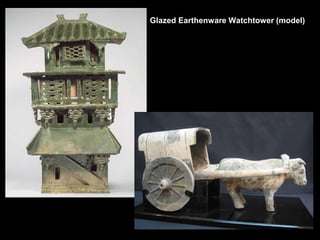
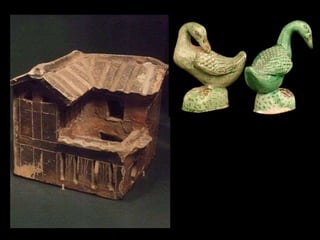
Glazed Earthenware Watchtower (model)
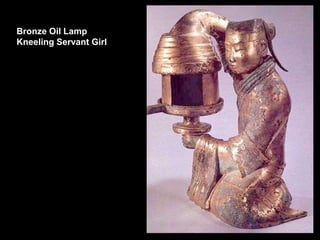
Bronze Oil Lamp
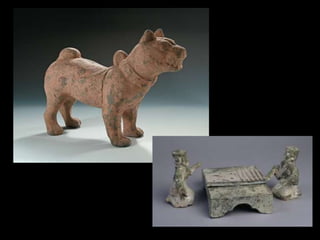
Kneeling Servant Girl
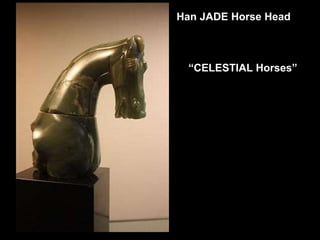
Han JADE Horse Head
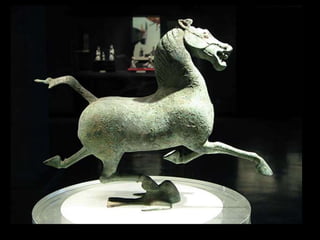
“CELESTIAL Horses”
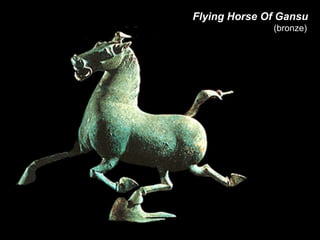
Flying Horse Of Gansu
(bronze)
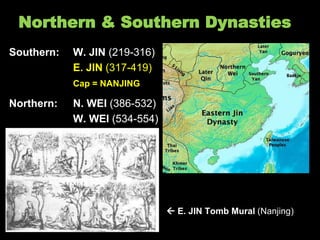
Southern: W. JIN (219-316)
E. JIN (317-419)
Cap = NANJING
Northern: N. WEI (386-532)
W. WEI (534-554)
Northern & Southern Dynasties
 E. JIN Tomb Mural (Nanjing)
Timeline of Chinese Dynasties and Other Key Events
ca. 2100-1600 BCE Xia (Hsia) Dynasty
ca. 1600-1050 BCE Shang Dynasty Capitals: near present-day Zhengzhou and Anyang
ca. 1046-256 BCE Zhou (Chou) Dynasty Capitals: Hao (near present-day Xi'an) and Luoyang
Western Zhou (ca. 1046-771 BCE)
Eastern Zhou (ca. 771-256 BCE) Spring and Autumn Period
(770-ca. 475 BCE)
Confucius (ca. 551-479 BCE)
Warring States Period (ca. 475-221 BCE)
221-206 BCE Qin (Ch'in) Dynasty Capital: Chang'an, present-day Xi'an
Qin Shihuangdi dies, 210 BCE
206 BCE-220 CE Han Dynasty
Western/Former Han (206 BCE-9 CE) Capital: Chang'an
Confucianism officially established as basis for Chinese state by Han Wudi (r. 141-86 BCE)
Eastern/Later Han (25-220 CE) Capital: Luoyang
220-589 CE Six Dynasties Period Period of disunity and instability following the fall of the Han
Buddhism introduced to China
Three Kingdoms (220-265 CE) Cao Wei, Shu Han, Dong Wu
Jin Dynasty (265-420 CE)
Period of the Northern and Southern Dynasties (386-589 CE)
581-618 CE Sui Dynasty Capital: Chang'an
618-906 CE Tang (T'ang) Dynasty Capitals: Chang'an and Luoyang
907-960 CE Five Dynasties Period
960-1279 Song (Sung) Dynasty
Northern Song (960-1127) Capital: Bianjing (present-day Kaifeng)
Southern Song (1127-1279) Capital: Lin'an (present-day Hangzhou)
1279-1368 Yuan Dynasty The reign of the Mongol empire; Capital: Dadu (present-day Beijing)
1368-1644 Ming Dynasty Re-establishment of rule by Han ruling house; Capitals: Nanjing and Beijing
1644-1912 Qing (Ch'ing) Dynasty Reign of the Manchus; Capital: Beijing
1912-1949 Republic Period Capitals: Beijing, Wuhan, and Nanjing
1949-present People's Republic of China Capital: Beijing
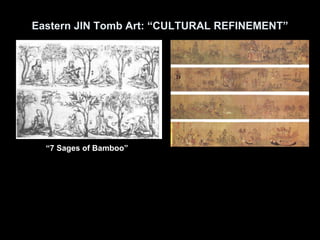
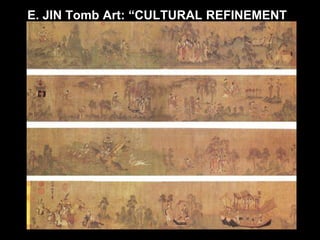
Eastern JIN Tomb Art: “CULTURAL REFINEMENT”
“7 Sages of Bamboo”
E. JIN Tomb Art: “CULTURAL REFINEMENT”
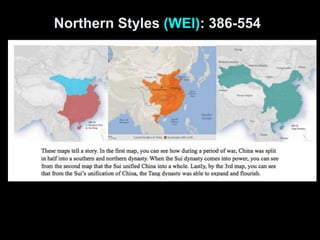
Northern Styles (WEI): 386-554
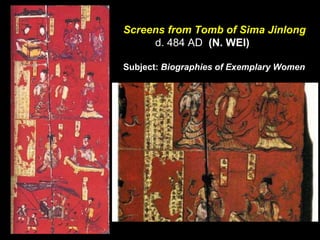
Screens from Tomb of Sima Jinlong
d. 484 AD (N. WEI)
Subject: Biographies of Exemplary Women
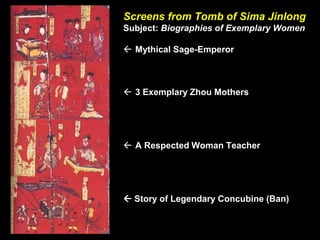
Screens from Tomb of Sima Jinlong
Subject: Biographies of Exemplary Women
 Mythical Sage-Emperor
 3 Exemplary Zhou Mothers
 A Respected Woman Teacher
 Story of Legendary Concubine (Ban)
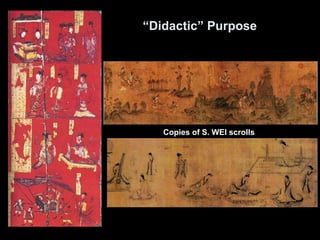
“Didactic” Purpose
Copies of S. WEI scrolls
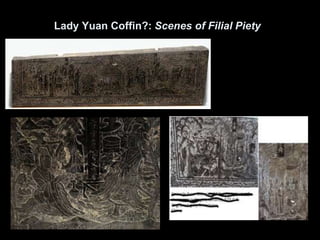
Lady Yuan Coffin?: Scenes of Filial Piety
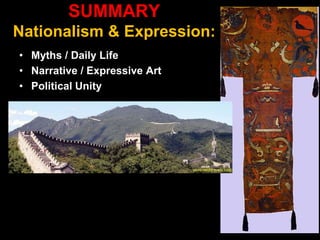
SUMMARY
Nationalism & Expression:
• Myths / Daily Life
• Narrative / Expressive Art
• Political Unity
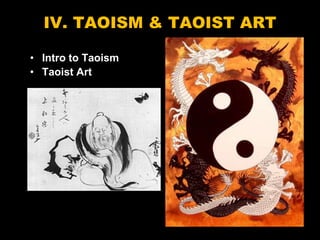
IV. TAOISM & TAOIST ART
• Intro to Taoism
• Taoist Art
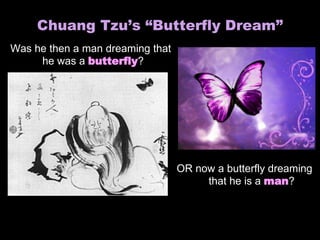
Chuang Tzu’s “Butterfly Dream”
Was he then a man dreaming that
he was a butterfly?
OR now a butterfly dreaming
that he is a man?
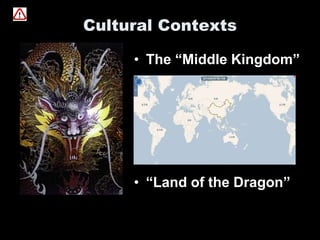
Cultural Contexts
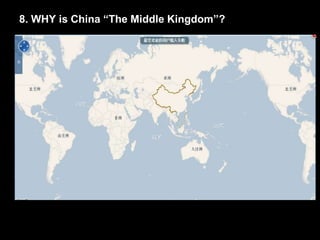
• The “Middle Kingdom”
• “Land of the Dragon”
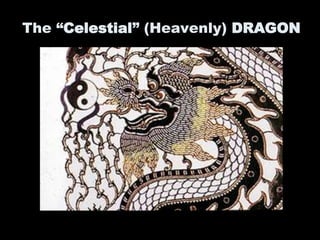
The “Celestial” (Heavenly) DRAGON
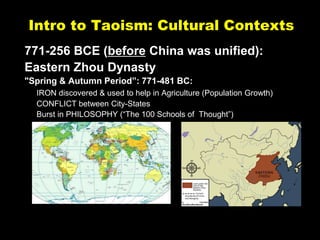
Intro to Taoism: Cultural Contexts
771-256 BCE (before China was unified):
Eastern Zhou Dynasty
"Spring & Autumn Period”: 771-481 BC:
IRON discovered & used to help in Agriculture (Population Growth)
CONFLICT between City-States
Burst in PHILOSOPHY (“The 100 Schools of Thought”)
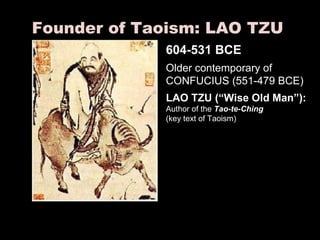
Founder of Taoism: LAO TZU
604-531 BCE
Older contemporary of
CONFUCIUS (551-479 BCE)
LAO TZU (“Wise Old Man”):
Author of the Tao-te-Ching
(key text of Taoism)
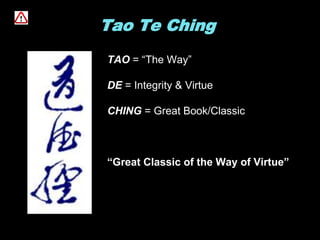
Tao Te Ching
TAO = “The Way”
DE = Integrity & Virtue
CHING = Great Book/Classic
“Great Classic of the Way of Virtue”
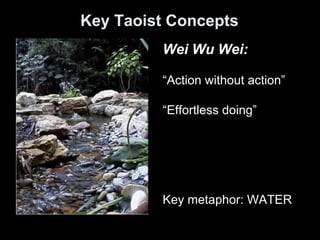
Key Taoist Concepts
Wei Wu Wei:
“Action without action”
“Effortless doing”
Key metaphor: WATER
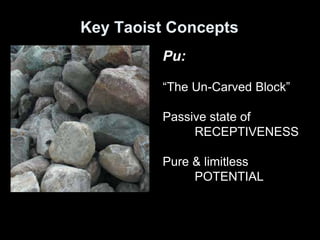
Key Taoist Concepts
Pu:
“The Un-Carved Block”
Passive state of
RECEPTIVENESS
Pure & limitless
POTENTIAL
Key Taoist Concepts
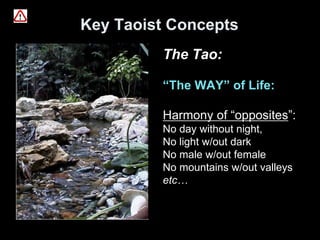
The Tao:
“The WAY” of Life:
Harmony of “opposites”:
No day without night,
No light w/out dark
No male w/out female
No mountains w/out valleys
etc…
Key Taoist Concepts
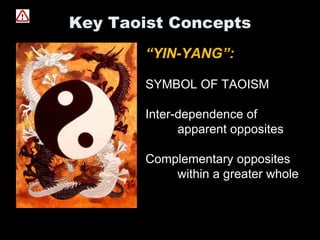
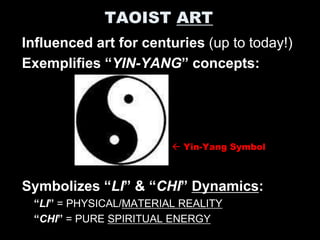
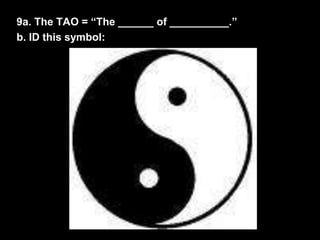
“YIN-YANG”:
SYMBOL OF TAOISM
Inter-dependence of
apparent opposites
Complementary opposites
within a greater whole
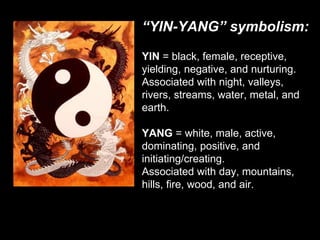
“YIN-YANG” symbolism:
YIN = black, female, receptive,
yielding, negative, and nurturing.
Associated with night, valleys,
rivers, streams, water, metal, and
earth.
YANG = white, male, active,
dominating, positive, and
initiating/creating.
Associated with day, mountains,
hills, fire, wood, and air.
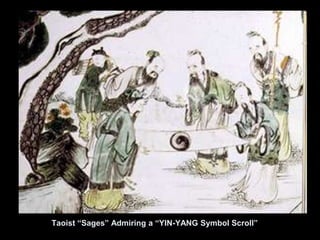
Taoist “Sages” Admiring a “YIN-YANG Symbol Scroll”
Key Taoist Concepts
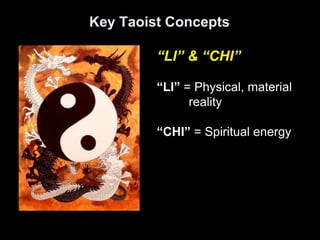
“LI” & “CHI”
“LI” = Physical, material
reality
“CHI” = Spiritual energy
TAOIST ART
Influenced art for centuries (up to today!)
Exemplifies “YIN-YANG” concepts:
 Yin-Yang Symbol
Symbolizes “LI” & “CHI” Dynamics:
“LI” = PHYSICAL/MATERIAL REALITY
“CHI” = PURE SPIRITUAL ENERGY
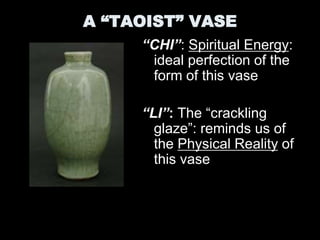
A “TAOIST” VASE
“CHI”: Spiritual Energy:
ideal perfection of the
form of this vase
“LI”: The “crackling
glaze”: reminds us of
the Physical Reality of
this vase
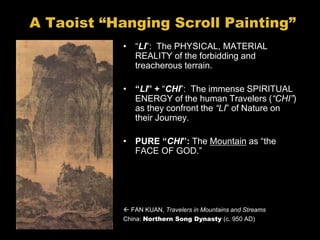
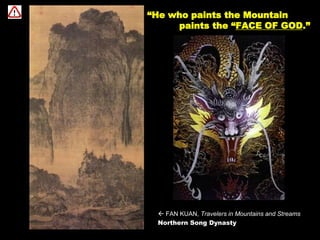
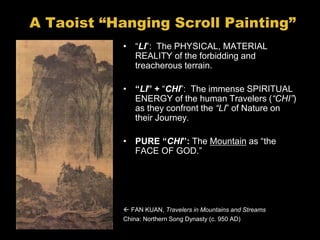
A Taoist “Hanging Scroll Painting”
• “LI”: The PHYSICAL, MATERIAL
REALITY of the forbidding and
treacherous terrain.
• “LI” + “CHI”: The immense SPIRITUAL
ENERGY of the human Travelers (“CHI”)
as they confront the “LI” of Nature on
their Journey.
• PURE “CHI”: The Mountain as “the
FACE OF GOD.”
 FAN KUAN, Travelers in Mountains and Streams
China: Northern Song Dynasty (c. 950 AD)
 FAN KUAN, Travelers in Mountains and Streams
Northern Song Dynasty
“He who paints the Mountain
paints the “FACE OF GOD.”
A Taoist “Hanging Scroll Painting”
• “LI”: The PHYSICAL, MATERIAL
REALITY of the forbidding and
treacherous terrain.
• “LI” + “CHI”: The immense SPIRITUAL
ENERGY of the human Travelers (“CHI”)
as they confront the “LI” of Nature on
their Journey.
• PURE “CHI”: The Mountain as “the
FACE OF GOD.”
 FAN KUAN, Travelers in Mountains and Streams
China: Northern Song Dynasty (c. 950 AD)
Timeline of Chinese Dynasties and Other Key Events
ca. 2100-1600 BCE Xia (Hsia) Dynasty
ca. 1600-1050 BCE Shang Dynasty Capitals: near present-day Zhengzhou and Anyang
ca. 1046-256 BCE Zhou (Chou) Dynasty Capitals: Hao (near present-day Xi'an) and Luoyang
Western Zhou (ca. 1046-771 BCE)
Eastern Zhou (ca. 771-256 BCE)
Spring and Autumn Period (770-ca. 475 BCE)
Confucius (ca. 551-479 BCE)
Warring States Period (ca. 475-221 BCE)
221-206 BCE Qin (Ch'in) Dynasty Capital: Chang'an, present-day Xi'an
Qin Shihuangdi dies, 210 BCE
206 BCE-220 CE Han Dynasty
Western/Former Han (206 BCE-9 CE) Capital: Chang'an
Confucianism officially established as basis for Chinese state by Han Wudi (r. 141-86 BCE)
Eastern/Later Han (25-220 CE) Capital: Luoyang
220-589 CE Six Dynasties Period Period of disunity and instability following the fall of the Han
Buddhism introduced to China
Three Kingdoms (220-265 CE) Cao Wei, Shu Han, Dong Wu
Jin Dynasty (265-420 CE)
Period of the Northern and Southern Dynasties (386-589 CE)
581-618 CE Sui Dynasty Capital: Chang'an
618-906 CE Tang (T'ang) Dynasty Capitals: Chang'an and Luoyang
907-960 CE Five Dynasties Period
960-1279 Song (Sung) Dynasty
Northern Song (960-1127) Capital: Bianjing (present-day Kaifeng)
Southern Song (1127-1279) Capital: Lin'an (present-day Hangzhou)
1279-1368 Yuan Dynasty The reign of the Mongol empire; Capital: Dadu (present-day Beijing)
1368-1644 Ming Dynasty Re-establishment of rule by Han ruling house; Capitals: Nanjing and Beijing
1644-1912 Qing (Ch'ing) Dynasty Reign of the Manchus; Capital: Beijing
1912-1949 Republic Period Capitals: Beijing, Wuhan, and Nanjing
1949-present People's Republic of China Capital: Beijing
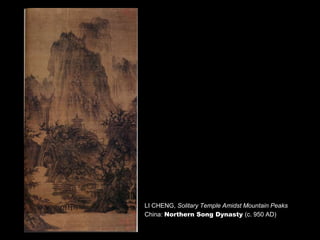
LI CHENG, Solitary Temple Amidst Mountain Peaks
China: Northern Song Dynasty (c. 950 AD)
8. WHY is China “The Middle Kingdom”?
9a. The TAO = “The ______ of __________.”
b. ID this symbol:
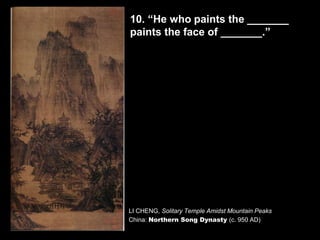
LI CHENG, Solitary Temple Amidst Mountain Peaks
China: Northern Song Dynasty (c. 950 AD)
10. “He who paints the _______
paints the face of _______.”
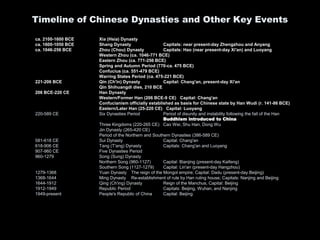
Timeline of Chinese Dynasties and Other Key Events
ca. 2100-1600 BCE Xia (Hsia) Dynasty
ca. 1600-1050 BCE Shang Dynasty Capitals: near present-day Zhengzhou and Anyang
ca. 1046-256 BCE Zhou (Chou) Dynasty Capitals: Hao (near present-day Xi'an) and Luoyang
Western Zhou (ca. 1046-771 BCE)
Eastern Zhou (ca. 771-256 BCE)
Spring and Autumn Period (770-ca. 475 BCE)
Confucius (ca. 551-479 BCE)
Warring States Period (ca. 475-221 BCE)
221-206 BCE Qin (Ch'in) Dynasty Capital: Chang'an, present-day Xi'an
Qin Shihuangdi dies, 210 BCE
206 BCE-220 CE Han Dynasty
Western/Former Han (206 BCE-9 CE) Capital: Chang'an
Confucianism officially established as basis for Chinese state by Han Wudi (r. 141-86 BCE)
Eastern/Later Han (25-220 CE) Capital: Luoyang
220-589 CE Six Dynasties Period Period of disunity and instability following the fall of the Han
Buddhism introduced to China
Three Kingdoms (220-265 CE) Cao Wei, Shu Han, Dong Wu
Jin Dynasty (265-420 CE)
Period of the Northern and Southern Dynasties (386-589 CE)
581-618 CE Sui Dynasty Capital: Chang'an
618-906 CE Tang (T'ang) Dynasty Capitals: Chang'an and Luoyang
907-960 CE Five Dynasties Period
960-1279 Song (Sung) Dynasty
Northern Song (960-1127) Capital: Bianjing (present-day Kaifeng)
Southern Song (1127-1279) Capital: Lin'an (present-day Hangzhou)
1279-1368 Yuan Dynasty The reign of the Mongol empire; Capital: Dadu (present-day Beijing)
1368-1644 Ming Dynasty Re-establishment of rule by Han ruling house; Capitals: Nanjing and Beijing
1644-1912 Qing (Ch'ing) Dynasty Reign of the Manchus; Capital: Beijing
1912-1949 Republic Period Capitals: Beijing, Wuhan, and Nanjing
1949-present People's Republic of China Capital: Beijing
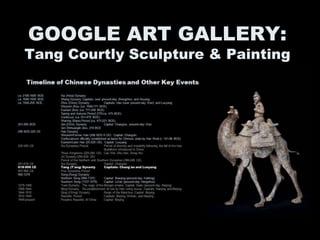
GOOGLE ART GALLERY:
Tang Courtly Sculpture & Painting

Wk 6 china

  • 1.
    Chinese Art History I.Theories of REPRESENTATION in Chinese Art: “MIMESIS” II. Ancient ORIGINS III. Art in the TOMB IV. NATIONALISM & Expression V. TAOISM & Taoist Art GOOGLE ART GALLERY:  Tang Courtly Sculpture & Painting
  • 2.
    I. Theories ofREPRESENTATION in Ancient Chinese Art “MIMESIS” (mimic, realism in art)
  • 3.
    Tomb Relief Sculptures “Deathapproximates Life.”
  • 4.
  • 5.
  • 6.
  • 8.
  • 9.
  • 10.
    Timeline of ChineseDynasties and Other Key Events ca. 2100-1600 BCE Xia (Hsia) Dynasty ca. 1600-1050 BCE Shang Dynasty Capitals: near present-day Zhengzhou and Anyang ca. 1046-256 BCE Zhou (Chou) Dynasty Capitals: Hao (near present-day Xi'an) and Luoyang Western Zhou (ca. 1046-771 BCE) Eastern Zhou (ca. 771-256 BCE) Spring and Autumn Period (770-ca. 475 BCE) Confucius (ca. 551-479 BCE) Warring States Period (ca. 475-221 BCE) 221-206 BCE Qin (Ch'in) Dynasty Capital: Chang'an, present-day Xi'an Qin Shihuangdi dies, 210 BCE 206 BCE-220 CE Han Dynasty Western/Former Han (206 BCE-9 CE) Capital: Chang'an Confucianism officially established as basis for Chinese state by Han Wudi (r. 141-86 BCE) Eastern/Later Han (25-220 CE) Capital: Luoyang 220-589 CE Six Dynasties Period Period of disunity and instability following the fall of the Han Buddhism introduced to China Three Kingdoms (220-265 CE) Cao Wei, Shu Han, Dong Wu Jin Dynasty (265-420 CE) Period of the Northern and Southern Dynasties (386-589 CE) 581-618 CE Sui Dynasty Capital: Chang'an 618-906 CE Tang (T'ang) Dynasty Capitals: Chang'an and Luoyang 907-960 CE Five Dynasties Period 960-1279 Song (Sung) Dynasty Northern Song (960-1127) Capital: Bianjing (present-day Kaifeng) Southern Song (1127-1279) Capital: Lin'an (present-day Hangzhou) 1279-1368 Yuan Dynasty The reign of the Mongol empire; Capital: Dadu (present-day Beijing) 1368-1644 Ming Dynasty Re-establishment of rule by Han ruling house; Capitals: Nanjing and Beijing 1644-1912 Qing (Ch'ing) Dynasty Reign of the Manchus; Capital: Beijing 1912-1949 Republic Period Capitals: Beijing, Wuhan, and Nanjing 1949-present People's Republic of China Capital: Beijing
  • 11.
    II. Ancient ORIGINS •Paleolithic Beginnings • Neolithic Crafts • Hieratic Art & the Bronze Age (Shang) • Status & Decoration (Zhou)
  • 12.
    Paleolithic Beginnings “PALEOLITHIC” • Fromc. 2.5 million years— 10,000 years ago • Stone Tools • Hunting & Gathering
  • 13.
    PALEO-CHINESE PEOPLES: “Homo-Erectus”: • Yuanmo Man •Lantian Man • Peking Man Early “Homo-Sapiens”: • Dingcun Man Late “Homo-Sapiens”: • Upper Cave Man
  • 14.
    “HOMO-ERECTUS” in China YUANMOMan (SW China): PEKING Man (NE China): c. 1.7 million BCE c. 700,000-200,000 BCE
  • 15.
    “HOMO-SAPIENS” in China DINGCUNMan (N China): UPPER CAVE Man (N China): c. 100,000 BCE c. 50,000 BCE
  • 16.
    Neolithic Crafts Neolithic RiverValley Settlements: c. 4000-1700 BCE  Jade Ax
  • 17.
  • 18.
  • 19.
    BANPO (modern Xi’an):Best Preserved 4800-4300 BCE Banpo Settlements: 1) Dwelling Area 2) Community House 3) Burial Area 4) Potters’ Area Banpo Round Hut Dwellings
  • 21.
    Banpo Potters’ AreaDistinctive Motifs
  • 22.
    Banpo = “PAINTEDPOTTERY CULTURE”
  • 25.
  • 26.
  • 27.
    “BLACK POTTERY CULTURE” 2QUALITIES: 1. EVERYDAY: heavy & cord impressions 2. SPECIAL: thin & brittle
  • 28.
    BLACK: More DiverseFORMS than Painted
  • 29.
    IMPRESSED POTTERY-MAKERS • RichSURFACE • Smooth Finish • High-fired
  • 30.
  • 31.
  • 32.
    Quiz #6: China 1.What is the BEST PRESERVED prehistoric Chinese settlement site called? B________
  • 33.
    III. Art inthe TOMB
  • 34.
    Hieratic Art &the Bronze Age SHANG: c. 1766—1111 BCE: • Imp Cap: ANYANG • BRONZE
  • 35.
    Timeline of ChineseDynasties and Other Key Events ca. 2100-1600 BCE Xia (Hsia) Dynasty ca. 1600-1050 BCE Shang Dynasty Capitals: near present-day Zhengzhou and Anyang ca. 1046-256 BCE Zhou (Chou) Dynasty Capitals: Hao (near present-day Xi'an) and Luoyang Western Zhou (ca. 1046-771 BCE) Eastern Zhou (ca. 771-256 BCE) Spring and Autumn Period (770-ca. 475 BCE) Confucius (ca. 551-479 BCE) Warring States Period (ca. 475-221 BCE) 221-206 BCE Qin (Ch'in) Dynasty Capital: Chang'an, present-day Xi'an Qin Shihuangdi dies, 210 BCE 206 BCE-220 CE Han Dynasty Western/Former Han (206 BCE-9 CE) Capital: Chang'an Confucianism officially established as basis for Chinese state by Han Wudi (r. 141-86 BCE) Eastern/Later Han (25-220 CE) Capital: Luoyang 220-589 CE Six Dynasties Period Period of disunity and instability following the fall of the Han Buddhism introduced to China Three Kingdoms (220-265 CE) Cao Wei, Shu Han, Dong Wu Jin Dynasty (265-420 CE) Period of the Northern and Southern Dynasties (386-589 CE) 581-618 CE Sui Dynasty Capital: Chang'an 618-906 CE Tang (T'ang) Dynasty Capitals: Chang'an and Luoyang 907-960 CE Five Dynasties Period 960-1279 Song (Sung) Dynasty Northern Song (960-1127) Capital: Bianjing (present-day Kaifeng) Southern Song (1127-1279) Capital: Lin'an (present-day Hangzhou) 1279-1368 Yuan Dynasty The reign of the Mongol empire; Capital: Dadu (present-day Beijing) 1368-1644 Ming Dynasty Re-establishment of rule by Han ruling house; Capitals: Nanjing and Beijing 1644-1912 Qing (Ch'ing) Dynasty Reign of the Manchus; Capital: Beijing 1912-1949 Republic Period Capitals: Beijing, Wuhan, and Nanjing 1949-present People's Republic of China Capital: Beijing
  • 37.
    Chinese Bronze Tech:UNIQUE! • “ALLOY” • Added LEAD • Complex Technique: Multiple “PIECE-MOLDS”
  • 38.
    Two SHANG Bronze-CastingTechs: 1. “Piece Mold” (clay orig) 2. “Lost Wax”
  • 39.
    Shang SOCIETY “GOD-KING”: Ruledthru: 1. Ritual 2. Warfare 3. Oracles RITUAL = Heart of Shang: 1. Imp for Rulers/Elite 2. Required ART!
  • 40.
  • 41.
    Shang Tomb GuardHorse-Drawn Chariot (Shang Invention)  Altar
  • 42.
  • 44.
    Pre –> EarlySHANG: L: Bronze JUE w/ Gold Leaf & Lacquer R: Bronze/Turquoise Inlay Plaque
  • 45.
    SHANG Ritual WineVessels: L: Ivory, R: Bronze
  • 46.
    Main Shang Art= BRONZE!  Shang “LIDING” (3 legs)
  • 47.
    Shang “DING” (vessel) •Impressed geometric dec • “KUI” (abstract Dragon)
  • 48.
    Confronting KUI  “TAOTIE” Mask
  • 49.
  • 50.
  • 52.
    Bronze DING w/Taotie Motif
  • 53.
    BRONZE = EPITOME ofShang Art • SHAPES • SCALE • SURFACE DEC
  • 54.
  • 55.
  • 56.
  • 57.
  • 58.
    “HIERATIC MOTIFS” • Symbolic(ritual) • Decorative  EXPRESSIVE Art Form!  Liding with “THREAD RELIEF”
  • 59.
  • 60.
    c. 12th CenturyFANG DING
  • 61.
  • 63.
    2 Shang ANIMALMOTIF Themes 1. “REALISTIC” 2. “MYTHICAL”  1: Owl-shaped Wine Vessel  2: Taotie Motif
  • 64.
  • 65.
  • 66.
    Bronze YU (bucket): •Monster • Human • KUI • Cat • Deer
  • 67.
  • 68.
  • 71.
    Owl & BoarBronze Containers
  • 72.
  • 73.
  • 74.
  • 75.
  • 76.
  • 77.
  • 79.
    Some Shang RITUALVESSEL TYPES… LIDING = 3 LEGS
  • 81.
  • 82.
  • 83.
  • 84.
  • 85.
    2. What’s the“epitome” of Shang art (medium)? 3. What’s this MOTIF called? T_______ mask.
  • 86.
  • 87.
    The SIMUWU Ding(Shang) Cast by Shang Emperor for Mother 3 characters inscription (inside): • SI = sacrificial ceremony • MUWU = mother’s name
  • 88.
  • 89.
  • 91.
  • 93.
    ORACLE BONES: • Usedby ancient “Diviners” • For Shang Kings • TOPICS include: good days for hunting, warfare, weather, ceremonies, etc.
  • 95.
  • 96.
    Beginnings of WRITING •c. 5th cent BCE: writings on BAMBOO STRIPS • Hist & Admin writings • Earliest ms’s of famous phil texts (Laozu) • “Classical Chinese" (wenyan): same  19th century • Standardization of writing by 1st Emperor of Qin (unified China in 221 BCE) • Qin script: official style • Calligraphic style = “Clerical Script" (LISHU): still readable today!
  • 97.
  • 98.
  • 99.
  • 100.
    Other Shang TombTreasures: JADE
  • 102.
  • 103.
    Ritual Jade ZONG(TREAGER Fig 24)
  • 104.
  • 105.
    Shang Jade Kneeling Figure (Noteroyal Hairstyle & fancy Girdle-Knot)
  • 106.
  • 108.
    STATUS & DECORATION ZHOUDYNASTY: 1111-221 BCE
  • 109.
    SHANG Dynasty: 1766-1111BCEZHOU Dynasty: 1111-221 BCE Shang defeated by ZHOU Warrior Clan. ZHOU = DIVIDED Period: > W. ZHOU: 1111-771: Chang’an > E. ZHOU: 771-481: Luoyan > WARRING STATES: c. 481-221
  • 110.
    Timeline of ChineseDynasties and Other Key Events ca. 2100-1600 BCE Xia (Hsia) Dynasty ca. 1600-1050 BCE Shang Dynasty Capitals: near present-day Zhengzhou and Anyang ca. 1046-256 BCE Zhou (Chou) Dynasty Capitals: Hao (near present-day Xi'an) and Luoyang Western Zhou (ca. 1046-771 BCE) Eastern Zhou (ca. 771-256 BCE) Spring and Autumn Period (770-ca. 475 BCE) Confucius (ca. 551-479 BCE) Warring States Period (ca. 475-221 BCE) 221-206 BCE Qin (Ch'in) Dynasty Capital: Chang'an, present-day Xi'an Qin Shihuangdi dies, 210 BCE 206 BCE-220 CE Han Dynasty Western/Former Han (206 BCE-9 CE) Capital: Chang'an Confucianism officially established as basis for Chinese state by Han Wudi (r. 141-86 BCE) Eastern/Later Han (25-220 CE) Capital: Luoyang 220-589 CE Six Dynasties Period Period of disunity and instability following the fall of the Han Buddhism introduced to China Three Kingdoms (220-265 CE) Cao Wei, Shu Han, Dong Wu Jin Dynasty (265-420 CE) Period of the Northern and Southern Dynasties (386-589 CE) 581-618 CE Sui Dynasty Capital: Chang'an 618-906 CE Tang (T'ang) Dynasty Capitals: Chang'an and Luoyang 907-960 CE Five Dynasties Period 960-1279 Song (Sung) Dynasty Northern Song (960-1127) Capital: Bianjing (present-day Kaifeng) Southern Song (1127-1279) Capital: Lin'an (present-day Hangzhou) 1279-1368 Yuan Dynasty The reign of the Mongol empire; Capital: Dadu (present-day Beijing) 1368-1644 Ming Dynasty Re-establishment of rule by Han ruling house; Capitals: Nanjing and Beijing 1644-1912 Qing (Ch'ing) Dynasty Reign of the Manchus; Capital: Beijing 1912-1949 Republic Period Capitals: Beijing, Wuhan, and Nanjing 1949-present People's Republic of China Capital: Beijing
  • 111.
    ZHOU Changes: • Nomore “GOD-King” • STATUS: now relative King Wen of Zhou (Founder of the Zhou Dynasty)
  • 112.
    Zhou BRONZES CHARACTERISTICS: 1. SECULARmotifs 2. EXAGGERATION (“flanges”) 3. More INSCRIPTIONS
  • 113.
    Zhou BRONZES CHARACTERISTICS: 1. SECULARmotifs 2. EXAGGERATION (flanges) 3. More INSCRIPTIONS  TREAGER Fig 25 Zhou YU (Bucket) Zhou YU (Bucket)
  • 114.
    SHANG vs ZHOU c.1766 – 1111 BC c. 1111 – 221 BC (Bronze) Key Differences
  • 115.
    Zhou STATUS “Culture of COMPETITION”
  • 116.
    W. ZHOU: Bronze Bust w/Gilt Mask Bronze Priest (?) 
  • 117.
  • 118.
    ZHOU Pectoral found ina Tomb: Jade, Agate, Turquoise
  • 119.
  • 120.
  • 121.
  • 122.
    2 Types ofZHOU DEPOSITS: HOARDS & TOMBS
  • 123.
    TOMB Treasure: ZhouJade “BI”
  • 124.
  • 126.
    Shang & Zhou: Human& Animal SACRIFICES
  • 128.
  • 129.
  • 130.
  • 131.
  • 133.
  • 134.
  • 137.
  • 138.
  • 141.
    TOMB Treasure: ZhouJade “BI”
  • 142.
    Tomb of KINGCUO (c. 320-308 BCE)
  • 143.
  • 145.
  • 146.
    Gilded Bronze BeltBuckle Bronze Candlestick Holder
  • 147.
    King Cuo’s GiltBronze Buckle (w/ gold, silver, turquoise)
  • 151.
  • 152.
    Bronze “BIXIE”: • MythicalSon of Dragon • Good Fortune • Attracts Wealth • Repels Evil
  • 153.
    Tomb: A DOORto the AFTERLIFE
  • 154.
  • 155.
  • 156.
    4. List the2 TYPES of Zhou DEPOSITS: a. ____________________ b. ____________________ 5. Zhou KING CUO’s tomb is shaped like an IDEOGRAM that MEANS WHAT?
  • 157.
    Warring States: EXPLOSIONOF ART! “Culture of COMPETITION”
  • 158.
    “Warring States” Demise of ZHOU “Culture of Competition”!!!
  • 159.
    Summary SHANG (1766—1111 BCE): •Rituals & Ceremonies • Divine Ruler • Hieratic Motifs ZHOU DYNASTY (1111-221 BCE): • Social Status • “Culture of Competition” • Exaggerated Style: “Flanges”
  • 160.
    III. Nationalism &Expression SHANG: God-King, Rituals, Hieratic Motifs ZHOU: Secular, Social Status, Exaggerated “Culture of Competition” QIN & HAN: Myths & DAILY LIFE Narrative & EXPRESSIVE Art Political UNITY
  • 161.
    Timeline of ChineseDynasties and Other Key Events ca. 2100-1600 BCE Xia (Hsia) Dynasty ca. 1600-1050 BCE Shang Dynasty Capitals: near present-day Zhengzhou and Anyang ca. 1046-256 BCE Zhou (Chou) Dynasty Capitals: Hao (near present-day Xi'an) and Luoyang Western Zhou (ca. 1046-771 BCE) Eastern Zhou (ca. 771-256 BCE) Spring and Autumn Period (770-ca. 475 BCE) Confucius (ca. 551-479 BCE) Warring States Period (ca. 475-221 BCE) 221-206 BCE Qin (Ch'in) Dynasty Capital: Chang'an, present-day Xi'an Qin Shihuangdi dies, 210 BCE 206 BCE-220 CE Han Dynasty Western/Former Han (206 BCE-9 CE) Capital: Chang'an Confucianism officially established as basis for Chinese state by Han Wudi (r. 141-86 BCE) Eastern/Later Han (25-220 CE) Capital: Luoyang 220-589 CE Six Dynasties Period Period of disunity and instability following the fall of the Han Buddhism introduced to China Three Kingdoms (220-265 CE) Cao Wei, Shu Han, Dong Wu Jin Dynasty (265-420 CE) Period of the Northern and Southern Dynasties (386-589 CE) 581-618 CE Sui Dynasty Capital: Chang'an 618-906 CE Tang (T'ang) Dynasty Capitals: Chang'an and Luoyang 907-960 CE Five Dynasties Period 960-1279 Song (Sung) Dynasty Northern Song (960-1127) Capital: Bianjing (present-day Kaifeng) Southern Song (1127-1279) Capital: Lin'an (present-day Hangzhou) 1279-1368 Yuan Dynasty The reign of the Mongol empire; Capital: Dadu (present-day Beijing) 1368-1644 Ming Dynasty Re-establishment of rule by Han ruling house; Capitals: Nanjing and Beijing 1644-1912 Qing (Ch'ing) Dynasty Reign of the Manchus; Capital: Beijing 1912-1949 Republic Period Capitals: Beijing, Wuhan, and Nanjing 1949-present People's Republic of China Capital: Beijing
  • 162.
    QIN Dynasty: 221- 206 BC SHANG & ZHOU: King = “Wang” 246 BC: “Wang Zheng of Qin” 221 BC: Unites 7 Warring States From “Wang”  “Huangdi” (Emperor)  “Qin Shihuangdi”
  • 163.
    Qin Shihuangdi: The 1st“YELLOW EMPEROR”
  • 170.
  • 171.
    Qin’s Terra CottaArmy (Xi’an)
  • 180.
  • 184.
    Key “Aesthetic” Characteristics: •Realism • Technical Skill • Individualized • Lively
  • 185.
    Key “Aesthetic” Characteristics: •Realism • Technical Skill • Individualized • Lively
  • 186.
    Key “Aesthetic” Characteristics: •Realism • Technical Skill • Individualized • Lively
  • 194.
  • 195.
  • 197.
    6. Who wasQin Shihuangdi? China’s 1st ___________.
  • 198.
    7. Qin builtGreat Wall to protect Empire from WHO?
  • 199.
    (Note EXPANSION) QIN (221-206BC)  HAN (206 BC – AD 221)
  • 200.
    Timeline of ChineseDynasties and Other Key Events ca. 2100-1600 BCE Xia (Hsia) Dynasty ca. 1600-1050 BCE Shang Dynasty Capitals: near present-day Zhengzhou and Anyang ca. 1046-256 BCE Zhou (Chou) Dynasty Capitals: Hao (near present-day Xi'an) and Luoyang Western Zhou (ca. 1046-771 BCE) Eastern Zhou (ca. 771-256 BCE) Spring and Autumn Period (770-ca. 475 BCE) Confucius (ca. 551-479 BCE) Warring States Period (ca. 475-221 BCE) 221-206 BCE Qin (Ch'in) Dynasty Capital: Chang'an, present-day Xi'an Qin Shihuangdi dies, 210 BCE 206 BCE-220 CE Han Dynasty Western/Former Han (206 BCE-9 CE) Capital: Chang'an Confucianism officially established as basis for Chinese state by Han Wudi (r. 141-86 BCE) Eastern/Later Han (25-220 CE) Capital: Luoyang 220-589 CE Six Dynasties Period Period of disunity and instability following the fall of the Han Buddhism introduced to China Three Kingdoms (220-265 CE) Cao Wei, Shu Han, Dong Wu Jin Dynasty (265-420 CE) Period of the Northern and Southern Dynasties (386-589 CE) 581-618 CE Sui Dynasty Capital: Chang'an 618-906 CE Tang (T'ang) Dynasty Capitals: Chang'an and Luoyang 907-960 CE Five Dynasties Period 960-1279 Song (Sung) Dynasty Northern Song (960-1127) Capital: Bianjing (present-day Kaifeng) Southern Song (1127-1279) Capital: Lin'an (present-day Hangzhou) 1279-1368 Yuan Dynasty The reign of the Mongol empire; Capital: Dadu (present-day Beijing) 1368-1644 Ming Dynasty Re-establishment of rule by Han ruling house; Capitals: Nanjing and Beijing 1644-1912 Qing (Ch'ing) Dynasty Reign of the Manchus; Capital: Beijing 1912-1949 Republic Period Capitals: Beijing, Wuhan, and Nanjing 1949-present People's Republic of China Capital: Beijing
  • 201.
    6th – 5thCENTURY BCE: Major WORLD Philosophers: •Buddha (563-483) •Lao-Tzu (c. 6th – 5th? cent BCE): Tao Te Ching •Xenophanes (560-478) •Confucius (551-479) •Heraclitus (540-480) LAO TZU CONFUCIUS
  • 202.
    CONFUCIANISM Confucius = “MasterK’ung” (551-479 BCE) (During ZHOU Period)
  • 203.
    The Analects • Writtenby Confucius’s STUDENTS • They took detailed NOTES when he spoke • “The Master” = Confucius Confucius with his Students
  • 204.
    Confucius (551-479 BCE): ATRAVELING Philosopher Importance of “Hierarchical” Society 5 “Confucian Virtues”: 1) Benevolence 2) Righteousness 3) Propriety 4) Wisdom 5) Trustworthiness • Ideal Ruler rules by MORAL EXAMPLE • Supreme VIRTUE: OBEDIENCE
  • 205.
    From HAN on… Confucianisminstitutionalized (gov) • Ideal of Scholar/Administrator • Growth of Bureaucracy • Focus of Ancestor Veneration: Tombs & “SHRINES”
  • 206.
    HAN Dynasty: 206BC – AD 221 Period of EXPANSION:
  • 207.
    Timeline of ChineseDynasties and Other Key Events ca. 2100-1600 BCE Xia (Hsia) Dynasty ca. 1600-1050 BCE Shang Dynasty Capitals: near present-day Zhengzhou and Anyang ca. 1046-256 BCE Zhou (Chou) Dynasty Capitals: Hao (near present-day Xi'an) and Luoyang Western Zhou (ca. 1046-771 BCE) Eastern Zhou (ca. 771-256 BCE) Spring and Autumn Period (770-ca. 475 BCE) Confucius (ca. 551-479 BCE) Warring States Period (ca. 475-221 BCE) 221-206 BCE Qin (Ch'in) Dynasty Capital: Chang'an, present-day Xi'an Qin Shihuangdi dies, 210 BCE 206 BCE-220 CE Han Dynasty Western/Former Han (206 BCE-9 CE) Capital: Chang'an Confucianism officially established as basis for Chinese state by Han Wudi (r. 141-86 BCE) Eastern/Later Han (25-220 CE) Capital: Luoyang 220-589 CE Six Dynasties Period Period of disunity and instability following the fall of the Han Buddhism introduced to China Three Kingdoms (220-265 CE) Cao Wei, Shu Han, Dong Wu Jin Dynasty (265-420 CE) Period of the Northern and Southern Dynasties (386-589 CE) 581-618 CE Sui Dynasty Capital: Chang'an 618-906 CE Tang (T'ang) Dynasty Capitals: Chang'an and Luoyang 907-960 CE Five Dynasties Period 960-1279 Song (Sung) Dynasty Northern Song (960-1127) Capital: Bianjing (present-day Kaifeng) Southern Song (1127-1279) Capital: Lin'an (present-day Hangzhou) 1279-1368 Yuan Dynasty The reign of the Mongol empire; Capital: Dadu (present-day Beijing) 1368-1644 Ming Dynasty Re-establishment of rule by Han ruling house; Capitals: Nanjing and Beijing 1644-1912 Qing (Ch'ing) Dynasty Reign of the Manchus; Capital: Beijing 1912-1949 Republic Period Capitals: Beijing, Wuhan, and Nanjing 1949-present People's Republic of China Capital: Beijing
  • 208.
    HAN = A“Golden Age” Calligraphy Painting “Literati”
  • 209.
  • 210.
    HAN DYNASTY TOMBMURALS: Narrative Paintings
  • 212.
     Guardians ofDay & Night Paintings on Ceramic Tiles Impressed Designs & Low-Relief Carvings
  • 213.
  • 214.
    Han “Paradise Realm” Later Landscapes
  • 215.
    Mawangdui Tomb FuneralBanner (c. 168 BC) 4 Mythocentric Levels: 1: Top (HEAVENS)
  • 216.
    Mawangdui Tomb FuneralBanner (c. 168 BC) 4 Mythocentric Levels: 1) Top (HEAVENS)
  • 217.
  • 218.
  • 219.
  • 221.
  • 222.
  • 224.
  • 225.
    Tomb Treasures of PrinceLiu Sheng & Princess Dou Wan Liu Sheng: Tomb Entrance Archaeologists at Work
  • 226.
    Gilt bronze tsunwine vessel with mountain scenes and animal feet
  • 227.
    Gilded bronze double cupswith turquoise inlay (jade ring in mouth)
  • 228.
  • 229.
  • 230.
    Bronze leopards inlaidwith gold and silver.
  • 231.
  • 234.
  • 235.
    Han JADE HorseHead “CELESTIAL Horses”
  • 236.
    Flying Horse OfGansu (bronze)
  • 238.
    Southern: W. JIN(219-316) E. JIN (317-419) Cap = NANJING Northern: N. WEI (386-532) W. WEI (534-554) Northern & Southern Dynasties  E. JIN Tomb Mural (Nanjing)
  • 239.
    Timeline of ChineseDynasties and Other Key Events ca. 2100-1600 BCE Xia (Hsia) Dynasty ca. 1600-1050 BCE Shang Dynasty Capitals: near present-day Zhengzhou and Anyang ca. 1046-256 BCE Zhou (Chou) Dynasty Capitals: Hao (near present-day Xi'an) and Luoyang Western Zhou (ca. 1046-771 BCE) Eastern Zhou (ca. 771-256 BCE) Spring and Autumn Period (770-ca. 475 BCE) Confucius (ca. 551-479 BCE) Warring States Period (ca. 475-221 BCE) 221-206 BCE Qin (Ch'in) Dynasty Capital: Chang'an, present-day Xi'an Qin Shihuangdi dies, 210 BCE 206 BCE-220 CE Han Dynasty Western/Former Han (206 BCE-9 CE) Capital: Chang'an Confucianism officially established as basis for Chinese state by Han Wudi (r. 141-86 BCE) Eastern/Later Han (25-220 CE) Capital: Luoyang 220-589 CE Six Dynasties Period Period of disunity and instability following the fall of the Han Buddhism introduced to China Three Kingdoms (220-265 CE) Cao Wei, Shu Han, Dong Wu Jin Dynasty (265-420 CE) Period of the Northern and Southern Dynasties (386-589 CE) 581-618 CE Sui Dynasty Capital: Chang'an 618-906 CE Tang (T'ang) Dynasty Capitals: Chang'an and Luoyang 907-960 CE Five Dynasties Period 960-1279 Song (Sung) Dynasty Northern Song (960-1127) Capital: Bianjing (present-day Kaifeng) Southern Song (1127-1279) Capital: Lin'an (present-day Hangzhou) 1279-1368 Yuan Dynasty The reign of the Mongol empire; Capital: Dadu (present-day Beijing) 1368-1644 Ming Dynasty Re-establishment of rule by Han ruling house; Capitals: Nanjing and Beijing 1644-1912 Qing (Ch'ing) Dynasty Reign of the Manchus; Capital: Beijing 1912-1949 Republic Period Capitals: Beijing, Wuhan, and Nanjing 1949-present People's Republic of China Capital: Beijing
  • 240.
    Eastern JIN TombArt: “CULTURAL REFINEMENT” “7 Sages of Bamboo”
  • 241.
    E. JIN TombArt: “CULTURAL REFINEMENT”
  • 242.
  • 243.
    Screens from Tombof Sima Jinlong d. 484 AD (N. WEI) Subject: Biographies of Exemplary Women
  • 244.
    Screens from Tombof Sima Jinlong Subject: Biographies of Exemplary Women  Mythical Sage-Emperor  3 Exemplary Zhou Mothers  A Respected Woman Teacher  Story of Legendary Concubine (Ban)
  • 245.
  • 246.
    Lady Yuan Coffin?:Scenes of Filial Piety
  • 247.
    SUMMARY Nationalism & Expression: •Myths / Daily Life • Narrative / Expressive Art • Political Unity
  • 248.
    IV. TAOISM &TAOIST ART • Intro to Taoism • Taoist Art
  • 249.
    Chuang Tzu’s “ButterflyDream” Was he then a man dreaming that he was a butterfly? OR now a butterfly dreaming that he is a man?
  • 250.
    Cultural Contexts • The“Middle Kingdom” • “Land of the Dragon”
  • 251.
  • 252.
    Intro to Taoism:Cultural Contexts 771-256 BCE (before China was unified): Eastern Zhou Dynasty "Spring & Autumn Period”: 771-481 BC: IRON discovered & used to help in Agriculture (Population Growth) CONFLICT between City-States Burst in PHILOSOPHY (“The 100 Schools of Thought”)
  • 253.
    Founder of Taoism:LAO TZU 604-531 BCE Older contemporary of CONFUCIUS (551-479 BCE) LAO TZU (“Wise Old Man”): Author of the Tao-te-Ching (key text of Taoism)
  • 254.
    Tao Te Ching TAO= “The Way” DE = Integrity & Virtue CHING = Great Book/Classic “Great Classic of the Way of Virtue”
  • 255.
    Key Taoist Concepts WeiWu Wei: “Action without action” “Effortless doing” Key metaphor: WATER
  • 256.
    Key Taoist Concepts Pu: “TheUn-Carved Block” Passive state of RECEPTIVENESS Pure & limitless POTENTIAL
  • 257.
    Key Taoist Concepts TheTao: “The WAY” of Life: Harmony of “opposites”: No day without night, No light w/out dark No male w/out female No mountains w/out valleys etc…
  • 258.
    Key Taoist Concepts “YIN-YANG”: SYMBOLOF TAOISM Inter-dependence of apparent opposites Complementary opposites within a greater whole
  • 259.
    “YIN-YANG” symbolism: YIN =black, female, receptive, yielding, negative, and nurturing. Associated with night, valleys, rivers, streams, water, metal, and earth. YANG = white, male, active, dominating, positive, and initiating/creating. Associated with day, mountains, hills, fire, wood, and air.
  • 260.
    Taoist “Sages” Admiringa “YIN-YANG Symbol Scroll”
  • 261.
    Key Taoist Concepts “LI”& “CHI” “LI” = Physical, material reality “CHI” = Spiritual energy
  • 262.
    TAOIST ART Influenced artfor centuries (up to today!) Exemplifies “YIN-YANG” concepts:  Yin-Yang Symbol Symbolizes “LI” & “CHI” Dynamics: “LI” = PHYSICAL/MATERIAL REALITY “CHI” = PURE SPIRITUAL ENERGY
  • 263.
    A “TAOIST” VASE “CHI”:Spiritual Energy: ideal perfection of the form of this vase “LI”: The “crackling glaze”: reminds us of the Physical Reality of this vase
  • 264.
    A Taoist “HangingScroll Painting” • “LI”: The PHYSICAL, MATERIAL REALITY of the forbidding and treacherous terrain. • “LI” + “CHI”: The immense SPIRITUAL ENERGY of the human Travelers (“CHI”) as they confront the “LI” of Nature on their Journey. • PURE “CHI”: The Mountain as “the FACE OF GOD.”  FAN KUAN, Travelers in Mountains and Streams China: Northern Song Dynasty (c. 950 AD)
  • 265.
     FAN KUAN,Travelers in Mountains and Streams Northern Song Dynasty “He who paints the Mountain paints the “FACE OF GOD.”
  • 266.
    A Taoist “HangingScroll Painting” • “LI”: The PHYSICAL, MATERIAL REALITY of the forbidding and treacherous terrain. • “LI” + “CHI”: The immense SPIRITUAL ENERGY of the human Travelers (“CHI”) as they confront the “LI” of Nature on their Journey. • PURE “CHI”: The Mountain as “the FACE OF GOD.”  FAN KUAN, Travelers in Mountains and Streams China: Northern Song Dynasty (c. 950 AD)
  • 267.
    Timeline of ChineseDynasties and Other Key Events ca. 2100-1600 BCE Xia (Hsia) Dynasty ca. 1600-1050 BCE Shang Dynasty Capitals: near present-day Zhengzhou and Anyang ca. 1046-256 BCE Zhou (Chou) Dynasty Capitals: Hao (near present-day Xi'an) and Luoyang Western Zhou (ca. 1046-771 BCE) Eastern Zhou (ca. 771-256 BCE) Spring and Autumn Period (770-ca. 475 BCE) Confucius (ca. 551-479 BCE) Warring States Period (ca. 475-221 BCE) 221-206 BCE Qin (Ch'in) Dynasty Capital: Chang'an, present-day Xi'an Qin Shihuangdi dies, 210 BCE 206 BCE-220 CE Han Dynasty Western/Former Han (206 BCE-9 CE) Capital: Chang'an Confucianism officially established as basis for Chinese state by Han Wudi (r. 141-86 BCE) Eastern/Later Han (25-220 CE) Capital: Luoyang 220-589 CE Six Dynasties Period Period of disunity and instability following the fall of the Han Buddhism introduced to China Three Kingdoms (220-265 CE) Cao Wei, Shu Han, Dong Wu Jin Dynasty (265-420 CE) Period of the Northern and Southern Dynasties (386-589 CE) 581-618 CE Sui Dynasty Capital: Chang'an 618-906 CE Tang (T'ang) Dynasty Capitals: Chang'an and Luoyang 907-960 CE Five Dynasties Period 960-1279 Song (Sung) Dynasty Northern Song (960-1127) Capital: Bianjing (present-day Kaifeng) Southern Song (1127-1279) Capital: Lin'an (present-day Hangzhou) 1279-1368 Yuan Dynasty The reign of the Mongol empire; Capital: Dadu (present-day Beijing) 1368-1644 Ming Dynasty Re-establishment of rule by Han ruling house; Capitals: Nanjing and Beijing 1644-1912 Qing (Ch'ing) Dynasty Reign of the Manchus; Capital: Beijing 1912-1949 Republic Period Capitals: Beijing, Wuhan, and Nanjing 1949-present People's Republic of China Capital: Beijing
  • 268.
    LI CHENG, SolitaryTemple Amidst Mountain Peaks China: Northern Song Dynasty (c. 950 AD)
  • 269.
    8. WHY isChina “The Middle Kingdom”?
  • 270.
    9a. The TAO= “The ______ of __________.” b. ID this symbol:
  • 271.
    LI CHENG, SolitaryTemple Amidst Mountain Peaks China: Northern Song Dynasty (c. 950 AD) 10. “He who paints the _______ paints the face of _______.”
  • 272.
    Timeline of ChineseDynasties and Other Key Events ca. 2100-1600 BCE Xia (Hsia) Dynasty ca. 1600-1050 BCE Shang Dynasty Capitals: near present-day Zhengzhou and Anyang ca. 1046-256 BCE Zhou (Chou) Dynasty Capitals: Hao (near present-day Xi'an) and Luoyang Western Zhou (ca. 1046-771 BCE) Eastern Zhou (ca. 771-256 BCE) Spring and Autumn Period (770-ca. 475 BCE) Confucius (ca. 551-479 BCE) Warring States Period (ca. 475-221 BCE) 221-206 BCE Qin (Ch'in) Dynasty Capital: Chang'an, present-day Xi'an Qin Shihuangdi dies, 210 BCE 206 BCE-220 CE Han Dynasty Western/Former Han (206 BCE-9 CE) Capital: Chang'an Confucianism officially established as basis for Chinese state by Han Wudi (r. 141-86 BCE) Eastern/Later Han (25-220 CE) Capital: Luoyang 220-589 CE Six Dynasties Period Period of disunity and instability following the fall of the Han Buddhism introduced to China Three Kingdoms (220-265 CE) Cao Wei, Shu Han, Dong Wu Jin Dynasty (265-420 CE) Period of the Northern and Southern Dynasties (386-589 CE) 581-618 CE Sui Dynasty Capital: Chang'an 618-906 CE Tang (T'ang) Dynasty Capitals: Chang'an and Luoyang 907-960 CE Five Dynasties Period 960-1279 Song (Sung) Dynasty Northern Song (960-1127) Capital: Bianjing (present-day Kaifeng) Southern Song (1127-1279) Capital: Lin'an (present-day Hangzhou) 1279-1368 Yuan Dynasty The reign of the Mongol empire; Capital: Dadu (present-day Beijing) 1368-1644 Ming Dynasty Re-establishment of rule by Han ruling house; Capitals: Nanjing and Beijing 1644-1912 Qing (Ch'ing) Dynasty Reign of the Manchus; Capital: Beijing 1912-1949 Republic Period Capitals: Beijing, Wuhan, and Nanjing 1949-present People's Republic of China Capital: Beijing
  • 273.
    GOOGLE ART GALLERY: TangCourtly Sculpture & Painting