INTRODUCTIONTOINTRODUCTIONTO
BUSINESS ETHICSBUSINESS ETHICS
Submitted to : Prof.Ashwini yaranal
Submitted by : Arun 05
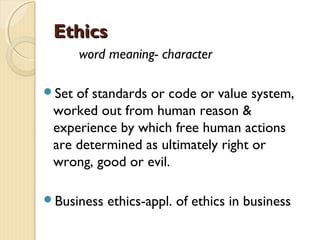
EthicsEthics
word meaning- character
Set of standards or code or value system,
worked out from human reason &
experience by which free human actions
are determined as ultimately right or
wrong, good or evil.
Business ethics-appl. of ethics in business
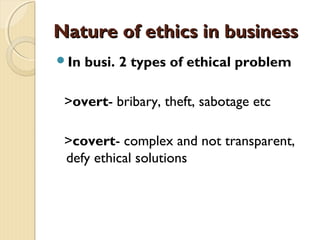
Nature of ethics in businessNature of ethics in business
In busi. 2 types of ethical problem
>overt- bribary, theft, sabotage etc
>covert- complex and not transparent,
defy ethical solutions
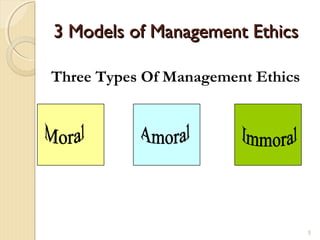
3 Models of Management Ethics3 Models of Management Ethics
5
Three Types Of Management Ethics
3 Models of Management Ethics3 Models of Management Ethics
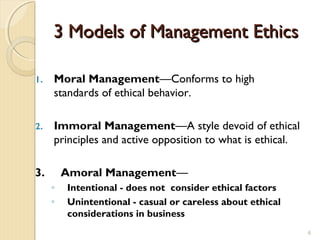
1. Moral Management—Conforms to high
standards of ethical behavior.
2. Immoral Management—A style devoid of ethical
principles and active opposition to what is ethical.
3. Amoral Management—
◦ Intentional - does not consider ethical factors
◦ Unintentional - casual or careless about ethical
considerations in business
6
Stages of Ethical Consciousness in BusinessStages of Ethical Consciousness in Business
First Stage
Law of Jungle: business Decisions are driven by
“might is right”
 Business ills are common at this stage
Second Stage
Anything for Profit: believe “anything goes as long
as one does not get caught by the law”
Bribery to government, tax evasion etc are common
Third Stage
Profit maximizing in short term: Believe that “good business is good ethics”-
to maximize profits within constraints of law
Fourth Stage
Profit maximizing in Long term: Shift in focus from business to ethics-
“sound ethics is good business” in long run. Here firms create post of ethics
officer to supervise ethical aspect of business
Fifth Stage
 Stakeholder concept- Companies concentrate on social and economic mission
 Focus on philanthropy
 Focus is to create mutual relationships between companies and society
Sixth Stage
Corporate Citizenship: Higher level of ethical
consciousness
Belief that business can be healthy only if society
around it is healthy and no other institution
including government has resources to bring this
transformation except Business Organizations
Entrepreneurs seek to achieve social objectives
such as promoting community health, employing
handicapped people, etc
Factors Affecting Ethical ChoicesFactors Affecting Ethical Choices
The ManagerThe Manager
Level or stage of moral development
Learned Ethics
The OrganizationThe Organization
Systems
Culture
Moral DevelopmentMoral Development
PreconventionalPreconventional Level = concernedLevel = concerned
with external rewards andwith external rewards and
punishmentspunishments
ConventionalConventional Level = conform to theLevel = conform to the
expectations of peers and societyexpectations of peers and society
(consistent with practical approach to(consistent with practical approach to
ethical decision making)ethical decision making)
PostconventionalPostconventional (Principled) Level =(Principled) Level =
individuals develop a personal,individuals develop a personal,
internal set of standards and values.internal set of standards and values.
(About 20% of adults)(About 20% of adults)
The OrganizationThe Organization
Systems
Explicit rules and policiesExplicit rules and policies
Reward systemReward system
Culture
Common ValuesCommon Values
TraditionsTraditions
Characteristics of BECharacteristics of BE
Differ with persons
ethical questions do not have a unique
soln but a multitude of alternatives
Ethical decisions are not limited to
themselves, but affects a wide range of
other situations as well.
ED involves a trade off between cost
incurred and benefits received.
Consequences are not clear
Every person is individually responsible for
the ethical or unethical decision and action
that he or she takes
Ethical actions are voluntary human actions
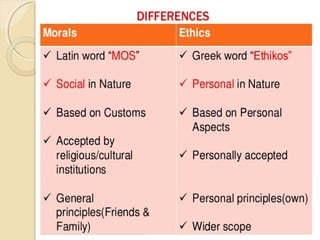
Morality and ethicsMorality and ethics
Morality is the std an individual or community
keeps about what is right and wrong or good
and evil.
Morality
Moral norms deals with topics that either
seriously harm or benefit human beings
Moral stds are not dependent on or changed
by the decision of authoritative bodies
Moral demands enjoys a self-driven force
Expressed through the medium of special
emotions.
Ethics
Ethics helps one to address questions
such as what do moral principles mean in
a given situation
Ethics offers certain moral stds to judge a
particular human behaviour or situation
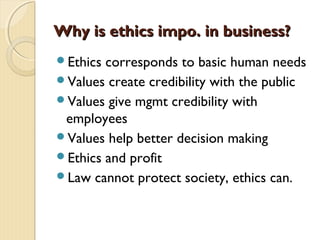
Why is ethics impo. in business?Why is ethics impo. in business?
Ethics corresponds to basic human needs
Values create credibility with the public
Values give mgmt credibility with
employees
Values help better decision making
Ethics and profit
Law cannot protect society, ethics can.
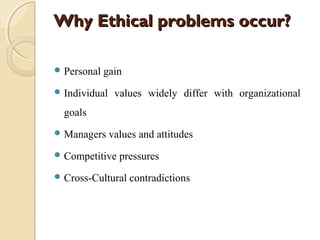
Why Ethical problems occur?Why Ethical problems occur?
 Personal gain
 Individual values widely differ with organizational
goals
 Managers values and attitudes
 Competitive pressures
 Cross-Cultural contradictions
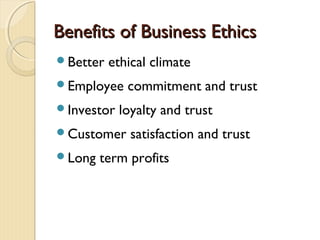
Benefits of Business EthicsBenefits of Business Ethics
Better ethical climate
Employee commitment and trust
Investor loyalty and trust
Customer satisfaction and trust
Long term profits
Criteria ForCriteria For
Ethical Decision MakingEthical Decision Making
Most ethical dilemmas involve
Conflict between needs of the part & whole
- Individual versus the organization
- Organization versus society as a whole
Managers use normative strategies to guide their
decision making - norms and values
Ethical Decision Making ApproachesEthical Decision Making Approaches
Utilitarian Approach
Individualism Approach
Moral-Rights Approach
Justice Approach
Utilitarian ApproachUtilitarian Approach
● Moral behavior produces the greatest
good for the greatest number
● Criticise fear a “Big Brother” approach
and ask if the common good is squeezing
the life out of the individual
Individualism ApproachIndividualism Approach
● Acts are moral when they promote the
individual's best long-term interests,
which ultimately leads to the greater
good
● Individual self-direction paramount
● Individualism is believed to lead to
honesty & integrity since that works best
in the long run
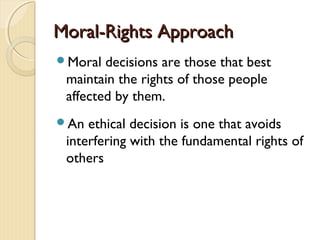
Moral-Rights ApproachMoral-Rights Approach
Moral decisions are those that best
maintain the rights of those people
affected by them.
An ethical decision is one that avoids
interfering with the fundamental rights of
others
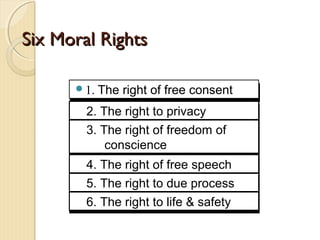
Six Moral RightsSix Moral Rights
1. The right of free consent1. The right of free consent
2. The right to privacy2. The right to privacy
3. The right of freedom of
conscience
3. The right of freedom of
conscience
4. The right of free speech4. The right of free speech
5. The right to due process5. The right to due process
6. The right to life & safety6. The right to life & safety
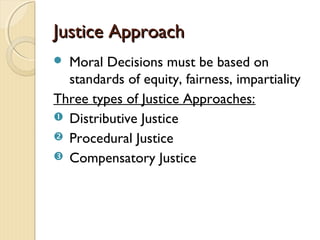
Justice ApproachJustice Approach
 Moral Decisions must be based on
standards of equity, fairness, impartiality
Three types of Justice Approaches:
 Distributive Justice
 Procedural Justice
 Compensatory Justice
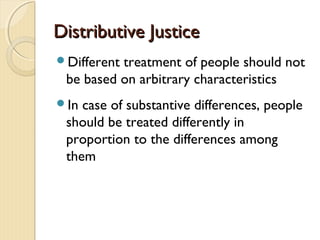
Distributive JusticeDistributive Justice
Different treatment of people should not
be based on arbitrary characteristics
In case of substantive differences, people
should be treated differently in
proportion to the differences among
them
Procedural JusticeProcedural Justice
Rules should be clearly stated
Rules should be consistently and
impartially enforced
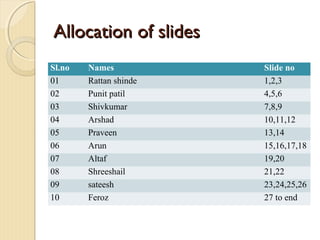
Allocation of slidesAllocation of slides
Sl.no Names Slide no
01 Rattan shinde 1,2,3
02 Punit patil 4,5,6
03 Shivkumar 7,8,9
04 Arshad 10,11,12
05 Praveen 13,14
06 Arun 15,16,17,18
07 Altaf 19,20
08 Shreeshail 21,22
09 sateesh 23,24,25,26
10 Feroz 27 to end
Thank you

Business Ethics

  • 1.
    INTRODUCTIONTOINTRODUCTIONTO BUSINESS ETHICSBUSINESS ETHICS Submittedto : Prof.Ashwini yaranal Submitted by : Arun 05
  • 2.
    EthicsEthics word meaning- character Setof standards or code or value system, worked out from human reason & experience by which free human actions are determined as ultimately right or wrong, good or evil. Business ethics-appl. of ethics in business
  • 3.
    Nature of ethicsin businessNature of ethics in business In busi. 2 types of ethical problem >overt- bribary, theft, sabotage etc >covert- complex and not transparent, defy ethical solutions
  • 5.
    3 Models ofManagement Ethics3 Models of Management Ethics 5 Three Types Of Management Ethics
  • 6.
    3 Models ofManagement Ethics3 Models of Management Ethics 1. Moral Management—Conforms to high standards of ethical behavior. 2. Immoral Management—A style devoid of ethical principles and active opposition to what is ethical. 3. Amoral Management— ◦ Intentional - does not consider ethical factors ◦ Unintentional - casual or careless about ethical considerations in business 6
  • 7.
    Stages of EthicalConsciousness in BusinessStages of Ethical Consciousness in Business First Stage Law of Jungle: business Decisions are driven by “might is right”  Business ills are common at this stage Second Stage Anything for Profit: believe “anything goes as long as one does not get caught by the law” Bribery to government, tax evasion etc are common
  • 8.
    Third Stage Profit maximizingin short term: Believe that “good business is good ethics”- to maximize profits within constraints of law Fourth Stage Profit maximizing in Long term: Shift in focus from business to ethics- “sound ethics is good business” in long run. Here firms create post of ethics officer to supervise ethical aspect of business Fifth Stage  Stakeholder concept- Companies concentrate on social and economic mission  Focus on philanthropy  Focus is to create mutual relationships between companies and society
  • 9.
    Sixth Stage Corporate Citizenship:Higher level of ethical consciousness Belief that business can be healthy only if society around it is healthy and no other institution including government has resources to bring this transformation except Business Organizations Entrepreneurs seek to achieve social objectives such as promoting community health, employing handicapped people, etc
  • 10.
    Factors Affecting EthicalChoicesFactors Affecting Ethical Choices The ManagerThe Manager Level or stage of moral development Learned Ethics The OrganizationThe Organization Systems Culture
  • 11.
    Moral DevelopmentMoral Development PreconventionalPreconventionalLevel = concernedLevel = concerned with external rewards andwith external rewards and punishmentspunishments ConventionalConventional Level = conform to theLevel = conform to the expectations of peers and societyexpectations of peers and society (consistent with practical approach to(consistent with practical approach to ethical decision making)ethical decision making) PostconventionalPostconventional (Principled) Level =(Principled) Level = individuals develop a personal,individuals develop a personal, internal set of standards and values.internal set of standards and values. (About 20% of adults)(About 20% of adults)
  • 12.
    The OrganizationThe Organization Systems Explicitrules and policiesExplicit rules and policies Reward systemReward system Culture Common ValuesCommon Values TraditionsTraditions
  • 13.
    Characteristics of BECharacteristicsof BE Differ with persons ethical questions do not have a unique soln but a multitude of alternatives Ethical decisions are not limited to themselves, but affects a wide range of other situations as well. ED involves a trade off between cost incurred and benefits received.
  • 14.
    Consequences are notclear Every person is individually responsible for the ethical or unethical decision and action that he or she takes Ethical actions are voluntary human actions
  • 15.
    Morality and ethicsMoralityand ethics Morality is the std an individual or community keeps about what is right and wrong or good and evil. Morality Moral norms deals with topics that either seriously harm or benefit human beings Moral stds are not dependent on or changed by the decision of authoritative bodies
  • 16.
    Moral demands enjoysa self-driven force Expressed through the medium of special emotions. Ethics Ethics helps one to address questions such as what do moral principles mean in a given situation Ethics offers certain moral stds to judge a particular human behaviour or situation
  • 18.
    Why is ethicsimpo. in business?Why is ethics impo. in business? Ethics corresponds to basic human needs Values create credibility with the public Values give mgmt credibility with employees Values help better decision making Ethics and profit Law cannot protect society, ethics can.
  • 19.
    Why Ethical problemsoccur?Why Ethical problems occur?  Personal gain  Individual values widely differ with organizational goals  Managers values and attitudes  Competitive pressures  Cross-Cultural contradictions
  • 20.
    Benefits of BusinessEthicsBenefits of Business Ethics Better ethical climate Employee commitment and trust Investor loyalty and trust Customer satisfaction and trust Long term profits
  • 21.
    Criteria ForCriteria For EthicalDecision MakingEthical Decision Making Most ethical dilemmas involve Conflict between needs of the part & whole - Individual versus the organization - Organization versus society as a whole Managers use normative strategies to guide their decision making - norms and values
  • 22.
    Ethical Decision MakingApproachesEthical Decision Making Approaches Utilitarian Approach Individualism Approach Moral-Rights Approach Justice Approach
  • 23.
    Utilitarian ApproachUtilitarian Approach ●Moral behavior produces the greatest good for the greatest number ● Criticise fear a “Big Brother” approach and ask if the common good is squeezing the life out of the individual
  • 24.
    Individualism ApproachIndividualism Approach ●Acts are moral when they promote the individual's best long-term interests, which ultimately leads to the greater good ● Individual self-direction paramount ● Individualism is believed to lead to honesty & integrity since that works best in the long run
  • 25.
    Moral-Rights ApproachMoral-Rights Approach Moraldecisions are those that best maintain the rights of those people affected by them. An ethical decision is one that avoids interfering with the fundamental rights of others
  • 26.
    Six Moral RightsSixMoral Rights 1. The right of free consent1. The right of free consent 2. The right to privacy2. The right to privacy 3. The right of freedom of conscience 3. The right of freedom of conscience 4. The right of free speech4. The right of free speech 5. The right to due process5. The right to due process 6. The right to life & safety6. The right to life & safety
  • 27.
    Justice ApproachJustice Approach Moral Decisions must be based on standards of equity, fairness, impartiality Three types of Justice Approaches:  Distributive Justice  Procedural Justice  Compensatory Justice
  • 28.
    Distributive JusticeDistributive Justice Differenttreatment of people should not be based on arbitrary characteristics In case of substantive differences, people should be treated differently in proportion to the differences among them
  • 29.
    Procedural JusticeProcedural Justice Rulesshould be clearly stated Rules should be consistently and impartially enforced
  • 30.
    Allocation of slidesAllocationof slides Sl.no Names Slide no 01 Rattan shinde 1,2,3 02 Punit patil 4,5,6 03 Shivkumar 7,8,9 04 Arshad 10,11,12 05 Praveen 13,14 06 Arun 15,16,17,18 07 Altaf 19,20 08 Shreeshail 21,22 09 sateesh 23,24,25,26 10 Feroz 27 to end
  • 31.