





Galaxies

Galaxy Field – Hubble Telescope
Hubble Classification of Galaxies (3)








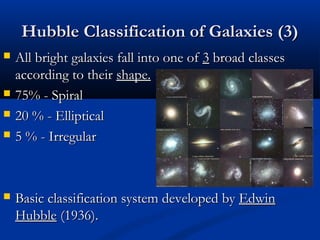
All bright galaxies fall into one of 3 broad classes
according to their shape.
75% - Spiral
20 % - Elliptical
5 % - Irregular

Basic classification system developed by Edwin
Hubble (1936).
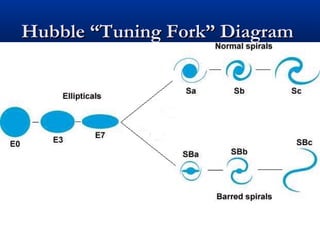
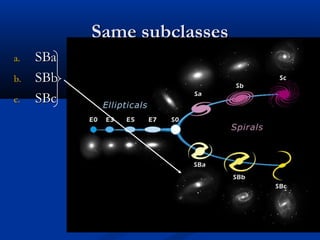
Hubble “Tuning Fork” Diagram
I. Spirals (2)
a) Normal Spirals
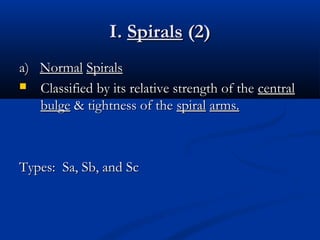
 Classified by its relative strength of the central
bulge & tightness of the spiral arms.

Types: Sa, Sb, and Sc


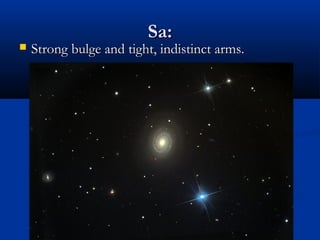
Sa:

Strong bulge and tight, indistinct arms.
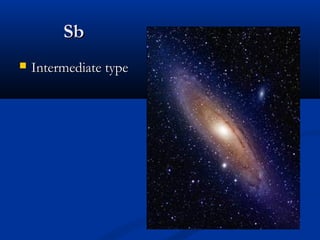
Sb


Intermediate type


Sc

Small central bulge and loose, well defined arms.
Examples
 The Milky Way (130,000 light

years wide)
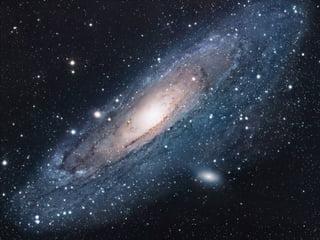
 Andromeda (our nearest galaxy
is 2-3 million light years away).
b. Type SB Barred Spirals
Features a strong central stellar bar.
 Bar rotates as a unit (solid body
rotation).
 Spiral arms emerge from the ends
of the bar.
Same subclasses
a.
b.
c.

SBa
SBb
SBc
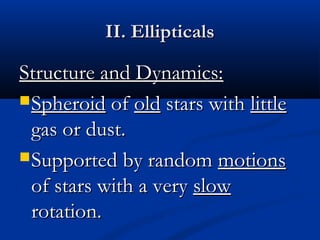
II. Ellipticals

Structure and Dynamics:
 Spheroid of old stars with little
gas or dust.
 Supported by random motions
of stars with a very slow
rotation.
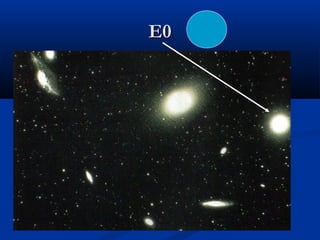
E0
E1
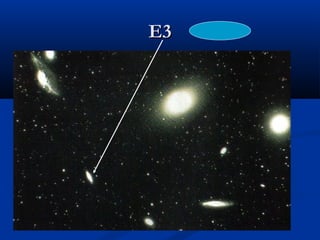
E3
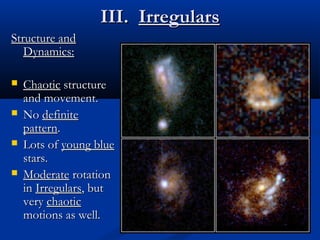
III. Irregulars
Structure and
Dynamics:





Chaotic structure
and movement.
No definite
pattern.
Lots of young blue
stars.
Moderate rotation
in Irregulars, but
very chaotic
motions as well.
Our Milky Way







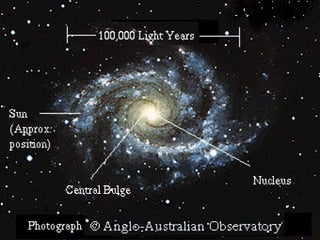
Spiral Galaxy.
Our sun is just one of the perhaps 100 billion
stars that make up the Milky Way.
The sun is located about 28,000 light years from
the center of the Milky Way.
The Milky Way galaxy is ~100,000 – 130,000
light years in diameter.
You
are
here.
3 parts of the Milky Way
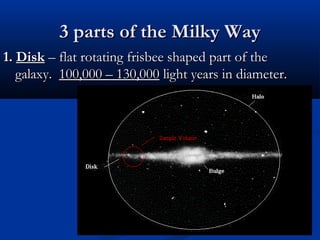
1. Disk – flat rotating frisbee shaped part of the
galaxy. 100,000 – 130,000 light years in diameter.
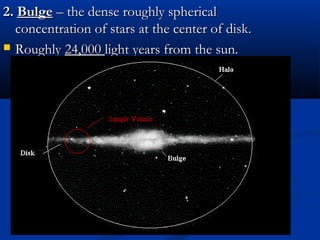
2. Bulge – the dense roughly spherical
concentration of stars at the center of disk.
 Roughly 24,000 light years from the sun.
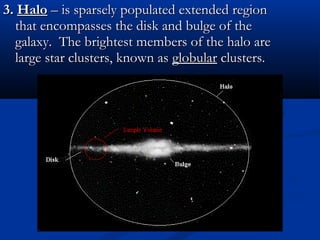
3. Halo – is sparsely populated extended region
that encompasses the disk and bulge of the
galaxy. The brightest members of the halo are
large star clusters, known as globular clusters.
Galaxies
Galaxies

Galaxies

  • 1.
    Galaxies Galaxy Field –Hubble Telescope
  • 3.
    Hubble Classification ofGalaxies (3)      All bright galaxies fall into one of 3 broad classes according to their shape. 75% - Spiral 20 % - Elliptical 5 % - Irregular Basic classification system developed by Edwin Hubble (1936).
  • 4.
  • 5.
    I. Spirals (2) a)Normal Spirals  Classified by its relative strength of the central bulge & tightness of the spiral arms. Types: Sa, Sb, and Sc
  • 6.
     Sa: Strong bulge andtight, indistinct arms.
  • 7.
  • 8.
     Sc Small central bulgeand loose, well defined arms.
  • 9.
    Examples  The MilkyWay (130,000 light years wide)  Andromeda (our nearest galaxy is 2-3 million light years away).
  • 10.
    b. Type SBBarred Spirals Features a strong central stellar bar.  Bar rotates as a unit (solid body rotation).  Spiral arms emerge from the ends of the bar.
  • 11.
  • 12.
    II. Ellipticals Structure andDynamics:  Spheroid of old stars with little gas or dust.  Supported by random motions of stars with a very slow rotation.
  • 13.
  • 14.
  • 15.
  • 16.
    III. Irregulars Structure and Dynamics:     Chaoticstructure and movement. No definite pattern. Lots of young blue stars. Moderate rotation in Irregulars, but very chaotic motions as well.
  • 17.
    Our Milky Way     SpiralGalaxy. Our sun is just one of the perhaps 100 billion stars that make up the Milky Way. The sun is located about 28,000 light years from the center of the Milky Way. The Milky Way galaxy is ~100,000 – 130,000 light years in diameter.
  • 18.
  • 19.
    3 parts ofthe Milky Way 1. Disk – flat rotating frisbee shaped part of the galaxy. 100,000 – 130,000 light years in diameter.
  • 20.
    2. Bulge –the dense roughly spherical concentration of stars at the center of disk.  Roughly 24,000 light years from the sun.
  • 21.
    3. Halo –is sparsely populated extended region that encompasses the disk and bulge of the galaxy. The brightest members of the halo are large star clusters, known as globular clusters.