MOOD STABILIZERS
SUBMITTED TO: SUBMITTED BY:
Dr (Mrs) Triza Jiwan Nitika Bhatt
Prof & Principal Roll no. 13
Mental Health Nursing Msc (N) 1 st year
Mood stabilizing agents
A mood stabilizer is a psychiatric medication
used to treat mood disorders characterized by
intense and sustained mood shifts, typically
bipolar disorder.
Lithium carbonate
– an element with atomic no.3 and atomic weight
7
– Smallest alkali ion
– Used for gout and for salt replacement in cardiac
disease
– Use was restricted due to fatal toxicity
– Rediscovered in 1949 by john cade for use in
treatment of mania
• Very effective in treatment of mania so word
antimanic is often used
• Equally effective in preventing mood swings
in bipolar disorders, so the better term is
mood stabilizer
PHARMOKINETICS
Lithium
GI tract ( take 8 hours to absorb)
Excreted through kidney
Indications
– treatment of acute mania
– Prophylaxis of bipolar mood disorder
– Treatment of schizoaffective disorder
– Prophylaxis of unipolar mood disorder
– Treatment of cyclothymia
– Treatment of acute depression
– Treatment of chronic alcoholism
Contraindications
– Hypothyroidism
– Hyperthyroidism
– Severe infection
– Chronic heart failure
– Kidney disease
– Hypercalcemia
– Dehydration
– Sodium depletion
Mechanism of action
– Not fully understood but may enhance reuptake
of norepinephrine and serotonin decreasing
levels in body thus resulting in decreased
hyperactivity.
– It may take 1-3 weeks for symptoms to subside.
Preparations
Lithium carbonate
– 300mg tablets
(LICAB 300mg)
– 400mg tablets
Lithium citrate
– 300mg/5ml liquid
Dose
– Acute mania: 1800-
2400mg/day
– Maintenance: 900-
1200mg/day
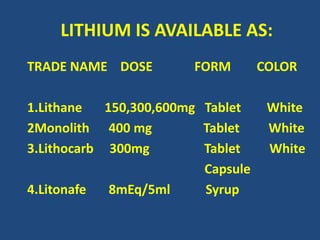
LITHIUM IS AVAILABLE AS:
TRADE NAME DOSE FORM COLOR
1.Lithane 150,300,600mg Tablet White
2Monolith 400 mg Tablet White
3.Lithocarb 300mg Tablet White
Capsule
4.Litonafe 8mEq/5ml Syrup
Thorough assessment for:
– General and systemic physical examination
– Routine blood counts
– Urine routine
– ECG
– RFT
– TFT(TSH,T3,T4)
BLOOD LITHIUM LEVELS:
– Therapeutic levels: 0.6-1.2meq/l
– Prophylactic levels: 0.6-1.0meq/l
– Toxic lithium levels: >2meq/l
Its very essential to monitor blood lithium levels at
regular intervals. Blood sample is taken 12 hrs
after the last lithium dose. Next blood level is
estimated after at least 7 days of the last change
LABORATORY INVESTIGATIONS
Initially , Blood levels monitored weekly
When therapeutic level
achieved
Monthly
After 1 year stability
3 Monthly
Blood sample should be drawn 8 to 12 hours after
Last dose of lithium.
ADVERSE EFFECTS
Central nervous system: Confusion, Muscle
irritability, Tremors etc
Cardiovascular system: Arrhythmias,
Bradycardia,
Hypotension
Gastrointestinal system: Perspiration, vomiting,
Diarrhea etc.
Genitourinary system: Albuminuria,
Polyuria
LITHIUM TOXICITY
There is a small range between lithium
therapeutic dose and toxic dose of
lithium.
No specific antidote for lithium poisoning
Lithium level Symptoms
Below 1.5 mEq/l
(mild)
Nausea, vomiting, diarrhea, increased
thirst, polyuria, slurred speech, muscle
weakness
1.5 to 2 mEq/l
(mild to
moderate)
Persistent GI upset, tremors, confusion,
hyperirritability of muscles, sedation or
incordination
2 to 2.5 mEq/l
(moderate to
severe)
Moderate to severe intoxication, ataxia,
giddiness, high urine output, blurred vision,
seizures, stupor, severe hypotension, coma,
death
>2.5 mEq/l
(Severe)
Generalized convulsions, oliguria, death
SIGN AND SYMPTOMS OF TOXICITY
MANAGEMENT OF TOXICITY
Immediately inform the doctor.
Discontinue lithium therapy.
Give fluids.
Monitor lithium level, electrolytes(Na, K, Cl), Renal
function test and ECG.
 Do gastric lavage, Induction of emesis.
If lithium level is > 2.5 do Hemodialysis.
Repeat dialysis every 6to10 hours.
If patient is having cardiopulmonary arrest, Give
CPR and put patient on ventilator.
Nursing implications for antimanic
drugs
Nursing implications
Side effects Nursing implication
Drowsiness, dizziness, headache Ensure that client doesn’t participate in
activities that require alertness or operate
dangerous machinery
Dry mouth, thirst Provide sugarless candies, ice chips,
frequent sips of water.
GI upset Eat and drink slowly, avoid lactulose, avoid
spicy food
Fine hand tremors Inform physician who may Decrease
dosage or prescribe small dose of beta
blockers
Hypotension, arrythmias, pulse
irregularities
Monitor vitals
Polyuria, dehydration I/O charting ,skin turgor
Weight gain Exercise, Reduced calorie diet, emphasize
importance of maintaining adequate
intake of sodium
CLIENT EDUCATION
 Dosage –
• Advice client to take dose exactly
prescribed by doctor. Don’t take dose
less or more.
• If you miss a dose , take it as soon as
possible . Don’t double the dose.
• Carry identification card noting that
he/she is on lithium.
 Blood test
 Schedule regular blood tests.
 Advice the client to have regular
monitoring of Lithium blood level ,
thyroid function and kidney status .
 When going to have Li level checked,
you should have taken your last lithium
dose 12 hrs earlier.
 Diet and fluid
 Avoid sudden changes in your diet or fluid
intake. If you do that , then your doctor need to
increase the frequency of blood tests.
 Caffeine and alcohol act as diuretics and can
lower your lithium concentration .
 During treatment, drink 2-3 quarts of fluid
daily and use normal amount of salt
 Inform your doctor if you start or stop a low
salt diet.
 Recognizing potential problems
 If you engage in vigorous exercise or have an illness
that causes sweating , vomiting and diarrhea , then
consult your doctor because these might affect Li level.
 Nausea and constipation, increased thirst , increased
micturition , weight gain or swelling of extremities
report the doctor.
 Blurred vision , confusion , loss of appetite, slurred
speech , seizures , loss of balance , diarrhea, vomiting
indicate severe toxicity and should consult the doctor
immediately.
SODIUM
VALPORATE
APPEARANCE
White
Odorless
Saline taste
Highly soluble in water
Highly soluble in alcohol
INDICATIONS
Bipolar disorder Epilepsy
Focal Generalized
Mania Prophylaxis
CONTRAINDICATIONS
Hypersensitivity
Family history of severe hepatitis
Thrombocytopenia
Pregnancy
Lactation
MODE OF ACTION
Valporate
Central nervous system
Increase GABA Block sodium Break neuro-
Receptors Channel transmitter
Glutamine
PREPARATION AVAILABLE AS:
GENERIC
NAME
TRADE
NAME
FORM DOSE TIME
TO
PEAK
Valporate
sodium
Depacon
Encorate
Injection 100mg/ml 1 hour
Valporic Depakane Syrup
Capsule
250mg/ml
250mg
1-2 hours
Divoprex
Sodium
Depakote tablet 125mg
250mg
500mg
3-8
hours
Divalporex
sodium
Depakote capsule 125mg 1-2
hours
GENERIC
NAME
TRADE
NAME
FORM DOSE TIME
TO
PEAK
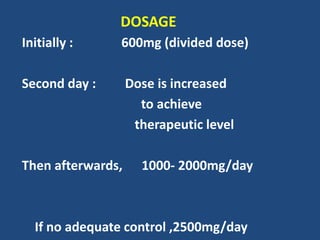
DOSAGE
Initially : 600mg (divided dose)
Second day : Dose is increased
to achieve
therapeutic level
Then afterwards, 1000- 2000mg/day
If no adequate control ,2500mg/day
LABORATORY MONITORING
Prior to treatment
1. Standard chemistry screen with special
attention to liver function tests
2. CBC, including white cell and platelet count
During treatment
1. Liver function tests at 1 month, then every 6
to 24 months if no abnormalities are found
2. Complete blood work with platelet count at
1 month, then every 6 to 24 months if
findings are normal
ADVERSE EFFECTS
Nervous system: Headache, fatigue, sedation,
twitching
Gastrointestinal system: Nausea, diarrhea,
vomiting and constipation
Blood disorder: Prolonged bleeding time,
Anaemia, Leucopenia
Skin problems: Alopecia, rashes and erythema
NURSING INTERVENTIONS
 Intake /output should be monitored.
 Dosing: Give advice to take prescribed
dose.
Give advice not to stop therapy in
between.
 Other medicines: Give advice not to take
any medicine without doctor’s prescription.
 Diet : Give advice to take medicine with
diet.
Take balanced diet.
 Laboratory monitoring: WBC, LFT at every
6-24 months.
 Toxicity: Tell about symptoms of vomiting,
diarrhea.
CLIENT EDUCATION
• Valporate may cause dizziness, drowsiness,
or changes in vision. Use caution while
driving or performing other tasks requiring
alertness.
• Avoid drinking alcohol or taking other
medications that cause drowsiness (eg,
sedatives) while taking Valporate.
• Before you have any medical or dental
treatments, emergency care, or surgery, tell
the doctor or dentist that you are using
Valporate.
• Diabetes patients : it may cause incorrect
test results . So, before adjusting dose of
your medicine, consult the doctor.
• Lab tests, including blood cell counts and liver
function tests, may be performed to monitor side
effects. Consult the doctor if there is elevation of
SGOT, SGPT, bilirubin.
• Use Valporate with extreme caution in CHILDREN
younger than 10 years of age. CHILDREN younger
than 2 years of age may be at increased risk of
serious liver problems.
PREGNANCY and BREAST-FEEDING:
Valporate has been shown to cause harm to
the fetus. If client is pregnant or planning to
conceive, she should tell the doctor . Valporate
is excreted into breast milk. Do not breast-feed
while you are taking Valporate .
CARBAMAZEPINE
MODE OF ACTION
Carbamazepine
Block sodium Activate
receptor Adenosine
at mitochondria
reduction in symptoms
TRADE NAMES
Tegretol : in capsule form
100mg,200mg,300mg
Mazetol : in capsule and tablet
100mg,200mg,300mg
Blood concentration range of
carbamazepine
is 8 – 12 mg/ml
mg/ml
DOSAGE
 Initially : 400mg
to achieve
therapeutic
level 8 – 12 mg/ml
400-1600mg
 Target dose is 1200mg
INDICATIONS
Acute mania
Schizophrenia
Hallucinations
Aggressive behavior
PTSD
Schizoaffective disorder
CONTRAINDICATIONS
Hypersensitivity
Bone marrow suppression
Pregnancy
SIDE EFFECTS
More serious less serious
effects effects
MORE SERIOUS EFFECTS
• fever, sore throat, and headache with a severe
blistering, peeling, and red skin rash
• pale skin, easy bruising or bleeding, unusual
weakness
• white patches or sores inside your mouth or on
your lips
• feeling short of breath, swelling of your ankles
or feet
• nausea, stomach pain, loss of appetite,
jaundice
• oliguria
LESS SERIOUS EFFECTS
• feeling dizzy, drowsy, or unsteady
• vomiting, diarrhea, constipation, stomach
pain
• confusion, headache, blurred vision
• ringing in your ears
• dry mouth, swollen tongue
• joint or muscle pain, leg cramps.
LABORATORY INVESTIGATIONS
 WBC count
 Level of Carbamazepine in blood
monitored weekly
NURSING INTERVENTIONS
 Monitor intake/output
 Give advice to take prescribed
dose
 Give advice not to take any
medicine without doctor’s
prescription.
 Tell client about overdose
symptoms like vomiting, diarrhea,
 Advice client to take
adequate and
balanced
diet.
 Advice client to avoid
grape juice.
 Advice client to take
medicine with food.
CLIENT EDUCATION
Carbamazepine may decrease the blood cell count
which help in fighting against infections. Be sure about
regular monitoring if WBC count .
 Take medicine as prescribed by doctor . Don’t take
large amount without the prescription of physician.
 To have regular eye check up .
Don’t stop it suddenly even if you feel better . It
should be continue upto 4 weeks before your
condition improves.
 Avoid the use of alcohol as it may increase the
risk of seizures.
Avoid exposure to sunlight carbamazepine make
skin more sensitive to sunlight and may cause
sunburn . So , use a sunscreen before or wear
protective clothing while going into sunlight.
Grapefruit juice may interact with it and cause
side effects.
Don’t drive after taking it as it cause drowsiness.
During the use of Carbamazepine ,
suicidal ideation may come during the first
few months of treatment or whenever
dose changes.
 Before taking Carbamazepine, tell doctor
if you are allergic to any drug .
Don’t use it if used MAO’s inhibitors
(isocarboxazid) within past 14 days.
THANKYOU

mood stabilizers.pptx

  • 1.
    MOOD STABILIZERS SUBMITTED TO:SUBMITTED BY: Dr (Mrs) Triza Jiwan Nitika Bhatt Prof & Principal Roll no. 13 Mental Health Nursing Msc (N) 1 st year
  • 2.
    Mood stabilizing agents Amood stabilizer is a psychiatric medication used to treat mood disorders characterized by intense and sustained mood shifts, typically bipolar disorder.
  • 3.
    Lithium carbonate – anelement with atomic no.3 and atomic weight 7 – Smallest alkali ion – Used for gout and for salt replacement in cardiac disease – Use was restricted due to fatal toxicity – Rediscovered in 1949 by john cade for use in treatment of mania
  • 4.
    • Very effectivein treatment of mania so word antimanic is often used • Equally effective in preventing mood swings in bipolar disorders, so the better term is mood stabilizer
  • 5.
    PHARMOKINETICS Lithium GI tract (take 8 hours to absorb) Excreted through kidney
  • 6.
    Indications – treatment ofacute mania – Prophylaxis of bipolar mood disorder – Treatment of schizoaffective disorder – Prophylaxis of unipolar mood disorder – Treatment of cyclothymia – Treatment of acute depression – Treatment of chronic alcoholism
  • 7.
    Contraindications – Hypothyroidism – Hyperthyroidism –Severe infection – Chronic heart failure – Kidney disease – Hypercalcemia – Dehydration – Sodium depletion
  • 8.
    Mechanism of action –Not fully understood but may enhance reuptake of norepinephrine and serotonin decreasing levels in body thus resulting in decreased hyperactivity. – It may take 1-3 weeks for symptoms to subside.
  • 9.
    Preparations Lithium carbonate – 300mgtablets (LICAB 300mg) – 400mg tablets Lithium citrate – 300mg/5ml liquid Dose – Acute mania: 1800- 2400mg/day – Maintenance: 900- 1200mg/day
  • 10.
    LITHIUM IS AVAILABLEAS: TRADE NAME DOSE FORM COLOR 1.Lithane 150,300,600mg Tablet White 2Monolith 400 mg Tablet White 3.Lithocarb 300mg Tablet White Capsule 4.Litonafe 8mEq/5ml Syrup
  • 11.
    Thorough assessment for: –General and systemic physical examination – Routine blood counts – Urine routine – ECG – RFT – TFT(TSH,T3,T4)
  • 12.
    BLOOD LITHIUM LEVELS: –Therapeutic levels: 0.6-1.2meq/l – Prophylactic levels: 0.6-1.0meq/l – Toxic lithium levels: >2meq/l Its very essential to monitor blood lithium levels at regular intervals. Blood sample is taken 12 hrs after the last lithium dose. Next blood level is estimated after at least 7 days of the last change
  • 13.
    LABORATORY INVESTIGATIONS Initially ,Blood levels monitored weekly When therapeutic level achieved Monthly After 1 year stability 3 Monthly Blood sample should be drawn 8 to 12 hours after Last dose of lithium.
  • 14.
    ADVERSE EFFECTS Central nervoussystem: Confusion, Muscle irritability, Tremors etc Cardiovascular system: Arrhythmias, Bradycardia, Hypotension Gastrointestinal system: Perspiration, vomiting, Diarrhea etc. Genitourinary system: Albuminuria, Polyuria
  • 15.
    LITHIUM TOXICITY There isa small range between lithium therapeutic dose and toxic dose of lithium. No specific antidote for lithium poisoning
  • 16.
    Lithium level Symptoms Below1.5 mEq/l (mild) Nausea, vomiting, diarrhea, increased thirst, polyuria, slurred speech, muscle weakness 1.5 to 2 mEq/l (mild to moderate) Persistent GI upset, tremors, confusion, hyperirritability of muscles, sedation or incordination 2 to 2.5 mEq/l (moderate to severe) Moderate to severe intoxication, ataxia, giddiness, high urine output, blurred vision, seizures, stupor, severe hypotension, coma, death >2.5 mEq/l (Severe) Generalized convulsions, oliguria, death SIGN AND SYMPTOMS OF TOXICITY
  • 17.
    MANAGEMENT OF TOXICITY Immediatelyinform the doctor. Discontinue lithium therapy. Give fluids. Monitor lithium level, electrolytes(Na, K, Cl), Renal function test and ECG.  Do gastric lavage, Induction of emesis. If lithium level is > 2.5 do Hemodialysis. Repeat dialysis every 6to10 hours. If patient is having cardiopulmonary arrest, Give CPR and put patient on ventilator.
  • 18.
    Nursing implications forantimanic drugs Nursing implications Side effects Nursing implication Drowsiness, dizziness, headache Ensure that client doesn’t participate in activities that require alertness or operate dangerous machinery Dry mouth, thirst Provide sugarless candies, ice chips, frequent sips of water. GI upset Eat and drink slowly, avoid lactulose, avoid spicy food Fine hand tremors Inform physician who may Decrease dosage or prescribe small dose of beta blockers Hypotension, arrythmias, pulse irregularities Monitor vitals Polyuria, dehydration I/O charting ,skin turgor Weight gain Exercise, Reduced calorie diet, emphasize importance of maintaining adequate intake of sodium
  • 19.
    CLIENT EDUCATION  Dosage– • Advice client to take dose exactly prescribed by doctor. Don’t take dose less or more. • If you miss a dose , take it as soon as possible . Don’t double the dose. • Carry identification card noting that he/she is on lithium.
  • 20.
     Blood test Schedule regular blood tests.  Advice the client to have regular monitoring of Lithium blood level , thyroid function and kidney status .  When going to have Li level checked, you should have taken your last lithium dose 12 hrs earlier.
  • 21.
     Diet andfluid  Avoid sudden changes in your diet or fluid intake. If you do that , then your doctor need to increase the frequency of blood tests.  Caffeine and alcohol act as diuretics and can lower your lithium concentration .  During treatment, drink 2-3 quarts of fluid daily and use normal amount of salt  Inform your doctor if you start or stop a low salt diet.
  • 22.
     Recognizing potentialproblems  If you engage in vigorous exercise or have an illness that causes sweating , vomiting and diarrhea , then consult your doctor because these might affect Li level.  Nausea and constipation, increased thirst , increased micturition , weight gain or swelling of extremities report the doctor.  Blurred vision , confusion , loss of appetite, slurred speech , seizures , loss of balance , diarrhea, vomiting indicate severe toxicity and should consult the doctor immediately.
  • 23.
  • 24.
  • 25.
    INDICATIONS Bipolar disorder Epilepsy FocalGeneralized Mania Prophylaxis
  • 26.
    CONTRAINDICATIONS Hypersensitivity Family history ofsevere hepatitis Thrombocytopenia Pregnancy Lactation
  • 27.
    MODE OF ACTION Valporate Centralnervous system Increase GABA Block sodium Break neuro- Receptors Channel transmitter Glutamine
  • 28.
    PREPARATION AVAILABLE AS: GENERIC NAME TRADE NAME FORMDOSE TIME TO PEAK Valporate sodium Depacon Encorate Injection 100mg/ml 1 hour Valporic Depakane Syrup Capsule 250mg/ml 250mg 1-2 hours
  • 29.
    Divoprex Sodium Depakote tablet 125mg 250mg 500mg 3-8 hours Divalporex sodium Depakotecapsule 125mg 1-2 hours GENERIC NAME TRADE NAME FORM DOSE TIME TO PEAK
  • 30.
    DOSAGE Initially : 600mg(divided dose) Second day : Dose is increased to achieve therapeutic level Then afterwards, 1000- 2000mg/day If no adequate control ,2500mg/day
  • 31.
    LABORATORY MONITORING Prior totreatment 1. Standard chemistry screen with special attention to liver function tests 2. CBC, including white cell and platelet count
  • 32.
    During treatment 1. Liverfunction tests at 1 month, then every 6 to 24 months if no abnormalities are found 2. Complete blood work with platelet count at 1 month, then every 6 to 24 months if findings are normal
  • 33.
    ADVERSE EFFECTS Nervous system:Headache, fatigue, sedation, twitching Gastrointestinal system: Nausea, diarrhea, vomiting and constipation Blood disorder: Prolonged bleeding time, Anaemia, Leucopenia Skin problems: Alopecia, rashes and erythema
  • 34.
    NURSING INTERVENTIONS  Intake/output should be monitored.  Dosing: Give advice to take prescribed dose. Give advice not to stop therapy in between.  Other medicines: Give advice not to take any medicine without doctor’s prescription.
  • 35.
     Diet :Give advice to take medicine with diet. Take balanced diet.  Laboratory monitoring: WBC, LFT at every 6-24 months.  Toxicity: Tell about symptoms of vomiting, diarrhea.
  • 36.
    CLIENT EDUCATION • Valporatemay cause dizziness, drowsiness, or changes in vision. Use caution while driving or performing other tasks requiring alertness. • Avoid drinking alcohol or taking other medications that cause drowsiness (eg, sedatives) while taking Valporate.
  • 37.
    • Before youhave any medical or dental treatments, emergency care, or surgery, tell the doctor or dentist that you are using Valporate. • Diabetes patients : it may cause incorrect test results . So, before adjusting dose of your medicine, consult the doctor.
  • 38.
    • Lab tests,including blood cell counts and liver function tests, may be performed to monitor side effects. Consult the doctor if there is elevation of SGOT, SGPT, bilirubin. • Use Valporate with extreme caution in CHILDREN younger than 10 years of age. CHILDREN younger than 2 years of age may be at increased risk of serious liver problems.
  • 39.
    PREGNANCY and BREAST-FEEDING: Valporatehas been shown to cause harm to the fetus. If client is pregnant or planning to conceive, she should tell the doctor . Valporate is excreted into breast milk. Do not breast-feed while you are taking Valporate .
  • 40.
  • 41.
    MODE OF ACTION Carbamazepine Blocksodium Activate receptor Adenosine at mitochondria reduction in symptoms
  • 42.
    TRADE NAMES Tegretol :in capsule form 100mg,200mg,300mg Mazetol : in capsule and tablet 100mg,200mg,300mg Blood concentration range of carbamazepine is 8 – 12 mg/ml mg/ml
  • 43.
    DOSAGE  Initially :400mg to achieve therapeutic level 8 – 12 mg/ml 400-1600mg  Target dose is 1200mg
  • 44.
  • 45.
  • 46.
    SIDE EFFECTS More seriousless serious effects effects
  • 47.
    MORE SERIOUS EFFECTS •fever, sore throat, and headache with a severe blistering, peeling, and red skin rash • pale skin, easy bruising or bleeding, unusual weakness • white patches or sores inside your mouth or on your lips • feeling short of breath, swelling of your ankles or feet • nausea, stomach pain, loss of appetite, jaundice • oliguria
  • 48.
    LESS SERIOUS EFFECTS •feeling dizzy, drowsy, or unsteady • vomiting, diarrhea, constipation, stomach pain • confusion, headache, blurred vision • ringing in your ears • dry mouth, swollen tongue • joint or muscle pain, leg cramps.
  • 49.
    LABORATORY INVESTIGATIONS  WBCcount  Level of Carbamazepine in blood monitored weekly
  • 50.
    NURSING INTERVENTIONS  Monitorintake/output  Give advice to take prescribed dose  Give advice not to take any medicine without doctor’s prescription.  Tell client about overdose symptoms like vomiting, diarrhea,
  • 51.
     Advice clientto take adequate and balanced diet.  Advice client to avoid grape juice.  Advice client to take medicine with food.
  • 52.
    CLIENT EDUCATION Carbamazepine maydecrease the blood cell count which help in fighting against infections. Be sure about regular monitoring if WBC count .  Take medicine as prescribed by doctor . Don’t take large amount without the prescription of physician.  To have regular eye check up . Don’t stop it suddenly even if you feel better . It should be continue upto 4 weeks before your condition improves.
  • 53.
     Avoid theuse of alcohol as it may increase the risk of seizures. Avoid exposure to sunlight carbamazepine make skin more sensitive to sunlight and may cause sunburn . So , use a sunscreen before or wear protective clothing while going into sunlight. Grapefruit juice may interact with it and cause side effects. Don’t drive after taking it as it cause drowsiness.
  • 54.
    During the useof Carbamazepine , suicidal ideation may come during the first few months of treatment or whenever dose changes.  Before taking Carbamazepine, tell doctor if you are allergic to any drug . Don’t use it if used MAO’s inhibitors (isocarboxazid) within past 14 days.
  • 55.