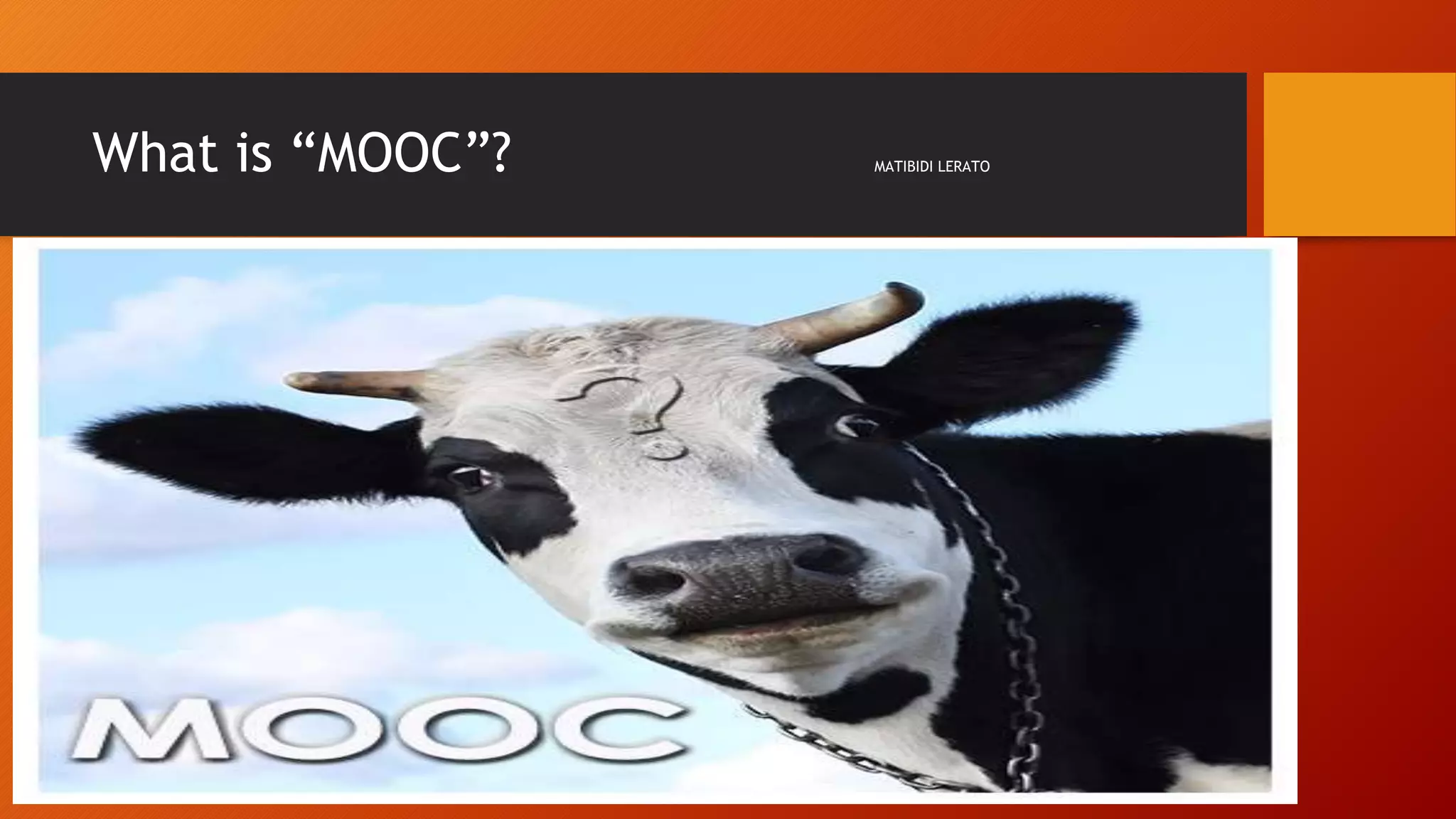

What is “MOOC”? MATIBIDI LERATO
CONTENT
• What does “MOOC” stand for?
• What is meant by “MOOC”?
• Types of “MOOC”.
• History of “MOOC”.
• Field of my interest of study.
• Topic I will like to pursue in my future mooc experience.
What is “MOOC” stand for?
• M-massive.
• O-open.
• O- online.
• C- course.
What is meant by “MOOC”?
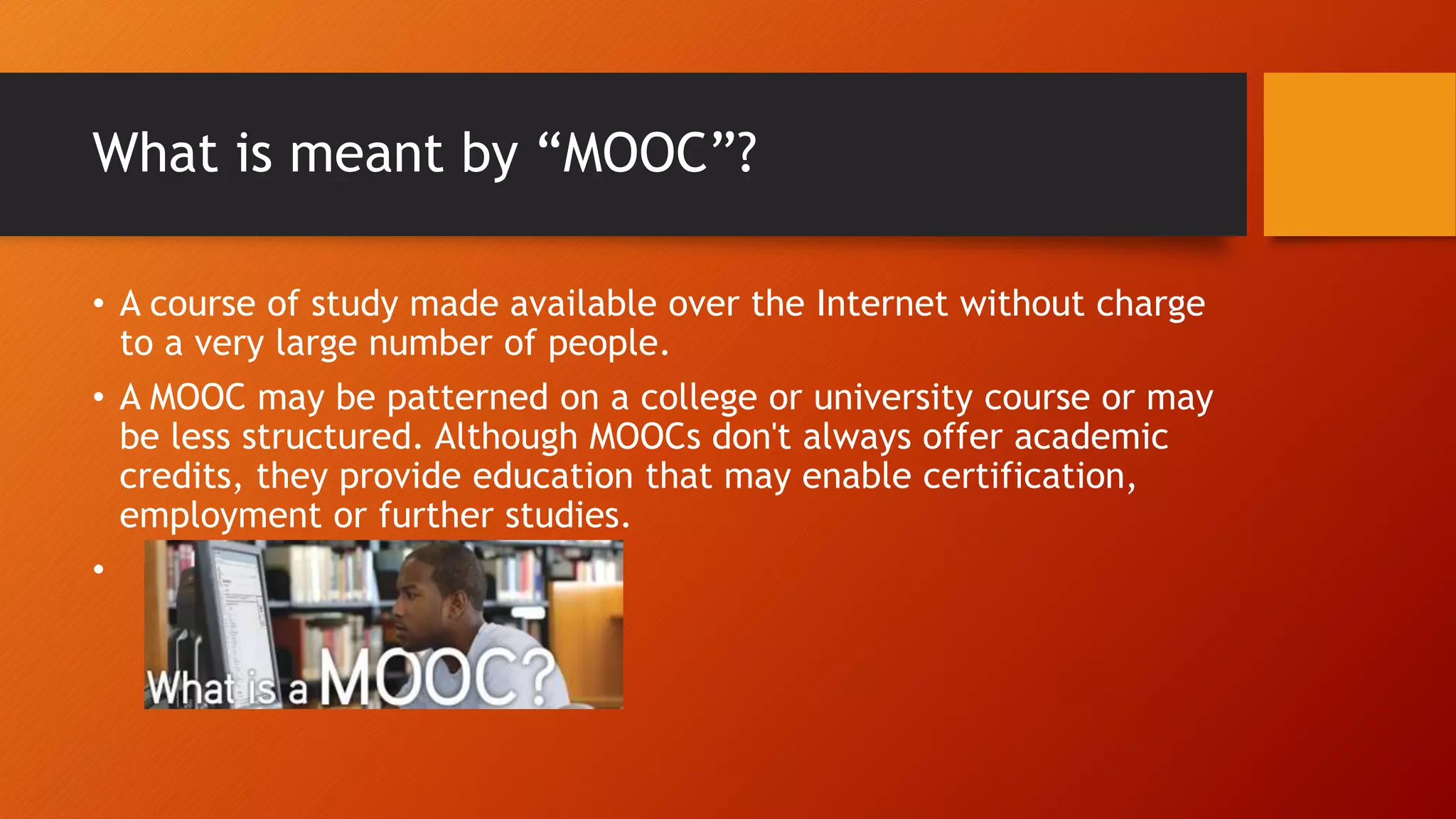
• A course of study made available over the Internet without charge
to a very large number of people.
• A MOOC may be patterned on a college or university course or may
be less structured. Although MOOCs don't always offer academic
credits, they provide education that may enable certification,
employment or further studies.
•
Website to view more.
• www.youtube.com/watch?v=eW3gMGqcZQc
Types of “MOOC”
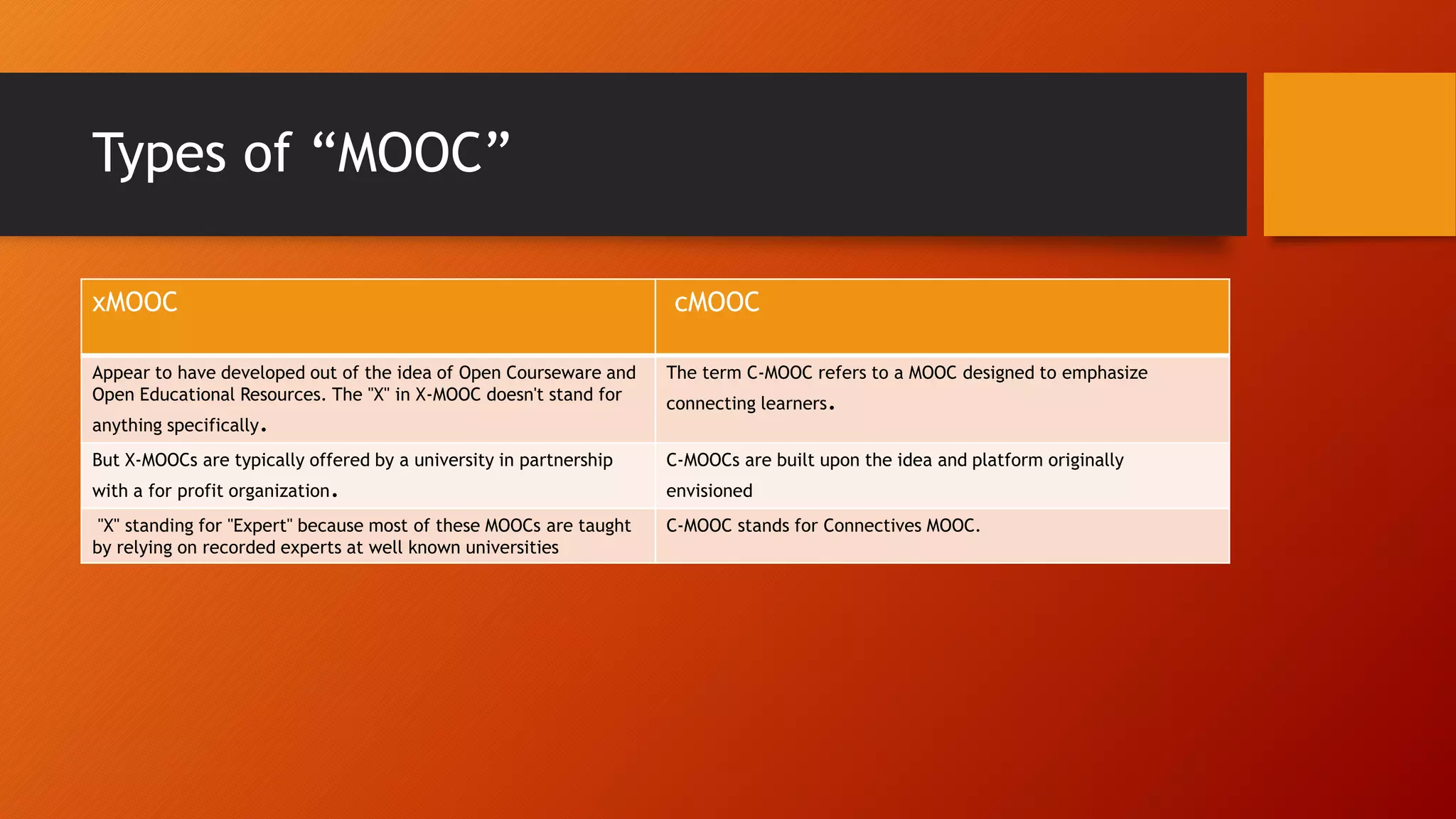
xMOOC cMOOC
Appear to have developed out of the idea of Open Courseware and
Open Educational Resources. The "X" in X-MOOC doesn't stand for
anything specifically.
The term C-MOOC refers to a MOOC designed to emphasize
connecting learners.
But X-MOOCs are typically offered by a university in partnership
with a for profit organization.
C-MOOCs are built upon the idea and platform originally
envisioned
"X" standing for "Expert" because most of these MOOCs are taught
by relying on recorded experts at well known universities
C-MOOC stands for Connectives MOOC.
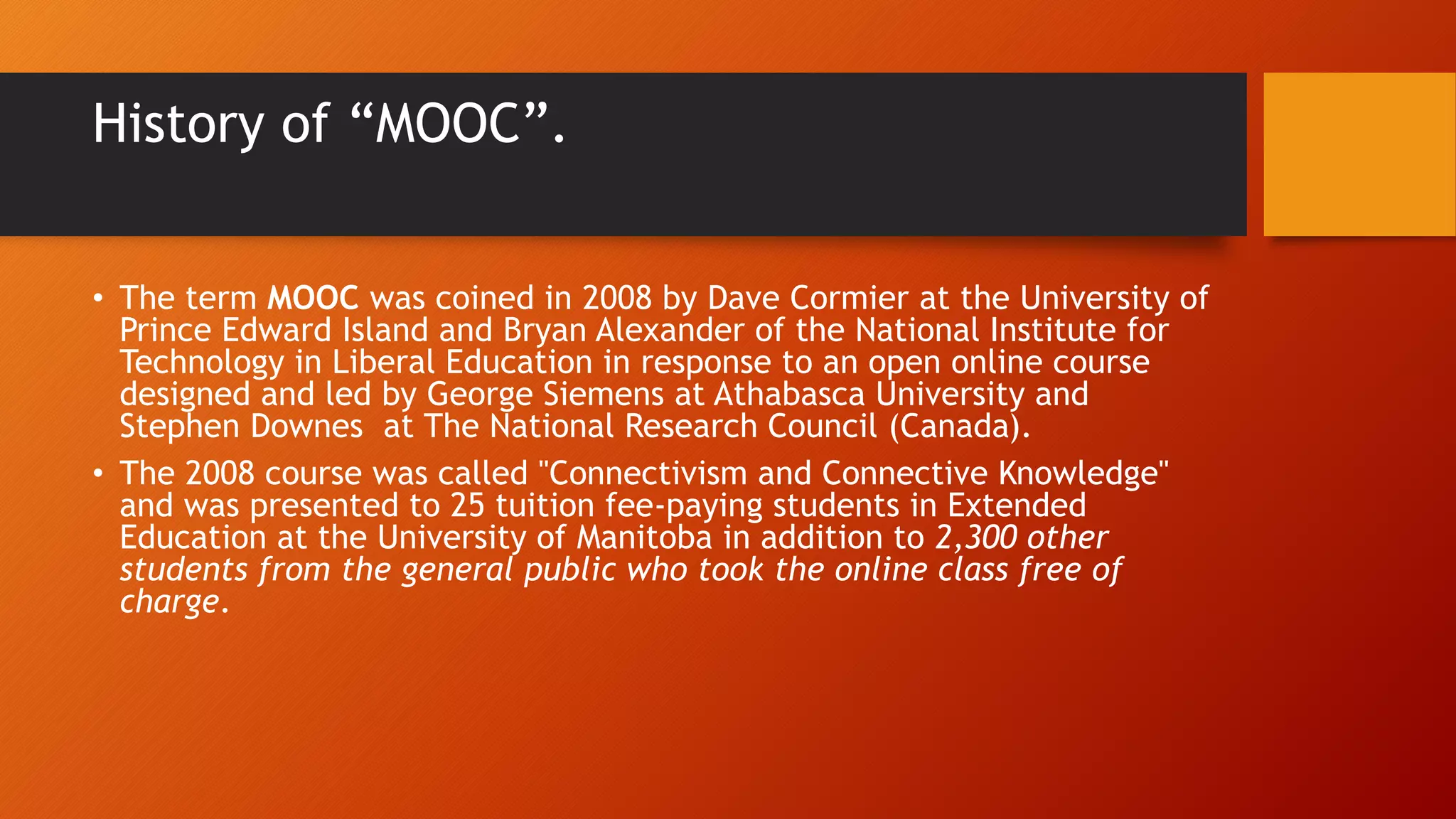
History of “MOOC”.
• The term MOOC was coined in 2008 by Dave Cormier at the University of
Prince Edward Island and Bryan Alexander of the National Institute for
Technology in Liberal Education in response to an open online course
designed and led by George Siemens at Athabasca University and
Stephen Downes at The National Research Council (Canada).
• The 2008 course was called "Connectivism and Connective Knowledge"
and was presented to 25 tuition fee-paying students in Extended
Education at the University of Manitoba in addition to 2,300 other
students from the general public who took the online class free of
charge.
Field of my interest of study.
• Language (Sepedi)
I am interested on hearing the voice of learners being heard in
public. As for “mooc” learners can use is without any charge, I will
use different types of mooc for my leaners to participate in. For
example :
• Grammar
• Poetry
• Literacy
Topic I will like to pursue in my future mooc
experience
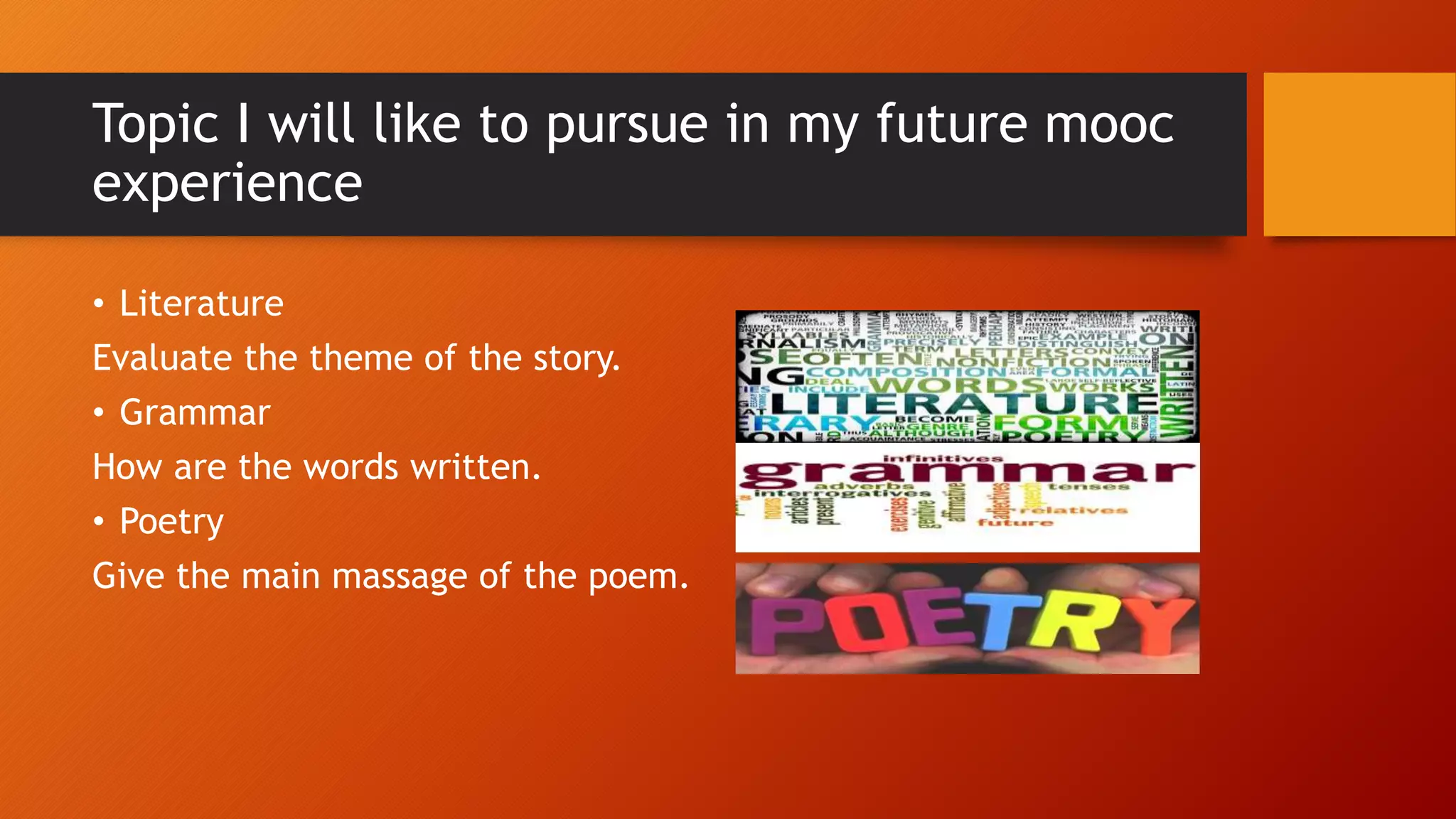
• Literature
Evaluate the theme of the story.
• Grammar
How are the words written.
• Poetry
Give the main massage of the poem.
Reference
 http://www.slideshare.net/oerafrica/the-rise-of-moocs o
 http://www.slideshare.net/LynGoodnight/multmedia-presentation-goodnight o
 http://www.slideshare.net/Downes/2013-05-06-moose o
 http://www.slideshare.net/Downes/education-as-platform?from_search=11 o
 http://www.slideshare.net/Downes/how-to-organize-a-mooc?from_search=9
 www.youtube.com/watch?v=eW3gMGqcZQc
MOOC ONE WAY!!!!!

Hitory of Mooc.

  • 1.
    What is “MOOC”?MATIBIDI LERATO
  • 2.
    CONTENT • What does“MOOC” stand for? • What is meant by “MOOC”? • Types of “MOOC”. • History of “MOOC”. • Field of my interest of study. • Topic I will like to pursue in my future mooc experience.
  • 3.
    What is “MOOC”stand for? • M-massive. • O-open. • O- online. • C- course.
  • 4.
    What is meantby “MOOC”? • A course of study made available over the Internet without charge to a very large number of people. • A MOOC may be patterned on a college or university course or may be less structured. Although MOOCs don't always offer academic credits, they provide education that may enable certification, employment or further studies. •
  • 5.
    Website to viewmore. • www.youtube.com/watch?v=eW3gMGqcZQc
  • 6.
    Types of “MOOC” xMOOCcMOOC Appear to have developed out of the idea of Open Courseware and Open Educational Resources. The "X" in X-MOOC doesn't stand for anything specifically. The term C-MOOC refers to a MOOC designed to emphasize connecting learners. But X-MOOCs are typically offered by a university in partnership with a for profit organization. C-MOOCs are built upon the idea and platform originally envisioned "X" standing for "Expert" because most of these MOOCs are taught by relying on recorded experts at well known universities C-MOOC stands for Connectives MOOC.
  • 7.
    History of “MOOC”. •The term MOOC was coined in 2008 by Dave Cormier at the University of Prince Edward Island and Bryan Alexander of the National Institute for Technology in Liberal Education in response to an open online course designed and led by George Siemens at Athabasca University and Stephen Downes at The National Research Council (Canada). • The 2008 course was called "Connectivism and Connective Knowledge" and was presented to 25 tuition fee-paying students in Extended Education at the University of Manitoba in addition to 2,300 other students from the general public who took the online class free of charge.
  • 8.
    Field of myinterest of study. • Language (Sepedi) I am interested on hearing the voice of learners being heard in public. As for “mooc” learners can use is without any charge, I will use different types of mooc for my leaners to participate in. For example : • Grammar • Poetry • Literacy
  • 9.
    Topic I willlike to pursue in my future mooc experience • Literature Evaluate the theme of the story. • Grammar How are the words written. • Poetry Give the main massage of the poem.
  • 10.
    Reference  http://www.slideshare.net/oerafrica/the-rise-of-moocs o http://www.slideshare.net/LynGoodnight/multmedia-presentation-goodnight o  http://www.slideshare.net/Downes/2013-05-06-moose o  http://www.slideshare.net/Downes/education-as-platform?from_search=11 o  http://www.slideshare.net/Downes/how-to-organize-a-mooc?from_search=9  www.youtube.com/watch?v=eW3gMGqcZQc
  • 11.