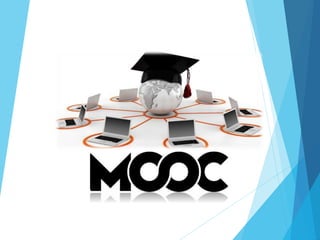
MOOCs
PRESENTATION
WHAT IS A MOOC?
 A massive online course (mooc) is a free web-based
distance learning program that is designed for the
participation of large numbers of geographically
dispersed students(whatis.techtarget.com).
 It is a model for learning content online to any person
who wants to take a course, with no limit on
attendance(educase.edu).
 The word MOOC was coined in 2008 by Dave
Cormier, from the University of Prince Edward
Island for a course offered by the University of
Manitoba, “Connectivism and Connective
Knowledge.”
 There were 25tuition-paying student from the
university and 2300 non-paying students from the
general public who took the course online. The
RSS feeds for material and participation was
facilitated through a variety if venues including
Moodle (a learning management system),blog
posts, Second life and real-time online meetings.
HISTORY CONTINUED...
 IN 2011, the Massachusetts Institute of Technology (MIT)
OpenCourseWare (OCW) became the first large
collections of MOOC resources made available by a
University. In 2012, MIT and Harvard university
spearheaded the edX initiative for the promotion of
MOOCs.
 The acronym MOC is pronounced with a ling oo sound,
to rhyme with kook rather than book. The Oxford online
dictionary added the term (as “Mooc”) in August 2013.
ADVANTAGES OF MOOCs
 They provide education that may enable certification,
employment and further studies.
 It is patterned on a college or university course or may
be less structured.
 They inform and shape what we do within and without
institutions.
 Provide no limits to attendance.
 It is for the whole society.
DISADVANTAGES OF MOOCs
 They do not always offer academic credits
 May not handle the pressure of self learning
Types of MOOCs
 Transfer MOOCs
 Made MOOCs
 Synchronous MOOCs
 Asynchronous MOOCs
 Adaptive MOOCs
 Group MOOCs
 Connectivist MOOCs
 Mini MOOCs
MY CHOSEN MOOCS
 I will be doing a MOOC about microbiology and forensic
science.
 Forensic microbiology is about the tracking of viral
transmission and bacteriorism. It is the study of micro-
organisms and how they can be used to help in the
society.
E.N.D
REFERENCES
 Clark .D. (2013). Taxonomy of MOOCs. Adapted from
http://donaldclark.blogspot.co.uk/search?q=MOOCs:+ta
xonomy. Accessed on 17 February 2014
 Rouse .M. Wigmore .I. (2013). Distance learning.
Adapted from
http://whatis.techtarget.com/definition/massively-
open-online-course-MOOC. Accessed on 17 February
2014
 Dune .j. (2013). Things you should know about MOOCs.
Adapted from
http://www.educase.edu/library/massive-open-online-
course-mooc. Accessed on 18 February 2014

Moo cs presentation (1)

  • 1.
  • 2.
    WHAT IS AMOOC?  A massive online course (mooc) is a free web-based distance learning program that is designed for the participation of large numbers of geographically dispersed students(whatis.techtarget.com).  It is a model for learning content online to any person who wants to take a course, with no limit on attendance(educase.edu).
  • 3.
     The wordMOOC was coined in 2008 by Dave Cormier, from the University of Prince Edward Island for a course offered by the University of Manitoba, “Connectivism and Connective Knowledge.”  There were 25tuition-paying student from the university and 2300 non-paying students from the general public who took the course online. The RSS feeds for material and participation was facilitated through a variety if venues including Moodle (a learning management system),blog posts, Second life and real-time online meetings.
  • 4.
    HISTORY CONTINUED...  IN2011, the Massachusetts Institute of Technology (MIT) OpenCourseWare (OCW) became the first large collections of MOOC resources made available by a University. In 2012, MIT and Harvard university spearheaded the edX initiative for the promotion of MOOCs.  The acronym MOC is pronounced with a ling oo sound, to rhyme with kook rather than book. The Oxford online dictionary added the term (as “Mooc”) in August 2013.
  • 5.
    ADVANTAGES OF MOOCs They provide education that may enable certification, employment and further studies.  It is patterned on a college or university course or may be less structured.  They inform and shape what we do within and without institutions.  Provide no limits to attendance.  It is for the whole society.
  • 6.
    DISADVANTAGES OF MOOCs They do not always offer academic credits  May not handle the pressure of self learning
  • 7.
    Types of MOOCs Transfer MOOCs  Made MOOCs  Synchronous MOOCs  Asynchronous MOOCs  Adaptive MOOCs  Group MOOCs  Connectivist MOOCs  Mini MOOCs
  • 8.
    MY CHOSEN MOOCS I will be doing a MOOC about microbiology and forensic science.  Forensic microbiology is about the tracking of viral transmission and bacteriorism. It is the study of micro- organisms and how they can be used to help in the society.
  • 9.
  • 10.
    REFERENCES  Clark .D.(2013). Taxonomy of MOOCs. Adapted from http://donaldclark.blogspot.co.uk/search?q=MOOCs:+ta xonomy. Accessed on 17 February 2014  Rouse .M. Wigmore .I. (2013). Distance learning. Adapted from http://whatis.techtarget.com/definition/massively- open-online-course-MOOC. Accessed on 17 February 2014  Dune .j. (2013). Things you should know about MOOCs. Adapted from http://www.educase.edu/library/massive-open-online- course-mooc. Accessed on 18 February 2014