Monitoring Milestones
 1969 - Health Department stream monitoring
 1984 - Gunston Cove ecological study
 1986 - Kingstowne environmental monitoring program
 1998 - Stream Protection Strategy
 2002 - Perennial streams mapping project
 2002 - Stream Physical Assessment
 2003 - Watershed management plan development
 2007 - UGSG gages partnership/study
2
Early Surface Water
Monitoring
…any open, unprotected body of water is subject to pollution from indiscriminate dumping of
litter and waste products, sewer line breaks and contamination from runoff
pesticides, herbicides, and waste from domestic and wildlife animals. Therefore, the use of
streams for contact recreational purposes, such as swimming, wading, etc., which could cause
ingestion of stream water or possible contamination of an open wound by stream
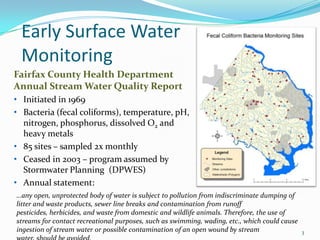
Fairfax County Health Department
Annual Stream Water Quality Report
• Initiated in 1969
• Bacteria (fecal coliforms), temperature, pH,
nitrogen, phosphorus, dissolved O2 and
heavy metals
• 85 sites – sampled 2x monthly
• Ceased in 2003 – program assumed by
Stormwater Planning (DPWES)
• Annual statement:
3
Early Surface Water Quality Monitoring
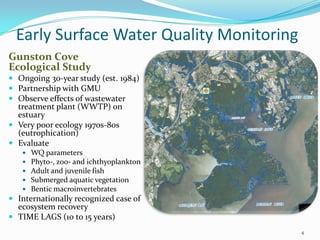
Gunston Cove
Ecological Study
 Ongoing 30-year study (est. 1984)
 Partnership with GMU
 Observe effects of wastewater
treatment plant (WWTP) on
estuary
 Very poor ecology 1970s-80s
(eutrophication)
 Evaluate
 WQ parameters
 Phyto-, zoo- and ichthyoplankton
 Adult and juvenile fish
 Submerged aquatic vegetation
 Bentic macroinvertebrates
 Internationally recognized case of
ecosystem recovery
 TIME LAGS (10 to 15 years)
4
Early Surface Water Quality Monitoring
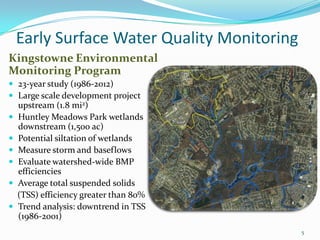
Kingstowne Environmental
Monitoring Program
 23-year study (1986-2012)
 Large scale development project
upstream (1.8 mi2)
 Huntley Meadows Park wetlands
downstream (1,500 ac)
 Potential siltation of wetlands
 Measure storm and baseflows
 Evaluate watershed-wide BMP
efficiencies
 Average total suspended solids
(TSS) efficiency greater than 80%
 Trend analysis: downtrend in TSS
(1986-2001)
5
Stream Biological Monitoring Program
6
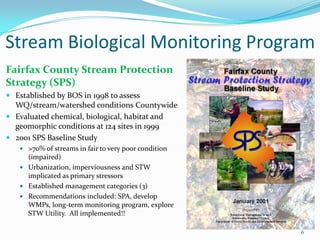
Fairfax County Stream Protection
Strategy (SPS)
 Established by BOS in 1998 to assess
WQ/stream/watershed conditions Countywide
 Evaluated chemical, biological, habitat and
geomorphic conditions at 124 sites in 1999
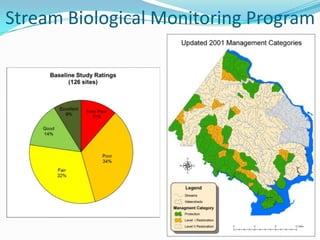
 2001 SPS Baseline Study
 >70% of streams in fair to very poor condition
(impaired)
 Urbanization, imperviousness and STW
implicated as primary stressors
 Established management categories (3)
 Recommendations included: SPA, develop
WMPs, long-term monitoring program, explore
STW Utility. All implemented!!
Stream Biological Monitoring Program
7
Stratified-random evaluation framework (2004)
 Similar to VA’s probabilistic monitoring
program
 Sites stratified by stream order (1st – 5th)
 Statistically valid way to make inferences on
countywide stream condition
40 sites selected annually. Sampled for:
 Benthic Macroinvertebrates (spring)
 Fish and habitat (summer)
 Bacteria (quarterly)
 Water quality (every visit)
 12 reference sites
Annual Stream Quality Index (SQI) [score 1-5]
Stream Biological
Monitoring Program
8
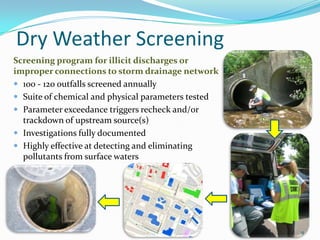
Dry Weather Screening
Screening program for illicit discharges or
improper connections to storm drainage network
100 - 120 outfalls screened annually
Suite of chemical and physical parameters tested
Parameter exceedance triggers recheck and/or
trackdown of upstream source(s)
Investigations fully documented
Highly effective at detecting and eliminating
pollutants from surface waters
9
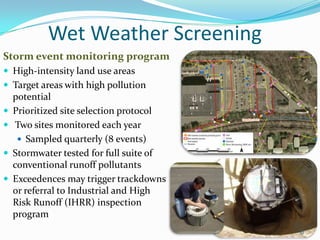
Wet Weather Screening
Storm event monitoring program
 High-intensity land use areas
 Target areas with high pollution
potential
 Prioritized site selection protocol
 Two sites monitored each year
 Sampled quarterly (8 events)
 Stormwater tested for full suite of
conventional runoff pollutants
 Exceedences may trigger trackdowns
or referral to Industrial and High
Risk Runoff (IHRR) inspection
program
10
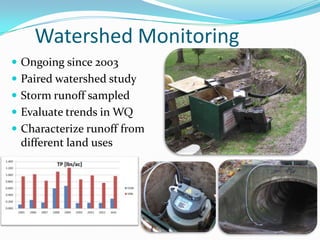
Watershed Monitoring
 Ongoing since 2003
 Paired watershed study
 Storm runoff sampled
 Evaluate trends in WQ
 Characterize runoff from
different land uses
11
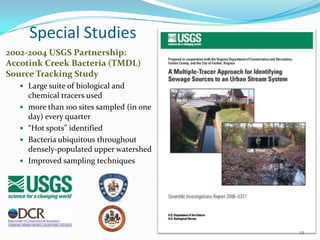
Special Studies
2002-2004 USGS Partnership:
Accotink Creek Bacteria (TMDL)
Source Tracking Study
 Large suite of biological and
chemical tracers used
 more than 100 sites sampled (in one
day) every quarter
 “Hot spots” identified
 Bacteria ubiquitous throughout
densely-populated upper watershed
 Improved sampling techniques
12
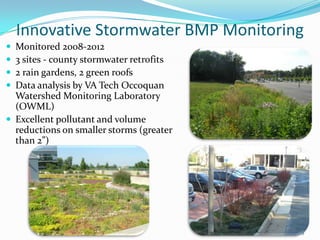
Innovative Stormwater BMP Monitoring
 Monitored 2008-2012
 3 sites - county stormwater retrofits
 2 rain gardens, 2 green roofs
 Data analysis by VA Tech Occoquan
Watershed Monitoring Laboratory
(OWML)
 Excellent pollutant and volume
reductions on smaller storms (greater
than 2”)
13
Innovative Stormwater
BMP Monitoring
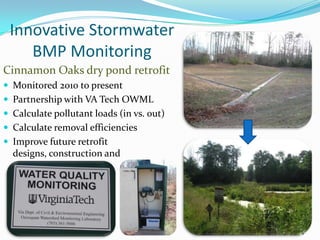
Cinnamon Oaks dry pond retrofit
 Monitored 2010 to present
 Partnership with VA Tech OWML
 Calculate pollutant loads (in vs. out)
 Calculate removal efficiencies
 Improve future retrofit
designs, construction and
maintenance
14
Lake Studies
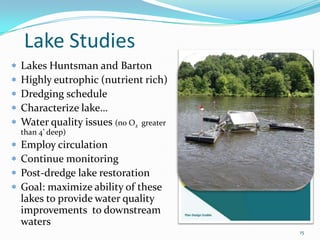
Lakes Huntsman and Barton
Highly eutrophic (nutrient rich)
Dredging schedule
Characterize lake…
Water quality issues (no O2 greater
than 4’ deep)
Employ circulation
Continue monitoring
Post-dredge lake restoration
Goal: maximize ability of these
lakes to provide water quality
improvements to downstream
waters
15
USGS Partnership: Stream Gaging Study
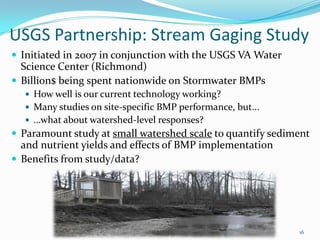
 Initiated in 2007 in conjunction with the USGS VA Water
Science Center (Richmond)
 Billion$ being spent nationwide on Stormwater BMPs
 How well is our current technology working?
 Many studies on site-specific BMP performance, but...
 …what about watershed-level responses?
 Paramount study at small watershed scale to quantify sediment
and nutrient yields and effects of BMP implementation
 Benefits from study/data?
16
Stream Gage Study with USGS
Objectives:
1. Generate long-term monitoring data to describe:
 Current water-quality conditions
 Trends in water-quality, nutrient and sediment
loads and yields
2. Evaluate relations between observed
conditions/trends and BMP implementation.
3. Transfer the understanding gained to other less-
intensively monitored watersheds.
17
Gage Study: Objective #1
18
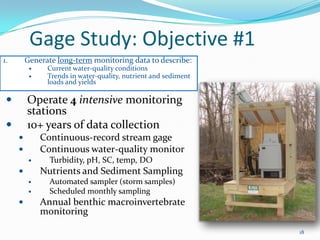
 Operate 4 intensive monitoring
stations
 10+ years of data collection
 Continuous-record stream gage
 Continuous water-quality monitor
 Turbidity, pH, SC, temp, DO
 Nutrients and Sediment Sampling
 Automated sampler (storm samples)
 Scheduled monthly sampling
 Annual benthic macroinvertebrate
monitoring
1. Generate long-term monitoring data to describe:
 Current water-quality conditions
 Trends in water-quality, nutrient and sediment
loads and yields
Gage Study: Objective #2
19
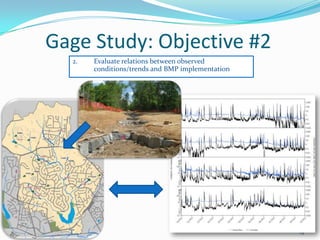
2. Evaluate relations between observed
conditions/trends and BMP implementation
Gage Study: Objective #3
20
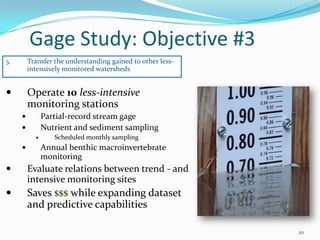
 Operate 10 less-intensive
monitoring stations
 Partial-record stream gage
 Nutrient and sediment sampling
 Scheduled monthly sampling
 Annual benthic macroinvertebrate
monitoring
 Evaluate relations between trend - and
intensive monitoring sites
 Saves $$$ while expanding dataset
and predictive capabilities
3. Transfer the understanding gained to other less-
intensively monitored watersheds
Gage Study:
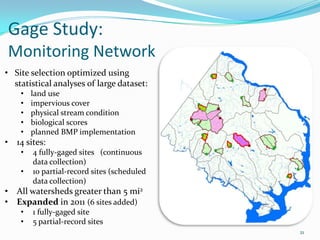
Monitoring Network
21
• Site selection optimized using
statistical analyses of large dataset:
• land use
• impervious cover
• physical stream condition
• biological scores
• planned BMP implementation
• 14 sites:
• 4 fully-gaged sites (continuous
data collection)
• 10 partial-record sites (scheduled
data collection)
• All watersheds greater than 5 mi2
• Expanded in 2011 (6 sites added)
• 1 fully-gaged site
• 5 partial-record sites
Gage Study: Data Analyses and
Benefits
 Rich dataset allows for enormous amount of robust analyses
 Characterize baseline conditions after 5 years
 Trend analysis after 10+ years
 Ultimately show effect of BMPs on watersheds
 Unanticipated learning (Triassic basin P)
 Data inform restoration designs
 Publication imminent (1st five yrs. data)
 Several “piggyback” studies describing:
 Floodplain dynamics
 Sediment transport
 Stream metabolism
22
Gage Study: Data Analyses & Benefits
23
 Compare to other systems
 Atlanta urban streams
 North Carolina study
 Occoquan watershed
 USGS bay-wide network
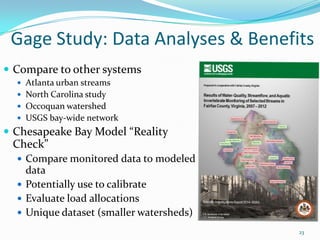
 Chesapeake Bay Model “Reality
Check”
 Compare monitored data to modeled
data
 Potentially use to calibrate
 Evaluate load allocations
 Unique dataset (smaller watersheds)
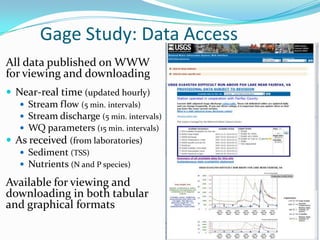
Gage Study: Data Access
All data published on WWW
for viewing and downloading
 Near-real time (updated hourly)
 Stream flow (5 min. intervals)
 Stream discharge (5 min. intervals)
 WQ parameters (15 min. intervals)
 As received (from laboratories)
 Sediment (TSS)
 Nutrients (N and P species)
Available for viewing and
downloading in both tabular
and graphical formats
24
So… what do we know??
25
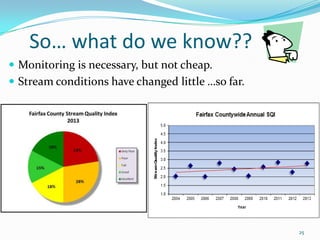
 Monitoring is necessary, but not cheap.
 Stream conditions have changed little …so far.
So… what do we know??
26
 Time lags are REAL – results don’t manifest overnight.
 Cleaning up Stormwater runoff is technically challenging
and expensive – but we’re definitely getting better!
 Floodplains, wetlands and other preserved natural areas are
providing beneficial functions
 Urban streams may never recover full functionality…
 Likely need to target for “best attainable conditions”
 No “silver bullet” cure. Will require multi-faceted approach
 Government(s) can not do it alone
Thank you.
 Shannon Curtis, Ecologist IV
 Stormwater Planning Division
 Department of Public Works and Environmental
Services
 Fairfax County
 703-324-5500, TTY 711
 www.fairfaxcounty.gov/dpwes/stormwater
 A Fairfax County Publication, April 2014
27

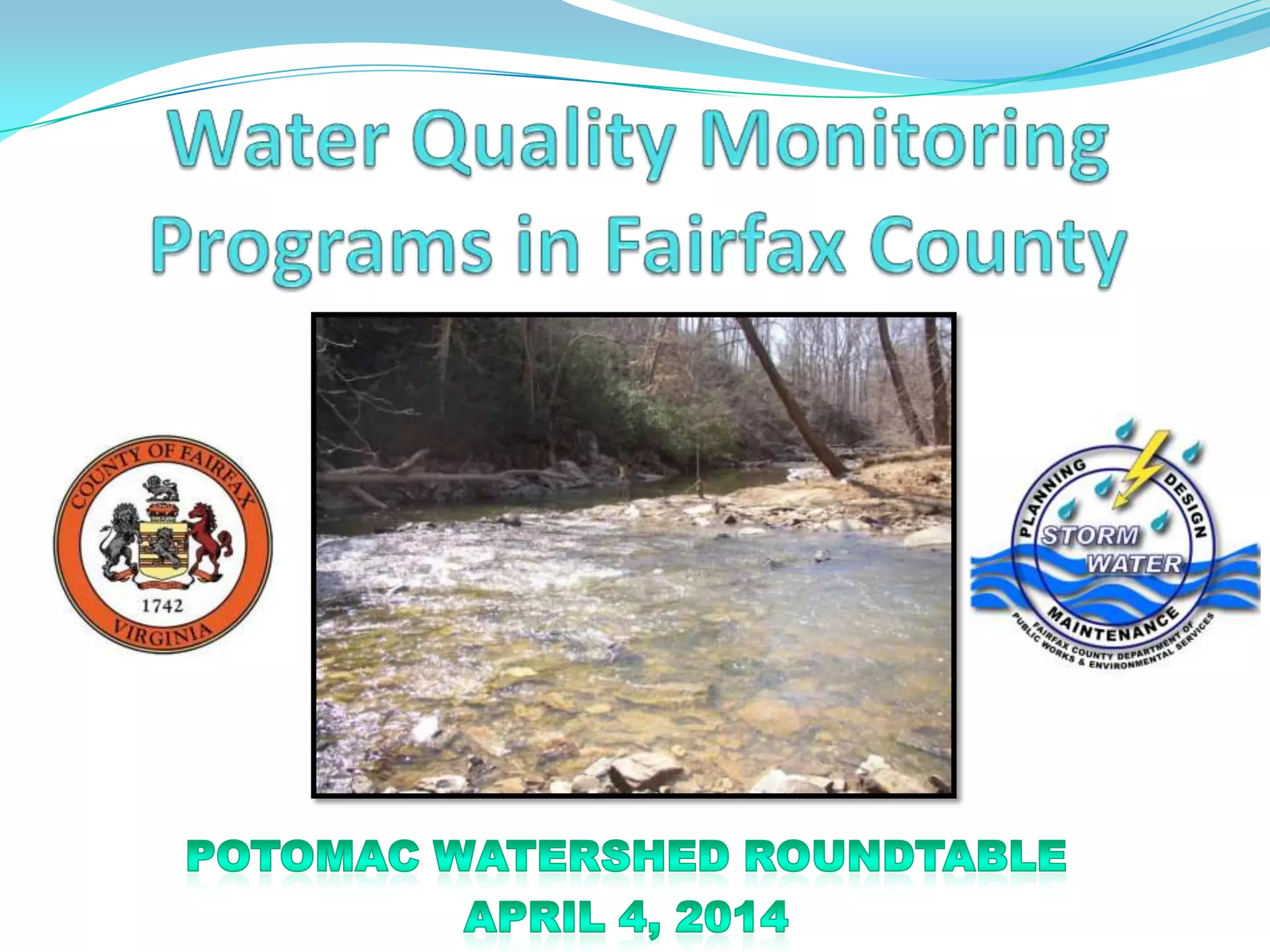
Water Quality Monitoring Programs in Fairfax County, April 2014

  • 2.
    Monitoring Milestones  1969- Health Department stream monitoring  1984 - Gunston Cove ecological study  1986 - Kingstowne environmental monitoring program  1998 - Stream Protection Strategy  2002 - Perennial streams mapping project  2002 - Stream Physical Assessment  2003 - Watershed management plan development  2007 - UGSG gages partnership/study 2
  • 3.
    Early Surface Water Monitoring …anyopen, unprotected body of water is subject to pollution from indiscriminate dumping of litter and waste products, sewer line breaks and contamination from runoff pesticides, herbicides, and waste from domestic and wildlife animals. Therefore, the use of streams for contact recreational purposes, such as swimming, wading, etc., which could cause ingestion of stream water or possible contamination of an open wound by stream Fairfax County Health Department Annual Stream Water Quality Report • Initiated in 1969 • Bacteria (fecal coliforms), temperature, pH, nitrogen, phosphorus, dissolved O2 and heavy metals • 85 sites – sampled 2x monthly • Ceased in 2003 – program assumed by Stormwater Planning (DPWES) • Annual statement: 3
  • 4.
    Early Surface WaterQuality Monitoring Gunston Cove Ecological Study  Ongoing 30-year study (est. 1984)  Partnership with GMU  Observe effects of wastewater treatment plant (WWTP) on estuary  Very poor ecology 1970s-80s (eutrophication)  Evaluate  WQ parameters  Phyto-, zoo- and ichthyoplankton  Adult and juvenile fish  Submerged aquatic vegetation  Bentic macroinvertebrates  Internationally recognized case of ecosystem recovery  TIME LAGS (10 to 15 years) 4
  • 5.
    Early Surface WaterQuality Monitoring Kingstowne Environmental Monitoring Program  23-year study (1986-2012)  Large scale development project upstream (1.8 mi2)  Huntley Meadows Park wetlands downstream (1,500 ac)  Potential siltation of wetlands  Measure storm and baseflows  Evaluate watershed-wide BMP efficiencies  Average total suspended solids (TSS) efficiency greater than 80%  Trend analysis: downtrend in TSS (1986-2001) 5
  • 6.
    Stream Biological MonitoringProgram 6 Fairfax County Stream Protection Strategy (SPS)  Established by BOS in 1998 to assess WQ/stream/watershed conditions Countywide  Evaluated chemical, biological, habitat and geomorphic conditions at 124 sites in 1999  2001 SPS Baseline Study  >70% of streams in fair to very poor condition (impaired)  Urbanization, imperviousness and STW implicated as primary stressors  Established management categories (3)  Recommendations included: SPA, develop WMPs, long-term monitoring program, explore STW Utility. All implemented!!
  • 7.
  • 8.
    Stratified-random evaluation framework(2004)  Similar to VA’s probabilistic monitoring program  Sites stratified by stream order (1st – 5th)  Statistically valid way to make inferences on countywide stream condition 40 sites selected annually. Sampled for:  Benthic Macroinvertebrates (spring)  Fish and habitat (summer)  Bacteria (quarterly)  Water quality (every visit)  12 reference sites Annual Stream Quality Index (SQI) [score 1-5] Stream Biological Monitoring Program 8
  • 9.
    Dry Weather Screening Screeningprogram for illicit discharges or improper connections to storm drainage network 100 - 120 outfalls screened annually Suite of chemical and physical parameters tested Parameter exceedance triggers recheck and/or trackdown of upstream source(s) Investigations fully documented Highly effective at detecting and eliminating pollutants from surface waters 9
  • 10.
    Wet Weather Screening Stormevent monitoring program  High-intensity land use areas  Target areas with high pollution potential  Prioritized site selection protocol  Two sites monitored each year  Sampled quarterly (8 events)  Stormwater tested for full suite of conventional runoff pollutants  Exceedences may trigger trackdowns or referral to Industrial and High Risk Runoff (IHRR) inspection program 10
  • 11.
    Watershed Monitoring  Ongoingsince 2003  Paired watershed study  Storm runoff sampled  Evaluate trends in WQ  Characterize runoff from different land uses 11
  • 12.
    Special Studies 2002-2004 USGSPartnership: Accotink Creek Bacteria (TMDL) Source Tracking Study  Large suite of biological and chemical tracers used  more than 100 sites sampled (in one day) every quarter  “Hot spots” identified  Bacteria ubiquitous throughout densely-populated upper watershed  Improved sampling techniques 12
  • 13.
    Innovative Stormwater BMPMonitoring  Monitored 2008-2012  3 sites - county stormwater retrofits  2 rain gardens, 2 green roofs  Data analysis by VA Tech Occoquan Watershed Monitoring Laboratory (OWML)  Excellent pollutant and volume reductions on smaller storms (greater than 2”) 13
  • 14.
    Innovative Stormwater BMP Monitoring CinnamonOaks dry pond retrofit  Monitored 2010 to present  Partnership with VA Tech OWML  Calculate pollutant loads (in vs. out)  Calculate removal efficiencies  Improve future retrofit designs, construction and maintenance 14
  • 15.
    Lake Studies Lakes Huntsmanand Barton Highly eutrophic (nutrient rich) Dredging schedule Characterize lake… Water quality issues (no O2 greater than 4’ deep) Employ circulation Continue monitoring Post-dredge lake restoration Goal: maximize ability of these lakes to provide water quality improvements to downstream waters 15
  • 16.
    USGS Partnership: StreamGaging Study  Initiated in 2007 in conjunction with the USGS VA Water Science Center (Richmond)  Billion$ being spent nationwide on Stormwater BMPs  How well is our current technology working?  Many studies on site-specific BMP performance, but...  …what about watershed-level responses?  Paramount study at small watershed scale to quantify sediment and nutrient yields and effects of BMP implementation  Benefits from study/data? 16
  • 17.
    Stream Gage Studywith USGS Objectives: 1. Generate long-term monitoring data to describe:  Current water-quality conditions  Trends in water-quality, nutrient and sediment loads and yields 2. Evaluate relations between observed conditions/trends and BMP implementation. 3. Transfer the understanding gained to other less- intensively monitored watersheds. 17
  • 18.
    Gage Study: Objective#1 18  Operate 4 intensive monitoring stations  10+ years of data collection  Continuous-record stream gage  Continuous water-quality monitor  Turbidity, pH, SC, temp, DO  Nutrients and Sediment Sampling  Automated sampler (storm samples)  Scheduled monthly sampling  Annual benthic macroinvertebrate monitoring 1. Generate long-term monitoring data to describe:  Current water-quality conditions  Trends in water-quality, nutrient and sediment loads and yields
  • 19.
    Gage Study: Objective#2 19 2. Evaluate relations between observed conditions/trends and BMP implementation
  • 20.
    Gage Study: Objective#3 20  Operate 10 less-intensive monitoring stations  Partial-record stream gage  Nutrient and sediment sampling  Scheduled monthly sampling  Annual benthic macroinvertebrate monitoring  Evaluate relations between trend - and intensive monitoring sites  Saves $$$ while expanding dataset and predictive capabilities 3. Transfer the understanding gained to other less- intensively monitored watersheds
  • 21.
    Gage Study: Monitoring Network 21 •Site selection optimized using statistical analyses of large dataset: • land use • impervious cover • physical stream condition • biological scores • planned BMP implementation • 14 sites: • 4 fully-gaged sites (continuous data collection) • 10 partial-record sites (scheduled data collection) • All watersheds greater than 5 mi2 • Expanded in 2011 (6 sites added) • 1 fully-gaged site • 5 partial-record sites
  • 22.
    Gage Study: DataAnalyses and Benefits  Rich dataset allows for enormous amount of robust analyses  Characterize baseline conditions after 5 years  Trend analysis after 10+ years  Ultimately show effect of BMPs on watersheds  Unanticipated learning (Triassic basin P)  Data inform restoration designs  Publication imminent (1st five yrs. data)  Several “piggyback” studies describing:  Floodplain dynamics  Sediment transport  Stream metabolism 22
  • 23.
    Gage Study: DataAnalyses & Benefits 23  Compare to other systems  Atlanta urban streams  North Carolina study  Occoquan watershed  USGS bay-wide network  Chesapeake Bay Model “Reality Check”  Compare monitored data to modeled data  Potentially use to calibrate  Evaluate load allocations  Unique dataset (smaller watersheds)
  • 24.
    Gage Study: DataAccess All data published on WWW for viewing and downloading  Near-real time (updated hourly)  Stream flow (5 min. intervals)  Stream discharge (5 min. intervals)  WQ parameters (15 min. intervals)  As received (from laboratories)  Sediment (TSS)  Nutrients (N and P species) Available for viewing and downloading in both tabular and graphical formats 24
  • 25.
    So… what dowe know?? 25  Monitoring is necessary, but not cheap.  Stream conditions have changed little …so far.
  • 26.
    So… what dowe know?? 26  Time lags are REAL – results don’t manifest overnight.  Cleaning up Stormwater runoff is technically challenging and expensive – but we’re definitely getting better!  Floodplains, wetlands and other preserved natural areas are providing beneficial functions  Urban streams may never recover full functionality…  Likely need to target for “best attainable conditions”  No “silver bullet” cure. Will require multi-faceted approach  Government(s) can not do it alone
  • 27.
    Thank you.  ShannonCurtis, Ecologist IV  Stormwater Planning Division  Department of Public Works and Environmental Services  Fairfax County  703-324-5500, TTY 711  www.fairfaxcounty.gov/dpwes/stormwater  A Fairfax County Publication, April 2014 27

Editor's Notes

  • #3 First stream WQ monitoring program started by HDSPS at the core of our monitoring programsPerennial Streams – developed evaluation protocol and applied to all headwater streamsresulted in countywide map and expanded protection of riparian buffers for water quality benefitsPerennial Streams - added 330 miles (63% increase)RPAs – 17 square miles new bufferSPA– evaluated 850 miles of stream countywideWMPs – 7 years developing plans. Identified 1,700 projects at cost of $800M – lot of work to do!USGS gages – will be large focus of this presentation
  • #7 Move on to our CORE monitoring programs that are ONGOING.Stream program is at the HEART of our monitoring programs
  • #8 Move on to our CORE monitoring programs that are ONGOING.Stream program is at the HEART of our monitoring programs