Surface Water and Groundwater
Status
Donal Daly
Hydrometric & Groundwater Section
Environmental Protection Agency

Acknowledgement: Colleagues in EPA and on WFD Groundwater Working Group
Water Freamework Directive
Water Status
“A measure of the present”
Status is the key element determining
the measures to be employed in the
Reliability Based Decoding Management
Plans to achieve the objectives of the
Water Framework Directive
Based on an evaluation of:
pressures, physical settings and
monitoring results
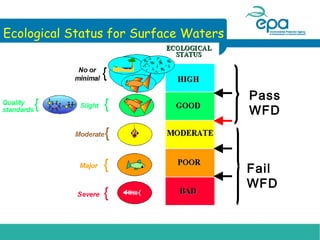
Ecological Status for Surface Waters

Pass
WFD

Fail
WFD
Interim Status Assessment of
Rivers
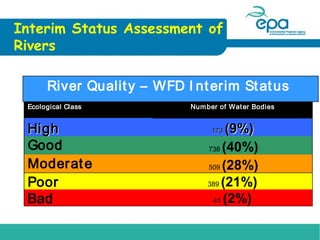
River Qualit y – WFD I nt erim St at us
Ecological Class

Hi g h
Good
Moderat e
Poor
Bad

Num ber of Wat er Bodies

(9%)
738 (40%)
509 (28%)
389 (21%)
41 (2%)
173
Interim Status Assessment
of Lakes
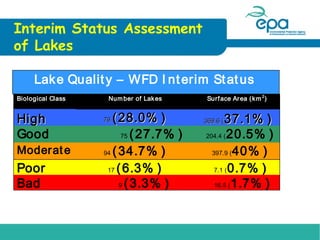
Lak e Qualit y – WFD I nt erim St at us
Biological Class

Hi g h
Good
Moder at e

Poor
Bad

Num ber of Lak es

( 2 8 .0 % )
75 ( 27.7% )
94 ( 34.7% )
17 ( 6.3% )
9 ( 3.3% )
76

Surf ace Ar ea ( k m 2 )

3 7 .1 % )
204.4 ( 20.5% )
397.9 ( 40% )
7.1 ( 0.7% )
16.5 ( 1.7% )

369.6 (
Main Causes of “less than good”
Status Surface Water Bodies

 Discharges from Wastewater Treatment
Plants (nutrients)
 Diffuse Agriculture (resulting in inputs
of Phosphorus and N)
 Forestry (sediment and Phosphorus)
 Urban areas
Groundwa
ter
boundary
Aquifer
boundary
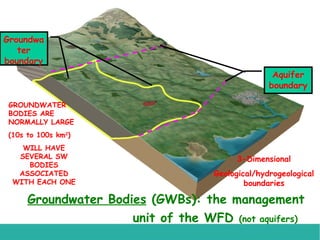
GROUNDWATER
BODIES ARE
NORMALLY LARGE
(10s to 100s km2)
WILL HAVE
SEVERAL SW
BODIES
ASSOCIATED
WITH EACH ONE

3-Dimensional
Geological/hydrogeological
boundaries

Groundwater Bodies (GWBs): the management
unit of the WFD (not aquifers)
Groundwater Status
 Groundwater Directive
The overall aim of the WFD is to achieve
“Good Status” for all GWBs by 2015
Status
Scale: Status assesses Average GWB
Conditions
Local issues are managed under site
specific “Prevent or Limit” legislation, but
they may still impact on status
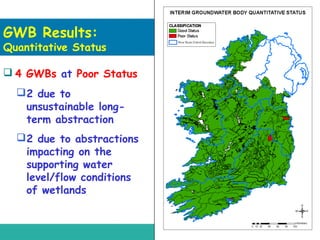
GWB Results:

Quantitative Status
 4 GWBs at Poor Status
 2 due to
unsustainable longterm abstraction
 2 due to abstractions
impacting on the
supporting water
level/flow conditions
of wetlands
GWB Results:
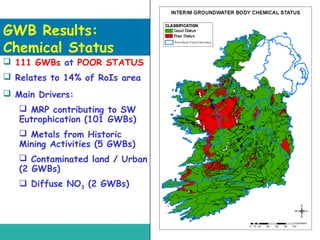
Chemical Status

 111 GWBs at POOR STATUS
 Relates to 14% of RoIs area
 Main Drivers:
 MRP contributing to SW
Eutrophication (101 GWBs)
 Metals from Historic
Mining Activities (5 GWBs)
 Contaminated land / Urban
(2 GWBs)
 Diffuse NO3 (2 GWBs)
Issues Arising (Selected)
1) Nitrogen & trac waters and sea lettuce
2) Groundwater as an input and a pathway to
surface water
3) Groundwater Dependent Terrestrial
Ecosystems
4) Phosphate in groundwater impacting on surface
water ecosystems
5) Groundwater Threshold Values
6) High status sites
7) Nitrate Trends
Who undertakes water
body classification?
 Environment Protection Agency
undertakes and is responsible for this
work

Small Stream Risk Score method not
used for status; but part of investigative
monitoring
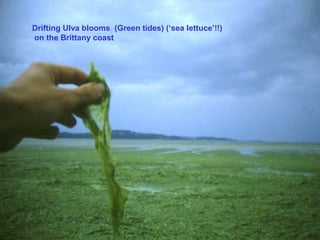
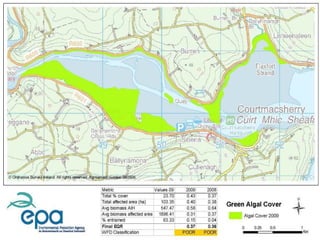
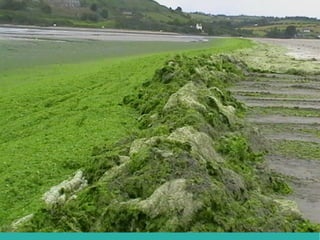
Drifting Ulva blooms (Green tides) (‘sea lettuce’!!)
on the Brittany coast
N
s
Nitrogen, TRAC Waters
and Sea Lettuce


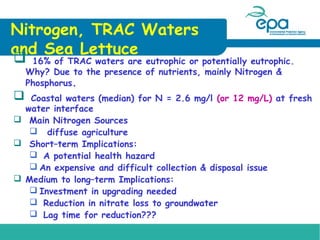
16% of TRAC waters are eutrophic or potentially eutrophic.
Why? Due to the presence of nutrients, mainly Nitrogen &
Phosphorus.



Coastal waters (median) for N = 2.6 mg/l (or 12 mg/L) at fresh
water interface
 Main Nitrogen Sources
 diffuse agriculture
 Short–term Implications:
 A potential health hazard
 An expensive and difficult collection & disposal issue
 Medium to long–term Implications:
 Investment in upgrading needed
 Reduction in nitrate loss to groundwater
 Lag time for reduction???
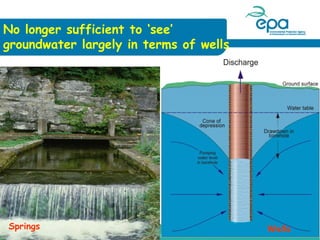
No longer sufficient to ‘see’
groundwater largely in terms of wells

Springs

Wells
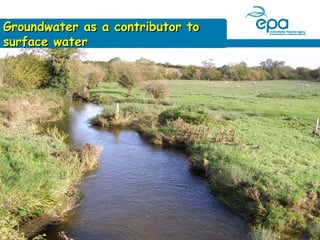
Groundwater as a contributor to
surface water
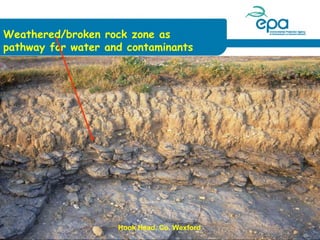
Weathered/broken rock zone as
pathway for water and contaminants

Hook Head, Co. Wexford
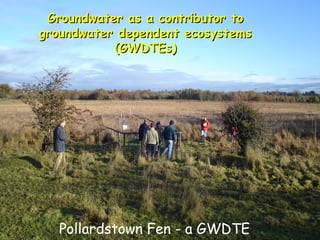
Groundwater as a contributor to
groundwater dependent ecosystems
(GWDTEs)

Pollardstown Fen - a GWDTE
Surface of Groundwater
Progress

 Very little

 Environmental Supporting Conditions not
known:

 Nitrogen & Phosphorus environmental quality
standards needed
 groundwater level and flow conditions
Phosphate in GW:
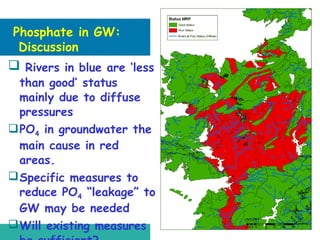
Discussion

 Rivers in blue are ‘less

than good’ status
mainly due to diffuse
pressures
 PO4 in groundwater the
main cause in red
areas.
 Specific measures to
reduce PO4 “leakage” to
GW may be needed
 Will existing measures
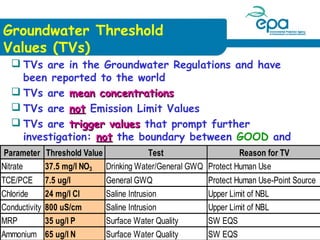
Groundwater Threshold
Values (TVs)
 TVs are in the Groundwater Regulations and have
been reported to the world
 TVs are mean concentrations
 TVs are not Emission Limit Values
 TVs are trigger values that prompt further
investigation: not the boundary between GOOD and
POOR status
Parameter Threshold Value
Test
Reason for TV

must NO
Nitrate TVs 37.5 mg/lbe 3 appropriate to the receptor, e.g.
Drinking Water/General GWQ Protect Human Use
Human
TCE/PCE s 7.5 ug/l use (drinking water)
General GWQ
Surface
Chloride s 24 mg/l Cl water Saline Intrusion
s Wetlands
Conductivity 800 uS/cm
Saline Intrusion
MRP
35 ug/l P
Surface Water Quality
Ammonium 65 ug/l N
Surface Water Quality

Protect Human Use-Point Source
Upper Limit of NBL
Upper Limit of NBL
SW EQS
SW EQS
High Status Surface
Water Bodies


9% of rivers and 28% of lakes.
 Number of high quality river sites halved in last 20
years.
 High status Water Bodies are critical to species
biodiversity
 Deterioration to ‘good’ not allowed, therefore
measures to prevent this of critical importance and a
high priority
 Sensitive to pressures (forestry, farming, peat
extraction, rural housing) so ‘low level’ activities may
cause the deterioration
 Additional measures to protect these areas likely to
be needed
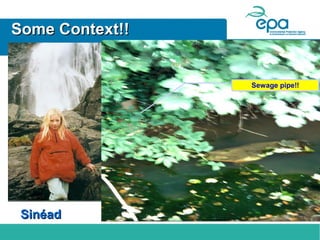
Some Context!!

Sewage pipe!!

holiday house in
west of Ireland
Sinéad

The Stray Cat
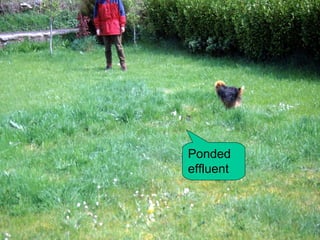
Ponded
effluent

26
27
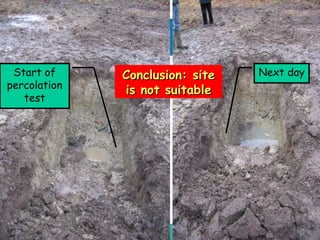
Start of
percolation
test

Next day

Conclusion: site
is not suitable

28
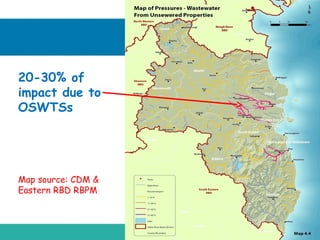
20-30% of
impact due to
OSWTSs

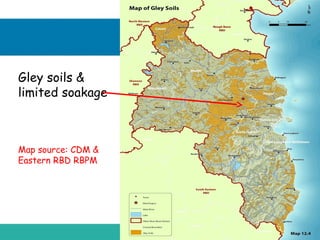
Map source: CDM &
Eastern RBD RBPM
Gley soils &
limited soakage

Map source: CDM &
Eastern RBD RBPM
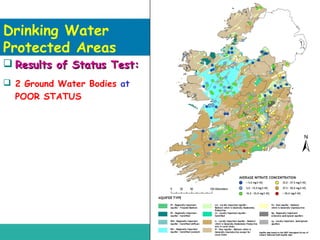
Drinking Water
Protected Areas
 Results of Status Test:
 2 Ground Water Bodies at
POOR STATUS
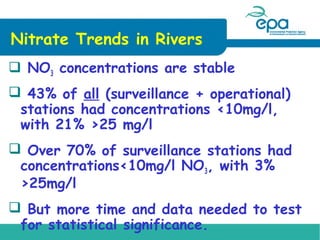
Nitrate Trends in Rivers
 NO3 concentrations are stable
 43% of all (surveillance + operational)
stations had concentrations <10mg/l,
with 21% >25 mg/l
 Over 70% of surveillance stations had
concentrations<10mg/l NO3, with 3%
>25mg/l
 But more time and data needed to test
for statistical significance.
Groundwater Surface 

File download,22803,en (2)

  • 1.
    Surface Water andGroundwater Status Donal Daly Hydrometric & Groundwater Section Environmental Protection Agency Acknowledgement: Colleagues in EPA and on WFD Groundwater Working Group
  • 2.
    Water Freamework Directive WaterStatus “A measure of the present” Status is the key element determining the measures to be employed in the Reliability Based Decoding Management Plans to achieve the objectives of the Water Framework Directive Based on an evaluation of: pressures, physical settings and monitoring results
  • 3.
    Ecological Status forSurface Waters Pass WFD Fail WFD
  • 4.
    Interim Status Assessmentof Rivers River Qualit y – WFD I nt erim St at us Ecological Class Hi g h Good Moderat e Poor Bad Num ber of Wat er Bodies (9%) 738 (40%) 509 (28%) 389 (21%) 41 (2%) 173
  • 5.
    Interim Status Assessment ofLakes Lak e Qualit y – WFD I nt erim St at us Biological Class Hi g h Good Moder at e Poor Bad Num ber of Lak es ( 2 8 .0 % ) 75 ( 27.7% ) 94 ( 34.7% ) 17 ( 6.3% ) 9 ( 3.3% ) 76 Surf ace Ar ea ( k m 2 ) 3 7 .1 % ) 204.4 ( 20.5% ) 397.9 ( 40% ) 7.1 ( 0.7% ) 16.5 ( 1.7% ) 369.6 (
  • 6.
    Main Causes of“less than good” Status Surface Water Bodies  Discharges from Wastewater Treatment Plants (nutrients)  Diffuse Agriculture (resulting in inputs of Phosphorus and N)  Forestry (sediment and Phosphorus)  Urban areas
  • 7.
    Groundwa ter boundary Aquifer boundary GROUNDWATER BODIES ARE NORMALLY LARGE (10sto 100s km2) WILL HAVE SEVERAL SW BODIES ASSOCIATED WITH EACH ONE 3-Dimensional Geological/hydrogeological boundaries Groundwater Bodies (GWBs): the management unit of the WFD (not aquifers)
  • 8.
    Groundwater Status  GroundwaterDirective The overall aim of the WFD is to achieve “Good Status” for all GWBs by 2015 Status Scale: Status assesses Average GWB Conditions Local issues are managed under site specific “Prevent or Limit” legislation, but they may still impact on status
  • 9.
    GWB Results: Quantitative Status 4 GWBs at Poor Status  2 due to unsustainable longterm abstraction  2 due to abstractions impacting on the supporting water level/flow conditions of wetlands
  • 10.
    GWB Results: Chemical Status 111 GWBs at POOR STATUS  Relates to 14% of RoIs area  Main Drivers:  MRP contributing to SW Eutrophication (101 GWBs)  Metals from Historic Mining Activities (5 GWBs)  Contaminated land / Urban (2 GWBs)  Diffuse NO3 (2 GWBs)
  • 11.
    Issues Arising (Selected) 1)Nitrogen & trac waters and sea lettuce 2) Groundwater as an input and a pathway to surface water 3) Groundwater Dependent Terrestrial Ecosystems 4) Phosphate in groundwater impacting on surface water ecosystems 5) Groundwater Threshold Values 6) High status sites 7) Nitrate Trends
  • 12.
    Who undertakes water bodyclassification?  Environment Protection Agency undertakes and is responsible for this work Small Stream Risk Score method not used for status; but part of investigative monitoring
  • 13.
    Drifting Ulva blooms(Green tides) (‘sea lettuce’!!) on the Brittany coast
  • 15.
  • 16.
    Nitrogen, TRAC Waters andSea Lettuce  16% of TRAC waters are eutrophic or potentially eutrophic. Why? Due to the presence of nutrients, mainly Nitrogen & Phosphorus.  Coastal waters (median) for N = 2.6 mg/l (or 12 mg/L) at fresh water interface  Main Nitrogen Sources  diffuse agriculture  Short–term Implications:  A potential health hazard  An expensive and difficult collection & disposal issue  Medium to long–term Implications:  Investment in upgrading needed  Reduction in nitrate loss to groundwater  Lag time for reduction???
  • 17.
    No longer sufficientto ‘see’ groundwater largely in terms of wells Springs Wells
  • 18.
    Groundwater as acontributor to surface water
  • 19.
    Weathered/broken rock zoneas pathway for water and contaminants Hook Head, Co. Wexford
  • 20.
    Groundwater as acontributor to groundwater dependent ecosystems (GWDTEs) Pollardstown Fen - a GWDTE
  • 21.
    Surface of Groundwater Progress Very little  Environmental Supporting Conditions not known:  Nitrogen & Phosphorus environmental quality standards needed  groundwater level and flow conditions
  • 22.
    Phosphate in GW: Discussion Rivers in blue are ‘less than good’ status mainly due to diffuse pressures  PO4 in groundwater the main cause in red areas.  Specific measures to reduce PO4 “leakage” to GW may be needed  Will existing measures
  • 23.
    Groundwater Threshold Values (TVs) TVs are in the Groundwater Regulations and have been reported to the world  TVs are mean concentrations  TVs are not Emission Limit Values  TVs are trigger values that prompt further investigation: not the boundary between GOOD and POOR status Parameter Threshold Value Test Reason for TV  must NO Nitrate TVs 37.5 mg/lbe 3 appropriate to the receptor, e.g. Drinking Water/General GWQ Protect Human Use Human TCE/PCE s 7.5 ug/l use (drinking water) General GWQ Surface Chloride s 24 mg/l Cl water Saline Intrusion s Wetlands Conductivity 800 uS/cm Saline Intrusion MRP 35 ug/l P Surface Water Quality Ammonium 65 ug/l N Surface Water Quality Protect Human Use-Point Source Upper Limit of NBL Upper Limit of NBL SW EQS SW EQS
  • 24.
    High Status Surface WaterBodies  9% of rivers and 28% of lakes.  Number of high quality river sites halved in last 20 years.  High status Water Bodies are critical to species biodiversity  Deterioration to ‘good’ not allowed, therefore measures to prevent this of critical importance and a high priority  Sensitive to pressures (forestry, farming, peat extraction, rural housing) so ‘low level’ activities may cause the deterioration  Additional measures to protect these areas likely to be needed
  • 25.
    Some Context!! Sewage pipe!! holidayhouse in west of Ireland Sinéad The Stray Cat
  • 26.
  • 27.
  • 28.
  • 29.
    20-30% of impact dueto OSWTSs Map source: CDM & Eastern RBD RBPM
  • 30.
    Gley soils & limitedsoakage Map source: CDM & Eastern RBD RBPM
  • 31.
    Drinking Water Protected Areas Results of Status Test:  2 Ground Water Bodies at POOR STATUS
  • 32.
    Nitrate Trends inRivers  NO3 concentrations are stable  43% of all (surveillance + operational) stations had concentrations <10mg/l, with 21% >25 mg/l  Over 70% of surveillance stations had concentrations<10mg/l NO3, with 3% >25mg/l  But more time and data needed to test for statistical significance.
  • 33.

Editor's Notes

  • #18 Here’s a spring in leitrim, which has a great supply. Groundwater is flowing from a pure bedded limestone – see the bedding planes – and utilising the bedding planes to flow along. Unfortunately, this spring was polluted by nearby farming activities, so it is no longer used.