NoSQL Database
Akshay Mathur
Sarang Shravagi
@akshaymathu, @_sarangs
{name: ‘mongo’, type: ‘db’}
Who uses MongoDB
@akshaymathu, @_sarangs 2

Let’s Know Each Other
• Do you code?
• OS?
• Programing Language?
• Why are you attending?
@akshaymathu, @_sarangs 3
Akshay Mathur
• Managed development, testing and
release teams in last 14+ years
– Currently Principal Architect at ShopSocially
• Founding Team Member of
– ShopSocially (Enabling “social” for retailers)
– AirTight Neworks (Global leader of WIPS)
@akshaymathu, @_sarangs 4
Sarang Shravagi
• 10gen Certified Developer and DBA
• CS graduate from PICT Pune
• 3+ years in Software Product industry
• Currently Senior Full-stack Developer at
ShopSocially
@akshaymathu, @_sarangs 5
How we use MongoDB
@akshaymathu, @_sarangs 6
Python MongoDB
MongoEngine
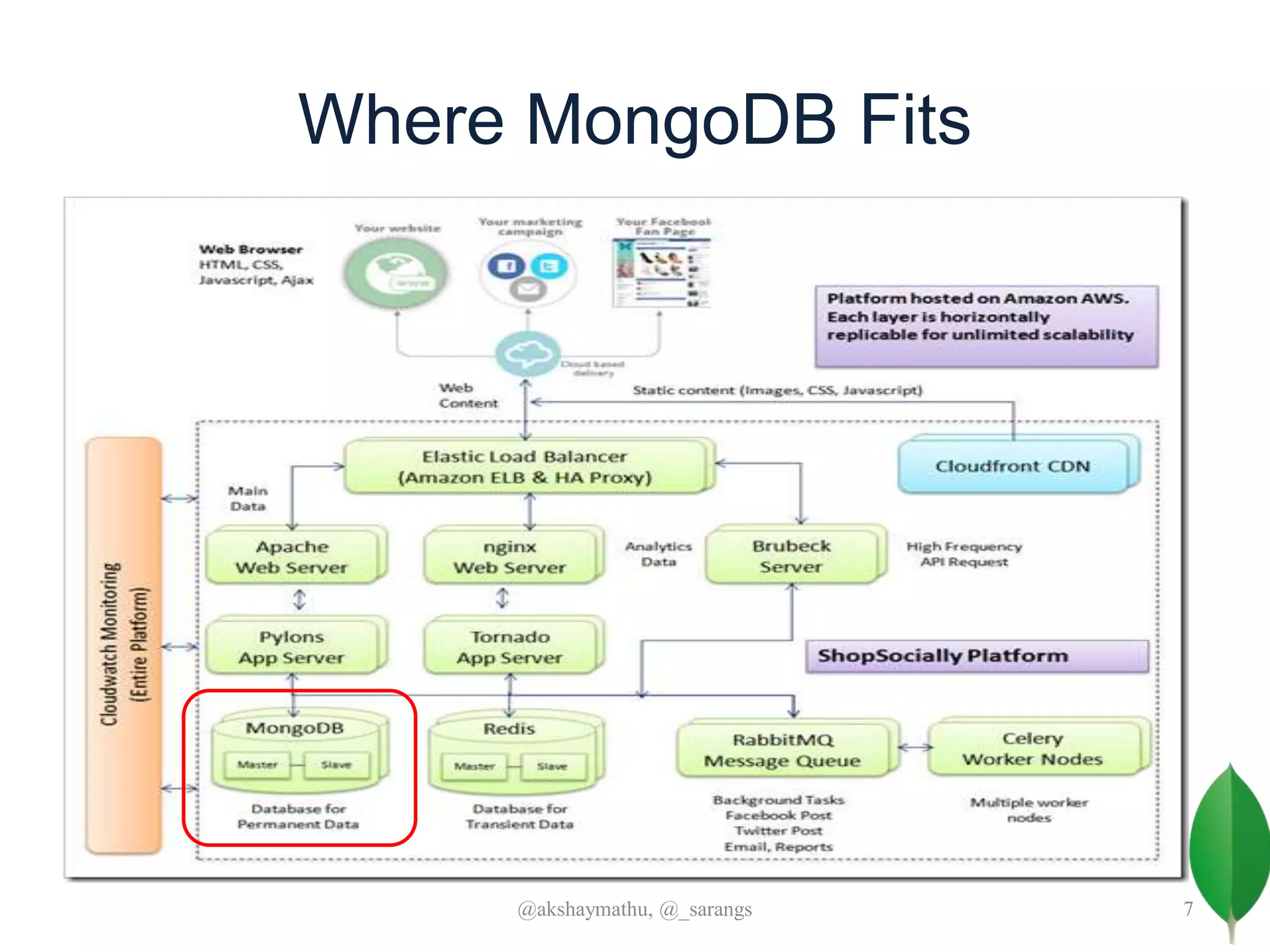
Where MongoDB Fits
@akshaymathu, @_sarangs 7
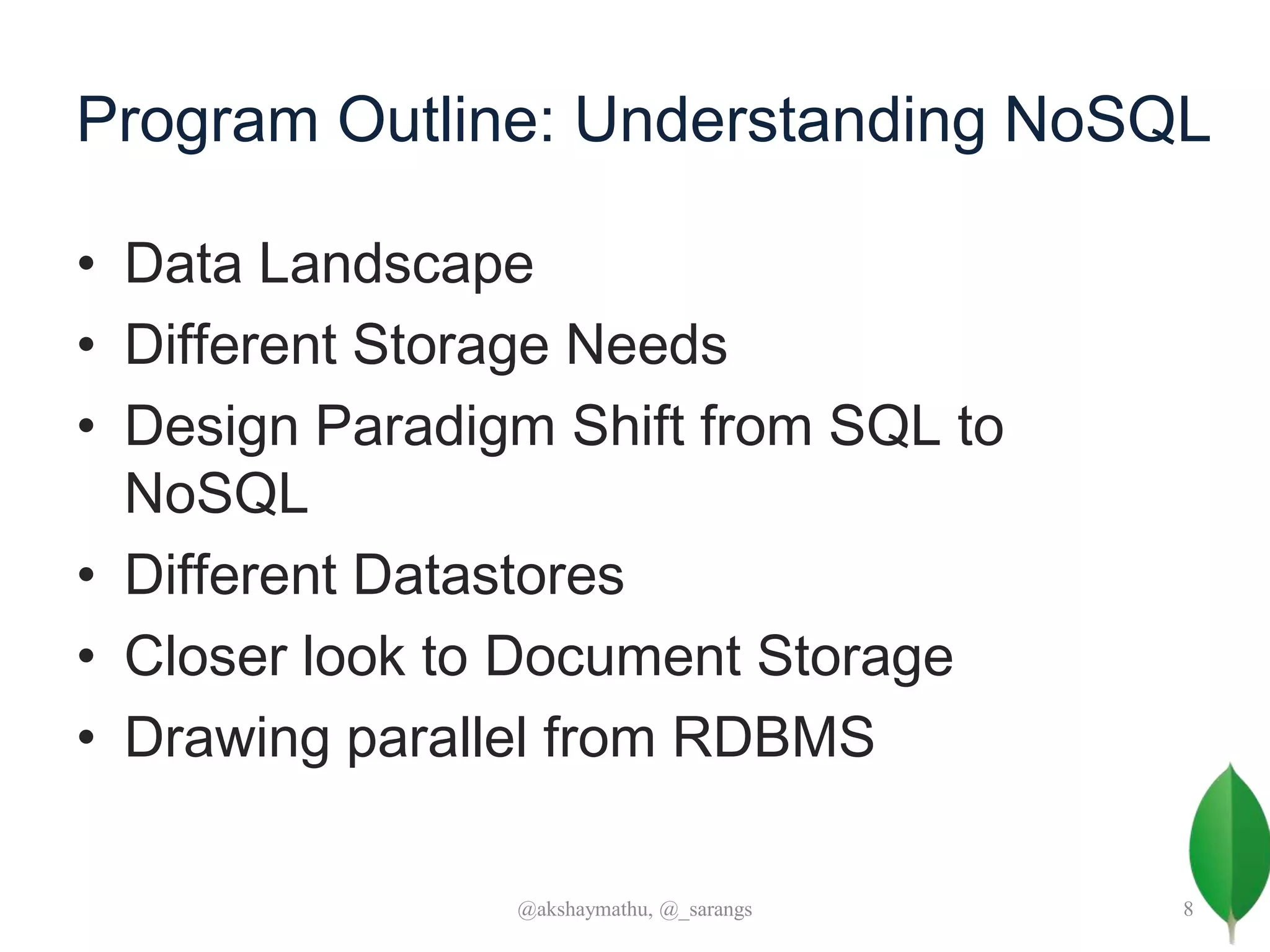
Program Outline: Understanding NoSQL
• Data Landscape
• Different Storage Needs
• Design Paradigm Shift from SQL to
NoSQL
• Different Datastores
• Closer look to Document Storage
• Drawing parallel from RDBMS
@akshaymathu, @_sarangs 8
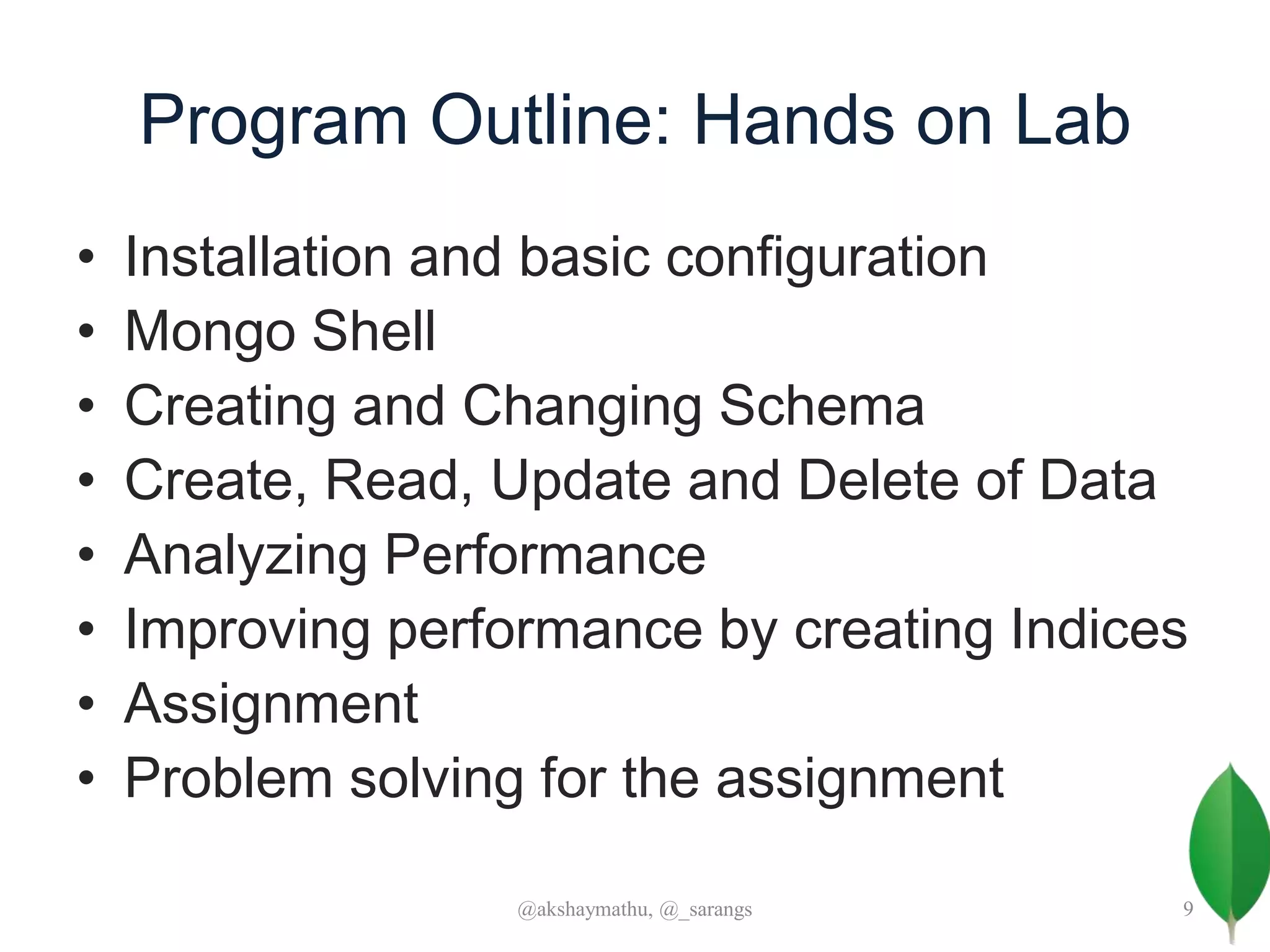
Program Outline: Hands on Lab
• Installation and basic configuration
• Mongo Shell
• Creating and Changing Schema
• Create, Read, Update and Delete of Data
• Analyzing Performance
• Improving performance by creating Indices
• Assignment
• Problem solving for the assignment
@akshaymathu, @_sarangs 9
Program Outline: Advance Topics
• Handling Big Data
– Introduction to Map/Reduce
– Introduction to Data Partitioning (Sharding)
• Disaster Recovery
– Introduction to Replica set and High
Availability
@akshaymathu, @_sarangs 10
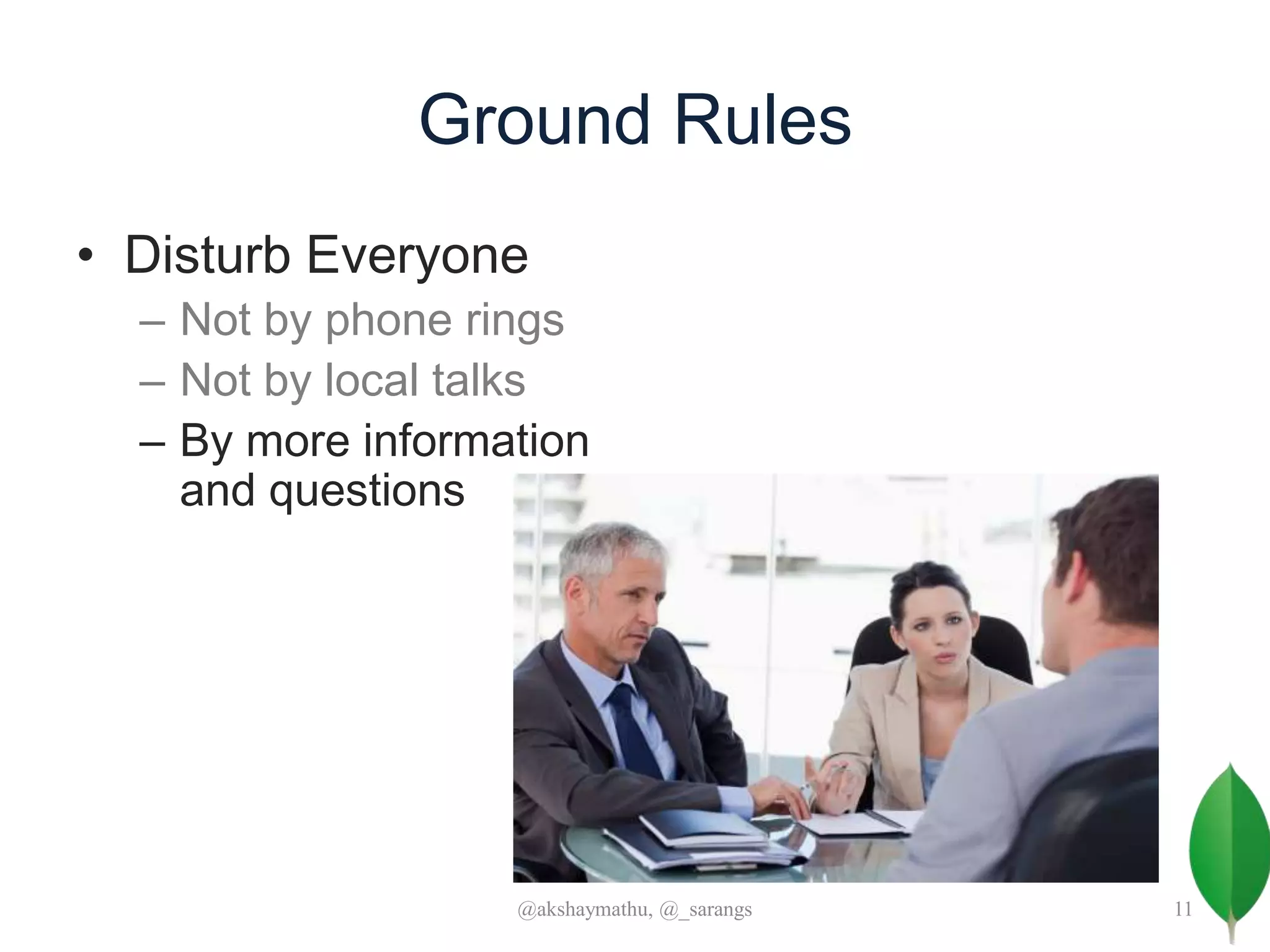
Ground Rules
• Disturb Everyone
– Not by phone rings
– Not by local talks
– By more information
and questions
@akshaymathu, @_sarangs 11
Data Patterns & Storage Needs
@akshaymathu, @_sarangs 12
Data at an Online Store
• Product Information
• User Information
• Purchase Information
• Product Reviews
• Site Interactions
• Social Graph
• Search Index
@akshaymathu, @_sarangs 13
SQL to NoSQL
Design Paradigm Shift
@akshaymathu, @_sarangs 14
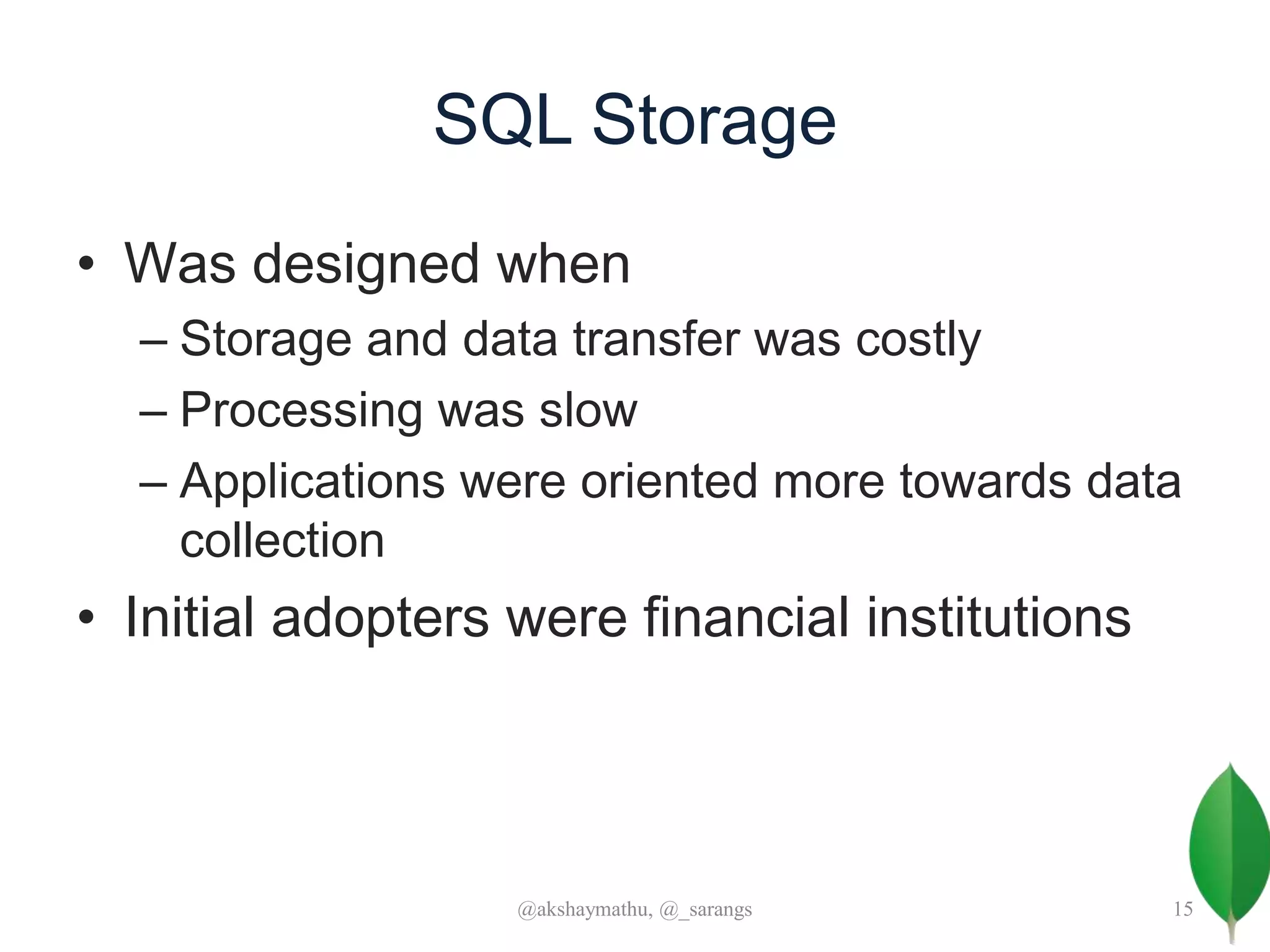
SQL Storage
• Was designed when
– Storage and data transfer was costly
– Processing was slow
– Applications were oriented more towards data
collection
• Initial adopters were financial institutions
@akshaymathu, @_sarangs 15
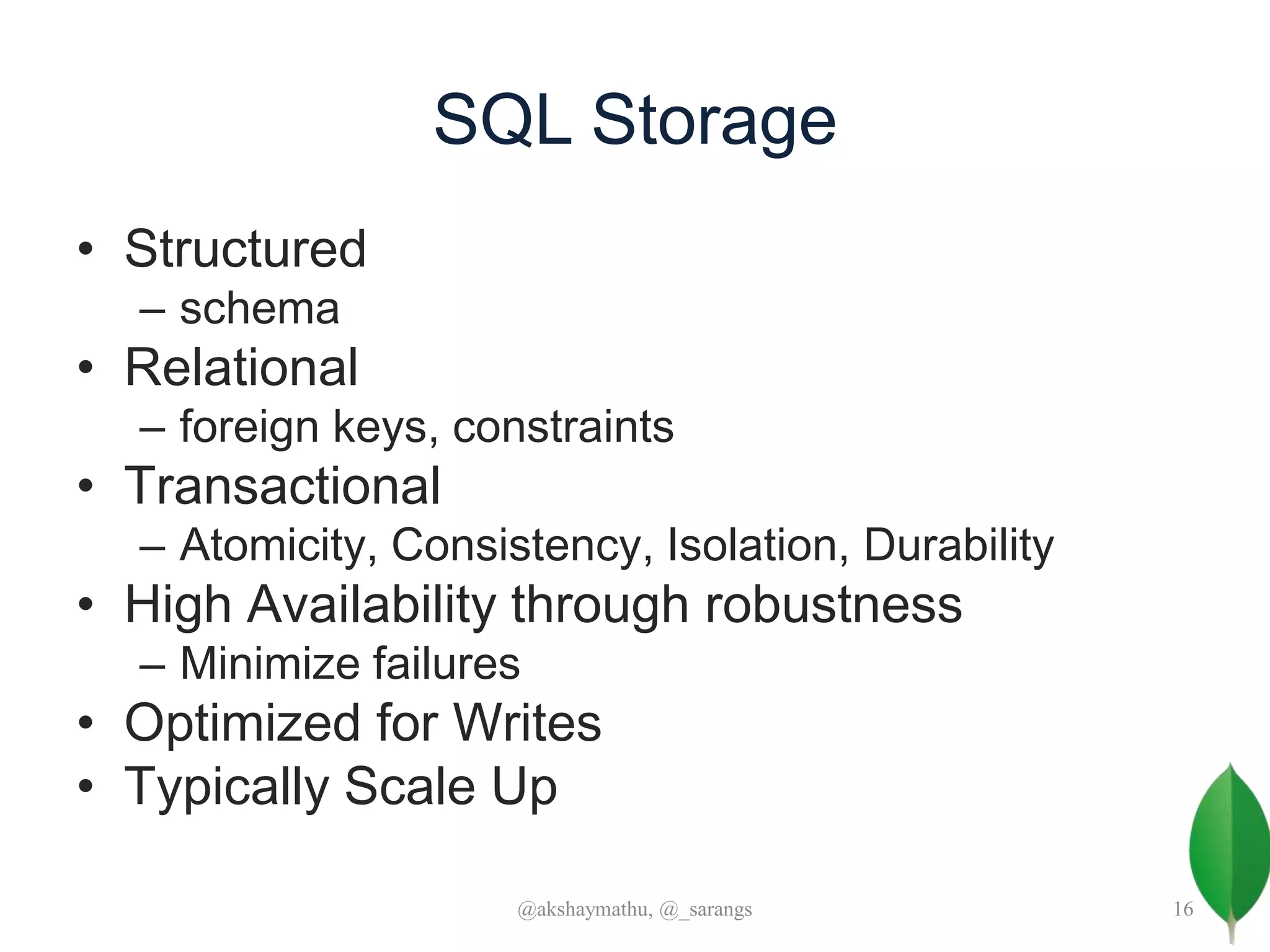
SQL Storage
• Structured
– schema
• Relational
– foreign keys, constraints
• Transactional
– Atomicity, Consistency, Isolation, Durability
• High Availability through robustness
– Minimize failures
• Optimized for Writes
• Typically Scale Up
@akshaymathu, @_sarangs 16
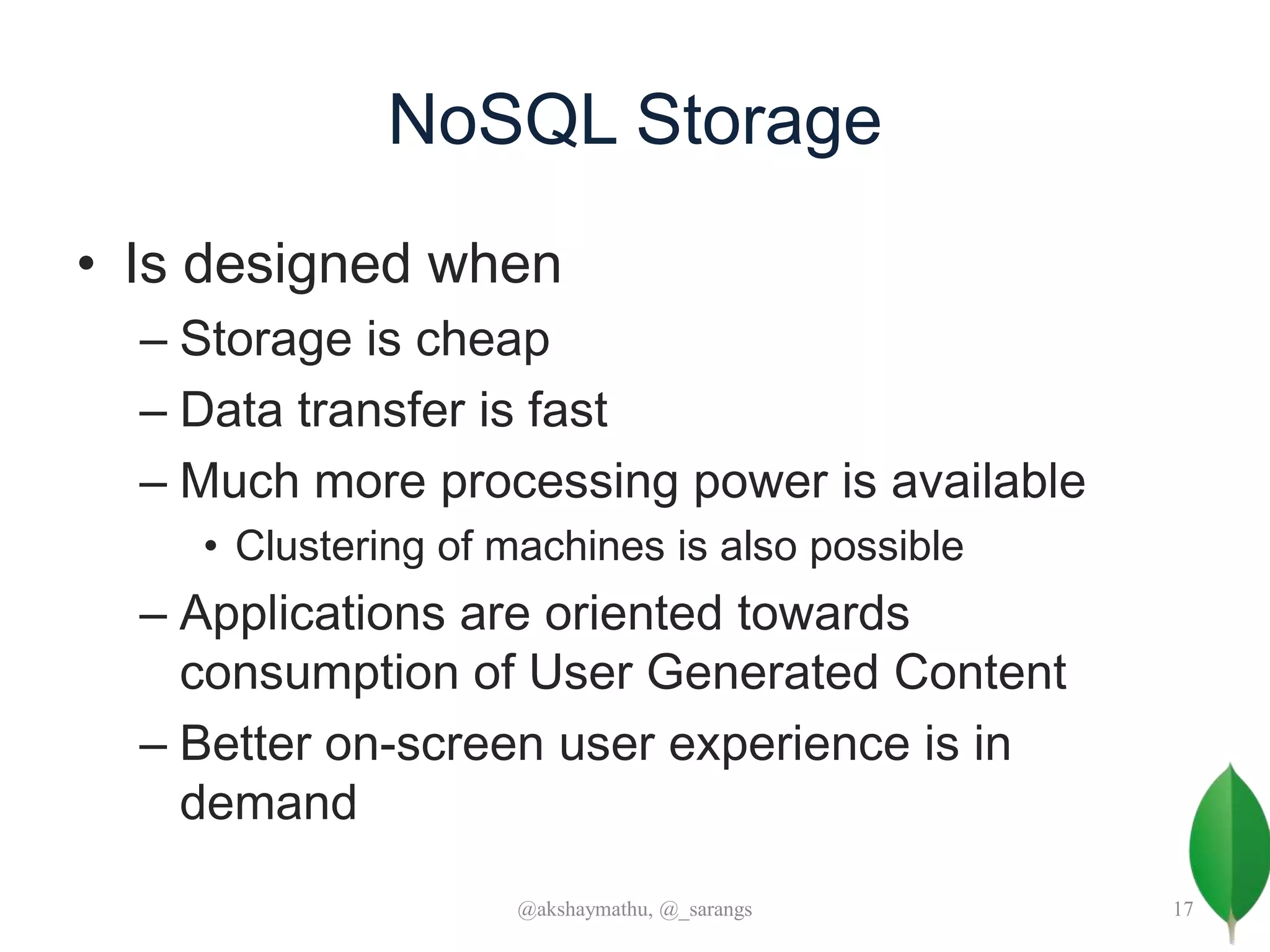
NoSQL Storage
• Is designed when
– Storage is cheap
– Data transfer is fast
– Much more processing power is available
• Clustering of machines is also possible
– Applications are oriented towards
consumption of User Generated Content
– Better on-screen user experience is in
demand
@akshaymathu, @_sarangs 17
NoSQL Storage
• Semi-structured
– Schemaless
• Consistency, Availability, Partition
Tolerance
• High Availability through clustering
– expect failures
• Optimized for Reads
• Typically Scale Out
@akshaymathu, @_sarangs 18
Different Datastores
Half Level Deep
@akshaymathu, @_sarangs 19
SQL: RDBMS
• MySql, Postgresql, Oracle etc.
• Stores data in tables having columns
– Basic (number, text) data types
• Strong query language
• Transparent values
– Query language can read and filter on them
– Relationship between tables based on values
• Suited for user info and transactions
@akshaymathu, @_sarangs 20
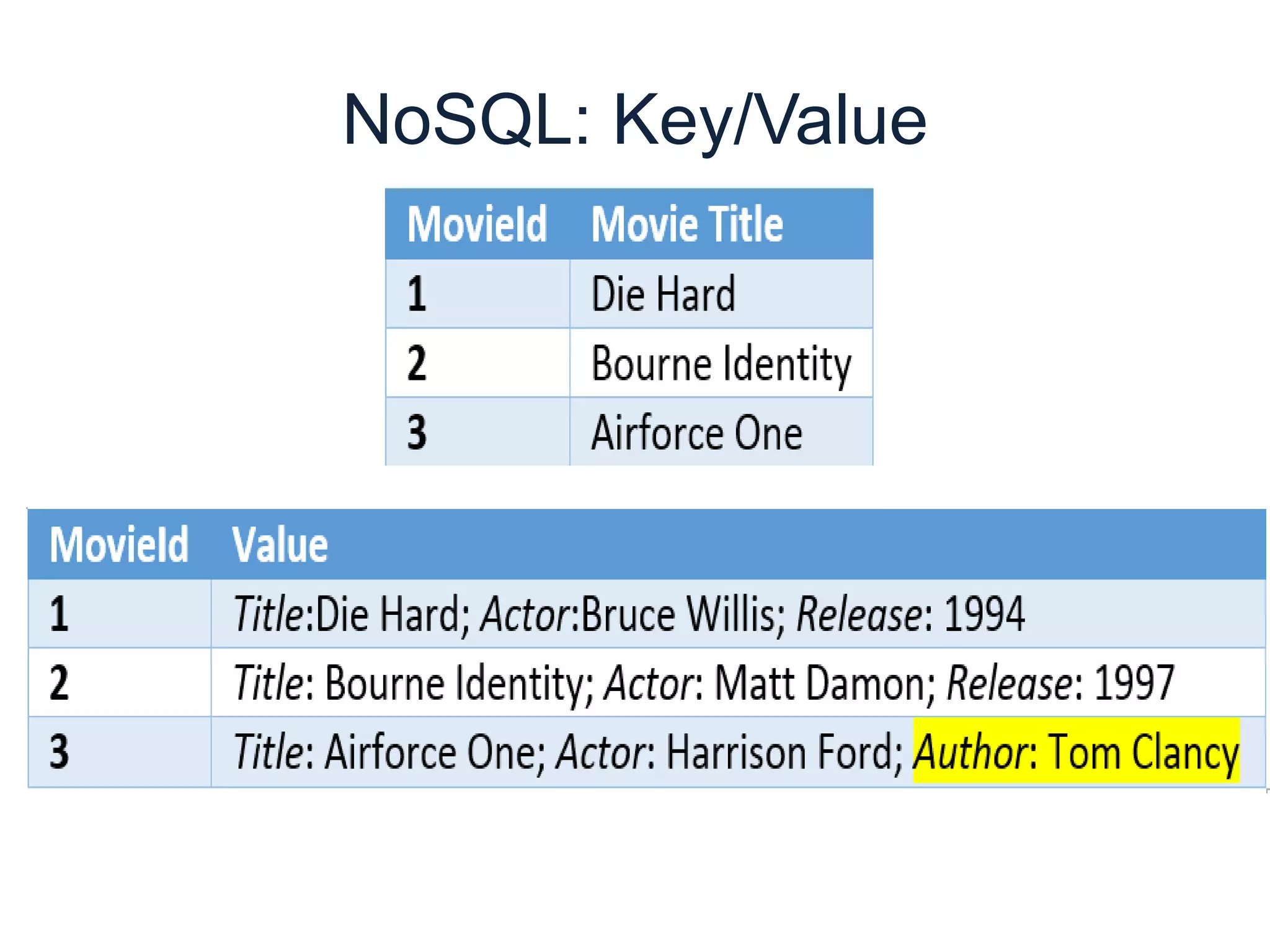
NoSQL: Key/Value
• Redis, DynamoDB etc.
• Stores a values against a key
– Strings
• Values are opaque
– Can not be part of query
• Suited for site interactions
@akshaymathu, @_sarangs 21
NoSQL: Key/Value
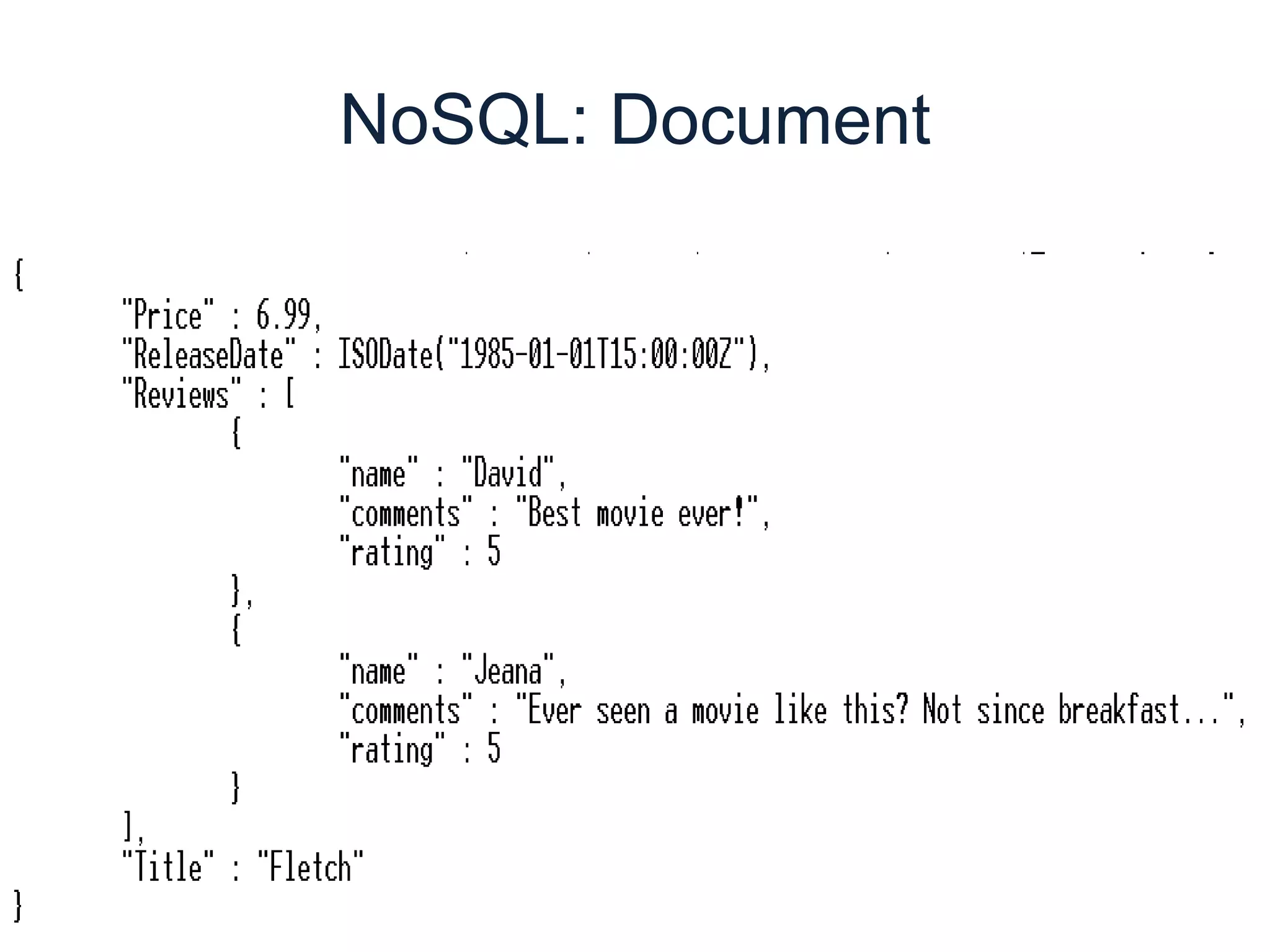
NoSQL: Document
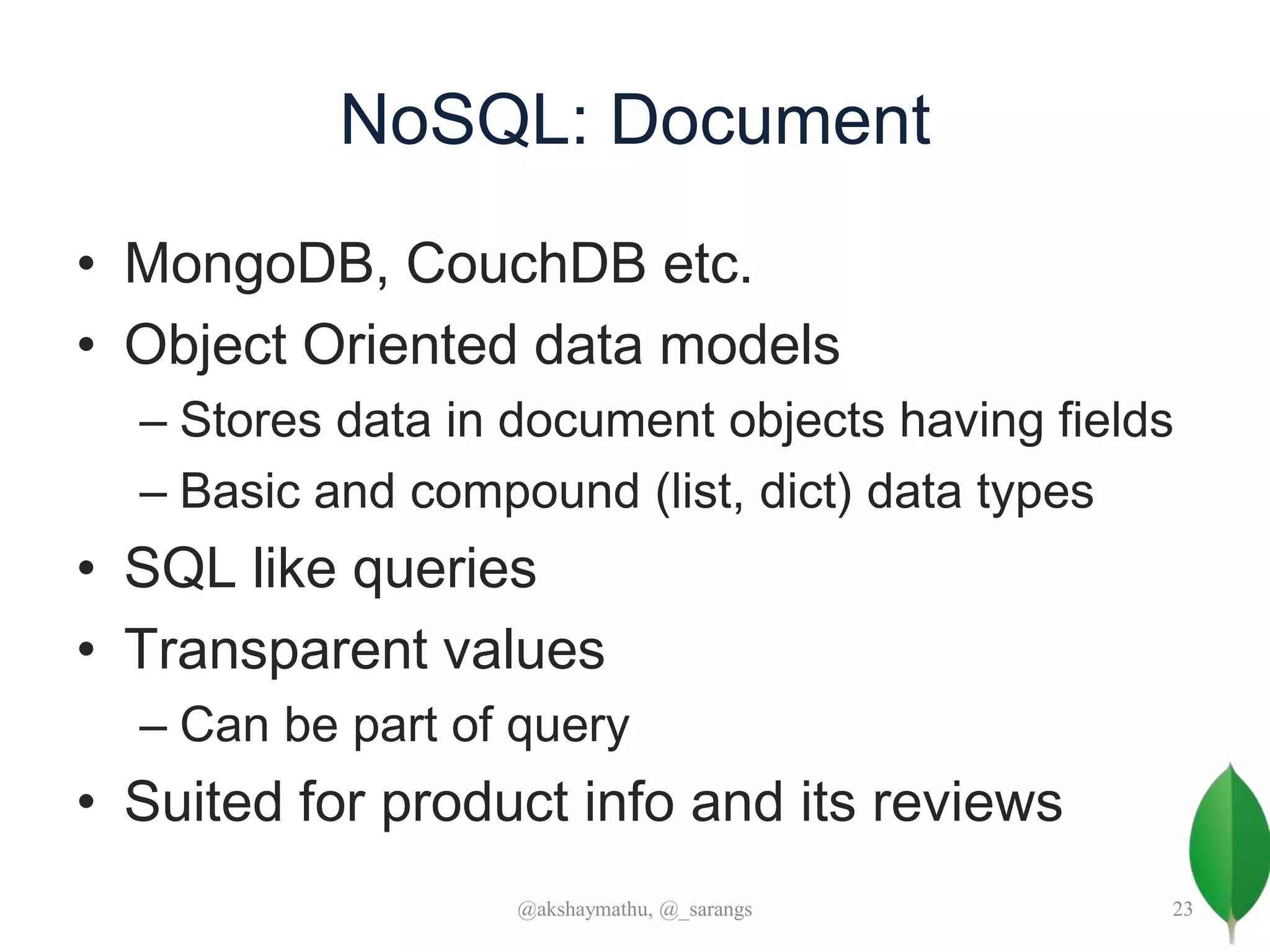
• MongoDB, CouchDB etc.
• Object Oriented data models
– Stores data in document objects having fields
– Basic and compound (list, dict) data types
• SQL like queries
• Transparent values
– Can be part of query
• Suited for product info and its reviews
@akshaymathu, @_sarangs 23
NoSQL: Document
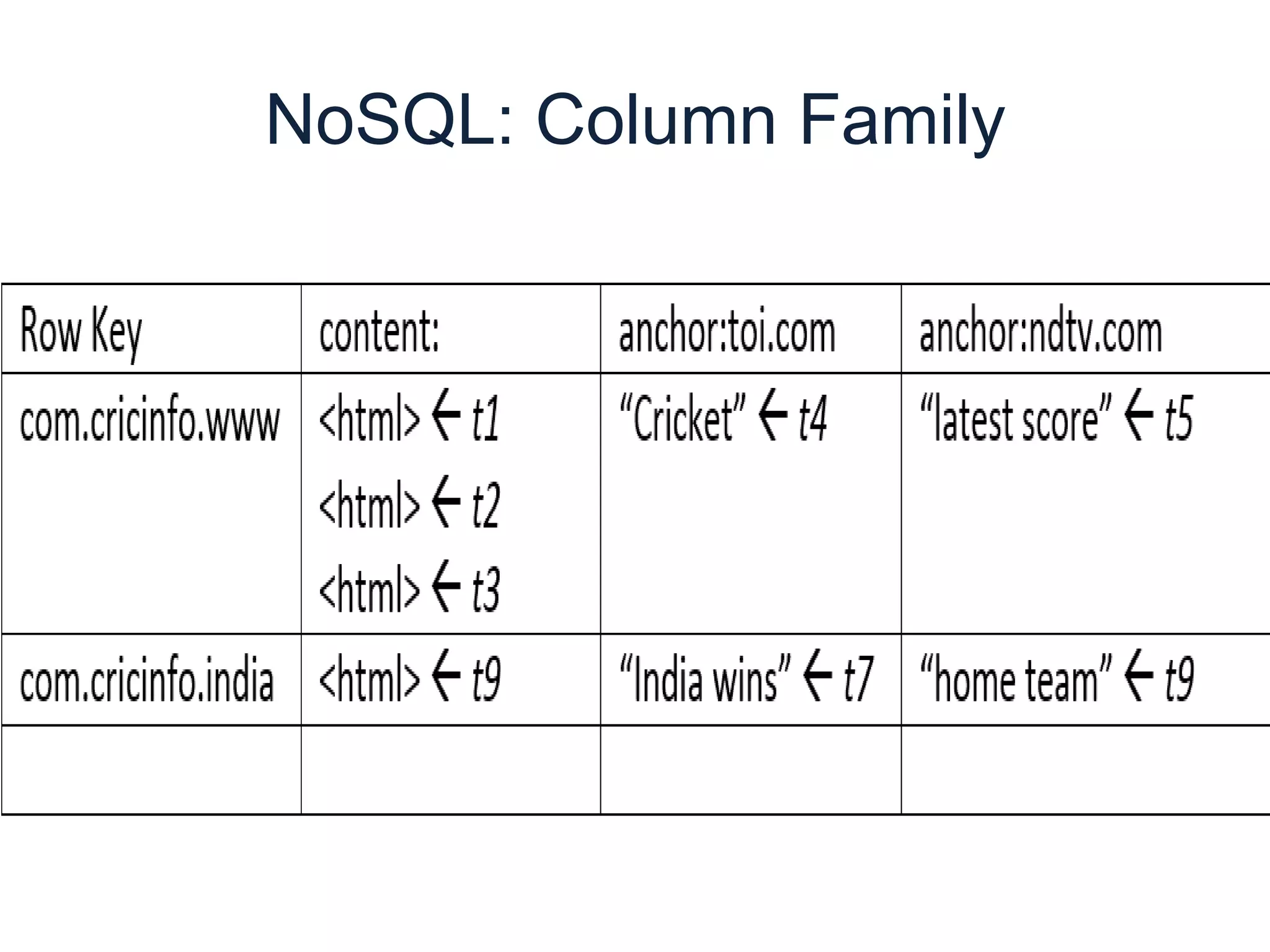
NoSQL: Column Family
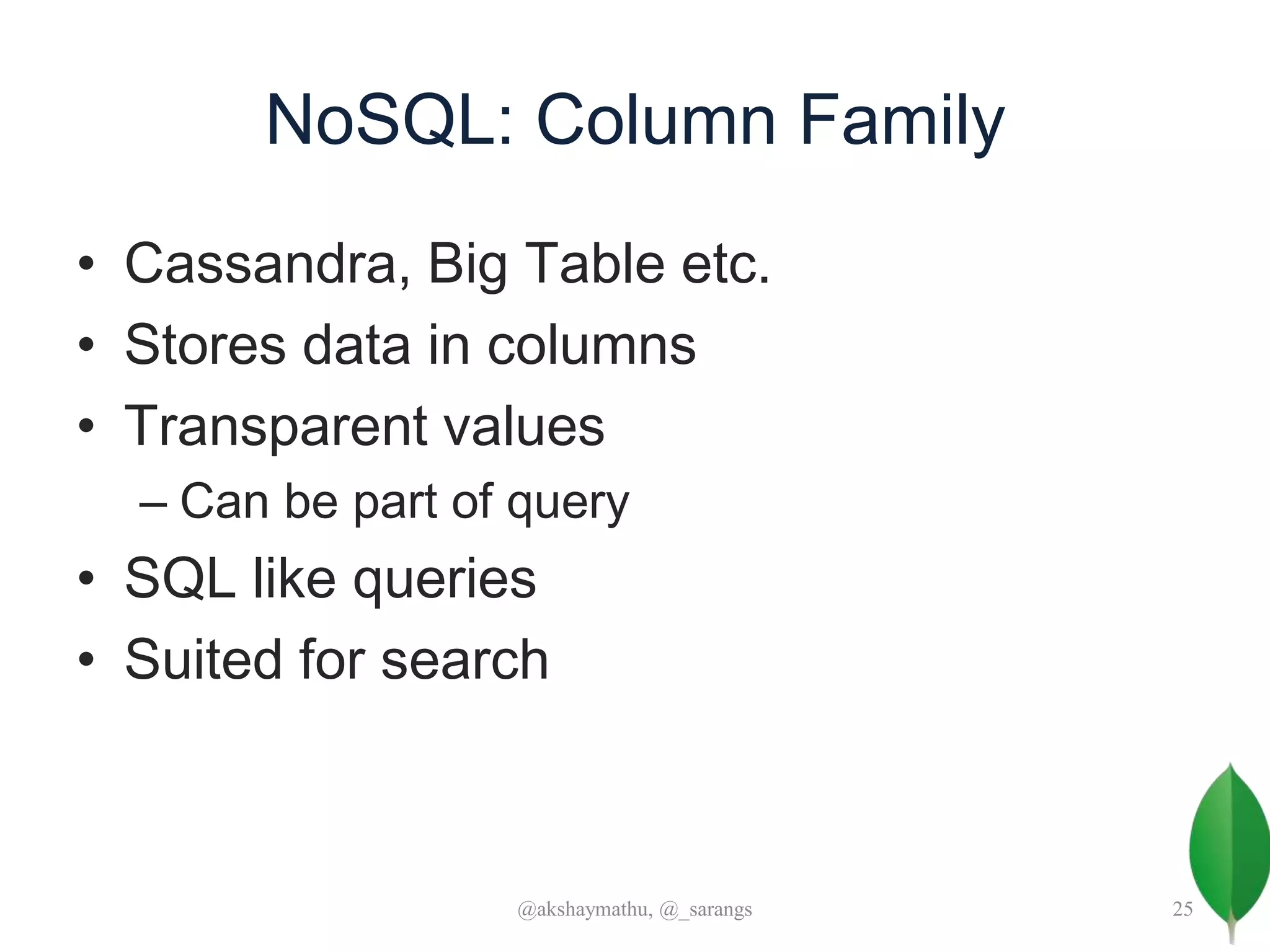
• Cassandra, Big Table etc.
• Stores data in columns
• Transparent values
– Can be part of query
• SQL like queries
• Suited for search
@akshaymathu, @_sarangs 25
NoSQL: Column Family
NoSQL: Graph
• Neo4j
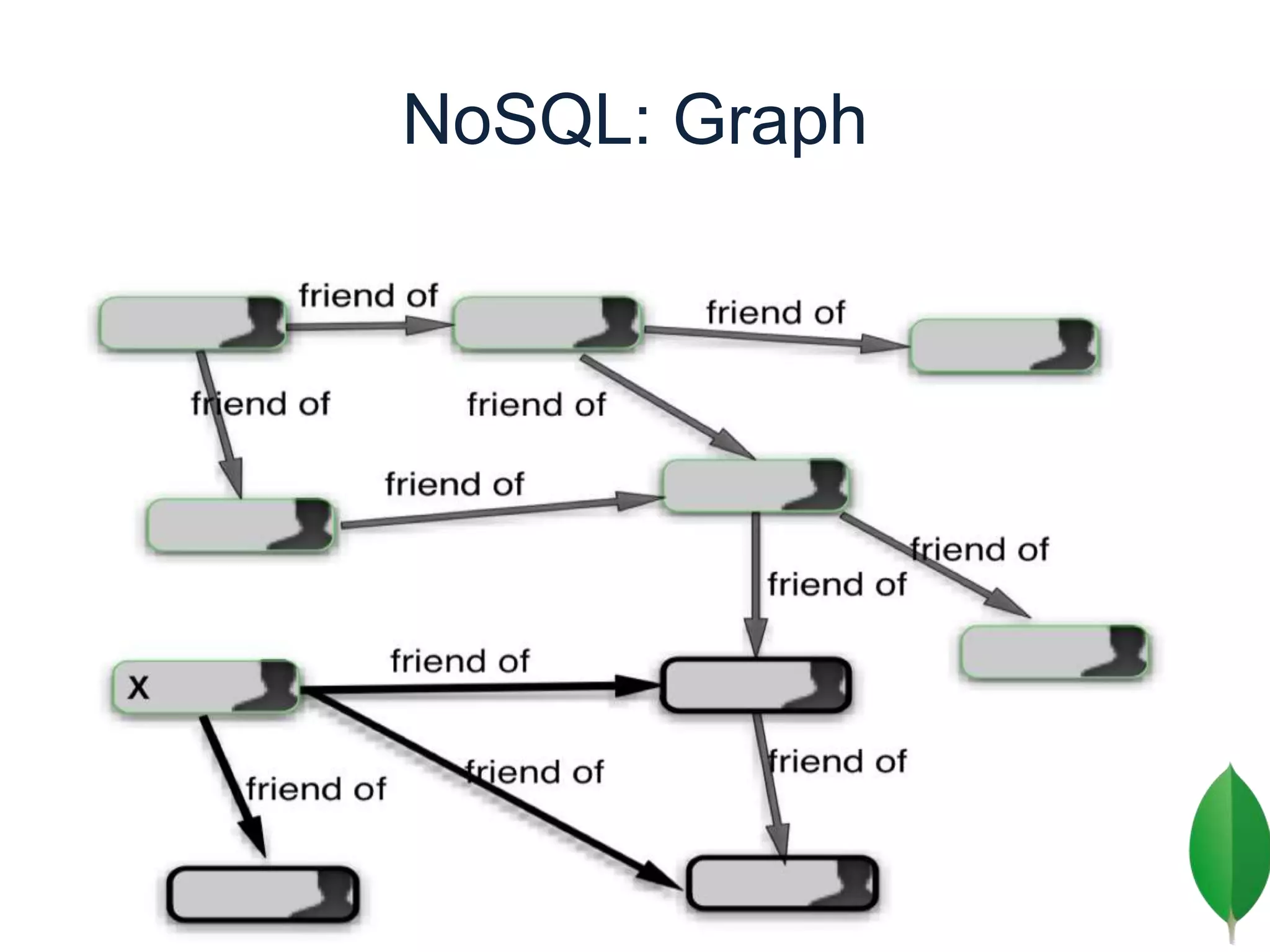
• Stores data in form of nodes and
relationships
• Query is in form of traversal
• In-memory
• Suited for social graph
@akshaymathu, @_sarangs 27
NoSQL: Graph
Document Storage: Closer Look
@akshaymathu, @_sarangs 30
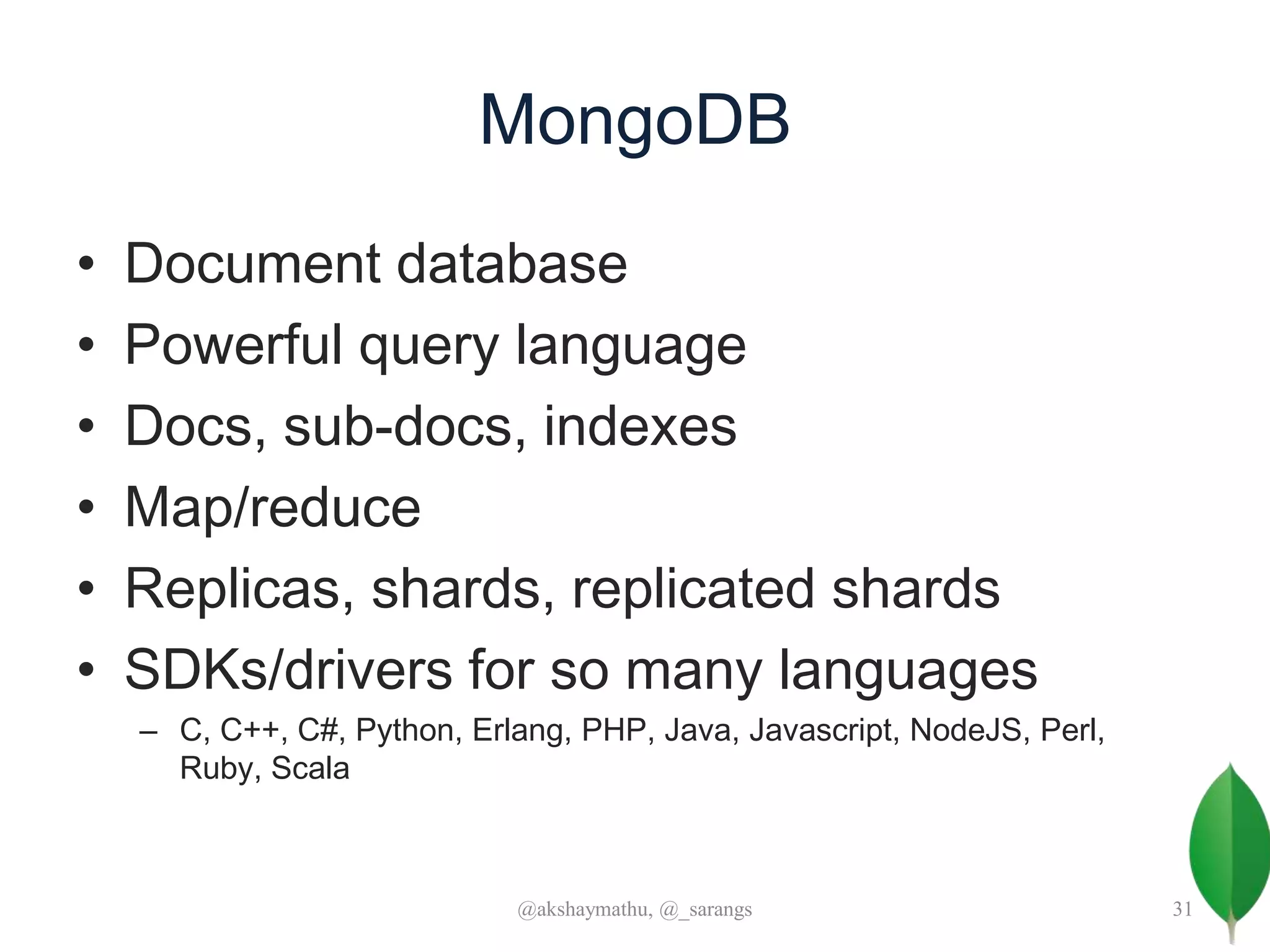
MongoDB
• Document database
• Powerful query language
• Docs, sub-docs, indexes
• Map/reduce
• Replicas, shards, replicated shards
• SDKs/drivers for so many languages
– C, C++, C#, Python, Erlang, PHP, Java, Javascript, NodeJS, Perl,
Ruby, Scala
@akshaymathu, @_sarangs 31
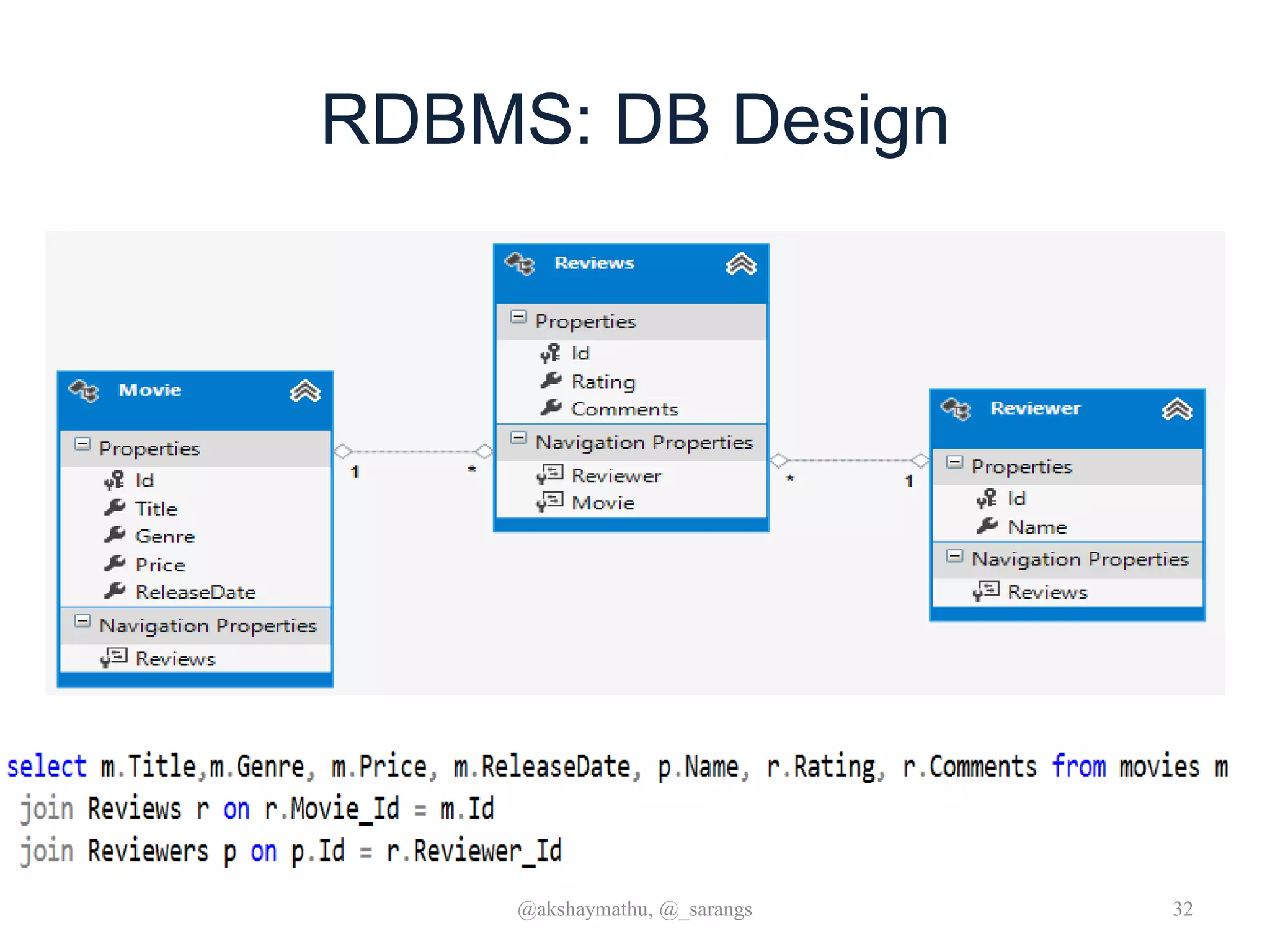
RDBMS: DB Design
@akshaymathu, @_sarangs 32
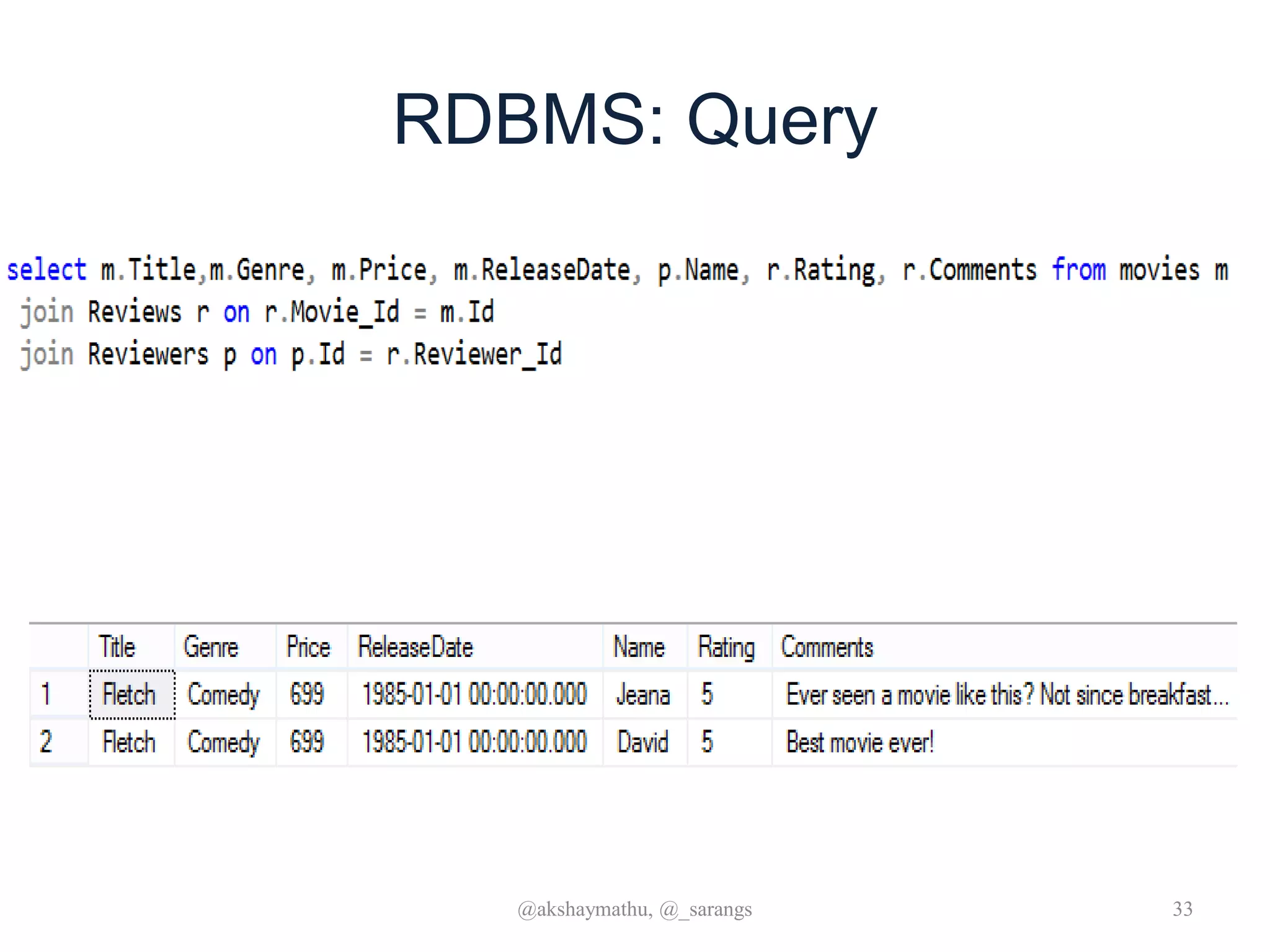
RDBMS: Query
@akshaymathu, @_sarangs 33
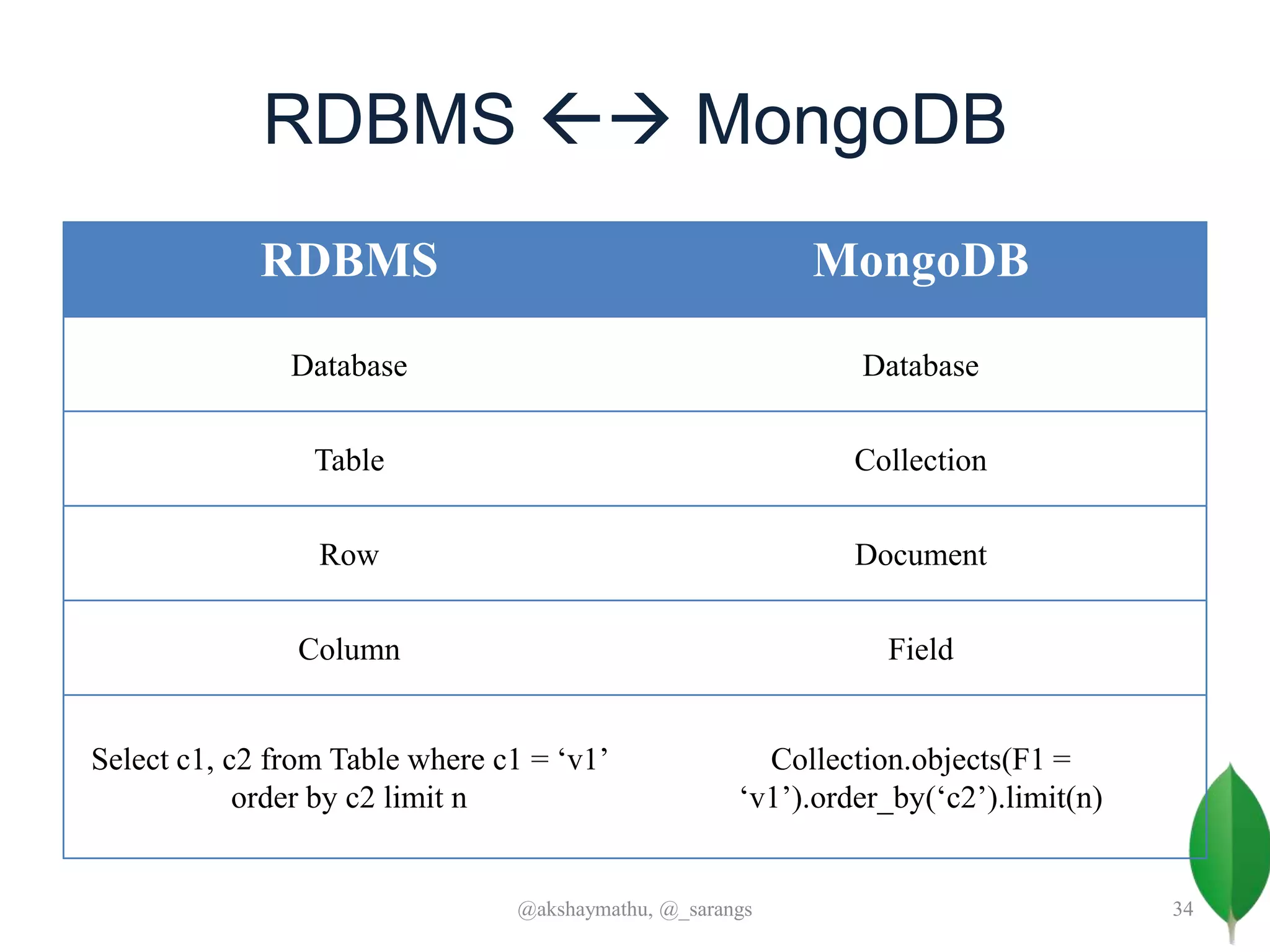
RDBMS  MongoDB
RDBMS MongoDB
Database Database
Table Collection
Row Document
Column Field
Select c1, c2 from Table where c1 = ‘v1’
order by c2 limit n
Collection.objects(F1 =
‘v1’).order_by(‘c2’).limit(n)
@akshaymathu, @_sarangs 34
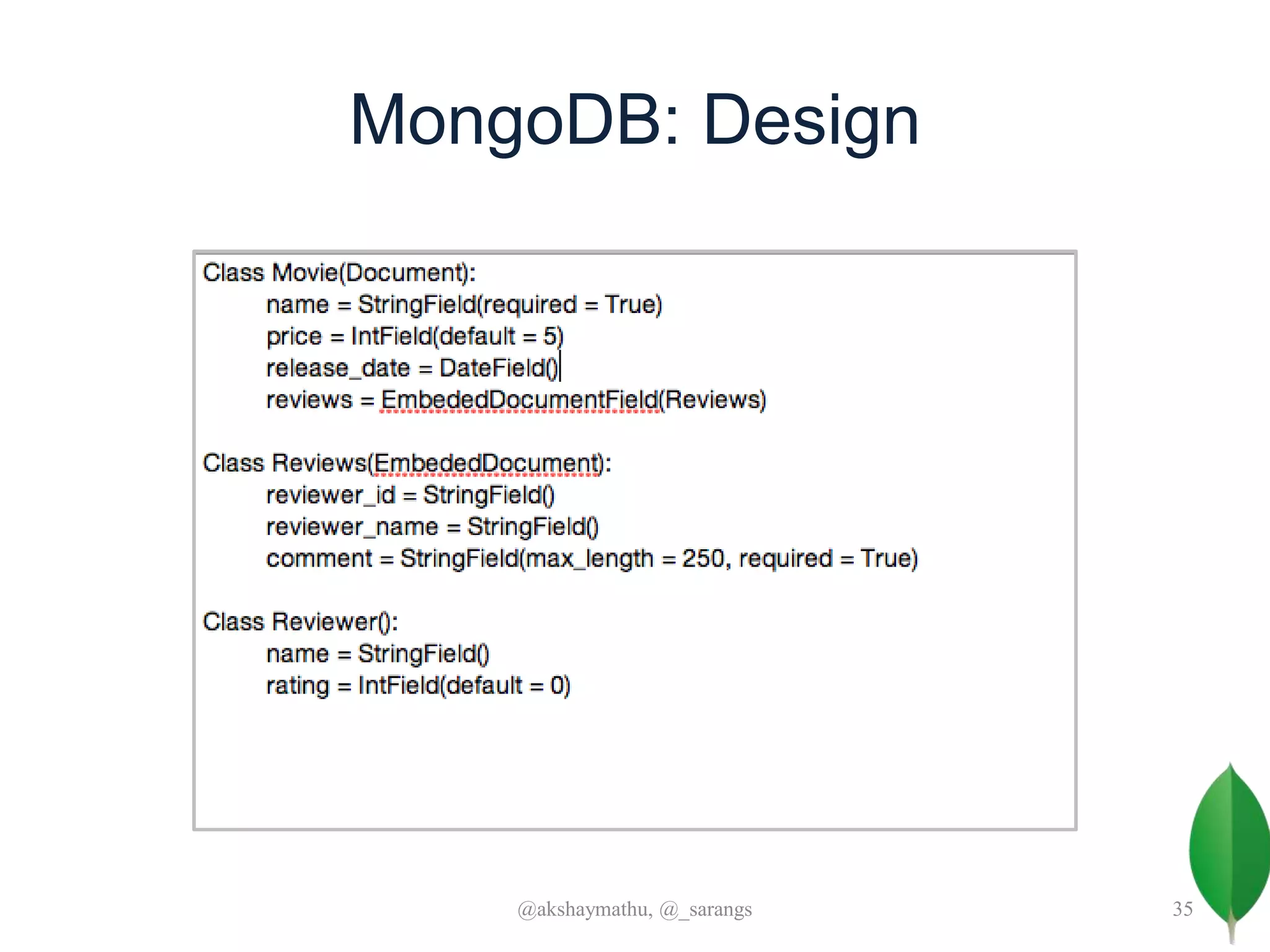
MongoDB: Design
@akshaymathu, @_sarangs 35
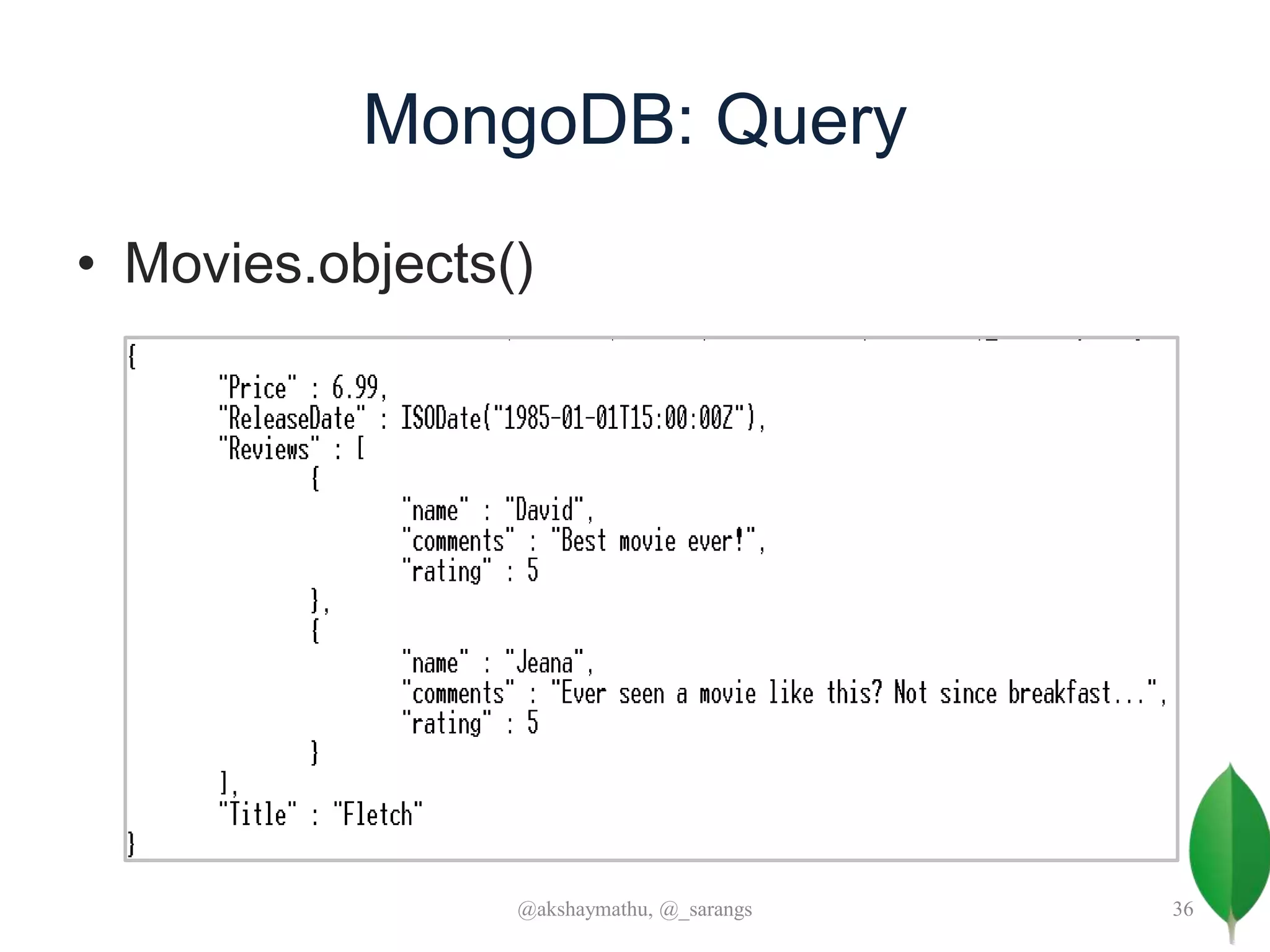
MongoDB: Query
• Movies.objects()
@akshaymathu, @_sarangs 36
@akshaymathu, @_sarangs 37
Have you Installed?
http://www.mongodb.org/downloads
@akshaymathu, @_sarangs
Hands-on
Dive-in with Sarang
@akshaymathu, @_sarangs 39
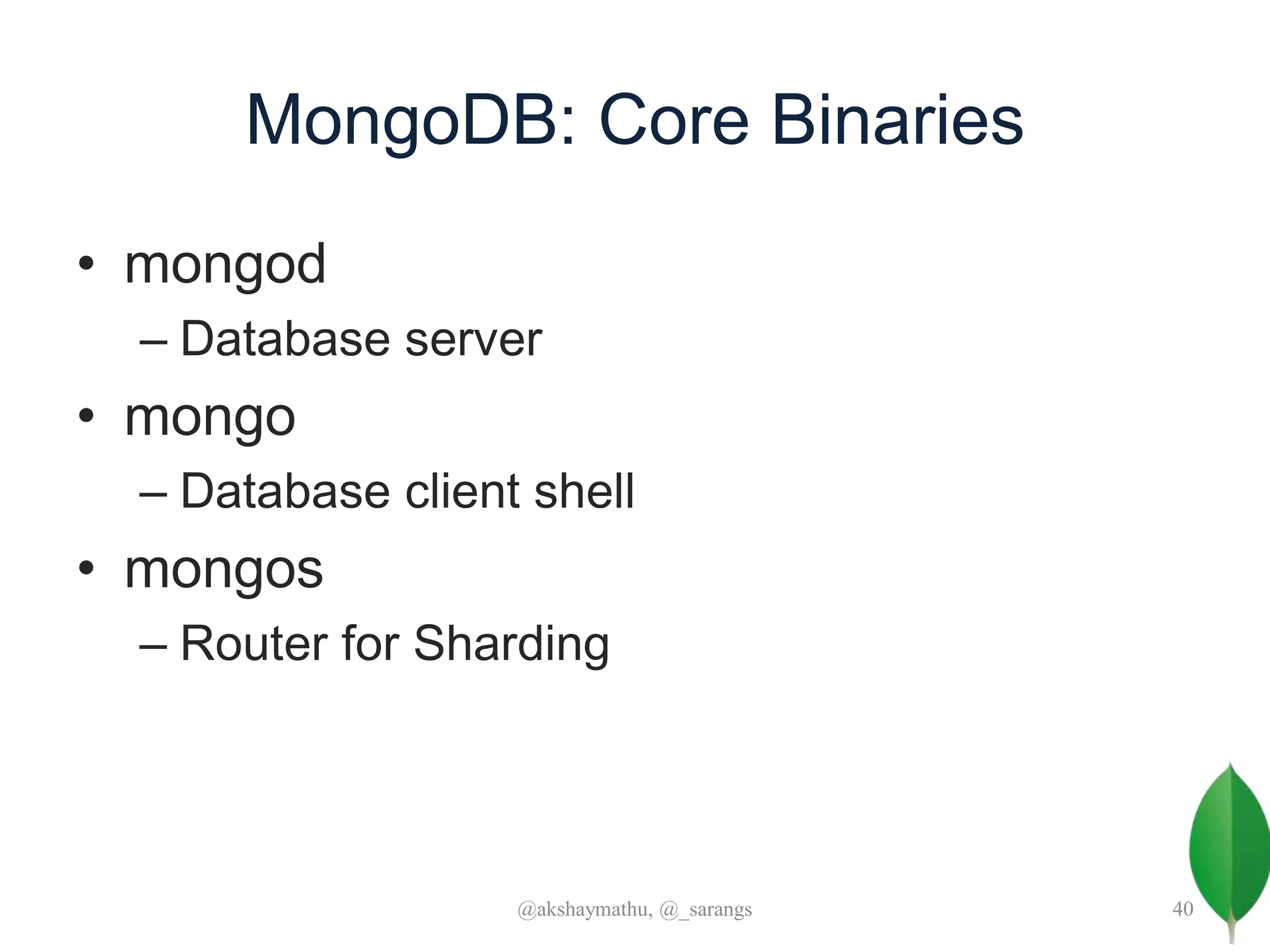
MongoDB: Core Binaries
• mongod
– Database server
• mongo
– Database client shell
• mongos
– Router for Sharding
@akshaymathu, @_sarangs 40
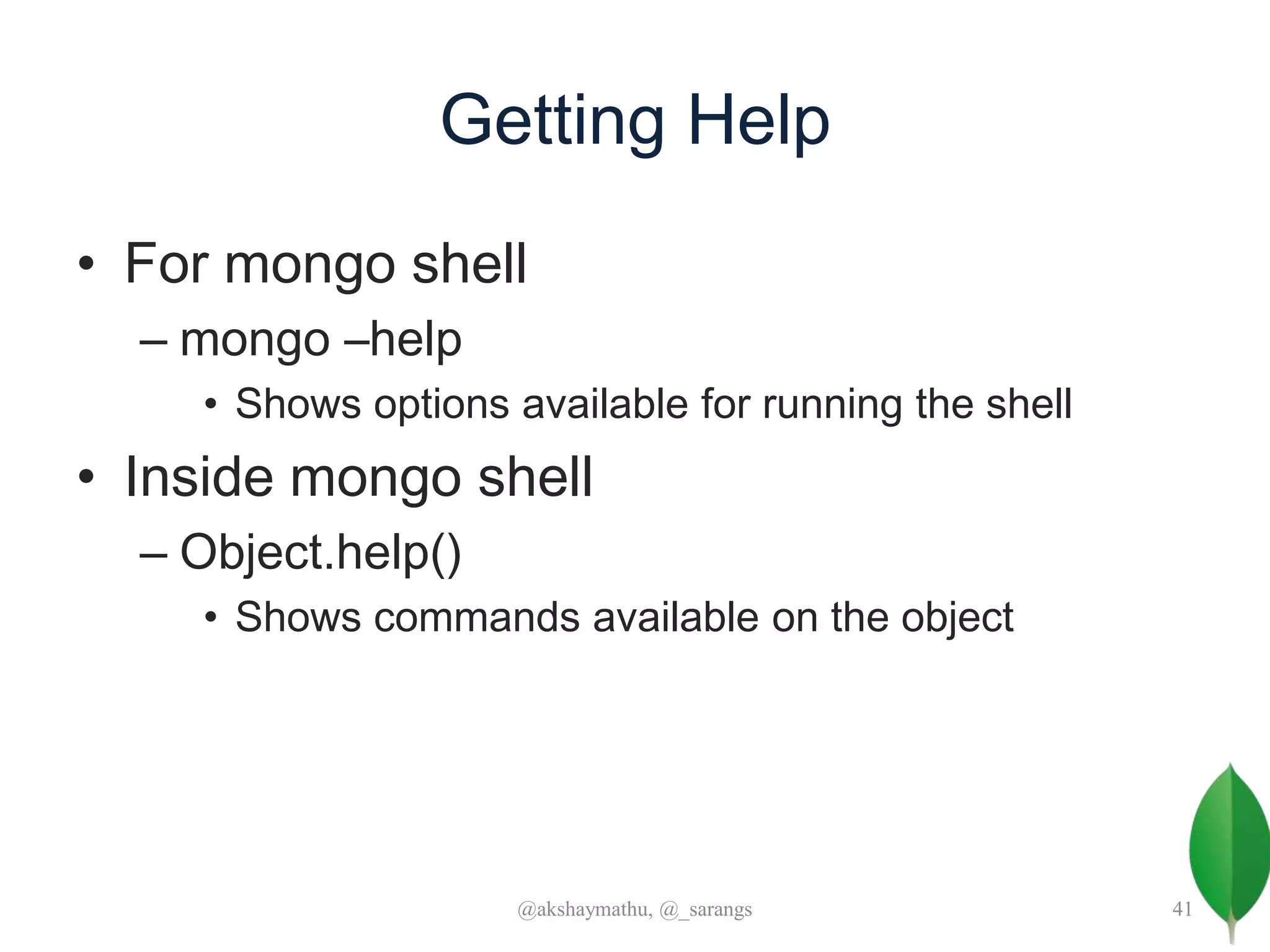
Getting Help
• For mongo shell
– mongo –help
• Shows options available for running the shell
• Inside mongo shell
– Object.help()
• Shows commands available on the object
@akshaymathu, @_sarangs 41
Import Export Tools
• For objects
– mongodump
– mongorestore
– bsondump
– mongooplog
• For data items
– mongoimport
– mongoexport
@akshaymathu, @_sarangs 42
Database Operations
• Database creation
• Creating/changing collection
• Data insertion
• Data read
• Data update
• Creating indices
• Data deletion
• Dropping collection
@akshaymathu, @_sarangs 43
Diagnostic Tools
• mongostat
• mongoperf
• mongosnif
• mongotop
@akshaymathu, @_sarangs 44
@akshaymathu, @_sarangs 45
Assignment
• Go to http://www.velocitainc.com/mongo/
– Tasks
• assignments.txt
– Data
• students.json
@akshaymathu, @_sarangs 46
Disaster Recovery
Introduction to Replica Sets and
High Availability
@akshaymathu, @_sarangs 47
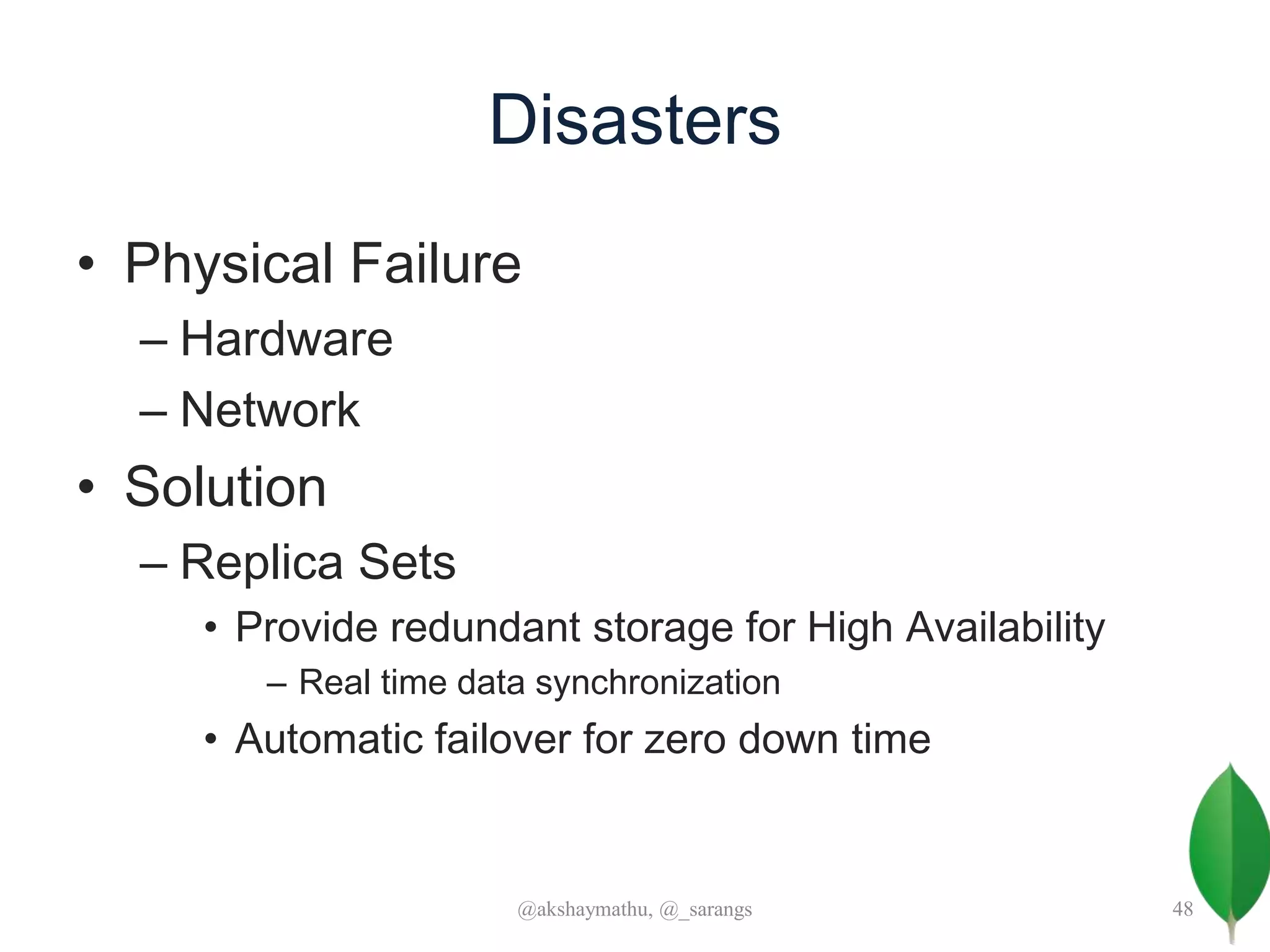
Disasters
• Physical Failure
– Hardware
– Network
• Solution
– Replica Sets
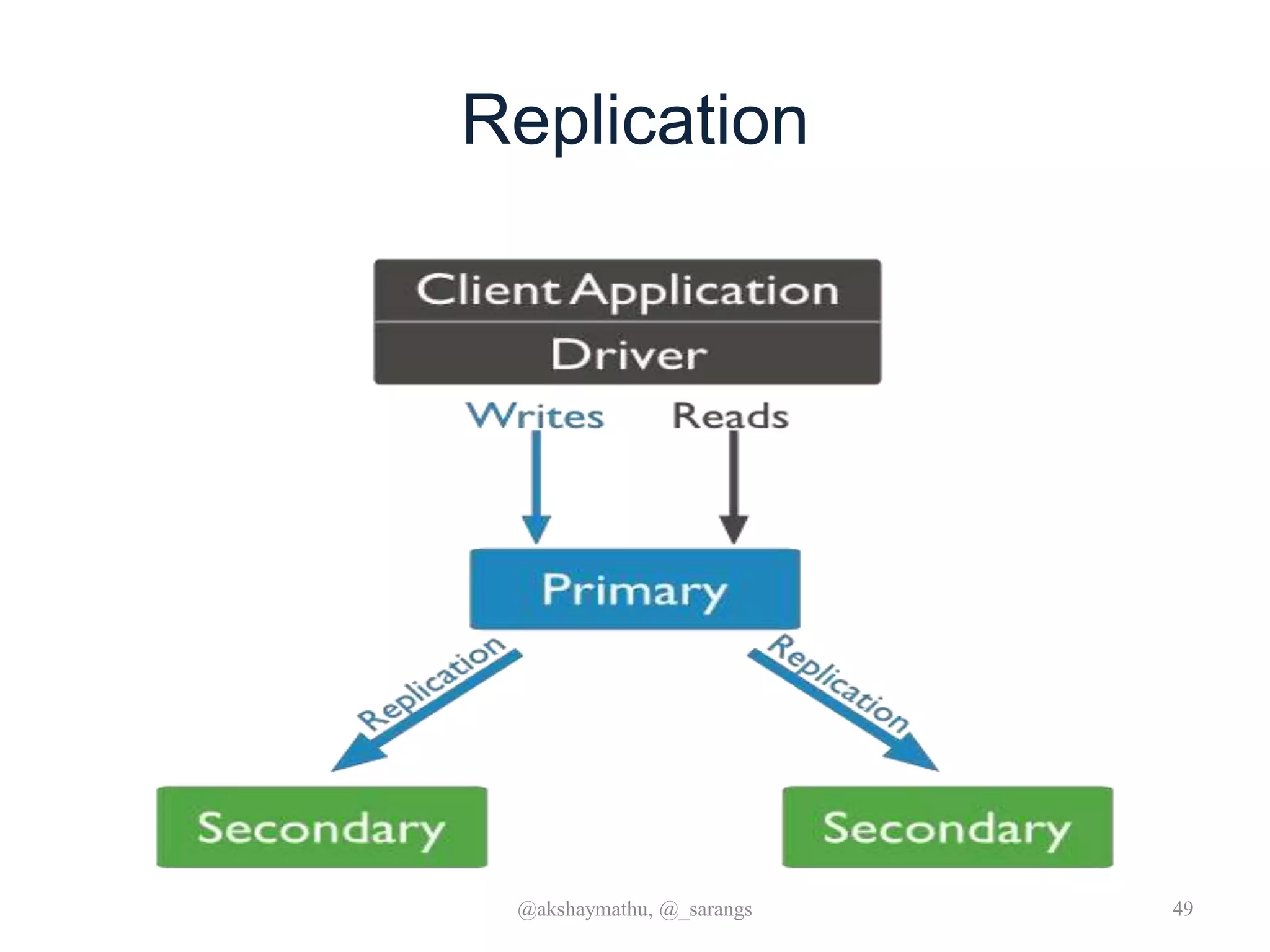
• Provide redundant storage for High Availability
– Real time data synchronization
• Automatic failover for zero down time
@akshaymathu, @_sarangs 48
Replication
@akshaymathu, @_sarangs 49
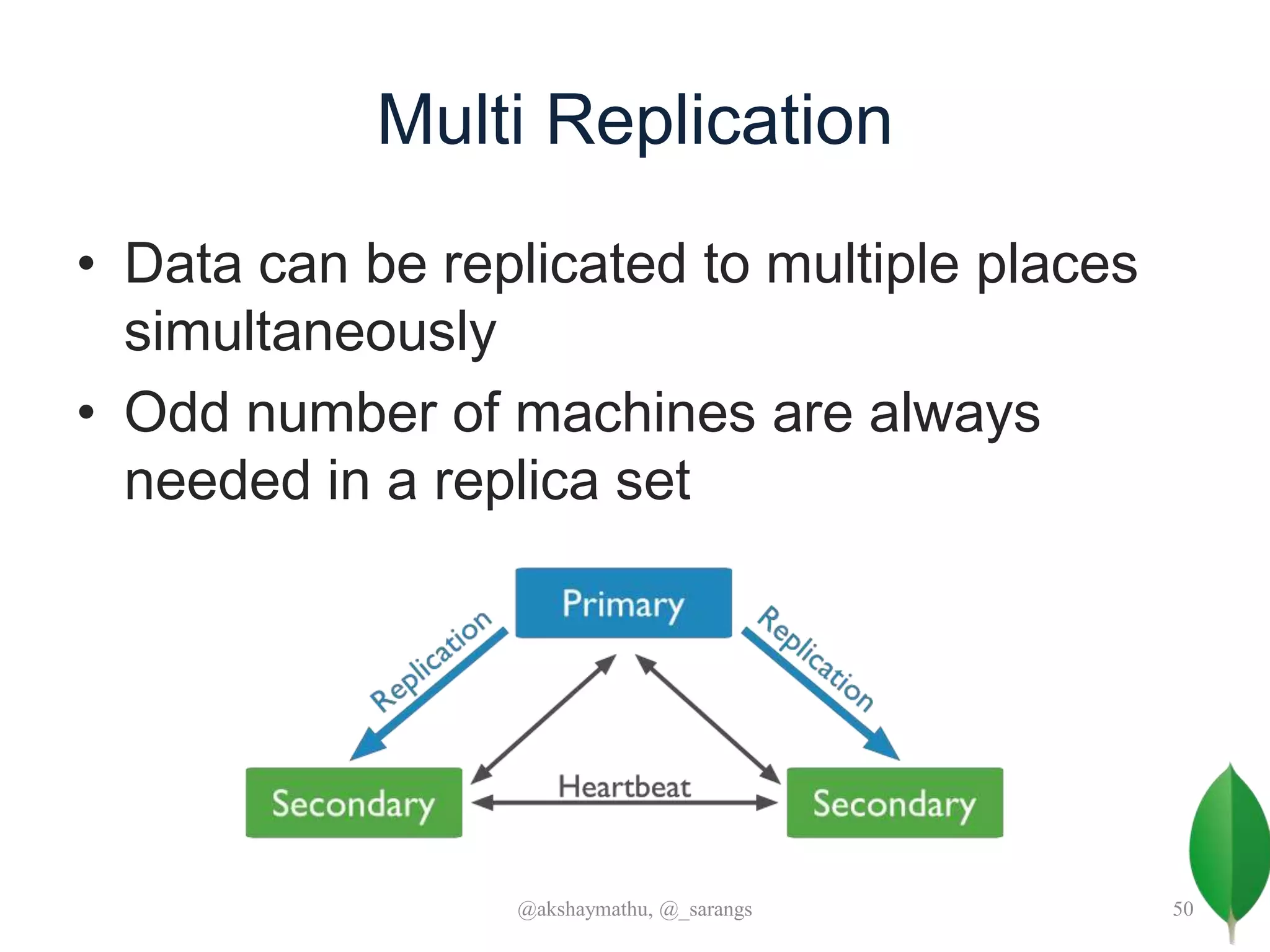
Multi Replication
• Data can be replicated to multiple places
simultaneously
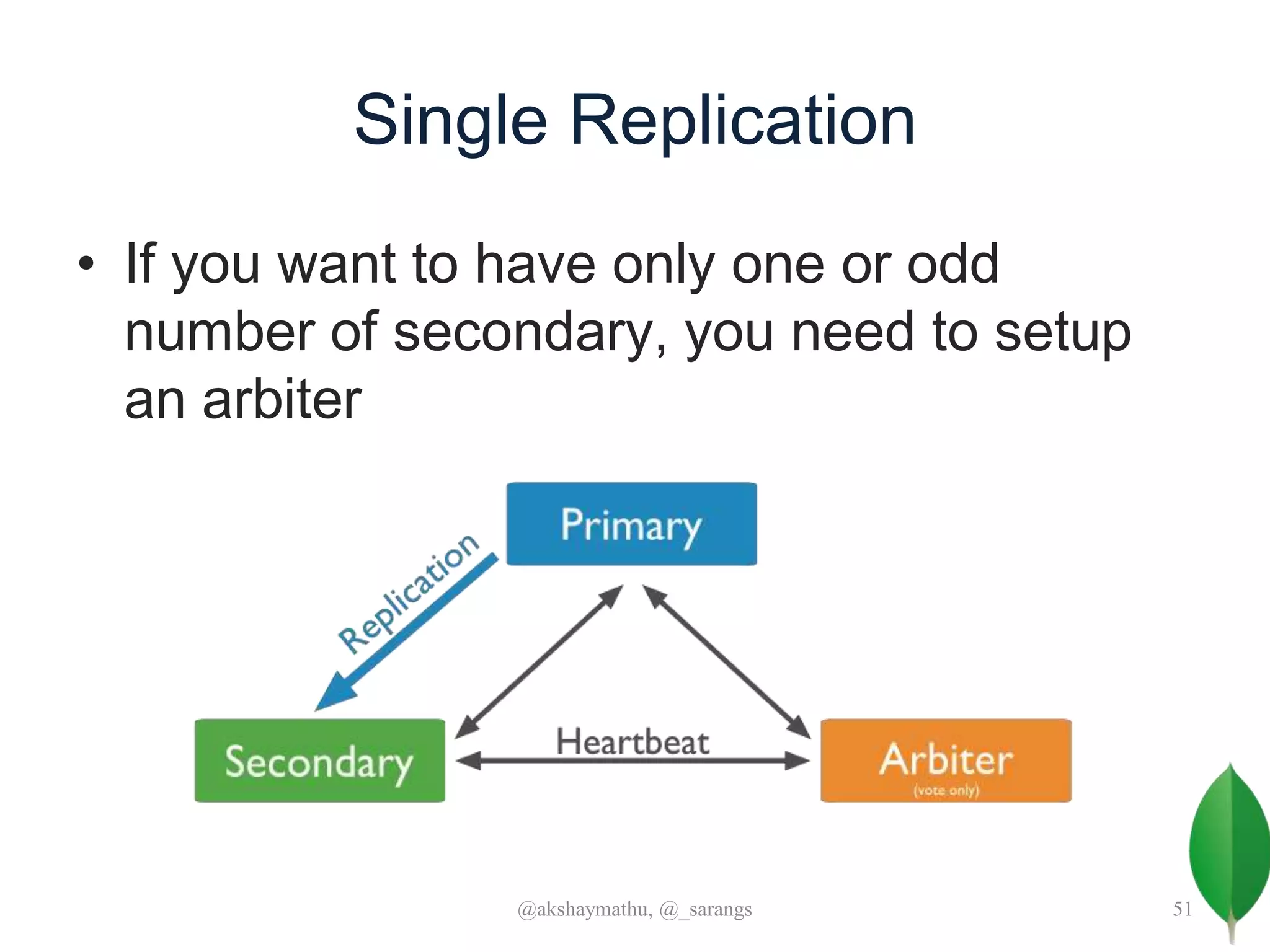
• Odd number of machines are always
needed in a replica set
@akshaymathu, @_sarangs 50
Single Replication
• If you want to have only one or odd
number of secondary, you need to setup
an arbiter
@akshaymathu, @_sarangs 51
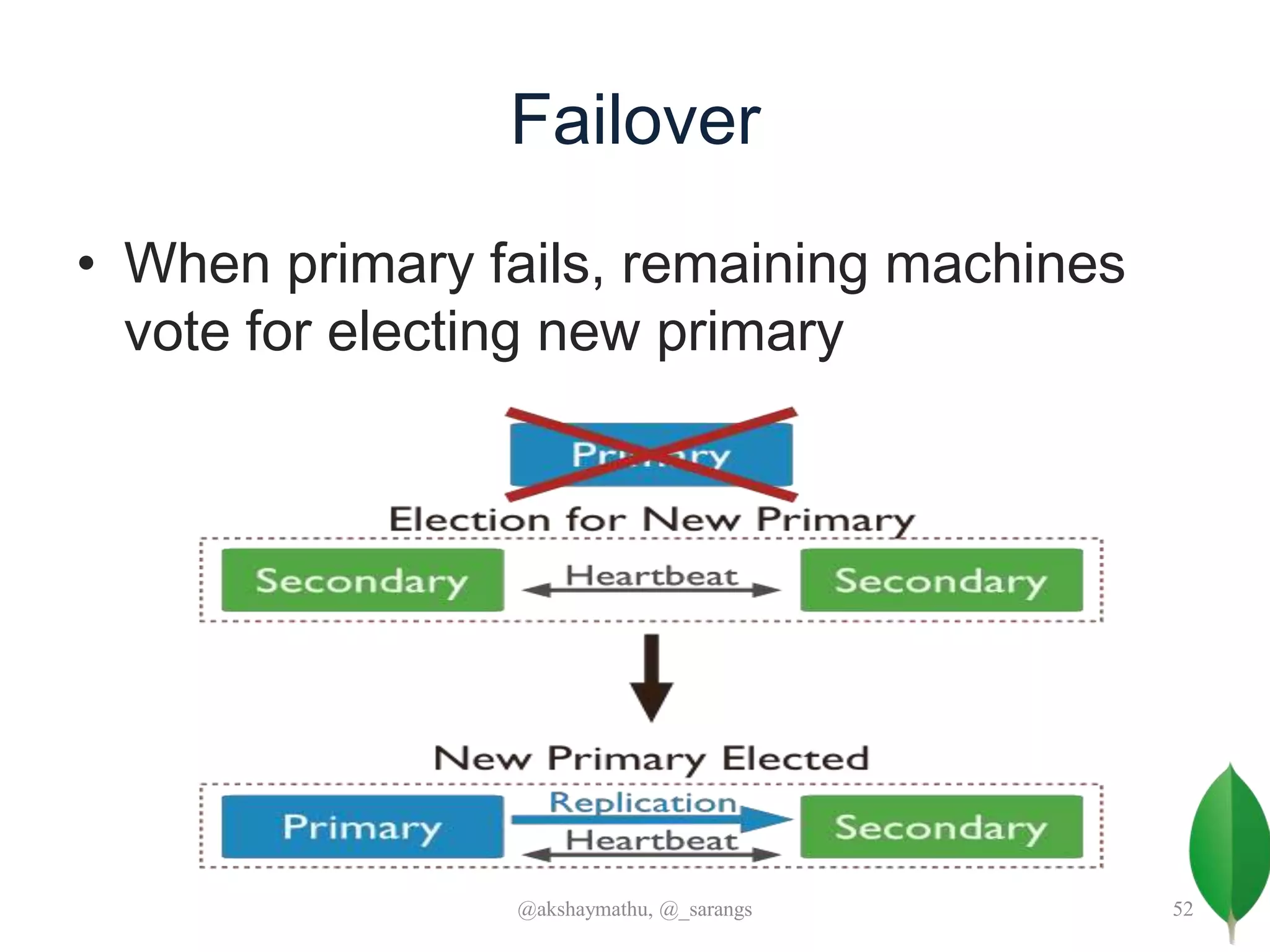
Failover
• When primary fails, remaining machines
vote for electing new primary
@akshaymathu, @_sarangs 52
Handling Big Data
Introduction to Map/Reduce
and Sharding
@akshaymathu, @_sarangs 53
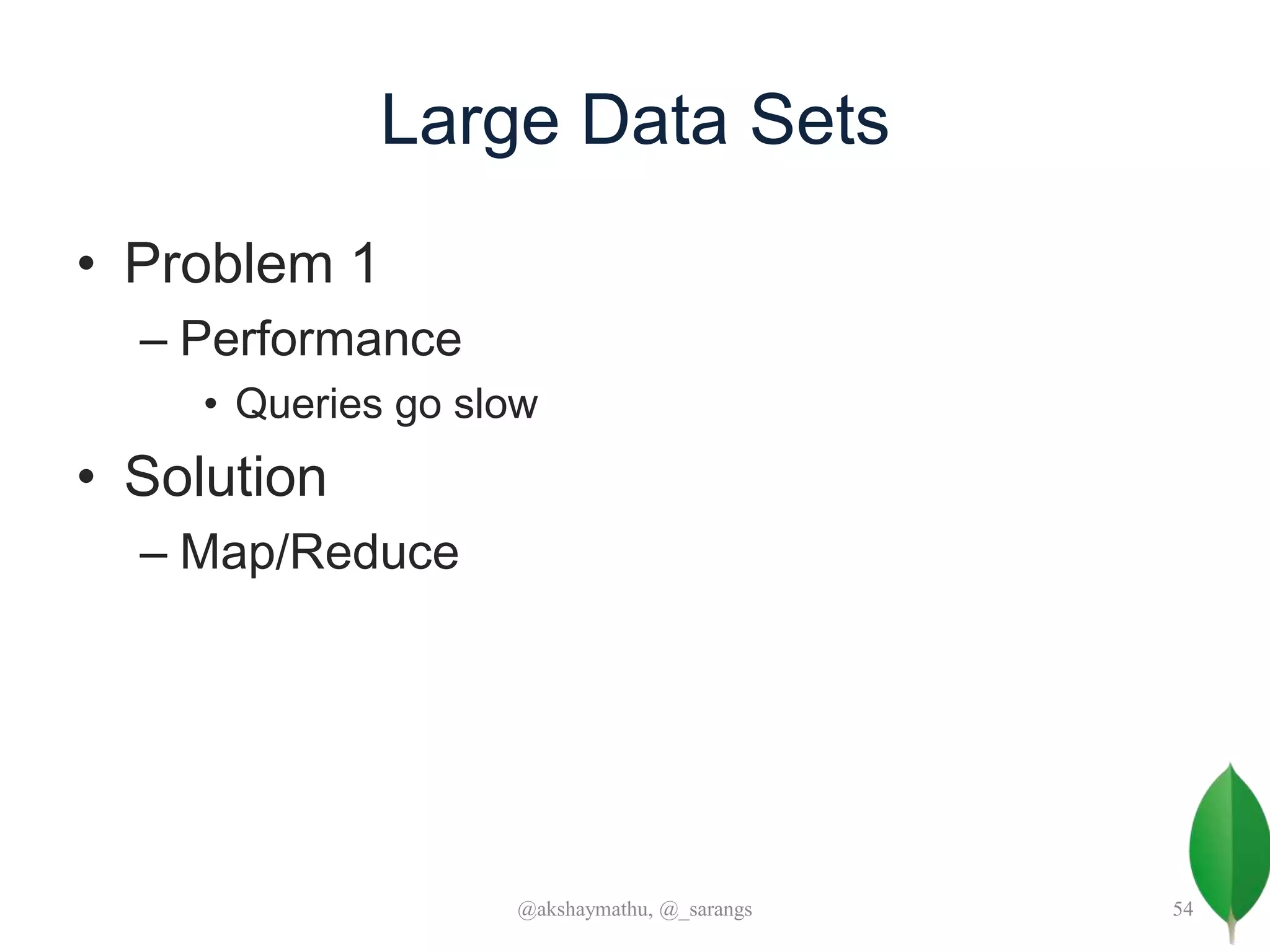
Large Data Sets
• Problem 1
– Performance
• Queries go slow
• Solution
– Map/Reduce
@akshaymathu, @_sarangs 54
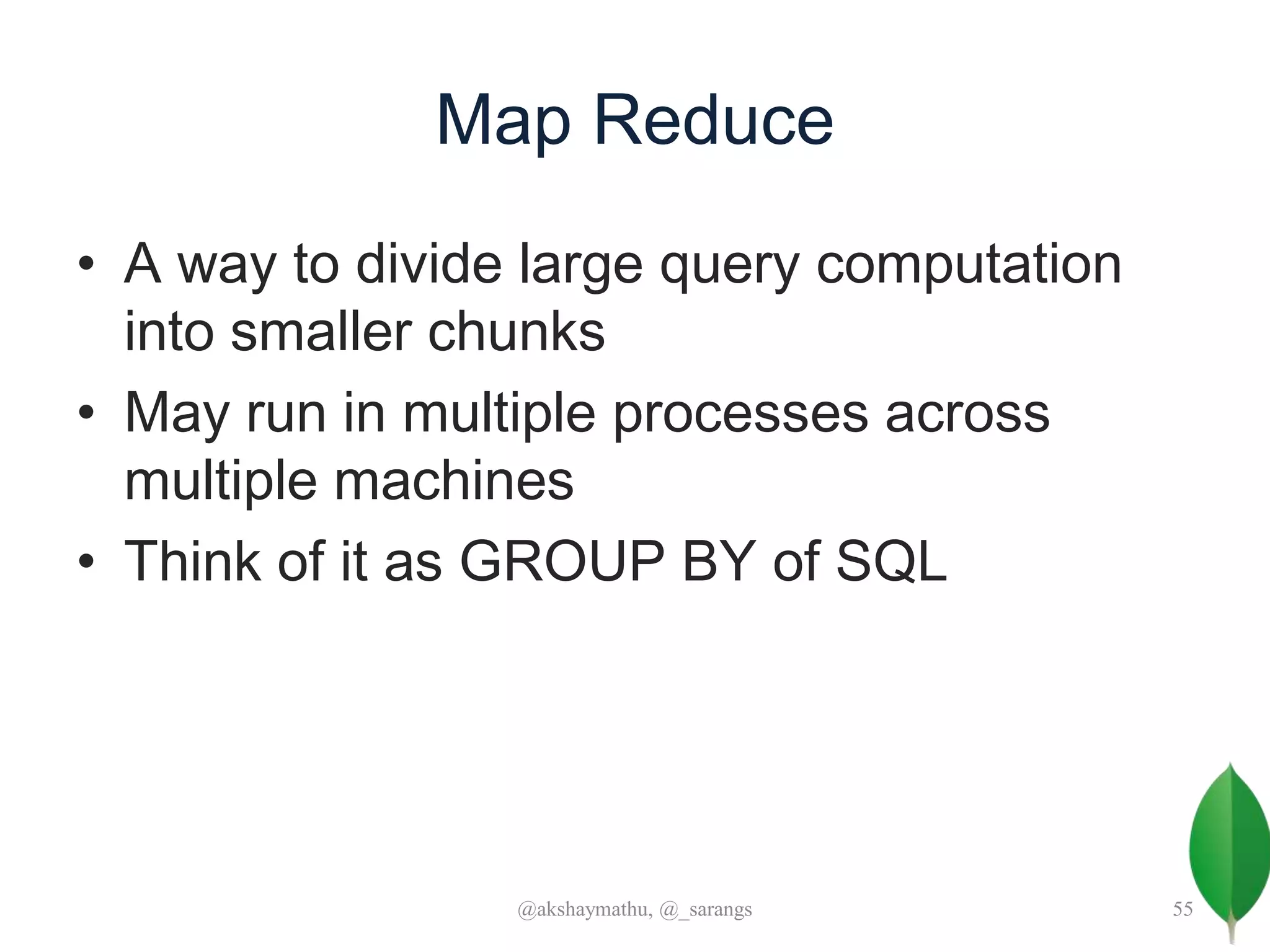
Map Reduce
• A way to divide large query computation
into smaller chunks
• May run in multiple processes across
multiple machines
• Think of it as GROUP BY of SQL
@akshaymathu, @_sarangs 55
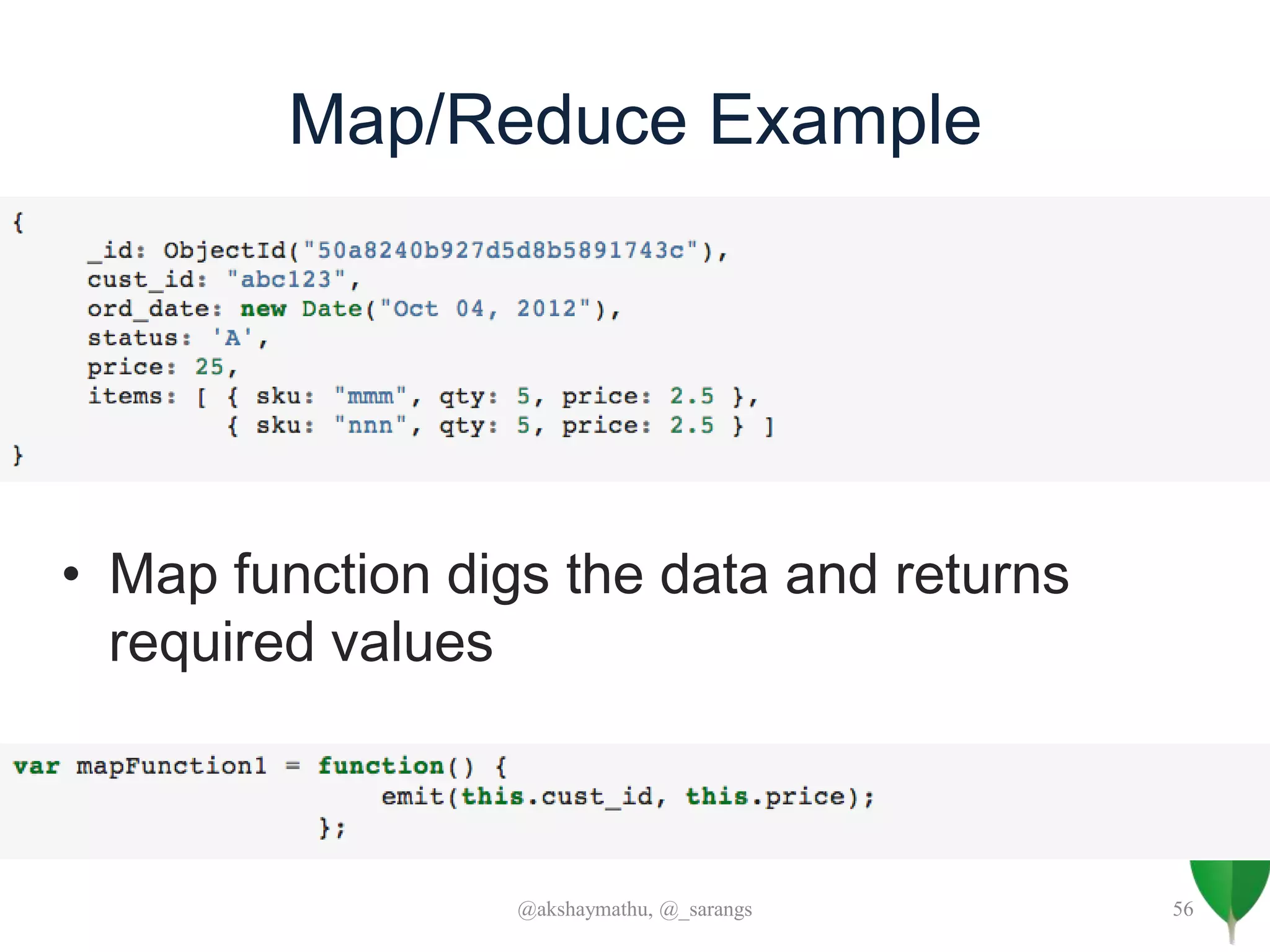
Map/Reduce Example
• Map function digs the data and returns
required values
@akshaymathu, @_sarangs 56
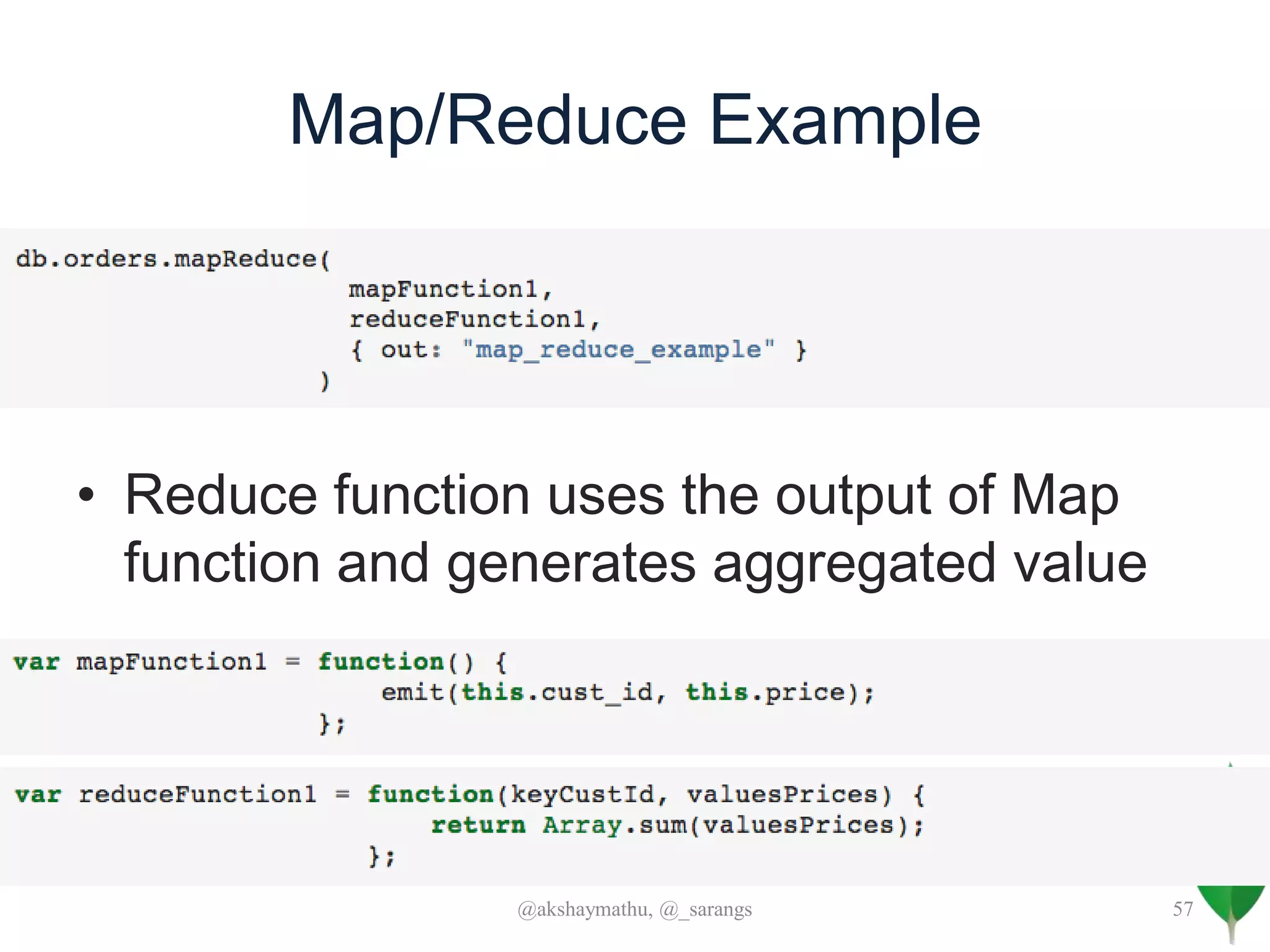
Map/Reduce Example
• Reduce function uses the output of Map
function and generates aggregated value
@akshaymathu, @_sarangs 57
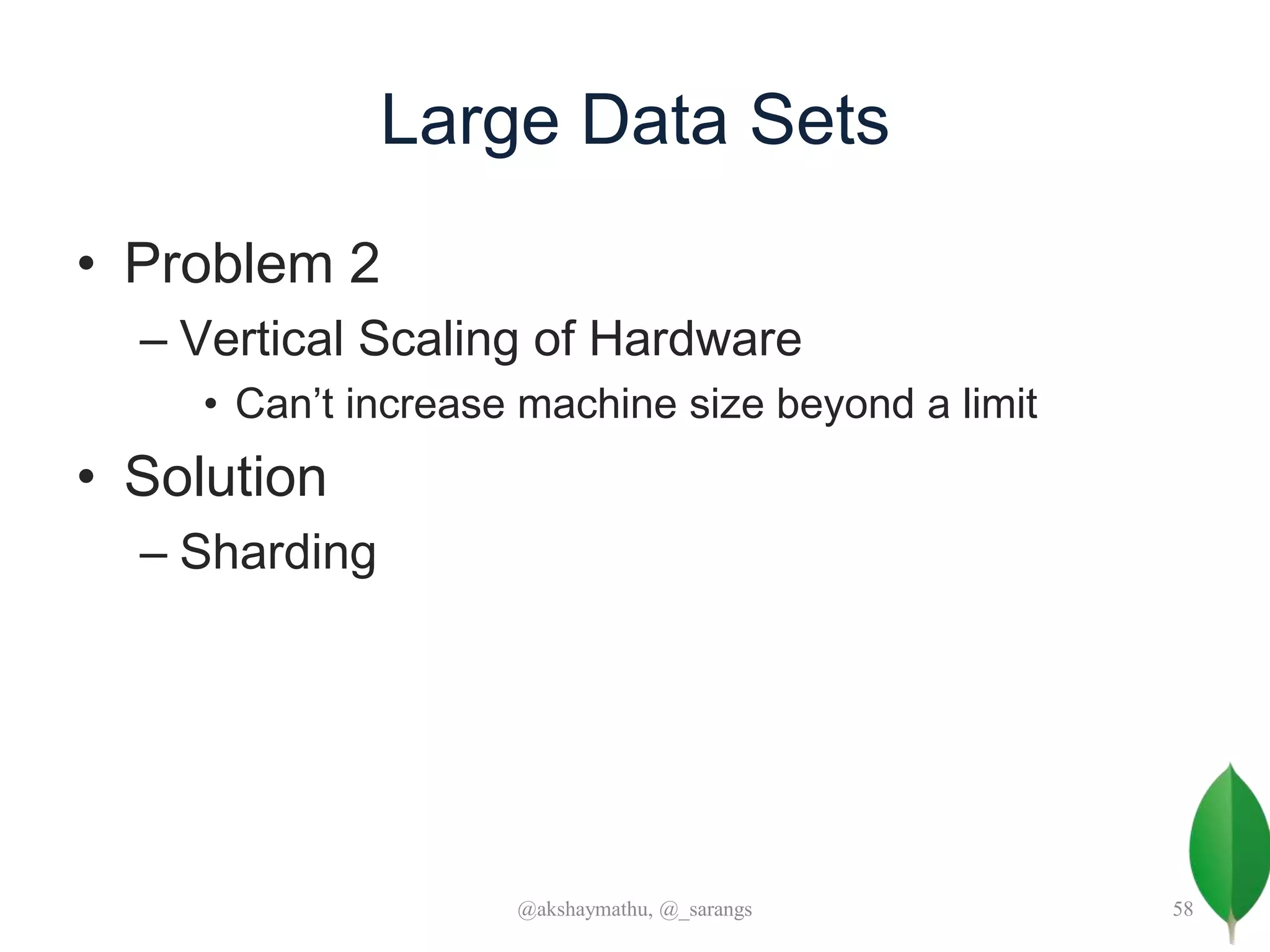
Large Data Sets
• Problem 2
– Vertical Scaling of Hardware
• Can’t increase machine size beyond a limit
• Solution
– Sharding
@akshaymathu, @_sarangs 58
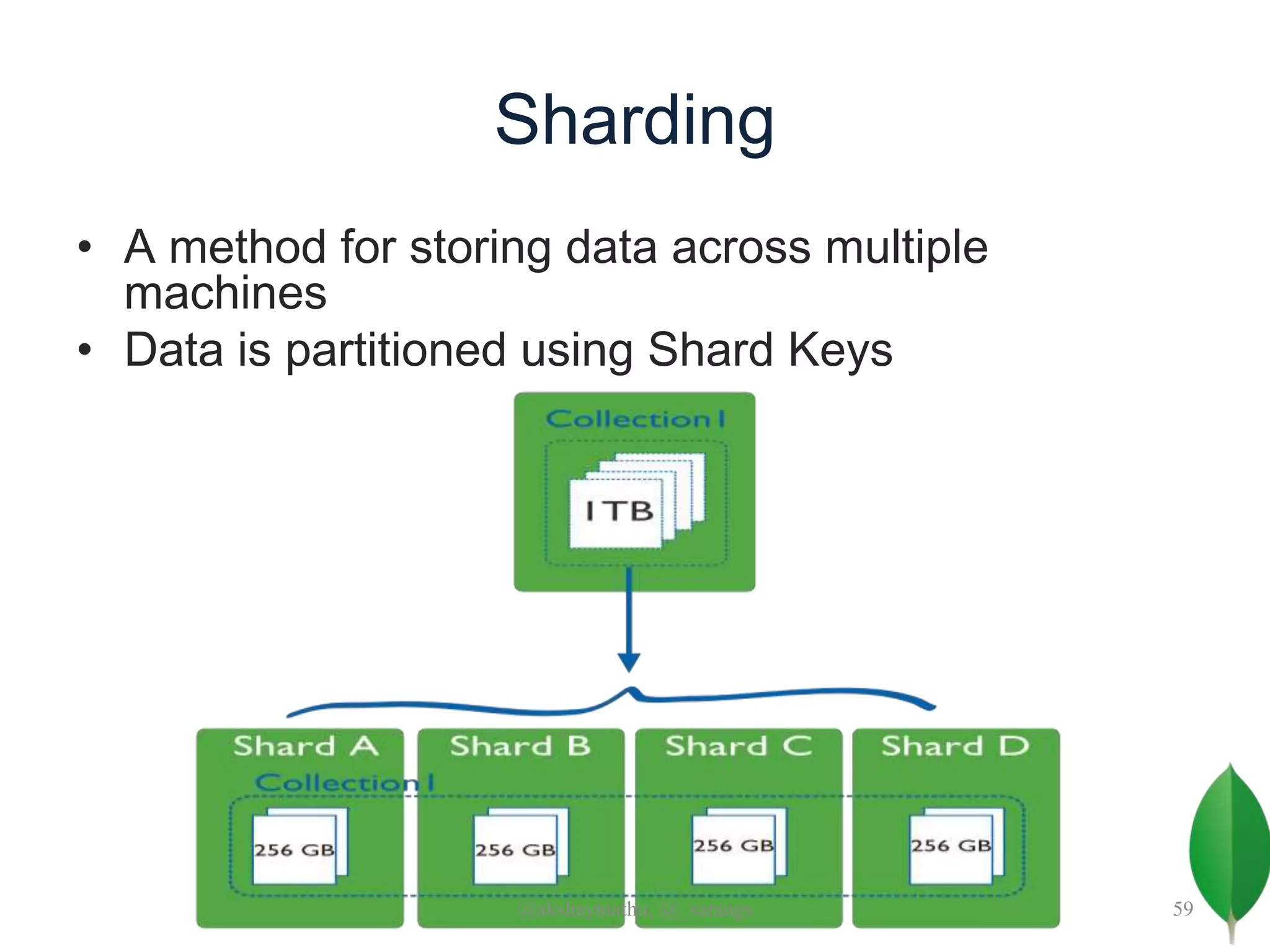
Sharding
• A method for storing data across multiple
machines
• Data is partitioned using Shard Keys
@akshaymathu, @_sarangs 59
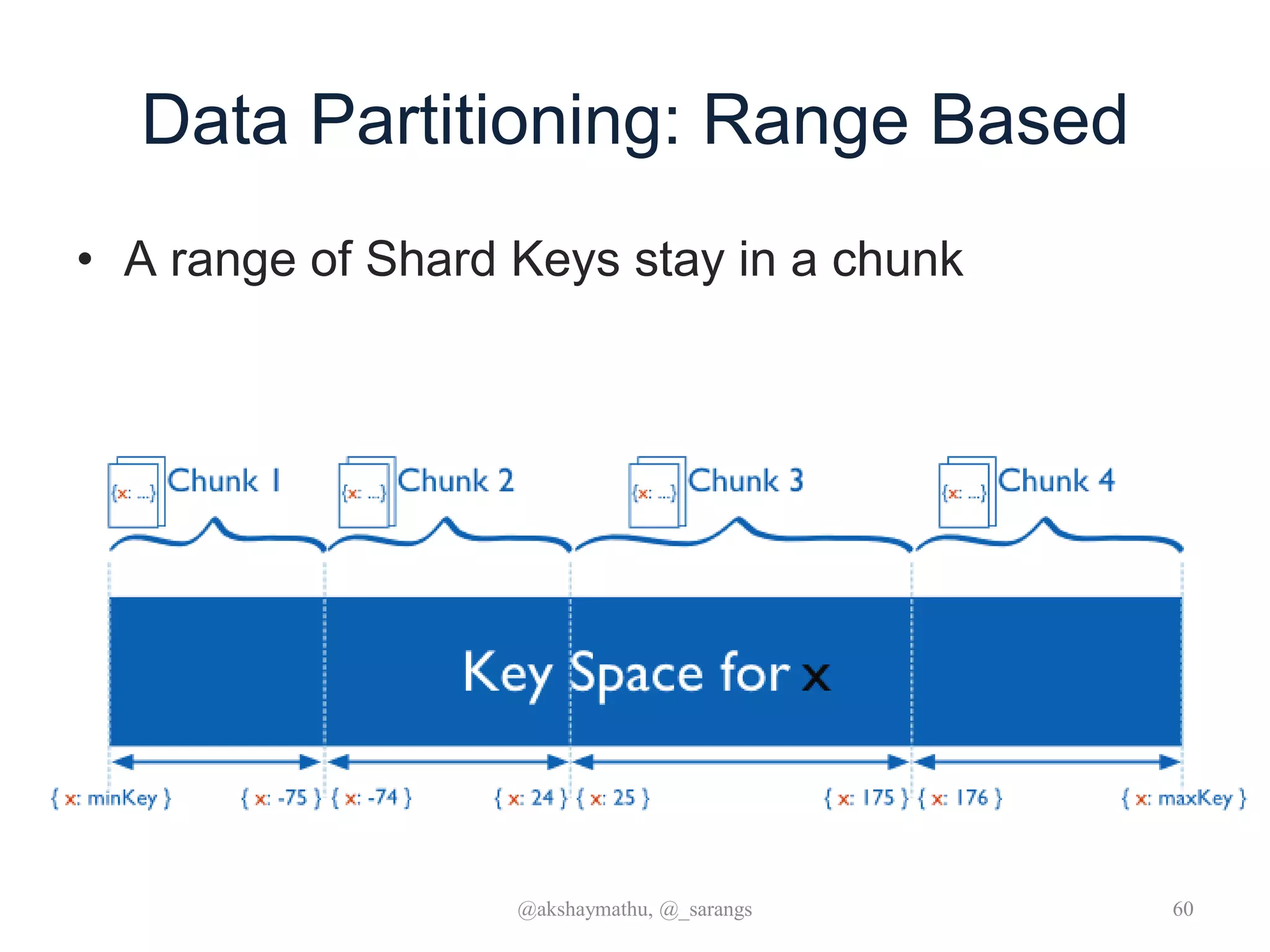
Data Partitioning: Range Based
• A range of Shard Keys stay in a chunk
@akshaymathu, @_sarangs 60
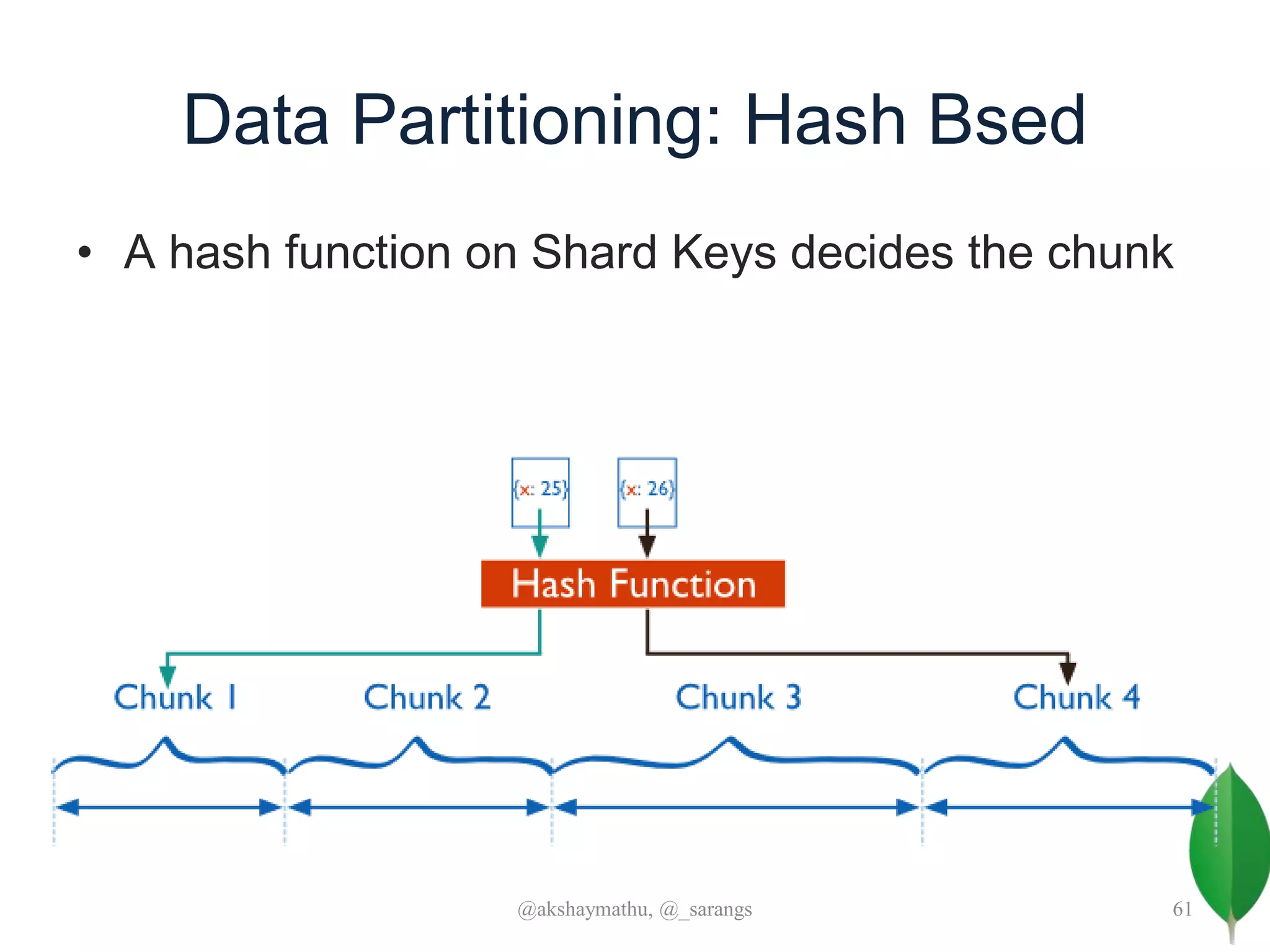
Data Partitioning: Hash Bsed
• A hash function on Shard Keys decides the chunk
@akshaymathu, @_sarangs 61
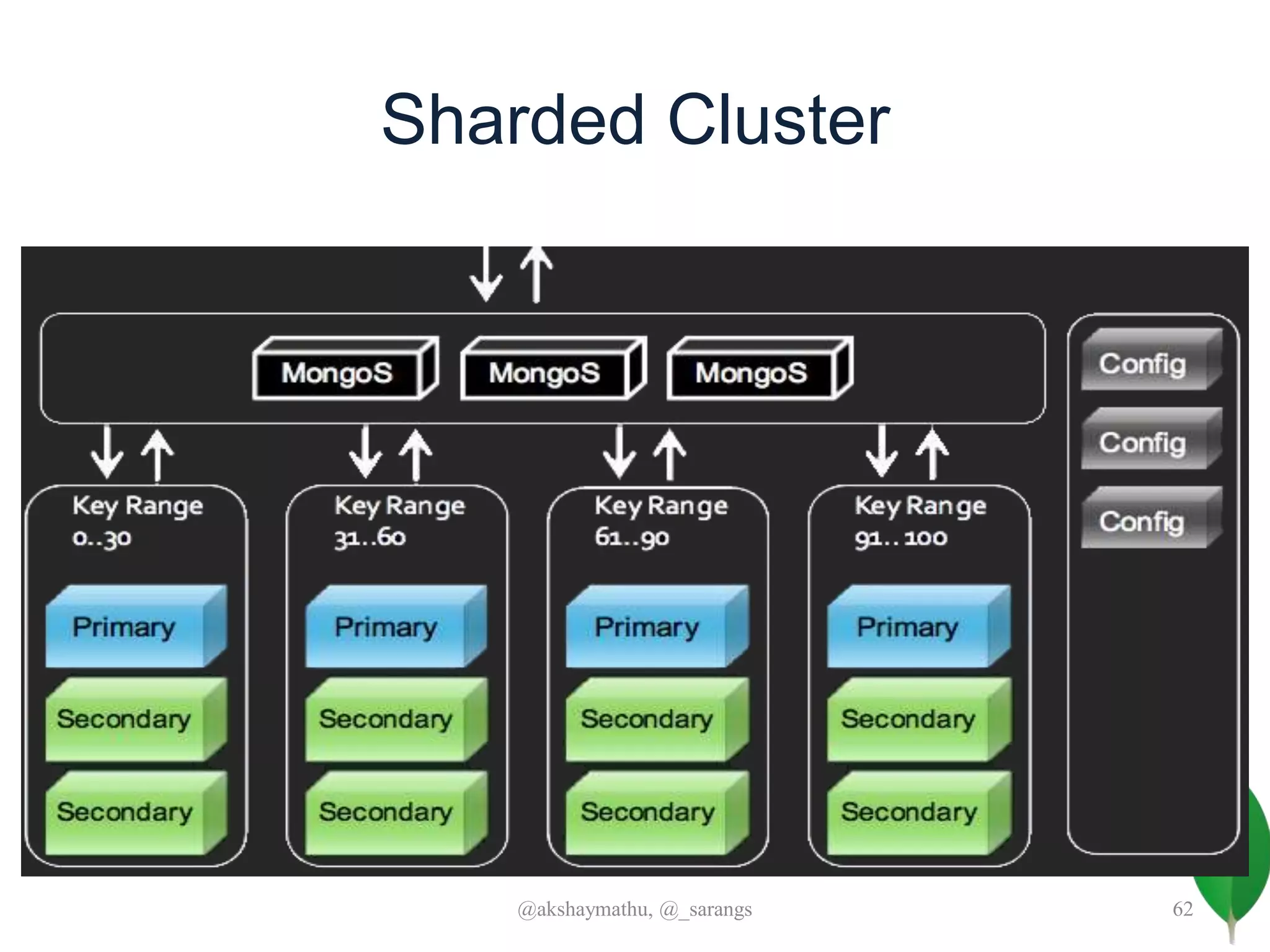
Sharded Cluster
@akshaymathu, @_sarangs 62
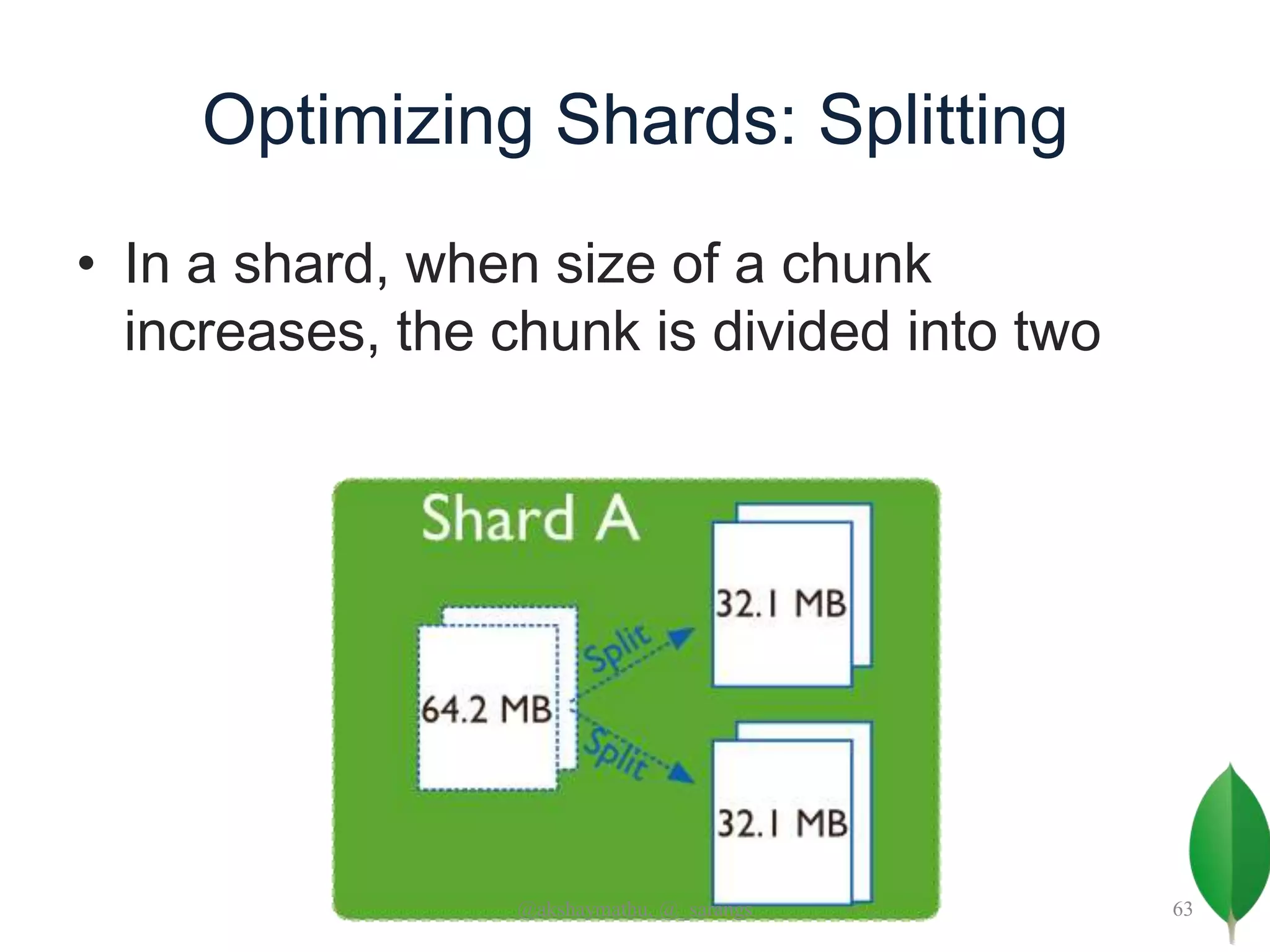
Optimizing Shards: Splitting
• In a shard, when size of a chunk
increases, the chunk is divided into two
@akshaymathu, @_sarangs 63
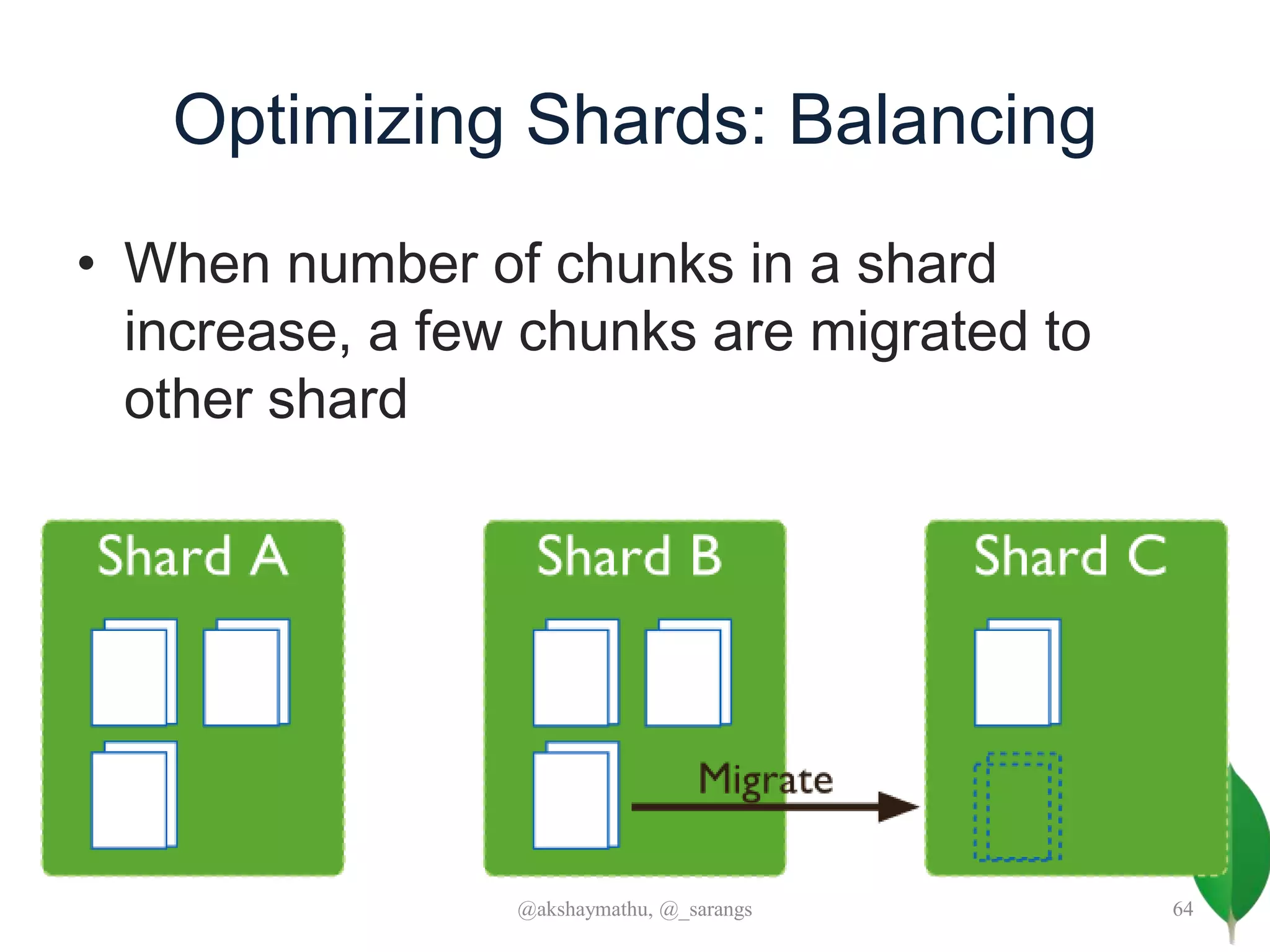
Optimizing Shards: Balancing
• When number of chunks in a shard
increase, a few chunks are migrated to
other shard
@akshaymathu, @_sarangs 64
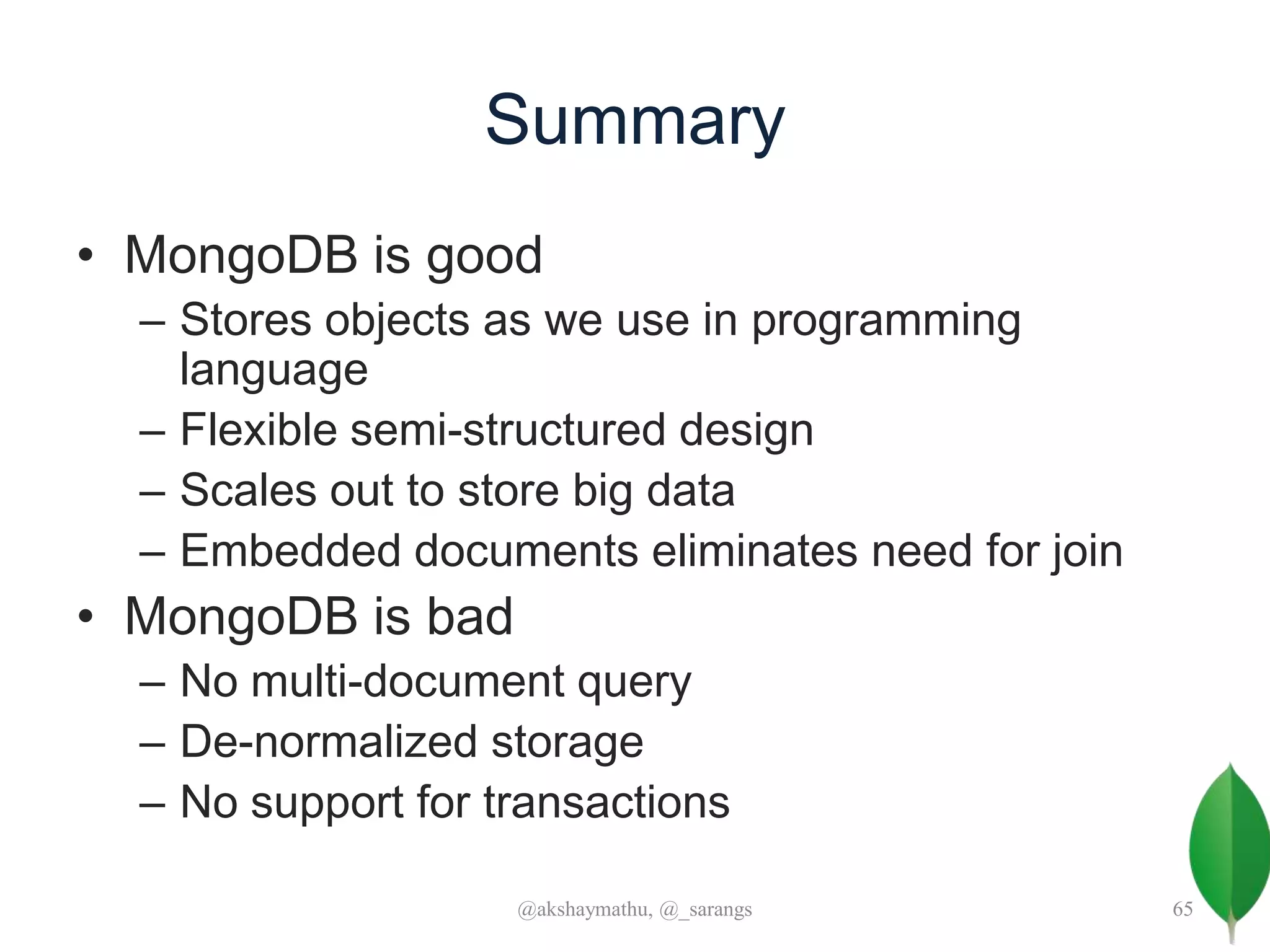
Summary
• MongoDB is good
– Stores objects as we use in programming
language
– Flexible semi-structured design
– Scales out to store big data
– Embedded documents eliminates need for join
• MongoDB is bad
– No multi-document query
– De-normalized storage
– No support for transactions
@akshaymathu, @_sarangs 65
Thanks
@akshaymathu, @_sarangs 66
@akshaymathu @_sarangs

Mongo db

  • 1.
    NoSQL Database Akshay Mathur SarangShravagi @akshaymathu, @_sarangs {name: ‘mongo’, type: ‘db’}
  • 2.
  • 3.
    Let’s Know EachOther • Do you code? • OS? • Programing Language? • Why are you attending? @akshaymathu, @_sarangs 3
  • 4.
    Akshay Mathur • Manageddevelopment, testing and release teams in last 14+ years – Currently Principal Architect at ShopSocially • Founding Team Member of – ShopSocially (Enabling “social” for retailers) – AirTight Neworks (Global leader of WIPS) @akshaymathu, @_sarangs 4
  • 5.
    Sarang Shravagi • 10genCertified Developer and DBA • CS graduate from PICT Pune • 3+ years in Software Product industry • Currently Senior Full-stack Developer at ShopSocially @akshaymathu, @_sarangs 5
  • 6.
    How we useMongoDB @akshaymathu, @_sarangs 6 Python MongoDB MongoEngine
  • 7.
  • 8.
    Program Outline: UnderstandingNoSQL • Data Landscape • Different Storage Needs • Design Paradigm Shift from SQL to NoSQL • Different Datastores • Closer look to Document Storage • Drawing parallel from RDBMS @akshaymathu, @_sarangs 8
  • 9.
    Program Outline: Handson Lab • Installation and basic configuration • Mongo Shell • Creating and Changing Schema • Create, Read, Update and Delete of Data • Analyzing Performance • Improving performance by creating Indices • Assignment • Problem solving for the assignment @akshaymathu, @_sarangs 9
  • 10.
    Program Outline: AdvanceTopics • Handling Big Data – Introduction to Map/Reduce – Introduction to Data Partitioning (Sharding) • Disaster Recovery – Introduction to Replica set and High Availability @akshaymathu, @_sarangs 10
  • 11.
    Ground Rules • DisturbEveryone – Not by phone rings – Not by local talks – By more information and questions @akshaymathu, @_sarangs 11
  • 12.
    Data Patterns &Storage Needs @akshaymathu, @_sarangs 12
  • 13.
    Data at anOnline Store • Product Information • User Information • Purchase Information • Product Reviews • Site Interactions • Social Graph • Search Index @akshaymathu, @_sarangs 13
  • 14.
    SQL to NoSQL DesignParadigm Shift @akshaymathu, @_sarangs 14
  • 15.
    SQL Storage • Wasdesigned when – Storage and data transfer was costly – Processing was slow – Applications were oriented more towards data collection • Initial adopters were financial institutions @akshaymathu, @_sarangs 15
  • 16.
    SQL Storage • Structured –schema • Relational – foreign keys, constraints • Transactional – Atomicity, Consistency, Isolation, Durability • High Availability through robustness – Minimize failures • Optimized for Writes • Typically Scale Up @akshaymathu, @_sarangs 16
  • 17.
    NoSQL Storage • Isdesigned when – Storage is cheap – Data transfer is fast – Much more processing power is available • Clustering of machines is also possible – Applications are oriented towards consumption of User Generated Content – Better on-screen user experience is in demand @akshaymathu, @_sarangs 17
  • 18.
    NoSQL Storage • Semi-structured –Schemaless • Consistency, Availability, Partition Tolerance • High Availability through clustering – expect failures • Optimized for Reads • Typically Scale Out @akshaymathu, @_sarangs 18
  • 19.
    Different Datastores Half LevelDeep @akshaymathu, @_sarangs 19
  • 20.
    SQL: RDBMS • MySql,Postgresql, Oracle etc. • Stores data in tables having columns – Basic (number, text) data types • Strong query language • Transparent values – Query language can read and filter on them – Relationship between tables based on values • Suited for user info and transactions @akshaymathu, @_sarangs 20
  • 21.
    NoSQL: Key/Value • Redis,DynamoDB etc. • Stores a values against a key – Strings • Values are opaque – Can not be part of query • Suited for site interactions @akshaymathu, @_sarangs 21
  • 22.
  • 23.
    NoSQL: Document • MongoDB,CouchDB etc. • Object Oriented data models – Stores data in document objects having fields – Basic and compound (list, dict) data types • SQL like queries • Transparent values – Can be part of query • Suited for product info and its reviews @akshaymathu, @_sarangs 23
  • 24.
  • 25.
    NoSQL: Column Family •Cassandra, Big Table etc. • Stores data in columns • Transparent values – Can be part of query • SQL like queries • Suited for search @akshaymathu, @_sarangs 25
  • 26.
  • 27.
    NoSQL: Graph • Neo4j •Stores data in form of nodes and relationships • Query is in form of traversal • In-memory • Suited for social graph @akshaymathu, @_sarangs 27
  • 28.
  • 30.
    Document Storage: CloserLook @akshaymathu, @_sarangs 30
  • 31.
    MongoDB • Document database •Powerful query language • Docs, sub-docs, indexes • Map/reduce • Replicas, shards, replicated shards • SDKs/drivers for so many languages – C, C++, C#, Python, Erlang, PHP, Java, Javascript, NodeJS, Perl, Ruby, Scala @akshaymathu, @_sarangs 31
  • 32.
  • 33.
  • 34.
    RDBMS  MongoDB RDBMSMongoDB Database Database Table Collection Row Document Column Field Select c1, c2 from Table where c1 = ‘v1’ order by c2 limit n Collection.objects(F1 = ‘v1’).order_by(‘c2’).limit(n) @akshaymathu, @_sarangs 34
  • 35.
  • 36.
  • 37.
  • 38.
  • 39.
  • 40.
    MongoDB: Core Binaries •mongod – Database server • mongo – Database client shell • mongos – Router for Sharding @akshaymathu, @_sarangs 40
  • 41.
    Getting Help • Formongo shell – mongo –help • Shows options available for running the shell • Inside mongo shell – Object.help() • Shows commands available on the object @akshaymathu, @_sarangs 41
  • 42.
    Import Export Tools •For objects – mongodump – mongorestore – bsondump – mongooplog • For data items – mongoimport – mongoexport @akshaymathu, @_sarangs 42
  • 43.
    Database Operations • Databasecreation • Creating/changing collection • Data insertion • Data read • Data update • Creating indices • Data deletion • Dropping collection @akshaymathu, @_sarangs 43
  • 44.
    Diagnostic Tools • mongostat •mongoperf • mongosnif • mongotop @akshaymathu, @_sarangs 44
  • 45.
  • 46.
    Assignment • Go tohttp://www.velocitainc.com/mongo/ – Tasks • assignments.txt – Data • students.json @akshaymathu, @_sarangs 46
  • 47.
    Disaster Recovery Introduction toReplica Sets and High Availability @akshaymathu, @_sarangs 47
  • 48.
    Disasters • Physical Failure –Hardware – Network • Solution – Replica Sets • Provide redundant storage for High Availability – Real time data synchronization • Automatic failover for zero down time @akshaymathu, @_sarangs 48
  • 49.
  • 50.
    Multi Replication • Datacan be replicated to multiple places simultaneously • Odd number of machines are always needed in a replica set @akshaymathu, @_sarangs 50
  • 51.
    Single Replication • Ifyou want to have only one or odd number of secondary, you need to setup an arbiter @akshaymathu, @_sarangs 51
  • 52.
    Failover • When primaryfails, remaining machines vote for electing new primary @akshaymathu, @_sarangs 52
  • 53.
    Handling Big Data Introductionto Map/Reduce and Sharding @akshaymathu, @_sarangs 53
  • 54.
    Large Data Sets •Problem 1 – Performance • Queries go slow • Solution – Map/Reduce @akshaymathu, @_sarangs 54
  • 55.
    Map Reduce • Away to divide large query computation into smaller chunks • May run in multiple processes across multiple machines • Think of it as GROUP BY of SQL @akshaymathu, @_sarangs 55
  • 56.
    Map/Reduce Example • Mapfunction digs the data and returns required values @akshaymathu, @_sarangs 56
  • 57.
    Map/Reduce Example • Reducefunction uses the output of Map function and generates aggregated value @akshaymathu, @_sarangs 57
  • 58.
    Large Data Sets •Problem 2 – Vertical Scaling of Hardware • Can’t increase machine size beyond a limit • Solution – Sharding @akshaymathu, @_sarangs 58
  • 59.
    Sharding • A methodfor storing data across multiple machines • Data is partitioned using Shard Keys @akshaymathu, @_sarangs 59
  • 60.
    Data Partitioning: RangeBased • A range of Shard Keys stay in a chunk @akshaymathu, @_sarangs 60
  • 61.
    Data Partitioning: HashBsed • A hash function on Shard Keys decides the chunk @akshaymathu, @_sarangs 61
  • 62.
  • 63.
    Optimizing Shards: Splitting •In a shard, when size of a chunk increases, the chunk is divided into two @akshaymathu, @_sarangs 63
  • 64.
    Optimizing Shards: Balancing •When number of chunks in a shard increase, a few chunks are migrated to other shard @akshaymathu, @_sarangs 64
  • 65.
    Summary • MongoDB isgood – Stores objects as we use in programming language – Flexible semi-structured design – Scales out to store big data – Embedded documents eliminates need for join • MongoDB is bad – No multi-document query – De-normalized storage – No support for transactions @akshaymathu, @_sarangs 65
  • 66.