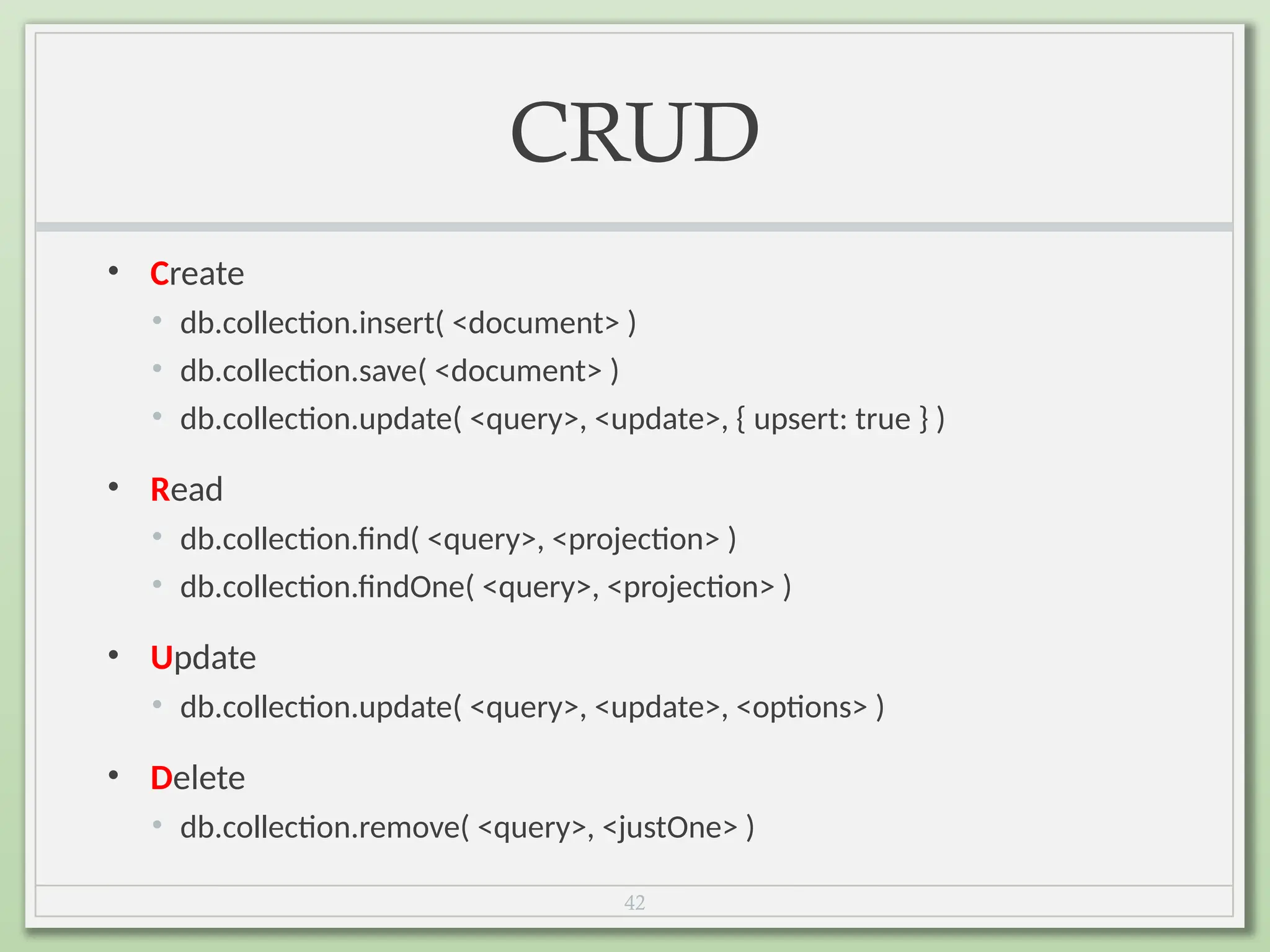
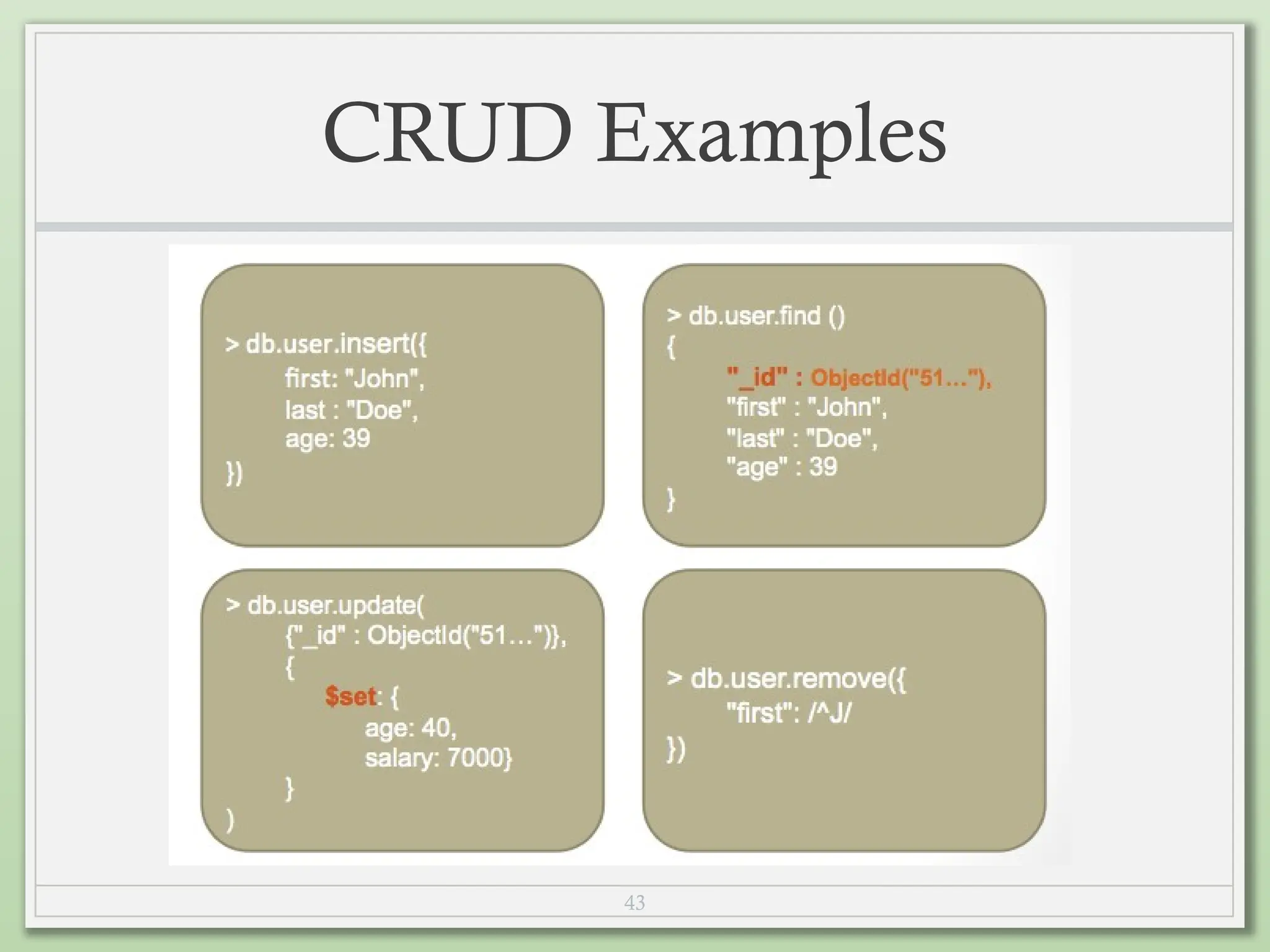
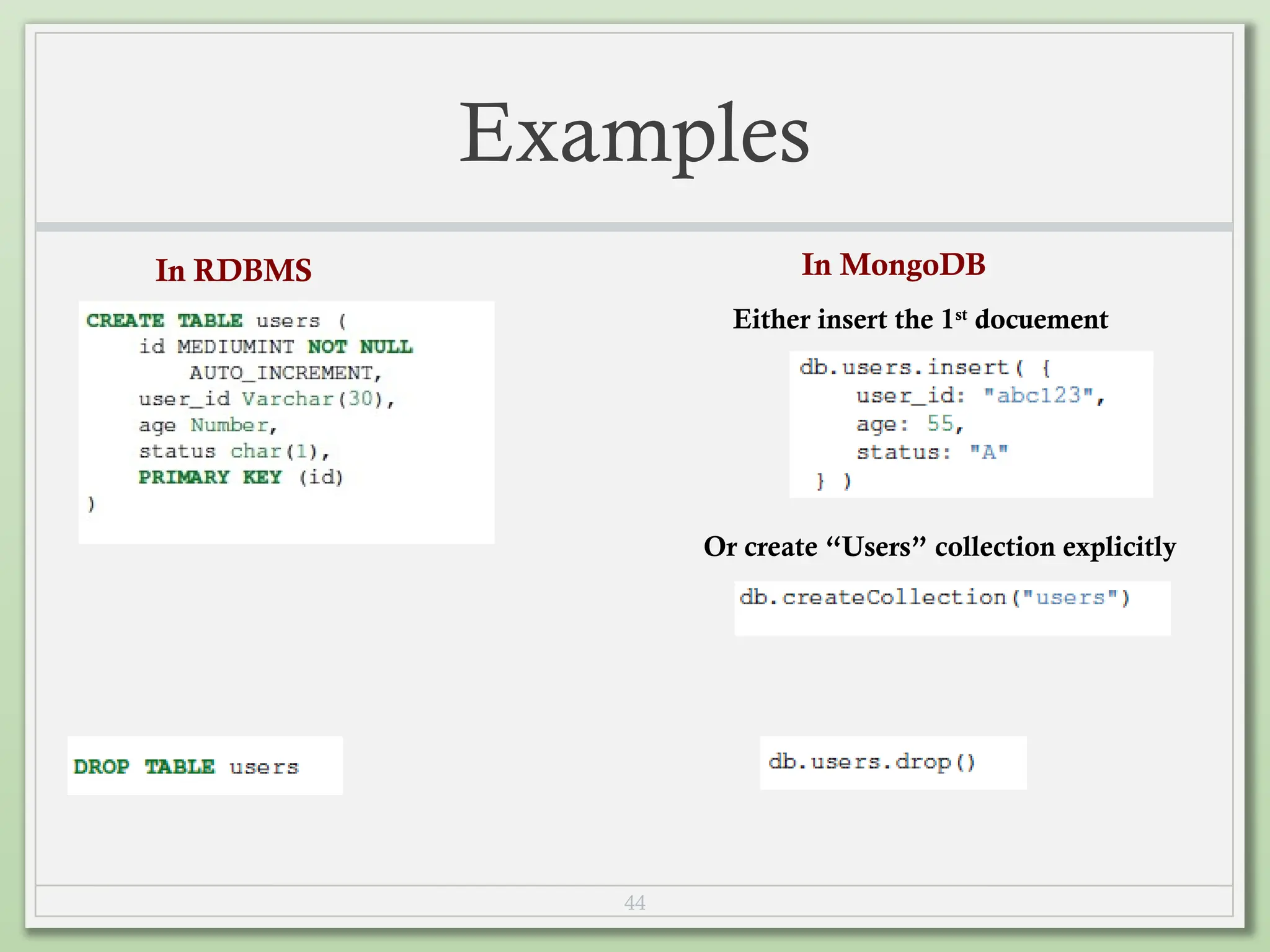
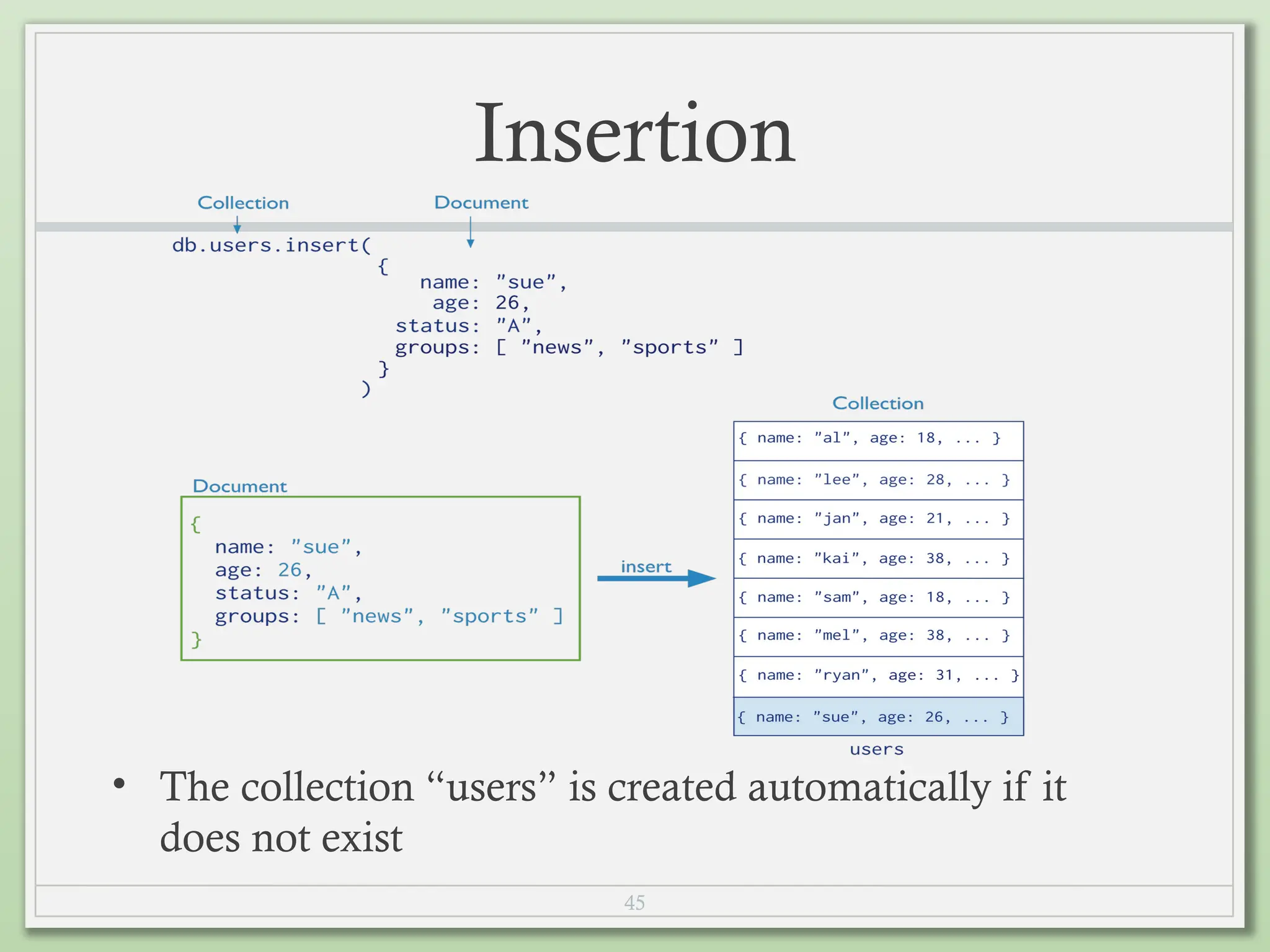
3
• Name comesfrom “Humongous” & huge data
• Written in C++, developed in 2009
• Creator: 10gen, former doublick
4.
4
MongoDB: Goal
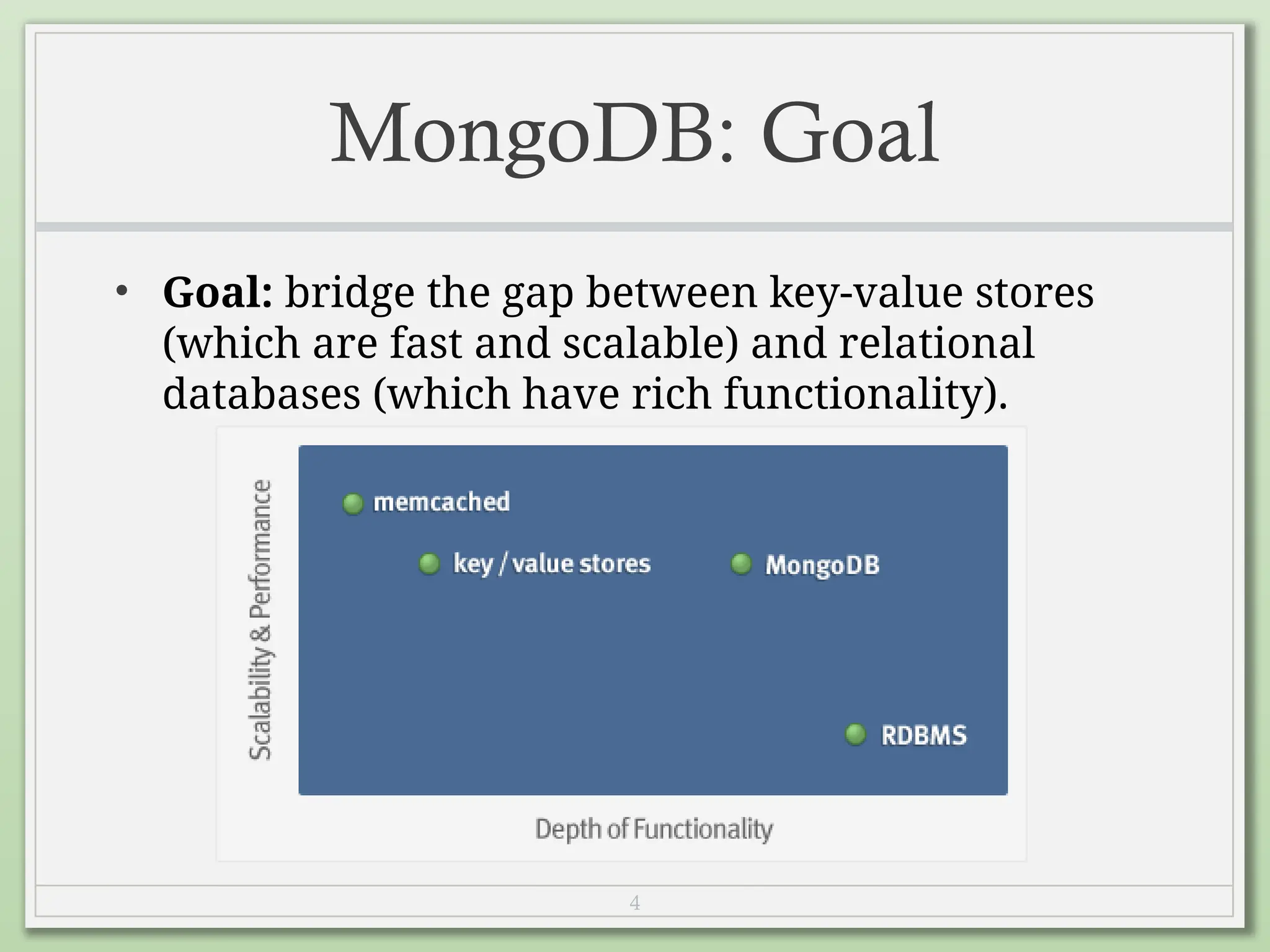
• Goal:bridge the gap between key-value stores
(which are fast and scalable) and relational
databases (which have rich functionality).
5.
5
What is MongoDB?
•Defination: MongoDB is an open source,
document-oriented database designed with both
scalability and developer agility in mind.
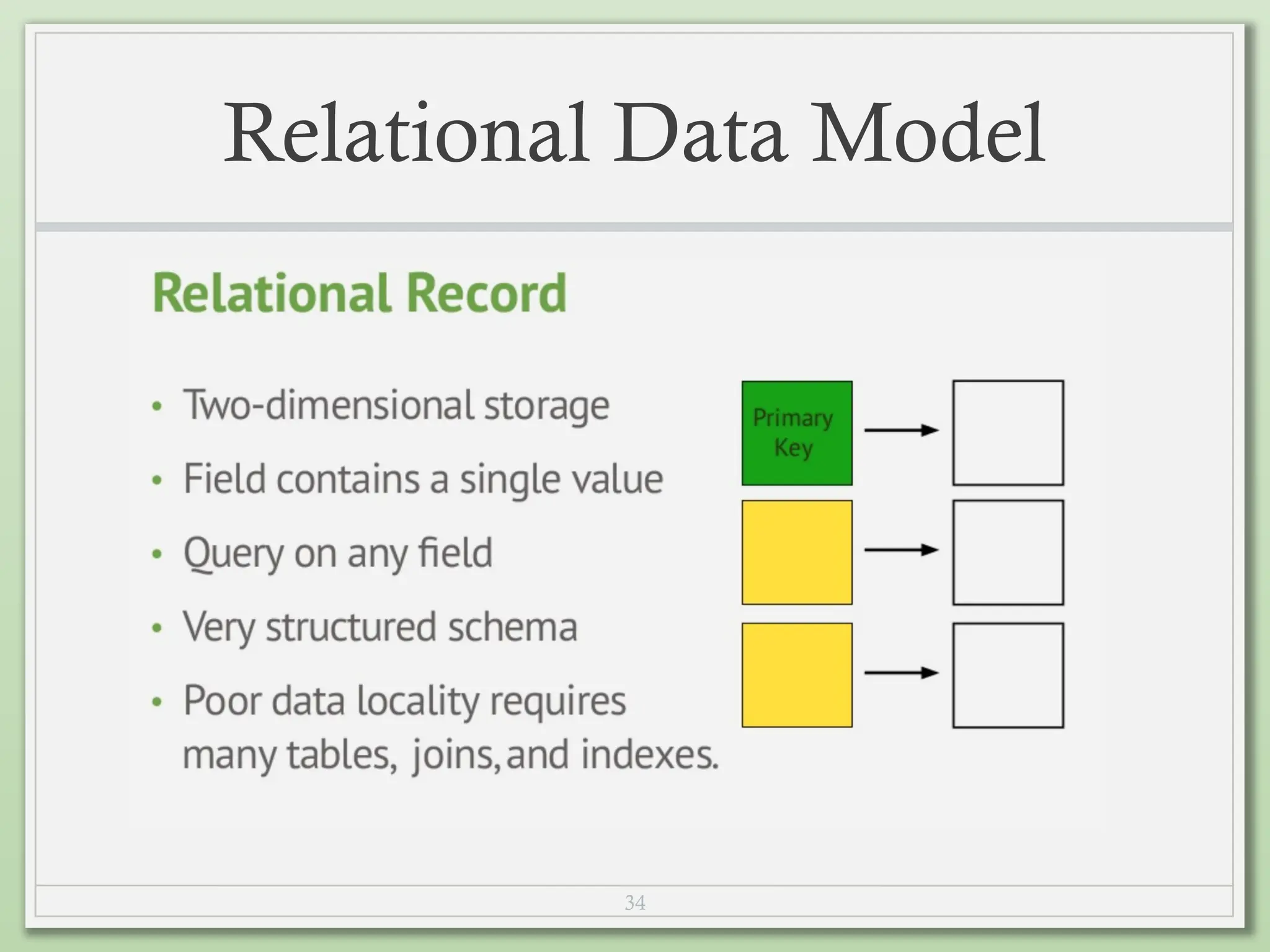
• Instead of storing your data in tables and rows as
you would with a relational database, in MongoDB
you store JSON-like documents with dynamic
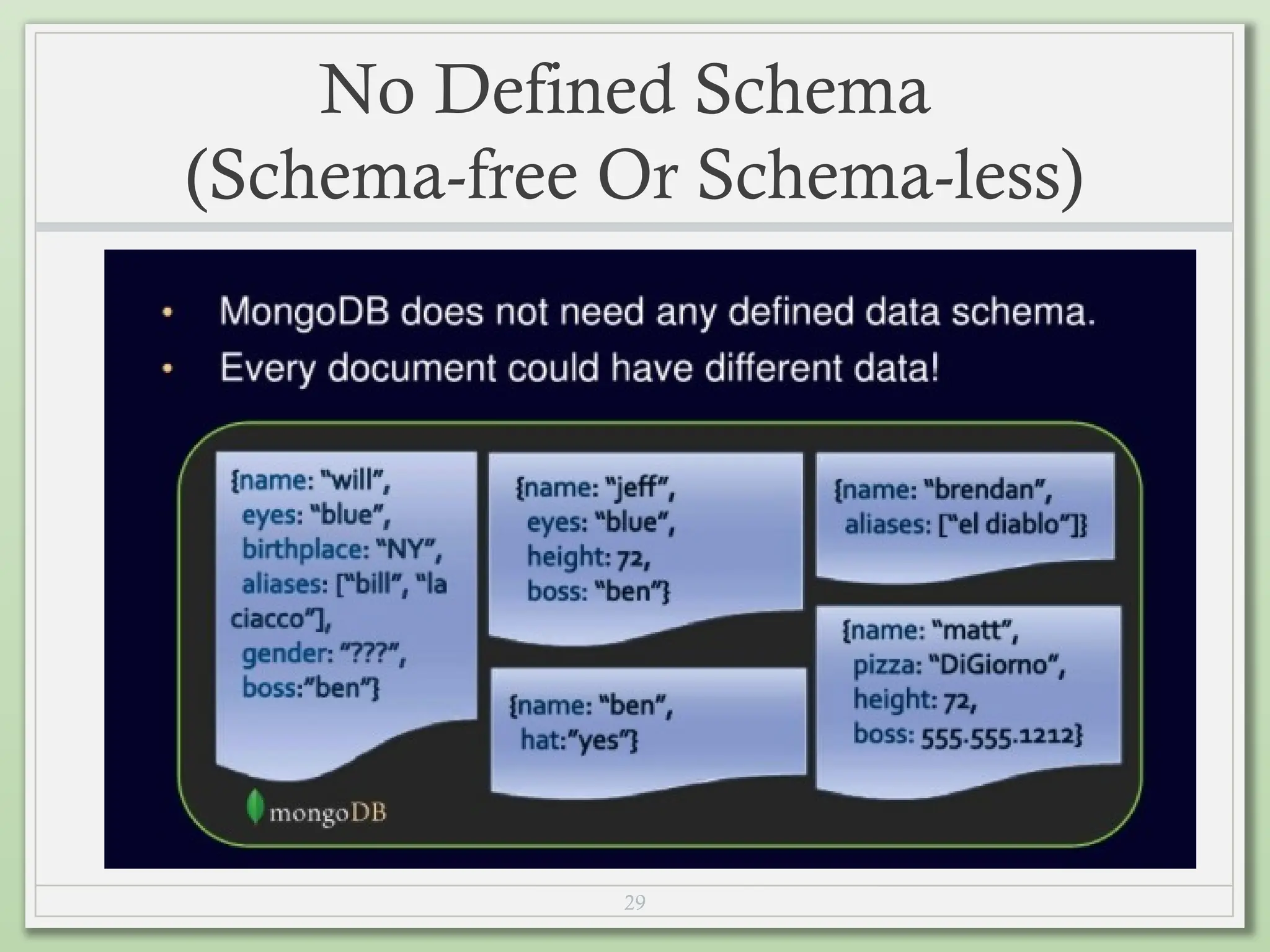
schemas (schema-free, schemaless).
6.
6
What is MongoDB?(Cont’d)
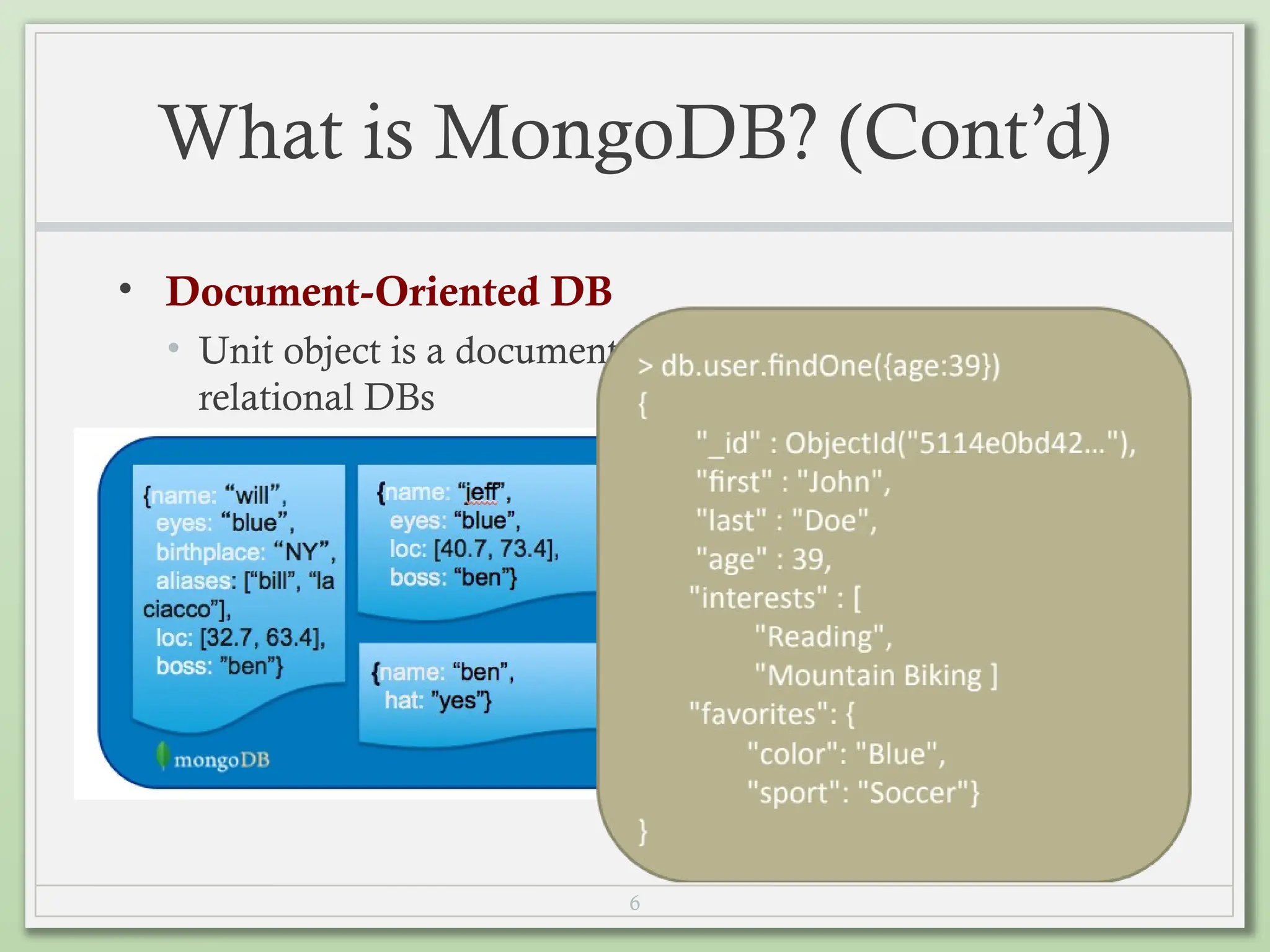
• Document-Oriented DB
• Unit object is a document instead of a row (tuple) in
relational DBs
7.
7
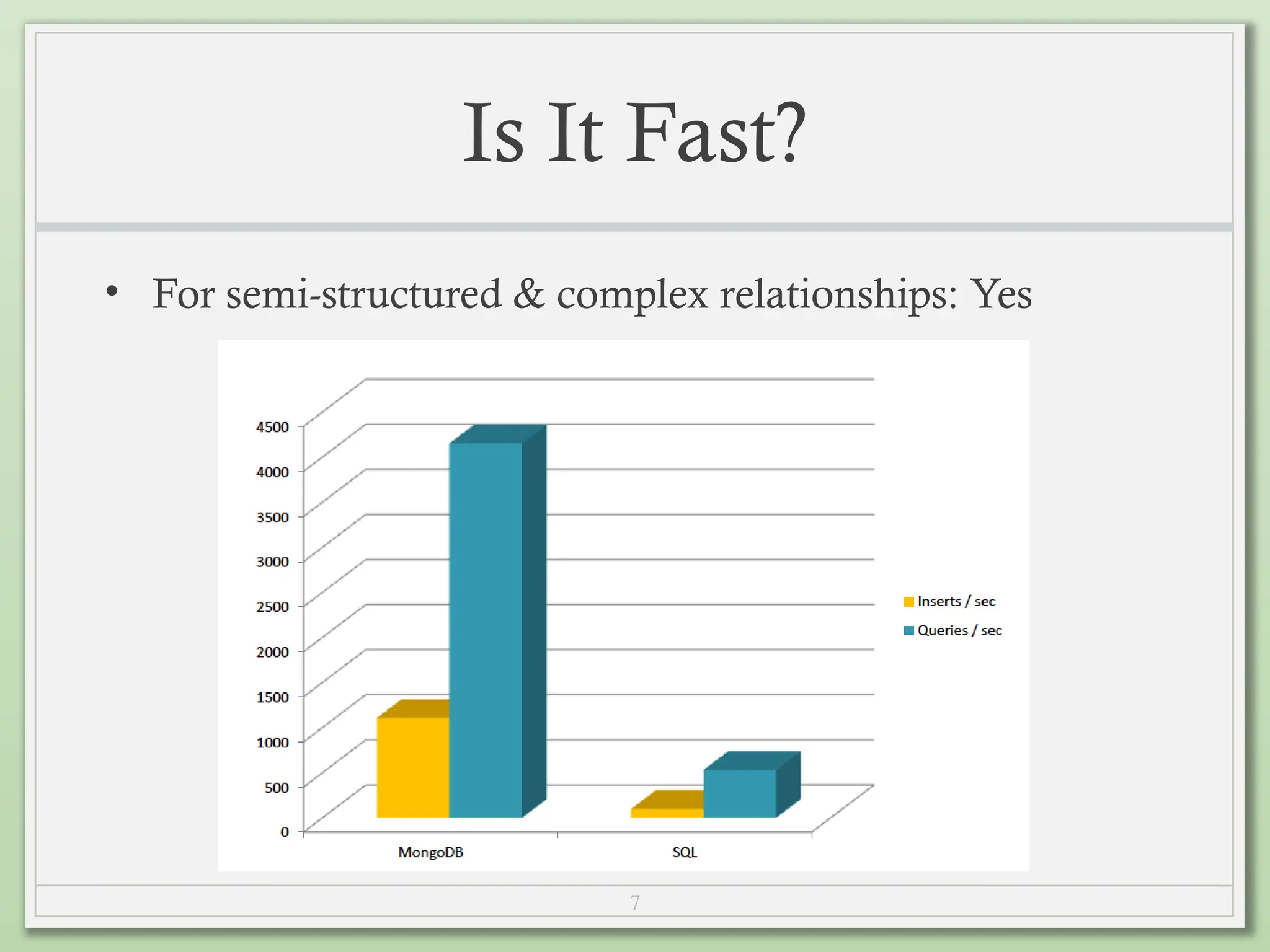
Is It Fast?
•For semi-structured & complex relationships: Yes
12
What is NoSQL
Stands for Not Only SQL??
Class of non-relational data storage systems
Usually do not require a fixed table schema nor
do they use the concept of joins
Distributed data storage systems
All NoSQL offerings relax one or more of the ACID
properties
will talk about the CAP theorem
13.
13
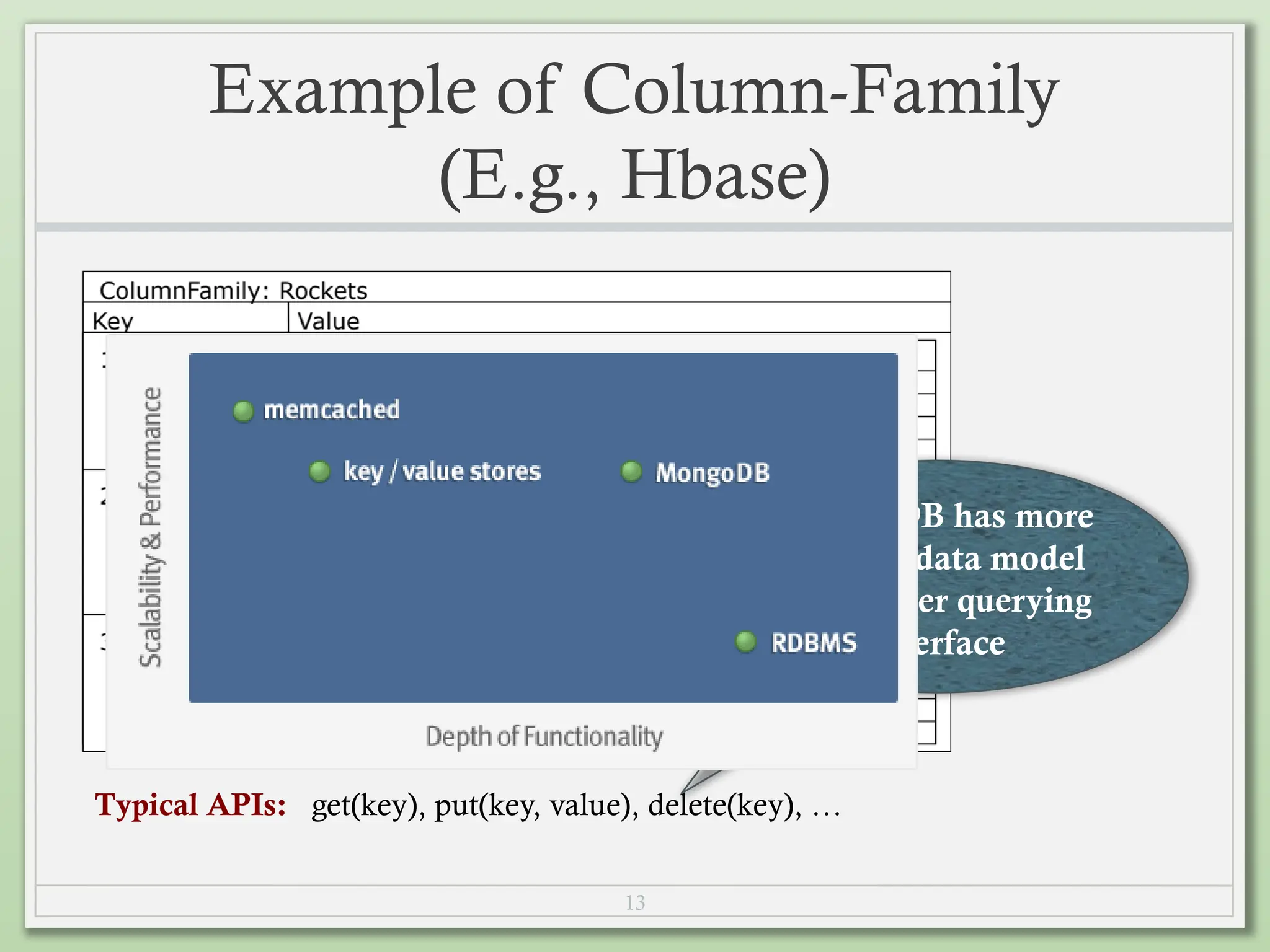
Example of Column-Family
(E.g.,Hbase)
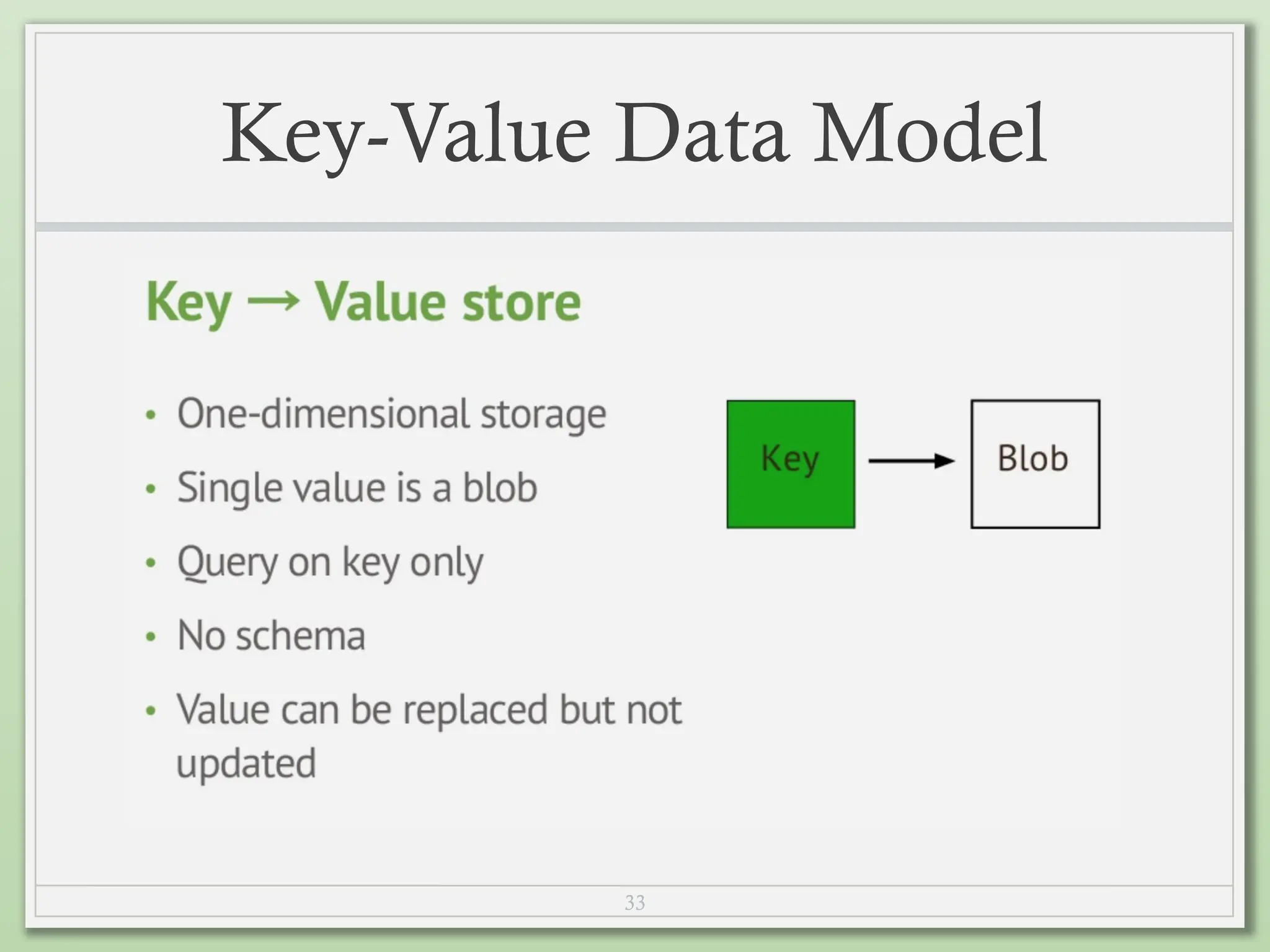
Typical APIs: get(key), put(key, value), delete(key), …
MongoDB has more
flexible data model
& stronger querying
interface
14.
14
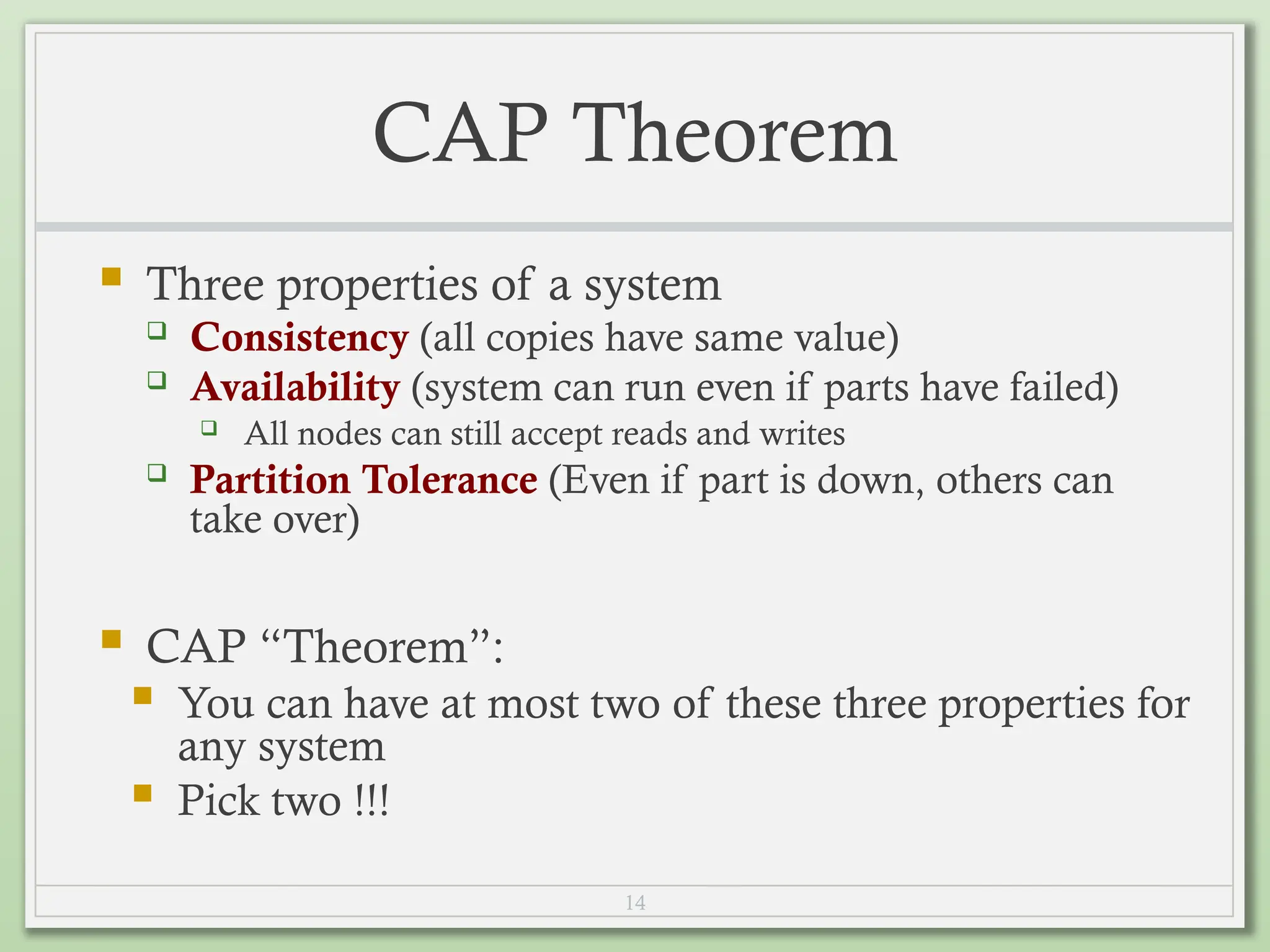
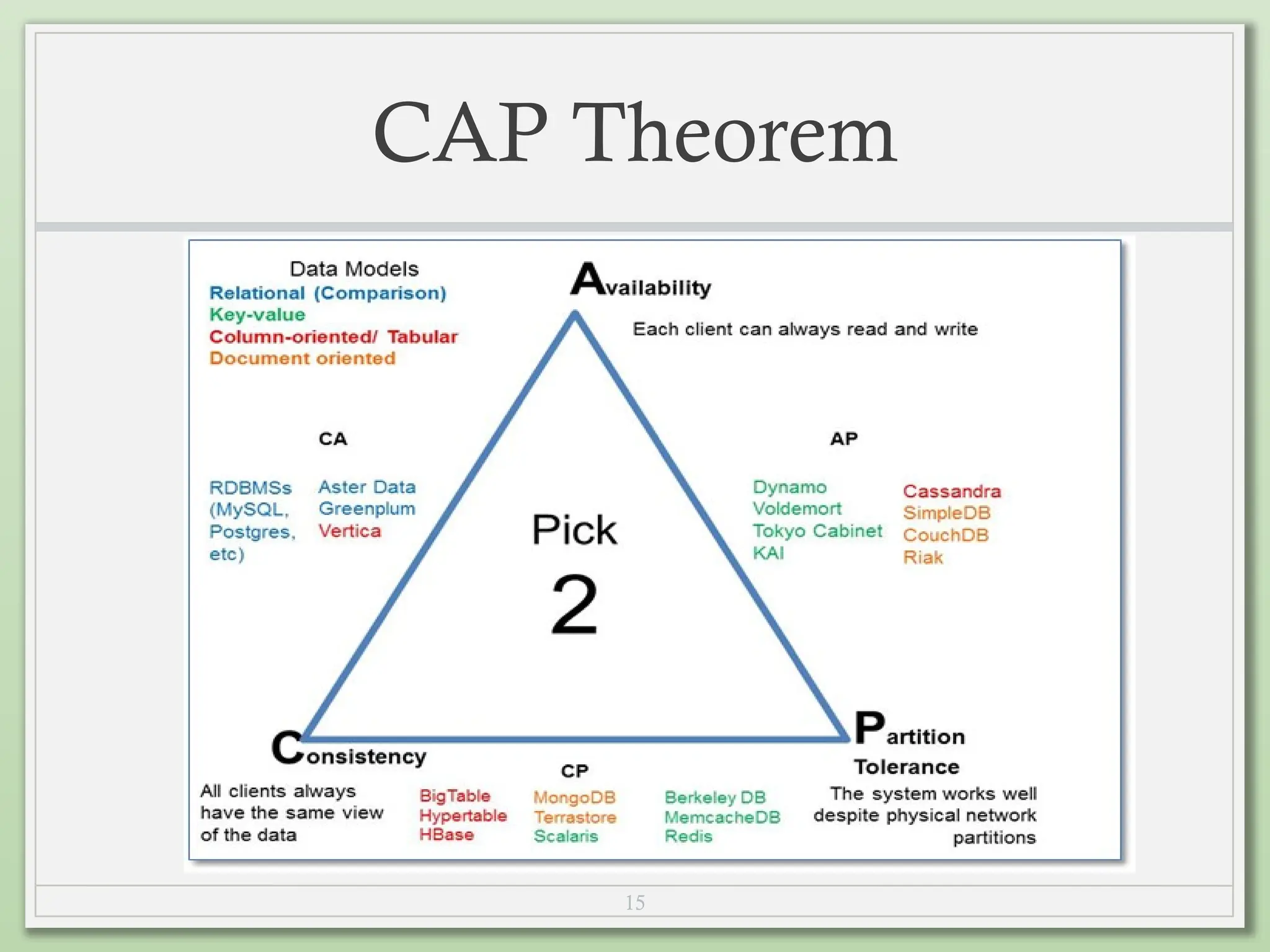
CAP Theorem
Threeproperties of a system
Consistency (all copies have same value)
Availability (system can run even if parts have failed)
All nodes can still accept reads and writes
Partition Tolerance (Even if part is down, others can
take over)
CAP “Theorem”:
You can have at most two of these three properties for
any system
Pick two !!!
16
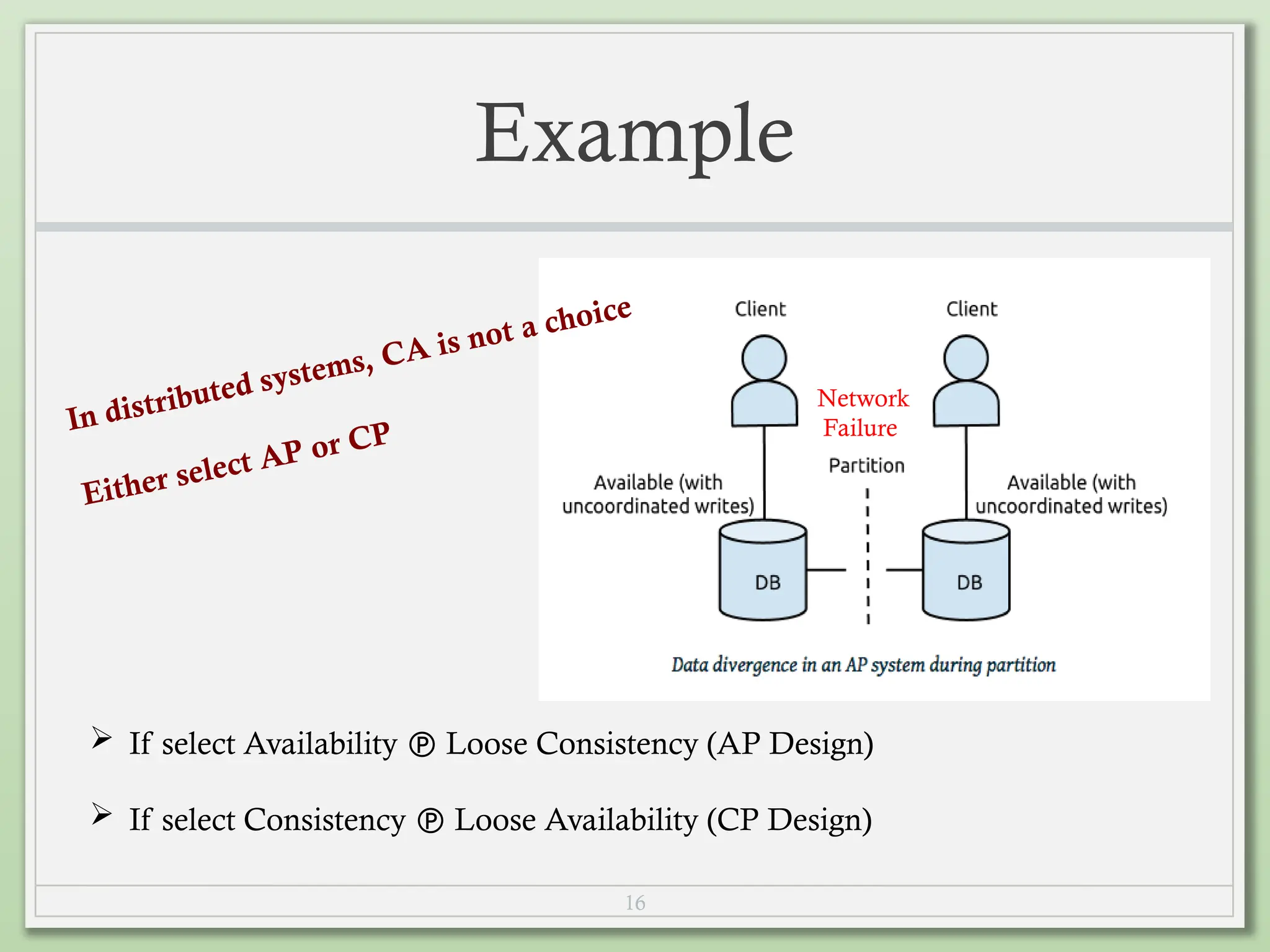
Example
Network
Failure
If selectAvailability Loose Consistency (AP Design)
If select Consistency Loose Availability (CP Design)
In distributed systems, CA is not a choice
Either select AP or CP
17.
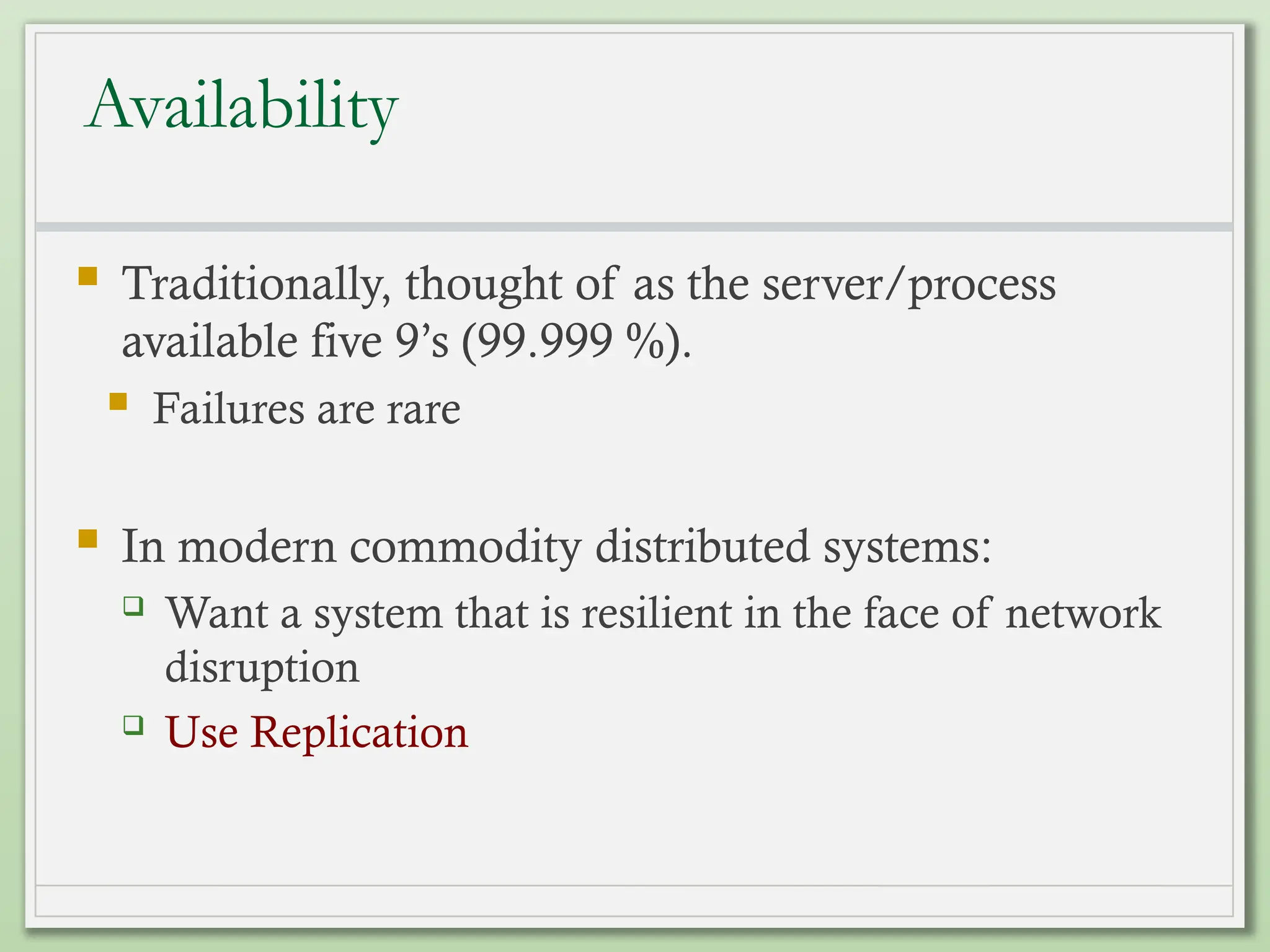
Availability
Traditionally, thoughtof as the server/process
available five 9’s (99.999 %).
Failures are rare
In modern commodity distributed systems:
Want a system that is resilient in the face of network
disruption
Use Replication
18.
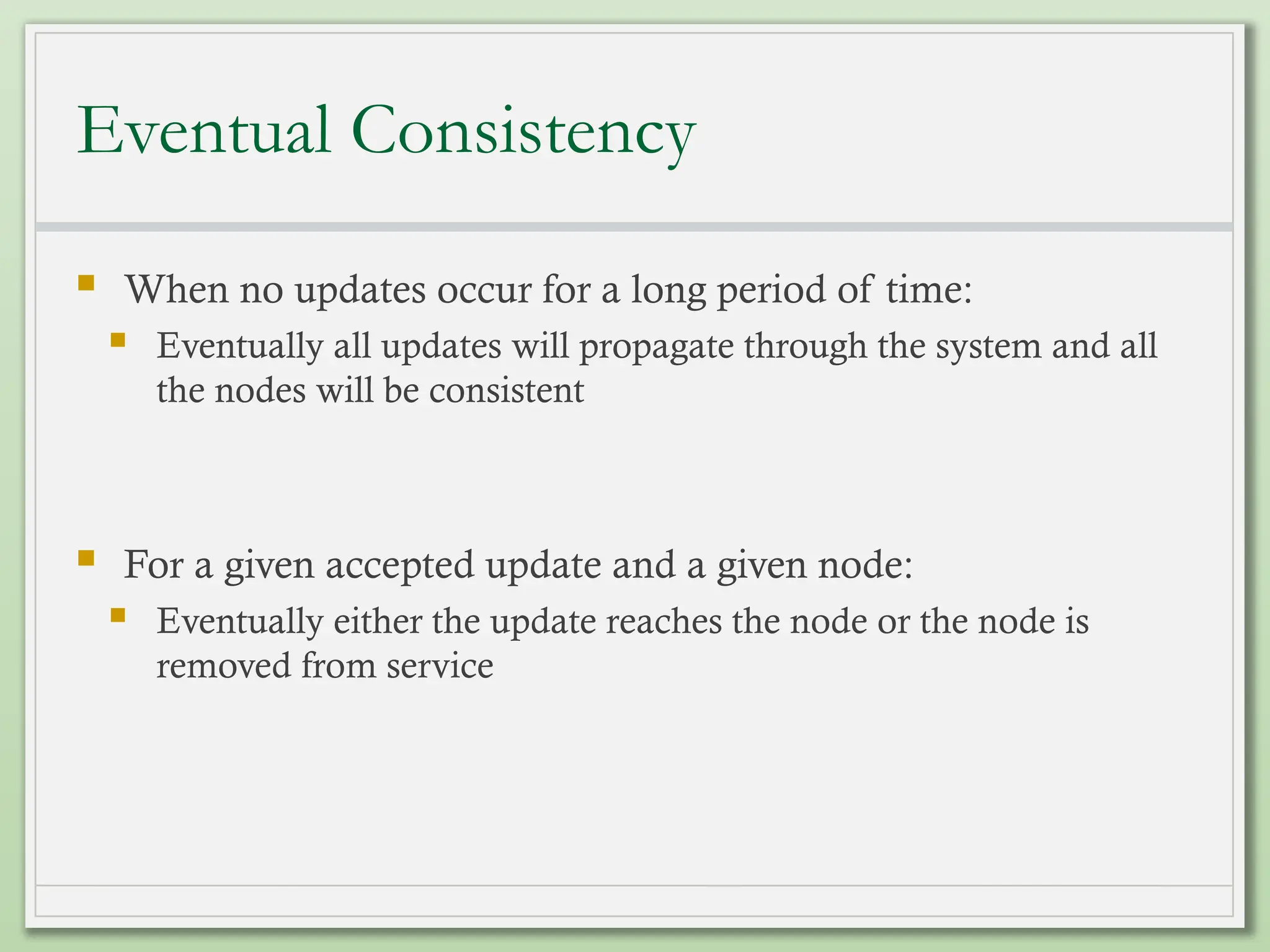
Eventual Consistency
Whenno updates occur for a long period of time:
Eventually all updates will propagate through the system and all
the nodes will be consistent
For a given accepted update and a given node:
Eventually either the update reaches the node or the node is
removed from service
19.
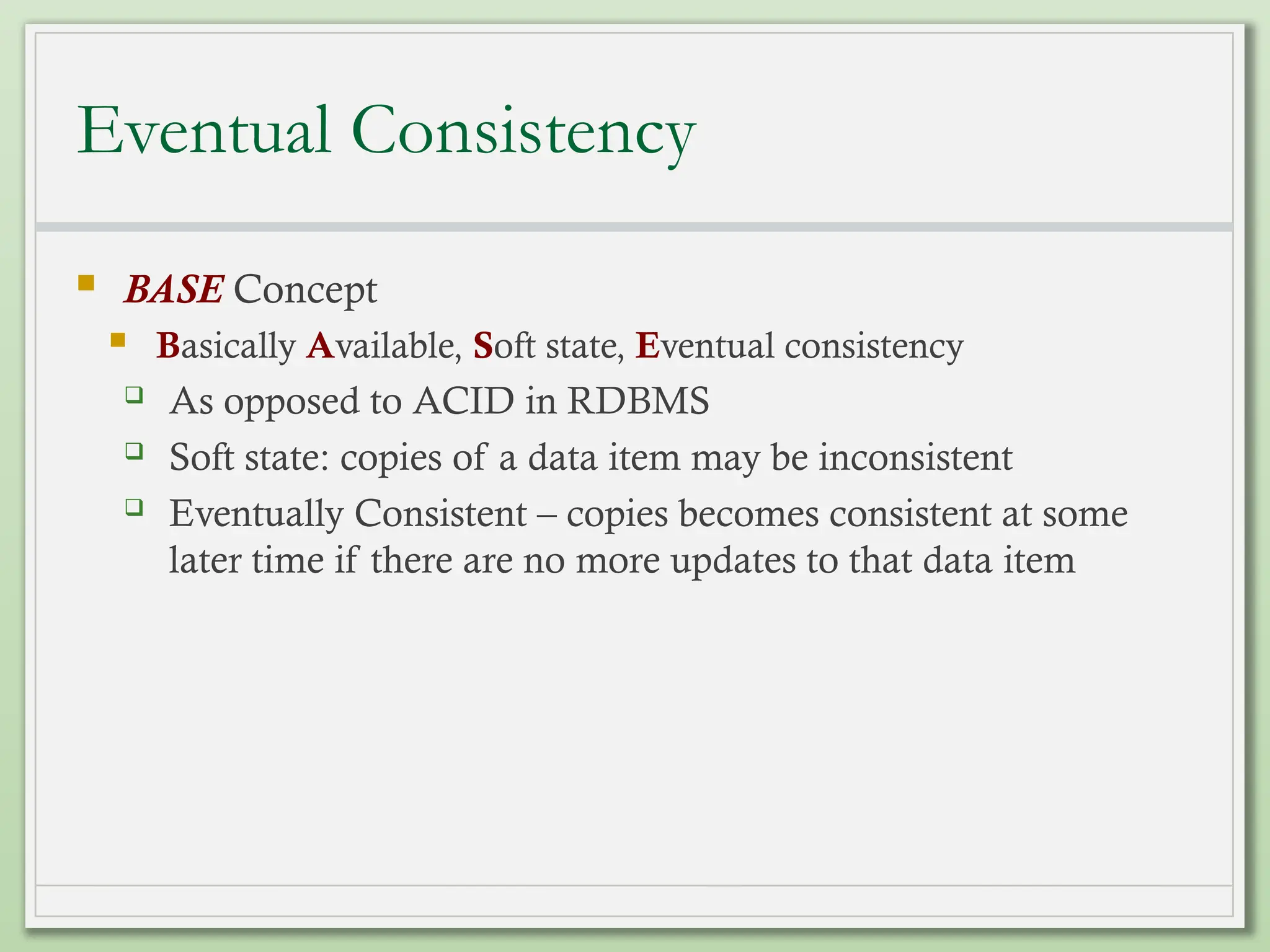
Eventual Consistency
BASEConcept
Basically Available, Soft state, Eventual consistency
As opposed to ACID in RDBMS
Soft state: copies of a data item may be inconsistent
Eventually Consistent – copies becomes consistent at some
later time if there are no more updates to that data item
20.
20
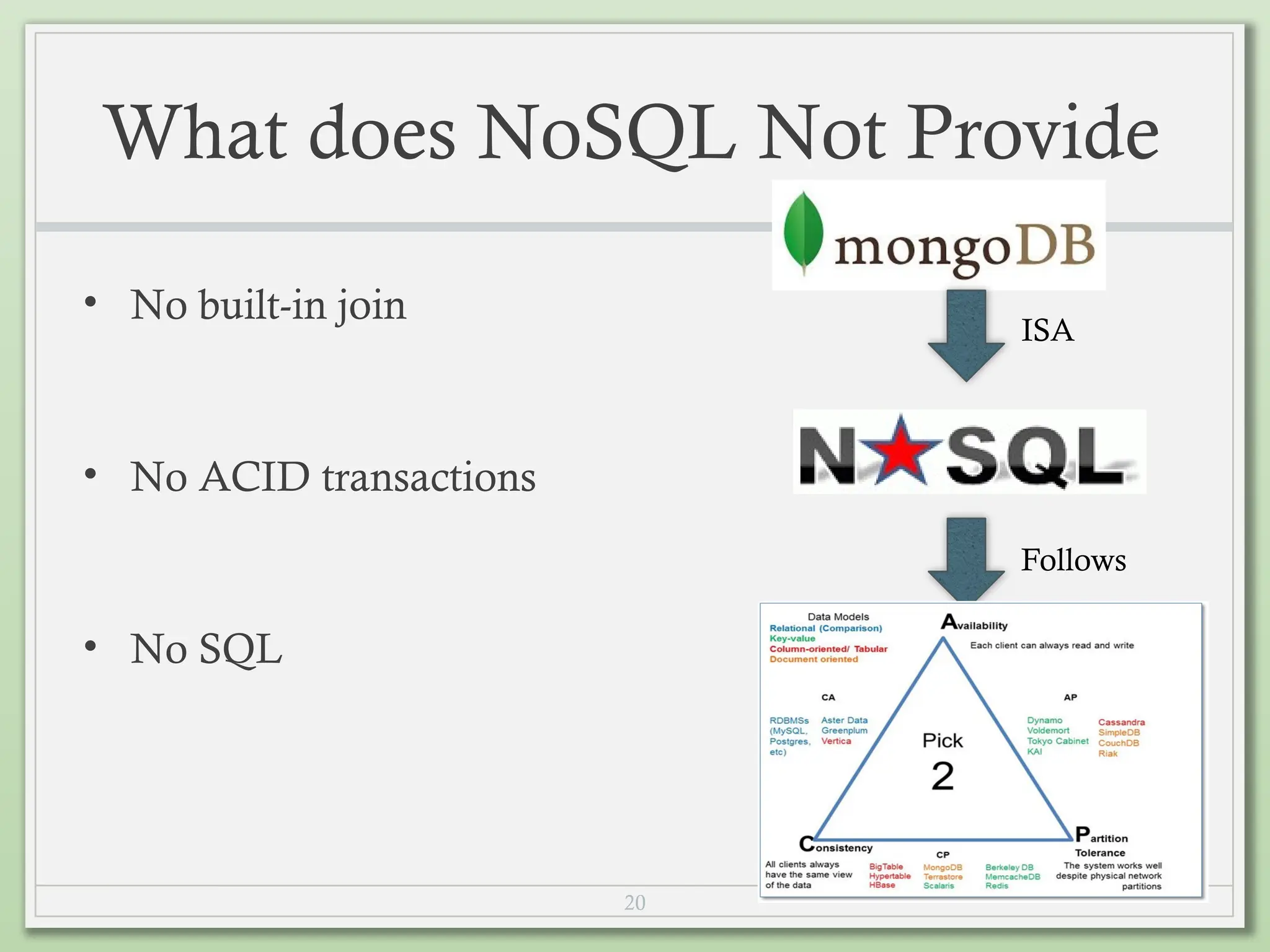
What does NoSQLNot Provide
• No built-in join
• No ACID transactions
• No SQL
ISA
Follows
22
Data Model
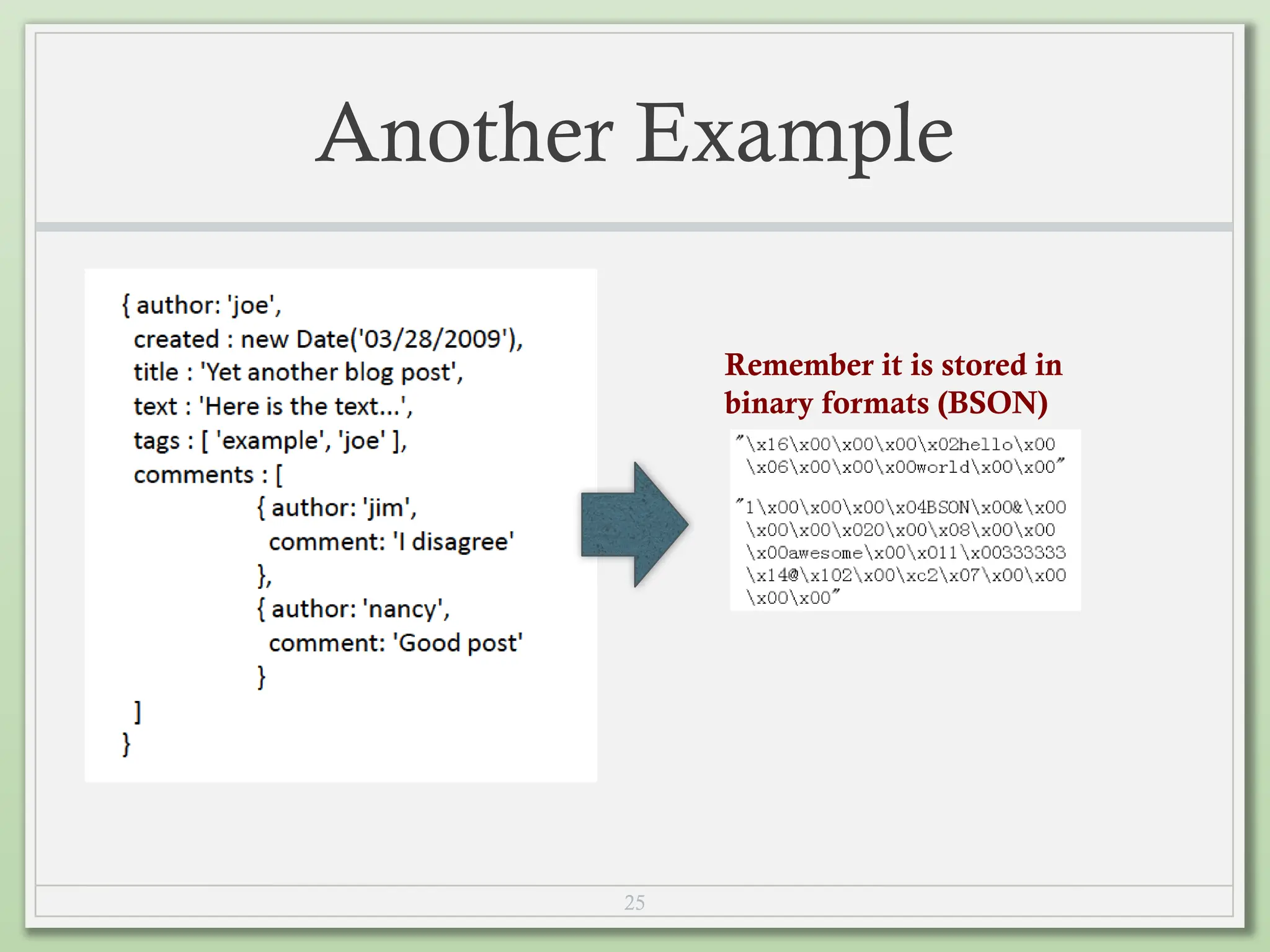
BSONformat (binary JSON)
Developers can easily map to modern object-
oriented languages without a complicated ORM
layer.
lightweight, traversable, efficient
24
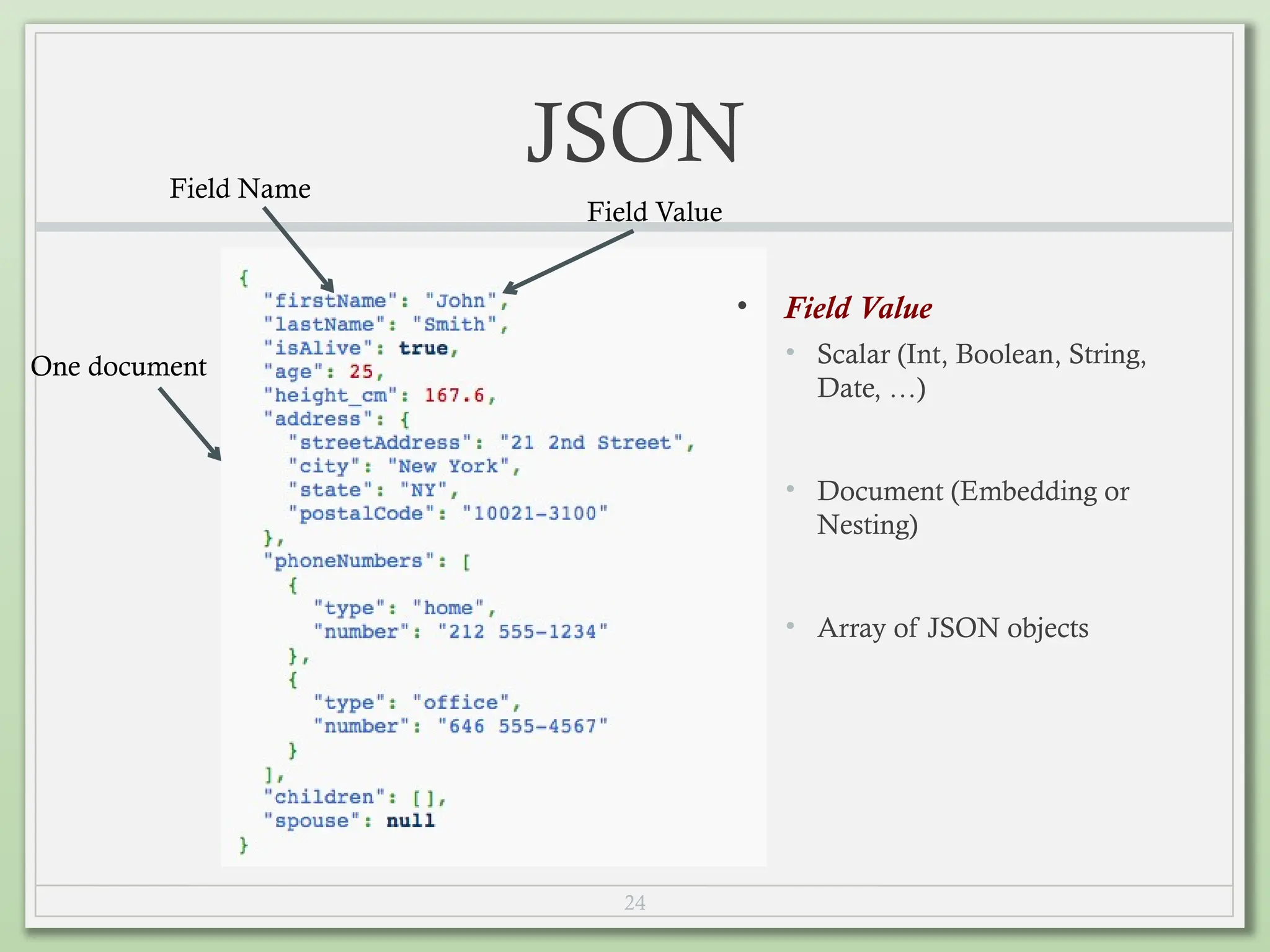
JSON
One document
Field Name
FieldValue
• Field Value
• Scalar (Int, Boolean, String,
Date, …)
• Document (Embedding or
Nesting)
• Array of JSON objects
26
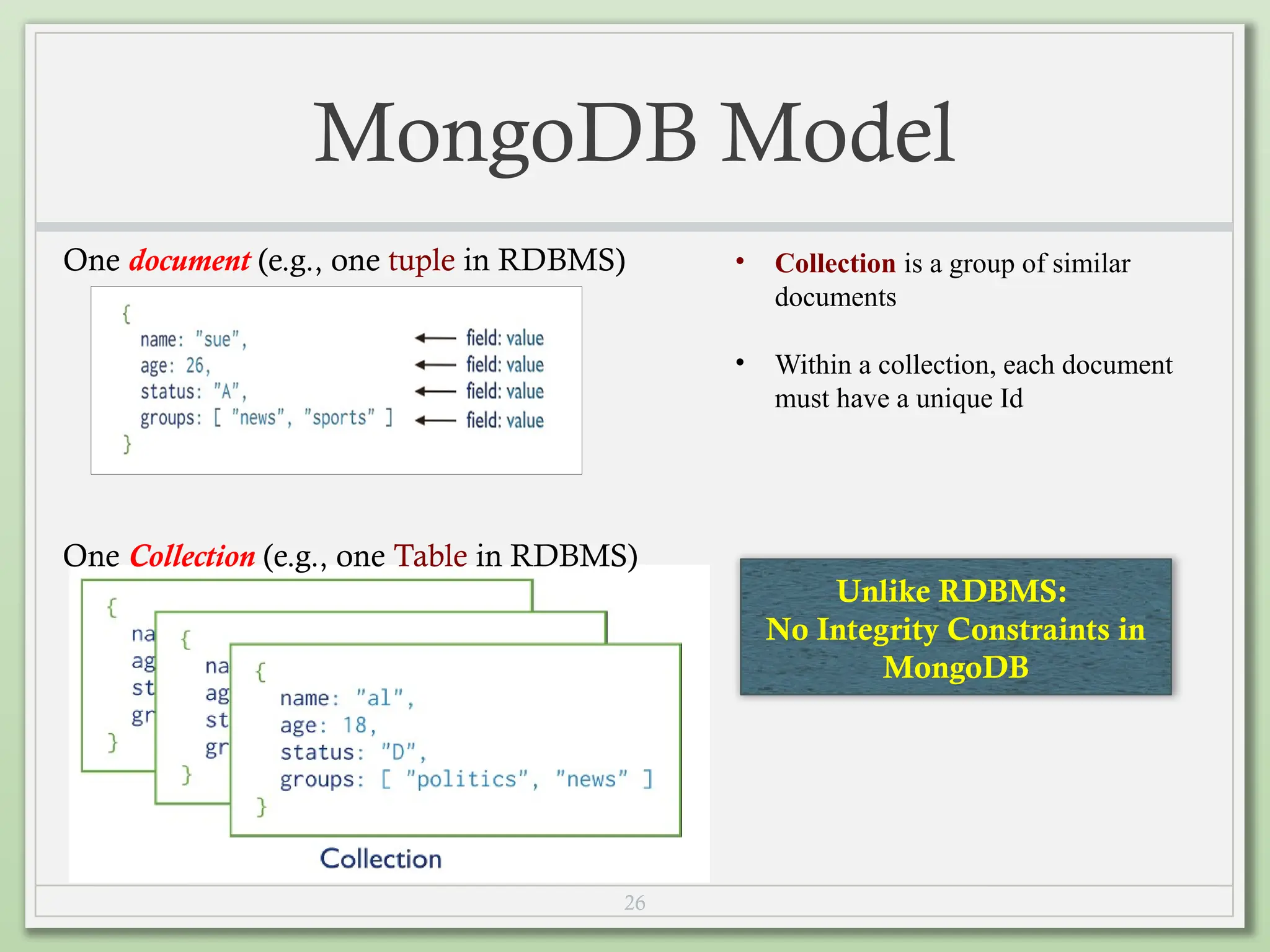
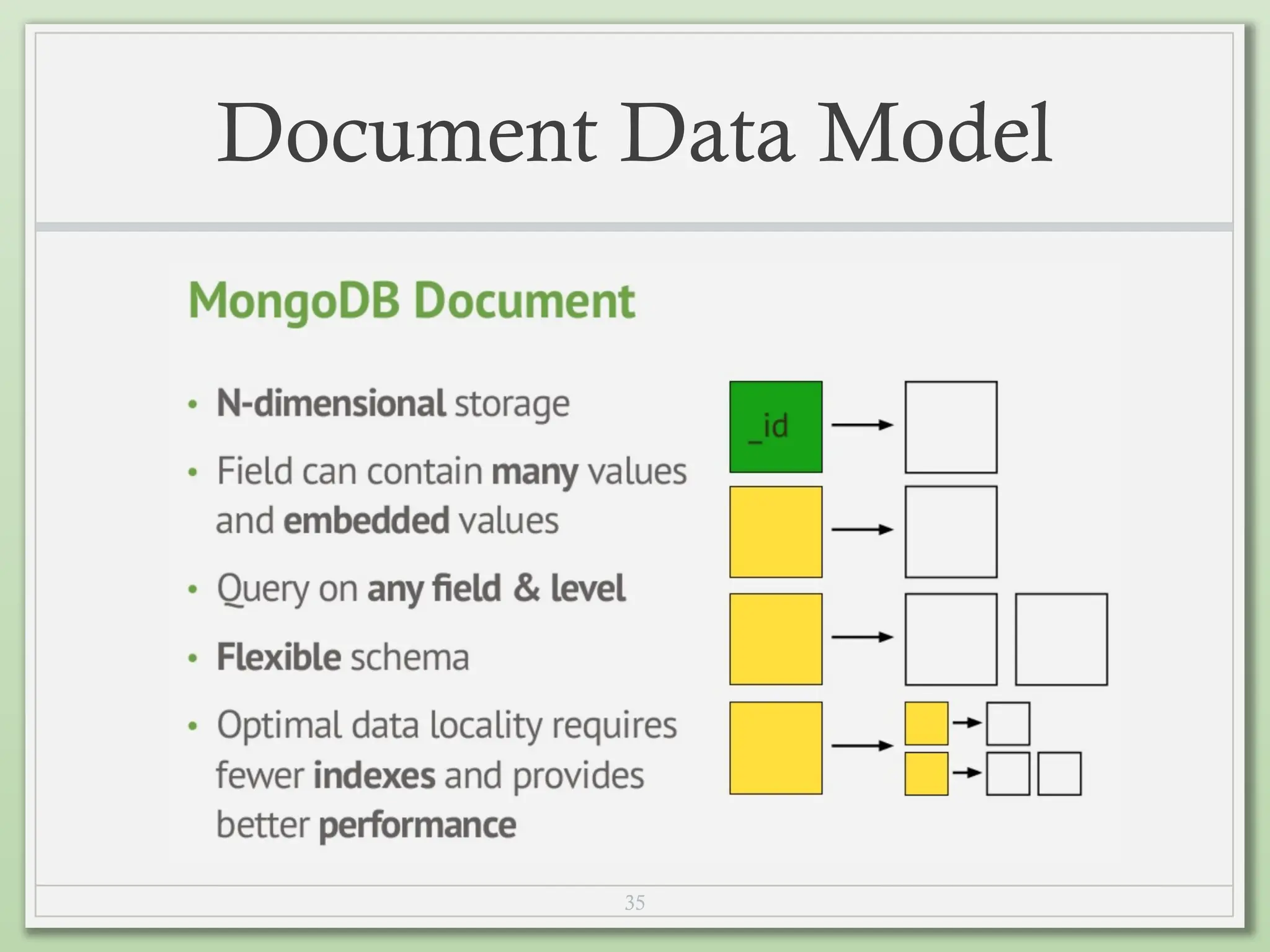
MongoDB Model
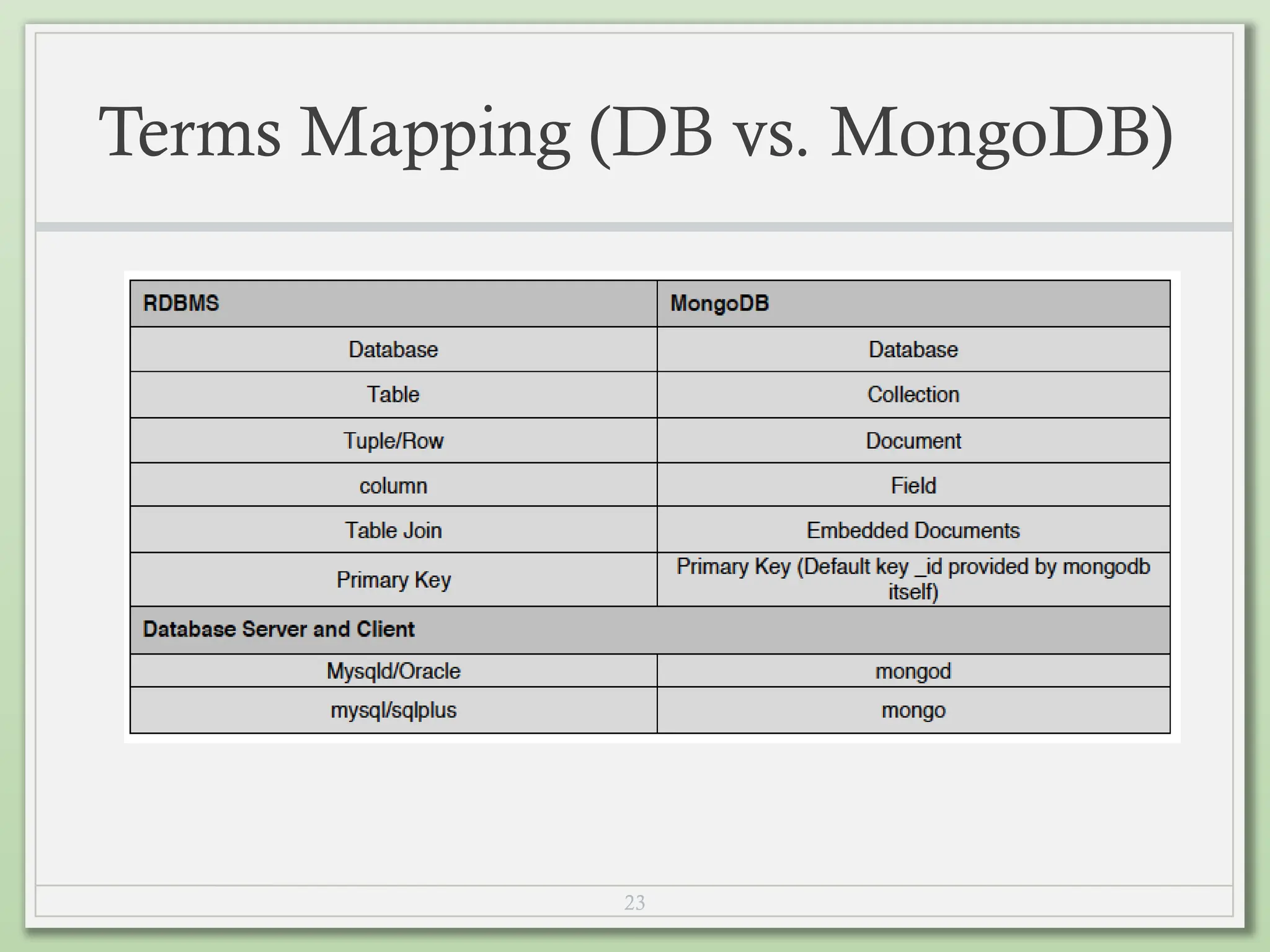
One document(e.g., one tuple in RDBMS)
One Collection (e.g., one Table in RDBMS)
• Collection is a group of similar
documents
• Within a collection, each document
must have a unique Id
Unlike RDBMS:
No Integrity Constraints in
MongoDB
27.
27
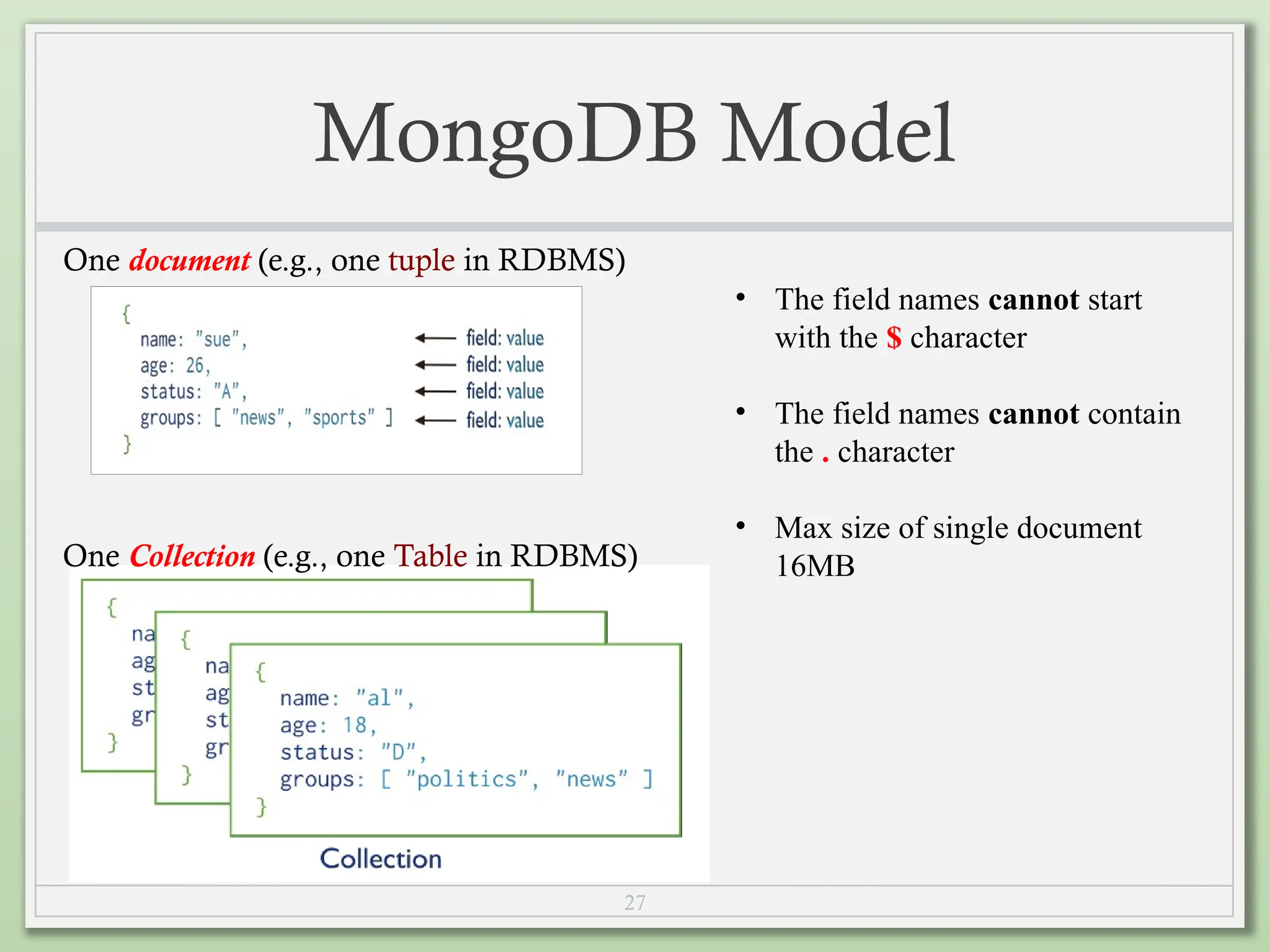
MongoDB Model
One document(e.g., one tuple in RDBMS)
One Collection (e.g., one Table in RDBMS)
• The field names cannot start
with the $ character
• The field names cannot contain
the . character
• Max size of single document
16MB
28.
28
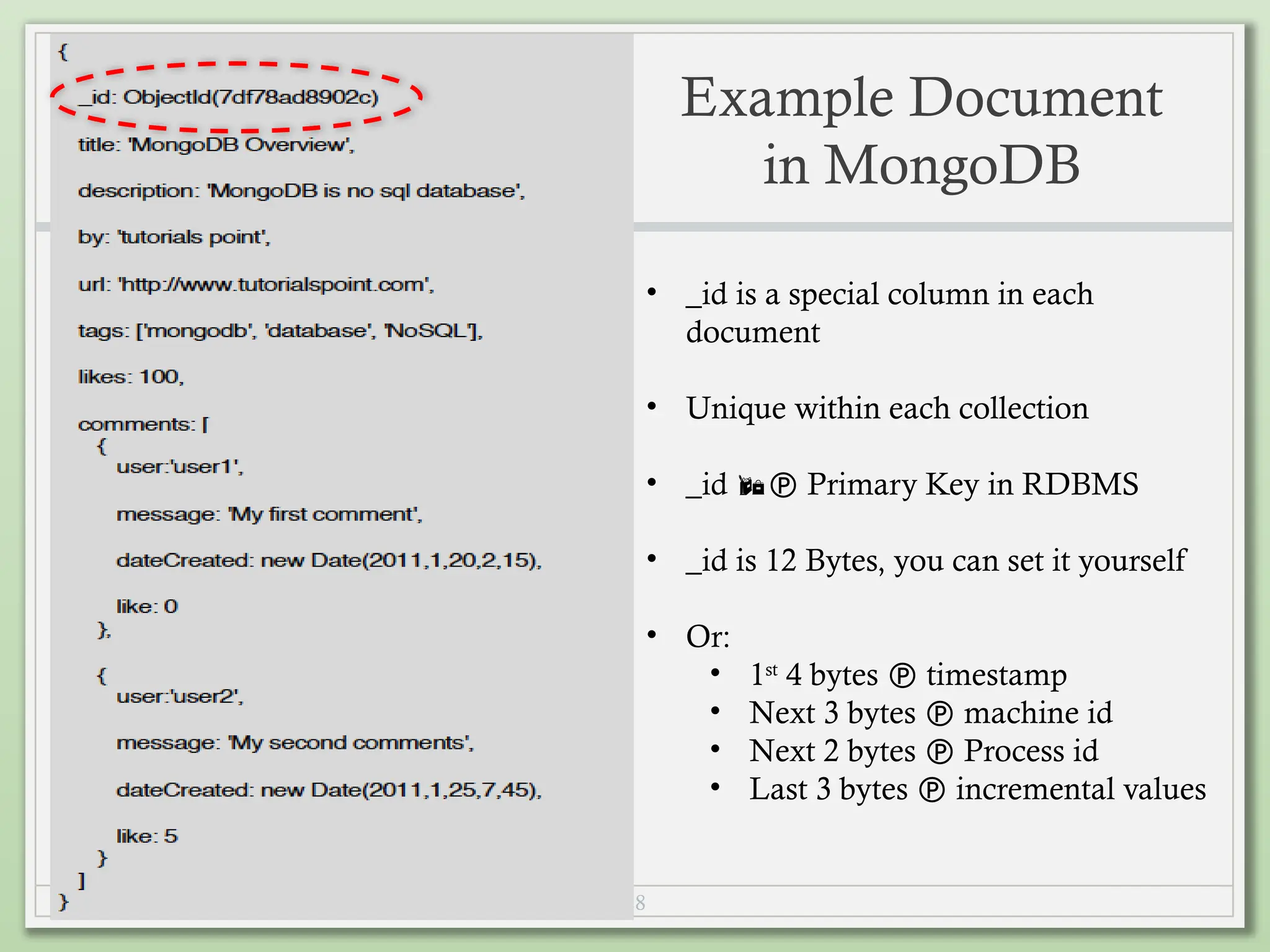
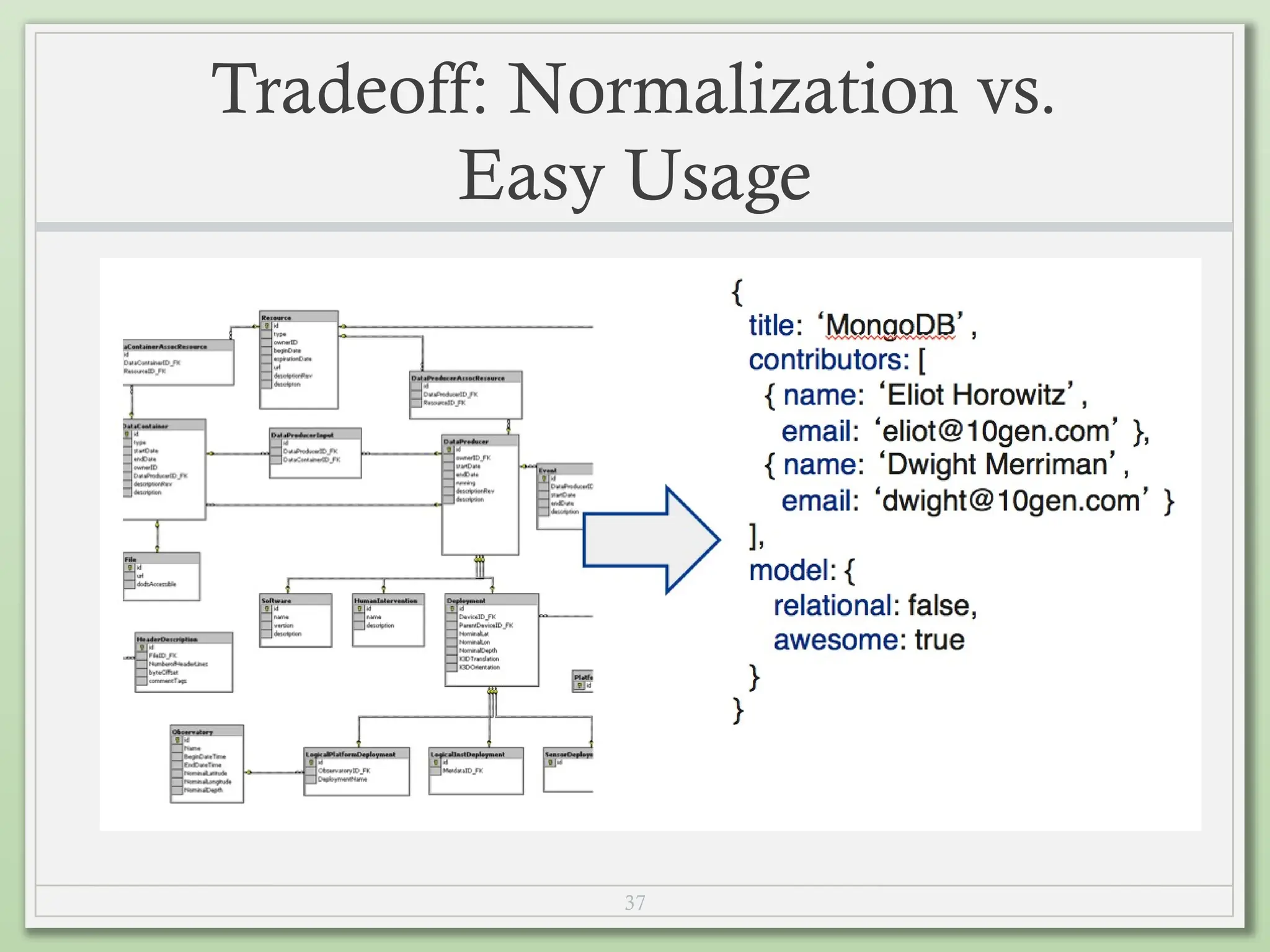
Example Document
in MongoDB
•_id is a special column in each
document
• Unique within each collection
• _id Primary Key in RDBMS
• _id is 12 Bytes, you can set it yourself
• Or:
• 1st
4 bytes timestamp
• Next 3 bytes machine id
• Next 2 bytes Process id
• Last 3 bytes incremental values
36
Document vs. Relational
Models
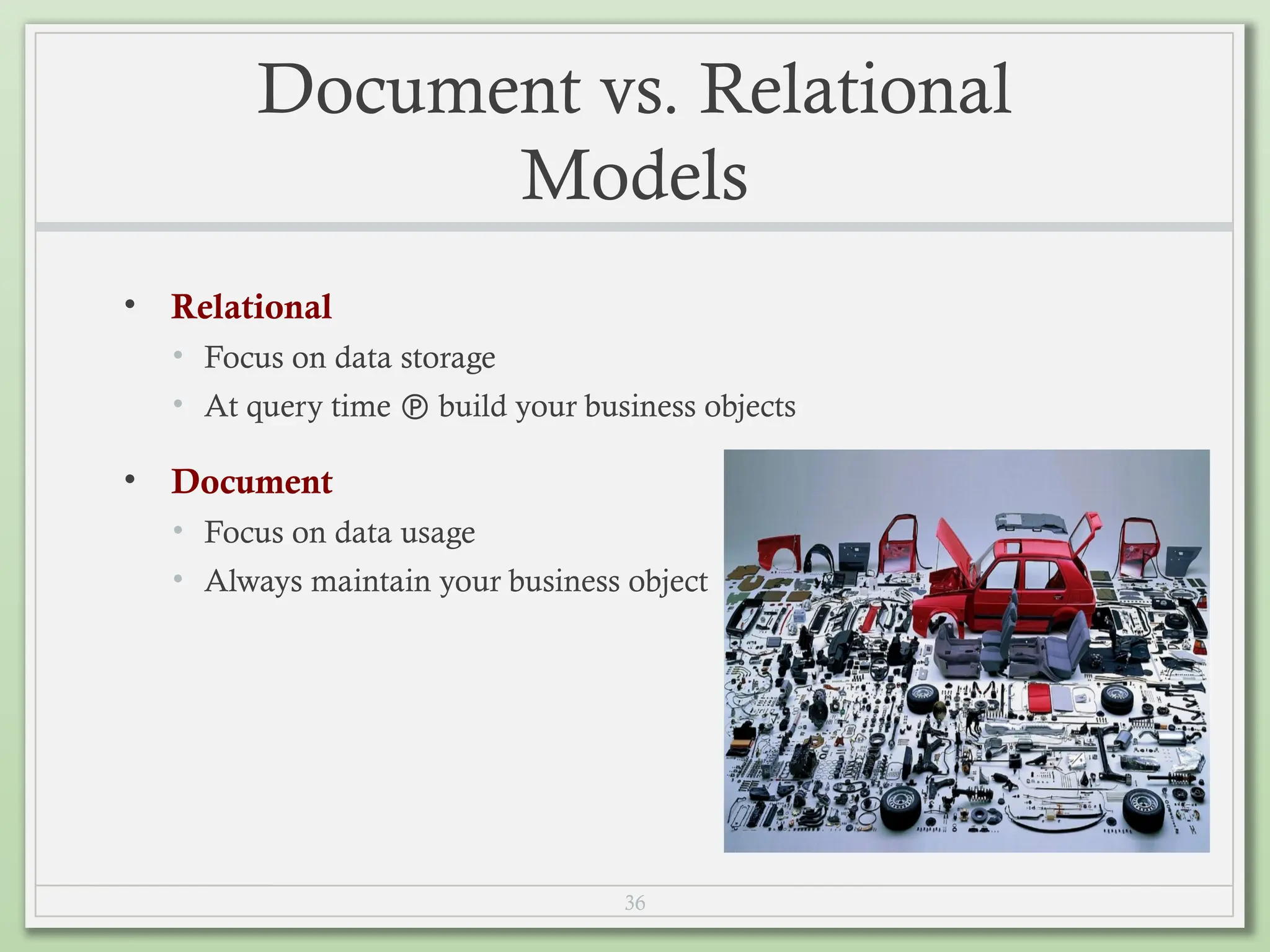
•Relational
• Focus on data storage
• At query time build your business objects
• Document
• Focus on data usage
• Always maintain your business object
41
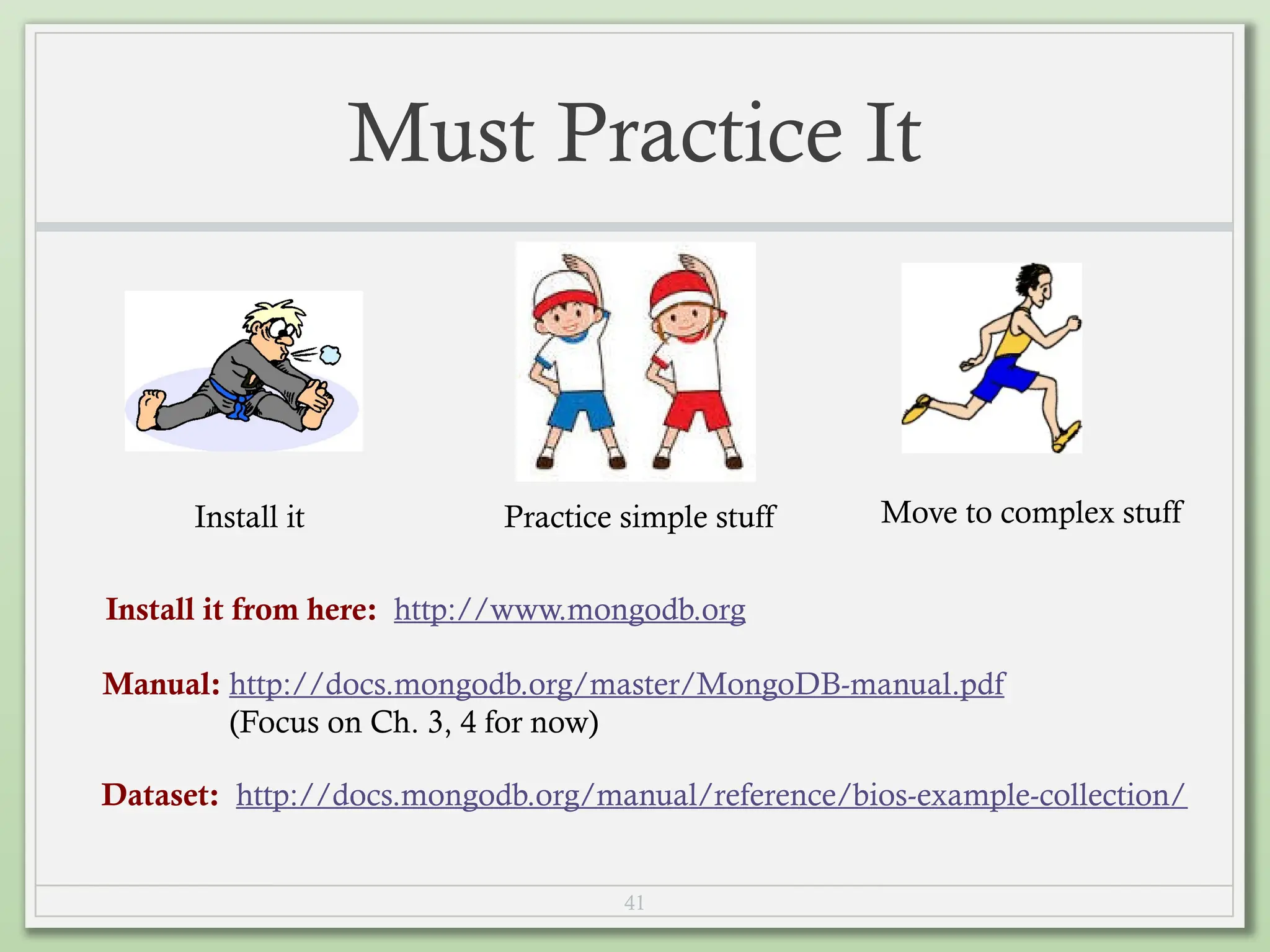
Must Practice It
Installit Practice simple stuff Move to complex stuff
Install it from here: http://www.mongodb.org
Manual: http://docs.mongodb.org/master/MongoDB-manual.pdf
(Focus on Ch. 3, 4 for now)
Dataset: http://docs.mongodb.org/manual/reference/bios-example-collection/
47
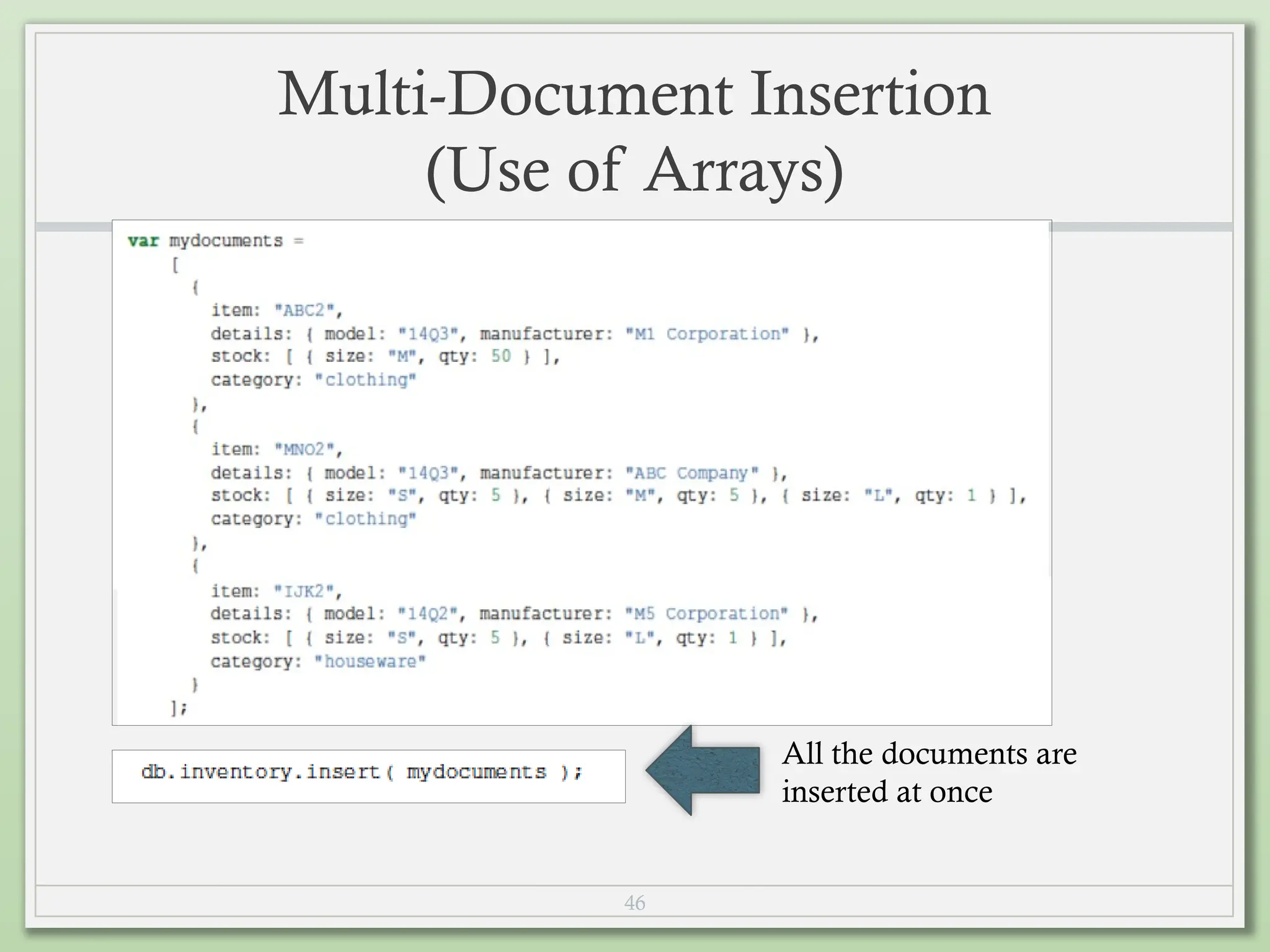
Multi-Document Insertion
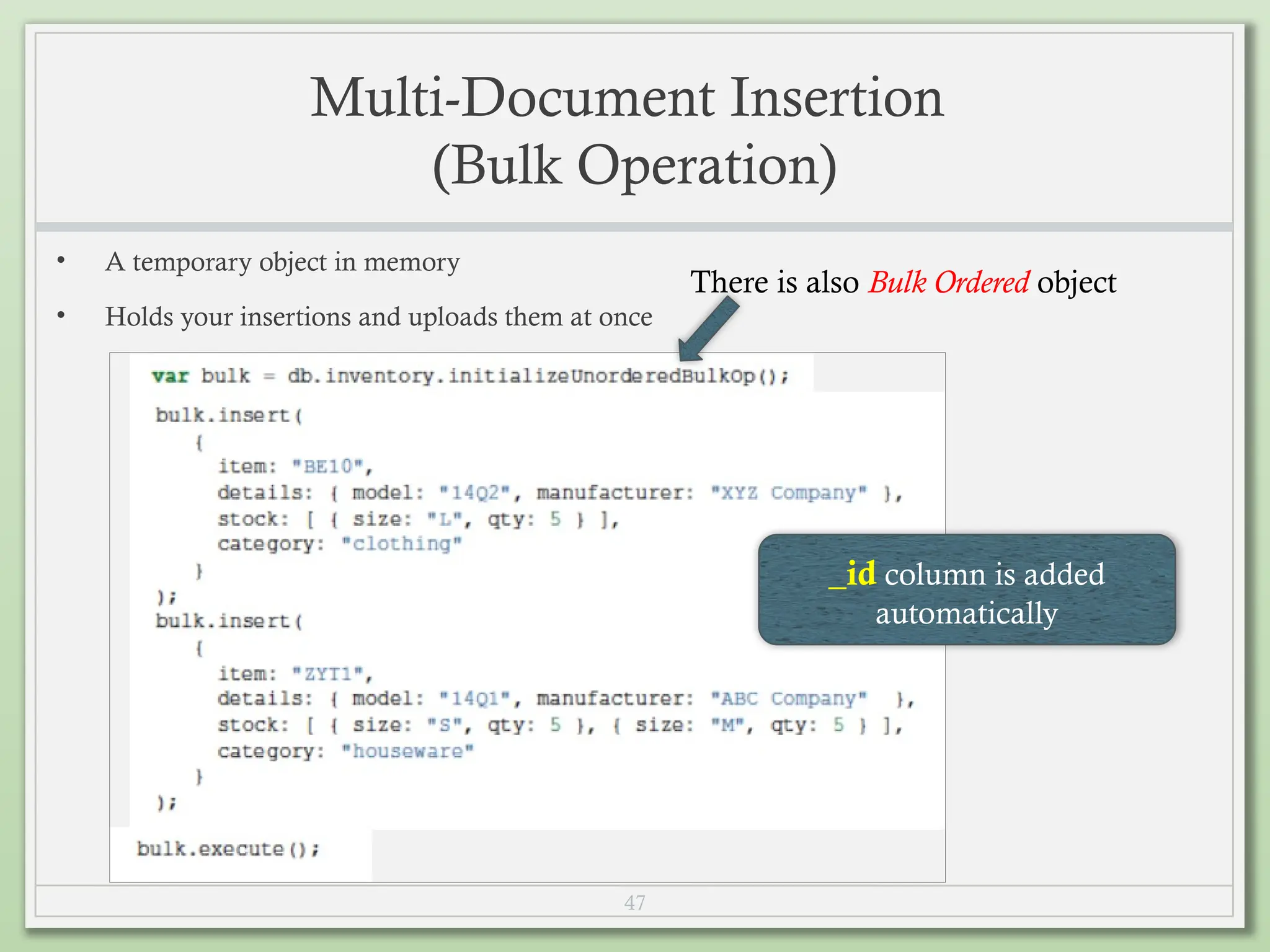
(Bulk Operation)
•A temporary object in memory
• Holds your insertions and uploads them at once
There is also Bulk Ordered object
_id column is added
automatically
48.
48
Deletion
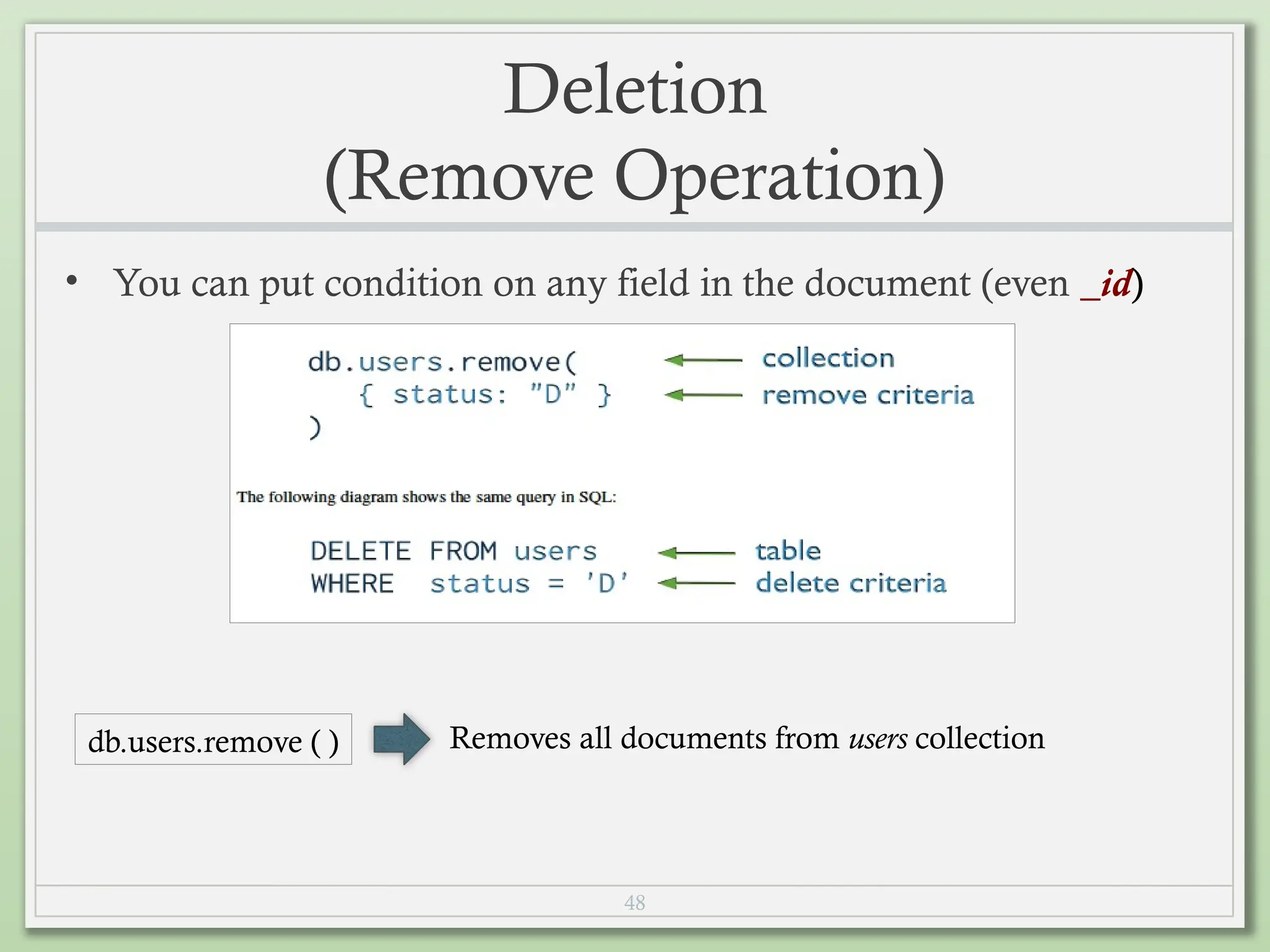
(Remove Operation)
• Youcan put condition on any field in the document (even _id)
db.users.remove ( ) Removes all documents from users collection