PPT-3
Moment of Inertia: (resistance of body to undergo rotational motion)
It is defined as a body’s tendency to resist angular acceleration (thus rotational motion)
There are 3 basic types of M.I.
1. Mass Moment of Inertia
2. Area Moment of Inertia*
3
*
.Extr
P
a
o
in
la
fo
rrm
M
a
o
ti
m
on
e
n
n
ot
t i
o
n
fsy
In
lla
eb
ru
ti
s
a*
Measure of distribution of mass of object relative to given axis
Reflects how body’s points are distributed relative to given axis
Shaft or Beam’s resistance to being distorted by torsion, as a
function of its shape.
Mass Moment of Inertia:
• It is a measure of distribution of the mass of an object relative to a given axis.
• Denoted by I,
• for single particle IO = M R2 , where O is the axis of rotation & R is the distance from
axis
• Unit = kg-m2 Dimension: [ L 2 M 1 ]
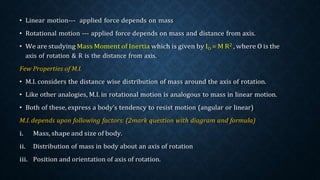
• Linear motion--- applied force depends on mass
• Rotational motion --- applied force depends on mass and distance from axis.
• We are studying Mass Moment of Inertia which is given by IO = M R2 , where O is the
axis of rotation & R is the distance from axis.
Few Properties of M.I.
• M.I. considers the distance wise distribution of mass around the axis of rotation.
• Like other analogies, M.I. in rotational motion is analogous to mass in linear motion.
• Both of these, express a body’s tendency to resist motion (angular or linear)
M.I. depends upon following factors: (2mark question with diagram and formula)
i. Mass, shape and size of body.
ii. Distribution of mass in body about an axis of rotation
iii. Position and orientation of axis of rotation.
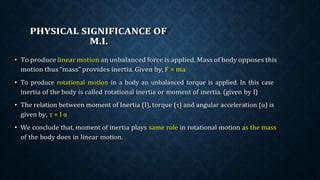
PHYSICAL SIGNIFICANCE OF
M.I.
• To produce linear motion an unbalanced force is applied. Mass of body opposes this
motion thus “mass” provides inertia. Given by, F = ma
• To produce rotational motion in a body an unbalanced torque is applied. In this case
inertia of the body is called rotational inertia or moment of inertia. (given by I)
• The relation between moment of Inertia (I), torque (τ) and angular acceleration (α) is
given by, τ = I α
• We conclude that, moment of inertia plays same role in rotational motion as the mass
of the body does in linear motion.
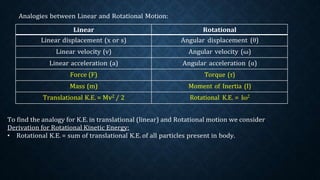
Analogies between Linear and Rotational Motion:
Linear Rotational
Linear displacement (x or s) Angular displacement (θ)
Linear velocity (v) Angular velocity (ω)
Linear acceleration (a) Angular acceleration (α)
Force (F) Torque (τ)
Mass (m) Moment of Inertia (I)
Translational K.E. = Mv2 / 2 Rotational K.E. = Iω2
To find the analogy for K.E. in translational (linear) and Rotational motion we consider
Derivation for Rotational Kinetic Energy:
• Rotational K.E. = sum of translational K.E. of all particles present in body.
1 1
2
3
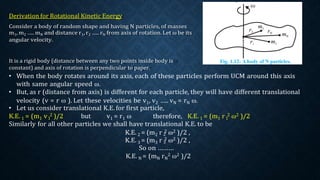
It is a rigid body (distance between any two points inside body is
constant) and axis of rotation is perpendicular to paper.
• When the body rotates around its axis, each of these particles perform UCM around this axis
with same angular speed ω.
• But, as r (distance from axis) is different for each particle, they will have different translational
velocity (v = r ω ). Let these velocities be v1, v2 ….. vN = rN ω.
• Let us consider translational K.E. for first particle,
K.E. 1 = (m1 v 2 )/2 but v1 = r1 ω therefore, K.E. 1 = (m1 r 2 ω2 )/2
Similarly for all other particles we shall have translational K.E. to be
K.E. 2 = (m2 r 2 ω2 )/2 ,
K.E. 3 = (m3 r 2 ω2 )/2 ,
So on ………
K.E. N = (mN rN
2 ω2 )/2
1 1 2 2 N N
1 1 2 2 N N
1 1 2 2 N N
We know,
Rotational K.E. = sum of translational K.E. of all particles present in body.
Therefore,
Rotational K.E. = (m r 2 ω2 )/2 + (m r 2 ω2 )/2 + ……. + (m r 2 ω2 )/2
= (1/2) (m r 2+m r 2+……. + m r 2)(ω2)
But m × r2 = I (moment of Inertia)
Rotational K.E. = (1/2) ( I1 + I2 +……+ IN) (ω2)
Let I1 + I2 +……+ IN = m r 2+m r 2+……. + m r 2= I
Rotational K.E. = (1/2) (I) (ω2 ) = I ω2 /2
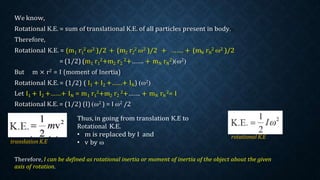
Thus, in going from translation K.E to
Rotational K.E.
translation K.E
• m is replaced by I and
• v by ω
rotational K.E
Therefore, I can be defined as rotational inertia or moment of inertia of the object about the given
axis of rotation.
This I = ∑mi ri
2 of an object depends upon,
• Individual masses (m1, m2 ….. mN ) and
• Distribution of these masses about the given axis of rotation (r1, r2 ….. rN )
If we have a different axis, this I will again depend upon on mass distribution around that axis
and if the object is not symmetric it will be different for each axis.
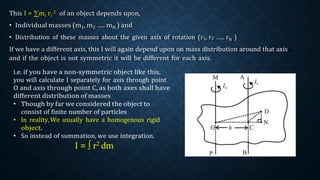
i.e. if you have a non-symmetric object like this,
you will calculate I separately for axis through point
O and axis through point C, as both axes shall have
different distribution of masses
• Though by far we considered the object to
consist of finite number of particles
• In reality,We usually have a homogenous rigid
object.
• So instead of summation, we use integration.
I = ∫ r2 dm
Further we will study, M.I. for different objects, like,
1. M.I. of Ring
2. M.I. of Disc
3. M.I. of Sphere
4. M.I. of Rod
5. M.I. of Cylinder
6. M.I. of Right Circular Cone
7. M.I. of Parallelepiped
Study in detail
Formulas Given
Directly for each with
its cases
I = ∫ r2 dm
If we do not know the mass distribution, theoretically it is not
possible to solve the above integral. But we can still find M.I.
experimentally.
Let us consider the application of M.I.
1) Moment of Inertia of a uniform ring:
• The mass of this ring is uniformly distributed on its
circumference.
• It is a two-dimensional object with negligible thickness.
• If this ring is rotating about its own axis, its entire mass M is
practically at a distance equal to its radius R from axis.
• Therefore, expression for its M.I. is
I = (mass) x ( sq. of distance from axis)
I = M R2 For ring
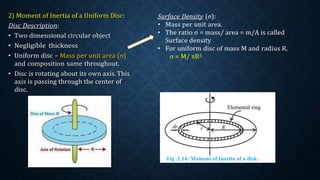
2) Moment of Inertia of a Uniform Disc:
Disc Description:
• Two dimensional circular object
• Negligible thickness
• Uniform disc – Mass per unit area (σ)
and composition same throughout.
• Disc is rotating about its own axis. This
axis is passing through the center of
disc.
Surface Density (σ):
• Mass per unit area.
• The ratio σ = mass/ area = m/A is called
Surface density
• For uniform disc of mass M and radius R,
σ = M/ πR2
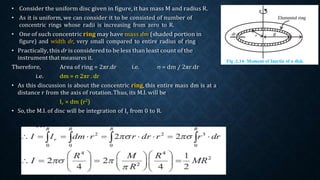
• Consider the uniform disc given in figure, it has mass M and radius R.
• As it is uniform, we can consider it to be consisted of number of
concentric rings whose radii is increasing from zero to R.
• One of such concentric ring may have mass dm (shaded portion in
figure) and width dr, very small compared to entire radius of ring
• Practically, this dr is considered to be less than least count of the
instrument that measures it.
Therefore, Area of ring = 2πr.dr i.e. σ = dm / 2πr.dr
i.e. dm = σ 2πr . dr
• As this discussion is about the concentric ring, this entire mass dm is at a
distance r from the axis of rotation.Thus, its M.I. will be
Ir = dm (r2)
• So, the M.I. of disc will be integration of Ir from 0 to R.
• As we said before, theoretically you can find M.I. only if you know the mass distribution in
object. But experimentally, we can find M.I. for all objects.
• Also, this M.I. depends upon mass of the object and how it is distributed around the axis of
rotation.
• So if we only want to know the mass distribution around the axis,
Let us write M.I. as I = MK2, where M is mass of object and this mass is effectively at a distance
K, from the axis of rotation.
• This K, is called as Radius of Gyration.
• It means that the mass of object is effectively at a distance K from the axis of rotation. If K is
radius of gyration, I = MK2, is the M.I.
• Radius of Gyration, can be defined as the distance from the axis of rotation to a point where the
total mass of the body is supposed to be concentrated. So if you find M.I. at this point it will be
equal to the M.I. that you would get in regular way. (Simple trick !!)
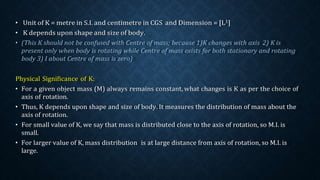
Physical Significance of K:
• For a given object mass (M) always remains constant, what changes is K as per the choice of
axis of rotation.
• Thus, K depends upon shape and size of body. It measures the distribution of mass about the
axis of rotation.
• For small value of K, we say that mass is distributed close to the axis of rotation, so M.I. is
small.
• For larger value of K, mass distribution is at large distance from axis of rotation, so M.I. is
large.
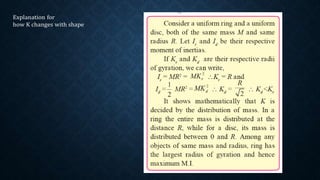
Explanation for
how K changes with shape
• While solving for M.I. , we generally take axis of rotation at axis of symmetry .
• But in some cases this axis may not be at axis of symmetry.
• It can be parallel or perpendicular to the symmetric axis.
For such cases, we need theorem of parallel axis and theorem of perpendicular axis.
1) Theorem of Parallel axes:
In order to apply this theorem to any object, we need two axes parallel
to each other with one of them passing through center of mass of
object.
Description: Figure shows object of mass(M),
• MOP is random axis passing through O and ACB is axis passing
through Centre of mass C.
• MOP is at a distance of h from ACB and they are parallel to each
other.
Let us consider small point mass dm at point D.
Construction:We draw perpendicular DN on extended line of OC upto
N. Join D point with C and O.
A line that divides any
object in half
• Considerations: M.I. at point O w.r.to D is IO = ∫ (DO)2 dm and at
point C w.r.to D is IC = ∫ (DC)2 dm
Let us consider IO (our axis of interest),
IO = ∫ (DO)2 dm = ∫ ( [DN]2 + [NO]2 )dm ….. By Pythagoras Theorem
But, [NO]2 = [NC + CO]2 = [NC]2 + [CO]2 +[2.NC.CO]
Therefore, IO = ∫ ( [DN]2 + [NC]2 + [CO]2 +[2.NC.CO] ) dm
But [DN]2 + [NC]2 = [DC]2
Therefore, IO = ∫ ( [DC]2 + [CO]2 +[2.NC.CO] ) dm
Separating integration to each term and substituting, CO = h, and
values of IC and ∫dm = M,
IO = ∫ [DC]2 dm + h2 ∫ dm + 2h ∫ NC dm
IO = IC + M h2 + 2h ∫ NC dm
IO = IC + M h2
So we have, IO = IC + M h2 + 2h ∫ NC dm
This NC is the distance of point from C.M., any mass distribution is symmetric about C.M.,
thus as per its definition ∫ NC dm=0
So we get, this is mathematical form of theorem of parallel axis.
Definition: The theorem of parallel axis states that, the moment of inertia (IO)
of an object about any given axis, is the sum of
➢moment of inertia (IC) about an axis parallel to the given axis, and passing
through the Centre of mass and
➢the product of the mass (M) of the object and the square of the distance
between the two axes (h2)
[if DN falls on OC,i.e.point N coincides with C.In that case ,DC will be the
distance of point from C.M.,∫ DC dm=0 i.e. therefore, IC =0 hence,
IO = M h2 . So if the point D is taken such that DN falls on OC, it is as good as
calculating M.I. for only one axis,which is axis of rotation]
2) Theorem of Perpendicular Axis:
• This theorem relates M.I. of laminar object about three
mutually perpendicular and concurrent axes, two of them in
the plane of object and third perpendicular to the object.
• Laminar objects: any two dimensional objects like leaf, ring,
disc, etc.
• By far, we considered that the object can rotate only along one
direction i.e. z axis, but in this theorem we are considering the
possibility that the object can rotate about any axes from x, y
and z
(Consider a rupee coin as a disc and try rotating it about x, y and z axes)
Image Description:
Consider a mass element dm located at point P.
PN = x and PM = y are perpendiculars drawn from P on X and Y
axes respectively.
The distance of point P from x-axis is ‘y’, from y-axis is ‘x’ and
from z-axis is √(x2 + y2 )
We know, I = (mass) x (sq. of distance from axis)
therefore,
Ix = ∫ (y2) dm I y= ∫(x2)dm Iz = ∫(x2 + y2 )dm
Ix , Iy ,and Iz are respective moment of inertias of body about x,
y and z axes.
If we consider the expression for Iz , we get
Iz = ∫(x2 + y2 )dm
= ∫(x2 ) dm + ∫(y2 )dm
Iz = I y + Ix
this is mathematical form of
theorem of perpendicular axis.
Definition: It states that, the M.I. (Iz) of laminar object about an axis (z) perpendicular to its
plane is sum of moment of inertias about two mutually perpendicular axes (x and y) in its
plane, all the three axes being concurrent.
• Also known as moment of linear momentum (i.e. multiply linear momentum (p=mv) with
distance)
• Analogous to linear momentum.
Definition: If 𝑝ҧ
is the instantaneous linear momentum of a particle undertaking a circular
motion, its angular momentum at that instance is given by,
𝐿
ത= 𝑟ҧ
× 𝑝ҧ
, where𝑟ҧ
is the position vector from the axis of rotation.
In magnitude,
It is the product of linear momentum and its perpendicular distance from the axis of rotation.
i.eL = (p)(r sinθ), where θ is the small angle between the directions of 𝑝ҧ
and𝑟ҧ
Unit = (kg-m2)/s in S.I. And (g-cm2)/s in CGS.
Dimension= [L2 M1 T -1]
Expression for Angular Momentum in terms of M.I.
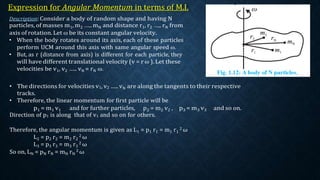
Description: Consider a body of random shape and having N
particles, of masses m1, m2 ….. mN and distance r1, r2 ….. rN from
axis of rotation. Let ω be its constant angular velocity.
• When the body rotates around its axis, each of these particles
perform UCM around this axis with same angular speed ω.
• But, as r (distance from axis) is different for each particle, they
will have different translational velocity (v = r ω ). Let these
velocities be v1, v2 ….. vN = rN ω.
• The directions for velocities v1, v2 ….. vN are along the tangents to their respective
tracks.
• Therefore, the linear momentum for first particle will be
p1 = m1 v1 and for further particles, p2 = m2 v2 , p3 = m3 v3 and so on.
Direction of p1 is along that of v1 and so on for others.
Therefore, the angular momentum is given as L1 = p1 r1 = m1 r1
2 ω
L2 = p2 r2 = m2 r2
2 ω
L3 = p3 r3 = m3 r3
2 ω
So on, LN = pN rN = mN rN
2 ω
• For a rigid body with fixed axis of rotation,
➢ All these angular momentum are directed along the axis of rotation, and
➢ Its direction is given by right hand thumb rule.
As all L have same directions, their magnitudes are directly added.
L = m1 r1
2ω+ m2 r2
2ω+……+ mNrN
2ω
= (m1 r1
2 + m2 r2
2+……+ mNrN
2) ω
Therefore, as I = m r 2
L = (I1 + I2 +…..+ IN ) ω
If we put I1 + I2 +……+ IN = I
L = I ω, where I is moment of Inertia about the axis of rotation.
We can see that above equation of
L = I ω is analogous to p = m v
moment of inertia I, replaces mass m as per its physical significance.
The two derivations that we do talk about expressing
in terms of Moment of Inertia
Why we do this?
In linear motion,
• we first find position of particle (x), then
• the force (f) which caused motion of this
particle.
• Once we know the force, we are interested
in knowing how this force relates to mass
and velocity together, i.e. momentum (p)
In case of Rotational Motion,
• We know the angular position of particle on circle
from angle (θ),
• To know efforts needed to carry out this circular
motion we found out torque,τ (analogous to force)
• Once we know torque τ, we found out its relation
with angular momentum, L (analogue of linear
momentum)
The most important property of that
particle (or object) which can affect
both f as well as p, is mass (M).
Similarly, the most important property of object
which can affect circular motion, τ and L is
Moment of Inertia (I).
Therefore, we are finding τ and L in terms of M.I.
Description: Consider a rigid body of random shape and having
N particles, of masses m1, m2 ….. mN and distance r1, r2 ….. rN
from axis of rotation.
This body is rotating with constant angular acceleration (α)
(By far we considered ω and now we are considering α , this is because both ω
and α are along same line for anticlockwise rotation of body.
Hence we can talk about ω or α as per requirement.
Another reason for considering α is that in present scenario we are interested in
force analogue torque.)
As the object rotates, each of these particles perform circular motion (not UCM..!) with same
angular acceleration but different linear acceleration.
Therefore we have, a1 = r1 α, a2 = r2 α, so on aN = rN α
Now,
The force experienced by first particle is f1 = m1 a , f2 = m2 a2 so on fN = mN aN
= m1 r1 α = m2 r2 α = mN rN α
Expression for Torque in terms of M.I.
N N
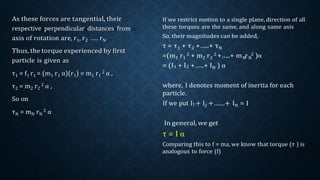
If we restrict motion to a single plane, direction of all
these torques are the same, and along same axis
So, their magnitudes can be added,
τ = τ1 + τ2 +…..+ τN
=(m1 r1
2 + m2 r2
2 +…..+ m r 2 )α
= (I1 + I2 +…..+ IN ) α
where, I denotes moment of inertia for each
particle.
If we put I1 + I2 +……+ IN = I
In general, we get
τ = I α
Comparing this to f = ma, we know that torque (τ ) is
analogous to force (f)
respective perpendicular distances from
Just like linear momentum of an isolated
system remains conserved in absence of an
external unbalanced force. Similarly, we can
show that Angular momentum also remains
conserved.
We know, 𝐿
ത= 𝑟ҧ
× 𝑝ҧ
where𝑟ҧ
is the position vector from the axis of
rotation and 𝑝ҧ
is linear momentum.
Differentiating w. r. to time,
Therefore, we conclude that,
• “angular momentum remains conserved in
absence of an external torque”.
• This is the statement for principle of conservation
of angular momentum,
• analogous to conservation of linear momentum.
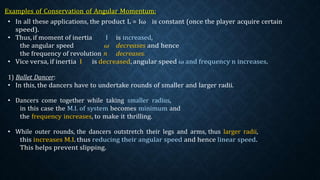
• In all these applications, the product L = Iω is constant (once the player acquire certain
speed).
• Thus, if moment of inertia I is increased,
the angular speed ω decreases and hence
the frequency of revolution n decreases.
• Vice versa, if inertia I is decreased, angular speed ω and frequency n increases.
1) Ballet Dancer:
• In this, the dancers have to undertake rounds of smaller and larger radii.
• Dancers come together while taking smaller radius,
in this case the M.I. of system becomes minimum and
the frequency increases, to make it thrilling.
• While outer rounds, the dancers outstretch their legs and arms, thus larger radii,
this increases M.I. thus reducing their angular speed and hence linear speed.
This helps prevent slipping.
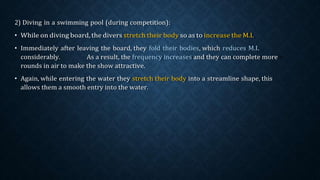
2) Diving in a swimming pool (during competition):
• While on diving board, the divers stretch their body so as to increase the M.I.
• Immediately after leaving the board, they fold their bodies, which reduces M.I.
considerably. As a result, the frequency increases and they can complete more
rounds in air to make the show attractive.
• Again, while entering the water they stretch their body into a streamline shape, this
allows them a smooth entry into the water.
Accordingly, the object now has two types of K.E., rotational and linear, sum of which makes
the total energy. (During motion P.E. is zero)
• Static friction is essential in this purely rolling motion as it prevents sliding.
• In reality, we always have some slipping involved with rolling motion.
Since the dynamics involved with circular motion present in rolling motion are same as
studied before, here we focus on deriving the expression of velocity and acceleration
for Rolling Motion.
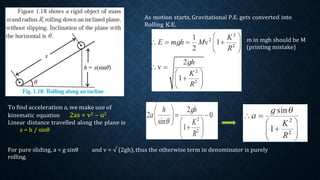
To find acceleration a, we make use of
kinematic equation 2as = v2 – u2
Linear distance travelled along the plane is
s = h / sinθ
As motion starts, Gravitational P.E. gets converted into
Rolling K.E.
m in mgh should be M
(printing mistake)
For pure sliding, a = g sinθ and v = √ (2gh), thus the otherwise term in denominator is purely
rolling.
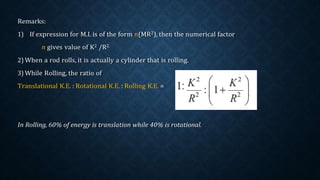
Remarks:
1) If expression for M.I. is of the form n(MR2), then the numerical factor
n gives value of K2 /R2.
2) When a rod rolls, it is actually a cylinder that is rolling.
3) While Rolling, the ratio of
Translational K.E. : Rotational K.E. : Rolling K.E. =

Rotational-Dynamics-ppt3.pdf HSC PHYSICS CHAPTER 1 ROTATIONAL DYNAMIC PART 3

  • 1.
  • 2.
    Moment of Inertia:(resistance of body to undergo rotational motion) It is defined as a body’s tendency to resist angular acceleration (thus rotational motion) There are 3 basic types of M.I. 1. Mass Moment of Inertia 2. Area Moment of Inertia* 3 * .Extr P a o in la fo rrm M a o ti m on e n n ot t i o n fsy In lla eb ru ti s a* Measure of distribution of mass of object relative to given axis Reflects how body’s points are distributed relative to given axis Shaft or Beam’s resistance to being distorted by torsion, as a function of its shape. Mass Moment of Inertia: • It is a measure of distribution of the mass of an object relative to a given axis. • Denoted by I, • for single particle IO = M R2 , where O is the axis of rotation & R is the distance from axis • Unit = kg-m2 Dimension: [ L 2 M 1 ]
  • 3.
    • Linear motion---applied force depends on mass • Rotational motion --- applied force depends on mass and distance from axis. • We are studying Mass Moment of Inertia which is given by IO = M R2 , where O is the axis of rotation & R is the distance from axis. Few Properties of M.I. • M.I. considers the distance wise distribution of mass around the axis of rotation. • Like other analogies, M.I. in rotational motion is analogous to mass in linear motion. • Both of these, express a body’s tendency to resist motion (angular or linear) M.I. depends upon following factors: (2mark question with diagram and formula) i. Mass, shape and size of body. ii. Distribution of mass in body about an axis of rotation iii. Position and orientation of axis of rotation.
  • 4.
    PHYSICAL SIGNIFICANCE OF M.I. •To produce linear motion an unbalanced force is applied. Mass of body opposes this motion thus “mass” provides inertia. Given by, F = ma • To produce rotational motion in a body an unbalanced torque is applied. In this case inertia of the body is called rotational inertia or moment of inertia. (given by I) • The relation between moment of Inertia (I), torque (τ) and angular acceleration (α) is given by, τ = I α • We conclude that, moment of inertia plays same role in rotational motion as the mass of the body does in linear motion.
  • 5.
    Analogies between Linearand Rotational Motion: Linear Rotational Linear displacement (x or s) Angular displacement (θ) Linear velocity (v) Angular velocity (ω) Linear acceleration (a) Angular acceleration (α) Force (F) Torque (τ) Mass (m) Moment of Inertia (I) Translational K.E. = Mv2 / 2 Rotational K.E. = Iω2 To find the analogy for K.E. in translational (linear) and Rotational motion we consider Derivation for Rotational Kinetic Energy: • Rotational K.E. = sum of translational K.E. of all particles present in body.
  • 6.
    1 1 2 3 It isa rigid body (distance between any two points inside body is constant) and axis of rotation is perpendicular to paper. • When the body rotates around its axis, each of these particles perform UCM around this axis with same angular speed ω. • But, as r (distance from axis) is different for each particle, they will have different translational velocity (v = r ω ). Let these velocities be v1, v2 ….. vN = rN ω. • Let us consider translational K.E. for first particle, K.E. 1 = (m1 v 2 )/2 but v1 = r1 ω therefore, K.E. 1 = (m1 r 2 ω2 )/2 Similarly for all other particles we shall have translational K.E. to be K.E. 2 = (m2 r 2 ω2 )/2 , K.E. 3 = (m3 r 2 ω2 )/2 , So on ……… K.E. N = (mN rN 2 ω2 )/2
  • 7.
    1 1 22 N N 1 1 2 2 N N 1 1 2 2 N N We know, Rotational K.E. = sum of translational K.E. of all particles present in body. Therefore, Rotational K.E. = (m r 2 ω2 )/2 + (m r 2 ω2 )/2 + ……. + (m r 2 ω2 )/2 = (1/2) (m r 2+m r 2+……. + m r 2)(ω2) But m × r2 = I (moment of Inertia) Rotational K.E. = (1/2) ( I1 + I2 +……+ IN) (ω2) Let I1 + I2 +……+ IN = m r 2+m r 2+……. + m r 2= I Rotational K.E. = (1/2) (I) (ω2 ) = I ω2 /2 Thus, in going from translation K.E to Rotational K.E. translation K.E • m is replaced by I and • v by ω rotational K.E Therefore, I can be defined as rotational inertia or moment of inertia of the object about the given axis of rotation.
  • 8.
    This I =∑mi ri 2 of an object depends upon, • Individual masses (m1, m2 ….. mN ) and • Distribution of these masses about the given axis of rotation (r1, r2 ….. rN ) If we have a different axis, this I will again depend upon on mass distribution around that axis and if the object is not symmetric it will be different for each axis. i.e. if you have a non-symmetric object like this, you will calculate I separately for axis through point O and axis through point C, as both axes shall have different distribution of masses • Though by far we considered the object to consist of finite number of particles • In reality,We usually have a homogenous rigid object. • So instead of summation, we use integration. I = ∫ r2 dm
  • 9.
    Further we willstudy, M.I. for different objects, like, 1. M.I. of Ring 2. M.I. of Disc 3. M.I. of Sphere 4. M.I. of Rod 5. M.I. of Cylinder 6. M.I. of Right Circular Cone 7. M.I. of Parallelepiped Study in detail Formulas Given Directly for each with its cases
  • 10.
    I = ∫r2 dm If we do not know the mass distribution, theoretically it is not possible to solve the above integral. But we can still find M.I. experimentally. Let us consider the application of M.I. 1) Moment of Inertia of a uniform ring: • The mass of this ring is uniformly distributed on its circumference. • It is a two-dimensional object with negligible thickness. • If this ring is rotating about its own axis, its entire mass M is practically at a distance equal to its radius R from axis. • Therefore, expression for its M.I. is I = (mass) x ( sq. of distance from axis) I = M R2 For ring
  • 11.
    2) Moment ofInertia of a Uniform Disc: Disc Description: • Two dimensional circular object • Negligible thickness • Uniform disc – Mass per unit area (σ) and composition same throughout. • Disc is rotating about its own axis. This axis is passing through the center of disc. Surface Density (σ): • Mass per unit area. • The ratio σ = mass/ area = m/A is called Surface density • For uniform disc of mass M and radius R, σ = M/ πR2
  • 12.
    • Consider theuniform disc given in figure, it has mass M and radius R. • As it is uniform, we can consider it to be consisted of number of concentric rings whose radii is increasing from zero to R. • One of such concentric ring may have mass dm (shaded portion in figure) and width dr, very small compared to entire radius of ring • Practically, this dr is considered to be less than least count of the instrument that measures it. Therefore, Area of ring = 2πr.dr i.e. σ = dm / 2πr.dr i.e. dm = σ 2πr . dr • As this discussion is about the concentric ring, this entire mass dm is at a distance r from the axis of rotation.Thus, its M.I. will be Ir = dm (r2) • So, the M.I. of disc will be integration of Ir from 0 to R.
  • 13.
    • As wesaid before, theoretically you can find M.I. only if you know the mass distribution in object. But experimentally, we can find M.I. for all objects. • Also, this M.I. depends upon mass of the object and how it is distributed around the axis of rotation. • So if we only want to know the mass distribution around the axis, Let us write M.I. as I = MK2, where M is mass of object and this mass is effectively at a distance K, from the axis of rotation. • This K, is called as Radius of Gyration. • It means that the mass of object is effectively at a distance K from the axis of rotation. If K is radius of gyration, I = MK2, is the M.I. • Radius of Gyration, can be defined as the distance from the axis of rotation to a point where the total mass of the body is supposed to be concentrated. So if you find M.I. at this point it will be equal to the M.I. that you would get in regular way. (Simple trick !!)
  • 14.
    Physical Significance ofK: • For a given object mass (M) always remains constant, what changes is K as per the choice of axis of rotation. • Thus, K depends upon shape and size of body. It measures the distribution of mass about the axis of rotation. • For small value of K, we say that mass is distributed close to the axis of rotation, so M.I. is small. • For larger value of K, mass distribution is at large distance from axis of rotation, so M.I. is large.
  • 15.
    Explanation for how Kchanges with shape
  • 16.
    • While solvingfor M.I. , we generally take axis of rotation at axis of symmetry . • But in some cases this axis may not be at axis of symmetry. • It can be parallel or perpendicular to the symmetric axis. For such cases, we need theorem of parallel axis and theorem of perpendicular axis. 1) Theorem of Parallel axes: In order to apply this theorem to any object, we need two axes parallel to each other with one of them passing through center of mass of object. Description: Figure shows object of mass(M), • MOP is random axis passing through O and ACB is axis passing through Centre of mass C. • MOP is at a distance of h from ACB and they are parallel to each other. Let us consider small point mass dm at point D. Construction:We draw perpendicular DN on extended line of OC upto N. Join D point with C and O. A line that divides any object in half
  • 17.
    • Considerations: M.I.at point O w.r.to D is IO = ∫ (DO)2 dm and at point C w.r.to D is IC = ∫ (DC)2 dm Let us consider IO (our axis of interest), IO = ∫ (DO)2 dm = ∫ ( [DN]2 + [NO]2 )dm ….. By Pythagoras Theorem But, [NO]2 = [NC + CO]2 = [NC]2 + [CO]2 +[2.NC.CO] Therefore, IO = ∫ ( [DN]2 + [NC]2 + [CO]2 +[2.NC.CO] ) dm But [DN]2 + [NC]2 = [DC]2 Therefore, IO = ∫ ( [DC]2 + [CO]2 +[2.NC.CO] ) dm Separating integration to each term and substituting, CO = h, and values of IC and ∫dm = M, IO = ∫ [DC]2 dm + h2 ∫ dm + 2h ∫ NC dm IO = IC + M h2 + 2h ∫ NC dm
  • 18.
    IO = IC+ M h2 So we have, IO = IC + M h2 + 2h ∫ NC dm This NC is the distance of point from C.M., any mass distribution is symmetric about C.M., thus as per its definition ∫ NC dm=0 So we get, this is mathematical form of theorem of parallel axis. Definition: The theorem of parallel axis states that, the moment of inertia (IO) of an object about any given axis, is the sum of ➢moment of inertia (IC) about an axis parallel to the given axis, and passing through the Centre of mass and ➢the product of the mass (M) of the object and the square of the distance between the two axes (h2) [if DN falls on OC,i.e.point N coincides with C.In that case ,DC will be the distance of point from C.M.,∫ DC dm=0 i.e. therefore, IC =0 hence, IO = M h2 . So if the point D is taken such that DN falls on OC, it is as good as calculating M.I. for only one axis,which is axis of rotation]
  • 19.
    2) Theorem ofPerpendicular Axis: • This theorem relates M.I. of laminar object about three mutually perpendicular and concurrent axes, two of them in the plane of object and third perpendicular to the object. • Laminar objects: any two dimensional objects like leaf, ring, disc, etc. • By far, we considered that the object can rotate only along one direction i.e. z axis, but in this theorem we are considering the possibility that the object can rotate about any axes from x, y and z (Consider a rupee coin as a disc and try rotating it about x, y and z axes) Image Description: Consider a mass element dm located at point P. PN = x and PM = y are perpendiculars drawn from P on X and Y axes respectively. The distance of point P from x-axis is ‘y’, from y-axis is ‘x’ and from z-axis is √(x2 + y2 )
  • 20.
    We know, I= (mass) x (sq. of distance from axis) therefore, Ix = ∫ (y2) dm I y= ∫(x2)dm Iz = ∫(x2 + y2 )dm Ix , Iy ,and Iz are respective moment of inertias of body about x, y and z axes. If we consider the expression for Iz , we get Iz = ∫(x2 + y2 )dm = ∫(x2 ) dm + ∫(y2 )dm Iz = I y + Ix this is mathematical form of theorem of perpendicular axis. Definition: It states that, the M.I. (Iz) of laminar object about an axis (z) perpendicular to its plane is sum of moment of inertias about two mutually perpendicular axes (x and y) in its plane, all the three axes being concurrent.
  • 21.
    • Also knownas moment of linear momentum (i.e. multiply linear momentum (p=mv) with distance) • Analogous to linear momentum. Definition: If 𝑝ҧ is the instantaneous linear momentum of a particle undertaking a circular motion, its angular momentum at that instance is given by, 𝐿 ത= 𝑟ҧ × 𝑝ҧ , where𝑟ҧ is the position vector from the axis of rotation. In magnitude, It is the product of linear momentum and its perpendicular distance from the axis of rotation. i.eL = (p)(r sinθ), where θ is the small angle between the directions of 𝑝ҧ and𝑟ҧ Unit = (kg-m2)/s in S.I. And (g-cm2)/s in CGS. Dimension= [L2 M1 T -1]
  • 22.
    Expression for AngularMomentum in terms of M.I. Description: Consider a body of random shape and having N particles, of masses m1, m2 ….. mN and distance r1, r2 ….. rN from axis of rotation. Let ω be its constant angular velocity. • When the body rotates around its axis, each of these particles perform UCM around this axis with same angular speed ω. • But, as r (distance from axis) is different for each particle, they will have different translational velocity (v = r ω ). Let these velocities be v1, v2 ….. vN = rN ω. • The directions for velocities v1, v2 ….. vN are along the tangents to their respective tracks. • Therefore, the linear momentum for first particle will be p1 = m1 v1 and for further particles, p2 = m2 v2 , p3 = m3 v3 and so on. Direction of p1 is along that of v1 and so on for others. Therefore, the angular momentum is given as L1 = p1 r1 = m1 r1 2 ω L2 = p2 r2 = m2 r2 2 ω L3 = p3 r3 = m3 r3 2 ω So on, LN = pN rN = mN rN 2 ω
  • 23.
    • For arigid body with fixed axis of rotation, ➢ All these angular momentum are directed along the axis of rotation, and ➢ Its direction is given by right hand thumb rule. As all L have same directions, their magnitudes are directly added. L = m1 r1 2ω+ m2 r2 2ω+……+ mNrN 2ω = (m1 r1 2 + m2 r2 2+……+ mNrN 2) ω Therefore, as I = m r 2 L = (I1 + I2 +…..+ IN ) ω If we put I1 + I2 +……+ IN = I L = I ω, where I is moment of Inertia about the axis of rotation. We can see that above equation of L = I ω is analogous to p = m v moment of inertia I, replaces mass m as per its physical significance.
  • 24.
    The two derivationsthat we do talk about expressing in terms of Moment of Inertia Why we do this? In linear motion, • we first find position of particle (x), then • the force (f) which caused motion of this particle. • Once we know the force, we are interested in knowing how this force relates to mass and velocity together, i.e. momentum (p) In case of Rotational Motion, • We know the angular position of particle on circle from angle (θ), • To know efforts needed to carry out this circular motion we found out torque,τ (analogous to force) • Once we know torque τ, we found out its relation with angular momentum, L (analogue of linear momentum) The most important property of that particle (or object) which can affect both f as well as p, is mass (M). Similarly, the most important property of object which can affect circular motion, τ and L is Moment of Inertia (I). Therefore, we are finding τ and L in terms of M.I.
  • 25.
    Description: Consider arigid body of random shape and having N particles, of masses m1, m2 ….. mN and distance r1, r2 ….. rN from axis of rotation. This body is rotating with constant angular acceleration (α) (By far we considered ω and now we are considering α , this is because both ω and α are along same line for anticlockwise rotation of body. Hence we can talk about ω or α as per requirement. Another reason for considering α is that in present scenario we are interested in force analogue torque.) As the object rotates, each of these particles perform circular motion (not UCM..!) with same angular acceleration but different linear acceleration. Therefore we have, a1 = r1 α, a2 = r2 α, so on aN = rN α Now, The force experienced by first particle is f1 = m1 a , f2 = m2 a2 so on fN = mN aN = m1 r1 α = m2 r2 α = mN rN α Expression for Torque in terms of M.I.
  • 26.
    N N If werestrict motion to a single plane, direction of all these torques are the same, and along same axis So, their magnitudes can be added, τ = τ1 + τ2 +…..+ τN =(m1 r1 2 + m2 r2 2 +…..+ m r 2 )α = (I1 + I2 +…..+ IN ) α where, I denotes moment of inertia for each particle. If we put I1 + I2 +……+ IN = I In general, we get τ = I α Comparing this to f = ma, we know that torque (τ ) is analogous to force (f) respective perpendicular distances from
  • 27.
    Just like linearmomentum of an isolated system remains conserved in absence of an external unbalanced force. Similarly, we can show that Angular momentum also remains conserved. We know, 𝐿 ത= 𝑟ҧ × 𝑝ҧ where𝑟ҧ is the position vector from the axis of rotation and 𝑝ҧ is linear momentum. Differentiating w. r. to time, Therefore, we conclude that, • “angular momentum remains conserved in absence of an external torque”. • This is the statement for principle of conservation of angular momentum, • analogous to conservation of linear momentum.
  • 28.
    • In allthese applications, the product L = Iω is constant (once the player acquire certain speed). • Thus, if moment of inertia I is increased, the angular speed ω decreases and hence the frequency of revolution n decreases. • Vice versa, if inertia I is decreased, angular speed ω and frequency n increases. 1) Ballet Dancer: • In this, the dancers have to undertake rounds of smaller and larger radii. • Dancers come together while taking smaller radius, in this case the M.I. of system becomes minimum and the frequency increases, to make it thrilling. • While outer rounds, the dancers outstretch their legs and arms, thus larger radii, this increases M.I. thus reducing their angular speed and hence linear speed. This helps prevent slipping.
  • 29.
    2) Diving ina swimming pool (during competition): • While on diving board, the divers stretch their body so as to increase the M.I. • Immediately after leaving the board, they fold their bodies, which reduces M.I. considerably. As a result, the frequency increases and they can complete more rounds in air to make the show attractive. • Again, while entering the water they stretch their body into a streamline shape, this allows them a smooth entry into the water.
  • 30.
    Accordingly, the objectnow has two types of K.E., rotational and linear, sum of which makes the total energy. (During motion P.E. is zero)
  • 31.
    • Static frictionis essential in this purely rolling motion as it prevents sliding. • In reality, we always have some slipping involved with rolling motion. Since the dynamics involved with circular motion present in rolling motion are same as studied before, here we focus on deriving the expression of velocity and acceleration for Rolling Motion.
  • 32.
    To find accelerationa, we make use of kinematic equation 2as = v2 – u2 Linear distance travelled along the plane is s = h / sinθ As motion starts, Gravitational P.E. gets converted into Rolling K.E. m in mgh should be M (printing mistake) For pure sliding, a = g sinθ and v = √ (2gh), thus the otherwise term in denominator is purely rolling.
  • 33.
    Remarks: 1) If expressionfor M.I. is of the form n(MR2), then the numerical factor n gives value of K2 /R2. 2) When a rod rolls, it is actually a cylinder that is rolling. 3) While Rolling, the ratio of Translational K.E. : Rotational K.E. : Rolling K.E. =