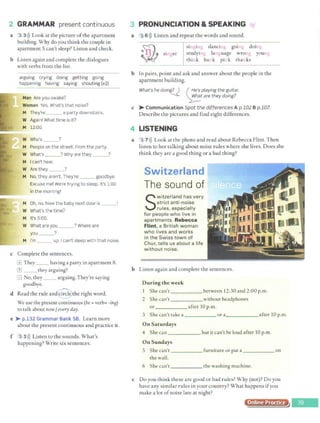
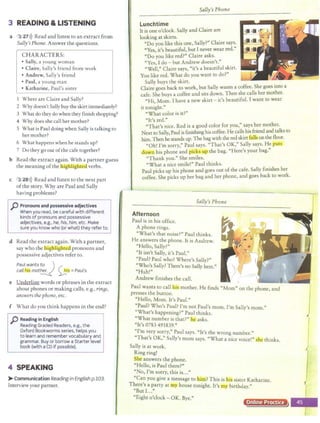
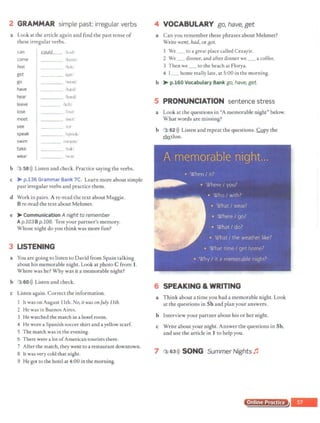
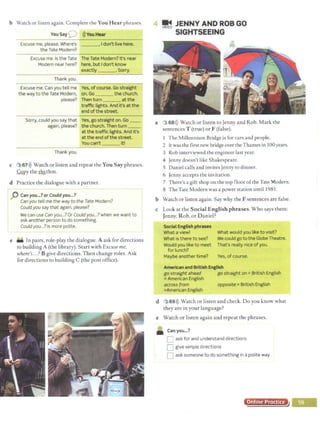
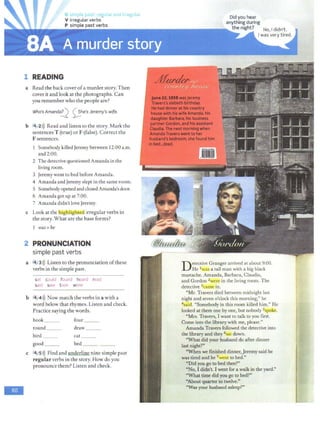
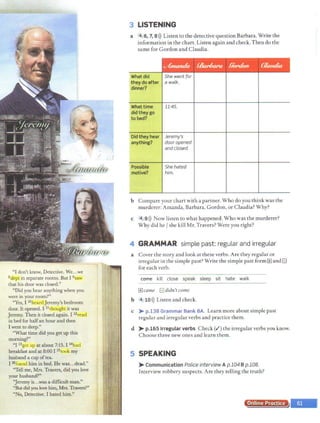
Christina Latham-Koenig
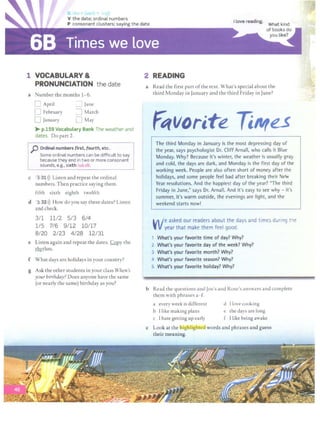
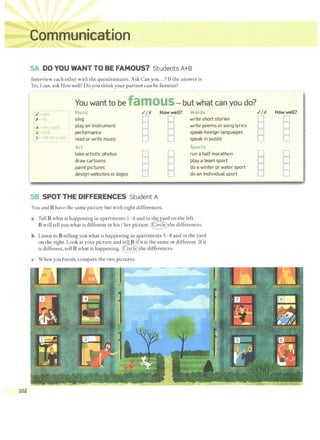
Clive Oxenden
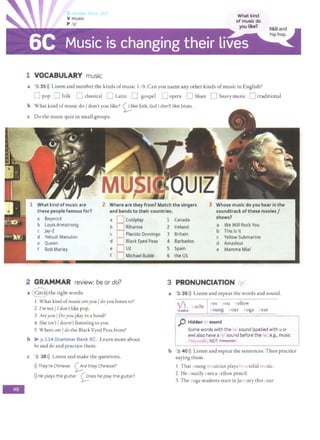
Paul Seligson
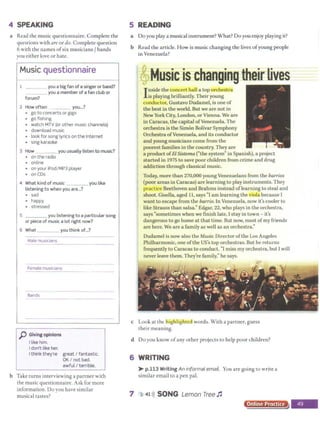
OXFORD
SECOND EDITION
...
2
Contents
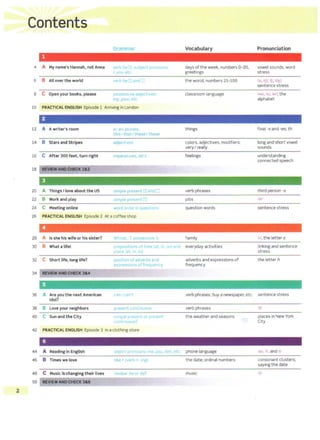
4 A My name's Hannah, not Anna
5 B All over the world
8 C Open your books, please
Grammar
verb be'• subject pronouns
I, you, etc
verb be ~and [
possess ve adject1
vec;:
you·, etc
10 PRACTICAL ENGLISH Episode l Arriving in London
12 A A writer's room al an, plurals;
this! thatI theseI those
14 B Stars and Stripes adjectives
15 c After 300 feet, turn right imperatives, let s
18 REVIEWANDCHECK 112
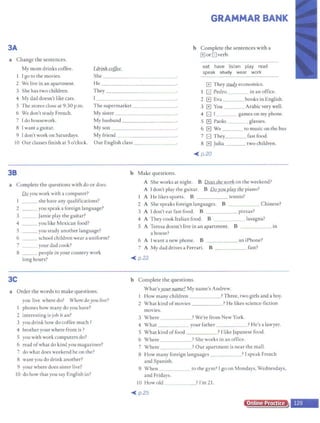
20 A Things I love about the US simple present :;:}and8
22 8 Work and play simple presert :!)
24 c Meeting online -uest :ins
26 PRACTICAL ENGLISH Episode 2 At a coffee shop
28 A Is she his wife or his sister?
30 8 What a life!
32 c Short life, long life?
34 REVIEW AND CHECK 31~
36 A Are you the next American
Idol?
38 Love your neighbors
40 Sun and the City
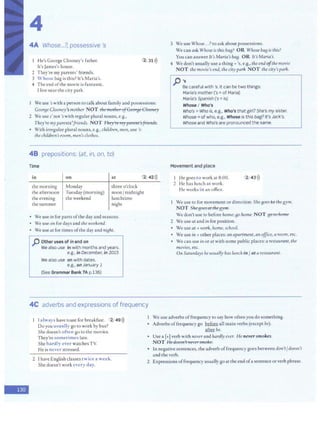
Whose...?, possessive 's
prepositions of time (at, m, on) a1 ~
place (at, in, to)
position of adverbs a"ld
expressions of frequency
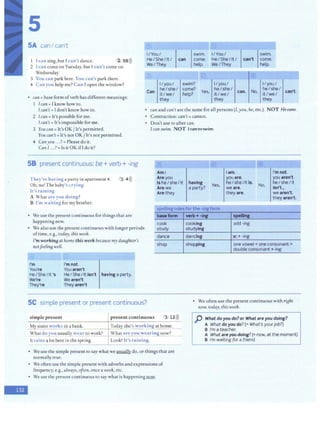
can/ can't
present continuous
s mple pres!mt or present
o
r
42 PRACTICAL ENGLISH Episode 3 In a clothing store
44 A Reading in English object pronouns· me, you, him, et
45 B Times we love ltke +(verb +·mg)
48 c Music is changing their lives review: beor do?
50 REVIEW ~ND CHECK 5&6
'·
.........
··' ....
.·
• • • • ~. r • ••
Vocabulary
days of the week, numbers 0-20,
greetings
the world, numbers 21-100
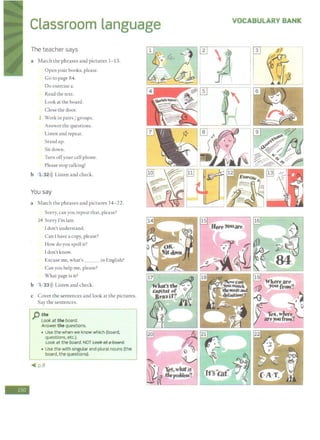
classroom language
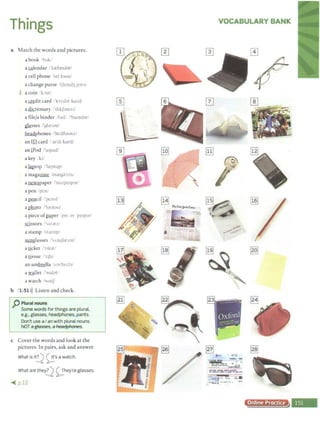
things
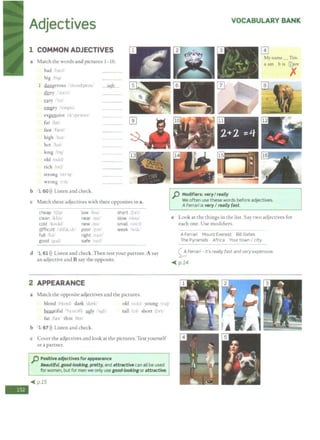
colors, adjectives, modifiers:
very/really
feelings
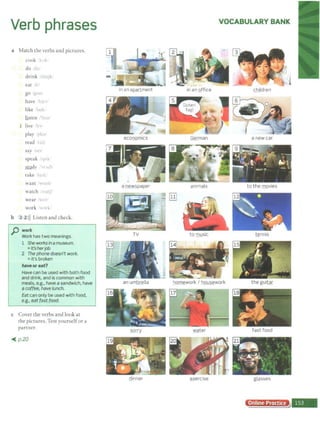
verb phrases
jobs
question words
family
everyday activities
adverbs and expressions of
frequency
Pronunciation
vowel sounds, word
stress
~ . tJ, .f.•!dy ;
sentence stress
/()(JI, tu/, tw;the
alphabet
final -sand -es; th
long and short vowel
sounds
understanding
connected speech
third person ·s
;ir
sentence stress
'""'·the letter o
linking and sentence
stress
the letter h
verb phrases: buy Cl newspaper, etc. sentence stress
verb phrases IJi
the weather and seasons places in New York
City
phone language
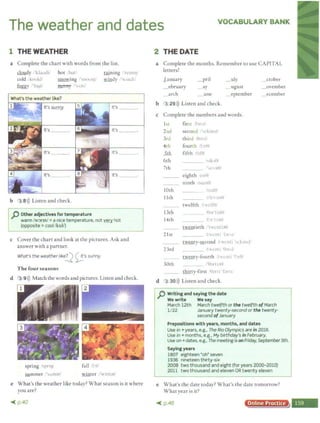
the date; ordinal numbers
music
1a11, ·J,, and /i
consonant clusters;
saying the date
ly!
.·
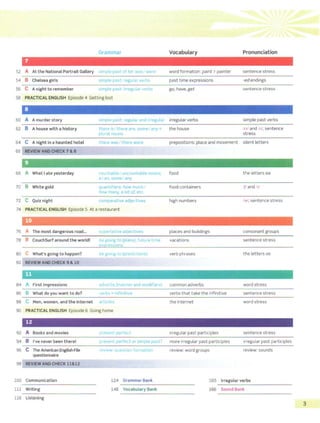
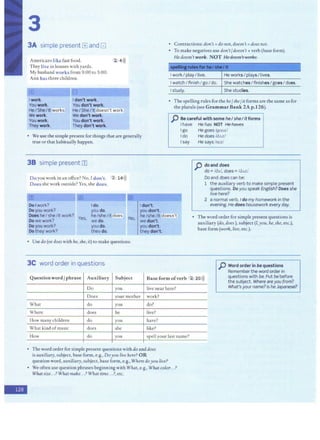
Grammar Vocabulary Pronunciation
52 A At the National PortraitGallery rT"ple past of be: was/ were word formation: paint >painter sentence stress
54 B Chelsea girls 1:-r.ple past: regu.ar verbs past time expressions -edendings
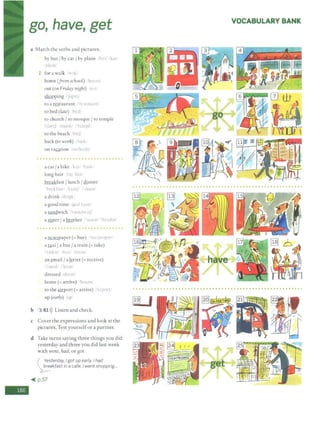
56 c A night to remember ~-•- - ..o;t: irregular verbs go, have, get sentence stress
58 PRACTICAL ENGL.
ISH Episode 4 Getting lost
60 A A murder story simple past: regular a'ld irregul11 irregular verbs simple past verbs
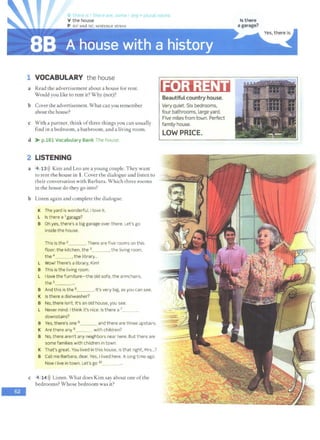
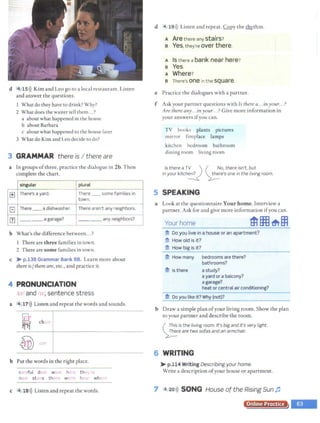
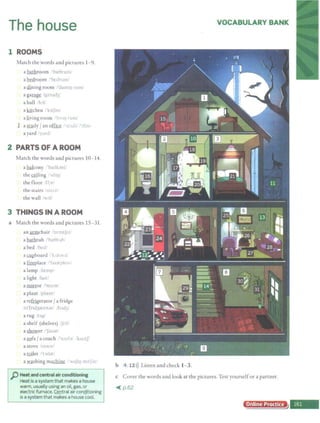
62 B A house with a history thPre isl there are, some/ any+ the house ti;rl and lirt, sentence
plval '10uns stress
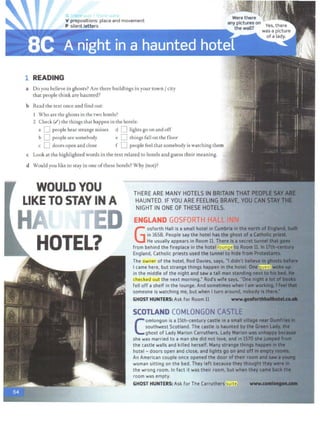
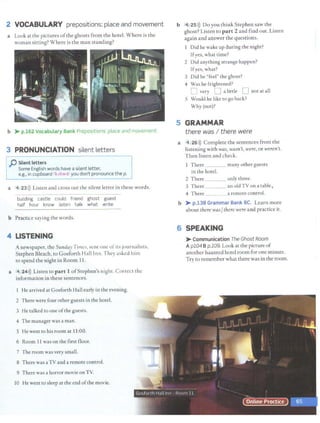
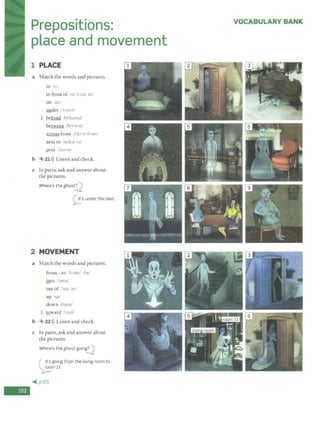
64 c A night in a haunted hotel there was/there were prepositions: place and movement silent letters
66 REVIEW AND CHECK 1 & 8
68 What I ate yesterday countable / uncountable nouns, food the letters ea
al an, some/ any
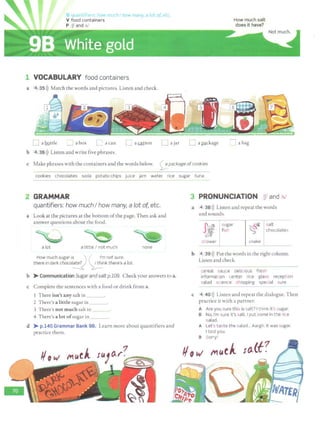
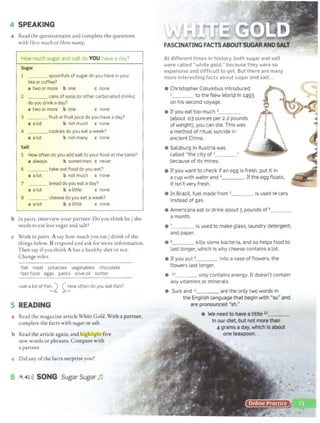
70 B White gold quantrf1ers: how much/ food containers lfi and 1,
how many, a tot of, etc.
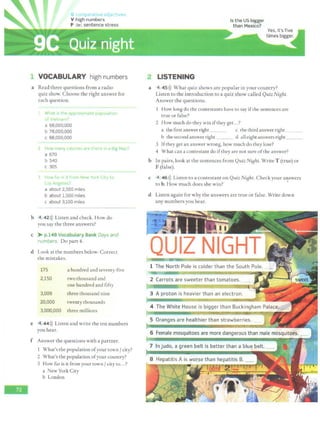
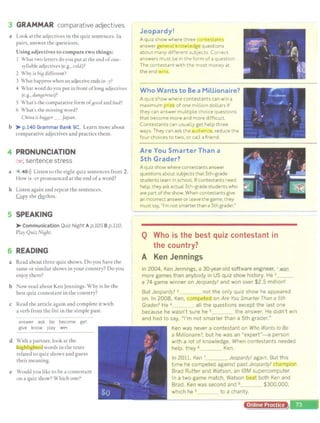
72 c Quiz night comoarative adjectives high numbers /;'Ir/, sentence stress
74 PRACTICAL ENGLISH Episode 5 At a restaurant
76 The most dangerous road... superlab '°'•Pr :ives places and buildings consonant groups
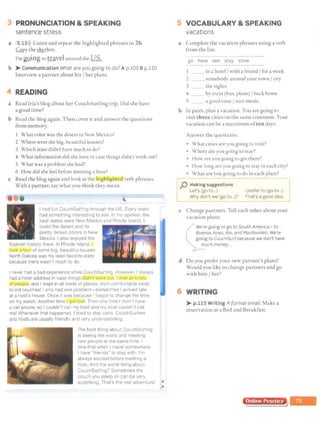
78 CouchSurf around the worldI bt1going a: ), future time vacations sentence stress
PX!l<cl<;Si011'>
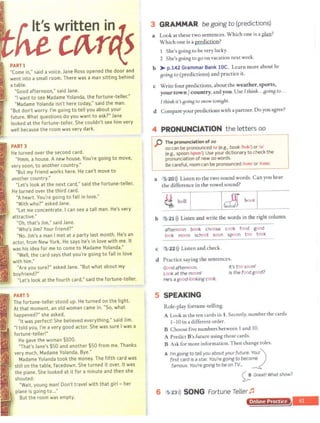
80 c What's going to happen? be going to (pred ct1o:is) verb phrases the letters oo
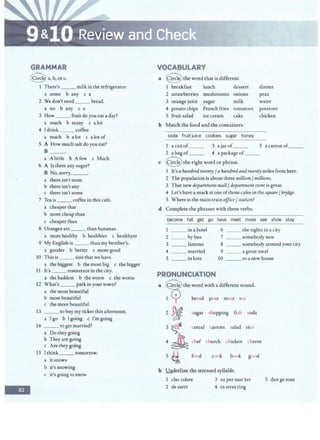
82 REVIEW ANO CHECK 9 & 1-0
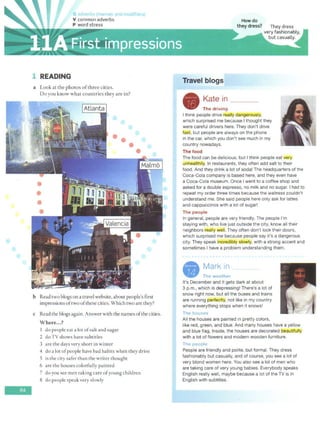
84 A First impressions tldverbs (manner and modifiers) common adverbs word stress
86
88
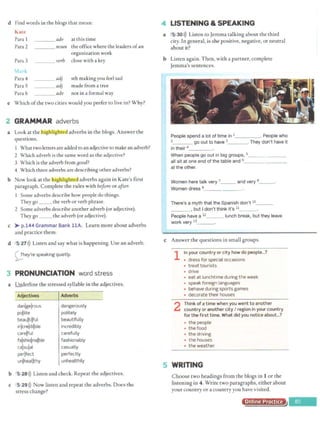
What do you want to do?
Men, women, and the Internet
verbs+ mfimt1ve
90 PRACTICAL ENGLISH Episode 6 Going home
92 A Books and movies
94 B I've never been there!
96 c The American English File
questionnaire
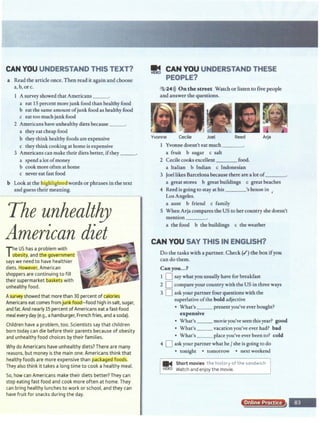
98 REVIEW AND CHECK 11&12
100 Communication
111 Writing
116 Listening
prec;erit perfect
preserit perfect or siriple past'i
rev1f'w questio11 forrnatiol'
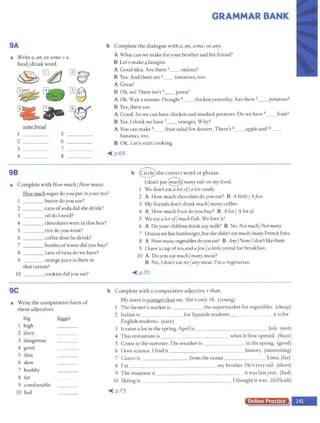
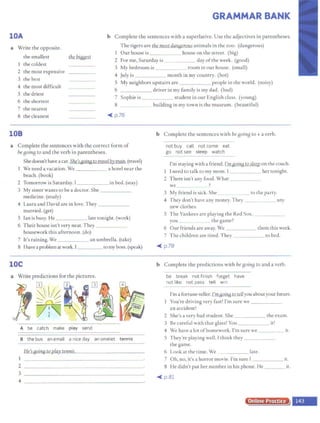
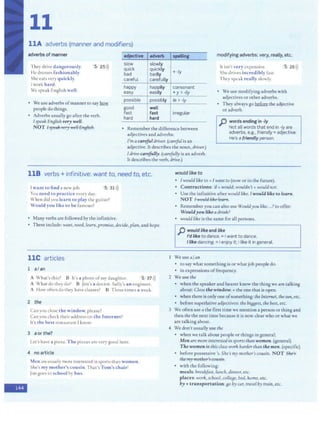
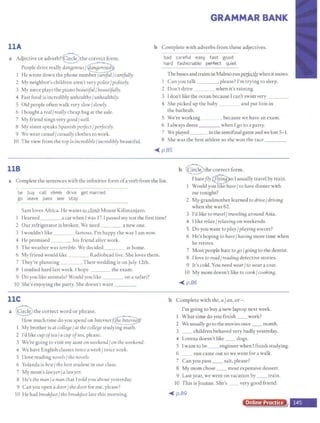
124 Grammar Bank
148 Vocabulary Bank
verbs that take the infinitive sentence stress
the Internet word stress
irregular past participles sentence stress
more irregular past participles irregular past participles
review: word groups review: sounds
165 Irregular verbs
166 Sound Bank
3 ·.
-
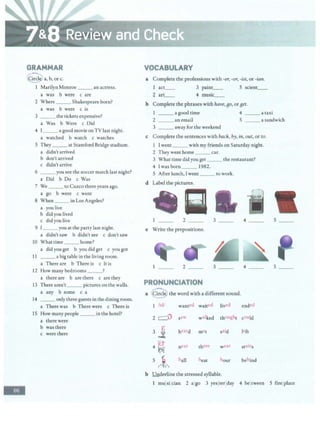
V days ofthe week, numbers 0-20, greetings
P vowel sounds, word stress
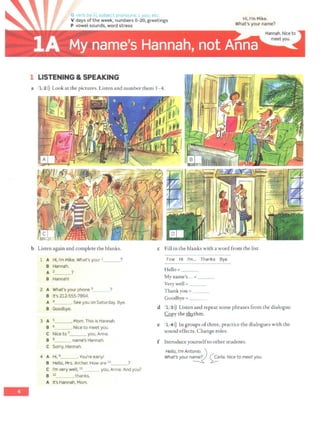
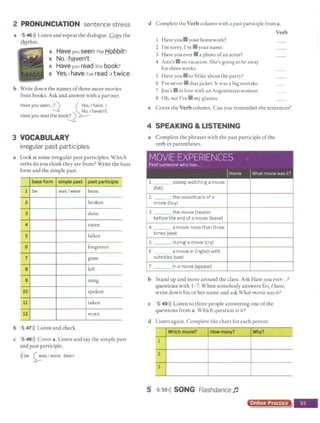
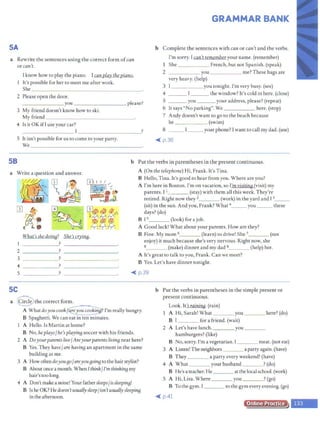
1 LISTENING & SPEAKING
Hi, I'm Mike.
What's your name?
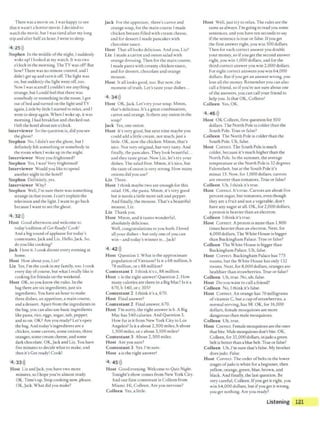
a 1 2>)) Look at the pictures. Listen and number them 1- 4.
b Listen again and complete the blanks.
1 A Hi, I'm Mike. What's your 1 ?
B Hannah.
A 2_~ ?
B Hannah!
2 A What's your phone 3 ?
B It's 212-555-7894.
A 4 .See you on Saturday. Bye.
B Goodbye.
3 A 5___, Mom. This is Hannah.
B 6 . Nice to meet you.
c Nice to 1 you, Anna.
B 8 name's Hannah.
c Sorry, Hannah.
4 A Hi, 9 . You're early!
B Hello, Mrs.Archer.How are io ?
C I'm very well, 11_ _ you, Anna. And you?
B i 2 .thanks.
A It's Hannah, Mom.
c Fill in the blanks with a word from the list.
Fine Hi I'm... Thanks Bye
Hello =_ _ _
My name's... =___
Very well = ___
Thank you = ___
Goodbye= _ _ _
d 1 3>)) Listen and repeat some phrases from the dialogue.
.(:Qpy the ~thm.
e 1 4>)) In groups ofthree, practice the dialogues with the
sound effects. Change roles.
f Introduce yourselfto other students.
Hello, I'm Antonio._ ')
What's your na~ 0rta. Nice to meet you.
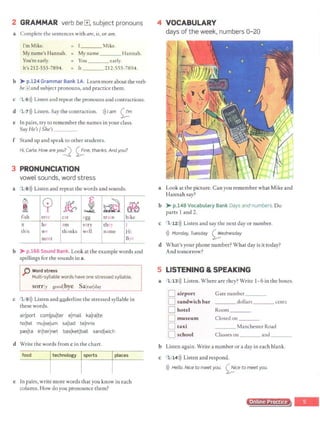
2 GRAMMAR verb be r±l, subject pronouns
a Complete the sentences with are, is, or am.
I'm Mike. ___ Mike.
My name's Hannah.
You're early.
My name ___Hannah.
= You _ __ early.
It's 212-555-7894. It 212-555-7894.
b >-p.124 Grammar Bank lA. Learn more about the verb
bel±land subject pronouns, and practice them.
c 1 ,.6 l)) Listen and repeat the pronouns and contractions.
d 1 71)) Listen.Say the contraction. 1)) I am ~
m
e In pairs, try to remember the names in your class.
Say He's/ She's_ _ _
f Stand up and speak to other students.
Hi, Carla. How are yo~ 0 ne, thanks. Andyou?
3 PRONUNCIATION
vowel sounds, word stress
a 1 8>)) Listen and repeat the words and sounds.
~
&
cp ~
E
~ ~ &e
fish tree cat egg train bike
it he am very they I
this we thanks well name Hi
meet Bye
b >-p.166 Sound Bank. Look at the example words and
spellings for the sounds in a.
p Word stress
Multi-syllable words have one stressed syllable.
sorrjy goodlbye Saicurjday
c 1 9>)) Listen and llilderlinc the stressed syllable in
these words.
airjport comjpujter ejmail kajrajte
hojtel mujsejum sallad tejnnis
pasjta lnjterlnet baslketjball sandlwich
d Write the words from c in the chart.
food technology sports places
e In pairs, write more words that you know in each
column. How do you pronounce them?
4 VOCABULARY
days of the week, numbers 0- 20
a Look at the picture. Can you remember what Mike and
Hannah say?
b >-p.148 Vocabulary Bank Days and numbers. Do
parts 1 and 2.
c 1 12>)) Listen and say the next day or number.
>)) Monday, Tuesday 0ednesday
d What's your phone number? What day is it today?
And tomorrow?
5 LISTENING & SPEAKING
a 1 13>)) Listen. Where are they? Write 1-6 in the boxes.
D airport Gate number___
D sandwich bar dollars cents
D hotel Room ___
D museum
D taxi
D school
Closed on ___
___ Manchester Road
Classes on and ___
b Listen again. Write a number or a day in each blank.
c 1 14>)) Listen and respond.
1)) Hello. Nice to meet you. <;_;!.ice to meet you.
Online Practice
-
G ve b be[?' anc g
V the world, numbers 21-100
P fa/, ltfl, If/, ld3/; sentence stress
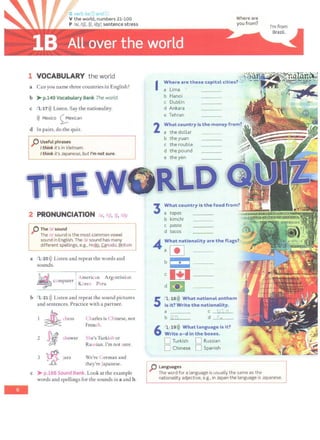
l VOCABULARY the world
a Can you name three countries in English?
b ~ p.149 Vocabulary Bank The world.
c 1 17>)) Listen.Say the nationality.
») Mexico 0exican
d In pairs, do the quiz.
p Use.fut phrases
I think it's in Vietnam.
I think it's Japanese, but I'm not sure.
2 PRONUNCIATION fat, ttft, tft, ict31
p The fol sound
The fat.sound.is the most common vowel
sound in English. The fa/ sound has man
different spellings, e.g., Hello, Canada, Jritain
a l ·20>)) Listen and repeat the words and
sounds.
~ computer · American Argentinian
~ I Korea Peru
b 1 21l)) Listen and repeat the sound pictures
and sentences. Practice with a partner.
2
3
~chess Chades is Chinm, not
French.
shower
~~'
~· jazz
She's Turkish or
Russian. I'm not sure.
We're German and
they're Japanese.
c ~ p.166 Sound Bank. Look at the exam le
words and spellings for the sounds in a a~db.
I
2
3
5
Where are
you from?
e Tehran
-~
What country is the moneyfrom? '
a the dollar
b theyuan
c the rouble
d the pound
e theyen
Whatcountry is the food from?
a tapas
b kirnchi
c pasta
d tacos
1 18>)) What nationalanthem
.. , .
•sit. Writ.e the nationality.
a c 110::,.,
b GB d F'
--'----"---
6 1 ~g>)) Whatlanguage is it?
Wnte a-din the boxes.
C Turkish D Russian
D Chinese 0 Spanish
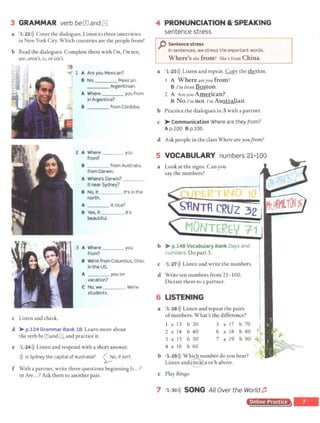
3 GRAMMAR verb beIll and El
a 1 22>)) Cover the dialogues. Listen to three interviews
in New York City. Which countries are the people from?
b Read the dialogues. Complete them with I'm, I'mnot,
are, aren't, is, or isn't.
c Listen and check.
1 A Are you Mexican?
8 No, Mexican.
___ Argentinian.
A Where you from
in Argentina?
B from C6rdoba.
2 A Where ___ you
from?
8 from Australia,
from Darwin.
A Where's Darwin? ___
it near Sydney?
B No, it . It's in the
north.
A it nice?
B Yes, it . It's
beautiful.
A Where you
from?
8 We're from Columbus, Ohio,
in the US.
A you on
vacation?
C No, we . We're
students.
d > p.124 Grammar Bank 18.Learn more about
the verb bernand 8 and practice it.
e 1 24>)) Listen and respond with a short answer.
>)) /s Sydney the capital of Australia? 00.it isn't.
f With a partner, write three questions beginning Is...?
or Are...? Ask them to another pair.
4 PRONUNCIATION & SPEAKING
sentence stress
p Sentence stress
In sentences, we stress the important words.
Where's she from? She'~ from China.
a 1 25l)) Listen and repeat. Copy the Ih}'.thm.
I A Where are you from?
B I'm from Boston.
2 A A re you American?
B No,I'm not.I'm Australian.
b Practice the dialogues in 3 with a partner.
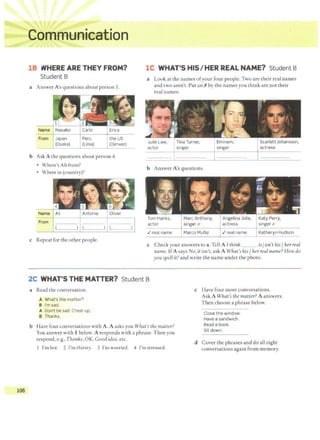
c > Communication Where are they from?
Ap.100 Bp.106.
d Ask people in the class Where areyoufrom?
5 VOCABULARY numbers 21-100
a Look at the signs. Can you
say the numbers?
'"' 'PER lfl ~n
SRNTH CRUZ 32
' MONTEREN ;-1;1
b > p.148 Vocabulary Bank Days and I
numbers. Do part 3. j
c 1 27>)) Listen and write the numbers. 1
d Write ten numbers from 21-100.
Dictate them to a partner.
6 LISTENING
a 1 28>)) Listen and repeat the pairs
ofnumbers. What's the difference?
a 13 b 30
2 a 14 b 40
3 a 15 b 50
4 a 16 b 60
5 a 17 b 70
6 a 18 b 80
7 a 19 b 90
b 1 29>)) Which number do you hear?
---
Listen and~le a orb above.
c Play Bin8o·
I
I
I
7 i 30>)) SONG All Over the World ~
Online Practice
,_
-
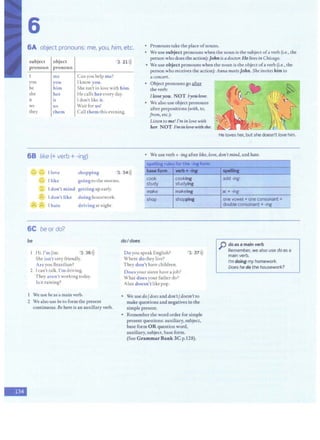
G possessive adjectives· my, your, etc.
V classroom language How do you spell
your last name?
P /ou/, /u/, far!; the alphabet
1 VOCABULARY
classroom language
a Look at the picture ofa classroom.
1 Match the words and pictures.
0 board /b;:ird/
D chair ltJcr/
D COOlpl!ter /hm'pyut~r/
Ddesk/desk/
L_ door /d:ir/
L pkture /'p1ktJ3r/
[II table /'te1bl/
D wall/w;:il/
D window /'wmdou/
b 1 31>)) Listen and check.
c >-p.150 Vocabulary Bank
Classroom language.
d 1 34>)) Listen and follow the instructions.
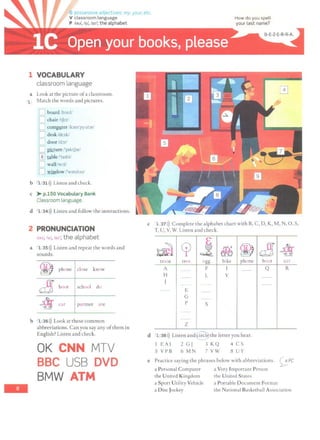
2 PRONUNCIATION
foul, tu!, !ar1; the alphabet
a 1 35>)) Listen and repeat the words and
sounds.
~ phone close know
d! boot school do
·~ car partner are
b 1 36l)) Look at these common
abbreviations. Can you say any ofthem in
English? Listen and check.
OK CNN MTV
BBC USB DVD
BMW ATM
c 1 37l)) Complete the alphabet chart with B, C, D, K, M, N, 0, S,
T, U, V, W. Listen and check.
~ Ci> j ~ ~ di 4h-
.,~
train tree egg bike phone boot car
A F I - - Q R
H L y - -
- -
J - - - - -
-- E - -
G - -
p x
- -
- -
z
d 1 38>)) Listen and1ti~the letter you hear.
lEAI 2GJ 3KQ 4CS
SVPB 6MN 7VW 8UY
e Practice saying the phrases below with abbreviations. ~PC
a Personal Computer a Very Important Person
the United Kingdom the United States
a Sport Utility Vehicle a Portable Document Format
a Disc Jockey the National Basketball Association
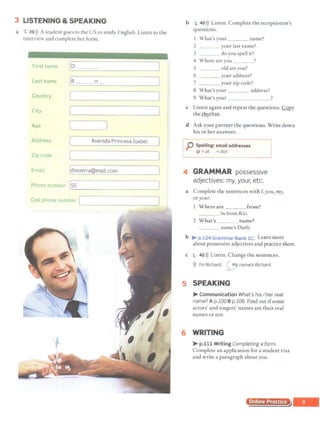
3 LISTENING & SPEAKING
a 1 39J)) A student goes to the US to study English. Listen to the
interview and complete her form.
First name (o_ ___
last name (s_ __ rr _
Country
City
Age
Address Avenida Princesa Isabel
Zip code
Email (dbezerra@mail.com
Cell phone nurnbe.
b 1 40>)) Listen. Complete the receptionist's
questions.
What's your ___ name?
2 _ your last name?
3 do you spell it?
4 Where are you ?
5 old are you?
6 your address?
7 your zip code?
8 What's your address?
9 What's your ?
c Listen again and repeat the questions. Copy
the rh}'..thm.
d Ask your partner the questions. Write down
his or her answers.
p Spelling: email addresses
@ = at . =dot
4 GRAMMAR possessive
adjectives: my, your, etc.
a Complete the sentences with I,you, my,
oryour.
Where are ___ from?
'mfromRio.
2 What's name?
__ _ name's Darly.
b > p.124 Grammar Bank lC. Learn more
about possessive adjectives and practice them.
c 1 42J)) Listen. Change the sentences.
>)) I'm Richard. 0y
name's Richard.
5 SPEAKING
> Communication What's hisI her real
name?Ap.100 B p.106. Find out ifsome
actors' and singers' names are their real
names or not.
6 WRITING
> p.111 Writing Completing a form.
Complete an application for a student visa
and write a paragraph about you.
Online Procfce
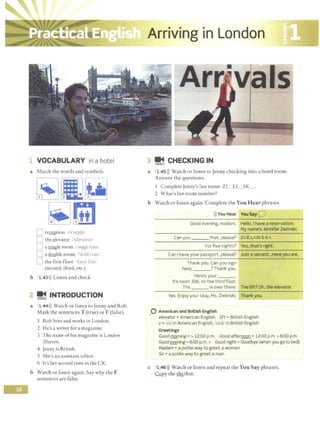
1 VOCABULARY in a hotel
a Match the words and symbols.
l1 re~tion n'-.cpfnf
D the ~Jevator /'davc1t~r'
D a single room /1
~11)91 rum/
L
1 a dmlble room /'dAbl rum!
LJ the first floor /farst fbr/
(second, third, etc.)
b l 43>)) Listen and check.
~ INTRODUCTION
a l 44>)) Watch or listen ro Jenny and Rob.
Mark the sentences T (true) or F (false).
1 Rob lives and works in London.
2 He's a writer for a magazine.
3 The name ofhis magazine is London
20seven.
4 Jenny is British.
S She's an assiscanr editor.
6 lt's her second time in the UK.
b Watch or listen again. Say why the F
sentences are false.
Arriving in London
~ CHECKING IN
a l 45>)) Watch or listen to Jenny checking into a hotel room.
Answer the questions.
I Complete Jenny's last name: ZI LI SK_ .
2 What's her room number?
b Watch or listen again. Complete the You Hear phrases.
>)) You Hear You Say0
Good evening, madam. Hello. I have a reservation.
My name's Jennifer Zielinski.
Can you ___ that. please? Z-1-E-L+N-S-K-I.
For five nights? Yes, that's right.
Can I have your passport, please? Just a second...Here you are.
Thank you. Can you sign
here, ? Thank you.
Here's your ___
It's room 306, on the third floor.
The is over there. The lift? Oh. the elevator.
Yes. Enjoy your stay, Ms. Zielinski. Thank you.
0 American and British English
elevator= American English lift= British English
z = /zi/ in American English, /zed/ in British English
Greetings
Goodmorning=> 12:00 p.m. Goodafter!1QQ!1 = 12:00 p.m. >6:00 p.m.
Goodevening= 6:00 p.m. > Goodnight= Goodbye (when you go tobed)
Madam= a polite way to greet a woman
Sir= a polite way to greet a man
c 1 46>)) Watch or listen and repeat the You Say phrases.
.GQpy the ~thm.
d Practice the dialogue with a partner.
e Work in pairs. Read your role and look at the
dialogue in 3b. What do you need to change?
A (book open) You are the receptionist. It's
11:00 a.m. B's room is 207 on the second
floor. Begin with Good mornin8 sir/madam.
B (book closed) You arrive at the hotel. Use
your first name and last name.
f .. Role-play the dialogue. Then change roles.
g 1 47>)) Look at the information in the box.
Listen and repeat the Can...? phrases.
0 Can you...?= Please do it
Can you sign here?
Can you spell that?
Can I have...?= Please give me (your passport,
etc.)
Can I haveyour passport, please?
Can I have my key, please?
h You are in a hotel. How do you ask the
receptionist to give you...?
• your key • your passport
• a map ofLondon • a pen
~ JENNY TALKS TO ROB
a 1 48>)) Watch or listen and mark
the sentences T (true) or F (false).
1 Jenny has a coffee.
2 She is in London on business.
3 The waitress is German.
4 Jenny calls Rob Walker.
5 Jenny is tired.
6 Their meeting is at I0:00.
b Watch or listen again. Say why the Fsentences are false.
c 1 49>)) Read the information in the box. Listen and repeat the
Would you like...? phrases and the responses. Practice offering
drinks and responding.
p Would you like...?
Would you like a coffee?
Would you like another tea?
Yes, please.
No, thanks.
We use Wouldyou like...?to offer somebody something.
We respond Yes, please or No, thanks.
d Look at the Social English phrases. Who says them: Jenny,
Rob, or the waitress?
Social English phrases
I'm here [on business].
I'm from [New York). What about you?
No problem.
Is that [Jennifer]?
This is [Rob. Rob Walker].
That's perfect.
It's time for bed.
e 1 SO>)) Watch or listen and check. Do you know what they are in
your language?
f Watch or listen again and repeat the phrases.
• Canyou...?
D check into a hotel and spell your name
D ask somebody to do something/to give you something
D offer somebody a drink, and accept or refuse
Online Practice
-
rat, tn1c. that these those
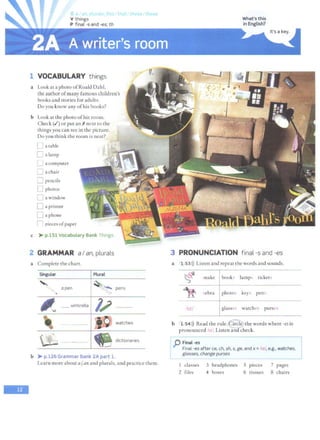
1 VOCABULARY things
a Look at a photo ofRoald Dahl,
the author ofmany famous children's
books and stories for adults.
Do you know any ofhis books?
b Look at the photo ofhis room.
Check (vi') or put an~ next to the
things you can see in the picture.
Do you think the room is neat?
L a table
L a lamp
u a computer
0 achair
D pencils
[J photos
D a window
D a printer
D a phone
n pieces ofpaper
c > p.151 Vocabulary Bank Things.
2 GRAMMAR aI an, plurals
a Complete the chart.
b > p.126 Grammar Bank 2A part 1.
Learn more about a/ an and plurals, and practice them.
What's this
in English?
3 PRONUNCIATION final -sand -es
a
b
1 53>)) Listen and repeat the words and sounds.
~ ..nakc [book lamps ticket<.
"It 1ebra photo key-; pens
Iw~"'
/1z/ watches purscc;
1 54>)) Read the rule.~ the words where -es is
pronounced 11 . Listen~heck.
p F~nal-es
L
Final -es after ce, ch, sh, s, ge, and x = Im, e.g., watches,
glasses, change purses
I classes 3 headphones 5 pieces 7 pages
2 files 4 boxes 6 tissues B chairs
--'
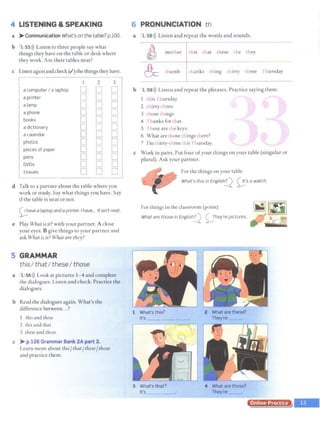
4 LISTENING & SPEAKING
a > Communication What's on the table? p.100.
b l 55>)) Listen to three people say what
things they have on the table or desk where
they work. Are their tables neat?
c Listen again and check (.I) the things they have.
I 2 3
a computer I alaptop 0 D D
a printer D D D
a lamp D D D
a phone D D D
books D 0 D
a dictionary D n D
a calendar D D 0
photos D n n
pieces of paper D D LJ
pens D D D
DVDs D D D
tissues D D D
d Talk to a partner about the table where you
work or study. Say what things you have. Say
ifthe table is neat or not.
0ave alaptop anda printer. Ihave... It isn't neat.
e Play What is it? with your partner. A close
your eyes. B give things to your partner and
ask What is it? What are they?
5 GRAMMAR
this I thatI theseI those
a 1 56l)) Look at pictures 1-4 and complete
the dialogues. Listen and check. Practice the
dialogues.
b Read the dialogues again. What's the
difference between...?
I this and these
2 this and that
3 these and those
c > p.126 Grammar Bank 2A part 2.
Learn more about this/ that/ these/ those
and practice them.
6 PRONUNCIATION th
a 1 SB>)) Listen and repeat the words and sounds.
~ mother this that these 1e they
& thumb thanks thing thirty three Thursday
b 1 59>)) Listen and repeat the phrases. Practice saying them.
is ursday
2 irty-1 ree
3 those things
4 rhanks for that.
5 These are t ~e keys.
6 What arc rhose things there?
7 l'm t lirty-three t liS·1 hursday.
c Work in pairs. Put four ofyour things on your table (singular or
plural). Ask your partner.
For the things on your table:
What's this in Eng/is~ 0,'sa watch.
For things in the classroom (point):
What are those in Englis~ 0 hey're pictures.
1 What's this?
It's ---~·
3 What's that? 4 What are those?
It's
- · They're ._.
Online Practice
G jJE'• .,
V colors, adjectives, modifiers: veryI really
P long and short vowel sounds
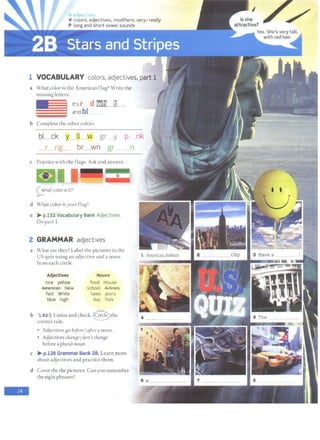
1 VOCABULARY
a What color is the American flag? Write the
missing letters.
It's r d l'!'m ~ ___,
and bl
.
h Complete the ocher colors.
bl_ ck y~w gr___y p_ nk
_ r___ng_ br_ wn gr n
c Practice with the flags. Ask and answer.
=c:
0 hat color is it?
d What color is your flag?
e > p.152 Vocabulary Bank Adjectives.
Do part I.
2 GRAMMAR adjectives
-
a What are they? Label the pictures in the
US quiz using an adjective and a noun
from each circle.
Adjectives
nice yellow
AmeFieaA New
fast White
blue high
N6uns
food House
schooi ~
taxis ieans
day York
b l 62i)) Listen and check. ® the
correct rule.
Adjectives go before/after a noun.
• Adjectives chan[Je/ do11't chan[Je
before a plural noun.
c > p.126 Grammar Bank 28. Learn more
about adjectives and practice them.
d Cover the the pictures. Can you remember
the eight phrases?
::: :::.··:..·~· ·. .
·..•.:· :.. ....
3 PRONUNCIATION
long and short vowel sounds
a 1 64>)) Listen and repeat the words
and sounds.
i cp '~
,, .
-
fish tree clock
saw bull boot
b Match an adjective from circle A with an
adjective from circle B with the.same vowel
sound. Write them in the chart.
A
blue full
easy rich
small hot
B
cheap big·
calm w(Mg
new good
c 1.•65>)) Listen and check.
d > p.166 Sound Bank. Look at the typical
spellings for these sounds.
e Adjective race In pairs, in three minutes
make phrases with an adjective and a noun
with the same vowel sound. Use a/an with
singular nouns.
Adjectives
old new
gray long
black good
big cheap
An old pho'i2_
Nouns
book boots
jeans photo
day fish
sorig cat
f ·1 66>)) Listen and check. Practice saying
the phrases.
4 VOCABULARY adjectives part 2
a > p.152 Vocabulary Bank Adjectives. Do part 2.
b Work in pairs. A say an adjective. B say a famous person.
sho~ 0om Cruise
5 READING
a Read the descriptions and look at the photos.
Who are the two people?
He's a famous American actor.
He's tall and he's very attractive.
He has long hair and brown eyes.
I think he's about 50.
She's a very beautiful actress.
She's short and slim,; and
she has long dark hair. She's a
Hollywood star, but she isn't
American, she's Spanish.
b Read them again. Guess the meaning ofthe 6i.ghlighte words.
6 WRITING &SPEAKING
a Think ofa famous person from any country in the world. Use the
jobs in the box to help you.
------------ ----
actor I actress musician politician
singer sportsman I sportswoman TV host
b Write ashort description ofthe person. Give it to your partner.
Can he / she guess who it is?
c Play Guess thefamous person.
A think ofa famous actor/ actress.
B ask ten questions using Is...?Try to guess the actor/ actress.
/sit aman ora woman
_Q 0 woman.
Is she America'!!] 0 es, she is.
Online Practice
lr>t '
V feelings
P understanding connected speech
1 VOCABULARY feelings
a Match the words and pictures.
r LJ"
l - )
....._ ...-_,.-'
0
[l] £-
~
~
'
6
0 hungry n sad :=i bored
l_J hot I ] thirsty ~ happy
~ ] angry n cold :] stressed
=1 tired mworried
Ip Collocation -
Use be+ hungry, thirsty, hot, etc.,
I
e.g., I'm very hungry.
NOT 11'teve -;ery 1'ttmgry.
-
~~~~~~~~~
b 1 68>)) Listen and check. Repeat the phrases.
c Cover the words and look at the pictures.
Make[ij and F sentences about how you feel
and tell your partner.
(
I'm really hungry.
I'm very tired.
I'm not hot.
2 LISTENING &READING
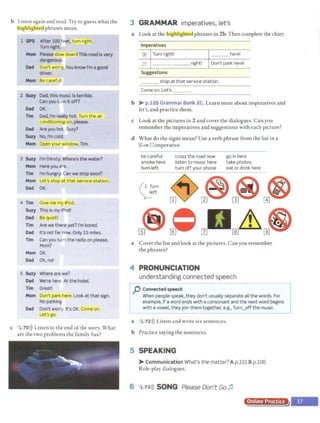
a 1 69 >)) The Carter family is on vacation. Look at the pictures.
Listen and number them 1-5.
b Listen again and read.Try to guess what the
fbighligluea phrases mean.
1 GPS After 100 feet, turn right.
Turn right.
Mom Please slow down! This roadis very
dangerous.
Dad Don't worry. You know I'm a good
driver.
Mom Be carefuj!
z Suzy Dad, this music is terrible.
Can you turn itoff?
Dad OK
Tim Dad, I'm really hot. Turn the air
conditioning on, please.
D
ad Are you hot, Suzy?
Suzy No, I'm cold.
Mom Open your window, Tim.
3 Suzy rm thirsty. Where's the water?
Mom Hereyou are.
Tim I'm hungry. Can we stop soon?
Mom Let's stop at that service station.
Dad OK.
4 Tim Give me my iPod.
Suzy This is my iPod!
Dad Be quiet!
Tim Are we there yet? I'm bored.
Dad It's not far now. Only 15 mites.
Tim Can you turn the radio on please,
Mom?
Mom OK.
Dad Oh, no!
5 Suzy Where are we?
Dad We're here. At the hotel.
Tim Great!
Mom Don't park here. Lookatthat sign.
No parking.
Dad Don't worry. It's OK. Come on.
Let's go.
c 1,70>)) Listen to the end ofthe story. What
are the two problems the family has?
3 GRAMMAR imperatives, let's
a Look at the lhigOiigllted phrases in 2b. Then complete the chart.
Imperatives
1±1 Turn right! ___ here!
El ______ right! Don't park here!
Suggestions
___ stop at that service station.
Come on.Let's _ _ _
b > p.126 Grammar Bank 2C. Learn more about imperatives and
let's, and practice them.
c Look at the pictures in 2 and cover the dialogues. Can you
remember the imperatives and suggestions with each picture?
d What do the signs mean? Use a verb phrase from the list in a
1±1orEl imperative.
be careful
smoke here
turn left
cross the road now
listen to music here
turn off your phone
go in here
take photos
eat or drink here
( 1 Turn
;_eft
e Cover the list and look at the pictures. Can you remember
the phrases?
4 PRONUNCIATION
understanding connected speech
.f::J Connectedspeech
When people speak, they don't usually separate all the words. For
example, if a word ends with a consonant and the next word begins
with a vowel, they join them together, e.g., Turl...,Offthe music.
a l 72>)) Listen and write six sentences.
b Practice saying the sentences.
5 SPEAKING
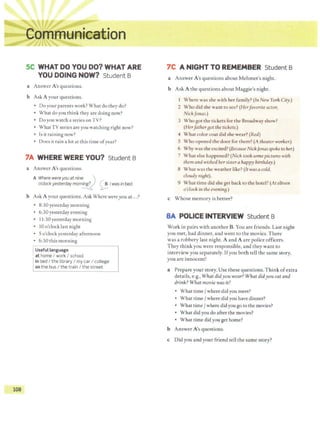
>Communication What's the matter? A p.101 Bp.106.
Role-play dialogues.
6 1 73>)) SONG Please Don't Go1'
Online Practice
-
GRAMMAR
@a,b,orc.
I Hello. __ your name?
a What b What are c What's
2 Maria is Mexican. astudent.
a She's b He's c It's
3 A Where from?
B He's from Turkey.
a he is b is c is he
4 They __ South Korean. They're
Vietnamese.
a isn't b aren't c not are
5 A Are you from Paris?
B Yes, _ _ .
a Iam b I'm c Iare
6 She's Brazilian. name's Daniela.
a His b Her c Your
7 We're from the US. ___ last name is
Preston.
a Your b Their c Our
8 A What are they?
B They're__.
a watches b a watch c watchs
9 A What is it?
B It's _ _ _.
a a umbrella
b an umbrella
c umbrella
10 Look at those ___.
a womans b women c womens
11 A What are ___ in English?
B They're keys.
a that b this c these
12 These are very __.
a difficult exercises
b exercises difficult
c difficults exercises
13 __ careful! That dog's dangerous.
a Are b Beyou c Be
14 Please___ in the library.
a not eat b don't eat c no eat
15 I'm hungry. ___ stop at the cafe.
a Let's b We c Don't
VOCABULARY
a Complete with at,Jrom, in, off, or to.
1 I'm __ Japan.
2 Nice _ __ meet you.
3 What's bonjour_ __ English?
4 Look ___ the board.
5 Please turn _ ___ your cell phone.
b Complete the phrases with these verbs.
Answer Stand Open Read Work
1 the text. 4 _ __ thedoor.
2 ___ in pairs. 5 _ _ _ the questions.
3 __ up.
c @ the word that is different.
one three e
1 eight two seven
five
file
2 Brazil Chinese Peru
3 Spanish Italian Japanese
4 Africa Asia Ireland
S sixteen forty ninety
6 Wednesday Italy Friday
7 glasses change purse headphones
Iran
France
Europe
eighty
Monday
scissors
school
magazine
stressed
8 door window wall
9 wallet newspaper book
10 happy tired angry
d Write the opposite adjective.
1 good 4 tall
2 expensive S empty
3 dirty
PRONUNCIATION
a Q the word with a different sound.
I 7 A B C D
2 ~ H i day my nice
3 lizl watches boxes files _glasses
4
~ Japan German good page
s ~ dangerous stamps bad laptop
b l!nderline the stressed syllable.
1 alddress 2 Ijtally 3 exjpenlsive 4 newsjpalper 5 thirlteen
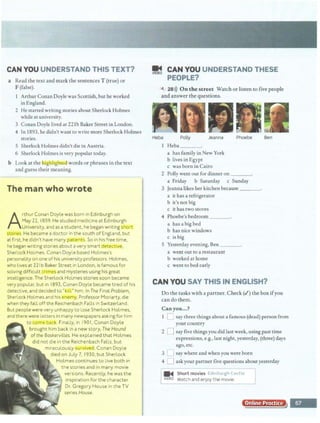
CAN YOU UNDERSTAND THIS TEXT?
a Read the article once. Do you know any more words
that are British English, not American English?
American and British English-
the same, but different
American and British people speak the same
language- English, but with some small differences.
VOCABULARY
Some words are different in British English, for ~xample,
British people say postcode, notzipcode, holiday, not vacation,
and mobile phone, not cell phone. Some words have different
meanings, for example in American English, a purse is a
woman's bag. In British English, apurse is a small thing (like a
wallet) where women have their moQgy and credit cards.
Color.favor, and other words that end in -or in American
• English end with -our in British English, e.g., colour.favour.
.. Center, theater, and other words that end in -ter in American
""II English end with -tre in British English, e.g., centre, theatre.
... GRAMMAR
British grammar is very simila to American grammar,
but with some small differences, especially prepositions.
For example, British people say Seeyou on Friday, but
Americans say Seeyou Friday.
PRONUNCIATION
The most important difference between American and
British English is pronunciation. American accents and
British accents are very different, and when a British person
starts speaking, American people know he or she is British,
and vice verg
b Lookat the~ighlighted words in the text and guess
their meaning.
c Read the article again. Mark the sentences T (true)
or F (false).
1 American English and British English are
very different.
2 Holiday and postcode are the same in British
and American English.
3 Purse has different meanings in American and
British English.
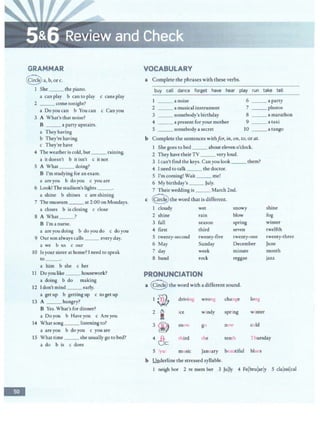
4 NeiBhbor is British spelling.
5 British and American grammar are not very different.
6 It's difficult to know from their accent ifa person is
British or American.
~ CAN YOU UNDERSTAND THESE
PEOPLE?
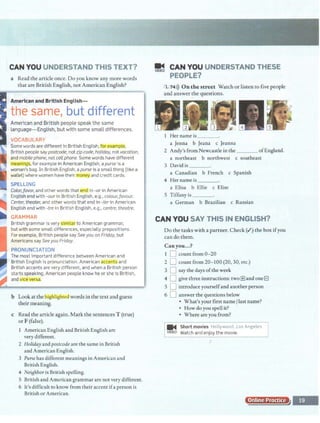
1,74i)) On the street Watch or listen to five people
and answer the questions.
• lilf·
. . 3
1 Her name is _ _ _
a Jenna b Jeana c Jeanna
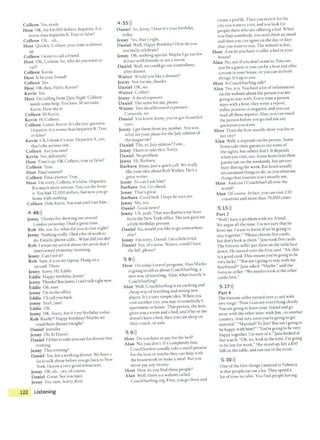
2 Andy's from Newcastle in the ofEngland.
a northeast b northwest c southeast
3 David is ____
a Canadian b French c Spanish
4 Her name is ___
a Elisa b Ellie c Elise
S Tiffany is ___
a German b Brazilian c Russian
CAN YOU SAY THIS IN ENGLISH?
Do the tasks with a partner. Check(.") the box ifyou
can do them.
Can you...?
1 D count from 0-20
2 D count from 20- 100 (20, 30, etc.)
3 D say the days ofthe w~ek
4 D give three instructions: two[±)and oneEl
5 D introduce yourselfand another person
6 D answer the questions below
• What's your first name/last name?
• How do you spell it?
• Where are you from?
j m. Sh~;t mo~;~--H~ltyw~~ct7o-;Angeles I
j VIDEO Watch and enjoy the movie.
Online Practice
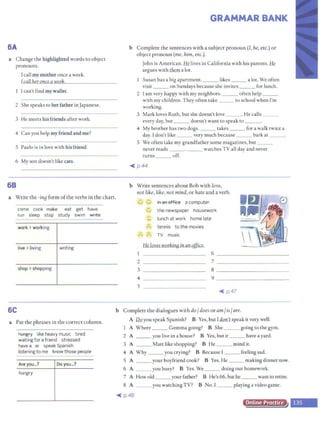
G simple prP"l>n ] and F
V verb phrases
P third person -s
1 VOCABULARY verb phrases
a Complete the phrases with a verb from the list.
go read work have listen
1 _ _ a newspaper
2 to the radio
3 children
4
5
co the movies
in an office
b > p.153 Vocabulary Bank Verb phrases.
c 2 3>)) Listen. Say the phrase. >))TV ~atch TV
2 GRAMMAR simple present[±]and B
a Look at four things people say about the US and Americans.
Do you think they are true or not true? Then read the text and
check your answers.
;.:_,~- . 4..... ·,,
; -~ > • •
Four foreigners,who live in the US talk about the things
people say about Americans...
Americans eat fast food every day. Pei from China
It's true that Americans eat a lot of fast food, but they don't eat fast food
every day. I share an apartment with an American woman, and she cooks
all the time. She only eats fast food on some days-with me!
The sun shines a lot in Southern California. Alberto from Mexico
The weather changes quickly in many places in the US, but not in Southern
California. The sun shines a lot there. It doesn't shineievery day, but be careful
when it shines.It gets very hot! I always ~r sunglasses when I go outl
Americans like animals. Naomi from Japan
I have a lot of friends here and many of them have a dog, a cat or a
bird.One American family that I know has a dog, a cat. and two birds.
American people love animals!
Americans are always loud. Gianni from Italy
Some Americans are very loud, but I work with an American man atacoffee shop,
and he's really quietand polite. He doesn't~ very much. But he's avery nice guy!
b Answer the questions with a partner.
Look at the llighlightea verbs. Why do
some verbs end in -s?
2 Write the he/ she/ it form ofthese verbs.
change ___ have
talk ___ go ___
cook ___ eat
3 Find two negativeElverbs. How are they
different from affirmative1±1 verbs a) for
he/she/ it b) for all other persons?
c > p.128 Grammar Bank 3A.
Learn more about simple present(±]and l=J,
and practice it.
3 PRONUNCIATION third person -s
a How do you pronounce these plural nc~uns?
books keys watches
b 2 S>)) Listen and repeat the third person
verb forms.
Isl She speaks Spanish.
He drinks coffee.
She cooks every day.
/z/ It rains a lot.
He has a cat.
She does homework.
He goes to the movies on Friday night.
/1z/ He watches TV.
The movie finishes in a minute.
The weather changes a lot.
c 2 6>)) Listen. Change the sentence.
))) I live in an apartment. She.
0.he lives in an apartment.
d Tell your partner six true things about you:
three 1±1and three G. Choose verb phrases
from p.153 Vocabulary Bank Verb phrases.
0 1ay the guitar. I don't wear glasses.
e Change partners. Tell your new partner the
six things about your old partner.
~va plays the guitar. She doesn't wear glasses.
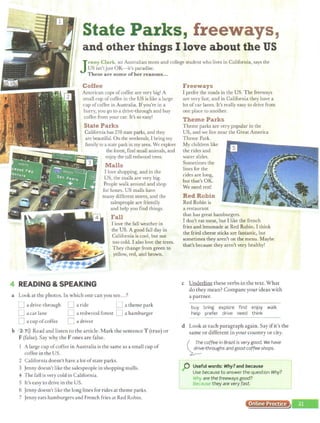
State Parks, freeways,
1
and other things I love about the US
Jenny Clark, an Australian mom and college student who lives in California, says the
US isn'tjust OK-it's paradise.
These are some ofher reasons...
Coffee
American cups ofcoffee are very big! A
small cup ofcoffee in the US is like a large
cup ofcoffoe in Australia. Ifyou're in a
hurry, you go to a drive-through and buy
coffee from your car. It's so easy!
State Parks
California has 278 state parks, and they
are beautiful. On the weekends, I bring my
family to a state park in my area. We explore
4 READING & SPEAKING
the forest, find small animals, and
enjoy the tall redwood trees.
Malls
I love shopping, and in the
US, the malls are very big.
People walk around and shop
for hours. US malls have
many different stores, and the
salespeople are friendly
and help you find things.
Fall
I love the fall weather in
the US. A good fall day in
California is cool, but not
too cold. I also love the trees.
They change from green to
yellow, red, and brown.
a Look at the photos. In which one can you see...?
Freeways
I prefer the roads in the US. The freeways
are very fast, and in California they have a
lot ofcar lanes. It's really easy to drive from
one place to another.
Theme Parks
Theme parks are very popular in the
US, and we live near the Great America
Theme Park.
My children like
the rides and
water slides.
Sometimes the
Iines for the
rides are long,
but that's OK.
We need rest!
Red Robin
Red Robin is
a restaurant
that has great hamburgers.
I don't eat meat, but I like the french
fries and lemonade at Red Robin. I think
the fried cheese sticks are fantastic, but
sometimes they aren't on the menu. Maybe
that's because they aren't very healthy!
c Underline these verbs in the text. What
do they mean? Compare your ideas with
a partner.
buy bring explore find enjoy walk
help prefer drive need think
D a drive-through LJ a ride LJ a theme park
[J a car lane 0 a redwood forest D a hamburger
D a cup ofcoffee 0 a driver
b 2 7>)) Read and listen to the article. Mark the sentence T (true) or
F (false). Say why the Fones are false.
d Look at each paragraph again. Say ifit's the
same or different in your country or city.
1 A large cup ofcoffee in Australia is the same as a small cup of
coffee in the US.
2 California doesn't have a lot ofstate parks.
3 Jenny doesn't like the salespeople in shopping malls.
4 The fall is very cold in California.
5 It's easy to drive in the US.
6 Jenny doesn't like the long lines for rides at theme parks.
7 Jenny eats hamburgers and French fries at Red Robin.
( ;_~e coffee in Brazil is very good. We have
~e-throughs and good coffee shops.
C Useful words: Why?and because J
Use because to answer the question Why?
Why are the freeways good?
Blicau.sv they are very fast.
Online Practice
~----
-
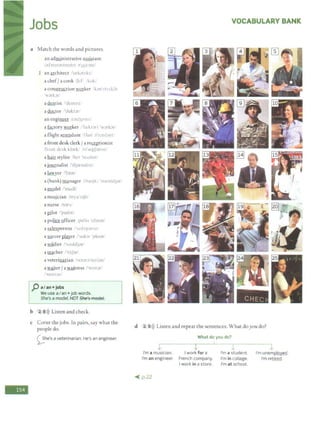
1 VOCABULARY jobs
a Order the letters to make words for jobs.
1 ACTEHRE T____
2 ROCAT A___
3 T RIEWA w_____
4 AXTI RREDIV T____ D____
5 PTIREONICEST R____
b > p.154 Vocabulary Bank Jobs.
c What do you do? Ask five other students in the class.
2 LISTENING
a 2 10, 11>)) Listen to a game show called Hisjob, herjob.
A team ofthree people ask Wayne questions about
his job and his wife Tanya's job. Write W next to the
questions they ask Wayne about his job, and T next to
the questions they ask aboutTanya's job.
b Listen again. What are Wayne's answers? Write
./(yes), X(no), or D (it depends) after each question.
c Look at the answers. What do you think his job is?
What do you think her job is?
d 2~12>)) Listen to the end ofthe game show. What do
Wayne and his wife do?
3 GRAMMAR simple present [1]
a ' 2113>)) Complete the questions. Listen and check.
Why are questions 3 and 4 different?
___you work with other people?
Yes,T ___
2 you work in an office?
No, I
3 she work with computers?
No, she
4 she work on the weekend?
Yes, she _ _ _
b > p.128 Grammar Bank 38. Learn more about
the simple present [1] and practice it.
c In groups offour, play Hisjob, herjob. Choose jobs
from p.154 Vocabulary Bank Jobs.Ask questions to
guess the jobs.
What do
you do?
His job, her job
Where? work
When? work
How? work
outside D
on the street D
inside D
in an office D
in the evening D
atnight D
on the weekend D
with computers D
with other people D
tong hours D
have special qualifications D
speak foreign languages 0 .,...w,,,;~-:
............"""= '·
travel D - r.
drive D
make things D i •:
wear a uniform or specialclothes DJ ..:·
earn a lot of money D .
4 PRONUNCIATION /'Jr/
a 2 15>)) Listen and repeat the words and sounds.
11
~ bird nurse thirty her work journalist
~ /)far/ l
~ ur, ir, and erusually = /<Jr/ when they are stressed.
b 2 16>)) Listen. Which word doesn't have the /<ir/ sound?
thirsty dirty thirteen tired
2 earn here prefer service
3 Thursday sure turn Turkey
c Practice saying the sentences.
Iprefer Turkish coffee.
Journalists work all over the world.
Shirley is thirty on Thursday.
5 SPEAKING ·
a Complete the phrases with a verb from the list.
do (x3) eat go listen read use ~ watch
During the u ·J
walk to work / school
__ a computer at work / school
_ _ in English
_ _ in a cafe or restaurant
__ housework
On the wccki:nd
_ _ TV in the morning
to music
__ housework
homework
_ _ to the movies
b Work in pairs. Ask and answer questions. Then
change roles.
A Ask B the questions.
B Answer the questions. Give more information
ifyou can.
A Do you walk to schoo!!.2 ~ No, I don't. Igo by bus.
c Change pairs. Ask your new partner about his/ her
old partner.
C Does Akita__ _,,., ) ( A ~o, he doesn't.
walk to sch~ ~e goes by bus.
6 READING
a Read the article. Match each text to a photo. What do
the three people do?
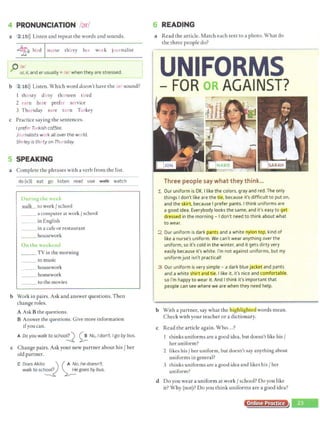
UNIFORMS·
FOR OR AGAINST?
Three people say what they think...
1 Our uniform is OK. I like the colors, gray and red. The only
things I don't like are the tie, because it's difficult to put on.
and the skirt, because I prefer pants. I think uniforms are
a good idea. Everybody looks the same, and it's easy to get
dressed in the morning - I don't need to think about what
to wear.
::Z Our uniform is dark pants and a white nylon top. kind of
like a nurse's uniform. We can't wear anything over the
uniform. so it's cold in the winter. and it gets dirty very
easily because it's white. I'm not against uniforms, but my
1
. uniform just isn't practical!
3 Our uniform is very simple - a dark blue jacket and pants
and a white Shirt and tie. I like it. it's nice and com orta~
I
so I'm happy to wear it. And I think it's important that
people c.an see where we are when they need help.
b With a partner, say what the h ig light1.!.d words mean.
Check with your teacher or a dictionary.
c Read the article again. Who...?
1 thinks uniforms are a good idea, but doesn't like his/
her uniform?
2 likes his/ her uniform, but doesn't say anything about
uniforms in general?
3 thinks uniforms are a good idea and likes his/ her
uniform?
d Do you wear a uniform at work/ school? Do you like
it? Why (not)? Do you think uniforms are a good idea?
Online Practice
'
l LISTENING
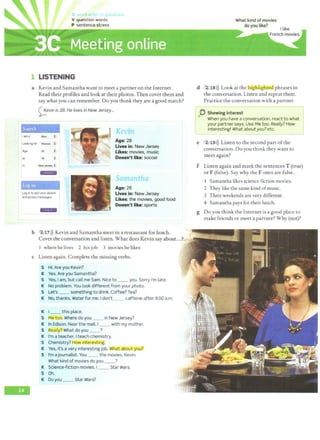
a Kevin and Samantha want to meet a partner on the Internet.
Read their profiles and look at their photos. Then cover them and
say whatyou can remember. Do you think they are a good match?
<;;;,evin is 28.He lives in New Jersey...
Search
I ama Man
.
.
Looking f0< Women .
.
Age 25 .
.
to 35 .
.
In New_~·!~Y ~
--r;JiTR~
fog in
Log in to edit your details
and access messages.
+;1.;,+
'
K~vi •
Age: 28
Uves in: New Jersey
Ukes: movies, music
Doesn't like: soccer
",..,.,.,.,...,.tha
I • L ...
Age: 26
Lives in: New Jersey
Likes: the movies, good food
Doesn't like: sports
What kind of movies
do you like?
d 2 18 >)) Look at the higfiTiglitE:I phrases in
the conversation. Listen and repeat them.
Practice the conversation with a partner.
p Showing interest . J
When you have a conversation, react to what .
your partner says. Use Me too. Really? How
interesting! What about you? etc.
e 2 19 >)) Listen to the second part ofthe
conversation. Do you think they want to
meet again?
f Listen again and mark the sentences T (true)
or F (false).Say why the Fones are false.
l Samantha likes science fiction movies.
2 They like the same kind ofmusic.
3 Their weekends are verydifferent.
4 Samantha pays for their lunch.
g Do you think the Internet is a good place to
make friends or meet a partner? Why (not)?
b 2117>)) Kevin and Samantha meet in a restaurant for lunch. .~
~ • • •
-
Cover the conversation and listen. What does Kevin say about...?. ~ ,·
1 where he lives 2 his job 3 movies he likes
c Listen again. Complete the missing verbs.
S Hi. Are you Kevin?
K Yes. Are you Samantha?
S Yes, I am, but call me Sam. Nice to __ you. Sorry I'm late.
IC No problem. You look different from your photo.
S Let's __ something to drink. Coffee? Tea?
K No, thanks. Water for me. Idon't __ caffeine after 9:00 a.m.
K I __ this place.
S Me too. Where do you __ in New Jersey?
K In Edison. Near the mall. I_ _ with my mother.
S Really?.What do you __?
K I'm a teacher. Iteach chemistry.
S Chemistry? How interesting.
K Yes, it's a very interesting job. What about yJ)Ul
S I'm ajournalist. You __ the movies, Kevin.
What kind of movies do you __?
K Science-fiction movies. I __ Star Wars.
S Oh.
K Do you __ Star Wars?
2 GRAMMAR word order in questions
a Cover the conversation. Put the words in order to make
the questions.
want you do drink a
___ ____?
2 in New live Jersey you do where
______?
3 movies like kind you ofwhat do
_____________ ?
b > p.128 Grammar Bank 3C. Learn more about word
order in questions and practice it.
3 VOCABULARY &PRONUNCIATION
question words; sentence stress
a 2 21>)) Listen and repeat the question words and
phrases. How is Wh- pronounced in Who? How is it
pronounced in the other question words?
How? How many? Whitt:? What kind?
When? Where? Which? Who? Why?
b Complete the questions with a question word or phrase
from the list in a.
What phone do you have?
I have an iPhone.
2 old are you?
22.
3 brothers and sisters do you have?
I have two sisters.
4 do you prefer, Saturdays or Sundays?
Saturdays.
S do you have English classes?
On Mondays and Wednesdays.
6 _ ofmovies do you like?
rlike old Japanese movies.
7 do you live?
Downtown.
8 's your favorite actor?
Tom Hanks.
9 _ do you like him?
Because he's very good-looking!
c 2 22>)) Listen and check.
d Listen again and repeat the questions. !:.Qpy the
r.11)'.'.thm.
~hat phone do you have?
e Work in pairs. A ask B the questions. B give your own
answers. Then change roles.
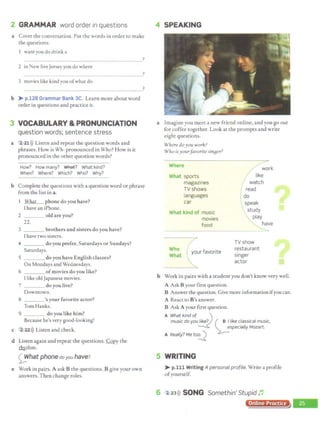
4 SPEAKING
a Imagine you meet a new friend online, and you go out
for coffee together. Look at che prompts and write
eight questions.
Where do you work?
Who isyourfavorite sinBer?
Where
work
What sports like
watch
magazines
TV shows 1 read
?
languages
~o
car speak
What kind of music study ti
movies play
food have
' TV show
?
Who
your favorite
restaurant
What I singer
~ actor ti
b Work in pairs with a student you don't know very well.
A Ask B your first question.
B Answer the question. Give more informationifyou can.
A React to B's answer.
B Ask Ayour first question.
A What kind of~
music do you like? ( B I like classical music,
~specially Mozart.
A Really? fvte to~
5 WRITING
> p.111 Writing A personal profile. Write a profile
ofyourself.
6 2 23>)) SONG Somethin' Stupid J3
Online Practice
,_
~11!::'.LZ.mli~~~--__:!:.__~~~~~
~ ;·' f':a coffee shop
l TELLING THE TIME
a Look at the clock. What time is it?
> p. 157 Vocabulary Bank Time. Do Part t.
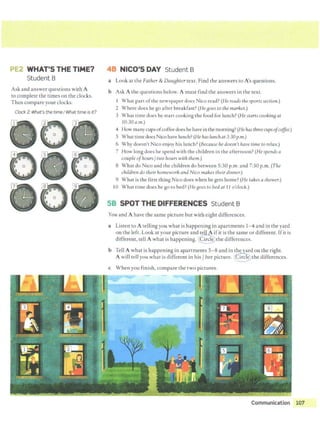
b Communication What's the time? A p.101 B p.107.
2 ~ ROB AND JENNY MEET
a 2 .2si)) Watch or listen to what happens when Rob and
Jenny meet. What do they decide to do?
b Watch or listen again. Mark the sentences T (true) or F
(false). Say why the F sentences are false.
I Jenny's full name is Jennifer.
2 Rob is early.
3 Jenny likes the hotel.
4 She doesn't like the hotel coffee.
5 She has a meeting with Daniel at 9:15.
6 The office isn't very far from the hotel.
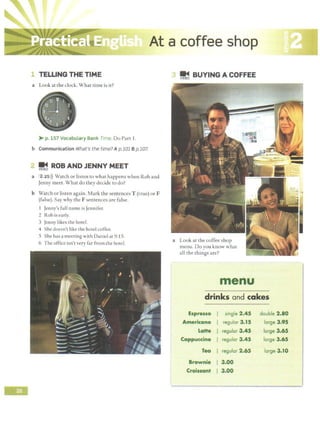
~ ~ BUYING A COFFEE
a Look at the coffee shop
menu. Do you know what
all the things are?
·.
menu· ....
..
drinks and cakes .·
Espresso single 2.45 dooble 2.ao·
Americano regular 3.15 large 3.95
Latte regular 3.45 large 3.65
Cappuccino regular 3.45 large 3.65
Teo regular 2.65 large 3.10
Brownie 3.00 .·.·
Croissant 3.00
: .·
..:
·.:~:~
:~.;,~;~
b 2 26l)) Watch or listen to Rob and Jenny buying coffee.
Answer the questions.
What kind ofcoffee do Rob and Jenny have?
2 What do they have to eat?
3 How much is it?
c Watch or listen again. Complete the You Hear phrases.
l)) You Hear You Say (,)
Can I you? What would you like, Jenny?
An espresso, please.
or double? Ooubie.
Can I have a latte, please?
or large? Large.
To have or
take away? To take away.
Anything else? No, thanks.
A brownie for me, please...
and a croissant.
OK. How much is that?
That's £12.45, please. Sorry, how much?
£12.45. Thank you.
And your Thanks.
ip Cultural note
, barista = a person who works in a coffee shop
I . . ...-- . ---
d 2 27l)) Watch or listen and repeat the You Say phrases.
Copy the rh}'..thm.
e In threes, practice the dialogue.
f Role-play the dialogue in groups ofthree.
Then change roles.
A (book open) You are the barista.
B (book closed) You invite C (book closed) to have
a drink.
A begins: Can Ihelp you?
B asks C: What wouldyou like?
Al ~ FIRST DAY IN THE OFFICE
a 2 -28>)) Watch or listen and answer the questions.
1 What's Karen's job?
2 Where in Europe does Jenny have family?
3 Where does she live in New York?
4 Does Karen have family in New York?
5 What does Daniel offer Jenny to drink?
6 What time is his next meeting?
b Look at the Social English phrases.Who says them:
..
c
Rob, Karen, or Daniel?
Social English phrases
Here we are.
Is this your first time in [the UK]?
Would you like something to drink?
Talk to you later.
2 .291)) Watch or listen and check. Do you know what
they are in your language?
d Watch or listen again and repeat the phrases.
Can you...?
D tell the time
D order food and drink in a cafe
D meet and introduce people
Online Practice
-
l
..
:- 1... noc;sessive 's
• V family
- P IA!, the letter o
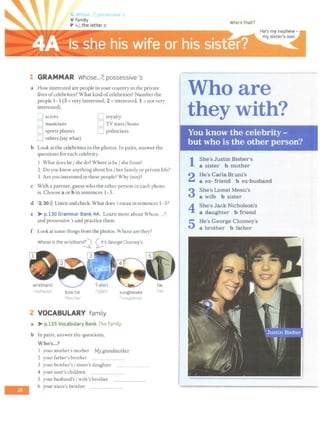
1 GRAMMAR Whose...?, possessive's
a How interested are people in your country in the private
lives ofcelebrities? What kind ofcelebrities? Number the
people 1-3 (3 =very interested, 2 = interested, 1 = not very
interested).
~ actors
0 musicians
0 sports players
0 others (say what)
D royalty
D TV stars/ hosts
D politicians
b Look at the celebrities in the photos. In pairs, answer the
questions for each celebrity.
What does he/ she do? Where is he/ she from?
2 Do you know anything about his/ her family or private life?
3 Are you interested in these people? Why (not)?
c With a partner, guess who the other person in each photo
is. Choose a orb in sentences 1- 5.
d 2 30>)) Listenand check. What does 5mean in sentences 1-5?
e )>- p.130 Grammar Bank 4A. Learn more about Whose.. .?
and possessive 'sand practice them.
f Look at some things from the photos. Whose are they?
Whose is the wristband
!l
·"mtha:ndi bow tie
/'boot a1/
1'tif~rt/
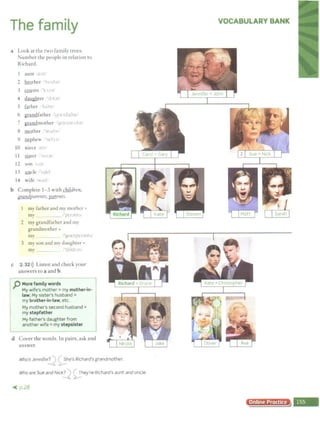
2 VOCABULARY family
sunglasses
/',An,gl<e,;.zi
a )>- p.155 Vocabulary Bank The famity.
b In pairs, answer the questions.
Who's...?
your mother's mother Myarandmother
2 your father's brother
3 your brother's/ sister's daughter
4 your aunt's children ___
5 your husband's/ wife's brother
6 your niece's brother
/ta1/
Who's that?
,,...,,,... >
Who are
they with?
You know the celebrity -
but who is the other person?
She's Justin Bieber's
a sister b mother
He's Carla Bruni's
a ex- friend b ex-husband
She's Lionel Messi's
a wife b sister
She's Jack Nicholson's
a daughter b friend
He's George Clooney's
a brother b father
aw;: ''* 4t;;
I
..,.-;-,,....,,, •••••••·""~.,.,.,,.,,..,.,.,.,..,.......v-.••• •,.·•··-.· '"l"r·~~·'"'· • ••'"••••••••••
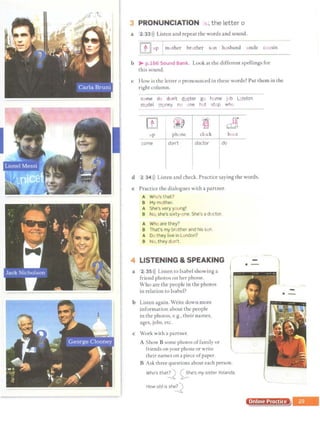
3 PRONUNCIATION  ,the letter o
a 2 33>)) Listen and repeat the words and sound.
II 1} JI up mother brother son husband uncle cuusin
b > p.166 Sound Bank. Look at the different spellings for
this sound.
c How is the letter o pronounced in these words? Put them in the
right column.
euffie ~b e t¥t eo
etef go hvme J b L ndon
m_,del mney n ne hot st p who
rn ~ lt
.. a9f
up phone clock boot
come don't doctor do
d 2 34>)) Liscen and check. Practice saying the words.
e Practice the dialogues with a partner.
A Who's that?
B My mother.
A She's very young!
B No, she's sixty-one. She's a doctor.
A Wh are they?
B That's my brother and his sen.
A De.. they live in London?
B N· , they don't.
4 LISTENING &SPEAKING
a 2 35>)) Listen to Isabel showing a
friend photos on her phone.
Who are the people in the photos
in relation co Isabel?
b Listen again. Write down more
information about the people
in che photos, e.g., their names,
ages, jobs, eLc.
c Work with a partner.
A Show B some photos offamily or
friends on your phone or write
their names on a piece ofpaper.
B Ask three questions about each person.
Who's that~ 0,he's mysister Yolanda.
How old is sh~
·-
Online Procf
-
·-
-
G prepoflions oft rie (at in on) and place (at in, to)
V everyday activities What do you do
in t he evening?
P linking and sentence stress
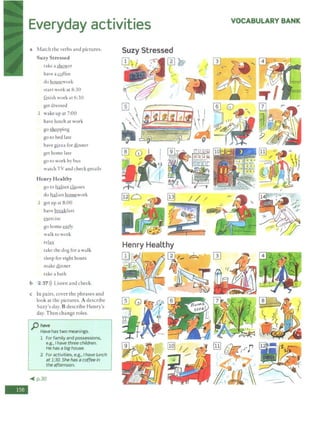
1 VOCABULARY
everyday activities
a 2 36>)) Listen to the sounds and number the
phrases 1-6.
D get dressed
mgetup
D have breakfast
D take ashower
D go to work / school
D have a coffee
b What order do you do these things in the
morning? Tell your partner.
<;_:!.rst, Iget up. Then I...
c > p.156 Vocabulary Bank Everyday
activities.
2 PRONUNCIATION
linking and sentence stress
r------------------
1 p Connected speech
i Remember, when people speak, they
I usually link words together.Sometimes
I three linked words sound like one word,
! e.g., I getupat seven. I
'---------------------------·------------· ---- _J
a 2 38i)) Listen and write five sentences.
2 ~--------------
3
4 ~-------------~
s
b 2.39l)) Listen and repeat the sentences.
Copy the rh}'..thm.
I get..,up_ytseven.
I take
~
a shower.
1gotowork.
I have_y sandwich for lunch.
l get homeJtsix.
I have pizza for dinner.
I goco bedJt ten.
What_alife!
j
I
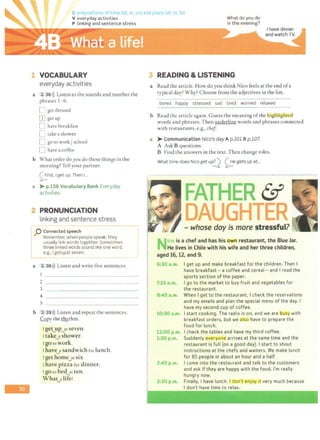
3 READING & LISTENING
a Read the article. How do you think Nico feels at the end ofa
typical day? Why? Choose from the adjectives in the list.
bored happy stressed sad tired worried relaxed
b Read the article again. G uess the meaning ofthe highlighted
words and phrases.Then underline words and phrases connected
w ith restaurants, e.g., chef
c >Communication Nico's day A p.101 B p.107.
A Ask B questions.
B Find the answers in the text. Then change roles.
What time does Nico get u~ 0e
gets up at...
ico is a chef and has his own restaurant, the Blue Jar.
He lives in Chile with his wife and her three children,
aged 16, 12, and 9.
6:30 a.m. I get up and make breakfast for the children. Then I
have breakfast - a coffee and cereal - and I read the
sports section of t he paper.
7:15 a.m. I go to the market to buy fruit and vegetables for
the restaurant.
8:4Sa.m.
10:30a.m.
12:00 p.m.
1:30p.m.
2:45 p.m.
3:30 p.m.
When I get to the restaurant, I check the reservations
and my emails and plan the special menu of the day. I
have my second cup of coffee.
I start cooking. The radio is on, and we are ousy with
breakfast orders, but we also have to prepare the
food for lunch.
I check the tables and have my third coffee.
Suddenly everyone arrives at t he same time and the
restaurant is full (on a good day). I start to shout
instructions at the chefs and waiters. We make lunch
for 85 people in about an hour and a half.
I come into the restaurant and talk to the customers
and ask if they are happy with the food. I'm really
hungry now.
Finally, I have lunch. I don't enjoy 1t very much because
I don't have time to relax.
d 2.40>)) Listen to Amelia, Nico's 16-year-old
stepdaughter, talking about her day. Fill in
the blanks with a word, a number, or a time.
1:~;.;--i~:~;;;::;::~~,-·--
-
---------------
She has or classes.
Afternoon
She has lunch. She only has
minutes for lunch.
She has or classes.
She finishes school.
On Mondays and she has extra classes to
prepare for the college entrance exam.
On Tuesdays and she has practice.
Evening
She does and studies until dinner.
After dinner, she studies until ___.
l_______She goe_s_~ob~~~------------------------- _ _
e Look back at the text and the information in d. Whose day do you
think is more stressful, Nico's or Amelia's? Why?
4:00 p.lh. After lunch, I go back to the kitchen and plan the food
for the evening menu.
5:30 p.m. I go home to be with the family for a couple of hours.
The children do their homework and I make their dinner.
7:30 p.m. I _go back to the restaurant, which is full again, and I
check that everythi119 is OK.
10:00 p.m. I go home and take a shower. Then I collapse on the
sofa with a sandwich.
11:00 p.m. I go to bed, reaoy to start again the next day.
- . . ' . --.-"'"':"~~~-;~~~~·l;~1'~~~~"'~~~,~~-,- ,~,-'-<:
. '
4 GRAMMAR prepositions of time
(at, in, on) and place (at, in, to)
a Look at some sentences from Amelia's day.
Complete them with in, on, at, or to.
Iget up _ six thirty.
2 _ the morning we usually have five
classes,sometimes six.
3 We have lunch school in the cafeteria.
4 _Mondays and Wednesdays Igo _
extra classes.
b 2 41 >)) Listen and check.
c )>- p.130 Grammar Bank 48. Learn more
about prepositions and practice them.
d 2 44>)) Listen and say the time phrases with
the right preposition.
>
))the weekend ~n the weekend
5 SPEAKING & WRITING
a Work in pairs. Interview your partner about
a typical weekday with the questions.
What time I get up?
I have breakf ast in_th~.m.Qming?
How I go to work or school?
What time I start work or school?
I have a longlunch break? How long?
What time I finis work or ~chool?
What rdo after work or school?
I relax in the evening? What I do?
When I do English homework?
What time I go to bed?
How I feel atthe end ofthe day?
-- -· - --- - -- --- - - --- -- - --------- ----------]
:p When you can't be exact
What time do you get up? At about 7:15.
What do you have for breakfast? It depends.
1 If I have time, Ihave toast or cereal.
t __________________________________________
b Who do you think has a more stressful day,
you or your partner? Why?
c >-p.112 Writing A magazine article. Write
about your favorite day.
Online Practice
'G poc;1
~10 o -idv<>rbs an· e) or· -;s1 is offrequency
V adverbs and expressions of frequency How often do
you eat fruit?
P the letter h
1 VOCABULARY
adverbs and expressions of frequency
a 2 45l)) Fill in the blanks with a "time" word.
Listen and check.
I sixty seconds =
2 thirty minutes =
3 sixty minutes =
azni.ntili
halfan
an
4 twenty-four hours = a __
5 seven days = a
6 four weeks = a
7 twelve months = a
b > p.157 Vocabulary Bank Time. Do parts 2 and 3.
2 GRAMMAR position of adverbs and
expressions of frequency
a Read the text about teenagers. Is it the same in
your country?
3 PRONUNCIATION the letter h
a 2 50l)) Listen and repeat the words and sound.
~house how hardly healthy high
have hungry happy
b 2 51>)) Listen.@ he word where his !lQl
pronounced.
Harry's a air stylist.
He hardly ever has breakfast.
He only has halfan hour for lunch.
He often has a hamburger for dinner.
Harry isn't very healthy.
c Practice saying the sentences.
d > p. 166 Sound Bank. Look at the typical spellings
for this sound.
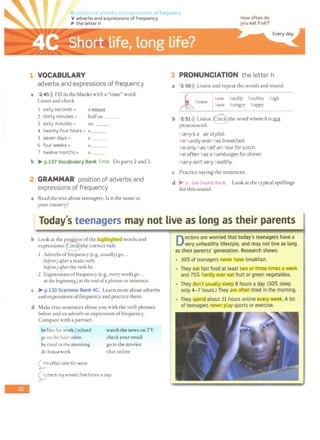
, Today's teenagers may not live as long as their parents
-
b Look at the p~n ofthe highlighted words and
expressions.~the correct rule.
1 Adverbs offrequency (e.g., usually) go.. .
before/ after a main verb.
before/ after the verb be.
2 Expressions offrequency (e.g., every week) go...
at the beBinning /at the end ofa phrase or sentence.
c > p.130 Grammar Bank 4C. Learn more about adverbs
and expressions offrequency and practice them.
d Make true sentences about you with the verb phrases
below and an adverb or expression offrequency.
Compare with a partner.
be late for work/ school
go to the hair salon
be tired in the morning
do housework
~
m often late for work.
watch the news onTV
check your email
go to the movies
chat online
0 heck my emails five times a day.
~..·· o octors are worried that today's teenagers have a
very unhealthy lifestyle, and may not live as long
as their parents' generation. Research shows:
~:· .
I
;:.
..
I : •
303of teenagers never have breakfast.
They eat fast food at least two or three times a week
and 75% hardly ever eat fruit or green vegetables.
They don't usually sleep 8 hours a day. (303 sleep
only 4-Thours.) They are often tired In the morning.
~ They spend about 31 hours online every week. A lot
of teenagers never play sports or exercise.
4 READING & SPEAKING
a Work in pairs. Check (.I) five things that
you think help people to live to be a
hundred.Then read the article to check.
D They have a big family.
D They aren't in a hurry.
nThey sleep eight hours.
D They have pets.
0 They hardly ever eat meat.
0 They hardly ever take medicine.
0 They often go to the doctor.
0 They work outside.
[] They often see friends.
b Read the article again. In which places are
these things important?
a special kind ofwater
2 a special kind offood
3 the weather
4 being positive
c Underline new words or phrases in the texts
and compare with a partner. Try to guess
their meaning. Choose two words to learn
from each text.
d Look at the five things in a that are in
the texts. Are they true for people in
your country? Do you think they have
a healthy lifestyle?
e > Communication Short life, long life?
p.101 Interview your partner with the
questionnaire.Then change roles.
5 2 s2>)) SONG Who Wants to
Live Forever Jj
Vilcabamba, a small village in the Andes, is often called "the Valley
of long life." What's its secret? Firstly, Vilcabamba is not very hot
or very cold - the temperature is usually between 64 and 80 degrees
Fahrenheit (18 and 27 degrees Celsius), and the air is very clean,.
Secondly, people work hard in the fields and exercise a lot. Thirdly,
their diet is very healthy. They eat a lot of fruit and vegetables, and
they hardly ever eat meat or fish. The water they drink, from the river in
Vilcabamba, is very rich in minerals. They also have a good social life.
In Vilcabamba people say, "The left leg and the right leg help you to be
healthy, because they take you to your friends' homes."
In Ogliastra, a mountain region of Sardinia,
one out of every 200 people lives to be 100,
and they are usually very healthy, too. Most of the
people in the villages work outside in their fields
and with their animals. They havE! a healthy diet.
with a lot of vegetables and not much meat or
fish.They hardly ever take any medicine. "Life is
hard," says Fortunato, who is a shepherd, "but
I am never stressed. I never read the newspaper-
because I can't read very well."
~n
People in Okinawa in Japan do not have big meals. They usually just
have vegetables and fish, and often eat soy. Okinawans are very
active, and they often work until they are 80 or more. Butthey also relax
every day- they see friends and they meditate. Ushi, from Okinawa,
is 107. In the evening, she often dances with her daughter. "I want to
have a boyfriend," she says. When journalists ask people from Okinawa
"What is your secret?" they answer, "We are happy, we are always
positive, and we are never in a hurry."
Isoy a kind ofbean typical in Asia I
Online Practice
-
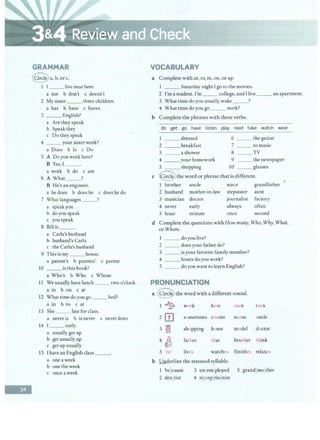
GRAMMAR
Qa,b,orc.
1 I__ live near here.
a not b don't c doesn't
2 My sister ___ three children.
a has b have c haves
3 __ English?
a Are they speak
b Speakthey
c Do they speak
4 ___your sister work?
a Does b Is c Do
S A Do you work here?
B Yes, I __.
a work b do c am
6 A What ?
B He's an engineer.
a he does b does he c does he do
7 What languages ___?
a speakyou
b do you speak
c you speak
8 Bill is
a Carla's husband
b husband's Carla
c the Carla's husband
9 This is my ___ house.
a parent's b parents' c parent
10 ___isthisbook?
a Who's b Who c Whose
11 We usually have lunch___ two o'clock.
a in b on c at
12 What time do you go __ bed?
a in b to c at
13 She __ late for class.
a never is b is never c never does
14 ! _ _ early.
a usually get up
b get usually up
c get up usually
15 I have an English class __.
a oneaweek
b one the week
c onceaweek
VOCABULARY
a Complete with at, to, in, on, or up.
1 ___ Saturday night Igo to the movies.
2 I'm a student. I'm ___college, and I live ___ an apartment.
3 What time do you usually wake _ __?
4 What time do you go _ __ work?
b Complete the phrases with these verbs.
do get go have listen play read take watch wear
1 dressed 6 ___ the guitar
2 ___ breakfast 7 ___ to music
3 a shower 8 TV
4 _ __ your homework 9 ___ the newspaper
S _ _ shopping 10 _ _ glasses
c @the word or phrase that is different.
1 brother uncle niece grandfather
2 husband mother-in-law stepsister aunt
3 musician doctor journalist factory
4 never early always often
S hour minute once second
d Complete the questions with How many, Who, Why, What,
or Where.
I ___ do you live?
2 ___ does your father do?
3 ___ is your favorite family member?
4 _ __ hours doyou work?
5 ___do you want to learn English?
PRONUNCIATION
a Q the word with a different sound.
I ~ work here earn turn
2
rn sometimes cousin nurse uncle
3 '~
>~ shopping home model doctor
4 ~ father that brother think
5 /1z/ lives watches finishes relaxes
b !.!nderline the stressed syllable.
I bejcause 3 unjemjployed S grandjmolther
2 denjtist 4 reJcep jtiojnist
CAN YOU UNDERSTAND THIS TEXT?
a Read the text and fill in the blanks with these verbs in
the correct form.
do (x2) drink drive earn eat have (x2)
live read spend travel work
b Read the text again. Is a typical man from your country
similar to the typical American man?
c Look at the liig iligbr_e_uwords or phrases in the text
and guess their meaning.
Is this the typical
Atnerican tnan?
S
tatistics tell us that the
typical American man is
34 years old, 1 lives in a
house that costs $175,400, and is
married with two children.
He 2_ _ more than 40 hours a
week and 3_ _ about $66,000
a year. He 4___ 100 hours a
year going to and from work. He 5___ a Ford car or
truck and 6___ it 16,408 miles a year.
The typical American man is overweight (he weighs
about 190 pounds), and he 7___ less tbanl three
hours of exercise a week. He usually sleeps betwcenl
six and half to seven hours a night. He a___
1.4 hours of housework a day, inducting cleaning.
He 9_ _ two cups of coffee a day, and he 10_ __
approximately 23 pounds of pizza a year.
The typical American man learns 14 new words and
11_ _ less than one book a year. He has five close
friends and more than 200 friends
on his·SociaL.rielwurkiug wchsito.
He 12_ _ three TVs,
and he watches
them at.ka four
hours a day. He
13_ _ about
13 hours online
every week.
~ CAN YOU UNDERSTAND THESE
PEOPLE?
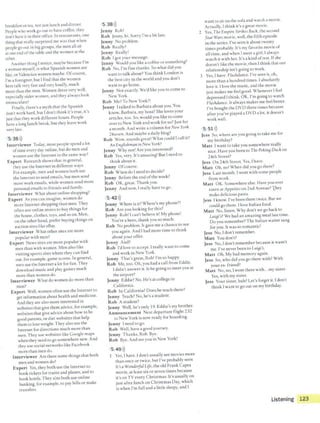
2 53>)) On the street Watch orlisten tO five people and
answer the questions.
James Anya Yuri Wells Stacey
I James works between hours a week.
a 20and30 b 30and40 c 40and50
2 Anya's sister is ___
a 20 b 15 c 16
3 Yuri usually gets up at about ___on the weekend.
a 6:30 b 8:00 c 8:30
4 Wells plays sports.
a hardly ever b sometimes c often
S Stacey___
a has a cat b has two cats c doesn't like cats
CAN YOU SAY THIS IN ENGLISH?
Do the tasks with a partner. Check (.I) the box ifyou
can do them.
Canyou...?
I D say where you.live and what youdo
2 0 say what time youusually get up andgo to bed
3 D say what you do on a typical Monday morning
4 D ask your parmer questions with the words below
• Whatsports...? • Whatlanguages...?
• Whatkindofmusic...? • WhatTVshows...?
~
-------------- ----------------
-
-
-]
... Short movies an Americ<1n police officer
DEO Watch and enjoy the movie.
~-· ·· - -- -- ___... --------·-----------
Online P f
-
'
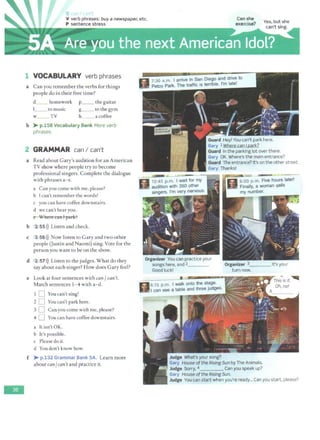
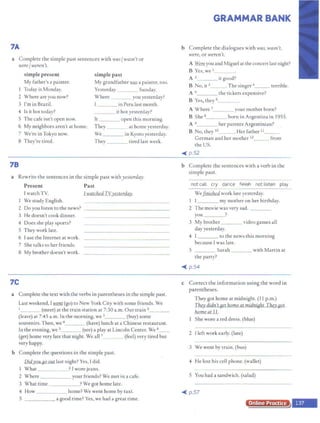
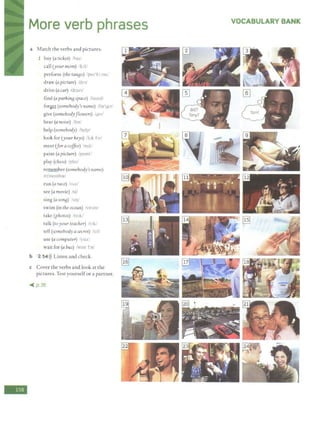
V verb phrases: buy a newspaper, etc.
P sentence stress
1 VOCABULARY verb phrases
a Can you remember the verbs for things
people do in their free time?
d__ homework
l_ _ tomusic
w TV
p__ the guitar
S-- to the gym
h_ _ acoffee
b > p.158 Vocabulary Bank More verb
phrases.
2 GRAMMAR can I can't
a Read about Gary's audition for an American
TV show where people try to become
professional singers. Complete the dialogue
with phrases a- e.
a Can you come with me, please?
b I can't remember the words!
c you can have coffee downstairs.
d we can't hear you.
e Where can I park?
b 2 55l)) Listen and check.
c 2 56 l)) Now listen to Gary and two other
people (Justin and Naomi) sing. Vote for the
person you want to be on the show.
d 2 57>}) Listen to the judges. W hat do they
say about each singer? How does Gary feel?
e Look at four sentences with can/ can't.
Match sentences 1- 4 with a- d.
1 D You can't sing!
2 D You can't park here.
3 D Can you come with me, please?
4 0 You can have coffee downstairs.
a It isn't OK.
b It's possible.
c Please do it.
d You don't know how.
f > p.132 Grammar Bank SA. Learn more
about can/can't and practice it.
s:;I 7:30 a.m. I arrive in San Diego and drive to
U Petco Park. The traffic is terrible. I'm late!
Guard Heyl You can't park here.
Gary l Where can I park?
Guard In the parking lot over there.
Gary OK. Where's the main entrance?
Guard The entrance? It's on the other street.
Gary Thanks!
Organizer You can practice your
songs here, and 2____
Good luck!
• «
n 6
:15p.m:-,-walk onto the stage.
IJII can see a table and three judges.
Judge What's your song?
Organizer 3____ lt's your
turn now.
Gary House ofthe Rising Sun by The Animals.
Judge Sorry, 4 Can you speak up?
Gary House ofthe Rising Sun.
Judge You can start when you're ready... Can you start, please?
3 PRONUNCIATION sentence stress
a 2,59>)) Listen and repeat the dialogues.
Copy the ~thm.
A Can you come tomorrow?
B Yes.1 can come in the morning.
A Can you play a musical instrument?
e Yes.lean.
A Whatcan you play? ··
B Ican play the guitar.
A Can we park here?
B No, you can't. You can't park here.
b 2 60>)) Listen. Can you hear the difference?
I a Ican sing.
b Ican't sing.
2 a She can exercise very well.
b She can't exercise very well.
3 a He can cook.
b He can't cook.
4 a Ican come to the meeting.
b Ican't come to the meeting.
5 a You can park here.
b You can't park here.
6 a [can drive.
b Ican't drive.
c 2, 61 >)) Listen.@or b.
4 SPEAKING
a > Communication Do you want to be famous? p.102.
Are you musical, artistic, sporty, or good with words?
Interview your partner and complete the survey.
b Change partners and tell your new partner what your
first partner can and can't do.
5 READING
a American Idol is an American TV show. Look at the
title ofthe article and the photos. With a partner, guess
which two ofthe singers are "winners" today. Then
read the article and check.
b Look at thelli1gliI1g!iteCI words and phrases related to
pop music. With a partner, guess their meaning. Are
the words similar in your language?
c Do you have similar shows to American Idol in your
country? Can you remember the names ofsome ofthe
winners? Where are they now?.
6 2 62>)) SONG Famous ~
•
winners
"In the future, everyone will be world-
famous for fifteen minutes." Andy Warhol
KELLY CLARKSON
WINNER, SEASON 1
And then? Number 1 hits in the
US and top ten records in the UK
and Australia. Appearances in a US
movie and several US TV shows,
and two Grammy awards.
Today? She has an album called
Stronger.
RUBEN STUDDARD
WINNER, SEASON 2['.
And then? A recordin.g contract
with JRecords. A number 1 album
in 2003 and a number 2single,
Flying Without Wings. Later a
singer in the play Ain'tMisbehavin'.
And today? A new recording
contractat asmall record company.
CARRIE UNDERWOOD
WINNER. SEASON 4
And then? Over seven million copies
sold of her album SomeHearts.
Winner ofseven Grammies and
sixteen Billboard MusicAwards.
And today? She has arecording
contract. She gives concerts to
audiences around the world.She is
also the face ofOlay skin products.
LEEDEWYZE
WINNER, SEASON 9
And then? A recording contract
with 19 Entertainment and RCA
Records. His version of U2's
Beautiful Day sold about 100,000
copies.
And today? He gives concerts in
South East Asia and China. but he
doesn't have a recording contract.
-
V verb phrases
p /JJ/
J<
VOCABULARY & SPEAKING
verb phrases
a 3 2 i)) Read the article about neighbors. Then
listen to eight sounds, and write a- h in the boxes.
Noisy neighbors
h h cl
Sometimes it is difficult to love your neighbors,
especially when they make a lot of noise. These
are some things people do that cause problems.
D I heir bd01e c.ry
D Their dO~$ b ·k
D Th y t I< loud y r r Jf
0 They .. ve 'lot y p t
0 Their ch· dre .• +n t n·e
0 Th 'Y ., v 'T'v o v lo
LJ Tli y pay o
0 Thev olav muc, c..tr n t
b Which do you think arc the top three for
your class?
c Do the questionnaire with a partner.
ro
Are you a noisy neighbor?
Do you live in a house or an apartment?
Do you have neighbors...?
a upstairs
b downstairs
c next door
Are your neighbors...?
a very noisy
b noisy
c not very noisy
Which of the things in a do they do? Do
they make any other noises?
Are you a noisy neighbor? Which of the
things in a do you or your family do?
What are
they doing?
They're
having a party.
2 GRAMMAR present cont inuous
a 3 3l)) Look at the picture ofthe apartment
building. Why do you think the couple in
apartment 5 can't sleep? Listen and check.
b Listen again and complete the dialogues
with verbs from the list.
arguing crying doing getting going
happening having saying shouting (x2}
Man Are you awake?
Woman Yes. What's that noise?
M They're __ a party downstairs.
W Again! What time is it?
M 12:00.
W Who's ?
M People on the street. From the party.
W What's __? Why are they ___?
M Ican't hear.
W Are they ___?
M No, they aren't . They're ___ goodbye.
Excuse me! We're trying to sleep. It's 1:00
in the morning!
M Oh, no. Now the baby next door is __!
W What's the time?
M It's 5:00.
W What are you _ __? Where are
you __?
M I'm __ up. I can't steep with that noise.
c Complete the sentences.
GJ They __ having a party in apartment 8.
(I) __ they arguing?
3 No, they _ _ arguing. They're saying
goodbye.
d Read the rule and~~~)he right word.
We use the present continuous (be+ verb+ -ina)
to talk about now/ every day.
e >- p.132 Grammar Bank SB. Learn more
about the present continuous and practice it.
f 3 5>)) Listen to the sounds. What's
happening? Write six sentences.
3 PRONUNCIATION & SPEAKING 1
0/
a ·3 6i)) Listen and repeat the words and sound.
singer
singing dancing going doing
studying language wrong young
think bank pink thanks
b In pairs, point and ask and answer about the people in the
apartment building.
What's he doing? ) ( ~:_·~playing the guitar.
~ ~tare they doing?
c >- Communication Spot the differences A p.102 B p.107.
Describe the pictures and find eight differences.
4 LISTENING
a 3 7>)) Look at the photo and read about Rebecca Flint. Then
listen to her talking about noise rules where she lives. Does she
think they are a good thing or a bad thing?
Switzerland
The sound of
S
wi~zerlan.d h~s very
strict ant 1
-no1se
rules, especially
for people who live in
apartments. Rebecca
Flint, a British woman
who lives and works
in t he Swiss tow n of
Chur, tells us about a life
wit hout noise.
b Listen again and complete the sentences.
During the week
I She can't _____ between 12:30 and 2:00 p.m.
2 She can't without headphones
or _____ after IO p.m.
3 She can't take a _____ or a_____ after 10 p.m.
On Saturdays
4 She can _____ , but it can't be loud after lO p.m.
On Sundays
5 · Shecan't _____ furnitureorputa on
the wall.
6 She can't _____ the washing machine.
c Do you think these are good or bad rules? Why (not)? Do you
have any similar rules in your country? What happens ifyou
make a lot ofnoise late at night?
Online Practice
-
V the weather and seasons
P places in New York City
- --
l VOCABULARY & LISTENING
the weather and seasons
a Look at the photo and answer the questions.
l What city is it?
2 What monument can you see?
ntinuous?
3 What's the weather like? Do you think it's typical
weather there?
b > p.159 Vocabulary Bank The weather and
dates. Do part 1.
c 3 ,10>)) Listen to a travel guide talking about the
weather in New York City. Mark the sentences T
(true) or F (false).
l It's neververy hot or very cold.
2 The normal temperature in the summer is 95° F.
3 It often snows in the winter.
4 In the spring and the fall, the weather changes a lot.
5 It's often foggy in New York City.
d What's the weather like where you live in the
different seasons?
2 READING & SPEAKING
a Read the guidebook extract about things to do in
New York City, and find the answers to the "Where can
you...?" questions. Answer withBP (Bryant Park), CL
(The Cloisters), or H L (the High Line).
b Read the text again. Underline three new words in
each paragraph. Compare with a partner.
c Talk to a partner.
• Which ofthe three places wouldyou prefer to go to?
Why?
• Where is a good place to go inyour town...?
- when it's very cold
- when it's raining
- when the sun is shining
• What can you do in these places?
LookI
It's raining!
It always
rains here.
WHATTODOIN
NEW YORK CITY. • •
WHEN IT'S VERY COLD
Go Ice skatingat Bryant Park. Bryant Park is a beautiful
park in midtown Manhattan, behind the New York Public
Library on Sixth Avenue. In the winter, the area behind
the library is made into an ice-skating rink. There is a
skating school where you can take lessons, and there is a
cafe where you can enjoy lunch or dinner afteryou skate.
From October to January, Bryant Park's walking paths
become an outdoor shopping center called the Holiday
Shops at Bryant Park.
2 WHEN IT'S RAINING
Go to FortTryon Park and visitThe Cloisters.'
You can take a subway or a bus from midtown Manhattan
and visit The Cloisters (part of the Metropolitan Museum
of Art) in Fort Tryon Park in the north of Manhattan. The
Cloisters is very popular with adults and children. Adults
like this museum because it is full of interesting old art
and architecture. Children like this museum because the
building Looks Like a castle! If the sun comes out, walk
outside and Look at the amazing views ofthe George
Washington Bridge or the New Jersey Palisades across
the Hudson River.
3 WHEN THE SUN IS SHINING
Go to the High Line, New York City's newest park.
On the west side of Manhattan between Gansevoort Street
and West 34th Street, the High Line is a I- mile public park
on old train tracks. The High Line has flower gardens with
chairs so you can sit and enjoy the sun. It has beautiful
views ofthe Hudson River and interesting art. It's a perfect
place for a picnic in the afternoon or a walk in the evening.
It's a beautiful place. and you can't believe that you are in
the middle of a busy city.
WHERE CAN YOU...?
I D learn to do something new
2 D take a walk in the evening
3 D D have a very good view
4 D D see art
s D
6 0
1 D
a D
exercise
do some shopping
see a bridge
see a very interesting building
l
3 GRAMMAR simple present or present continuous?
a 3 11>)) Jack and his friend Marisolare at the Top ofthe Rock at the
Rockefeller Center. Cover the conversation and listen. Check(...') the places
they see.
Oh, it's really crowded up here! Let's stand over there. Those people are
moving (move).
This is great. Everybody (take) photos, too. Look, that's Central Park.
Where? Oh, yes. I can see it. Where's the Brooklyn Bridge?
It's over there. And look at Yankee Stadium. A baseballgame is on!
How do you know?
Because the stadium lights _ (shine). The lights only ____
(shine) when there's a baseball game on.
____ (love) the view ofthe Hudson River with the Statue ofLiberty
and Ellis Island.
Me, too. Go and stand there. I (want) to take a photo ofyou.
OK. Make sure you get the Chrysler Building, too.
I think it (start) to rain. Oh, yes, look. It {rain).
It always (rain) when we're sightseeing!
And it's windy, too. Let's go back inside.
M Quick, the elevator door ____ (open). Let's go.
c Read the conversation again, and focus on the verbs shine and rain. When do
we use the simple present? When do we use the present continuous?
d > p.132 Grammar Bank SC. Learn more about the simple present and
present continuous and practice them.
e > Communication What do you do? What are you doing now?
Ap.103 Bp.108.
PRONUNCIATION places in New York City
a 3 13>)) Place names in New York City are sometimes difficult for visitors
to pronounce and understand. Listen.Underline the stressed syllable in the
bold words.
Cenltral Park the Broolklyn Bridge the Staltue ofLilberlty Elllis lslland
St. Paltrick's Caltheldral Rolckelfelller Cenlter the Hudison Rilver
Yanlkee Staldilum Walshinglton Square Park Grand Cenjtral Terlmilnal
b Listen again and repeat the names.
c Practice with a partner. Imagine you are in a taxi.
Where do you want to g°.!J ~o Grand Central Terminal, please.
WRITING
a Arc social networking sites, e.g., Twitter or Facebook, popular in your
country? What kind ofpeople use them? Do you or your friends use them?
b > p.113 Writing Social networking. Write Facebook posts to say what you
are doing on vacation.
Online Practice
1 VOCABULARY clothes
a Match the words and pictures.
!E~ MEETING ON THE STREET
a 3 15>)) Watch or listen to Jenny and Rob. What problem does
Rob have?
b Watch or listen again. Complete the sentences.
1 Rob has a for Jenny.
2 Jenny has another meeting with _ _ _
3 Rob has an interview in minutes.
4 Jenny's meeting is at nine _ _ _
5 Rob needs to buy a new _ _ _
6 They go to a clothing
";I 7 Jenny needs to answer her ___
...
0 ajAcket f'd3:ebt/ D a skirt1brt/
;:: jeans l13inz/ D shoes Ju;'
I
...,....,
[l ashirt1J3rt, n asweater I '.'>WCIJr/
I] aI-shirt /'t1Jar~i '.] pants /pa:nts/
b 3 14>)) Listen and check. Practice saying
the words.
c 3 16l)) Look at the information box. Listen and repeat
the phrases.
0 Apologizing
I'm sorry. That's OK.
I'm so sorry. Don't worry.
I'm really sorry. No problem.
d Cover the box. In pairs, practice apologizing and responding.
~ BUYING CLOTHES
a 3 17>)) Watch or listen to Rob
buying a shirt. Answer the
questions.
1 What si:t.e does Rob want?
2 Does he try it on?
3 How much is the shirt?
b Watch or listen again. Complete the You Hear phrases.
i)) You Hear You Say 0
Can I you? Yes, what size is this shirt?
Let's see. It's a small.
What _ do you need? A medium.
This is a Thanks. Where can I try it
on?
The changing are
over there. Thank you.
is it? It's fine. How much is it?
It's £44.99.
c 3 18>)) Watch or listen and repeat the You Say
phrases. !:.Qpy the r.b.x,thm.
0 Saying prices in the US
$5.00 =five dollars
$5.50 =Five dollars and
fifty-five cents,
five-fifty
50¢ =fifty cents
Sizes
Saying prices in the UK
£5.00 =five pounds
£5.50 =fifty five pounds
sop =fifty pence
Sizes S=small, M =medium, L =large, XL =extra large
d Practice the dialogue with a partner.
e • In pairs, role-play buying clothes.
A (book open) You are rhe salesperson. Start with Can I
lielpyou?
B (book closed) You are the cusromer. Buy a T-shirt,
a jacket, or jeans.
f Change roles.
! j JENNY'S ON THE PHONE
a 3 19>)) Watch or listen and mark the sentences T (true)
or F (false).
1 Jenny is talking to Eddie.
2 She says she doesn't like London.
3 She says she likes the people in the office.
4 Jenny is standing outside the store.
5 Eddie thinks that Rob is her boss.
6 Jenny loves Rob's new shirt.
I
~
1
b Watch or listen again. Say why the F sentences are false.
c Look at the Social English phrases.
Who says them: Jenny, Rob,or Eddie?
Social English phrases
It's so cool! I have to go.
Right now? Have fun!
Don't be silly! What's wrong?
Wait a minute. No way!
American and British English
store =American English
shop =British English
{nine]-thirty =American English
halfpast [nine]= British English
d 3 20>)) Watch or listen and check. Do you
know what they arc in your language?
e Watch or listen again and repeat
the phrases.
• Canyou...?
[J apologize
C buy clothes
C: say prices
-
P, you, him, etc.
Do you
like her?
'Who is the man with the roses in his hand?" thinks Anna. "J want to meet him...
"Who is the girl with the guitar?" thinks Will. "I like her, I want to meet hen
."
But they do not meet.
"There are lots of men," says Anna's friend Vicki, but Anna
can't forget Will. And then one rainy day...
Sally's Pnon~
Sally is always running, and she has her phone with
her all the time: at home, on the train, at work, at
lunchtime, and at the stores.
But then one afternoon, suddenly she has a
different phone...and it changes her life.
When Cal Dexter rents one of the Blue Lake
Cabins, he finds $3,000 - under the floor! He
doesn't know it, but it is the money from a
bank robbery. A dead man's money.
"Do I take it to the police?" he thinks.
But three more people want the money,
and two of them are dangerous.
Can Cal stop them?
1 GRAMMAR object pronouns 2 PRONUNCIATION /a1/, Iii, and 111
a Look at the three book covers and read the information
that tells you what the book is about. Answer the
questions with Red Roses (RR), Sally's Phone (SP), or
Dead Man's Money (DMM).
Which book...?
1 __ is a love story
2 __ takes place in the US
3 __ is about a person who is stressed
4 __ is about a man in a difficult situation
5 _ _ is about a person who is romantic
6 __ has a gadget that is important
b Look at the hi:ghU
glu_
e.d words in the texts. Who do
they refer to?
<;,}2im=the man with the roses
c )>- p.134 Grammar Bank 6A. Learn more about object
pronouns and practice them.
d 3 22>)) Listen and say the sentences with a pronoun
instead ofthe name(s).
l)) I like Anna. 0ike her.
a 3 23>)) Say the three groups ofwords and match them
to a sound picture. Listen and check.
~ i cp
D bike D fish D tree
1 him it his ring finish pick
2 he she me meet read leave
3 I my buy smile nice tonight
b 3 24>)) Listen. Can you hear the difference?
l a he's b his 4 a leave b live
2 a me b my 5 a this b these
3 a it b eat 6 a we b why
c 3 25>)) Listen and check (I') the word you hear.
d 3, 26>)) Listen to this love story. Practice telling it.
They live in a big city.
He works in an office, she's a writer.
She meets him in the gym. She likes his smile.
He thinks she loves him. He buys her a ring.
But fi nally,she says goodbye.
3 READING &LISTENING
a 3 27>)) Read and listen to an extract from
Sally's Phone. Answer the questions.
CHARACTERS:
• Sally, a young woman
• Claire, Sally's friend from work
• Andrew, Sally's friend
• Paul, a young man
• Katharine, Paul's sister
I Where are Claire and Sally?
2 Why doesn't Sally buy the skirt immediately?
3 What do they do when they finish shopping?
4 Why does she call her mother?
5 What is Paul doing when Sally is talking to
her mother?
6 What happens when he stands up?
7 Do they go out ofthe cafe together?
b Read the extract again. With a partner guess
the meaning ofthe highlighcell verbs.
c 3 28>)) Read and listen to the next part
ofthe story. Why are Paul and Sally
having problems?
p Pronouns and possessive adjectives
When you read, be careful with different
kinds of pronouns and possessive
adjectives, e.g., he, his, him, etc. Make
sure you know who (or what) they refer to.
d Read the extract again. With a partner,
say who the highlig teal pronouns and
possessive adjectives refer to.
Paul wants to )
call'Iia mot~ ~ = Paul's
e Underline words or phrases in the extract
about phones or making calls, e.g., rinBs,
answersthe phone,etc.
f What do you think happens in the end?
p Reading in English
Reading Graded Readers, e.g., the
Oxford Bookworms series, helps you
to learn and remember vocabulary and
grammar. Buy or borrow a Starter level
book (with aCD if possible).
4 SPEAKING
>Communication Reading in English p.103.
Interview your partner.
Sally's Phone
Lunchtime
It is one o'clock. Sally and Claire are
looking at skins.
"Do you like this one, Sally?" Claire says.
"Yes, it's beautiful, but I never wear red."
"Do you like red?" Claire asks.
"Yes, I do - but Andrew doesn't."
"Well," Claire says, "it's a beautiful skirt.
You like red. What do you want to do?"
Sally buys the skirt. . ·
Claire goes back to work, but Sally wants a coffee. She goes mto a
cafe. She buys a coffee and sits down. Then she calls her mother.
"Hi, Mom. I have a new skirt - it's beautiful. I want to wear
it tonight."
"What color is it?"
"It's red."
"That's nice. Red is a good color for you," says her mother.
Next to Sally, Paul is finishing his coffee. He calls his friend and talks to
him. Then he stands up. The bagwith the red skirc£alls on thefloor.
"Oh! I'm sorry," Paul says. "That's OK," Sally says. He puts
cfown his phone and picks UQ the bag. "Here's your bag."
"Thank you." She smiles.
"What a nice smile!" Paul thinks.
Paul picks up his phone and goes out of the cafe. Sally finishes her
coffee. She picks up her bag and her phone, and goes back to work.
Sally's Phone
Afternoon
Paul is in his office.
A phone rings.
"What's that noise?" Paul thinks.
He answers the phone. It is Andrew.
"Hello, Sally?"
"It isn't Sally, it's Paul."
"Paul? Paul who? Where's Sally?"
"Who's Sally? There's no Sally here."
"Huh!"
Andrew finishes the call.
Paul wants to call fus mother. He finds "Mom" on the phone, and
presses the button.
"Hello, Mom. It's Paul."
"Paul? Who's Paul? I'm not Paul's mom. I'm Sally's mom."
"What's happening?" Paul thinks.
"What number is that?" he1 asks.
"It's 0783 491839."
"I' "P l "I ' h
m very sorry, au says. ts t e wrong number."
"That's OK," Sally's mom says. "What a nice voice!" she thinks.
Sally is at work.
Ring ring!
S e answers the phone.
"Hello, is Paul there?"
"No, I'm sorry, this is..."
"Can you give a message to him? This is lusisister Katharine.
There's a party at my house tonight. It's my birthday."
"But I..."
"Eight o'clock - OK. Bye."
Online Practice
V the date; ordinal numbers
P consonant clusters; saying the date
I love reading.
1 VOCABULARY &
PRONUNCIATION the date
a Number the months 1- 6.
0 April ._J June
0 february ~ March
0 January D May
>-p.159 Vocabulary Bank The weather and
dates. Do part 2.
p Ordinal numbers first, fourth, etc.
Some ordinal numbers can be difficult to say
because they end in two or more consonant
sounds, e.g., sixth
c 3 31 >)) Listen and repeat the ordinal
numbers.Then practice saying them.
fifth sixth eighth twelfth
d 3 32>)) How do you say these dates? Listen
and check.
3/1 11/2 5/3 6/4
1/5 7/6 9/12 10/17
8/20 2/23 4/28 12/31
e Listen again and repeat the dates. Copy the
~thm.
f What days are holidays in your country?
g Ask the other students in your class When's
your birthday? Does anyone have the same
(or nearly the same) birrhday as you?
2 READING
a Read the first part ofthe text. What's special about the
third Monday in January and the third Friday in June?
The third Monday in January is the most depressing day of
the year, says psychologist Dr. Cliff Arnall, who calls it Blue
Monday. Why? Because it's winter, the weather is usually gray
and cold, the days are dark, and Monday is the first day of the
working week. People are also often short of money after the
holidays, and some people feel bad after breaking their Ne'.v
Year resolutions. And the happiest day of the year? "The third
Friday in June," says Dr. Arnall. And it's easy to see why - it's
summer, it's warm outside, the evenings are light, and the
weekend starts now!
l A /e asked our readers about the days and times during trie
t Vyear that make them feel good.
1 What's your favorite time of day? Why?
2 What's your favorite day of the week? Why?
3 What's your favorite month? Why?
4 What's your favorite season? Why?
5 What's your favorite holiday? Why?
b Read the questions and Joe's and Rose's answers and complete
them with phrases a-f.
a every week is different d I love cooking
b l like making plans e the days are long
c Ihate getting up early f Ilike being awake
c Look at the rughligfitcil words and phrases and guess
their meaning.
Joe 24
Ten thirty at night. Because it's the time of day when I c.a.n
really relax.
2 Saturday. Because 1 during the week, and Saturday
is the first day when I can stay "" bed until 12 if I want!
3 August. Because my birthday is in August and I'm usually
onvacation.
4 Thesummer. Because the weather's good, 2 and
peopleare 1n a good m
ill)].
5 January 1st. Because it's the start ofa new year, and 3___
fl.o.se Js
E
arly morning. Because4
when other people are
a5kep, and the light is beautiful.
2 It depends. Because 5 !
3 May. Because the world is pale green, and asparagus
isinseason!
4 Fall. Because thekaie.s are red anti yellow, and it's a time
for alot of wonderful fruit and vegetables. 6 !
5 Fourth of July. Because I love fireworks, and I always watch
them at night with my family.
3 LISTENING
a 3 33>)) Listen to Martin answering the questions in
Favorite Times. Complete column 1.
1 W hat's your favorite...? 2 W hy?
time ofday:
during the week _ _
on the weekend
day ofthe week _
month _ _
season ___
_
holiday ____
b Listen again and complete column 2.
4 GRAMMAR like+ (verb + -ing)
a Complete the chart with a verb from the list.
don't like hate don't mind like love
I_ _
I _~
b What form ofthe verb follows like, love, don't mind,
and hate?
c > p.134 Grammar Bank 68. Learn more about
like+ (verb + -inB) and practice it.
5 SPEAKING & WRITING
a Write a verb or verb phrase for each picture. Use the
-inB form ofthe verb.
b In pairs, ask and answer about each activity.
A Do you like reading?--2 0.Yes, I love it.
A What write~s } ( B I like John Grisham.
do you lik~ ~hat about you?
c Interview your partner with the five questions from
Favorite Times in 2.
d Write an article called Myfavorite times. Add photos or
drawings ifyou can. Use the texts in 2 as a model.
Online Practice
-
r do..,
1 VOCABULARY music
What kind
of music do
you like?
a 3 35>)) Listen and number the kinds ofmusic 1- 9. Can you name any other kinds ofmusic in English?
0 pop 0 folk 0 classical 0 Latin D gospel [J opera [J blues 0 heavy music D traditional
b What kind ofmusic do/ don't you like? 0ike folk, but I don't like blues .
c Do the music quiz in small groups.
2 Where are they from? Match the singers Whose music do you hear in the
these people famous for? and bands to their countries. soundtrack ofthese movies/
a Beyonce a
b Louis Armstrong b
c Jay-Z
d Yehudi Menuhin
c
e Queen d
f Bob Marley e
f
2 GRAMMAR review: be or do?
a r
c~the right words.
Coldplay
Rihanna
Placido Domingo
Black Eyed Peas
U2
Michael Buble
I What kind ofmusic areyou/ doyou listen to?
2 I'm not/ Tdon't like pop.
3 Areyou/ Doyou play in a band?
4 She isn't/ doesn't listening to you.
5 Where are/ do the Black Eyed Peas from?
b :>- p.134 Grammar Bank 6C. Learn more about
be and do and practice them.
c 3 38>)) Listen and make the questions.
>)) They're Chinese. 0re theyChinese?
>))He plays the guitar. ~oes he play the guitar?
1 Canada shows?
2 Ireland a We Will Rock You
3 Britain
b This Is It
Yellow Submarine
c
4 Barbados d Amadeus
5 Spain e Mamma Mia!
6 the US
3 PRONUNCIATION /y/
a 3 39>)) Listen and repeat the words and sound.
~ vacht
es  OU ellow
voung vour voga vear
p Hidden sound
Some words with the iw sound (spelled with uor
ew) also have a/y/ sound before the /u/, e.g., music
IT' uz1k., NOT 1 muZii<1.
b 3 40>)) Listen and repeat the sentences. Then practice
saying them.
1 That oung 1 1
sician plays tiful L sic.
2 He .sually ,ses a ellow pencil.
3 The oga students start in Ja 1 ary this ear.
4 SPEAKING
a Read the music questionnaire. Complete the
questions with are or do. Complete question
6 with the names ofsix musicians/ bands
you either love or hate.
Music questionnaire
l you a big fan ofa singer or band?
___ you a member ofa fan club or
forum?
2 How often _ _ you...?
• go to concerts orgigs
• go fishing
• watch MTV (or other music channels)
• download music
• look for song lyrics on the Internet
• sing karaoke
3 How you usually listen to music?
• on the radio
• online
• on your iPod/MP3 player
• on CDs
4 What kind of music ____ you Like
Listening to when you are...?
• sad
• happy
• stressed
5 you listening t o a particular song
or piece of music a lot right now?
6 What ____ you think of...?
Male musicians
Female musicians
Bands
p Giving opinions
I like him.
I don't like her.
I think they're great I fantastic.
OK I not bad.
awful I terrible.
b Take turns interviewing a partner with
the music questionnaire. Ask for more
information. Do you have similar
musical tastes?
5 READING
a Do you play a musical instrument?What? Do you enjoy playing it?
b Read the article. How is music changing the lives ofyoung people
in Venezuela?
~MuSic_is_cfianQiilg ffieifilives~
-
Inside the con$.:1.:rLhalla top on.;_
he_
sJra
is playing brilliantly. Their young
conductor, Gustavo Dudamel, is one of
the best in the world. nutwe are not in
NewYork City, London, orVienna. We are
in Caracas, the capital ofVenezuela. The
orchestra is the Simon Bolivar Symphony
1
Orchestra ofVenezuela, and its conductor
and youngmusicians come from the
poorestfamilies in the country.They are
a product ofELSistema (8the system~ in Spanish), a project
started in 1975 to save poor children from crime and drug
addiction through classical music.
Today, more than 270,000 young Venezuelans from the barrios
(poor areas in Caracas) are learning to play instruments. They
practice Beethoven and Brahms instead oflearning to steal and
shoot. Gisella, aged 11, says "I am learning the viola because I
want to escape from the barrio. In Venezuela,now it's cooler to
like Strauss than salsa." Edgar, 22, who plays in the orchestra,
says "sometimes when we finish late, I stay in town - it's
dangerous to go home at that time. But now, most ofmy friends
are here. We are a family as well as an orchestra."
Dudamel is now also the Music Director ofthe Los Angeles
Philharmonic, one ofthe US's top orchestras. But he returns
frequently to Caracas to conduct. "I miss my orchestra, but Iwill
never leave them. They're family," he says.
c Look at the lllghllghted words. With a partner, guess
their meaning.
d Do you know ofany other projects to help poor children?
6 WRITING
)-- p.113 Writing An informal email. You are going to write a
similar email to a pen pal.
7 3 41 >)) SONG Lemon Tree 1'
Online Practice
,_
-
GRAMMAR
~a,b,orc.
1 She __ the piano.
a can play b can to play c cans play
2 __ come tonight?
a Doyou can b You can c Can you
3 A What's that noise?
B ___ a party upstairs.
a They having
b They're having
c They're have
4 The weather is cold, but___ raining.
a it doesn't b it isn't c itnot
5 A What ___ doing?
B I'm studying for an exam.
a are you b doyou c you are
6 Look! The stadium's lights __.
a shine b shines c are shining
7 The museum ___ at 2:00 on Mondays.
a closes b is closing c close
8 A What __?
B I'm a nurse.
a are you doing b do you do c do you
9 Our son always calls ___ every day.
a we b us c our
10 ls your sister at home? I need to speak
to ___.
a him b she c her
11 Doyou like ___ housework?
a doing b do making
12 ldon'tmind __early.
a getup b getting up c to getup
13 A __ hungry?
B Yes. What's for dinner?
a Do you b Have you c Areyou
14 What song ___ listening to?
a are you b do you c you are
15 What time __ she usually go to bed?
a do b is c does
VOCABULARY
a Complete the phrases with these verbs.
buy call dance forget have hear play run take tell
___ a noise 6 ___ a party
2 ___ a musical instrument 7 _ __ photos
3 _ _ somebody's birthday 8 a marathon
4 - -·- a present for your mother 9 a taxi
5 ___ somebody a secret 10 ___ a tango
b Complete the sentences withfor, in, on. to, or at.
1 She goes to bed ___ about eleveno'clock.
2 They have their TV __ very loud.
3 I can't find the keys. Can you look _ __ them?
4 I need to talk ___ the doctor.
5 I'm coming! Wait _ _ _ me!
6 My birthday's __ July.
7 Theirwedding is ___ March 2nd.
c ~the word that is different.
1 cloudy wet snowy shine
2 shine rain blow fog
3 fall season spring
4 first third seven
5 twenty-second twenty-five twenty-one
6 May Sunday December
7 day week minute
8 band rock reggae
PRONUNCIATION
a Q the word with adifferent sound.
driving wrong change long
ce w ndy spring winter
sn l g<.:. now cold
winter
twelfth
twenty-three
June
month
jazz
third the tenth Thursday
5 /yu/ music January beautiful blues
b Underline the stressed syllable.
1 neigh bor 2 re mem ber 3 Jujly 4 Felbrularly S clajssi!cal
CAN YOU UNDERSTAND THIS TEXT?
a Read the text and answer the questions.
Where is agood place to go in WallaWallaifyouwant to...?
l have lunch or dinner
2 hear stories about the past
3 buy a present
4 stay for a night
5 see ashow
b Look at thel1lghligl1ted words or phrases in the text
and guess their meaning.
c Read the text again and underline the thing you would
like to do most.
Walla Walla,Washington
-thefriendly city
In 2011, a US newspaper had a competition for friendly
towns in the US, and Walla Walla in Washington was
the winner.Jason and Nikki Wynn went to the city for the
competition. and they say it's a happy town with friendly
people. Local people gc_e_et visitors with smiles, and if you get
lost on Main Street after shopping, ask people for directions.
They are happy to help you.
There'sa lot to do in Walla Walla. Fo.J exampli!, you can ride a
bike around the city or. in the summer. go on a hot-air balloon
ride. It's a great view! In the city, you can see an entertaining
show atthe Little Theater of Walla Walla and visitthe Fort
Walla Walla Museum.The tour guides there are very friendly
and can tell you interesting stories about Walla Walla's past.
If you want to stay for a night. the Marcus Whitman Hotel is
the place to stay. It's a beautiful. htsto.rlc.1 hotel in downtown
Walla Walla, and the hotel workersare, of course, friendly and
helpful. But the best
thing about the hotel
is the food.They make
' it with vegetables
from the hotel's
garden.
In general, the food is
good, there are lots
ofthings to see, and
the people are great.
It's no surprise that
Walla Wallawon the
competition!
!e1 CAN YOU UNDERSTAND THESE
PEOPLE?
Yoni
3 •42>)) On the street Watch or liste, to five people
and answer the questions.
Yvonne Tiffany Ben
Which sentence is true?
a Yvonne can't play the piano.
b Yoni can play a musical instrument.
c Yvonne can play the piano and the harp.
2 Tiffany _ _ _
a has noisy neighbors
b doesn't have noisy neighbors
c is the noisy neighbor
3 Yoni's favorite month is in the ___
a winter b fall c summer
4 Ben doesn't like ___
Anya
a classical music b heavy music c folk music
5 Right now, Anya is reading _ _ _
a a romantic novel b a biography c a trilogy
CAN YOU SAY THIS IN ENGLISH?
Do the tasks with a partner. Check (.I) the box ifyou
can do them.
Canyou...?
1 D say two things you can do well, and two things you
can'tdo (e.g., cook)
2 0 say three things you can or can't do in class (e.g., use
your cell phone)
3 0 say what kind ofbooks you usually read, and what
you are reading right now
4 0 askyour partner questions with the words below
... tired ?Why?
... like watching sports on TV? Which sports?
... enjoying your English classes?
... play a musical instrument? Which one?
I
•• Short movies Willi-
amsburg, New York 1
v10Eo_ Watch ~nd enjoy t~~ovie.______
J
Online Procr e
,_
-
G 'r p V"'
V word formation: paint >painter
P sentence stress
1 GRAMMAR was I were
a Read about the National Portrait Gallery in
Washington, D.C. and answer the questions.
1 Where is it?
2 What can you see there?
3 When is it open?
4 How much does it cost?
b 3.43>)) Look at a photo that is in the
National Portrait Gallery. Cover the
dialogue and listen. Who are the two people
in the photo?
c Listen again and read the dialogue. Then fill
in the blanks.
Simple present Simple past
He is the president. He ____ the president.
She is an actress. She an actress.
They are happy. They happy.
_ _:__ ____:_;_:__ _.J._
d >- p.136 Grammar Bank 7A. Learn more
about wasfwere and practice it.
Who was she?
The National Portrait Gallery hasacollection of
portraits of famous American men and women
f rom the 17th century to the present day.The
portraitsare both paintingsand photographs.The
National Portrait Gallery is in Washington. D.C.. a
short wallcfrom the National Mall. It isopen daily and
admission is free.
2 PRONUNCIATION & SPEAKING
sentence stress
a 3 45 >)) Listen and repeat. Copy the ~chm.
1±11 was at a QMty. She was born in Mexico.
My parents were ~mgry.
El He wasn't at home. They weren't very happy.
ITl When were you born? Where was the hotel?
Was it expensive? No, it wasn't.
Were they at the concert? Yes,they were.
b 3 46>)) Say the sentences in the simple past.
>))I'm at home. ~was at home.
c >-Communication Where were you? A p.103 B p.108.
3 READING
a Look at three more
pictures from the National
Portrait Gallery. Do you
know who the people are
or anything about them?
b 3 47>)) Read and listen to three audio guide extracts. Check your
answers to a.
~an inventor and businessman, was born in Ohio
N.13, hewas an excellent salesperson selling candy and
flimlll8irs totrain passengers. Later, he was the inventor of the
MM*1't tight bulb, a movie camera, and the phonograph.
wasalsothe owner of many companies, and some of them
~-
· ie~ss today, e.g., General Electric.He was the loving
oftwo wives-Mary Stillwell (1855-1884) and Mina Miller
;i,947)-and the father of six children.
c Read the texts again and answer the questions.
l Why was Marilyn's life hard when she was a child?
2 Who were Joe DiMaggio and Arthur Miller?
3 Were there any men inThe Supremes?
4 Why is The Supreme's music still popular today?
5 What was Thomas Edison good at when he was a boy?
6 Who was Thomas's second wife?
d Cover the texts. What can you remember?
4 VOCABULARY word formation
a Find words in the texts for people made
from these words:
act _ _ (OR actor)
2 sail ___
3 play __
4 write ___
5 sing _ _
6 business __
7 design _ _
8 invent __
p Word building: professions
We often add -er or -or to a verb, e.g.,
writer, actor.
We often add -ian, -ist, or
-man/woman to a noun, e.g., musician.
b Are the words below verbs or nouns? Do
you know the words for the people?
1 play 6 novel ____
2 compose 7 sports
3 politics
4 science 8 paint
5 direct movie 9 art
10 music
c 3 48 >)) Listen and check. ,Underline the
stressed syllable. Practice saying the words.
d Write the names offour famous people in
each circle. Ask a partner.
ALIVE DEAD
Who's Celine Dion!.J 0he's a singer.
Who was
Charles Darwi'!!.d 0ewas a scientist.
5 LISTENING & WRITING
a 3 49>)) Listen to five clues about two
famous people. Do you know who they are?
b With a partner, write clues about a famous
man and a woman (both dead).
c Read your clues to another pair. Do they
know the people?
Online Practice
-
V past time expressions
P -ed endings
1 READING & LISTENING
a 3 SO>)) Read and listen to the true story about a trip.
Number the sentences 1- 7.
D The taxi arrived ac the girls' house.
n They looked out ofthe window.
0 They chatted and listened co music.
[1J The girls wanted to go to a match.
D The taxi stopped in a street with pretty houses.
0 They called a taxi.
0 The taxi driver typed their destination into his GPS.
b 3151l)) Listen and check. Do you think they were
in London?
c 3 •52l)) Listen to the news story on the radio. Where
were they?
d >-Communication Stamford Bridge p.103. Read some
tourist information about the place they were in and
look at the map.
e Do you think it is easy to make a mistake like this?
Whose fault was it?
2 GRAMMAR
simple past: regular verbs
a Read the text again and highlig t ten more simple past
regular verbs[±], one simple past negative sentenceB
and one simple past question[IJ.
b In pairs, complete the chart and answer questions 1- 3.
Simple present Simple past
They want to go to They to go to
the match. the match.
They don't talk to the They to the
taxi driver. taxi driver.
Where do you want to go? Where ____ to go?
What letters do you add to a reguJar verb in the simple
past, e.g., call?
2 What do you do ifthe verb ends in e, e.g., type?
3 What happens to verbs that end with one vowel and
one consonant, e.g., chat, stop?
c >- p.136 Grammar Bank 78. Learn more about simple
past regular verbs and practice them.
What did they
want to do?
C
harles Spencer,
Princess Diana's
brother, has three
daughters. 18-year-old
Kitty. and 15-year-old twins
Eliza and Amelia. They live
in Althorp. a large country
house near Northampton,
about 85 miles (136 kilo-
meters) north of London.
One of the sisters and her friend wanted to go to a soccer
match in London. It was a Premier League match between
Chelsea and Arsenal at Stamford Bridge. They called a
taxi to take them to London and back. The taxi arrived
and the driver typed Stamford Bridge into his GPS. The
girls relaxed in the back ofthe car. They probably chatted.
listened to music on their iPods, and texted their friends.
They didn't talk to the taxi driver.
Two hours later the taxi stopped. They looked out of the
window. It was a street with pretty houses.
The girls were a little surprised. and they asked the taxi
driver where they were. "In Stamford Bridge," he said.
"Where did you want to go?"
d Stand up and move around the class. Ask Didyou...
yesterday? questions with the verb phrases below. When
somebody answers Yes, Idid, write his or her name.
YESTERDAY
Find a person who...
- used a GPS
- watched a soccer match
- chatted online
- studied for an exam
- texted a friend
- arrived at work I school late ___ _
- listened to the radio
- started a new book
- worked I studied until late
- played a computer game
Did you use a GPS yesterdar!l 00.I didn't. Did you...?
3 PRONUNCIATION -ed endings
p Simple past regular verbs
The ein -ed is not usually pronounced, and -ed is
pronounced /di or /ti, e.g., closed /kloozd/, stopped/stopt/.
The -edis pronounced ltd/ only in verbs that end with the
sound 't/ or Id!, e.g., waited rwe1t1d/, ended rcnd1dl.
a 3 54>)) Listen and repeat the verbs.
1 -ed= 1<l.1 2 -ed= .i: 3 -ed = '1d
called looked wanted
arrived relaxed chatted
listened stopp»d texteo
b 3 55>)) Look at the verbs in the list.Ghe ones that
belong to group 3. Listen and check.
played finished started traveled asked missed
cooked needed watched lived liked typed
c 3 56>)) Listen to some verb phrases.Make true[±] or
Elsentences about yesterday.
>))play tennis ( . !.~layed tennis yesterday.I
~n·t play tennis yesterday.
4 VOCABULARY & SPEAKING
past time expressions
a Number the past time expressions 1- 10.
0 IDterday !D.Q.(ning
b
D last night
D lastmonth
D three days agQ
mfive minutes agQ
D last week
D last summer
0 the day be~ y:esterday
0 a yearagg
D in 2009
p Pasttime expressions
We say last week, last monthNOT t~
~. the last month.
51>)) Listen and check. Then listen and repeat.
c Look at the questionnaire below.Tell your partner
true sentences with past time expressions. Ask for
more information.
I cried at the end.of ) ( ~~· really?
a movie last we~ ~twas it?
When was
the last time
you...?
* cried at the end of a movie
* traveled by plane
* started a new hobby
* walked more than 5 miles
* booked a flight online
* downloaded asong
* played a sport
* missed an English class
* watched a really good movie
* called a friend
* exercise
Online Practice
" l!ular verbs
1 READING
What did
you do?
We went to
a restaurant.
a Look at the photos and read the introduction to the article.
For each photo, say why you think the night was memorable.
b Read about two people's nights, and match them to a photo.
c Read the texts again and match the questions to their answers in
the texts.
0 What time did you get back?
0 What was the weather like?
C Why was it a memorable night?
0 When was it? Where were you?
D What did you wear?
D Who were you with?
D What did you do?
II] It was in February when I went to New York City.
..... .................................. ..................................................................................... ...
~ I was with my family, and itwas my sister's birthday. She
wanted to see a Broadway show. and my favorite actor,
NickJonas. was the star. So my dad got tickets and
organized a surprise meeting with Nick after the show.
[Ij I felt pretty. I wore a black dress and a red coat and
warm, black boots.
@] It was a cold and cloudy night.
[fil After the show. many people were at the side door.
Then a theater worker opened the door and Nick
Jonas came out! We were really excited because he
spoke to us and said happy birthday to my sister! We
took some pictures with Nick, and then he left.
@] We went back to our hotel at 11 p.m.
12] It was an amazing evening! I saw a great show
and met my favorite actor. And my sister had a
memorable birthday.
[II It was last year. I was in
Istanbul, where I Live.
rnI was with my friends. It was my best friend's birthday.
[}) I wore a black T-shirt and blue jeans.
I~.~r..i.~~..~..hot night~..~.nd~~~:waterwas really..~:~·~:~-. .....
IrnWe went to a great place called Cezayir. It's an old building with a
great restaurant. We had dinner. and after dinner we had a coffee.
Then we went to the beach at Florya and swam in the ocean. It was
fantastic. The water wasn't very clean. but we didn't mind!
@] After our swim. we were tired and decided to go back, but I
couldn't find my car keys! We went back to the beach and we
looked everywhere. but it was too dark. In the end. I left the
car at the beach and I went home in my friend's car! I got home
really late. at 5:00 in the morning.
[7J It was a memorable night because we had a fantastic dinner and
took a great swim. but also because I lost the car keys - 1t was my
f..,..,__
fa
_t~
h-
er-
·s_c_
a_
r_
an
_
d he was really angry!
2 GRAMMAR simple past: irregular verbs
a Look at the article again and find the past tense of
these irregular verbs.
can 'ai.lla 1kud'
come /kcrnit
feel /fell)
get _ _ _ _ .1
yo1
go Wt:Ol f
have /ha:dl
hear /hard/
leave /left/
lose ib~t f
meet met'
see /s:i/
speak /spouk/
swim /swa:m'
take itokf
wear /WJr/
b 3 58>)) Listen and check. Practice saying the verbs.
c > p.136 Grammar Bank 7C. Learn more about simple
past irregular verbs and practice them.
d Work in pairs. A re-read the text about Maggie.
Bre-read the text about Mehmet.
e > Communication A night to remember
Ap.103 Bp.108. Test your partner's memory.
Whose night do you think was more fun?
3 LISTENING
a You are going to listen to David from Spain talking
about his memorable night. Look at photo C from 1.
Where was he? Why was it a memorable night?
b 3 60>)) Listen and check.
c Listen again. Correct the information.
I It was on August 11th. No, it wasonJuly 11th.
2 He was in Buenos Aires.
3 He watched the match in a hotel room.
4 He wore aSpanish soccer shirt and a yellow scarf.
S The match was in the evening.
6 There were a lot ofAmerican tourists there.
7 After the match, they went to a restaurant downtown.
8 It was very cold that night.
9 He got to the hotel at 4:00 in the morning.
4 VOCABULARY go, have, get
a Can you remember these phrases about Mehmet?
Write went, had, or BOt.
1 We to a great place called Cezayir.
2 We _ dinner, and after dinner we _ a coffee.
3 Then we_ to the beach at Florya.
4 I_ home really late, at 5:00 in the morning.
b > p.160 Vocabulary Bank go, have, get.
5 PRONUNCIATION sentence stress
a Look at the questions in "A memorable night" below.
What words are missing?
b 3 62>)) Listen and repeat the questions.!:&py the
~thm.
6 SPEAKING & WRITING
a Think about a time you had a memorable night. Look
at the questions in Sb and plan your answers.
b Interview your partner about his or her night.
c Write about your night. Answer the questions in Sb,
and use the article in 1 to help you.
7 3 63>)) SONG Summer Nights ~
Online Practice
!E~ A FREE MORNING
a 3 64>)) Rob and Jenny are planning what to do on
their free morning. Watch or listen once. What is
the problem?
b Watch or listen again. Complete the sentences with
a word, a name, or a number.
I Rob suggests that they go _ _ ___
2 He says that they can __ _ _ bikes.
3 calls _ _ ___
4 Rob needs to interview an ____ _
S Rob asks ifhe can do the interview on _ _ _ _ _
6 Rob and Jenny arrange to meet at - - - - -
o'clock outside the Tate Modern*.
0 Culturalnote
•The Tate Modern is a famous art gallery in London.
? VOCABULARY directions
a Match the words and pictures. __J L - ..c•:::±:::::!::::..!
D on the mrner 'brn~' ~• ~ G!J.=s5•;;;:;r;
[J at the traffic lights :'t ra:f1h. Ja1h1
0 a bridge 1'11 1, 111 1
A iD
0 across (from) ;:rko-,,' m•1
- lIJ:' •
[] turn left t:>rn It ft' ~
CJ turn right 1t:u 11 ra1
1i
3 0
0 go straight ahead ~1rl'H ;o'htd
D go past (the church) 1p,Cl[ rr -=:IlD
b 3 65>)) Listen and check. 01•C CITJ•0
!j ASKING THE WAY
a 3 66 >)) Jenny is trying to find the Tate Modern.
Watch or listen. Is it A, B, C, or D?
''
•1
Jenny I
b Watch or listen again. Complete the You Hear phrases.
You SayQ l)) YouHear
Excuse me, please. Where's •Idon't live here.
the Tate Modern?
Excuse me.Is the Tate The Tate Modern? It's near
Modern near here? here, but Idon't know
exactly .Sorry.
Thank you.
Excuse me. Can you tell me Yes, ofcourse. Go straight
the way to the Tate Modern, on.Go the church.
please? Then turn -··-atthe
traffic lights. And it's at the
end of the street.
Sorry, could you say that Yes, go straight on. Go __
again, please? the church. Then turn
at the traffic lights. And it's
at the end of the street.
You can't it!
Thank you.
c 3 67>)) Watch or listen and repeat the You Say phrases.
CQpy the ~thm.
d Practice the dialogue with a partner.
0 Can you._? or Could you...?
Canyou tell me the way to the Tate Modern?
Could you say that again, please?
We can use Can you...?Or Could you...?when we want to
ask another person to do something.
Could you...? is more polite.
e - In pairs, role-play the dialogue. A ask for directions
to building A (the library). Start with Excuse me,
where's...?B give directions. Then change roles. Ask
for directions to building C (the post office).
a
~ JENNY AND ROB GO
SIGHTSEEING
3 68l)) Watch or listen to Jenny and Rob. Mark the
sentences T (true) or F (false). ·
1 The Millennium Bridge is for cars and people.
2 lewas the first new bridge over the Thames in 100years.
3 Rob interviewed the engineer last year.
4 Jenny doesn't like Shakespeare.
5 Daniel calls and invites Jenny to dinner.
6 Jenny accepts the invitation.
7 There's a gift shop on the top floor ofthe Tate Modern.
8 The Tate Modern was a power station until I981.
b Watch or listen again. Say why the Fsentences are false.
c Look at the Social English phrases.Who says them:
Jenny, Rob, or Daniel?
SocialEnglish phrases
What aview!
What is there to see?
Would you like to meet
for lunch?
Maybe another time?
What would you like to visit?
We could go to the Globe Theatre.
That's really nice of you.
Yes, of course.
American and British English
go straight ahead go straight on =British English
=American English
across from opposite= British English
=American English
d 3 69>)) Watch or listen and check. Do you know what
they are in your language?
e Watch or listen again and repeat the phrases.
• Canyou...?
C ask for and understand directions
D give simple directions
D ask someone to do something in a polite way
Online Practice
G simple t ·pg• ;ir and irregular
V irregular verbs
P simple past verbs
1 READING
a Read the back cover ofa murder story. Then
cover it and look at the photographs. Can
you remember who the people are?
Who's Amandai)_ 0he's Jeremy's wife.
b 4y2>)) Read and listen to the story. Mark the
sentences T (true) or F (false). Correct the
F sentences.
Somebody killed Jeremy between 12:00 a.m.
and 2:00.
2 The detective questioned Amanda in the
living room.
3 Jeremy went to bed before Amanda.
4 Amanda and Jeremy slept in the same room.
5 Somebodyopenedand closed Amanda'sdoor.
6 Amanda got up at 7:00.
7 Amanda didn't love Jeremy.
c Look at the !highlighted irregular verbs in
the story. What are the base forms?
1 was= be
2 PRONUNCIATION
simple past verbs
a t4 •3>)) Listen to the pronunciation ofthese
verbs in the simple past.
sat could found heard read
said saw took wore
b f414>)) Now match the verbs in a with a
word below that rhymes. Listen and check.
Practice saying the words.
book four
round___ draw
bird ___ cat
good __ bed _ _ __
c ~4..,5>)) Find and underline nine simple past
regular verbs in the story. How do you
pronounce them? Listen and check.
Did you hear
anything during
the night?
Detective Granger arrived at about 9:00.
He 1w~ a tall man with a big black
mustache. Amanda, Barbara, Claudia,
and Gordon 2were in the living room. The
detective 3camc in.
"Mr. Travers died between midnight last
night and seven o'clock this morning," he
4said. "Somebody in this room killed him." He
looked at them one by one, but nobody 5spoke.
"Mrs. Travers, I want to talk to you first.
Come into the library with me, please."
Amanda Travers followed the detective into
the library and they 6sat down.
"What did your husband do after dinner
last night?"
"When we finished dinner,Jeremy said he
was tired and he 7 wem to bed."
"Did you go to bed then?"
"No, I didn't. I went for a walk in the yard."
"What time did you go to bed?"
"Aboutquarter to twelve!'
"Was your husband asleep?"
/ :/
f?
"I don't know, Detective.~e..~:--- . !:1·'. ·
8slepl in separate rooms. But I 9saw ; ·i
that his door was closed." ~ ~,;
"Did you hear anythingwhen you . J ~
were in your room?" ~
"Yes, I lOhcardJeremy's bedroom
door. It opened. I 11thought it was
Jeremy. Then it closed again. I 12
read
in bed for halfan hour and then
I went to sleep."
"What time did you get·up this
morning?"
"I 13got up at about 7:15. I 14had
breakfast and at 8:00 I 15took my
husband a cup oftea.
I 16found him in bed. Hewas...dead."
"Tell me, Mrs. Travers, didyou love
your husband?"
':Jeremyis...was a difficult man."
"But didyou love him, Mrs. Travers?"
"No, Detective. I hated him.''
3 LISTENING
a '4_.6, 7, 8 >)) Listen to the detective question Barbara. Write the
information in the chart. Listen again and check. Then do the
same for Gordon and Claudia.
../fnuuula .<&r6ara !/ord<Nl {~amlia·
I
What did She went for
they do after a walk.
dinner?
What time 11:45.
did they go
to bed?
Did they hear Jeremy's
anything? door opened
and closed.
Possible She hated
motive? him.
b Compare your chart with a partner. Who do you think was the
murderer: Amanda, Barbara, Gordon, or Claudia? Why?
c "4~9>)) Now listen to what happened. Who was the murderer?
Why did he/ she kill Mr. Travers? Were you right?
4 GRAMMAR simple past: regular and irregular
a Cover the story and look at these verbs. Are they regular or
irregular in the simple past? Write the simple past form 1±1and El
for each verb.
eeme kill close speak sleep sit hate walk
1±1came El didn't come
b 4 10>)) Listen and check.
c > p.138 Grammar Bank SA. Learn more about simple past
regular and irregular verbs and practice them.
d > p.165 Irregular verbs Check(,/) the irregular verbs you know.
Choose three new ones and learn them.
5 SPEAKING
> Communication Police interview A p.104 B p.108.
Interview robbery suspects. Are they telling the truth?
Online Practice
-
e are some I dny+ plural noun~
V the house
P /er/ and /ir/, sentence stress
1 VOCABULARY the house
a Read the advertisement about a house for rent.
Would you like to rent it?Why (not)?
b Cover the advertisement. What can you remember
about the house?
c With a partner, think ofthree things you can usually
find in a bedroom, a bathroom, and a living room.
d >- p.161 Vocabulary Bank The house.
2 LISTENING
a 4 13>)) Kirn and Leo are a young couple. They want
co rent the house in I . Cover the dialogue and listen to
their conversation with Barbara. Which three rooms
in the house do they go into?
b Listen again and complete the dialogue.
K The yardis wonderful. I love it.
L Is there a 1
ea.r~?
B Oh yes, there's a big garage over there. Let's go
inside the house.
This is the 2 • ihere are five rooms on this
floor: the kitchen, the 3_ _ , the living room,
the 4
_~ , the library...
L Wow! There's a library, Kim!
B This is the living room.
L I love the furniture-the old sofa, the armchairs,
the 5
.~ ...
B And this is the 6 . It's very big, as you can see.
K. Is there a dishwasher?
B No; there isn't. It's an old house, you see.
L Never mind. l think it's nice. Is there a 7_
downstairs?
B Yes, there's one 8_ _ _ and there are three upstairs.
K Are there any 9_ _ _ with children?
B No, there aren't any neighbors near here. But there are
some families with children in town.
K That's great. You lived in this house, 1s that right, Mrs...?
B Call me Barbara, dear. Yes, I lived here. A long time ago.
Now I live in town. Let's go io__ _ ...
c 4 14>)) Listen. What does Kim say about one ofthe
bedrooms? Whose bedroom was it?
Beautiful country house.
Very quiet. Six bedrooms,
four bathrooms, large yard.
Five miles from town. Perfect
family house.
LOW PRICE.
Is there
a garage?
d '4 15>)) Kim and Leo go to a local restaurant. Listen
and answer the questions.
I What do they have to drink? Why?
2 What does the waiter tell them...?
a about what happened in the house
b about Barbara
c about what happened to the house later
3 What do Kim and Leo decide to do?
3 GRAMMAR there is I there are
a In groups ofthree, practice the dialogue in 2b.Then
complete the chart.
singular plural
1±1 There's a yard. There _ some families in
town.
- -
El There -- a dishwasher. There aren't any neighbors.
Ill ____ a garage? ____ any neighbors?
b What's the difference between...?
l There are three families in town.
2 There aresome families in town.
c ~ p.138 Grammar Bank 88. Learn more about
thereis/ there are, etc., and practice it.
4 PRONUNCIATION
t.r and 1r, sentence st ress
a 4.17>)) Listen and repeat the words and sounds.
b Put the words in the right place.
c fut dear W· h the
n stairs th w h Ar wh
c 4 18>)) Listen and repeat the words.
l
I
d 4 19>)) Listen and repeat. Copy the Ihx.thm.
A Are there any stairs?
s Yes,they're over there.
A Is there a bank near here ?
s Yes.
A Where?
B There's one in the square.
e Practice the dialogues with a partner.
f Ask your partner questions with Is there a...inyour...?
Are there any...inyour...? Give more information in
your answers ifyou can.
TV books plants pictures
mirror fireplace lamps
kitchen bedroom bathroom
dining room living room
Is there a T~_,.., ') ( H. ~o, there isn't, but
in your kitch~ ~e·s one in the living room.
5 SPEAKING
a Look at the questionnaire Your home. Interview a
partner. Ask for and give more information ifyou can.
Your home
#l Do you live in a house or an apartment?
#l How old is it?
mHow big is it?
mHow many bedrooms are there?
bathrooms?
$ Is there a study?
a yard or a balcony?
a garage?
heat or central air conditioning?
-------
*Do you like it? W
hy (not)?
b Draw a simple plan ofyour living room.Show the plan
to your partner and describe the room.
( ::~;~ is the living room. It's big andit's very light.
~e are two sofas and an armchair.
6 WRITING
~ p.114 Writing Describingyour home.
Write a description ofyour house or apartment.
7 4 20>)) SONG House of the Rising Sun fJ
Online Practice
V prepositions: place and movement
P silent letters
1 READING
a Do you believe in ghosts? Are there buildings in your town / city
that people think are haunted?
b Read the text once and find out:
Who are the ghosts in the two hotels?
2 Check (I') the things that happen in the hotels:
a D people hear strange noises d D lights go on and off
b D people see somebody e D things fall on the floor
c C doors open and close f D people feel that somebody is watching them
c Look at the highlighted words in the text related to hotels and guess their meaning.
d Would you like to stay in one of these hotels? Why (not)?
WOULD YOU
LIKE TO STAY IN A
H D
HOTEL?
u t khttt
THERE ARE MANY HOTELSIN BRITAIN THAT PmlP£
HAUNTED. IFYOU ARE FEELING BRAVE, YOU CAN
NIGHT IN ONE OFTHESE HOTELS.
ENGLAND GOS~OQTH HALL INN
The owner of the hotel, Rod Davies, says, "I didn't bellfie
I came here, but strange things happen in the hotel Qne 9ues
in the middle of the night and saw a tall man stan -
checked out the next morning." Rod's wife says, •0nt
fell off a shelf in the lounge. And sometimes when I am .
someone is watching me, but when I tum around, nobclitf
GHOST HUNTERS: Ask for Room 11 www....MI!
SCOTLAND COMLONGON CASTLE
C
omlongon is a 15th-century castle in a small Yitlqe
southwest Scotland. The castle is haunted by the
ghost of lady Marion Carruthers. lady Marlon was
she was married to a man she did not love, and In 1570.....
the castle walls and killed herself. Many strange things h
hotel - doors open and close, and lights go on and off&l
An American couple once opened t he door of their room
woman sitting on the bed. They left because they th~t
the wrong room. In fact it was their room, but when~
room was empty.
GHOST HUNTERS: Ask for The Carruthers suite.
2 VOCABULARY prepositions: place and movement
a Look at the pictures ofthe ghosts from the hotel. Where is the
woman sitting? Where is the man standing?
b > p.162 Vocabulary Bank Prepositions. place and movement.
3 PRONUNCIATION silent letters
p Silent letters
Some English words have a silent letter,
e.g., in cupboard/'kAb:ird/ you don't pronounce the p.
a 4 23>)) Listen and cross out the silent letter in these words.
building castle could friend ghost guest
half hour know listen talk what write
b Practice saying the words.
4 LISTENING
A newspaper, the Sunday Times, sent one of its journalists,
Stephen Bleach, to Gosforth Hall Inn. They asked him
to spend the night in Room 11.
a 4 24>)) Listen to part 1 ofStephen's night. Correct the
information in these sentences.
He arrived at Gosforth Hall early in the evening.
2 There were four other guests in the hotel.
3 He talked co one ofthe guests.
4 The manager was a man.
S He went to his room at 11:00.
6 Room 11 was on the first floor.
7 The room was very small.
8 There was aTV and a remote control.
9 There was a horror movie onTV.
10 He went to sleep at the end ofthe movie.
b 4 25>)) Do you think Stephen saw the
ghost? Listen to pa r t 2 and find out. Listen
again and answer the questions.
Did he wake up during the night?
Ifyes, what time?
2 Did anything strange happen?
Ifyes, what?
3 Did he "feel" the ghost?
4 Was he frightened?
D very D a little D not at all
5 Would he like to go back?
Why (not)?
5 GRAMMAR
there was I there were
a 4 26 >)) Complete the sentences from the
listening with was, wasn't, were, or weren't.
Then listen and check.
1 There ___ many other guests
in the hotel.
2 There _ _ _ only three.
3 There an old TV on a table,.
4 There _ _ _ a remote control.
b > p.138 Grammar Bank SC. Learn more
about there wasJthere were and practice it.
6 SPEAKING
> Communication The Ghost Room
Apl04 Bp.109. Look at the picture of
another haunted hotel room for one minute.
Try to remember what there was in the room.
-
GRAMMAR
CCircl~ a, b, or c.
1 Marilyn Monroe ___ an actress.
a was b were c are
2 Where ___Shakespeare born?
a was b were c is
3 _ __ the tickets expensive?
a Was b Were c Did
4 I_ _ a goodmovie onTV last night.
a watched b watch c watches
S They __at Stamford Bridge stadium.
a didn't arrived
b don't arrived
c didn't arrive
6 ___ you see the soccer match last night?
a Did b Do c Was
7 We ___ to Cuzco three years ago.
a go b were c went
8 When___ in Los Angeles?
a you live
b did you lived
c did you live
9 I___ you at the party last night.
a didn't saw b didn't see c don't saw
10 Whattime _ __ home?
a did you get b you did get c you got
11 __ a big table in the living room.
a There are b There is c It is
12 How many bedrooms___?
a there are b are there c are they
13 There aren't___ pictures on the walls.
a any b some c a
14 __ only three guests in the diningroom.
a There was b There were c There is
15 How many people __ in the hotel?
a therewere
b wasthere
c werethere
VOCABULARY
a Complete the professions with -er, -or, -ist, or -ian.
act__ 3 paint__ S scient__
2 art__ 4 music__
b Complete the phrases with have, BO, or Bet.
1 ___ a good time 4 a taxi
2 ___ an email S a sandwich
3 ___ away for the weekend
c Complete the sentences with back, by, in, out, or to.
1 I went_ __with my friends on Saturday night.
2 They went home___ car.
3 What time didyou get___ the restaurant?
4 lwasborn _ _ 1982.
5 After lunch, I went ___ to work.
d Label the pictures.
l __ 2 3 __ 4 _ _ 5 __
e Write the prepositions.
I __ 2 _ _ 3 __ 4 __ s __
PRONUNCIATION
a Circle) the word with a different sound.
1 'id! wanted waited Jived ended
2 c:::O saw walked thOught cOUld
3
E heard met said teft
~
4 ~ near there wel stairs
5 /i' hall heat hour behind
b l!nderline the stressed syllable.
1 mujsilcian 2 algo 3 yesjterlday 4 beltween 5 firelplace
CAN YOU UNDERSTAND THIS TEXT?
a Read the text and mark the sentences T (true) or
F (false).
Arthur Conan Doyle was Scottish, but he worked
in England.
2 He started writing stories about Sherlock Holmes
while at university.
3 Conan Doyle lived at 22lb Baker Street in London.
4 In 1893, he didn't want to write more Sherlock Holmes
stories.
5 Sherlock Holmes didn'tdie in Austria.
6 Sherlock Holmes is very popular today.
b Look at the h1ghllgl1tea words or phrases in the text
and guess their meaning.
...., '
J : I ..
1~~~he man wh~__wrote
:·:;:::H:L...
-:.·:::m:•••·•
~. ~!~. .
mg;;·
if.;;_··I Arthur Conan Doyle wasborn in Edinburgh on
rEE;;,. .. May 22, 1859.He studied medicine at Edinburgh
f:t" ,:.:: Univel'~ity, and as astudent, he began writing short
Hm stories. He became a doctor in the south of England, but
~:#.iatfii-sthe didn't have many p,gt1er it . So in his free time,
he began wrjting stories aboutavery smart dete '
Stierl ock Holmes Conan Doyle based Holmes's
person9tlty on one-0fhis university professors. Holmes,
whollves:at221b Baker Street rn London,is famous for
solving:difficult crim and mysteries using his great
. intelligence.The SlTerlock Holmes storiessoon became
m:· very popul-ar, butin 18CJ3, Conan Doyle became tired of his
detective, and decided to ·tiflr him. In The Final Problem,
Sherlock Holmes-and h~ enem) , ProfessorMoriarty, die
when theyfa:ll off the Reichenbach Falls in Switzerland.
. _
But people werevery unhappy to lose Sherlock Holmes,
::·:w~:nd there were letters in many newspapersasking for him
~~:~:~:. · to COIT'P ba· k. Finally, in 190 I, Conan Doyle
:::m, brought hfm back in anew story, The Hound
oftM Boskeriillles. He ex-plained that Holmes
did not die in the Reichenbach Falls, but
miraculously ~u v1..tedl Conan Doyle
died on July 7, 1930,but Sherlock
Holmes continues to live both in
the stoMs and in many movie
versions. Recently, he was the
inspiration for the character
Dr. Gregory House in the TV
series House.
I
~ CAN YOU UNDERSTAND THESE
PEOPLE?
4 28>)) On the street Watch or listen to five people
and answer the questions.
Heba Polly Jeanna Phoebe Ben
Heba
a has family in New York
b lives in Egypt
c was born in Cairo
2 Polly went out for dinner on
a Friday b Saturday c Sunday
3 Jeanna likes her kitchen because
a it has a refrigerator
b it's not big
c it has two stoves
4 Phoebe's bedroom
a has a big bed
b has nice windows
c isbig
5 Yesterday evening, Ben
a went out to a restaurant
b worked at home
c went to bed early
CAN YOU SAY THIS IN ENGLISH?
Do the tasks with a partner. Check(-/) the box ifyou
can do them.
Can you...?
1 L say three things about a famous (dead) person from
your country
2 D say five things you did last week, using past time
expressions, e.g., last night, yesterday, (three) days
ago, etc.
3 lJ say where and when you were born
4 D ask your partner five questions about yesterday
•• Sho;tm;~i;~ Ed1nburg·h-ca,-;je J
: VIDEO Watch and enjoy the movie.
-...... ...._.......
Online Practice
-
le u"'c ourtable nouns , some y
VOCABULARY food
a What food words do you know
in English? With a partner, try to
think offive words.
b >- p.163 Vocabulary Bank Food.
2 READING
a Look at the photos that show meals
that three people - a polo player, a
model, and an actress - ate last week.
Guess which person ate which meal.
b Read three articles from a series
New York Diet in New York MaBazine.
Check your answers to a.
c Read the articles again. Answer the
questions with P (the polo player),
M (the model), or A (the actress).
Who...?
l never eats one kind offood?
2 didn't have salad for lunch?
3 has tea every morning?
4 didn't have soup for dinner?
5 had dinner at a restaurant?
6 didn't drink tea or coffee?
7 didn't eat any fruit?
8 had breakfast, lunch, and dinner in
one place?
9 had home-cooked food?
d With a partner, look at the highlighted
words related to food and guess their
meaning. Use the photos to help you.
e Whose food do you prefer? Why?
risotto an lcalian dish made with rice and
vegecable or meat broth
omelet a dish with eggs, often with small
pieces ofmeat,vegetables, or cheese
pancakes thin, sweet, round cake~. cooked
in apan
What did you
have for lunch?
What I ate last week
Nacho Figueras polo player
Wednesday
A pizza and
some salad.
Breakfast In the morning, I drank an Argentinian drink called
mate. I put it in a pot, and I drink it with a;Stra . It's like green
tea. I start every day with mate. I also haditoasi and cream c eese.
Lu 1 !t I had a salad, just a regular salad at a hotel. I was in the
area for a meeting, so I just had it there.
Dinner We put the kids to sleep first. I kissed them good night.
Then, I went to the Metropolitan Museum ofArt restaurant with
my wife. I had soup and a dish ofmushroom risotto.
Selita Ebanks model
Sunday
Breakfast I was in Dallas, Texas for business. I had a nice
.tne.al with my manager at the hotel. I had an omelet, toast, and
pancakes. I also had coffee and orange juice.
Lunch I had some meetings after breakfast, so I worked from
the hotel. I had fruit, potato chips, and French fries sent to my
room so I didn't have to leave the hotel.
Dmner We ate in my manager's room. I had chicken and
mashed..p6tatoe~. Then I flew from Dallas to New York City.
The plane landed around I a.m. I drank a lot ofwater because I
was so thirsty. When rgot home, l had to walk my dogs!
Jennifer Esposito actress
Tuesday
Breakfast I am very careful about what I eat. I don't eat food
with wneat, or I.get sick. I also don't eat at restaurants often.
So I had a bowl ofcereal with fruit for breakfast.
Lunch Lunch was a big salad. I was at work on a new movie, so
they got me a salad with olives, lettuce, carrots, and tomatoes.
Dmner For dinner, I made soup with pasta and vegetables. I
.___________ _____ ____, like to cook. About ten years ago when I was in Los Angeles,
I was bored, so I started cooking to be creative.
.. GRAMMAR countableI uncountable
nouns; aI an, someI any
a Look at the photos. Fill in the
blanks with a, ar1, orsome.
I _ __ strawberry
2 ____ tomato
3 rice
4 ___ _
s
cookies
onion
b ,.... p.140 Grammar Bank 9A.
Learn more about countable/
uncountable nouns, etc., and
practice them.
c Make sentences with there'sa/an/some... and
there are some... Choose food and drink from
p.163 Vocabulary Bank ood.
4 PRONUNCIATION the letters ea
a How is ea pronounced in these words? Put them in the
correct column.
bread breakfast eat healthy ice cream
meat peas steak t ea
cp j ~~
~I
tree egg
r a
m
b 4 31>)) Listen and check. Practice saying the words.
Which is the most common pronunciation ofea?
5 SPEAKING
a Make a food diary for yesterday. Write down what food
and drink you had. Use Vocabulary Bank Foo 1p.16 1to
help you.
Breakfast acup ofcoffee, some cereal
b Work in pairs.Tell each other what you had yesterday.
Was it very similar or very different?
<;;_or breakfast, I had a cup ofcoffee and some ce1eal.
6 LISTENING
a What cooking shows do you have on TV inyour
country? What do you think ofthem? Do you
sometimes use their recipes?
b 4 32>)) Listen to part 1ofaTV cooking competition
called Get ready! Cook! where contestants have to
cook an appetizer, a main course, and a dessert.
Answer the questions.
c
1 How many ingredients are there in the bag?
2 How long do the contestants have to make theil"dishes?
3 Name three ofthe basic ingredients they can use.
4 33>» Listen to part 2. Complete the dishes thatJack
and Liz make.
2 breasts filled with
cream
3 pancakes with ___
sauce
Liz IJudge's comments
1 carrot and salad
with _ _ _ dressing
- :--
sa
_u
_c
_
e_ _
:-
~:-h-
~
-re_a_m_~
- ~- -- -
mousse J
d ,..... Communication Get ready! Cook! p.109 Look at the
photos oftheir dishes. Whose dishes do you prefer?
e 4 34>)) Listen to part 3. What does the judge say about
Jack and Liz's dishes? Who wins?
f In pairs, think ofone ofyour favorite dishes. Write the
ingredients you need. Tell your partner.
Online Pro f
G u• n' f 0 s lie rr uchl how many, a lot of, etc
V food containers
P !fl and Isl
1 VOCABULARY food containers
a 4 35>)) Match the words and pictures. Listen and check.
D a bottle :__J a box [__! a can LJ aQI.tOn LJ ajar
b 4 36l)) Listen and write five phrases.
LJ a~ckage
How much salt
does it have?
~a bag
c Make phrases with the containers and the words below. <;_;_package of cookies
cookies chocolates soda potato chips juice jam water rice sugar tuna
2 GRAMMAR
quantifiers: how muchI how many, a lot of, etc.
a Look at the pictures at the bottom ofthe page. Then ask and
answer questions about the food.
a lot a little I not much
How much sugar i~_._.., l ( ..~·m not sure.
there in dark chocot~ ~nk there's a tot.
none
b >Communication Sugarand saltp.109. Check your answers to a.
c Complete the sentences with a food or drink from a.
1 There isn't any sale in ___
2 There's a little sugar in ___
3 There's not much salt in
4 There's a lot ofsugar in ___
d )>- p.140 Grammar Bank 98. Learn more about quantifiers and
practice them.
3 PRONUNCIATION If! and Isl
a 4 3Bl)) Listen and repeat the words
and sounds.
sugar
~
salt
J1f. fish chocolates
shower snake
b 4 39l)) Put the words in the rightcolumn.
Listen and check.
cereal sauce delicious fresh
information center rice glass reception
salad science shopping special sure
c 4 40>)) Listen and repeat the dialogue. Then
practice it with a partner.
A Are you sure this is salt? I think it's sugar.
B No, I'm sure it's salt. I put some in the rice
salad.
A Let's taste the salad... Aargh. It was sugar.
I told you.
B Sorry!
10.lt?
SPEAKING
a Read rhe questionnaire and complete the questions
wirh Jloll' muclz or How many.
How much sugar and c,att do YOU .ave at y?
Sugar
1 _ _ spoonfuls of sugar do you have in your
tea or coffee?
a t wo or more b one c none
2 cans of soda (or other carbonated drinks)
do you drink a day?
a two or more b one c none
3 _ _ _fruit or fruit juice do you have a day?
a a lot b not much c none
4 cookies do you eat a week?
a a lot b not many c none
Salt
5 How of ten do you add salt to your food at the table?
a always b sometimes c never
6 take-out food do you eat?
a a lot b not much c none
7 bread do you eat a day?
a a lot b a little c none
B cheese do you eat a week?
a a lot b a little c none
b In pairs. interview your partner. Do you think he/ she
needs to eac less sugar and sale?
c Work in pairs. A say how much you eac / drink ofthe
things below. B respond and ask for more information.
Then say ifyou think A has a healrhy diet or not.
Change roles.
fish meat potatoes vegetables chocolate
fast food eggs pasta olive oil butter
I eat a lot offis~ 0 owoften do you eat fish?
5 READING
a Read the magazine article White Gold. With a partner,
complete the facts with SUBar or salt.
b Read the article again, and highJighc five
new words or phrases. Compare with
a partner.
c Did any ofthe facts surprise you?
6 4 41>
)) SONG Sugar Sugar
FASCINATING FACTSABOUTSUGARANDSALT
At different times in history, both sugar and salt
were called "white gold,'' because they were so
expensive and difficult to get. But there are many
more interesting facts about sugar and salt. ..
• Christopher Columbus introduced
___ to the New World in 1493
on his second voyage.
• Ifyou eat too much 2_ _ __
(about .03 ounces per 2.2 pounds
of weight), you can die. This was
a method of ritual suicide in
ancient China.
•Salzburg in Austria was
called "the city of 3_ _ _
because of its mines.
•If you want to check if an egg is fresh, put it in
a cup with water and 4 . If the egg floats,
it isn't very fresh.
• In Brazil, fuel made from 5_ _ _ is used irn cars
instead of gas.
• Americans eat or drink abouts pounds of 6_ _ _
a month.
• 7 is used to make glass, laundry detergent,
and paper.
• 8 kills some bacteria, and so helps food to
last longer, which is why cheese contains a lot.
• If you put 9 into a vase of flowers, the
flowers last longer.
• 10 only contains energy. It doesn't contain
any vitamins or minerals.
• Sure and 11 are the only two words in
the English language that begin with "su" and
are pronounced "sh."
• We need to have a little u___
in our diet, but not more than
4 grams a day, which is about
one teaspoon.
C 1r t ''e d jertives
V high numbers
P far/, sentence stress
VOCABULARY high numbers
a Read three questions from a radio
quiz show. Choose the right answer for
each question.
Wha~ 1
5 tlw ~ppttl~ltntltl' populatioh
,, "11
a 68,000,000
b 78,000,000
c 88,000,000
' iow mmv tillot1~s i'ltt? the'" 111 a Big Ma~?
a 670
b 540
c 305
1 How t;;i• •'> 1~ fton' t-.lew 'fotk C1
ly lo
,  n1:P.l'"'
a about 2,500 miles
b about 1,500 miles
c about 3,100 miles
b 4 42>)) Listen and check. How do
you say the three answers?
c > p.149 Vocnbul1ryBank DBys ltf'ld
numbers. Do part 4.
d Look at the numbers below. Correct
the mistakes.
175 a hundred and seventy-five
2,150 two thousand and
one hundred and fifty
3,009 three thousand nine
20,000 twenty thousands
3,000,000 three millions
e 4 44>)) Listen and write the ten numbers
you hear.
f Answer the questions with a partner.
What's the population ofyour town {city?
2 What's the population ofyour country?
3 How far is it from your town/ city to...?
a New York City
b London
LISTENING
Is t he US bigger
than Mexico?
a 4 45>)) What quiz shows are popular in your country?
Listen to the introduction to a quiz show called Quiz Night.
Answer the questions.
How long do the contestants have to say ifthe sentences are
true or false?
2 How much do they win ifthey get...?
a the first answer right c the third answer right _ _ _
b the second answer right d alleight answers right _ _ _
3 Ifthey get an answer wrong, how much do they lose?
4 What can a contestant do ifthey are not sure ofthe answer?
b In pairs, look at the sentences from Quiz Night. Write T (true) or
F (false).
c 4 46>)) Listen to a contestant on Quiz NiBht. Check your an,swcrs
to b. How much does she win? '
d Listen again for why the answers are true or false. Write down
any numbers you hear.
3 GRAMMAR comparative adjectives
a Look at the adjectives in the quiz sentences. In
pairs, answer the questions.
Using adjectives to compare two things:
I What two letters do you put at the end ofone-
S) liable adjectives (e.g., cold)?
2 Why is biB different?
3 What happens when an adjective ends in -y?
4 What word do you pul in front oflong adjectives
(e.g., danBerous)?
S What's the comparative form of8ood and bad?
6 What's the missing word?
Chma is biBBer _ /apart.
b )i- p.140 Grammar Bank 9C. Learn more about
comparative adjectives and practice them.
4 PRONUNCIATION
/~r , sentence stress
a 4 48>)) Listen to the eight quiz sentences from 2.
How is -er pronounced at the end ofa word?
b Listen again and repeat the sentences.
.G.Qpy the lfuthm.
5 SPEAKING
)i- Communication Quiz Night A p.105 B p.110.
Play Quiz NiBht.
6 READING
a Read about three quiz shows. Do you have the
same or similar shows in your country? Do you
enjoy them?
b ow read about Ken Jennings. Why is he the
best quiz contestant in the country?
c Read the article again and complete it with
a verb from the list in the simple past.
answer ask be become get
give know play wffl
d With a partner, look at the
lug ·gh.t@words in the texts
related to quiz shows and guess
their meaning.
e Would you like to be a contestant
on a quiz show? Which one?
Jeopardy!
A quiz show where three t ,ntestaj1t
answer general know t-dgt> questions
about many different subjects. Correct
answers must be in the form of a question
The contestant with the most money at
the end :. ·
Who Wants to Bea Millionaire?
A quiz show where contestants can win a
maximum ,·~e of one million dollars if
they can answer multiple choice questions
that become more and more difficult.
Contestants can usually get help three
ways: They can ask the .11Hl1<'r:ic..e., reduce the
four choices to two, or call afriend.
Are You Smarter Than a
5th Grader?
A quiz show where contestants answer
questions about subjects that 5th-grade
students Learn ln school. If contestants need
help, they ask actual 5th-grade students who -
are part ofthe show. When contestantsgive
an incorrectanswer or leave thegame, they
must say, "I'm not smarter than a 5th grader."
......
Q Who is the best quiz contestant in
the country?
A Ken Jennings
In 2004, Ken Jennings, a 30-year·old software engineer, 1..wo.a
more games than anybody in US quiz show history. He 2
a 74·game winner on Jeopardy! and won over $2.5 million!
But Jeopardy! 3 _ not the only quiz show he appeared
on. In 2008, Ken, cor µeted on Are You Smarter Than a 5th
Grader? He 4_ _ all the questions except the last one
because he wasn't sure he 5 the answer. He didn't win
and had to say, "I'm not smarter than a 5th grader."
Ken was never a contestant on Who Wants to Be
a Mil/ionalfe?, but he was an "expert"- a person
with a lot of knowledge. When contestants needed
help, they 6 Ken.
In 2011, Ken 7 _ _ Jeopardy! again. But this
time he competed against past Jeopardy! rnt:iJ.Qr
Brad Rutter and Watson, an IBM supercomputer.
In a two·game match, Watson ti both Ken and
Brad. Ken was second and 8 $300,000,
_ _ to a charity.
Online Practice
' ·-~~~ajiilrestaurant
L:..lliillll!!:::.J.:::.&~.Ut.;l!iro..:.:::!111&1..____.::._,________~.::.:~ln!mmm1,;~..g=~":: ·
-
1 ~ AN INVITATION TO DINNER
a 4 491)) Watch or listen and mark the sentences T (true)
or F (false).
1 Jenny and Rob worked lase night.
2 Jenny wants to read Rob's article.
3 It's Eddie's birthday today.
4 Rob and Daniel invite Jenny to dinner.
5 Jenny says yes to Rob.
b Watch or listen again. Say why the F sentences are false.
c 4 50>)) Read the information box. Listen and repeat B's phrases.
0 Responding to what somebody says
l A It's my birthday today. B Happy birthday!
2 A We won t he game! B Congratulations! j'
3 A Ihave my driving test tomorrow. B Good luck! ,
4 A Igot all my English homework right. B Good job!
--~A Ididn't get the job. B ~ett:r_~~c~nexttime. I
d 4 51 l)) Listen and respond with phrases from the box.
>)) Igot two goals this afternoon. ~oodjob!
? VOCABULARY
understanding a menu
a Complete the menu with Main courses,
Desserts, or Appetizers.
b 4 521)) What do the higliligbted words
mean? How do you pronounce them?
Listen and check.
c Cover the menu. In pairs, try to remember
what's on the menu.
. .,
u191 s
2 courses $20.00
3 courses $29.00
Onion soup
Mozzarella and tomato salad
Grilled chicken breast
with vegetables
Mushroom ravioli
6eaiood risotto
l::lomemade vanilla ice cream with
hot chocolate .
sauce
r~h fruit salad
Tiramisu
3 !j ORDERING A MEAL
a 4 53>)) Watch or listen toJenny and Daniel having
dinner. What food do they order?
b Watch or listen again. Complete the You Hear phrases.
>)) You Hear You Say ;i.- J
----- --
Good evening. Do you Yes, a table for two.
have a ? My name's Daniel O'Connor.
Come this
please.
Are you ready ··
to ?
What would you
I'd like the mozzarella salad and
then the chicken, please.
___ to drink? A bottle of mineral water, please.
_ _ or sparkling? Is sparkling OK?
Thank you, sir. Thank you.
c 4 54>)) Watch or listen and repeat the You Say phrases.
Copy the ~chm.
d Practice the dialogue in groups ofthree.
e .... In groups ofthree, role-play the dialogue. A is
the waiter. Start with Good everiin[J. Doyou have a
reservation? Band C go to LuiBi's. Then change roles.
4 !!1 THE END OF THE MEAL
a 4 55>)) Watch or listen and answer the questions.
1 How does Jenny usually celebrate her birthday?
2 Do they order dessert or coffee?
3 What does Daniel say to Jenny after the meal?
4 How doe!> Jenny answer?
5 Does Barbara give Jenny good news or bad news?
6 Where docs Jenny want to go after the meal?
b Look at the Social English phrases. Who says them:
Jenny, Daniel, the waiter, or Barbara?
Social English phrases
Nothing special.
Would you like a dessert?
Not for me, thanks.
A decaf espresso.
American and British English
The same for me, please.
Go ahead.
Good news?
Could I have the bill, please?
check =American English bill =British English
c 4 56>)) Watch or listen and check. Do you know what
they are m your language?
d Watch or listen again and repeat the phrases.
• Canyou...?
• J
use common phrases, e.g.. Good luck.
=:J understand a menu
1order a meal
Online Practice
VOCABULARY places and buildings
a Complete these famous tourist sights with a word from
the list. Do you know what countries/ cities they are in?
Bridge Castle Mountains Square Street
Trafalgar ___ 4 Edinburgh ___
2 The Golden Gate 5 The Rocky ___
3 Wall __
b 5 2>)) Listen and check.
c > p.164 Vocabulary Bank Places and buildings.
2 GRAMMAR superlative adjectives
a Look at the photos. Do you know what countries
they arc in?
b 5 4>)) With a partner, complete the captions with
a phrase from the list. Listen and check.
the biggest the busiest the most dangerous
the longest the most popular the widest
c Complete the chart with superlatives from b.
Adjective Comparative Superlative
big bigger the biggest
long longer
wide wider
busy busier
dangerous more dangerous
popular more popular
d What letters do you add to a one-syllable
adjective co make a superlative? What
words do you put before longer adjectives?
e > p.142 Grammar Bank lOA.
Learn more about superlative
adjectives and practice them.
4 Tiananmen Square
5
3 PRONUNCIATION consonant groups
a 5 6l)) Listen and repeat the adjectives in 2 c.
[p-~::~~~~::~;:~~~-~:-::,.:~sona~t:t~=~::.-~-:~-1
L___(as~:~~ c~n ~e_d~f~i~-~~ to~-°-~~~~:~~- _ __________J
b 5 7 l)) Listen and repeat these superlatives.
the most expensive
the most beautiful
the most exciting
the smallest
the oldest
c > Communication Cities quiz A p.105 B p.110.
Complete the questions with superlative adjectives.
Then ask and answer the questions with a partner.
4 READING
a Read the article below and look at the photo. Would
you like to ride a bike there? Why (not)?
b Read the article again. Then cover the text and answer
the questions in pairs.
1 Where is the North Yungas Road?
2 Why is it called "Death Road"?
3 How wide is the road?
4 Why is it popular with bike riders?
5 When is the most dangerous time ofyear to go?
6 Why is the road similar to London Bridge
and the Sydney Opera House?
7 Why didn't Marte enjoy riding a bike on the
Yungas Road?
c In pairs, guess the meaning ofthe lllglilightea words.
d Is riding a bike popular in your country/ region? [s
there an area that is very popular with bike riders? Why?
5 SPEAKING & WRITING
a Work in pairs.
A Imagine you are a tourist in your tmvn (or nearest big
town) who only speaks English. Ask B,who lives in
the town, questions 1-5. Get as much information
as you can.
B You live in your town. A is a tourist who doesn't speak
your language. Answer his f her questions (1-5).
Explain everything very clearly and give as much
information as you can!
Then change roles for questions 6-10.
What's the ~~st )
beautiful par~
( I think Griffth Park.
.µ--
Where's tha~ { ~t.':.?owntown, near the
~ywood sign. It has...
A 1 What's park?(beautiful)
2 What's way to get around? (easy)
3 What's museum? (interesting)
4 What's time ofyear to visit? (good)
5 What's place to eat typical food? (nice)
B 6 What's building? (old)
7 What's place to go for a day trip? (nice)
8 What's __area to walk at night? (dangerous)
9 Where's _ _ place to buy a souvenir? (good)
10 What's area to go at night?(popular)
b Imagine you want to advertise your town / city for
tourists. Write an advertisement using superlative
adjectives. Add photos ifyou can.
Come to Veracruz. It isn't the biggest or the most important
town in Mexico, butit has the nicest people and the most
delicious seafood...
-
G be going to (plans), future time expressions
V vacations
P sentence stress
1 LISTENING
a Read the dictionary definition for couch, and look at the
CouchSurfing website. What do you think CouchSurfing is?
couch /kaotJ/ noun 1 a long comfortable scat for two
orin6:repeoplc to sit on(= a sofa) 2 the bed in a
" doctor's room for a patient to lie on
b 5 Bl)) Listen to part ofa radio travel program. Were you
right? How does CouchSurfing work?
c 5 9l)) Now listen to the speaker give more details about
CouchSurfing. Mark the sentences T (true) or F (false).
1 D CouchSurfers usually pay their host a little money.
2 D You need to create a profile on the website.
3 D When you find a person with a bed, you call them to
agree on the days you want to stay.
4 D You have to offer other people a bed in your house
or apartment.
5 0 CouchSurfing is safe because you can read what other
travelers say about the host.
6 D The host always shows their guests their city.
7 LJ You can CouchSurfall over the world.
d Would you like to go CouchSurfing? Why (not)? Would you
like to have a stranger stay inyour house? Why (not)?
What are
2 GRAMMAR be going to (plans)
a 5 lOl)) lria Gonzalez Liano, a teacher from Spain,
is going to CouchSurfthrough all SO states in the
US. Cover the dialogue and listen to the interview.
What are her plans?
Listen again and fill in the blanks with a verb.
Host Tell me about your plans, lria.
lria I'm go_ing to travel around the U - to all
50 states.
Host Wow! That's amazing! How lon_
g are,you going
to.JJ in each state?
lria I'm not sure, but I think maybe three nights
in each state-maybe more in big states like
California and Texas.
Host ltio areyou going to1~
lria I'm going to stay with all kinds of people. I want
to make new friends across the US!
Host Are you going to 4 on a couch?
lria Yes, I'm going to sleep on a lot of couches!
Host How are )'OU going to s ?
lria rillgQJDg tqJ most y_ by QMsJ
Host What are you going to 7 _ _ _ in each state?
lria Idon't just want to see the typical tourist
sights. Ihope I'm going to 8 things that
aren't in a guide book.
Host Well, have a good trip and good luck!
c Look at the[liigfiiiglite sentences in the dialogue.
Then answer the questions.
What form is the verb after goin8 to?
2 Do we use 80iti8 to to talk about the past, the
present, or the future?
d > p.142 Grammar Bank 108. Learn more about
beBoinB to (plans) and practice it.
e Number the future time expressions 1- 8.
[J tonight D tomorrow night
D nextyear Q] today
D tomorrow morning D next week
L next month :=J tomorrow afternoon
f 5 12l)) Listen and check. Then listen again and
repeat. Make four true sentences about your plans.
3 PRONUNCIATION & SPEAKING
sentence stress
a 5 13>)) Listen and repeat the highlighted phrases in 2b.
Copy the tlzy.thm.
I'mgQing to travel around the US.
b > Communication What are you going to do? A p.105 Bp.110.
Interview a partner about his/ her plans.
4 READING
a Read Iria's blog about her CouchSurfing trip. Did she have
a good time?
b Read the blog again. Then cover it and answer the questions
from memory.
What color was the desert in New Mexico?
2 Where were the big, beautiful houses?
3 Which state didn't have much ta do?
4 What information did she have in case things didn't work out?
5 What was a problem she had?
6 How did she feel before meeting a host?
c Read the blog again and look at the iighlig Wilverb phrases.
With a partner, say what you think they mean.
I had fun CouchSurfing through the US. Every stale
had something interesting to see. In my opinion. the
best states were New Mexico and Rhode Island. I
loved the desert and its -.-..~
pretty. brown colors rn New
Mexico. I also enjoyed the
Spanish history there In Rhode Island,
..__.......,,__....
. of some big beautiful houses.
North Dakota was my least favorite state
because there wasn't much to do.
I never had a bad experience while CouchSurfing. However, I always
had a hotel address in case things a· 1 · a "
IOI peop!J, and I slept in all kinds of places, from comfortable beds
to old couches! I only had one problem-sometimes I arrived late
at a host's house. Once it was because I forgot to change the time
on my watch. Another time 1 g~. Then one time I didn't have
a cell phone, so I couldn't call my host and my host couldn't call
me! Whenever that happened, I tried to stay calm. CouchSurfers
and hosts are usually friendly and very understanding.
The best thing about CouchSurfing
1s seeing the world and meeting
new people at the same time I
love that when I travel somewhere,
I have "friends" to stay with. I'm
always excited before meeting a
host. And the worst thrng about
CouchSurfing? Sometimes the
couch you sleep on can be very
surprising That's the real adventure! ..
•
5 VOCABULARY & SPEAKING
vacations
a Complete the vacation phrases using a verb
from the list.
go have see stay show
1 _ _ in a hotel/ with a friend Jfor a week
2 __ somebody around your town / city
3 the sights
4 _ _ by train (bus, plane) J back home
5 __ a good time / nice meals
b In pairs, plan a vacation. You are going to
visit three citiei; on the same continent. Your
vacation can be a maximum often days.
Answer the questions:
• What cities are you going to visit?
• Where are you gomg to stay?
• How arc you going to get there?
• Hm' long are you going to stay in each city?
• What are you going to do in each place?
r -- -- -,
j) Making suggestions I
Let's (go to...) I prefer to (go to...)
L Why don't we (go to...)? That's a good idea. :
c Change partners. Tell each other about your
vacation plans.
"" We're going to go to South America - to
Buenos Aires, Rio, and Montevideo. We're
gorng to CouchSurf because we don't have
much money...
~ -
d Do you prefer your new parcner's plane;?
Would you like to change partners and go
with him / her?
6 WRITING
>-p.115 Writing A formal email. Make a
reservation at a Bed and Breakfast.
Online Prnrtirn
-
G 1
e RC 1(T t (pr"ldictions)
V verb phrases
P the letters oo
1 VOCABULARY verb phrases
a Do people in your country go to fortune-tellers, or use
fortune-telling sites on the Internet? Doyou believe in
fortune -telling?
b Match the fortune-teller's cards and verb phrases.
D become famous ::J get a lot ofmoney
L get a new job [] have a surprise
C get married ~ be illcky
n meet somebody new i::J travel
D fall in love ::J move co a new house
Am I going to
fall in love?
2 READING & LISTENING
a 5 14>)) Read and listen to PART 1ofa story. In pairs,
answer the questions.
Who does Jane wane to see?
2 Who is going co tell her about her future? Why?
3 Why couldn't she see the man very well?
b 5 lSl)) Listen to part 2.
Then, with a partner, complete
the information.
Jane has a problem with
her
2 She chooses __ cards.
3 Her first card means she's
going to be __.
4 Jane asks the fortune-teller
ifshe's going to __ with her friend.
c 5 16>)) Read and listen to PART 3. In pairs, answer
the questions.
I What's che second card? What does ic mean?
2 Why is this a problem for Jane?
3 What's her third card? What does it mean?
4 Who's Jim? Where did Jane meet him?
5 What do you think the fourth card is going to be?
d 5 17>)) Listen to part 4. Then,
with a partner, complete the
information.
e
Her fourth card means she is
going to her friend
and go away with Jim
co
2 Very soon they are going
to
3 Jane asks ifshe is going to
be and the fortune-
teller says __.
4 She pays the fortune-teller
$__.
5 18>)) Read and listen to PART 5. In pairs, answer
the questions.
Who was the fortune-teller?
2 Why did he pay Madame Yolanda $100?
3 What's the fifth card? What do you think is going
to happen?
PARTl
"Come in," said a voice. Jane Ross opened the door and
went into a small room. There was a man sitting behind
a table.
"Good afternoon," said Jane.
"I want to see Madame Yolanda, the fortune-teller."
"Madame Yolanda isn't here today,'' said the man.
"But don't worry. I'm going to tell you about your
future. What questions do you want to ask?" Jane
looked at the fortune-teller. She couldn't see him very
well because the room was very dark.
PART3
He turned over the second card.
"Hmm, a house. A new house. You're going to move,
very soon, to another country."
"But my friend works here. He can't move to
another country."
"Let's look at the next card," said the fortune-teller.
He turned over the third card.
"A heart. You're going to fall in love."
"With who?" asked Jane.
"Let me concentrate. I can see a tall man. He's very
attractive."
"Oh, that's Jim," said Jane.
"Who's Jim? Your friend?"
"No. Jim's a man I met at a party last mont~. He's an
actor, from New York. He says he's in love with me. It
was his idea for me to come to Madame Yolanda."
"Well, the card says that you're going to fall in love
with him."
"Are you sure?" asked Jane. "But what about my
boyfriend?"
"Let's look at the fourth card," said the fortune-teller.
PARTS
The fortune-teller stood up. He turned on the light.
At that moment, an.old woman came in. "So, what
happened?" she asked.
"It was perfect! She believed everything," said Jim.
"I told you, I'm a very good actor. She was sure I was a
fortune-teller!"
He gave the woman $100.
"That's Jane's $50 and another $50 from me. Thanks
very much, Madame Yolanda. Bye."
Madame Yolanda took the money. The fifth card was
still on the table, facedown. She turned it over. It was
the plane. She looked at it for a minute and then she
shouted:
"Wait, young man! Don't travel with that girl - her
plane is going to..."
But the room was empty.
3 GRAMMAR be going to (predictions)
a Look at these two sentences. Which one is a plan?
Which one is a prediction?
l She's going to be very lucky.
2 She's going to go onvacation next week.
b >-p.142 Grammar Bank lOC. Learn more about be
BoinB to (predictions) and practice it.
c Write four predictions, about the weather, sports,
your town / country, and you. Use Ithink..·BoinB to...
I thinkit'sgoing to snow tonight.
d Compareyourpredictions with a partner. Doyouagree?
4 PRONUNCIATION the letters oo
rp The pronunciation of oo
oo can be pronounced l<i (e.g., book/buk/) or /u/
(e.g., spoon /spun/). use your dictionary to check the
pronunciation of new oo words.
Be careful, room can be pronounced 1
rurru or 'rum/.
a 5 20>)) Listen to the two sound words. Canyou hear
the difference in the vowel sound?
b s 21 l)) Listen and write the words in the right column.
afternoon book choose c ok food good
took moon school soon spoon too took
c 5 22l)) Listen and check.
d Practice saying the sentences.
Good afternoon.
Look at the moon!
He's a good-looking cook.
5 SPEAKING
Role-play fortune-telling.
It's too soon!
Is the food good?
A Look at the ten cards in 1. Secretly, number the cards
1- 10 in a different order.
B Choose five numbers between 1 and 10.
A Predict B's future using those cards.
B Ask for more information. Then change roles.
A I'm going t.o tell you about y~urfuture. ~:)ur
first card 1s a star. You're going to become
famous. You're going to be on TV...
0 Great! What show?
6 s 23l)) SONG Fortune Teller J'
Online Practice
,-
GRAMMAR
Q a,b,orc.
1 There's___ milk in the refrigerator.
a some b any c a
2 We don't need___ bread.
a no b any c a
3 How_ _ _ fruit do you eat a day?
a much b many c a lot
4 I drink _ _ _ coffee.
a much b a lot c a lotof
5 A How muchsaltdo you eat?
B __.
a Alittle b A few c Much
6 A Is there any sugar?
B No, sorry, ___.
a there isn't none
b there isn't any
c there isn't some
7 Tea is __coffeein this cafe.
a cheaper that
b more cheap than
c cheaper than
-
8 Oranges are ___ than bananas.
a more healthy b healthier c healthyer
9 My English is__ than my brother's.
a gooder b better c more good
10 This is __ size that we have.
a the biggest b the most big c the bigger
11 It's___ restaurant in the city.
a the baddest b the worst c the worse
12 What's___ park in your town?
a the most beautiful
b most beautiful
c the more beautiful
13 ___ to buy my ticket this afternoon.
a I go b I going c I'm going
14 __ to get married?
a Do they going
b They are going
c Are they going
15 Ithink ___ tomorrow.
a itsnows
b it's snowing
c it's going to snow
VOCABULARY
a @ the word that is different.
I breakfast lunch dessert dinner
2 strawberries mushrooms onions peas
3 orange juice sugar milk water
4 potato chips French fries tomatoes potatoes
5 fruit salad ice cream cake chicken
b Match the food and the containers.
soda fruit juice cookies sugar honey
1 a can of 3 a jar of___ 5 a cartonof__
2 a bag of__ 4 a package of_ _
c @ the right word or phrase.
1 It's a hundred twenty fa hundredandtwenty miles from here.
2 The populationis about three millionf millions.
3 That newdepartment mall / department store is great.
4 Let's have asnack at one ofthose cafes in the square fbr,id(Je.
5 Where is the main trainoffice fstation?
d Complete the phrases with these verbs.
become fall get go have · meet move see show stay
1 ___ in a hotel 6 ___ the sights in a city
2 __ bybus 7 _ __somebody new
3 ___ famous 8 ___somebody around your city
4 married 9 ___ a great meal
5 ___ inlove 10 ___ to a new house
PRONUNCIATION
a @ theword with a different sound.
1 cp bread peas meat tea
2 ~ sugar shopping fish soda
3 ~
4 ~ chef chmxh chicken cheese
cereal carrots salad rice
5 ~ food cook book good
b Underline the stressed syllable.
1 cho colate 3 su per mar ket 5 dangerous
2 dessert 4 in teres ting
CAN YOU UNDERSTAND THIS TEXT?
a Read the article once. Then read it againand choose
a, b,orc.
Asurvey showed that Americans _ _ .
a eat 15 percent more junk food than healthy food
b eat the same amount ofjunk food as healthy food
c eat too much junk food
2 Americans have unhealthy diets because_ _ .
a they eatcheap food
b they think healthy foods areexpensive
c they think cooking at home is expensive
3 Americans can make their diets better, ifthey __.
a spend a lot of money
b cook more often at home
c never eat fast food
b Look at the highlightedwords or phrases in the text
and guess their meaning.
The unhealtl!J
American diet
The US has a problem with
obesity. and the govern(Jlent
says we need to have healthier
diets. However. American
shoppers are continuing to fill
their supermarket baskets with
unhealthy food.
Asurveyshowed that more than 30 percent ofcalones
Americans eat comes fromjunk food~food high in salt. sugar,
and fat. And nearly15percent ofAmericans eatafast-food
meal every day (e.g., ahamburger.French fries. and asoda).
Children have a problem, too.Scientists say that children
born today can die before their parents because of obesity
and unhealthy food choices by their families.
Why do Americans have unhealthy diets? There are many
reasons, but money is the main one. Americans think that
healthy foods are more expensive than packaged foods.
They also think it takes along time to cook a healthy meal.
So. how can Americans make their diets better? They can
stop eating fast food and cook more often at home.They
can bring healthy lunches to work or school, and they can
have fruit for snacks during the day.
.~~?~~:~.-· '.·~ ' .
-----~.
~ .•'
·~ ·:~ ,-~
91!1 CAN YOU UNDERSTAND THESE
PEOPLE?
5 24>)) On the street Watch or listen to five people
and answer the questions.
Yvonne Cecile Joel Reed Arja
Yvonne doesn't eat much___
a fruit b sugar c salt
2 Cecile cooks excellent food.
a Italian b Indian c Indonesian
3 Joellikes Barcelonabecause there are a lot of_ _ _
a greatstores b greatbuildings c greatbeaches
4 Reed is going to stay athis 's house in .
'
Los Angeles.
a aunt b friend c family
S When Arja compares the US to her countryshe doesn't
mention _ _ _
a the food b the buildings c theweather
CAN YOU SAY THIS IN ENGLISH?
Do the tasks with a partner. Check (I') the box ifyou
can do them.
Canyou ••.?
1 0 say whatyou usually have for breakfast
2 D compareyour country with the US in three ways
3 0 ask your partner four questions with the
superlative ofthe bold adjective
• What's __ present you've ever bought?
expensive
• What's __ movie you'veseen this year? good
• What's __ vacation you've ever had? bad
• What's__ place you've ever been to? cold
4 0 ask your partner what he Jshe is going to do
• tonight • tomorrow • next weekend
... Short movies the history of the sandwich
v10Eo W
atchand enjoy the movie.
Online Proct"
:~
-
1 READING
a Look at the photos ofthree cities.
Do you know what countries they are in?
•
•
••
b Read two biogs on a travel website, about people's first
impressions oftwo ofthese cities. Which two are they?
c Read the biogs again. Answer with the names ofthe cities.
Where...?
I do people eat a lot ofsalt and sugar
2 do TV shows have subtitles
3 are the days very shore in winter
4 do a lot ofpeople have bad habits when they drive
5 is the city safer than the writer thought
6 are the houses colorfully painted
7 do you see men taking care ofyoung children
8 do people speak very slowly
Travel biogs
A Kate in ___
- The driving
I think people drive really dangerQusly,
which surprised me because I thought they
were careful drivers here. They don't drive
fast, but people are always on the phone
in the car, which you don't see much in my
country nowadays.
The food
The food can be delicious, but I think people eat very
unhealtMy. In restaurants, they often add salt to their
food. And they drink a lot of soda! The headquarters of the
Coca-Cola company is based here, and they even have
a Coca-Cola museum. Once I went to a coffee shop and
asked for a double espresso, no milk and no sugar. I had to
repeat my order three times because the waitress couldn't
understand me. She said people here only ask for lattes
and cappuccinos with a lot of sugar!
The people
In general, people are very friendly. The people I'm
staying with, who live just outside the city, know all their
neighbors really well. They often don't lock their doors,
which surprised me because people say it's a dangerous
city. They speak incrediblJ! slowly, with a strong accent and
sometimes I have a problem understanding them.
- ~.~.~.~:,------
It's December and it gets dark at about
3 p.m., which is depressing! There's a lot of
snow right now, but all the buses and trains
are running perfectly, not like in my country
where everything stops when it snows!
The houses
All the houses are painted in pretty colors,
like red, green, and blue. And many houses have a yellow
and blue flag. Inside, the houses are decorated beautifully
with a lot of flowers and modern wooden furniture.
The people
People are friendly and polite, but formal. They dress
fashionably but.casually, and of course, you see a lot of
very blond women here. You also see a lot of men who
are taking care of very young babies. Everybody speaks
English really well, maybe because a lot of the TV is in
English with subtitles.
d Find words in the biogs that mean:
Kare
Para 1 ___ adv at this time
Para 2 ___ noun the office where the leaders ofan
Para 3
organization work
_ __ verb close with a key
Para 4 adj sth making you feel sad
Para S adj made from a tree
Para 6 adv not in a formal way
e Which ofthe two cities would you prefer to live in? Why?
2 GRAMMAR adverbs
a Look at the hlgfilighte<l adverbs in the biogs. Answer the
questions.
What twoletters are added toan adjective to make anadverb?
2 Which adverb is the same word as the adjective?
3 Which is the adverb from Bood?
4 Which three adverbs are describing other adverbs?
b Now look at the highlighted adverbs again in Kate's first
paragraph. Complete the rules with before or after.
1 Some adverbs describe how people do things.
They go __ the verb or verb phrase.
2 Some adverbs describe another adverb (or adjective).
They go __ the adverb (or adjective).
c )-- p.144 Grammar Bank llA. Learn more about adverbs
and practice them.
d 5 27>)) Listen and say what is happening. Use an adverb.
~hey're speaking quietly.
3 PRONUNCIATION word stress
a Underline the stressed syllable in the adjectives.
Adjectives
dan!gejrous
pojlite
beaujtilful
inlcrejdilble
carejful
falshiolnalble
cajsujal
perjfect
unjheal~hy
Adverbs
dangerously
politely
beautifully
incredibly
carefully
fashionably
casually
perfectly
unhealthily
b 5 28>)) Listen and check. Repeat the adjectives.
c 5 29>)) Now listen and repeat the adverbs. Does the
stress change?
LISTENING & SPEAKING
a 5 30>)) Listen co Jemma talking about the third
city. In general, is she positive, negative, or neutral
about it?
b Listen again. Then, with a partner, complete
Jemma's sentences.
People spend a lot of time in 1 . People who
2 go out to have 3_ _ _. They don't have it
in their 4_ _ __
When people go out in big groups, s_______
all sit at one end of the table and 6_ _ _ _ _ __
at the other.
Women here talk very 7_ __ and very a
_ _ .
Women dress 9_ _____
There's a myth that the Spanish don't 10_ _ _
_ _ _ , but I don't think it's 11
People have a 12 _ _ lunch break, but they leave
work very 13 _ __.
c Answer the questions in small groups.
1 In your country or city how do people...?
• dress for special occasions
• treat tourists
• drive
• eat at lunchtime during the week
• speak foreign languages
• behave during sports games
• decorate their houses
2 Think of a time when you went to another
country or another city I region in your country
for the first time. What did you notice about...?
• the people
• the food
• the driving
• the houses
• the weather
~ WRITING
Choose two headings from the biogs in 1 or the
listening in 4. Write two paragraphs, either about
your country or a country you have visited.
Online Practice
~ ----
-
G ve ·bs +irtf nit1ve
v verbs that take the infinitive Would you like
P sentence stress to get a new job?
--.,......~~~~~~~...,...~~~,..,..,.~.,.........,..._,,.,,.,..,.""""'.,,.,,...,,..,.,..,~ No, I want to
1 READING & SPEAKING
a Read about the website 43things.com.
How does it work?
43Thinasis a website where
people write things~at they want to do.
There are always 43 different ambitions.
Some are trivial, and some are more serious.
Other people respond and write about their
experiences and sometimes give advice.
b Read today's 43 things and responses A- E.
Match the responses with five things people
want to do. Doyou think their adviceisgood?
c Complete the phrases from the text with a
verb from the list.
become bite choose climb /kla1m/
download go learn spend ',ljsit
___ a mountain
2 on a safari
3 to cook
4 less time on the Internet
5 the lyrics
6 five things you really like eating
7 a Goth
8 all the continents
9 my nails
d Cover the verbs and try to remember them.
2 GRAMMAR verbs + infinitive
a Look at the liigfiligllfo verbs in the text.
What's the form ofthe next verb? Which
one is different?
b > p.1-M GrammarBank UR. Learn more
about verbs + infinitive and practice them.
stay where I am.
What do you want
to do with your life?
////d///U/////////////////////////////h'///////////////////.4-W//////d//////////////////////////////////////////////HW/////IY///U///d////
On 43Things today, people want to...,
climb Mount Kilimanjaro get up earlier go.on a safari
get anewjob havevery long hair have more time for myself
learn to cook learn to dancelike Shakira make ashort movie
visit all the continents spend less time on the Internet write anovel
read 12 books amonth run a half marathon see Radiohead live
learn to speak Italian stop biting my nails get married
go to Iceland write a song become a Goth paint my kitchen
sµ~nd I.,•, mo"ey f)n doth(·< stop eating meat :;tay ,;,1;dk< frr 24 hm;r<:
Spend less time on Facebook, for example, only two
hours on weekends. Stop using Second Life ifyou use
it. (I uninstalled it.)
Get a Laura Pausini CD. Download the lyrics to a song
and translate them - you can use Google Translate for
this. Listen carefully to the pronunciation, and then
sing along with her. (I sang "lncancellabile.")
Youjust need to stop cutting it! Don't worry about the
latest fashions. Go for it!
Choose five things you really like eating (e.g., roast
chicken and chocolate cake) and then look at recipes
on the Internet. Choose the recipes that you'dl ike to
try, preferably ones that aren't too difficult. Make the
five things again and again until they're perfect. It isn't
difficult. You just need to practice.
Wear black clothes. Be yourself, and listen to bands like
The Cult and The Mission.
Second Life® a website that is a free 30 virtual world where users
can socialize, create new personalities, and interact with other users
Laura Pausini an Italian pop singer, popular in several European and
Latin American countries
3 PRONUNCIATION sentence stress
a 5 32>)) Listen and repeat the dialogue. ,C,Qpy thel'.b>:thm. How do
you pronounee to?
A Would you liketo goto Iceland?
e No,1wouldn't.
A Whynot?
e Beca.use1don't likethe cold.
b 5 33>)) Listen to another dialogue. Complete the missing
stressed words.
A you ___ to _ __ a _ _ ___ _ ?
B ,I'd to.
A ?
B Because I _ _ _ my_ __. It's
c Practice the dialogues with a partner.
d In pairs, choose ten ambitions from W hat do you want
to do with your life? Ask your partner questions using
Wouldyou like to...?
Would you like to.___,., ') ( •~es, I would. I
climb Mount Kilimanj~ ~ wouldn't.
SPEAKING
Work in pairs. Take turns.
A Tell your partner about the things below.
B Respond to what A says. Ask questions.
A Ask What aboutyou?
a country you want to go to
e> something you would like to learn to do
something you need to do tomorrow
e> a vacation you are planning to take soon
a famous person you hope to meet one day
e a movie you want to see soon
a dangerous sport you would like to try
e something you need to buy soon
~ a singer or group you hope to see one day
I really want togo to Australi~ <;_;:,h,yes? Why Australia?
5 WRITING
a Create a class page for 43T hings. Write three things you really
want to do. Your teacher will write some ofthem on the board.
b Read other students' ambitions and choose one that you know
something about. Write a response (like the ones in 43Things)
to give advice or talk about your experience.
f s 34>)) SONG Don't Tell Me that it's Over ~
Online Practice
I
- .-
.. -
' "'
, ..
:~ ~ ....
• •
,,. ., -' ..... ~- .., ..
Do men and women
use the Internet in
the same way?
1 VOCABULARY & PRONUNCIATION
the Internet
a Do you ever visit any ofthe websites'on this page, or
websites like them? How much time do you spend a day
on the Internet? Do you use it mainly for your work/
studies or for pleasure?
b Look at some words and phrases related to the
Internet. Match them with their definitions.
a ttach ment down load goo gle log in on line
search for skype so cial net work up load wi fi
1
2
3
4 _ _ _
5 ___
6 _ _ _
7 _ _ _
8
9
10
adj, advon the Internet
noun sth you send with an email, e.g., a
document or a photo
verb to move sth from your computer to
an Internet site, e.g., photos
verb to move sth from an Internet site to
your computer, e.g., music, movies
verb to type words into the search engine
Google® to find information about sbI sth
verb to make a telephone call over the
Internet
verb to type your username (usually
your name or email address) and a
password to begin using a computer or
a website
noun a way of connecting a computer to
the Internet without wires
noun a website that people use to
communicate, e.g., Facebook, Twitter,
etc.
verb to try to find sb or sth, e.g., on the
Internet
Dictionary abbreviations
sth =something sb =somebody
c 5 35>)) Listen and check. Repeat the words. Underline
the stressed syllable in the multisyllable words.
2 SPEAKING & LISTENING
a With a partner, look at some things that people do
on the Internet. For each one, say ifyou do it often,
sometimes, hardly ever, or never.
<;;_often send emails for work. What about you?
D send personal emails
D send emails for work
D read the news
D buy things on shopping websites
D buy things on eBay (or a similar site)
D get sports information
D visit websites about health and medicine
D use social networks
D play games
D download music
D visit forums about diet or caring for children
D use online banking
D use online maps for directions
n book tickets and hotels online
b Now go through the list again and write Mifyou
think men do them more than women, W ifyou think
women do them more than men, and ND ifyou think
there is no difference.
c 5 36>)) Listen to an interview with a marketing expert
about how men and women use the Internet. Check
your answers.
d Do you think the situation is the same in your country?
3 GRAMMAR articles
a Complete the email with a,an, the, or - (=no article).
Sent Friday, July 8 4:16 PM
To: Carola Whitney
Subjoct: Re: Hello!
Hi Carola,
Thanks for your email. I would really like to write to you and
practice my English.
I'm i _ _ student at Buenos Aires University. It's
2_ _ biggest university in Argentina. I'm studying 3_ _
medicine. I live in Buenos Aires with my grandmother,
4_ _ my mother's mother, because my family lives in
s_ _ small town far away, but I go 6_ home on
7 weekend.
I love listening to e_ _ classical music, and 9_ _ fast
week, I went to 10_ _ amazing concert at 11_ _ Opera
House here.
b >- p.144 Grammar Bank llC. Learn more about
articles and practice them.
c Work in pairs. A choose a circle. Think ofthree things,
three places, etc., and tell B. B respond and ask for
more information. Then change roles.
I love fish, strawberries, and ) ( '.~.r;iatoes?
chocolate cake. I don't like tomat~ ~not?
.·
.:' · kinds of food
you love (and
one you don't
like}
things you do
first thing in
the morning
things you
sometimes do
on Saturday
evening
.,.. things you did
last night
iobs you
would like to
Jo(andone
you wouldn't) t hings men
usually like
doing(but
women don't)
things you
always have
in your bag or
pocket
things women
usually like
doing (but
men don't)
Online Practice
Going home
~ JENNY'S LAST MORNING
a 5 38>)) Watch or listen and mark the sentences T (true)
or F (false).
Rob arrives lace.
2 He has a coffee with Jenny.
3 Jenny has good news for him.
4 The job offer is for ayear.
5 Rob thinks A WriterinNew York is a good name for
the column.
6 Rob needs time to think.
b Watch or listen again.Say why the F sentences are false.
VOCABULARY public transportation
a Match the words and pictures.
GJ train +
D plane
n raxi m
[J bus - -
0 fruy
D fillhway
b 5 39l)) Listen and check.
c Complete the headings with a word from a.
2
You get one at a stand or by waving your hand.
They are also called cabs.
People usually give the driver a tip (= some extra
money, about 10-20%).
In New York City, they are yellow.
You get one at an airport.
First, you have to check in.
Then you go through security to the departure lounge.
Finally, you go to your gate.
3 _____
You get one at a station.
You usually need to buy a ticket or card first.
Then you need to find the right platform.
Most go underground in big cities.
4 _____
You get one at a station or a stop.
Some are public and some are private.
You can buy a ticket in advance or sometimes
you can pay the driver.
In New York City, they are white and blue.
d Cover the columns and look at the headings. Try co
remember the four facts about each type ofpublic
transportation.
3 ~ GETTING TO THE AIRPORT
a 5 :40>)) Watch or listen to Jenny's three conversations.
How does she get to the airport?
b Watch or listen again. Complete the You Hear phrases.
You Say0 >))You Hear
Could you call me a taxi, Yes, ofcourse. to?
please?
To Paddington station. And when would you like
it ?
Now, please.
How much is it? That's £___,
, please.
Make it £15. And could I Thank you very
have a receipt? much, ___
Could Ihave a ticket to Single or ___?
Heathrow Airport, please?
Single, please. Standard or ___ class?
St andard, please. That's £18.
Can I pay by credit card? Yes, of ___
c ~41>)) Watch or listen and repeat the You Say phrases.
Copy the J:h)'..thm.
d • Practice the dialogue with a partner.
e In pairs, role-play the dialogue. Then change roles.
A (book open) You are the receptionist, the taxi driver,
and the ticket clerk.The taxi costs $12.60. The ticket
costs $32.50.
B (book closed) You wane to get a taxi to Penn Station,
and then a train to JFK Airport. Begin with Couldyou
call mea taxi, please?
4 ~ SAYING GOODBYE
a 5,42>)) Watch or listen and answer the questions.
What does Jenny leave in the hotel?
2 .How does she get it back?
3 What has Rob decided to do?
4 Is Eddie going to meet her at the airport? Why,.(not)?
5 Who is Eddie? How old is he?
b Look at the Social English phrases. Who says them:
Jenny or Rob?
Social English phrases American and British English
I can't believe it!
Thank you so much.
I'd love to [accept].
one-way ticket= American English
single ticket= British English
round-trip ticket =American English
I'm so happy. return ticket= British English
Have a good journey. coach= American English
See you in [New York]. standard= British English
c 5 43>)) Watch or listen and check. How do you say
them in your language?
d Watch or listen again and repeat the phrases.
Can you...?
D ask for a taxi
D buy a ticket for public transportation
D use common phrases, e.g., Thank you so
much, See you in New York, etc.
Online Procrce
'·''-G pres1>"t ; ·ft:>c
V irregular past participles
P sentence stress
1 GRAMMAR present perfect
-
a Look at some images from movies. What do the
movies have in common?
b 5 44l)) Listen to Alan and Lucy talking on
the phone. What two things are they going
to do tonight?
c Listen again and read the conversation.
Complete the chart below and answer the
questions with a partner.
Alan Hi, Lucy.Have you f inished your report?
Lucy Ye!;;, I have, finally!
Alan What do you want to do tonight? Do you want
t n.goout?
Lucy No, I'm a little tired.
A[an Would you like to come here? I can order pizza
and we cam watch a movie.
tocy Good idea,What movies do you have?
Afan How about Eclipse? Have you seen it ?
Locy No; I haveo't seen it, but I've read t he book.
Alan Ts itgood?
( ucy l loved it! Vampires - perfect for a winter night!
Alan Greot. What pizza topping do you want?
Lucy Cheese and blood, please...no, cheese
and tomato.
ill I've seen the movie.
B I the movie.
l1J you _ ___ the movie?
1 What is 've? What verb is seen from?
2 Change the three sentences in the chart to third
person singular (He or She).
3 Lucy says, "I've read the book." Do we know when
she read it?
d >- p.146 Grammar Bank 12A. Learn more about
the present perfect and practice it.
e Look at the movies in a and talk to a partner.
Which ofthe movies have you seen? Have you
read any ofthe books?
I've seen Eclipse, b;)t ~haven't seen the movie
Ihaven't read the book. ofAlice in Wonderland,
but I've read the book.
2 PRONUNCIATION sentence stress
a 5 46>)) Listen and repeat the dialogue. Copy the
~thm.
A Have you seen The Hobbit?
e No,1 haven't.
A Haveyou read the book?
e Yes.1have.rve read it twice.
b Write down the names ofthree more movies
from books. Ask and answer with a partner.
Have you seen...?) ~es,I have. I
~ No, I haven't.
Have you read the book
! l
3 VOCABULARY
irregular past part iciples
a Look at some irregular past participles. Which
verbs do you think they are from? Write the base
form and the simple past.
base form simple past past participle I
1 be was/were been
2 broken
3 done
4 eaten
5 fallen
6 forgotten
7 gone
8 left
9 sung
10 spoken
11 taken
12 worn
b 5,47>)) Listen and check.
c S 48>)) Cover a. Listen and say the simple past
and past participle.
>))be ~asI were, been
d Complete the Verb column with a past participle from a.
1 Have you• your homework?
2 I'm sorry, I've • your name.
3 Have you ever • a photo ofan actor?
4 Ann's • on vacation.She's going to be away
for three weeks.
5 Have you • to Mike about the party?
6 I've never • that jacket. It was a big mistake.
7 Jim's • in love with an Argentinian woman.
8 Oh, no! f've • my glasses.
Verb
e Cover the Verb column. Can you remember the sentences?
4 SPEAKING &LISTENING
a Complete the phrases with the past participle ofthe
verb in parentheses.
MOVIE EXPERIENCES
Find someone who has
IName IWhat movie was 1
t ?
1 asleep watching a movie
(fall)
2 the soundtrack of a
movie (buy)
3 the movie theater
before the end of a movie {leave)
4 - - a movie more than three
times (see)
5 during a movie (cry)
6 a movie in English with
subtitles (see)
7 in a movie (appear)
b Stand up and move around the class. Ask Haveyou ever.. .?
questions with 1- 7. When somebody answers Yes, Ihave,
write down his or her name and ask What movie wasit?
c 5 49>)) Listen to three people answering one ofthe
questions from a. Which question is it?
d Listen again. Complete the chart for each person.
Which movie? How many? Why?
1
2
3
5 s so>)) SONG Flashdance 1'
Online Practice
j
V more irregular past participles
P irregular past participles
1 LISTENING
a Are you following a TV series right now? Which one?
Why do you like it?
5
b 51>)) Look at the information about an episode from an
-
American TV series. Listen co part ofthe episode.Then answer
questions 1 and 2.
Which restaurants has Jess eaten at before? Check(../) or
put an 1 in the boxes.
D The Peking Duck D Appetito D Luigi's
2 Do they agree on which restaurant to go to?
c Listen again and answer the questions.
When did Jess go to The Pekin8 Duckand who with?
2 How many times has she been to Appetito?
3 What did Matt say happened when they went to Lui£ji's?
4 Why is Jess angry?
S Who does Jess think Matt went with to LuiBi's?
6 What does Matt say? Do you believe him?
2 GRAMMAR
present perfect or simple past?
a Look at part ofthe conversation between
Matt and Jess. In pairs, answer the questions.
Matt Have you been to The Peking Duck?
Jess Yes, I have.
Matt Oh, no! When did you go there?
Jess Last month. Iwent with some people
from work.
I What tense is Matt's first question?
2 What tense is Matt's second question?
3 Which ofthe two questions is about a
specific time in the past?
b >- p.146 Grammar Bank 12B. Learn more
about the present perfect and simple past
and practice them.
c Play Guess where I've been.
Guess where I've been
1 Write down the names of six cities in
your country or abroad (three you have
been to and three you haven't been to.)
2 Exchange lists with your partner. Check
(.I) the three cities you think your partner
has been to, but don't tell him I her.
3 Ask Have you been to...?for each
place to check your guesses. Did you
guess correctly?
~aveyou been to Boston?
4 Now ask some simple past questions for
the cities your partner has been to.
0hen did you go to...?
<;;:idyou like it?
3 VOCABULARY &
PRONUNCIATION
more irregular past participles
a Look at some more irregular past participles.
Write the base form and the simple past.
I buy bouaht bought
2 drunk
3 found
4
s
6
7
8
9
IO
11
12
given
_ __ heard
___ had
___ known
___ lose
___ made
met
___ paid
13 - - --
___ sent
___ spent
14
15
rhought
_ _ _ won
.b 5•54>)) Listen and check.
c )o- p.165 Irregular verbs Check (.I) all the
ones you know. Try to learn the new ones.
d 5:55>)) Put three irregular past participles
in each column. Listen and check.
bought
drunk
known
brcken c st d ne dr ven
forgotten given gc.ne got
lost made paid spoken
si..ng t.1
ken wr tten
:~
' ' ' -..
. .
( .
..
,
cl ck
up phone
e Play past participle BinBo·
tra,n
saw
4 SPEAKING
a Look at question 1below. What words are missing in the present
perfect question? What words are missing in the simple past
question? What form do you need ofthe verb in bold?
__,.....,.....
Present perfect Simple past
1 I be to the movie theater recently? What I see? / like it?
2 I buy any new clothes recently? What / buy?
3 I have a really good meal recently? Where I go? What I have?
4 I be to a sports event recently? I your team win?
In your life...
Present perfect Simple past
5 I ever be on TV? What TV show I it?
6 I ever lose your cell phone? Where / lose it? I find it?
7 I ever win a cup or medal? What I win it for?
a I ever speak to a famous person? Who I it? What I say?
I
b Work in pairs. A ask B the questions. If B answers Yes, l have, ask
the simple past questions, too. Then change roles.
Online Practice
-
1 READING
a Read the information about Sir Ian McKellen. Have
you seen any ofhis movies? Did you like them?
Sir Ian McKellen is one of Britain's
greatest actors. He was born 1n
Burnley in the north of England on
May 25, 1939. He first became well
known as an actor for his roles in
Shakespeare's plays, e.g., Hamlet and
Macbeth. In recent years, he has had
many important movie roles including
James Whale in Gods and Monsters,
Gandalf in The Lord ofthe Rings trilogy,
and Magneto in X-Men.
b Sir Ian McKellen agreed to be interviewed especially
for American EnBlish File. Read the interview and write
a heading from the list below in each section.
YOURABILITIES
YOUR WORK EXPERIENCES
YOUR HOME
YOUR LIFESTYLE
YOUR PLACES
YOUR TASTES
c Read the interview again. Then mark the sentences
T (true) or F (false). Say why the Fones are false.
I He became an actor when he was a student.
2 He lives outside London.
3 He gees up early ev<!r, clay.
4 He's never been to India.
S He spends a long rime on the Internet every day.
6 He read The Lord ofthe RinBS
when he was young.
7 His deskisn't very neat.
8 He doesn't like animals.
9 He relaxes by playing games.
10 He doesn't have any ambitions.
. . .
SIR IAN MCKELLEN
1 YOUR TASTES
What kind of music do you tike?
I hardly ever listen to music at home - I prefer going to
concerts. Ienjoy classical music and pop, but my favorite
kind of music is traditional American music.
What book are you reading right now?
I'm reading The Hammersteins, a biography ofthe American
theater family written byOscar Andrew Hammerstein.
Who's your favorite historical character?
Perhaps William Shakespeare.
What time do you usually get up in t he morning?
If I am working, l get up one hour before I have to leave
the house. If I am not working, and Iwent to bed late the
night before, Iget up at about 10 in the morning.
How much time do you spend a day on the Internet?
Ican very easily spend three or four hours on the Internet,
answering emails, reading the news, etc. I think of the
Internet as a wonderful encyclopedia ofinformation.
How do you relax?
Ienjoy a late night sudoku, but especially being with friends.
3 __
What's your favorite room in the house?
Perhaps the living room where I cook and eat, and from
where I can see the River Thames in London.
What doyou always haveon your desk?
I always have too many letters, papers, and books which
are waiting for me to read.
Do you have any pets? I love dogs, but I can't have one
because I'm often away from home.
4 _ _ _
What languages do you speak?
Ionly speak English, but I can remember a
little of the French Ilearned at school.
Can you play a musical instrument ? No.
Is there something you would like t o learn
to do? Yes - many things, e.g., to sing
well, to play the piano, and to speak
foreign languages.
What's your favorite pla e in London?
Ilove the River Thames and the views from its
many bridges.
Wliere are you.going to go for your next
vac:a~l0co? I'm goingto go to India for the
first time in February.
What'$ t~e rnost beautiful city yclll've ever
visited? I can't choose between Edinburgh,
Prague, and Venice.
6 ----~--
What was your first job?
The first money Iearned as a professional
actor was when I was a student at Cambridge
University in 1959.1 played small parts in
audio recordings of Shakespeare's plays.
When did you first read The Lordofthe Rings?
I read it first when I was preparing to play
Gandalf in the movie trilogy.
What was the best and worst thing about
filming The Lordoft he Rings?
The best thing about filming was discovering
the countryside and people of New Zealand.
But the worst thing was living away from
home for a year or more.
2 VOCABULARY review: word groups
a Put these words from the interview in the right column.
actor books desk goto bed living room small
Rooms Things Jobs
Furniture Adjectives Daily rout ine
b With a partner, add three more words to each column.
3 PRONUNCIATION review: sounds
a Look at some words from the interview. Which word has a
different sound?
~ school choose cook too
2 ~ first earn worst year
3 ~ sa) wait c n't favorite
4
1 friends many people ever
5 ~ enjoy bridge dog languages
6 ~ hou• hom• P"h•ps h"dly
7 & thing three the think
8 ~ information school traditional professional
b 5 56>)) Listen and check. Practice saying the words.
4 GRAMMAR &SPEAKING
review: question formation
a Without looking back at the interview, try to remember the
questions for these answers.
Perhaps William Shakespeare.
2 I'm going to go to India for the first time in February.
3 Ionly speak English...
4 Ican't choose between Edinburgh, Prague, and Venice.
5 Iread it first when Iwas preparing to play Gandalf...
b Choose eight questions from the questionnaire to ask a partner.
Online Practice
-
GRAMMAR
~a,b,orc.
I Youspeak __.
a very slow
b very slowly
c very slower
2 She plays tennis ___.
a really well
b really good
c really goodly
3 My husband works __.
a incredible hard
b incredibly hard
c incredibly hardly
4 I'd like ___ a Ferrari.
a drive b to drive c driving
5 What do we need ___ next?
a todo b do c doing
6 She wants co pass her exams,but she
doesn't like ___.
a study b studing c studying
7 __ usually drive fast in chis country.
a The men b Men c The man
8 Isaw ___good movie last night.
a the b a c -
9 It's___ best place to eat in the city.
a the b a c -
10 Do you go to ___bed late on weekends?
a the b a c -
11 I've read the book, but I ___ the movie.
a don't see
b haven't saw
c haven't seen
12 A Have you ___ anyone famous?
B Yes,Ihave.A famous movie actor.
a ever met b ever meet c met ever
13 ___ he been to New York?
a Has b Did c Have
14 We __ to Canada last year.
a have gone b have been c went
15 She __ in a restaurant before.
a did never worked
b have never worked
c has never worked
VOCABULARY
a Write the opposite adjective or adverb.
I quickly __ 3 well 5 formal
2 safe 4 noisy ___ 6 healthily __
b Complete the sentences with these verbs.
need learn promise want
l I'd like to__ to speak english.
2 You don't___ to wash it. You've onlyworn it once.
3 Ican't___ to be on time. It depends onthe traffic.
4 Do you ___to go to a restaurantor to a cafe for lunch?
c Complete the sentences with these Internet words.
attachment wifi download online website
1 Ido a lot ofshopping__ these days.
2 Ican ___ the song for you tonight.
3 You can find all the information on the hotel's ___ .
4 Don't open an___ when you don'tknow who it's from.
5 We have ___ at home so I can send emails from my bedroom.
d Complete the sentences withfor, in, with, or up.
1 Log___ with your username and password.
2 I looked __ U2 on Wikipedia - they started in 1976.
3 You can search___ all kinds ofinformation on the Internet.
4 Have you ever seen a movie ___ subtitles?
e Write the past participle ofthe following verbs.
1 see saw ___ 3 know knew ___ 5 fall fell
2 go went ___ 4 give gave 6 take took__
PRONUNCIATION
a @ the word with a different sound.
1 rn done sung gone won
2 j said betn any left
3 ~m want had father watch
4 ~ choose soon food book
5 ~ worst wore prefer search
b Underline the stressed syllable.
1 pollitelly 2 danlgelrouslly 3 dejcide 4 alttachlment 5 weblsite
CAN YOU UNDERSTAND THIS TEXT?
a Read the text and mark the sentences T (true) or
F (false).
1 It is more expensive to live in the US than in the UK.
2 It is less expensive to besickin the UK.
3 Waiters are better in UK restaurants.
4 It's more difficult to make friends in the US.
5 Americans are more direct than the British.
b Look atthehig@ightc.dwords or phrases in the text
and guess their meaning.
Amy Johnson is an English woman who
lives and works in the US. We asked her to tell
us about her first Impressions of the US.
0
ne of my first impressions was that the US is
cheaper than the UK. I live in Ohio and cost
QI. 1v1ng (rent, bills food, etc.) is lower than in
Oxford, where I'm from in the UK. The only thing that's
more expensive here is ealthcare. You need to have
health insurance, which can be very expensive. Of
course in the UK, it's free to go to the doctor's or to the
hospital.
Eating out is less expensive in the US as well and the
service is better, but you can eat very well in England.
There's a wjde varje_ty of food from all around the world
(Chinese, Japanese, Italian, Turkish, etc.). And generally, I'd
say British food is healthier than American food, and the
postio_
ns are a lot smaller, too.
As for the people, I find Americans very positive and
optimistic about the future compared to British people,
who can be pessjmrstic. Also, when I'm in Ohio, I talk to
everybody: salespeople, the person behind me in the
supermarket line, the person sitting next to me in the
restaurant. I can't do that in the UK - people are much
more re.servea. But, oo the otl:l anCll, I think it's easier
to make teal friends in the UK than in the US.
I also think British people
are not very good at
telling you what they
really think or (in
a work situation)
saying something
negative about
you. Americans
just say things
as they are!
~ CAN YOU UNDERSTAND THESE
PEOPLE?
'
5 57>)) On the street Watch or listen to five people
and answer the questions.
Arja James Ruth Ben Justin
I Arja isvisiting the US for ___
a amonth
b four days
c for the first time
2 James would like to ___,
a have a beautiful garden
b build a great park
c be a gardener in a park
3 When Ruth talks about Mamma Mia, she doesn't
mention___
a the actors b the soundtrack c the story
4 Benthinks that women drive than men.
a more slowly b less dangerously c better
5 Justinwent to a karaoke bar___
a a longtime ago b quite recently c last year
CAN YOU SAY THIS IN ENGLISH?
Do the tasks with a partner. Check(.!) the box ifyou
can do them.
Canyou...?
1 0 say how people in your country a) drive b) dress
2 0 say three things you would like to do in the future
3 0 say which ofthe following you prefer and why
• classical music or pop music
• summer vacations or winter vacations
• Chinese food or Japanese food
4 CJ say whatthingsyoudo on the Internetandhow often
5 LJ answer thequestions below
• What city have you been to recently?
• When did you go there?
• What did you do there?
• What's the bestJworst thing aboutyourtown?
m'4 Short movies I11 •tor 1
1v1oeo Watch and enjoy the movie. :_j
Online Practice
100
18 WHERE ARE THEY FROM?
St udent A
a Ask B the questions about person 1.
• Where's Masako from?
• Where in (country)?
Name Masako Carlo Erica
From
L_l
b Answer B's questions about person 4.
c Repeat for the other people.
Name Ali
From Turkey
(Ankara)
Antonia
Mexico
(Acapulco)
Oliver
Germany
(Berlin)
2A WHAT'S ON THE TABLE?
Student s A+B
a Look at the picture for one minute. Try to
remember the things on the table.
b Close your books and write down the ten
things on the table.
c Now compare with your partner. Did he f
she remember more things than you?
lC WHAT'S HISI HER REAL NAME? Student A
a Look at the names ofyour four people. Two are their real names
and two aren't. Put an Xby the names you think are not their
real names.
Tom Hanks,
actor
Marc Anthony
singer
Angelina Jolie,
actress
Katy Perry,
singer
b Check your answers. Tell BIthink ___ isfisn't his f her real
name. IfB says No, it isn't,ask B What's his/ her real name? How do
you spell it? and write the name under the photo.
c Answer B's questions.
Jude Law,
actor
Tina Turner,
singer J(
./ real name Anna MaeBullock
Eminem,
singer J(
Marshall Mathers
Scarlett Johansson,
actress
./ real name
J
--~--
2C WHAT'S THE MATTER?
Student A
a Read the conversation.
A What's the matter?
B l'msad.
A Don't be sad. Cheer up
B Thanks.
b Have four conversations with B. Ask B
What's the matter? B answers. Then choose a
phrase below.
Relax. Take a vacation. Open the window.
Have a drink. Don't worry.
~~~~~~~~~~
c Change roles. Basks you What's the matter?
You answer with 1 below. B responds with a
phrase. Then you respond, e.g., Thanks, OK,
Good idea,etc.
I'm bored.
2 I'mcold.
3 T
'm tired.
4 I'm hungry.
d Cover the phrases and do all eight
conversations again from memory.
PE2 WHAT'S THE TIME?
Student A
Ask and answer questions with B to complete
the times on the clocks. Then compare
your clocks.
~lock 1: What's the time/What time is it?
48 NICO'S DAY Student A
a Ask B the questions below. B must find the answers in the text.
1 What time does Nico get up? (He Bets up at 6:30 a.m.)
2 What does he have for breakfast? (He has a coffee andcereal.)
3 What two things does he check at the restaurant? (He checks the
reservationsand hisemails.)
4 What time do all the customers arrive? (They arrive at I:30 p.m.)
5 How many customers do they have in the restaurant at lunchtime?
(They have 85 customers.)
6 What does Nico ask the customers? (He asks ifthey are happy with
thefood.)
7 What does Nico do after lunch? (He Boes back to the kitchen and
plans thefoodfor the eveninB menu.)
8 What time does he go home in the afternoon? (HeBoes home at
5:30p.m.)
9 What does Nico do at 7:30 p.m.? (He Boes back to the restaurant and
checks that everythinB is OK.)
10 What time does Nico go home? (He Boeshome at 10 o'clock.)
b Look at the text. Find the answers to B's questions.
4C SHORT LIFE, LONG LIFE? Students A+B
Interview your partner. A ask the questions in the questionnaire.
B answer and give more information ifyou can. Then change roles.
Howoftendoyou...?
6
!I
L
.' II
a hardly ever/never
b sometimesI usually
a hardly ever / never
b sometimes
c every day
7 • our 1'1t ''
a sometimes
b often
c always
2 ~ tab
reI.
i
a hardly ever
b once a day
c three times a day
c very often
3 1 t "c.. • ~ ' ii
a often
]'.
b sometimes
c hardlyever/never
• I
a hardly ever/never
b once or twice a week
c three or four times aweek
a Oto4
b 5to6
c 7to9
9 C 1ps. Of l"Jff'
a more than five
b usually only one or two
c Idon'tdrink coffee
5 '
a always/often
b sometimes
c hardly ever/never
10 I" ~ ,1 LI " ? f t J II
a I'm notvery positive about Ute.
b I'm usually positive about life.
c I'm always positive about life.
Nowcalculate your partner's score.
" Totail score = number of years you live
Communication 101
102
SA DO YOU WANT TO BE FAMOUS? Students A+B
Interview each other with the questionnaire. Ask Canyou...? Ifthe answer is
Yes, Ican, ask How well? Do you think your partner can be famous?
You want to be famOUS-but what can you do?
r.I=yrs Music .IIX How well? Words
IX~no sing D D write short stories
play an instrument D D write poems or song lyrics
1
3 - very wPll
:2 - Wet~ performance D D speak foreign languages
I1 riot very 1vell ' read or write music D D speak in public
!
Art Sports
take artistic photos D D run a half marathon
draw cartoons D D play a team sport
paint pictures D D do a winter or water sport
design websites or logos D D do an individual sport
SB SPOT THE DIFFERENCES Student A
You and B have the same picture but with eight differences.
a Tell B what is happening in apartments 1-4and in the ard on the left.
B will tell you what is different in his /her picture. Circle the differences.
b Listen to B telling you what is happening in apartments 5-8 and in the yard
on the right. Look at your picture and tell B ifit is the same or different. Ifit
is different, tell B what is happening. @ the differences.
c When you finish, compare the two pictures.
.//X How well?
D D
D D
D D
D D
D D
D D
D D
D D
SC WHAT DO YOU DO? WHAT
ARE YOU DOING NOW?
Student A
a Ask B your questions.
• What do you do?
• What are you doing now?
• Are you wearing a watch today?
• Do you usually wear a watch?
• What kind ofbooks do you usually read?
• What are you reading right now?
b Answer B's questions.
6A READING IN ENGLISH
Students A+B
How do you usually read?
a on paper b on screen c on an eReader
What kind of things do you read?
a books d websites
b newspapers e work documents
c magazines f others (what?)
When and where do you usually read?
a at work I school
b when you are on a bus or train
c on vacation
d before you go to bed
Do you ever need t o read in English? What?
7A WHERE WERE YOU? St udent A
a Ask B your questions. Ask Where were
you at...?
• 9 o'clock yesterday morning
• 11:30 yesterday evening
• 3 o'clock yesterday afternoon
• 12 o'clock last night
• 6:30 yesterday evening
• 7 o'clock this morning
b Answer B's questions.
Useful language
at home I work I school
in bed I the library I my car I college
on the bus I the train I the street
I
7B STAMFORD BRIDGE Students A+B
~--~- H Ct 11
Tourist Information
STAMFORD BRIDGE
Stamford Bridge is asmall village in the North of England, near York.
It is about 230 miles (370 kilometers) from London. It has a population
of 3,500 people. It is famous for a battle between the English and the
Vikings in 1066.
NOTE: Don'tconfuse Stamford Bridge near York with Stamford Bridge
in London, the stadium ofChelsea Football Club!
7C A NIGHT TO REMEMBER Student A
a Ask B the questions about Mehmet's night.
When and where was it? (Last year, iri Istanbul.)
2 Who was he with? Why? (Hisfriends.It was his bestfriend's
birthday.)
3 What color T-shirt did he wear? (Black.)
4 What is Cczayir? (It's an old buildinB with a restauram.)
5 What did they do after dinner? (They had some coffeeand then
they went to the beach to swim.)
6 Was the water cold? (No, it was warm.)
7 Why did he go home in his friend's car? (Because he couldn't
find his car keys.)
8 What time did he get home? (Really late, atfive o'clockin
the morninB.)
b Answer B's questions about Maggie's night.
c Whose memory is better?
Communication 103
.·
104
SA POLICE INTERVIEW
Student A
Work in pairs with another A. You are police
officers. There was a robbery last night. B
and Bare two friends. You think they were
responsible. They say that they went out for
dinner and went to the movies last night. You
want to know ifthis is true.
a Look at the police interview form and
prepare to ask the Bs the questions.Think
ofmore questions to get more details about
the evening, e.g., What didyou wear? What
didyou eat and drink? What movie wasit?
b Interview one ofthe Bs. Write down his /
her answers in the form. (Your partner
interviews the other B.)
c Compare with your partner. Did the two
Bs tell exactly the same story? Ifnot,
arrest them!
SC THE GHOST ROOM Student A
a Look at the picture for a minute.Try to
remember what's in the room.
b Ask B the questions.
• /aTV? (No, there wasn't.)
• / a double or a single bed?
(There wasasinBle bed.)
/ a mirror? Where was it?
(Yes, there was.It wason the table.)
• /any plants? (No, there weren't.)
• /any books in the room? (No, there weren't.)
• How many windows / ?(There were two.)
c Close your books. Answer B's questions.
POLICE INTERVIEW FORM
Name: ____________~
What time?
I meetl
I have
dinner?
I go to the
movies~
What I do after
the moviesl
What time I get
homel
-··
Where?
Date: ------
More details:
9C QUIZ NIGHT Student A
a Complete your sentences 1- 8 with the comparative of
the bold adjectives.
1 small Brazil is _ _ _ than the US.
(True. Brazil is 3.3 millionsquare milesand the US is
3.79 million square miles.)
2 long The Amazon River is than the Nile
River.
(False. The Amazon isabout 4,000 miles long and the
Nile isabout4,130 miles long.)
3 old Oxford University is than
Cambridge University.
(True.Oxford University wasfounded in 1167 and
Cambridge 43years later.)
4 short The English alphabet is than the
Arabic alphabet.
(True. There are 26 lettersin the Englishalphabetand
28 in the Arabicalphabet.)
5 dangerous K2 is to climb than Mount
Everest.
(True. 25% ofclimberswho get to the top ofK2 die,
butonly9% ofclimbers ofEverestdie.)
6 large Agigabyte is than a megabyte.
(True.A megabyte is 1,000bytes, but agifjabyte is
1,000 megabytes.)
7 dry The Sahara Desert is than the
AtacamaDesert.
(False. Sahara Desertavera8e rainfall =0.79 inches;
Atacama Desert average rainfall= 0.004 inches.)
8 far New Zealand is south than Australia.
(True. It's about 1,242 milessoutheast ofAustralia.)
b Play Quiz Night. You are the host.
• Read your sentence 1to B. B says ifit's true or false.
• Tell B ifhe / she is right and give the extra
information in parentheses.
• IfBis right,he /she wins 500 dollars. Then read
sentence 2 for 1,000 dollars, sentence 3 for 2,000
dollars, sentence 4 for 4,000 dollars,etc.
• IfB gets aquestion wrong, he/ she loses the money,
but continues to play. The prize starts again from
500 dollars.
c Play Quiz Night again.You are the contestant.
lOA CITIES QUIZ Student A
a Complete your questions with the superlative of the
adjectives in parentheses.
What's the _ _ _ city in the world? (noisy)
a Tokyo b Madrid c Santiago
2 What's the _ _ city in the world? (hot)
a Rio de Janeiro b Bangkok c Nairobi
3 Which city has the ___ monument in the world?
(popular)
a New York b Paris c Istanbul
4 What's the __ city in the US? (wet)
a Chicago b San Diego c New Orleans
5 Which city has the ___ traffic jams in the world?
(bad)
a Sao Paulo b Beijing c Mexico City
b Answer B's questions.
c Ask B your questions. Does he/ she know the answers?
(The correct answers are in bold.)
( What's the noisiestcity in the
~Id-Tokyo, fvladrid, orSantiago?
108 WHAT ARE YOU GOING TO DO?
Student A
a Ask B the questions below.
Tonight • What / do tonight?
• / study English?Why (not)?
Tomorrow • What time/ get up tomorrow?
• Where/ have lunch?
Next weekend • /go away next weekend?Where to?
• What / do on Saturday night?
b Answer B's questions.
Communication 105
IUU
::~::·
·:::: "!!L
0
. . . . 1 •ii ;c, ~
18 WHEREARETHEYFROM?
Student B
a Answer A's questions about person 1.
Name ' Masako
From Japan
(Osaka)
Carlo
Peru
(Lima)
Erica
the US
(Denver)
b Ask A the questions about person 4.
• Where's Ali from?
• Where in (country)?
Name Ali Antonia Oliver
From
c Repeat for the other people.
lC WHAT'S HIS/HER REAL NAME? Student B
a Look at the names ofyour four people. Two are their real names
and two aren't. Put an Xby the names you think are not their
real names.
Jude Law,
actor
Tina Turner,
singer
b Answer A's questions.
Tom Hanks,
actor
./real name
Marc Anthony,
singer x
Marco Muniz
Eminem,
singer
Angelina Jolie,
actress
./real name
Scarlett Johansson,
actress
Katy Perry,
singer x
Katheryn Hudson
c Check your answers to a. Tell A I think ___ is/isn't his/ herreal
name. IfA says No, it isn't, ask A What's his/ her real name? How do
you spell it? and write the name under the photo.
2C WHAT'S THE MATTER? Student B
a Read the conversation.
A What's the matter?
B l'msad.
A Don't be sad. Cheer up.
B Thanks.
b Have four conversations with A. A asks you What's the matter?
You answer with 1 below. A responds with a phrase. Then you
respond, e.g., Thanks, OK, Good idea, etc.
1 I'm hot. 2 I'm thirsty. 3 I'm worried. 4 I'm stressed.
c Have four more conversations.
Ask A What's the matter? A answers.
Then choose a phrase below.
Close the window.
Have a sandwich.
Read a book.
Sit down.
d Cover the phrases and do all eight
conversations again from memory.
rlf. 106
"'•·
PE2 WHAT'S THE TIME?
Student B
Ask and answer questions with A
to complete the times on the clocks.
Then compare your clocks.
Clock2: What's the timeI What time is it?
0
0
'
0
.
0
48 NICO'S DAY Student B
a Look at the Father & DauBhter text. Find the answers to A's questions.
b Ask A the questions below. A must find the answers in the text.
1 What part ofthe newspaper does Nico read? (lle reads the sportssection.)
2 Where does he go after breakfast? (He aoes to the market.)
3 What time does he start cooking the food for lunch? (He starts cookina at
l0:30a.m.)
4 How manycups ofcoffeedoes he have in the morning? (He hasthreecupsofcoffee.)
5 What time docs Nico have lunch? (He has lunchat3:30p.m.)
6 Why doesn't Nico enjoy his lunch? (Because he doesn't have time to relax.)
7 How long does he spend with the children in the afternoon? (He spends a
couple ofhours/two hours with them.)
8 What do Nico and the children do between 5:30 p.m. and 7:30 p.m. (The
children do their homework and Nico makes their dinner.)
9 What is the first thing Nico does when he gets home? (He takes ashower.)
10 What time does he go to bed? (He aoes to bed at 11 o'clock.)
SB SPOT THE DIFFERENCES Student B
You and A have the same picture but with eight differences.
a Listen to A telling you what is happening in apartments 1-4 and in the yard
on the left. Look at your picture and tell A ifit is the same or different. Ifit is
different, tell A what is happening. @the differences.
b Tell A what is happening in apartments 5-8 and in thuard on the right.
A will tell you what is different in his/ her picture. ~the differences.
c When you finish, compare the two pictures.
Communication 107
-
108
SC WHAT DO YOU DO? WHAT ARE
YOU DOING NOW? Student B
a Answer A's questions.
b Ask A your questions.
• Do your parents work? What do they do?
• What do you think they are doing now?
• Do you watch a series on T V?
• WhatTV series are you watching right now?
• Is it raining now?
• Does it rain a lot at this time ofyear?
7A WHERE WERE YOU? Student B
a Answer A's questions.
A Where wereyou at nine. ~ ')
o'clock yesterday morn
~ ~ I was in bed.
b Ask A your questions. Ask Where wereyou at...?
• 8:30 yesterday morning
• 6:30 yesterday evening
• 11:30 yesterday morning
• 10 o'clock last night
• 5 o'clock yesterday afternoon
• 6:30 this morning
Useful language
at home I work I school
in bed I the library I my car I college
on the bus I the train I the street
7C A NIGHT TO REMEMBER Student B
a Answer A's questions about Mehmet's night.
b Ask A the questions about Maggie's night.
Where was she with her family? (In New York City.)
2 Who did she want to see? (Herfavorite actor,
NickJonas.)
3 Who got the tickets for the Broadway show?
(Herfather aot the tickets.)
4 What color coat did she wear? (Red)
5 Who opened the door for them? (A theater worker.)
6 Why was she excited? (Because NickJonasspoke to her.)
7 What else happened? (Nick took some pictures with
them and wished hersistera happy birthday.)
8 What was the weather like? (It was a cold,
cloudy niaht).
9 What time did she get back to the hotel? (At eleven
o'clockin the evenina.)
c Whose memory is better?
8A POLICE INTERVIEW Student B
Work in pairs with another B.You are friends. Last night
you met, had dinner, and went to the movies. There
was a robbery last night. A and A are police officers.
They think you were responsible, and they want to
interview you separately. Ifyou both tell the same story,
you are innocent!
a Prepare your story. Use these questions. Think ofextra
details, e.g., What didyou wear? What didyou eat and
drink? What movie was it?
• What time/ where did you meet?
• What time/ where did you have dinner?
• What time/ where did you go to the movies?
• What did you do after the movies?
• What time didyou get home?
b Answer A's questions.
c Did you and your friend tell the same story?
SC THE GHOST ROOM Student B
a Look at the picture for a minute. Try to
remember what's in the room.
b Close your books. Answer A's questions.
c Ask A the questions.
• / aclock?Where was it?
(Yes, therewas. ft was next to the window.)
• /a rug on the floor? (No, therewasn't.)
• / a lamp or light? Where was it?
(Yes, therewas. It was on the wall.)
• /any pictures on the wall? What of?
(Yes, there wasone. It was ofa woman.)
• / any cupboards? (No, there weren't.)
• How many chairs / ? (There was one.)
9A GET READY! COOK! Students A+B
Jack's Meal
Appetizer
Maincourse
Dessert
Liz's Meal
Appetizer
Main course
Dessert
. . . "i-.. ).
chocolate and orang~ mousse
• al!.- -
98 SUGAR AND SALT
Students A+B
rHow much sugar? l
I
According to the American Heart Association, I
a woman should have no more than 20g
(grams) of sugar a day (= 5 teaspoons) and a I
man no more than 36g (= 9 teaspoons). 1
• a can of Coke has approximately 39g of sugar
• an apple has approximately 23g of sugar
• a small (40g) bar of dark chocolate has
approximately 7g of sugar
I
•an egg doesn't have any sugar
How much salt?
According to UK Government studies, an
adult should eat no more than 6g of salt a
I
day.
• a small bag of potato chips has approximately 1
.15g of salt
• a slice of white bread has approximately O.Sg
of salt
I
•a bottle of water has approximately 0.0023g
of salt
• a bottle of olive oil doesn't have any salt
Communication 109
110
..., ...
..
.•.
4.; iii ~
9C QUIZ NIGHT Student B
a Complete your sentences 1- 8 with the comparative of
the bold adjectives.
I old The pyramids in Egypt are than the
Parthenon in Greece.
(True.The pyramids are about 4,500years oldand the
Parthenon isabout 2,500years old.)
2 short World War I was than World War II.
(True. WorldWar Ilastedfouryears (1914- 1918), but
World War IIlastedsixyears (1939-1945).)
3 high The mountainson Earth are than
the mountains on Mars.
(False. OlympusMons onMars is 16 miles hiBh; Everest
isabout 5 miles hi8h.)
4 big China is than Canada.
(False.Canadaisabout 3,800,000 square miles; China is
about 3,700,000square miles.)
S popular Coffee is ___ with women than men
inthe US.
(False. On avera8e, mendrink 1.9 cups ofcoffee aday
andwomen drink 1.4 cups ofcoffee aday.)
6 warm The Mediterranean Sea is than
the Red Sea.
(False.Mediterranean Sea avera8e temperature =
75- 78 °F; Red Sea avera8e =78- 86 °F.)
7 good It's ----- to do exercise in the morning
than in the afternoon.
(Faise. In the afternoon between 4andSp.m., the body
temperature isat itsmaximum, whichmeans it is the
perfect time to exercise.)
8 hot The earth is than the moon.
(False. The avera8e temperature ofthe moon isabout
225 •F durinB theday; theavera8e temperature ofthe
earthis 55-62"F.)
b Play Quiz NiBht. You are the contestant.
• A will read you his/ her sentence I. You say ifit's ·
true or false.
• A will tellyou ifyou are right, and give you extra
information.
• Ifyou are right, you win 500 dollars. A then reads
you sentence 2 for 1,000dollars, sentence 3 for 2,000
dollars, sentence 4 for 4,000 dollars, etc.
• Ifyou get a question wrong,you lose all the money,
but continue to play. The prize starts again from
500 dollars.
c Play Quiz Ni&ht again. You are the host. Use your
questions 1-8.
lOA CITIES QUIZ Student B
a Complete your questions with the superlative ofthe
adjectives in parentheses.
b Ask A your questions. Does he/ she know the answers?
(the correct answers are in bold.)
Which city has the __ quality oflife in the world?
(good)
a Tokyo b Copenhagen c Miami
2 Which US city has the __ population? (big)
a New York b Chicago c San Francisco
3 Which city has the __ airport in the world? (busy)
a London b Atlanta c Singapore
4 What's the __ capital city in the world? (high)
a La Paz, Bolivia
b Kathmandu, Nepal
c Lima, Peru
5 Which city has the ___ public transportation in the
world? (expensive)
a Seoul b Mexico City c London
c Answer A's questions.
( ~~ichcity has the bestqualityoflife in
~world-Tokyo, Copenhagen, orfvliami?
108 WHAT ARE YOU GOING TO DO?
Student B
a Answer A's questions.
b Ask A the questions below.
Tonight • What/ have for dinner tonight?
• What/ do after dinner?
Tomorrow • /go to work (or school) tomorrow?
• What/ do in the evening?
Next weekend • /go out on Friday night? What/ do?
• What/ do on Sunday?
1 COMPLETING A FORM
a Look at the information about capital letters.
IpCapitall
e
~ters - ------- ~
I; In English these words start with a CAPITAL letter. l
• first and last names Melissa Rogers
• countries, nationalities, and languages Japan,Japanese
• towns and cities New York City
• days of the week Monday =J
I • the first word in a sentence Her father is from Miami.
L . the pronoun I she:_s Vietn~mese ~d I'm Mexican.
b Complete the form with your information.
c Write this text again with capital letters where necessary.
my name's alberto. i'm from salvador in brazil, and i speak
portuguese, english, and a little french. my teacher is
american. her name's kate. my english classes are on
mondays and wednesdays.
d Write a similar text about you. Check the capital letters
are correct. Then check for any other mistakes.
~ '"I
2 A PERSONAL PROFILE
a Read Jamie's profile. Do you have similar interests?
b Look at the examples below.
II j) and, but, and or
and I speak English and a little Italian.
I watch the news and soccer on the weekend.
j but I speak English, but Idon't speak Italian.
I'm from Chicago, but I live in San Francisco.
or I don't speak English or Italian.
Idon't like classical music or blues.
e.g. e.g. =for example. We often use it when we write
1 informally./ like folk music, e.g., Ballyhoo.
L-
c Write a profile ofyourself. Use the same headings
(Hometown, Music, etc.). Attach a photo ifyou can.
Use and, but, and or to join your ideas together.
d Check your profile for mistakes (e.g., capital letters
and spelling).
l
APPLICATION FOR A STUDENT VISA
About You
First name
Mr. Mrs. Ms.
last name (Family name)
Gender Male Female
Date of birth Month Day Year
Marital status Married Single · Divorced Separated
Nationality
Place of birth
Country
ContactOetails
Home address
Town/City
Email address
Phone number
home
cell phone
Passport/ Identity card number
Signature Date
Netfriends Worldwide
W~ll
Profile
Photos (SI)
Notes
Friends
Jamie Hamilton
Myproftle
Horretown I'm from Chicago, but I live
in San Francisco.
Occupcltion I'm a graphic designer. I work for
an international company.
Languoges I speak English and a little Italian.
Interests
Music I like pop and folk. I don't like classical
music orblues.
Films I like American and Asian movies. I love
old Japanese movies, e.g., Kurosawa's
Seven Samurai.
TV I watch the news in the evening and
soccer on the weekend.
Sports I play tennis and I go to the gym.
Writing -
-
3 A MAGAZINE ARTICLE
a Read Cristina's article. Is her Saturday like yours?
b Look at the examples below.
j) afterand then
Use after+ another word, e.g., after lunch, after work,
after that, etc.
Use then to say what happens next, e.g., Iget up and
then I have breakfast.
c Read her article again and check that you understand
thelhighliglttJ!_dJwords. Then use them to complete the
sentences below.
Jack usually gets up at 7:30. ___ he takes
a shower.
2 lunch, Ioften sleep for halfan hour.
3 She always takes a bath she goes to bed.
4 the week I work 9:00 _ _ _
5:00.
S I usually get home at about midnight, and ___
l go to bed.
6 We usually watch TV _ __ it's time to go to bed.
d You are going to write an article for a magazine called
My Favorite Day.Write four paragraphs. First, look at
the questions and make notes o f what you can say.
I What's your favorite day ofthe week? Why?
2 What do you usually do in the morning?
3 Where do you have lunch? What do you usually do
after lunch?
4 What do you usually do in the evening?
e Now write your article. Choose which ofyour ideas
you want to use. Don't forget to use some ofthe
lhigfiliglitCJ. words to link together your ideas.
f Check your article for mistakes. Show your article
to another student. Find one thing in your partner's
article that is the same for you.
~ p.31
My favorite day
My favorite day ofthe week is Saturday because
it's the first day ofthe weekend!
I get up very early during the week, so on Saturday
it's nice to get up late, and I always stay in bed
until about 10:30. if
lleriI usually go shopping with
a friend. In Mexico stores are sometimes closed on
Sundays, so Saturday is the best day for shopping.
We don't always buy anything, but we have fun
just looking.
I often have lunch with my mother and my brother.
It's great because my mom is a really good cook and
she always makes things we like, and my brother
and I have time to talk about our week. After lunch, I
sometimes study from about 4:00 to 6:00, especially
ifI have exams.
In the evening, I usually go out with my friends. We
often go to the movies, and then we have a pizza or
tacos. I never go to bed before 1:00, or sometimes later.
4 SOCIAL NETWORKING
a Jun is traveling around the world. He writes posts
and puts photos from different places on a social
networking site. Read his posts and match them to the
photos. What countries do you think he is in?
aD
cO
o[l
I'm standing above Niagara Falls... Wow! Check out
my photos!
I'm sitting on the beach looking at the sunset and
watching a game of beach volleyball. Ihave three
more days here - paradise!
I'm on the bullet train going to Mount Fuji. It's really
fast -186 miles per hour - just like the trains at
home! ha ha©
I'm having lunch at a little trattoria just one minute
from the Trevi fountain. I have my three coins ready
to throw in - but my wish is a secret...
I'm watching a cricket match in the park in Oxford.
A very strange sport - Ithink they're stopping to
have tea now! Can you believe it?
b Imagine you are on vacation in your country or abroad.
Write four different posts ofabout 20-25 words saying
what you're doing.
c Check your posts for mistakes.
4( p.4.1.
5 AN INFORMAL EMAIL
To practice your English, you can write to a pen pal in
another country. You can find pen pal websites on
the Internet.
a Read the email. Then cover it. Can you remember what
information Chiara gives in the three main paragraphs?
From· Chiara [chiararossi@hitmail.com]
To: Stefan (stefan7541200@moebius.ch]
Subject: Hi from Italy!
Hi Stefan,
My name's Chiara. I'm 19, and I'm from Milan, in Italy. I'm a
receptionist at a hotel. I'm ~English ~I need it
for my job.
I live with my parents and my brother and sister. My father
is an ~and my mother works in a clothing store. My
brother and sister are at school.
I don't have very much free time because I work six days a
week. I ~go St!9QiAg on my day off. In the evening, I
like listening to music, or talking with ~· I really like
pop - do you like it?
Please write soon.
Best wishes
Chiara
b Look at the six underlined spelling mistakes. Can you
spell these words?
p Informal emails
beginning: Hi+ name
middle: Use contractions, e.g.. I'm from Milan.
end: Best wishes, or Love (for a good friend)
c You are going to write a similar email to your teacher.
First, make notes about the following information.
Paragraph 1 Your name, age, and where you are from.
What you do, and why you are studying
English.
Paragraph 2 Who you live with. Your family.
Paragraph 3 What you like doing in your free time.
d Now write your email. Use your notes and the
language in the information box.
e Check your email for mistakes.
4( µ49
Writing -
6 DESCRIBING YOUR HOME
a Read the website and the description ofan
apartment in Hermosa Beach, California.
Would you like to stay there?
b Number the information in the order it
comes in the description.
C Details about some of the rooms
C How far it is from Los Angeles
D What floor the apartment is on
D What rooms there are
D What services there are nearby
D What you can see from the apartment
D Where it is
c Look at the information about so.
j) so
There's a sofa bed in the study, so you can use
it as an extra bedroom.
-
We can use soto express a result or
consequence, e.g.,
I was very tired, so I went to bed early.
My office is nearmy house, so I walk to work.
d You are going to write a description ofyour
house or apartment for the website. First,
make notes on the topics in b.
e Now write your description. Choose which
ofyour ideas you want to use. Don't forget
to say where you would like to go.
f Check your description for mistakes. Show
it to otherstudents. Whose house orapartment
wouldyou like to stay in?
11 ~m~~~~'~:~~'a"d wow iJo;o ~"ommm.ty IHelp I
1 c
o=
o=y
=o
=u
==
w=
a=
n=
t =
a=
c=
h
=
e=
a=
p=v
=
a
=
c=
a=
ti=
o=
n=
?=
W
:--
ri-
te
_a
__
d~
e-
sc
-r-ip
-t-io
-n
--.o·
t·y·
o·
u·
r·
h·
o·
us
.e.... II
f I or apartment, and say where y_g_y want to go. Post the description I
I
on our website, and find someone to swap homes with.
1I
I My home
Apartment near the beach
My apartment is on a quiet street
in Hermosa Beach, California. It's
on the second floor. It has two
bedrooms, two bathrooms, a living
room, a study, and a kitchen. The
kitchen is small, but it has a stove,
a refrigerator, and a dishwasher.
There's a sofa bed in the study, so
you can use it as an extra bedroom.
The bedrooms have a great view of
the beach and the Pacific Ocean.
The apartment doesn't have a yard,
but it has a community swimming
pool. It's a 5-minute walk from stores,
restaurants, and a bus stop. It's also
about a 30-minute car ride from
downtown Los Angeles.
Where I want to go
New York City, Buenos
Aires, Phuket
7 A FORMAL EMAIL
a Read the advertisement and Marco's email.
Complete the email with the words in the list.
about confirm Dear double from
hope Sincerely reservat ion would
b Look at the in formation box and then w rite
asimilar email to the Bay House Bed and
Breakfast.
• Decide how many nights you want to stay
and the kind of room you need.
• Ask an Tsthere / Are there...?question.
p Formal emails (e.g., to a hotel or Bed and
Breakfast, a language school, etc.)
Beginning
Dear Mr. I Mrs. I Ms. + last name, or
Dear SirI Madam if you don't know t he
person's name
Use a comma (.) NOT a colon (:)
Dear Mr. Brown,NOT Dear Mr. Brown:
Middle
Don't use contractions.
Iwould like to make a reservation.
NOT I'd like to...
l.1..i
Use a comma (.)
Srncerely,
Your first name+ last name
~ p 79
The Bay House
Bed and Breakfast
in Bath, Maine
Gary and Rebecca Brewster
and their family "clcome you
to their IOO-year-old home in a
small town in lIainc.
sdouble bedrooms, 3 single.and a
family suite D TV ~ WIFl
The Bay House - reservation
From Marco Perez [marco84@gomail.com]
To: thebayhouse@bedbreakfastonhne.net
____ Mr. and Mrs. Brewster,
I 2 _ _ __ like to make a 3_____ for a 4 room
and a single room for two nights, 5 June 24th to June
26th.
We 6 to arrive by car at 7
5:00 in the
afternoon on the 24th. Is there a place where we can park near
your house?
Could you please 8 ___ the reservation?
9
----·
Marco Perez
Writing -
•:
w::,f•
~.u; .
....
116
Ill ,"'If'
1 13>))
A Acheese and tomato sandwich, please.
B That's 7dollars and 20 cents.
2 A So Anna, your classes are on Tuesday
andThursday mornings.
B Yes, that's fine. Thank you.
3 }erBlue flight to Los Angeles is now
boardingat gace number 9.
4 A Where co, madam?
B Manchester Road, please. Number 16.
S A Here's your key, sir. Room 12.
B Thankyou.
6 A Here we are.
B Oh no. It's closed.
A Look, itsays "Closed on Mondays~!
1 29>))
The train waiting ar platform 13 is the
Meiroliner co Washingcon, D.C.
2 A Excuse me! How far is it to Miami?
B It's about 40 miles.
B Thanks a !or.
3 IS love.
4 Will all passengers on flight BA234 to
New York please go to gate 60 immediately.
S A How much is that?
B Apizzaand two waters.That's 17dollars.
6 A What'~ your address?
B It's 80 Park Road.
A Sorry? What number?
B 80,8zero.
7 Teacher OK. Can you be quiet, plea~e?
Open your books to pagi= 90.
Studentl Whatpage?
Student 2 Page 90.
1 39>))
Receptionist Hello. Are you a new student?
Darly Yes, Iam.
Receptionist Sit down, please. I'm the
receptionist and my name's Mark. I'm just
going to ask you a few questions.
Darty OK.
Receptionist Great. What's your first name?
Darty Oarly.
Receptionist How do you spell that?
Darly 0 -A-R-L-Y
Receptionist 0 -A-R-L-Y?
Darty Yes, that's right.
Receptionist And what's your last name?
Darly Bezerra.
Receptionist Bezerra. ls that B-E-Z-E-R-A?
Darty B-E-Z-E-R-R-A.
Receptionist B-E-Z-E-R-R-A. OK. Where
are you from?
Darty I'm from Brazil.
Receptionist Where in Brazil?
Darly From Rio.
Reception ist And how old are you?
Darly l'm20.
Receptionist What's your address?
Darly In Rio?
Receptionist Yes.
Darty It's 350 Avenida Princesa Isabel.
R eceptionist That's 350 Avenida Princesa
Isabel.
Darly Yes.
Receptionist Whar's your zip code?
Darty Sorry?
Receptionist The zip code, you know, a
number? Or postcode?
Darty Ah,yes.Ic's22011-010.
Receptionist 22011-010. Great. What's
your email address?
Darly It's dbezerra@mail.com.
Receptionist And what's your phone
number?
Darly My cell phone number or my home
number in Rio?
Receptionist Both - home and cell phone.
Dariy My phone number in Rio is SS- that's
the code for BraLil 219 560733.
Receptionist 55 219 560733.
Darly Yes, that's right. And my cell phone
number is 970-555-3784. It's an American
cell phone.
Receptionist 970-555-3784.Thar's great,
Darly.Thank you. OK, so you're in level 6.
Your first class is on Monday.
1 44>))
Rob Hi. My name's Rob Walker. l live here
in London, Iwork in London, and I write
about London! Iwork for a magazine
called Loridon 24severi. l write about life
in London.The people, the theater the
restaurants... It's fun! Ilove London. It's a
great city.
Jenny Hi. My name's Jenny Zielinski. I'm
from New York. The number one city in
the world. I'm the assistant editor ofa
magazine, New York 24severi. I'm the new
assistant editor. But this week, I'm on a
business trip to London. This is my firsc
time in the UK. It's very exciting!
1 48>))
Waitress Is your rea OK?
Jenny Yes, thank you. It's very quiet this
evening.
Waitress Yes, very relaxing! Are you on
holiday?
Jenny No, I'm here on business.
W aitress Whi=re are you from?
Jenny I'm from New York. What about you?
Waitress I'm from Budapest, in Hungary.
Jenny Really? Oh,sorry.
Waitress No problem.
Jenny Hello?
Rob ls that Jennifer?
Jenny Yes.
Rob This is Rob. Rob Walker...From London
24seven?
Jenny Oh, Rob, yes, ofcourse. Hi.
Rob Hi. How are you?
Jenny Oh, I'm fine, thanks. A little tired,
that's all.
Rob l can meet you at the hotel tomorrow
morning. Is nine OK for you?
Jenny That's perfect.
Rob Great. OK,see you tomorrow at nine.
Jenny Thanks. See you then. Bye.
Waitress Would you like another tea?
Jenny No, thanks. It's time for bed.
Waitress Good night, and enjoy your stay.
Jenny Good night.
1 55 >))
I have a big table, and on the table Ihave a
computerand a printer,pens and pieces
ofpaper, uh, photos, and a lamp. Lors of
things. My table isn't neat. It's very messy.
2 On my desk Ihave a lamp, a phone, books,
a laptop, a photo of my family, pens and
pencils, and a lotof pieces ofpaper I think
my desk is neat. Not very neat, but neat.
3 On my desk I have a lamp, a calendar, a
Spanish-English dictionary, a computer,
OVOs, and some pens. Oh, and tissues.
Right now, my desk is very neat.
1 70 >))
R eceptionist Good evening, sir. Good
evening, madam.
D ad Good evening. Can we have two double
rooms, please?
Receptionist Do you have a reservation?
Dad No, we don't.
R eceptionist I'msorry, sir. The hotel is full.
Mom Oh, no!
D ad Come on. Let's go. I know another hotel
near here.
Police officer Excuse me, sir. Is thisyour car?
Dad Yes, it is. What's the problem?
Police officer This is no parking,sir. Look
at the sign.
Dad I'm very sorry.
Policeofficer Can Isee your driver's licence,
please?
2 10>))
Announcer And now on WKOT, Ilisjob,
herjob.
Host Good evening and welcome again to
the jobs quiz, His job, her job. And our
team tonight is David, a teacher...
David Hello.
Host ...Kate, who's unemployed...
Kate Iii.
Host ...and Lorna, who's a writer.
Lorna Good evening.
Host And our first gucsr conightis...
Wayne Wayne.
Host Hello, Wayne. Welcome to the show.
What's your wife's name, Wayne?
Wayne Her name's Tanya.
Host Tanya? Nice name. OK team, you have
one minute to ask Wayne questions about
his job and then one minute to ask him
about Tanya's job,starting now. Let's have
your first question.
David Hi. Wayne. Do you work in an office?
Wayne No, Idon't.
Lorna Do you work in the evening?
Wayne h depends. Yes, sometimes.
Kate Do you make things?
Wayne No, I don't.
Lorna Do you wear a uniform or special
clothes?
Wayne Uh, yes - I wear special clothes.
Kate Do you drive in your job?
Wayne No, Idon't.
Lorna Do you work with other people?
Wayne Yes, Ido. Ten people.
Kate Do you have special qualifications?
Wayne Qualifications? No, Idon't.
David Do you speak foreign languages?
Wayne No, only English.
Host You only have time for one more
question team.
David Uh, do you earn a lot of money?
Wayne Yes, Ido.
Host Your time's up...
2 11>))
Host Now you have a minute to ask Wayne
about Tanya's job.
Kate Wayne, does Tanya work outside?
Wayne It depends. Outside and inside.
Lorna Does she work on the weekend?
Wayne Yes, she docs.
Kate Does she work with computers?
Wayne No, she doesn't.
David Doesshe wear a uniform orspecial
clothes?
Wayne Yes, she does. She wears special
clothes.
Kate Does ~he travel?
Wayne Yes, she does. Alot.
Lorna Does sheearn a lot ofmoney?
Wayne Yes, shedoes. Alot.
Host That's time. OK team...
2 l2l))
Host OK team. So, what's Wayne's job?
Kate OK,so you wear special clothes, you
work with ten other people, you earn a lot
ofmoney. Are you asoccer player, Wayne?
Wayne Yes, I am.
Host Very good! And Tanya's job?
David Let'ssee. She works outside and
inside. She works on the weekend. She
doesn't work with computers. She wears
specialclothes. She travels a lot. Sheearns
a lot ofmoney. We think she'sa night
attendant.
Host Is that right, Wayne?
W ayne No, that's wrong. Tanya is a model.
2 19>))
Kevin Do you like Scar Wars?
Samantha No, I don't.
Kevin Why not? It's a fantastic movie.
Samantha I don't like science fiction.
Kevin What kind of movie~ do you like?
Samantha Ilove foreign movies, French,
Italian,Spanish.
Kevin Oh.
Samantha My salad's very good.
Kevin Oh. My burger's good. too.
Samantha Whac kind ofmusic do you like?
Kevin Music? I love heavy music.What about
you?
Samantha Opera.
Kevin Opera- that's not really my thing!
Kevin What do you do on the weekend?
Samantha Igo to rescaurancs, Icook. I love
good food. And you?
Kevin Well, Idon't cook! I meet friends and
we play video games.
Samantha You meet friends and you play
video games. Wow.
Kevin Do you want some more water?
Samantha Oh, excuse me. Hi. Oh? Why?
Now? OK.See you in a minute. Sorry
Kevin. Ineed to go. Nice to meet you. Bye.
Kevin Oh. Bye.
Waiter Here's your check.
Kevin The check! Hey,Samantha. Wait!
2 25>))
R ob Um... Jennifer?
Jenny Rob?
Rob Yes, hello. Nice to meet you, Jennifer.
Jenny Call me Jenny. Good to meet you, too.
Rob Welcome co London. Am I late?
Jenny Um... just a little.
Rob Whac cime is it?
Jenny Nine fifteen.
R ob I'm really sorry.The traffic is terrible
today.
Jenny No problem.
Rob How are you? How's the hotel?
Jenny The hotel's very nice. Bue breakfast
isn't great. I'd like a good cup ofcoffee. Not
hotel coffee, real coffee.
Rob OK, let's gee a coffee.
Jenny Do I have time? 1have a meeting at
nine-thirty.
Rob With Daniel?
Jenny Yes.
Rob Don't worry. We have lots oftime, the
office is very near. So, Jenny, where do you
live m New York?
2 28>))
Rob Here we are. This is the office. And chis
is Karen.
Jenny Hello, Karen.
Rob Karen, this is Jennifer Zielinski from the
New York office.
Karen Hello, Jennifer.
Jenny Nice co meet you.
R ob Karen is our administrator. We all
depend on her.
Karen Don't listen to Rob.
Rob But it's crue!
Karen Is chis your first cime in che UK,
Jennifer?
Jenny Yes, it is. Bue it isn't my first time in
Europe. Ihave family in Poland.
Karen Really? And where do you live in New
York?
Jenny In Manhattan. Do you know New
York?
Karen Yes. My sisterlives in Brooklyn.
Jenny I have family in Brooklyn, too. Where
does your sisterlive?
Daniel Jennifer!
Jenny Daniel?
Daniel How nice to meet you, at lase. Would
you like something co drink? Tea, coffee,
water?
Jenny No, I'm fine, thanks.
Daniel Great. Oh, Karen. What cime is my
next meeting?
Karen At twelve o'clock.
Daniel That'~ good, we have time. OK, come
into my office, Jennifer.
Jenny Thank you.
Daniel Talk to you later, Rob.
Rob Yeah. Sure.
2 35>))
Anna Who's that?
Isabel That's my friend, Alex.
Anna He's good-looking. How old is he?
Isabel Twe::nty-six.
Anna What does he do?
Isabel He's a policeofficer.
Anna Really? Docs he like it?
Isabel Yes, he loves it. And this is my dad.
Anna He looks very young.
Isabel Well, he's fifty-five this year.
Anna He doesn't look fifty-five! ls that your
mother?
Isabel No, that's Gloria, my stepmother.
Anna Is she nice?
Isabel Yes, she's great. She's a hair stylisc-
she does my hair for free!
Anna How nice! Who's that?
Isabel That's Natalie.
Anna Who's she?
Isabel My brother's friend.
Anna She's pretty!
Isabel Do you think so?
Anna Yes. Don't you like her?
Isabel Not very much.She thinks she's very
intelligent, but she isn't really.
Anna What does she do?
Isabel She's astudent. She studies Spanish-
butshe can'tspeakit very well...
2 40>))
Interviewer What time do you get up in the
morning?
Amelia Me levanto a lasseis y media. Nunca
me quiero levantar porquees tan temprano.
l get up at six thirty. I never want to get up
because it's very early.
Interviewer Do you have breakfast?
Amelia Yes, a quick breakfast, and then Igo
to school.
Interviewer How do you go to school?
Listening 117
Amelia By bus. We have the~e yellow school
buses we call them liebres.
Interviewer What time do you start school?
Amelia At 8o'clock. In the first class
everyone is really sleepy.
Interviewer Ho"' many cla~~e~ do you have?
Amelia In the morning we usually have five
but sometimessix.
Interviewer What time do you have lunch?
Amelia Ar I o'clock.
Interviewer That's a very long morning!
Amelia Yes, it is. We're ,·cry hungry at
lunchtime.
Interviewer Where do you have lunch'
Amelia We have lunch at school in the
cafeteria We only have fifty minutes, so we
don't have much time to relax. We just eat
our food and then run to the next class.
In terviewer How many d.isses do you have
in the .ifternoon'
Amelia On a good day only three, on a bad
day five. After the second cla~~ everybody
is tired and we don't concentrate on what
the teacher is telling us.
Interviewer What time docs school finish?
Amelia Ar five thirty.
Interviewer Do you go home then?
Amelia h depends. On Mondays and
Wednesdays I go to extra clas~es to prepare
for college entrance exam~, and onTuesdar
,md Thursdays Ih.ive basketball practice.
Interviewer What do you do when you get
home?
Amelia I just want to relax, but it's
impossible. I have homework and exams,
<;O I need co studyl So I sit down at my desk
and start working again. After dinner, I go
back to my room and study until 11 o'clock,
or sometimes later.
Interviewer What rime do you go to bed?
Amelia About eleven thirty. I he in bed and
think about the next day and the classes I
have. Luckily, it's Friday today! No school
tomorrow!
2 57>))
GARY
Gary (sings)
Judge I Very nice Gary.
Judge 2 Yes, I like it. Good job.
JUSTIN
Justin (sings)
Judge 1 In a word... "terrible!"
Judge 2 Justin, you have a very prett} face,
but I'm sorry, you can't sing!
NAOMI
Naomi (sings)
Judge 1 Thank you, Naomi. Very.nice. .
Judge 2 Naomi, you have a beautiful voice,
but Ican't hear the feeling.
Judge 1 OK. Justin and Naomi. Thank
you very much, but no thank you. Gary,
congratulations. See you on the show next
week.
Gary Awesome! That's great. Thank you.
118 Listening
3 7>))
Interviewer Do you have a problem with
noisy neighbor~, Rebecca?
Rebecca No, I don't, not at all. But
sometimes my neighbors have problems
with me! I live man apartment building
and the house rules here arc really strict.
Interviewer What kind ofhouse rules do
you have?
Rebecca Well, for example, durmg the week
you can't make noise between 12:30 and
cwo o'clock because this is when young
children are asleep and the same is true
after ten o'clock at night. So, for example,
after ten o'clock you can't listen to loud
music without headphone~, or play a
musical instrument. I think ic's becau~e
people in SwitLerland get up early in the
morning. so chcy go co bed very early.
Interviewer Can you watch TV after ten
o'clock?
R ebecca Yes, you can, just not really loudly.
So,I watch TV, but with che volume low
and the windows closed ~o that not a
problem. But the problem is I can't use
my hathroom, because the water makes
a noise, and my bathroom is next to my
neighbor's bedroom.
In terviewe r So you can't take a shower or a
bath?
R ebecca No, not after ten o'clock. This isn't
true in all apartments in SwitLerland, but
in my apartment it is. Maybe because the
apartmenti. are small.
Interviewer What about on the weekend?
Rebecca On Saturday, the rules are the same.
No noise after ten o'clock in the evening.
Interviewer What happens ifyou want to
have a party? .
R ebecca You can have a party, but the music
can't be loud after ten.
Interviewer What happens ifyou make a lot
ofnoise after ten?
R ebecca Well, the neighbors complain and if
it's really loud, they can call the police.
Interviewer What about onSunday?
R ebecca Sunday is a day ofrest in
Switzerland,so you can't make any noise in
your apartment at all.For example, in my
building you can't move furniture, or p~c a
picture on the wall, or turn on the washmg
machine.
Interviewer What do you think ofthese
rules?
R ebecca Well, Ilike the rules chat control
noise during che week and on Sunday. I
think it's a good idea. But I think they ne~d
to be more flexible onSaturdays. I mean if
a party is Milla little loud afte.r ten, Idon't
think you need to call the police.
Inter viewer Doe& that really happen?
Rebecca Yes, it happened co me.
3 10>))
The best thing about the wearher in New
York City is chat it's always changing. In the
summer, it's usually hot and sometimessunny
and sometimes cloudy, with temperatures of
about 85 degrees Fahrenheit. And ofcourse, it
sometimes rains.
In the winter, the temperature is usually
between 30 degrees and 40 degrees. Itcan be
windy and cold, but it doesn't snow often. .
Jn the spring and in the fall the weather is
very changeable -you can have all the four
seasons in one day! It can be sunny or foggy
in che morning, cloudy at lunchtime, raining
in the afternoon, and then cold and windy in
the evening. I always tell tourists to take their
sunglasses and their jackets when they go out!
3 15>))
R ob Hey, Jenny!
Jenny Oh, hi, Roh. Isthat coffee for me?
R ob Yes. A double espresso.
Jen ny Oh, wow, thanks. That's really nice of
YOU
Ro'b No problem. Do you have a meeting
v. ith Daniel?
Jen ny Yes, another meeting. And you?
R ob I'm going to the office, coo. I have an
interview in twenty minute.~.
Jenny Oh really? With who?
Rob A theater director.
Jenny Sounds interel>ting. . . . ?
R ob What time is your meeting with Dame!.
Je nny At halfpast nine.
Rob Cgh!
Jenny Oh, no. Arc you OK? I'm so sorry!
R ob I'm fine!
Jenny I'm really ~orry. You can't wear that
shirt to an interview!
R ob Don't worry, there's a clothes shop over
there. Ican buy a new one.
Jenny OK. I can help you choose one.
Jenny Oh, chat's my phone. Sorry, I need to
answer this. See you in there?
Rob OK.
3 19l))
E ddie So, Jenny, whatdo you chink ofLondon?
Jenny Ilove it, Eddie! It's so cool!
E ddie What about che people in the office?
Jenny They're really nice. And they're very
polite!
E ddie What arc you doing right now? You
aren't in the office. I can hear traffic.
Jenny Right now? I am standing outside a
men's clothing score.
Ed die You're what?
Jenny I'm waiting for Rob.
Edd ie Who's Rob? Do you have a new
friend already?
Jenny Oon'r be silly. He's just a guy from the
office. He's buying a new shirt.
Ed d ie Wait a minute. So you're waiting for
a guy named R.ob outsiJe a men's clothing
score?
Jenny Stop it. Idon't have time to explain it
all now. Oh, here he is now. I have to go.
Eddie OK. Have fun.
Je nny Bye, Eddie. Love you.
R ob So, what do you chink?
Jenny You cannot be serious!
R ob What's wrong? You don't like my new
shirt?
Jenny No way! You can't wear that to an
interview! Come on, let's go back into rhe
store and change it.
Rob OK.
3 33l))
Interviewer What's your favorite time of
day?
Martin It depends. During the week it's
seven in the evening, because that's when I
get home from work and when Ican relax.
But on rhe weekend, my favorite time is
breakfast time. Ihave a big breakfast, and
Ihave time to read the papers and listen to
the radio.
Interviewer What's your favorite day ofthe
week?
Martin My favorite day ofthe week is Friday,
because then I know the weekend is near.
Interviewer What's your favorite month?
Martin Probably May. Ir's when the weather
starts to get warm and the evenings are Jong.
Interviewer What's your favorite season?
Martin Spring,because it means that winter
is finally over. Ilove riding my bike, and
spring is a great time for bike riding- not
too hot and not too cold.
Interviewer What's your favorite holiday?
Martin Probably New Year's Eve, because
you don't need to worry about buying
presents or cooking a big lunch, and
everybody's in agood mood.
3 49l))
I He was an English writer.
He was born in the 16th century.
He was married with three children.
He was born in Stratford-upon-Avon.
He is famous for his plays, for example,
Hamlet and Macbeth.
2 She was born in London in 1932 to
American parents.
She was a famous actress.
She was dark-haired and very bedutiful.
She was bestfriends with Michael Jackson.
She was famous for her dark blue eyes.
3 52l))
... and finally on the news today the story of
two soccer fans who missed the big match.
Last week, Chelsea played Arsenal at
Chelsea's famous stadium,Stamford Bridge in
west London. It was the match that soccer fans
all over the world wanted to watch. Charles
Spencer'sdaughter and a friend were among
the lucky people with tickets.The girls were
in Althorp, which is about 85 miles from
London, and they decided to go by taxi. But
when the taxi stopped in a small village, it was
clear that something was wrong. They were
in Stamford Bridge, but not at the Chelsea
stadium.The driver had typed Stamford
Bridge into his GPS. But unfortunately,
Stamford Bridge is also a small village in the
north ofEngland - and that's where they were!
Ofcourse, they missed the match.
3 60l))
Interviewer When was your memorable
night?
David Tc puedo decir exactamenre, fue el
once de julio de! dos mil diez. Ican tell you
exacdy, it was July 11th, 2010.
Interviewer Why do you remember the
date?
David Because it was the final ofthe World
Cup, Spain against Holland.
Interviewer Where were you?
David Well, I'm a flight attendant and that
day Iwas in Acapulco in Mexico.
Interviewer Who were you with?
David Iwas with three other Spanish flight
attendants.
Interviewer Where did you go to watch the
march?
David We didn't go out. We watched the
match in the hotel restaurant.
Interviewer And what did you wear to watch
the match?
David We wore Spanish soccershirts that we
bought in a store, and we also had red and
yellow scarves.
Interviewer Tell me about the night. What
did you do?
David Well, the match was on in the
afternoon Mexican time. We went down to
the hotel restaurant early to get a good seat.
There was a bigscreen.The restaurant was
full ofSpanish tourists. There was a great
atmosphere.
Interviewer And Spain won the match, of
course.
David Yes. It wasn't a good march, but when
Spain got their winning goal everybody
shouted and jumped up. It was amazing!
When the match finished we all went
out. We wanted ro celebrate. We went to
another restaurant near the beach, and it
was full ofSpanish people. Everyone was
really happy. We had a great party!
Interviewer What was the weather like? Do
you remember?
David Yes, it was a warm night. About 20
degrees Celcius, Ithink.
Interviewer What time did you gee back to
your hotel?
David Ican't remember exactly bur very late,
about three in the morning. Luckily, I had a
free day the next day, so Ididn't need ro get
up early.
Interviewer Why was this night so
memorable?
David First, ofcourse, because Spain won
their first World Cup, but also because of
the circumstances -we were very far away
from Spain, thousands ofkilometers away
in another country, but we all felt very
Spanish that night!
3 64>))
Rob So, Jenny, we have a free morning. What
do you want ro do?
Jenny Well, you're the expert on London life!
What do you suggest?
Rob Well, we can go cycling.
Jenny I don't have a bike.
Rob We can rent bikes. Ir's easy.
Jenny That'scool.
Rob OK, great.So we can cycle through the
parks, and you can see a bitofLondon. Oh,
hangon. Uh, oh. It's Daniel. Daniel, hi!
Daniel Hi, Rob. You need to do an interview
this morning, with an artbt. He's at the
Tare Modern.
Rob Can Ido the interview on Monday?
Daniel Sorry, he can only do this morning.
Rob OK, send me the derails.
Daniel Thank you very much, Rob.
Rob I'm sorry.
Jenny Thar's OK, Iunderstand. Work is work!
Rob But Ican meet you later, outside the Tate
Modern. It's on rhe South Bank.
Jenny Ican find it. I have a map, Ican cycle
there.
Rob Let's meet at twelve o'clock then.
Jenny Great.
3.sai))
Rob Sorry about the weather.
Jenny Yeah .. bur what a view! It's a great
bridge too.
Rob Ir's the Millennium Bridge. It's not for
cars, only for people. It was the first new
bridge over the Thames in I00 years.
Jenny You sound like a tour guide! 1
Rob Sorry... Iinterviewed the architect lase
year. So what would you like to visit?
Jenny What is there to see?
Rob Well, we couldsee the Tate Modern first
as we're here, and then we could go to the
Globe Theatre. Do you likeShakespeare?
Jenny Not really. Istudied too much
Shakespearein college. It's Daniel. Sorry.
Hi, Daniel.
Daniel Hi, Jennifer. How's your free day?
Arc you enjoying London?
Jenny Absolutely. It's fantastic.
Daniel Listen, I have some free time today.
Would you like to meet for lunch?
Jenny That's really nice ofyou, Daniel, but
I'm sorry, Ican't. I'm really far away from
the office right now.
Daniel Thar's OK. No problem. Maybe
another time?
Jenny Definitely. Bye.
Rob What did he want? Anyrhing
important?
Jenny Nor at all. Hey, let's go inside the Tate
Modern now.
Rob Yes, ofcourse. There's a great restaurant
on the top floor. The view is fantastic. The
Tate Modern was a powerstation until
1981. Did you know that?
Jenny Ididn't. Do you know anything else
about the Tare Modem?
Rob Thank you for asking. Iknow a lot about
it actually.
Jenny Oh, great!
Listening 119 ~
4 6>))
Then the detecriveques1toned Barbara Travers.
Detective What did you do after dinner
yesterday evening? .
Barbara After dinner? I played cards wnh
Gordon, and then I went to bed.
Detective What time was that?
Barbara It was about eleven thirty. 1
remember Ilooked at my watch.
Detective Did you hear anything m your
father's room?
Barbara No. Ididn't hear anything.
Detective Miss Travers, did you have any
problems with your father?
Barbara No, l didn't have any problems
with him at all. My father was a wonderful
man and a wonderful father. I'm sorry,
Detective.
Detective Don't worry, Miss Travers. No
more que~tions.
4 7>))
Next, the detective questioned Gordon Smith
Detective What did you do after dinner,
Gordon?
Gordon I played cards with Barbara.Then
she went to bed.
Detective Did you go to bed then?
Gordon No. lstayed in the living room and l
had a cup oftea. Then Iwent co bed.
Detective What time was that?
Gordon Idon't remember exactly. l didn't
look at the time.
Detective Did you hear anything during the
night? .
Gordon No, l didn't. l was very med.I slept
very well.
Detective You and Mr.Travers were
business partners, weren't you?
Gordon Yes, that'~ right.
Detective And it's a very good business I
understand.
Gordon Yes, Dececcive,it is.
Detective And now, it is your business.
Gordon Listen, Detective, Idid not kill
Jeremy. He was my partner and he was my
friend.
4 8>))
Finally, thedetective questionedClaudia
Simeone.
Detective What did you do yesterday
evening, after dinner?
Claudia Iwent to my room and Itook a bath
and I went co bed.
Detective What time was that?
Claudia About 11 o'clock.
Detective Did you hear anything?
Claudia Yes. I heard somebody go into
Jeremy's room. It was about 12 o'clock.
Detective Who was it?
Claudia It was Amanda, his wife.
Detective Are you sure? Did you see her?
Claudia Well, no, Ididn't see her. But I'm
sure 1t was Amanda.
Detective You were Mr. Travers's assi~tant,
Claudia.
Claudia Yes, Iwa.s.
120 Listening
Detective Were you justhis assistant?
Claudia What do you mean?
Detective Were you in love wirh Mr.
Travers?
Claudia No, Iwasn't.
Detective The truth please, Claudia.
Claudia Fine, Detective. Yes, l was in love
with him, and he said he was in love with
me. He said he wanted to leave his wife -
Amanda-and marry me. I was stupid. I
believed him. He used me, Detective! I was
very angry with him.
Detective Did you kill him?
Claudia No, Detective, I loved Jeremy.
4 9 >))
Before dinner, Gordon met withJeremy in the
ltbrary.
Gordon Happy birthday, Jeremy.
Jeremy Ah, rhanks, Gordon.
Gordon Listen, Jeremy, I want to talk to you
about Barbara.
Jeremy Barbara?What's the problem?
Gordon It's not exactly a problem. Iam in
love with her, and I want to marry her.
Jeremy Marry Barbara? Marry my daughter!
Are you crazy? Never! You don't love
Barbara. You only want her money!
Gordon That's not true, Jeremy. l love her.
Jeremy Listen to me. Ifyou marry Barba~a,
when I die all my money goes to Claudia.
Gordon To Claudia?To your assistant?
Jeremy Yes.
Gordon ls rhat your last word, Jeremy?
Jeremy Yes, it is.
Amanda Dinnereverybody!
Reader At midnight, Gordon was in the
living room. He finished his tea and went
upstairs.
Jeremy Who is it? Gordon?
4 14>))
Barbara Let's go upstairs. Follow me. Be
careful. The ceilingis very low here.
Leo It's a very old house.
Barbara Yes, the house is three hundred
years old. My family lived here for nearly.
eighty years. There arc six bedrooms. This
was my father's bedroom.
Kim Is there heat in the house?
Barbara Yes, there is. Why do you ask? Are
you cold?
Kim Yes, it's very cold m here.
Leo That's because we're from California.
Barbara Let's go and sec the other
bedrooms.
Leo Yes, ofcourse.
Leo Well, what do you think, Kim? Ilove it!
Don't you?
Kim I'm not sure. There's something about
the house Idon't like.
Leo Kim, it's perfect for the kids.Think of
the yard. And it's a real authentic country
house. What do you say?
Kim Isuppoi.eso. Ifyou're sure. .
Leo Iam sure! Mrs...uh, Barbara. We want 1t.
We want to rent the house.
Barbara Excellent.
Leo When can we move in?
Barbara As soon as you like.
4 15>))
Leo 1lello.
Waiter Good evening. sir, madam. What can
Iget you?
Kim How about a coffee? I'm stillcold.
Waiter Yes, madam. And you, sir?
Leo You know, I'm cold, too. I'll also have a
coffee, thanks.
Waiter Here you are!
Leo Well, here's to our new house!
Kim Yes!
Waiter You're new around here, aren't you?
Leo Yes, that's right.
Kim We just rented the big house on Darwin
Road.
Waiter Which house?The Travers family's
house?
Leo Yes.
Waiter Oh.
Leo Is something wrong?
Waiter Who showed you the house?
Kim Barbara.The old lady who lived there
before.
Waiter Ahh, Barbara. Old Mr.Travers's
daughter. Some people thought that sh~
was the one who did ir. She never married,
ofcourse.
Kim The one who did what? What
happened? Why didn't she marry?
Waiter Didn'tshe tell you?
Leo Tell us what?
Waiter About the murder.
Leo & Kim Murder??
Waiter Yes, Mr.Travers was murdered in
that house in 1958... in his bed.
Kim Oh, how horrible!
Waiter The man who killed Mr. Travers was
Barbara's lover. The family never lived
there again. They tried to sell the house,
but nobody wanted to buy it. Not after a
murder. That's why that house is always
rented.
Leo Kim.
Kim Yes.
Leo Are you thinking what I'm thinking?
Kim Yes - Idon't want to sleep in a house
where somebody was murdered. Come on.
Let's go to a hotel.
Waiter Hey, your coffee! You didn't drink
your coffee! Ah, well.
4 24>))
[arrived at Gosforth Hall late in the evening.
Idon't believein ghosts, but yes, I felt a little
nervous. Ichecked in, and the fronr-desk clerk
gave me the key and showed me to my room.
Ileft my things in the room and came
downstairs. There weren't many other guests
in the hotel. There were only three. I sat in
the lounge and Italked to the manager, S_ara
Daniels, about her hotel. Then Ihad a dnnk
and at 12 o'clock, Iwent upstairs to my room.
Room 11 was on the top floor. Iopened the
door and turm:d on the light.
It was a very big room, very old, and yes,
it was a little spooky.There was an old TV on
a table - but there wasn't a remote control. I
turned on the TV.
There was amovie on. Iwas happy cosee
that it wasn'r ahorror movie. I decided LO
watch the movie, but Iwas tired after my long
trip and afrer halfan hour, Iwent to sleep.
4 25>))
Stephen In the middle ofthe night, Isuddenly
woke up! Ilooked at my watch. It was two
o'clock in the morning. The TV was off! But
how? There was no remote control, and I
didn't get up and turn it off. The light was
on, butsuddenly tht! light went off, coo.
Now Iwas scared! I couldn'tsee anything
strange, bur Icould feel that there was
somebody orsomething in the room. Igot
our ofbed and turned on the light and TV
again. Linle by little Iscarred to relax, and I
went cosleep again. When Iwoke up, it was
morning. Ihad breakfast and checked out.
Ileft the hotel about ten o'clock.
Interviewer So the question is, did you see
the ghost?
Stephen No, Ididn't see the ghost, but I
definitely felt somethingorsomebody in
the room when Iwoke up in the night.
Interviewer Were you frightened?
Stephen Yes, Iwas! Very frightened!
Interviewer Would you like to spend
another night in the hotel?
Stephen Definitely, yes.
Interviewer Why?
Stephen Well, I'm sure there was something
strange in that room. Ican'texplain the
television and the light. Iwant to go back
because Iwant to see the ghost.
4 32>))
Host Good afternoon and welcome to
today's edition ofGet Ready! Cook!
And a big round ofapplause for today's
contestants, Jack and Liz. Hello, Jack. So,
do you like cooking?
Jack Ilove it. Icook dinner every evening at
home.
Host How about you, Liz?
Liz Yes, I'm the cook in my family, too. Icook
every day ofcourse, but what Ireally like is
cooking for friends on the weekend.
Host OK, soyou know the rules. In the
bagthere are six ingredients, just six
ingredients. You have an hour to make
three dishes, an appetizer, a main course,
and a dessert. Apart from the ingredients in
the bag, you can also use basic ingredients
like pasta, rice, eggs, sugar, salt, pepper,
and so on. OK? Are you ready? Let's open
the bag. And today's ingredients are a
chicken, some carrots,some onions, three
oranges,some creamcheese,and some
dark chocolate. OK, Jack and Liz. You have
five minutes to decide what to make, and
then it's Get ready! Cook!
4 33>))
Host Liz and Jack, you have two more
minutes, so Ihope you're almost ready.
OK. Time's up. Stopcooking now, please.
OK, Jack. What did you make?
Jack ror the apperizer, rhere's carrotand
orange soup, for the main course I made
chicken breasts filled wirh cream cheese,
and for dessert I made pancakes with
chocolate sauce.
Host That all looks delicious. And you, Liz?
Liz I made a carrot and onion salad with
orange dressing. Then for rhc main course,
Imade pasta with creamy chickensauce,
and for dessert, chocolate and orange
mousse.
Host It all looks good, too. But now, the
moment oftruth. Let's taste your dishes...
4 34>))
Host OK, Jack. Let's cry your soup. Mmm,
that's delicious. It's a great combination,
carrot and orange. Is there any onion in the
soup?
Jack Yes, one onion.
Host It's very good, but next time maybe you
could add a little cream, not much, justa
little. OK, now the chicken. Mmm, that's
nice. Not very original, but very tasty. And
finally, che pancakes.They look beautiful...
and they caste great. Now Liz. let's try your
dishes. Thesalad first. Mmm, it's nice, but
the caste ofonion is very strong. How many
onions did you use?
Liz Three.
Host Ithink maybe rwo are enough for this
salad. OK, the pasta. Moun, it's very good
but it needs a little more salt and peppt!r.
And finally, the mousse. That's a beautiful
mousse, Liz.
Liz Thank you.
Host Mmm, and it tastes wonderful,
absolutely delicious.
Well, congratulations ro you both. Iloved
illl your dishes- but only one ofyou can
win - and today's winner is...Jack!
4 42 l))
Host Question I. What is the approximate
populationofVietnam? Is it a 68 million, b
78 million, or c 88 million?
Contestant I I think it's c, 88 million.
Host c is the right answer! Question 2. How
many caloriesare there in a Big Mac? Is it a
670, b 540,orc 305?
Contestant 2 Ithink it's a, 670.
Host Final answer?
Contestant 2 Final answer, 670.
Host I'm sorry, rhe right answer is b. A Big
Mac has 540 calories. And Question 3.
How far is it from New York City to Los
Angeles? Is it a about 2,500 miles, b about
1,500 miles, or c about 3,100 miles?
Contestant 3 About 2,500 miles.
Host Are you sure?
Contestant3 Yes. I'm sure.
Host a is the right answer!
4 45>))
Host Good evening. Welcome co Quiz NiBht.
Tonight'sshow comes from New York City.
And our first contestant is Colleen from
Miami. Hi, Colleen. Are you nervous?
Colleen Yes, a little.
Host Well, jui.t try to relax. The rules are the
sameas always. I'm going to read you some
sentences, and you have ten seconds ro say
ifthe sentence is true or false. Ifyou get
the first answer right, you win 500 dollars.
Then for each correct answer you double
your money, so ifyou get the second answer
right, you win l,000 dollars, and for the
third correctanswer you win 2,000 dollars.
For eight correctanswers you win 64,000
dollars. But ifyou get an answer wrong, you
lose all the money. Remember you can also
call a friend, so ifyou're not sure about one
ofthe answers, you can call your friend ro
help you. ls that OK, Colleen?
Colleen Yes, OK.
4 46>))
Host OK Colleen, first question for 500
dollars. The North Pole is colder than the
South Pole. True or false?
Colleen The North Pole is colder than the
Sourh Pole. Uh, false.
Host Correct. The South Pole is much
colder, because it's much higher than the
North Pole. In the summer, the average
temperature at the North Pole is 32degrees
Fahrenheit, but at the South Pole it's
minus 15. Now, for 1,000 dollars, carrots
are sweeter than tomatoes. True or false?
Colleen Uh, Ithink it's true.
Host Correct. It's true. Carrots are abo1fr five
percentsugar, but tomatoes, even though
they are a fruit and not a vegetable, don't
have any sugar at all. OK, for 2,000 dollars,
a proton is heavier than an electron.
Colleen Ithink it's true.
Host Correct. Aproton is more than 1,800
times heavier than an electron. Next, for
4,000 dollars, The White House is bigger
than Buckingham Palace. True or false?
Colleen The White House is bigger than
Buckingham Palace. Uh, false.
Host Correct. BuckinghamPalace has 775
rooms, but the White House has only 132
rooms. Next, for 8,000dollars, oranges are
healthier than strawberries.True or false?
Colleen Uh, true. No, uh, false.
Host Do you want to calla friend?
Colleen No, Ithink it's false.
Host Correct. An orange has 70 milligrams
ofvitamin C, but a cup ofstrawberries, a
normal serving, has 98. OK, for 16,000
dollars, female mosquitoes are more
dangerous than male mosquitoes.
Colleen Uh, true.
Host Correct. Female mosquitoes are the ones
that bite. Male mosquitoes don't bite. OK,
Colleen, for 32,000dollars, injudoagreen
belt is better than a blue belt.True or false?
Colleen Uh, I'm sure that's false. My brother
does judo. False.
Host Correct.The order ofbelts in the lower
stagesofjudo is white for abeginner, then
yellow, orange, green, blue, brown, and
black. And finally, the last question. Be
very careful, Colleen. Ifyou get it right, you
win 64,000 dollars, but ifyou get it wrong,
you get nothing. Are you ready?
Listening 121
Colleen Yes, ready.
Host OK, for 64,000 dollars, hepa1iris A is
worse than heparitis B.True or false?
Colleen Uh... uh...
Host Quickly, Colleen, your time is almost
up.
Colleen Iwant to call a friend.
Host OK, Colleen. So, who do you want to
call?
Colleen Kevin.
Host Is he your friend?
Colleen Yes.
Host OK then. Hello, Kevin?
Kevin Yes.
Host I'm calling from QuizNi[Jht. Colleen
needs ~ome help. You have 30seconds,
Kevin. I!ere she is.
Colleen Hi Ke'in.
Kevin Hi Colleen.
Colleen Listen, Kevin. It's the last question.
Hepatitis A is worse rhan hepari1is B.True
or false?
Kevin Uh, I think ir's true. Hepatitis A, yes,
chat's the serious one.
Colleen Are you sure?
Kevin Yes, definitely!
Host Time's up. OK Colleen, true or false?
Colleen True.
Host Final answer?
Colleen Final answer. True.
Host I'm sorry, Colleen, it's false. Heparitis
Bis much more serious. You can die from
it. You had 32,000dollars, but now you go
home with nothing.
Colleen Ooh, Kevin. You wait until Isee him...
4 49>))
Jenny Thanks for showing me around
London yesterday. Ihad a great time.
Rob Me, roo. So, what did you do last night?
Jenny Norhing really. Ihad a lot of~ork to ,
do. Emails, phone calls... What did you do.
Rob Iwrote my article about the amsr that I
interviewed yesrerday morning.
Jenny Can Isee it?
Rob Sure, it's on my laptop. Hang on a
second. There.
Jenny Sorry. Hi, Eddie.
Eddie Happy birrhday, Jenny'
Jenny Thanks! But lisren, Ican't ralk right now.
Eddie Oh, sure.
Jenny I'm in the office.
Eddie I'll call you back.
Jenny Yeah, later.
Eddie OK.
Jenny OK. Sorry, but it's my birthday today.
Rob Really?! Happybirrhday! Maybe we
could have dinner tonight?
Daniel Jennifer.
Jenny Oh, hi Daniel.
Daniel I'd like to take you out for dinner this
evening.
Jenny This evening?
Daniel Yes, for aworking dinner. We have a
lot to talk about before you go back to New
York. I know a very good restaurant.
Jenny Oh, uh... yes, ofcourse.
Daniel Great.Sec you later.
Jenny Yes, sure. Sorry, Rob.
122 Listening
4 SS>))
Oaniel So, Jenny, Ihear it's your birthday
today.
Jenny Yes, that's right.
Daniel Well, Happy Birthday! How do you
normally celebrate?
Jenny Oh, nothing special. Maybe.' go out for
dinner with friends or see a movie.
Daniel Well, we could go outsomewhere,
after dinner.
Waiter Would you like a dessert?
Jenny Not for me, thanks.
Daniel OK, no.
Waiter Coffee?
Jenny A decafespresso.
Daniel Thesamefor me, please.
Waiter Two decaffeinated espressos.
Certainly, sir.
Daniel You know Jenny, you've got beautiful
eyes.
Jenny I ger rhem from my mother. Anyway,
what are your plans for the July edition of
the magazine?
Daniel The, er, July edition? Ium...
Jenny I have to cake this. Sorry.
Daniel '.'lo problem.
Jenny Hi, Barbara.
Barbara Jenny, just a quick call. We really
like your idea about Rob Walker. He's a
great writer.
Jenny So can Iask him?
Barbara Yes. Go ahead.
Jenny That's great.
Barbara Good luck. I hope he says yes.
Jenny Me, too.
Daniel Good news?
Jenny Uh, yeah. That was Barbara my boss
from the New York office. She just gave me
a little birthday present.
Daniel So, would you like to go ~omewhere
else?
Jenny l'm sorry, Oaniel. l'm a little tired.
Daniel Yes, ofcourse. Waiter, could Ihave
the bill, please?
s 8>))
Host On today's travel program, Alan Marks
is going to tell us about CouchSurfing, a
new way oftraveling. Alan, what exactly is
CouchSurfing?
Alan Well, CouchSurfing is an exciting and
cheap way oftraveling and seeing new
places. Ir's a very simple idea. When you
visit another city, you stay in somebody's
apartment or house.That person, the host,
gives you a room and a bed, and ifhe orshe
doesn't have abed, then you cansleepon
their couch, orsofa.
s 9>))
H ost Do you have to pay for the bed?
Alan No, you don't. It's completely free.
CouchSurfers usually take a small present
for the host or mayhe they can help with
the housework or make a meal. But you
never pay any money.
Host How do you find these people?
Alan Well, there is a website called
CouchSurfing.org. l'irsr, you go there and
create a profile. Then you search for the
city you want to visit, and you look for
people there who are offering abed. When.
you find somebody, you send them an email
and then you can agree on the day or days
that you want to stay. The website is free.
Host And do you have to offer a bed in your
house?
Alan No, not ifyou don't want to. You can
justbe a guest or you can be a host and offer
a room in your house, or you can do both
things. It's up to you.
Host Is CouchSurfingsafe?
Alan Yes, it is. You have alot of information
on the website about the person you are
going to stay with. Every ~ime a person
stays with a host, they write a report,
either p<.>sitive or negative, and you can
read all these reports. Also, you canemail
the person before you go OAnd ask any
questions you want.
Host Does the host usually show you his or
her city?
Alan Well, it depends on the person. Some
hosts cake their guests to see someof
the sighrs, but others don't. Itdepends .
when you visir, too. Some hoses take their
gucsrs out on the weekends, but are too
busy during the week. But hosts usually
recommend things to do, so you often see
things that tourisrs don't usually see.
Host And can l CouchSurfall over the
world?
Alan Ofcourse. In fact, you can visit 230
countries and more than 70,000 cities.
s lS>))
Part2
"Well Ihave a problem with my friend.
We argue all the time. I'm not sure that he
loves me. Iwant to know ifwe're going to
stay wgether." "Please choose five cards,
but don't look at chem." Jane rook five cards.
The forrune-teller put them on the table face
down. He turned over chefirst card. "Ah, rhis
is a good card.This means you're goi~g to be
very lucky." "But am Igoing to stay with my
boyfriend?" Jane asked. "Maybe,'' said the
fortune-teller. "We need to look at the other
cards first."
s 17>))
Part4
The fortune-teller turned over a card with
cwo rings. "Now Ican see everything clearly.
You are going to leave your friend and go
away with the other man, with Jim...to another
country. And very soon you're going to get
married." "Married?To Jim? But am I going to
be happy with him?" "You're going to be very
happy rogerher. I'm sure ofir." Jane lo~kedat
her watch. "Oh, no, look at the ume. I m gomg
to be late for work." Shestood up, left a $50
bill on the table, and ran out ofthe room.
5 30>))
One ofthe first things I noticed in Valencia
is that peopleeat out a lot. They spend a.
lot oftime in cafes. You find people having
breakfasr or rea, not justlunch and dinner.
People who work go out w have coffee, rhey
don't have it in rheir office. In restauranrs, one
thing that really surprised me was that when
people go out in big groups, rhe men all sit
at one end ofthe cable and the women ar rhe
other.
Anorher thing I notice, maybe because I'm
a woman myself, is what Spanish women are
like,or Valencian women maybe. Ofcourse,
I'm a foreigner, but l find that the women
here talk very fast and very loudly, much
more than the men. Women dress very well,
especially older women, and they alwar look
immaculate!
Finally, there's a myth that the Spanish
don't work hard, but Idon't chink it's true, it's
just that they work different hours. People
have a long lunch break, but they leave work
very late.
5 36>))
Interviewer Today, most people spend a lot
oftime every day online, but do men and
women u~e the Internet in the same way?
Expert Research shows that in general,
they use the Internet in different ways.
For example, men and women both use
the Internet to send emails, but men send
more work emails, while women send more
personal emails to friends and family.
Interviewer What abour online shopping?
Expert As you can imagine, women do
more Internetshopping than men. They
often use online stores to buy things for
the house, clothes, coys, and so on. Men,
on the other hand, prefer buying things on
auction sires like eBay.
Interviewer What ochersites are more
popular with men?
Expert News sites are more popular with
men than with women. Men also like
visiring sports sites where they can find
our, for example, game scores. In general,
men use the Internet a lot for fun. They
download music and play games much
more than women do.
Interviewer What do women do more than
men?
Expert Well, women often use the Internet co
get information about health and medicine.
And they are also more interested in
websites that give rhem advice, for example,
websites that give advice about how to be
good parents, or diet websites rbar help
them to lose weight. They also use the
Internet for directions much more than
men. They use websites like Google maps
when they need tO go somewhere new. And
they use social networks like Facebook
more than men do.
Interviewer Are there some things that boch
men and women do?
Expert Yes, they both use the Internet to
book tickets for trains and planes, and to
book horels. They also both use online
banking, for example, to pay bills or make
transfers.
5 38>))
Jenny Rob!
Rob Jenny, hi. Sorry I'm a bir late.
Jenny No problem.
Rob Really?
Jenny Really!
Rob Igot your message.
Jenny Would you like acoffee orsomething?
Rob No, I'm fine thanks. So whar did you
want to talk about? You think London is
che best city in the world and you don't
want to go home.
Jenny Not exactly. We'd like you to come to
New York.
Rob Me? To New York?!
Jenny Italked to Barbara about you. You
know, Barbara, my boss? Sheloves your
articles, too. So, would you like to come
over to New York and work for us? Just for
a month. And write a column for New York
24seven. And maybe a daily blog?
Rob Wow, sounds great! What could I call ir?
An Enlllishmari in New York?
Jenny Why not! Are you interested?
Rob Yes, very. It'~ amaz.ing! But I need ro
think about it.
Jenny Ofcourse.
Rob When do I need to decide?
Jenny Before rhe end ofthe week?
Rob OK, great. Thank you.
Jenny And now, Ireally have to go.
5 42>))
Jenny Where is it? Where's my phone?!
Rob Are you looking for this?
Jenny Rob! Ican't believe it! My phone!
You're a hero, thank you so much.
Rob No problem. lt gave me a chance to see
you again. And I had more time to think
about your offer.
Jenny And?
Rob I'd love to accept. I really want to come
and work in New York.
Jenny That's great, Rob! I'm ~o happy.
Rob Me, too. Oh, you had a call from Eddie.
Ididn't answer it. ls he going to meet you at
the airport?
Jenny Eddie? No. He's at college in
California.
Rob ln California? Does he teach there?
Jenny Teach? No, he's a student.
Rob Astudent?
Jenny Well, he's only 19. Eddie's roy brother.
Announcement Next departure flight 232
to New York is now ready for boarding.
Jenny I need to go.
Rob Well, have a good journey.
Jenny Thanks, Rob. Bye.
Rob Bye. And see you in New York!
5 49>))
1 Yes, I have. Idon't usually sec movies more
than once or rwice, but I've probably seen
It's aWonderful Life, the old Frank Capra
movie, at leastsix orseven rimes because
it's on TV every Christmas. It's usually on
jusrafter lunch on Christmas Day, which
is when I'm full and a little sleepy, and I
want to sir on the sofa and watch a movie.
Actually, 1think it's a great movie.
2 Yes, The EmpireStrikes Back, the second
StarWars movie, well, the fifth episode
in che series. l've seen it abour twenty
times probably. It·~ my favorite movie of
all time, and when Imeet a girl, I always
watch it with her. It's a kind oftest. Ifshe
doesn't like rhe movie, then I think that our
relationship isn't going to work.
3 Yes, I have. Flashdance. l've seen it, oh,
more than a hundred times. Iabsolutely
love it. I love the music, and the movie
just makes me feel good. Whenever I feel
depressed Ithink, OK, I'm going to watch
Flashdarice. Italways makes me feel better.
I've bought the DVD three rimes because
afcer you've played a DVl) a lot, ic doesn't
work well.
5 51 >))
Jess So, where arc you going to take me for
my birthday?
Matt l want to take you somewhere really
nice. Have you been to The Peking Duck on
24th Street?
Jess On 24th Street. Yes, Ihave.
Matt Oh, no! When did you go there?
Jess Last month. Iwent with some people
from work.
Matt OK. Somewhereelse. Have you ever
eaten at Appetitoon 2nd Avenue?hey
make delicious pasta.
Jess Iknow. I've been there twice. But we
could go there. Ilove Italian food.
Matt No, listen. Why don't we go back to
Luigi's? We had an amazing meal last time.
Do you remember? The Italian waiter sang
for you. It was so romantic!
Jess No, Idon't remember.
Matt You don't?
Jess No, I don't remember because ir wasn't
me. I've never been tO Luigi's.
Matt Oh. My bad memory again.
Jess So, who did you go there with? With
your ex- friend?
Matt No, no, I wenr there with...my sister.
Yes, with my sister.
Jess Your sister, huh? Let's forger it. Idon't
think Iwant to go out on my birthday.
Listening 123
1
lA present tense verb be El, subject pronouns: /, you, etc.
[!]=affirmative form
Full form
I am your teacher.
You are in room 7.
He is Mike.
She is Hannah.
It is a school.
We are students.
You are in Class 2.
Contraction
I'm your teacher.
You're in room 7.
He's Mike.
She's Hannah.
It's a school.
We're students.
You're in Class 2.
They are teachers. They're teachers.
1 5>))
18 present tense verb beG and Ill
I'm not Brazilian. ' l 23>))
She isn't from Los Angeles.
They aren't Spanish.
Are you Peruvian? Yes, Iam.
Is she South Korean? No, sheisn't.
El =negativeform
. fuUform
l am not
You are not
He/She/ltis not
Weare not
You are not
They are not
Contraction
I'mnot
You aren't
HeI SheI It isn't
We aren't
You aren't
They aren't
Italian.
Spanish.
Mexican.
• Put not after the verb beto make negatives.
• You can also contract are not and is not like this:
You're not Italian.She's notSpanish.
lC possessive adjectives: my, your, etc.
• Always use a subject pronoun (you, he, etc.) with a verb, e.g.,
It's a school.NOT J'j a:!t:hool. They're teachers. NOT Arc: teacJ1ers.
• Always use capital I, e.g., He's Mike and I'm Sally. NOT i'm Sally.
With other pronouns only use a capital letter when it's the first word
in a sentence.
• you= singular and plural.
• Use he for a man, she for a woman, and it for a thing.
• Use they for people and things.
Contractions
• In contractions'= a missing letter, e.g., 'm =am.
• We use contractions in conversation and in informal writing, e.g., an
email to a friend.
Ill• question form
Ami
Are you
Is he/she/it
Are we
Are you
Are they
lam.
you are.
~
..._,,.,,,.,.,.,....,...,....
Chinese?
American?
Turkish?
heI she /it is.
Yes, weare. No,
you are,
they are.
I'm not.
you aren't.
h~ I sheI it isn't.
we aren't.
you aren't.
they aren't.
• In questions, putam, are, is,~ /,you, he, etc.
Areyou German? NOT You are Ger marl?
Where areyoufrom? NOT Vlhe1 eyou ai efrom?
• Don't use contractions in affirmative short answers.
Areyou Iranian? Yes, I am. NOT ~
p it'sor its?
I'm Chinese.
You're in level 1.
He's the director.
She's your teacher.
It's a school.
My family is from Beijing.
This is your classroom.
His name is Michael.
l , 41>))
Be careful with it's and its.
it's =it is It's a school.
its =possessive Its name is
/vlcQueen's Language School.
We're an international school.
They're new students.
Her name is Tina.
Its name is McQueen's Language School.
Our students are from many different countries.
Their names are David and Emma.
• his= ofa man, her= ofa woman, its= ofa thing.
• their= ofplural people or things.
• Possessive adjectives don't change with plural nouns.
ourstudents NOT 01:m strulents
-
GRAMMAR BANK
lA b Write the sentences with contractions.
He is late. He's late.
1 It is Friday.
a Complete with am, is, or are.
Tam Mike.
l We
2 He
3 They
4 Today
5 I
6 le
7 You
8 She
9 Myname
lO I
from Boston.
early.
teachers.
Wednesday.
sorry.
ahotel.
in room402.
a student.
Carla.
in a taxi.
2 They are in school.
3 Iam very well.
4 You are in my class.
c Write the sentences with a subject pronoun and a contraction.
Mike and Hannah are students. Thzy1e students.
1 John is in room 5.
2 Sam and I ar e early.
3 Julia is a teacher.
4 T he school is in Santiago. _ - - -- - - - -- -- - - -- - -
~ p.5
18 c Complete the dialogue. Use contractions if
possible.
a Write the sentences in the negative.
A Hi. Cm Mark.
b
She's Australian. She isn't Australian.
I'm Amcrican.
2 They're Brazilian.
3 h's in South America.
4 You're French.
Make questions and short answers.
/ you Russian? [1J Ar~)!QU B.uui,.m?
1 / I in room 10? rn -
2 J it Italian? rn
3 /they students? rn
4 J he from the US? rn
5 Iyou sure? III
?
?
?
?
?
0 Yes, lam.
[{) _______
[l] ____ ___
[l] _ ______
0 _ _ ____
[l) ______
B Hello, Mark. My name 1__ Maria.
A 2__ you Spanish, Maria?
B No. I 3__ from Mexico.
A 4_ _ you from Mexico City?
B No. I 5__ from Tijuana.
A 6__ Tijuana near Mexico City?
B No, it 7_ _ • It 8 in the north.
A 9__ you a student?
B No. I10__ a teacher.
~ p.7
lC b @the correct word.
a Complete the sentences with a possessive adjective.
~name's Dady. I'm from Brazil.
The students are from Italy. _ names are Susanna
and Tito.
2 She's in my class. __ name is Rebecca.
3 We're in class 2. __ teacher is Richard.
4 London is famous for _ _ parks.
S How do you spell __ last name, Anna?
6 This is my teacher. __ name is Brad.
7 I'm from Boston. __ address is 31 Kent Road.
8 Sic down and open _ _ books, please.
9 Laura is in my class. __ desk is near the window.
10 We're from Beijing. _ _ last name is Wong.
Mark and Simon are friends.c§pTheirare in class 2.
1 She's a new student. ShefHer name's Carla.
2 ls they/ their teacher British?
3 My name's Soraya. I'm inyou fyour class.
4 Where areyouJyour friends from?
5 We're French. We/ Our names are Marc and Jacques.
6 Isshe/herJapanese?
7 Peter is a teacher. He/ His is from Canada.
8 What's he/his name?
9 I'm Karen. I/My last name is White.
10 She / Her is from Seoul.
~ p. 9
Online Proa·
2
2A aI an, plurals; this I that I these I those irregular plurals
aI an, plurals
It's a bag.
Ir's an umbrella.
They're books.
They're watches.
alan (indefinite article)
bag.
pen.
It's .
an IDcard.
umbrella,
a
1 52>))
• Use a/an with singular nouns.
• Use anwith a noun beginning with a vowel (a, e, i, o, u).
a man /nuI!n/
a woman /'wum.,n/
a child /tfa1ld/
a person /'p:Jrsn/
Plural
men /men/
women /1
w1m<in/
children /'t.flldr~n/
people /'pipl/
this/ that/ these/ those
[I]
~
What's this?It's a ticket. l 57l))
• Useawith nouns beginning u when u =/yu/, e.g., university.
These watches are Japanese.
2 That car is Italian.
regular plurals
~Sih1Utar Pbirat SPe.Uin1 '
a book books add-s
a key keys
a watch watches add -es after ch, sh, s, x
abox boxes
a country countries consonant + y >ies
a dictionary dictionaries
• Add -s (or -esor -ies) ro make plural nouns:
lt's a pen. They'repens.
• Don't use a/an with plural nouns:
They're keys. NOT Fhey'1et:1 k~.
28 adjectives
The White House is in the US.
They're blue jeans.
1 63>))
2 He's strong.
It isn't easy.
Is it American?
3 Ir's a very bigcity.
She's reallysmall
2C imperatives, let's
-
Open the door. Turn right.
Don't worry. Don't stop.
Be quiet, please. Please sitdown.
2 Let's go home. Let's wait.
1 71>))
..
l
What are those?They're headphones.
Use this/ these for things nearyou (here}.
2 Use that/ thosefor things which aren't near you (there).
• this/ that=singular; these/ those= plural.
• this, that, these, and those canbe adjectives (this watch) or
pronouns (What'sthis?).
Use imperatives to give orders or instructions.
• [+)imperatives= verb (base form).
{-]imperatives = don't+ verb (base form).
• Add please to be polite: Open the door, please.
• We often use be+ adjective in imperatives: Bequiet, Be careful,etc.
• Don't use a pronoun with imperatives: Be quiet.
2 Use Let's+ verb (base form) co make suggestions.
Use Let's not+ verb to make a negative suggestion: Let'snot wait.
2A
a Complete with a or an. Write the plural.
singular plural
aphoto photos
l __ city
2 email
3 __ person
4 __ box
s woman
GRAMMAR BANK
c Complete the dialogues with this, these, that, or those.
Teacher What's i _ _ _ ,
Jenny?
Jenny Ct's an iPod.
Teacher And what are
Jenny
2 , Jenny?
They're
headphones.
Teacher Give chem to me,
please, Jenny.
b Write sentences with It's orThey're (and a or an ifnecessary).
Boy 1 Who's 3_ __
pen It's ape.a.
buses They're buseS,
children
2 change purse
3 men
4 umbrella
5 sunglasses
<lll( p.12
28
a Underline the adjectives in these sentences.
He's a rich man.
1 They're Japanese tourists.
2 lt's an international school.
3 That isn't the right answer.
4 We're good friends.
5 Hi, Anna. Nice to meet you.
6 Those animals are dangerous.
7 This is a big country.
b
<Ill( p.13
Put the words in the right order.
is Chinese he ? ls. he Chines.e.?
l a day very it's hot
2 your Australian is teacher?
3 car fast isn't that very
4 a idea bad it's
s a are student you good?
6 easy is English very
7 strong my is brother very
8 watch expensive is this an
Boy2
Boy I
Boy2
Boy 1
man over there?
He's my father.
Andare 4_ _ _
your dogs?
Yes, they are.
Wow!
8 My phone is very cheap. ~ p.14
2C b Complete with Let's and a verb from the list.
a Complete with a verb from the list. Use a GoraG imperative. close go Opet! sit down stop turn off
be go have epeR park read speak take turn on wewy It's hot. Let's. open the window.
1 Comeon. _ _ _
2 It's late._ _ _ the TV and go to bed.
3 I'm tired. _ _ _
A It's hot. B Qpm the window.
A I'm very sorry B 12..!m'Ul!Qrry. It isn't a problem.
1 A I'm bored. B the TV.
2 A No entiendo. B Thisis an Englishclass. Please___
3 A I'm tired. B It's late. to bed.
Spanish.
4 It's very cold in here. _ __ the window.
S There's a service station. _ __ and have
a coffee.
4 A ls this book good? B No, it isn't. it.
S A l'mhungry. B _ _ _ asandwich. <Ill( p.17
6 A Look ac chose animals. B careful. They're dangerous.
7 A It's raining. B _ an umbrella.
8 A Where is our hotel? B It's over there. ___ here.
Online Practice
3
3A simple present l±land G
Americans like fast food. 2 4>))
They live in houses with yards.
My husband works from 9:00 co 5:00.
Ann has three children.
13
Iwork.
You work.
He/She/ltworks.
We work. ·
You work.
They work.
El
.I don't work.
You don'twork.
HeI SheI It doesn't work.
We don't work.
You don't work.
They don't work.
• We use the simple present for things that are generally
true or that habitually happen.
38 simple present III
Doyou work in anoffice? No, I don't. 2 14>))
Does she work outside? Yes, she does.
til
Dot work?
Do you work? .
ldo.
you do.
I don't.
you don't.
• Contractions: don't= do not, doesn't "' does not.
• To make negatives use don't/ doesn't+ verb (base form).
He doesn't work. NOT Hedoesn't works.
IworkI playI live. He worksI plays/lives.
Iwatch I finish I goI do. She watchesI finishesI goesI does.
I study. She studies.
• The spelling rules for the he/she/it forms are the same as for
the plurals (see Grammar Bank 2A p.126).
p Be careful with some heI sheI it forms
I have He has NOT He haves
I go He goes /gooz/
Ido He does /dAz/
I say He says /sez/
p doanddoes
do =/du/, does= ldAzl
Do and does can be:
l the auxiliary verb to make simple present
questions. Do you speak English? Does she
live here?
2 a normal verb. Ido myhomework in the
evening. He does housework every day.
Does heI she /it work?
Dowe work?
Yes,
he/she/ it does,
we do.
No,
he/she /it doesn't.
we don't.
• The word order for simple present questions is
auxiliary (do,does),subject (I,you, he, she, etc.),
base form (work, live, etc.).
· Do you work? you do. you don't.
Do they work? thevdo. they don't.
• Use do (or does with he,she, it) to make questions.
3C word order in questions
Questionwordfphrase Auxiliary Subject Base form ofverb
Do you live near here?
Does your mother work?
What do you do?
Where does he live?
How many children do you have?
What kind ofmusic does she like?
How do you spell your last name?
• The word order for simple present questions with do anddoes
is auxiliary, subject, base form, e.g., Doyou live here? OR
question word, auxiliary, subject, base form, e.g., Where doyou live?
• We often use question phrases beginning with What, e.g., What color...?
What size...?What make...?What time...?,etc.
-
2 ' 20>))
p Word order in be questions
Remember the word order in
questions with be. Put bebefore
the subject. Where are you from?
What's your name?Is heJapanese?
3A
a Change the sentences.
My mom drinks coffee. Lddnk coffee.
GRAMMAR BANK
b Complete the sentences with a
G or G verb.
I I go to the movies. She ______ _ ~
--·
eat have listen play read
speak study wear work
2 We live in an apartment.
3 She has two children.
lie ____________
G They S1.Jl.d). economics.
They _ _ ___ ___
I G Pedro in an office.
4 My dad doesn't like cats. 1 -----------~ 2 El Eva books inEnglish.
S The stores close at 9:30 p.m.
6 We don't study French.
The supermarket_______ 3 El You Arabicvery well.
My sister_ _ _____ _ 4 G I games on my phone.
7 Ido housework. My husband _________ S El Paolo glasses.
8 I want a guitar. My son ______ _ ____ 6 El We to music on the bus
9 Idon't work on Saturdays. My friend 7 G They fast food.
10 Our classes finish at So'clock. Our English class _ _ _ 8 mJulia two children.
38
a Complete the questions with do or does.
Ila you work with a computer?
1 __ she have any quaIifications?
2 __ you speak a foreign language?
3 __ Jamie play the guitar?
4 __ you like Mexican food?
S __ you study another language?
6 school children wear a uniform?
7 your dad cook?
8 __ people in your country work
long hours?
3C
a Order the words to make questions.
you live where do? Where doyou live?
l phones how many do you have?
2 interesting is job it an?
3 you drink how do coffee much?
4 brother your where from is ?
5 you with work computers do?
6 read ofwhat do kind you magazines?
7 do what does weekend he on the?
8 want you do drink another?
9 your where does sister live?
IO do how that you say English in?
<lll( p.20
b Make questions.
A She works at night. B Doesshe work on the weekend?
A I don't play the guitar. B Doyou play the piano?
A He likes sports. B tennis?
2 A She speaks foreign languages. B Chinese?
3 A I don't eat fast food. B _____ pizzas?
4 A They cook Italian food. B lasagna?
S A Teresa doesn't live in an apartment. B ____ in
a house?
6 A I want a new phone. B an iPhone?
7 A My dad drives a Ferrari. B _ ____ fast?
<Ill( p.22
b Complete the questions.
What's your name? My name's Andrew.
I How many children ? Three, two girls and a boy.
2 What kind ofmovies ? He likes science-fiction
movies.
3 Where ? We're from New York.
-----
4 What your father ? He's a lawyer.
5 What kind offood ? I like Japanese food.
6 Where ?She works in an office.
7 Where ? Our apartment is near the mall.
8 How many foreign languages ? I speak French
and Spanish.
9 When to the gym? I go on Mondays, Wednesdays,
and Fridays.
IO Howold ? I'm 21.
- - -
<Ill( p.25
Online Practice
4
4A Whose...?, possessive 's 3 We use Whose...?to ask about possessions.
He's George Clooney's father.
It's James's house.
·2 31 >))
We can ask Whose is thisbag? OR Whose baB is this?
You can answer It's Maria's bag. OR It's Maria's.
4 We don't usually use a thing+ 's, e.g., the endofthemovie
NOT themovie's end, thecity park NOT the city'spark.
2 They're my parents' friends.
3 Whose bag is chis? It's Maria's.
4 The end ofthe movie is fantastic.
I live near che city park.
p 's
Be careful with 's. It can be two things:
fvlaria's mother('s =of Maria)
We use 's with a person to talk about family and possessions:
Maria's Spanish ('s =is)
Whose I Who's
George Clooney's mother NOT the mother o;'George Cloo11ry
2 We uses' not 'swith regular plural nouns, e.g.,
Who's =Who is, e.g., Who's that girl? She's my sister.
Whose= of who, e.g., Whose is this bag? It's Jack's.
Whose and Who's are pronounced the same.
They're my parents'Jrier1ds. NOT They '1 eniy pt11 wt'sfriwds.
• With irregular plural nouns, e.g., children, men, use 's:
thechildren's room, men's clothes.
48 prepositions: (at, in, on, to)
Time Movement and place
in on at ' 2 42>)) I He goes to work at 8:00.
2 He has lunch at work.
2 43>))
-
the morning
the afternoon
the evening
the summer
Monday
Tuesday (morning)
the weekend
three o'clock
noonImidnight
lunchtime
night
• We use in for parts ofthe day and seasons.
• We use on for days and the weekend.
• We use at for times ofche day and night.
p Other uses ofin and on
We also use in with months and years.
e.g., in December, in 2015
We also use on with dates.
e.g., on January 1
(See Grammar Bank 7A p.136)
He works in an office.
We use to for movement or direction: She goes to the gym.
NOT Shegoe~atthegym.
We don't use to before home:go home NOT go to hom'
2 We use at and in for position.
• We use at + work, home,school.
• We use in+ other places: anapartment, an office, a room, etc.
• We can use in orat with some public places: a restaurant, the
movies, etc.
On Saturdays he usually has lunch in/ at a restaurant.
4C adverbs and expressions of frequency
Ialways have toast for breakfast. 2 ·49>))
Do you usually go to work by bus?
She doesn't often go to the movies.
They're sometimes late.
She hardly ever watchesTV.
He is never stressed.
2 Ihave English classes twice a week.
She doesn't work every day.
We use adverbs offrequency to say how oftenyou do something.
• Adverbs offrequency go ~all main verbs (except be).
after be.
• Use a[+) verb with never and hardly ever. He never smokes.
NOT Hedoem't ne~er smoke.
• In negative sentences, the adverb offrequency goes between don't/ doesn't
and the verb.
2 Expressions offrequency usually go at the end ofa sentence orverb phrase.
GRAMMAR BANK
4A
a @ the correct form.
Monica Cruz is~sister'sPenelope Cruz.
I It's my mother's birthday/my birthday's mother.
2 That's her house's parenls/her parents' house.
3 I'm tired when I go home at theend ofthe day/ the day's end.
4 Those arefriends' mysister/ my sisler'sfriends.
5 That's Anne's baa/ Annes' baa.
6 Those arc the students' desks/ the student's desks.
b Look at the pictures. Answer the questions with a short sentence.
Whose is the laptop? Lt';Bill]~ 3 Whose are the magazines?
Whose are the cars? 4 Whose is the watch?
2 Whose is the wallet? 5 Whose are the glasses? ____
c Complete with Whose or Who's.
Whose car is this? l:aJ<U the man with dark hair?
I book is this? 4 Kevin's friend?
2 keys are these? 5 bag is this?
3 your favorite singer? 6 their English teacher?
~ p.28
48
a Complete with itt, on, or at.
Q11 Saturday
I the evening
2 September 22nd
3 the summer
4 7:30
5 night
6 Monday mornings
7 the weekend
8 January
b Complete with to, at, in, or - .
We go to school by bus. They get _ . _ home late.
Sorry, John's not here. He's work.
2 It's a great day. Let's go __ the beach.
3 Laura's husband works __ an office.
4 My brother studies math the University ofChicago.
5 I go __ the gym on Tuesdays and Thursdays.
6 What time do you go home?
7 We live an apartment.
8 It's Monday. The children are school.
9 My father's a doctor. He works a hospital.
10 Jack isn't __ the store. He's on vacation. ~ p.31
4C
a Put the adverb or expression offrequency in the right place.
b Order the words to make sentences.
always she at six up gets
They drive - they don't have a car. never
Tliey never drive - tliey don'1 have a car.
Do you wear glasses? usually
2 I'm bored. hardly ever
3 She does housework. sometimes
4 We go to the movic1.. once a week _ _ _________
5 Why are you late? always
6 I walk to work. every day
7 My friend is stressed. never
8 Does it rain in the winter? often
She always aets up at SIX.
l for late never I am class
2 eat ever fast hardly we food
3 what work you usually time do finish ?
4 parents radio often the my listen don't to
5 always brother lunchtime is my hungry at
6 don't homework always our we do
7 you work every day to do drive ?
8 hardly teacher angry is our ever
~ p.32
Online Practice
5
SA can I can't IT' 8
I/You/ swim. I/You/ swim.
l I can sing, but I can't dance. ' 2 58>)) He/She/It/ can come. He/She/ It/ can't come.
2 I can come onTuesday, but 1can't come on
Wednesday.
3 You can park here. You can't park there.
4 Can you help me? Can I open the window?
• can+ base form ofverb has different meanings:
I Ican = I know how to.
We/They
&J
I/you/
Can
he/she/
it/we/
they
help.
0
swim?
come?
Yes,
help?
We/They help.
I/you/
I/you/ r
he/she/
can. No, ~eI sheI can't .
it/we/ 1t/we/
they they
I can't= Idon't know how to.
2 I can= It's possible for me.
• can and can't are the same for all persons (/,you, he, etc.). NOT He-ettm:
• Contraction: can't =cannot.
I can't= It's impossible for me. • Don't use to after can.
3 You can= It's OK/ It's permitted. I canswim. N OT /e411t<Hwirn.
You can't=It's not OK/ It's not permitted.
4 Canyou .. .? =Please do it.
Can I ...?= Is it OK ifIdo it?
58 present continuous: be+ verb + -ing
They're having a party in apartment 4.
Oh, no! The baby's crying.
It's raining.
A What are you doing?
B I'm waiting for my brother.
f?1 .
Am i
Are you
Is he/she/it
Are we
Are they
having
a party?
Yes,
tam.
you are.
heI she /it is.
we a.re.
they are.
No,
I'm not.
you aren't.
he/she/it
isn't .,.
we aren't.
they aren't.
t. f
spe lmgru es or ttie -ing form
' "
,.,
• We use the presentcontinuous for things that are
happening now.
• We also use the present continuous with longer periods
oftime, e.g., today, this week.
I'm workino at home thisweek becausemydaughter's
notfeelin8 well.
I'm
You're
HeI She/It 's
We're
They're
I'm not
You aren't
HeI SheI It isn't having a party.
We aren't
They aren't
SC simple present or present continuous?
simple present present continuous
basefotm
cook
study
dance
shop
3 . 12l))
_M
__,_
y_s_
is_
te
_r_w
_o
_r
_k_s_
i_
n_
a_b_
a_
n_
k_
. ------11--
Today she's work.i_ngat home:__
W~ac d~ you usu
~ll_,__
y w
_e
_
a
_
r
_
t_
o_
w
_
o
_
r_
k_
? -+_
W
_
h_
at
_
a_r_e_.y
_
o
_
u
_w
_e_ar
_i_
n-""--l!:
n
_
o
_
w
_
?
-
It rains a lot here in the spring. Look! It's raining.
• We use the simple present to say what we usually do, or things that are
normally true.
• We often use the simple present withadverbs and expressions of
frequency, e.g., always, often, oncea week, etc.
• We use the present continuous tO say what is happeningllilli'.·
''· .
verb+-ing spelUn1
cooking
studying
add -ing
dancing ')!:,+ -ing
shopping one vowel+ one consonant =
. double consonant +-ing
• We often use the present continuouswith riBht
now, today, this week.
p What do you do?or What are you doing?
A What do you do?(= What's yourjob?)
B I'm a teacher.
A Whatare you doing?(= now, at the moment)
B I'm waiting for a friend.
+
SA
a Rewrite the sentences using the correct form ofcan
or can't.
I know how to play the piano. I canplay the piano.
It's possible for her to meet me after work.
She _ _ _ ____________ _
2 Please open the door.
_______ you ________, please?
3 My friend doesn't know how to ski.
My friend _____________ _
4 Is it 0 KifI use your car?
____ _ _ _ _ ! __________?
5 It isn't possible for us to come to your party.
'We _________________ _
GRAMMAR BANK
b Complete the sentences with can or can't and the verbs.
I'm sorry. I can't remember your name. (remember)
I She French, but not Spanish. (speak)
2 you me? These bags are
very heavy. (help)
3 I you tonight. I'm very busy. (see)
4 the ~indow? It's cold in here. (close)
5 you your address, please? (repeat)
6 It says "No parking". 'We here. (stop)
7 Andy doesn't want to go to the beach because
he . (swim)
8 __ I__your phone? Iwant to call my dad. (use)
<Ill( p.36
SB b Put the verbs in parentheses in the present continuous.
a 'Write a question and answer. A (On the telephone) Hi, Frank. It'sTina.
B Hello, Tina. It's good to hear from you. 'Where are you?
A I'm here in Boston. I'm on vacation, so I'm visiting (visit) my
parents. I 1____ (stay) with them all this week. They're
retired. Right now they 2 (work) in the yard and I 3_ _
(sit) in the sun. And you, Frank? 'What 4_ _ _ you ___ these
days? (do)
B Is (look) for a job.
A Good luck! 'What about your parents. How are they?
What's shedoing? She's crying. B Fine. My mom 6 (learn) to drive! She 7
(not
enjoy) it much because she's very nervous. Right now, she
a (make) dinner and my dad 9 (help) her.
______? - - - - - - - --
2 ______? ---------
3 ? _________
4 ? _________
A It's great to talk to you, Frank. Can we meet?
B Yes. Let's have dinner tonight.
5 ? _________ <Ill( p.39
SC
a Q the correct form.
A 'Whatdoyoucook/~ I'm really hungry.
B Spaghetti. 'We can eat in ten minutes.
A Hello. Is Martin at home?
B No, he plays/he's playing soccer with his friends.
2 A Doyourparents live/ Areyourparents livinB near here?
B Yes. They have/are having an apartment in the same
building as me.
3 A How oftendoyougo/areyougoinB to the hairstylist?
B Aboutonce a month. 'When Ithink/ I'm thinking my
hair's too long.
4 A Don't makea noise! Your father sleeps/is sleepi"fJ!
B Ishe OK? He doesn't usuallysleep/isn'tusuallysleepi"fJ
in the afternoon.
b Put the verbs in parentheses in the simple present or
present continuous.
Look. It's raining.(rain)
A Hi, Sarah! 'What you ___ here? (do)
B I for a friend. (wait)
2 A Let's have lunch. you ___
hamburgers? (like)
B No, sorry. I'm a vegetarian. I meat. (not eat)
3 A Listen! The neighbors a party again. (have)
B They a party every weekend! (have)
4 A 'What your husband ?(do)
B He's a teacher. He atthe local school. (work)
5 A Hi, Lisa. 'Where you ? (go)
B To the gym. I to the gym everyevening. (go)
<Ill( p.41
Online Practice
-
6
6A object pronouns: me, you, him, etc. • Pronouns take the place ofnouns.
• We use subject pronouns when the nounis the subject ofa verb (i.e., the
person who does the action):John isa doctor.He livesinChicaeo.
subject object
pronoun pronoun
3 21>))
• We use object pronounswhen the noun is the object ofa verb (i.e., the
person who receives the action): AnnameetsJohn. She inviteshim to
me
you you
he him
she her
it it
we us
they them
Can you help me?
Iknow you.
She isn't in love with him.
He calls her every day.
I don't like it.
Wait for us!
Call them this evening.
a concert.
• Object pronouns go~
the verb:
Iloveyou. NOT Iyoit lot1t.
• We also use object pronouns
after prepositions (with, to,
from, etc.):
Listen to me! I'm in love with
her. NOT I'm iii lo1e ~ith :the.
If()) -"" ·~(:/y~
~~ ?' ~':t
~~JAJ11r
He loves her, but she doesn't love him.
68 like (+ verb + -ing) • We useverb+ -ina after like, love, don't mind,and hate.
I love shopping 3
I like goingto the movies.
II
I don't mind gettingup early.
II
I don't like doing housework.
,,---.,
" II
,,---., ,,---., I hate drivingat night.
6C be or do?
be
Hi. I'm Jim. 3 36>))
She isn'tvery friendly.
Are you Brazilian?
2 Ican't talk. I'mdriving.
They aren't working today.
ls it raining?
1 We use beas'a main verb.
2 We also use be to form the present
continuous. Be here is an auxiliary verb.
I$pel.ikra rutes for tn. .ingror1n
34>)) lbasetorm "8fb•-ma
took cooking
.,study studying
make makelng
"' shop shopping
do/does
Doyou speak English? 3 37>))
Where do they live?
They don't have children.
Does your sister have a job?
What does your father do?
Alan doesn't like pop .
• We usedo/doesanddon'tfdoesn't to
makequestions and negatives in the
simple present.
• Remember theword order for simple
present questions: auxiliary, subject,
base form OR question word,
auxiliary, subject, base form.
(See Grammar Bank 3C p.128).
...
.. ... -i:'
I
..
spelUna
...
I
add -ing
..
l
::e::+ -ing
one vowel +one consonant =
double consonant + -ing
p do as a main verb
Remember, we also use do as a
main verb.
I'm doing my homework.
Does he do the housework?
6A
a Change the highlighted words to object
pronouns.
I call my mother once a week.
I call her once a week.
I can't find my wallet.
2 She speaks to her father in Japanese.
3 He meets his friends after work.
4 Can you help my friend and me?
5 Paulo is in love with his friend.
6 My son doesn't like cats.
68
a Write the -ina form ofthe verbs in the chart.
come cook make eat get have
run sleep stop study swim wfite
work >working
live> living writing
shop >shopping
GRAMMAR BANK
b Complete the sentences with a subject pronoun(/, he, etc.) or
object pronoun (me,him, etc.).
John is American. He lives in California with his parents. Ik
argues with tlwn a lot.
Susan has a big apartment. ___ likes ___ a lot. We often
visit ___ on Sundays because she invites ___ for lunch.
2 I am very happy with my neighbors. ___ often help __
with my children. They often take ___ to school when I'm
working.
3 Mark loves Ruth, but she doesn't love ___. He calls ___
every day, but ___ doesn't want to speak to ___.
4 My brother has two dogs. ___ takes ___ for a walk twice a
day. I don't like ___ very much because ___ bark at ___.
S We often take my grandfather some magazines, but ___
never reads _ __. _ __ watches TV all day and never
turns off.
~ p.44
b Write sentences about Bob with love,
not like, like, not mind, or hate and a verb.
..
'J
,;
,-...
1
2
3
4
s
ll
in an office a computer
'-../
II
the newspaper housework
'-'
tt lunch at work home late
,,
tennis to the movies
"'
ii'
,-" TV music
He lovesworking in an office.
6 - - -- - - - - - -- -
? - - - -- - - -- - - -
8 -----------~
9 -----------~
~ p.47
6C b Complete the dialogues with do/does or am/is/are.
a Put the phrases in the correct column.
Rtffigfy like heavy music tired
waiting for a friend stressed
have a ar speak Spanish
listening to me know those people
Are you...? Do you...?
hungry
A llii you speak Spanish? B Yes, but Idon'tspeak it very well.
1 A Where ___ Gemma going? B She _ __ going to the gym.
2 A ___ youliveinahouse? B Yes,butit ___ haveayard.
3 A _ __ Matt like shopping? B He ___ mind it.
4 A Why _ __ you crying? B Because I ___ feeling sad.
S A _ __ your boyfriend cook? B Yes. He ___ making dinner now.
6 A ___ you busy? B Yes. We ___ doing our homework.
7 A How old ___ your father? B He's 66, but he ___ want to retire.
8 A ___ you watchingTV? B No. I ___ playing a video game.
~ p.48
Online Practice
,_
7
7A simple past of be: was/ were
President Reagan's wife was an actress.
She wasn't in class yesterday.Was she sick?
The Beatles were famous in the 1960s.
Where were you last night?You weren't at home.
• We use was/were to talkabout the past.
• We often usewas/werewith past time expressions,
e.g.,yesterday,last niBht, in 1945, etc.
• Weuse was/werewith born: I was bominVietnam.
78 simple past: regular verbs
3 44>))
Iplayed tennis this morning. 3 . 53>
))
We watched a good movie on TV last night.
My grandfather lived in Sao Paulo when he was young.
Istudied Korean when I was at school.
• We use thesimple past for finished actions inthe past.
spetnng rule$ for regular verbs .•J
' '
: ff] G
II HeI SheI It Iwas there.
YouI We / They were there.
II HeI SheJIt Iwasn't there.
. You/We/They weren'tthere.
m
Was II he/she/it Yes, Iwas. No, I wa$n't.
------
Were youI weI
they
famous? Yes, you were. No, you
weren't.
G
I/You/ worked I/You/ didn't work
He/She/It/ yesterday. He/She/It/ yesterday.
We/They We/They
0 0
I/ I/ I/
you/ you/ you/
he/
work
he/ he/
Did she/
yesterday?
Yes, she/ did. : No, she/ didn't.
it/ jt/ it/
we/ we/ we/ ,
' baseform ptlt speWna
..
.. 1
-
they they they
• Contraction: didn't= did not.
watch watched adcf-ed i
play played t
live lived add -d '
stop stopped one-syllable verbs: one vowel
• Regularverbs in the past[!] end in -ed,
e.g., worked, lived, played.
+one consonant =double
consonant
study studied consonant +y >ied
7C simple past: irregular verbs
Iwent to Canada last month. 3 59>))
Ididn't go to Toronto.
Did you go to Montreal?
base furm pastf+~ past::·
go went didn't go
have had didn'thave
get got didn'tget
teach taught didn'tteach
hear heard didn'thear
feel felt didn't feel
leave left didn't l&ave
lose lost didn't lose
meet met didn't meet
see sa~ didn't see
wear wore didn't wear
speak spoke didn't speak
do did didn'tdo
'
• The simple past is the same for all persons (I,you,she, etc.).
• Use auxiliaries did/ didn't+ base form for simple pastf.1l and[::J.
Did is the pastofdo.
• Use the irregularpast form only inG sentences:
I saw amovielast niBht.
• Use the base form af~er didfdidn't:
DidyouseeamovielastniBht? NOT Dtdyoruaw...?
I didn'tsoout lastniBht. NOT Ididn't werit...
• Remember the word order in questions:
auxiliary, subject, base form, e.g., Didyou80 out last n4Jht? or
question word, auxiliary, subject, base form, e.g., Where didyoueo?
• There is a listofirregular verbsonpage 165.
p could
Past of can =could.
El =couldn't NOT ffidtt'~ ean
f.1l =Couldyou...? NOT Didyoti can...?.
7A
a Complete the simple past sentences with was/ wasn't or
were/ weren't.
simple present simple past
My father's a painter. My grandfather.l:!!aS a painter, too.
I Today is Monday. Yesterday Sunday.
2 Where are you now? Where ___ you yesterday?
3 I'm in Brazil. l in Peru last month.
4 ls it hot today? it hot yesterday?
5 The cafe isn't open now. It open this morning.
6 My neighbors aren't at home. They at home yesterday.
7 We're inTokyo now. We in Kyoto yesterday.
8 They're tired. They tired last week.
78
a Rewrite the sentences in the simple past withyesterday.
Present Past
I watchTV. I watchedTYyesterday.
I We study English.
2 Do you listen to the news? - - - - - - - - - - - - - -
3 He doesn't cook dinner.
4 Does she play sports?
5 They work late.
6 1use the Internet at work.
7 She talks to her friends.
8 My brother doesn't work.
1C
a Complete the text with the verbs in parentheses in the simple past.
Last weekend, [went (go) to New York City with some friends. We
1 (meet) at the train station at 7:30 a.m. Our train 2_
(leave) at 7:45 a.m. In the morning, we 3 _ _ (buy) some
souvenirs. Then, we 4 (have) lunch at a Chinese restaurant.
In the evening, we 5 (see) a play at Lincoln Center. We 6__
(get) borne very late that night. We all 7 (feel) very tired but
very happy.
h Complete the questions in the simple past.
Did.you~ last night? Yes, I did.
I What ? I wore jeans.
2 Where your friends? We met in a cafe.
3 What time ?We got home late.
4 How
5
____ home? We went home by taxi.
- - - - - a good time? Yes, we had a great time.
GRAMMAR BANK
b Complete the dialogues with was, wasn't,
were, or weren't.
A Were you and Miguel at the concert last night?
B Yes, we 1_ _ __
A 2 it good?
B No, it 3 . The singer 4_ __ terrible.
A 5 the tickets expensive?
B Yes, they 6
A Where 7_ _ _ your mother born?
born in Argentina in 1955.
B She 8_ _
A 9 her parents Argentinian?
B No, they 10 _ . I[er father 11
German and her mother 12_ _ from
the US.
~ p.52
b Complete the sentences with a verb in the
simple past.
not call cry dance fiAish not listen play
We~ work late yesterday.
I I my mother on her birthday.
2 The movie was very sad. ____
you ?
3 My brother _ _ video games all
day yesterday.
4 [ to the news this morning
because [was late.
5 Sarah with Martin at
the party?
~ p.54
c Correct the information using the word in
parentheses.
They got home at midnight. (11 p.m.)
They didn't get home at midnight.They got
home at 11.
I She wore a red dress. (blue)
2 I left work early. (late)
3 We went by train. (bus)
4 He Jost his cell phone. (wallet}
S You had a sandwich. (salad)
~ p.57
Online Practice
-
8
BA simple past: regular and irregular verbs
1 be
G I was born in Japan.
They were late for class yesterday.
3 She wasn't at home last night.
You weren't very nice to her.
11J Wereyou sick yesterday?
When washe born?
2 regularverbs
G I really likedthe present.
She wantedto be a docror.
n She didn't enjoy the concert.
They didn't arrive until very late.
[lJ Didyou watch the game last night?
When did you finish the book?
3 irregularverbs
r+ I went to Seoul last summer.
She slept on the sofa.
;J He didn't come home lase night.
They didn't hearrhe music.
[?] Didyou speaktoyoursisteryesterday?
Where didyou havelunch?
BB there isI there are, someI any+ plural nouns
4 11>))
The past ofbe is was/were. We add nottomake
negatives and invert the subject and verb to
make questions.
2 Regular verbs add -ed or -din the simple past[!],
e.g., like-liked, want-wanted.
3 Irregular verbs change their form in the simple
pastB e.g.,so-went, see-saw.
• Regular and irregular verbs (except can) use:
- didn't+ base form to make negatives, e.g.,/ didn't
likeit. She didn't seehim.
- did + subject + base form to make questions, e.g.,
Didyou want to come? Wheredid sheso?
p can/ could
The past of can is could.We add not to
make negatives (I couldn't find my glasses.)
and reverse the subject and verb to make
questions (Could you use yourcell phone on
the mountain?).
aI an, some and any
Singular Plural 4 16 >))
• We often use there isfthere are with
a fan, some, and any.
• Use some and anywith plural nouns.
[E There's agarage.
G There isn'ta swimming pool.
l1J Is therea bathroomdownstairs?
0 Yes, there is.
0 No, there isn't.
there islt here are
There are some pictures on the wall.
There aren't any plants in rhe room.
Are there any neighbor~ with children?
Yes, there are.
No, there aren't.
• We use thereisfthere are to say that somebody or something exists. We use there is +
a singular noun and there are+ plural nouns.
• There is is often contracted toThere's. There are is not usually contracted.
• When we talkabout a listofthings,we use thereis ifthe first word in rhe list is
singularor thereareifthe first word in the list is plural:
Jn my bedroom, there'sa bed, two chairs, andadesk.
In the livins room, therei:ire twoarmchairsanda sofa.
BC there was I there were
Singular
G [here was an old TV.
G There wasn't a remote control.
[?' 'as there a ghost?
0 Yes, there was.
[!.] No, there wasn't.
Plural
There wereonly three guests.
There weren't any more people.
'ere there any windows?
Yes, there were.
No, there weren't.
• therewas fwere is the past ofthere is/are.
4 27>))
Some = not an exact number.
• Usesome inGsentences and any inG
and [11.
p There is or It is?
Be careful. There is and It is are
different.
There's a key on the table. It's the
key to the kitchen.
GRAMMAR BANK
BA
a Complete the dialogue using the simple past ofthe verbs in parentheses.
b Complete the text with the simple past of
the verbs in parentheses.
Last night, I~ (be) asleep in my room when
A Where .lffIT (be) you last night at 8:00? a Strange noise I (wake) me up. [
2 (not want) to leave my room
B 11
(be) at home, Detective. With my wife. We
2 (be) at home all evening. because 13 (feel) very scared.
A What 3 you _ (do)? Then I 4 (hear) the noise again, so
B We 4
(warch) TV and then we 5_ I 5 (decide) to go and investigate.
(have) a lighr dinner. We 6 _(not be) hungry. After When 16 (turn on) the light in the
that, we 7 (go) to bed. kitchen, a bird 7 (fly) out ofthe
A What time 8 you (go) to bed? window.
B About 10 o'clock. fB (close) the window SO that the
bird 9_ (not can) come in again,
and then I io (go) back to bed.
A 9_ _ ____ you-- - - - - (hear) a noise during
the night?
B No,1 10_ _ __ _ (nothear) anything.
BB
a Complete with G or [1J ofThere's or There are.
llifila dishwasher in the kitchen.
Are there any people in the room?
1 any books on the shelf?
2 a toilet downstairs?
3 some stairs over there.
4 a rug on the floor.
5 some pictures on the wall.
6 a shower in the bathroom?
7 some chairs in the yard.
8 _ __ a lamp in the bedroom?
9 a bicycle in the garage.
IO any glasses in the cupboard?
BC
a Complete the dialogue with the correct
form ofthere was or there were.
A How many guests J&m ~in the hotel?
B 1_ four including me. 2
a Brazilian tourist and 3 _ __
two businessmen.
A " a restaurant?
B No, s____ ,but 6_ ____ a
coffee shop.
A 1_ a refrigerator in your room?
B Yes, 8 _ , but 9_ _
any drinks in it.
A How many beds 10_ _ ?
B One. A double bed.
~ p.61
b Write G, B or [1J sentences with there is/are+ a/ an,
some or any.
El trees/ the yard There are some trees in theyard.
1 El table/ the kitchen
2 [1J fireplace/ the living room
3 [;] plants/your apartment
4 [1J people/ the hall
5 El pictures/your bedroom
6 [;] TY/ the kitchen
7 G computer /the study
8 [;] chairs/thediningroom
9 [1J mirror/ the bathroom
10 [;] car/ the garage
~ p.63
b Complete the sentences with there was/ were/ wasn't/weren't +
a/an, or some/ any.
There were some ghosts in the haunted hotel I stayed in.
1 My sister didn't take a shower because spider in the
bathtub.
2 We couldn'twatch the news because_
3 1couldn't sleep on the plane because
behind me.
TV in our room.
_ _ __ noisy children
4 They couldn't play tennis because tennis balls.
5 She didn't have a coffee because cups.
6 He took a photo because beautiful view.
7 They couldn't park near the restaurant because ____
parking lot.
8 I couldn't work in the hotel because computer.
~ p.65
Online Practice
9
9A countable I uncountable nouns
·-
an apple threeapples rice meat
• There are two kinds ofnouns in English,
countable (C) and uncounrable (U).
C =things you can count, e.g., apples. C nouns can
besingular (an apple) or plural (apples).
U =things you can't count.
butter, meat NOT two butters, three meats
Unouns are usually singular.
• Some nouns can be C or U, but the meaning
is different.
anicecream (C) some icecream (U)
aIan, someIany
countable uncountable 4 30>))
Ii) We need an apple. some butter.
~ome apples.
8 We don't need a comato. any rice.
any tomatoes.
[?' Do we need an orange? an) sugar?
any oranges ?
• We use a/an with singular C nouns; a/an= one.
• We use some~ with plural C nouns and with U nouns; some= not an
exact number or quantity.
• We use any in Gand rnwith plural c nouns and with u nouns.
p some in[1]
We use some in[i] to ask for and offer things.
Can I have some apples, please?
Would you like some coffee?
98 quantifiers: how muchI how many, a lot of, etc. • We use How much...? with uncountable (U) nouns and
How many.. .?with plural counrable (C) nouns.
• We use:
a lot (of) with C and U nouns for a big quantity.
alittle/ l!Ot.. .much with U nouns for·a small quantity.
uncountable short answers full answers 4 37>))
(singular)
aJew/ not...manywith C plural nouns for a small quantity.
A lot. I eat a lot ofsugar.
How much sugar A little. rcata little sugar.
-
do you eat? Not much. Idon't eat much sugar.
None. rdon'c eat an) sugar.
countable (plural)
A lot Ieat a lot ofcookies.
How many cookies A few I eat a few cookies.
do you eat? Not many Idon't eat many cookies.
None Idon't cat any cookies.
9C comparative adjectives
Isyour sister older than you? 4 47>))
Buckingham Palace is bigger than the White
House.
Female mo~quitocs are more dangcrou., than
males.
My new job is bectcr rhan my old one.
The traffic is always worse in the evening.
• Use comparative adjectives +than to
compare two things, people, etc.
[ adjective
old
cheap
big
hot
dry
healthy
famous
expensive
good
bad
far
not. ..any (none in short answers) for zero quantity.
a lot ofand much! many
• In 0sentences we usually use alot of
• Jn Gsentences and [1). we usually use muchand many:
I don't drink much water. Doyou drink much coffee?
• It is also possible to use a lot ofinGand !1J: Doyou drink
a lot ofcoffee? Idon't eat a lot of veBetables.
comparative spelling
.l
older
one-syllable adjectives: add -er
cheaper
bigger adjectives ending one vowel+ one
hotter consonant: double consonant, add -er
drier one-or two-syllable adjectives ending
healthier consonant + y >-ier
more famous two- or more syllable adjectives: more+
more expensive adjective
'
better
worse irregular
farther I further
9A
a Write a, an, or some + a
food/ drink word.
~ m~ rn&
- • m
©
~ ..~
some bread
s ___ _
2 6 _ ___
3 _ ___ 7
4 ____ 8 ____
98
a Complete with How much/How many.
GRAMMAR BANK
b Complete the dialogue with a, an, some, or any.
A What can we make for your brother and his friend?
B Let's make f! lasagna.
A Good idea. Are there 1__ onions?
B Yes. And there are 2__ tomatoes, too.
A Great!
B Oh, no! There isn't 3__ pasta!
A Oh. Wait a minute. I bought 4_ _ chicken yesterday. Are there s__ potatoes?
B Yes, there are.
A Good. So we can have chicken and mashed potatoes. Do we have 6__ fruit?
B Yes. I think we have 7__ oranges. Why?
A You can make 8_ fruit salad for dessert. There's 9 apple and 10_ _
bananas, too.
B OK. Let's start cooking.
.o< p.69
b @ the correct word or phrase.
How muchsugar do you put in your tea?
___ butter do you use?
Idon't put9 many salt on my food.
1 We don't eat a lot of/a lot candy.
2 A How much chocolate do you eat? B A little/ Afew.
3 My friends don't drink much/manycoffee.
2 cans ofsoda did she dri:nk?
3 oil do I need?
4 chocolates were in that box?
5 rice do you want?
6 coffee does he drink?
4 A How much fruit do you buy? B A lot/ A lot of
5 We eat a lot off much fish. We love it!
6 A Do yourchildrendrinkany milk? B No. Not much/Not many.
7 bottles ofwater did you buy?
7 Donna ate herhamburger, but she didn't eat much/many French fries.
8 A How many vegetables doyou eat? B Any/None.I don'tlike them.
9 I have a cup oftea and afew/ a little cereal for breakfast.
8 cansoftunadowehave?
9 orange juice is there in
that carton?
10 _ __cookies did you eat?
9C
a Write the comparative form of
these adjectives.
big bi88er
1 high
2 dirty
3 dangerous
4 good
5 thin
6 slow
7 healthy
8 far
9 comfortable
10 bad
l0 A Do you eat much/ many meat?
B No, Idon't eat no/any meat. I'm a vegetarian.
-oC'. p.70
b Complete with a comparative adjective + than.
My sister isyounger than me. She's only 18. (young)
The farmer's market is the supermarket for vegetables. (cheap)
2 Italian is for Spanish students _ _ _ it is for
English students. (easy)
3 It rains a lot in the spring. April is ______ ______ July. (wet)
4 This restaurant is _ _ _ when it first opened. (busy)
5 Come in the summer. The weather is in the spring. (good)
6 I love science. I find it history. (interesting)
7 Cuzco is _ ___ _ ___ from the ocean _______ Lima. (far)
8 I'm _ ____ _____ _ _ __ my brother. He's very tall. (short)
9 The situation is it was last year. (bad)
IO Skiing is I thought it was. (difficult)
-oC'. p.73
onrn P r
-
10
lOA superlative adjectives
It's the hottest month ofthe year. 5 S>))
It's the most dangerous road in the world.
She's the best student in the class.
Monday is the worst day ofthe week.
• Use the +superlative adjective to say which is the
(biB13est, etc.) in a group.
• After superlatives, we use in (not of)+ places, e.g.,
the world, the class.
108 be going to (plans)
I'm going to cake a vacation next month. 5 11 >))
l'm not going to study English.
Are you going to take a vacation, too?
full form
lam I'm
You are You're
[+] He I She I It is He I She I It's goingto
We are We're
They are They're
lam not I'm not
You are not You aren't
G He I She / It is not He I She / It isn't going to
We are not We aren't
They are not They aren't
lOC be going to (predictions)
• We can use be soi118 to+ verb (base form) to make
predictions(: to say what you think or can see is
goingco happen in the future).
I think it's going to rain. 5 19>))
You're going to be very happy.
I'm sure they're going to win.
adjective comparative superlative
cold colder the coldest
add-est
high higher the highest
big bigger the biggest double consonant,
hot hotter the hottest add -est
dry drier the driest
>-iest
sunny sunnier the sunniest
dangerous more dangerous the most dangerous the most+
adjective
good better the best
bad worse the worst
far farther/further the farthest/
irregular
take a vacation next
month.
study English tonight.
take a vacation next
month.
study English tonight.
furthest
rn
.
Am i
Are you
Is heI sheI it going to
Are we
Are they
lam.
you are.
Yes, heI she/it is. No,
we are.
they are.
take a vacation next
month.
study English tonight.
I'm not.
you aren't . ,.
heI she I It isn't .
we aren't .
they aren't.
We use begoi118 to +verb (base form) to talk
about future plans.
.We often u<;e future time expressions with
801118 IO:
tomorrow, next week, nextyear,etc.
GRAMMAR BANK
lOA b Complete the sentences with a superlative. Use the adjectives in parentheses.
a Write the opposite.
the smallest lb~ bigae.st
1 the coldest
2 the most expensive
3 the best
4 the most difficult
5 the driest
6 the shortest
7 the nearest
The tigers are the most danaerous animals in the zoo. (dangerous)
1 Our house is house on the street. (big)
2 For me, Saturday is day ofthe week. (good)
3 My bedroom is room in our house. (small)
4 July is month in my country. (hot)
5 My neighbors upstairs are people in the world. (noisy)
6 driver in my family is my dad. (bad)
7 Sophie is student in our English class. (young)
8 building in my town is the museum. (beautiful)
8 the cleanest .-<_ p.76
108 b Complete the sentences with be BOinB to + a verb.
a Complete the sentences with the correct form of
beBOinB to and the verb in parentheses.
Shedoesn't have a car. She'saoin.g to travel by train. (travel)
We need a vacation. We _____ a hotel near the
beach. (book)
2 Tomorrow is Saturday. I_____ in bed. (stay)
3 My sister wants to be a doctor. She
medicine. (study)
4 Laura and David are in love.They
married. (get)
5 Ian is busy. He _ late tonight. (work)
6 Their house isn't very neat. They _____
housework this afternoon. (do)
7 It's raining.We an umbrella. (take)
8 Ihave aproblem at work. I to my boss. (speak)
lOC
a Write predictions for the pictures.
2
A be catch make pley send
B the bus an email a nice day an omelet ~
2
3
He's goi718 to pla~__.te
...
n..,n...
is.....- - - - - -- - - - -
4 ------------------~
not buy call not come eat
go not see sleep watch
I'm staying with a friend. I'mgoina tosleep on the couch.
1 I need to talk to my mom. I her tonight.
2 There isn't any food. What _____
we :>
3 My friend is sick. She to the party.
4 They don't have any money. They ___ _ any
new cloches.
5 The Yankees are playing the Red Sox. _____
you the game?
6 Our friends are away. We _____ them this week.
7 The children are tired. They co bed.
.-<_ p.78
b Complete the predictions with be BOinB to and a verb.
be break not finish forget have
not like not pass tell win
I'm a fortune-teller. L'Ul.8Qing1Qldlyou aboutyourfuture.
You're driving very fast! I'm sure we ____ _
an accident!
2 She's a very bad ~tudent. She the exam.
3 Be careful with that glass! You it!
4 We have a lot ofhomework. I'm sure we ir.
5 They're playing well. I think they ____ _
che game.
6 Look at the time. We late.
7 Oh, no, it's a horror movie. I'm sure f _____ ir.
8 He didn't put her number in his phone. He ___ it.
--< p.81
Online Practice
u
-
11
llA adverbs (manner and modifiers)
adverbs of manner
They drive dangerously.
He dresses fashionably.
She ears very quickly.
I workhard.
We speak English well.
5 25>
))
• We use adverbs ofmanner to say h!m:
people do things.
• Adverbs usuallygo after the verb.
adjective
slow
quick
bad
careful
happy
easy
possible
good
fast
hard
adverb spelling
slowly
quickly
+-ly
badly
carefully
happily consonant
easily + y >-ily
possibly le> -ly
well
fast irregular
hard
~ . modifying adverbs: very, really, etc.
It isn't very expensive.
She drives incredibly fast
They speak really slowly.
5 26>))
• We use modifyingadverbs with
adjectives or other adverbs.
• They always go~ the adjective
or adverb.
p words ending in -ly
IspeakEnBlish very well.
NOT {1peale ~t:iy well E11gli1lt. • Remember the difference between
adjectives and adverbs:
Not all words that end in -ly are
adverbs, e.g., friendly= adjective.
He's a friendly person.
I'm acarefuldriver. (careful is an
adjective. It describes the noun, driver.)
Idrive carefully. (carefully is an adverb.
le describes the verb, drive.)
118 verbs + infinitive: want to, needto.etc.
I want to find a new job. 5 31 >))
You need to practice every day.
Whendid you learn to play the guitar?
Wouldyou like to be famous?
• Many verbs are followed by the infinitive.
• These include:want, need, learn, promise, decide, plan, and hope.
llC articles
1 a/an
A What's this? B It's a photo ofmy daughter. 5 37>))
A What do theydo? B Jim's a doctor. Sally's an engineer.
A How oftendo they have classes? B Three times a week.
2 the
Can you close the window, please?
Can you check their address on the Internet?
It's the best restaurant I know.
3 aor the?
Let's have a pizza.The pizzas are very good here.
-
4 no article
Men arc usually more interested in sports than women.
She's mymother's cousin.That's Tom's chair!
Jimgoes to school by bus.
would like to
• I would like to= I want to (now or in the future).
• Contractions: 'd= would; wouldn't = wouldnot.
• Use the infinitive afterwould like. I would liketo learn.
NOT /.-would like ken 11.
• Rememberyou can also use Wouldyou like...?to offer:
Would you likeadrink?
• would like is the same for all persons.
p would like and like
I'd like to dance.=
Iwant to dance.
Ilike dancing.:::: Ienjoy it; I like it in general.
We use a/an
• to say what something is or what job people do.
• in expressions offrequency.
2 We use the
• when the speaker and hearer know the thing we are talking
about: Close thewindow. =the onethat is open.
• when there is only one ofsomething: the Internet, the sun, etc.
• before superlative adjectives: the biBBest, the best, etc.
3 We often use a the first timewe mention a personorthing and
then the the next time because it is now clear who or whatwe
are talking about.
4 We don't usually use the
• when we talk about people or things in general:
Men aremore interestedinsports thanwomen. (general)
The women in thisclass workharder thanthemen.(specific)
• before possessive's. She's mymother'scousin. NOT ~
tlte my mothe1'5 emisi11.
• with the following:
meals:breakfast, lunch, dinner, etc.
places: work, school, colleBe, bed, home, etc.
by + transportation: BO by car, travel by train, etc.
llA
a Adjective or adverb?@the correct form.
People drive really dan8erous/~
He wrote down the phone number careful/carefully.
2 My neighbor's children aren't very polite/politely.
3 My niece plays the piano beautiful/ beautifully.
4 Fast food is incredibly unhealthy/unhealthily.
5 Old people often walk very slow/slowly.
6 I bought a real/really cheap bag at the sale.
7 My friend sings very BOOd/well.
8 My sister speaks Spanish perfect/perfectly.
9 We wear casual{casually clothes to work.
l0 The view from the top is incredible{incredibly beautiful.
118
GRAMMAR BANK
b Complete with adverbs from these adjectives.
bad careful easy fast good
hard fashionable ~ quiet
The busesandtrainsinMalmo runpeefectlywhen itsnows.
l Can you talk , please? l'm crying to sleep.
2 Don't drive when it's raining.
3 Idon't like the ocean because Ican't swim very ___
4 She picked up the baby and put him in
the bathtub.
5 We're working because we have an exam.
6 I always dress when Igo co a party.
7 We played in the semifinal gameandwe lost 5- 1.
8 She was the best athlete so she won the race ____
~ p.85
b @the correct form.
a Complete the sentences with the infinitive form ofa verb from the list. I hatefly ~o I usually travel by train.
Would y~~ave/to have dinner with
me tonight?
be buy call eltffle drive get married
go leave pass see stay
Sam loves Africa. He wants to climb Mount Kilimanjaro.
1 Ilearned a car when Iwas 17. I passed my test the first time!
2 Our refrigerator is broken. We need a new one.
3 l wouldn't like famous. I'm happy the way Jam now.
4 He promised his friend after work.
5 The weather was terrible. We decided at home.
6 My friend would like Radiohead live. She loves them.
7 They're planning .Their wedding is on July 12th.
8 Istudied hard last week. I hope the exam.
9 Do you like animals? Would you like on a safari?
I0 She's enjoying the party. She doesn't want ____
llC
a @the correct word or phrase.
How much time do you spend on Internet~
I My brother is at colleBe/at thecolleBe studying math.
2 I'd like cup oftea/acup oftea, please.
3 We're going to visit my aunt on weekend/ on the weekend.
4 We have English classes twice a week/ twice week.
5 Ilove reading novels/ thenovels.
6 Yolanda is best/ the best student in our class.
7 My mom's lawyer{a lawyer.
8 He's the man/a man that Ttold you about yesterday.
9 Canyou open adoor/the door for me, please?
10 He had breakfast{the brealefast late this morning.
2 My grandmother learned to drive/ drivinB
when she was 62.
3 I'd like to travel/ travelinB around Asia.
4 Ilike relax/relaxinB on weekends.
5 Do you wane to play/ playin8 soccer?
6 He's hoping to have{havinB more time when
he retires.
7 Most people hate to80 /BoinB to the dentist.
8 I love to read/ readinB detective stories.
9 It's cold. You need wear/to wear a coat.
10 My mom doesn't like to cook/cookin8.
~ p.86
b Complete with the, a fan, or-.
I'm going to buy q new laptop next week.
1 What time do you finish __ work?
2 We usuallygo to the moviesonce__ month.
3 __ children behaved very badly yesterday.
4 Lorena doesn't like __ dogs.
5 Iwant to be __ engineer when I finish studying.
6 __ sun came out so we went for a walk.
7 Can you pass __ salt, please?
8 My momchose __ most expensive dessert.
9 Last year, we went on vacation by __ train.
10 This is Joanne. She's _ very good friend.
~ p.89
Online Procf
-
12
12A present perfect
A Have you seen his new movie? 5 45>))
B Yes,I've seen all his movies.
She hasn't read any Harry Potter books.
2 Have you ever read a Russian novel?
Sarah's never worked in a big company.
3 Have you finished the exercise?
Your parents have arrived. They're in the living room.
We use the present perfectwhen we talkor askabout things
that have happened in the past, but when we don't saywhen.
2 We often use the present perfectwithever(= atany time in
your life) and never(= at no time in your life).
3 We also use the present perfect to talk about something that
has recently happened.
· fullform ofhave contraction
I have I've
You have You've
ill He/She/It has HeI SheI It's
We have We've
They have They've
I have not thaven't
seen that movie.
You have not You haven't
G He/She/It has not HeI SheI It hasn't
We have not We haven't
They have not They haven't
128 present perfect or simple past?
A Have you been to Luigi's?
A Whendid you go there?
A Who did you go with?
B Yes, I have. •S, 52>))
B l went last weekend.
B I went with some people
from work.
I've been to New York twice. I went to visit my sister - she's
married to an American.
• We often use the present perfect to ask about or tell
somebody about a past action for the first time. We don't
ask/say when the action happened: Haveyou been to LuiBi's?
I've beento New York twice.
• We then use the simple past to ask/talkabout specific past
details: When didyou80 there? Iwent to visitmysister.
• We use the simple past NOT the present perfect with when
and past time expressions, e.g.,yesterday, lastweek:
When didyou see it? NOT Whe11 li:a11eyott st:c!lt it?
Jsaw it last week. NOT {'11e$c!t!lt it lmt wec!le.
m
Have II/you/we/they r .
Has heI sheI it seen that movie? ·
[2J
Yes II/you/ we/they
' he/she/it
@
No rI/you/ we/they
' Ihe/she/it
have.
has.
haven't.
hasn't.
• To make the present perfect use have/has + the past participle
ofthe verb.
• 's =has in present perfect.
• Past participles ofregular verbs are thesame as the simple past.
: baseform simple pest pastparticiple
like liked liked
want wanted wanted
• Past participles ofirregular verbs are sometimes the sameas
the simplepast, e.g., read, but sometimes different, e.g.,seen.
baseform simple past pc1stparticiple
read Irid( read /rt<l/ read /rt;d/
see saw seen
(There is a list ofirregular past participles on p.165)
been or gone?
I've been to Brazil. 5 53>))
My sister's gone to Brazil to study Portuguese.
• Been to and Bone to have different meanings. Been is the past
participleofbe, and80ne is the past participle of80·
• In the present perfect, we use been to (NOTgmtHOorbeemn)
to say that somebody has visited a place.
I've been to the US three times. Haveyou been to the new
Vietnamese restauranton Geor8e Street?
• We use Bone to when somebody goes to a place and is
still there:
My parentshavesone to the USfor their vacation. They don't
come backuntilSaturday.
• Compare: Nick has been to Paris = He visited Paris and came
back atsome time in the past.
Nick hassoneto Paris, = He went to Paris, and he is in
Paris now.
GRAMMAR BANK
12A c Write a sentence in the present perfect for each picture. Use the
verbs in the box.
a Write the sentences with contractions.
I have seen the movie. I've seen the movie.
She has not read the book.
2 You have not washed the dishes.
3 We have done the housework.
4 He has been sick.
5 They have not eaten Japanese food before.
b Write G.G' and rn sentences in the present
perfect.
G I/meet a famous actor.
l've met a famous actor.
.,
G I/forget your name
2 G my boyfriend/wear his new shirt
3 III you/ speak to your boss
4 G they/do their homework
5 III your brother/ work in New York
6 G the train/ leave the train station
7 G we/ take any photos
8 III the children/ eat all the cookies
9 G my friend/ call me today
IO G Janet/ leave her book at home
They've won the cup.
_____ his leg.
2 _____ to the beach.
3 _____ ___ ___ offhis motorcycle.
4 - - -- - - - -- - the newspaper.
S - -- - ---- - - - -- a new car.
~ p.92
128
a @ the correct form.
~ Didyou ever eat at Appetito?
I I haven'tbouBht/didn't buy any new clothes recently.
2 My friend hasBiven/Bave me a ring for my
last birthday.
3 They've spent/spent a lot ofmoney yesterday.
4 Haveyou ever won/Didyou ever win a competition?
5 My friends have had/ had a party last weekend.
b @ the correct form.
Let's go to the Peking Duck. I've neve@ Bone there.
1 The secretary isn't here. She's Bone/ been to the bank.
2 I've never Bone/ been to the US.
3 My neighbors aren't at home. They've Bone/ been
on vacation.
4 Have you ever Bone /been abroad?
5 We have lots offood. We've Bone/ been to the
supermarket.
c Put the verbs in parentheses in the present perfect or
simple past.
A Haveyou ever traveled abroad? (travel)
B Yes, Iwent to Peru last year. (go)
A 1___ you ever ___ any countries in Asia? (visit)
B Yes, I have. 12___ to South Korea a few years ago.
(go)
A WhoJ__ you __ with? (go)
B My husband. It was a work trip and his company
4_ _ for everything. (pay)
A How wonderful! How 5_ __ you _ __ there? (get)
B We 6_ _. (fly)
A Where 7_ _ you _ _ ? (stay)
B We a___ a suite in a five-star hotel. It was beautiful!
(have)
A 9_ _ the company ___ you on any other trips
recently? (take)
B No. My husband 10___ working there a year later, so
that was our only trip. (stop)
A Too bad!
~ p.94
Online Practice
Days and numbers
1 DAYS OF THE WEEK
a Complete the days ofthe week with the letters.
W Fr S S Th T M
Monday /'rnAndcr/
_ uesday f'tuzde1f
_ ednesday /'wrnzder/
_ursday /'0drzde1
/
_ iday /'fra1de1/
_ aturday /'s<et;irdcr/
_ unday /'sAnderi
b 1
1110>)) Listen and check.
c Cover the days ofthe week. Say them in order.
pusefulphrases
the weekend (= Saturday and Sunday)
a weekday (=Monday-Friday)
Whatday is itto~? It's Friday.
Havea good weekend. You too.
See you on Monday.
Capitalletters
Days ofthe week begin with a capital letter.
Tuesday NOT fttesf:lay
2 NUMBERS 0-20
a Match the words with the numbers.
twelve twenty eleven #!tee
eighteen five fifteen seven
0 zero /'z1roo/ 11 /r'lcvn/
1 one /wAn/ 12 tcwdvi
2 two /tu/ 13 thir~ /0or'tin/
3 ~ 10ril 14 four1"ll /br'tin/
4 four /hr/ 15 /f1f'tin/
5 /farv/ 16 sixteen /siks'tin/
6 six /s1ks/ 17 seventeen /sevn'tin/
7 /'scvn/ 18 /er'tin/
8 eight /elti 19 nineteen /nam'tin/
9 nine /nam/ 20 /'twcnti/
10 ten /ten/
b •1,11>)) Listen and check.
c Cover the words. Say the numbers.
p Phone numbers
We say the digits separately.
794-1938 =seven nine four, one nine three eight
~ p.5
-
VOCABULARY BANK
3 NUMBERS 21-100. ..
a Write the numbers.
twenty-~ /'twcnti w...nJ
thirty l'fbrti/
thirty-five /'(mti fa1v/
forty i' brt ii
forty-three /'farti Ori!
fifty /'f1fti/
fifty-nine /lftfti narn/
sixty /'s1ksti/
~ty-&ven /'s1ksti 'scvn/
~venty /'scvnti/
&venty-UYQ /'scvnti tu/
eighty /1
e1ti/
righty-eight /'e1ti cit/
ninety /'namti/
ninety-four /'namti f:ir/
a/ one hundred /'hAndr;.">d/
b 1 26>)) Listen and repeat.
p Pronunciation
13and 30, 14 and 40, etc., are similar, but the stress is
different, e.g., thirteen, thirty, fourteen, forty, etc.
~ p.7
4 HIGH NUMBERS
a Write the missing words or numbers.
_lQS_ a / one hundred and five
two hundred
350
875
1,000
2,012
5,420
100,000
1,000,000
2,300,000
three hundred and
eight hundred _ __ seventy-five
a / one thousand /'Oaoznd/
one thousand five hundred
two thousand and _ _ _
five thousand four ___ and twenty
twenty-five thousand
a/ one hundred ___
a/ one million /'m1lyon/
two million _hundredthousand
b 4 ,43>)) Listen and check.
~ p.72
The world
1 CONTINENTS
a Match the words and continents.
Continent Adjective
~frica 'ccfnb1
African f~frrbn
~sia /'c13:i.' ~sian /'e13n/
Australia l:l'strc1lya/ Australian h 'strc1ly;m/
Europe /'yurap/ EuroQ.ean /yur:i'pi:m/
1 NorthA~ica North American
South America South American
b 1 15 >)) Listen and check.
c Cover the words and look at the map. Can you remember
the continents and their adjectives?
2 COUNTRIES AND NATIONALITIES
a ' 1 16>)) Match the words and countries. Then listen and check.
Country /'kAnlri/ Nationality adjective
-ish
E
ngland /'11Jyl;}ud/ fnglish /'11JghJ'
Ireland /'a1:irl:ind/ Jrish /1
a1r1JI
Spain /~pcm! ~nish /'<;premji'
Turkey ,'1a1ki/ Turkish 't:irk1f/
-an
Chile /'tf1li/ Chilgan /Lf1'lc1an/
Germany /'d3:irmani/ German /'d3arm:in/
Mexico 1'mcks1kou! Mexican /'mcks1k:in/
South Korea l'>aoe b'ri~ South Ko~an 1
sati} k::i'rian/
The (United) States I the US(A) American /a'mcrikan,
-ian
Brazil /hro'z1J/ Brazilian /bra'zdyan/
l C_gnada /'kreoad:i/ Canadian /ka'ne1di;m/
Iran 1
1'rren Iranian 1'n.m1;inf
!taly P1treli! Italian lt'tielyan/
Peru /p:i'rul Peruvian ipa'ruvianf
Russia /'11j·a/ Russian /'rAfn/
-ese
China 'tJam::v Chinese 1
lfa1'niz/
JaQQD /d3:l1
pa:n/ Japa~ fd3e:epo'ni.d
Vietnam /vict'nrem/ Vietnamese /viatna'miz/
France /fncns/ French /frtntf/
Thailand /'taila::nd/ Thai /ta1/
b Cover the words and look at the maps. Can you remember
the countries and nationalities?
p Capital letters
UseCAPITAL letters for countries, continents, nationalities, and
languages, e.g., Japan NOTjapan; Spanish NOTspat'lish.
~ p.6
I A ( U I (
0 ( frltfr0/ ~
North
/~tflia.1tf
/Sou6'
VOCABULARY BANK
l 0 U1 N
All.tiff(
O< f AN
I# 0 I A I
tc I A•
fHJlt(
OCIA#
Online Practice
-
Classroom language
The teacher says
a Match the phrases and pictures 1- 13.
Open your books, please.
Go to page 84.
Do exercise a.
Read the text.
Look at the board.
Close the door.
1 Work in pairs/ groups.
Answer the questions.
Listen and repeat.
Stand up.
Sit down.
Turn offyour cell phone.
Please stop talking!
b 1 32>)) Listen and check.
You say
a Match the phrases and pictures 14-22.
Sorry, can you repeat that, please?
14 Sorry I'm late.
Idon't understand.
Can I have a copy, please?
How doyou spell it?
I don't know.
Excuse me, what's __ in English?
Can you help me, please?
What page is it?
b 1 33>)) Listen and check.
c Cover the sentences and look at the pictures.
Say the sentences.
pthe
Look at the board.
Answer the questions.
• Use the when we know which (board,
questions, etc.).
Look at the board. NOT Look et6 hoerd.
• Use thewith singular and plural nouns (t he
board, the questions).
'( p.8
VOCABULARY BANK
l.
Things
a Match the words and pictures.
a book ·1'uk1
acalendar / k.reloncJ:m
a cell phone /sci foon/
a change purse .1tJcmu3 p;:ir"/
1 acoin bin/
a~dit card !'krc<.l:>t kurtil
as;!ktionary ,''cJ1k.f;mcri,'
a file/a binder fat I i'haind:ir/
glg.sses /'gla:~:>zl
~phones /'hctlfoonzl
an Illcard 1
a1'cJi kordf
an iPod /'aipudl
a key /ki/
ali!.ptop ·'l<eptup'
a magazine 1ma.:y:1'1in.
a~paper /'nuzpc1por/
a pen 'pen/
a~cil ·"prn-,1'
aphQto /'footoo/
a piece of~per /pi' :iv 'pe1p:ir/
scissors 1z;:irz..
astamp /:-.ta:mp;
fil!.llglasses /'-;Angla:~oz/
aticket 'llk;:it'
atissue 1 11Ju'
an um~lla /Am'brtbi
a wallet t'wal.:it/
a watch 1
wu1J
b 1 51>)) Listen and check.
p Plural nouns
Some words for things are plural,
e.g.. glasses, headphones, pants.
Don't use aI anwith plural nouns.
NOT a~. aheadf)hafles.
c Cover the words and look at the
pictures. In pairs, ask and answer.
What is i~ ~·s a watch.
What are ther.?1 <;,.;.hey'reglasses.
~ p.12
VOCABULARY BANK
• I
: 1••1• 'r
·==~... ..:·.Ii~;:·
@Zl ~
> ~ ..,.
--
··.:..=-~... ,."J.,
..:...=-....-~~
~-11t-•­
.. IWITIM.N•1r••·--
Online Practice
-
Adjectives
1 COMMON ADJECTIVES
a Match the words and pictures 1- 16.
bad r ...I
big h1y1
1 dangerous "'dc1nd3.Jr;;is/
dirty bni
safe_
easy /i
empty 1 ,~, i•
CXI2£!1Sive 1i-''ipcn~1v
far 1tm,
fast /f,:cst/
high h 11 /
hot t ''
long bl)
old :ovldt
rich 1ntf
strong 1str.11JI
wrong ''"
b 1 60>)) Listen and check.
c Match these adjectives with their opposites in a.
cheap :'t_fip; low !fou' short ifJrt/
clean /klini near .'n1r: slow isloo/
cold 'kookl· new ·n J' small ·..,nvll
Qifficult 1'd1f1k It poor I 'r weak  1I..
full J(,, right ' It'
good 4 Kl' safe II
d 1 61 ))) Listen and check. Then test your partner. A say
an adjective and B say the opposite.
2 APPEARANCE
a Match the opposite adjectives and the pictures.
blond .'hl.tn<.i dark /Jork1
beautiful 'h}'u1.1fli ygly ·"qli1
fat Let thin Hm
b 1 67>)) Listen and check.
old 1<•DIJ• young YIJ/
tall t.:-1. short j.Jrtl
c Cover the adjectives and look at the pictures. Test yourself
or a partner.
p Positive adjectives for appearance
Beautiful,good-looking,pretty, and attractive can all be used
for women,but for men we only usegood-lookingor attractive.
~ p.15
VOCABULARY BANK
My name _ Tim.
a am b is @)are
p Modifiers: veryI really
We often use these words before adjectives.
A Ferrari is veryI really fast.
x
e Look at the things in the list. Say two adjectives for
each one. Use modifiers.
A Ferrari Mount Everest Bill Gates
The Pyramids Africa Your town I city
0 Ferrari - It's really fast and very expensive.
~ p.14
Verb phrases
a Match the verbs and pictures.
cook >K
do
drink idt11.Jk!
eat 1
go
have h;n•
like la k:
listen 'll<sn
I live h
play ·rh:il
read ll1
say .u
speak pik ·
study di
take 11,. I,.
want 1wont/
watch ~ utJi
wear <'C:
work Xk·
b 2 2>)) Listen and check.
p work
Work has two meanings.
1 She wo!Xsinamuseum.
=it's herjob
2 The phone doesn't work.
=it's broken
haveor eat?
Have can be used with both food
and drink, and is common with
meals, e.g., have a sandwich, have
a coffee, have lunch.
Eat can only be used with food,
e.g., eat fast food.
c Cover the verbs and look at
the piclures. Test yourselfor a
partner.
~ p.20
VOCABULARY BANK
-
in an a~rtment in an Qffice children
economics German a new car
a newspaper animals to the movies
TV to music tennis
an umbrella homework I housework the guitar
girry water fast food
dinner ~xercise glasses
Online Practice
-
Jobs
a Match the words and pictures.
an administrative a~tant
.
1:iJ'rnin;istre1t1
v )J'>l:mtl
1 an architect l'urk;itrkt.'
a chef/ a cook 'li.:f kok'
a construction ~ker k·111',t r,1; fn
Jrlo..x
adentist drnt1-.1
a ~tor "dukt-1t;
an engi~ iu1d_3J'ntr
a factory worker /'fa·kt .)11 'wJrbr!
a flight attendant :f!art ;i't1 ntbnti
a front desk clerk/ a re~tionist
'fr,-.nt di:..,k kbrk 1rt',i:pr;in1,1
a hair stylist hn •...1ad1...t
a journalist dy1rn;ihst/
a lawyer 1'b1Jr
a (bank) manager 1 h.i.:nkJ 'rna:md3:ir1
a model /'modi/
a mufilcian imyu'1.1Jn1
a nurse ln;in,/
a Jtllot ''paJIJt•
a police Qfficer p;i 11, 'ofo,Jr,
a salesperson "'t1l1p.1r'n
a fil2Ccer ~er ·,uk;i: 'pk1:ir1
a soldier /'<,oold3:ir/
a!_tlcher !'titJ:ir/
a veterinarian /vi:t:in'ni.:ri:in/
a waiter/ a~tress i'wc1tJrf
·'well r;i, ·
J' a/an+ jobs
We use aI an+job words.
I She's amodel. NOT She's medel.
b 2 8>)) Listen and check.
c Cover the jobs. In pairs, say what the
people do.
0he's a veterinarian. He's an engineer.
VOCABULARY BANK
d 2 9>)) Listen and repeat the sentences. What doyou do?
What do you do?
v
I'm a musician. Iwork for a
I'm an engineer. French company.
I work in a store.
~ p.22
I'm a student.
I'm in college.
I'm at school.
....
I'm unemQ!QYed.
I'm retired.
The family
a Look at the two family trees.
!umber the people in relation to
Richard.
b
aunt <-t.:nt
2 bmther 'hrA1br:
3 £QYsin :''k.vn·
4 d..iw.ghter bt.:n!
5 futher "'v'
6 grandfather :n lll('Jr
7 grandmother 41 a:11!11 <~r
8 IllQther :'m,,1.)r·
9 ~phew , Del U'
IO niece ')•-..
11 filter 'l'-i "If
12 ~on °'An
13 uncle · l)kl·
14 wife /v,mf'
Complele 1-3 with dilldren,
arandparents,llfilent~.
my father and my mother =
my _ __, pn.1nb
2 my grandfather and my
grandmother =
my lJU.r·('lr:lnt~....
3 my son and my daughter =
my _ _ 111'
c 2 32>)) Listen and check your
answers to a and b.
p Morefamily words
My wife's mother = my mother-in-
law;My sister's husband =
my brother-in-law, etc.
My mother's second husband =
my stepfather
My father's daughter from
another wife =my stepsister
d Cover the words. In pairs, ask and
answer.
Who's Jennifer!.) ( She's Richard's grandmother.
Who are Sue and Nick? They're Richard's aunt and uncle.
~ 2-.r-
-< p.28
VOCABULARY BANK
Online Practice
-
Everyday activities
a Match the verbs and pictures.
Suzy Stressed
take ashower
have a coffee
do housework
start work at 8:30
finish work at 6:30
get dressed
1 wake up at 7:00
have lunch at work
go shopping
go to bed late
have wzza for dinner
get home late
go to work by bus
watch TV and check~mails
Henry Healthy
go to Italian .dilsses
do Italian homework
1 get up at 8:00
have breakfast
exercise
go home early
walk to work
relax
take the dog for a walk
sleep for eight hours
make dinner
take a bath
b 2 37>)) Listen and check.
c In pairs, cover the phrases and
look at the pictures. A describe
Suzy's day. Bdescribe Henry's
day. Then change roles.
j)have
Have hast wo meanings.
1 For family and possessions,
e.g., Ihave three children.
He has a bighouse.
2 For activities, e.g., I have lunch
at 1:30. She has a coffee in
the afternoon.
<II( p.30
VOCABULARY BANK
Time
1 TELLING THE TIME
a Match the watches and phrases.
[TI M
1
••
,
'
It's It's six fifw:n. /(a) ql!llter after six.
It's six o'ci.Qd.
1 It's It's six .furty-five. /(a) .qygrter to ~ven.
It's It's six ten. / ten ;ilter six.
It's It's six fifty-five./ five to ~ven.
It's It's six thir.ty five./ ~ty-five to ~ven.
It's It's six-thirty./ half past six.
It's threeminutes after six.
It's It's six ~ty. / lli'.mty .ilfter six.
b 2 24>)) Listen and check.
p rime
You can ask for the time in two different ways:
What time is it?OR What's the time?
For t imes that are not multiples of five we use minutes,
e.g., 6:03 =It's three minutes after six.
c Cover the phrases. Ask and answer with a partner.
What time is i~ 0·s...
-< p.26
VOCABULARY BANK
2 EXPRESSIONS OF FREQUENCY
a Complete the expressions.
0ow often do you see your friends?
1 every 't n dtzy. M, T, W, Th, F, S, S
2 every w week I, week 2, week 3, etc.
3 every m January, February, March,etc.
4 every y 2001, 2002, 2003, etc.
5 once v0~ a ___ only on Mondays
6 twice :lwad a on Mondays and
Wednesdays
7 three times a on Mondays, Wednesdays,
and Fridays
8 four times a ____ in January, April, July, and
October
b 2 46>)) Listen and check.
c Cover the left-hand column. Test yourself.
3 ADVERBS OF FREQUENCY
a Match sentences 1- 6 with a-f. What do thelh1g1ili
words mean?
1 [J l ,1lwa_µ;,1Jl'AL'I/• get up at 7:00 during the week.
2 0 Iofiinl l'ofn.' go to the movies after work.
3 C IJJUJI } u:--ill finish work at 6:00.
4 [_] I mermh·~ ·.,,,1,11, 1r. 7 meet a friend for lunch.
5 D Iliardl · ., er ·'hurdh 'i.:v~r· go to the theater.
6 [ j I neve 1'm·11 Jr/ have coffee.
a About seven or eight times a month.
b I start work at 8:00 every day.
c But on Fridays we stop at 3:00.
d l don't like it.
e Only once or twice a year.
f About once or twice a month.
b 2 47>)) Listen and check.
p normally
Normally is the same as usually. I normally get
up early =I usually get up earty.
c Cover sentences 1-6 and look at a- f. Can you
remember the sentences?
d 2 48>)) Listen and repeat the filgnlig ed adverbs
offrequency.
-< p.32
Online Practice
!J-
-
More verb phrases
a Match the verbs and pictures.
1 buy (a ticket) /ba1!
call (your mom) /bl/
perform (the tanBo) tper'h:rm/
draw (a picture) /dr-:i/
drive (a car) /dra1v/
find (a parkinB space) lfamdl
for~ (somebody's name) ifor'gd/
give (somebodyflowers) fyrv/
hear (a noise) lhirl
help (somebody) !help/
look for (your keys) /lok for/
meet (for a coffee) /m1t/
paint (a picture) /peml/
play (chess) /ple1/
remember (somebody's name)
/n'mt:mbor/
run (a race) lrAnl
see (a movie) /si/
sing (asonB) !suy
swim (in the ocean) /swim/
take (photos) /tctk/
talk (toyour teacher) /t:ik/
tell (somebody asecret) /tel/
use (a computer) .'yuz/
wait for (a bus) /welt br/
b 2 54l)) Listen and check.
c Cover the verbs and look at the
pictures. Test yourselfor a partner.
-< p.36
VOCABULARY BANK
The weather and dates VOCABULARY BANK
1 THE WEATHER
a Complete the chart with words from the list.
clm!dy /1
kb0Ji1
cold i kool<.li
fuggy 'fllHI
hot 1huti
.srura'..ing 100011.1/
mnny ',nJ I
What's the weather like?
It's sunny.
It's _ _ _
It's _ __.
It's _ _ ~
b 3 8 1)) Listen and check.
raining :'rcm11J
windy l''h inJi!
It's ___
It's ___
It's _ _ _
It's
r
p Other adjectives for temperature
warm /w:irm/ =
a nice temperature, not very hot
I (opposite
_=
_c
_o
_
o_
Ilk
_ u_
I/J
______________,
c Cover the chart and look at the pictures. Ask and
answer with a partner.
What's the weather like
.!.1 ~·s sunny.
The four seasons
d 3 9>)) Match thewords and pictures. Listen and check.
spring lspnIJI
summer lAm;"tr/
fall lf'"l)
winter /'wrnt;,r/
e What's the weather like today? What season is it where
you are?
<Ill( p.40
2 THEDATE
a Complete the months. Remember to use CAPITAL
letters!
January
_ cbruary
_ arch
_ pril
ay
une
b 3 291)) Listen and check.
_ uly
ugust
_ eptember
c Complete the numbers and words.
h t
2nd
3rd
4th
-5lh..
first I~' t.
second /ck~nd ·
third (farJ:
fourth brtt
fifth 1110'
6th _ _ _ /s1ksH/
7th 'srvnO
10th
eighth l'ltf'
ninth natnH/
!tt:nOI
11th 1
'ln :inO
twelfth twl'lftl
13th /O~r't1nO'
14th br'I 111 I
21st
twentieth t  rnti."lll'
1IWt:nt1 'l;"tf">I
twenty-gcond /I l'llli 'st:bllll1
23rd t'' tnl '(brd
twenty-fourth ,,cnt1 'f:lrH
30th /'fbrt t.:iO/
thirty-first ·H;"trtt ·r~r~t'
d 3 30>
)) Listen and check.
p Writing and saying the date
We write We say
_ ctobcr
_ ovember
_ccember
March 12th March twelfth or the twelfth ofMarch
1/22 January twenty-second or the twenty-
second ofJanuary
Prepositions with years, months, and dates
Use in +years, e.g., The Rio Olympics are in 2016.
Use in +months, e.g., My birthday's in February.
Use on +dates, e.g., The meetingis on Friday, September 5th.
Saying years
1807 eighteen "oh" seven
1936 nineteen thirty-six
2008 two thousand and eight (for years 2000-2010)
2011 t wo thousand and eleven OR twenty eleven
e What's the date today? What's the date tomorrow?
What year is it?
...i( p.46 Online Proctic
-
go, have, get
a Match the verbs and pictures.
by bus/ by car/ by plane lw,I lkm'
pkm·
1 for a walk :v. -,k·
home (from school) 'h<i. •111
out (on Friday niBht) ot
sh.Qpping ~
to a restaurant Ct;mmt
to bed (late) h t.
ro church/ to mosque / to temple
tJ:1rtf :musk. i'tl mp!:
to the beach .'hit.I
back (to work) h .d.
on vagtion e1'~ t'1fn
.... .. ................
a car/ a bike .JI l'alk
long hair ,.,1_
1 h.,r
breakfast/ lunch fdinner
'l">rci..fast• Lntf d111>1
a drink /dn!Jl-.'
a good time yod t;,1r11•
a sandwich ·._ ·1 .J' lJ
a sister / a brother ~t:ir ,·bn1x
...........
a newspaper(= buy) I ! I l r.11
a rs.xi/ a bus/ a train(= take)
, t.•·k~t' 'ti,,._, trun
an ~mail/ a ktter (= receive)
11111..il "Jt:l:>P
dressed 'd "·~t
home(= arrive) ·he n
co che airport(= arrive) 'crp:in'
up (early) AP
b 3 61>)) Listen and check.
c Cover the expressions and look at the
pictures. Test yourselfor a partner.
d Take turns saying three things you did
yesterday and three you did last week
with went, had,or got.
Yesterday, Igot up early. I had
 breakfast in a cafe. I went shopping...
b-
~ p.57
VOCABULARY BANK
.... . • 1 • • • • • .. • • •
• l'I . . . e • e • • ea•. e • e •• e e e e a•• ,. • ••• e I
The house
1 ROOMS
Match the words and pictures 1- 9.
a 2filb.room ·bcc0rurn·
a~room 'hcdruml
a.dining room ·<JamHJ rum
aga~ _ r 1 :>
a hall , ,·
a kitchen r.tt ;:ii••
alivingroom 'h11) rumf
1 a llildy /an office i''>t..dii i':ifas:
a yard 1yurd1
2 PARTS OF A ROOM
Match the words and pictures 10- 14.
a .llillcony h..clk;,m.
the lliling s1h~J1
the floor ·n'"lr·
the stairs ''>lCl'ZI
the wall lw;)f/
3 THINGS IN A ROOM
a Match the words and pictures 15- 31.
an armchair ormlft·..
a ha.Ihtub n1eOt/b1
abed 'b j
a Qij2board 'k.,b;:ird1
a fittplace /'fa1:irple1s.1
a lamp ila:mpi
a light i(ai( I
a.minor f'mir;,r'
a plant l nr
a refrigerator / a fridge
·n fnJ:>-xe1t,r fnJ3
a rug r,!-l
a shelf (shelves) /Jdf/
a sllim'.er /'J~to~r/
a ~fa / a couch /oof:>/ /kaotJI
a stove ,.,1001
a IQilet 1 ,1• ' t
a ~shing machine i.a.ufnJ m~'Jtn
p Heat and centralairconditioning
Heat is a system that makes a house
warm, usually using an oil, gas, or
electric furnace. C:~l)tral air conQitioning
is asystemthat makes ahouse cool.
VOCABULARY BANK
b 4 12>)) Listen and check 1- 3.
c Cover the words and look at the pictures. Test yourselfor a partner.
~ p.62
Online Practice
-
Prepositions:
place and movement
1 PLACE
a Match the words and pictures.
in ·1n
in front of 'm frAnt Jv/
on un
Y.nder .'1
111tbr/
1 behirul. lht'ham<l/
be~ /ht'twinl
a~ from h'kr:i<. fr:m1/
next to /nt:k't t ul
Qver l'oov;;ir/
b 4 21>)) Listen and check.
c In pairs, ask and answer about
the pictures.
Where's the ghosti2_
0·sunder the bed.
2 MOVEMENT
a Match the words and pictures.
from ...to /fr;Jm/ /tu/
into J'mtul
out of /'<tot :ivl
up IAp/
down 'daonr
l IQ.ward t :>rd'
b 4 22 >)) Listen and check.
c In pairs, ask and answer about
the pictures.
Where's the ghost going
.?l
( It's going from the living room to
"2:!-m11
~ p.65
VOCABULARY BANK
Food
a Match the words and pictures.
Breakfast /'brckfast/
bread /hml!
butter /'bAt;:iri
meal /'srri;)l/
cheese /tfizJ
mffee /'kofi/
eggs /cgz/
jam /d3rem/
(orange) juice /d3us/
milk /mtlk/
fil!gar /'J'og<ir/
l tea /ti/
toast /toost/
b 4 29>)) Listen and check.
Lunch/ dinner /lAntf/ /'dm:.ir/
fish Jflfl
meat (steak, chicken, fil!l!Sages)
/mit/
(Qlive) oil ':HI/
~ta /'pust<J/
rice /rat~/
glad /'srefad/
Vegetables /'vcd3t:.iblz/
carrots /'kc.er:>ts/
French fries lfrcntf fra1s/
kttuce flct;:is/
mushrooms l'mAfwmzl
onions l'Any;mz/
peas /piz/
potatoes 'p::>'te1tooz/
tomatoes /t<i'meltoozJ
c Cover the words and look at the pictures. Test yourselfor a partner.
-<p.$8
VOCABULARY BANK
Fruit tfrutl
.!!pples /'a:plz!
bananas /b:.i'men;:iz/
m:anges /':irind31z/
a J2ineapple /'painrepl/
strawberries /'str;:1bcrizi
Desserts /ch'z:.irt.,,
cake /kc1ki
fruit ~lad /frut rel<>d!
ice~ /a1s 'krim/
Snacks /.,na;ks/
candy /'krendi/
chocolate /'t.fukl;:it/
£QQkies /'kokiz/
potato chips /p:>'tertoo t.f1ps'
sandwiches /'sa::ndw1tf1z/
Online Practice
,_
-
Places and buildings
a Match the words and pictures.
an art gallery /'art gae):)ri/
a bridge /bnd3f'
a bus station /'bAS ste1Jn/
a gstle /'kre1>11
a church /tf.,rtf/
a del2illment store
/d1'portm;;mt st::ir/
a hospital /'hospltl/
a market /'mark:>t/
a mosque /mask/
a museum /myu'zfam/
a I2fil:king lot /'porkti) lot/
a pharmacy /'form;Jsi/
a police station /p;,'lis ste1Jn/
a post Qffice /'poost ofas/
a river /'nv-;Jr/
a road /roud/
a shopping mall /'fopllJ m::>I/
a square /skwcr/
a street /strit/
a supermarket /'sup<)rmork<)t/
a ~pie /'tempi/
a theater /'61ot;,r/
1 a town hall /taun 'h;:il/
a train filtion /'trem ste1Jn/
b 5 3>)) Listen and check.
c Cover the words and look at
the pictures. Test yourself
or a partner.
~ p.76
VOCABULARY BANK
••u,
....... iit
5 58>))
Present Simple past Past participle Present Simple past Past participle
be /bi/ was .v::>zi been ,btB!
leave /livl left /left! left
were iw':3r1 lose /luzi lost it::>st/ lost
become /b1'kAm/ became 1b1'J-ennr become
begin /b1'gm/ began /hftgami begun 1b1'gAn./ make /me1k/ made /meu.11 made
break /bre1k/ broke /hrol>k' broken !'hrook~n/ meet /mlt/ met /met' met
bring /brnj/ brought lbntl brought
pay /pe1/ paid /~e1d1 paid
build /bdd/ built /b1!t/ built
put /put/ put put
buy /bat/ bought /b;'.lt/ bought
read /ritl/ read 1rcd! read ir£d!
can /ka:n/ could lknd· -
run lrAnl ran Jr:rn/ run
catch !ki£tfl caught lkott caught
come /kAm/ came .'ke1m/ come say /se1/ said 1
srd/ said
cost /bst/ cost cost see /si/ saw ts,/ seen isin'
send lsi:nd/ sent ls1..11t/ sent
do /<lu/ did /did/ done /~hni
sing /sro/ sang !sreu/ sung /s,,IJi
drink /dnl)k/ drank /drreok/ drunk tdr...i:ik./
sit /stt/ sat /sret/ sat
drive /dra1v/ drove ldt0uvl driven /'dnvn/
sleep /slip/ slept lslcpt/ slept
~
eat /it/ ate /en1 eaten /'itn/ speak /spik/ spoke /spook/ spoken /'-,pook.an/
spend /spend/ spent /<;pent/ spent
fall /bl/ fell iftl1 fallen /'blanl
stand /sta:nd/ stood fstud/ stood
feel Ifill felt /felt/ felt
swim /swim/ swam f'?>1.•a;ml swum /swAmi
find /famd/ found /faund/ found
fly !flail flew lflu1 flown ifloon/ teach ltitff taught /t;,t/ taught
forget /far'gct/ forgot /for'gatl forgotten 1for'gutn/ take /terk/ took itokl taken i'terk~n.i
tell /tel/ told /tould/ told
get /get/ got /gat/ got
think /0Igk/ thought /fbtl thought
give /g1v/ gave /ge1v/ given !'91vnl
go Igou/ went /went/ gone igun! understand understood understood
/An<lar'stamd/ /And~r'stud/
have /hrev/ had .lhredl had
wake /wc1k/ woke /wouk/ woken f'wou k;mi
hear /hir/ heard 'h~rdl heard
wear fwcr/ wore /w:>r/ worn /w':lrn/
know /nou/ knew lnul known /noon/ win /wm/ won /w/n/ won
- write trait/ wrote trout/ written /'ntn/
Online Practice ~ Irregular verbs 165
Vowel sounds
usual spelling ! but also
ee meet three people police
ea speak eat key niece
e me we
tree
~
&
fish
i his this l:.nglish women
win six busy
big swim
eer cheer engineer
ere here we're
ear year hear
a thanks can
black Japan
j cat
have stamp
...
f
l
e yes hd p friend bread
ten pet breakfast any
red very said
egg
air airport stairs thetr there
fair hair wear
are square careful
0 hot stop father watch
doctor job want
not box
clock
al talk walk water wrong
aw saw dra bought
Sa
or sport door four board
short
00 school food do fruit juice
u* June use shoe
ew new flew
boot
*especially before consonant + e
-
bull
tourist
[[]
up
computer
d
l!J
usual spelling
u fu ll put
oo good book
look room
A very unusual sound.
euro Europe sure
plural
u bus lunch
ugly run
lucky cut
SOUND BANK
but also
could would
woman
come brother
son does
young
Many different spellings.
!:JI is always unstressed.
umbrella America famous
~cond agQ
er
ir
ur
h v b
f St th d
n se t n
learn work
world word
~~~~~~~~~~~~~~~~~~
OU out thousand
house count
ow how brown
~~~~~~~~~.....-~~~~~~~~
[!]
o* home close slow lo
r!!!J/ old don't
oa road toast
phone - - - - - - + - - - -
car
vowels
ar are party
start far
name make
rain pamt
play day gray
break steak
great eight
they
buy
0 vowels followed by /r/ Q diphthongs
Consonant sounds
~it '
1 1'~'°' J
m
w
~
~ key J
[!]
(
flower
nake
( 1
·O
celevi" on
Q voiced
usual spelling ! butalso
p paper pilot
Portuguese sleep
pp apple happy
b he tahle joh
builder num •er
bb ruhher
c credit ard at tOr an.hitecc
k kitchen m.e
ck black ba
g green get
angry hig
gg eggs bi;:~er
f Friday I ·teen wi e
ph photo elephant
ff office coffee
v very cJe, en of
li,·e tra, el
ri er lo e
t tea take liked dressed
student si
tt letter battle
d drink understand played tired
bad read
dd address middle
s sister stop' nice city
SS stress actre. police
z zero Brazil
s music please
dogs watches
sh shopping shoes sugar sure
Spanish fi<.11
ti (+vowel)
stat·on informa on
si (+on) decision u..ually garage
confus on
() unvoiced
I~
[!]
~
.
z
rn
[2J
v
'~ itch
~
( ~ 1
lnonkeyj
singer
l
(/' I
1;j
SOUND BANK
usual spelling ! but also
th think thirty
throw bathroom
fourth cenrh
th the t ese
r en or er
at wi
ch dieap thildren
church
tch watch mard1
t (+ure) picture adventure
j January 1
uice German manager
July en1
oy
dge briJ fri l[
I ike itt
pane gir
II small spelling
r red rich write wrong
problem try
rr sorry ter•ible
w window c emy me nee
.
 ednesday in
wh why • 1en
y , ellow vesterday
oung ~ es
before u use university
music
m man l1onday
n oney swi
mm SU rer swi 1"'1ing
n o never !.;.now
nh c ra 1
nn dinner thinner
ng song En~1 land think bank
Ian1uage thing
101 ~ goi11 ~
h happy ' ungry who whose
hotel behind
hall head
o r P f
Get everyone talking.
In class. Everywhere.
Grammar, Vocabulary, Pronunciation -
in each lesson.
For Students
• Student Book with Online Practice
• Workbook with ~m
•,
For Teachers
• Teacher's Book with Testing Program CD-ROM
• Class DVD
• Multi-Pack: Student Book/Workbook Split
Edition with Online Practice and ~~im!n
• Class Audio CDs
• iTools Presentation Software DVD-ROM
• English File Pronunciation app
OXFORD
UNIVE RSITY PRESS
www.oup.com
• Online Class Management
English Sounds Pronunciation Chart based on an original idea
and design by Paul Seligson and Carmen Dolz.
ISBN 978-0-19-477615-8
111 I
9 780194 776158

American_English_File_1.pdf

  • 1.
    Christina Latham-Koenig Clive Oxenden PaulSeligson OXFORD SECOND EDITION
  • 2.
    ... 2 Contents 4 A Myname's Hannah, not Anna 5 B All over the world 8 C Open your books, please Grammar verb be'• subject pronouns I, you, etc verb be ~and [ possess ve adject1 vec;: you·, etc 10 PRACTICAL ENGLISH Episode l Arriving in London 12 A A writer's room al an, plurals; this! thatI theseI those 14 B Stars and Stripes adjectives 15 c After 300 feet, turn right imperatives, let s 18 REVIEWANDCHECK 112 20 A Things I love about the US simple present :;:}and8 22 8 Work and play simple presert :!) 24 c Meeting online -uest :ins 26 PRACTICAL ENGLISH Episode 2 At a coffee shop 28 A Is she his wife or his sister? 30 8 What a life! 32 c Short life, long life? 34 REVIEW AND CHECK 31~ 36 A Are you the next American Idol? 38 Love your neighbors 40 Sun and the City Whose...?, possessive 's prepositions of time (at, m, on) a1 ~ place (at, in, to) position of adverbs a"ld expressions of frequency can/ can't present continuous s mple pres!mt or present o r 42 PRACTICAL ENGLISH Episode 3 In a clothing store 44 A Reading in English object pronouns· me, you, him, et 45 B Times we love ltke +(verb +·mg) 48 c Music is changing their lives review: beor do? 50 REVIEW ~ND CHECK 5&6 '· ......... ··' .... .· • • • • ~. r • •• Vocabulary days of the week, numbers 0-20, greetings the world, numbers 21-100 classroom language things colors, adjectives, modifiers: very/really feelings verb phrases jobs question words family everyday activities adverbs and expressions of frequency Pronunciation vowel sounds, word stress ~ . tJ, .f.•!dy ; sentence stress /()(JI, tu/, tw;the alphabet final -sand -es; th long and short vowel sounds understanding connected speech third person ·s ;ir sentence stress '""'·the letter o linking and sentence stress the letter h verb phrases: buy Cl newspaper, etc. sentence stress verb phrases IJi the weather and seasons places in New York City phone language the date; ordinal numbers music 1a11, ·J,, and /i consonant clusters; saying the date ly! .·
  • 3.
    Grammar Vocabulary Pronunciation 52A At the National PortraitGallery rT"ple past of be: was/ were word formation: paint >painter sentence stress 54 B Chelsea girls 1:-r.ple past: regu.ar verbs past time expressions -edendings 56 c A night to remember ~-•- - ..o;t: irregular verbs go, have, get sentence stress 58 PRACTICAL ENGL. ISH Episode 4 Getting lost 60 A A murder story simple past: regular a'ld irregul11 irregular verbs simple past verbs 62 B A house with a history thPre isl there are, some/ any+ the house ti;rl and lirt, sentence plval '10uns stress 64 c A night in a haunted hotel there was/there were prepositions: place and movement silent letters 66 REVIEW AND CHECK 1 & 8 68 What I ate yesterday countable / uncountable nouns, food the letters ea al an, some/ any 70 B White gold quantrf1ers: how much/ food containers lfi and 1, how many, a tot of, etc. 72 c Quiz night comoarative adjectives high numbers /;'Ir/, sentence stress 74 PRACTICAL ENGLISH Episode 5 At a restaurant 76 The most dangerous road... superlab '°'•Pr :ives places and buildings consonant groups 78 CouchSurf around the worldI bt1going a: ), future time vacations sentence stress PX!l<cl<;Si011'> 80 c What's going to happen? be going to (pred ct1o:is) verb phrases the letters oo 82 REVIEW ANO CHECK 9 & 1-0 84 A First impressions tldverbs (manner and modifiers) common adverbs word stress 86 88 What do you want to do? Men, women, and the Internet verbs+ mfimt1ve 90 PRACTICAL ENGLISH Episode 6 Going home 92 A Books and movies 94 B I've never been there! 96 c The American English File questionnaire 98 REVIEW AND CHECK 11&12 100 Communication 111 Writing 116 Listening prec;erit perfect preserit perfect or siriple past'i rev1f'w questio11 forrnatiol' 124 Grammar Bank 148 Vocabulary Bank verbs that take the infinitive sentence stress the Internet word stress irregular past participles sentence stress more irregular past participles irregular past participles review: word groups review: sounds 165 Irregular verbs 166 Sound Bank 3 ·.
  • 4.
    - V days oftheweek, numbers 0-20, greetings P vowel sounds, word stress 1 LISTENING & SPEAKING Hi, I'm Mike. What's your name? a 1 2>)) Look at the pictures. Listen and number them 1- 4. b Listen again and complete the blanks. 1 A Hi, I'm Mike. What's your 1 ? B Hannah. A 2_~ ? B Hannah! 2 A What's your phone 3 ? B It's 212-555-7894. A 4 .See you on Saturday. Bye. B Goodbye. 3 A 5___, Mom. This is Hannah. B 6 . Nice to meet you. c Nice to 1 you, Anna. B 8 name's Hannah. c Sorry, Hannah. 4 A Hi, 9 . You're early! B Hello, Mrs.Archer.How are io ? C I'm very well, 11_ _ you, Anna. And you? B i 2 .thanks. A It's Hannah, Mom. c Fill in the blanks with a word from the list. Fine Hi I'm... Thanks Bye Hello =_ _ _ My name's... =___ Very well = ___ Thank you = ___ Goodbye= _ _ _ d 1 3>)) Listen and repeat some phrases from the dialogue. .(:Qpy the ~thm. e 1 4>)) In groups ofthree, practice the dialogues with the sound effects. Change roles. f Introduce yourselfto other students. Hello, I'm Antonio._ ') What's your na~ 0rta. Nice to meet you.
  • 5.
    2 GRAMMAR verbbe r±l, subject pronouns a Complete the sentences with are, is, or am. I'm Mike. ___ Mike. My name's Hannah. You're early. My name ___Hannah. = You _ __ early. It's 212-555-7894. It 212-555-7894. b >-p.124 Grammar Bank lA. Learn more about the verb bel±land subject pronouns, and practice them. c 1 ,.6 l)) Listen and repeat the pronouns and contractions. d 1 71)) Listen.Say the contraction. 1)) I am ~ m e In pairs, try to remember the names in your class. Say He's/ She's_ _ _ f Stand up and speak to other students. Hi, Carla. How are yo~ 0 ne, thanks. Andyou? 3 PRONUNCIATION vowel sounds, word stress a 1 8>)) Listen and repeat the words and sounds. ~ & cp ~ E ~ ~ &e fish tree cat egg train bike it he am very they I this we thanks well name Hi meet Bye b >-p.166 Sound Bank. Look at the example words and spellings for the sounds in a. p Word stress Multi-syllable words have one stressed syllable. sorrjy goodlbye Saicurjday c 1 9>)) Listen and llilderlinc the stressed syllable in these words. airjport comjpujter ejmail kajrajte hojtel mujsejum sallad tejnnis pasjta lnjterlnet baslketjball sandlwich d Write the words from c in the chart. food technology sports places e In pairs, write more words that you know in each column. How do you pronounce them? 4 VOCABULARY days of the week, numbers 0- 20 a Look at the picture. Can you remember what Mike and Hannah say? b >-p.148 Vocabulary Bank Days and numbers. Do parts 1 and 2. c 1 12>)) Listen and say the next day or number. >)) Monday, Tuesday 0ednesday d What's your phone number? What day is it today? And tomorrow? 5 LISTENING & SPEAKING a 1 13>)) Listen. Where are they? Write 1-6 in the boxes. D airport Gate number___ D sandwich bar dollars cents D hotel Room ___ D museum D taxi D school Closed on ___ ___ Manchester Road Classes on and ___ b Listen again. Write a number or a day in each blank. c 1 14>)) Listen and respond. 1)) Hello. Nice to meet you. <;_;!.ice to meet you. Online Practice
  • 6.
    - G ve bbe[?' anc g V the world, numbers 21-100 P fa/, ltfl, If/, ld3/; sentence stress l VOCABULARY the world a Can you name three countries in English? b ~ p.149 Vocabulary Bank The world. c 1 17>)) Listen.Say the nationality. ») Mexico 0exican d In pairs, do the quiz. p Use.fut phrases I think it's in Vietnam. I think it's Japanese, but I'm not sure. 2 PRONUNCIATION fat, ttft, tft, ict31 p The fol sound The fat.sound.is the most common vowel sound in English. The fa/ sound has man different spellings, e.g., Hello, Canada, Jritain a l ·20>)) Listen and repeat the words and sounds. ~ computer · American Argentinian ~ I Korea Peru b 1 21l)) Listen and repeat the sound pictures and sentences. Practice with a partner. 2 3 ~chess Chades is Chinm, not French. shower ~~' ~· jazz She's Turkish or Russian. I'm not sure. We're German and they're Japanese. c ~ p.166 Sound Bank. Look at the exam le words and spellings for the sounds in a a~db. I 2 3 5 Where are you from? e Tehran -~ What country is the moneyfrom? ' a the dollar b theyuan c the rouble d the pound e theyen Whatcountry is the food from? a tapas b kirnchi c pasta d tacos 1 18>)) What nationalanthem .. , . •sit. Writ.e the nationality. a c 110::,., b GB d F' --'----"--- 6 1 ~g>)) Whatlanguage is it? Wnte a-din the boxes. C Turkish D Russian D Chinese 0 Spanish
  • 7.
    3 GRAMMAR verbbeIll and El a 1 22>)) Cover the dialogues. Listen to three interviews in New York City. Which countries are the people from? b Read the dialogues. Complete them with I'm, I'mnot, are, aren't, is, or isn't. c Listen and check. 1 A Are you Mexican? 8 No, Mexican. ___ Argentinian. A Where you from in Argentina? B from C6rdoba. 2 A Where ___ you from? 8 from Australia, from Darwin. A Where's Darwin? ___ it near Sydney? B No, it . It's in the north. A it nice? B Yes, it . It's beautiful. A Where you from? 8 We're from Columbus, Ohio, in the US. A you on vacation? C No, we . We're students. d > p.124 Grammar Bank 18.Learn more about the verb bernand 8 and practice it. e 1 24>)) Listen and respond with a short answer. >)) /s Sydney the capital of Australia? 00.it isn't. f With a partner, write three questions beginning Is...? or Are...? Ask them to another pair. 4 PRONUNCIATION & SPEAKING sentence stress p Sentence stress In sentences, we stress the important words. Where's she from? She'~ from China. a 1 25l)) Listen and repeat. Copy the Ih}'.thm. I A Where are you from? B I'm from Boston. 2 A A re you American? B No,I'm not.I'm Australian. b Practice the dialogues in 3 with a partner. c > Communication Where are they from? Ap.100 Bp.106. d Ask people in the class Where areyoufrom? 5 VOCABULARY numbers 21-100 a Look at the signs. Can you say the numbers? '"' 'PER lfl ~n SRNTH CRUZ 32 ' MONTEREN ;-1;1 b > p.148 Vocabulary Bank Days and I numbers. Do part 3. j c 1 27>)) Listen and write the numbers. 1 d Write ten numbers from 21-100. Dictate them to a partner. 6 LISTENING a 1 28>)) Listen and repeat the pairs ofnumbers. What's the difference? a 13 b 30 2 a 14 b 40 3 a 15 b 50 4 a 16 b 60 5 a 17 b 70 6 a 18 b 80 7 a 19 b 90 b 1 29>)) Which number do you hear? --- Listen and~le a orb above. c Play Bin8o· I I I 7 i 30>)) SONG All Over the World ~ Online Practice ,_
  • 8.
    - G possessive adjectives·my, your, etc. V classroom language How do you spell your last name? P /ou/, /u/, far!; the alphabet 1 VOCABULARY classroom language a Look at the picture ofa classroom. 1 Match the words and pictures. 0 board /b;:ird/ D chair ltJcr/ D COOlpl!ter /hm'pyut~r/ Ddesk/desk/ L_ door /d:ir/ L pkture /'p1ktJ3r/ [II table /'te1bl/ D wall/w;:il/ D window /'wmdou/ b 1 31>)) Listen and check. c >-p.150 Vocabulary Bank Classroom language. d 1 34>)) Listen and follow the instructions. 2 PRONUNCIATION foul, tu!, !ar1; the alphabet a 1 35>)) Listen and repeat the words and sounds. ~ phone close know d! boot school do ·~ car partner are b 1 36l)) Look at these common abbreviations. Can you say any ofthem in English? Listen and check. OK CNN MTV BBC USB DVD BMW ATM c 1 37l)) Complete the alphabet chart with B, C, D, K, M, N, 0, S, T, U, V, W. Listen and check. ~ Ci> j ~ ~ di 4h- .,~ train tree egg bike phone boot car A F I - - Q R H L y - - - - J - - - - - -- E - - G - - p x - - - - z d 1 38>)) Listen and1ti~the letter you hear. lEAI 2GJ 3KQ 4CS SVPB 6MN 7VW 8UY e Practice saying the phrases below with abbreviations. ~PC a Personal Computer a Very Important Person the United Kingdom the United States a Sport Utility Vehicle a Portable Document Format a Disc Jockey the National Basketball Association
  • 9.
    3 LISTENING &SPEAKING a 1 39J)) A student goes to the US to study English. Listen to the interview and complete her form. First name (o_ ___ last name (s_ __ rr _ Country City Age Address Avenida Princesa Isabel Zip code Email (dbezerra@mail.com Cell phone nurnbe. b 1 40>)) Listen. Complete the receptionist's questions. What's your ___ name? 2 _ your last name? 3 do you spell it? 4 Where are you ? 5 old are you? 6 your address? 7 your zip code? 8 What's your address? 9 What's your ? c Listen again and repeat the questions. Copy the rh}'..thm. d Ask your partner the questions. Write down his or her answers. p Spelling: email addresses @ = at . =dot 4 GRAMMAR possessive adjectives: my, your, etc. a Complete the sentences with I,you, my, oryour. Where are ___ from? 'mfromRio. 2 What's name? __ _ name's Darly. b > p.124 Grammar Bank lC. Learn more about possessive adjectives and practice them. c 1 42J)) Listen. Change the sentences. >)) I'm Richard. 0y name's Richard. 5 SPEAKING > Communication What's hisI her real name?Ap.100 B p.106. Find out ifsome actors' and singers' names are their real names or not. 6 WRITING > p.111 Writing Completing a form. Complete an application for a student visa and write a paragraph about you. Online Procfce
  • 10.
    1 VOCABULARY ina hotel a Match the words and symbols. l1 re~tion n'-.cpfnf D the ~Jevator /'davc1t~r' D a single room /1 ~11)91 rum/ L 1 a dmlble room /'dAbl rum! LJ the first floor /farst fbr/ (second, third, etc.) b l 43>)) Listen and check. ~ INTRODUCTION a l 44>)) Watch or listen ro Jenny and Rob. Mark the sentences T (true) or F (false). 1 Rob lives and works in London. 2 He's a writer for a magazine. 3 The name ofhis magazine is London 20seven. 4 Jenny is British. S She's an assiscanr editor. 6 lt's her second time in the UK. b Watch or listen again. Say why the F sentences are false. Arriving in London ~ CHECKING IN a l 45>)) Watch or listen to Jenny checking into a hotel room. Answer the questions. I Complete Jenny's last name: ZI LI SK_ . 2 What's her room number? b Watch or listen again. Complete the You Hear phrases. >)) You Hear You Say0 Good evening, madam. Hello. I have a reservation. My name's Jennifer Zielinski. Can you ___ that. please? Z-1-E-L+N-S-K-I. For five nights? Yes, that's right. Can I have your passport, please? Just a second...Here you are. Thank you. Can you sign here, ? Thank you. Here's your ___ It's room 306, on the third floor. The is over there. The lift? Oh. the elevator. Yes. Enjoy your stay, Ms. Zielinski. Thank you. 0 American and British English elevator= American English lift= British English z = /zi/ in American English, /zed/ in British English Greetings Goodmorning=> 12:00 p.m. Goodafter!1QQ!1 = 12:00 p.m. >6:00 p.m. Goodevening= 6:00 p.m. > Goodnight= Goodbye (when you go tobed) Madam= a polite way to greet a woman Sir= a polite way to greet a man c 1 46>)) Watch or listen and repeat the You Say phrases. .GQpy the ~thm.
  • 11.
    d Practice thedialogue with a partner. e Work in pairs. Read your role and look at the dialogue in 3b. What do you need to change? A (book open) You are the receptionist. It's 11:00 a.m. B's room is 207 on the second floor. Begin with Good mornin8 sir/madam. B (book closed) You arrive at the hotel. Use your first name and last name. f .. Role-play the dialogue. Then change roles. g 1 47>)) Look at the information in the box. Listen and repeat the Can...? phrases. 0 Can you...?= Please do it Can you sign here? Can you spell that? Can I have...?= Please give me (your passport, etc.) Can I haveyour passport, please? Can I have my key, please? h You are in a hotel. How do you ask the receptionist to give you...? • your key • your passport • a map ofLondon • a pen ~ JENNY TALKS TO ROB a 1 48>)) Watch or listen and mark the sentences T (true) or F (false). 1 Jenny has a coffee. 2 She is in London on business. 3 The waitress is German. 4 Jenny calls Rob Walker. 5 Jenny is tired. 6 Their meeting is at I0:00. b Watch or listen again. Say why the Fsentences are false. c 1 49>)) Read the information in the box. Listen and repeat the Would you like...? phrases and the responses. Practice offering drinks and responding. p Would you like...? Would you like a coffee? Would you like another tea? Yes, please. No, thanks. We use Wouldyou like...?to offer somebody something. We respond Yes, please or No, thanks. d Look at the Social English phrases. Who says them: Jenny, Rob, or the waitress? Social English phrases I'm here [on business]. I'm from [New York). What about you? No problem. Is that [Jennifer]? This is [Rob. Rob Walker]. That's perfect. It's time for bed. e 1 SO>)) Watch or listen and check. Do you know what they are in your language? f Watch or listen again and repeat the phrases. • Canyou...? D check into a hotel and spell your name D ask somebody to do something/to give you something D offer somebody a drink, and accept or refuse Online Practice
  • 12.
    - rat, tn1c. thatthese those 1 VOCABULARY things a Look at a photo ofRoald Dahl, the author ofmany famous children's books and stories for adults. Do you know any ofhis books? b Look at the photo ofhis room. Check (vi') or put an~ next to the things you can see in the picture. Do you think the room is neat? L a table L a lamp u a computer 0 achair D pencils [J photos D a window D a printer D a phone n pieces ofpaper c > p.151 Vocabulary Bank Things. 2 GRAMMAR aI an, plurals a Complete the chart. b > p.126 Grammar Bank 2A part 1. Learn more about a/ an and plurals, and practice them. What's this in English? 3 PRONUNCIATION final -sand -es a b 1 53>)) Listen and repeat the words and sounds. ~ ..nakc [book lamps ticket<. "It 1ebra photo key-; pens Iw~"' /1z/ watches purscc; 1 54>)) Read the rule.~ the words where -es is pronounced 11 . Listen~heck. p F~nal-es L Final -es after ce, ch, sh, s, ge, and x = Im, e.g., watches, glasses, change purses I classes 3 headphones 5 pieces 7 pages 2 files 4 boxes 6 tissues B chairs --'
  • 13.
    4 LISTENING &SPEAKING a > Communication What's on the table? p.100. b l 55>)) Listen to three people say what things they have on the table or desk where they work. Are their tables neat? c Listen again and check (.I) the things they have. I 2 3 a computer I alaptop 0 D D a printer D D D a lamp D D D a phone D D D books D 0 D a dictionary D n D a calendar D D 0 photos D n n pieces of paper D D LJ pens D D D DVDs D D D tissues D D D d Talk to a partner about the table where you work or study. Say what things you have. Say ifthe table is neat or not. 0ave alaptop anda printer. Ihave... It isn't neat. e Play What is it? with your partner. A close your eyes. B give things to your partner and ask What is it? What are they? 5 GRAMMAR this I thatI theseI those a 1 56l)) Look at pictures 1-4 and complete the dialogues. Listen and check. Practice the dialogues. b Read the dialogues again. What's the difference between...? I this and these 2 this and that 3 these and those c > p.126 Grammar Bank 2A part 2. Learn more about this/ that/ these/ those and practice them. 6 PRONUNCIATION th a 1 SB>)) Listen and repeat the words and sounds. ~ mother this that these 1e they & thumb thanks thing thirty three Thursday b 1 59>)) Listen and repeat the phrases. Practice saying them. is ursday 2 irty-1 ree 3 those things 4 rhanks for that. 5 These are t ~e keys. 6 What arc rhose things there? 7 l'm t lirty-three t liS·1 hursday. c Work in pairs. Put four ofyour things on your table (singular or plural). Ask your partner. For the things on your table: What's this in Eng/is~ 0,'sa watch. For things in the classroom (point): What are those in Englis~ 0 hey're pictures. 1 What's this? It's ---~· 3 What's that? 4 What are those? It's - · They're ._. Online Practice
  • 14.
    G jJE'• ., Vcolors, adjectives, modifiers: veryI really P long and short vowel sounds 1 VOCABULARY a What color is the American flag? Write the missing letters. It's r d l'!'m ~ ___, and bl . h Complete the ocher colors. bl_ ck y~w gr___y p_ nk _ r___ng_ br_ wn gr n c Practice with the flags. Ask and answer. =c: 0 hat color is it? d What color is your flag? e > p.152 Vocabulary Bank Adjectives. Do part I. 2 GRAMMAR adjectives - a What are they? Label the pictures in the US quiz using an adjective and a noun from each circle. Adjectives nice yellow AmeFieaA New fast White blue high N6uns food House schooi ~ taxis ieans day York b l 62i)) Listen and check. ® the correct rule. Adjectives go before/after a noun. • Adjectives chan[Je/ do11't chan[Je before a plural noun. c > p.126 Grammar Bank 28. Learn more about adjectives and practice them. d Cover the the pictures. Can you remember the eight phrases? ::: :::.··:..·~· ·. . ·..•.:· :.. ....
  • 15.
    3 PRONUNCIATION long andshort vowel sounds a 1 64>)) Listen and repeat the words and sounds. i cp '~ ,, . - fish tree clock saw bull boot b Match an adjective from circle A with an adjective from circle B with the.same vowel sound. Write them in the chart. A blue full easy rich small hot B cheap big· calm w(Mg new good c 1.•65>)) Listen and check. d > p.166 Sound Bank. Look at the typical spellings for these sounds. e Adjective race In pairs, in three minutes make phrases with an adjective and a noun with the same vowel sound. Use a/an with singular nouns. Adjectives old new gray long black good big cheap An old pho'i2_ Nouns book boots jeans photo day fish sorig cat f ·1 66>)) Listen and check. Practice saying the phrases. 4 VOCABULARY adjectives part 2 a > p.152 Vocabulary Bank Adjectives. Do part 2. b Work in pairs. A say an adjective. B say a famous person. sho~ 0om Cruise 5 READING a Read the descriptions and look at the photos. Who are the two people? He's a famous American actor. He's tall and he's very attractive. He has long hair and brown eyes. I think he's about 50. She's a very beautiful actress. She's short and slim,; and she has long dark hair. She's a Hollywood star, but she isn't American, she's Spanish. b Read them again. Guess the meaning ofthe 6i.ghlighte words. 6 WRITING &SPEAKING a Think ofa famous person from any country in the world. Use the jobs in the box to help you. ------------ ---- actor I actress musician politician singer sportsman I sportswoman TV host b Write ashort description ofthe person. Give it to your partner. Can he / she guess who it is? c Play Guess thefamous person. A think ofa famous actor/ actress. B ask ten questions using Is...?Try to guess the actor/ actress. /sit aman ora woman _Q 0 woman. Is she America'!!] 0 es, she is. Online Practice
  • 16.
    lr>t ' V feelings Punderstanding connected speech 1 VOCABULARY feelings a Match the words and pictures. r LJ" l - ) ....._ ...-_,.-' 0 [l] £- ~ ~ ' 6 0 hungry n sad :=i bored l_J hot I ] thirsty ~ happy ~ ] angry n cold :] stressed =1 tired mworried Ip Collocation - Use be+ hungry, thirsty, hot, etc., I e.g., I'm very hungry. NOT 11'teve -;ery 1'ttmgry. - ~~~~~~~~~ b 1 68>)) Listen and check. Repeat the phrases. c Cover the words and look at the pictures. Make[ij and F sentences about how you feel and tell your partner. ( I'm really hungry. I'm very tired. I'm not hot. 2 LISTENING &READING a 1 69 >)) The Carter family is on vacation. Look at the pictures. Listen and number them 1-5.
  • 17.
    b Listen againand read.Try to guess what the fbighligluea phrases mean. 1 GPS After 100 feet, turn right. Turn right. Mom Please slow down! This roadis very dangerous. Dad Don't worry. You know I'm a good driver. Mom Be carefuj! z Suzy Dad, this music is terrible. Can you turn itoff? Dad OK Tim Dad, I'm really hot. Turn the air conditioning on, please. D ad Are you hot, Suzy? Suzy No, I'm cold. Mom Open your window, Tim. 3 Suzy rm thirsty. Where's the water? Mom Hereyou are. Tim I'm hungry. Can we stop soon? Mom Let's stop at that service station. Dad OK. 4 Tim Give me my iPod. Suzy This is my iPod! Dad Be quiet! Tim Are we there yet? I'm bored. Dad It's not far now. Only 15 mites. Tim Can you turn the radio on please, Mom? Mom OK. Dad Oh, no! 5 Suzy Where are we? Dad We're here. At the hotel. Tim Great! Mom Don't park here. Lookatthat sign. No parking. Dad Don't worry. It's OK. Come on. Let's go. c 1,70>)) Listen to the end ofthe story. What are the two problems the family has? 3 GRAMMAR imperatives, let's a Look at the lhigOiigllted phrases in 2b. Then complete the chart. Imperatives 1±1 Turn right! ___ here! El ______ right! Don't park here! Suggestions ___ stop at that service station. Come on.Let's _ _ _ b > p.126 Grammar Bank 2C. Learn more about imperatives and let's, and practice them. c Look at the pictures in 2 and cover the dialogues. Can you remember the imperatives and suggestions with each picture? d What do the signs mean? Use a verb phrase from the list in a 1±1orEl imperative. be careful smoke here turn left cross the road now listen to music here turn off your phone go in here take photos eat or drink here ( 1 Turn ;_eft e Cover the list and look at the pictures. Can you remember the phrases? 4 PRONUNCIATION understanding connected speech .f::J Connectedspeech When people speak, they don't usually separate all the words. For example, if a word ends with a consonant and the next word begins with a vowel, they join them together, e.g., Turl...,Offthe music. a l 72>)) Listen and write six sentences. b Practice saying the sentences. 5 SPEAKING >Communication What's the matter? A p.101 Bp.106. Role-play dialogues. 6 1 73>)) SONG Please Don't Go1' Online Practice
  • 18.
    - GRAMMAR @a,b,orc. I Hello. __your name? a What b What are c What's 2 Maria is Mexican. astudent. a She's b He's c It's 3 A Where from? B He's from Turkey. a he is b is c is he 4 They __ South Korean. They're Vietnamese. a isn't b aren't c not are 5 A Are you from Paris? B Yes, _ _ . a Iam b I'm c Iare 6 She's Brazilian. name's Daniela. a His b Her c Your 7 We're from the US. ___ last name is Preston. a Your b Their c Our 8 A What are they? B They're__. a watches b a watch c watchs 9 A What is it? B It's _ _ _. a a umbrella b an umbrella c umbrella 10 Look at those ___. a womans b women c womens 11 A What are ___ in English? B They're keys. a that b this c these 12 These are very __. a difficult exercises b exercises difficult c difficults exercises 13 __ careful! That dog's dangerous. a Are b Beyou c Be 14 Please___ in the library. a not eat b don't eat c no eat 15 I'm hungry. ___ stop at the cafe. a Let's b We c Don't VOCABULARY a Complete with at,Jrom, in, off, or to. 1 I'm __ Japan. 2 Nice _ __ meet you. 3 What's bonjour_ __ English? 4 Look ___ the board. 5 Please turn _ ___ your cell phone. b Complete the phrases with these verbs. Answer Stand Open Read Work 1 the text. 4 _ __ thedoor. 2 ___ in pairs. 5 _ _ _ the questions. 3 __ up. c @ the word that is different. one three e 1 eight two seven five file 2 Brazil Chinese Peru 3 Spanish Italian Japanese 4 Africa Asia Ireland S sixteen forty ninety 6 Wednesday Italy Friday 7 glasses change purse headphones Iran France Europe eighty Monday scissors school magazine stressed 8 door window wall 9 wallet newspaper book 10 happy tired angry d Write the opposite adjective. 1 good 4 tall 2 expensive S empty 3 dirty PRONUNCIATION a Q the word with a different sound. I 7 A B C D 2 ~ H i day my nice 3 lizl watches boxes files _glasses 4 ~ Japan German good page s ~ dangerous stamps bad laptop b l!nderline the stressed syllable. 1 alddress 2 Ijtally 3 exjpenlsive 4 newsjpalper 5 thirlteen
  • 19.
    CAN YOU UNDERSTANDTHIS TEXT? a Read the article once. Do you know any more words that are British English, not American English? American and British English- the same, but different American and British people speak the same language- English, but with some small differences. VOCABULARY Some words are different in British English, for ~xample, British people say postcode, notzipcode, holiday, not vacation, and mobile phone, not cell phone. Some words have different meanings, for example in American English, a purse is a woman's bag. In British English, apurse is a small thing (like a wallet) where women have their moQgy and credit cards. Color.favor, and other words that end in -or in American • English end with -our in British English, e.g., colour.favour. .. Center, theater, and other words that end in -ter in American ""II English end with -tre in British English, e.g., centre, theatre. ... GRAMMAR British grammar is very simila to American grammar, but with some small differences, especially prepositions. For example, British people say Seeyou on Friday, but Americans say Seeyou Friday. PRONUNCIATION The most important difference between American and British English is pronunciation. American accents and British accents are very different, and when a British person starts speaking, American people know he or she is British, and vice verg b Lookat the~ighlighted words in the text and guess their meaning. c Read the article again. Mark the sentences T (true) or F (false). 1 American English and British English are very different. 2 Holiday and postcode are the same in British and American English. 3 Purse has different meanings in American and British English. 4 NeiBhbor is British spelling. 5 British and American grammar are not very different. 6 It's difficult to know from their accent ifa person is British or American. ~ CAN YOU UNDERSTAND THESE PEOPLE? 1,74i)) On the street Watch or listen to five people and answer the questions. • lilf· . . 3 1 Her name is _ _ _ a Jenna b Jeana c Jeanna 2 Andy's from Newcastle in the ofEngland. a northeast b northwest c southeast 3 David is ____ a Canadian b French c Spanish 4 Her name is ___ a Elisa b Ellie c Elise S Tiffany is ___ a German b Brazilian c Russian CAN YOU SAY THIS IN ENGLISH? Do the tasks with a partner. Check(.") the box ifyou can do them. Can you...? 1 D count from 0-20 2 D count from 20- 100 (20, 30, etc.) 3 D say the days ofthe w~ek 4 D give three instructions: two[±)and oneEl 5 D introduce yourselfand another person 6 D answer the questions below • What's your first name/last name? • How do you spell it? • Where are you from? j m. Sh~;t mo~;~--H~ltyw~~ct7o-;Angeles I j VIDEO Watch and enjoy the movie. Online Practice
  • 20.
    G simple prP"l>n] and F V verb phrases P third person -s 1 VOCABULARY verb phrases a Complete the phrases with a verb from the list. go read work have listen 1 _ _ a newspaper 2 to the radio 3 children 4 5 co the movies in an office b > p.153 Vocabulary Bank Verb phrases. c 2 3>)) Listen. Say the phrase. >))TV ~atch TV 2 GRAMMAR simple present[±]and B a Look at four things people say about the US and Americans. Do you think they are true or not true? Then read the text and check your answers. ;.:_,~- . 4..... ·,, ; -~ > • • Four foreigners,who live in the US talk about the things people say about Americans... Americans eat fast food every day. Pei from China It's true that Americans eat a lot of fast food, but they don't eat fast food every day. I share an apartment with an American woman, and she cooks all the time. She only eats fast food on some days-with me! The sun shines a lot in Southern California. Alberto from Mexico The weather changes quickly in many places in the US, but not in Southern California. The sun shines a lot there. It doesn't shineievery day, but be careful when it shines.It gets very hot! I always ~r sunglasses when I go outl Americans like animals. Naomi from Japan I have a lot of friends here and many of them have a dog, a cat or a bird.One American family that I know has a dog, a cat. and two birds. American people love animals! Americans are always loud. Gianni from Italy Some Americans are very loud, but I work with an American man atacoffee shop, and he's really quietand polite. He doesn't~ very much. But he's avery nice guy! b Answer the questions with a partner. Look at the llighlightea verbs. Why do some verbs end in -s? 2 Write the he/ she/ it form ofthese verbs. change ___ have talk ___ go ___ cook ___ eat 3 Find two negativeElverbs. How are they different from affirmative1±1 verbs a) for he/she/ it b) for all other persons? c > p.128 Grammar Bank 3A. Learn more about simple present(±]and l=J, and practice it. 3 PRONUNCIATION third person -s a How do you pronounce these plural nc~uns? books keys watches b 2 S>)) Listen and repeat the third person verb forms. Isl She speaks Spanish. He drinks coffee. She cooks every day. /z/ It rains a lot. He has a cat. She does homework. He goes to the movies on Friday night. /1z/ He watches TV. The movie finishes in a minute. The weather changes a lot. c 2 6>)) Listen. Change the sentence. ))) I live in an apartment. She. 0.he lives in an apartment. d Tell your partner six true things about you: three 1±1and three G. Choose verb phrases from p.153 Vocabulary Bank Verb phrases. 0 1ay the guitar. I don't wear glasses. e Change partners. Tell your new partner the six things about your old partner. ~va plays the guitar. She doesn't wear glasses.
  • 21.
    State Parks, freeways, 1 andother things I love about the US Jenny Clark, an Australian mom and college student who lives in California, says the US isn'tjust OK-it's paradise. These are some ofher reasons... Coffee American cups ofcoffee are very big! A small cup ofcoffee in the US is like a large cup ofcoffoe in Australia. Ifyou're in a hurry, you go to a drive-through and buy coffee from your car. It's so easy! State Parks California has 278 state parks, and they are beautiful. On the weekends, I bring my family to a state park in my area. We explore 4 READING & SPEAKING the forest, find small animals, and enjoy the tall redwood trees. Malls I love shopping, and in the US, the malls are very big. People walk around and shop for hours. US malls have many different stores, and the salespeople are friendly and help you find things. Fall I love the fall weather in the US. A good fall day in California is cool, but not too cold. I also love the trees. They change from green to yellow, red, and brown. a Look at the photos. In which one can you see...? Freeways I prefer the roads in the US. The freeways are very fast, and in California they have a lot ofcar lanes. It's really easy to drive from one place to another. Theme Parks Theme parks are very popular in the US, and we live near the Great America Theme Park. My children like the rides and water slides. Sometimes the Iines for the rides are long, but that's OK. We need rest! Red Robin Red Robin is a restaurant that has great hamburgers. I don't eat meat, but I like the french fries and lemonade at Red Robin. I think the fried cheese sticks are fantastic, but sometimes they aren't on the menu. Maybe that's because they aren't very healthy! c Underline these verbs in the text. What do they mean? Compare your ideas with a partner. buy bring explore find enjoy walk help prefer drive need think D a drive-through LJ a ride LJ a theme park [J a car lane 0 a redwood forest D a hamburger D a cup ofcoffee 0 a driver b 2 7>)) Read and listen to the article. Mark the sentence T (true) or F (false). Say why the Fones are false. d Look at each paragraph again. Say ifit's the same or different in your country or city. 1 A large cup ofcoffee in Australia is the same as a small cup of coffee in the US. 2 California doesn't have a lot ofstate parks. 3 Jenny doesn't like the salespeople in shopping malls. 4 The fall is very cold in California. 5 It's easy to drive in the US. 6 Jenny doesn't like the long lines for rides at theme parks. 7 Jenny eats hamburgers and French fries at Red Robin. ( ;_~e coffee in Brazil is very good. We have ~e-throughs and good coffee shops. C Useful words: Why?and because J Use because to answer the question Why? Why are the freeways good? Blicau.sv they are very fast. Online Practice ~----
  • 22.
    - 1 VOCABULARY jobs aOrder the letters to make words for jobs. 1 ACTEHRE T____ 2 ROCAT A___ 3 T RIEWA w_____ 4 AXTI RREDIV T____ D____ 5 PTIREONICEST R____ b > p.154 Vocabulary Bank Jobs. c What do you do? Ask five other students in the class. 2 LISTENING a 2 10, 11>)) Listen to a game show called Hisjob, herjob. A team ofthree people ask Wayne questions about his job and his wife Tanya's job. Write W next to the questions they ask Wayne about his job, and T next to the questions they ask aboutTanya's job. b Listen again. What are Wayne's answers? Write ./(yes), X(no), or D (it depends) after each question. c Look at the answers. What do you think his job is? What do you think her job is? d 2~12>)) Listen to the end ofthe game show. What do Wayne and his wife do? 3 GRAMMAR simple present [1] a ' 2113>)) Complete the questions. Listen and check. Why are questions 3 and 4 different? ___you work with other people? Yes,T ___ 2 you work in an office? No, I 3 she work with computers? No, she 4 she work on the weekend? Yes, she _ _ _ b > p.128 Grammar Bank 38. Learn more about the simple present [1] and practice it. c In groups offour, play Hisjob, herjob. Choose jobs from p.154 Vocabulary Bank Jobs.Ask questions to guess the jobs. What do you do? His job, her job Where? work When? work How? work outside D on the street D inside D in an office D in the evening D atnight D on the weekend D with computers D with other people D tong hours D have special qualifications D speak foreign languages 0 .,...w,,,;~-: ............"""= '· travel D - r. drive D make things D i •: wear a uniform or specialclothes DJ ..:· earn a lot of money D .
  • 23.
    4 PRONUNCIATION /'Jr/ a2 15>)) Listen and repeat the words and sounds. 11 ~ bird nurse thirty her work journalist ~ /)far/ l ~ ur, ir, and erusually = /<Jr/ when they are stressed. b 2 16>)) Listen. Which word doesn't have the /<ir/ sound? thirsty dirty thirteen tired 2 earn here prefer service 3 Thursday sure turn Turkey c Practice saying the sentences. Iprefer Turkish coffee. Journalists work all over the world. Shirley is thirty on Thursday. 5 SPEAKING · a Complete the phrases with a verb from the list. do (x3) eat go listen read use ~ watch During the u ·J walk to work / school __ a computer at work / school _ _ in English _ _ in a cafe or restaurant __ housework On the wccki:nd _ _ TV in the morning to music __ housework homework _ _ to the movies b Work in pairs. Ask and answer questions. Then change roles. A Ask B the questions. B Answer the questions. Give more information ifyou can. A Do you walk to schoo!!.2 ~ No, I don't. Igo by bus. c Change pairs. Ask your new partner about his/ her old partner. C Does Akita__ _,,., ) ( A ~o, he doesn't. walk to sch~ ~e goes by bus. 6 READING a Read the article. Match each text to a photo. What do the three people do? UNIFORMS· FOR OR AGAINST? Three people say what they think... 1 Our uniform is OK. I like the colors, gray and red. The only things I don't like are the tie, because it's difficult to put on. and the skirt, because I prefer pants. I think uniforms are a good idea. Everybody looks the same, and it's easy to get dressed in the morning - I don't need to think about what to wear. ::Z Our uniform is dark pants and a white nylon top. kind of like a nurse's uniform. We can't wear anything over the uniform. so it's cold in the winter. and it gets dirty very easily because it's white. I'm not against uniforms, but my 1 . uniform just isn't practical! 3 Our uniform is very simple - a dark blue jacket and pants and a white Shirt and tie. I like it. it's nice and com orta~ I so I'm happy to wear it. And I think it's important that people c.an see where we are when they need help. b With a partner, say what the h ig light1.!.d words mean. Check with your teacher or a dictionary. c Read the article again. Who...? 1 thinks uniforms are a good idea, but doesn't like his/ her uniform? 2 likes his/ her uniform, but doesn't say anything about uniforms in general? 3 thinks uniforms are a good idea and likes his/ her uniform? d Do you wear a uniform at work/ school? Do you like it? Why (not)? Do you think uniforms are a good idea? Online Practice
  • 24.
    ' l LISTENING a Kevinand Samantha want to meet a partner on the Internet. Read their profiles and look at their photos. Then cover them and say whatyou can remember. Do you think they are a good match? <;;;,evin is 28.He lives in New Jersey... Search I ama Man . . Looking f0< Women . . Age 25 . . to 35 . . In New_~·!~Y ~ --r;JiTR~ fog in Log in to edit your details and access messages. +;1.;,+ ' K~vi • Age: 28 Uves in: New Jersey Ukes: movies, music Doesn't like: soccer ",..,.,.,.,...,.tha I • L ... Age: 26 Lives in: New Jersey Likes: the movies, good food Doesn't like: sports What kind of movies do you like? d 2 18 >)) Look at the higfiTiglitE:I phrases in the conversation. Listen and repeat them. Practice the conversation with a partner. p Showing interest . J When you have a conversation, react to what . your partner says. Use Me too. Really? How interesting! What about you? etc. e 2 19 >)) Listen to the second part ofthe conversation. Do you think they want to meet again? f Listen again and mark the sentences T (true) or F (false).Say why the Fones are false. l Samantha likes science fiction movies. 2 They like the same kind ofmusic. 3 Their weekends are verydifferent. 4 Samantha pays for their lunch. g Do you think the Internet is a good place to make friends or meet a partner? Why (not)? b 2117>)) Kevin and Samantha meet in a restaurant for lunch. .~ ~ • • • - Cover the conversation and listen. What does Kevin say about...?. ~ ,· 1 where he lives 2 his job 3 movies he likes c Listen again. Complete the missing verbs. S Hi. Are you Kevin? K Yes. Are you Samantha? S Yes, I am, but call me Sam. Nice to __ you. Sorry I'm late. IC No problem. You look different from your photo. S Let's __ something to drink. Coffee? Tea? K No, thanks. Water for me. Idon't __ caffeine after 9:00 a.m. K I __ this place. S Me too. Where do you __ in New Jersey? K In Edison. Near the mall. I_ _ with my mother. S Really?.What do you __? K I'm a teacher. Iteach chemistry. S Chemistry? How interesting. K Yes, it's a very interesting job. What about yJ)Ul S I'm ajournalist. You __ the movies, Kevin. What kind of movies do you __? K Science-fiction movies. I __ Star Wars. S Oh. K Do you __ Star Wars?
  • 25.
    2 GRAMMAR wordorder in questions a Cover the conversation. Put the words in order to make the questions. want you do drink a ___ ____? 2 in New live Jersey you do where ______? 3 movies like kind you ofwhat do _____________ ? b > p.128 Grammar Bank 3C. Learn more about word order in questions and practice it. 3 VOCABULARY &PRONUNCIATION question words; sentence stress a 2 21>)) Listen and repeat the question words and phrases. How is Wh- pronounced in Who? How is it pronounced in the other question words? How? How many? Whitt:? What kind? When? Where? Which? Who? Why? b Complete the questions with a question word or phrase from the list in a. What phone do you have? I have an iPhone. 2 old are you? 22. 3 brothers and sisters do you have? I have two sisters. 4 do you prefer, Saturdays or Sundays? Saturdays. S do you have English classes? On Mondays and Wednesdays. 6 _ ofmovies do you like? rlike old Japanese movies. 7 do you live? Downtown. 8 's your favorite actor? Tom Hanks. 9 _ do you like him? Because he's very good-looking! c 2 22>)) Listen and check. d Listen again and repeat the questions. !:.Qpy the r.11)'.'.thm. ~hat phone do you have? e Work in pairs. A ask B the questions. B give your own answers. Then change roles. 4 SPEAKING a Imagine you meet a new friend online, and you go out for coffee together. Look at che prompts and write eight questions. Where do you work? Who isyourfavorite sinBer? Where work What sports like watch magazines TV shows 1 read ? languages ~o car speak What kind of music study ti movies play food have ' TV show ? Who your favorite restaurant What I singer ~ actor ti b Work in pairs with a student you don't know very well. A Ask B your first question. B Answer the question. Give more informationifyou can. A React to B's answer. B Ask Ayour first question. A What kind of~ music do you like? ( B I like classical music, ~specially Mozart. A Really? fvte to~ 5 WRITING > p.111 Writing A personal profile. Write a profile ofyourself. 6 2 23>)) SONG Somethin' Stupid J3 Online Practice ,_
  • 26.
    ~11!::'.LZ.mli~~~--__:!:.__~~~~~ ~ ;·' f':acoffee shop l TELLING THE TIME a Look at the clock. What time is it? > p. 157 Vocabulary Bank Time. Do Part t. b Communication What's the time? A p.101 B p.107. 2 ~ ROB AND JENNY MEET a 2 .2si)) Watch or listen to what happens when Rob and Jenny meet. What do they decide to do? b Watch or listen again. Mark the sentences T (true) or F (false). Say why the F sentences are false. I Jenny's full name is Jennifer. 2 Rob is early. 3 Jenny likes the hotel. 4 She doesn't like the hotel coffee. 5 She has a meeting with Daniel at 9:15. 6 The office isn't very far from the hotel. ~ ~ BUYING A COFFEE a Look at the coffee shop menu. Do you know what all the things are? ·. menu· .... .. drinks and cakes .· Espresso single 2.45 dooble 2.ao· Americano regular 3.15 large 3.95 Latte regular 3.45 large 3.65 Cappuccino regular 3.45 large 3.65 Teo regular 2.65 large 3.10 Brownie 3.00 .·.· Croissant 3.00 : .· ..: ·.:~:~ :~.;,~;~
  • 27.
    b 2 26l))Watch or listen to Rob and Jenny buying coffee. Answer the questions. What kind ofcoffee do Rob and Jenny have? 2 What do they have to eat? 3 How much is it? c Watch or listen again. Complete the You Hear phrases. l)) You Hear You Say (,) Can I you? What would you like, Jenny? An espresso, please. or double? Ooubie. Can I have a latte, please? or large? Large. To have or take away? To take away. Anything else? No, thanks. A brownie for me, please... and a croissant. OK. How much is that? That's £12.45, please. Sorry, how much? £12.45. Thank you. And your Thanks. ip Cultural note , barista = a person who works in a coffee shop I . . ...-- . --- d 2 27l)) Watch or listen and repeat the You Say phrases. Copy the rh}'..thm. e In threes, practice the dialogue. f Role-play the dialogue in groups ofthree. Then change roles. A (book open) You are the barista. B (book closed) You invite C (book closed) to have a drink. A begins: Can Ihelp you? B asks C: What wouldyou like? Al ~ FIRST DAY IN THE OFFICE a 2 -28>)) Watch or listen and answer the questions. 1 What's Karen's job? 2 Where in Europe does Jenny have family? 3 Where does she live in New York? 4 Does Karen have family in New York? 5 What does Daniel offer Jenny to drink? 6 What time is his next meeting? b Look at the Social English phrases.Who says them: .. c Rob, Karen, or Daniel? Social English phrases Here we are. Is this your first time in [the UK]? Would you like something to drink? Talk to you later. 2 .291)) Watch or listen and check. Do you know what they are in your language? d Watch or listen again and repeat the phrases. Can you...? D tell the time D order food and drink in a cafe D meet and introduce people Online Practice
  • 28.
    - l .. :- 1... noc;sessive's • V family - P IA!, the letter o 1 GRAMMAR Whose...?, possessive's a How interested are people in your country in the private lives ofcelebrities? What kind ofcelebrities? Number the people 1-3 (3 =very interested, 2 = interested, 1 = not very interested). ~ actors 0 musicians 0 sports players 0 others (say what) D royalty D TV stars/ hosts D politicians b Look at the celebrities in the photos. In pairs, answer the questions for each celebrity. What does he/ she do? Where is he/ she from? 2 Do you know anything about his/ her family or private life? 3 Are you interested in these people? Why (not)? c With a partner, guess who the other person in each photo is. Choose a orb in sentences 1- 5. d 2 30>)) Listenand check. What does 5mean in sentences 1-5? e )>- p.130 Grammar Bank 4A. Learn more about Whose.. .? and possessive 'sand practice them. f Look at some things from the photos. Whose are they? Whose is the wristband !l ·"mtha:ndi bow tie /'boot a1/ 1'tif~rt/ 2 VOCABULARY family sunglasses /',An,gl<e,;.zi a )>- p.155 Vocabulary Bank The famity. b In pairs, answer the questions. Who's...? your mother's mother Myarandmother 2 your father's brother 3 your brother's/ sister's daughter 4 your aunt's children ___ 5 your husband's/ wife's brother 6 your niece's brother /ta1/ Who's that? ,,...,,,... > Who are they with? You know the celebrity - but who is the other person? She's Justin Bieber's a sister b mother He's Carla Bruni's a ex- friend b ex-husband She's Lionel Messi's a wife b sister She's Jack Nicholson's a daughter b friend He's George Clooney's a brother b father aw;: ''* 4t;;
  • 29.
    I ..,.-;-,,....,,, •••••••·""~.,.,.,,.,,..,.,.,.,..,.......v-.••• •,.·•··-.·'"l"r·~~·'"'· • ••'"•••••••••• 3 PRONUNCIATION ,the letter o a 2 33>)) Listen and repeat the words and sound. II 1} JI up mother brother son husband uncle cuusin b > p.166 Sound Bank. Look at the different spellings for this sound. c How is the letter o pronounced in these words? Put them in the right column. euffie ~b e t¥t eo etef go hvme J b L ndon m_,del mney n ne hot st p who rn ~ lt .. a9f up phone clock boot come don't doctor do d 2 34>)) Liscen and check. Practice saying the words. e Practice the dialogues with a partner. A Who's that? B My mother. A She's very young! B No, she's sixty-one. She's a doctor. A Wh are they? B That's my brother and his sen. A De.. they live in London? B N· , they don't. 4 LISTENING &SPEAKING a 2 35>)) Listen to Isabel showing a friend photos on her phone. Who are the people in the photos in relation co Isabel? b Listen again. Write down more information about the people in che photos, e.g., their names, ages, jobs, eLc. c Work with a partner. A Show B some photos offamily or friends on your phone or write their names on a piece ofpaper. B Ask three questions about each person. Who's that~ 0,he's mysister Yolanda. How old is sh~ ·- Online Procf - ·-
  • 30.
    - G prepoflions oftrie (at in on) and place (at in, to) V everyday activities What do you do in t he evening? P linking and sentence stress 1 VOCABULARY everyday activities a 2 36>)) Listen to the sounds and number the phrases 1-6. D get dressed mgetup D have breakfast D take ashower D go to work / school D have a coffee b What order do you do these things in the morning? Tell your partner. <;_:!.rst, Iget up. Then I... c > p.156 Vocabulary Bank Everyday activities. 2 PRONUNCIATION linking and sentence stress r------------------ 1 p Connected speech i Remember, when people speak, they I usually link words together.Sometimes I three linked words sound like one word, ! e.g., I getupat seven. I '---------------------------·------------· ---- _J a 2 38i)) Listen and write five sentences. 2 ~-------------- 3 4 ~-------------~ s b 2.39l)) Listen and repeat the sentences. Copy the rh}'..thm. I get..,up_ytseven. I take ~ a shower. 1gotowork. I have_y sandwich for lunch. l get homeJtsix. I have pizza for dinner. I goco bedJt ten. What_alife! j I 3 READING & LISTENING a Read the article. How do you think Nico feels at the end ofa typical day? Why? Choose from the adjectives in the list. bored happy stressed sad tired worried relaxed b Read the article again. G uess the meaning ofthe highlighted words and phrases.Then underline words and phrases connected w ith restaurants, e.g., chef c >Communication Nico's day A p.101 B p.107. A Ask B questions. B Find the answers in the text. Then change roles. What time does Nico get u~ 0e gets up at... ico is a chef and has his own restaurant, the Blue Jar. He lives in Chile with his wife and her three children, aged 16, 12, and 9. 6:30 a.m. I get up and make breakfast for the children. Then I have breakfast - a coffee and cereal - and I read the sports section of t he paper. 7:15 a.m. I go to the market to buy fruit and vegetables for the restaurant. 8:4Sa.m. 10:30a.m. 12:00 p.m. 1:30p.m. 2:45 p.m. 3:30 p.m. When I get to the restaurant, I check the reservations and my emails and plan the special menu of the day. I have my second cup of coffee. I start cooking. The radio is on, and we are ousy with breakfast orders, but we also have to prepare the food for lunch. I check the tables and have my third coffee. Suddenly everyone arrives at t he same time and the restaurant is full (on a good day). I start to shout instructions at the chefs and waiters. We make lunch for 85 people in about an hour and a half. I come into the restaurant and talk to the customers and ask if they are happy with the food. I'm really hungry now. Finally, I have lunch. I don't enjoy 1t very much because I don't have time to relax.
  • 31.
    d 2.40>)) Listento Amelia, Nico's 16-year-old stepdaughter, talking about her day. Fill in the blanks with a word, a number, or a time. 1:~;.;--i~:~;;;::;::~~,-·-- - --------------- She has or classes. Afternoon She has lunch. She only has minutes for lunch. She has or classes. She finishes school. On Mondays and she has extra classes to prepare for the college entrance exam. On Tuesdays and she has practice. Evening She does and studies until dinner. After dinner, she studies until ___. l_______She goe_s_~ob~~~------------------------- _ _ e Look back at the text and the information in d. Whose day do you think is more stressful, Nico's or Amelia's? Why? 4:00 p.lh. After lunch, I go back to the kitchen and plan the food for the evening menu. 5:30 p.m. I go home to be with the family for a couple of hours. The children do their homework and I make their dinner. 7:30 p.m. I _go back to the restaurant, which is full again, and I check that everythi119 is OK. 10:00 p.m. I go home and take a shower. Then I collapse on the sofa with a sandwich. 11:00 p.m. I go to bed, reaoy to start again the next day. - . . ' . --.-"'"':"~~~-;~~~~·l;~1'~~~~"'~~~,~~-,- ,~,-'-<: . ' 4 GRAMMAR prepositions of time (at, in, on) and place (at, in, to) a Look at some sentences from Amelia's day. Complete them with in, on, at, or to. Iget up _ six thirty. 2 _ the morning we usually have five classes,sometimes six. 3 We have lunch school in the cafeteria. 4 _Mondays and Wednesdays Igo _ extra classes. b 2 41 >)) Listen and check. c )>- p.130 Grammar Bank 48. Learn more about prepositions and practice them. d 2 44>)) Listen and say the time phrases with the right preposition. > ))the weekend ~n the weekend 5 SPEAKING & WRITING a Work in pairs. Interview your partner about a typical weekday with the questions. What time I get up? I have breakf ast in_th~.m.Qming? How I go to work or school? What time I start work or school? I have a longlunch break? How long? What time I finis work or ~chool? What rdo after work or school? I relax in the evening? What I do? When I do English homework? What time I go to bed? How I feel atthe end ofthe day? -- -· - --- - -- --- - - --- -- - --------- ----------] :p When you can't be exact What time do you get up? At about 7:15. What do you have for breakfast? It depends. 1 If I have time, Ihave toast or cereal. t __________________________________________ b Who do you think has a more stressful day, you or your partner? Why? c >-p.112 Writing A magazine article. Write about your favorite day. Online Practice
  • 32.
    'G poc;1 ~10 o-idv<>rbs an· e) or· -;s1 is offrequency V adverbs and expressions of frequency How often do you eat fruit? P the letter h 1 VOCABULARY adverbs and expressions of frequency a 2 45l)) Fill in the blanks with a "time" word. Listen and check. I sixty seconds = 2 thirty minutes = 3 sixty minutes = azni.ntili halfan an 4 twenty-four hours = a __ 5 seven days = a 6 four weeks = a 7 twelve months = a b > p.157 Vocabulary Bank Time. Do parts 2 and 3. 2 GRAMMAR position of adverbs and expressions of frequency a Read the text about teenagers. Is it the same in your country? 3 PRONUNCIATION the letter h a 2 50l)) Listen and repeat the words and sound. ~house how hardly healthy high have hungry happy b 2 51>)) Listen.@ he word where his !lQl pronounced. Harry's a air stylist. He hardly ever has breakfast. He only has halfan hour for lunch. He often has a hamburger for dinner. Harry isn't very healthy. c Practice saying the sentences. d > p. 166 Sound Bank. Look at the typical spellings for this sound. , Today's teenagers may not live as long as their parents - b Look at the p~n ofthe highlighted words and expressions.~the correct rule. 1 Adverbs offrequency (e.g., usually) go.. . before/ after a main verb. before/ after the verb be. 2 Expressions offrequency (e.g., every week) go... at the beBinning /at the end ofa phrase or sentence. c > p.130 Grammar Bank 4C. Learn more about adverbs and expressions offrequency and practice them. d Make true sentences about you with the verb phrases below and an adverb or expression offrequency. Compare with a partner. be late for work/ school go to the hair salon be tired in the morning do housework ~ m often late for work. watch the news onTV check your email go to the movies chat online 0 heck my emails five times a day. ~..·· o octors are worried that today's teenagers have a very unhealthy lifestyle, and may not live as long as their parents' generation. Research shows: ~:· . I ;:. .. I : • 303of teenagers never have breakfast. They eat fast food at least two or three times a week and 75% hardly ever eat fruit or green vegetables. They don't usually sleep 8 hours a day. (303 sleep only 4-Thours.) They are often tired In the morning. ~ They spend about 31 hours online every week. A lot of teenagers never play sports or exercise.
  • 33.
    4 READING &SPEAKING a Work in pairs. Check (.I) five things that you think help people to live to be a hundred.Then read the article to check. D They have a big family. D They aren't in a hurry. nThey sleep eight hours. D They have pets. 0 They hardly ever eat meat. 0 They hardly ever take medicine. 0 They often go to the doctor. 0 They work outside. [] They often see friends. b Read the article again. In which places are these things important? a special kind ofwater 2 a special kind offood 3 the weather 4 being positive c Underline new words or phrases in the texts and compare with a partner. Try to guess their meaning. Choose two words to learn from each text. d Look at the five things in a that are in the texts. Are they true for people in your country? Do you think they have a healthy lifestyle? e > Communication Short life, long life? p.101 Interview your partner with the questionnaire.Then change roles. 5 2 s2>)) SONG Who Wants to Live Forever Jj Vilcabamba, a small village in the Andes, is often called "the Valley of long life." What's its secret? Firstly, Vilcabamba is not very hot or very cold - the temperature is usually between 64 and 80 degrees Fahrenheit (18 and 27 degrees Celsius), and the air is very clean,. Secondly, people work hard in the fields and exercise a lot. Thirdly, their diet is very healthy. They eat a lot of fruit and vegetables, and they hardly ever eat meat or fish. The water they drink, from the river in Vilcabamba, is very rich in minerals. They also have a good social life. In Vilcabamba people say, "The left leg and the right leg help you to be healthy, because they take you to your friends' homes." In Ogliastra, a mountain region of Sardinia, one out of every 200 people lives to be 100, and they are usually very healthy, too. Most of the people in the villages work outside in their fields and with their animals. They havE! a healthy diet. with a lot of vegetables and not much meat or fish.They hardly ever take any medicine. "Life is hard," says Fortunato, who is a shepherd, "but I am never stressed. I never read the newspaper- because I can't read very well." ~n People in Okinawa in Japan do not have big meals. They usually just have vegetables and fish, and often eat soy. Okinawans are very active, and they often work until they are 80 or more. Butthey also relax every day- they see friends and they meditate. Ushi, from Okinawa, is 107. In the evening, she often dances with her daughter. "I want to have a boyfriend," she says. When journalists ask people from Okinawa "What is your secret?" they answer, "We are happy, we are always positive, and we are never in a hurry." Isoy a kind ofbean typical in Asia I Online Practice
  • 34.
    - GRAMMAR Qa,b,orc. 1 I__ livenear here. a not b don't c doesn't 2 My sister ___ three children. a has b have c haves 3 __ English? a Are they speak b Speakthey c Do they speak 4 ___your sister work? a Does b Is c Do S A Do you work here? B Yes, I __. a work b do c am 6 A What ? B He's an engineer. a he does b does he c does he do 7 What languages ___? a speakyou b do you speak c you speak 8 Bill is a Carla's husband b husband's Carla c the Carla's husband 9 This is my ___ house. a parent's b parents' c parent 10 ___isthisbook? a Who's b Who c Whose 11 We usually have lunch___ two o'clock. a in b on c at 12 What time do you go __ bed? a in b to c at 13 She __ late for class. a never is b is never c never does 14 ! _ _ early. a usually get up b get usually up c get up usually 15 I have an English class __. a oneaweek b one the week c onceaweek VOCABULARY a Complete with at, to, in, on, or up. 1 ___ Saturday night Igo to the movies. 2 I'm a student. I'm ___college, and I live ___ an apartment. 3 What time do you usually wake _ __? 4 What time do you go _ __ work? b Complete the phrases with these verbs. do get go have listen play read take watch wear 1 dressed 6 ___ the guitar 2 ___ breakfast 7 ___ to music 3 a shower 8 TV 4 _ __ your homework 9 ___ the newspaper S _ _ shopping 10 _ _ glasses c @the word or phrase that is different. 1 brother uncle niece grandfather 2 husband mother-in-law stepsister aunt 3 musician doctor journalist factory 4 never early always often S hour minute once second d Complete the questions with How many, Who, Why, What, or Where. I ___ do you live? 2 ___ does your father do? 3 ___ is your favorite family member? 4 _ __ hours doyou work? 5 ___do you want to learn English? PRONUNCIATION a Q the word with a different sound. I ~ work here earn turn 2 rn sometimes cousin nurse uncle 3 '~ >~ shopping home model doctor 4 ~ father that brother think 5 /1z/ lives watches finishes relaxes b !.!nderline the stressed syllable. I bejcause 3 unjemjployed S grandjmolther 2 denjtist 4 reJcep jtiojnist
  • 35.
    CAN YOU UNDERSTANDTHIS TEXT? a Read the text and fill in the blanks with these verbs in the correct form. do (x2) drink drive earn eat have (x2) live read spend travel work b Read the text again. Is a typical man from your country similar to the typical American man? c Look at the liig iligbr_e_uwords or phrases in the text and guess their meaning. Is this the typical Atnerican tnan? S tatistics tell us that the typical American man is 34 years old, 1 lives in a house that costs $175,400, and is married with two children. He 2_ _ more than 40 hours a week and 3_ _ about $66,000 a year. He 4___ 100 hours a year going to and from work. He 5___ a Ford car or truck and 6___ it 16,408 miles a year. The typical American man is overweight (he weighs about 190 pounds), and he 7___ less tbanl three hours of exercise a week. He usually sleeps betwcenl six and half to seven hours a night. He a___ 1.4 hours of housework a day, inducting cleaning. He 9_ _ two cups of coffee a day, and he 10_ __ approximately 23 pounds of pizza a year. The typical American man learns 14 new words and 11_ _ less than one book a year. He has five close friends and more than 200 friends on his·SociaL.rielwurkiug wchsito. He 12_ _ three TVs, and he watches them at.ka four hours a day. He 13_ _ about 13 hours online every week. ~ CAN YOU UNDERSTAND THESE PEOPLE? 2 53>)) On the street Watch orlisten tO five people and answer the questions. James Anya Yuri Wells Stacey I James works between hours a week. a 20and30 b 30and40 c 40and50 2 Anya's sister is ___ a 20 b 15 c 16 3 Yuri usually gets up at about ___on the weekend. a 6:30 b 8:00 c 8:30 4 Wells plays sports. a hardly ever b sometimes c often S Stacey___ a has a cat b has two cats c doesn't like cats CAN YOU SAY THIS IN ENGLISH? Do the tasks with a partner. Check (.I) the box ifyou can do them. Canyou...? I D say where you.live and what youdo 2 0 say what time youusually get up andgo to bed 3 D say what you do on a typical Monday morning 4 D ask your parmer questions with the words below • Whatsports...? • Whatlanguages...? • Whatkindofmusic...? • WhatTVshows...? ~ -------------- ---------------- - - -] ... Short movies an Americ<1n police officer DEO Watch and enjoy the movie. ~-· ·· - -- -- ___... --------·----------- Online P f
  • 36.
    - ' V verb phrases:buy a newspaper, etc. P sentence stress 1 VOCABULARY verb phrases a Can you remember the verbs for things people do in their free time? d__ homework l_ _ tomusic w TV p__ the guitar S-- to the gym h_ _ acoffee b > p.158 Vocabulary Bank More verb phrases. 2 GRAMMAR can I can't a Read about Gary's audition for an American TV show where people try to become professional singers. Complete the dialogue with phrases a- e. a Can you come with me, please? b I can't remember the words! c you can have coffee downstairs. d we can't hear you. e Where can I park? b 2 55l)) Listen and check. c 2 56 l)) Now listen to Gary and two other people (Justin and Naomi) sing. Vote for the person you want to be on the show. d 2 57>}) Listen to the judges. W hat do they say about each singer? How does Gary feel? e Look at four sentences with can/ can't. Match sentences 1- 4 with a- d. 1 D You can't sing! 2 D You can't park here. 3 D Can you come with me, please? 4 0 You can have coffee downstairs. a It isn't OK. b It's possible. c Please do it. d You don't know how. f > p.132 Grammar Bank SA. Learn more about can/can't and practice it. s:;I 7:30 a.m. I arrive in San Diego and drive to U Petco Park. The traffic is terrible. I'm late! Guard Heyl You can't park here. Gary l Where can I park? Guard In the parking lot over there. Gary OK. Where's the main entrance? Guard The entrance? It's on the other street. Gary Thanks! Organizer You can practice your songs here, and 2____ Good luck! • « n 6 :15p.m:-,-walk onto the stage. IJII can see a table and three judges. Judge What's your song? Organizer 3____ lt's your turn now. Gary House ofthe Rising Sun by The Animals. Judge Sorry, 4 Can you speak up? Gary House ofthe Rising Sun. Judge You can start when you're ready... Can you start, please?
  • 37.
    3 PRONUNCIATION sentencestress a 2,59>)) Listen and repeat the dialogues. Copy the ~thm. A Can you come tomorrow? B Yes.1 can come in the morning. A Can you play a musical instrument? e Yes.lean. A Whatcan you play? ·· B Ican play the guitar. A Can we park here? B No, you can't. You can't park here. b 2 60>)) Listen. Can you hear the difference? I a Ican sing. b Ican't sing. 2 a She can exercise very well. b She can't exercise very well. 3 a He can cook. b He can't cook. 4 a Ican come to the meeting. b Ican't come to the meeting. 5 a You can park here. b You can't park here. 6 a [can drive. b Ican't drive. c 2, 61 >)) Listen.@or b. 4 SPEAKING a > Communication Do you want to be famous? p.102. Are you musical, artistic, sporty, or good with words? Interview your partner and complete the survey. b Change partners and tell your new partner what your first partner can and can't do. 5 READING a American Idol is an American TV show. Look at the title ofthe article and the photos. With a partner, guess which two ofthe singers are "winners" today. Then read the article and check. b Look at thelli1gliI1g!iteCI words and phrases related to pop music. With a partner, guess their meaning. Are the words similar in your language? c Do you have similar shows to American Idol in your country? Can you remember the names ofsome ofthe winners? Where are they now?. 6 2 62>)) SONG Famous ~ • winners "In the future, everyone will be world- famous for fifteen minutes." Andy Warhol KELLY CLARKSON WINNER, SEASON 1 And then? Number 1 hits in the US and top ten records in the UK and Australia. Appearances in a US movie and several US TV shows, and two Grammy awards. Today? She has an album called Stronger. RUBEN STUDDARD WINNER, SEASON 2['. And then? A recordin.g contract with JRecords. A number 1 album in 2003 and a number 2single, Flying Without Wings. Later a singer in the play Ain'tMisbehavin'. And today? A new recording contractat asmall record company. CARRIE UNDERWOOD WINNER. SEASON 4 And then? Over seven million copies sold of her album SomeHearts. Winner ofseven Grammies and sixteen Billboard MusicAwards. And today? She has arecording contract. She gives concerts to audiences around the world.She is also the face ofOlay skin products. LEEDEWYZE WINNER, SEASON 9 And then? A recording contract with 19 Entertainment and RCA Records. His version of U2's Beautiful Day sold about 100,000 copies. And today? He gives concerts in South East Asia and China. but he doesn't have a recording contract.
  • 38.
    - V verb phrases p/JJ/ J< VOCABULARY & SPEAKING verb phrases a 3 2 i)) Read the article about neighbors. Then listen to eight sounds, and write a- h in the boxes. Noisy neighbors h h cl Sometimes it is difficult to love your neighbors, especially when they make a lot of noise. These are some things people do that cause problems. D I heir bd01e c.ry D Their dO~$ b ·k D Th y t I< loud y r r Jf 0 They .. ve 'lot y p t 0 Their ch· dre .• +n t n·e 0 Th 'Y ., v 'T'v o v lo LJ Tli y pay o 0 Thev olav muc, c..tr n t b Which do you think arc the top three for your class? c Do the questionnaire with a partner. ro Are you a noisy neighbor? Do you live in a house or an apartment? Do you have neighbors...? a upstairs b downstairs c next door Are your neighbors...? a very noisy b noisy c not very noisy Which of the things in a do they do? Do they make any other noises? Are you a noisy neighbor? Which of the things in a do you or your family do? What are they doing? They're having a party.
  • 39.
    2 GRAMMAR presentcont inuous a 3 3l)) Look at the picture ofthe apartment building. Why do you think the couple in apartment 5 can't sleep? Listen and check. b Listen again and complete the dialogues with verbs from the list. arguing crying doing getting going happening having saying shouting (x2} Man Are you awake? Woman Yes. What's that noise? M They're __ a party downstairs. W Again! What time is it? M 12:00. W Who's ? M People on the street. From the party. W What's __? Why are they ___? M Ican't hear. W Are they ___? M No, they aren't . They're ___ goodbye. Excuse me! We're trying to sleep. It's 1:00 in the morning! M Oh, no. Now the baby next door is __! W What's the time? M It's 5:00. W What are you _ __? Where are you __? M I'm __ up. I can't steep with that noise. c Complete the sentences. GJ They __ having a party in apartment 8. (I) __ they arguing? 3 No, they _ _ arguing. They're saying goodbye. d Read the rule and~~~)he right word. We use the present continuous (be+ verb+ -ina) to talk about now/ every day. e >- p.132 Grammar Bank SB. Learn more about the present continuous and practice it. f 3 5>)) Listen to the sounds. What's happening? Write six sentences. 3 PRONUNCIATION & SPEAKING 1 0/ a ·3 6i)) Listen and repeat the words and sound. singer singing dancing going doing studying language wrong young think bank pink thanks b In pairs, point and ask and answer about the people in the apartment building. What's he doing? ) ( ~:_·~playing the guitar. ~ ~tare they doing? c >- Communication Spot the differences A p.102 B p.107. Describe the pictures and find eight differences. 4 LISTENING a 3 7>)) Look at the photo and read about Rebecca Flint. Then listen to her talking about noise rules where she lives. Does she think they are a good thing or a bad thing? Switzerland The sound of S wi~zerlan.d h~s very strict ant 1 -no1se rules, especially for people who live in apartments. Rebecca Flint, a British woman who lives and works in t he Swiss tow n of Chur, tells us about a life wit hout noise. b Listen again and complete the sentences. During the week I She can't _____ between 12:30 and 2:00 p.m. 2 She can't without headphones or _____ after IO p.m. 3 She can't take a _____ or a_____ after 10 p.m. On Saturdays 4 She can _____ , but it can't be loud after lO p.m. On Sundays 5 · Shecan't _____ furnitureorputa on the wall. 6 She can't _____ the washing machine. c Do you think these are good or bad rules? Why (not)? Do you have any similar rules in your country? What happens ifyou make a lot ofnoise late at night? Online Practice
  • 40.
    - V the weatherand seasons P places in New York City - -- l VOCABULARY & LISTENING the weather and seasons a Look at the photo and answer the questions. l What city is it? 2 What monument can you see? ntinuous? 3 What's the weather like? Do you think it's typical weather there? b > p.159 Vocabulary Bank The weather and dates. Do part 1. c 3 ,10>)) Listen to a travel guide talking about the weather in New York City. Mark the sentences T (true) or F (false). l It's neververy hot or very cold. 2 The normal temperature in the summer is 95° F. 3 It often snows in the winter. 4 In the spring and the fall, the weather changes a lot. 5 It's often foggy in New York City. d What's the weather like where you live in the different seasons? 2 READING & SPEAKING a Read the guidebook extract about things to do in New York City, and find the answers to the "Where can you...?" questions. Answer withBP (Bryant Park), CL (The Cloisters), or H L (the High Line). b Read the text again. Underline three new words in each paragraph. Compare with a partner. c Talk to a partner. • Which ofthe three places wouldyou prefer to go to? Why? • Where is a good place to go inyour town...? - when it's very cold - when it's raining - when the sun is shining • What can you do in these places? LookI It's raining! It always rains here. WHATTODOIN NEW YORK CITY. • • WHEN IT'S VERY COLD Go Ice skatingat Bryant Park. Bryant Park is a beautiful park in midtown Manhattan, behind the New York Public Library on Sixth Avenue. In the winter, the area behind the library is made into an ice-skating rink. There is a skating school where you can take lessons, and there is a cafe where you can enjoy lunch or dinner afteryou skate. From October to January, Bryant Park's walking paths become an outdoor shopping center called the Holiday Shops at Bryant Park. 2 WHEN IT'S RAINING Go to FortTryon Park and visitThe Cloisters.' You can take a subway or a bus from midtown Manhattan and visit The Cloisters (part of the Metropolitan Museum of Art) in Fort Tryon Park in the north of Manhattan. The Cloisters is very popular with adults and children. Adults like this museum because it is full of interesting old art and architecture. Children like this museum because the building Looks Like a castle! If the sun comes out, walk outside and Look at the amazing views ofthe George Washington Bridge or the New Jersey Palisades across the Hudson River. 3 WHEN THE SUN IS SHINING Go to the High Line, New York City's newest park. On the west side of Manhattan between Gansevoort Street and West 34th Street, the High Line is a I- mile public park on old train tracks. The High Line has flower gardens with chairs so you can sit and enjoy the sun. It has beautiful views ofthe Hudson River and interesting art. It's a perfect place for a picnic in the afternoon or a walk in the evening. It's a beautiful place. and you can't believe that you are in the middle of a busy city. WHERE CAN YOU...? I D learn to do something new 2 D take a walk in the evening 3 D D have a very good view 4 D D see art s D 6 0 1 D a D exercise do some shopping see a bridge see a very interesting building
  • 41.
    l 3 GRAMMAR simplepresent or present continuous? a 3 11>)) Jack and his friend Marisolare at the Top ofthe Rock at the Rockefeller Center. Cover the conversation and listen. Check(...') the places they see. Oh, it's really crowded up here! Let's stand over there. Those people are moving (move). This is great. Everybody (take) photos, too. Look, that's Central Park. Where? Oh, yes. I can see it. Where's the Brooklyn Bridge? It's over there. And look at Yankee Stadium. A baseballgame is on! How do you know? Because the stadium lights _ (shine). The lights only ____ (shine) when there's a baseball game on. ____ (love) the view ofthe Hudson River with the Statue ofLiberty and Ellis Island. Me, too. Go and stand there. I (want) to take a photo ofyou. OK. Make sure you get the Chrysler Building, too. I think it (start) to rain. Oh, yes, look. It {rain). It always (rain) when we're sightseeing! And it's windy, too. Let's go back inside. M Quick, the elevator door ____ (open). Let's go. c Read the conversation again, and focus on the verbs shine and rain. When do we use the simple present? When do we use the present continuous? d > p.132 Grammar Bank SC. Learn more about the simple present and present continuous and practice them. e > Communication What do you do? What are you doing now? Ap.103 Bp.108. PRONUNCIATION places in New York City a 3 13>)) Place names in New York City are sometimes difficult for visitors to pronounce and understand. Listen.Underline the stressed syllable in the bold words. Cenltral Park the Broolklyn Bridge the Staltue ofLilberlty Elllis lslland St. Paltrick's Caltheldral Rolckelfelller Cenlter the Hudison Rilver Yanlkee Staldilum Walshinglton Square Park Grand Cenjtral Terlmilnal b Listen again and repeat the names. c Practice with a partner. Imagine you are in a taxi. Where do you want to g°.!J ~o Grand Central Terminal, please. WRITING a Arc social networking sites, e.g., Twitter or Facebook, popular in your country? What kind ofpeople use them? Do you or your friends use them? b > p.113 Writing Social networking. Write Facebook posts to say what you are doing on vacation. Online Practice
  • 42.
    1 VOCABULARY clothes aMatch the words and pictures. !E~ MEETING ON THE STREET a 3 15>)) Watch or listen to Jenny and Rob. What problem does Rob have? b Watch or listen again. Complete the sentences. 1 Rob has a for Jenny. 2 Jenny has another meeting with _ _ _ 3 Rob has an interview in minutes. 4 Jenny's meeting is at nine _ _ _ 5 Rob needs to buy a new _ _ _ 6 They go to a clothing ";I 7 Jenny needs to answer her ___ ... 0 ajAcket f'd3:ebt/ D a skirt1brt/ ;:: jeans l13inz/ D shoes Ju;' I ...,...., [l ashirt1J3rt, n asweater I '.'>WCIJr/ I] aI-shirt /'t1Jar~i '.] pants /pa:nts/ b 3 14>)) Listen and check. Practice saying the words. c 3 16l)) Look at the information box. Listen and repeat the phrases. 0 Apologizing I'm sorry. That's OK. I'm so sorry. Don't worry. I'm really sorry. No problem. d Cover the box. In pairs, practice apologizing and responding. ~ BUYING CLOTHES a 3 17>)) Watch or listen to Rob buying a shirt. Answer the questions. 1 What si:t.e does Rob want? 2 Does he try it on? 3 How much is the shirt?
  • 43.
    b Watch orlisten again. Complete the You Hear phrases. i)) You Hear You Say 0 Can I you? Yes, what size is this shirt? Let's see. It's a small. What _ do you need? A medium. This is a Thanks. Where can I try it on? The changing are over there. Thank you. is it? It's fine. How much is it? It's £44.99. c 3 18>)) Watch or listen and repeat the You Say phrases. !:.Qpy the r.b.x,thm. 0 Saying prices in the US $5.00 =five dollars $5.50 =Five dollars and fifty-five cents, five-fifty 50¢ =fifty cents Sizes Saying prices in the UK £5.00 =five pounds £5.50 =fifty five pounds sop =fifty pence Sizes S=small, M =medium, L =large, XL =extra large d Practice the dialogue with a partner. e • In pairs, role-play buying clothes. A (book open) You are rhe salesperson. Start with Can I lielpyou? B (book closed) You are the cusromer. Buy a T-shirt, a jacket, or jeans. f Change roles. ! j JENNY'S ON THE PHONE a 3 19>)) Watch or listen and mark the sentences T (true) or F (false). 1 Jenny is talking to Eddie. 2 She says she doesn't like London. 3 She says she likes the people in the office. 4 Jenny is standing outside the store. 5 Eddie thinks that Rob is her boss. 6 Jenny loves Rob's new shirt. I ~ 1 b Watch or listen again. Say why the F sentences are false. c Look at the Social English phrases. Who says them: Jenny, Rob,or Eddie? Social English phrases It's so cool! I have to go. Right now? Have fun! Don't be silly! What's wrong? Wait a minute. No way! American and British English store =American English shop =British English {nine]-thirty =American English halfpast [nine]= British English d 3 20>)) Watch or listen and check. Do you know what they arc in your language? e Watch or listen again and repeat the phrases. • Canyou...? [J apologize C buy clothes C: say prices
  • 44.
    - P, you, him,etc. Do you like her? 'Who is the man with the roses in his hand?" thinks Anna. "J want to meet him... "Who is the girl with the guitar?" thinks Will. "I like her, I want to meet hen ." But they do not meet. "There are lots of men," says Anna's friend Vicki, but Anna can't forget Will. And then one rainy day... Sally's Pnon~ Sally is always running, and she has her phone with her all the time: at home, on the train, at work, at lunchtime, and at the stores. But then one afternoon, suddenly she has a different phone...and it changes her life. When Cal Dexter rents one of the Blue Lake Cabins, he finds $3,000 - under the floor! He doesn't know it, but it is the money from a bank robbery. A dead man's money. "Do I take it to the police?" he thinks. But three more people want the money, and two of them are dangerous. Can Cal stop them? 1 GRAMMAR object pronouns 2 PRONUNCIATION /a1/, Iii, and 111 a Look at the three book covers and read the information that tells you what the book is about. Answer the questions with Red Roses (RR), Sally's Phone (SP), or Dead Man's Money (DMM). Which book...? 1 __ is a love story 2 __ takes place in the US 3 __ is about a person who is stressed 4 __ is about a man in a difficult situation 5 _ _ is about a person who is romantic 6 __ has a gadget that is important b Look at the hi:ghU glu_ e.d words in the texts. Who do they refer to? <;,}2im=the man with the roses c )>- p.134 Grammar Bank 6A. Learn more about object pronouns and practice them. d 3 22>)) Listen and say the sentences with a pronoun instead ofthe name(s). l)) I like Anna. 0ike her. a 3 23>)) Say the three groups ofwords and match them to a sound picture. Listen and check. ~ i cp D bike D fish D tree 1 him it his ring finish pick 2 he she me meet read leave 3 I my buy smile nice tonight b 3 24>)) Listen. Can you hear the difference? l a he's b his 4 a leave b live 2 a me b my 5 a this b these 3 a it b eat 6 a we b why c 3 25>)) Listen and check (I') the word you hear. d 3, 26>)) Listen to this love story. Practice telling it. They live in a big city. He works in an office, she's a writer. She meets him in the gym. She likes his smile. He thinks she loves him. He buys her a ring. But fi nally,she says goodbye.
  • 45.
    3 READING &LISTENING a3 27>)) Read and listen to an extract from Sally's Phone. Answer the questions. CHARACTERS: • Sally, a young woman • Claire, Sally's friend from work • Andrew, Sally's friend • Paul, a young man • Katharine, Paul's sister I Where are Claire and Sally? 2 Why doesn't Sally buy the skirt immediately? 3 What do they do when they finish shopping? 4 Why does she call her mother? 5 What is Paul doing when Sally is talking to her mother? 6 What happens when he stands up? 7 Do they go out ofthe cafe together? b Read the extract again. With a partner guess the meaning ofthe highlighcell verbs. c 3 28>)) Read and listen to the next part ofthe story. Why are Paul and Sally having problems? p Pronouns and possessive adjectives When you read, be careful with different kinds of pronouns and possessive adjectives, e.g., he, his, him, etc. Make sure you know who (or what) they refer to. d Read the extract again. With a partner, say who the highlig teal pronouns and possessive adjectives refer to. Paul wants to ) call'Iia mot~ ~ = Paul's e Underline words or phrases in the extract about phones or making calls, e.g., rinBs, answersthe phone,etc. f What do you think happens in the end? p Reading in English Reading Graded Readers, e.g., the Oxford Bookworms series, helps you to learn and remember vocabulary and grammar. Buy or borrow a Starter level book (with aCD if possible). 4 SPEAKING >Communication Reading in English p.103. Interview your partner. Sally's Phone Lunchtime It is one o'clock. Sally and Claire are looking at skins. "Do you like this one, Sally?" Claire says. "Yes, it's beautiful, but I never wear red." "Do you like red?" Claire asks. "Yes, I do - but Andrew doesn't." "Well," Claire says, "it's a beautiful skirt. You like red. What do you want to do?" Sally buys the skirt. . · Claire goes back to work, but Sally wants a coffee. She goes mto a cafe. She buys a coffee and sits down. Then she calls her mother. "Hi, Mom. I have a new skirt - it's beautiful. I want to wear it tonight." "What color is it?" "It's red." "That's nice. Red is a good color for you," says her mother. Next to Sally, Paul is finishing his coffee. He calls his friend and talks to him. Then he stands up. The bagwith the red skirc£alls on thefloor. "Oh! I'm sorry," Paul says. "That's OK," Sally says. He puts cfown his phone and picks UQ the bag. "Here's your bag." "Thank you." She smiles. "What a nice smile!" Paul thinks. Paul picks up his phone and goes out of the cafe. Sally finishes her coffee. She picks up her bag and her phone, and goes back to work. Sally's Phone Afternoon Paul is in his office. A phone rings. "What's that noise?" Paul thinks. He answers the phone. It is Andrew. "Hello, Sally?" "It isn't Sally, it's Paul." "Paul? Paul who? Where's Sally?" "Who's Sally? There's no Sally here." "Huh!" Andrew finishes the call. Paul wants to call fus mother. He finds "Mom" on the phone, and presses the button. "Hello, Mom. It's Paul." "Paul? Who's Paul? I'm not Paul's mom. I'm Sally's mom." "What's happening?" Paul thinks. "What number is that?" he1 asks. "It's 0783 491839." "I' "P l "I ' h m very sorry, au says. ts t e wrong number." "That's OK," Sally's mom says. "What a nice voice!" she thinks. Sally is at work. Ring ring! S e answers the phone. "Hello, is Paul there?" "No, I'm sorry, this is..." "Can you give a message to him? This is lusisister Katharine. There's a party at my house tonight. It's my birthday." "But I..." "Eight o'clock - OK. Bye." Online Practice
  • 46.
    V the date;ordinal numbers P consonant clusters; saying the date I love reading. 1 VOCABULARY & PRONUNCIATION the date a Number the months 1- 6. 0 April ._J June 0 february ~ March 0 January D May >-p.159 Vocabulary Bank The weather and dates. Do part 2. p Ordinal numbers first, fourth, etc. Some ordinal numbers can be difficult to say because they end in two or more consonant sounds, e.g., sixth c 3 31 >)) Listen and repeat the ordinal numbers.Then practice saying them. fifth sixth eighth twelfth d 3 32>)) How do you say these dates? Listen and check. 3/1 11/2 5/3 6/4 1/5 7/6 9/12 10/17 8/20 2/23 4/28 12/31 e Listen again and repeat the dates. Copy the ~thm. f What days are holidays in your country? g Ask the other students in your class When's your birthday? Does anyone have the same (or nearly the same) birrhday as you? 2 READING a Read the first part ofthe text. What's special about the third Monday in January and the third Friday in June? The third Monday in January is the most depressing day of the year, says psychologist Dr. Cliff Arnall, who calls it Blue Monday. Why? Because it's winter, the weather is usually gray and cold, the days are dark, and Monday is the first day of the working week. People are also often short of money after the holidays, and some people feel bad after breaking their Ne'.v Year resolutions. And the happiest day of the year? "The third Friday in June," says Dr. Arnall. And it's easy to see why - it's summer, it's warm outside, the evenings are light, and the weekend starts now! l A /e asked our readers about the days and times during trie t Vyear that make them feel good. 1 What's your favorite time of day? Why? 2 What's your favorite day of the week? Why? 3 What's your favorite month? Why? 4 What's your favorite season? Why? 5 What's your favorite holiday? Why? b Read the questions and Joe's and Rose's answers and complete them with phrases a-f. a every week is different d I love cooking b l like making plans e the days are long c Ihate getting up early f Ilike being awake c Look at the rughligfitcil words and phrases and guess their meaning.
  • 47.
    Joe 24 Ten thirtyat night. Because it's the time of day when I c.a.n really relax. 2 Saturday. Because 1 during the week, and Saturday is the first day when I can stay "" bed until 12 if I want! 3 August. Because my birthday is in August and I'm usually onvacation. 4 Thesummer. Because the weather's good, 2 and peopleare 1n a good m ill)]. 5 January 1st. Because it's the start ofa new year, and 3___ fl.o.se Js E arly morning. Because4 when other people are a5kep, and the light is beautiful. 2 It depends. Because 5 ! 3 May. Because the world is pale green, and asparagus isinseason! 4 Fall. Because thekaie.s are red anti yellow, and it's a time for alot of wonderful fruit and vegetables. 6 ! 5 Fourth of July. Because I love fireworks, and I always watch them at night with my family. 3 LISTENING a 3 33>)) Listen to Martin answering the questions in Favorite Times. Complete column 1. 1 W hat's your favorite...? 2 W hy? time ofday: during the week _ _ on the weekend day ofthe week _ month _ _ season ___ _ holiday ____ b Listen again and complete column 2. 4 GRAMMAR like+ (verb + -ing) a Complete the chart with a verb from the list. don't like hate don't mind like love I_ _ I _~ b What form ofthe verb follows like, love, don't mind, and hate? c > p.134 Grammar Bank 68. Learn more about like+ (verb + -inB) and practice it. 5 SPEAKING & WRITING a Write a verb or verb phrase for each picture. Use the -inB form ofthe verb. b In pairs, ask and answer about each activity. A Do you like reading?--2 0.Yes, I love it. A What write~s } ( B I like John Grisham. do you lik~ ~hat about you? c Interview your partner with the five questions from Favorite Times in 2. d Write an article called Myfavorite times. Add photos or drawings ifyou can. Use the texts in 2 as a model. Online Practice
  • 48.
    - r do.., 1 VOCABULARYmusic What kind of music do you like? a 3 35>)) Listen and number the kinds ofmusic 1- 9. Can you name any other kinds ofmusic in English? 0 pop 0 folk 0 classical 0 Latin D gospel [J opera [J blues 0 heavy music D traditional b What kind ofmusic do/ don't you like? 0ike folk, but I don't like blues . c Do the music quiz in small groups. 2 Where are they from? Match the singers Whose music do you hear in the these people famous for? and bands to their countries. soundtrack ofthese movies/ a Beyonce a b Louis Armstrong b c Jay-Z d Yehudi Menuhin c e Queen d f Bob Marley e f 2 GRAMMAR review: be or do? a r c~the right words. Coldplay Rihanna Placido Domingo Black Eyed Peas U2 Michael Buble I What kind ofmusic areyou/ doyou listen to? 2 I'm not/ Tdon't like pop. 3 Areyou/ Doyou play in a band? 4 She isn't/ doesn't listening to you. 5 Where are/ do the Black Eyed Peas from? b :>- p.134 Grammar Bank 6C. Learn more about be and do and practice them. c 3 38>)) Listen and make the questions. >)) They're Chinese. 0re theyChinese? >))He plays the guitar. ~oes he play the guitar? 1 Canada shows? 2 Ireland a We Will Rock You 3 Britain b This Is It Yellow Submarine c 4 Barbados d Amadeus 5 Spain e Mamma Mia! 6 the US 3 PRONUNCIATION /y/ a 3 39>)) Listen and repeat the words and sound. ~ vacht es OU ellow voung vour voga vear p Hidden sound Some words with the iw sound (spelled with uor ew) also have a/y/ sound before the /u/, e.g., music IT' uz1k., NOT 1 muZii<1. b 3 40>)) Listen and repeat the sentences. Then practice saying them. 1 That oung 1 1 sician plays tiful L sic. 2 He .sually ,ses a ellow pencil. 3 The oga students start in Ja 1 ary this ear.
  • 49.
    4 SPEAKING a Readthe music questionnaire. Complete the questions with are or do. Complete question 6 with the names ofsix musicians/ bands you either love or hate. Music questionnaire l you a big fan ofa singer or band? ___ you a member ofa fan club or forum? 2 How often _ _ you...? • go to concerts orgigs • go fishing • watch MTV (or other music channels) • download music • look for song lyrics on the Internet • sing karaoke 3 How you usually listen to music? • on the radio • online • on your iPod/MP3 player • on CDs 4 What kind of music ____ you Like Listening to when you are...? • sad • happy • stressed 5 you listening t o a particular song or piece of music a lot right now? 6 What ____ you think of...? Male musicians Female musicians Bands p Giving opinions I like him. I don't like her. I think they're great I fantastic. OK I not bad. awful I terrible. b Take turns interviewing a partner with the music questionnaire. Ask for more information. Do you have similar musical tastes? 5 READING a Do you play a musical instrument?What? Do you enjoy playing it? b Read the article. How is music changing the lives ofyoung people in Venezuela? ~MuSic_is_cfianQiilg ffieifilives~ - Inside the con$.:1.:rLhalla top on.;_ he_ sJra is playing brilliantly. Their young conductor, Gustavo Dudamel, is one of the best in the world. nutwe are not in NewYork City, London, orVienna. We are in Caracas, the capital ofVenezuela. The orchestra is the Simon Bolivar Symphony 1 Orchestra ofVenezuela, and its conductor and youngmusicians come from the poorestfamilies in the country.They are a product ofELSistema (8the system~ in Spanish), a project started in 1975 to save poor children from crime and drug addiction through classical music. Today, more than 270,000 young Venezuelans from the barrios (poor areas in Caracas) are learning to play instruments. They practice Beethoven and Brahms instead oflearning to steal and shoot. Gisella, aged 11, says "I am learning the viola because I want to escape from the barrio. In Venezuela,now it's cooler to like Strauss than salsa." Edgar, 22, who plays in the orchestra, says "sometimes when we finish late, I stay in town - it's dangerous to go home at that time. But now, most ofmy friends are here. We are a family as well as an orchestra." Dudamel is now also the Music Director ofthe Los Angeles Philharmonic, one ofthe US's top orchestras. But he returns frequently to Caracas to conduct. "I miss my orchestra, but Iwill never leave them. They're family," he says. c Look at the lllghllghted words. With a partner, guess their meaning. d Do you know ofany other projects to help poor children? 6 WRITING )-- p.113 Writing An informal email. You are going to write a similar email to a pen pal. 7 3 41 >)) SONG Lemon Tree 1' Online Practice ,_
  • 50.
    - GRAMMAR ~a,b,orc. 1 She __the piano. a can play b can to play c cans play 2 __ come tonight? a Doyou can b You can c Can you 3 A What's that noise? B ___ a party upstairs. a They having b They're having c They're have 4 The weather is cold, but___ raining. a it doesn't b it isn't c itnot 5 A What ___ doing? B I'm studying for an exam. a are you b doyou c you are 6 Look! The stadium's lights __. a shine b shines c are shining 7 The museum ___ at 2:00 on Mondays. a closes b is closing c close 8 A What __? B I'm a nurse. a are you doing b do you do c do you 9 Our son always calls ___ every day. a we b us c our 10 ls your sister at home? I need to speak to ___. a him b she c her 11 Doyou like ___ housework? a doing b do making 12 ldon'tmind __early. a getup b getting up c to getup 13 A __ hungry? B Yes. What's for dinner? a Do you b Have you c Areyou 14 What song ___ listening to? a are you b do you c you are 15 What time __ she usually go to bed? a do b is c does VOCABULARY a Complete the phrases with these verbs. buy call dance forget have hear play run take tell ___ a noise 6 ___ a party 2 ___ a musical instrument 7 _ __ photos 3 _ _ somebody's birthday 8 a marathon 4 - -·- a present for your mother 9 a taxi 5 ___ somebody a secret 10 ___ a tango b Complete the sentences withfor, in, on. to, or at. 1 She goes to bed ___ about eleveno'clock. 2 They have their TV __ very loud. 3 I can't find the keys. Can you look _ __ them? 4 I need to talk ___ the doctor. 5 I'm coming! Wait _ _ _ me! 6 My birthday's __ July. 7 Theirwedding is ___ March 2nd. c ~the word that is different. 1 cloudy wet snowy shine 2 shine rain blow fog 3 fall season spring 4 first third seven 5 twenty-second twenty-five twenty-one 6 May Sunday December 7 day week minute 8 band rock reggae PRONUNCIATION a Q the word with adifferent sound. driving wrong change long ce w ndy spring winter sn l g<.:. now cold winter twelfth twenty-three June month jazz third the tenth Thursday 5 /yu/ music January beautiful blues b Underline the stressed syllable. 1 neigh bor 2 re mem ber 3 Jujly 4 Felbrularly S clajssi!cal
  • 51.
    CAN YOU UNDERSTANDTHIS TEXT? a Read the text and answer the questions. Where is agood place to go in WallaWallaifyouwant to...? l have lunch or dinner 2 hear stories about the past 3 buy a present 4 stay for a night 5 see ashow b Look at thel1lghligl1ted words or phrases in the text and guess their meaning. c Read the text again and underline the thing you would like to do most. Walla Walla,Washington -thefriendly city In 2011, a US newspaper had a competition for friendly towns in the US, and Walla Walla in Washington was the winner.Jason and Nikki Wynn went to the city for the competition. and they say it's a happy town with friendly people. Local people gc_e_et visitors with smiles, and if you get lost on Main Street after shopping, ask people for directions. They are happy to help you. There'sa lot to do in Walla Walla. Fo.J exampli!, you can ride a bike around the city or. in the summer. go on a hot-air balloon ride. It's a great view! In the city, you can see an entertaining show atthe Little Theater of Walla Walla and visitthe Fort Walla Walla Museum.The tour guides there are very friendly and can tell you interesting stories about Walla Walla's past. If you want to stay for a night. the Marcus Whitman Hotel is the place to stay. It's a beautiful. htsto.rlc.1 hotel in downtown Walla Walla, and the hotel workersare, of course, friendly and helpful. But the best thing about the hotel is the food.They make ' it with vegetables from the hotel's garden. In general, the food is good, there are lots ofthings to see, and the people are great. It's no surprise that Walla Wallawon the competition! !e1 CAN YOU UNDERSTAND THESE PEOPLE? Yoni 3 •42>)) On the street Watch or liste, to five people and answer the questions. Yvonne Tiffany Ben Which sentence is true? a Yvonne can't play the piano. b Yoni can play a musical instrument. c Yvonne can play the piano and the harp. 2 Tiffany _ _ _ a has noisy neighbors b doesn't have noisy neighbors c is the noisy neighbor 3 Yoni's favorite month is in the ___ a winter b fall c summer 4 Ben doesn't like ___ Anya a classical music b heavy music c folk music 5 Right now, Anya is reading _ _ _ a a romantic novel b a biography c a trilogy CAN YOU SAY THIS IN ENGLISH? Do the tasks with a partner. Check (.I) the box ifyou can do them. Canyou...? 1 D say two things you can do well, and two things you can'tdo (e.g., cook) 2 0 say three things you can or can't do in class (e.g., use your cell phone) 3 0 say what kind ofbooks you usually read, and what you are reading right now 4 0 askyour partner questions with the words below ... tired ?Why? ... like watching sports on TV? Which sports? ... enjoying your English classes? ... play a musical instrument? Which one? I •• Short movies Willi- amsburg, New York 1 v10Eo_ Watch ~nd enjoy t~~ovie.______ J Online Procr e ,_
  • 52.
    - G 'r pV"' V word formation: paint >painter P sentence stress 1 GRAMMAR was I were a Read about the National Portrait Gallery in Washington, D.C. and answer the questions. 1 Where is it? 2 What can you see there? 3 When is it open? 4 How much does it cost? b 3.43>)) Look at a photo that is in the National Portrait Gallery. Cover the dialogue and listen. Who are the two people in the photo? c Listen again and read the dialogue. Then fill in the blanks. Simple present Simple past He is the president. He ____ the president. She is an actress. She an actress. They are happy. They happy. _ _:__ ____:_;_:__ _.J._ d >- p.136 Grammar Bank 7A. Learn more about wasfwere and practice it. Who was she? The National Portrait Gallery hasacollection of portraits of famous American men and women f rom the 17th century to the present day.The portraitsare both paintingsand photographs.The National Portrait Gallery is in Washington. D.C.. a short wallcfrom the National Mall. It isopen daily and admission is free. 2 PRONUNCIATION & SPEAKING sentence stress a 3 45 >)) Listen and repeat. Copy the ~chm. 1±11 was at a QMty. She was born in Mexico. My parents were ~mgry. El He wasn't at home. They weren't very happy. ITl When were you born? Where was the hotel? Was it expensive? No, it wasn't. Were they at the concert? Yes,they were. b 3 46>)) Say the sentences in the simple past. >))I'm at home. ~was at home. c >-Communication Where were you? A p.103 B p.108.
  • 53.
    3 READING a Lookat three more pictures from the National Portrait Gallery. Do you know who the people are or anything about them? b 3 47>)) Read and listen to three audio guide extracts. Check your answers to a. ~an inventor and businessman, was born in Ohio N.13, hewas an excellent salesperson selling candy and flimlll8irs totrain passengers. Later, he was the inventor of the MM*1't tight bulb, a movie camera, and the phonograph. wasalsothe owner of many companies, and some of them ~- · ie~ss today, e.g., General Electric.He was the loving oftwo wives-Mary Stillwell (1855-1884) and Mina Miller ;i,947)-and the father of six children. c Read the texts again and answer the questions. l Why was Marilyn's life hard when she was a child? 2 Who were Joe DiMaggio and Arthur Miller? 3 Were there any men inThe Supremes? 4 Why is The Supreme's music still popular today? 5 What was Thomas Edison good at when he was a boy? 6 Who was Thomas's second wife? d Cover the texts. What can you remember? 4 VOCABULARY word formation a Find words in the texts for people made from these words: act _ _ (OR actor) 2 sail ___ 3 play __ 4 write ___ 5 sing _ _ 6 business __ 7 design _ _ 8 invent __ p Word building: professions We often add -er or -or to a verb, e.g., writer, actor. We often add -ian, -ist, or -man/woman to a noun, e.g., musician. b Are the words below verbs or nouns? Do you know the words for the people? 1 play 6 novel ____ 2 compose 7 sports 3 politics 4 science 8 paint 5 direct movie 9 art 10 music c 3 48 >)) Listen and check. ,Underline the stressed syllable. Practice saying the words. d Write the names offour famous people in each circle. Ask a partner. ALIVE DEAD Who's Celine Dion!.J 0he's a singer. Who was Charles Darwi'!!.d 0ewas a scientist. 5 LISTENING & WRITING a 3 49>)) Listen to five clues about two famous people. Do you know who they are? b With a partner, write clues about a famous man and a woman (both dead). c Read your clues to another pair. Do they know the people? Online Practice
  • 54.
    - V past timeexpressions P -ed endings 1 READING & LISTENING a 3 SO>)) Read and listen to the true story about a trip. Number the sentences 1- 7. D The taxi arrived ac the girls' house. n They looked out ofthe window. 0 They chatted and listened co music. [1J The girls wanted to go to a match. D The taxi stopped in a street with pretty houses. 0 They called a taxi. 0 The taxi driver typed their destination into his GPS. b 3151l)) Listen and check. Do you think they were in London? c 3 •52l)) Listen to the news story on the radio. Where were they? d >-Communication Stamford Bridge p.103. Read some tourist information about the place they were in and look at the map. e Do you think it is easy to make a mistake like this? Whose fault was it? 2 GRAMMAR simple past: regular verbs a Read the text again and highlig t ten more simple past regular verbs[±], one simple past negative sentenceB and one simple past question[IJ. b In pairs, complete the chart and answer questions 1- 3. Simple present Simple past They want to go to They to go to the match. the match. They don't talk to the They to the taxi driver. taxi driver. Where do you want to go? Where ____ to go? What letters do you add to a reguJar verb in the simple past, e.g., call? 2 What do you do ifthe verb ends in e, e.g., type? 3 What happens to verbs that end with one vowel and one consonant, e.g., chat, stop? c >- p.136 Grammar Bank 78. Learn more about simple past regular verbs and practice them. What did they want to do? C harles Spencer, Princess Diana's brother, has three daughters. 18-year-old Kitty. and 15-year-old twins Eliza and Amelia. They live in Althorp. a large country house near Northampton, about 85 miles (136 kilo- meters) north of London. One of the sisters and her friend wanted to go to a soccer match in London. It was a Premier League match between Chelsea and Arsenal at Stamford Bridge. They called a taxi to take them to London and back. The taxi arrived and the driver typed Stamford Bridge into his GPS. The girls relaxed in the back ofthe car. They probably chatted. listened to music on their iPods, and texted their friends. They didn't talk to the taxi driver. Two hours later the taxi stopped. They looked out of the window. It was a street with pretty houses. The girls were a little surprised. and they asked the taxi driver where they were. "In Stamford Bridge," he said. "Where did you want to go?"
  • 55.
    d Stand upand move around the class. Ask Didyou... yesterday? questions with the verb phrases below. When somebody answers Yes, Idid, write his or her name. YESTERDAY Find a person who... - used a GPS - watched a soccer match - chatted online - studied for an exam - texted a friend - arrived at work I school late ___ _ - listened to the radio - started a new book - worked I studied until late - played a computer game Did you use a GPS yesterdar!l 00.I didn't. Did you...? 3 PRONUNCIATION -ed endings p Simple past regular verbs The ein -ed is not usually pronounced, and -ed is pronounced /di or /ti, e.g., closed /kloozd/, stopped/stopt/. The -edis pronounced ltd/ only in verbs that end with the sound 't/ or Id!, e.g., waited rwe1t1d/, ended rcnd1dl. a 3 54>)) Listen and repeat the verbs. 1 -ed= 1<l.1 2 -ed= .i: 3 -ed = '1d called looked wanted arrived relaxed chatted listened stopp»d texteo b 3 55>)) Look at the verbs in the list.Ghe ones that belong to group 3. Listen and check. played finished started traveled asked missed cooked needed watched lived liked typed c 3 56>)) Listen to some verb phrases.Make true[±] or Elsentences about yesterday. >))play tennis ( . !.~layed tennis yesterday.I ~n·t play tennis yesterday. 4 VOCABULARY & SPEAKING past time expressions a Number the past time expressions 1- 10. 0 IDterday !D.Q.(ning b D last night D lastmonth D three days agQ mfive minutes agQ D last week D last summer 0 the day be~ y:esterday 0 a yearagg D in 2009 p Pasttime expressions We say last week, last monthNOT t~ ~. the last month. 51>)) Listen and check. Then listen and repeat. c Look at the questionnaire below.Tell your partner true sentences with past time expressions. Ask for more information. I cried at the end.of ) ( ~~· really? a movie last we~ ~twas it? When was the last time you...? * cried at the end of a movie * traveled by plane * started a new hobby * walked more than 5 miles * booked a flight online * downloaded asong * played a sport * missed an English class * watched a really good movie * called a friend * exercise Online Practice
  • 56.
    " l!ular verbs 1READING What did you do? We went to a restaurant. a Look at the photos and read the introduction to the article. For each photo, say why you think the night was memorable. b Read about two people's nights, and match them to a photo. c Read the texts again and match the questions to their answers in the texts. 0 What time did you get back? 0 What was the weather like? C Why was it a memorable night? 0 When was it? Where were you? D What did you wear? D Who were you with? D What did you do? II] It was in February when I went to New York City. ..... .................................. ..................................................................................... ... ~ I was with my family, and itwas my sister's birthday. She wanted to see a Broadway show. and my favorite actor, NickJonas. was the star. So my dad got tickets and organized a surprise meeting with Nick after the show. [Ij I felt pretty. I wore a black dress and a red coat and warm, black boots. @] It was a cold and cloudy night. [fil After the show. many people were at the side door. Then a theater worker opened the door and Nick Jonas came out! We were really excited because he spoke to us and said happy birthday to my sister! We took some pictures with Nick, and then he left. @] We went back to our hotel at 11 p.m. 12] It was an amazing evening! I saw a great show and met my favorite actor. And my sister had a memorable birthday. [II It was last year. I was in Istanbul, where I Live. rnI was with my friends. It was my best friend's birthday. [}) I wore a black T-shirt and blue jeans. I~.~r..i.~~..~..hot night~..~.nd~~~:waterwas really..~:~·~:~-. ..... IrnWe went to a great place called Cezayir. It's an old building with a great restaurant. We had dinner. and after dinner we had a coffee. Then we went to the beach at Florya and swam in the ocean. It was fantastic. The water wasn't very clean. but we didn't mind! @] After our swim. we were tired and decided to go back, but I couldn't find my car keys! We went back to the beach and we looked everywhere. but it was too dark. In the end. I left the car at the beach and I went home in my friend's car! I got home really late. at 5:00 in the morning. [7J It was a memorable night because we had a fantastic dinner and took a great swim. but also because I lost the car keys - 1t was my f..,..,__ fa _t~ h- er- ·s_c_ a_ r_ an _ d he was really angry!
  • 57.
    2 GRAMMAR simplepast: irregular verbs a Look at the article again and find the past tense of these irregular verbs. can 'ai.lla 1kud' come /kcrnit feel /fell) get _ _ _ _ .1 yo1 go Wt:Ol f have /ha:dl hear /hard/ leave /left/ lose ib~t f meet met' see /s:i/ speak /spouk/ swim /swa:m' take itokf wear /WJr/ b 3 58>)) Listen and check. Practice saying the verbs. c > p.136 Grammar Bank 7C. Learn more about simple past irregular verbs and practice them. d Work in pairs. A re-read the text about Maggie. Bre-read the text about Mehmet. e > Communication A night to remember Ap.103 Bp.108. Test your partner's memory. Whose night do you think was more fun? 3 LISTENING a You are going to listen to David from Spain talking about his memorable night. Look at photo C from 1. Where was he? Why was it a memorable night? b 3 60>)) Listen and check. c Listen again. Correct the information. I It was on August 11th. No, it wasonJuly 11th. 2 He was in Buenos Aires. 3 He watched the match in a hotel room. 4 He wore aSpanish soccer shirt and a yellow scarf. S The match was in the evening. 6 There were a lot ofAmerican tourists there. 7 After the match, they went to a restaurant downtown. 8 It was very cold that night. 9 He got to the hotel at 4:00 in the morning. 4 VOCABULARY go, have, get a Can you remember these phrases about Mehmet? Write went, had, or BOt. 1 We to a great place called Cezayir. 2 We _ dinner, and after dinner we _ a coffee. 3 Then we_ to the beach at Florya. 4 I_ home really late, at 5:00 in the morning. b > p.160 Vocabulary Bank go, have, get. 5 PRONUNCIATION sentence stress a Look at the questions in "A memorable night" below. What words are missing? b 3 62>)) Listen and repeat the questions.!:&py the ~thm. 6 SPEAKING & WRITING a Think about a time you had a memorable night. Look at the questions in Sb and plan your answers. b Interview your partner about his or her night. c Write about your night. Answer the questions in Sb, and use the article in 1 to help you. 7 3 63>)) SONG Summer Nights ~ Online Practice
  • 58.
    !E~ A FREEMORNING a 3 64>)) Rob and Jenny are planning what to do on their free morning. Watch or listen once. What is the problem? b Watch or listen again. Complete the sentences with a word, a name, or a number. I Rob suggests that they go _ _ ___ 2 He says that they can __ _ _ bikes. 3 calls _ _ ___ 4 Rob needs to interview an ____ _ S Rob asks ifhe can do the interview on _ _ _ _ _ 6 Rob and Jenny arrange to meet at - - - - - o'clock outside the Tate Modern*. 0 Culturalnote •The Tate Modern is a famous art gallery in London. ? VOCABULARY directions a Match the words and pictures. __J L - ..c•:::±:::::!::::..! D on the mrner 'brn~' ~• ~ G!J.=s5•;;;:;r; [J at the traffic lights :'t ra:f1h. Ja1h1 0 a bridge 1'11 1, 111 1 A iD 0 across (from) ;:rko-,,' m•1 - lIJ:' • [] turn left t:>rn It ft' ~ CJ turn right 1t:u 11 ra1 1i 3 0 0 go straight ahead ~1rl'H ;o'htd D go past (the church) 1p,Cl[ rr -=:IlD b 3 65>)) Listen and check. 01•C CITJ•0 !j ASKING THE WAY a 3 66 >)) Jenny is trying to find the Tate Modern. Watch or listen. Is it A, B, C, or D? '' •1 Jenny I
  • 59.
    b Watch orlisten again. Complete the You Hear phrases. You SayQ l)) YouHear Excuse me, please. Where's •Idon't live here. the Tate Modern? Excuse me.Is the Tate The Tate Modern? It's near Modern near here? here, but Idon't know exactly .Sorry. Thank you. Excuse me. Can you tell me Yes, ofcourse. Go straight the way to the Tate Modern, on.Go the church. please? Then turn -··-atthe traffic lights. And it's at the end of the street. Sorry, could you say that Yes, go straight on. Go __ again, please? the church. Then turn at the traffic lights. And it's at the end of the street. You can't it! Thank you. c 3 67>)) Watch or listen and repeat the You Say phrases. CQpy the ~thm. d Practice the dialogue with a partner. 0 Can you._? or Could you...? Canyou tell me the way to the Tate Modern? Could you say that again, please? We can use Can you...?Or Could you...?when we want to ask another person to do something. Could you...? is more polite. e - In pairs, role-play the dialogue. A ask for directions to building A (the library). Start with Excuse me, where's...?B give directions. Then change roles. Ask for directions to building C (the post office). a ~ JENNY AND ROB GO SIGHTSEEING 3 68l)) Watch or listen to Jenny and Rob. Mark the sentences T (true) or F (false). · 1 The Millennium Bridge is for cars and people. 2 lewas the first new bridge over the Thames in 100years. 3 Rob interviewed the engineer last year. 4 Jenny doesn't like Shakespeare. 5 Daniel calls and invites Jenny to dinner. 6 Jenny accepts the invitation. 7 There's a gift shop on the top floor ofthe Tate Modern. 8 The Tate Modern was a power station until I981. b Watch or listen again. Say why the Fsentences are false. c Look at the Social English phrases.Who says them: Jenny, Rob, or Daniel? SocialEnglish phrases What aview! What is there to see? Would you like to meet for lunch? Maybe another time? What would you like to visit? We could go to the Globe Theatre. That's really nice of you. Yes, of course. American and British English go straight ahead go straight on =British English =American English across from opposite= British English =American English d 3 69>)) Watch or listen and check. Do you know what they are in your language? e Watch or listen again and repeat the phrases. • Canyou...? C ask for and understand directions D give simple directions D ask someone to do something in a polite way Online Practice
  • 60.
    G simple t·pg• ;ir and irregular V irregular verbs P simple past verbs 1 READING a Read the back cover ofa murder story. Then cover it and look at the photographs. Can you remember who the people are? Who's Amandai)_ 0he's Jeremy's wife. b 4y2>)) Read and listen to the story. Mark the sentences T (true) or F (false). Correct the F sentences. Somebody killed Jeremy between 12:00 a.m. and 2:00. 2 The detective questioned Amanda in the living room. 3 Jeremy went to bed before Amanda. 4 Amanda and Jeremy slept in the same room. 5 Somebodyopenedand closed Amanda'sdoor. 6 Amanda got up at 7:00. 7 Amanda didn't love Jeremy. c Look at the !highlighted irregular verbs in the story. What are the base forms? 1 was= be 2 PRONUNCIATION simple past verbs a t4 •3>)) Listen to the pronunciation ofthese verbs in the simple past. sat could found heard read said saw took wore b f414>)) Now match the verbs in a with a word below that rhymes. Listen and check. Practice saying the words. book four round___ draw bird ___ cat good __ bed _ _ __ c ~4..,5>)) Find and underline nine simple past regular verbs in the story. How do you pronounce them? Listen and check. Did you hear anything during the night? Detective Granger arrived at about 9:00. He 1w~ a tall man with a big black mustache. Amanda, Barbara, Claudia, and Gordon 2were in the living room. The detective 3camc in. "Mr. Travers died between midnight last night and seven o'clock this morning," he 4said. "Somebody in this room killed him." He looked at them one by one, but nobody 5spoke. "Mrs. Travers, I want to talk to you first. Come into the library with me, please." Amanda Travers followed the detective into the library and they 6sat down. "What did your husband do after dinner last night?" "When we finished dinner,Jeremy said he was tired and he 7 wem to bed." "Did you go to bed then?" "No, I didn't. I went for a walk in the yard." "What time did you go to bed?" "Aboutquarter to twelve!' "Was your husband asleep?"
  • 61.
    / :/ f? "I don'tknow, Detective.~e..~:--- . !:1·'. · 8slepl in separate rooms. But I 9saw ; ·i that his door was closed." ~ ~,; "Did you hear anythingwhen you . J ~ were in your room?" ~ "Yes, I lOhcardJeremy's bedroom door. It opened. I 11thought it was Jeremy. Then it closed again. I 12 read in bed for halfan hour and then I went to sleep." "What time did you get·up this morning?" "I 13got up at about 7:15. I 14had breakfast and at 8:00 I 15took my husband a cup oftea. I 16found him in bed. Hewas...dead." "Tell me, Mrs. Travers, didyou love your husband?" ':Jeremyis...was a difficult man." "But didyou love him, Mrs. Travers?" "No, Detective. I hated him.'' 3 LISTENING a '4_.6, 7, 8 >)) Listen to the detective question Barbara. Write the information in the chart. Listen again and check. Then do the same for Gordon and Claudia. ../fnuuula .<&r6ara !/ord<Nl {~amlia· I What did She went for they do after a walk. dinner? What time 11:45. did they go to bed? Did they hear Jeremy's anything? door opened and closed. Possible She hated motive? him. b Compare your chart with a partner. Who do you think was the murderer: Amanda, Barbara, Gordon, or Claudia? Why? c "4~9>)) Now listen to what happened. Who was the murderer? Why did he/ she kill Mr. Travers? Were you right? 4 GRAMMAR simple past: regular and irregular a Cover the story and look at these verbs. Are they regular or irregular in the simple past? Write the simple past form 1±1and El for each verb. eeme kill close speak sleep sit hate walk 1±1came El didn't come b 4 10>)) Listen and check. c > p.138 Grammar Bank SA. Learn more about simple past regular and irregular verbs and practice them. d > p.165 Irregular verbs Check(,/) the irregular verbs you know. Choose three new ones and learn them. 5 SPEAKING > Communication Police interview A p.104 B p.108. Interview robbery suspects. Are they telling the truth? Online Practice
  • 62.
    - e are someI dny+ plural noun~ V the house P /er/ and /ir/, sentence stress 1 VOCABULARY the house a Read the advertisement about a house for rent. Would you like to rent it?Why (not)? b Cover the advertisement. What can you remember about the house? c With a partner, think ofthree things you can usually find in a bedroom, a bathroom, and a living room. d >- p.161 Vocabulary Bank The house. 2 LISTENING a 4 13>)) Kirn and Leo are a young couple. They want co rent the house in I . Cover the dialogue and listen to their conversation with Barbara. Which three rooms in the house do they go into? b Listen again and complete the dialogue. K The yardis wonderful. I love it. L Is there a 1 ea.r~? B Oh yes, there's a big garage over there. Let's go inside the house. This is the 2 • ihere are five rooms on this floor: the kitchen, the 3_ _ , the living room, the 4 _~ , the library... L Wow! There's a library, Kim! B This is the living room. L I love the furniture-the old sofa, the armchairs, the 5 .~ ... B And this is the 6 . It's very big, as you can see. K. Is there a dishwasher? B No; there isn't. It's an old house, you see. L Never mind. l think it's nice. Is there a 7_ downstairs? B Yes, there's one 8_ _ _ and there are three upstairs. K Are there any 9_ _ _ with children? B No, there aren't any neighbors near here. But there are some families with children in town. K That's great. You lived in this house, 1s that right, Mrs...? B Call me Barbara, dear. Yes, I lived here. A long time ago. Now I live in town. Let's go io__ _ ... c 4 14>)) Listen. What does Kim say about one ofthe bedrooms? Whose bedroom was it? Beautiful country house. Very quiet. Six bedrooms, four bathrooms, large yard. Five miles from town. Perfect family house. LOW PRICE. Is there a garage?
  • 63.
    d '4 15>))Kim and Leo go to a local restaurant. Listen and answer the questions. I What do they have to drink? Why? 2 What does the waiter tell them...? a about what happened in the house b about Barbara c about what happened to the house later 3 What do Kim and Leo decide to do? 3 GRAMMAR there is I there are a In groups ofthree, practice the dialogue in 2b.Then complete the chart. singular plural 1±1 There's a yard. There _ some families in town. - - El There -- a dishwasher. There aren't any neighbors. Ill ____ a garage? ____ any neighbors? b What's the difference between...? l There are three families in town. 2 There aresome families in town. c ~ p.138 Grammar Bank 88. Learn more about thereis/ there are, etc., and practice it. 4 PRONUNCIATION t.r and 1r, sentence st ress a 4.17>)) Listen and repeat the words and sounds. b Put the words in the right place. c fut dear W· h the n stairs th w h Ar wh c 4 18>)) Listen and repeat the words. l I d 4 19>)) Listen and repeat. Copy the Ihx.thm. A Are there any stairs? s Yes,they're over there. A Is there a bank near here ? s Yes. A Where? B There's one in the square. e Practice the dialogues with a partner. f Ask your partner questions with Is there a...inyour...? Are there any...inyour...? Give more information in your answers ifyou can. TV books plants pictures mirror fireplace lamps kitchen bedroom bathroom dining room living room Is there a T~_,.., ') ( H. ~o, there isn't, but in your kitch~ ~e·s one in the living room. 5 SPEAKING a Look at the questionnaire Your home. Interview a partner. Ask for and give more information ifyou can. Your home #l Do you live in a house or an apartment? #l How old is it? mHow big is it? mHow many bedrooms are there? bathrooms? $ Is there a study? a yard or a balcony? a garage? heat or central air conditioning? ------- *Do you like it? W hy (not)? b Draw a simple plan ofyour living room.Show the plan to your partner and describe the room. ( ::~;~ is the living room. It's big andit's very light. ~e are two sofas and an armchair. 6 WRITING ~ p.114 Writing Describingyour home. Write a description ofyour house or apartment. 7 4 20>)) SONG House of the Rising Sun fJ Online Practice
  • 64.
    V prepositions: placeand movement P silent letters 1 READING a Do you believe in ghosts? Are there buildings in your town / city that people think are haunted? b Read the text once and find out: Who are the ghosts in the two hotels? 2 Check (I') the things that happen in the hotels: a D people hear strange noises d D lights go on and off b D people see somebody e D things fall on the floor c C doors open and close f D people feel that somebody is watching them c Look at the highlighted words in the text related to hotels and guess their meaning. d Would you like to stay in one of these hotels? Why (not)? WOULD YOU LIKE TO STAY IN A H D HOTEL? u t khttt THERE ARE MANY HOTELSIN BRITAIN THAT PmlP£ HAUNTED. IFYOU ARE FEELING BRAVE, YOU CAN NIGHT IN ONE OFTHESE HOTELS. ENGLAND GOS~OQTH HALL INN The owner of the hotel, Rod Davies, says, "I didn't bellfie I came here, but strange things happen in the hotel Qne 9ues in the middle of the night and saw a tall man stan - checked out the next morning." Rod's wife says, •0nt fell off a shelf in the lounge. And sometimes when I am . someone is watching me, but when I tum around, nobclitf GHOST HUNTERS: Ask for Room 11 www....MI! SCOTLAND COMLONGON CASTLE C omlongon is a 15th-century castle in a small Yitlqe southwest Scotland. The castle is haunted by the ghost of lady Marion Carruthers. lady Marlon was she was married to a man she did not love, and In 1570..... the castle walls and killed herself. Many strange things h hotel - doors open and close, and lights go on and off&l An American couple once opened t he door of their room woman sitting on the bed. They left because they th~t the wrong room. In fact it was their room, but when~ room was empty. GHOST HUNTERS: Ask for The Carruthers suite.
  • 65.
    2 VOCABULARY prepositions:place and movement a Look at the pictures ofthe ghosts from the hotel. Where is the woman sitting? Where is the man standing? b > p.162 Vocabulary Bank Prepositions. place and movement. 3 PRONUNCIATION silent letters p Silent letters Some English words have a silent letter, e.g., in cupboard/'kAb:ird/ you don't pronounce the p. a 4 23>)) Listen and cross out the silent letter in these words. building castle could friend ghost guest half hour know listen talk what write b Practice saying the words. 4 LISTENING A newspaper, the Sunday Times, sent one of its journalists, Stephen Bleach, to Gosforth Hall Inn. They asked him to spend the night in Room 11. a 4 24>)) Listen to part 1 ofStephen's night. Correct the information in these sentences. He arrived at Gosforth Hall early in the evening. 2 There were four other guests in the hotel. 3 He talked co one ofthe guests. 4 The manager was a man. S He went to his room at 11:00. 6 Room 11 was on the first floor. 7 The room was very small. 8 There was aTV and a remote control. 9 There was a horror movie onTV. 10 He went to sleep at the end ofthe movie. b 4 25>)) Do you think Stephen saw the ghost? Listen to pa r t 2 and find out. Listen again and answer the questions. Did he wake up during the night? Ifyes, what time? 2 Did anything strange happen? Ifyes, what? 3 Did he "feel" the ghost? 4 Was he frightened? D very D a little D not at all 5 Would he like to go back? Why (not)? 5 GRAMMAR there was I there were a 4 26 >)) Complete the sentences from the listening with was, wasn't, were, or weren't. Then listen and check. 1 There ___ many other guests in the hotel. 2 There _ _ _ only three. 3 There an old TV on a table,. 4 There _ _ _ a remote control. b > p.138 Grammar Bank SC. Learn more about there wasJthere were and practice it. 6 SPEAKING > Communication The Ghost Room Apl04 Bp.109. Look at the picture of another haunted hotel room for one minute. Try to remember what there was in the room.
  • 66.
    - GRAMMAR CCircl~ a, b,or c. 1 Marilyn Monroe ___ an actress. a was b were c are 2 Where ___Shakespeare born? a was b were c is 3 _ __ the tickets expensive? a Was b Were c Did 4 I_ _ a goodmovie onTV last night. a watched b watch c watches S They __at Stamford Bridge stadium. a didn't arrived b don't arrived c didn't arrive 6 ___ you see the soccer match last night? a Did b Do c Was 7 We ___ to Cuzco three years ago. a go b were c went 8 When___ in Los Angeles? a you live b did you lived c did you live 9 I___ you at the party last night. a didn't saw b didn't see c don't saw 10 Whattime _ __ home? a did you get b you did get c you got 11 __ a big table in the living room. a There are b There is c It is 12 How many bedrooms___? a there are b are there c are they 13 There aren't___ pictures on the walls. a any b some c a 14 __ only three guests in the diningroom. a There was b There were c There is 15 How many people __ in the hotel? a therewere b wasthere c werethere VOCABULARY a Complete the professions with -er, -or, -ist, or -ian. act__ 3 paint__ S scient__ 2 art__ 4 music__ b Complete the phrases with have, BO, or Bet. 1 ___ a good time 4 a taxi 2 ___ an email S a sandwich 3 ___ away for the weekend c Complete the sentences with back, by, in, out, or to. 1 I went_ __with my friends on Saturday night. 2 They went home___ car. 3 What time didyou get___ the restaurant? 4 lwasborn _ _ 1982. 5 After lunch, I went ___ to work. d Label the pictures. l __ 2 3 __ 4 _ _ 5 __ e Write the prepositions. I __ 2 _ _ 3 __ 4 __ s __ PRONUNCIATION a Circle) the word with a different sound. 1 'id! wanted waited Jived ended 2 c:::O saw walked thOught cOUld 3 E heard met said teft ~ 4 ~ near there wel stairs 5 /i' hall heat hour behind b l!nderline the stressed syllable. 1 mujsilcian 2 algo 3 yesjterlday 4 beltween 5 firelplace
  • 67.
    CAN YOU UNDERSTANDTHIS TEXT? a Read the text and mark the sentences T (true) or F (false). Arthur Conan Doyle was Scottish, but he worked in England. 2 He started writing stories about Sherlock Holmes while at university. 3 Conan Doyle lived at 22lb Baker Street in London. 4 In 1893, he didn't want to write more Sherlock Holmes stories. 5 Sherlock Holmes didn'tdie in Austria. 6 Sherlock Holmes is very popular today. b Look at the h1ghllgl1tea words or phrases in the text and guess their meaning. ...., ' J : I .. 1~~~he man wh~__wrote :·:;:::H:L... -:.·:::m:•••·• ~. ~!~. . mg;;· if.;;_··I Arthur Conan Doyle wasborn in Edinburgh on rEE;;,. .. May 22, 1859.He studied medicine at Edinburgh f:t" ,:.:: Univel'~ity, and as astudent, he began writing short Hm stories. He became a doctor in the south of England, but ~:#.iatfii-sthe didn't have many p,gt1er it . So in his free time, he began wrjting stories aboutavery smart dete ' Stierl ock Holmes Conan Doyle based Holmes's person9tlty on one-0fhis university professors. Holmes, whollves:at221b Baker Street rn London,is famous for solving:difficult crim and mysteries using his great . intelligence.The SlTerlock Holmes storiessoon became m:· very popul-ar, butin 18CJ3, Conan Doyle became tired of his detective, and decided to ·tiflr him. In The Final Problem, Sherlock Holmes-and h~ enem) , ProfessorMoriarty, die when theyfa:ll off the Reichenbach Falls in Switzerland. . _ But people werevery unhappy to lose Sherlock Holmes, ::·:w~:nd there were letters in many newspapersasking for him ~~:~:~:. · to COIT'P ba· k. Finally, in 190 I, Conan Doyle :::m, brought hfm back in anew story, The Hound oftM Boskeriillles. He ex-plained that Holmes did not die in the Reichenbach Falls, but miraculously ~u v1..tedl Conan Doyle died on July 7, 1930,but Sherlock Holmes continues to live both in the stoMs and in many movie versions. Recently, he was the inspiration for the character Dr. Gregory House in the TV series House. I ~ CAN YOU UNDERSTAND THESE PEOPLE? 4 28>)) On the street Watch or listen to five people and answer the questions. Heba Polly Jeanna Phoebe Ben Heba a has family in New York b lives in Egypt c was born in Cairo 2 Polly went out for dinner on a Friday b Saturday c Sunday 3 Jeanna likes her kitchen because a it has a refrigerator b it's not big c it has two stoves 4 Phoebe's bedroom a has a big bed b has nice windows c isbig 5 Yesterday evening, Ben a went out to a restaurant b worked at home c went to bed early CAN YOU SAY THIS IN ENGLISH? Do the tasks with a partner. Check(-/) the box ifyou can do them. Can you...? 1 L say three things about a famous (dead) person from your country 2 D say five things you did last week, using past time expressions, e.g., last night, yesterday, (three) days ago, etc. 3 lJ say where and when you were born 4 D ask your partner five questions about yesterday •• Sho;tm;~i;~ Ed1nburg·h-ca,-;je J : VIDEO Watch and enjoy the movie. -...... ...._....... Online Practice
  • 68.
    - le u"'c ourtablenouns , some y VOCABULARY food a What food words do you know in English? With a partner, try to think offive words. b >- p.163 Vocabulary Bank Food. 2 READING a Look at the photos that show meals that three people - a polo player, a model, and an actress - ate last week. Guess which person ate which meal. b Read three articles from a series New York Diet in New York MaBazine. Check your answers to a. c Read the articles again. Answer the questions with P (the polo player), M (the model), or A (the actress). Who...? l never eats one kind offood? 2 didn't have salad for lunch? 3 has tea every morning? 4 didn't have soup for dinner? 5 had dinner at a restaurant? 6 didn't drink tea or coffee? 7 didn't eat any fruit? 8 had breakfast, lunch, and dinner in one place? 9 had home-cooked food? d With a partner, look at the highlighted words related to food and guess their meaning. Use the photos to help you. e Whose food do you prefer? Why? risotto an lcalian dish made with rice and vegecable or meat broth omelet a dish with eggs, often with small pieces ofmeat,vegetables, or cheese pancakes thin, sweet, round cake~. cooked in apan What did you have for lunch? What I ate last week Nacho Figueras polo player Wednesday A pizza and some salad. Breakfast In the morning, I drank an Argentinian drink called mate. I put it in a pot, and I drink it with a;Stra . It's like green tea. I start every day with mate. I also haditoasi and cream c eese. Lu 1 !t I had a salad, just a regular salad at a hotel. I was in the area for a meeting, so I just had it there. Dinner We put the kids to sleep first. I kissed them good night. Then, I went to the Metropolitan Museum ofArt restaurant with my wife. I had soup and a dish ofmushroom risotto. Selita Ebanks model Sunday Breakfast I was in Dallas, Texas for business. I had a nice .tne.al with my manager at the hotel. I had an omelet, toast, and pancakes. I also had coffee and orange juice. Lunch I had some meetings after breakfast, so I worked from the hotel. I had fruit, potato chips, and French fries sent to my room so I didn't have to leave the hotel. Dmner We ate in my manager's room. I had chicken and mashed..p6tatoe~. Then I flew from Dallas to New York City. The plane landed around I a.m. I drank a lot ofwater because I was so thirsty. When rgot home, l had to walk my dogs! Jennifer Esposito actress Tuesday Breakfast I am very careful about what I eat. I don't eat food with wneat, or I.get sick. I also don't eat at restaurants often. So I had a bowl ofcereal with fruit for breakfast. Lunch Lunch was a big salad. I was at work on a new movie, so they got me a salad with olives, lettuce, carrots, and tomatoes. Dmner For dinner, I made soup with pasta and vegetables. I .___________ _____ ____, like to cook. About ten years ago when I was in Los Angeles, I was bored, so I started cooking to be creative.
  • 69.
    .. GRAMMAR countableIuncountable nouns; aI an, someI any a Look at the photos. Fill in the blanks with a, ar1, orsome. I _ __ strawberry 2 ____ tomato 3 rice 4 ___ _ s cookies onion b ,.... p.140 Grammar Bank 9A. Learn more about countable/ uncountable nouns, etc., and practice them. c Make sentences with there'sa/an/some... and there are some... Choose food and drink from p.163 Vocabulary Bank ood. 4 PRONUNCIATION the letters ea a How is ea pronounced in these words? Put them in the correct column. bread breakfast eat healthy ice cream meat peas steak t ea cp j ~~ ~I tree egg r a m b 4 31>)) Listen and check. Practice saying the words. Which is the most common pronunciation ofea? 5 SPEAKING a Make a food diary for yesterday. Write down what food and drink you had. Use Vocabulary Bank Foo 1p.16 1to help you. Breakfast acup ofcoffee, some cereal b Work in pairs.Tell each other what you had yesterday. Was it very similar or very different? <;;_or breakfast, I had a cup ofcoffee and some ce1eal. 6 LISTENING a What cooking shows do you have on TV inyour country? What do you think ofthem? Do you sometimes use their recipes? b 4 32>)) Listen to part 1ofaTV cooking competition called Get ready! Cook! where contestants have to cook an appetizer, a main course, and a dessert. Answer the questions. c 1 How many ingredients are there in the bag? 2 How long do the contestants have to make theil"dishes? 3 Name three ofthe basic ingredients they can use. 4 33>» Listen to part 2. Complete the dishes thatJack and Liz make. 2 breasts filled with cream 3 pancakes with ___ sauce Liz IJudge's comments 1 carrot and salad with _ _ _ dressing - :-- sa _u _c _ e_ _ :- ~:-h- ~ -re_a_m_~ - ~- -- - mousse J d ,..... Communication Get ready! Cook! p.109 Look at the photos oftheir dishes. Whose dishes do you prefer? e 4 34>)) Listen to part 3. What does the judge say about Jack and Liz's dishes? Who wins? f In pairs, think ofone ofyour favorite dishes. Write the ingredients you need. Tell your partner. Online Pro f
  • 70.
    G u• n'f 0 s lie rr uchl how many, a lot of, etc V food containers P !fl and Isl 1 VOCABULARY food containers a 4 35>)) Match the words and pictures. Listen and check. D a bottle :__J a box [__! a can LJ aQI.tOn LJ ajar b 4 36l)) Listen and write five phrases. LJ a~ckage How much salt does it have? ~a bag c Make phrases with the containers and the words below. <;_;_package of cookies cookies chocolates soda potato chips juice jam water rice sugar tuna 2 GRAMMAR quantifiers: how muchI how many, a lot of, etc. a Look at the pictures at the bottom ofthe page. Then ask and answer questions about the food. a lot a little I not much How much sugar i~_._.., l ( ..~·m not sure. there in dark chocot~ ~nk there's a tot. none b >Communication Sugarand saltp.109. Check your answers to a. c Complete the sentences with a food or drink from a. 1 There isn't any sale in ___ 2 There's a little sugar in ___ 3 There's not much salt in 4 There's a lot ofsugar in ___ d )>- p.140 Grammar Bank 98. Learn more about quantifiers and practice them. 3 PRONUNCIATION If! and Isl a 4 3Bl)) Listen and repeat the words and sounds. sugar ~ salt J1f. fish chocolates shower snake b 4 39l)) Put the words in the rightcolumn. Listen and check. cereal sauce delicious fresh information center rice glass reception salad science shopping special sure c 4 40>)) Listen and repeat the dialogue. Then practice it with a partner. A Are you sure this is salt? I think it's sugar. B No, I'm sure it's salt. I put some in the rice salad. A Let's taste the salad... Aargh. It was sugar. I told you. B Sorry! 10.lt?
  • 71.
    SPEAKING a Read rhequestionnaire and complete the questions wirh Jloll' muclz or How many. How much sugar and c,att do YOU .ave at y? Sugar 1 _ _ spoonfuls of sugar do you have in your tea or coffee? a t wo or more b one c none 2 cans of soda (or other carbonated drinks) do you drink a day? a two or more b one c none 3 _ _ _fruit or fruit juice do you have a day? a a lot b not much c none 4 cookies do you eat a week? a a lot b not many c none Salt 5 How of ten do you add salt to your food at the table? a always b sometimes c never 6 take-out food do you eat? a a lot b not much c none 7 bread do you eat a day? a a lot b a little c none B cheese do you eat a week? a a lot b a little c none b In pairs. interview your partner. Do you think he/ she needs to eac less sugar and sale? c Work in pairs. A say how much you eac / drink ofthe things below. B respond and ask for more information. Then say ifyou think A has a healrhy diet or not. Change roles. fish meat potatoes vegetables chocolate fast food eggs pasta olive oil butter I eat a lot offis~ 0 owoften do you eat fish? 5 READING a Read the magazine article White Gold. With a partner, complete the facts with SUBar or salt. b Read the article again, and highJighc five new words or phrases. Compare with a partner. c Did any ofthe facts surprise you? 6 4 41> )) SONG Sugar Sugar FASCINATING FACTSABOUTSUGARANDSALT At different times in history, both sugar and salt were called "white gold,'' because they were so expensive and difficult to get. But there are many more interesting facts about sugar and salt. .. • Christopher Columbus introduced ___ to the New World in 1493 on his second voyage. • Ifyou eat too much 2_ _ __ (about .03 ounces per 2.2 pounds of weight), you can die. This was a method of ritual suicide in ancient China. •Salzburg in Austria was called "the city of 3_ _ _ because of its mines. •If you want to check if an egg is fresh, put it in a cup with water and 4 . If the egg floats, it isn't very fresh. • In Brazil, fuel made from 5_ _ _ is used irn cars instead of gas. • Americans eat or drink abouts pounds of 6_ _ _ a month. • 7 is used to make glass, laundry detergent, and paper. • 8 kills some bacteria, and so helps food to last longer, which is why cheese contains a lot. • If you put 9 into a vase of flowers, the flowers last longer. • 10 only contains energy. It doesn't contain any vitamins or minerals. • Sure and 11 are the only two words in the English language that begin with "su" and are pronounced "sh." • We need to have a little u___ in our diet, but not more than 4 grams a day, which is about one teaspoon.
  • 72.
    C 1r t''e d jertives V high numbers P far/, sentence stress VOCABULARY high numbers a Read three questions from a radio quiz show. Choose the right answer for each question. Wha~ 1 5 tlw ~ppttl~ltntltl' populatioh ,, "11 a 68,000,000 b 78,000,000 c 88,000,000 ' iow mmv tillot1~s i'ltt? the'" 111 a Big Ma~? a 670 b 540 c 305 1 How t;;i• •'> 1~ fton' t-.lew 'fotk C1 ly lo , n1:P.l'"' a about 2,500 miles b about 1,500 miles c about 3,100 miles b 4 42>)) Listen and check. How do you say the three answers? c > p.149 Vocnbul1ryBank DBys ltf'ld numbers. Do part 4. d Look at the numbers below. Correct the mistakes. 175 a hundred and seventy-five 2,150 two thousand and one hundred and fifty 3,009 three thousand nine 20,000 twenty thousands 3,000,000 three millions e 4 44>)) Listen and write the ten numbers you hear. f Answer the questions with a partner. What's the population ofyour town {city? 2 What's the population ofyour country? 3 How far is it from your town/ city to...? a New York City b London LISTENING Is t he US bigger than Mexico? a 4 45>)) What quiz shows are popular in your country? Listen to the introduction to a quiz show called Quiz Night. Answer the questions. How long do the contestants have to say ifthe sentences are true or false? 2 How much do they win ifthey get...? a the first answer right c the third answer right _ _ _ b the second answer right d alleight answers right _ _ _ 3 Ifthey get an answer wrong, how much do they lose? 4 What can a contestant do ifthey are not sure ofthe answer? b In pairs, look at the sentences from Quiz Night. Write T (true) or F (false). c 4 46>)) Listen to a contestant on Quiz NiBht. Check your an,swcrs to b. How much does she win? ' d Listen again for why the answers are true or false. Write down any numbers you hear.
  • 73.
    3 GRAMMAR comparativeadjectives a Look at the adjectives in the quiz sentences. In pairs, answer the questions. Using adjectives to compare two things: I What two letters do you put at the end ofone- S) liable adjectives (e.g., cold)? 2 Why is biB different? 3 What happens when an adjective ends in -y? 4 What word do you pul in front oflong adjectives (e.g., danBerous)? S What's the comparative form of8ood and bad? 6 What's the missing word? Chma is biBBer _ /apart. b )i- p.140 Grammar Bank 9C. Learn more about comparative adjectives and practice them. 4 PRONUNCIATION /~r , sentence stress a 4 48>)) Listen to the eight quiz sentences from 2. How is -er pronounced at the end ofa word? b Listen again and repeat the sentences. .G.Qpy the lfuthm. 5 SPEAKING )i- Communication Quiz Night A p.105 B p.110. Play Quiz NiBht. 6 READING a Read about three quiz shows. Do you have the same or similar shows in your country? Do you enjoy them? b ow read about Ken Jennings. Why is he the best quiz contestant in the country? c Read the article again and complete it with a verb from the list in the simple past. answer ask be become get give know play wffl d With a partner, look at the lug ·gh.t@words in the texts related to quiz shows and guess their meaning. e Would you like to be a contestant on a quiz show? Which one? Jeopardy! A quiz show where three t ,ntestaj1t answer general know t-dgt> questions about many different subjects. Correct answers must be in the form of a question The contestant with the most money at the end :. · Who Wants to Bea Millionaire? A quiz show where contestants can win a maximum ,·~e of one million dollars if they can answer multiple choice questions that become more and more difficult. Contestants can usually get help three ways: They can ask the .11Hl1<'r:ic..e., reduce the four choices to two, or call afriend. Are You Smarter Than a 5th Grader? A quiz show where contestants answer questions about subjects that 5th-grade students Learn ln school. If contestants need help, they ask actual 5th-grade students who - are part ofthe show. When contestantsgive an incorrectanswer or leave thegame, they must say, "I'm not smarter than a 5th grader." ...... Q Who is the best quiz contestant in the country? A Ken Jennings In 2004, Ken Jennings, a 30-year·old software engineer, 1..wo.a more games than anybody in US quiz show history. He 2 a 74·game winner on Jeopardy! and won over $2.5 million! But Jeopardy! 3 _ not the only quiz show he appeared on. In 2008, Ken, cor µeted on Are You Smarter Than a 5th Grader? He 4_ _ all the questions except the last one because he wasn't sure he 5 the answer. He didn't win and had to say, "I'm not smarter than a 5th grader." Ken was never a contestant on Who Wants to Be a Mil/ionalfe?, but he was an "expert"- a person with a lot of knowledge. When contestants needed help, they 6 Ken. In 2011, Ken 7 _ _ Jeopardy! again. But this time he competed against past Jeopardy! rnt:iJ.Qr Brad Rutter and Watson, an IBM supercomputer. In a two·game match, Watson ti both Ken and Brad. Ken was second and 8 $300,000, _ _ to a charity. Online Practice
  • 74.
    ' ·-~~~ajiilrestaurant L:..lliillll!!:::.J.:::.&~.Ut.;l!iro..:.:::!111&1..____.::._,________~.::.:~ln!mmm1,;~..g=~":: · - 1~ AN INVITATION TO DINNER a 4 491)) Watch or listen and mark the sentences T (true) or F (false). 1 Jenny and Rob worked lase night. 2 Jenny wants to read Rob's article. 3 It's Eddie's birthday today. 4 Rob and Daniel invite Jenny to dinner. 5 Jenny says yes to Rob. b Watch or listen again. Say why the F sentences are false. c 4 50>)) Read the information box. Listen and repeat B's phrases. 0 Responding to what somebody says l A It's my birthday today. B Happy birthday! 2 A We won t he game! B Congratulations! j' 3 A Ihave my driving test tomorrow. B Good luck! , 4 A Igot all my English homework right. B Good job! --~A Ididn't get the job. B ~ett:r_~~c~nexttime. I d 4 51 l)) Listen and respond with phrases from the box. >)) Igot two goals this afternoon. ~oodjob! ? VOCABULARY understanding a menu a Complete the menu with Main courses, Desserts, or Appetizers. b 4 521)) What do the higliligbted words mean? How do you pronounce them? Listen and check. c Cover the menu. In pairs, try to remember what's on the menu. . ., u191 s 2 courses $20.00 3 courses $29.00 Onion soup Mozzarella and tomato salad Grilled chicken breast with vegetables Mushroom ravioli 6eaiood risotto l::lomemade vanilla ice cream with hot chocolate . sauce r~h fruit salad Tiramisu
  • 75.
    3 !j ORDERINGA MEAL a 4 53>)) Watch or listen toJenny and Daniel having dinner. What food do they order? b Watch or listen again. Complete the You Hear phrases. >)) You Hear You Say ;i.- J ----- -- Good evening. Do you Yes, a table for two. have a ? My name's Daniel O'Connor. Come this please. Are you ready ·· to ? What would you I'd like the mozzarella salad and then the chicken, please. ___ to drink? A bottle of mineral water, please. _ _ or sparkling? Is sparkling OK? Thank you, sir. Thank you. c 4 54>)) Watch or listen and repeat the You Say phrases. Copy the ~chm. d Practice the dialogue in groups ofthree. e .... In groups ofthree, role-play the dialogue. A is the waiter. Start with Good everiin[J. Doyou have a reservation? Band C go to LuiBi's. Then change roles. 4 !!1 THE END OF THE MEAL a 4 55>)) Watch or listen and answer the questions. 1 How does Jenny usually celebrate her birthday? 2 Do they order dessert or coffee? 3 What does Daniel say to Jenny after the meal? 4 How doe!> Jenny answer? 5 Does Barbara give Jenny good news or bad news? 6 Where docs Jenny want to go after the meal? b Look at the Social English phrases. Who says them: Jenny, Daniel, the waiter, or Barbara? Social English phrases Nothing special. Would you like a dessert? Not for me, thanks. A decaf espresso. American and British English The same for me, please. Go ahead. Good news? Could I have the bill, please? check =American English bill =British English c 4 56>)) Watch or listen and check. Do you know what they are m your language? d Watch or listen again and repeat the phrases. • Canyou...? • J use common phrases, e.g.. Good luck. =:J understand a menu 1order a meal Online Practice
  • 76.
    VOCABULARY places andbuildings a Complete these famous tourist sights with a word from the list. Do you know what countries/ cities they are in? Bridge Castle Mountains Square Street Trafalgar ___ 4 Edinburgh ___ 2 The Golden Gate 5 The Rocky ___ 3 Wall __ b 5 2>)) Listen and check. c > p.164 Vocabulary Bank Places and buildings. 2 GRAMMAR superlative adjectives a Look at the photos. Do you know what countries they arc in? b 5 4>)) With a partner, complete the captions with a phrase from the list. Listen and check. the biggest the busiest the most dangerous the longest the most popular the widest c Complete the chart with superlatives from b. Adjective Comparative Superlative big bigger the biggest long longer wide wider busy busier dangerous more dangerous popular more popular d What letters do you add to a one-syllable adjective co make a superlative? What words do you put before longer adjectives? e > p.142 Grammar Bank lOA. Learn more about superlative adjectives and practice them. 4 Tiananmen Square 5
  • 77.
    3 PRONUNCIATION consonantgroups a 5 6l)) Listen and repeat the adjectives in 2 c. [p-~::~~~~::~;:~~~-~:-::,.:~sona~t:t~=~::.-~-:~-1 L___(as~:~~ c~n ~e_d~f~i~-~~ to~-°-~~~~:~~- _ __________J b 5 7 l)) Listen and repeat these superlatives. the most expensive the most beautiful the most exciting the smallest the oldest c > Communication Cities quiz A p.105 B p.110. Complete the questions with superlative adjectives. Then ask and answer the questions with a partner. 4 READING a Read the article below and look at the photo. Would you like to ride a bike there? Why (not)? b Read the article again. Then cover the text and answer the questions in pairs. 1 Where is the North Yungas Road? 2 Why is it called "Death Road"? 3 How wide is the road? 4 Why is it popular with bike riders? 5 When is the most dangerous time ofyear to go? 6 Why is the road similar to London Bridge and the Sydney Opera House? 7 Why didn't Marte enjoy riding a bike on the Yungas Road? c In pairs, guess the meaning ofthe lllglilightea words. d Is riding a bike popular in your country/ region? [s there an area that is very popular with bike riders? Why? 5 SPEAKING & WRITING a Work in pairs. A Imagine you are a tourist in your tmvn (or nearest big town) who only speaks English. Ask B,who lives in the town, questions 1-5. Get as much information as you can. B You live in your town. A is a tourist who doesn't speak your language. Answer his f her questions (1-5). Explain everything very clearly and give as much information as you can! Then change roles for questions 6-10. What's the ~~st ) beautiful par~ ( I think Griffth Park. .µ-- Where's tha~ { ~t.':.?owntown, near the ~ywood sign. It has... A 1 What's park?(beautiful) 2 What's way to get around? (easy) 3 What's museum? (interesting) 4 What's time ofyear to visit? (good) 5 What's place to eat typical food? (nice) B 6 What's building? (old) 7 What's place to go for a day trip? (nice) 8 What's __area to walk at night? (dangerous) 9 Where's _ _ place to buy a souvenir? (good) 10 What's area to go at night?(popular) b Imagine you want to advertise your town / city for tourists. Write an advertisement using superlative adjectives. Add photos ifyou can. Come to Veracruz. It isn't the biggest or the most important town in Mexico, butit has the nicest people and the most delicious seafood...
  • 78.
    - G be goingto (plans), future time expressions V vacations P sentence stress 1 LISTENING a Read the dictionary definition for couch, and look at the CouchSurfing website. What do you think CouchSurfing is? couch /kaotJ/ noun 1 a long comfortable scat for two orin6:repeoplc to sit on(= a sofa) 2 the bed in a " doctor's room for a patient to lie on b 5 Bl)) Listen to part ofa radio travel program. Were you right? How does CouchSurfing work? c 5 9l)) Now listen to the speaker give more details about CouchSurfing. Mark the sentences T (true) or F (false). 1 D CouchSurfers usually pay their host a little money. 2 D You need to create a profile on the website. 3 D When you find a person with a bed, you call them to agree on the days you want to stay. 4 D You have to offer other people a bed in your house or apartment. 5 0 CouchSurfing is safe because you can read what other travelers say about the host. 6 D The host always shows their guests their city. 7 LJ You can CouchSurfall over the world. d Would you like to go CouchSurfing? Why (not)? Would you like to have a stranger stay inyour house? Why (not)? What are 2 GRAMMAR be going to (plans) a 5 lOl)) lria Gonzalez Liano, a teacher from Spain, is going to CouchSurfthrough all SO states in the US. Cover the dialogue and listen to the interview. What are her plans? Listen again and fill in the blanks with a verb. Host Tell me about your plans, lria. lria I'm go_ing to travel around the U - to all 50 states. Host Wow! That's amazing! How lon_ g are,you going to.JJ in each state? lria I'm not sure, but I think maybe three nights in each state-maybe more in big states like California and Texas. Host ltio areyou going to1~ lria I'm going to stay with all kinds of people. I want to make new friends across the US! Host Are you going to 4 on a couch? lria Yes, I'm going to sleep on a lot of couches! Host How are )'OU going to s ? lria rillgQJDg tqJ most y_ by QMsJ Host What are you going to 7 _ _ _ in each state? lria Idon't just want to see the typical tourist sights. Ihope I'm going to 8 things that aren't in a guide book. Host Well, have a good trip and good luck! c Look at the[liigfiiiglite sentences in the dialogue. Then answer the questions. What form is the verb after goin8 to? 2 Do we use 80iti8 to to talk about the past, the present, or the future? d > p.142 Grammar Bank 108. Learn more about beBoinB to (plans) and practice it. e Number the future time expressions 1- 8. [J tonight D tomorrow night D nextyear Q] today D tomorrow morning D next week L next month :=J tomorrow afternoon f 5 12l)) Listen and check. Then listen again and repeat. Make four true sentences about your plans.
  • 79.
    3 PRONUNCIATION &SPEAKING sentence stress a 5 13>)) Listen and repeat the highlighted phrases in 2b. Copy the tlzy.thm. I'mgQing to travel around the US. b > Communication What are you going to do? A p.105 Bp.110. Interview a partner about his/ her plans. 4 READING a Read Iria's blog about her CouchSurfing trip. Did she have a good time? b Read the blog again. Then cover it and answer the questions from memory. What color was the desert in New Mexico? 2 Where were the big, beautiful houses? 3 Which state didn't have much ta do? 4 What information did she have in case things didn't work out? 5 What was a problem she had? 6 How did she feel before meeting a host? c Read the blog again and look at the iighlig Wilverb phrases. With a partner, say what you think they mean. I had fun CouchSurfing through the US. Every stale had something interesting to see. In my opinion. the best states were New Mexico and Rhode Island. I loved the desert and its -.-..~ pretty. brown colors rn New Mexico. I also enjoyed the Spanish history there In Rhode Island, ..__.......,,__.... . of some big beautiful houses. North Dakota was my least favorite state because there wasn't much to do. I never had a bad experience while CouchSurfing. However, I always had a hotel address in case things a· 1 · a " IOI peop!J, and I slept in all kinds of places, from comfortable beds to old couches! I only had one problem-sometimes I arrived late at a host's house. Once it was because I forgot to change the time on my watch. Another time 1 g~. Then one time I didn't have a cell phone, so I couldn't call my host and my host couldn't call me! Whenever that happened, I tried to stay calm. CouchSurfers and hosts are usually friendly and very understanding. The best thing about CouchSurfing 1s seeing the world and meeting new people at the same time I love that when I travel somewhere, I have "friends" to stay with. I'm always excited before meeting a host. And the worst thrng about CouchSurfing? Sometimes the couch you sleep on can be very surprising That's the real adventure! .. • 5 VOCABULARY & SPEAKING vacations a Complete the vacation phrases using a verb from the list. go have see stay show 1 _ _ in a hotel/ with a friend Jfor a week 2 __ somebody around your town / city 3 the sights 4 _ _ by train (bus, plane) J back home 5 __ a good time / nice meals b In pairs, plan a vacation. You are going to visit three citiei; on the same continent. Your vacation can be a maximum often days. Answer the questions: • What cities are you going to visit? • Where are you gomg to stay? • How arc you going to get there? • Hm' long are you going to stay in each city? • What are you going to do in each place? r -- -- -, j) Making suggestions I Let's (go to...) I prefer to (go to...) L Why don't we (go to...)? That's a good idea. : c Change partners. Tell each other about your vacation plans. "" We're going to go to South America - to Buenos Aires, Rio, and Montevideo. We're gorng to CouchSurf because we don't have much money... ~ - d Do you prefer your new parcner's plane;? Would you like to change partners and go with him / her? 6 WRITING >-p.115 Writing A formal email. Make a reservation at a Bed and Breakfast. Online Prnrtirn
  • 80.
    - G 1 e RC1(T t (pr"ldictions) V verb phrases P the letters oo 1 VOCABULARY verb phrases a Do people in your country go to fortune-tellers, or use fortune-telling sites on the Internet? Doyou believe in fortune -telling? b Match the fortune-teller's cards and verb phrases. D become famous ::J get a lot ofmoney L get a new job [] have a surprise C get married ~ be illcky n meet somebody new i::J travel D fall in love ::J move co a new house Am I going to fall in love? 2 READING & LISTENING a 5 14>)) Read and listen to PART 1ofa story. In pairs, answer the questions. Who does Jane wane to see? 2 Who is going co tell her about her future? Why? 3 Why couldn't she see the man very well? b 5 lSl)) Listen to part 2. Then, with a partner, complete the information. Jane has a problem with her 2 She chooses __ cards. 3 Her first card means she's going to be __. 4 Jane asks the fortune-teller ifshe's going to __ with her friend. c 5 16>)) Read and listen to PART 3. In pairs, answer the questions. I What's che second card? What does ic mean? 2 Why is this a problem for Jane? 3 What's her third card? What does it mean? 4 Who's Jim? Where did Jane meet him? 5 What do you think the fourth card is going to be? d 5 17>)) Listen to part 4. Then, with a partner, complete the information. e Her fourth card means she is going to her friend and go away with Jim co 2 Very soon they are going to 3 Jane asks ifshe is going to be and the fortune- teller says __. 4 She pays the fortune-teller $__. 5 18>)) Read and listen to PART 5. In pairs, answer the questions. Who was the fortune-teller? 2 Why did he pay Madame Yolanda $100? 3 What's the fifth card? What do you think is going to happen?
  • 81.
    PARTl "Come in," saida voice. Jane Ross opened the door and went into a small room. There was a man sitting behind a table. "Good afternoon," said Jane. "I want to see Madame Yolanda, the fortune-teller." "Madame Yolanda isn't here today,'' said the man. "But don't worry. I'm going to tell you about your future. What questions do you want to ask?" Jane looked at the fortune-teller. She couldn't see him very well because the room was very dark. PART3 He turned over the second card. "Hmm, a house. A new house. You're going to move, very soon, to another country." "But my friend works here. He can't move to another country." "Let's look at the next card," said the fortune-teller. He turned over the third card. "A heart. You're going to fall in love." "With who?" asked Jane. "Let me concentrate. I can see a tall man. He's very attractive." "Oh, that's Jim," said Jane. "Who's Jim? Your friend?" "No. Jim's a man I met at a party last mont~. He's an actor, from New York. He says he's in love with me. It was his idea for me to come to Madame Yolanda." "Well, the card says that you're going to fall in love with him." "Are you sure?" asked Jane. "But what about my boyfriend?" "Let's look at the fourth card," said the fortune-teller. PARTS The fortune-teller stood up. He turned on the light. At that moment, an.old woman came in. "So, what happened?" she asked. "It was perfect! She believed everything," said Jim. "I told you, I'm a very good actor. She was sure I was a fortune-teller!" He gave the woman $100. "That's Jane's $50 and another $50 from me. Thanks very much, Madame Yolanda. Bye." Madame Yolanda took the money. The fifth card was still on the table, facedown. She turned it over. It was the plane. She looked at it for a minute and then she shouted: "Wait, young man! Don't travel with that girl - her plane is going to..." But the room was empty. 3 GRAMMAR be going to (predictions) a Look at these two sentences. Which one is a plan? Which one is a prediction? l She's going to be very lucky. 2 She's going to go onvacation next week. b >-p.142 Grammar Bank lOC. Learn more about be BoinB to (predictions) and practice it. c Write four predictions, about the weather, sports, your town / country, and you. Use Ithink..·BoinB to... I thinkit'sgoing to snow tonight. d Compareyourpredictions with a partner. Doyouagree? 4 PRONUNCIATION the letters oo rp The pronunciation of oo oo can be pronounced l<i (e.g., book/buk/) or /u/ (e.g., spoon /spun/). use your dictionary to check the pronunciation of new oo words. Be careful, room can be pronounced 1 rurru or 'rum/. a 5 20>)) Listen to the two sound words. Canyou hear the difference in the vowel sound? b s 21 l)) Listen and write the words in the right column. afternoon book choose c ok food good took moon school soon spoon too took c 5 22l)) Listen and check. d Practice saying the sentences. Good afternoon. Look at the moon! He's a good-looking cook. 5 SPEAKING Role-play fortune-telling. It's too soon! Is the food good? A Look at the ten cards in 1. Secretly, number the cards 1- 10 in a different order. B Choose five numbers between 1 and 10. A Predict B's future using those cards. B Ask for more information. Then change roles. A I'm going t.o tell you about y~urfuture. ~:)ur first card 1s a star. You're going to become famous. You're going to be on TV... 0 Great! What show? 6 s 23l)) SONG Fortune Teller J' Online Practice ,-
  • 82.
    GRAMMAR Q a,b,orc. 1 There's___milk in the refrigerator. a some b any c a 2 We don't need___ bread. a no b any c a 3 How_ _ _ fruit do you eat a day? a much b many c a lot 4 I drink _ _ _ coffee. a much b a lot c a lotof 5 A How muchsaltdo you eat? B __. a Alittle b A few c Much 6 A Is there any sugar? B No, sorry, ___. a there isn't none b there isn't any c there isn't some 7 Tea is __coffeein this cafe. a cheaper that b more cheap than c cheaper than - 8 Oranges are ___ than bananas. a more healthy b healthier c healthyer 9 My English is__ than my brother's. a gooder b better c more good 10 This is __ size that we have. a the biggest b the most big c the bigger 11 It's___ restaurant in the city. a the baddest b the worst c the worse 12 What's___ park in your town? a the most beautiful b most beautiful c the more beautiful 13 ___ to buy my ticket this afternoon. a I go b I going c I'm going 14 __ to get married? a Do they going b They are going c Are they going 15 Ithink ___ tomorrow. a itsnows b it's snowing c it's going to snow VOCABULARY a @ the word that is different. I breakfast lunch dessert dinner 2 strawberries mushrooms onions peas 3 orange juice sugar milk water 4 potato chips French fries tomatoes potatoes 5 fruit salad ice cream cake chicken b Match the food and the containers. soda fruit juice cookies sugar honey 1 a can of 3 a jar of___ 5 a cartonof__ 2 a bag of__ 4 a package of_ _ c @ the right word or phrase. 1 It's a hundred twenty fa hundredandtwenty miles from here. 2 The populationis about three millionf millions. 3 That newdepartment mall / department store is great. 4 Let's have asnack at one ofthose cafes in the square fbr,id(Je. 5 Where is the main trainoffice fstation? d Complete the phrases with these verbs. become fall get go have · meet move see show stay 1 ___ in a hotel 6 ___ the sights in a city 2 __ bybus 7 _ __somebody new 3 ___ famous 8 ___somebody around your city 4 married 9 ___ a great meal 5 ___ inlove 10 ___ to a new house PRONUNCIATION a @ theword with a different sound. 1 cp bread peas meat tea 2 ~ sugar shopping fish soda 3 ~ 4 ~ chef chmxh chicken cheese cereal carrots salad rice 5 ~ food cook book good b Underline the stressed syllable. 1 cho colate 3 su per mar ket 5 dangerous 2 dessert 4 in teres ting
  • 83.
    CAN YOU UNDERSTANDTHIS TEXT? a Read the article once. Then read it againand choose a, b,orc. Asurvey showed that Americans _ _ . a eat 15 percent more junk food than healthy food b eat the same amount ofjunk food as healthy food c eat too much junk food 2 Americans have unhealthy diets because_ _ . a they eatcheap food b they think healthy foods areexpensive c they think cooking at home is expensive 3 Americans can make their diets better, ifthey __. a spend a lot of money b cook more often at home c never eat fast food b Look at the highlightedwords or phrases in the text and guess their meaning. The unhealtl!J American diet The US has a problem with obesity. and the govern(Jlent says we need to have healthier diets. However. American shoppers are continuing to fill their supermarket baskets with unhealthy food. Asurveyshowed that more than 30 percent ofcalones Americans eat comes fromjunk food~food high in salt. sugar, and fat. And nearly15percent ofAmericans eatafast-food meal every day (e.g., ahamburger.French fries. and asoda). Children have a problem, too.Scientists say that children born today can die before their parents because of obesity and unhealthy food choices by their families. Why do Americans have unhealthy diets? There are many reasons, but money is the main one. Americans think that healthy foods are more expensive than packaged foods. They also think it takes along time to cook a healthy meal. So. how can Americans make their diets better? They can stop eating fast food and cook more often at home.They can bring healthy lunches to work or school, and they can have fruit for snacks during the day. .~~?~~:~.-· '.·~ ' . -----~. ~ .•' ·~ ·:~ ,-~ 91!1 CAN YOU UNDERSTAND THESE PEOPLE? 5 24>)) On the street Watch or listen to five people and answer the questions. Yvonne Cecile Joel Reed Arja Yvonne doesn't eat much___ a fruit b sugar c salt 2 Cecile cooks excellent food. a Italian b Indian c Indonesian 3 Joellikes Barcelonabecause there are a lot of_ _ _ a greatstores b greatbuildings c greatbeaches 4 Reed is going to stay athis 's house in . ' Los Angeles. a aunt b friend c family S When Arja compares the US to her countryshe doesn't mention _ _ _ a the food b the buildings c theweather CAN YOU SAY THIS IN ENGLISH? Do the tasks with a partner. Check (I') the box ifyou can do them. Canyou ••.? 1 0 say whatyou usually have for breakfast 2 D compareyour country with the US in three ways 3 0 ask your partner four questions with the superlative ofthe bold adjective • What's __ present you've ever bought? expensive • What's __ movie you'veseen this year? good • What's __ vacation you've ever had? bad • What's__ place you've ever been to? cold 4 0 ask your partner what he Jshe is going to do • tonight • tomorrow • next weekend ... Short movies the history of the sandwich v10Eo W atchand enjoy the movie. Online Proct"
  • 84.
    :~ - 1 READING a Lookat the photos ofthree cities. Do you know what countries they are in? • • •• b Read two biogs on a travel website, about people's first impressions oftwo ofthese cities. Which two are they? c Read the biogs again. Answer with the names ofthe cities. Where...? I do people eat a lot ofsalt and sugar 2 do TV shows have subtitles 3 are the days very shore in winter 4 do a lot ofpeople have bad habits when they drive 5 is the city safer than the writer thought 6 are the houses colorfully painted 7 do you see men taking care ofyoung children 8 do people speak very slowly Travel biogs A Kate in ___ - The driving I think people drive really dangerQusly, which surprised me because I thought they were careful drivers here. They don't drive fast, but people are always on the phone in the car, which you don't see much in my country nowadays. The food The food can be delicious, but I think people eat very unhealtMy. In restaurants, they often add salt to their food. And they drink a lot of soda! The headquarters of the Coca-Cola company is based here, and they even have a Coca-Cola museum. Once I went to a coffee shop and asked for a double espresso, no milk and no sugar. I had to repeat my order three times because the waitress couldn't understand me. She said people here only ask for lattes and cappuccinos with a lot of sugar! The people In general, people are very friendly. The people I'm staying with, who live just outside the city, know all their neighbors really well. They often don't lock their doors, which surprised me because people say it's a dangerous city. They speak incrediblJ! slowly, with a strong accent and sometimes I have a problem understanding them. - ~.~.~.~:,------ It's December and it gets dark at about 3 p.m., which is depressing! There's a lot of snow right now, but all the buses and trains are running perfectly, not like in my country where everything stops when it snows! The houses All the houses are painted in pretty colors, like red, green, and blue. And many houses have a yellow and blue flag. Inside, the houses are decorated beautifully with a lot of flowers and modern wooden furniture. The people People are friendly and polite, but formal. They dress fashionably but.casually, and of course, you see a lot of very blond women here. You also see a lot of men who are taking care of very young babies. Everybody speaks English really well, maybe because a lot of the TV is in English with subtitles.
  • 85.
    d Find wordsin the biogs that mean: Kare Para 1 ___ adv at this time Para 2 ___ noun the office where the leaders ofan Para 3 organization work _ __ verb close with a key Para 4 adj sth making you feel sad Para S adj made from a tree Para 6 adv not in a formal way e Which ofthe two cities would you prefer to live in? Why? 2 GRAMMAR adverbs a Look at the hlgfilighte<l adverbs in the biogs. Answer the questions. What twoletters are added toan adjective to make anadverb? 2 Which adverb is the same word as the adjective? 3 Which is the adverb from Bood? 4 Which three adverbs are describing other adverbs? b Now look at the highlighted adverbs again in Kate's first paragraph. Complete the rules with before or after. 1 Some adverbs describe how people do things. They go __ the verb or verb phrase. 2 Some adverbs describe another adverb (or adjective). They go __ the adverb (or adjective). c )-- p.144 Grammar Bank llA. Learn more about adverbs and practice them. d 5 27>)) Listen and say what is happening. Use an adverb. ~hey're speaking quietly. 3 PRONUNCIATION word stress a Underline the stressed syllable in the adjectives. Adjectives dan!gejrous pojlite beaujtilful inlcrejdilble carejful falshiolnalble cajsujal perjfect unjheal~hy Adverbs dangerously politely beautifully incredibly carefully fashionably casually perfectly unhealthily b 5 28>)) Listen and check. Repeat the adjectives. c 5 29>)) Now listen and repeat the adverbs. Does the stress change? LISTENING & SPEAKING a 5 30>)) Listen co Jemma talking about the third city. In general, is she positive, negative, or neutral about it? b Listen again. Then, with a partner, complete Jemma's sentences. People spend a lot of time in 1 . People who 2 go out to have 3_ _ _. They don't have it in their 4_ _ __ When people go out in big groups, s_______ all sit at one end of the table and 6_ _ _ _ _ __ at the other. Women here talk very 7_ __ and very a _ _ . Women dress 9_ _____ There's a myth that the Spanish don't 10_ _ _ _ _ _ , but I don't think it's 11 People have a 12 _ _ lunch break, but they leave work very 13 _ __. c Answer the questions in small groups. 1 In your country or city how do people...? • dress for special occasions • treat tourists • drive • eat at lunchtime during the week • speak foreign languages • behave during sports games • decorate their houses 2 Think of a time when you went to another country or another city I region in your country for the first time. What did you notice about...? • the people • the food • the driving • the houses • the weather ~ WRITING Choose two headings from the biogs in 1 or the listening in 4. Write two paragraphs, either about your country or a country you have visited. Online Practice ~ ----
  • 86.
    - G ve ·bs+irtf nit1ve v verbs that take the infinitive Would you like P sentence stress to get a new job? --.,......~~~~~~~...,...~~~,..,..,.~.,.........,..._,,.,,.,..,.""""'.,,.,,...,,..,.,..,~ No, I want to 1 READING & SPEAKING a Read about the website 43things.com. How does it work? 43Thinasis a website where people write things~at they want to do. There are always 43 different ambitions. Some are trivial, and some are more serious. Other people respond and write about their experiences and sometimes give advice. b Read today's 43 things and responses A- E. Match the responses with five things people want to do. Doyou think their adviceisgood? c Complete the phrases from the text with a verb from the list. become bite choose climb /kla1m/ download go learn spend ',ljsit ___ a mountain 2 on a safari 3 to cook 4 less time on the Internet 5 the lyrics 6 five things you really like eating 7 a Goth 8 all the continents 9 my nails d Cover the verbs and try to remember them. 2 GRAMMAR verbs + infinitive a Look at the liigfiligllfo verbs in the text. What's the form ofthe next verb? Which one is different? b > p.1-M GrammarBank UR. Learn more about verbs + infinitive and practice them. stay where I am. What do you want to do with your life? ////d///U/////////////////////////////h'///////////////////.4-W//////d//////////////////////////////////////////////HW/////IY///U///d//// On 43Things today, people want to..., climb Mount Kilimanjaro get up earlier go.on a safari get anewjob havevery long hair have more time for myself learn to cook learn to dancelike Shakira make ashort movie visit all the continents spend less time on the Internet write anovel read 12 books amonth run a half marathon see Radiohead live learn to speak Italian stop biting my nails get married go to Iceland write a song become a Goth paint my kitchen sµ~nd I.,•, mo"ey f)n doth(·< stop eating meat :;tay ,;,1;dk< frr 24 hm;r<: Spend less time on Facebook, for example, only two hours on weekends. Stop using Second Life ifyou use it. (I uninstalled it.) Get a Laura Pausini CD. Download the lyrics to a song and translate them - you can use Google Translate for this. Listen carefully to the pronunciation, and then sing along with her. (I sang "lncancellabile.") Youjust need to stop cutting it! Don't worry about the latest fashions. Go for it! Choose five things you really like eating (e.g., roast chicken and chocolate cake) and then look at recipes on the Internet. Choose the recipes that you'dl ike to try, preferably ones that aren't too difficult. Make the five things again and again until they're perfect. It isn't difficult. You just need to practice. Wear black clothes. Be yourself, and listen to bands like The Cult and The Mission. Second Life® a website that is a free 30 virtual world where users can socialize, create new personalities, and interact with other users Laura Pausini an Italian pop singer, popular in several European and Latin American countries
  • 87.
    3 PRONUNCIATION sentencestress a 5 32>)) Listen and repeat the dialogue. ,C,Qpy thel'.b>:thm. How do you pronounee to? A Would you liketo goto Iceland? e No,1wouldn't. A Whynot? e Beca.use1don't likethe cold. b 5 33>)) Listen to another dialogue. Complete the missing stressed words. A you ___ to _ __ a _ _ ___ _ ? B ,I'd to. A ? B Because I _ _ _ my_ __. It's c Practice the dialogues with a partner. d In pairs, choose ten ambitions from W hat do you want to do with your life? Ask your partner questions using Wouldyou like to...? Would you like to.___,., ') ( •~es, I would. I climb Mount Kilimanj~ ~ wouldn't. SPEAKING Work in pairs. Take turns. A Tell your partner about the things below. B Respond to what A says. Ask questions. A Ask What aboutyou? a country you want to go to e> something you would like to learn to do something you need to do tomorrow e> a vacation you are planning to take soon a famous person you hope to meet one day e a movie you want to see soon a dangerous sport you would like to try e something you need to buy soon ~ a singer or group you hope to see one day I really want togo to Australi~ <;_;:,h,yes? Why Australia? 5 WRITING a Create a class page for 43T hings. Write three things you really want to do. Your teacher will write some ofthem on the board. b Read other students' ambitions and choose one that you know something about. Write a response (like the ones in 43Things) to give advice or talk about your experience. f s 34>)) SONG Don't Tell Me that it's Over ~ Online Practice
  • 88.
    I - .- .. - '"' , .. :~ ~ .... • • ,,. ., -' ..... ~- .., .. Do men and women use the Internet in the same way? 1 VOCABULARY & PRONUNCIATION the Internet a Do you ever visit any ofthe websites'on this page, or websites like them? How much time do you spend a day on the Internet? Do you use it mainly for your work/ studies or for pleasure? b Look at some words and phrases related to the Internet. Match them with their definitions. a ttach ment down load goo gle log in on line search for skype so cial net work up load wi fi 1 2 3 4 _ _ _ 5 ___ 6 _ _ _ 7 _ _ _ 8 9 10 adj, advon the Internet noun sth you send with an email, e.g., a document or a photo verb to move sth from your computer to an Internet site, e.g., photos verb to move sth from an Internet site to your computer, e.g., music, movies verb to type words into the search engine Google® to find information about sbI sth verb to make a telephone call over the Internet verb to type your username (usually your name or email address) and a password to begin using a computer or a website noun a way of connecting a computer to the Internet without wires noun a website that people use to communicate, e.g., Facebook, Twitter, etc. verb to try to find sb or sth, e.g., on the Internet Dictionary abbreviations sth =something sb =somebody c 5 35>)) Listen and check. Repeat the words. Underline the stressed syllable in the multisyllable words.
  • 89.
    2 SPEAKING &LISTENING a With a partner, look at some things that people do on the Internet. For each one, say ifyou do it often, sometimes, hardly ever, or never. <;;_often send emails for work. What about you? D send personal emails D send emails for work D read the news D buy things on shopping websites D buy things on eBay (or a similar site) D get sports information D visit websites about health and medicine D use social networks D play games D download music D visit forums about diet or caring for children D use online banking D use online maps for directions n book tickets and hotels online b Now go through the list again and write Mifyou think men do them more than women, W ifyou think women do them more than men, and ND ifyou think there is no difference. c 5 36>)) Listen to an interview with a marketing expert about how men and women use the Internet. Check your answers. d Do you think the situation is the same in your country? 3 GRAMMAR articles a Complete the email with a,an, the, or - (=no article). Sent Friday, July 8 4:16 PM To: Carola Whitney Subjoct: Re: Hello! Hi Carola, Thanks for your email. I would really like to write to you and practice my English. I'm i _ _ student at Buenos Aires University. It's 2_ _ biggest university in Argentina. I'm studying 3_ _ medicine. I live in Buenos Aires with my grandmother, 4_ _ my mother's mother, because my family lives in s_ _ small town far away, but I go 6_ home on 7 weekend. I love listening to e_ _ classical music, and 9_ _ fast week, I went to 10_ _ amazing concert at 11_ _ Opera House here. b >- p.144 Grammar Bank llC. Learn more about articles and practice them. c Work in pairs. A choose a circle. Think ofthree things, three places, etc., and tell B. B respond and ask for more information. Then change roles. I love fish, strawberries, and ) ( '.~.r;iatoes? chocolate cake. I don't like tomat~ ~not? .· .:' · kinds of food you love (and one you don't like} things you do first thing in the morning things you sometimes do on Saturday evening .,.. things you did last night iobs you would like to Jo(andone you wouldn't) t hings men usually like doing(but women don't) things you always have in your bag or pocket things women usually like doing (but men don't) Online Practice
  • 90.
    Going home ~ JENNY'SLAST MORNING a 5 38>)) Watch or listen and mark the sentences T (true) or F (false). Rob arrives lace. 2 He has a coffee with Jenny. 3 Jenny has good news for him. 4 The job offer is for ayear. 5 Rob thinks A WriterinNew York is a good name for the column. 6 Rob needs time to think. b Watch or listen again.Say why the F sentences are false. VOCABULARY public transportation a Match the words and pictures. GJ train + D plane n raxi m [J bus - - 0 fruy D fillhway b 5 39l)) Listen and check. c Complete the headings with a word from a. 2 You get one at a stand or by waving your hand. They are also called cabs. People usually give the driver a tip (= some extra money, about 10-20%). In New York City, they are yellow. You get one at an airport. First, you have to check in. Then you go through security to the departure lounge. Finally, you go to your gate. 3 _____ You get one at a station. You usually need to buy a ticket or card first. Then you need to find the right platform. Most go underground in big cities. 4 _____ You get one at a station or a stop. Some are public and some are private. You can buy a ticket in advance or sometimes you can pay the driver. In New York City, they are white and blue. d Cover the columns and look at the headings. Try co remember the four facts about each type ofpublic transportation.
  • 91.
    3 ~ GETTINGTO THE AIRPORT a 5 :40>)) Watch or listen to Jenny's three conversations. How does she get to the airport? b Watch or listen again. Complete the You Hear phrases. You Say0 >))You Hear Could you call me a taxi, Yes, ofcourse. to? please? To Paddington station. And when would you like it ? Now, please. How much is it? That's £___, , please. Make it £15. And could I Thank you very have a receipt? much, ___ Could Ihave a ticket to Single or ___? Heathrow Airport, please? Single, please. Standard or ___ class? St andard, please. That's £18. Can I pay by credit card? Yes, of ___ c ~41>)) Watch or listen and repeat the You Say phrases. Copy the J:h)'..thm. d • Practice the dialogue with a partner. e In pairs, role-play the dialogue. Then change roles. A (book open) You are the receptionist, the taxi driver, and the ticket clerk.The taxi costs $12.60. The ticket costs $32.50. B (book closed) You wane to get a taxi to Penn Station, and then a train to JFK Airport. Begin with Couldyou call mea taxi, please? 4 ~ SAYING GOODBYE a 5,42>)) Watch or listen and answer the questions. What does Jenny leave in the hotel? 2 .How does she get it back? 3 What has Rob decided to do? 4 Is Eddie going to meet her at the airport? Why,.(not)? 5 Who is Eddie? How old is he? b Look at the Social English phrases. Who says them: Jenny or Rob? Social English phrases American and British English I can't believe it! Thank you so much. I'd love to [accept]. one-way ticket= American English single ticket= British English round-trip ticket =American English I'm so happy. return ticket= British English Have a good journey. coach= American English See you in [New York]. standard= British English c 5 43>)) Watch or listen and check. How do you say them in your language? d Watch or listen again and repeat the phrases. Can you...? D ask for a taxi D buy a ticket for public transportation D use common phrases, e.g., Thank you so much, See you in New York, etc. Online Procrce
  • 92.
    '·''-G pres1>"t ;·ft:>c V irregular past participles P sentence stress 1 GRAMMAR present perfect - a Look at some images from movies. What do the movies have in common? b 5 44l)) Listen to Alan and Lucy talking on the phone. What two things are they going to do tonight? c Listen again and read the conversation. Complete the chart below and answer the questions with a partner. Alan Hi, Lucy.Have you f inished your report? Lucy Ye!;;, I have, finally! Alan What do you want to do tonight? Do you want t n.goout? Lucy No, I'm a little tired. A[an Would you like to come here? I can order pizza and we cam watch a movie. tocy Good idea,What movies do you have? Afan How about Eclipse? Have you seen it ? Locy No; I haveo't seen it, but I've read t he book. Alan Ts itgood? ( ucy l loved it! Vampires - perfect for a winter night! Alan Greot. What pizza topping do you want? Lucy Cheese and blood, please...no, cheese and tomato. ill I've seen the movie. B I the movie. l1J you _ ___ the movie? 1 What is 've? What verb is seen from? 2 Change the three sentences in the chart to third person singular (He or She). 3 Lucy says, "I've read the book." Do we know when she read it? d >- p.146 Grammar Bank 12A. Learn more about the present perfect and practice it. e Look at the movies in a and talk to a partner. Which ofthe movies have you seen? Have you read any ofthe books? I've seen Eclipse, b;)t ~haven't seen the movie Ihaven't read the book. ofAlice in Wonderland, but I've read the book.
  • 93.
    2 PRONUNCIATION sentencestress a 5 46>)) Listen and repeat the dialogue. Copy the ~thm. A Have you seen The Hobbit? e No,1 haven't. A Haveyou read the book? e Yes.1have.rve read it twice. b Write down the names ofthree more movies from books. Ask and answer with a partner. Have you seen...?) ~es,I have. I ~ No, I haven't. Have you read the book ! l 3 VOCABULARY irregular past part iciples a Look at some irregular past participles. Which verbs do you think they are from? Write the base form and the simple past. base form simple past past participle I 1 be was/were been 2 broken 3 done 4 eaten 5 fallen 6 forgotten 7 gone 8 left 9 sung 10 spoken 11 taken 12 worn b 5,47>)) Listen and check. c S 48>)) Cover a. Listen and say the simple past and past participle. >))be ~asI were, been d Complete the Verb column with a past participle from a. 1 Have you• your homework? 2 I'm sorry, I've • your name. 3 Have you ever • a photo ofan actor? 4 Ann's • on vacation.She's going to be away for three weeks. 5 Have you • to Mike about the party? 6 I've never • that jacket. It was a big mistake. 7 Jim's • in love with an Argentinian woman. 8 Oh, no! f've • my glasses. Verb e Cover the Verb column. Can you remember the sentences? 4 SPEAKING &LISTENING a Complete the phrases with the past participle ofthe verb in parentheses. MOVIE EXPERIENCES Find someone who has IName IWhat movie was 1 t ? 1 asleep watching a movie (fall) 2 the soundtrack of a movie (buy) 3 the movie theater before the end of a movie {leave) 4 - - a movie more than three times (see) 5 during a movie (cry) 6 a movie in English with subtitles (see) 7 in a movie (appear) b Stand up and move around the class. Ask Haveyou ever.. .? questions with 1- 7. When somebody answers Yes, Ihave, write down his or her name and ask What movie wasit? c 5 49>)) Listen to three people answering one ofthe questions from a. Which question is it? d Listen again. Complete the chart for each person. Which movie? How many? Why? 1 2 3 5 s so>)) SONG Flashdance 1' Online Practice j
  • 94.
    V more irregularpast participles P irregular past participles 1 LISTENING a Are you following a TV series right now? Which one? Why do you like it? 5 b 51>)) Look at the information about an episode from an - American TV series. Listen co part ofthe episode.Then answer questions 1 and 2. Which restaurants has Jess eaten at before? Check(../) or put an 1 in the boxes. D The Peking Duck D Appetito D Luigi's 2 Do they agree on which restaurant to go to? c Listen again and answer the questions. When did Jess go to The Pekin8 Duckand who with? 2 How many times has she been to Appetito? 3 What did Matt say happened when they went to Lui£ji's? 4 Why is Jess angry? S Who does Jess think Matt went with to LuiBi's? 6 What does Matt say? Do you believe him? 2 GRAMMAR present perfect or simple past? a Look at part ofthe conversation between Matt and Jess. In pairs, answer the questions. Matt Have you been to The Peking Duck? Jess Yes, I have. Matt Oh, no! When did you go there? Jess Last month. Iwent with some people from work. I What tense is Matt's first question? 2 What tense is Matt's second question? 3 Which ofthe two questions is about a specific time in the past? b >- p.146 Grammar Bank 12B. Learn more about the present perfect and simple past and practice them. c Play Guess where I've been. Guess where I've been 1 Write down the names of six cities in your country or abroad (three you have been to and three you haven't been to.) 2 Exchange lists with your partner. Check (.I) the three cities you think your partner has been to, but don't tell him I her. 3 Ask Have you been to...?for each place to check your guesses. Did you guess correctly? ~aveyou been to Boston? 4 Now ask some simple past questions for the cities your partner has been to. 0hen did you go to...? <;;:idyou like it?
  • 95.
    3 VOCABULARY & PRONUNCIATION moreirregular past participles a Look at some more irregular past participles. Write the base form and the simple past. I buy bouaht bought 2 drunk 3 found 4 s 6 7 8 9 IO 11 12 given _ __ heard ___ had ___ known ___ lose ___ made met ___ paid 13 - - -- ___ sent ___ spent 14 15 rhought _ _ _ won .b 5•54>)) Listen and check. c )o- p.165 Irregular verbs Check (.I) all the ones you know. Try to learn the new ones. d 5:55>)) Put three irregular past participles in each column. Listen and check. bought drunk known brcken c st d ne dr ven forgotten given gc.ne got lost made paid spoken si..ng t.1 ken wr tten :~ ' ' ' -.. . . ( . .. , cl ck up phone e Play past participle BinBo· tra,n saw 4 SPEAKING a Look at question 1below. What words are missing in the present perfect question? What words are missing in the simple past question? What form do you need ofthe verb in bold? __,.....,..... Present perfect Simple past 1 I be to the movie theater recently? What I see? / like it? 2 I buy any new clothes recently? What / buy? 3 I have a really good meal recently? Where I go? What I have? 4 I be to a sports event recently? I your team win? In your life... Present perfect Simple past 5 I ever be on TV? What TV show I it? 6 I ever lose your cell phone? Where / lose it? I find it? 7 I ever win a cup or medal? What I win it for? a I ever speak to a famous person? Who I it? What I say? I b Work in pairs. A ask B the questions. If B answers Yes, l have, ask the simple past questions, too. Then change roles. Online Practice
  • 96.
    - 1 READING a Readthe information about Sir Ian McKellen. Have you seen any ofhis movies? Did you like them? Sir Ian McKellen is one of Britain's greatest actors. He was born 1n Burnley in the north of England on May 25, 1939. He first became well known as an actor for his roles in Shakespeare's plays, e.g., Hamlet and Macbeth. In recent years, he has had many important movie roles including James Whale in Gods and Monsters, Gandalf in The Lord ofthe Rings trilogy, and Magneto in X-Men. b Sir Ian McKellen agreed to be interviewed especially for American EnBlish File. Read the interview and write a heading from the list below in each section. YOURABILITIES YOUR WORK EXPERIENCES YOUR HOME YOUR LIFESTYLE YOUR PLACES YOUR TASTES c Read the interview again. Then mark the sentences T (true) or F (false). Say why the Fones are false. I He became an actor when he was a student. 2 He lives outside London. 3 He gees up early ev<!r, clay. 4 He's never been to India. S He spends a long rime on the Internet every day. 6 He read The Lord ofthe RinBS when he was young. 7 His deskisn't very neat. 8 He doesn't like animals. 9 He relaxes by playing games. 10 He doesn't have any ambitions. . . . SIR IAN MCKELLEN 1 YOUR TASTES What kind of music do you tike? I hardly ever listen to music at home - I prefer going to concerts. Ienjoy classical music and pop, but my favorite kind of music is traditional American music. What book are you reading right now? I'm reading The Hammersteins, a biography ofthe American theater family written byOscar Andrew Hammerstein. Who's your favorite historical character? Perhaps William Shakespeare. What time do you usually get up in t he morning? If I am working, l get up one hour before I have to leave the house. If I am not working, and Iwent to bed late the night before, Iget up at about 10 in the morning. How much time do you spend a day on the Internet? Ican very easily spend three or four hours on the Internet, answering emails, reading the news, etc. I think of the Internet as a wonderful encyclopedia ofinformation. How do you relax? Ienjoy a late night sudoku, but especially being with friends. 3 __ What's your favorite room in the house? Perhaps the living room where I cook and eat, and from where I can see the River Thames in London. What doyou always haveon your desk? I always have too many letters, papers, and books which are waiting for me to read. Do you have any pets? I love dogs, but I can't have one because I'm often away from home.
  • 97.
    4 _ __ What languages do you speak? Ionly speak English, but I can remember a little of the French Ilearned at school. Can you play a musical instrument ? No. Is there something you would like t o learn to do? Yes - many things, e.g., to sing well, to play the piano, and to speak foreign languages. What's your favorite pla e in London? Ilove the River Thames and the views from its many bridges. Wliere are you.going to go for your next vac:a~l0co? I'm goingto go to India for the first time in February. What'$ t~e rnost beautiful city yclll've ever visited? I can't choose between Edinburgh, Prague, and Venice. 6 ----~-- What was your first job? The first money Iearned as a professional actor was when I was a student at Cambridge University in 1959.1 played small parts in audio recordings of Shakespeare's plays. When did you first read The Lordofthe Rings? I read it first when I was preparing to play Gandalf in the movie trilogy. What was the best and worst thing about filming The Lordoft he Rings? The best thing about filming was discovering the countryside and people of New Zealand. But the worst thing was living away from home for a year or more. 2 VOCABULARY review: word groups a Put these words from the interview in the right column. actor books desk goto bed living room small Rooms Things Jobs Furniture Adjectives Daily rout ine b With a partner, add three more words to each column. 3 PRONUNCIATION review: sounds a Look at some words from the interview. Which word has a different sound? ~ school choose cook too 2 ~ first earn worst year 3 ~ sa) wait c n't favorite 4 1 friends many people ever 5 ~ enjoy bridge dog languages 6 ~ hou• hom• P"h•ps h"dly 7 & thing three the think 8 ~ information school traditional professional b 5 56>)) Listen and check. Practice saying the words. 4 GRAMMAR &SPEAKING review: question formation a Without looking back at the interview, try to remember the questions for these answers. Perhaps William Shakespeare. 2 I'm going to go to India for the first time in February. 3 Ionly speak English... 4 Ican't choose between Edinburgh, Prague, and Venice. 5 Iread it first when Iwas preparing to play Gandalf... b Choose eight questions from the questionnaire to ask a partner. Online Practice
  • 98.
    - GRAMMAR ~a,b,orc. I Youspeak __. avery slow b very slowly c very slower 2 She plays tennis ___. a really well b really good c really goodly 3 My husband works __. a incredible hard b incredibly hard c incredibly hardly 4 I'd like ___ a Ferrari. a drive b to drive c driving 5 What do we need ___ next? a todo b do c doing 6 She wants co pass her exams,but she doesn't like ___. a study b studing c studying 7 __ usually drive fast in chis country. a The men b Men c The man 8 Isaw ___good movie last night. a the b a c - 9 It's___ best place to eat in the city. a the b a c - 10 Do you go to ___bed late on weekends? a the b a c - 11 I've read the book, but I ___ the movie. a don't see b haven't saw c haven't seen 12 A Have you ___ anyone famous? B Yes,Ihave.A famous movie actor. a ever met b ever meet c met ever 13 ___ he been to New York? a Has b Did c Have 14 We __ to Canada last year. a have gone b have been c went 15 She __ in a restaurant before. a did never worked b have never worked c has never worked VOCABULARY a Write the opposite adjective or adverb. I quickly __ 3 well 5 formal 2 safe 4 noisy ___ 6 healthily __ b Complete the sentences with these verbs. need learn promise want l I'd like to__ to speak english. 2 You don't___ to wash it. You've onlyworn it once. 3 Ican't___ to be on time. It depends onthe traffic. 4 Do you ___to go to a restaurantor to a cafe for lunch? c Complete the sentences with these Internet words. attachment wifi download online website 1 Ido a lot ofshopping__ these days. 2 Ican ___ the song for you tonight. 3 You can find all the information on the hotel's ___ . 4 Don't open an___ when you don'tknow who it's from. 5 We have ___ at home so I can send emails from my bedroom. d Complete the sentences withfor, in, with, or up. 1 Log___ with your username and password. 2 I looked __ U2 on Wikipedia - they started in 1976. 3 You can search___ all kinds ofinformation on the Internet. 4 Have you ever seen a movie ___ subtitles? e Write the past participle ofthe following verbs. 1 see saw ___ 3 know knew ___ 5 fall fell 2 go went ___ 4 give gave 6 take took__ PRONUNCIATION a @ the word with a different sound. 1 rn done sung gone won 2 j said betn any left 3 ~m want had father watch 4 ~ choose soon food book 5 ~ worst wore prefer search b Underline the stressed syllable. 1 pollitelly 2 danlgelrouslly 3 dejcide 4 alttachlment 5 weblsite
  • 99.
    CAN YOU UNDERSTANDTHIS TEXT? a Read the text and mark the sentences T (true) or F (false). 1 It is more expensive to live in the US than in the UK. 2 It is less expensive to besickin the UK. 3 Waiters are better in UK restaurants. 4 It's more difficult to make friends in the US. 5 Americans are more direct than the British. b Look atthehig@ightc.dwords or phrases in the text and guess their meaning. Amy Johnson is an English woman who lives and works in the US. We asked her to tell us about her first Impressions of the US. 0 ne of my first impressions was that the US is cheaper than the UK. I live in Ohio and cost QI. 1v1ng (rent, bills food, etc.) is lower than in Oxford, where I'm from in the UK. The only thing that's more expensive here is ealthcare. You need to have health insurance, which can be very expensive. Of course in the UK, it's free to go to the doctor's or to the hospital. Eating out is less expensive in the US as well and the service is better, but you can eat very well in England. There's a wjde varje_ty of food from all around the world (Chinese, Japanese, Italian, Turkish, etc.). And generally, I'd say British food is healthier than American food, and the postio_ ns are a lot smaller, too. As for the people, I find Americans very positive and optimistic about the future compared to British people, who can be pessjmrstic. Also, when I'm in Ohio, I talk to everybody: salespeople, the person behind me in the supermarket line, the person sitting next to me in the restaurant. I can't do that in the UK - people are much more re.servea. But, oo the otl:l anCll, I think it's easier to make teal friends in the UK than in the US. I also think British people are not very good at telling you what they really think or (in a work situation) saying something negative about you. Americans just say things as they are! ~ CAN YOU UNDERSTAND THESE PEOPLE? ' 5 57>)) On the street Watch or listen to five people and answer the questions. Arja James Ruth Ben Justin I Arja isvisiting the US for ___ a amonth b four days c for the first time 2 James would like to ___, a have a beautiful garden b build a great park c be a gardener in a park 3 When Ruth talks about Mamma Mia, she doesn't mention___ a the actors b the soundtrack c the story 4 Benthinks that women drive than men. a more slowly b less dangerously c better 5 Justinwent to a karaoke bar___ a a longtime ago b quite recently c last year CAN YOU SAY THIS IN ENGLISH? Do the tasks with a partner. Check(.!) the box ifyou can do them. Canyou...? 1 0 say how people in your country a) drive b) dress 2 0 say three things you would like to do in the future 3 0 say which ofthe following you prefer and why • classical music or pop music • summer vacations or winter vacations • Chinese food or Japanese food 4 CJ say whatthingsyoudo on the Internetandhow often 5 LJ answer thequestions below • What city have you been to recently? • When did you go there? • What did you do there? • What's the bestJworst thing aboutyourtown? m'4 Short movies I11 •tor 1 1v1oeo Watch and enjoy the movie. :_j Online Practice
  • 100.
    100 18 WHERE ARETHEY FROM? St udent A a Ask B the questions about person 1. • Where's Masako from? • Where in (country)? Name Masako Carlo Erica From L_l b Answer B's questions about person 4. c Repeat for the other people. Name Ali From Turkey (Ankara) Antonia Mexico (Acapulco) Oliver Germany (Berlin) 2A WHAT'S ON THE TABLE? Student s A+B a Look at the picture for one minute. Try to remember the things on the table. b Close your books and write down the ten things on the table. c Now compare with your partner. Did he f she remember more things than you? lC WHAT'S HISI HER REAL NAME? Student A a Look at the names ofyour four people. Two are their real names and two aren't. Put an Xby the names you think are not their real names. Tom Hanks, actor Marc Anthony singer Angelina Jolie, actress Katy Perry, singer b Check your answers. Tell BIthink ___ isfisn't his f her real name. IfB says No, it isn't,ask B What's his/ her real name? How do you spell it? and write the name under the photo. c Answer B's questions. Jude Law, actor Tina Turner, singer J( ./ real name Anna MaeBullock Eminem, singer J( Marshall Mathers Scarlett Johansson, actress ./ real name J --~--
  • 101.
    2C WHAT'S THEMATTER? Student A a Read the conversation. A What's the matter? B l'msad. A Don't be sad. Cheer up B Thanks. b Have four conversations with B. Ask B What's the matter? B answers. Then choose a phrase below. Relax. Take a vacation. Open the window. Have a drink. Don't worry. ~~~~~~~~~~ c Change roles. Basks you What's the matter? You answer with 1 below. B responds with a phrase. Then you respond, e.g., Thanks, OK, Good idea,etc. I'm bored. 2 I'mcold. 3 T 'm tired. 4 I'm hungry. d Cover the phrases and do all eight conversations again from memory. PE2 WHAT'S THE TIME? Student A Ask and answer questions with B to complete the times on the clocks. Then compare your clocks. ~lock 1: What's the time/What time is it? 48 NICO'S DAY Student A a Ask B the questions below. B must find the answers in the text. 1 What time does Nico get up? (He Bets up at 6:30 a.m.) 2 What does he have for breakfast? (He has a coffee andcereal.) 3 What two things does he check at the restaurant? (He checks the reservationsand hisemails.) 4 What time do all the customers arrive? (They arrive at I:30 p.m.) 5 How many customers do they have in the restaurant at lunchtime? (They have 85 customers.) 6 What does Nico ask the customers? (He asks ifthey are happy with thefood.) 7 What does Nico do after lunch? (He Boes back to the kitchen and plans thefoodfor the eveninB menu.) 8 What time does he go home in the afternoon? (HeBoes home at 5:30p.m.) 9 What does Nico do at 7:30 p.m.? (He Boes back to the restaurant and checks that everythinB is OK.) 10 What time does Nico go home? (He Boeshome at 10 o'clock.) b Look at the text. Find the answers to B's questions. 4C SHORT LIFE, LONG LIFE? Students A+B Interview your partner. A ask the questions in the questionnaire. B answer and give more information ifyou can. Then change roles. Howoftendoyou...? 6 !I L .' II a hardly ever/never b sometimesI usually a hardly ever / never b sometimes c every day 7 • our 1'1t '' a sometimes b often c always 2 ~ tab reI. i a hardly ever b once a day c three times a day c very often 3 1 t "c.. • ~ ' ii a often ]'. b sometimes c hardlyever/never • I a hardly ever/never b once or twice a week c three or four times aweek a Oto4 b 5to6 c 7to9 9 C 1ps. Of l"Jff' a more than five b usually only one or two c Idon'tdrink coffee 5 ' a always/often b sometimes c hardly ever/never 10 I" ~ ,1 LI " ? f t J II a I'm notvery positive about Ute. b I'm usually positive about life. c I'm always positive about life. Nowcalculate your partner's score. " Totail score = number of years you live Communication 101
  • 102.
    102 SA DO YOUWANT TO BE FAMOUS? Students A+B Interview each other with the questionnaire. Ask Canyou...? Ifthe answer is Yes, Ican, ask How well? Do you think your partner can be famous? You want to be famOUS-but what can you do? r.I=yrs Music .IIX How well? Words IX~no sing D D write short stories play an instrument D D write poems or song lyrics 1 3 - very wPll :2 - Wet~ performance D D speak foreign languages I1 riot very 1vell ' read or write music D D speak in public ! Art Sports take artistic photos D D run a half marathon draw cartoons D D play a team sport paint pictures D D do a winter or water sport design websites or logos D D do an individual sport SB SPOT THE DIFFERENCES Student A You and B have the same picture but with eight differences. a Tell B what is happening in apartments 1-4and in the ard on the left. B will tell you what is different in his /her picture. Circle the differences. b Listen to B telling you what is happening in apartments 5-8 and in the yard on the right. Look at your picture and tell B ifit is the same or different. Ifit is different, tell B what is happening. @ the differences. c When you finish, compare the two pictures. .//X How well? D D D D D D D D D D D D D D D D
  • 103.
    SC WHAT DOYOU DO? WHAT ARE YOU DOING NOW? Student A a Ask B your questions. • What do you do? • What are you doing now? • Are you wearing a watch today? • Do you usually wear a watch? • What kind ofbooks do you usually read? • What are you reading right now? b Answer B's questions. 6A READING IN ENGLISH Students A+B How do you usually read? a on paper b on screen c on an eReader What kind of things do you read? a books d websites b newspapers e work documents c magazines f others (what?) When and where do you usually read? a at work I school b when you are on a bus or train c on vacation d before you go to bed Do you ever need t o read in English? What? 7A WHERE WERE YOU? St udent A a Ask B your questions. Ask Where were you at...? • 9 o'clock yesterday morning • 11:30 yesterday evening • 3 o'clock yesterday afternoon • 12 o'clock last night • 6:30 yesterday evening • 7 o'clock this morning b Answer B's questions. Useful language at home I work I school in bed I the library I my car I college on the bus I the train I the street I 7B STAMFORD BRIDGE Students A+B ~--~- H Ct 11 Tourist Information STAMFORD BRIDGE Stamford Bridge is asmall village in the North of England, near York. It is about 230 miles (370 kilometers) from London. It has a population of 3,500 people. It is famous for a battle between the English and the Vikings in 1066. NOTE: Don'tconfuse Stamford Bridge near York with Stamford Bridge in London, the stadium ofChelsea Football Club! 7C A NIGHT TO REMEMBER Student A a Ask B the questions about Mehmet's night. When and where was it? (Last year, iri Istanbul.) 2 Who was he with? Why? (Hisfriends.It was his bestfriend's birthday.) 3 What color T-shirt did he wear? (Black.) 4 What is Cczayir? (It's an old buildinB with a restauram.) 5 What did they do after dinner? (They had some coffeeand then they went to the beach to swim.) 6 Was the water cold? (No, it was warm.) 7 Why did he go home in his friend's car? (Because he couldn't find his car keys.) 8 What time did he get home? (Really late, atfive o'clockin the morninB.) b Answer B's questions about Maggie's night. c Whose memory is better? Communication 103 .·
  • 104.
    104 SA POLICE INTERVIEW StudentA Work in pairs with another A. You are police officers. There was a robbery last night. B and Bare two friends. You think they were responsible. They say that they went out for dinner and went to the movies last night. You want to know ifthis is true. a Look at the police interview form and prepare to ask the Bs the questions.Think ofmore questions to get more details about the evening, e.g., What didyou wear? What didyou eat and drink? What movie wasit? b Interview one ofthe Bs. Write down his / her answers in the form. (Your partner interviews the other B.) c Compare with your partner. Did the two Bs tell exactly the same story? Ifnot, arrest them! SC THE GHOST ROOM Student A a Look at the picture for a minute.Try to remember what's in the room. b Ask B the questions. • /aTV? (No, there wasn't.) • / a double or a single bed? (There wasasinBle bed.) / a mirror? Where was it? (Yes, there was.It wason the table.) • /any plants? (No, there weren't.) • /any books in the room? (No, there weren't.) • How many windows / ?(There were two.) c Close your books. Answer B's questions. POLICE INTERVIEW FORM Name: ____________~ What time? I meetl I have dinner? I go to the movies~ What I do after the moviesl What time I get homel -·· Where? Date: ------ More details:
  • 105.
    9C QUIZ NIGHTStudent A a Complete your sentences 1- 8 with the comparative of the bold adjectives. 1 small Brazil is _ _ _ than the US. (True. Brazil is 3.3 millionsquare milesand the US is 3.79 million square miles.) 2 long The Amazon River is than the Nile River. (False. The Amazon isabout 4,000 miles long and the Nile isabout4,130 miles long.) 3 old Oxford University is than Cambridge University. (True.Oxford University wasfounded in 1167 and Cambridge 43years later.) 4 short The English alphabet is than the Arabic alphabet. (True. There are 26 lettersin the Englishalphabetand 28 in the Arabicalphabet.) 5 dangerous K2 is to climb than Mount Everest. (True. 25% ofclimberswho get to the top ofK2 die, butonly9% ofclimbers ofEverestdie.) 6 large Agigabyte is than a megabyte. (True.A megabyte is 1,000bytes, but agifjabyte is 1,000 megabytes.) 7 dry The Sahara Desert is than the AtacamaDesert. (False. Sahara Desertavera8e rainfall =0.79 inches; Atacama Desert average rainfall= 0.004 inches.) 8 far New Zealand is south than Australia. (True. It's about 1,242 milessoutheast ofAustralia.) b Play Quiz Night. You are the host. • Read your sentence 1to B. B says ifit's true or false. • Tell B ifhe / she is right and give the extra information in parentheses. • IfBis right,he /she wins 500 dollars. Then read sentence 2 for 1,000 dollars, sentence 3 for 2,000 dollars, sentence 4 for 4,000 dollars,etc. • IfB gets aquestion wrong, he/ she loses the money, but continues to play. The prize starts again from 500 dollars. c Play Quiz Night again.You are the contestant. lOA CITIES QUIZ Student A a Complete your questions with the superlative of the adjectives in parentheses. What's the _ _ _ city in the world? (noisy) a Tokyo b Madrid c Santiago 2 What's the _ _ city in the world? (hot) a Rio de Janeiro b Bangkok c Nairobi 3 Which city has the ___ monument in the world? (popular) a New York b Paris c Istanbul 4 What's the __ city in the US? (wet) a Chicago b San Diego c New Orleans 5 Which city has the ___ traffic jams in the world? (bad) a Sao Paulo b Beijing c Mexico City b Answer B's questions. c Ask B your questions. Does he/ she know the answers? (The correct answers are in bold.) ( What's the noisiestcity in the ~Id-Tokyo, fvladrid, orSantiago? 108 WHAT ARE YOU GOING TO DO? Student A a Ask B the questions below. Tonight • What / do tonight? • / study English?Why (not)? Tomorrow • What time/ get up tomorrow? • Where/ have lunch? Next weekend • /go away next weekend?Where to? • What / do on Saturday night? b Answer B's questions. Communication 105
  • 106.
    IUU ::~::· ·:::: "!!L 0 . .. . 1 •ii ;c, ~ 18 WHEREARETHEYFROM? Student B a Answer A's questions about person 1. Name ' Masako From Japan (Osaka) Carlo Peru (Lima) Erica the US (Denver) b Ask A the questions about person 4. • Where's Ali from? • Where in (country)? Name Ali Antonia Oliver From c Repeat for the other people. lC WHAT'S HIS/HER REAL NAME? Student B a Look at the names ofyour four people. Two are their real names and two aren't. Put an Xby the names you think are not their real names. Jude Law, actor Tina Turner, singer b Answer A's questions. Tom Hanks, actor ./real name Marc Anthony, singer x Marco Muniz Eminem, singer Angelina Jolie, actress ./real name Scarlett Johansson, actress Katy Perry, singer x Katheryn Hudson c Check your answers to a. Tell A I think ___ is/isn't his/ herreal name. IfA says No, it isn't, ask A What's his/ her real name? How do you spell it? and write the name under the photo. 2C WHAT'S THE MATTER? Student B a Read the conversation. A What's the matter? B l'msad. A Don't be sad. Cheer up. B Thanks. b Have four conversations with A. A asks you What's the matter? You answer with 1 below. A responds with a phrase. Then you respond, e.g., Thanks, OK, Good idea, etc. 1 I'm hot. 2 I'm thirsty. 3 I'm worried. 4 I'm stressed. c Have four more conversations. Ask A What's the matter? A answers. Then choose a phrase below. Close the window. Have a sandwich. Read a book. Sit down. d Cover the phrases and do all eight conversations again from memory. rlf. 106
  • 107.
    "'•· PE2 WHAT'S THETIME? Student B Ask and answer questions with A to complete the times on the clocks. Then compare your clocks. Clock2: What's the timeI What time is it? 0 0 ' 0 . 0 48 NICO'S DAY Student B a Look at the Father & DauBhter text. Find the answers to A's questions. b Ask A the questions below. A must find the answers in the text. 1 What part ofthe newspaper does Nico read? (lle reads the sportssection.) 2 Where does he go after breakfast? (He aoes to the market.) 3 What time does he start cooking the food for lunch? (He starts cookina at l0:30a.m.) 4 How manycups ofcoffeedoes he have in the morning? (He hasthreecupsofcoffee.) 5 What time docs Nico have lunch? (He has lunchat3:30p.m.) 6 Why doesn't Nico enjoy his lunch? (Because he doesn't have time to relax.) 7 How long does he spend with the children in the afternoon? (He spends a couple ofhours/two hours with them.) 8 What do Nico and the children do between 5:30 p.m. and 7:30 p.m. (The children do their homework and Nico makes their dinner.) 9 What is the first thing Nico does when he gets home? (He takes ashower.) 10 What time does he go to bed? (He aoes to bed at 11 o'clock.) SB SPOT THE DIFFERENCES Student B You and A have the same picture but with eight differences. a Listen to A telling you what is happening in apartments 1-4 and in the yard on the left. Look at your picture and tell A ifit is the same or different. Ifit is different, tell A what is happening. @the differences. b Tell A what is happening in apartments 5-8 and in thuard on the right. A will tell you what is different in his/ her picture. ~the differences. c When you finish, compare the two pictures. Communication 107 -
  • 108.
    108 SC WHAT DOYOU DO? WHAT ARE YOU DOING NOW? Student B a Answer A's questions. b Ask A your questions. • Do your parents work? What do they do? • What do you think they are doing now? • Do you watch a series on T V? • WhatTV series are you watching right now? • Is it raining now? • Does it rain a lot at this time ofyear? 7A WHERE WERE YOU? Student B a Answer A's questions. A Where wereyou at nine. ~ ') o'clock yesterday morn ~ ~ I was in bed. b Ask A your questions. Ask Where wereyou at...? • 8:30 yesterday morning • 6:30 yesterday evening • 11:30 yesterday morning • 10 o'clock last night • 5 o'clock yesterday afternoon • 6:30 this morning Useful language at home I work I school in bed I the library I my car I college on the bus I the train I the street 7C A NIGHT TO REMEMBER Student B a Answer A's questions about Mehmet's night. b Ask A the questions about Maggie's night. Where was she with her family? (In New York City.) 2 Who did she want to see? (Herfavorite actor, NickJonas.) 3 Who got the tickets for the Broadway show? (Herfather aot the tickets.) 4 What color coat did she wear? (Red) 5 Who opened the door for them? (A theater worker.) 6 Why was she excited? (Because NickJonasspoke to her.) 7 What else happened? (Nick took some pictures with them and wished hersistera happy birthday.) 8 What was the weather like? (It was a cold, cloudy niaht). 9 What time did she get back to the hotel? (At eleven o'clockin the evenina.) c Whose memory is better? 8A POLICE INTERVIEW Student B Work in pairs with another B.You are friends. Last night you met, had dinner, and went to the movies. There was a robbery last night. A and A are police officers. They think you were responsible, and they want to interview you separately. Ifyou both tell the same story, you are innocent! a Prepare your story. Use these questions. Think ofextra details, e.g., What didyou wear? What didyou eat and drink? What movie was it? • What time/ where did you meet? • What time/ where did you have dinner? • What time/ where did you go to the movies? • What did you do after the movies? • What time didyou get home? b Answer A's questions. c Did you and your friend tell the same story?
  • 109.
    SC THE GHOSTROOM Student B a Look at the picture for a minute. Try to remember what's in the room. b Close your books. Answer A's questions. c Ask A the questions. • / aclock?Where was it? (Yes, therewas. ft was next to the window.) • /a rug on the floor? (No, therewasn't.) • / a lamp or light? Where was it? (Yes, therewas. It was on the wall.) • /any pictures on the wall? What of? (Yes, there wasone. It was ofa woman.) • / any cupboards? (No, there weren't.) • How many chairs / ? (There was one.) 9A GET READY! COOK! Students A+B Jack's Meal Appetizer Maincourse Dessert Liz's Meal Appetizer Main course Dessert . . . "i-.. ). chocolate and orang~ mousse • al!.- - 98 SUGAR AND SALT Students A+B rHow much sugar? l I According to the American Heart Association, I a woman should have no more than 20g (grams) of sugar a day (= 5 teaspoons) and a I man no more than 36g (= 9 teaspoons). 1 • a can of Coke has approximately 39g of sugar • an apple has approximately 23g of sugar • a small (40g) bar of dark chocolate has approximately 7g of sugar I •an egg doesn't have any sugar How much salt? According to UK Government studies, an adult should eat no more than 6g of salt a I day. • a small bag of potato chips has approximately 1 .15g of salt • a slice of white bread has approximately O.Sg of salt I •a bottle of water has approximately 0.0023g of salt • a bottle of olive oil doesn't have any salt Communication 109
  • 110.
    110 ..., ... .. .•. 4.; iii~ 9C QUIZ NIGHT Student B a Complete your sentences 1- 8 with the comparative of the bold adjectives. I old The pyramids in Egypt are than the Parthenon in Greece. (True.The pyramids are about 4,500years oldand the Parthenon isabout 2,500years old.) 2 short World War I was than World War II. (True. WorldWar Ilastedfouryears (1914- 1918), but World War IIlastedsixyears (1939-1945).) 3 high The mountainson Earth are than the mountains on Mars. (False. OlympusMons onMars is 16 miles hiBh; Everest isabout 5 miles hi8h.) 4 big China is than Canada. (False.Canadaisabout 3,800,000 square miles; China is about 3,700,000square miles.) S popular Coffee is ___ with women than men inthe US. (False. On avera8e, mendrink 1.9 cups ofcoffee aday andwomen drink 1.4 cups ofcoffee aday.) 6 warm The Mediterranean Sea is than the Red Sea. (False.Mediterranean Sea avera8e temperature = 75- 78 °F; Red Sea avera8e =78- 86 °F.) 7 good It's ----- to do exercise in the morning than in the afternoon. (Faise. In the afternoon between 4andSp.m., the body temperature isat itsmaximum, whichmeans it is the perfect time to exercise.) 8 hot The earth is than the moon. (False. The avera8e temperature ofthe moon isabout 225 •F durinB theday; theavera8e temperature ofthe earthis 55-62"F.) b Play Quiz NiBht. You are the contestant. • A will read you his/ her sentence I. You say ifit's · true or false. • A will tellyou ifyou are right, and give you extra information. • Ifyou are right, you win 500 dollars. A then reads you sentence 2 for 1,000dollars, sentence 3 for 2,000 dollars, sentence 4 for 4,000 dollars, etc. • Ifyou get a question wrong,you lose all the money, but continue to play. The prize starts again from 500 dollars. c Play Quiz Ni&ht again. You are the host. Use your questions 1-8. lOA CITIES QUIZ Student B a Complete your questions with the superlative ofthe adjectives in parentheses. b Ask A your questions. Does he/ she know the answers? (the correct answers are in bold.) Which city has the __ quality oflife in the world? (good) a Tokyo b Copenhagen c Miami 2 Which US city has the __ population? (big) a New York b Chicago c San Francisco 3 Which city has the __ airport in the world? (busy) a London b Atlanta c Singapore 4 What's the __ capital city in the world? (high) a La Paz, Bolivia b Kathmandu, Nepal c Lima, Peru 5 Which city has the ___ public transportation in the world? (expensive) a Seoul b Mexico City c London c Answer A's questions. ( ~~ichcity has the bestqualityoflife in ~world-Tokyo, Copenhagen, orfvliami? 108 WHAT ARE YOU GOING TO DO? Student B a Answer A's questions. b Ask A the questions below. Tonight • What/ have for dinner tonight? • What/ do after dinner? Tomorrow • /go to work (or school) tomorrow? • What/ do in the evening? Next weekend • /go out on Friday night? What/ do? • What/ do on Sunday?
  • 111.
    1 COMPLETING AFORM a Look at the information about capital letters. IpCapitall e ~ters - ------- ~ I; In English these words start with a CAPITAL letter. l • first and last names Melissa Rogers • countries, nationalities, and languages Japan,Japanese • towns and cities New York City • days of the week Monday =J I • the first word in a sentence Her father is from Miami. L . the pronoun I she:_s Vietn~mese ~d I'm Mexican. b Complete the form with your information. c Write this text again with capital letters where necessary. my name's alberto. i'm from salvador in brazil, and i speak portuguese, english, and a little french. my teacher is american. her name's kate. my english classes are on mondays and wednesdays. d Write a similar text about you. Check the capital letters are correct. Then check for any other mistakes. ~ '"I 2 A PERSONAL PROFILE a Read Jamie's profile. Do you have similar interests? b Look at the examples below. II j) and, but, and or and I speak English and a little Italian. I watch the news and soccer on the weekend. j but I speak English, but Idon't speak Italian. I'm from Chicago, but I live in San Francisco. or I don't speak English or Italian. Idon't like classical music or blues. e.g. e.g. =for example. We often use it when we write 1 informally./ like folk music, e.g., Ballyhoo. L- c Write a profile ofyourself. Use the same headings (Hometown, Music, etc.). Attach a photo ifyou can. Use and, but, and or to join your ideas together. d Check your profile for mistakes (e.g., capital letters and spelling). l APPLICATION FOR A STUDENT VISA About You First name Mr. Mrs. Ms. last name (Family name) Gender Male Female Date of birth Month Day Year Marital status Married Single · Divorced Separated Nationality Place of birth Country ContactOetails Home address Town/City Email address Phone number home cell phone Passport/ Identity card number Signature Date Netfriends Worldwide W~ll Profile Photos (SI) Notes Friends Jamie Hamilton Myproftle Horretown I'm from Chicago, but I live in San Francisco. Occupcltion I'm a graphic designer. I work for an international company. Languoges I speak English and a little Italian. Interests Music I like pop and folk. I don't like classical music orblues. Films I like American and Asian movies. I love old Japanese movies, e.g., Kurosawa's Seven Samurai. TV I watch the news in the evening and soccer on the weekend. Sports I play tennis and I go to the gym. Writing -
  • 112.
    - 3 A MAGAZINEARTICLE a Read Cristina's article. Is her Saturday like yours? b Look at the examples below. j) afterand then Use after+ another word, e.g., after lunch, after work, after that, etc. Use then to say what happens next, e.g., Iget up and then I have breakfast. c Read her article again and check that you understand thelhighliglttJ!_dJwords. Then use them to complete the sentences below. Jack usually gets up at 7:30. ___ he takes a shower. 2 lunch, Ioften sleep for halfan hour. 3 She always takes a bath she goes to bed. 4 the week I work 9:00 _ _ _ 5:00. S I usually get home at about midnight, and ___ l go to bed. 6 We usually watch TV _ __ it's time to go to bed. d You are going to write an article for a magazine called My Favorite Day.Write four paragraphs. First, look at the questions and make notes o f what you can say. I What's your favorite day ofthe week? Why? 2 What do you usually do in the morning? 3 Where do you have lunch? What do you usually do after lunch? 4 What do you usually do in the evening? e Now write your article. Choose which ofyour ideas you want to use. Don't forget to use some ofthe lhigfiliglitCJ. words to link together your ideas. f Check your article for mistakes. Show your article to another student. Find one thing in your partner's article that is the same for you. ~ p.31 My favorite day My favorite day ofthe week is Saturday because it's the first day ofthe weekend! I get up very early during the week, so on Saturday it's nice to get up late, and I always stay in bed until about 10:30. if lleriI usually go shopping with a friend. In Mexico stores are sometimes closed on Sundays, so Saturday is the best day for shopping. We don't always buy anything, but we have fun just looking. I often have lunch with my mother and my brother. It's great because my mom is a really good cook and she always makes things we like, and my brother and I have time to talk about our week. After lunch, I sometimes study from about 4:00 to 6:00, especially ifI have exams. In the evening, I usually go out with my friends. We often go to the movies, and then we have a pizza or tacos. I never go to bed before 1:00, or sometimes later.
  • 113.
    4 SOCIAL NETWORKING aJun is traveling around the world. He writes posts and puts photos from different places on a social networking site. Read his posts and match them to the photos. What countries do you think he is in? aD cO o[l I'm standing above Niagara Falls... Wow! Check out my photos! I'm sitting on the beach looking at the sunset and watching a game of beach volleyball. Ihave three more days here - paradise! I'm on the bullet train going to Mount Fuji. It's really fast -186 miles per hour - just like the trains at home! ha ha© I'm having lunch at a little trattoria just one minute from the Trevi fountain. I have my three coins ready to throw in - but my wish is a secret... I'm watching a cricket match in the park in Oxford. A very strange sport - Ithink they're stopping to have tea now! Can you believe it? b Imagine you are on vacation in your country or abroad. Write four different posts ofabout 20-25 words saying what you're doing. c Check your posts for mistakes. 4( p.4.1. 5 AN INFORMAL EMAIL To practice your English, you can write to a pen pal in another country. You can find pen pal websites on the Internet. a Read the email. Then cover it. Can you remember what information Chiara gives in the three main paragraphs? From· Chiara [chiararossi@hitmail.com] To: Stefan (stefan7541200@moebius.ch] Subject: Hi from Italy! Hi Stefan, My name's Chiara. I'm 19, and I'm from Milan, in Italy. I'm a receptionist at a hotel. I'm ~English ~I need it for my job. I live with my parents and my brother and sister. My father is an ~and my mother works in a clothing store. My brother and sister are at school. I don't have very much free time because I work six days a week. I ~go St!9QiAg on my day off. In the evening, I like listening to music, or talking with ~· I really like pop - do you like it? Please write soon. Best wishes Chiara b Look at the six underlined spelling mistakes. Can you spell these words? p Informal emails beginning: Hi+ name middle: Use contractions, e.g.. I'm from Milan. end: Best wishes, or Love (for a good friend) c You are going to write a similar email to your teacher. First, make notes about the following information. Paragraph 1 Your name, age, and where you are from. What you do, and why you are studying English. Paragraph 2 Who you live with. Your family. Paragraph 3 What you like doing in your free time. d Now write your email. Use your notes and the language in the information box. e Check your email for mistakes. 4( µ49 Writing -
  • 114.
    6 DESCRIBING YOURHOME a Read the website and the description ofan apartment in Hermosa Beach, California. Would you like to stay there? b Number the information in the order it comes in the description. C Details about some of the rooms C How far it is from Los Angeles D What floor the apartment is on D What rooms there are D What services there are nearby D What you can see from the apartment D Where it is c Look at the information about so. j) so There's a sofa bed in the study, so you can use it as an extra bedroom. - We can use soto express a result or consequence, e.g., I was very tired, so I went to bed early. My office is nearmy house, so I walk to work. d You are going to write a description ofyour house or apartment for the website. First, make notes on the topics in b. e Now write your description. Choose which ofyour ideas you want to use. Don't forget to say where you would like to go. f Check your description for mistakes. Show it to otherstudents. Whose house orapartment wouldyou like to stay in? 11 ~m~~~~'~:~~'a"d wow iJo;o ~"ommm.ty IHelp I 1 c o= o=y =o =u == w= a= n= t = a= c= h = e= a= p=v = a = c= a= ti= o= n= ?= W :-- ri- te _a __ d~ e- sc -r-ip -t-io -n --.o· t·y· o· u· r· h· o· us .e.... II f I or apartment, and say where y_g_y want to go. Post the description I I on our website, and find someone to swap homes with. 1I I My home Apartment near the beach My apartment is on a quiet street in Hermosa Beach, California. It's on the second floor. It has two bedrooms, two bathrooms, a living room, a study, and a kitchen. The kitchen is small, but it has a stove, a refrigerator, and a dishwasher. There's a sofa bed in the study, so you can use it as an extra bedroom. The bedrooms have a great view of the beach and the Pacific Ocean. The apartment doesn't have a yard, but it has a community swimming pool. It's a 5-minute walk from stores, restaurants, and a bus stop. It's also about a 30-minute car ride from downtown Los Angeles. Where I want to go New York City, Buenos Aires, Phuket
  • 115.
    7 A FORMALEMAIL a Read the advertisement and Marco's email. Complete the email with the words in the list. about confirm Dear double from hope Sincerely reservat ion would b Look at the in formation box and then w rite asimilar email to the Bay House Bed and Breakfast. • Decide how many nights you want to stay and the kind of room you need. • Ask an Tsthere / Are there...?question. p Formal emails (e.g., to a hotel or Bed and Breakfast, a language school, etc.) Beginning Dear Mr. I Mrs. I Ms. + last name, or Dear SirI Madam if you don't know t he person's name Use a comma (.) NOT a colon (:) Dear Mr. Brown,NOT Dear Mr. Brown: Middle Don't use contractions. Iwould like to make a reservation. NOT I'd like to... l.1..i Use a comma (.) Srncerely, Your first name+ last name ~ p 79 The Bay House Bed and Breakfast in Bath, Maine Gary and Rebecca Brewster and their family "clcome you to their IOO-year-old home in a small town in lIainc. sdouble bedrooms, 3 single.and a family suite D TV ~ WIFl The Bay House - reservation From Marco Perez [marco84@gomail.com] To: thebayhouse@bedbreakfastonhne.net ____ Mr. and Mrs. Brewster, I 2 _ _ __ like to make a 3_____ for a 4 room and a single room for two nights, 5 June 24th to June 26th. We 6 to arrive by car at 7 5:00 in the afternoon on the 24th. Is there a place where we can park near your house? Could you please 8 ___ the reservation? 9 ----· Marco Perez Writing -
  • 116.
    •: w::,f• ~.u; . .... 116 Ill ,"'If' 113>)) A Acheese and tomato sandwich, please. B That's 7dollars and 20 cents. 2 A So Anna, your classes are on Tuesday andThursday mornings. B Yes, that's fine. Thank you. 3 }erBlue flight to Los Angeles is now boardingat gace number 9. 4 A Where co, madam? B Manchester Road, please. Number 16. S A Here's your key, sir. Room 12. B Thankyou. 6 A Here we are. B Oh no. It's closed. A Look, itsays "Closed on Mondays~! 1 29>)) The train waiting ar platform 13 is the Meiroliner co Washingcon, D.C. 2 A Excuse me! How far is it to Miami? B It's about 40 miles. B Thanks a !or. 3 IS love. 4 Will all passengers on flight BA234 to New York please go to gate 60 immediately. S A How much is that? B Apizzaand two waters.That's 17dollars. 6 A What'~ your address? B It's 80 Park Road. A Sorry? What number? B 80,8zero. 7 Teacher OK. Can you be quiet, plea~e? Open your books to pagi= 90. Studentl Whatpage? Student 2 Page 90. 1 39>)) Receptionist Hello. Are you a new student? Darly Yes, Iam. Receptionist Sit down, please. I'm the receptionist and my name's Mark. I'm just going to ask you a few questions. Darty OK. Receptionist Great. What's your first name? Darty Oarly. Receptionist How do you spell that? Darly 0 -A-R-L-Y Receptionist 0 -A-R-L-Y? Darty Yes, that's right. Receptionist And what's your last name? Darly Bezerra. Receptionist Bezerra. ls that B-E-Z-E-R-A? Darty B-E-Z-E-R-R-A. Receptionist B-E-Z-E-R-R-A. OK. Where are you from? Darty I'm from Brazil. Receptionist Where in Brazil? Darly From Rio. Reception ist And how old are you? Darly l'm20. Receptionist What's your address? Darly In Rio? Receptionist Yes. Darty It's 350 Avenida Princesa Isabel. R eceptionist That's 350 Avenida Princesa Isabel. Darly Yes. Receptionist Whar's your zip code? Darty Sorry? Receptionist The zip code, you know, a number? Or postcode? Darty Ah,yes.Ic's22011-010. Receptionist 22011-010. Great. What's your email address? Darly It's dbezerra@mail.com. Receptionist And what's your phone number? Darly My cell phone number or my home number in Rio? Receptionist Both - home and cell phone. Dariy My phone number in Rio is SS- that's the code for BraLil 219 560733. Receptionist 55 219 560733. Darly Yes, that's right. And my cell phone number is 970-555-3784. It's an American cell phone. Receptionist 970-555-3784.Thar's great, Darly.Thank you. OK, so you're in level 6. Your first class is on Monday. 1 44>)) Rob Hi. My name's Rob Walker. l live here in London, Iwork in London, and I write about London! Iwork for a magazine called Loridon 24severi. l write about life in London.The people, the theater the restaurants... It's fun! Ilove London. It's a great city. Jenny Hi. My name's Jenny Zielinski. I'm from New York. The number one city in the world. I'm the assistant editor ofa magazine, New York 24severi. I'm the new assistant editor. But this week, I'm on a business trip to London. This is my firsc time in the UK. It's very exciting! 1 48>)) Waitress Is your rea OK? Jenny Yes, thank you. It's very quiet this evening. Waitress Yes, very relaxing! Are you on holiday? Jenny No, I'm here on business. W aitress Whi=re are you from? Jenny I'm from New York. What about you? Waitress I'm from Budapest, in Hungary. Jenny Really? Oh,sorry. Waitress No problem. Jenny Hello? Rob ls that Jennifer? Jenny Yes. Rob This is Rob. Rob Walker...From London 24seven? Jenny Oh, Rob, yes, ofcourse. Hi. Rob Hi. How are you? Jenny Oh, I'm fine, thanks. A little tired, that's all. Rob l can meet you at the hotel tomorrow morning. Is nine OK for you? Jenny That's perfect. Rob Great. OK,see you tomorrow at nine. Jenny Thanks. See you then. Bye. Waitress Would you like another tea? Jenny No, thanks. It's time for bed. Waitress Good night, and enjoy your stay. Jenny Good night. 1 55 >)) I have a big table, and on the table Ihave a computerand a printer,pens and pieces ofpaper, uh, photos, and a lamp. Lors of things. My table isn't neat. It's very messy. 2 On my desk Ihave a lamp, a phone, books, a laptop, a photo of my family, pens and pencils, and a lotof pieces ofpaper I think my desk is neat. Not very neat, but neat. 3 On my desk I have a lamp, a calendar, a Spanish-English dictionary, a computer, OVOs, and some pens. Oh, and tissues. Right now, my desk is very neat. 1 70 >)) R eceptionist Good evening, sir. Good evening, madam. D ad Good evening. Can we have two double rooms, please? Receptionist Do you have a reservation? Dad No, we don't. R eceptionist I'msorry, sir. The hotel is full. Mom Oh, no! D ad Come on. Let's go. I know another hotel near here. Police officer Excuse me, sir. Is thisyour car? Dad Yes, it is. What's the problem? Police officer This is no parking,sir. Look at the sign. Dad I'm very sorry. Policeofficer Can Isee your driver's licence, please? 2 10>)) Announcer And now on WKOT, Ilisjob, herjob. Host Good evening and welcome again to the jobs quiz, His job, her job. And our team tonight is David, a teacher... David Hello. Host ...Kate, who's unemployed... Kate Iii. Host ...and Lorna, who's a writer. Lorna Good evening.
  • 117.
    Host And ourfirst gucsr conightis... Wayne Wayne. Host Hello, Wayne. Welcome to the show. What's your wife's name, Wayne? Wayne Her name's Tanya. Host Tanya? Nice name. OK team, you have one minute to ask Wayne questions about his job and then one minute to ask him about Tanya's job,starting now. Let's have your first question. David Hi. Wayne. Do you work in an office? Wayne No, Idon't. Lorna Do you work in the evening? Wayne h depends. Yes, sometimes. Kate Do you make things? Wayne No, I don't. Lorna Do you wear a uniform or special clothes? Wayne Uh, yes - I wear special clothes. Kate Do you drive in your job? Wayne No, Idon't. Lorna Do you work with other people? Wayne Yes, Ido. Ten people. Kate Do you have special qualifications? Wayne Qualifications? No, Idon't. David Do you speak foreign languages? Wayne No, only English. Host You only have time for one more question team. David Uh, do you earn a lot of money? Wayne Yes, Ido. Host Your time's up... 2 11>)) Host Now you have a minute to ask Wayne about Tanya's job. Kate Wayne, does Tanya work outside? Wayne It depends. Outside and inside. Lorna Does she work on the weekend? Wayne Yes, she docs. Kate Does she work with computers? Wayne No, she doesn't. David Doesshe wear a uniform orspecial clothes? Wayne Yes, she does. She wears special clothes. Kate Does ~he travel? Wayne Yes, she does. Alot. Lorna Does sheearn a lot ofmoney? Wayne Yes, shedoes. Alot. Host That's time. OK team... 2 l2l)) Host OK team. So, what's Wayne's job? Kate OK,so you wear special clothes, you work with ten other people, you earn a lot ofmoney. Are you asoccer player, Wayne? Wayne Yes, I am. Host Very good! And Tanya's job? David Let'ssee. She works outside and inside. She works on the weekend. She doesn't work with computers. She wears specialclothes. She travels a lot. Sheearns a lot ofmoney. We think she'sa night attendant. Host Is that right, Wayne? W ayne No, that's wrong. Tanya is a model. 2 19>)) Kevin Do you like Scar Wars? Samantha No, I don't. Kevin Why not? It's a fantastic movie. Samantha I don't like science fiction. Kevin What kind of movie~ do you like? Samantha Ilove foreign movies, French, Italian,Spanish. Kevin Oh. Samantha My salad's very good. Kevin Oh. My burger's good. too. Samantha Whac kind ofmusic do you like? Kevin Music? I love heavy music.What about you? Samantha Opera. Kevin Opera- that's not really my thing! Kevin What do you do on the weekend? Samantha Igo to rescaurancs, Icook. I love good food. And you? Kevin Well, Idon't cook! I meet friends and we play video games. Samantha You meet friends and you play video games. Wow. Kevin Do you want some more water? Samantha Oh, excuse me. Hi. Oh? Why? Now? OK.See you in a minute. Sorry Kevin. Ineed to go. Nice to meet you. Bye. Kevin Oh. Bye. Waiter Here's your check. Kevin The check! Hey,Samantha. Wait! 2 25>)) R ob Um... Jennifer? Jenny Rob? Rob Yes, hello. Nice to meet you, Jennifer. Jenny Call me Jenny. Good to meet you, too. Rob Welcome co London. Am I late? Jenny Um... just a little. Rob Whac cime is it? Jenny Nine fifteen. R ob I'm really sorry.The traffic is terrible today. Jenny No problem. Rob How are you? How's the hotel? Jenny The hotel's very nice. Bue breakfast isn't great. I'd like a good cup ofcoffee. Not hotel coffee, real coffee. Rob OK, let's gee a coffee. Jenny Do I have time? 1have a meeting at nine-thirty. Rob With Daniel? Jenny Yes. Rob Don't worry. We have lots oftime, the office is very near. So, Jenny, where do you live m New York? 2 28>)) Rob Here we are. This is the office. And chis is Karen. Jenny Hello, Karen. Rob Karen, this is Jennifer Zielinski from the New York office. Karen Hello, Jennifer. Jenny Nice co meet you. R ob Karen is our administrator. We all depend on her. Karen Don't listen to Rob. Rob But it's crue! Karen Is chis your first cime in che UK, Jennifer? Jenny Yes, it is. Bue it isn't my first time in Europe. Ihave family in Poland. Karen Really? And where do you live in New York? Jenny In Manhattan. Do you know New York? Karen Yes. My sisterlives in Brooklyn. Jenny I have family in Brooklyn, too. Where does your sisterlive? Daniel Jennifer! Jenny Daniel? Daniel How nice to meet you, at lase. Would you like something co drink? Tea, coffee, water? Jenny No, I'm fine, thanks. Daniel Great. Oh, Karen. What cime is my next meeting? Karen At twelve o'clock. Daniel That'~ good, we have time. OK, come into my office, Jennifer. Jenny Thank you. Daniel Talk to you later, Rob. Rob Yeah. Sure. 2 35>)) Anna Who's that? Isabel That's my friend, Alex. Anna He's good-looking. How old is he? Isabel Twe::nty-six. Anna What does he do? Isabel He's a policeofficer. Anna Really? Docs he like it? Isabel Yes, he loves it. And this is my dad. Anna He looks very young. Isabel Well, he's fifty-five this year. Anna He doesn't look fifty-five! ls that your mother? Isabel No, that's Gloria, my stepmother. Anna Is she nice? Isabel Yes, she's great. She's a hair stylisc- she does my hair for free! Anna How nice! Who's that? Isabel That's Natalie. Anna Who's she? Isabel My brother's friend. Anna She's pretty! Isabel Do you think so? Anna Yes. Don't you like her? Isabel Not very much.She thinks she's very intelligent, but she isn't really. Anna What does she do? Isabel She's astudent. She studies Spanish- butshe can'tspeakit very well... 2 40>)) Interviewer What time do you get up in the morning? Amelia Me levanto a lasseis y media. Nunca me quiero levantar porquees tan temprano. l get up at six thirty. I never want to get up because it's very early. Interviewer Do you have breakfast? Amelia Yes, a quick breakfast, and then Igo to school. Interviewer How do you go to school? Listening 117
  • 118.
    Amelia By bus.We have the~e yellow school buses we call them liebres. Interviewer What time do you start school? Amelia At 8o'clock. In the first class everyone is really sleepy. Interviewer Ho"' many cla~~e~ do you have? Amelia In the morning we usually have five but sometimessix. Interviewer What time do you have lunch? Amelia Ar I o'clock. Interviewer That's a very long morning! Amelia Yes, it is. We're ,·cry hungry at lunchtime. Interviewer Where do you have lunch' Amelia We have lunch at school in the cafeteria We only have fifty minutes, so we don't have much time to relax. We just eat our food and then run to the next class. In terviewer How many d.isses do you have in the .ifternoon' Amelia On a good day only three, on a bad day five. After the second cla~~ everybody is tired and we don't concentrate on what the teacher is telling us. Interviewer What time docs school finish? Amelia Ar five thirty. Interviewer Do you go home then? Amelia h depends. On Mondays and Wednesdays I go to extra clas~es to prepare for college entrance exam~, and onTuesdar ,md Thursdays Ih.ive basketball practice. Interviewer What do you do when you get home? Amelia I just want to relax, but it's impossible. I have homework and exams, <;O I need co studyl So I sit down at my desk and start working again. After dinner, I go back to my room and study until 11 o'clock, or sometimes later. Interviewer What rime do you go to bed? Amelia About eleven thirty. I he in bed and think about the next day and the classes I have. Luckily, it's Friday today! No school tomorrow! 2 57>)) GARY Gary (sings) Judge I Very nice Gary. Judge 2 Yes, I like it. Good job. JUSTIN Justin (sings) Judge 1 In a word... "terrible!" Judge 2 Justin, you have a very prett} face, but I'm sorry, you can't sing! NAOMI Naomi (sings) Judge 1 Thank you, Naomi. Very.nice. . Judge 2 Naomi, you have a beautiful voice, but Ican't hear the feeling. Judge 1 OK. Justin and Naomi. Thank you very much, but no thank you. Gary, congratulations. See you on the show next week. Gary Awesome! That's great. Thank you. 118 Listening 3 7>)) Interviewer Do you have a problem with noisy neighbor~, Rebecca? Rebecca No, I don't, not at all. But sometimes my neighbors have problems with me! I live man apartment building and the house rules here arc really strict. Interviewer What kind ofhouse rules do you have? Rebecca Well, for example, durmg the week you can't make noise between 12:30 and cwo o'clock because this is when young children are asleep and the same is true after ten o'clock at night. So, for example, after ten o'clock you can't listen to loud music without headphone~, or play a musical instrument. I think ic's becau~e people in SwitLerland get up early in the morning. so chcy go co bed very early. Interviewer Can you watch TV after ten o'clock? R ebecca Yes, you can, just not really loudly. So,I watch TV, but with che volume low and the windows closed ~o that not a problem. But the problem is I can't use my hathroom, because the water makes a noise, and my bathroom is next to my neighbor's bedroom. In terviewe r So you can't take a shower or a bath? R ebecca No, not after ten o'clock. This isn't true in all apartments in SwitLerland, but in my apartment it is. Maybe because the apartmenti. are small. Interviewer What about on the weekend? Rebecca On Saturday, the rules are the same. No noise after ten o'clock in the evening. Interviewer What happens ifyou want to have a party? . R ebecca You can have a party, but the music can't be loud after ten. Interviewer What happens ifyou make a lot ofnoise after ten? R ebecca Well, the neighbors complain and if it's really loud, they can call the police. Interviewer What about onSunday? R ebecca Sunday is a day ofrest in Switzerland,so you can't make any noise in your apartment at all.For example, in my building you can't move furniture, or p~c a picture on the wall, or turn on the washmg machine. Interviewer What do you think ofthese rules? R ebecca Well, Ilike the rules chat control noise during che week and on Sunday. I think it's a good idea. But I think they ne~d to be more flexible onSaturdays. I mean if a party is Milla little loud afte.r ten, Idon't think you need to call the police. Inter viewer Doe& that really happen? Rebecca Yes, it happened co me. 3 10>)) The best thing about the wearher in New York City is chat it's always changing. In the summer, it's usually hot and sometimessunny and sometimes cloudy, with temperatures of about 85 degrees Fahrenheit. And ofcourse, it sometimes rains. In the winter, the temperature is usually between 30 degrees and 40 degrees. Itcan be windy and cold, but it doesn't snow often. . Jn the spring and in the fall the weather is very changeable -you can have all the four seasons in one day! It can be sunny or foggy in che morning, cloudy at lunchtime, raining in the afternoon, and then cold and windy in the evening. I always tell tourists to take their sunglasses and their jackets when they go out! 3 15>)) R ob Hey, Jenny! Jenny Oh, hi, Roh. Isthat coffee for me? R ob Yes. A double espresso. Jen ny Oh, wow, thanks. That's really nice of YOU Ro'b No problem. Do you have a meeting v. ith Daniel? Jen ny Yes, another meeting. And you? R ob I'm going to the office, coo. I have an interview in twenty minute.~. Jenny Oh really? With who? Rob A theater director. Jenny Sounds interel>ting. . . . ? R ob What time is your meeting with Dame!. Je nny At halfpast nine. Rob Cgh! Jenny Oh, no. Arc you OK? I'm so sorry! R ob I'm fine! Jenny I'm really ~orry. You can't wear that shirt to an interview! R ob Don't worry, there's a clothes shop over there. Ican buy a new one. Jenny OK. I can help you choose one. Jenny Oh, chat's my phone. Sorry, I need to answer this. See you in there? Rob OK. 3 19l)) E ddie So, Jenny, whatdo you chink ofLondon? Jenny Ilove it, Eddie! It's so cool! E ddie What about che people in the office? Jenny They're really nice. And they're very polite! E ddie What arc you doing right now? You aren't in the office. I can hear traffic. Jenny Right now? I am standing outside a men's clothing score. Ed die You're what? Jenny I'm waiting for Rob. Edd ie Who's Rob? Do you have a new friend already? Jenny Oon'r be silly. He's just a guy from the office. He's buying a new shirt. Ed d ie Wait a minute. So you're waiting for a guy named R.ob outsiJe a men's clothing score? Jenny Stop it. Idon't have time to explain it all now. Oh, here he is now. I have to go. Eddie OK. Have fun. Je nny Bye, Eddie. Love you. R ob So, what do you chink? Jenny You cannot be serious! R ob What's wrong? You don't like my new shirt?
  • 119.
    Jenny No way!You can't wear that to an interview! Come on, let's go back into rhe store and change it. Rob OK. 3 33l)) Interviewer What's your favorite time of day? Martin It depends. During the week it's seven in the evening, because that's when I get home from work and when Ican relax. But on rhe weekend, my favorite time is breakfast time. Ihave a big breakfast, and Ihave time to read the papers and listen to the radio. Interviewer What's your favorite day ofthe week? Martin My favorite day ofthe week is Friday, because then I know the weekend is near. Interviewer What's your favorite month? Martin Probably May. Ir's when the weather starts to get warm and the evenings are Jong. Interviewer What's your favorite season? Martin Spring,because it means that winter is finally over. Ilove riding my bike, and spring is a great time for bike riding- not too hot and not too cold. Interviewer What's your favorite holiday? Martin Probably New Year's Eve, because you don't need to worry about buying presents or cooking a big lunch, and everybody's in agood mood. 3 49l)) I He was an English writer. He was born in the 16th century. He was married with three children. He was born in Stratford-upon-Avon. He is famous for his plays, for example, Hamlet and Macbeth. 2 She was born in London in 1932 to American parents. She was a famous actress. She was dark-haired and very bedutiful. She was bestfriends with Michael Jackson. She was famous for her dark blue eyes. 3 52l)) ... and finally on the news today the story of two soccer fans who missed the big match. Last week, Chelsea played Arsenal at Chelsea's famous stadium,Stamford Bridge in west London. It was the match that soccer fans all over the world wanted to watch. Charles Spencer'sdaughter and a friend were among the lucky people with tickets.The girls were in Althorp, which is about 85 miles from London, and they decided to go by taxi. But when the taxi stopped in a small village, it was clear that something was wrong. They were in Stamford Bridge, but not at the Chelsea stadium.The driver had typed Stamford Bridge into his GPS. But unfortunately, Stamford Bridge is also a small village in the north ofEngland - and that's where they were! Ofcourse, they missed the match. 3 60l)) Interviewer When was your memorable night? David Tc puedo decir exactamenre, fue el once de julio de! dos mil diez. Ican tell you exacdy, it was July 11th, 2010. Interviewer Why do you remember the date? David Because it was the final ofthe World Cup, Spain against Holland. Interviewer Where were you? David Well, I'm a flight attendant and that day Iwas in Acapulco in Mexico. Interviewer Who were you with? David Iwas with three other Spanish flight attendants. Interviewer Where did you go to watch the march? David We didn't go out. We watched the match in the hotel restaurant. Interviewer And what did you wear to watch the match? David We wore Spanish soccershirts that we bought in a store, and we also had red and yellow scarves. Interviewer Tell me about the night. What did you do? David Well, the match was on in the afternoon Mexican time. We went down to the hotel restaurant early to get a good seat. There was a bigscreen.The restaurant was full ofSpanish tourists. There was a great atmosphere. Interviewer And Spain won the match, of course. David Yes. It wasn't a good march, but when Spain got their winning goal everybody shouted and jumped up. It was amazing! When the match finished we all went out. We wanted ro celebrate. We went to another restaurant near the beach, and it was full ofSpanish people. Everyone was really happy. We had a great party! Interviewer What was the weather like? Do you remember? David Yes, it was a warm night. About 20 degrees Celcius, Ithink. Interviewer What time did you gee back to your hotel? David Ican't remember exactly bur very late, about three in the morning. Luckily, I had a free day the next day, so Ididn't need ro get up early. Interviewer Why was this night so memorable? David First, ofcourse, because Spain won their first World Cup, but also because of the circumstances -we were very far away from Spain, thousands ofkilometers away in another country, but we all felt very Spanish that night! 3 64>)) Rob So, Jenny, we have a free morning. What do you want ro do? Jenny Well, you're the expert on London life! What do you suggest? Rob Well, we can go cycling. Jenny I don't have a bike. Rob We can rent bikes. Ir's easy. Jenny That'scool. Rob OK, great.So we can cycle through the parks, and you can see a bitofLondon. Oh, hangon. Uh, oh. It's Daniel. Daniel, hi! Daniel Hi, Rob. You need to do an interview this morning, with an artbt. He's at the Tare Modern. Rob Can Ido the interview on Monday? Daniel Sorry, he can only do this morning. Rob OK, send me the derails. Daniel Thank you very much, Rob. Rob I'm sorry. Jenny Thar's OK, Iunderstand. Work is work! Rob But Ican meet you later, outside the Tate Modern. It's on rhe South Bank. Jenny Ican find it. I have a map, Ican cycle there. Rob Let's meet at twelve o'clock then. Jenny Great. 3.sai)) Rob Sorry about the weather. Jenny Yeah .. bur what a view! It's a great bridge too. Rob Ir's the Millennium Bridge. It's not for cars, only for people. It was the first new bridge over the Thames in I00 years. Jenny You sound like a tour guide! 1 Rob Sorry... Iinterviewed the architect lase year. So what would you like to visit? Jenny What is there to see? Rob Well, we couldsee the Tate Modern first as we're here, and then we could go to the Globe Theatre. Do you likeShakespeare? Jenny Not really. Istudied too much Shakespearein college. It's Daniel. Sorry. Hi, Daniel. Daniel Hi, Jennifer. How's your free day? Arc you enjoying London? Jenny Absolutely. It's fantastic. Daniel Listen, I have some free time today. Would you like to meet for lunch? Jenny That's really nice ofyou, Daniel, but I'm sorry, Ican't. I'm really far away from the office right now. Daniel Thar's OK. No problem. Maybe another time? Jenny Definitely. Bye. Rob What did he want? Anyrhing important? Jenny Nor at all. Hey, let's go inside the Tate Modern now. Rob Yes, ofcourse. There's a great restaurant on the top floor. The view is fantastic. The Tate Modern was a powerstation until 1981. Did you know that? Jenny Ididn't. Do you know anything else about the Tare Modem? Rob Thank you for asking. Iknow a lot about it actually. Jenny Oh, great! Listening 119 ~
  • 120.
    4 6>)) Then thedetecriveques1toned Barbara Travers. Detective What did you do after dinner yesterday evening? . Barbara After dinner? I played cards wnh Gordon, and then I went to bed. Detective What time was that? Barbara It was about eleven thirty. 1 remember Ilooked at my watch. Detective Did you hear anything m your father's room? Barbara No. Ididn't hear anything. Detective Miss Travers, did you have any problems with your father? Barbara No, l didn't have any problems with him at all. My father was a wonderful man and a wonderful father. I'm sorry, Detective. Detective Don't worry, Miss Travers. No more que~tions. 4 7>)) Next, the detective questioned Gordon Smith Detective What did you do after dinner, Gordon? Gordon I played cards with Barbara.Then she went to bed. Detective Did you go to bed then? Gordon No. lstayed in the living room and l had a cup oftea. Then Iwent co bed. Detective What time was that? Gordon Idon't remember exactly. l didn't look at the time. Detective Did you hear anything during the night? . Gordon No, l didn't. l was very med.I slept very well. Detective You and Mr.Travers were business partners, weren't you? Gordon Yes, that'~ right. Detective And it's a very good business I understand. Gordon Yes, Dececcive,it is. Detective And now, it is your business. Gordon Listen, Detective, Idid not kill Jeremy. He was my partner and he was my friend. 4 8>)) Finally, thedetective questionedClaudia Simeone. Detective What did you do yesterday evening, after dinner? Claudia Iwent to my room and Itook a bath and I went co bed. Detective What time was that? Claudia About 11 o'clock. Detective Did you hear anything? Claudia Yes. I heard somebody go into Jeremy's room. It was about 12 o'clock. Detective Who was it? Claudia It was Amanda, his wife. Detective Are you sure? Did you see her? Claudia Well, no, Ididn't see her. But I'm sure 1t was Amanda. Detective You were Mr. Travers's assi~tant, Claudia. Claudia Yes, Iwa.s. 120 Listening Detective Were you justhis assistant? Claudia What do you mean? Detective Were you in love wirh Mr. Travers? Claudia No, Iwasn't. Detective The truth please, Claudia. Claudia Fine, Detective. Yes, l was in love with him, and he said he was in love with me. He said he wanted to leave his wife - Amanda-and marry me. I was stupid. I believed him. He used me, Detective! I was very angry with him. Detective Did you kill him? Claudia No, Detective, I loved Jeremy. 4 9 >)) Before dinner, Gordon met withJeremy in the ltbrary. Gordon Happy birthday, Jeremy. Jeremy Ah, rhanks, Gordon. Gordon Listen, Jeremy, I want to talk to you about Barbara. Jeremy Barbara?What's the problem? Gordon It's not exactly a problem. Iam in love with her, and I want to marry her. Jeremy Marry Barbara? Marry my daughter! Are you crazy? Never! You don't love Barbara. You only want her money! Gordon That's not true, Jeremy. l love her. Jeremy Listen to me. Ifyou marry Barba~a, when I die all my money goes to Claudia. Gordon To Claudia?To your assistant? Jeremy Yes. Gordon ls rhat your last word, Jeremy? Jeremy Yes, it is. Amanda Dinnereverybody! Reader At midnight, Gordon was in the living room. He finished his tea and went upstairs. Jeremy Who is it? Gordon? 4 14>)) Barbara Let's go upstairs. Follow me. Be careful. The ceilingis very low here. Leo It's a very old house. Barbara Yes, the house is three hundred years old. My family lived here for nearly. eighty years. There arc six bedrooms. This was my father's bedroom. Kim Is there heat in the house? Barbara Yes, there is. Why do you ask? Are you cold? Kim Yes, it's very cold m here. Leo That's because we're from California. Barbara Let's go and sec the other bedrooms. Leo Yes, ofcourse. Leo Well, what do you think, Kim? Ilove it! Don't you? Kim I'm not sure. There's something about the house Idon't like. Leo Kim, it's perfect for the kids.Think of the yard. And it's a real authentic country house. What do you say? Kim Isuppoi.eso. Ifyou're sure. . Leo Iam sure! Mrs...uh, Barbara. We want 1t. We want to rent the house. Barbara Excellent. Leo When can we move in? Barbara As soon as you like. 4 15>)) Leo 1lello. Waiter Good evening. sir, madam. What can Iget you? Kim How about a coffee? I'm stillcold. Waiter Yes, madam. And you, sir? Leo You know, I'm cold, too. I'll also have a coffee, thanks. Waiter Here you are! Leo Well, here's to our new house! Kim Yes! Waiter You're new around here, aren't you? Leo Yes, that's right. Kim We just rented the big house on Darwin Road. Waiter Which house?The Travers family's house? Leo Yes. Waiter Oh. Leo Is something wrong? Waiter Who showed you the house? Kim Barbara.The old lady who lived there before. Waiter Ahh, Barbara. Old Mr.Travers's daughter. Some people thought that sh~ was the one who did ir. She never married, ofcourse. Kim The one who did what? What happened? Why didn't she marry? Waiter Didn'tshe tell you? Leo Tell us what? Waiter About the murder. Leo & Kim Murder?? Waiter Yes, Mr.Travers was murdered in that house in 1958... in his bed. Kim Oh, how horrible! Waiter The man who killed Mr. Travers was Barbara's lover. The family never lived there again. They tried to sell the house, but nobody wanted to buy it. Not after a murder. That's why that house is always rented. Leo Kim. Kim Yes. Leo Are you thinking what I'm thinking? Kim Yes - Idon't want to sleep in a house where somebody was murdered. Come on. Let's go to a hotel. Waiter Hey, your coffee! You didn't drink your coffee! Ah, well. 4 24>)) [arrived at Gosforth Hall late in the evening. Idon't believein ghosts, but yes, I felt a little nervous. Ichecked in, and the fronr-desk clerk gave me the key and showed me to my room. Ileft my things in the room and came downstairs. There weren't many other guests in the hotel. There were only three. I sat in the lounge and Italked to the manager, S_ara Daniels, about her hotel. Then Ihad a dnnk and at 12 o'clock, Iwent upstairs to my room. Room 11 was on the top floor. Iopened the door and turm:d on the light. It was a very big room, very old, and yes, it was a little spooky.There was an old TV on a table - but there wasn't a remote control. I turned on the TV.
  • 121.
    There was amovieon. Iwas happy cosee that it wasn'r ahorror movie. I decided LO watch the movie, but Iwas tired after my long trip and afrer halfan hour, Iwent to sleep. 4 25>)) Stephen In the middle ofthe night, Isuddenly woke up! Ilooked at my watch. It was two o'clock in the morning. The TV was off! But how? There was no remote control, and I didn't get up and turn it off. The light was on, butsuddenly tht! light went off, coo. Now Iwas scared! I couldn'tsee anything strange, bur Icould feel that there was somebody orsomething in the room. Igot our ofbed and turned on the light and TV again. Linle by little Iscarred to relax, and I went cosleep again. When Iwoke up, it was morning. Ihad breakfast and checked out. Ileft the hotel about ten o'clock. Interviewer So the question is, did you see the ghost? Stephen No, Ididn't see the ghost, but I definitely felt somethingorsomebody in the room when Iwoke up in the night. Interviewer Were you frightened? Stephen Yes, Iwas! Very frightened! Interviewer Would you like to spend another night in the hotel? Stephen Definitely, yes. Interviewer Why? Stephen Well, I'm sure there was something strange in that room. Ican'texplain the television and the light. Iwant to go back because Iwant to see the ghost. 4 32>)) Host Good afternoon and welcome to today's edition ofGet Ready! Cook! And a big round ofapplause for today's contestants, Jack and Liz. Hello, Jack. So, do you like cooking? Jack Ilove it. Icook dinner every evening at home. Host How about you, Liz? Liz Yes, I'm the cook in my family, too. Icook every day ofcourse, but what Ireally like is cooking for friends on the weekend. Host OK, soyou know the rules. In the bagthere are six ingredients, just six ingredients. You have an hour to make three dishes, an appetizer, a main course, and a dessert. Apart from the ingredients in the bag, you can also use basic ingredients like pasta, rice, eggs, sugar, salt, pepper, and so on. OK? Are you ready? Let's open the bag. And today's ingredients are a chicken, some carrots,some onions, three oranges,some creamcheese,and some dark chocolate. OK, Jack and Liz. You have five minutes to decide what to make, and then it's Get ready! Cook! 4 33>)) Host Liz and Jack, you have two more minutes, so Ihope you're almost ready. OK. Time's up. Stopcooking now, please. OK, Jack. What did you make? Jack ror the apperizer, rhere's carrotand orange soup, for the main course I made chicken breasts filled wirh cream cheese, and for dessert I made pancakes with chocolate sauce. Host That all looks delicious. And you, Liz? Liz I made a carrot and onion salad with orange dressing. Then for rhc main course, Imade pasta with creamy chickensauce, and for dessert, chocolate and orange mousse. Host It all looks good, too. But now, the moment oftruth. Let's taste your dishes... 4 34>)) Host OK, Jack. Let's cry your soup. Mmm, that's delicious. It's a great combination, carrot and orange. Is there any onion in the soup? Jack Yes, one onion. Host It's very good, but next time maybe you could add a little cream, not much, justa little. OK, now the chicken. Mmm, that's nice. Not very original, but very tasty. And finally, che pancakes.They look beautiful... and they caste great. Now Liz. let's try your dishes. Thesalad first. Mmm, it's nice, but the caste ofonion is very strong. How many onions did you use? Liz Three. Host Ithink maybe rwo are enough for this salad. OK, the pasta. Moun, it's very good but it needs a little more salt and peppt!r. And finally, the mousse. That's a beautiful mousse, Liz. Liz Thank you. Host Mmm, and it tastes wonderful, absolutely delicious. Well, congratulations ro you both. Iloved illl your dishes- but only one ofyou can win - and today's winner is...Jack! 4 42 l)) Host Question I. What is the approximate populationofVietnam? Is it a 68 million, b 78 million, or c 88 million? Contestant I I think it's c, 88 million. Host c is the right answer! Question 2. How many caloriesare there in a Big Mac? Is it a 670, b 540,orc 305? Contestant 2 Ithink it's a, 670. Host Final answer? Contestant 2 Final answer, 670. Host I'm sorry, rhe right answer is b. A Big Mac has 540 calories. And Question 3. How far is it from New York City to Los Angeles? Is it a about 2,500 miles, b about 1,500 miles, or c about 3,100 miles? Contestant 3 About 2,500 miles. Host Are you sure? Contestant3 Yes. I'm sure. Host a is the right answer! 4 45>)) Host Good evening. Welcome co Quiz NiBht. Tonight'sshow comes from New York City. And our first contestant is Colleen from Miami. Hi, Colleen. Are you nervous? Colleen Yes, a little. Host Well, jui.t try to relax. The rules are the sameas always. I'm going to read you some sentences, and you have ten seconds ro say ifthe sentence is true or false. Ifyou get the first answer right, you win 500 dollars. Then for each correct answer you double your money, so ifyou get the second answer right, you win l,000 dollars, and for the third correctanswer you win 2,000 dollars. For eight correctanswers you win 64,000 dollars. But ifyou get an answer wrong, you lose all the money. Remember you can also call a friend, so ifyou're not sure about one ofthe answers, you can call your friend ro help you. ls that OK, Colleen? Colleen Yes, OK. 4 46>)) Host OK Colleen, first question for 500 dollars. The North Pole is colder than the South Pole. True or false? Colleen The North Pole is colder than the Sourh Pole. Uh, false. Host Correct. The South Pole is much colder, because it's much higher than the North Pole. In the summer, the average temperature at the North Pole is 32degrees Fahrenheit, but at the South Pole it's minus 15. Now, for 1,000 dollars, carrots are sweeter than tomatoes. True or false? Colleen Uh, Ithink it's true. Host Correct. It's true. Carrots are abo1fr five percentsugar, but tomatoes, even though they are a fruit and not a vegetable, don't have any sugar at all. OK, for 2,000 dollars, a proton is heavier than an electron. Colleen Ithink it's true. Host Correct. Aproton is more than 1,800 times heavier than an electron. Next, for 4,000 dollars, The White House is bigger than Buckingham Palace. True or false? Colleen The White House is bigger than Buckingham Palace. Uh, false. Host Correct. BuckinghamPalace has 775 rooms, but the White House has only 132 rooms. Next, for 8,000dollars, oranges are healthier than strawberries.True or false? Colleen Uh, true. No, uh, false. Host Do you want to calla friend? Colleen No, Ithink it's false. Host Correct. An orange has 70 milligrams ofvitamin C, but a cup ofstrawberries, a normal serving, has 98. OK, for 16,000 dollars, female mosquitoes are more dangerous than male mosquitoes. Colleen Uh, true. Host Correct. Female mosquitoes are the ones that bite. Male mosquitoes don't bite. OK, Colleen, for 32,000dollars, injudoagreen belt is better than a blue belt.True or false? Colleen Uh, I'm sure that's false. My brother does judo. False. Host Correct.The order ofbelts in the lower stagesofjudo is white for abeginner, then yellow, orange, green, blue, brown, and black. And finally, the last question. Be very careful, Colleen. Ifyou get it right, you win 64,000 dollars, but ifyou get it wrong, you get nothing. Are you ready? Listening 121
  • 122.
    Colleen Yes, ready. HostOK, for 64,000 dollars, hepa1iris A is worse than heparitis B.True or false? Colleen Uh... uh... Host Quickly, Colleen, your time is almost up. Colleen Iwant to call a friend. Host OK, Colleen. So, who do you want to call? Colleen Kevin. Host Is he your friend? Colleen Yes. Host OK then. Hello, Kevin? Kevin Yes. Host I'm calling from QuizNi[Jht. Colleen needs ~ome help. You have 30seconds, Kevin. I!ere she is. Colleen Hi Ke'in. Kevin Hi Colleen. Colleen Listen, Kevin. It's the last question. Hepatitis A is worse rhan hepari1is B.True or false? Kevin Uh, I think ir's true. Hepatitis A, yes, chat's the serious one. Colleen Are you sure? Kevin Yes, definitely! Host Time's up. OK Colleen, true or false? Colleen True. Host Final answer? Colleen Final answer. True. Host I'm sorry, Colleen, it's false. Heparitis Bis much more serious. You can die from it. You had 32,000dollars, but now you go home with nothing. Colleen Ooh, Kevin. You wait until Isee him... 4 49>)) Jenny Thanks for showing me around London yesterday. Ihad a great time. Rob Me, roo. So, what did you do last night? Jenny Norhing really. Ihad a lot of~ork to , do. Emails, phone calls... What did you do. Rob Iwrote my article about the amsr that I interviewed yesrerday morning. Jenny Can Isee it? Rob Sure, it's on my laptop. Hang on a second. There. Jenny Sorry. Hi, Eddie. Eddie Happy birrhday, Jenny' Jenny Thanks! But lisren, Ican't ralk right now. Eddie Oh, sure. Jenny I'm in the office. Eddie I'll call you back. Jenny Yeah, later. Eddie OK. Jenny OK. Sorry, but it's my birthday today. Rob Really?! Happybirrhday! Maybe we could have dinner tonight? Daniel Jennifer. Jenny Oh, hi Daniel. Daniel I'd like to take you out for dinner this evening. Jenny This evening? Daniel Yes, for aworking dinner. We have a lot to talk about before you go back to New York. I know a very good restaurant. Jenny Oh, uh... yes, ofcourse. Daniel Great.Sec you later. Jenny Yes, sure. Sorry, Rob. 122 Listening 4 SS>)) Oaniel So, Jenny, Ihear it's your birthday today. Jenny Yes, that's right. Daniel Well, Happy Birthday! How do you normally celebrate? Jenny Oh, nothing special. Maybe.' go out for dinner with friends or see a movie. Daniel Well, we could go outsomewhere, after dinner. Waiter Would you like a dessert? Jenny Not for me, thanks. Daniel OK, no. Waiter Coffee? Jenny A decafespresso. Daniel Thesamefor me, please. Waiter Two decaffeinated espressos. Certainly, sir. Daniel You know Jenny, you've got beautiful eyes. Jenny I ger rhem from my mother. Anyway, what are your plans for the July edition of the magazine? Daniel The, er, July edition? Ium... Jenny I have to cake this. Sorry. Daniel '.'lo problem. Jenny Hi, Barbara. Barbara Jenny, just a quick call. We really like your idea about Rob Walker. He's a great writer. Jenny So can Iask him? Barbara Yes. Go ahead. Jenny That's great. Barbara Good luck. I hope he says yes. Jenny Me, too. Daniel Good news? Jenny Uh, yeah. That was Barbara my boss from the New York office. She just gave me a little birthday present. Daniel So, would you like to go ~omewhere else? Jenny l'm sorry, Oaniel. l'm a little tired. Daniel Yes, ofcourse. Waiter, could Ihave the bill, please? s 8>)) Host On today's travel program, Alan Marks is going to tell us about CouchSurfing, a new way oftraveling. Alan, what exactly is CouchSurfing? Alan Well, CouchSurfing is an exciting and cheap way oftraveling and seeing new places. Ir's a very simple idea. When you visit another city, you stay in somebody's apartment or house.That person, the host, gives you a room and a bed, and ifhe orshe doesn't have abed, then you cansleepon their couch, orsofa. s 9>)) H ost Do you have to pay for the bed? Alan No, you don't. It's completely free. CouchSurfers usually take a small present for the host or mayhe they can help with the housework or make a meal. But you never pay any money. Host How do you find these people? Alan Well, there is a website called CouchSurfing.org. l'irsr, you go there and create a profile. Then you search for the city you want to visit, and you look for people there who are offering abed. When. you find somebody, you send them an email and then you can agree on the day or days that you want to stay. The website is free. Host And do you have to offer a bed in your house? Alan No, not ifyou don't want to. You can justbe a guest or you can be a host and offer a room in your house, or you can do both things. It's up to you. Host Is CouchSurfingsafe? Alan Yes, it is. You have alot of information on the website about the person you are going to stay with. Every ~ime a person stays with a host, they write a report, either p<.>sitive or negative, and you can read all these reports. Also, you canemail the person before you go OAnd ask any questions you want. Host Does the host usually show you his or her city? Alan Well, it depends on the person. Some hosts cake their guests to see someof the sighrs, but others don't. Itdepends . when you visir, too. Some hoses take their gucsrs out on the weekends, but are too busy during the week. But hosts usually recommend things to do, so you often see things that tourisrs don't usually see. Host And can l CouchSurfall over the world? Alan Ofcourse. In fact, you can visit 230 countries and more than 70,000 cities. s lS>)) Part2 "Well Ihave a problem with my friend. We argue all the time. I'm not sure that he loves me. Iwant to know ifwe're going to stay wgether." "Please choose five cards, but don't look at chem." Jane rook five cards. The forrune-teller put them on the table face down. He turned over chefirst card. "Ah, rhis is a good card.This means you're goi~g to be very lucky." "But am Igoing to stay with my boyfriend?" Jane asked. "Maybe,'' said the fortune-teller. "We need to look at the other cards first." s 17>)) Part4 The fortune-teller turned over a card with cwo rings. "Now Ican see everything clearly. You are going to leave your friend and go away with the other man, with Jim...to another country. And very soon you're going to get married." "Married?To Jim? But am I going to be happy with him?" "You're going to be very happy rogerher. I'm sure ofir." Jane lo~kedat her watch. "Oh, no, look at the ume. I m gomg to be late for work." Shestood up, left a $50 bill on the table, and ran out ofthe room. 5 30>)) One ofthe first things I noticed in Valencia is that peopleeat out a lot. They spend a. lot oftime in cafes. You find people having
  • 123.
    breakfasr or rea,not justlunch and dinner. People who work go out w have coffee, rhey don't have it in rheir office. In restauranrs, one thing that really surprised me was that when people go out in big groups, rhe men all sit at one end ofthe cable and the women ar rhe other. Anorher thing I notice, maybe because I'm a woman myself, is what Spanish women are like,or Valencian women maybe. Ofcourse, I'm a foreigner, but l find that the women here talk very fast and very loudly, much more than the men. Women dress very well, especially older women, and they alwar look immaculate! Finally, there's a myth that the Spanish don't work hard, but Idon't chink it's true, it's just that they work different hours. People have a long lunch break, but they leave work very late. 5 36>)) Interviewer Today, most people spend a lot oftime every day online, but do men and women u~e the Internet in the same way? Expert Research shows that in general, they use the Internet in different ways. For example, men and women both use the Internet to send emails, but men send more work emails, while women send more personal emails to friends and family. Interviewer What abour online shopping? Expert As you can imagine, women do more Internetshopping than men. They often use online stores to buy things for the house, clothes, coys, and so on. Men, on the other hand, prefer buying things on auction sires like eBay. Interviewer What ochersites are more popular with men? Expert News sites are more popular with men than with women. Men also like visiring sports sites where they can find our, for example, game scores. In general, men use the Internet a lot for fun. They download music and play games much more than women do. Interviewer What do women do more than men? Expert Well, women often use the Internet co get information about health and medicine. And they are also more interested in websites that give rhem advice, for example, websites that give advice about how to be good parents, or diet websites rbar help them to lose weight. They also use the Internet for directions much more than men. They use websites like Google maps when they need tO go somewhere new. And they use social networks like Facebook more than men do. Interviewer Are there some things that boch men and women do? Expert Yes, they both use the Internet to book tickets for trains and planes, and to book horels. They also both use online banking, for example, to pay bills or make transfers. 5 38>)) Jenny Rob! Rob Jenny, hi. Sorry I'm a bir late. Jenny No problem. Rob Really? Jenny Really! Rob Igot your message. Jenny Would you like acoffee orsomething? Rob No, I'm fine thanks. So whar did you want to talk about? You think London is che best city in the world and you don't want to go home. Jenny Not exactly. We'd like you to come to New York. Rob Me? To New York?! Jenny Italked to Barbara about you. You know, Barbara, my boss? Sheloves your articles, too. So, would you like to come over to New York and work for us? Just for a month. And write a column for New York 24seven. And maybe a daily blog? Rob Wow, sounds great! What could I call ir? An Enlllishmari in New York? Jenny Why not! Are you interested? Rob Yes, very. It'~ amaz.ing! But I need ro think about it. Jenny Ofcourse. Rob When do I need to decide? Jenny Before rhe end ofthe week? Rob OK, great. Thank you. Jenny And now, Ireally have to go. 5 42>)) Jenny Where is it? Where's my phone?! Rob Are you looking for this? Jenny Rob! Ican't believe it! My phone! You're a hero, thank you so much. Rob No problem. lt gave me a chance to see you again. And I had more time to think about your offer. Jenny And? Rob I'd love to accept. I really want to come and work in New York. Jenny That's great, Rob! I'm ~o happy. Rob Me, too. Oh, you had a call from Eddie. Ididn't answer it. ls he going to meet you at the airport? Jenny Eddie? No. He's at college in California. Rob ln California? Does he teach there? Jenny Teach? No, he's a student. Rob Astudent? Jenny Well, he's only 19. Eddie's roy brother. Announcement Next departure flight 232 to New York is now ready for boarding. Jenny I need to go. Rob Well, have a good journey. Jenny Thanks, Rob. Bye. Rob Bye. And see you in New York! 5 49>)) 1 Yes, I have. Idon't usually sec movies more than once or rwice, but I've probably seen It's aWonderful Life, the old Frank Capra movie, at leastsix orseven rimes because it's on TV every Christmas. It's usually on jusrafter lunch on Christmas Day, which is when I'm full and a little sleepy, and I want to sir on the sofa and watch a movie. Actually, 1think it's a great movie. 2 Yes, The EmpireStrikes Back, the second StarWars movie, well, the fifth episode in che series. l've seen it abour twenty times probably. It·~ my favorite movie of all time, and when Imeet a girl, I always watch it with her. It's a kind oftest. Ifshe doesn't like rhe movie, then I think that our relationship isn't going to work. 3 Yes, I have. Flashdance. l've seen it, oh, more than a hundred times. Iabsolutely love it. I love the music, and the movie just makes me feel good. Whenever I feel depressed Ithink, OK, I'm going to watch Flashdarice. Italways makes me feel better. I've bought the DVD three rimes because afcer you've played a DVl) a lot, ic doesn't work well. 5 51 >)) Jess So, where arc you going to take me for my birthday? Matt l want to take you somewhere really nice. Have you been to The Peking Duck on 24th Street? Jess On 24th Street. Yes, Ihave. Matt Oh, no! When did you go there? Jess Last month. Iwent with some people from work. Matt OK. Somewhereelse. Have you ever eaten at Appetitoon 2nd Avenue?hey make delicious pasta. Jess Iknow. I've been there twice. But we could go there. Ilove Italian food. Matt No, listen. Why don't we go back to Luigi's? We had an amazing meal last time. Do you remember? The Italian waiter sang for you. It was so romantic! Jess No, Idon't remember. Matt You don't? Jess No, I don't remember because ir wasn't me. I've never been tO Luigi's. Matt Oh. My bad memory again. Jess So, who did you go there with? With your ex- friend? Matt No, no, I wenr there with...my sister. Yes, with my sister. Jess Your sister, huh? Let's forger it. Idon't think Iwant to go out on my birthday. Listening 123
  • 124.
    1 lA present tenseverb be El, subject pronouns: /, you, etc. [!]=affirmative form Full form I am your teacher. You are in room 7. He is Mike. She is Hannah. It is a school. We are students. You are in Class 2. Contraction I'm your teacher. You're in room 7. He's Mike. She's Hannah. It's a school. We're students. You're in Class 2. They are teachers. They're teachers. 1 5>)) 18 present tense verb beG and Ill I'm not Brazilian. ' l 23>)) She isn't from Los Angeles. They aren't Spanish. Are you Peruvian? Yes, Iam. Is she South Korean? No, sheisn't. El =negativeform . fuUform l am not You are not He/She/ltis not Weare not You are not They are not Contraction I'mnot You aren't HeI SheI It isn't We aren't You aren't They aren't Italian. Spanish. Mexican. • Put not after the verb beto make negatives. • You can also contract are not and is not like this: You're not Italian.She's notSpanish. lC possessive adjectives: my, your, etc. • Always use a subject pronoun (you, he, etc.) with a verb, e.g., It's a school.NOT J'j a:!t:hool. They're teachers. NOT Arc: teacJ1ers. • Always use capital I, e.g., He's Mike and I'm Sally. NOT i'm Sally. With other pronouns only use a capital letter when it's the first word in a sentence. • you= singular and plural. • Use he for a man, she for a woman, and it for a thing. • Use they for people and things. Contractions • In contractions'= a missing letter, e.g., 'm =am. • We use contractions in conversation and in informal writing, e.g., an email to a friend. Ill• question form Ami Are you Is he/she/it Are we Are you Are they lam. you are. ~ ..._,,.,,,.,.,.,....,...,.... Chinese? American? Turkish? heI she /it is. Yes, weare. No, you are, they are. I'm not. you aren't. h~ I sheI it isn't. we aren't. you aren't. they aren't. • In questions, putam, are, is,~ /,you, he, etc. Areyou German? NOT You are Ger marl? Where areyoufrom? NOT Vlhe1 eyou ai efrom? • Don't use contractions in affirmative short answers. Areyou Iranian? Yes, I am. NOT ~ p it'sor its? I'm Chinese. You're in level 1. He's the director. She's your teacher. It's a school. My family is from Beijing. This is your classroom. His name is Michael. l , 41>)) Be careful with it's and its. it's =it is It's a school. its =possessive Its name is /vlcQueen's Language School. We're an international school. They're new students. Her name is Tina. Its name is McQueen's Language School. Our students are from many different countries. Their names are David and Emma. • his= ofa man, her= ofa woman, its= ofa thing. • their= ofplural people or things. • Possessive adjectives don't change with plural nouns. ourstudents NOT 01:m strulents -
  • 125.
    GRAMMAR BANK lA bWrite the sentences with contractions. He is late. He's late. 1 It is Friday. a Complete with am, is, or are. Tam Mike. l We 2 He 3 They 4 Today 5 I 6 le 7 You 8 She 9 Myname lO I from Boston. early. teachers. Wednesday. sorry. ahotel. in room402. a student. Carla. in a taxi. 2 They are in school. 3 Iam very well. 4 You are in my class. c Write the sentences with a subject pronoun and a contraction. Mike and Hannah are students. Thzy1e students. 1 John is in room 5. 2 Sam and I ar e early. 3 Julia is a teacher. 4 T he school is in Santiago. _ - - -- - - - -- -- - - -- - - ~ p.5 18 c Complete the dialogue. Use contractions if possible. a Write the sentences in the negative. A Hi. Cm Mark. b She's Australian. She isn't Australian. I'm Amcrican. 2 They're Brazilian. 3 h's in South America. 4 You're French. Make questions and short answers. / you Russian? [1J Ar~)!QU B.uui,.m? 1 / I in room 10? rn - 2 J it Italian? rn 3 /they students? rn 4 J he from the US? rn 5 Iyou sure? III ? ? ? ? ? 0 Yes, lam. [{) _______ [l] ____ ___ [l] _ ______ 0 _ _ ____ [l) ______ B Hello, Mark. My name 1__ Maria. A 2__ you Spanish, Maria? B No. I 3__ from Mexico. A 4_ _ you from Mexico City? B No. I 5__ from Tijuana. A 6__ Tijuana near Mexico City? B No, it 7_ _ • It 8 in the north. A 9__ you a student? B No. I10__ a teacher. ~ p.7 lC b @the correct word. a Complete the sentences with a possessive adjective. ~name's Dady. I'm from Brazil. The students are from Italy. _ names are Susanna and Tito. 2 She's in my class. __ name is Rebecca. 3 We're in class 2. __ teacher is Richard. 4 London is famous for _ _ parks. S How do you spell __ last name, Anna? 6 This is my teacher. __ name is Brad. 7 I'm from Boston. __ address is 31 Kent Road. 8 Sic down and open _ _ books, please. 9 Laura is in my class. __ desk is near the window. 10 We're from Beijing. _ _ last name is Wong. Mark and Simon are friends.c§pTheirare in class 2. 1 She's a new student. ShefHer name's Carla. 2 ls they/ their teacher British? 3 My name's Soraya. I'm inyou fyour class. 4 Where areyouJyour friends from? 5 We're French. We/ Our names are Marc and Jacques. 6 Isshe/herJapanese? 7 Peter is a teacher. He/ His is from Canada. 8 What's he/his name? 9 I'm Karen. I/My last name is White. 10 She / Her is from Seoul. ~ p. 9 Online Proa·
  • 126.
    2 2A aI an,plurals; this I that I these I those irregular plurals aI an, plurals It's a bag. Ir's an umbrella. They're books. They're watches. alan (indefinite article) bag. pen. It's . an IDcard. umbrella, a 1 52>)) • Use a/an with singular nouns. • Use anwith a noun beginning with a vowel (a, e, i, o, u). a man /nuI!n/ a woman /'wum.,n/ a child /tfa1ld/ a person /'p:Jrsn/ Plural men /men/ women /1 w1m<in/ children /'t.flldr~n/ people /'pipl/ this/ that/ these/ those [I] ~ What's this?It's a ticket. l 57l)) • Useawith nouns beginning u when u =/yu/, e.g., university. These watches are Japanese. 2 That car is Italian. regular plurals ~Sih1Utar Pbirat SPe.Uin1 ' a book books add-s a key keys a watch watches add -es after ch, sh, s, x abox boxes a country countries consonant + y >ies a dictionary dictionaries • Add -s (or -esor -ies) ro make plural nouns: lt's a pen. They'repens. • Don't use a/an with plural nouns: They're keys. NOT Fhey'1et:1 k~. 28 adjectives The White House is in the US. They're blue jeans. 1 63>)) 2 He's strong. It isn't easy. Is it American? 3 Ir's a very bigcity. She's reallysmall 2C imperatives, let's - Open the door. Turn right. Don't worry. Don't stop. Be quiet, please. Please sitdown. 2 Let's go home. Let's wait. 1 71>)) .. l What are those?They're headphones. Use this/ these for things nearyou (here}. 2 Use that/ thosefor things which aren't near you (there). • this/ that=singular; these/ those= plural. • this, that, these, and those canbe adjectives (this watch) or pronouns (What'sthis?). Use imperatives to give orders or instructions. • [+)imperatives= verb (base form). {-]imperatives = don't+ verb (base form). • Add please to be polite: Open the door, please. • We often use be+ adjective in imperatives: Bequiet, Be careful,etc. • Don't use a pronoun with imperatives: Be quiet. 2 Use Let's+ verb (base form) co make suggestions. Use Let's not+ verb to make a negative suggestion: Let'snot wait.
  • 127.
    2A a Complete witha or an. Write the plural. singular plural aphoto photos l __ city 2 email 3 __ person 4 __ box s woman GRAMMAR BANK c Complete the dialogues with this, these, that, or those. Teacher What's i _ _ _ , Jenny? Jenny Ct's an iPod. Teacher And what are Jenny 2 , Jenny? They're headphones. Teacher Give chem to me, please, Jenny. b Write sentences with It's orThey're (and a or an ifnecessary). Boy 1 Who's 3_ __ pen It's ape.a. buses They're buseS, children 2 change purse 3 men 4 umbrella 5 sunglasses <lll( p.12 28 a Underline the adjectives in these sentences. He's a rich man. 1 They're Japanese tourists. 2 lt's an international school. 3 That isn't the right answer. 4 We're good friends. 5 Hi, Anna. Nice to meet you. 6 Those animals are dangerous. 7 This is a big country. b <Ill( p.13 Put the words in the right order. is Chinese he ? ls. he Chines.e.? l a day very it's hot 2 your Australian is teacher? 3 car fast isn't that very 4 a idea bad it's s a are student you good? 6 easy is English very 7 strong my is brother very 8 watch expensive is this an Boy2 Boy I Boy2 Boy 1 man over there? He's my father. Andare 4_ _ _ your dogs? Yes, they are. Wow! 8 My phone is very cheap. ~ p.14 2C b Complete with Let's and a verb from the list. a Complete with a verb from the list. Use a GoraG imperative. close go Opet! sit down stop turn off be go have epeR park read speak take turn on wewy It's hot. Let's. open the window. 1 Comeon. _ _ _ 2 It's late._ _ _ the TV and go to bed. 3 I'm tired. _ _ _ A It's hot. B Qpm the window. A I'm very sorry B 12..!m'Ul!Qrry. It isn't a problem. 1 A I'm bored. B the TV. 2 A No entiendo. B Thisis an Englishclass. Please___ 3 A I'm tired. B It's late. to bed. Spanish. 4 It's very cold in here. _ __ the window. S There's a service station. _ __ and have a coffee. 4 A ls this book good? B No, it isn't. it. S A l'mhungry. B _ _ _ asandwich. <Ill( p.17 6 A Look ac chose animals. B careful. They're dangerous. 7 A It's raining. B _ an umbrella. 8 A Where is our hotel? B It's over there. ___ here. Online Practice
  • 128.
    3 3A simple presentl±land G Americans like fast food. 2 4>)) They live in houses with yards. My husband works from 9:00 co 5:00. Ann has three children. 13 Iwork. You work. He/She/ltworks. We work. · You work. They work. El .I don't work. You don'twork. HeI SheI It doesn't work. We don't work. You don't work. They don't work. • We use the simple present for things that are generally true or that habitually happen. 38 simple present III Doyou work in anoffice? No, I don't. 2 14>)) Does she work outside? Yes, she does. til Dot work? Do you work? . ldo. you do. I don't. you don't. • Contractions: don't= do not, doesn't "' does not. • To make negatives use don't/ doesn't+ verb (base form). He doesn't work. NOT Hedoesn't works. IworkI playI live. He worksI plays/lives. Iwatch I finish I goI do. She watchesI finishesI goesI does. I study. She studies. • The spelling rules for the he/she/it forms are the same as for the plurals (see Grammar Bank 2A p.126). p Be careful with some heI sheI it forms I have He has NOT He haves I go He goes /gooz/ Ido He does /dAz/ I say He says /sez/ p doanddoes do =/du/, does= ldAzl Do and does can be: l the auxiliary verb to make simple present questions. Do you speak English? Does she live here? 2 a normal verb. Ido myhomework in the evening. He does housework every day. Does heI she /it work? Dowe work? Yes, he/she/ it does, we do. No, he/she /it doesn't. we don't. • The word order for simple present questions is auxiliary (do,does),subject (I,you, he, she, etc.), base form (work, live, etc.). · Do you work? you do. you don't. Do they work? thevdo. they don't. • Use do (or does with he,she, it) to make questions. 3C word order in questions Questionwordfphrase Auxiliary Subject Base form ofverb Do you live near here? Does your mother work? What do you do? Where does he live? How many children do you have? What kind ofmusic does she like? How do you spell your last name? • The word order for simple present questions with do anddoes is auxiliary, subject, base form, e.g., Doyou live here? OR question word, auxiliary, subject, base form, e.g., Where doyou live? • We often use question phrases beginning with What, e.g., What color...? What size...?What make...?What time...?,etc. - 2 ' 20>)) p Word order in be questions Remember the word order in questions with be. Put bebefore the subject. Where are you from? What's your name?Is heJapanese?
  • 129.
    3A a Change thesentences. My mom drinks coffee. Lddnk coffee. GRAMMAR BANK b Complete the sentences with a G or G verb. I I go to the movies. She ______ _ ~ --· eat have listen play read speak study wear work 2 We live in an apartment. 3 She has two children. lie ____________ G They S1.Jl.d). economics. They _ _ ___ ___ I G Pedro in an office. 4 My dad doesn't like cats. 1 -----------~ 2 El Eva books inEnglish. S The stores close at 9:30 p.m. 6 We don't study French. The supermarket_______ 3 El You Arabicvery well. My sister_ _ _____ _ 4 G I games on my phone. 7 Ido housework. My husband _________ S El Paolo glasses. 8 I want a guitar. My son ______ _ ____ 6 El We to music on the bus 9 Idon't work on Saturdays. My friend 7 G They fast food. 10 Our classes finish at So'clock. Our English class _ _ _ 8 mJulia two children. 38 a Complete the questions with do or does. Ila you work with a computer? 1 __ she have any quaIifications? 2 __ you speak a foreign language? 3 __ Jamie play the guitar? 4 __ you like Mexican food? S __ you study another language? 6 school children wear a uniform? 7 your dad cook? 8 __ people in your country work long hours? 3C a Order the words to make questions. you live where do? Where doyou live? l phones how many do you have? 2 interesting is job it an? 3 you drink how do coffee much? 4 brother your where from is ? 5 you with work computers do? 6 read ofwhat do kind you magazines? 7 do what does weekend he on the? 8 want you do drink another? 9 your where does sister live? IO do how that you say English in? <lll( p.20 b Make questions. A She works at night. B Doesshe work on the weekend? A I don't play the guitar. B Doyou play the piano? A He likes sports. B tennis? 2 A She speaks foreign languages. B Chinese? 3 A I don't eat fast food. B _____ pizzas? 4 A They cook Italian food. B lasagna? S A Teresa doesn't live in an apartment. B ____ in a house? 6 A I want a new phone. B an iPhone? 7 A My dad drives a Ferrari. B _ ____ fast? <Ill( p.22 b Complete the questions. What's your name? My name's Andrew. I How many children ? Three, two girls and a boy. 2 What kind ofmovies ? He likes science-fiction movies. 3 Where ? We're from New York. ----- 4 What your father ? He's a lawyer. 5 What kind offood ? I like Japanese food. 6 Where ?She works in an office. 7 Where ? Our apartment is near the mall. 8 How many foreign languages ? I speak French and Spanish. 9 When to the gym? I go on Mondays, Wednesdays, and Fridays. IO Howold ? I'm 21. - - - <Ill( p.25 Online Practice
  • 130.
    4 4A Whose...?, possessive's 3 We use Whose...?to ask about possessions. He's George Clooney's father. It's James's house. ·2 31 >)) We can ask Whose is thisbag? OR Whose baB is this? You can answer It's Maria's bag. OR It's Maria's. 4 We don't usually use a thing+ 's, e.g., the endofthemovie NOT themovie's end, thecity park NOT the city'spark. 2 They're my parents' friends. 3 Whose bag is chis? It's Maria's. 4 The end ofthe movie is fantastic. I live near che city park. p 's Be careful with 's. It can be two things: fvlaria's mother('s =of Maria) We use 's with a person to talk about family and possessions: Maria's Spanish ('s =is) Whose I Who's George Clooney's mother NOT the mother o;'George Cloo11ry 2 We uses' not 'swith regular plural nouns, e.g., Who's =Who is, e.g., Who's that girl? She's my sister. Whose= of who, e.g., Whose is this bag? It's Jack's. Whose and Who's are pronounced the same. They're my parents'Jrier1ds. NOT They '1 eniy pt11 wt'sfriwds. • With irregular plural nouns, e.g., children, men, use 's: thechildren's room, men's clothes. 48 prepositions: (at, in, on, to) Time Movement and place in on at ' 2 42>)) I He goes to work at 8:00. 2 He has lunch at work. 2 43>)) - the morning the afternoon the evening the summer Monday Tuesday (morning) the weekend three o'clock noonImidnight lunchtime night • We use in for parts ofthe day and seasons. • We use on for days and the weekend. • We use at for times ofche day and night. p Other uses ofin and on We also use in with months and years. e.g., in December, in 2015 We also use on with dates. e.g., on January 1 (See Grammar Bank 7A p.136) He works in an office. We use to for movement or direction: She goes to the gym. NOT Shegoe~atthegym. We don't use to before home:go home NOT go to hom' 2 We use at and in for position. • We use at + work, home,school. • We use in+ other places: anapartment, an office, a room, etc. • We can use in orat with some public places: a restaurant, the movies, etc. On Saturdays he usually has lunch in/ at a restaurant. 4C adverbs and expressions of frequency Ialways have toast for breakfast. 2 ·49>)) Do you usually go to work by bus? She doesn't often go to the movies. They're sometimes late. She hardly ever watchesTV. He is never stressed. 2 Ihave English classes twice a week. She doesn't work every day. We use adverbs offrequency to say how oftenyou do something. • Adverbs offrequency go ~all main verbs (except be). after be. • Use a[+) verb with never and hardly ever. He never smokes. NOT Hedoem't ne~er smoke. • In negative sentences, the adverb offrequency goes between don't/ doesn't and the verb. 2 Expressions offrequency usually go at the end ofa sentence orverb phrase.
  • 131.
    GRAMMAR BANK 4A a @the correct form. Monica Cruz is~sister'sPenelope Cruz. I It's my mother's birthday/my birthday's mother. 2 That's her house's parenls/her parents' house. 3 I'm tired when I go home at theend ofthe day/ the day's end. 4 Those arefriends' mysister/ my sisler'sfriends. 5 That's Anne's baa/ Annes' baa. 6 Those arc the students' desks/ the student's desks. b Look at the pictures. Answer the questions with a short sentence. Whose is the laptop? Lt';Bill]~ 3 Whose are the magazines? Whose are the cars? 4 Whose is the watch? 2 Whose is the wallet? 5 Whose are the glasses? ____ c Complete with Whose or Who's. Whose car is this? l:aJ<U the man with dark hair? I book is this? 4 Kevin's friend? 2 keys are these? 5 bag is this? 3 your favorite singer? 6 their English teacher? ~ p.28 48 a Complete with itt, on, or at. Q11 Saturday I the evening 2 September 22nd 3 the summer 4 7:30 5 night 6 Monday mornings 7 the weekend 8 January b Complete with to, at, in, or - . We go to school by bus. They get _ . _ home late. Sorry, John's not here. He's work. 2 It's a great day. Let's go __ the beach. 3 Laura's husband works __ an office. 4 My brother studies math the University ofChicago. 5 I go __ the gym on Tuesdays and Thursdays. 6 What time do you go home? 7 We live an apartment. 8 It's Monday. The children are school. 9 My father's a doctor. He works a hospital. 10 Jack isn't __ the store. He's on vacation. ~ p.31 4C a Put the adverb or expression offrequency in the right place. b Order the words to make sentences. always she at six up gets They drive - they don't have a car. never Tliey never drive - tliey don'1 have a car. Do you wear glasses? usually 2 I'm bored. hardly ever 3 She does housework. sometimes 4 We go to the movic1.. once a week _ _ _________ 5 Why are you late? always 6 I walk to work. every day 7 My friend is stressed. never 8 Does it rain in the winter? often She always aets up at SIX. l for late never I am class 2 eat ever fast hardly we food 3 what work you usually time do finish ? 4 parents radio often the my listen don't to 5 always brother lunchtime is my hungry at 6 don't homework always our we do 7 you work every day to do drive ? 8 hardly teacher angry is our ever ~ p.32 Online Practice
  • 132.
    5 SA can Ican't IT' 8 I/You/ swim. I/You/ swim. l I can sing, but I can't dance. ' 2 58>)) He/She/It/ can come. He/She/ It/ can't come. 2 I can come onTuesday, but 1can't come on Wednesday. 3 You can park here. You can't park there. 4 Can you help me? Can I open the window? • can+ base form ofverb has different meanings: I Ican = I know how to. We/They &J I/you/ Can he/she/ it/we/ they help. 0 swim? come? Yes, help? We/They help. I/you/ I/you/ r he/she/ can. No, ~eI sheI can't . it/we/ 1t/we/ they they I can't= Idon't know how to. 2 I can= It's possible for me. • can and can't are the same for all persons (/,you, he, etc.). NOT He-ettm: • Contraction: can't =cannot. I can't= It's impossible for me. • Don't use to after can. 3 You can= It's OK/ It's permitted. I canswim. N OT /e411t<Hwirn. You can't=It's not OK/ It's not permitted. 4 Canyou .. .? =Please do it. Can I ...?= Is it OK ifIdo it? 58 present continuous: be+ verb + -ing They're having a party in apartment 4. Oh, no! The baby's crying. It's raining. A What are you doing? B I'm waiting for my brother. f?1 . Am i Are you Is he/she/it Are we Are they having a party? Yes, tam. you are. heI she /it is. we a.re. they are. No, I'm not. you aren't. he/she/it isn't .,. we aren't. they aren't. t. f spe lmgru es or ttie -ing form ' " ,., • We use the presentcontinuous for things that are happening now. • We also use the present continuous with longer periods oftime, e.g., today, this week. I'm workino at home thisweek becausemydaughter's notfeelin8 well. I'm You're HeI She/It 's We're They're I'm not You aren't HeI SheI It isn't having a party. We aren't They aren't SC simple present or present continuous? simple present present continuous basefotm cook study dance shop 3 . 12l)) _M __,_ y_s_ is_ te _r_w _o _r _k_s_ i_ n_ a_b_ a_ n_ k_ . ------11-- Today she's work.i_ngat home:__ W~ac d~ you usu ~ll_,__ y w _e _ a _ r _ t_ o_ w _ o _ r_ k_ ? -+_ W _ h_ at _ a_r_e_.y _ o _ u _w _e_ar _i_ n-""--l!: n _ o _ w _ ? - It rains a lot here in the spring. Look! It's raining. • We use the simple present to say what we usually do, or things that are normally true. • We often use the simple present withadverbs and expressions of frequency, e.g., always, often, oncea week, etc. • We use the present continuous tO say what is happeningllilli'.· ''· . verb+-ing spelUn1 cooking studying add -ing dancing ')!:,+ -ing shopping one vowel+ one consonant = . double consonant +-ing • We often use the present continuouswith riBht now, today, this week. p What do you do?or What are you doing? A What do you do?(= What's yourjob?) B I'm a teacher. A Whatare you doing?(= now, at the moment) B I'm waiting for a friend. +
  • 133.
    SA a Rewrite thesentences using the correct form ofcan or can't. I know how to play the piano. I canplay the piano. It's possible for her to meet me after work. She _ _ _ ____________ _ 2 Please open the door. _______ you ________, please? 3 My friend doesn't know how to ski. My friend _____________ _ 4 Is it 0 KifI use your car? ____ _ _ _ _ ! __________? 5 It isn't possible for us to come to your party. 'We _________________ _ GRAMMAR BANK b Complete the sentences with can or can't and the verbs. I'm sorry. I can't remember your name. (remember) I She French, but not Spanish. (speak) 2 you me? These bags are very heavy. (help) 3 I you tonight. I'm very busy. (see) 4 the ~indow? It's cold in here. (close) 5 you your address, please? (repeat) 6 It says "No parking". 'We here. (stop) 7 Andy doesn't want to go to the beach because he . (swim) 8 __ I__your phone? Iwant to call my dad. (use) <Ill( p.36 SB b Put the verbs in parentheses in the present continuous. a 'Write a question and answer. A (On the telephone) Hi, Frank. It'sTina. B Hello, Tina. It's good to hear from you. 'Where are you? A I'm here in Boston. I'm on vacation, so I'm visiting (visit) my parents. I 1____ (stay) with them all this week. They're retired. Right now they 2 (work) in the yard and I 3_ _ (sit) in the sun. And you, Frank? 'What 4_ _ _ you ___ these days? (do) B Is (look) for a job. A Good luck! 'What about your parents. How are they? What's shedoing? She's crying. B Fine. My mom 6 (learn) to drive! She 7 (not enjoy) it much because she's very nervous. Right now, she a (make) dinner and my dad 9 (help) her. ______? - - - - - - - -- 2 ______? --------- 3 ? _________ 4 ? _________ A It's great to talk to you, Frank. Can we meet? B Yes. Let's have dinner tonight. 5 ? _________ <Ill( p.39 SC a Q the correct form. A 'Whatdoyoucook/~ I'm really hungry. B Spaghetti. 'We can eat in ten minutes. A Hello. Is Martin at home? B No, he plays/he's playing soccer with his friends. 2 A Doyourparents live/ Areyourparents livinB near here? B Yes. They have/are having an apartment in the same building as me. 3 A How oftendoyougo/areyougoinB to the hairstylist? B Aboutonce a month. 'When Ithink/ I'm thinking my hair's too long. 4 A Don't makea noise! Your father sleeps/is sleepi"fJ! B Ishe OK? He doesn't usuallysleep/isn'tusuallysleepi"fJ in the afternoon. b Put the verbs in parentheses in the simple present or present continuous. Look. It's raining.(rain) A Hi, Sarah! 'What you ___ here? (do) B I for a friend. (wait) 2 A Let's have lunch. you ___ hamburgers? (like) B No, sorry. I'm a vegetarian. I meat. (not eat) 3 A Listen! The neighbors a party again. (have) B They a party every weekend! (have) 4 A 'What your husband ?(do) B He's a teacher. He atthe local school. (work) 5 A Hi, Lisa. 'Where you ? (go) B To the gym. I to the gym everyevening. (go) <Ill( p.41 Online Practice
  • 134.
    - 6 6A object pronouns:me, you, him, etc. • Pronouns take the place ofnouns. • We use subject pronouns when the nounis the subject ofa verb (i.e., the person who does the action):John isa doctor.He livesinChicaeo. subject object pronoun pronoun 3 21>)) • We use object pronounswhen the noun is the object ofa verb (i.e., the person who receives the action): AnnameetsJohn. She inviteshim to me you you he him she her it it we us they them Can you help me? Iknow you. She isn't in love with him. He calls her every day. I don't like it. Wait for us! Call them this evening. a concert. • Object pronouns go~ the verb: Iloveyou. NOT Iyoit lot1t. • We also use object pronouns after prepositions (with, to, from, etc.): Listen to me! I'm in love with her. NOT I'm iii lo1e ~ith :the. If()) -"" ·~(:/y~ ~~ ?' ~':t ~~JAJ11r He loves her, but she doesn't love him. 68 like (+ verb + -ing) • We useverb+ -ina after like, love, don't mind,and hate. I love shopping 3 I like goingto the movies. II I don't mind gettingup early. II I don't like doing housework. ,,---., " II ,,---., ,,---., I hate drivingat night. 6C be or do? be Hi. I'm Jim. 3 36>)) She isn'tvery friendly. Are you Brazilian? 2 Ican't talk. I'mdriving. They aren't working today. ls it raining? 1 We use beas'a main verb. 2 We also use be to form the present continuous. Be here is an auxiliary verb. I$pel.ikra rutes for tn. .ingror1n 34>)) lbasetorm "8fb•-ma took cooking .,study studying make makelng "' shop shopping do/does Doyou speak English? 3 37>)) Where do they live? They don't have children. Does your sister have a job? What does your father do? Alan doesn't like pop . • We usedo/doesanddon'tfdoesn't to makequestions and negatives in the simple present. • Remember theword order for simple present questions: auxiliary, subject, base form OR question word, auxiliary, subject, base form. (See Grammar Bank 3C p.128). ... .. ... -i:' I .. spelUna ... I add -ing .. l ::e::+ -ing one vowel +one consonant = double consonant + -ing p do as a main verb Remember, we also use do as a main verb. I'm doing my homework. Does he do the housework?
  • 135.
    6A a Change thehighlighted words to object pronouns. I call my mother once a week. I call her once a week. I can't find my wallet. 2 She speaks to her father in Japanese. 3 He meets his friends after work. 4 Can you help my friend and me? 5 Paulo is in love with his friend. 6 My son doesn't like cats. 68 a Write the -ina form ofthe verbs in the chart. come cook make eat get have run sleep stop study swim wfite work >working live> living writing shop >shopping GRAMMAR BANK b Complete the sentences with a subject pronoun(/, he, etc.) or object pronoun (me,him, etc.). John is American. He lives in California with his parents. Ik argues with tlwn a lot. Susan has a big apartment. ___ likes ___ a lot. We often visit ___ on Sundays because she invites ___ for lunch. 2 I am very happy with my neighbors. ___ often help __ with my children. They often take ___ to school when I'm working. 3 Mark loves Ruth, but she doesn't love ___. He calls ___ every day, but ___ doesn't want to speak to ___. 4 My brother has two dogs. ___ takes ___ for a walk twice a day. I don't like ___ very much because ___ bark at ___. S We often take my grandfather some magazines, but ___ never reads _ __. _ __ watches TV all day and never turns off. ~ p.44 b Write sentences about Bob with love, not like, like, not mind, or hate and a verb. .. 'J ,; ,-... 1 2 3 4 s ll in an office a computer '-../ II the newspaper housework '-' tt lunch at work home late ,, tennis to the movies "' ii' ,-" TV music He lovesworking in an office. 6 - - -- - - - - - -- - ? - - - -- - - -- - - - 8 -----------~ 9 -----------~ ~ p.47 6C b Complete the dialogues with do/does or am/is/are. a Put the phrases in the correct column. Rtffigfy like heavy music tired waiting for a friend stressed have a ar speak Spanish listening to me know those people Are you...? Do you...? hungry A llii you speak Spanish? B Yes, but Idon'tspeak it very well. 1 A Where ___ Gemma going? B She _ __ going to the gym. 2 A ___ youliveinahouse? B Yes,butit ___ haveayard. 3 A _ __ Matt like shopping? B He ___ mind it. 4 A Why _ __ you crying? B Because I ___ feeling sad. S A _ __ your boyfriend cook? B Yes. He ___ making dinner now. 6 A ___ you busy? B Yes. We ___ doing our homework. 7 A How old ___ your father? B He's 66, but he ___ want to retire. 8 A ___ you watchingTV? B No. I ___ playing a video game. ~ p.48 Online Practice ,_
  • 136.
    7 7A simple pastof be: was/ were President Reagan's wife was an actress. She wasn't in class yesterday.Was she sick? The Beatles were famous in the 1960s. Where were you last night?You weren't at home. • We use was/were to talkabout the past. • We often usewas/werewith past time expressions, e.g.,yesterday,last niBht, in 1945, etc. • Weuse was/werewith born: I was bominVietnam. 78 simple past: regular verbs 3 44>)) Iplayed tennis this morning. 3 . 53> )) We watched a good movie on TV last night. My grandfather lived in Sao Paulo when he was young. Istudied Korean when I was at school. • We use thesimple past for finished actions inthe past. spetnng rule$ for regular verbs .•J ' ' : ff] G II HeI SheI It Iwas there. YouI We / They were there. II HeI SheJIt Iwasn't there. . You/We/They weren'tthere. m Was II he/she/it Yes, Iwas. No, I wa$n't. ------ Were youI weI they famous? Yes, you were. No, you weren't. G I/You/ worked I/You/ didn't work He/She/It/ yesterday. He/She/It/ yesterday. We/They We/They 0 0 I/ I/ I/ you/ you/ you/ he/ work he/ he/ Did she/ yesterday? Yes, she/ did. : No, she/ didn't. it/ jt/ it/ we/ we/ we/ , ' baseform ptlt speWna .. .. 1 - they they they • Contraction: didn't= did not. watch watched adcf-ed i play played t live lived add -d ' stop stopped one-syllable verbs: one vowel • Regularverbs in the past[!] end in -ed, e.g., worked, lived, played. +one consonant =double consonant study studied consonant +y >ied 7C simple past: irregular verbs Iwent to Canada last month. 3 59>)) Ididn't go to Toronto. Did you go to Montreal? base furm pastf+~ past::· go went didn't go have had didn'thave get got didn'tget teach taught didn'tteach hear heard didn'thear feel felt didn't feel leave left didn't l&ave lose lost didn't lose meet met didn't meet see sa~ didn't see wear wore didn't wear speak spoke didn't speak do did didn'tdo ' • The simple past is the same for all persons (I,you,she, etc.). • Use auxiliaries did/ didn't+ base form for simple pastf.1l and[::J. Did is the pastofdo. • Use the irregularpast form only inG sentences: I saw amovielast niBht. • Use the base form af~er didfdidn't: DidyouseeamovielastniBht? NOT Dtdyoruaw...? I didn'tsoout lastniBht. NOT Ididn't werit... • Remember the word order in questions: auxiliary, subject, base form, e.g., Didyou80 out last n4Jht? or question word, auxiliary, subject, base form, e.g., Where didyoueo? • There is a listofirregular verbsonpage 165. p could Past of can =could. El =couldn't NOT ffidtt'~ ean f.1l =Couldyou...? NOT Didyoti can...?.
  • 137.
    7A a Complete thesimple past sentences with was/ wasn't or were/ weren't. simple present simple past My father's a painter. My grandfather.l:!!aS a painter, too. I Today is Monday. Yesterday Sunday. 2 Where are you now? Where ___ you yesterday? 3 I'm in Brazil. l in Peru last month. 4 ls it hot today? it hot yesterday? 5 The cafe isn't open now. It open this morning. 6 My neighbors aren't at home. They at home yesterday. 7 We're inTokyo now. We in Kyoto yesterday. 8 They're tired. They tired last week. 78 a Rewrite the sentences in the simple past withyesterday. Present Past I watchTV. I watchedTYyesterday. I We study English. 2 Do you listen to the news? - - - - - - - - - - - - - - 3 He doesn't cook dinner. 4 Does she play sports? 5 They work late. 6 1use the Internet at work. 7 She talks to her friends. 8 My brother doesn't work. 1C a Complete the text with the verbs in parentheses in the simple past. Last weekend, [went (go) to New York City with some friends. We 1 (meet) at the train station at 7:30 a.m. Our train 2_ (leave) at 7:45 a.m. In the morning, we 3 _ _ (buy) some souvenirs. Then, we 4 (have) lunch at a Chinese restaurant. In the evening, we 5 (see) a play at Lincoln Center. We 6__ (get) borne very late that night. We all 7 (feel) very tired but very happy. h Complete the questions in the simple past. Did.you~ last night? Yes, I did. I What ? I wore jeans. 2 Where your friends? We met in a cafe. 3 What time ?We got home late. 4 How 5 ____ home? We went home by taxi. - - - - - a good time? Yes, we had a great time. GRAMMAR BANK b Complete the dialogues with was, wasn't, were, or weren't. A Were you and Miguel at the concert last night? B Yes, we 1_ _ __ A 2 it good? B No, it 3 . The singer 4_ __ terrible. A 5 the tickets expensive? B Yes, they 6 A Where 7_ _ _ your mother born? born in Argentina in 1955. B She 8_ _ A 9 her parents Argentinian? B No, they 10 _ . I[er father 11 German and her mother 12_ _ from the US. ~ p.52 b Complete the sentences with a verb in the simple past. not call cry dance fiAish not listen play We~ work late yesterday. I I my mother on her birthday. 2 The movie was very sad. ____ you ? 3 My brother _ _ video games all day yesterday. 4 [ to the news this morning because [was late. 5 Sarah with Martin at the party? ~ p.54 c Correct the information using the word in parentheses. They got home at midnight. (11 p.m.) They didn't get home at midnight.They got home at 11. I She wore a red dress. (blue) 2 I left work early. (late) 3 We went by train. (bus) 4 He Jost his cell phone. (wallet} S You had a sandwich. (salad) ~ p.57 Online Practice
  • 138.
    - 8 BA simple past:regular and irregular verbs 1 be G I was born in Japan. They were late for class yesterday. 3 She wasn't at home last night. You weren't very nice to her. 11J Wereyou sick yesterday? When washe born? 2 regularverbs G I really likedthe present. She wantedto be a docror. n She didn't enjoy the concert. They didn't arrive until very late. [lJ Didyou watch the game last night? When did you finish the book? 3 irregularverbs r+ I went to Seoul last summer. She slept on the sofa. ;J He didn't come home lase night. They didn't hearrhe music. [?] Didyou speaktoyoursisteryesterday? Where didyou havelunch? BB there isI there are, someI any+ plural nouns 4 11>)) The past ofbe is was/were. We add nottomake negatives and invert the subject and verb to make questions. 2 Regular verbs add -ed or -din the simple past[!], e.g., like-liked, want-wanted. 3 Irregular verbs change their form in the simple pastB e.g.,so-went, see-saw. • Regular and irregular verbs (except can) use: - didn't+ base form to make negatives, e.g.,/ didn't likeit. She didn't seehim. - did + subject + base form to make questions, e.g., Didyou want to come? Wheredid sheso? p can/ could The past of can is could.We add not to make negatives (I couldn't find my glasses.) and reverse the subject and verb to make questions (Could you use yourcell phone on the mountain?). aI an, some and any Singular Plural 4 16 >)) • We often use there isfthere are with a fan, some, and any. • Use some and anywith plural nouns. [E There's agarage. G There isn'ta swimming pool. l1J Is therea bathroomdownstairs? 0 Yes, there is. 0 No, there isn't. there islt here are There are some pictures on the wall. There aren't any plants in rhe room. Are there any neighbor~ with children? Yes, there are. No, there aren't. • We use thereisfthere are to say that somebody or something exists. We use there is + a singular noun and there are+ plural nouns. • There is is often contracted toThere's. There are is not usually contracted. • When we talkabout a listofthings,we use thereis ifthe first word in rhe list is singularor thereareifthe first word in the list is plural: Jn my bedroom, there'sa bed, two chairs, andadesk. In the livins room, therei:ire twoarmchairsanda sofa. BC there was I there were Singular G [here was an old TV. G There wasn't a remote control. [?' 'as there a ghost? 0 Yes, there was. [!.] No, there wasn't. Plural There wereonly three guests. There weren't any more people. 'ere there any windows? Yes, there were. No, there weren't. • therewas fwere is the past ofthere is/are. 4 27>)) Some = not an exact number. • Usesome inGsentences and any inG and [11. p There is or It is? Be careful. There is and It is are different. There's a key on the table. It's the key to the kitchen.
  • 139.
    GRAMMAR BANK BA a Completethe dialogue using the simple past ofthe verbs in parentheses. b Complete the text with the simple past of the verbs in parentheses. Last night, I~ (be) asleep in my room when A Where .lffIT (be) you last night at 8:00? a Strange noise I (wake) me up. [ 2 (not want) to leave my room B 11 (be) at home, Detective. With my wife. We 2 (be) at home all evening. because 13 (feel) very scared. A What 3 you _ (do)? Then I 4 (hear) the noise again, so B We 4 (warch) TV and then we 5_ I 5 (decide) to go and investigate. (have) a lighr dinner. We 6 _(not be) hungry. After When 16 (turn on) the light in the that, we 7 (go) to bed. kitchen, a bird 7 (fly) out ofthe A What time 8 you (go) to bed? window. B About 10 o'clock. fB (close) the window SO that the bird 9_ (not can) come in again, and then I io (go) back to bed. A 9_ _ ____ you-- - - - - (hear) a noise during the night? B No,1 10_ _ __ _ (nothear) anything. BB a Complete with G or [1J ofThere's or There are. llifila dishwasher in the kitchen. Are there any people in the room? 1 any books on the shelf? 2 a toilet downstairs? 3 some stairs over there. 4 a rug on the floor. 5 some pictures on the wall. 6 a shower in the bathroom? 7 some chairs in the yard. 8 _ __ a lamp in the bedroom? 9 a bicycle in the garage. IO any glasses in the cupboard? BC a Complete the dialogue with the correct form ofthere was or there were. A How many guests J&m ~in the hotel? B 1_ four including me. 2 a Brazilian tourist and 3 _ __ two businessmen. A " a restaurant? B No, s____ ,but 6_ ____ a coffee shop. A 1_ a refrigerator in your room? B Yes, 8 _ , but 9_ _ any drinks in it. A How many beds 10_ _ ? B One. A double bed. ~ p.61 b Write G, B or [1J sentences with there is/are+ a/ an, some or any. El trees/ the yard There are some trees in theyard. 1 El table/ the kitchen 2 [1J fireplace/ the living room 3 [;] plants/your apartment 4 [1J people/ the hall 5 El pictures/your bedroom 6 [;] TY/ the kitchen 7 G computer /the study 8 [;] chairs/thediningroom 9 [1J mirror/ the bathroom 10 [;] car/ the garage ~ p.63 b Complete the sentences with there was/ were/ wasn't/weren't + a/an, or some/ any. There were some ghosts in the haunted hotel I stayed in. 1 My sister didn't take a shower because spider in the bathtub. 2 We couldn'twatch the news because_ 3 1couldn't sleep on the plane because behind me. TV in our room. _ _ __ noisy children 4 They couldn't play tennis because tennis balls. 5 She didn't have a coffee because cups. 6 He took a photo because beautiful view. 7 They couldn't park near the restaurant because ____ parking lot. 8 I couldn't work in the hotel because computer. ~ p.65 Online Practice
  • 140.
    9 9A countable Iuncountable nouns ·- an apple threeapples rice meat • There are two kinds ofnouns in English, countable (C) and uncounrable (U). C =things you can count, e.g., apples. C nouns can besingular (an apple) or plural (apples). U =things you can't count. butter, meat NOT two butters, three meats Unouns are usually singular. • Some nouns can be C or U, but the meaning is different. anicecream (C) some icecream (U) aIan, someIany countable uncountable 4 30>)) Ii) We need an apple. some butter. ~ome apples. 8 We don't need a comato. any rice. any tomatoes. [?' Do we need an orange? an) sugar? any oranges ? • We use a/an with singular C nouns; a/an= one. • We use some~ with plural C nouns and with U nouns; some= not an exact number or quantity. • We use any in Gand rnwith plural c nouns and with u nouns. p some in[1] We use some in[i] to ask for and offer things. Can I have some apples, please? Would you like some coffee? 98 quantifiers: how muchI how many, a lot of, etc. • We use How much...? with uncountable (U) nouns and How many.. .?with plural counrable (C) nouns. • We use: a lot (of) with C and U nouns for a big quantity. alittle/ l!Ot.. .much with U nouns for·a small quantity. uncountable short answers full answers 4 37>)) (singular) aJew/ not...manywith C plural nouns for a small quantity. A lot. I eat a lot ofsugar. How much sugar A little. rcata little sugar. - do you eat? Not much. Idon't eat much sugar. None. rdon'c eat an) sugar. countable (plural) A lot Ieat a lot ofcookies. How many cookies A few I eat a few cookies. do you eat? Not many Idon't eat many cookies. None Idon't cat any cookies. 9C comparative adjectives Isyour sister older than you? 4 47>)) Buckingham Palace is bigger than the White House. Female mo~quitocs are more dangcrou., than males. My new job is bectcr rhan my old one. The traffic is always worse in the evening. • Use comparative adjectives +than to compare two things, people, etc. [ adjective old cheap big hot dry healthy famous expensive good bad far not. ..any (none in short answers) for zero quantity. a lot ofand much! many • In 0sentences we usually use alot of • Jn Gsentences and [1). we usually use muchand many: I don't drink much water. Doyou drink much coffee? • It is also possible to use a lot ofinGand !1J: Doyou drink a lot ofcoffee? Idon't eat a lot of veBetables. comparative spelling .l older one-syllable adjectives: add -er cheaper bigger adjectives ending one vowel+ one hotter consonant: double consonant, add -er drier one-or two-syllable adjectives ending healthier consonant + y >-ier more famous two- or more syllable adjectives: more+ more expensive adjective ' better worse irregular farther I further
  • 141.
    9A a Write a,an, or some + a food/ drink word. ~ m~ rn& - • m © ~ ..~ some bread s ___ _ 2 6 _ ___ 3 _ ___ 7 4 ____ 8 ____ 98 a Complete with How much/How many. GRAMMAR BANK b Complete the dialogue with a, an, some, or any. A What can we make for your brother and his friend? B Let's make f! lasagna. A Good idea. Are there 1__ onions? B Yes. And there are 2__ tomatoes, too. A Great! B Oh, no! There isn't 3__ pasta! A Oh. Wait a minute. I bought 4_ _ chicken yesterday. Are there s__ potatoes? B Yes, there are. A Good. So we can have chicken and mashed potatoes. Do we have 6__ fruit? B Yes. I think we have 7__ oranges. Why? A You can make 8_ fruit salad for dessert. There's 9 apple and 10_ _ bananas, too. B OK. Let's start cooking. .o< p.69 b @ the correct word or phrase. How muchsugar do you put in your tea? ___ butter do you use? Idon't put9 many salt on my food. 1 We don't eat a lot of/a lot candy. 2 A How much chocolate do you eat? B A little/ Afew. 3 My friends don't drink much/manycoffee. 2 cans ofsoda did she dri:nk? 3 oil do I need? 4 chocolates were in that box? 5 rice do you want? 6 coffee does he drink? 4 A How much fruit do you buy? B A lot/ A lot of 5 We eat a lot off much fish. We love it! 6 A Do yourchildrendrinkany milk? B No. Not much/Not many. 7 bottles ofwater did you buy? 7 Donna ate herhamburger, but she didn't eat much/many French fries. 8 A How many vegetables doyou eat? B Any/None.I don'tlike them. 9 I have a cup oftea and afew/ a little cereal for breakfast. 8 cansoftunadowehave? 9 orange juice is there in that carton? 10 _ __cookies did you eat? 9C a Write the comparative form of these adjectives. big bi88er 1 high 2 dirty 3 dangerous 4 good 5 thin 6 slow 7 healthy 8 far 9 comfortable 10 bad l0 A Do you eat much/ many meat? B No, Idon't eat no/any meat. I'm a vegetarian. -oC'. p.70 b Complete with a comparative adjective + than. My sister isyounger than me. She's only 18. (young) The farmer's market is the supermarket for vegetables. (cheap) 2 Italian is for Spanish students _ _ _ it is for English students. (easy) 3 It rains a lot in the spring. April is ______ ______ July. (wet) 4 This restaurant is _ _ _ when it first opened. (busy) 5 Come in the summer. The weather is in the spring. (good) 6 I love science. I find it history. (interesting) 7 Cuzco is _ ___ _ ___ from the ocean _______ Lima. (far) 8 I'm _ ____ _____ _ _ __ my brother. He's very tall. (short) 9 The situation is it was last year. (bad) IO Skiing is I thought it was. (difficult) -oC'. p.73 onrn P r
  • 142.
    - 10 lOA superlative adjectives It'sthe hottest month ofthe year. 5 S>)) It's the most dangerous road in the world. She's the best student in the class. Monday is the worst day ofthe week. • Use the +superlative adjective to say which is the (biB13est, etc.) in a group. • After superlatives, we use in (not of)+ places, e.g., the world, the class. 108 be going to (plans) I'm going to cake a vacation next month. 5 11 >)) l'm not going to study English. Are you going to take a vacation, too? full form lam I'm You are You're [+] He I She I It is He I She I It's goingto We are We're They are They're lam not I'm not You are not You aren't G He I She / It is not He I She / It isn't going to We are not We aren't They are not They aren't lOC be going to (predictions) • We can use be soi118 to+ verb (base form) to make predictions(: to say what you think or can see is goingco happen in the future). I think it's going to rain. 5 19>)) You're going to be very happy. I'm sure they're going to win. adjective comparative superlative cold colder the coldest add-est high higher the highest big bigger the biggest double consonant, hot hotter the hottest add -est dry drier the driest >-iest sunny sunnier the sunniest dangerous more dangerous the most dangerous the most+ adjective good better the best bad worse the worst far farther/further the farthest/ irregular take a vacation next month. study English tonight. take a vacation next month. study English tonight. furthest rn . Am i Are you Is heI sheI it going to Are we Are they lam. you are. Yes, heI she/it is. No, we are. they are. take a vacation next month. study English tonight. I'm not. you aren't . ,. heI she I It isn't . we aren't . they aren't. We use begoi118 to +verb (base form) to talk about future plans. .We often u<;e future time expressions with 801118 IO: tomorrow, next week, nextyear,etc.
  • 143.
    GRAMMAR BANK lOA bComplete the sentences with a superlative. Use the adjectives in parentheses. a Write the opposite. the smallest lb~ bigae.st 1 the coldest 2 the most expensive 3 the best 4 the most difficult 5 the driest 6 the shortest 7 the nearest The tigers are the most danaerous animals in the zoo. (dangerous) 1 Our house is house on the street. (big) 2 For me, Saturday is day ofthe week. (good) 3 My bedroom is room in our house. (small) 4 July is month in my country. (hot) 5 My neighbors upstairs are people in the world. (noisy) 6 driver in my family is my dad. (bad) 7 Sophie is student in our English class. (young) 8 building in my town is the museum. (beautiful) 8 the cleanest .-<_ p.76 108 b Complete the sentences with be BOinB to + a verb. a Complete the sentences with the correct form of beBOinB to and the verb in parentheses. Shedoesn't have a car. She'saoin.g to travel by train. (travel) We need a vacation. We _____ a hotel near the beach. (book) 2 Tomorrow is Saturday. I_____ in bed. (stay) 3 My sister wants to be a doctor. She medicine. (study) 4 Laura and David are in love.They married. (get) 5 Ian is busy. He _ late tonight. (work) 6 Their house isn't very neat. They _____ housework this afternoon. (do) 7 It's raining.We an umbrella. (take) 8 Ihave aproblem at work. I to my boss. (speak) lOC a Write predictions for the pictures. 2 A be catch make pley send B the bus an email a nice day an omelet ~ 2 3 He's goi718 to pla~__.te ... n..,n... is.....- - - - - -- - - - - 4 ------------------~ not buy call not come eat go not see sleep watch I'm staying with a friend. I'mgoina tosleep on the couch. 1 I need to talk to my mom. I her tonight. 2 There isn't any food. What _____ we :> 3 My friend is sick. She to the party. 4 They don't have any money. They ___ _ any new cloches. 5 The Yankees are playing the Red Sox. _____ you the game? 6 Our friends are away. We _____ them this week. 7 The children are tired. They co bed. .-<_ p.78 b Complete the predictions with be BOinB to and a verb. be break not finish forget have not like not pass tell win I'm a fortune-teller. L'Ul.8Qing1Qldlyou aboutyourfuture. You're driving very fast! I'm sure we ____ _ an accident! 2 She's a very bad ~tudent. She the exam. 3 Be careful with that glass! You it! 4 We have a lot ofhomework. I'm sure we ir. 5 They're playing well. I think they ____ _ che game. 6 Look at the time. We late. 7 Oh, no, it's a horror movie. I'm sure f _____ ir. 8 He didn't put her number in his phone. He ___ it. --< p.81 Online Practice u -
  • 144.
    11 llA adverbs (mannerand modifiers) adverbs of manner They drive dangerously. He dresses fashionably. She ears very quickly. I workhard. We speak English well. 5 25> )) • We use adverbs ofmanner to say h!m: people do things. • Adverbs usuallygo after the verb. adjective slow quick bad careful happy easy possible good fast hard adverb spelling slowly quickly +-ly badly carefully happily consonant easily + y >-ily possibly le> -ly well fast irregular hard ~ . modifying adverbs: very, really, etc. It isn't very expensive. She drives incredibly fast They speak really slowly. 5 26>)) • We use modifyingadverbs with adjectives or other adverbs. • They always go~ the adjective or adverb. p words ending in -ly IspeakEnBlish very well. NOT {1peale ~t:iy well E11gli1lt. • Remember the difference between adjectives and adverbs: Not all words that end in -ly are adverbs, e.g., friendly= adjective. He's a friendly person. I'm acarefuldriver. (careful is an adjective. It describes the noun, driver.) Idrive carefully. (carefully is an adverb. le describes the verb, drive.) 118 verbs + infinitive: want to, needto.etc. I want to find a new job. 5 31 >)) You need to practice every day. Whendid you learn to play the guitar? Wouldyou like to be famous? • Many verbs are followed by the infinitive. • These include:want, need, learn, promise, decide, plan, and hope. llC articles 1 a/an A What's this? B It's a photo ofmy daughter. 5 37>)) A What do theydo? B Jim's a doctor. Sally's an engineer. A How oftendo they have classes? B Three times a week. 2 the Can you close the window, please? Can you check their address on the Internet? It's the best restaurant I know. 3 aor the? Let's have a pizza.The pizzas are very good here. - 4 no article Men arc usually more interested in sports than women. She's mymother's cousin.That's Tom's chair! Jimgoes to school by bus. would like to • I would like to= I want to (now or in the future). • Contractions: 'd= would; wouldn't = wouldnot. • Use the infinitive afterwould like. I would liketo learn. NOT /.-would like ken 11. • Rememberyou can also use Wouldyou like...?to offer: Would you likeadrink? • would like is the same for all persons. p would like and like I'd like to dance.= Iwant to dance. Ilike dancing.:::: Ienjoy it; I like it in general. We use a/an • to say what something is or what job people do. • in expressions offrequency. 2 We use the • when the speaker and hearer know the thing we are talking about: Close thewindow. =the onethat is open. • when there is only one ofsomething: the Internet, the sun, etc. • before superlative adjectives: the biBBest, the best, etc. 3 We often use a the first timewe mention a personorthing and then the the next time because it is now clear who or whatwe are talking about. 4 We don't usually use the • when we talk about people or things in general: Men aremore interestedinsports thanwomen. (general) The women in thisclass workharder thanthemen.(specific) • before possessive's. She's mymother'scousin. NOT ~ tlte my mothe1'5 emisi11. • with the following: meals:breakfast, lunch, dinner, etc. places: work, school, colleBe, bed, home, etc. by + transportation: BO by car, travel by train, etc.
  • 145.
    llA a Adjective oradverb?@the correct form. People drive really dan8erous/~ He wrote down the phone number careful/carefully. 2 My neighbor's children aren't very polite/politely. 3 My niece plays the piano beautiful/ beautifully. 4 Fast food is incredibly unhealthy/unhealthily. 5 Old people often walk very slow/slowly. 6 I bought a real/really cheap bag at the sale. 7 My friend sings very BOOd/well. 8 My sister speaks Spanish perfect/perfectly. 9 We wear casual{casually clothes to work. l0 The view from the top is incredible{incredibly beautiful. 118 GRAMMAR BANK b Complete with adverbs from these adjectives. bad careful easy fast good hard fashionable ~ quiet The busesandtrainsinMalmo runpeefectlywhen itsnows. l Can you talk , please? l'm crying to sleep. 2 Don't drive when it's raining. 3 Idon't like the ocean because Ican't swim very ___ 4 She picked up the baby and put him in the bathtub. 5 We're working because we have an exam. 6 I always dress when Igo co a party. 7 We played in the semifinal gameandwe lost 5- 1. 8 She was the best athlete so she won the race ____ ~ p.85 b @the correct form. a Complete the sentences with the infinitive form ofa verb from the list. I hatefly ~o I usually travel by train. Would y~~ave/to have dinner with me tonight? be buy call eltffle drive get married go leave pass see stay Sam loves Africa. He wants to climb Mount Kilimanjaro. 1 Ilearned a car when Iwas 17. I passed my test the first time! 2 Our refrigerator is broken. We need a new one. 3 l wouldn't like famous. I'm happy the way Jam now. 4 He promised his friend after work. 5 The weather was terrible. We decided at home. 6 My friend would like Radiohead live. She loves them. 7 They're planning .Their wedding is on July 12th. 8 Istudied hard last week. I hope the exam. 9 Do you like animals? Would you like on a safari? I0 She's enjoying the party. She doesn't want ____ llC a @the correct word or phrase. How much time do you spend on Internet~ I My brother is at colleBe/at thecolleBe studying math. 2 I'd like cup oftea/acup oftea, please. 3 We're going to visit my aunt on weekend/ on the weekend. 4 We have English classes twice a week/ twice week. 5 Ilove reading novels/ thenovels. 6 Yolanda is best/ the best student in our class. 7 My mom's lawyer{a lawyer. 8 He's the man/a man that Ttold you about yesterday. 9 Canyou open adoor/the door for me, please? 10 He had breakfast{the brealefast late this morning. 2 My grandmother learned to drive/ drivinB when she was 62. 3 I'd like to travel/ travelinB around Asia. 4 Ilike relax/relaxinB on weekends. 5 Do you wane to play/ playin8 soccer? 6 He's hoping to have{havinB more time when he retires. 7 Most people hate to80 /BoinB to the dentist. 8 I love to read/ readinB detective stories. 9 It's cold. You need wear/to wear a coat. 10 My mom doesn't like to cook/cookin8. ~ p.86 b Complete with the, a fan, or-. I'm going to buy q new laptop next week. 1 What time do you finish __ work? 2 We usuallygo to the moviesonce__ month. 3 __ children behaved very badly yesterday. 4 Lorena doesn't like __ dogs. 5 Iwant to be __ engineer when I finish studying. 6 __ sun came out so we went for a walk. 7 Can you pass __ salt, please? 8 My momchose __ most expensive dessert. 9 Last year, we went on vacation by __ train. 10 This is Joanne. She's _ very good friend. ~ p.89 Online Procf
  • 146.
    - 12 12A present perfect AHave you seen his new movie? 5 45>)) B Yes,I've seen all his movies. She hasn't read any Harry Potter books. 2 Have you ever read a Russian novel? Sarah's never worked in a big company. 3 Have you finished the exercise? Your parents have arrived. They're in the living room. We use the present perfectwhen we talkor askabout things that have happened in the past, but when we don't saywhen. 2 We often use the present perfectwithever(= atany time in your life) and never(= at no time in your life). 3 We also use the present perfect to talk about something that has recently happened. · fullform ofhave contraction I have I've You have You've ill He/She/It has HeI SheI It's We have We've They have They've I have not thaven't seen that movie. You have not You haven't G He/She/It has not HeI SheI It hasn't We have not We haven't They have not They haven't 128 present perfect or simple past? A Have you been to Luigi's? A Whendid you go there? A Who did you go with? B Yes, I have. •S, 52>)) B l went last weekend. B I went with some people from work. I've been to New York twice. I went to visit my sister - she's married to an American. • We often use the present perfect to ask about or tell somebody about a past action for the first time. We don't ask/say when the action happened: Haveyou been to LuiBi's? I've beento New York twice. • We then use the simple past to ask/talkabout specific past details: When didyou80 there? Iwent to visitmysister. • We use the simple past NOT the present perfect with when and past time expressions, e.g.,yesterday, lastweek: When didyou see it? NOT Whe11 li:a11eyott st:c!lt it? Jsaw it last week. NOT {'11e$c!t!lt it lmt wec!le. m Have II/you/we/they r . Has heI sheI it seen that movie? · [2J Yes II/you/ we/they ' he/she/it @ No rI/you/ we/they ' Ihe/she/it have. has. haven't. hasn't. • To make the present perfect use have/has + the past participle ofthe verb. • 's =has in present perfect. • Past participles ofregular verbs are thesame as the simple past. : baseform simple pest pastparticiple like liked liked want wanted wanted • Past participles ofirregular verbs are sometimes the sameas the simplepast, e.g., read, but sometimes different, e.g.,seen. baseform simple past pc1stparticiple read Irid( read /rt<l/ read /rt;d/ see saw seen (There is a list ofirregular past participles on p.165) been or gone? I've been to Brazil. 5 53>)) My sister's gone to Brazil to study Portuguese. • Been to and Bone to have different meanings. Been is the past participleofbe, and80ne is the past participle of80· • In the present perfect, we use been to (NOTgmtHOorbeemn) to say that somebody has visited a place. I've been to the US three times. Haveyou been to the new Vietnamese restauranton Geor8e Street? • We use Bone to when somebody goes to a place and is still there: My parentshavesone to the USfor their vacation. They don't come backuntilSaturday. • Compare: Nick has been to Paris = He visited Paris and came back atsome time in the past. Nick hassoneto Paris, = He went to Paris, and he is in Paris now.
  • 147.
    GRAMMAR BANK 12A cWrite a sentence in the present perfect for each picture. Use the verbs in the box. a Write the sentences with contractions. I have seen the movie. I've seen the movie. She has not read the book. 2 You have not washed the dishes. 3 We have done the housework. 4 He has been sick. 5 They have not eaten Japanese food before. b Write G.G' and rn sentences in the present perfect. G I/meet a famous actor. l've met a famous actor. ., G I/forget your name 2 G my boyfriend/wear his new shirt 3 III you/ speak to your boss 4 G they/do their homework 5 III your brother/ work in New York 6 G the train/ leave the train station 7 G we/ take any photos 8 III the children/ eat all the cookies 9 G my friend/ call me today IO G Janet/ leave her book at home They've won the cup. _____ his leg. 2 _____ to the beach. 3 _____ ___ ___ offhis motorcycle. 4 - - -- - - - -- - the newspaper. S - -- - ---- - - - -- a new car. ~ p.92 128 a @ the correct form. ~ Didyou ever eat at Appetito? I I haven'tbouBht/didn't buy any new clothes recently. 2 My friend hasBiven/Bave me a ring for my last birthday. 3 They've spent/spent a lot ofmoney yesterday. 4 Haveyou ever won/Didyou ever win a competition? 5 My friends have had/ had a party last weekend. b @ the correct form. Let's go to the Peking Duck. I've neve@ Bone there. 1 The secretary isn't here. She's Bone/ been to the bank. 2 I've never Bone/ been to the US. 3 My neighbors aren't at home. They've Bone/ been on vacation. 4 Have you ever Bone /been abroad? 5 We have lots offood. We've Bone/ been to the supermarket. c Put the verbs in parentheses in the present perfect or simple past. A Haveyou ever traveled abroad? (travel) B Yes, Iwent to Peru last year. (go) A 1___ you ever ___ any countries in Asia? (visit) B Yes, I have. 12___ to South Korea a few years ago. (go) A WhoJ__ you __ with? (go) B My husband. It was a work trip and his company 4_ _ for everything. (pay) A How wonderful! How 5_ __ you _ __ there? (get) B We 6_ _. (fly) A Where 7_ _ you _ _ ? (stay) B We a___ a suite in a five-star hotel. It was beautiful! (have) A 9_ _ the company ___ you on any other trips recently? (take) B No. My husband 10___ working there a year later, so that was our only trip. (stop) A Too bad! ~ p.94 Online Practice
  • 148.
    Days and numbers 1DAYS OF THE WEEK a Complete the days ofthe week with the letters. W Fr S S Th T M Monday /'rnAndcr/ _ uesday f'tuzde1f _ ednesday /'wrnzder/ _ursday /'0drzde1 / _ iday /'fra1de1/ _ aturday /'s<et;irdcr/ _ unday /'sAnderi b 1 1110>)) Listen and check. c Cover the days ofthe week. Say them in order. pusefulphrases the weekend (= Saturday and Sunday) a weekday (=Monday-Friday) Whatday is itto~? It's Friday. Havea good weekend. You too. See you on Monday. Capitalletters Days ofthe week begin with a capital letter. Tuesday NOT fttesf:lay 2 NUMBERS 0-20 a Match the words with the numbers. twelve twenty eleven #!tee eighteen five fifteen seven 0 zero /'z1roo/ 11 /r'lcvn/ 1 one /wAn/ 12 tcwdvi 2 two /tu/ 13 thir~ /0or'tin/ 3 ~ 10ril 14 four1"ll /br'tin/ 4 four /hr/ 15 /f1f'tin/ 5 /farv/ 16 sixteen /siks'tin/ 6 six /s1ks/ 17 seventeen /sevn'tin/ 7 /'scvn/ 18 /er'tin/ 8 eight /elti 19 nineteen /nam'tin/ 9 nine /nam/ 20 /'twcnti/ 10 ten /ten/ b •1,11>)) Listen and check. c Cover the words. Say the numbers. p Phone numbers We say the digits separately. 794-1938 =seven nine four, one nine three eight ~ p.5 - VOCABULARY BANK 3 NUMBERS 21-100. .. a Write the numbers. twenty-~ /'twcnti w...nJ thirty l'fbrti/ thirty-five /'(mti fa1v/ forty i' brt ii forty-three /'farti Ori! fifty /'f1fti/ fifty-nine /lftfti narn/ sixty /'s1ksti/ ~ty-&ven /'s1ksti 'scvn/ ~venty /'scvnti/ &venty-UYQ /'scvnti tu/ eighty /1 e1ti/ righty-eight /'e1ti cit/ ninety /'namti/ ninety-four /'namti f:ir/ a/ one hundred /'hAndr;.">d/ b 1 26>)) Listen and repeat. p Pronunciation 13and 30, 14 and 40, etc., are similar, but the stress is different, e.g., thirteen, thirty, fourteen, forty, etc. ~ p.7 4 HIGH NUMBERS a Write the missing words or numbers. _lQS_ a / one hundred and five two hundred 350 875 1,000 2,012 5,420 100,000 1,000,000 2,300,000 three hundred and eight hundred _ __ seventy-five a / one thousand /'Oaoznd/ one thousand five hundred two thousand and _ _ _ five thousand four ___ and twenty twenty-five thousand a/ one hundred ___ a/ one million /'m1lyon/ two million _hundredthousand b 4 ,43>)) Listen and check. ~ p.72
  • 149.
    The world 1 CONTINENTS aMatch the words and continents. Continent Adjective ~frica 'ccfnb1 African f~frrbn ~sia /'c13:i.' ~sian /'e13n/ Australia l:l'strc1lya/ Australian h 'strc1ly;m/ Europe /'yurap/ EuroQ.ean /yur:i'pi:m/ 1 NorthA~ica North American South America South American b 1 15 >)) Listen and check. c Cover the words and look at the map. Can you remember the continents and their adjectives? 2 COUNTRIES AND NATIONALITIES a ' 1 16>)) Match the words and countries. Then listen and check. Country /'kAnlri/ Nationality adjective -ish E ngland /'11Jyl;}ud/ fnglish /'11JghJ' Ireland /'a1:irl:ind/ Jrish /1 a1r1JI Spain /~pcm! ~nish /'<;premji' Turkey ,'1a1ki/ Turkish 't:irk1f/ -an Chile /'tf1li/ Chilgan /Lf1'lc1an/ Germany /'d3:irmani/ German /'d3arm:in/ Mexico 1'mcks1kou! Mexican /'mcks1k:in/ South Korea l'>aoe b'ri~ South Ko~an 1 sati} k::i'rian/ The (United) States I the US(A) American /a'mcrikan, -ian Brazil /hro'z1J/ Brazilian /bra'zdyan/ l C_gnada /'kreoad:i/ Canadian /ka'ne1di;m/ Iran 1 1'rren Iranian 1'n.m1;inf !taly P1treli! Italian lt'tielyan/ Peru /p:i'rul Peruvian ipa'ruvianf Russia /'11j·a/ Russian /'rAfn/ -ese China 'tJam::v Chinese 1 lfa1'niz/ JaQQD /d3:l1 pa:n/ Japa~ fd3e:epo'ni.d Vietnam /vict'nrem/ Vietnamese /viatna'miz/ France /fncns/ French /frtntf/ Thailand /'taila::nd/ Thai /ta1/ b Cover the words and look at the maps. Can you remember the countries and nationalities? p Capital letters UseCAPITAL letters for countries, continents, nationalities, and languages, e.g., Japan NOTjapan; Spanish NOTspat'lish. ~ p.6 I A ( U I ( 0 ( frltfr0/ ~ North /~tflia.1tf /Sou6' VOCABULARY BANK l 0 U1 N All.tiff( O< f AN I# 0 I A I tc I A• fHJlt( OCIA# Online Practice
  • 150.
    - Classroom language The teachersays a Match the phrases and pictures 1- 13. Open your books, please. Go to page 84. Do exercise a. Read the text. Look at the board. Close the door. 1 Work in pairs/ groups. Answer the questions. Listen and repeat. Stand up. Sit down. Turn offyour cell phone. Please stop talking! b 1 32>)) Listen and check. You say a Match the phrases and pictures 14-22. Sorry, can you repeat that, please? 14 Sorry I'm late. Idon't understand. Can I have a copy, please? How doyou spell it? I don't know. Excuse me, what's __ in English? Can you help me, please? What page is it? b 1 33>)) Listen and check. c Cover the sentences and look at the pictures. Say the sentences. pthe Look at the board. Answer the questions. • Use the when we know which (board, questions, etc.). Look at the board. NOT Look et6 hoerd. • Use thewith singular and plural nouns (t he board, the questions). '( p.8 VOCABULARY BANK l.
  • 151.
    Things a Match thewords and pictures. a book ·1'uk1 acalendar / k.reloncJ:m a cell phone /sci foon/ a change purse .1tJcmu3 p;:ir"/ 1 acoin bin/ a~dit card !'krc<.l:>t kurtil as;!ktionary ,''cJ1k.f;mcri,' a file/a binder fat I i'haind:ir/ glg.sses /'gla:~:>zl ~phones /'hctlfoonzl an Illcard 1 a1'cJi kordf an iPod /'aipudl a key /ki/ ali!.ptop ·'l<eptup' a magazine 1ma.:y:1'1in. a~paper /'nuzpc1por/ a pen 'pen/ a~cil ·"prn-,1' aphQto /'footoo/ a piece of~per /pi' :iv 'pe1p:ir/ scissors 1z;:irz.. astamp /:-.ta:mp; fil!.llglasses /'-;Angla:~oz/ aticket 'llk;:it' atissue 1 11Ju' an um~lla /Am'brtbi a wallet t'wal.:it/ a watch 1 wu1J b 1 51>)) Listen and check. p Plural nouns Some words for things are plural, e.g.. glasses, headphones, pants. Don't use aI anwith plural nouns. NOT a~. aheadf)hafles. c Cover the words and look at the pictures. In pairs, ask and answer. What is i~ ~·s a watch. What are ther.?1 <;,.;.hey'reglasses. ~ p.12 VOCABULARY BANK • I : 1••1• 'r ·==~... ..:·.Ii~;:· @Zl ~ > ~ ..,. -- ··.:..=-~... ,."J., ..:...=-....-~~ ~-11t-•­ .. IWITIM.N•1r••·-- Online Practice
  • 152.
    - Adjectives 1 COMMON ADJECTIVES aMatch the words and pictures 1- 16. bad r ...I big h1y1 1 dangerous "'dc1nd3.Jr;;is/ dirty bni safe_ easy /i empty 1 ,~, i• CXI2£!1Sive 1i-''ipcn~1v far 1tm, fast /f,:cst/ high h 11 / hot t '' long bl) old :ovldt rich 1ntf strong 1str.11JI wrong ''" b 1 60>)) Listen and check. c Match these adjectives with their opposites in a. cheap :'t_fip; low !fou' short ifJrt/ clean /klini near .'n1r: slow isloo/ cold 'kookl· new ·n J' small ·..,nvll Qifficult 1'd1f1k It poor I 'r weak 1I.. full J(,, right ' It' good 4 Kl' safe II d 1 61 ))) Listen and check. Then test your partner. A say an adjective and B say the opposite. 2 APPEARANCE a Match the opposite adjectives and the pictures. blond .'hl.tn<.i dark /Jork1 beautiful 'h}'u1.1fli ygly ·"qli1 fat Let thin Hm b 1 67>)) Listen and check. old 1<•DIJ• young YIJ/ tall t.:-1. short j.Jrtl c Cover the adjectives and look at the pictures. Test yourself or a partner. p Positive adjectives for appearance Beautiful,good-looking,pretty, and attractive can all be used for women,but for men we only usegood-lookingor attractive. ~ p.15 VOCABULARY BANK My name _ Tim. a am b is @)are p Modifiers: veryI really We often use these words before adjectives. A Ferrari is veryI really fast. x e Look at the things in the list. Say two adjectives for each one. Use modifiers. A Ferrari Mount Everest Bill Gates The Pyramids Africa Your town I city 0 Ferrari - It's really fast and very expensive. ~ p.14
  • 153.
    Verb phrases a Matchthe verbs and pictures. cook >K do drink idt11.Jk! eat 1 go have h;n• like la k: listen 'll<sn I live h play ·rh:il read ll1 say .u speak pik · study di take 11,. I,. want 1wont/ watch ~ utJi wear <'C: work Xk· b 2 2>)) Listen and check. p work Work has two meanings. 1 She wo!Xsinamuseum. =it's herjob 2 The phone doesn't work. =it's broken haveor eat? Have can be used with both food and drink, and is common with meals, e.g., have a sandwich, have a coffee, have lunch. Eat can only be used with food, e.g., eat fast food. c Cover the verbs and look at the piclures. Test yourselfor a partner. ~ p.20 VOCABULARY BANK - in an a~rtment in an Qffice children economics German a new car a newspaper animals to the movies TV to music tennis an umbrella homework I housework the guitar girry water fast food dinner ~xercise glasses Online Practice
  • 154.
    - Jobs a Match thewords and pictures. an administrative a~tant . 1:iJ'rnin;istre1t1 v )J'>l:mtl 1 an architect l'urk;itrkt.' a chef/ a cook 'li.:f kok' a construction ~ker k·111',t r,1; fn Jrlo..x adentist drnt1-.1 a ~tor "dukt-1t; an engi~ iu1d_3J'ntr a factory worker /'fa·kt .)11 'wJrbr! a flight attendant :f!art ;i't1 ntbnti a front desk clerk/ a re~tionist 'fr,-.nt di:..,k kbrk 1rt',i:pr;in1,1 a hair stylist hn •...1ad1...t a journalist dy1rn;ihst/ a lawyer 1'b1Jr a (bank) manager 1 h.i.:nkJ 'rna:md3:ir1 a model /'modi/ a mufilcian imyu'1.1Jn1 a nurse ln;in,/ a Jtllot ''paJIJt• a police Qfficer p;i 11, 'ofo,Jr, a salesperson "'t1l1p.1r'n a fil2Ccer ~er ·,uk;i: 'pk1:ir1 a soldier /'<,oold3:ir/ a!_tlcher !'titJ:ir/ a veterinarian /vi:t:in'ni.:ri:in/ a waiter/ a~tress i'wc1tJrf ·'well r;i, · J' a/an+ jobs We use aI an+job words. I She's amodel. NOT She's medel. b 2 8>)) Listen and check. c Cover the jobs. In pairs, say what the people do. 0he's a veterinarian. He's an engineer. VOCABULARY BANK d 2 9>)) Listen and repeat the sentences. What doyou do? What do you do? v I'm a musician. Iwork for a I'm an engineer. French company. I work in a store. ~ p.22 I'm a student. I'm in college. I'm at school. .... I'm unemQ!QYed. I'm retired.
  • 155.
    The family a Lookat the two family trees. !umber the people in relation to Richard. b aunt <-t.:nt 2 bmther 'hrA1br: 3 £QYsin :''k.vn· 4 d..iw.ghter bt.:n! 5 futher "'v' 6 grandfather :n lll('Jr 7 grandmother 41 a:11!11 <~r 8 IllQther :'m,,1.)r· 9 ~phew , Del U' IO niece ')•-.. 11 filter 'l'-i "If 12 ~on °'An 13 uncle · l)kl· 14 wife /v,mf' Complele 1-3 with dilldren, arandparents,llfilent~. my father and my mother = my _ __, pn.1nb 2 my grandfather and my grandmother = my lJU.r·('lr:lnt~.... 3 my son and my daughter = my _ _ 111' c 2 32>)) Listen and check your answers to a and b. p Morefamily words My wife's mother = my mother-in- law;My sister's husband = my brother-in-law, etc. My mother's second husband = my stepfather My father's daughter from another wife =my stepsister d Cover the words. In pairs, ask and answer. Who's Jennifer!.) ( She's Richard's grandmother. Who are Sue and Nick? They're Richard's aunt and uncle. ~ 2-.r- -< p.28 VOCABULARY BANK Online Practice
  • 156.
    - Everyday activities a Matchthe verbs and pictures. Suzy Stressed take ashower have a coffee do housework start work at 8:30 finish work at 6:30 get dressed 1 wake up at 7:00 have lunch at work go shopping go to bed late have wzza for dinner get home late go to work by bus watch TV and check~mails Henry Healthy go to Italian .dilsses do Italian homework 1 get up at 8:00 have breakfast exercise go home early walk to work relax take the dog for a walk sleep for eight hours make dinner take a bath b 2 37>)) Listen and check. c In pairs, cover the phrases and look at the pictures. A describe Suzy's day. Bdescribe Henry's day. Then change roles. j)have Have hast wo meanings. 1 For family and possessions, e.g., Ihave three children. He has a bighouse. 2 For activities, e.g., I have lunch at 1:30. She has a coffee in the afternoon. <II( p.30 VOCABULARY BANK
  • 157.
    Time 1 TELLING THETIME a Match the watches and phrases. [TI M 1 •• , ' It's It's six fifw:n. /(a) ql!llter after six. It's six o'ci.Qd. 1 It's It's six .furty-five. /(a) .qygrter to ~ven. It's It's six ten. / ten ;ilter six. It's It's six fifty-five./ five to ~ven. It's It's six thir.ty five./ ~ty-five to ~ven. It's It's six-thirty./ half past six. It's threeminutes after six. It's It's six ~ty. / lli'.mty .ilfter six. b 2 24>)) Listen and check. p rime You can ask for the time in two different ways: What time is it?OR What's the time? For t imes that are not multiples of five we use minutes, e.g., 6:03 =It's three minutes after six. c Cover the phrases. Ask and answer with a partner. What time is i~ 0·s... -< p.26 VOCABULARY BANK 2 EXPRESSIONS OF FREQUENCY a Complete the expressions. 0ow often do you see your friends? 1 every 't n dtzy. M, T, W, Th, F, S, S 2 every w week I, week 2, week 3, etc. 3 every m January, February, March,etc. 4 every y 2001, 2002, 2003, etc. 5 once v0~ a ___ only on Mondays 6 twice :lwad a on Mondays and Wednesdays 7 three times a on Mondays, Wednesdays, and Fridays 8 four times a ____ in January, April, July, and October b 2 46>)) Listen and check. c Cover the left-hand column. Test yourself. 3 ADVERBS OF FREQUENCY a Match sentences 1- 6 with a-f. What do thelh1g1ili words mean? 1 [J l ,1lwa_µ;,1Jl'AL'I/• get up at 7:00 during the week. 2 0 Iofiinl l'ofn.' go to the movies after work. 3 C IJJUJI } u:--ill finish work at 6:00. 4 [_] I mermh·~ ·.,,,1,11, 1r. 7 meet a friend for lunch. 5 D Iliardl · ., er ·'hurdh 'i.:v~r· go to the theater. 6 [ j I neve 1'm·11 Jr/ have coffee. a About seven or eight times a month. b I start work at 8:00 every day. c But on Fridays we stop at 3:00. d l don't like it. e Only once or twice a year. f About once or twice a month. b 2 47>)) Listen and check. p normally Normally is the same as usually. I normally get up early =I usually get up earty. c Cover sentences 1-6 and look at a- f. Can you remember the sentences? d 2 48>)) Listen and repeat the filgnlig ed adverbs offrequency. -< p.32 Online Practice !J-
  • 158.
    - More verb phrases aMatch the verbs and pictures. 1 buy (a ticket) /ba1! call (your mom) /bl/ perform (the tanBo) tper'h:rm/ draw (a picture) /dr-:i/ drive (a car) /dra1v/ find (a parkinB space) lfamdl for~ (somebody's name) ifor'gd/ give (somebodyflowers) fyrv/ hear (a noise) lhirl help (somebody) !help/ look for (your keys) /lok for/ meet (for a coffee) /m1t/ paint (a picture) /peml/ play (chess) /ple1/ remember (somebody's name) /n'mt:mbor/ run (a race) lrAnl see (a movie) /si/ sing (asonB) !suy swim (in the ocean) /swim/ take (photos) /tctk/ talk (toyour teacher) /t:ik/ tell (somebody asecret) /tel/ use (a computer) .'yuz/ wait for (a bus) /welt br/ b 2 54l)) Listen and check. c Cover the verbs and look at the pictures. Test yourselfor a partner. -< p.36 VOCABULARY BANK
  • 159.
    The weather anddates VOCABULARY BANK 1 THE WEATHER a Complete the chart with words from the list. clm!dy /1 kb0Ji1 cold i kool<.li fuggy 'fllHI hot 1huti .srura'..ing 100011.1/ mnny ',nJ I What's the weather like? It's sunny. It's _ _ _ It's _ __. It's _ _ ~ b 3 8 1)) Listen and check. raining :'rcm11J windy l''h inJi! It's ___ It's ___ It's _ _ _ It's r p Other adjectives for temperature warm /w:irm/ = a nice temperature, not very hot I (opposite _= _c _o _ o_ Ilk _ u_ I/J ______________, c Cover the chart and look at the pictures. Ask and answer with a partner. What's the weather like .!.1 ~·s sunny. The four seasons d 3 9>)) Match thewords and pictures. Listen and check. spring lspnIJI summer lAm;"tr/ fall lf'"l) winter /'wrnt;,r/ e What's the weather like today? What season is it where you are? <Ill( p.40 2 THEDATE a Complete the months. Remember to use CAPITAL letters! January _ cbruary _ arch _ pril ay une b 3 291)) Listen and check. _ uly ugust _ eptember c Complete the numbers and words. h t 2nd 3rd 4th -5lh.. first I~' t. second /ck~nd · third (farJ: fourth brtt fifth 1110' 6th _ _ _ /s1ksH/ 7th 'srvnO 10th eighth l'ltf' ninth natnH/ !tt:nOI 11th 1 'ln :inO twelfth twl'lftl 13th /O~r't1nO' 14th br'I 111 I 21st twentieth t rnti."lll' 1IWt:nt1 'l;"tf">I twenty-gcond /I l'llli 'st:bllll1 23rd t'' tnl '(brd twenty-fourth ,,cnt1 'f:lrH 30th /'fbrt t.:iO/ thirty-first ·H;"trtt ·r~r~t' d 3 30> )) Listen and check. p Writing and saying the date We write We say _ ctobcr _ ovember _ccember March 12th March twelfth or the twelfth ofMarch 1/22 January twenty-second or the twenty- second ofJanuary Prepositions with years, months, and dates Use in +years, e.g., The Rio Olympics are in 2016. Use in +months, e.g., My birthday's in February. Use on +dates, e.g., The meetingis on Friday, September 5th. Saying years 1807 eighteen "oh" seven 1936 nineteen thirty-six 2008 two thousand and eight (for years 2000-2010) 2011 t wo thousand and eleven OR twenty eleven e What's the date today? What's the date tomorrow? What year is it? ...i( p.46 Online Proctic
  • 160.
    - go, have, get aMatch the verbs and pictures. by bus/ by car/ by plane lw,I lkm' pkm· 1 for a walk :v. -,k· home (from school) 'h<i. •111 out (on Friday niBht) ot sh.Qpping ~ to a restaurant Ct;mmt to bed (late) h t. ro church/ to mosque / to temple tJ:1rtf :musk. i'tl mp!: to the beach .'hit.I back (to work) h .d. on vagtion e1'~ t'1fn .... .. ................ a car/ a bike .JI l'alk long hair ,.,1_ 1 h.,r breakfast/ lunch fdinner 'l">rci..fast• Lntf d111>1 a drink /dn!Jl-.' a good time yod t;,1r11• a sandwich ·._ ·1 .J' lJ a sister / a brother ~t:ir ,·bn1x ........... a newspaper(= buy) I ! I l r.11 a rs.xi/ a bus/ a train(= take) , t.•·k~t' 'ti,,._, trun an ~mail/ a ktter (= receive) 11111..il "Jt:l:>P dressed 'd "·~t home(= arrive) ·he n co che airport(= arrive) 'crp:in' up (early) AP b 3 61>)) Listen and check. c Cover the expressions and look at the pictures. Test yourselfor a partner. d Take turns saying three things you did yesterday and three you did last week with went, had,or got. Yesterday, Igot up early. I had breakfast in a cafe. I went shopping... b- ~ p.57 VOCABULARY BANK .... . • 1 • • • • • .. • • • • l'I . . . e • e • • ea•. e • e •• e e e e a•• ,. • ••• e I
  • 161.
    The house 1 ROOMS Matchthe words and pictures 1- 9. a 2filb.room ·bcc0rurn· a~room 'hcdruml a.dining room ·<JamHJ rum aga~ _ r 1 :> a hall , ,· a kitchen r.tt ;:ii•• alivingroom 'h11) rumf 1 a llildy /an office i''>t..dii i':ifas: a yard 1yurd1 2 PARTS OF A ROOM Match the words and pictures 10- 14. a .llillcony h..clk;,m. the lliling s1h~J1 the floor ·n'"lr· the stairs ''>lCl'ZI the wall lw;)f/ 3 THINGS IN A ROOM a Match the words and pictures 15- 31. an armchair ormlft·.. a ha.Ihtub n1eOt/b1 abed 'b j a Qij2board 'k.,b;:ird1 a fittplace /'fa1:irple1s.1 a lamp ila:mpi a light i(ai( I a.minor f'mir;,r' a plant l nr a refrigerator / a fridge ·n fnJ:>-xe1t,r fnJ3 a rug r,!-l a shelf (shelves) /Jdf/ a sllim'.er /'J~to~r/ a ~fa / a couch /oof:>/ /kaotJI a stove ,.,1001 a IQilet 1 ,1• ' t a ~shing machine i.a.ufnJ m~'Jtn p Heat and centralairconditioning Heat is a system that makes a house warm, usually using an oil, gas, or electric furnace. C:~l)tral air conQitioning is asystemthat makes ahouse cool. VOCABULARY BANK b 4 12>)) Listen and check 1- 3. c Cover the words and look at the pictures. Test yourselfor a partner. ~ p.62 Online Practice
  • 162.
    - Prepositions: place and movement 1PLACE a Match the words and pictures. in ·1n in front of 'm frAnt Jv/ on un Y.nder .'1 111tbr/ 1 behirul. lht'ham<l/ be~ /ht'twinl a~ from h'kr:i<. fr:m1/ next to /nt:k't t ul Qver l'oov;;ir/ b 4 21>)) Listen and check. c In pairs, ask and answer about the pictures. Where's the ghosti2_ 0·sunder the bed. 2 MOVEMENT a Match the words and pictures. from ...to /fr;Jm/ /tu/ into J'mtul out of /'<tot :ivl up IAp/ down 'daonr l IQ.ward t :>rd' b 4 22 >)) Listen and check. c In pairs, ask and answer about the pictures. Where's the ghost going .?l ( It's going from the living room to "2:!-m11 ~ p.65 VOCABULARY BANK
  • 163.
    Food a Match thewords and pictures. Breakfast /'brckfast/ bread /hml! butter /'bAt;:iri meal /'srri;)l/ cheese /tfizJ mffee /'kofi/ eggs /cgz/ jam /d3rem/ (orange) juice /d3us/ milk /mtlk/ fil!gar /'J'og<ir/ l tea /ti/ toast /toost/ b 4 29>)) Listen and check. Lunch/ dinner /lAntf/ /'dm:.ir/ fish Jflfl meat (steak, chicken, fil!l!Sages) /mit/ (Qlive) oil ':HI/ ~ta /'pust<J/ rice /rat~/ glad /'srefad/ Vegetables /'vcd3t:.iblz/ carrots /'kc.er:>ts/ French fries lfrcntf fra1s/ kttuce flct;:is/ mushrooms l'mAfwmzl onions l'Any;mz/ peas /piz/ potatoes 'p::>'te1tooz/ tomatoes /t<i'meltoozJ c Cover the words and look at the pictures. Test yourselfor a partner. -<p.$8 VOCABULARY BANK Fruit tfrutl .!!pples /'a:plz! bananas /b:.i'men;:iz/ m:anges /':irind31z/ a J2ineapple /'painrepl/ strawberries /'str;:1bcrizi Desserts /ch'z:.irt.,, cake /kc1ki fruit ~lad /frut rel<>d! ice~ /a1s 'krim/ Snacks /.,na;ks/ candy /'krendi/ chocolate /'t.fukl;:it/ £QQkies /'kokiz/ potato chips /p:>'tertoo t.f1ps' sandwiches /'sa::ndw1tf1z/ Online Practice ,_
  • 164.
    - Places and buildings aMatch the words and pictures. an art gallery /'art gae):)ri/ a bridge /bnd3f' a bus station /'bAS ste1Jn/ a gstle /'kre1>11 a church /tf.,rtf/ a del2illment store /d1'portm;;mt st::ir/ a hospital /'hospltl/ a market /'mark:>t/ a mosque /mask/ a museum /myu'zfam/ a I2fil:king lot /'porkti) lot/ a pharmacy /'form;Jsi/ a police station /p;,'lis ste1Jn/ a post Qffice /'poost ofas/ a river /'nv-;Jr/ a road /roud/ a shopping mall /'fopllJ m::>I/ a square /skwcr/ a street /strit/ a supermarket /'sup<)rmork<)t/ a ~pie /'tempi/ a theater /'61ot;,r/ 1 a town hall /taun 'h;:il/ a train filtion /'trem ste1Jn/ b 5 3>)) Listen and check. c Cover the words and look at the pictures. Test yourself or a partner. ~ p.76 VOCABULARY BANK
  • 165.
    ••u, ....... iit 5 58>)) PresentSimple past Past participle Present Simple past Past participle be /bi/ was .v::>zi been ,btB! leave /livl left /left! left were iw':3r1 lose /luzi lost it::>st/ lost become /b1'kAm/ became 1b1'J-ennr become begin /b1'gm/ began /hftgami begun 1b1'gAn./ make /me1k/ made /meu.11 made break /bre1k/ broke /hrol>k' broken !'hrook~n/ meet /mlt/ met /met' met bring /brnj/ brought lbntl brought pay /pe1/ paid /~e1d1 paid build /bdd/ built /b1!t/ built put /put/ put put buy /bat/ bought /b;'.lt/ bought read /ritl/ read 1rcd! read ir£d! can /ka:n/ could lknd· - run lrAnl ran Jr:rn/ run catch !ki£tfl caught lkott caught come /kAm/ came .'ke1m/ come say /se1/ said 1 srd/ said cost /bst/ cost cost see /si/ saw ts,/ seen isin' send lsi:nd/ sent ls1..11t/ sent do /<lu/ did /did/ done /~hni sing /sro/ sang !sreu/ sung /s,,IJi drink /dnl)k/ drank /drreok/ drunk tdr...i:ik./ sit /stt/ sat /sret/ sat drive /dra1v/ drove ldt0uvl driven /'dnvn/ sleep /slip/ slept lslcpt/ slept ~ eat /it/ ate /en1 eaten /'itn/ speak /spik/ spoke /spook/ spoken /'-,pook.an/ spend /spend/ spent /<;pent/ spent fall /bl/ fell iftl1 fallen /'blanl stand /sta:nd/ stood fstud/ stood feel Ifill felt /felt/ felt swim /swim/ swam f'?>1.•a;ml swum /swAmi find /famd/ found /faund/ found fly !flail flew lflu1 flown ifloon/ teach ltitff taught /t;,t/ taught forget /far'gct/ forgot /for'gatl forgotten 1for'gutn/ take /terk/ took itokl taken i'terk~n.i tell /tel/ told /tould/ told get /get/ got /gat/ got think /0Igk/ thought /fbtl thought give /g1v/ gave /ge1v/ given !'91vnl go Igou/ went /went/ gone igun! understand understood understood /An<lar'stamd/ /And~r'stud/ have /hrev/ had .lhredl had wake /wc1k/ woke /wouk/ woken f'wou k;mi hear /hir/ heard 'h~rdl heard wear fwcr/ wore /w:>r/ worn /w':lrn/ know /nou/ knew lnul known /noon/ win /wm/ won /w/n/ won - write trait/ wrote trout/ written /'ntn/ Online Practice ~ Irregular verbs 165
  • 166.
    Vowel sounds usual spelling! but also ee meet three people police ea speak eat key niece e me we tree ~ & fish i his this l:.nglish women win six busy big swim eer cheer engineer ere here we're ear year hear a thanks can black Japan j cat have stamp ... f l e yes hd p friend bread ten pet breakfast any red very said egg air airport stairs thetr there fair hair wear are square careful 0 hot stop father watch doctor job want not box clock al talk walk water wrong aw saw dra bought Sa or sport door four board short 00 school food do fruit juice u* June use shoe ew new flew boot *especially before consonant + e - bull tourist [[] up computer d l!J usual spelling u fu ll put oo good book look room A very unusual sound. euro Europe sure plural u bus lunch ugly run lucky cut SOUND BANK but also could would woman come brother son does young Many different spellings. !:JI is always unstressed. umbrella America famous ~cond agQ er ir ur h v b f St th d n se t n learn work world word ~~~~~~~~~~~~~~~~~~ OU out thousand house count ow how brown ~~~~~~~~~.....-~~~~~~~~ [!] o* home close slow lo r!!!J/ old don't oa road toast phone - - - - - - + - - - - car vowels ar are party start far name make rain pamt play day gray break steak great eight they buy 0 vowels followed by /r/ Q diphthongs
  • 167.
    Consonant sounds ~it ' 11'~'°' J m w ~ ~ key J [!] ( flower nake ( 1 ·O celevi" on Q voiced usual spelling ! butalso p paper pilot Portuguese sleep pp apple happy b he tahle joh builder num •er bb ruhher c credit ard at tOr an.hitecc k kitchen m.e ck black ba g green get angry hig gg eggs bi;:~er f Friday I ·teen wi e ph photo elephant ff office coffee v very cJe, en of li,·e tra, el ri er lo e t tea take liked dressed student si tt letter battle d drink understand played tired bad read dd address middle s sister stop' nice city SS stress actre. police z zero Brazil s music please dogs watches sh shopping shoes sugar sure Spanish fi<.11 ti (+vowel) stat·on informa on si (+on) decision u..ually garage confus on () unvoiced I~ [!] ~ . z rn [2J v '~ itch ~ ( ~ 1 lnonkeyj singer l (/' I 1;j SOUND BANK usual spelling ! but also th think thirty throw bathroom fourth cenrh th the t ese r en or er at wi ch dieap thildren church tch watch mard1 t (+ure) picture adventure j January 1 uice German manager July en1 oy dge briJ fri l[ I ike itt pane gir II small spelling r red rich write wrong problem try rr sorry ter•ible w window c emy me nee . ednesday in wh why • 1en y , ellow vesterday oung ~ es before u use university music m man l1onday n oney swi mm SU rer swi 1"'1ing n o never !.;.now nh c ra 1 nn dinner thinner ng song En~1 land think bank Ian1uage thing 101 ~ goi11 ~ h happy ' ungry who whose hotel behind hall head o r P f
  • 168.
    Get everyone talking. Inclass. Everywhere. Grammar, Vocabulary, Pronunciation - in each lesson. For Students • Student Book with Online Practice • Workbook with ~m •, For Teachers • Teacher's Book with Testing Program CD-ROM • Class DVD • Multi-Pack: Student Book/Workbook Split Edition with Online Practice and ~~im!n • Class Audio CDs • iTools Presentation Software DVD-ROM • English File Pronunciation app OXFORD UNIVE RSITY PRESS www.oup.com • Online Class Management English Sounds Pronunciation Chart based on an original idea and design by Paul Seligson and Carmen Dolz. ISBN 978-0-19-477615-8 111 I 9 780194 776158