+
Didactic Unit – Part 2
Guided Activity 2
Aprendizaje y Enseñanza de Lengua Extranjera
(Inglés)
Cristian Martín Reinhold
+
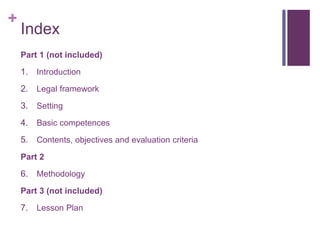
Index
Part 1 (not included)
1. Introduction
2. Legal framework
3. Setting
4. Basic competences
5. Contents, objectives and evaluation criteria
Part 2
6. Methodology
Part 3 (not included)
7. Lesson Plan
+
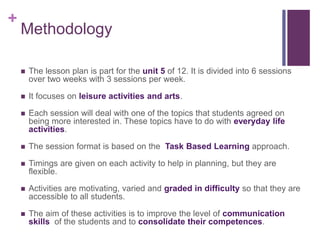
Methodology
 The lesson plan is part for the unit 5 of 12. It is divided into 6 sessions
over two weeks with 3 sessions per week.
 It focuses on leisure activities and arts.
 Each session will deal with one of the topics that students agreed on
being more interested in. These topics have to do with everyday life
activities.
 The session format is based on the Task Based Learning approach.
 Timings are given on each activity to help in planning, but they are
flexible.
 Activities are motivating, varied and graded in difficulty so that they are
accessible to all students.
 The aim of these activities is to improve the level of communication
skills of the students and to consolidate their competences.
+
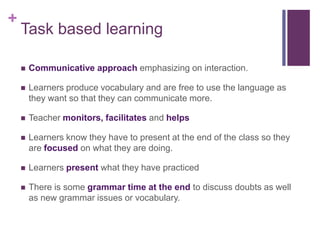
Task based learning
 Communicative approach emphasizing on interaction.
 Learners produce vocabulary and are free to use the language as
they want so that they can communicate more.
 Teacher monitors, facilitates and helps
 Learners know they have to present at the end of the class so they
are focused on what they are doing.
 Learners present what they have practiced
 There is some grammar time at the end to discuss doubts as well
as new grammar issues or vocabulary.
+
Task based learning
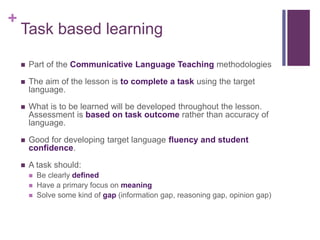
 Part of the Communicative Language Teaching methodologies
 The aim of the lesson is to complete a task using the target
language.
 What is to be learned will be developed throughout the lesson.
Assessment is based on task outcome rather than accuracy of
language.
 Good for developing target language fluency and student
confidence.
 A task should:
 Be clearly defined
 Have a primary focus on meaning
 Solve some kind of gap (information gap, reasoning gap, opinion gap)
+
Stages of a Task Based Activity
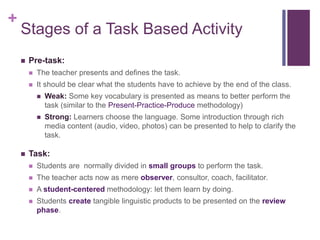
 Pre-task:
 The teacher presents and defines the task.
 It should be clear what the students have to achieve by the end of the class.
 Weak: Some key vocabulary is presented as means to better perform the
task (similar to the Present-Practice-Produce methodology)
 Strong: Learners choose the language. Some introduction through rich
media content (audio, video, photos) can be presented to help to clarify the
task.
 Task:
 Students are normally divided in small groups to perform the task.
 The teacher acts now as mere observer, consultor, coach, facilitator.
 A student-centered methodology: let them learn by doing.
 Students create tangible linguistic products to be presented on the review
phase.
+
Stages of a Task-Based Activity
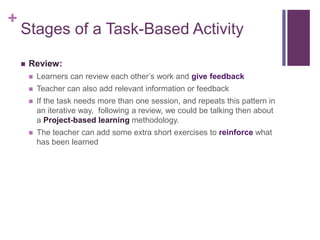
 Review:
 Learners can review each other’s work and give feedback
 Teacher can also add relevant information or feedback
 If the task needs more than one session, and repeats this pattern in
an iterative way, following a review, we could be talking then about
a Project-based learning methodology.
 The teacher can add some extra short exercises to reinforce what
has been learned
+
Roles in Task-Based Learning
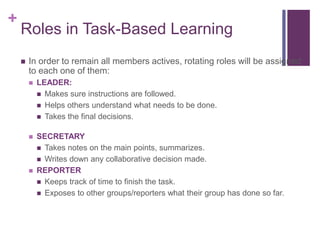
 In order to remain all members actives, rotating roles will be assigned
to each one of them:
 LEADER:
 Makes sure instructions are followed.
 Helps others understand what needs to be done.
 Takes the final decisions.
 SECRETARY
 Takes notes on the main points, summarizes.
 Writes down any collaborative decision made.
 REPORTER
 Keeps track of time to finish the task.
 Exposes to other groups/reporters what their group has done so far.
+
Temporalization of a TBL session
[Bruton, A. (2005) Task Based Language Learning: For the state secondary FL
classroom? Language Learning Journal, No 31, 55-68]
 PRE-TASK or WARM-UP: (10% of the time)
 Engages students to the topic, makes them want to know more. Lasts around
10 minutes usually and uses videos or other multimedia to put the user into
context.
 Task objectives are clarified – What to achieve and why.
 Teacher is an activator.
 TASK: (75-80% of the time)
 Work in groups mainly to build the solution together. Cooperation is a must.
 (Optional): Each student has a different role when performing the task.
 (Optional): Findings can be shared to other groups.
 Teacher is facilitator/guide.
 LANGUAGE-FOCUS/REVIEW: (10-15% of the time)
 Teacher clarifies concepts and explain grammar contents.
 Teacher is an instructor.
+
Unit 5
Temporalization
 Unit 5 theme  leisure activities chosen by students.
 Unit divided in 6 sessions (3 lessons per week)
 55 minutes per session – 5 minutes lost on average
= 50 minutes of planned activity
 Task-Based Learning approach is used throughout all six sessions
 Their individual progress as well as their group progress will be
marked on each session
 Final comments and visual design will be included on their portfolio
+
Unit 5:
Leisure and everyday activities
 Session 1: Music in our everyday life. (Monday, 20th June)
 Task: Discuss in what jobs and placer music is beneficial and why.
 Session 2: Clothes. (Wednesday, 22nd June)
 Task: Listen to conversations at a mall to identify vocabulary of clothes
and decide with your partners what you prefer to buy and wear.
 Session 3: Travelling. (Friday, 24th June)
 Task: You are preparing yourselves for your holidays. Decide with your
partner what you should put in the luggage.
* Sessions 1 and 3 will be explained in Activity 3
+
Unit 5:
Leisure and everyday activities
 Session 4: Wild Sports. (Monday, 27th June)
 Task: Create a telephone conversation to make a reservation in a
leisure area where several wild sports are offered.
 Session 5: Videogames. (Wednesday, 29nd June)
 Task: Disc. Discuss in groups arguments for and against of playing
videogames in today’s world.
 Session 6: Famous stars. (Friday, 1st July)
 Task: Listen to an interview of Kith Harrington (Game of Thrones)
about what he likes to do on his free time. Do you agree or not?
What would you do different?

Didactic-Unit-1-Part-2.pptx

  • 1.
    + Didactic Unit –Part 2 Guided Activity 2 Aprendizaje y Enseñanza de Lengua Extranjera (Inglés) Cristian Martín Reinhold
  • 2.
    + Index Part 1 (notincluded) 1. Introduction 2. Legal framework 3. Setting 4. Basic competences 5. Contents, objectives and evaluation criteria Part 2 6. Methodology Part 3 (not included) 7. Lesson Plan
  • 3.
    + Methodology  The lessonplan is part for the unit 5 of 12. It is divided into 6 sessions over two weeks with 3 sessions per week.  It focuses on leisure activities and arts.  Each session will deal with one of the topics that students agreed on being more interested in. These topics have to do with everyday life activities.  The session format is based on the Task Based Learning approach.  Timings are given on each activity to help in planning, but they are flexible.  Activities are motivating, varied and graded in difficulty so that they are accessible to all students.  The aim of these activities is to improve the level of communication skills of the students and to consolidate their competences.
  • 4.
    + Task based learning Communicative approach emphasizing on interaction.  Learners produce vocabulary and are free to use the language as they want so that they can communicate more.  Teacher monitors, facilitates and helps  Learners know they have to present at the end of the class so they are focused on what they are doing.  Learners present what they have practiced  There is some grammar time at the end to discuss doubts as well as new grammar issues or vocabulary.
  • 5.
    + Task based learning Part of the Communicative Language Teaching methodologies  The aim of the lesson is to complete a task using the target language.  What is to be learned will be developed throughout the lesson. Assessment is based on task outcome rather than accuracy of language.  Good for developing target language fluency and student confidence.  A task should:  Be clearly defined  Have a primary focus on meaning  Solve some kind of gap (information gap, reasoning gap, opinion gap)
  • 6.
    + Stages of aTask Based Activity  Pre-task:  The teacher presents and defines the task.  It should be clear what the students have to achieve by the end of the class.  Weak: Some key vocabulary is presented as means to better perform the task (similar to the Present-Practice-Produce methodology)  Strong: Learners choose the language. Some introduction through rich media content (audio, video, photos) can be presented to help to clarify the task.  Task:  Students are normally divided in small groups to perform the task.  The teacher acts now as mere observer, consultor, coach, facilitator.  A student-centered methodology: let them learn by doing.  Students create tangible linguistic products to be presented on the review phase.
  • 7.
    + Stages of aTask-Based Activity  Review:  Learners can review each other’s work and give feedback  Teacher can also add relevant information or feedback  If the task needs more than one session, and repeats this pattern in an iterative way, following a review, we could be talking then about a Project-based learning methodology.  The teacher can add some extra short exercises to reinforce what has been learned
  • 8.
    + Roles in Task-BasedLearning  In order to remain all members actives, rotating roles will be assigned to each one of them:  LEADER:  Makes sure instructions are followed.  Helps others understand what needs to be done.  Takes the final decisions.  SECRETARY  Takes notes on the main points, summarizes.  Writes down any collaborative decision made.  REPORTER  Keeps track of time to finish the task.  Exposes to other groups/reporters what their group has done so far.
  • 9.
    + Temporalization of aTBL session [Bruton, A. (2005) Task Based Language Learning: For the state secondary FL classroom? Language Learning Journal, No 31, 55-68]  PRE-TASK or WARM-UP: (10% of the time)  Engages students to the topic, makes them want to know more. Lasts around 10 minutes usually and uses videos or other multimedia to put the user into context.  Task objectives are clarified – What to achieve and why.  Teacher is an activator.  TASK: (75-80% of the time)  Work in groups mainly to build the solution together. Cooperation is a must.  (Optional): Each student has a different role when performing the task.  (Optional): Findings can be shared to other groups.  Teacher is facilitator/guide.  LANGUAGE-FOCUS/REVIEW: (10-15% of the time)  Teacher clarifies concepts and explain grammar contents.  Teacher is an instructor.
  • 10.
    + Unit 5 Temporalization  Unit5 theme  leisure activities chosen by students.  Unit divided in 6 sessions (3 lessons per week)  55 minutes per session – 5 minutes lost on average = 50 minutes of planned activity  Task-Based Learning approach is used throughout all six sessions  Their individual progress as well as their group progress will be marked on each session  Final comments and visual design will be included on their portfolio
  • 11.
    + Unit 5: Leisure andeveryday activities  Session 1: Music in our everyday life. (Monday, 20th June)  Task: Discuss in what jobs and placer music is beneficial and why.  Session 2: Clothes. (Wednesday, 22nd June)  Task: Listen to conversations at a mall to identify vocabulary of clothes and decide with your partners what you prefer to buy and wear.  Session 3: Travelling. (Friday, 24th June)  Task: You are preparing yourselves for your holidays. Decide with your partner what you should put in the luggage. * Sessions 1 and 3 will be explained in Activity 3
  • 12.
    + Unit 5: Leisure andeveryday activities  Session 4: Wild Sports. (Monday, 27th June)  Task: Create a telephone conversation to make a reservation in a leisure area where several wild sports are offered.  Session 5: Videogames. (Wednesday, 29nd June)  Task: Disc. Discuss in groups arguments for and against of playing videogames in today’s world.  Session 6: Famous stars. (Friday, 1st July)  Task: Listen to an interview of Kith Harrington (Game of Thrones) about what he likes to do on his free time. Do you agree or not? What would you do different?