Task-basedLanguageAssessment(TBLA)A presentation byUlrike Schuh-Fricke & Wolfgang Stadler 1
Group Presentation (7.2)Consists ofA PowerPoint in which we, among others,Explain the thinking behind our test designSay what tasks the students will have to doPresent and describe our assessment instrumentExplain why it is task-based and how it relates to the textbookAddress concerns raised in the literature on TBLAReflect on how task-based tests relate to the issues of generalisability, task difficulty, and task variabilityA task-based language test for a group of students who have done unit 1 of the course book Widgets2
StructureBackground (Slide 4)Task-based language teaching (Slides 5–7) Course book Widgets, Unit 1 (Slides 8, 9)Tasks to do on Threshold Level (=B1, CEF) (Slides 10, 11)Concept behind performance tasks (Slide 12)Tasks achieved after Unit 1, Widgets (Slide 13)Task-based language testing (Slides 14–16) Performance (Assessment) Criteria (Slides 17–21)The Test (Slides 22–25)Critical reflection (Slide 26)Literature (Slide 27)3
BackgroundCommunicative Language Ability (CLA): Focus on use of language in various situations (see David’s comment in 7.1)Action-orientedapproach: users and learners of a language are primarily ‘social agents’, i.e. members of society who have tasks to accomplish in a given set of circumstances, in a specific environment and within a particular field of action. (CEFR, ch. 2.1)Focus on the agents’ use of strategies linked to their competences and how they perceive or imagine the situation to be mastered with their language skills In accordance with the action-oriented approach, it is assumed that the language learner is in the process of becoming a plurilinguallanguage user developing interculturality(ibid.)4
Task-based language teachingTasks are a feature of everyday life in the personal, public, educational or occupational domains.A task may be quite simple or extremely complex and it may involve a greater or lesser number of steps or embedded sub-tasks.Tasks can be extremely varied in nature, and may involve language activities to a greater or lesser extent, for example: creative, skills based, problem solving, routine transactions, interpreting a role in a play, taking part in a discussion, giving a presentation, planning a course of action, reading and replying to (an e-mail) message, etc.Task accomplishment involves the strategic activation of specific competences in order to carry out a set of purposeful actions in a particular domain with a clearly defined goal and a specific outcome. (CEFR, ch. 7.1)5
What is a language task? (Definition)“A task [is] any activity in which a person engages, given an appropriate setting, in order to achieve a specifiable class of objectives.“  (J.B. Carroll, 1993)According to CEFR, a task is defined as any purposeful action considered by an individual as necessary in order to achieve a given result in the context of a problem to be solved, an obligation to fulfil or an objective to be achieved (CEFR, ch. 2.1)Tasksare closely associated with specific situationsare goal-orientedinvolve active participation of the language users6
Developing a task (Checklist)According to Bachman/Palmer’s framework (1996), five aspects need to be considered when developing a task (checklist):Setting (physical characteristics, participants, time)	Test rubric (instructions, structure, time allotment, scoring method)Input (format, language)Expected response (format, language)Relationship between input and response (reactivity, scope of relationship, directness of relationship)7
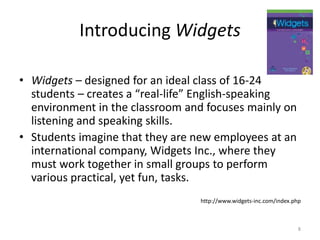
Introducing Widgets Widgets – designed for an ideal class of 16-24 students – creates a “real-life” English-speaking environment in the classroom and focuses mainly on listening and speaking skills.Students imagine that they are new employees at an international company, Widgets Inc., where they must work together in small groups to perform various practical, yet fun, tasks.http://www.widgets-inc.com/index.php8
CoursebookWidgets, Unit 1In Unit 1 studentslearn about the course concept and objectiveslearn about Widgets Inc. (the company)explore customs about business cards, name tags and handshakingmeet and greet each other in a casual business settinglearn about Victoria Vanderhoff, the company’s presidentfamiliarize themselves with appropriate conversation topics9
Tasks to do on Threshold Level(=B1, CEFR)Personal identificationLearners can say who they are, spell their name, state their address, give their telephone number, say when and where they were born, state their age, sex, state whether they are married or not, state their nationality, say where they are from, what they do for a living, describe their family, state their religion, if any, state their likes and dislikes, say what other people are like; elicit/understand similar information from others.10
Tasks to do on Threshold Level(=B1, CEFR), cont.Communication at workSeek work permits etc. as required;Enquire (e.g. from employment agencies) about the nature, availability and conditions of employment (e.g. job description, pay, laws of work, free time and holidays, length of notice);read employment advertisements;Write letters of application and attend interviews giving written or spoken information about own personal data, qualifications and experience and answer questions about them;Understand and follow joining procedures;Understand and ask questions concerning the tasks to be performed on starting work;Understand safety and security regulations and instructions;Report an accident and make an insurance claim;Make use of welfare facilities;Communicate appropriately with superiors, colleagues and subordinates;11
Concept behind performance tasksStudents perform authentic, real-life tasks, using the productive skills of speaking and/or writing but also combining skills.Teachers elicit authentic communication and may predict students’ future performances in target language use situations.If performance assessment is closely linked to the curriculum, a strong positive washbackeffect may be achieved.12
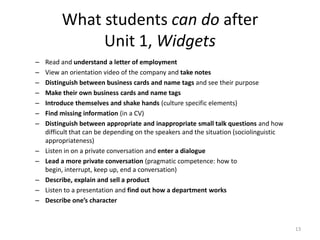
What students can do afterUnit 1, WidgetsRead and understand a letter of employmentView an orientation video of the company and take notesDistinguish between business cards and name tags and see their purposeMake their own business cards and name tagsIntroduce themselves and shake hands (culture specific elements)Find missing information (in a CV)Distinguish between appropriate and inappropriate small talk questions and how difficult that can be depending on the speakers and the situation (sociolinguistic appropriateness)Listen in on a private conversation and enter a dialogueLead a more private conversation (pragmatic competence: how to begin, interrupt, keep up, end a conversation)Describe, explain and sell a productListen to a presentation and find out how a department worksDescribe one’s character13
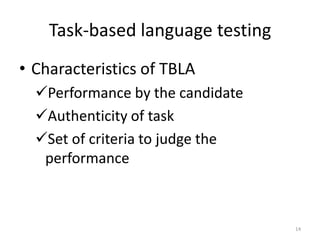
Task-based language testingCharacteristics of TBLAPerformance by the candidate
Authenticity of task
Set of criteria to judge the performance14
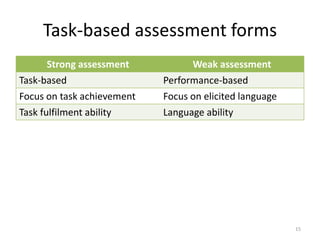
Task-based assessment forms15
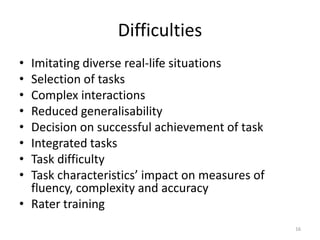
DifficultiesImitating diverse real-life situations
Selection of tasksComplex interactionsReduced generalisability
Decision on successful achievement of task
Integrated tasks
Task difficulty
Task characteristics’ impact on measures of fluency, complexity and accuracy
Rater training16
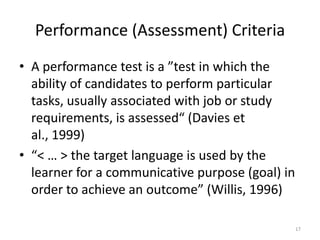
Performance (Assessment) CriteriaA performance test is a ”test in which the ability of candidates to perform particular tasks, usually associated with job or study requirements, is assessed“ (Davies et al., 1999)“< … > the target language is used by the learner for a communicative purpose (goal) in order to achieve an outcome” (Willis, 1996)17
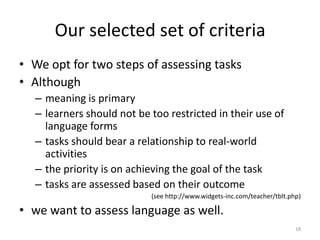
Our selected set of criteriaWe opt for two steps of assessing tasksAlthoughmeaning is primarylearners should not be too restricted in their use of language formstasks should bear a relationship to real-world activitiesthe priority is on achieving the goal of the tasktasks are assessed based on their outcome(see http://www.widgets-inc.com/teacher/tblt.php)we want to assess language as well.18
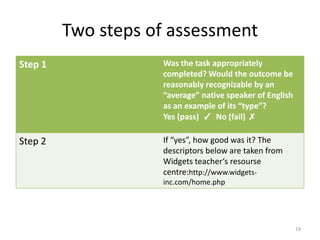
Two steps of assessment19
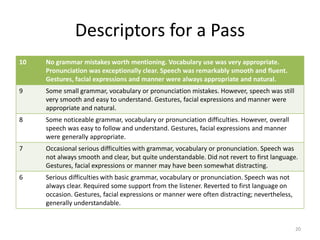
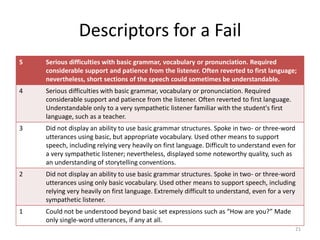
Descriptors for a Pass20

TBLA

  • 1.
  • 2.
    Group Presentation (7.2)ConsistsofA PowerPoint in which we, among others,Explain the thinking behind our test designSay what tasks the students will have to doPresent and describe our assessment instrumentExplain why it is task-based and how it relates to the textbookAddress concerns raised in the literature on TBLAReflect on how task-based tests relate to the issues of generalisability, task difficulty, and task variabilityA task-based language test for a group of students who have done unit 1 of the course book Widgets2
  • 3.
    StructureBackground (Slide 4)Task-basedlanguage teaching (Slides 5–7) Course book Widgets, Unit 1 (Slides 8, 9)Tasks to do on Threshold Level (=B1, CEF) (Slides 10, 11)Concept behind performance tasks (Slide 12)Tasks achieved after Unit 1, Widgets (Slide 13)Task-based language testing (Slides 14–16) Performance (Assessment) Criteria (Slides 17–21)The Test (Slides 22–25)Critical reflection (Slide 26)Literature (Slide 27)3
  • 4.
    BackgroundCommunicative Language Ability(CLA): Focus on use of language in various situations (see David’s comment in 7.1)Action-orientedapproach: users and learners of a language are primarily ‘social agents’, i.e. members of society who have tasks to accomplish in a given set of circumstances, in a specific environment and within a particular field of action. (CEFR, ch. 2.1)Focus on the agents’ use of strategies linked to their competences and how they perceive or imagine the situation to be mastered with their language skills In accordance with the action-oriented approach, it is assumed that the language learner is in the process of becoming a plurilinguallanguage user developing interculturality(ibid.)4
  • 5.
    Task-based language teachingTasksare a feature of everyday life in the personal, public, educational or occupational domains.A task may be quite simple or extremely complex and it may involve a greater or lesser number of steps or embedded sub-tasks.Tasks can be extremely varied in nature, and may involve language activities to a greater or lesser extent, for example: creative, skills based, problem solving, routine transactions, interpreting a role in a play, taking part in a discussion, giving a presentation, planning a course of action, reading and replying to (an e-mail) message, etc.Task accomplishment involves the strategic activation of specific competences in order to carry out a set of purposeful actions in a particular domain with a clearly defined goal and a specific outcome. (CEFR, ch. 7.1)5
  • 6.
    What is alanguage task? (Definition)“A task [is] any activity in which a person engages, given an appropriate setting, in order to achieve a specifiable class of objectives.“ (J.B. Carroll, 1993)According to CEFR, a task is defined as any purposeful action considered by an individual as necessary in order to achieve a given result in the context of a problem to be solved, an obligation to fulfil or an objective to be achieved (CEFR, ch. 2.1)Tasksare closely associated with specific situationsare goal-orientedinvolve active participation of the language users6
  • 7.
    Developing a task(Checklist)According to Bachman/Palmer’s framework (1996), five aspects need to be considered when developing a task (checklist):Setting (physical characteristics, participants, time) Test rubric (instructions, structure, time allotment, scoring method)Input (format, language)Expected response (format, language)Relationship between input and response (reactivity, scope of relationship, directness of relationship)7
  • 8.
    Introducing Widgets Widgets– designed for an ideal class of 16-24 students – creates a “real-life” English-speaking environment in the classroom and focuses mainly on listening and speaking skills.Students imagine that they are new employees at an international company, Widgets Inc., where they must work together in small groups to perform various practical, yet fun, tasks.http://www.widgets-inc.com/index.php8
  • 9.
    CoursebookWidgets, Unit 1InUnit 1 studentslearn about the course concept and objectiveslearn about Widgets Inc. (the company)explore customs about business cards, name tags and handshakingmeet and greet each other in a casual business settinglearn about Victoria Vanderhoff, the company’s presidentfamiliarize themselves with appropriate conversation topics9
  • 10.
    Tasks to doon Threshold Level(=B1, CEFR)Personal identificationLearners can say who they are, spell their name, state their address, give their telephone number, say when and where they were born, state their age, sex, state whether they are married or not, state their nationality, say where they are from, what they do for a living, describe their family, state their religion, if any, state their likes and dislikes, say what other people are like; elicit/understand similar information from others.10
  • 11.
    Tasks to doon Threshold Level(=B1, CEFR), cont.Communication at workSeek work permits etc. as required;Enquire (e.g. from employment agencies) about the nature, availability and conditions of employment (e.g. job description, pay, laws of work, free time and holidays, length of notice);read employment advertisements;Write letters of application and attend interviews giving written or spoken information about own personal data, qualifications and experience and answer questions about them;Understand and follow joining procedures;Understand and ask questions concerning the tasks to be performed on starting work;Understand safety and security regulations and instructions;Report an accident and make an insurance claim;Make use of welfare facilities;Communicate appropriately with superiors, colleagues and subordinates;11
  • 12.
    Concept behind performancetasksStudents perform authentic, real-life tasks, using the productive skills of speaking and/or writing but also combining skills.Teachers elicit authentic communication and may predict students’ future performances in target language use situations.If performance assessment is closely linked to the curriculum, a strong positive washbackeffect may be achieved.12
  • 13.
    What students cando afterUnit 1, WidgetsRead and understand a letter of employmentView an orientation video of the company and take notesDistinguish between business cards and name tags and see their purposeMake their own business cards and name tagsIntroduce themselves and shake hands (culture specific elements)Find missing information (in a CV)Distinguish between appropriate and inappropriate small talk questions and how difficult that can be depending on the speakers and the situation (sociolinguistic appropriateness)Listen in on a private conversation and enter a dialogueLead a more private conversation (pragmatic competence: how to begin, interrupt, keep up, end a conversation)Describe, explain and sell a productListen to a presentation and find out how a department worksDescribe one’s character13
  • 14.
    Task-based language testingCharacteristicsof TBLAPerformance by the candidate
  • 15.
  • 16.
    Set of criteriato judge the performance14
  • 17.
  • 18.
  • 19.
    Selection of tasksComplexinteractionsReduced generalisability
  • 20.
    Decision on successfulachievement of task
  • 21.
  • 22.
  • 23.
    Task characteristics’ impacton measures of fluency, complexity and accuracy
  • 24.
  • 25.
    Performance (Assessment) CriteriaAperformance test is a ”test in which the ability of candidates to perform particular tasks, usually associated with job or study requirements, is assessed“ (Davies et al., 1999)“< … > the target language is used by the learner for a communicative purpose (goal) in order to achieve an outcome” (Willis, 1996)17
  • 26.
    Our selected setof criteriaWe opt for two steps of assessing tasksAlthoughmeaning is primarylearners should not be too restricted in their use of language formstasks should bear a relationship to real-world activitiesthe priority is on achieving the goal of the tasktasks are assessed based on their outcome(see http://www.widgets-inc.com/teacher/tblt.php)we want to assess language as well.18
  • 27.
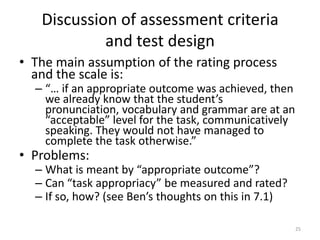
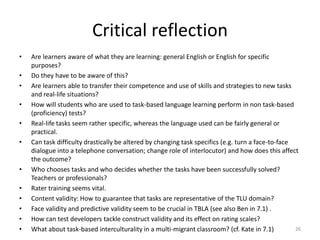
    Two steps ofassessment19
  • 28.