













Module 9
DPA 306: HUMAN RESOURCE
MANAGEMENT AND
DEVELOPMENT
JOSEFINA B. BITONIO, DPA
PROFESSOR
PRESENTED BY:
GILBERTO S. CARIÑO, MPA
DPA STUDENT
MOTIVATION OVERVIEW
 Motivation- Definition
 Management Theories of Motivation
 Needs Theories
 Theories of Motivation
Conditioning Theory
Expectancy Theory
Motivation-Hygiene Theory
 Dimension of Supervisory Style
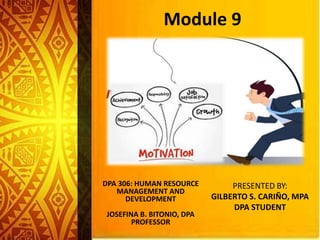
MOTIVATION
Definition – (Martires) is the intrinsic
inducement that propels an individual to think,
feel, and perform in certain ways.
It is the desire or willingness of the employee
to exert effort to achieve objectives either
employee’s personal goals or those of the
organization.
Derive from the word “motive” which is
defined as a need that requires satisfaction.
The needs could be wants or desires that are
acquired through influence of culture, society,
lifestyle, etc. or generally innate.
It is one of the most important concepts in
Human Resource Department
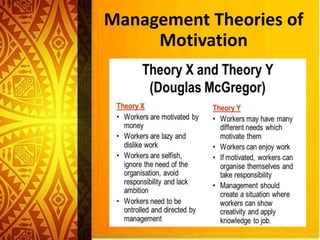
Management Theories of
Motivation
Management Theories of
Motivation
Management Theories
of Motivation
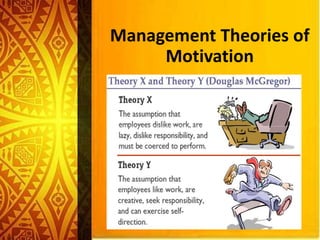
Douglas McGregor popularized the
human relations approach to
management in the 1960
Theory X : assumes workers dislike
and avoid work, so managers must
use coercion, threats, and various
control schemes to get workers to
meet objectives.
Management Theories
of Motivation
Theory Y : assumes individuals consider
work as natural as play or rest and enjoy
the satisfaction of esteem and self-
actualization needs
Theory Z: Introduced in 1981 by William
Ouchi and is based on the Japanese
approach to motivating workers,
emphasizing trust, quality, collective
decision making, and cultural values.
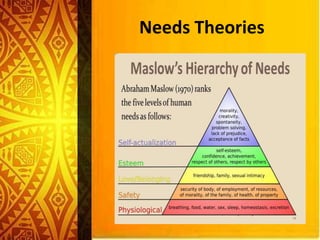
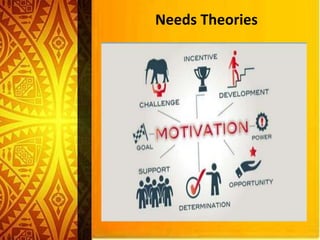
Needs Theories
(Legaspi) HRM policies and practices should
pay attention to all of this needs ranging from
the most basic to the highest in order to
achieve the overall goals of the organization.
It is not enough that the individual employees
are provided with their basic physiological
and psychological needs but they have to be
given the opportunity to participate in
decision making processes in such a way that
they will be able to realize their own growth,
development, and potentials.
IMPLICATION OF THIS
THEORY FOR HRM
Needs Theories
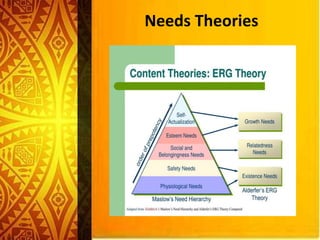
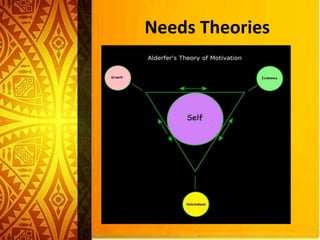
Clayton Alderfer’s theory centers on three
needs – Existence, Relatedness, and Growth.
Existence – include foods, clothing and
shelter.
Relatedness – refers to the desire for human
relationships to include interaction with
family members, friends, peers, superior
and subordinates.
Growth – include those which involve
making oneself creative and productive
(Legaspi)
Needs Theories
Alderfer’s needs are parallel to Maslow’s
needs, they should not be placed in
hierarchal order. The theory states that all
the three needs can simultaneously be
satisfied and therefore serves as
motivators. A person need not satisfy
existence needs before meeting needs for
relationship with others and fully
developing potentials.
“One implication of this theory for HRM is
that in designing and managing HR policies
and practices, the HR practitioner should
assume that all personnel have the
potential for growth and development”
Needs Theories
McClelland’s theory focuses on the
need for achievement, the need
for affiliation, and the need for
power. The Need for Achievement
refers to the drive for success;
Need for Affiliation includes the
need for social relationships and
mutual support and Need for
Power refers to the need to
influence others and dominate and
control.
Needs For Power
• Power is the prime mover of people and
events.
• The essence of power is to influence over the
behavior of others.
• Over the years, it is no longer considered
synonymous with controlling others, neither is
it fait, mindless obedience or robotic servitude
• Power is the ability to lead and inspire. It is
based on trust, respect, and wholehearted
commitment, freely given and earned.
• Power is the foundation of effective leadership.
(CSC-UND-SDC Track II&III)
POWER: The Foundation of Leadership
Module 9 Motivation HRMD

Module 9 Motivation HRMD

  • 1.
    Module 9 DPA 306:HUMAN RESOURCE MANAGEMENT AND DEVELOPMENT JOSEFINA B. BITONIO, DPA PROFESSOR PRESENTED BY: GILBERTO S. CARIÑO, MPA DPA STUDENT
  • 2.
    MOTIVATION OVERVIEW  Motivation-Definition  Management Theories of Motivation  Needs Theories  Theories of Motivation Conditioning Theory Expectancy Theory Motivation-Hygiene Theory  Dimension of Supervisory Style
  • 3.
    MOTIVATION Definition – (Martires)is the intrinsic inducement that propels an individual to think, feel, and perform in certain ways. It is the desire or willingness of the employee to exert effort to achieve objectives either employee’s personal goals or those of the organization. Derive from the word “motive” which is defined as a need that requires satisfaction. The needs could be wants or desires that are acquired through influence of culture, society, lifestyle, etc. or generally innate. It is one of the most important concepts in Human Resource Department
  • 4.
  • 5.
  • 6.
    Management Theories of Motivation DouglasMcGregor popularized the human relations approach to management in the 1960 Theory X : assumes workers dislike and avoid work, so managers must use coercion, threats, and various control schemes to get workers to meet objectives.
  • 7.
    Management Theories of Motivation TheoryY : assumes individuals consider work as natural as play or rest and enjoy the satisfaction of esteem and self- actualization needs Theory Z: Introduced in 1981 by William Ouchi and is based on the Japanese approach to motivating workers, emphasizing trust, quality, collective decision making, and cultural values.
  • 8.
  • 9.
    (Legaspi) HRM policiesand practices should pay attention to all of this needs ranging from the most basic to the highest in order to achieve the overall goals of the organization. It is not enough that the individual employees are provided with their basic physiological and psychological needs but they have to be given the opportunity to participate in decision making processes in such a way that they will be able to realize their own growth, development, and potentials. IMPLICATION OF THIS THEORY FOR HRM
  • 10.
  • 11.
    Clayton Alderfer’s theorycenters on three needs – Existence, Relatedness, and Growth. Existence – include foods, clothing and shelter. Relatedness – refers to the desire for human relationships to include interaction with family members, friends, peers, superior and subordinates. Growth – include those which involve making oneself creative and productive (Legaspi)
  • 12.
  • 13.
    Alderfer’s needs areparallel to Maslow’s needs, they should not be placed in hierarchal order. The theory states that all the three needs can simultaneously be satisfied and therefore serves as motivators. A person need not satisfy existence needs before meeting needs for relationship with others and fully developing potentials. “One implication of this theory for HRM is that in designing and managing HR policies and practices, the HR practitioner should assume that all personnel have the potential for growth and development”
  • 14.
  • 15.
    McClelland’s theory focuseson the need for achievement, the need for affiliation, and the need for power. The Need for Achievement refers to the drive for success; Need for Affiliation includes the need for social relationships and mutual support and Need for Power refers to the need to influence others and dominate and control.
  • 16.
    Needs For Power •Power is the prime mover of people and events. • The essence of power is to influence over the behavior of others. • Over the years, it is no longer considered synonymous with controlling others, neither is it fait, mindless obedience or robotic servitude • Power is the ability to lead and inspire. It is based on trust, respect, and wholehearted commitment, freely given and earned. • Power is the foundation of effective leadership. (CSC-UND-SDC Track II&III) POWER: The Foundation of Leadership