MOTIVATION THEORY IN ORGANISATION BEHAVIOUR.ppt.pptx
1.
Motivation Theories:
Motivation isa crucial aspect of human behavior. Understanding the
theories behind motivation can help individuals and organizations
achieve their goals. This presentation will delve into various theories,
exploring their concepts, applications, and implications.
By - Mohammed Talib Baksh & Aditya Dubey
2.
Maslow's Hierarchy ofNeeds
1 Physiological Needs
These are the most basic needs, such as food, water, and shelter.
2 Safety Needs
These needs involve security, stability, and protection from harm.
3 Belongingness and Love Needs
These needs relate to social connections, affection, and a sense of belonging.
4 Esteem Needs
These needs include self-esteem, confidence, and respect from others.
5 Self-Actualization Needs
This is the highest level of need, involving fulfilling one's potential and achieving personal growth.
3.
Application of Maslow’sHierarchy of Needs Theory
1. Physiological Needs
Application in Business: Employers ensure that workers have comfortable working environments with access to proper break times, water, food, and rest facilities.
Application in Education: Schools ensure students have access to food programs, proper lighting, and a comfortable study environment.
2. Safety Needs
Application in Business: Companies provide job security, health insurance, a safe work environment, and policies that ensure employee well-being
Application in Education: Schools ensure student safety through anti-bullying policies, safe learning environments, and access to counselors.
3. Belongingness and Love Needs
Application in Business: Promoting teamwork, collaboration, and strong corporate culture helps satisfy the need for belonging
Application in Education: Schools emphasize group work, extracurricular activities, and social clubs to build a sense of community among students.
4. Esteem Needs
Application in Business: Employers use recognition programs, promotions, and performance appraisals to boost employees’ self-esteem.
Application in Education: Teachers boost students’ self-esteem through positive reinforcement, acknowledgment of achievements, and leadership
opportunities.
4.
5. Self-Actualization Needs
Applicationin Business : Companies offer personal development opportunities, challenging projects, and creative freedom to enable employees to reach their
full potential
Application in Education: Schools foster critical thinking, creativity, and independent projects to help students achieve self-actualization.
5.
Alderfer's ERG Theory
1Existence Needs
Similar to Maslow's
physiological and safety
needs, these are
fundamental for survival
and well-being.
2 Relatedness Needs
These needs focus on social
connections, belonging,
and meaningful
relationships.
3 Growth Needs
These needs are about personal development, self-actualization,
and achieving one's full potential.
6.
Applications of Alderfer’sERG Theory
1. Existense Needs –
Application in Business: Companies must ensure that employees' basic needs (salary, benefits, job security) are met. Providing competitive salaries,
safe working conditions, and healthcare benefits ensures workers' motivation at the existence level.
Application in Healthcare:Hospitals and care facilities focus on ensuring that patients' basic physiological needs are met through proper nutrition,
safety protocols, and security measures.
2. Relatedness Needs -
Application in Business:Employers promote teamwork, collaboration, and interpersonal relationships among employees. This can be
done by creating a positive organizational culture, encouraging team-building activities, or establishing mentorship programs.
Application in Healthcare:In healthcare settings, emphasis is placed on establishing strong communication between healthcare
providers, patients, and their families. This builds trust and strengthens relationships.
3. Growth Needs –
Application in Business: Companies can offer opportunities for professional growth and development, such as training programs, leadership
opportunities, and challenging projects.
Application in Healthcare: Healthcare organizations encourage professionals to engage in continuous learning and skill development through
workshops, certifications, and research opportunities. Empowering patients to take control of their health also helps address growth needs.
7.
McClelland's Need Theory
Needfor Achievement
Individuals with a high need for
achievement strive for excellence, set
challenging goals, and seek feedback.
Need for Affiliation
Individuals with a high need for
affiliation value social relationships,
harmony, and belonging.
Need for Power
Individuals with a high need for
power desire influence, control, and
impact on others.
8.
Applications of McClelland’sNeed Theory
1. Need for Achievement (nAch)
• Assign challenging but achievable tasks with clear goals . Provide regular and detailed feedback .
Create opportunities for advancement based on measurable success . Avoid too much
micromanagement as they thrive on autonomy and problem-solving.
2. Need for Affiliation (nAff)
• Foster a collaborative team environment . Assign roles that involve frequent interaction with
others, such as customer relations, HR, or team-based projects . Provide recognition and praise
in social settings or publicly . Encourage them to lead team-building activities or mentor others.
3. Need to power (nPOW)
• Provide leadership opportunities or roles where they can influence decisions.Encourage them to
take charge of projects or mentor junior staff.Involve them in strategic decision-making
processes.If their desire for power is organizational (benefiting the organization), they can be
valuable leaders. However, if personal, this can sometimes lead to conflict.
9.
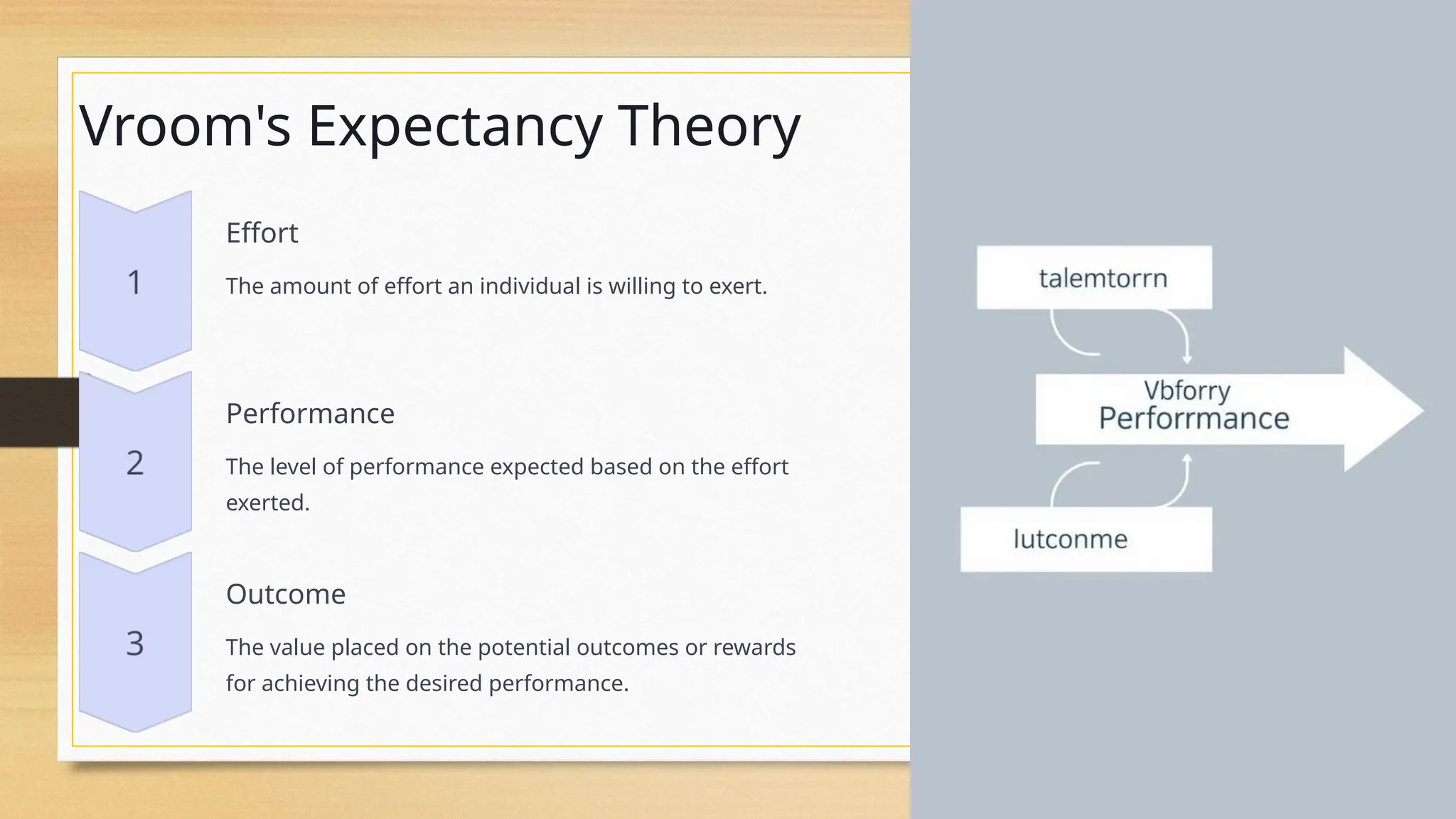
Vroom's Expectancy Theory
Effort
Theamount of effort an individual is willing to exert.
Performance
The level of performance expected based on the effort
exerted.
Outcome
The value placed on the potential outcomes or rewards
for achieving the desired performance.
10.
Application of vroom’sExpectancy Theory
1. Effort (Expectancy):Application: Provide employees with the necessary training, resources, and
support so they believe their effort will lead to success. Ensure goals are realistic and achievable to
boost confidence
2. Performance (Instrumentality):Application: Link performance directly to rewards. Employees need
to trust that if they perform well, they will receive the promised reward, like bonuses or promotions.
3. Outcome (Valence):Application: Offer rewards that employees value. Understand individual
preferences (e.g., financial incentives, recognition, career growth) and align outcomes with their
personal goals.
11.
Ouchi's Theory Z
FocusLong-Term
Employment
Collective
Decision-
Making
Holistic
Concern for
Employees
Slow
Promotion and
Evaluation
12.
Application For TheoryZ
1. Long-term Employment: Provide employees with job security by offering long-term contracts or permanent
positions. This fosters loyalty and encourages employees to invest in the company’s success, reducing turnover
and enhancing productivity.
2. 2. Collective Decision-Making: Involve employees in decision-making processes through regular team meetings
or committees. This promotes a sense of ownership and shared responsibility, leading to more innovative
solutions and higher employee engagement.
3. 3. Holistic Concern for Employees: Implement programs that support employees' overall well-being, such as
work-life balance initiatives, wellness programs, and personal development opportunities. When employees feel
cared for, their commitment to the company grows.
4. 4. Slow Promotion and Evaluation: Adopt a long-term approach to performance evaluation and promotion.
Focus on employees’ overall growth, not just short-term achievements. This encourages continuous
improvement, loyalty, and a more balanced work environment.
13.
Practical Applications ofMotivation Theories
Team Building
Understanding individual needs and motivations can foster
a cohesive and productive team environment.
Performance Management
Motivation theories can guide performance appraisal, goal
setting, and reward systems.
14.
Conclusion and Key
Takeaways
Understandingmotivation theories is essential for creating a positive
and productive work environment. Each theory offers valuable insights
into human behavior, providing a framework for motivating individuals
and teams.