Monitoring &
Evaluation (M&E)
Module 8
Value of M & E
Learn from experience, and share this learning
(especially important if you are part of an
alliance/coalition)
Adapt plans to respond to events
Improve the effectiveness of future advocacy work
Ensure that resources are used in the most effective
way possible
Be accountable to managers, colleagues and funders
What’s the Difference?!
Monitoring - is a process that tracks
the implementation of activities
[It checks that we are implementing
activities according to our action
plan.]
Evaluation - assesses the results of
our project at one point in time
[In short-scale projects, this would be
on completion – but in longer-scale
projects, it could be done
periodically.]
Monitoring is about
keeping to the plan:
Not about questioning
the plan
It takes place during
And may involve
diagnosis and remedial
action to get back on
track
Evaluation questions the
plan:
Is/was it the best way?
Will objectives be/have they been
achieved?
Were we on time (expected progress
made?)
What have we learned?
What can we change to increase
success?
Is it worth doing (again)?
Designing Your M&E
System
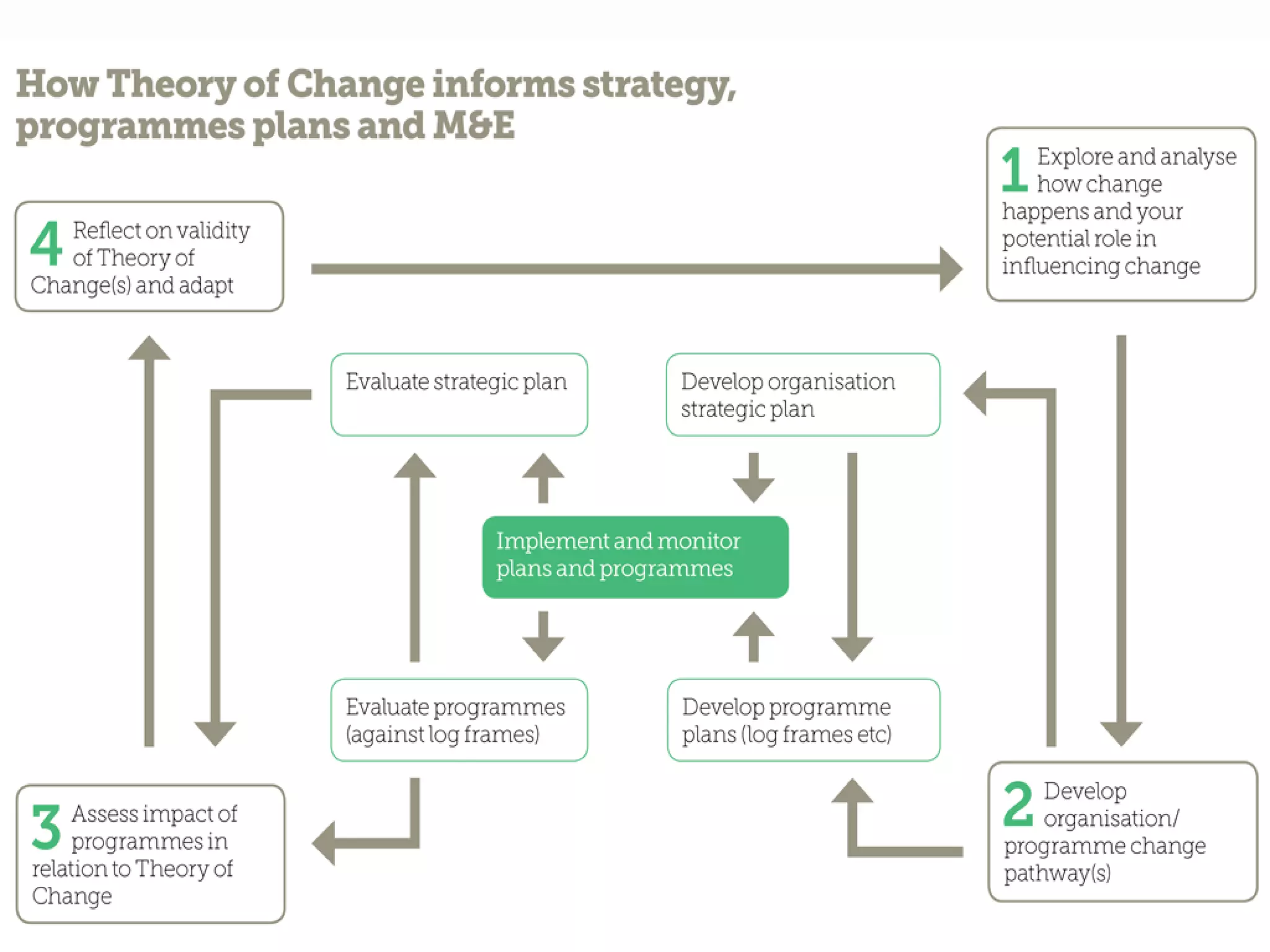
Before designing your M&E
system, think carefully about
the changes you are trying
to achieve, and how these
can be brought about
Do at action planning
stage, and build results into
plan
Theory of Change – see next slide
Advocacy Change
Advocacy changes are
difficult to measure
They also occur at
multiple levels – See the
next slide!
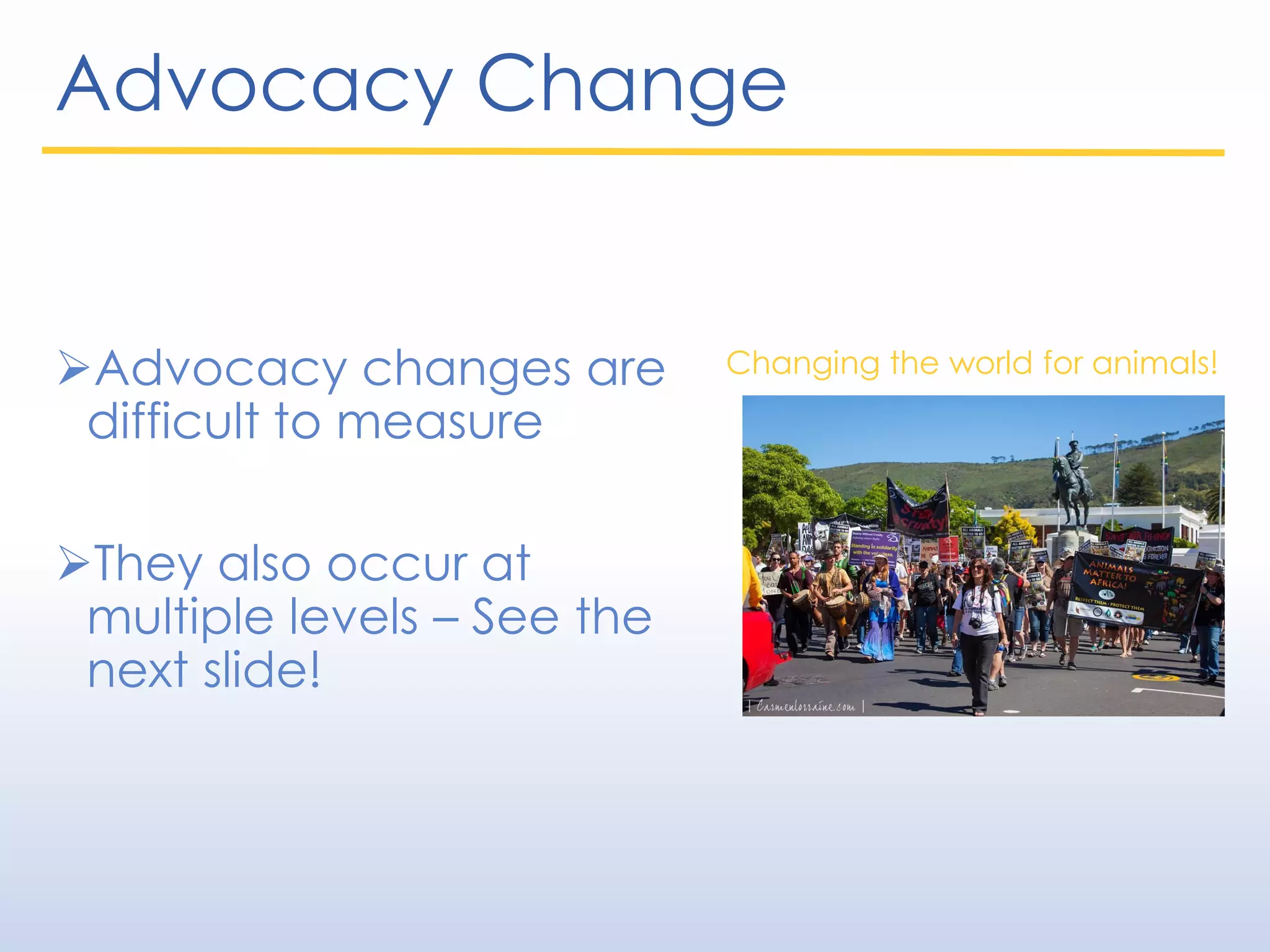
Changing the world for animals!
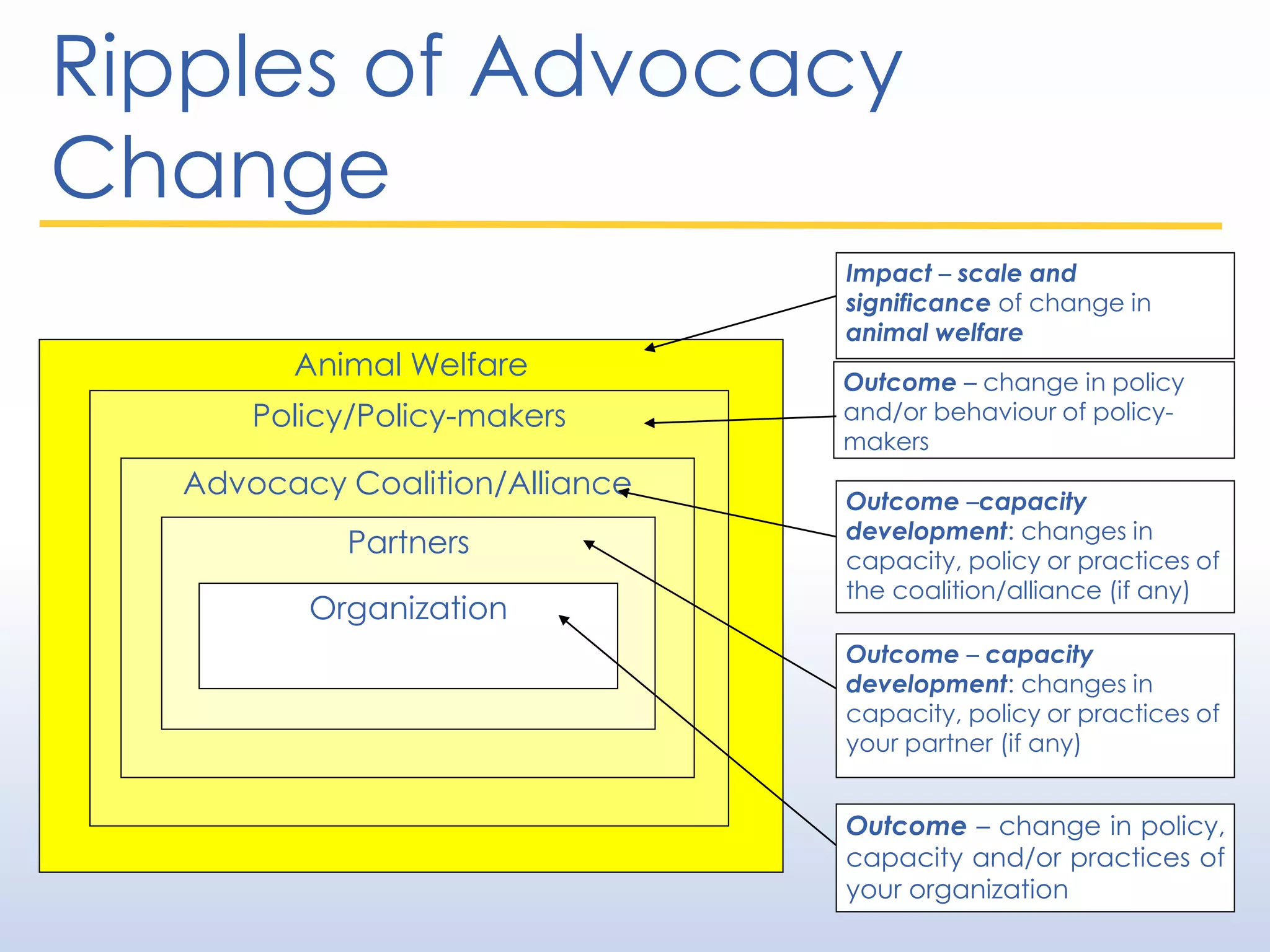
Animal Welfare
Policy/Policy-makers
Advocacy Coalition/Alliance
Partners
Organization
Impact – scale and
significance of change in
animal welfare
Outcome – change in policy
and/or behaviour of policy-
makers
Outcome –capacity
development: changes in
capacity, policy or practices of
the coalition/alliance (if any)
Outcome – capacity
development: changes in
capacity, policy or practices of
your partner (if any)
Outcome – change in policy,
capacity and/or practices of
your organization
Ripples of Advocacy
Change
Key Questions
 What is the purpose of carrying
out M&E
 Who needs, uses M&E
information
 Who carries out M&E?
 How is M&E carried out?
 When should M&E be carried
out?
 Frequency?
What Sort of Data?
See the Module Notes for info on the
type of data which you could collect
on your advocacy plan
But decide on the data that is most
relevant for measuring your objectives
Do what suits your advocacy plan!
The data needed, and the reasons for
its collection, should be known and
understood by all
Methods of Collecting Data
 Reports (written or verbal)
 Inspection/Field visits
 Surveys/Questionnaires/Interviews
 Participatory Meetings
 Participatory Techniques (e.g. SWOT
Analysis, Matrix Ranking—see our
Advocacy Toolkit) – build teamwork and
understanding
Measuring
We need indicators to
measure results
Indicators
 Help to measure change by showing progress
towards meeting objectives
 Observable, measurable, and agreed upon
as valid markers of progress towards
objectives
 Indicators differ from objectives in that they
address specific criteria that will be used to
judge the success of the project or program
Features of Good Indicators
 Valid: Measures the effect it is supposed to
measure
 Reliable: Gives same result if measured in the
same way
 Precise: Is operationally defined so people are
clear about what they are measuring
 Timely: Can be measured at an interval that is
appropriate to the level of change expected
 Comparable: Can be compared across
different project approaches
Proxy Indicators
Proxy indicators can be helpful in advocacy work
because of the difficulty of attributing results (and
often intangible outcomes)
They are plausible indicators of outcomes or progress
towards an outcome
In particular, they can be a legitimate way to measure
an individual organisation’s roles in coalition work.
There is more about Proxy Indicators in the module notes
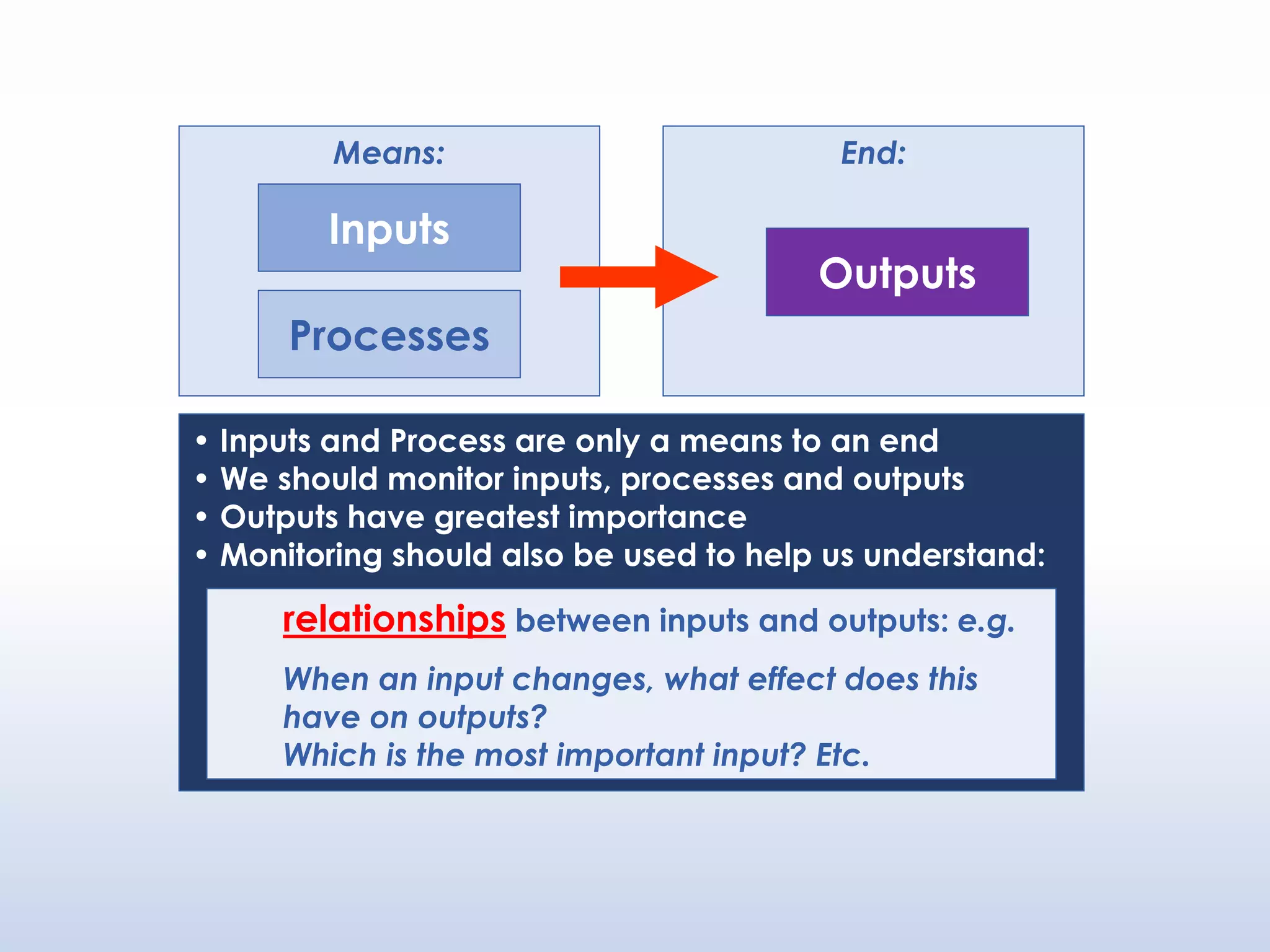
Means: End:
Inputs
Processes
Outputs
• Inputs and Process are only a means to an end
• We should monitor inputs, processes and outputs
• Outputs have greatest importance
• Monitoring should also be used to help us understand:
relationships between inputs and outputs: e.g.
When an input changes, what effect does this
have on outputs?
Which is the most important input? Etc.
After Evaluation
Celebrate successes
Replicate successful
formulas
Don’t apportion blame
Communicate and learn
through failures
Continuous Improvement
With the pace of change ever quickening, the need
to develop mechanisms for continuous learning and
innovation is greater than ever
M&E is an important part of your organizational
learning and continuous improvement
Organizational learning will create more
knowledgeable staff and a flexible organization
where people will accept and adapt to new
ideas and changes through a shared vision
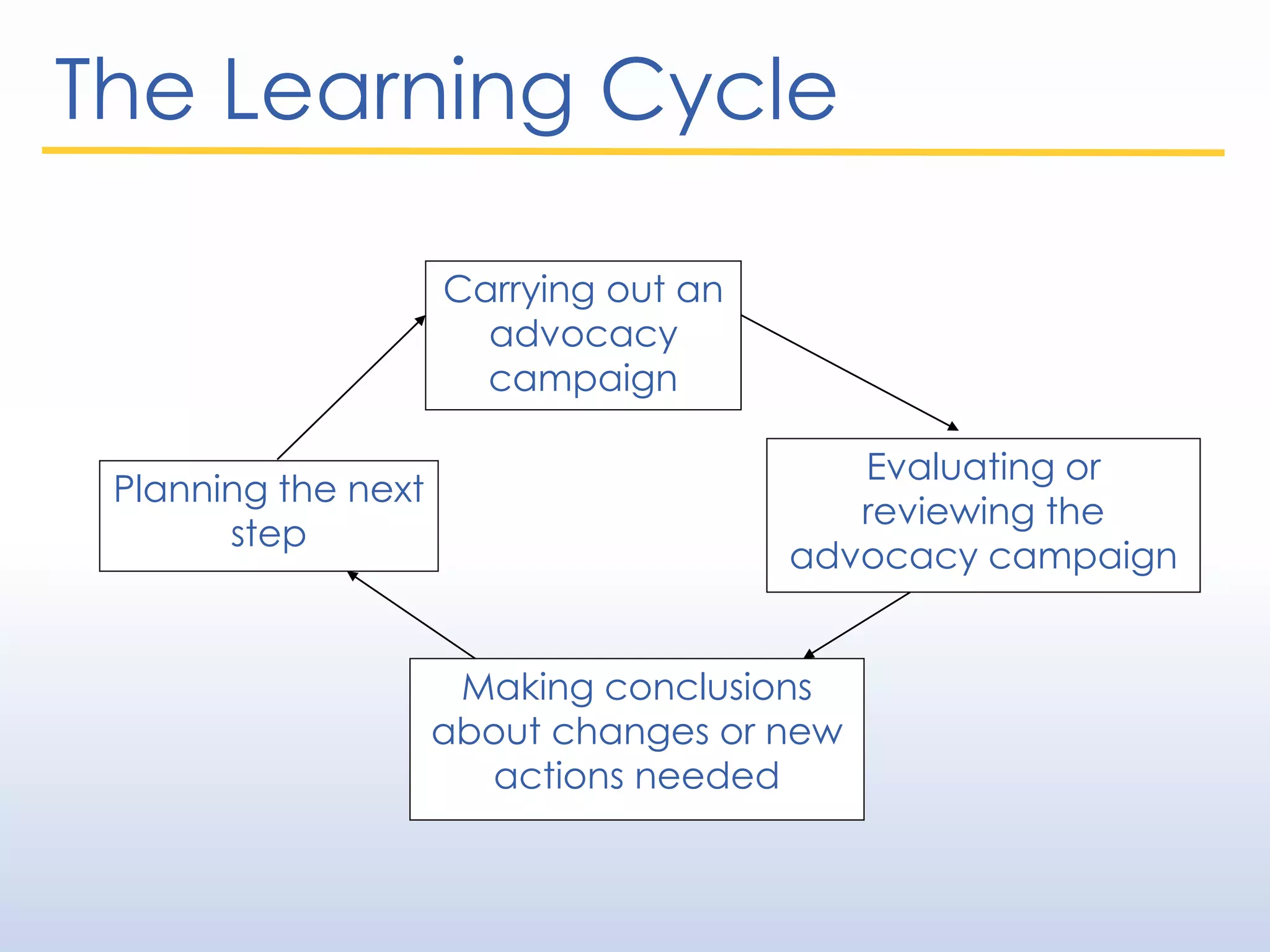
The Learning Cycle
Carrying out an
advocacy
campaign
Evaluating or
reviewing the
advocacy campaign
Making conclusions
about changes or new
actions needed
Planning the next
step
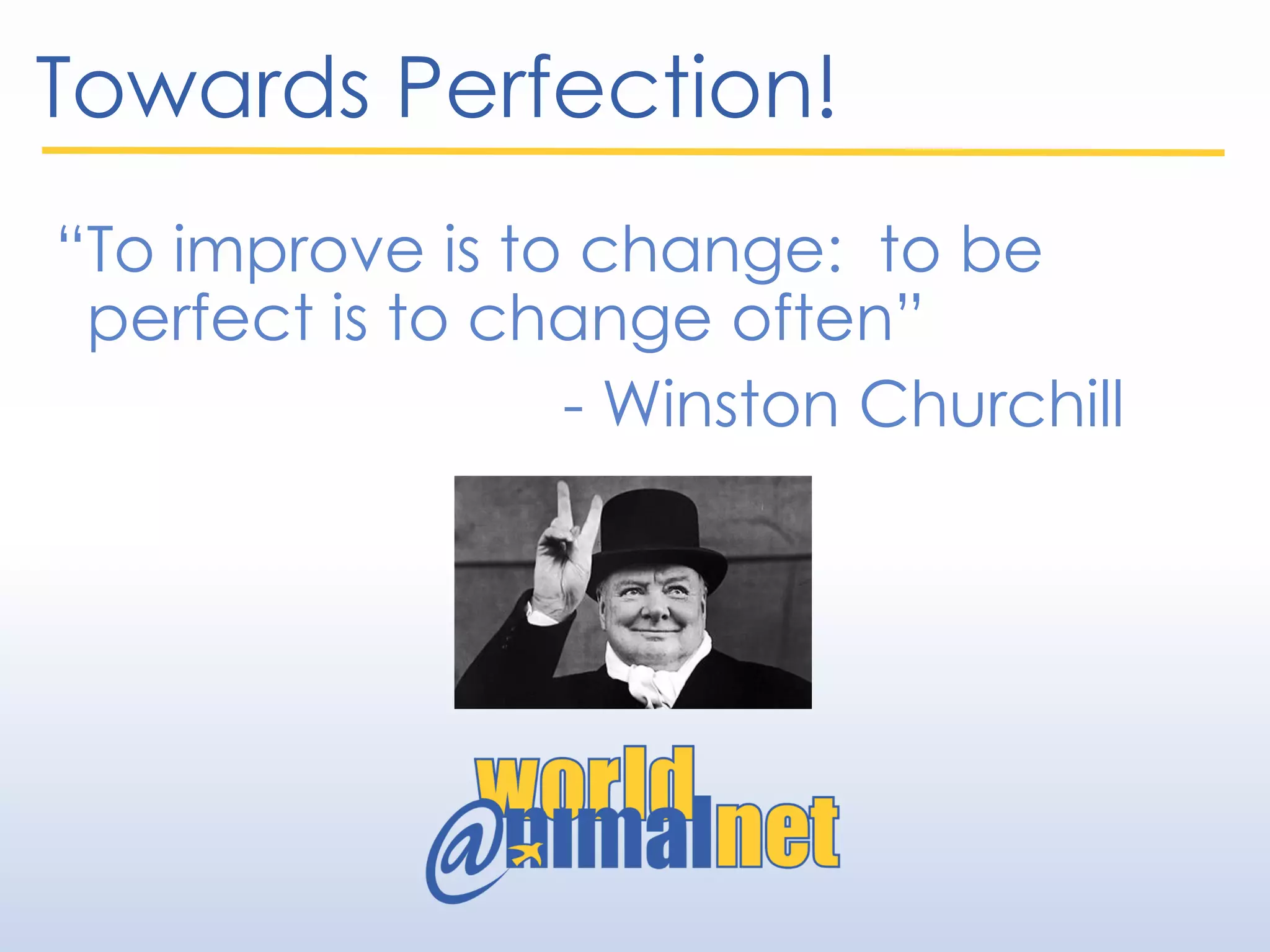
Towards Perfection!
“To improve is to change: to be
perfect is to change often”
- Winston Churchill

Module 8 - Monitoring and Evaluation

  • 1.
  • 2.
    Value of M& E Learn from experience, and share this learning (especially important if you are part of an alliance/coalition) Adapt plans to respond to events Improve the effectiveness of future advocacy work Ensure that resources are used in the most effective way possible Be accountable to managers, colleagues and funders
  • 3.
    What’s the Difference?! Monitoring- is a process that tracks the implementation of activities [It checks that we are implementing activities according to our action plan.] Evaluation - assesses the results of our project at one point in time [In short-scale projects, this would be on completion – but in longer-scale projects, it could be done periodically.]
  • 4.
    Monitoring is about keepingto the plan: Not about questioning the plan It takes place during And may involve diagnosis and remedial action to get back on track
  • 5.
    Evaluation questions the plan: Is/wasit the best way? Will objectives be/have they been achieved? Were we on time (expected progress made?) What have we learned? What can we change to increase success? Is it worth doing (again)?
  • 6.
    Designing Your M&E System Beforedesigning your M&E system, think carefully about the changes you are trying to achieve, and how these can be brought about Do at action planning stage, and build results into plan Theory of Change – see next slide
  • 8.
    Advocacy Change Advocacy changesare difficult to measure They also occur at multiple levels – See the next slide! Changing the world for animals!
  • 9.
    Animal Welfare Policy/Policy-makers Advocacy Coalition/Alliance Partners Organization Impact– scale and significance of change in animal welfare Outcome – change in policy and/or behaviour of policy- makers Outcome –capacity development: changes in capacity, policy or practices of the coalition/alliance (if any) Outcome – capacity development: changes in capacity, policy or practices of your partner (if any) Outcome – change in policy, capacity and/or practices of your organization Ripples of Advocacy Change
  • 10.
    Key Questions  Whatis the purpose of carrying out M&E  Who needs, uses M&E information  Who carries out M&E?  How is M&E carried out?  When should M&E be carried out?  Frequency?
  • 11.
    What Sort ofData? See the Module Notes for info on the type of data which you could collect on your advocacy plan But decide on the data that is most relevant for measuring your objectives Do what suits your advocacy plan! The data needed, and the reasons for its collection, should be known and understood by all
  • 12.
    Methods of CollectingData  Reports (written or verbal)  Inspection/Field visits  Surveys/Questionnaires/Interviews  Participatory Meetings  Participatory Techniques (e.g. SWOT Analysis, Matrix Ranking—see our Advocacy Toolkit) – build teamwork and understanding
  • 13.
    Measuring We need indicatorsto measure results
  • 14.
    Indicators  Help tomeasure change by showing progress towards meeting objectives  Observable, measurable, and agreed upon as valid markers of progress towards objectives  Indicators differ from objectives in that they address specific criteria that will be used to judge the success of the project or program
  • 15.
    Features of GoodIndicators  Valid: Measures the effect it is supposed to measure  Reliable: Gives same result if measured in the same way  Precise: Is operationally defined so people are clear about what they are measuring  Timely: Can be measured at an interval that is appropriate to the level of change expected  Comparable: Can be compared across different project approaches
  • 16.
    Proxy Indicators Proxy indicatorscan be helpful in advocacy work because of the difficulty of attributing results (and often intangible outcomes) They are plausible indicators of outcomes or progress towards an outcome In particular, they can be a legitimate way to measure an individual organisation’s roles in coalition work. There is more about Proxy Indicators in the module notes
  • 17.
    Means: End: Inputs Processes Outputs • Inputsand Process are only a means to an end • We should monitor inputs, processes and outputs • Outputs have greatest importance • Monitoring should also be used to help us understand: relationships between inputs and outputs: e.g. When an input changes, what effect does this have on outputs? Which is the most important input? Etc.
  • 18.
    After Evaluation Celebrate successes Replicatesuccessful formulas Don’t apportion blame Communicate and learn through failures
  • 19.
    Continuous Improvement With thepace of change ever quickening, the need to develop mechanisms for continuous learning and innovation is greater than ever M&E is an important part of your organizational learning and continuous improvement Organizational learning will create more knowledgeable staff and a flexible organization where people will accept and adapt to new ideas and changes through a shared vision
  • 20.
    The Learning Cycle Carryingout an advocacy campaign Evaluating or reviewing the advocacy campaign Making conclusions about changes or new actions needed Planning the next step
  • 21.
    Towards Perfection! “To improveis to change: to be perfect is to change often” - Winston Churchill