Networking & Alliances
Module 4
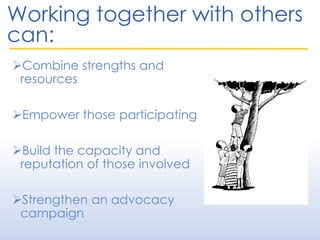
Working together with others
can:
Combine strengths and
resources
Empower those participating
Build the capacity and
reputation of those involved
Strengthen an advocacy
campaign
Principles of Partnership
Advocacy
Integration – mainstream in your organization’s work
Joint planning – with your own steering group too
Play to your strengths – know and use skills/resources
Focus on capacity building – and continuous
improvement
Share visibility
Models of Joint Working
Networks:
Primarily for information sharing
Alliances:
Longer-term strategic partnerships
Coalitions:
Usually formed for a single issue or campaign
Federations:
Ongoing collaboration in a union or
association
Advantages &
Disadvantages
• There are many
advantages and
disadvantages in advocacy
collaboration
• Thought and analysis can
help to understand these
• In particular, think carefully
about your choice of
partners!
Careful planning can lessen risks and
surprises…
Don’t reinvent the Wheel!
• Is there an existing coalition?
• If so, consider joining or
supporting this
• But if none, consider
forming a new coalition with allies
• Read and research – see WAN’s
web resource:
http://www.worldanimal.net/our-
programs/consortiums
Forming a Coalition
Key elements are:
• A clear mission and purpose
• The involvement of committed individuals
and organizations that share this mission
• Action orientation
• Realistic objectives and tasks
• Agreed participatory management, or
decision-making structure - A joint steering
group may be useful from an early stage
Role of Coalition Leadership
• Promote participatory planning and decision
making
• Delegate tasks
• Spread responsibilities and workload across
members
• Share information readily
• Foster trust, openness and honesty among
members
• Motivate and empowers members
• Act as role model
• Ensure that coalition members practice
cooperation, not competition
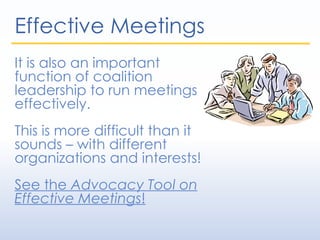
Effective Meetings
It is also an important
function of coalition
leadership to run meetings
effectively.
This is more difficult than it
sounds – with different
organizations and interests!
See the Advocacy Tool on
Effective Meetings!
Starting a coalition is the
easy part…
Developing the coalition and keeping
momentum is far more difficult!

Module 4 - Networking and Alliances

  • 1.
  • 2.
    Working together withothers can: Combine strengths and resources Empower those participating Build the capacity and reputation of those involved Strengthen an advocacy campaign
  • 3.
    Principles of Partnership Advocacy Integration– mainstream in your organization’s work Joint planning – with your own steering group too Play to your strengths – know and use skills/resources Focus on capacity building – and continuous improvement Share visibility
  • 4.
    Models of JointWorking Networks: Primarily for information sharing Alliances: Longer-term strategic partnerships Coalitions: Usually formed for a single issue or campaign Federations: Ongoing collaboration in a union or association
  • 5.
    Advantages & Disadvantages • Thereare many advantages and disadvantages in advocacy collaboration • Thought and analysis can help to understand these • In particular, think carefully about your choice of partners! Careful planning can lessen risks and surprises…
  • 6.
    Don’t reinvent theWheel! • Is there an existing coalition? • If so, consider joining or supporting this • But if none, consider forming a new coalition with allies • Read and research – see WAN’s web resource: http://www.worldanimal.net/our- programs/consortiums
  • 7.
    Forming a Coalition Keyelements are: • A clear mission and purpose • The involvement of committed individuals and organizations that share this mission • Action orientation • Realistic objectives and tasks • Agreed participatory management, or decision-making structure - A joint steering group may be useful from an early stage
  • 8.
    Role of CoalitionLeadership • Promote participatory planning and decision making • Delegate tasks • Spread responsibilities and workload across members • Share information readily • Foster trust, openness and honesty among members • Motivate and empowers members • Act as role model • Ensure that coalition members practice cooperation, not competition
  • 9.
    Effective Meetings It isalso an important function of coalition leadership to run meetings effectively. This is more difficult than it sounds – with different organizations and interests! See the Advocacy Tool on Effective Meetings!
  • 10.
    Starting a coalitionis the easy part… Developing the coalition and keeping momentum is far more difficult!