Basic Principles of Monitoring & Evaluation
A Guide to Coalition Building – Training slides
What we will do in this session
• Review the definition of monitoring and evaluation
• Review monitoring and evaluation principles for development projects
• Monitoring and Evaluation for Advocacy: Approaches and Challenges
What is it: Monitoring
and Evaluation
Monitoring
What is it:
Regular collection and analysis of information
What is it used for:
• Track progress against planned activities
• Verify compliance with standards
• Identify trends and patterns
• Adapting strategies
Make informed decisions for project/programme management
Evaluation
What is it:
The evaluation systematically and objectively measures the extent to which the
project has achieved its intended objectives and the extent to which changes in
results can be attributed to the project/programme
It includes the following 5 key elements:
1. Relevance
2. Efficacy
3. Efficiency
4. Impact
5. Durability
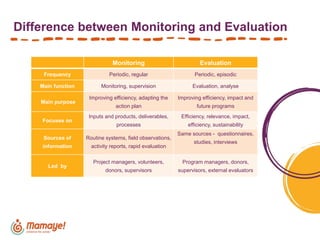
Difference between Monitoring and Evaluation
Monitoring​ Evaluation​
Frequency​ Periodic, regular​ Periodic, episodic​
Main function​ Monitoring, supervision Evaluation, analyse​
Main purpose
Improving efficiency, adapting the
action plan
Improving efficiency, impact and
future programs
Focuses on
Inputs and products, deliverables,
processes
Efficiency, relevance, impact,
efficiency, sustainability
Sources of
information
Routine systems, field observations,
activity reports, rapid evaluation
Same sources - questionnaires,
studies, interviews
Led by
Project managers, volunteers,
donors, supervisors
Program managers, donors,
supervisors, external evaluators
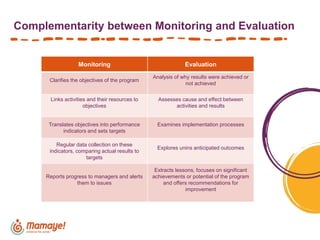
Complementarity between Monitoring and Evaluation
Monitoring Evaluation
Clarifies the objectives of the program
Analysis of why results were achieved or
not achieved
Links activities and their resources to
objectives
Assesses cause and effect between
activities and results
Translates objectives into performance
indicators and sets targets
Examines implementation processes
Regular data collection on these
indicators, comparing actual results to
targets
Explores unins anticipated outcomes
Reports progress to managers and alerts
them to issues
Extracts lessons, focuses on significant
achievements or potential of the program
and offers recommendations for
improvement
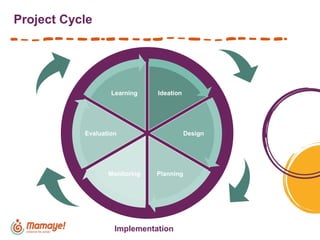
The project cycle
Project Cycle
Implementation
Ideation
Design
Planning
Monitoring
Evaluation
Learning
Results-based
management (RBM)
RBM: what is it?
• It’s a definition of realistic expected results, based on appropriate
analysys
• It includes an accurate identification of programme’s
beneficiaries and development of programmes that meet their
needs
• It includes monitoring, based on appropriate indicators, of progress
based on results and resources consumed
• It comprises identification and management of risks, while taking
into account expected results and required resources
• It aims at increasing knowledge by learning from experience and
integrating them into the decision-making process
• It includes reporting on results achieved and resources used
Key elements of RBM
• Theory of Change: The History of Change. How will the project, in its
context and environment, achieve the expected objective and impact
• Steps to Change: Link to the Advocacy Handbook
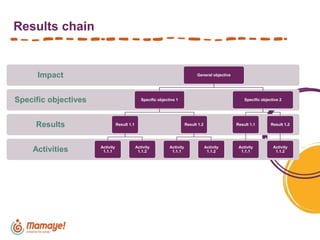
• Result framework: A visualization of the result chain between
activities, results and objectives
• Logical framework: A table summarizing the activities under their
relative results and objectives, as well as the indicators and
assumptions of the project (several models exist with more or less
information, depending on the use and the funder)
Results chain
Activities
Results
Specific objectives
Impact General objective
Specific objective 1
Result 1.1
Activity
1.1.1
Activity
1.1.2
Result 1.2
Activity
1.1.1
Activity
1.1.2
Specific objective 2
Result 1.1
Activity
1.1.1
Result 1.2
Activity
1.1.2
Objectives and results
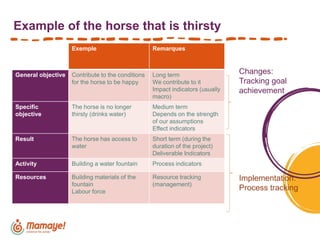
Example of the horse that is thirsty
Exemple Remarques
General objective Contribute to the conditions
for the horse to be happy
Long term
We contribute to it
Impact indicators (usually
macro)
Specific
objective
The horse is no longer
thirsty (drinks water)
Medium term
Depends on the strength
of our assumptions
Effect indicators
Result The horse has access to
water
Short term (during the
duration of the project)
Deliverable Indicators
Activity Building a water fountain Process indicators
Resources Building materials of the
fountain
Labour force
Resource tracking
(management)
Changes:
Tracking goal
achievement
Implementation:
Process tracking
Indicators
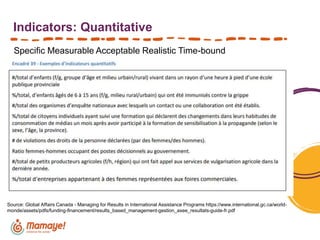
Indicators: Quantitative
Specific Measurable Acceptable Realistic Time-bound
Source: Global Affairs Canada - Managing for Results in International Assistance Programs https://www.international.gc.ca/world-
monde/assets/pdfs/funding-financement/results_based_management-gestion_axee_resultats-guide-fr.pdf
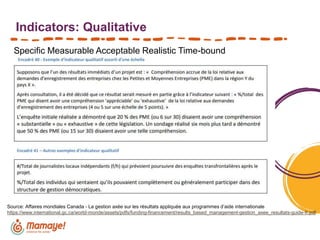
Indicators: Qualitative
Specific Measurable Acceptable Realistic Time-bound
Source: Affaires mondiales Canada - La gestion axée sur les résultats appliquée aux programmes d’aide internationale
https://www.international.gc.ca/world-monde/assets/pdfs/funding-financement/results_based_management-gestion_axee_resultats-guide-fr.pdf
Monitoring and
Evaluation Framework
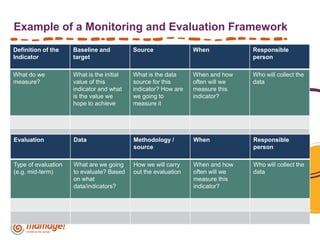
Example of a Monitoring and Evaluation Framework
Definition of the
Indicator
Baseline and
target
Source When Responsible
person
What do we
measure?
What is the initial
value of this
indicator and what
is the value we
hope to achieve
What is the data
source for this
indicator? How are
we going to
measure it
When and how
often will we
measure this
indicator?
Who will collect the
data
Evaluation Data Methodology /
source
When Responsible
person
Type of evaluation
(e.g. mid-term)
What are we going
to evaluate? Based
on what
data/indicators?
How we will carry
out the evaluation
When and how
often will we
measure this
indicator?
Who will collect the
data
M&E for advocacy
What are the challenges for advocacy M&E?
The M&E process is continuous, and it affects the whole cycle of
your project/activity. A similar approach can be used to monitor
your advocacy as well.
M&E for Advocacy
• It’s similar to the Monitoring and Evaluation of a project
• The difference is in indicators, how the progress is measured and
how the approaches are evaluated
• Advocacy is often very complex and is the result of several
contributions which makes it hard to monitor
• Decision-makers can sometimes be ‘adversaries’, which can
complicate data collection and the objectivity of assessments
How do we follow up on our advocacy?
• Track and measure intermediate outcomes
• Document your activities and have multiple data sources
• Using policy experts as a source of information
Checklist for Monitoring and Evaluation for Advocacy
□ SMART Advocacy Goals
□ Intermediate long- and medium-term objectives
□ Milestones (Important for Advocacy)
□ SMART Indicators
□ Data collection methods
□ Baselines
□ Targets
□ Activities and logic of intervention
□ Data analysis and reporting
□ Journals and reflections
□ Evaluation

Evaluation_Training.pptx

  • 1.
    Basic Principles ofMonitoring & Evaluation A Guide to Coalition Building – Training slides
  • 2.
    What we willdo in this session • Review the definition of monitoring and evaluation • Review monitoring and evaluation principles for development projects • Monitoring and Evaluation for Advocacy: Approaches and Challenges
  • 3.
    What is it:Monitoring and Evaluation
  • 4.
    Monitoring What is it: Regularcollection and analysis of information What is it used for: • Track progress against planned activities • Verify compliance with standards • Identify trends and patterns • Adapting strategies Make informed decisions for project/programme management
  • 5.
    Evaluation What is it: Theevaluation systematically and objectively measures the extent to which the project has achieved its intended objectives and the extent to which changes in results can be attributed to the project/programme It includes the following 5 key elements: 1. Relevance 2. Efficacy 3. Efficiency 4. Impact 5. Durability
  • 6.
    Difference between Monitoringand Evaluation Monitoring​ Evaluation​ Frequency​ Periodic, regular​ Periodic, episodic​ Main function​ Monitoring, supervision Evaluation, analyse​ Main purpose Improving efficiency, adapting the action plan Improving efficiency, impact and future programs Focuses on Inputs and products, deliverables, processes Efficiency, relevance, impact, efficiency, sustainability Sources of information Routine systems, field observations, activity reports, rapid evaluation Same sources - questionnaires, studies, interviews Led by Project managers, volunteers, donors, supervisors Program managers, donors, supervisors, external evaluators
  • 7.
    Complementarity between Monitoringand Evaluation Monitoring Evaluation Clarifies the objectives of the program Analysis of why results were achieved or not achieved Links activities and their resources to objectives Assesses cause and effect between activities and results Translates objectives into performance indicators and sets targets Examines implementation processes Regular data collection on these indicators, comparing actual results to targets Explores unins anticipated outcomes Reports progress to managers and alerts them to issues Extracts lessons, focuses on significant achievements or potential of the program and offers recommendations for improvement
  • 8.
  • 9.
  • 10.
  • 11.
    RBM: what isit? • It’s a definition of realistic expected results, based on appropriate analysys • It includes an accurate identification of programme’s beneficiaries and development of programmes that meet their needs • It includes monitoring, based on appropriate indicators, of progress based on results and resources consumed • It comprises identification and management of risks, while taking into account expected results and required resources • It aims at increasing knowledge by learning from experience and integrating them into the decision-making process • It includes reporting on results achieved and resources used
  • 12.
    Key elements ofRBM • Theory of Change: The History of Change. How will the project, in its context and environment, achieve the expected objective and impact • Steps to Change: Link to the Advocacy Handbook • Result framework: A visualization of the result chain between activities, results and objectives • Logical framework: A table summarizing the activities under their relative results and objectives, as well as the indicators and assumptions of the project (several models exist with more or less information, depending on the use and the funder)
  • 13.
    Results chain Activities Results Specific objectives ImpactGeneral objective Specific objective 1 Result 1.1 Activity 1.1.1 Activity 1.1.2 Result 1.2 Activity 1.1.1 Activity 1.1.2 Specific objective 2 Result 1.1 Activity 1.1.1 Result 1.2 Activity 1.1.2
  • 14.
  • 15.
    Example of thehorse that is thirsty Exemple Remarques General objective Contribute to the conditions for the horse to be happy Long term We contribute to it Impact indicators (usually macro) Specific objective The horse is no longer thirsty (drinks water) Medium term Depends on the strength of our assumptions Effect indicators Result The horse has access to water Short term (during the duration of the project) Deliverable Indicators Activity Building a water fountain Process indicators Resources Building materials of the fountain Labour force Resource tracking (management) Changes: Tracking goal achievement Implementation: Process tracking
  • 16.
  • 17.
    Indicators: Quantitative Specific MeasurableAcceptable Realistic Time-bound Source: Global Affairs Canada - Managing for Results in International Assistance Programs https://www.international.gc.ca/world- monde/assets/pdfs/funding-financement/results_based_management-gestion_axee_resultats-guide-fr.pdf
  • 18.
    Indicators: Qualitative Specific MeasurableAcceptable Realistic Time-bound Source: Affaires mondiales Canada - La gestion axée sur les résultats appliquée aux programmes d’aide internationale https://www.international.gc.ca/world-monde/assets/pdfs/funding-financement/results_based_management-gestion_axee_resultats-guide-fr.pdf
  • 19.
  • 20.
    Example of aMonitoring and Evaluation Framework Definition of the Indicator Baseline and target Source When Responsible person What do we measure? What is the initial value of this indicator and what is the value we hope to achieve What is the data source for this indicator? How are we going to measure it When and how often will we measure this indicator? Who will collect the data Evaluation Data Methodology / source When Responsible person Type of evaluation (e.g. mid-term) What are we going to evaluate? Based on what data/indicators? How we will carry out the evaluation When and how often will we measure this indicator? Who will collect the data
  • 21.
  • 22.
    What are thechallenges for advocacy M&E? The M&E process is continuous, and it affects the whole cycle of your project/activity. A similar approach can be used to monitor your advocacy as well.
  • 23.
    M&E for Advocacy •It’s similar to the Monitoring and Evaluation of a project • The difference is in indicators, how the progress is measured and how the approaches are evaluated • Advocacy is often very complex and is the result of several contributions which makes it hard to monitor • Decision-makers can sometimes be ‘adversaries’, which can complicate data collection and the objectivity of assessments
  • 24.
    How do wefollow up on our advocacy? • Track and measure intermediate outcomes • Document your activities and have multiple data sources • Using policy experts as a source of information
  • 25.
    Checklist for Monitoringand Evaluation for Advocacy □ SMART Advocacy Goals □ Intermediate long- and medium-term objectives □ Milestones (Important for Advocacy) □ SMART Indicators □ Data collection methods □ Baselines □ Targets □ Activities and logic of intervention □ Data analysis and reporting □ Journals and reflections □ Evaluation

Editor's Notes

  • #6 Relevance: Relevance seeks to know if the project was applicable to the problem it intended to solve Is the intervention appropriate to the priorities of the beneficiaries? Are the objectives still valid? Are the activities and outputs consistent with the project goal? Efficiency: Was the project completed on time? Was the project delivered on budget? Was the project scope delivered as planned? Effectiveness: Effectiveness means the ability of the project to achieve the planned objectives The extend to which the project objectives were achieved. The factors that influenced the achievement of the objectives. The factors that kept the project from achieving the objectives. Impact: is about the positive and negative changes produced by the project, directly or indirectly, intended or unintended. This involves the main impacts and effects resulting from the project on the social, economic, environmental and other development indicators in the target group of beneficiaries. What has happened as a result of the project? What real difference has the project made to the beneficiaries? How many people have been affected? Sustainability is concerned with measuring whether the benefits of an activity are likely to continue after the project has ended. When evaluating the sustainability of a project, it is useful to consider the following questions: • To what extent did the benefits of the project continue after the end of the project? • What were the major factors which influenced the achievement or nonachievement of sustainability in the project?
  • #10 The DME cycle, contains three basic components. There is the design component, the monitoring component, and the evaluation component of the cycle. In this model there is a tight relationship amongst these components. The design will create the documents and the plans that are used to implement and monitor the project activities. The data collected during monitoring, provides information used in the evaluation phase. The evaluation component in turn provides recommendations back into the design component that can be used for future projects.
  • #21 Takes the logical framework but adds other indicators as well