Clinical Supervision Foundations
Module Seven
Counselor Development
Covered Thus Far:
1. Definition and Roles
2. Personal Theory
3. Supervisory Alliance
4. Modalities & Methods
5. Assessment Resources
6. Performance Evaluation
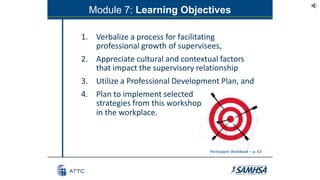
Module 7: Learning Objectives
1. Verbalize a process for facilitating
professional growth of supervisees,
2. Appreciate cultural and contextual factors
that impact the supervisory relationship
3. Utilize a Professional Development Plan, and
4. Plan to implement selected
strategies from this workshop
in the workplace.
Participant Workbook – p. 63
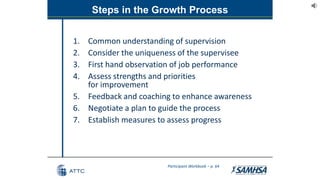
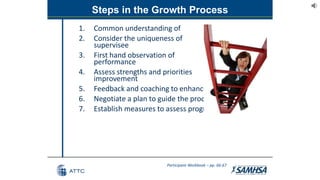
Steps in the Growth Process
1. Common understanding of supervision
2. Consider the uniqueness of the supervisee
3. First hand observation of job performance
4. Assess strengths and priorities
for improvement
5. Feedback and coaching to enhance awareness
6. Negotiate a plan to guide the process
7. Establish measures to assess progress
Participant Workbook – p. 64
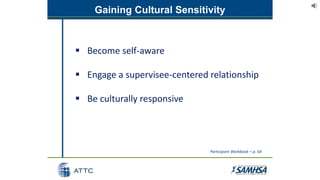
Gaining Cultural Sensitivity
 Become self-aware
 Engage a supervisee-centered relationship
 Be culturally responsive
Participant Workbook – p. 64
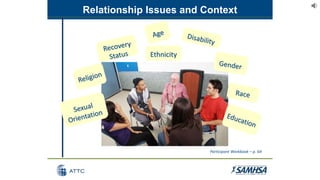
Relationship Issues and Context
Ethnicity
Participant Workbook – p. 64
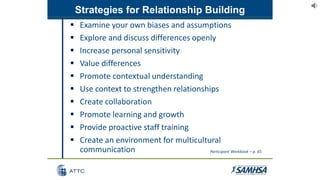
Strategies for Relationship Building
 Examine your own biases and assumptions
 Explore and discuss differences openly
 Increase personal sensitivity
 Value differences
 Promote contextual understanding
 Use context to strengthen relationships
 Create collaboration
 Promote learning and growth
 Provide proactive staff training
 Create an environment for multicultural
communication Participant Workbook – p. 65
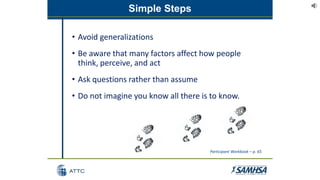
Simple Steps
• Avoid generalizations
• Be aware that many factors affect how people
think, perceive, and act
• Ask questions rather than assume
• Do not imagine you know all there is to know.
Participant Workbook – p. 65
Steps in the Growth Process
1. Common understanding of supervision
2. Consider the uniqueness of the
supervisee
3. First hand observation of job
performance
4. Assess strengths and priorities for
improvement
5. Feedback and coaching to enhance awareness
6. Negotiate a plan to guide the process
7. Establish measures to assess progress
Participant Workbook – pp. 66-67
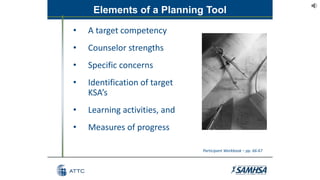
Elements of a Planning Tool
• A target competency
• Counselor strengths
• Specific concerns
• Identification of target
KSA’s
• Learning activities, and
• Measures of progress
Participant Workbook – pp. 66-67
Self-Care/Ongoing Growth
Thoughts/Feelings
What are your thoughts about working
with new supervisees?
Tip 21-A Definition of a Supervisor
“A social influence process that occurs over time, in which
the supervisor participates with supervisees to ensure
quality clinical care. Effective supervisors observe,
mentor, coach, evaluate, inspire, and create an
atmosphere that promotes self-motivation, learning, and
professional development. They build teams, create
cohesion, resolve conflict, and shape
agency culture, while attending to ethical and diversity
issues in all aspects of the process. Such supervision is key
to both quality improvement and the successful
implementation of consensus- and evidence-based
practices.”
Worksite Assignment
• Review TAP 21-A
• Select a Foundation Area or Performance
Domain
• Do a self-assessment of your proficiency
in the selected area
• Choose a competency that you want to
improve
• Build a Professional Development Plan for
yourself, focused on your selected
competency
• Send your PDP to your trainer Participant Workbook – p. 69
Module 7
Module 7

Module 7

  • 1.
    Clinical Supervision Foundations ModuleSeven Counselor Development
  • 2.
    Covered Thus Far: 1.Definition and Roles 2. Personal Theory 3. Supervisory Alliance 4. Modalities & Methods 5. Assessment Resources 6. Performance Evaluation
  • 3.
    Module 7: LearningObjectives 1. Verbalize a process for facilitating professional growth of supervisees, 2. Appreciate cultural and contextual factors that impact the supervisory relationship 3. Utilize a Professional Development Plan, and 4. Plan to implement selected strategies from this workshop in the workplace. Participant Workbook – p. 63
  • 4.
    Steps in theGrowth Process 1. Common understanding of supervision 2. Consider the uniqueness of the supervisee 3. First hand observation of job performance 4. Assess strengths and priorities for improvement 5. Feedback and coaching to enhance awareness 6. Negotiate a plan to guide the process 7. Establish measures to assess progress Participant Workbook – p. 64
  • 5.
    Gaining Cultural Sensitivity Become self-aware  Engage a supervisee-centered relationship  Be culturally responsive Participant Workbook – p. 64
  • 6.
    Relationship Issues andContext Ethnicity Participant Workbook – p. 64
  • 7.
    Strategies for RelationshipBuilding  Examine your own biases and assumptions  Explore and discuss differences openly  Increase personal sensitivity  Value differences  Promote contextual understanding  Use context to strengthen relationships  Create collaboration  Promote learning and growth  Provide proactive staff training  Create an environment for multicultural communication Participant Workbook – p. 65
  • 8.
    Simple Steps • Avoidgeneralizations • Be aware that many factors affect how people think, perceive, and act • Ask questions rather than assume • Do not imagine you know all there is to know. Participant Workbook – p. 65
  • 9.
    Steps in theGrowth Process 1. Common understanding of supervision 2. Consider the uniqueness of the supervisee 3. First hand observation of job performance 4. Assess strengths and priorities for improvement 5. Feedback and coaching to enhance awareness 6. Negotiate a plan to guide the process 7. Establish measures to assess progress Participant Workbook – pp. 66-67
  • 10.
    Elements of aPlanning Tool • A target competency • Counselor strengths • Specific concerns • Identification of target KSA’s • Learning activities, and • Measures of progress Participant Workbook – pp. 66-67
  • 11.
  • 12.
  • 13.
    Thoughts/Feelings What are yourthoughts about working with new supervisees?
  • 14.
    Tip 21-A Definitionof a Supervisor “A social influence process that occurs over time, in which the supervisor participates with supervisees to ensure quality clinical care. Effective supervisors observe, mentor, coach, evaluate, inspire, and create an atmosphere that promotes self-motivation, learning, and professional development. They build teams, create cohesion, resolve conflict, and shape agency culture, while attending to ethical and diversity issues in all aspects of the process. Such supervision is key to both quality improvement and the successful implementation of consensus- and evidence-based practices.”
  • 15.
    Worksite Assignment • ReviewTAP 21-A • Select a Foundation Area or Performance Domain • Do a self-assessment of your proficiency in the selected area • Choose a competency that you want to improve • Build a Professional Development Plan for yourself, focused on your selected competency • Send your PDP to your trainer Participant Workbook – p. 69

Editor's Notes

  • #3 Trainer Guidebook – page 79
  • #4 Trainer Guidebook – page 79
  • #5 Trainer Guidebook – page 80
  • #6 Trainer Guidebook – page 81
  • #7 Trainer Guidebook – page 81
  • #8 Trainer Guidebook – page 82
  • #9 Trainer Guidebook – page 82
  • #10 Trainer Guidebook – page 83
  • #11 Trainer Guidebook – page 83
  • #12 Trainer Guidebook – pages 83-84
  • #16 Trainer Guidebook – page 88
  • #17 In closing the workshop make sure you include the instructions listed on page 87 in your Trainer Guidebook.