Clinical Supervision FoundationsModule Five
Assessment Resources
1
1. Understand the value of a developmental
perspective
2. Link TAP 21: Addiction Counseling
Competencies to the companion Performance
Assessment Rubrics
3. Assess counselor performance and develop
learning goals using TAP 21
and the Rubrics
2
Module 5: Learning Objectives
Participant Workbook – p. 43
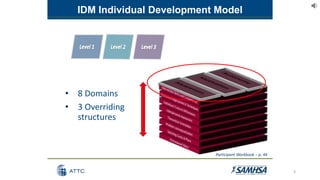
• 8 Domains
• 3 Overriding
structures
3
IDM Individual Development Model
Participant Workbook – p. 44
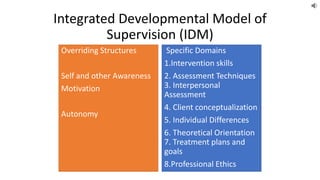
Integrated Developmental Model of
Supervision (IDM)
Overriding Structures
Self and other Awareness
Motivation
Autonomy
Specific Domains
1.Intervention skills
2. Assessment Techniques
3. Interpersonal
Assessment
4. Client conceptualization
5. Individual Differences
6. Theoretical Orientation
7. Treatment plans and
goals
8.Professional Ethics
Level I Counselor
Motivation: High Motivation, High levels of anxiety,
Skill acquisition focus
Autonomy: Dependent upon supervisor
Needs structure from supervisor, Positive feedback,
Minimum direct confrontation
Awareness: Self-awareness is limited Self-focus is
high, Evaluation apprehension, Unaware of
strengths/weaknesses
Level 2 Counselor:
Motivation: Fluctuating, sometimes highly confident,
confusion, despair, vacillation
Autonomy: Dependency – autonomy conflict, Can be
quite assertive, pursue own agenda, Functions more
independently, May only want requested, specific
input, Other times dependent or evasive
Awareness: Focuses more on client, Empathy more
possible, Understanding client worldview more
possible, May become enmeshed, May become
confused, Appropriate balance is an issue
Level 3
Motivation: Stable motivation, doubts remain, but
not disabling, Total professional identity is the focus
Autonomy: Firm belief in own autonomy, knows
when to seek consultation, retains responsibility
Awareness: Accepts own strengths and weaknesses,
High empathy and understanding
Each counselor will develop at a different
pace in each of the multiple professional
areas. Two counselors may be considered
level 1 but one will be more competent in
certain areas while the others will be ahead
in other areas.
Performance issues for each will also
differ. Supervision, therefore, cannot be the
same for both. It must be individualized
and focus on the needs of each counselor
Measuring Competency
10
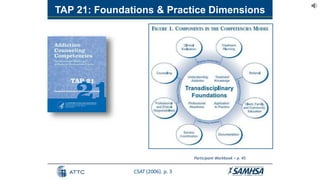
TAP 21: Foundations & Practice Dimensions
CSAT (2006). p. 3
Participant Workbook – p. 45
Please Watch the Following Short Video
12
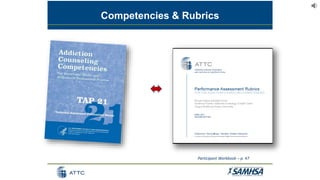
Competencies & Rubrics
Participant Workbook – p. 47
13
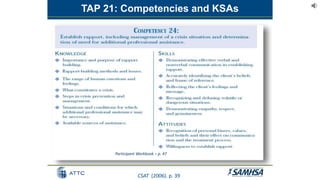
TAP 21: Competencies and KSAs
CSAT (2006). p. 39
Participant Workbook – p. 47
14
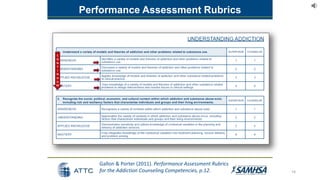
Performance Assessment Rubrics
Gallon & Porter (2011). Performance Assessment Rubrics
for the Addiction Counseling Competencies, p.12.
C
O
N
T
I
N
U
U
M
16
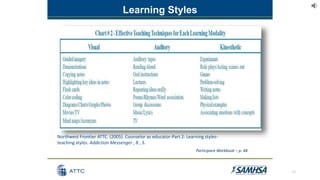
Learning Styles
Northwest Frontier ATTC. (2005). Counselor as educator-Part 2: Learning styles-
teaching styles. Addiction Messenger , 8 , 3.
Participant Workbook – p. 48
 Provide focused support
 Continually assess counselor
needs
 Facilitate outcome-oriented
planning
 Recommend training
opportunities
 Assist in developing a career
ladder
17
Tailored Supervision
Participant Workbook – p. 48

Module 5

  • 1.
    Clinical Supervision FoundationsModuleFive Assessment Resources 1
  • 2.
    1. Understand thevalue of a developmental perspective 2. Link TAP 21: Addiction Counseling Competencies to the companion Performance Assessment Rubrics 3. Assess counselor performance and develop learning goals using TAP 21 and the Rubrics 2 Module 5: Learning Objectives Participant Workbook – p. 43
  • 3.
    • 8 Domains •3 Overriding structures 3 IDM Individual Development Model Participant Workbook – p. 44
  • 4.
    Integrated Developmental Modelof Supervision (IDM) Overriding Structures Self and other Awareness Motivation Autonomy Specific Domains 1.Intervention skills 2. Assessment Techniques 3. Interpersonal Assessment 4. Client conceptualization 5. Individual Differences 6. Theoretical Orientation 7. Treatment plans and goals 8.Professional Ethics
  • 5.
    Level I Counselor Motivation:High Motivation, High levels of anxiety, Skill acquisition focus Autonomy: Dependent upon supervisor Needs structure from supervisor, Positive feedback, Minimum direct confrontation Awareness: Self-awareness is limited Self-focus is high, Evaluation apprehension, Unaware of strengths/weaknesses
  • 6.
    Level 2 Counselor: Motivation:Fluctuating, sometimes highly confident, confusion, despair, vacillation Autonomy: Dependency – autonomy conflict, Can be quite assertive, pursue own agenda, Functions more independently, May only want requested, specific input, Other times dependent or evasive Awareness: Focuses more on client, Empathy more possible, Understanding client worldview more possible, May become enmeshed, May become confused, Appropriate balance is an issue
  • 7.
    Level 3 Motivation: Stablemotivation, doubts remain, but not disabling, Total professional identity is the focus Autonomy: Firm belief in own autonomy, knows when to seek consultation, retains responsibility Awareness: Accepts own strengths and weaknesses, High empathy and understanding
  • 8.
    Each counselor willdevelop at a different pace in each of the multiple professional areas. Two counselors may be considered level 1 but one will be more competent in certain areas while the others will be ahead in other areas. Performance issues for each will also differ. Supervision, therefore, cannot be the same for both. It must be individualized and focus on the needs of each counselor
  • 9.
  • 10.
    10 TAP 21: Foundations& Practice Dimensions CSAT (2006). p. 3 Participant Workbook – p. 45
  • 11.
    Please Watch theFollowing Short Video
  • 12.
  • 13.
    13 TAP 21: Competenciesand KSAs CSAT (2006). p. 39 Participant Workbook – p. 47
  • 14.
    14 Performance Assessment Rubrics Gallon& Porter (2011). Performance Assessment Rubrics for the Addiction Counseling Competencies, p.12. C O N T I N U U M
  • 16.
    16 Learning Styles Northwest FrontierATTC. (2005). Counselor as educator-Part 2: Learning styles- teaching styles. Addiction Messenger , 8 , 3. Participant Workbook – p. 48
  • 17.
     Provide focusedsupport  Continually assess counselor needs  Facilitate outcome-oriented planning  Recommend training opportunities  Assist in developing a career ladder 17 Tailored Supervision Participant Workbook – p. 48

Editor's Notes

  • #3 Trainer Guidebook – page 54 Ask if Participants would be willing to be in different groups????
  • #4 Trainer Guidebook – page 55
  • #10 Some have elements, others don’t In all competencies there are 3 subsections-KSA’s
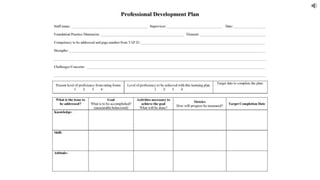
  • #11 Trainer Guidebook – page 56 NOTE: these documents may appear complex at first and can be a challenge for workshop participants who are not familiar with the TAP 21. We will spend a little time getting to know these 2 resources and how to utilize them-More time will be spent on Friday insuring competence in the TIP 21. I would like to introduce you to them though. The TAP 21 was developed by ATTC as a resource for professional development and credentialing. As we look at this I would like for you to pick it up and for a moment familiarize yourself with it. Transdisciplinary Foundation: Page 5 TAP 21 Four sets of competencies that underlie the work of all health and social service professionals who care for or work with people who have substance use disorders. Because they are thought to be prerequisite to the development of discipline specific skills the focus in the Foundations is on the knowledge and attitudes that form the basis of understanding on which discipline-specific proficiencies are build. Practice Dimensions: Page 35 TAP 21 The Practice Dimensions are comprised of eight different areas of responsibility that constitute the essential work of an addictions counseling professional. Note the Practice Dimensions are comprised of SKILLS in addition to KNOWLEDGE and ATTITUDES essential to developing proficiency in each of the competencies.
  • #13 Trainer Guidebook – page 57
  • #14 Trainer Guidebook – page 56 Turn to page 39 in your TAP 21
  • #15 Trainer Guidebook – page 58 Let’s get familiar now with your Performance Rubrics The organization of the Rubrics is similar to TAP 21 and developed by ATTC. The Rubrics provides a resource for assessing proficiency in the TAP 21 Addiction Counseling Competencies Like the TAP 21 the Rubric is also divided into 2 sections-The Transdisciplinary Foundations and the Practice Dimensions and includes all the competencies comprising the TAP 21
  • #17 Trainer Guidebook – page 61
  • #18 Trainer Guidebook – page 61