ESCO Energy Service
Company
Suppose you are the Principle of GEC
Monthly Bill of Energy is 100000 Rupees
I am the manager of ESCO came in your college and
arrange a meeting with principle
3.
Manager: Sir,you are wasting 40000 rupees on energy by monthly bill
Why you cant save this energy and save money
You can use LED, Solar lights, Battery, Storage, HVAC, Proper ventilation and
advance equipment
Principle: That’s a Fantastic Idea but we don’t have that money for
investment
4.
Manager: Don’tworry sir, Just give 60000 monthly utility bill and 30000 our
monthly payment. You can save 10000 per month. And we will update your
college and save the energy not only that we provide Fire safety, Security and
smart classes arrangement.
Principle: wow,
Principle: but if utility bill came more then 60000 then
Manager: Chill sir, we will gurrenty you that utility will be under 60000 and if
not we will pay the compensatory amount
ESCO (Energy SavingCompany) Concept
ESCOs are usually companies that provide a complete energy project service, from
assessment to design to construction or installation, along with engineering and project
management services, and financing, In one way or another, the contract involves the
capitalization of all of the services and goods purchased, and repayment out of the energy
savings that result from the project, In performance contracting, an end-user (such as an
industry, institution, or utility) seeking to improve its energy efficiency, contracts with ESCO
for energy efficiency services and financing. In some contracts, the ESCOs provide a
guarantee for the savings that will be realized, and absorbs the cost if real savings fall short
of this level. Typically. there will be a risk management cost involved in the contract in these
situations, Insurance is sometimes attached, at a cost, to protect the ESCO in the event of a
savings short fall. Energy efficiency projects generate incremental cost savings as opposed lo
incremental revenues from the sale of outputs. The energy cost savings can be turned into
incremental cashflows to the lender or ESCO based on the commitment of the energy user
(and in some cases, a utility ) to pay for the savings. ESCOs are not “bankers” in the narrow
sense, Their strength is in putting together a package of services that can provide guaranteed
and measurable energy savings that serve as the basis for guaranteed cost savings. But, the
energy savings must be measurable.
7.
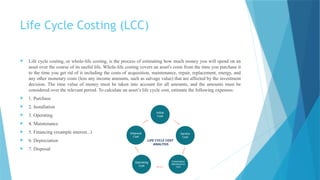
Life Cycle Costing(LCC)
Life cycle costing, or whole-life costing, is the process of estimating how much money you will spend on an
asset over the course of its useful life. Whole-life costing covers an asset's costs from the time you purchase it
to the time you get rid of it including the costs of acquisition, maintenance, repair, replacement, energy, and
any other monetary costs (less any income amounts, such as salvage value) that are affected by the investment
decision. The time value of money must be taken into account for all amounts, and the amounts must be
considered over the relevant period. To calculate an asset’s life cycle cost, estimate the following expenses:
1. Purchase
2. Installation
3. Operating
4. Maintenance
5. Financing (example interest...)
6. Depreciation
7. Disposal
8.
Energy Economics
Inthe process of energy management, al some stage, investment would be required for
reducing the energy consumption of a process or utility. Investment would be required
for modifications retrofitting and for incorporating new technology. It would be prudent
to adopt a systematic approach for merit rating of the different investment options vis-a-
vis the anticipated savings.
It is essential to identify the benefits of the proposed measure with reference to not only
energy savings but also other associated benefits such as increased productivity,
improved product quality etc., The cost involved in the proposed measure should be
captured in totality viz
Direct project cost
Additional operations and maintenance cost
Training of personnel on new technology etc.
9.
Based onthe above, the energy economics can be carried out by the energy
management team. Energy manager has to identify how cost savings arising from
energy management could be redeployed within his organization to the maximum
effect. To do this, he has to work out how benefits of increased energy efficiency can be
best sold to top management as,
Reducing operating /production costs
Increasing employee comfort and well-being
Improving cost-effectiveness and/or profits
Protecting under-funded core activities
Enhancing the quality of service or customer care delivered
Protecting the environment
10.
Cost-Benefit Analysis
Withinany organization there are many worthy causes, each of which requires funding and it is the job
of senior management to invest in capital where it is going to obtain the greatest return. In order to make
a decision about any course of action, management needs to be able to appraise all the costs involved in
a project and determine the potential benefits. This however, is not quite as simple as it might first
appear. The capital value of plant or equipment usually decreases with time and it often requires more
maintenance as it gets older, If money is borrowed from a bank to finance a project, then interest will
have to be paid on the loan. Inflation too will influence the value of any future energy savings that
might be achieved. Itis therefore important that the cost-benefit analysis allows for all these factors, with
the aim of determining which investments should be undertaken, and of optimizing the benefits
achieved. To this end a number of accounting and financial appraisal techniques have been developed
which help energy managers and auditors make correct and objective decisions. When appraising the
cost-benefit involved in a project it is important to understand the difference between fixed and variable
costs, Variable costs are those which vary directly with the output of a particular plant or production
process, such as fuel costs, Fixed costs are those costs, which are not dependent on plant or process
output, such as site-rent and insurance. The total cast of any project is therefore the sum of the fixed and
variable costs
11.
Discount Rate orRate of Return
The rate of return is the amount you receive after the cost of an initial
investment, calculated in the form of a percentage. The percentage can be
reflected as a positive, which is considered a gain or profit. When the
percentage is negative, it reflects a loss. This information is very useful in
determining whether or not the initial investment you made was a good one,
13.
Internal Rate ofReturn
This method calculates the rate of return that the investment is expected to yield. The
internal rate of return (IRR) method expresses each investment alternative in terms of a
rate of return (a compound interest rate), The expected rate of return is the interest rate
for which total discounted benefits become just equal to total discounted costs (i.e. net
present benefits or net annual benefits are equal to zero, or for which the benefit / cost
ratio equals one). The criterion for selection among alternatives is lo choose the
investment with the highest rate of return. The rate of return is usually calculated by a
process of trial and error, whereby the net cash flow is computed for various discount
rates until its value is reduced to zero. The internal rate of return (IRR) of a project is
the discount rate, which makes its net present value (NPV) equal to zero.
14.
Net Present Value
The net present valve method calculates the present value of all the yearly cash flows
(i.e. capital costs and net savings) incurred or accrued throughout the life of a project,
and summate them. The net present value (NPV) of a project is equal to the sum of the
present values of all the cash flows associated with it.
Advantages:
The net present value criterion has considerable merits.
It takes into account the time value of money.
It considers the cash flow stream in its project life.
15.
Simple Pay-Back Period
Simple Payback Period (SPP) is defined as the time (number of years) required
to recovering the initial investment (First Cost), considering only the Net
Annual Saving