Module 4
Memory System Organizationand
Architecture
Overview
• Memory systems hierarchy
• Main memory organization
• Types of Main memory-memory inter- leaving
and its characteristics and performance-
• Cache memories: address mapping-line size-
replacement and policies- coherence-
• Virtual memory systems- TLB- Reliability of
memory systems-
• Error detecting and error correcting systems
Introduction
• Programs and the data that processor operate are
held in the main memory of the computer during
execution, and the data with high storage
requirement is stored in the secondary memories.
Characteristics Of Memory Systems
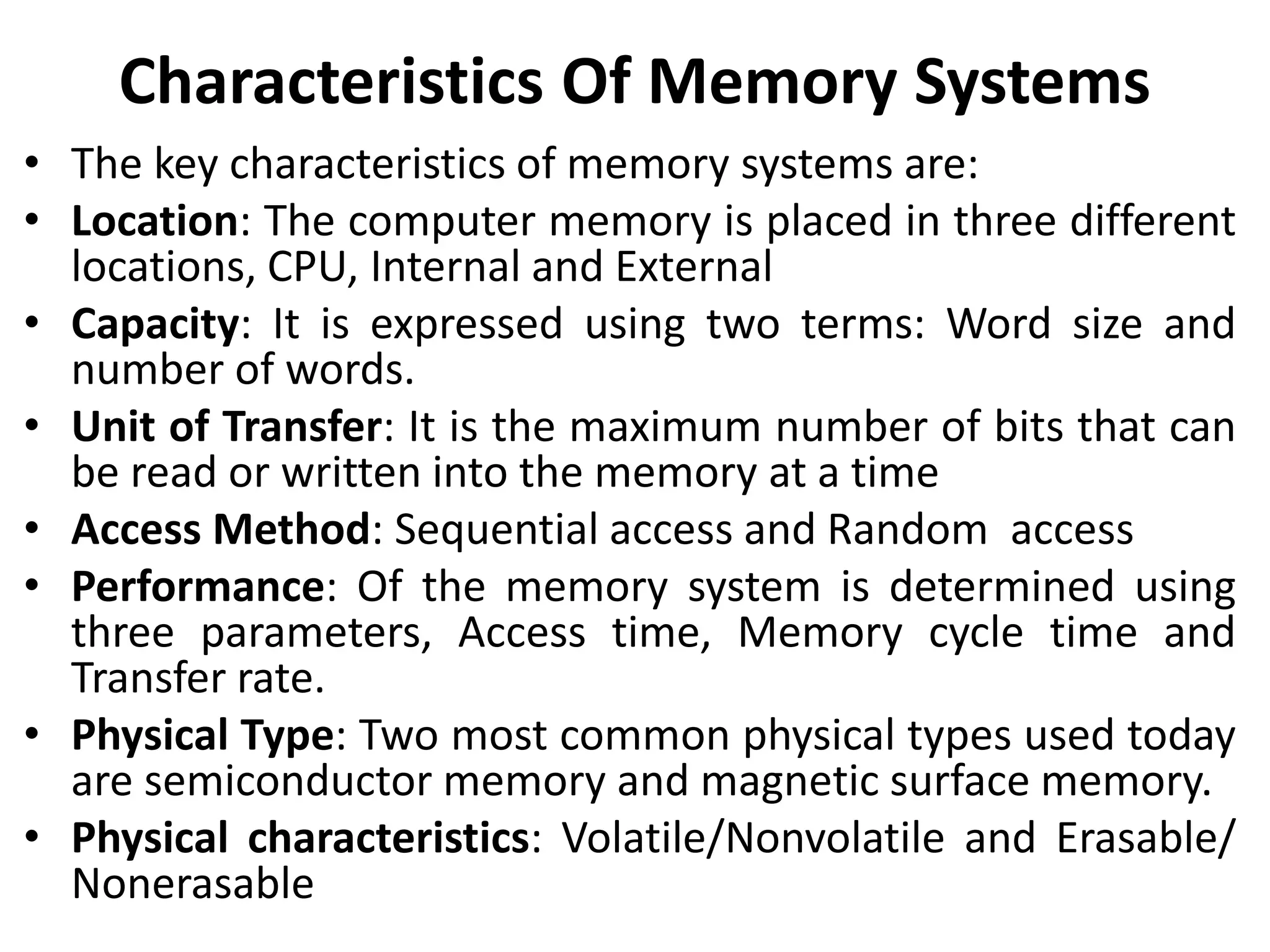
• The key characteristics of memory systems are:
• Location: The computer memory is placed in three different
locations, CPU, Internal and External
• Capacity: It is expressed using two terms: Word size and
number of words.
• Unit of Transfer: It is the maximum number of bits that can
be read or written into the memory at a time
• Access Method: Sequential access and Random access
• Performance: Of the memory system is determined using
three parameters, Access time, Memory cycle time and
Transfer rate.
• Physical Type: Two most common physical types used today
are semiconductor memory and magnetic surface memory.
• Physical characteristics: Volatile/Nonvolatile and Erasable/
Nonerasable
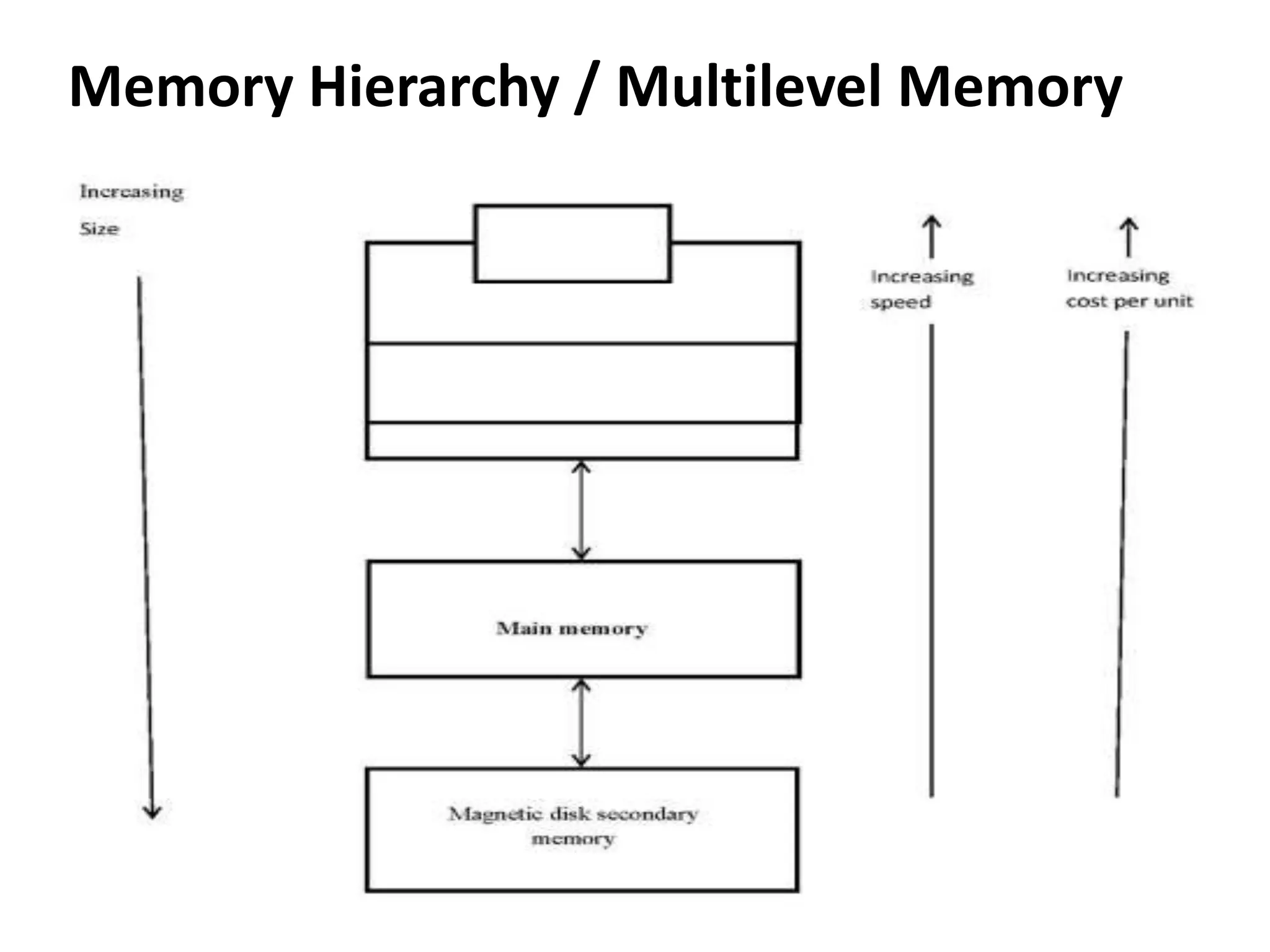
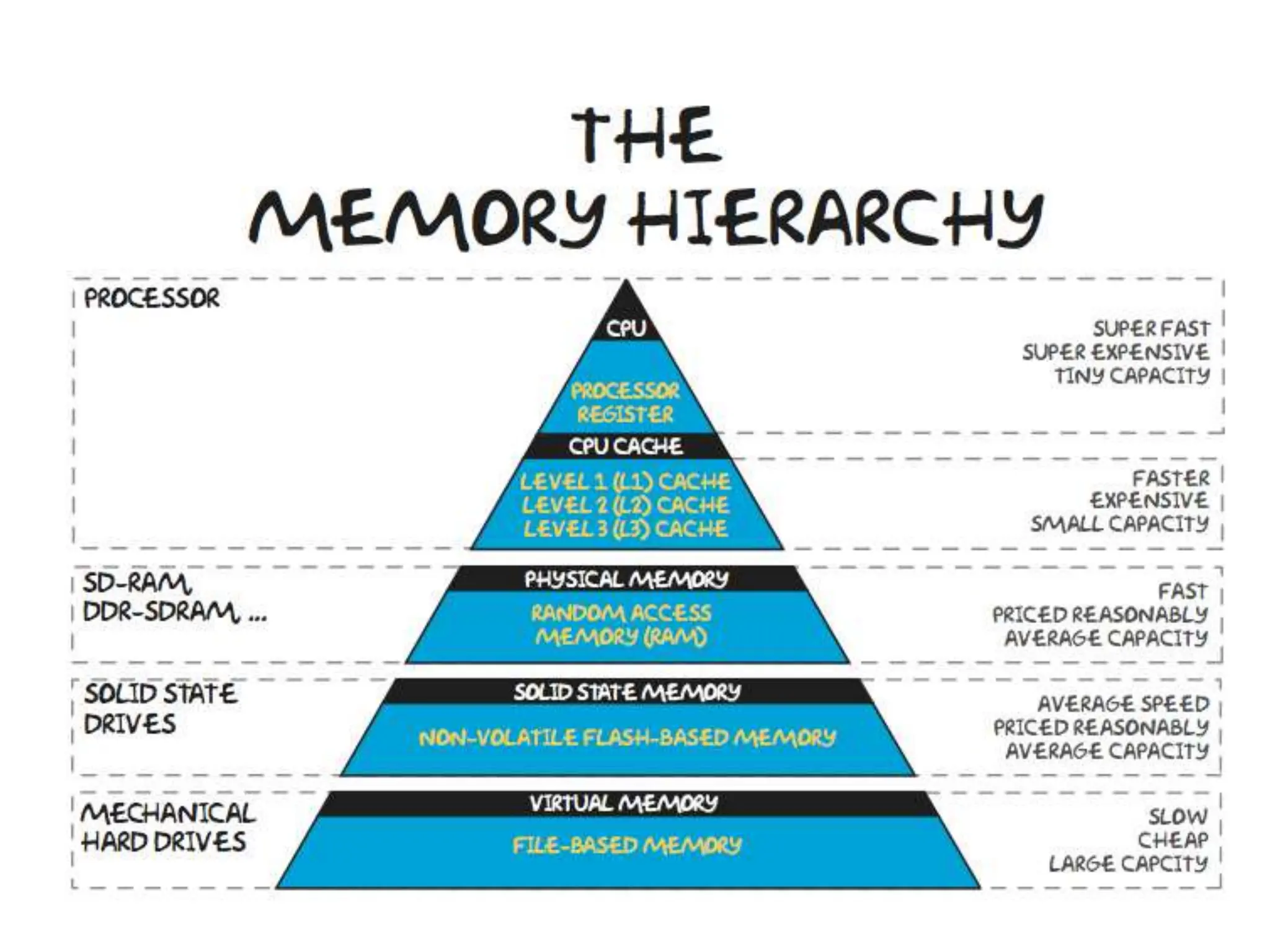
Memory Hierarchy / Multilevel Memory
• Memory unit is essential component of digital
computer since it is needed for storing programs and
data.
• Memory unit that communicates directly with CPU is
called Main memory.
• Devices that provide backup storage is called auxiliary
memory.
• Only programs and data currently needed by
processor reside in the main memory.
• All other information is stored in auxiliary memory
and transferred to main memory when needed.
Click to add text
Main Memory
• It is the memory used to store programs and data
during the computer operation.
• The principal technology is based on
semiconductor integrated circuits.
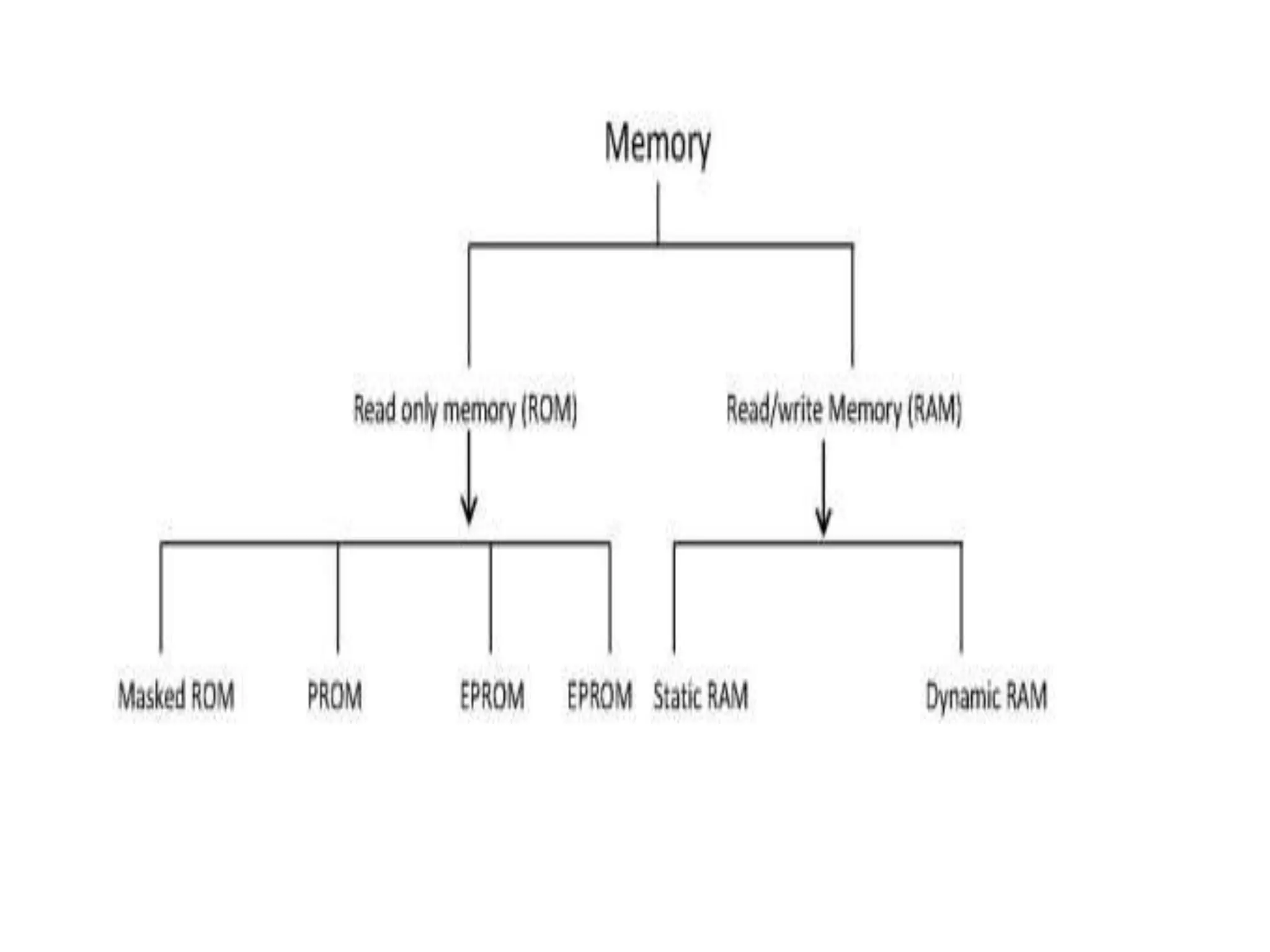
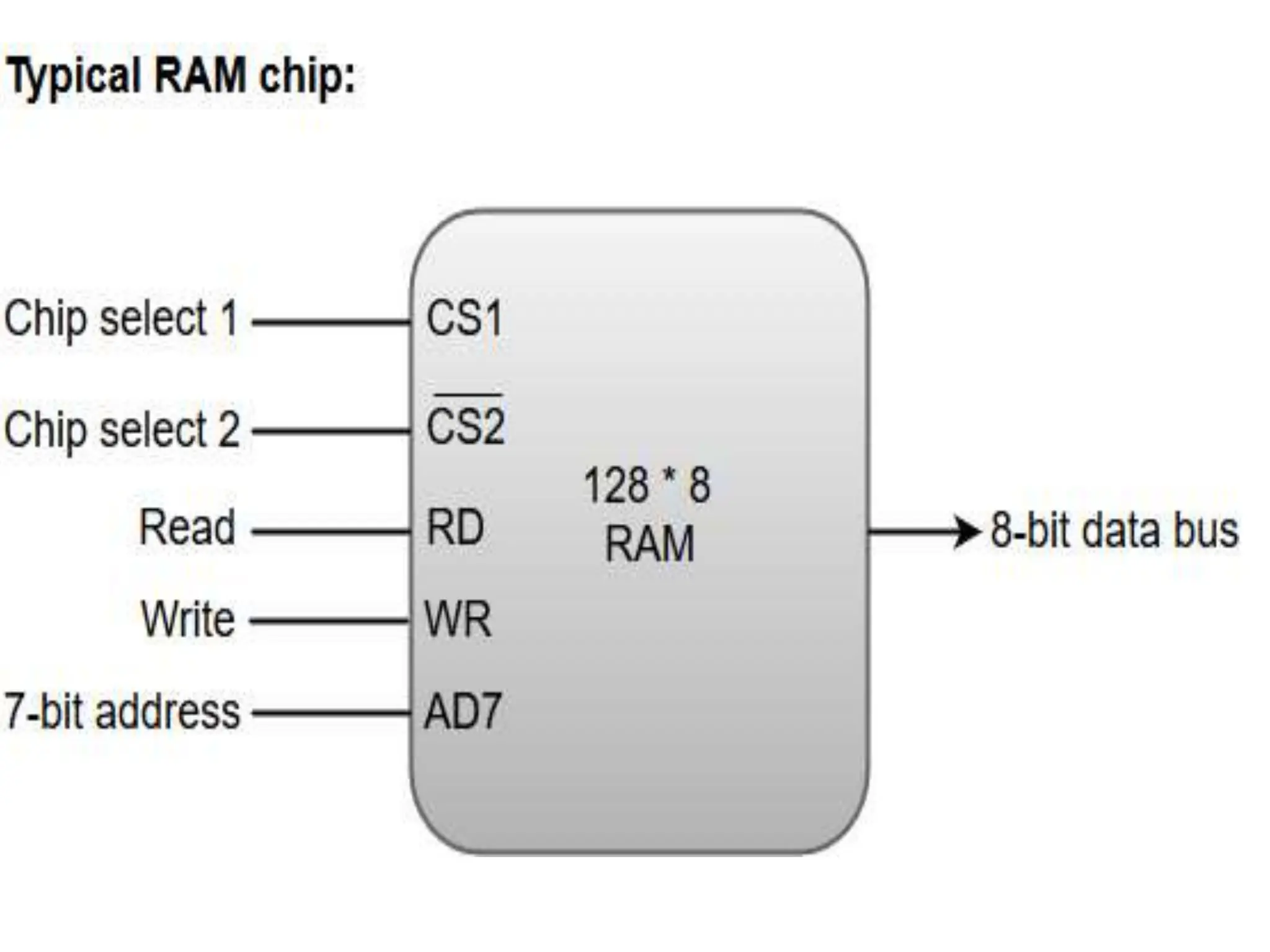
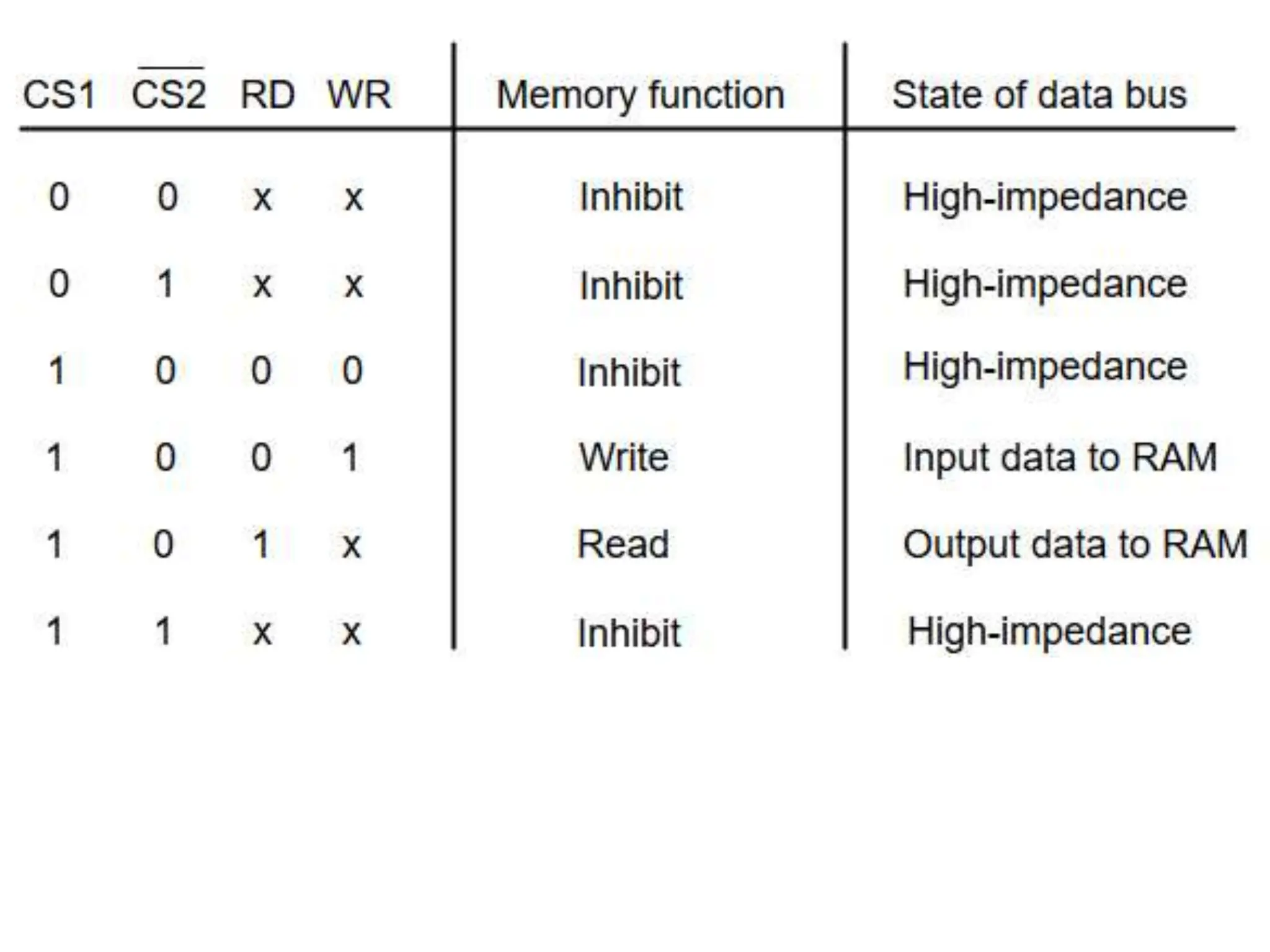
• It consists of RAM and ROM chips.
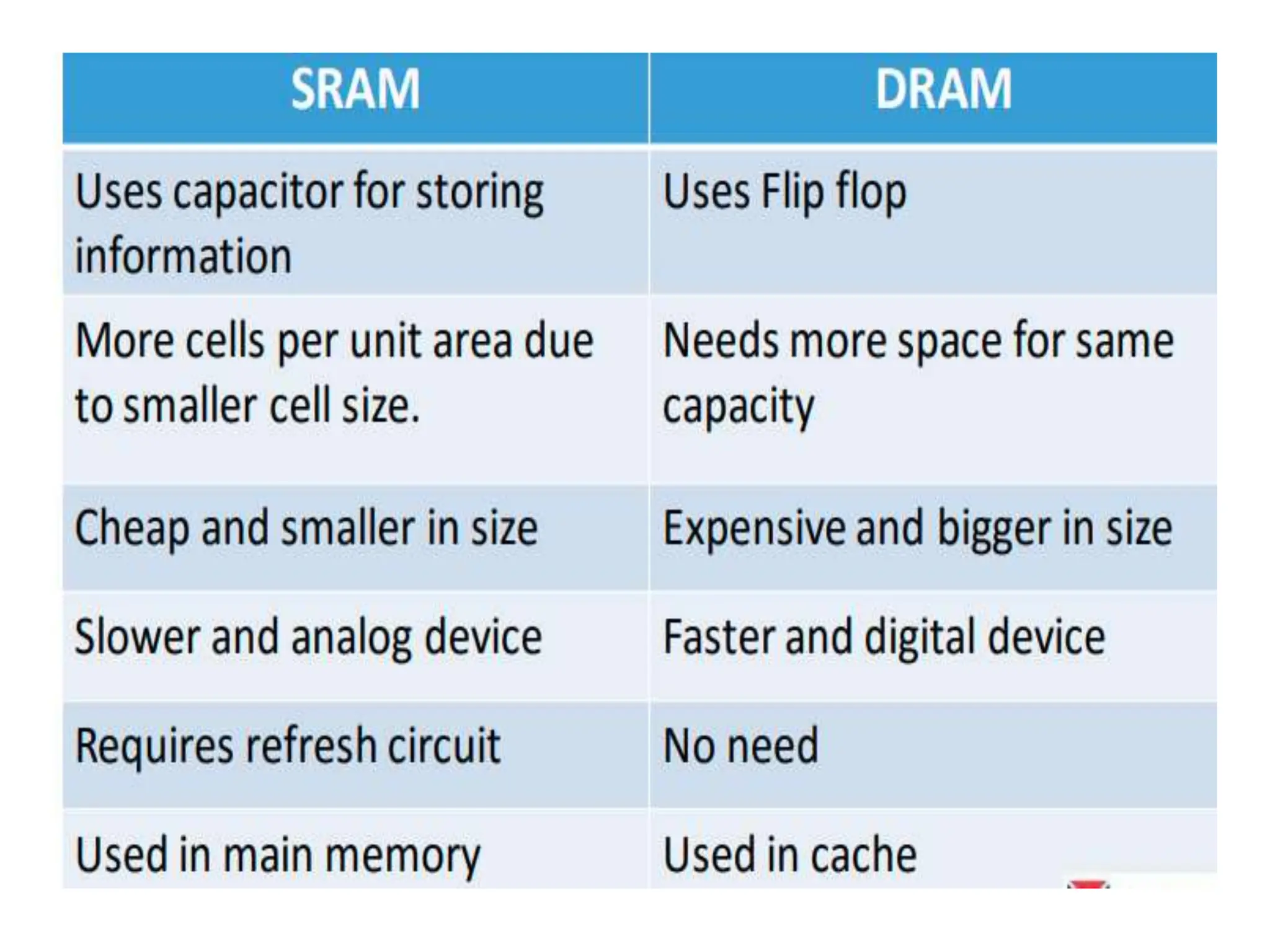
• RAM chips are available in two form static and
dynamic.
Main Memory
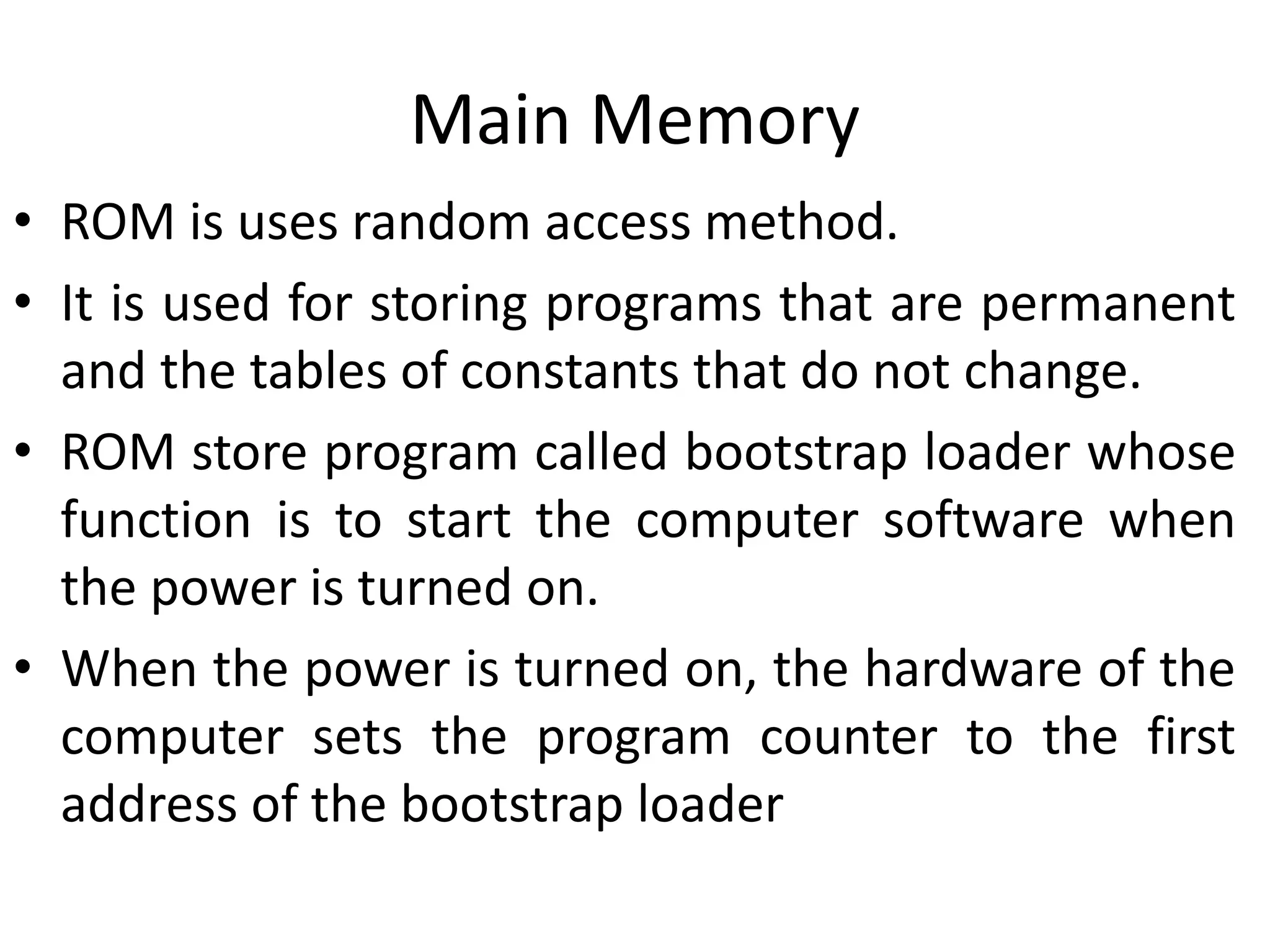
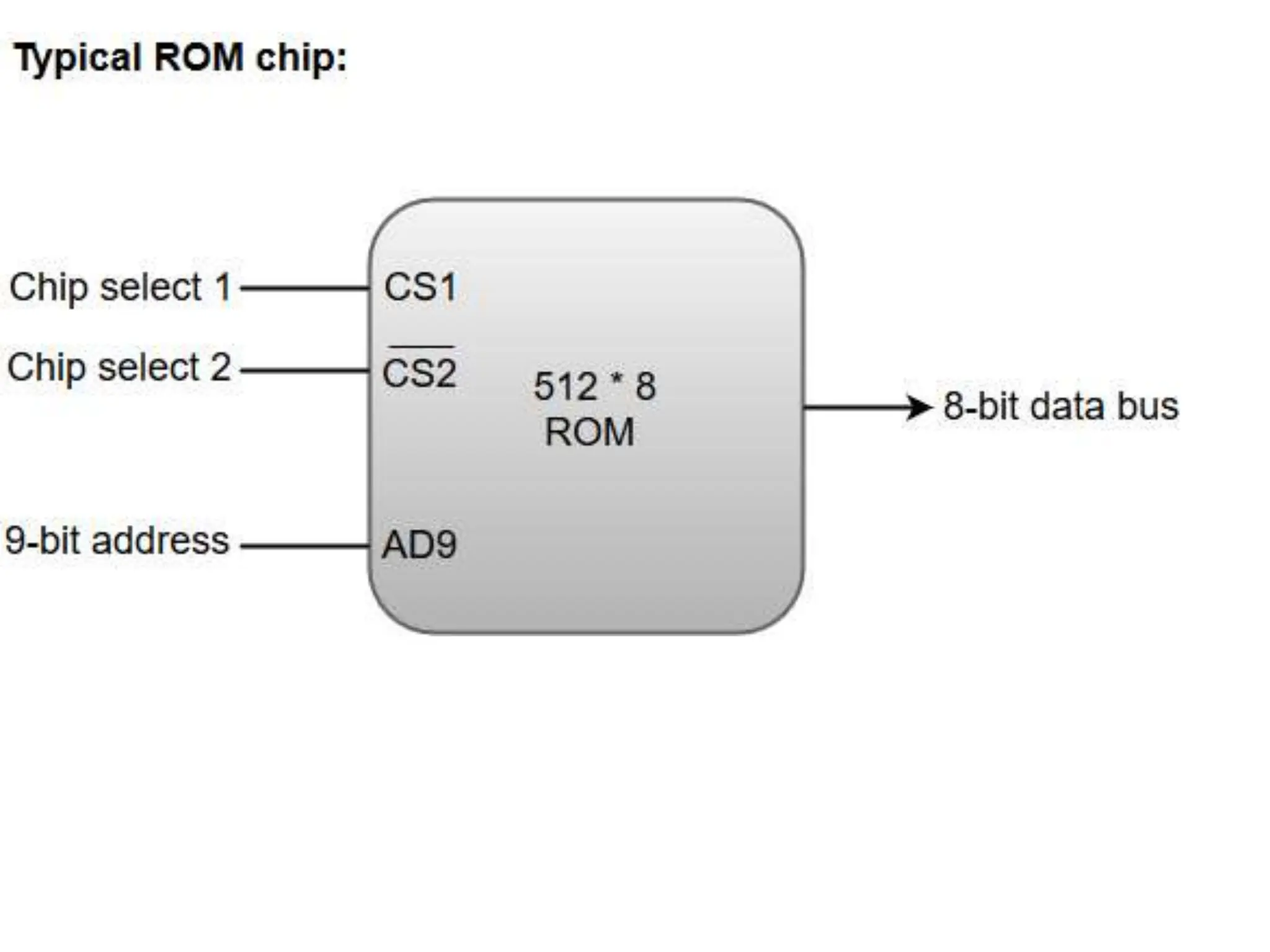
• ROM is uses random access method.
• It is used for storing programs that are permanent
and the tables of constants that do not change.
• ROM store program called bootstrap loader whose
function is to start the computer software when
the power is turned on.
• When the power is turned on, the hardware of the
computer sets the program counter to the first
address of the bootstrap loader
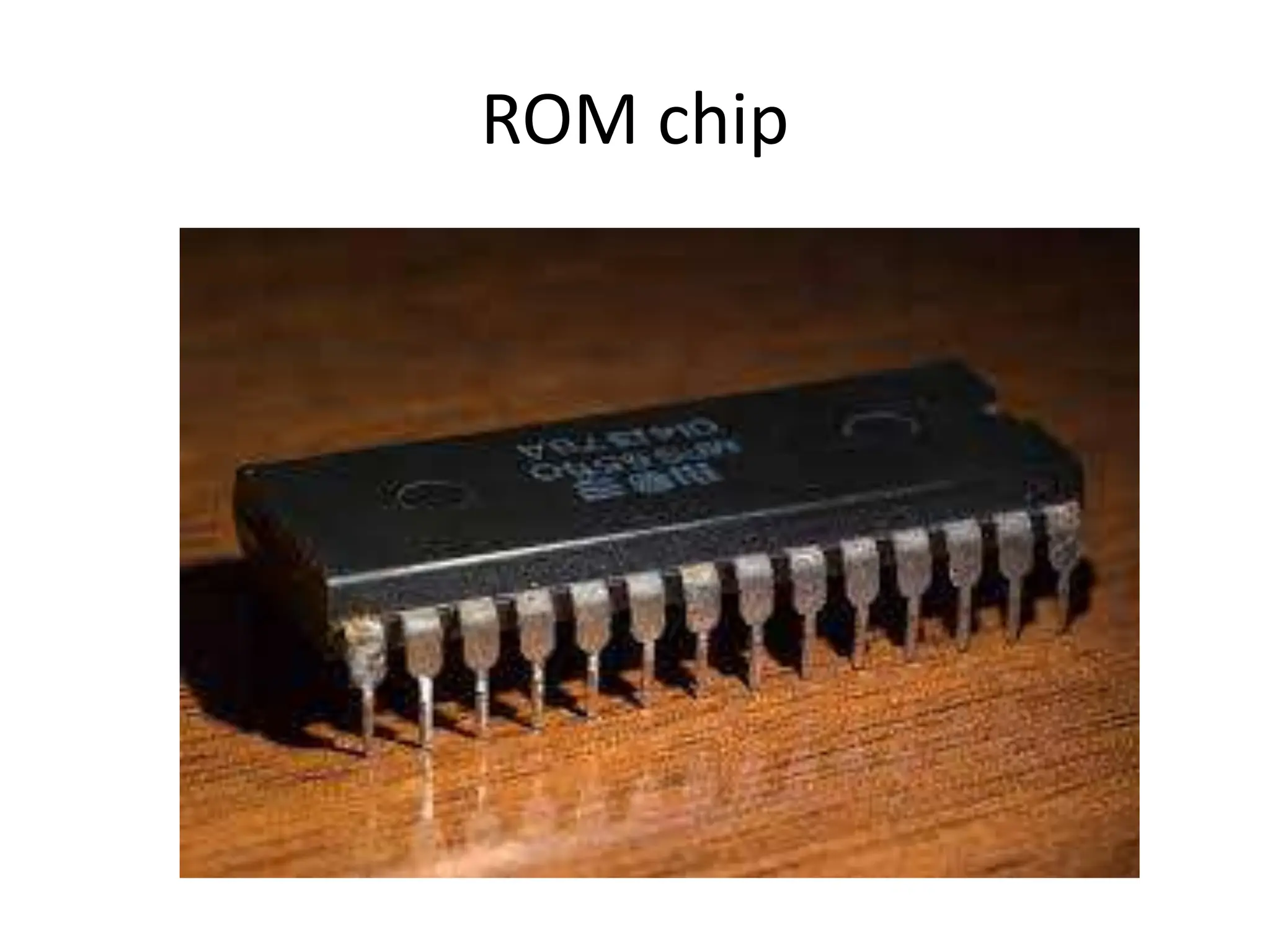
ROM chip
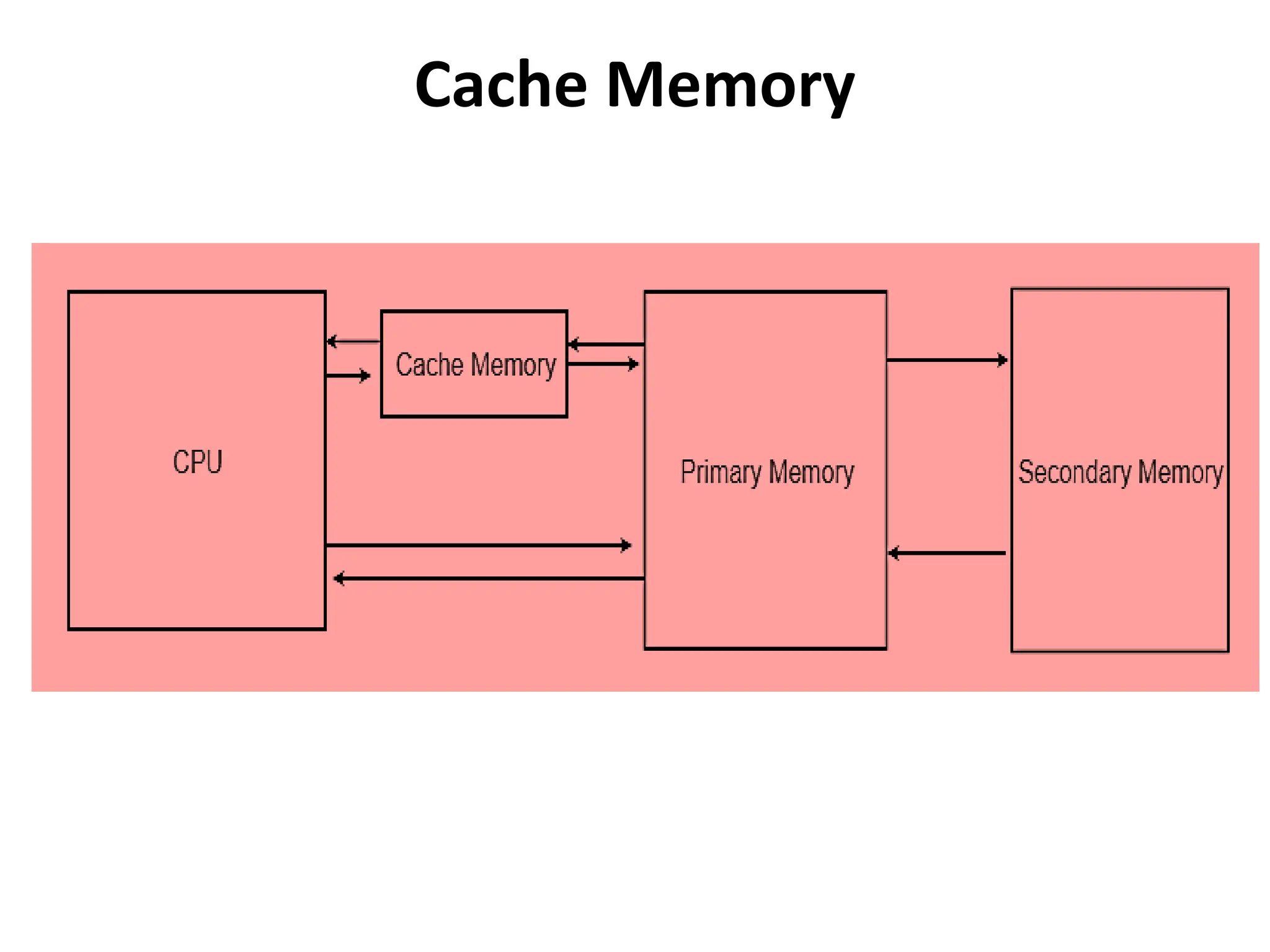
Cache Memory
• A special very high-speed memory.
• Used to speed up and synchronizing with high-speed CPU.
• Costlier than main memory or disk memory but economical
than CPU registers.
• Extremely fast memory type that acts as a buffer between
RAM and the CPU. It holds frequently requested data and
instructions so that they are immediately available to the
CPU when needed.
• Used to reduce the average time to access data from the
Main memory.
• Smaller and faster memory which stores copies of the data
from frequently used main memory locations.
• Various different independent caches in a CPU, which store
instructions and data.
Cache Memory
Terminology
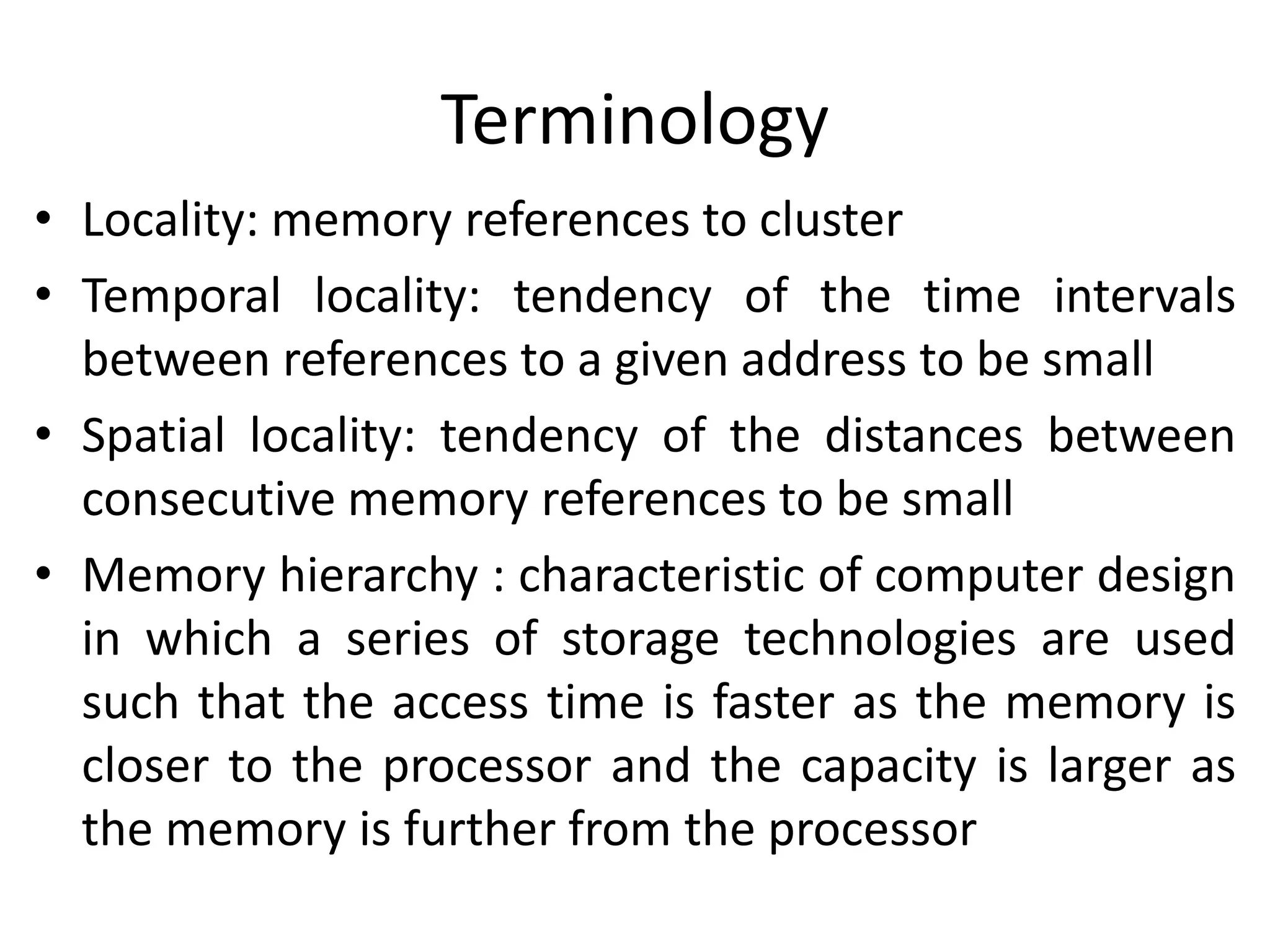
• Locality: memory references to cluster
• Temporal locality: tendency of the time intervals
between references to a given address to be small
• Spatial locality: tendency of the distances between
consecutive memory references to be small
• Memory hierarchy : characteristic of computer design
in which a series of storage technologies are used
such that the access time is faster as the memory is
closer to the processor and the capacity is larger as
the memory is further from the processor
Terminology
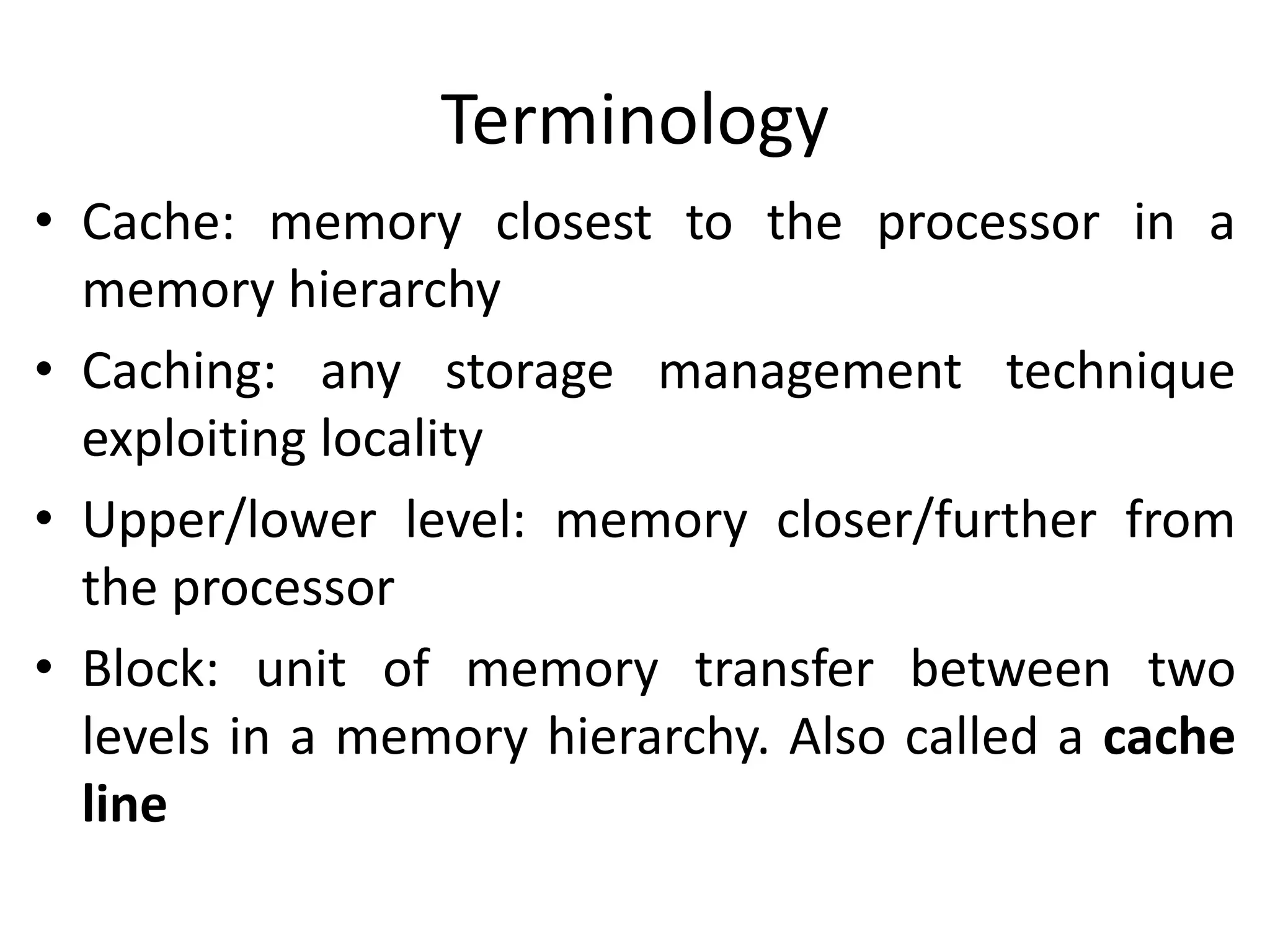
• Cache: memory closest to the processor in a
memory hierarchy
• Caching: any storage management technique
exploiting locality
• Upper/lower level: memory closer/further from
the processor
• Block: unit of memory transfer between two
levels in a memory hierarchy. Also called a cache
line
Cache Performance
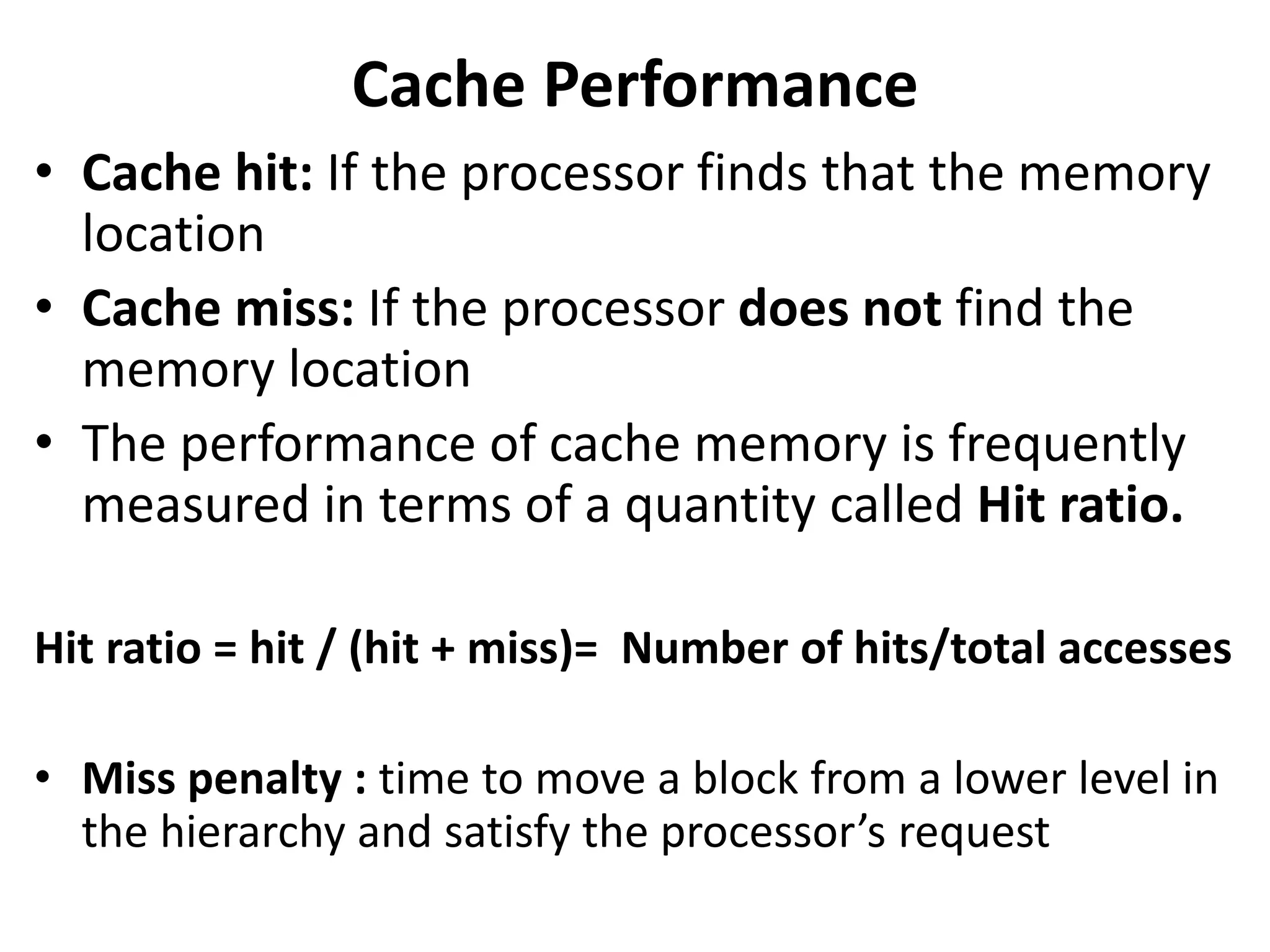
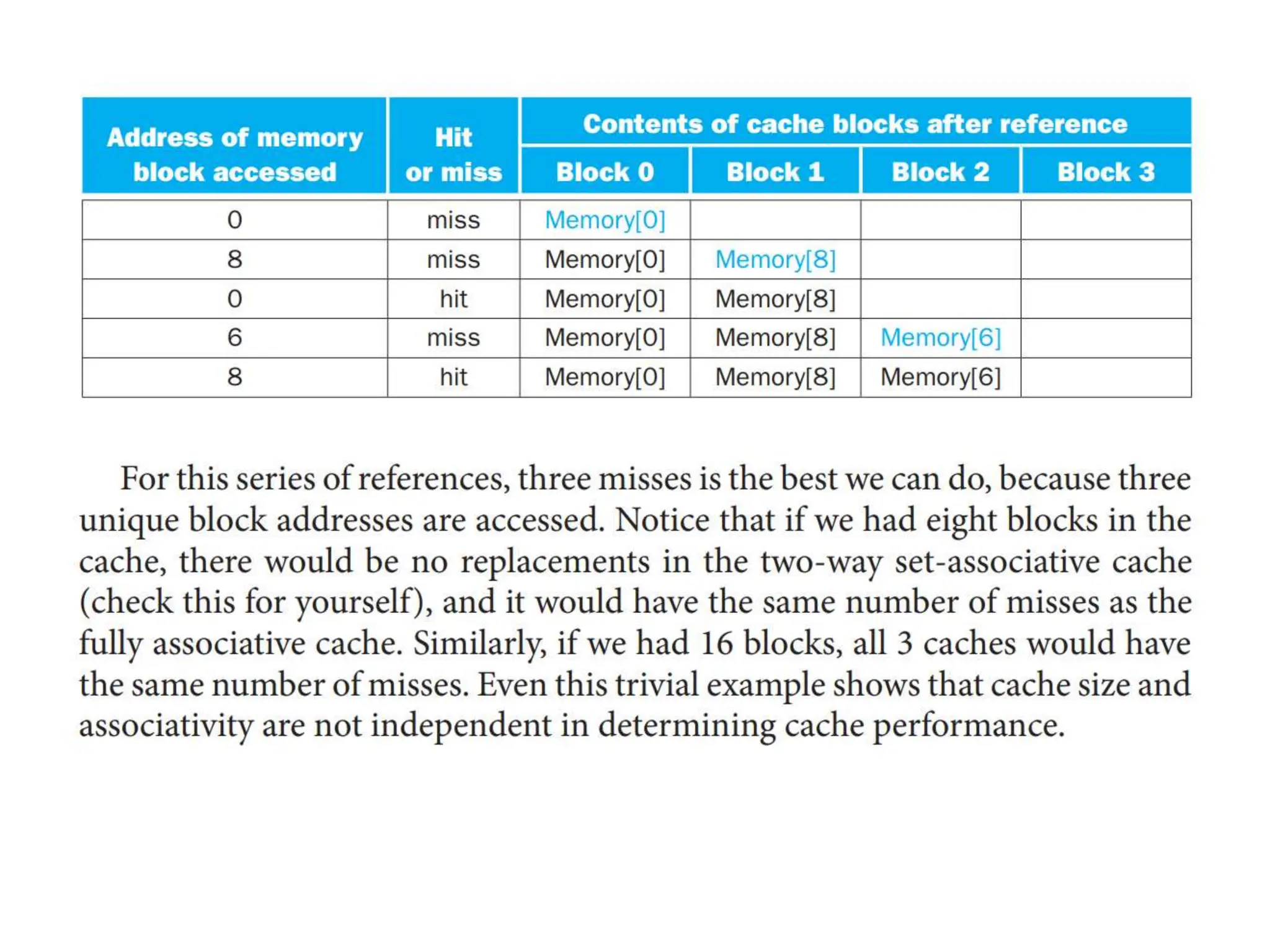
• Cache hit: If the processor finds that the memory
location
• Cache miss: If the processor does not find the
memory location
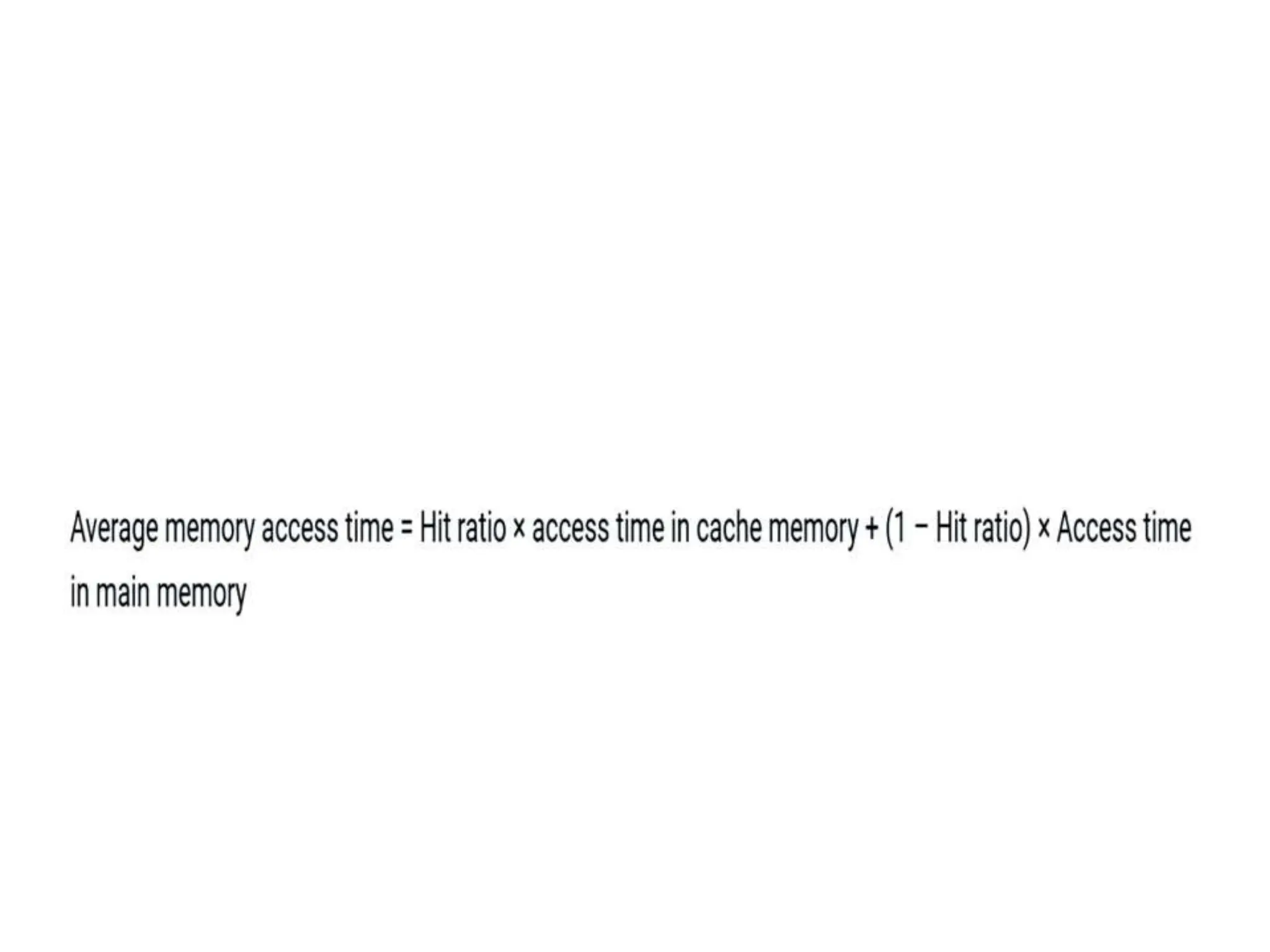
• The performance of cache memory is frequently
measured in terms of a quantity called Hit ratio.
Hit ratio = hit / (hit + miss)= Number of hits/total accesses
• Miss penalty : time to move a block from a lower level in
the hierarchy and satisfy the processor’s request
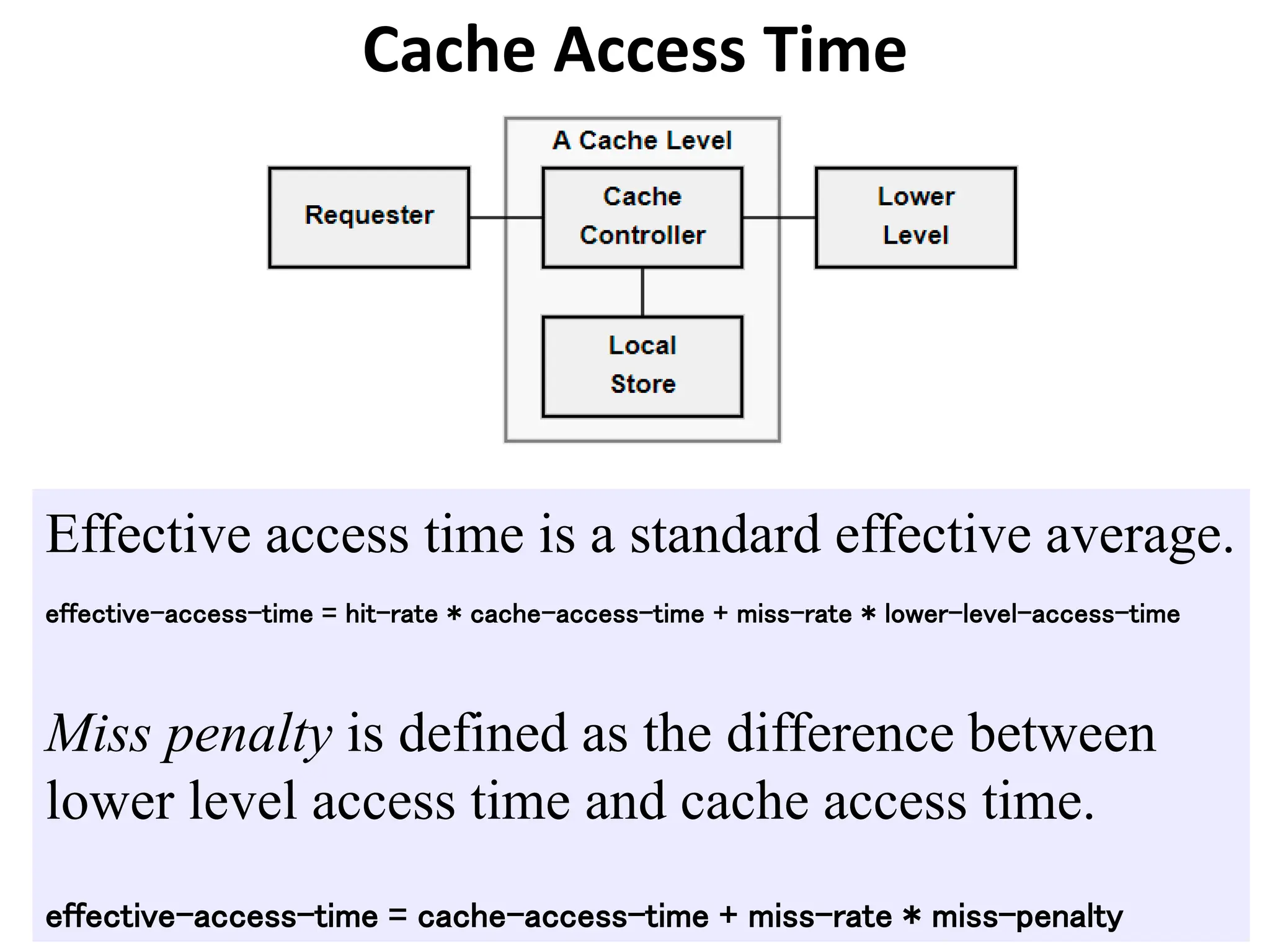
Cache Access Time
Effective access time is a standard effective average.
effective-access-time = hit-rate * cache-access-time + miss-rate * lower-level-access-time
Miss penalty is defined as the difference between
lower level access time and cache access time.
effective-access-time = cache-access-time + miss-rate * miss-penalty
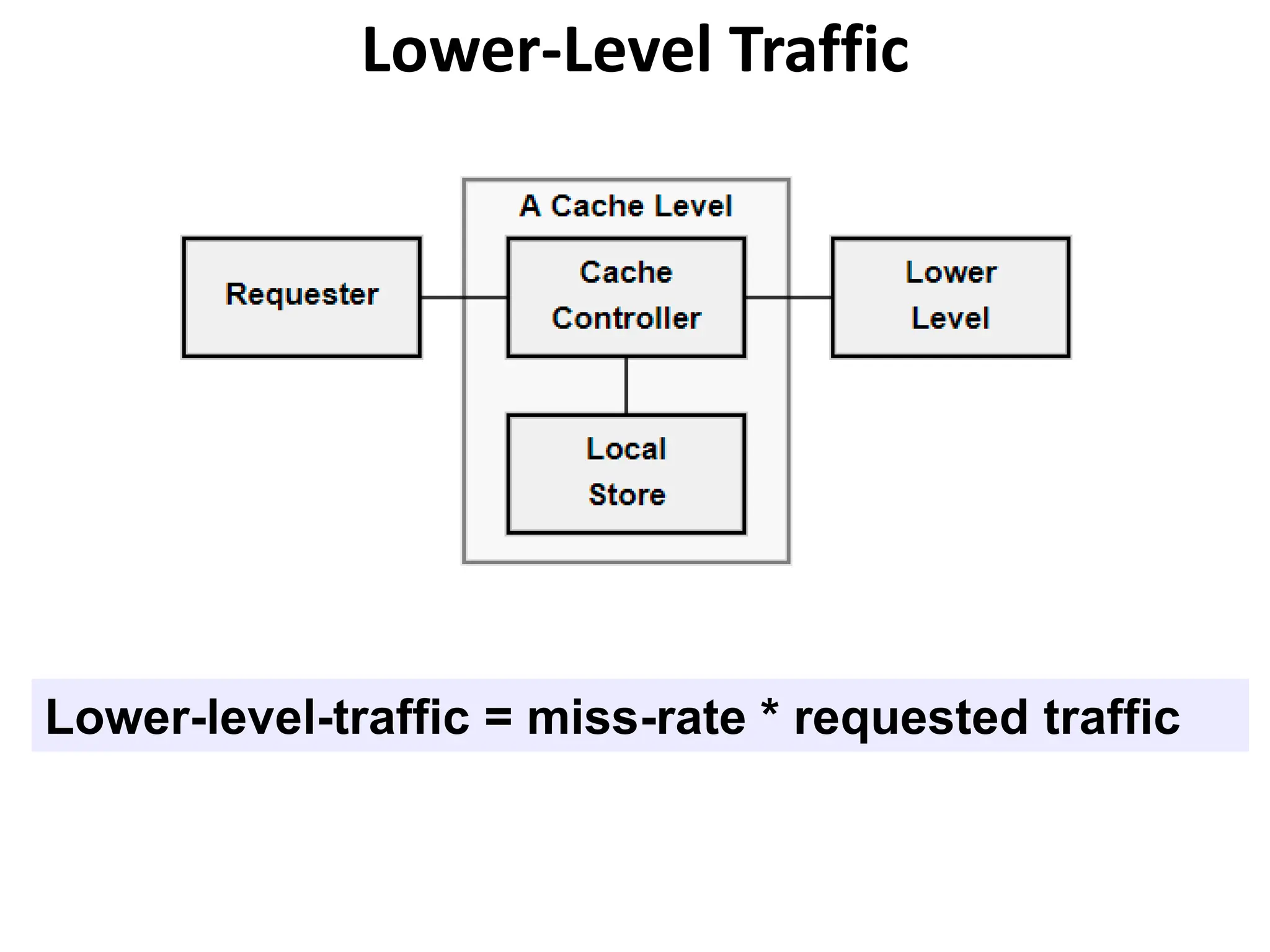
Lower-Level Traffic
Lower-level-traffic = miss-rate * requested traffic
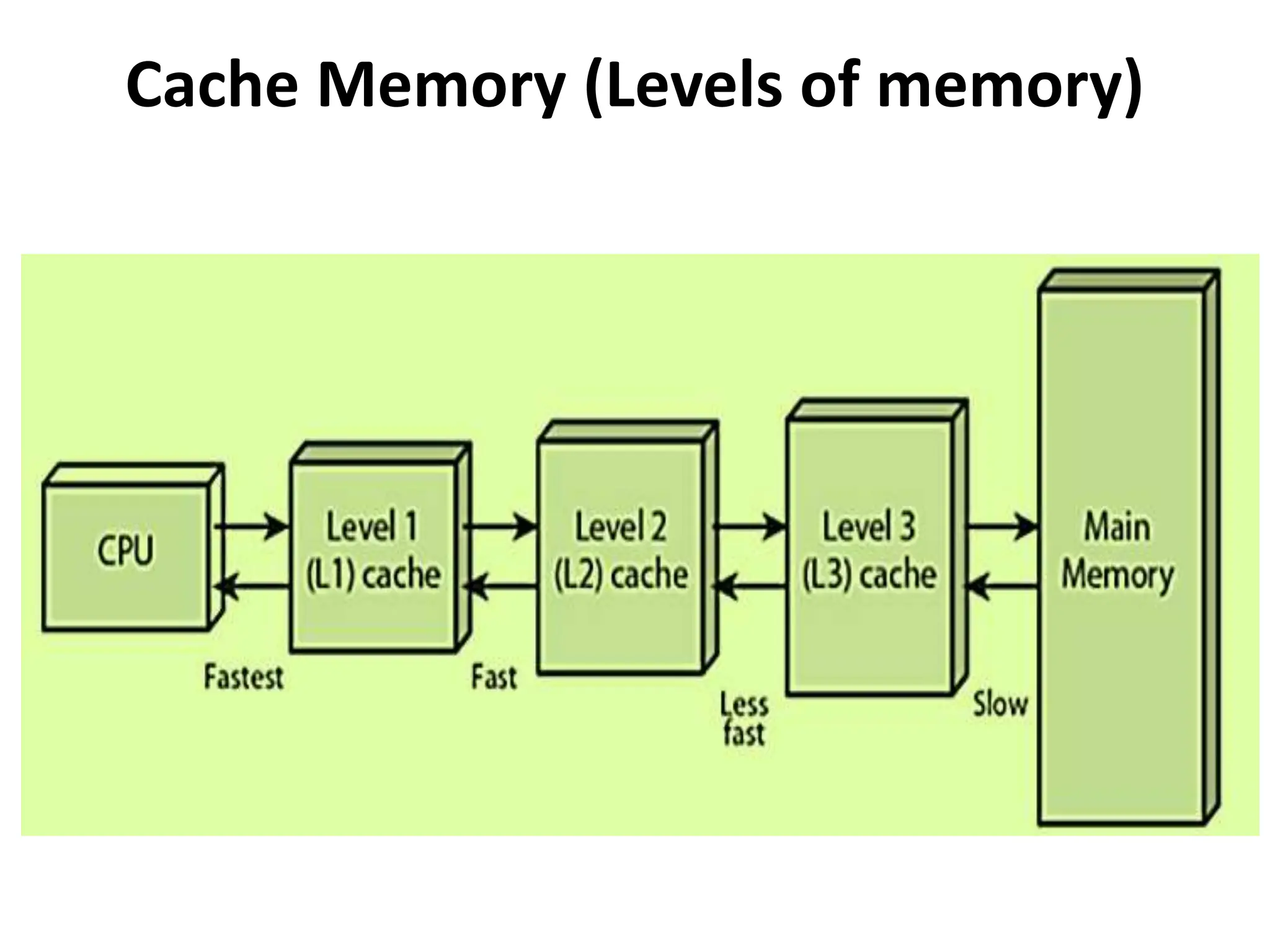
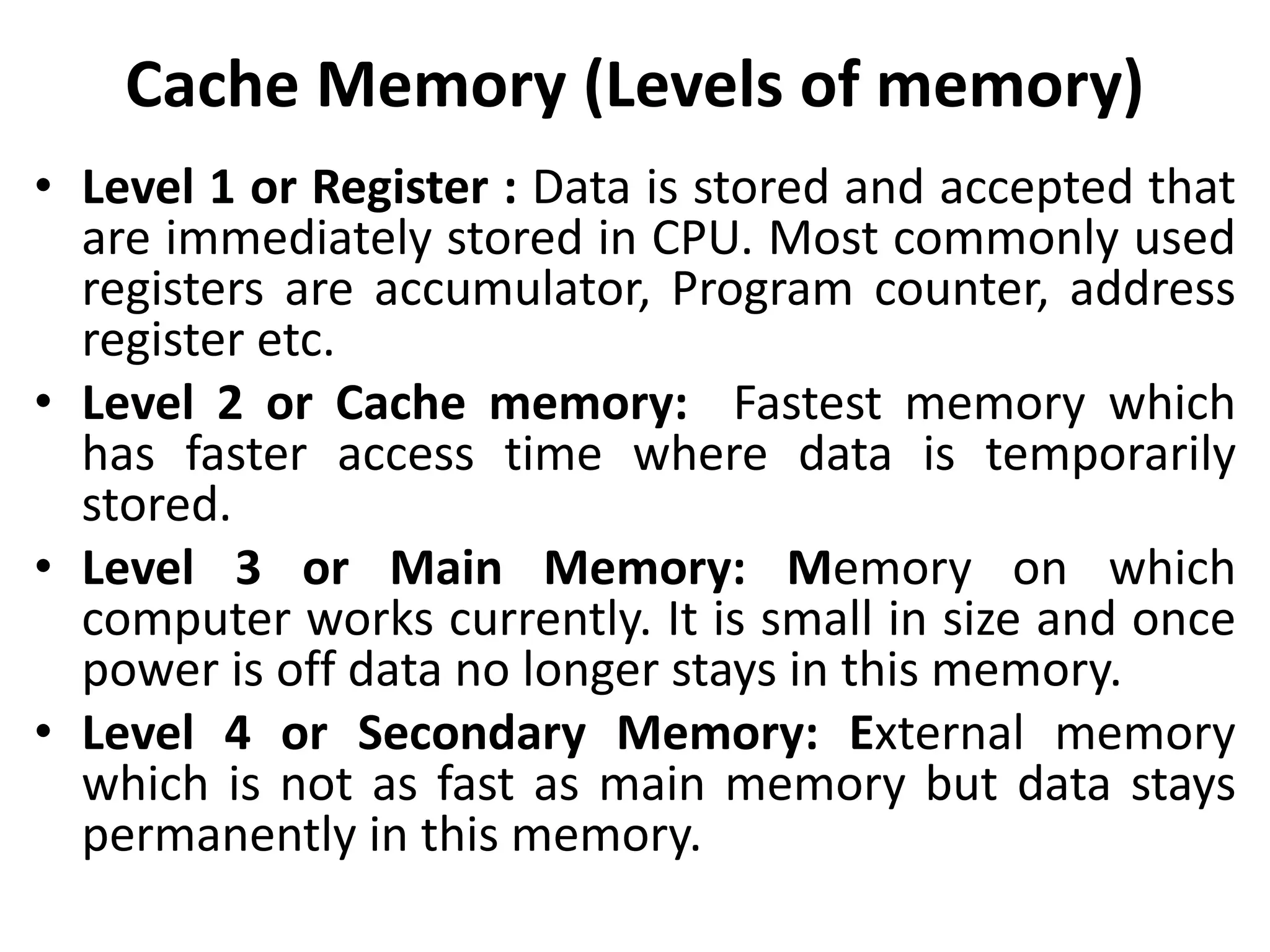
Cache Memory (Levels of memory)
• Level 1 or Register : Data is stored and accepted that
are immediately stored in CPU. Most commonly used
registers are accumulator, Program counter, address
register etc.
• Level 2 or Cache memory: Fastest memory which
has faster access time where data is temporarily
stored.
• Level 3 or Main Memory: Memory on which
computer works currently. It is small in size and once
power is off data no longer stays in this memory.
• Level 4 or Secondary Memory: External memory
which is not as fast as main memory but data stays
permanently in this memory.
Cache Mapping
• Direct mapping, Associative mapping, and Set-
Associative mapping
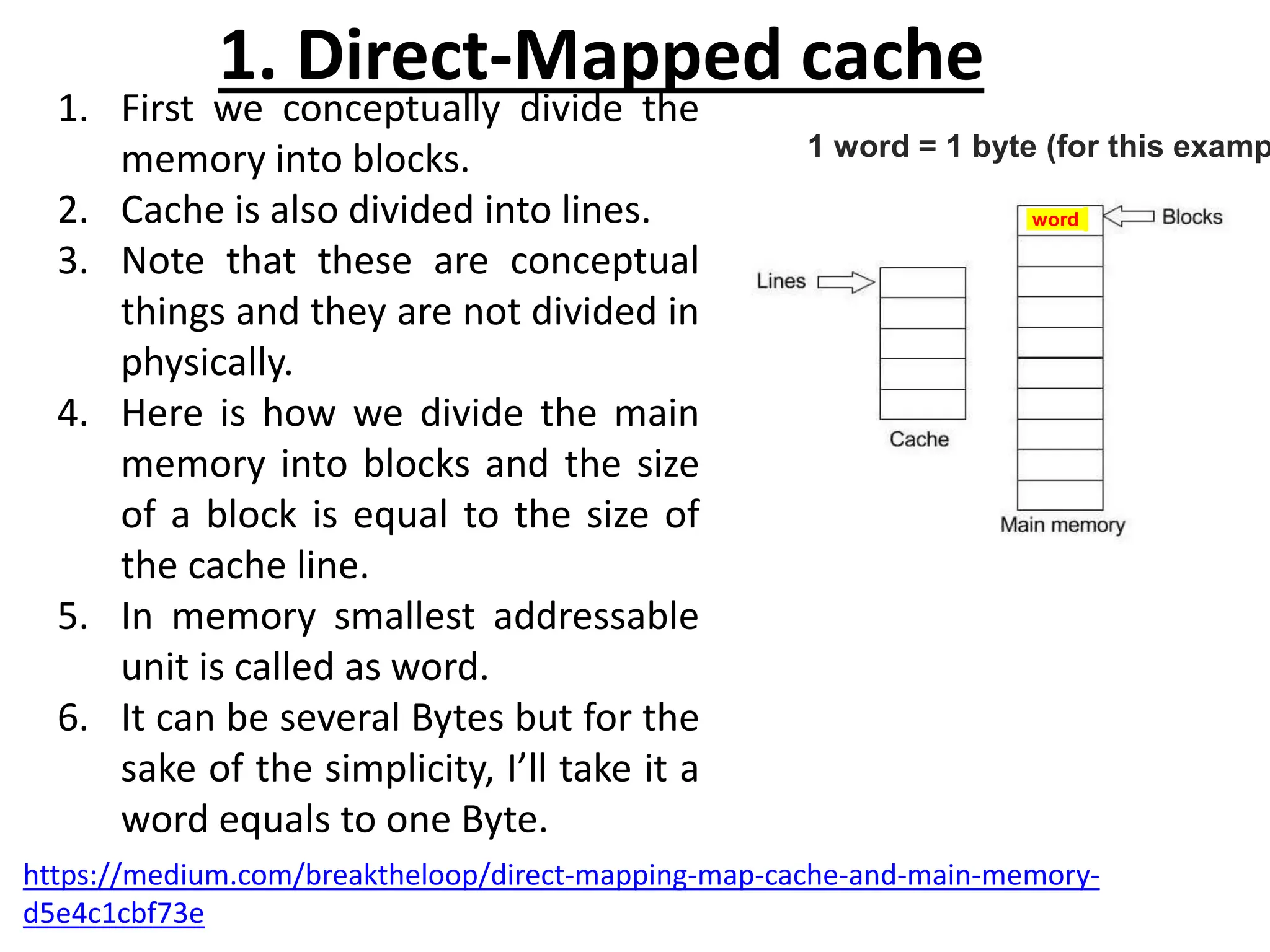
1. First we conceptually divide the
memory into blocks.
2. Cache is also divided into lines.
3. Note that these are conceptual
things and they are not divided in
physically.
4. Here is how we divide the main
memory into blocks and the size
of a block is equal to the size of
the cache line.
5. In memory smallest addressable
unit is called as word.
6. It can be several Bytes but for the
sake of the simplicity, I’ll take it a
word equals to one Byte.
1. Direct-Mapped cache
1 word = 1 byte (for this examp
word
https://medium.com/breaktheloop/direct-mapping-map-cache-and-main-memory-
d5e4c1cbf73e
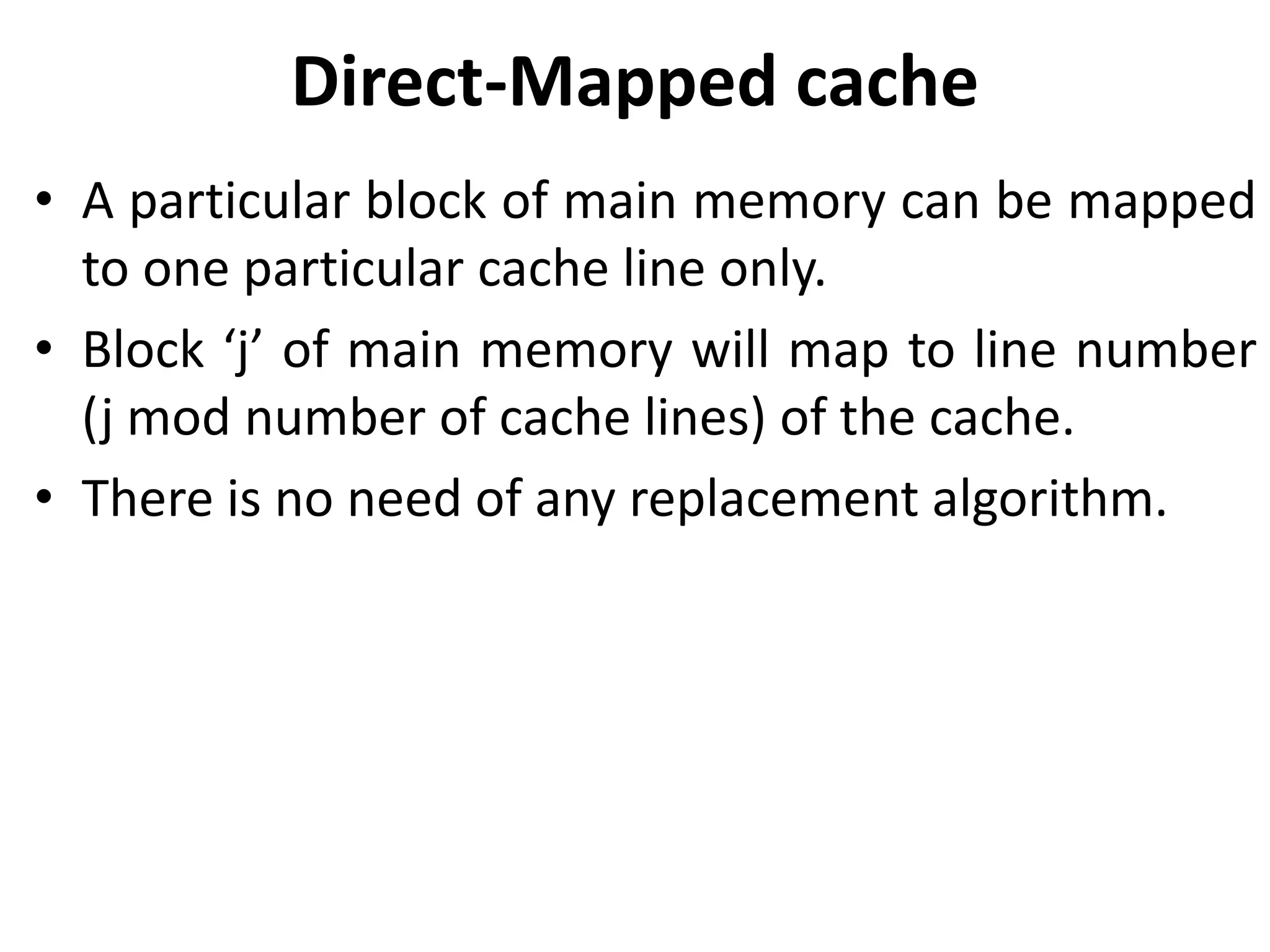
Direct-Mapped cache
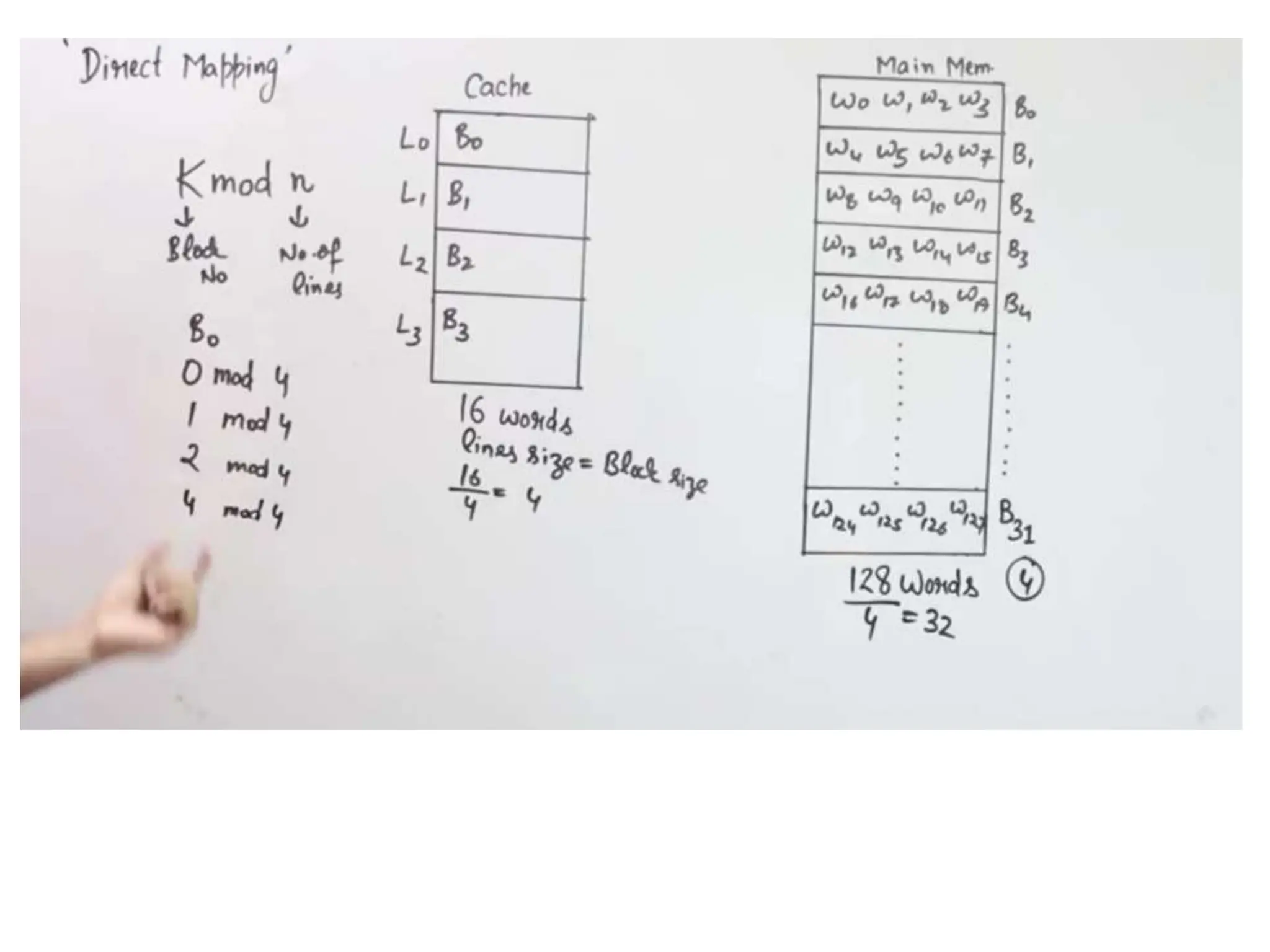
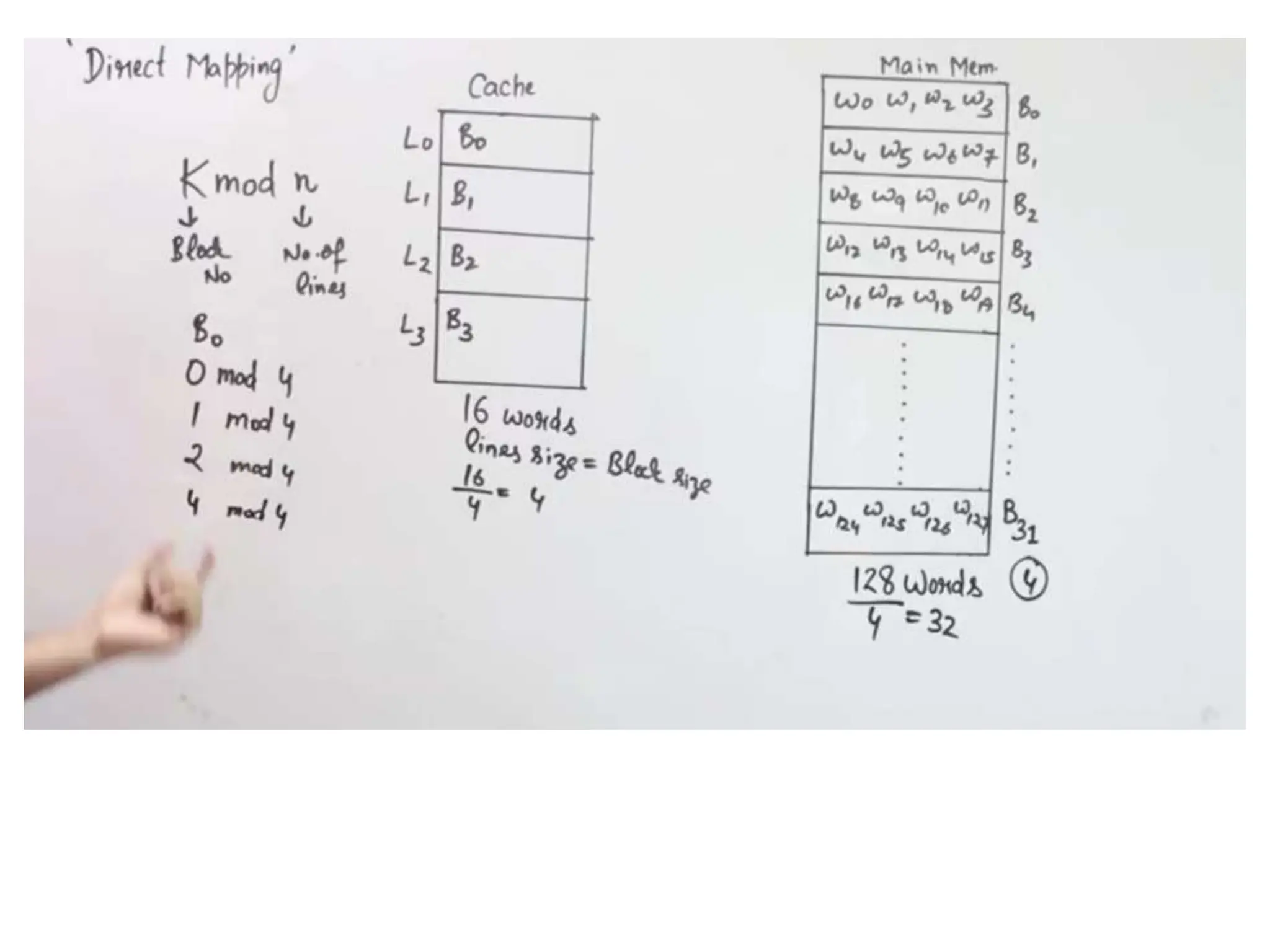
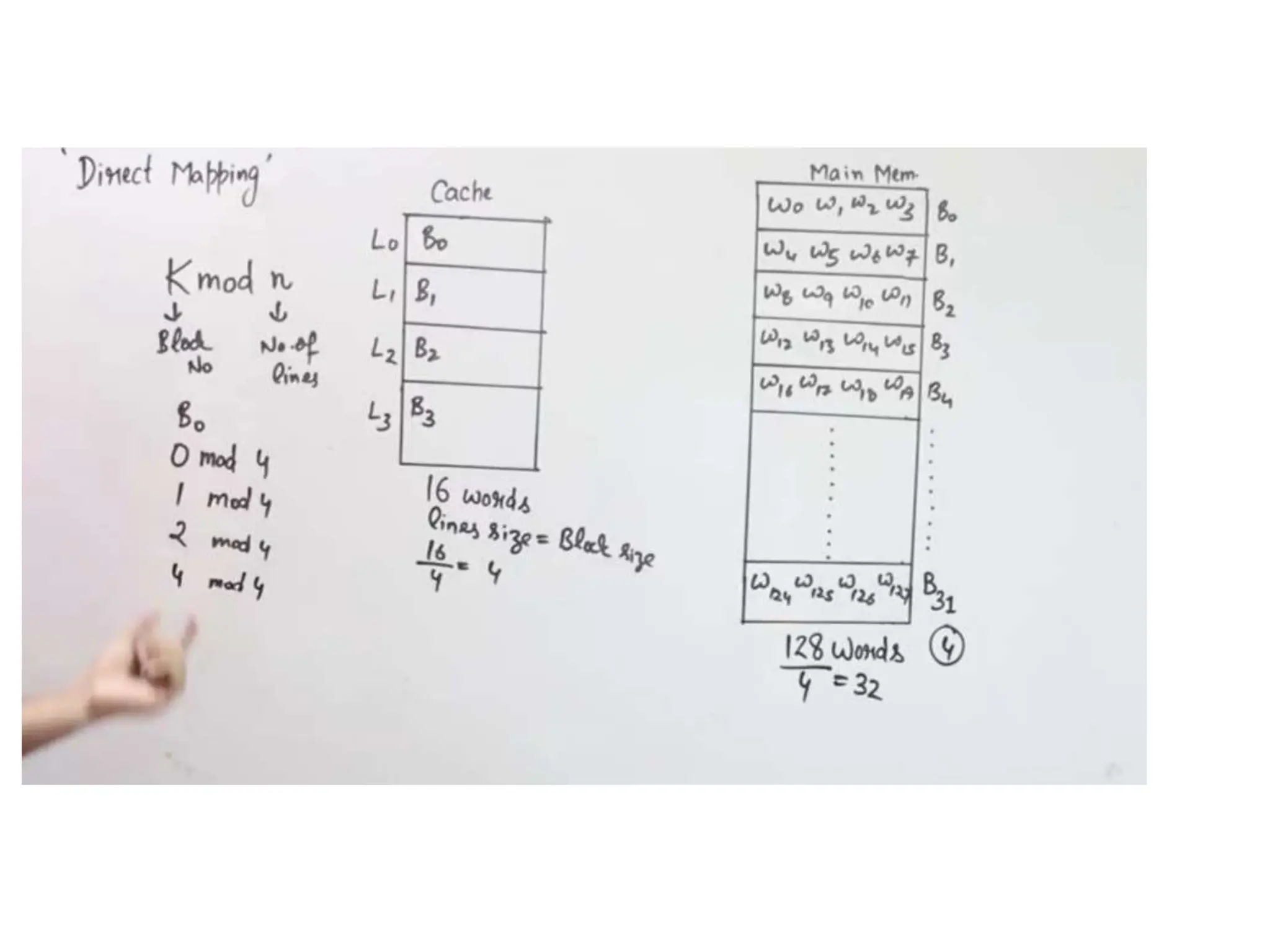
• A particular block of main memory can be mapped
to one particular cache line only.
• Block ‘j’ of main memory will map to line number
(j mod number of cache lines) of the cache.
• There is no need of any replacement algorithm.
https://www.youtube.com/watch?v=eObN3u3eAnU&t=1s
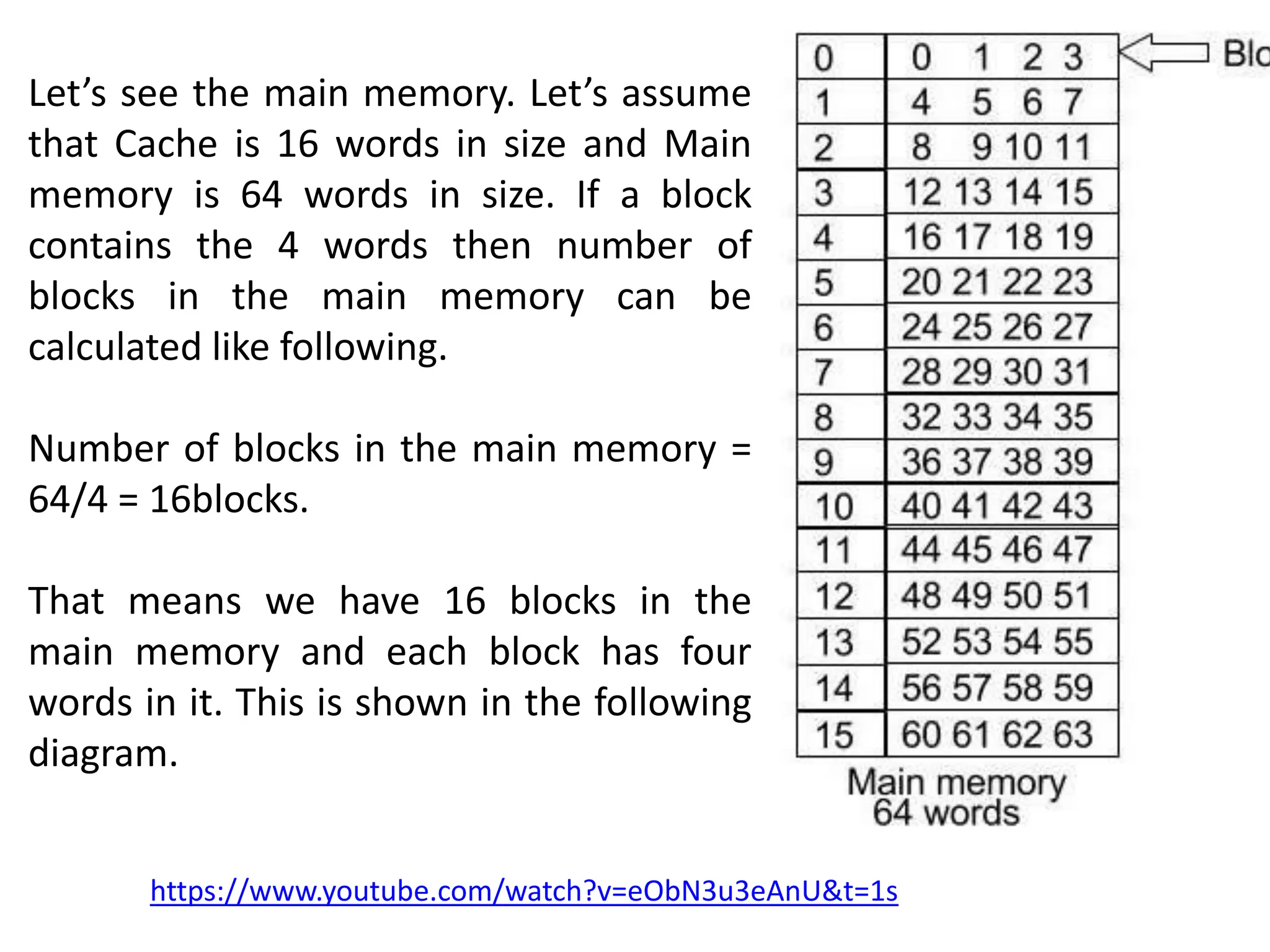
Let’s see the main memory. Let’s assume
that Cache is 16 words in size and Main
memory is 64 words in size. If a block
contains the 4 words then number of
blocks in the main memory can be
calculated like following.
Number of blocks in the main memory =
64/4 = 16blocks.
That means we have 16 blocks in the
main memory and each block has four
words in it. This is shown in the following
diagram.
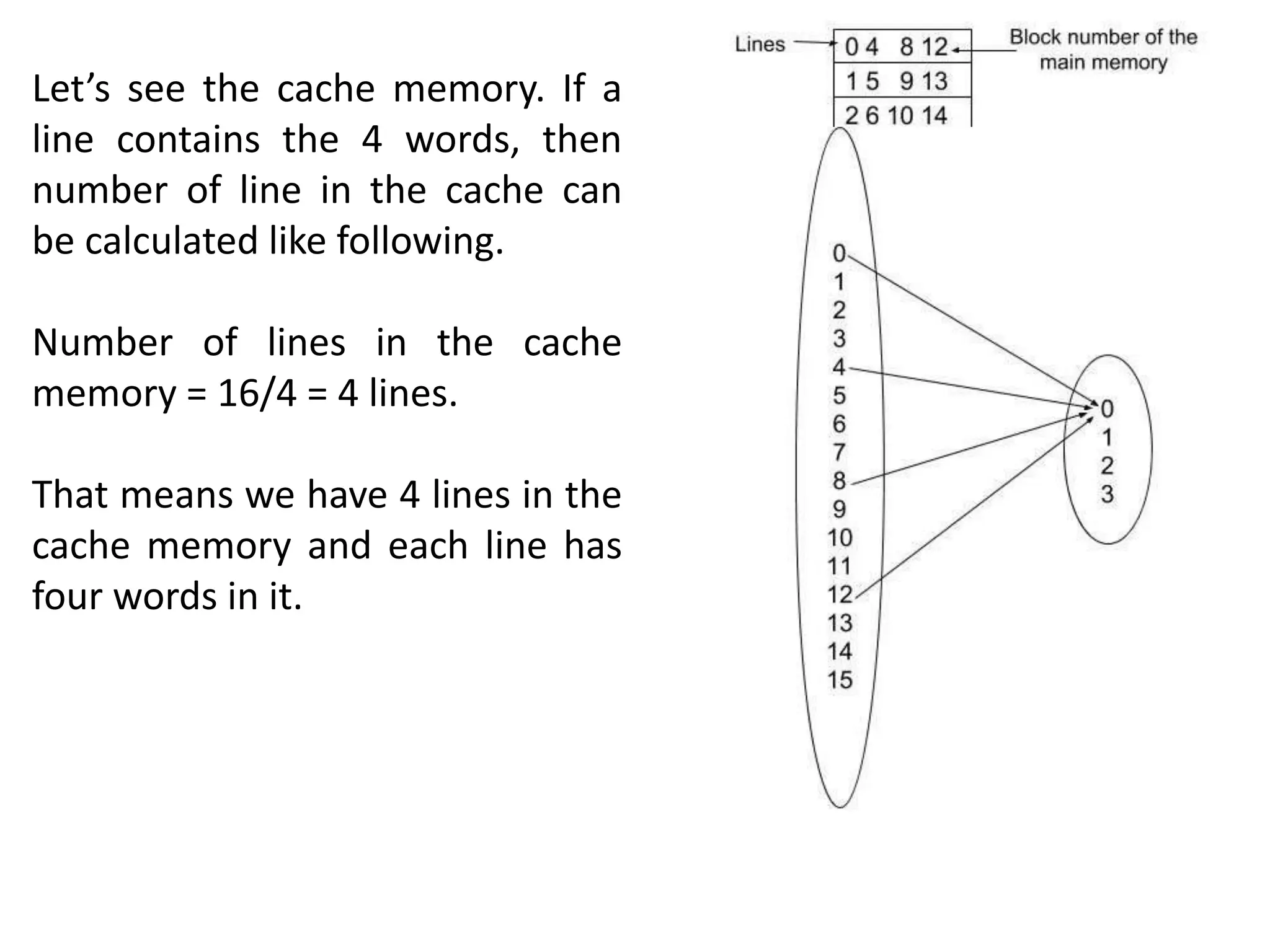
Let’s see the cache memory. If a
line contains the 4 words, then
number of line in the cache can
be calculated like following.
Number of lines in the cache
memory = 16/4 = 4 lines.
That means we have 4 lines in the
cache memory and each line has
four words in it.
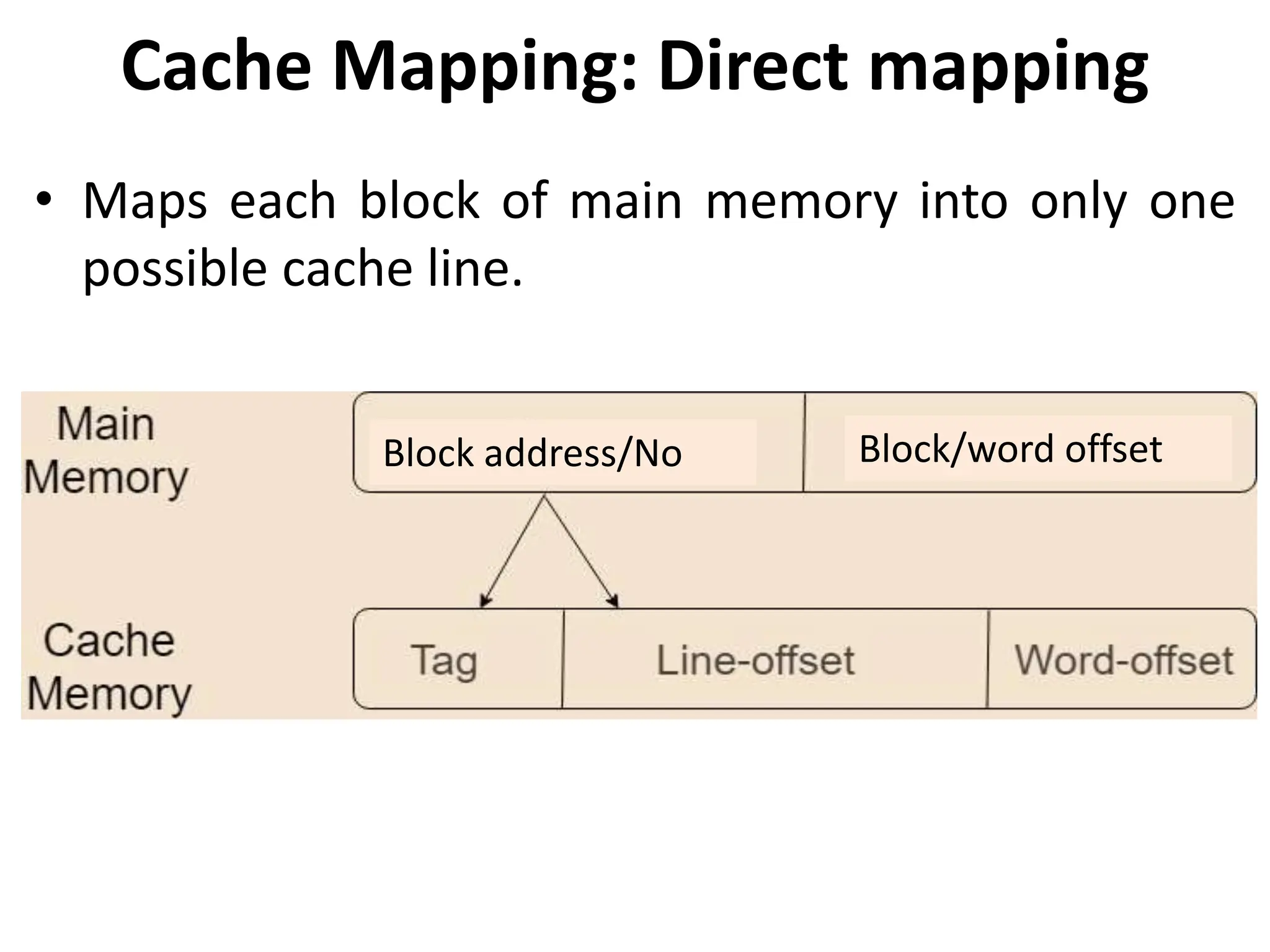
Cache Mapping: Direct mapping
• Maps each block of main memory into only one
possible cache line.
Block address/No Block/word offset
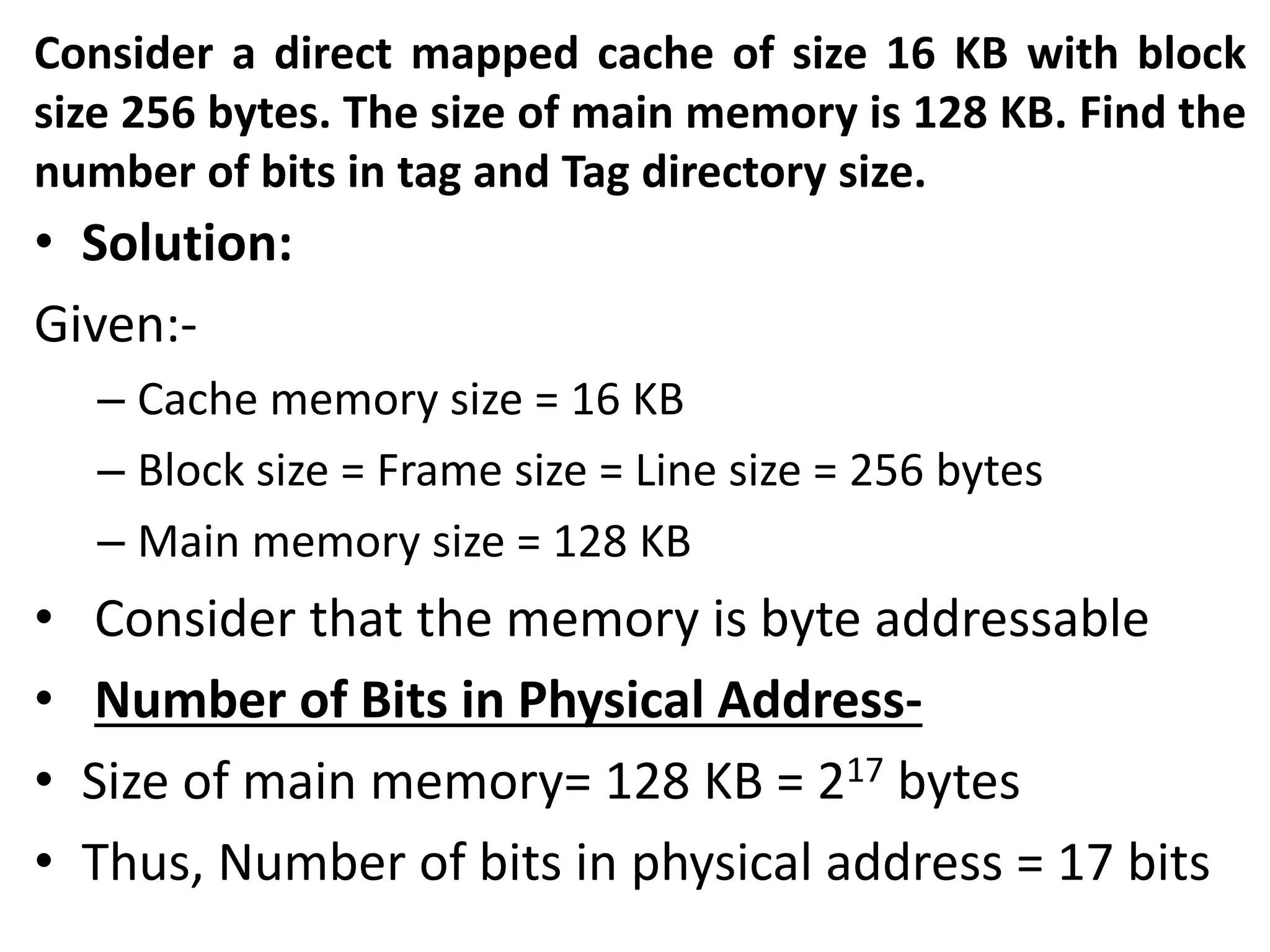
Consider a direct mapped cache of size 16 KB with block
size 256 bytes. The size of main memory is 128 KB. Find the
number of bits in tag and Tag directory size.
• Solution:
Given:-
– Cache memory size = 16 KB
– Block size = Frame size = Line size = 256 bytes
– Main memory size = 128 KB
• Consider that the memory is byte addressable
• Number of Bits in Physical Address-
• Size of main memory= 128 KB = 217 bytes
• Thus, Number of bits in physical address = 17 bits
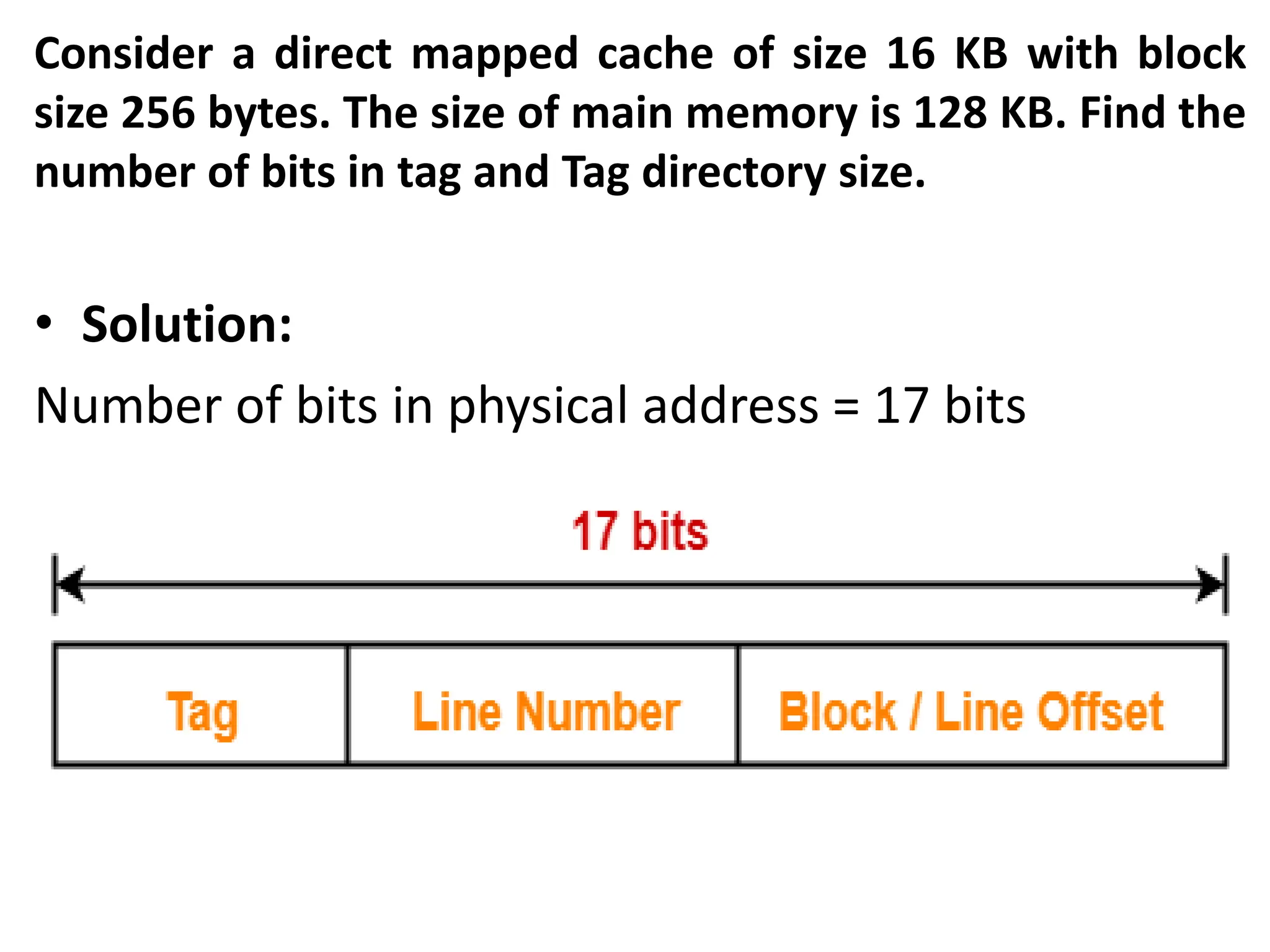
Consider a direct mapped cache of size 16 KB with block
size 256 bytes. The size of main memory is 128 KB. Find the
number of bits in tag and Tag directory size.
• Solution:
Number of bits in physical address = 17 bits
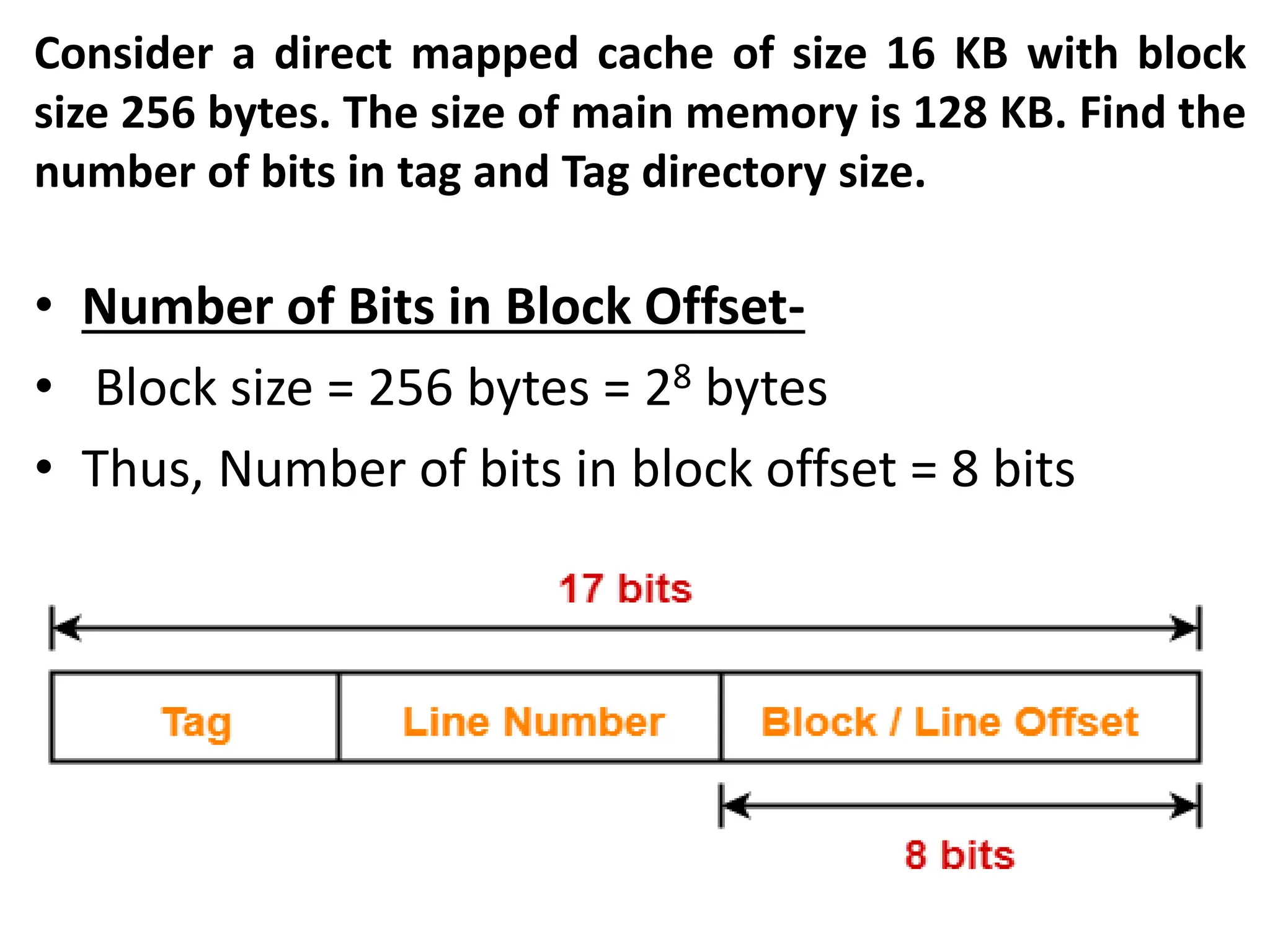
Consider a direct mapped cache of size 16 KB with block
size 256 bytes. The size of main memory is 128 KB. Find the
number of bits in tag and Tag directory size.
• Number of Bits in Block Offset-
• Block size = 256 bytes = 28 bytes
• Thus, Number of bits in block offset = 8 bits
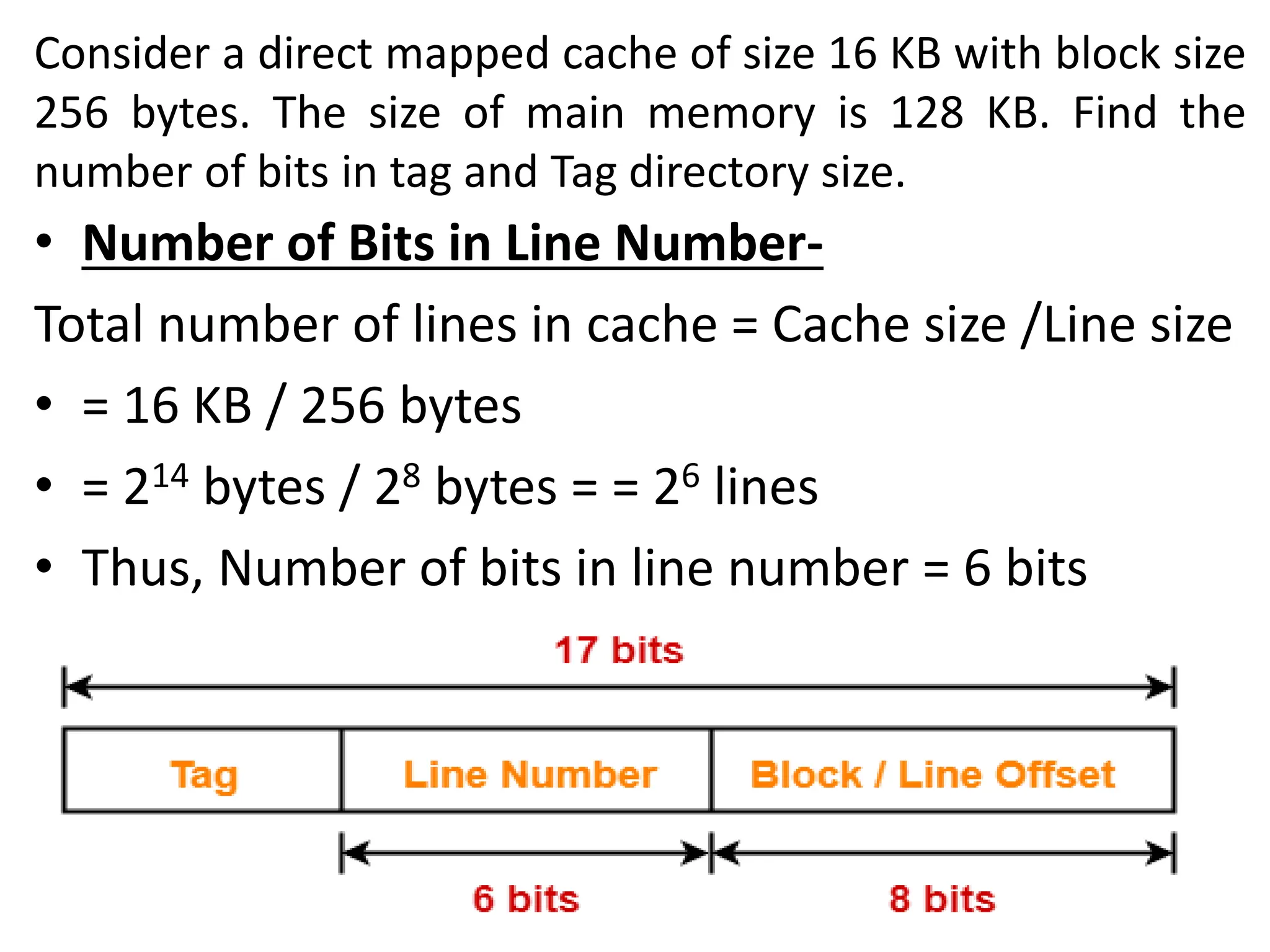
Consider a direct mapped cache of size 16 KB with block size
256 bytes. The size of main memory is 128 KB. Find the
number of bits in tag and Tag directory size.
• Number of Bits in Line Number-
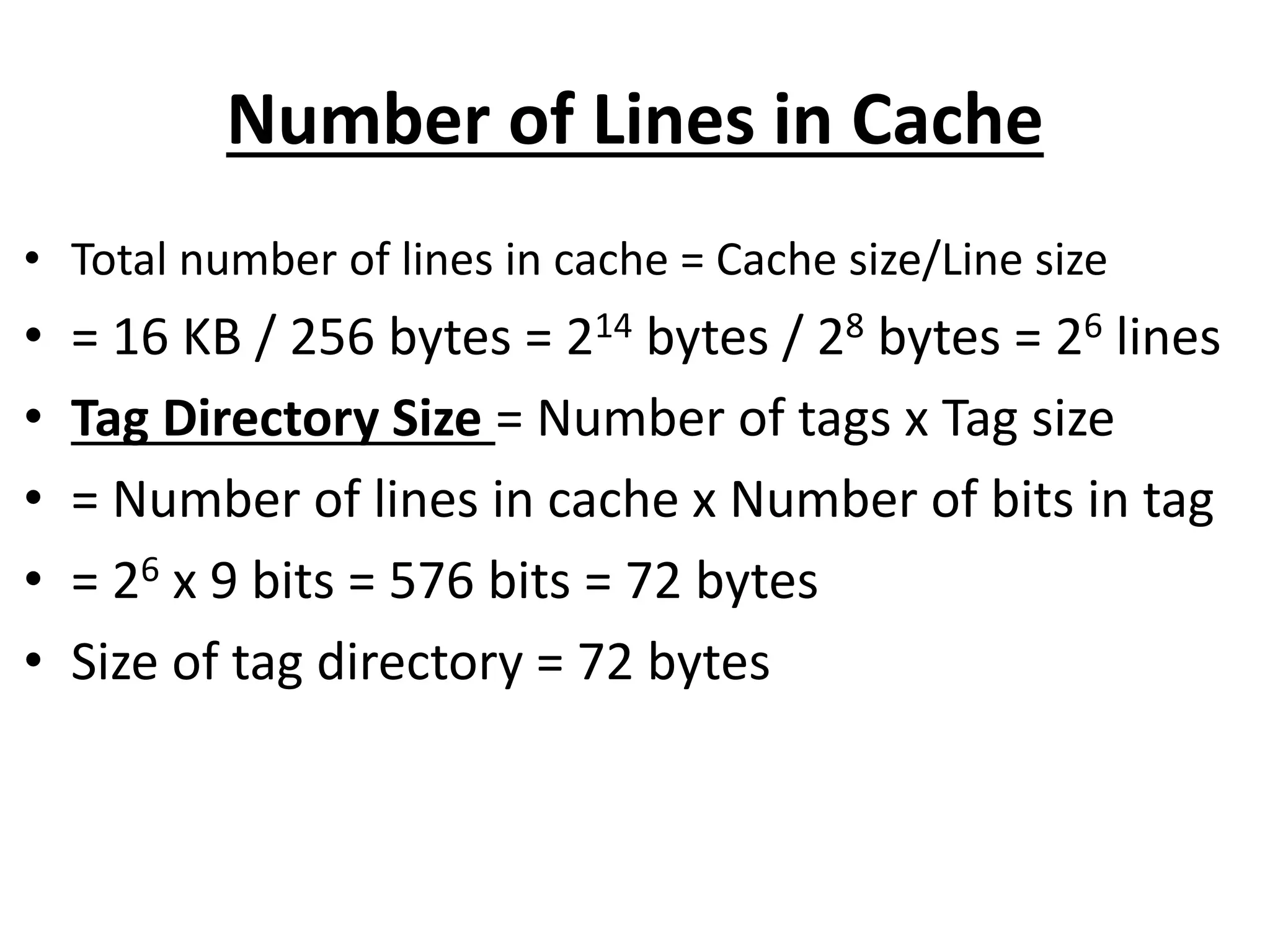
Total number of lines in cache = Cache size /Line size
• = 16 KB / 256 bytes
• = 214 bytes / 28 bytes = = 26 lines
• Thus, Number of bits in line number = 6 bits
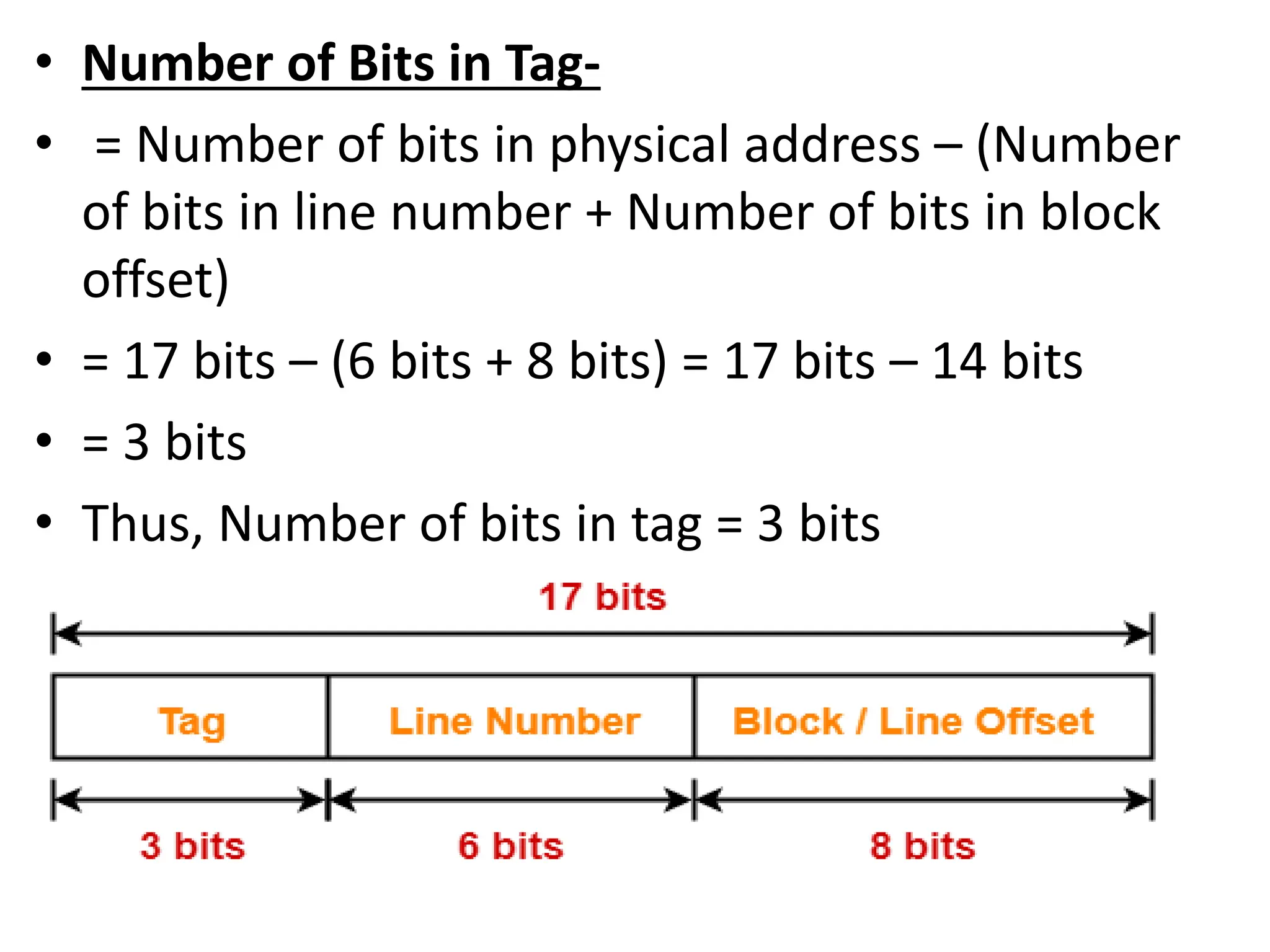
• Number of Bits in Tag-
• = Number of bits in physical address – (Number
of bits in line number + Number of bits in block
offset)
• = 17 bits – (6 bits + 8 bits) = 17 bits – 14 bits
• = 3 bits
• Thus, Number of bits in tag = 3 bits
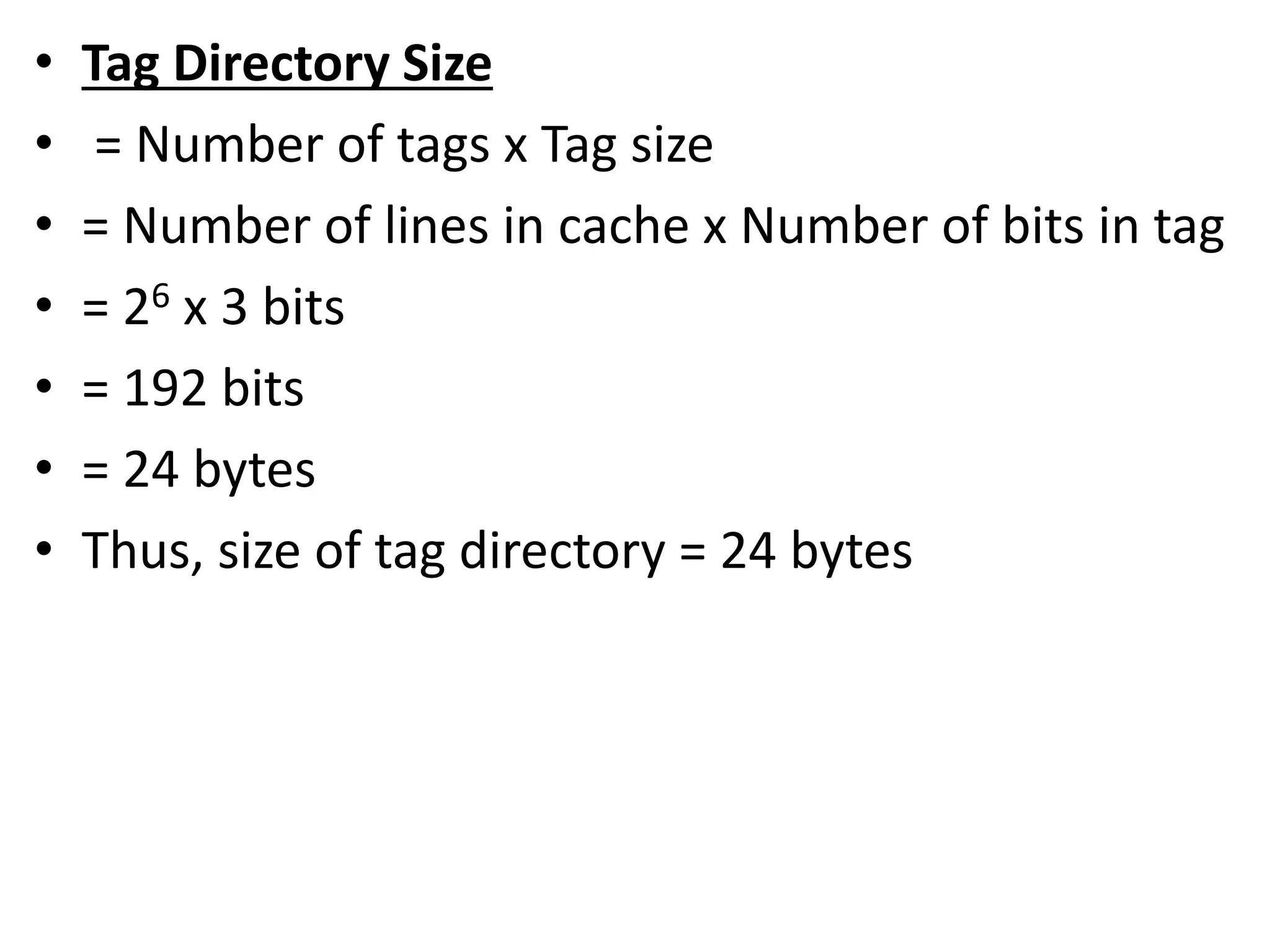
• Tag Directory Size
• = Number of tags x Tag size
• = Number of lines in cache x Number of bits in tag
• = 26 x 3 bits
• = 192 bits
• = 24 bytes
• Thus, size of tag directory = 24 bytes
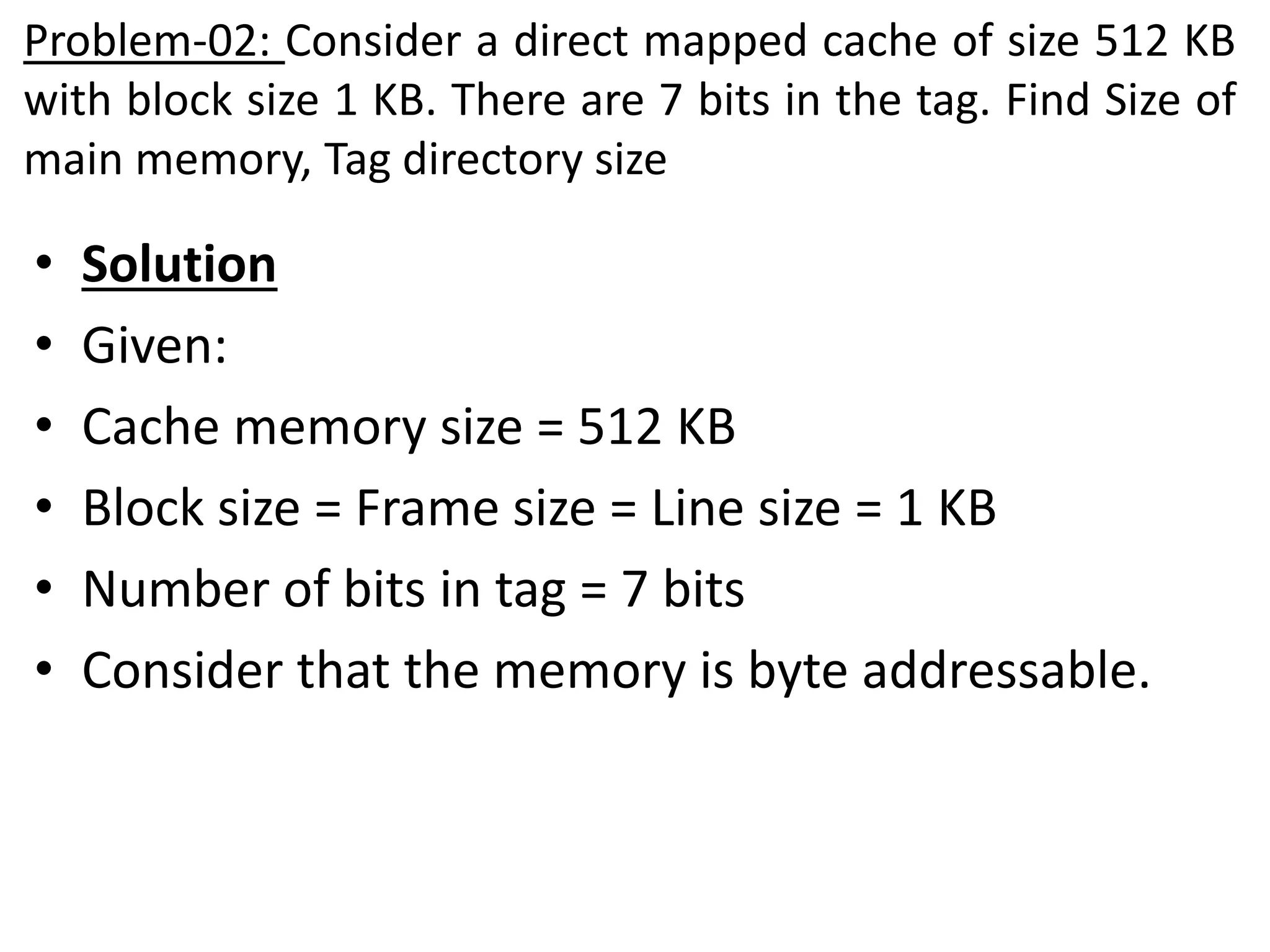
Problem-02: Consider a direct mapped cache of size 512 KB
with block size 1 KB. There are 7 bits in the tag. Find Size of
main memory, Tag directory size
• Solution
• Given:
• Cache memory size = 512 KB
• Block size = Frame size = Line size = 1 KB
• Number of bits in tag = 7 bits
• Consider that the memory is byte addressable.
Problem-02: Consider a direct mapped cache of size 512 KB
with block size 1 KB. There are 7 bits in the tag. Find Size of
main memory, Tag directory size
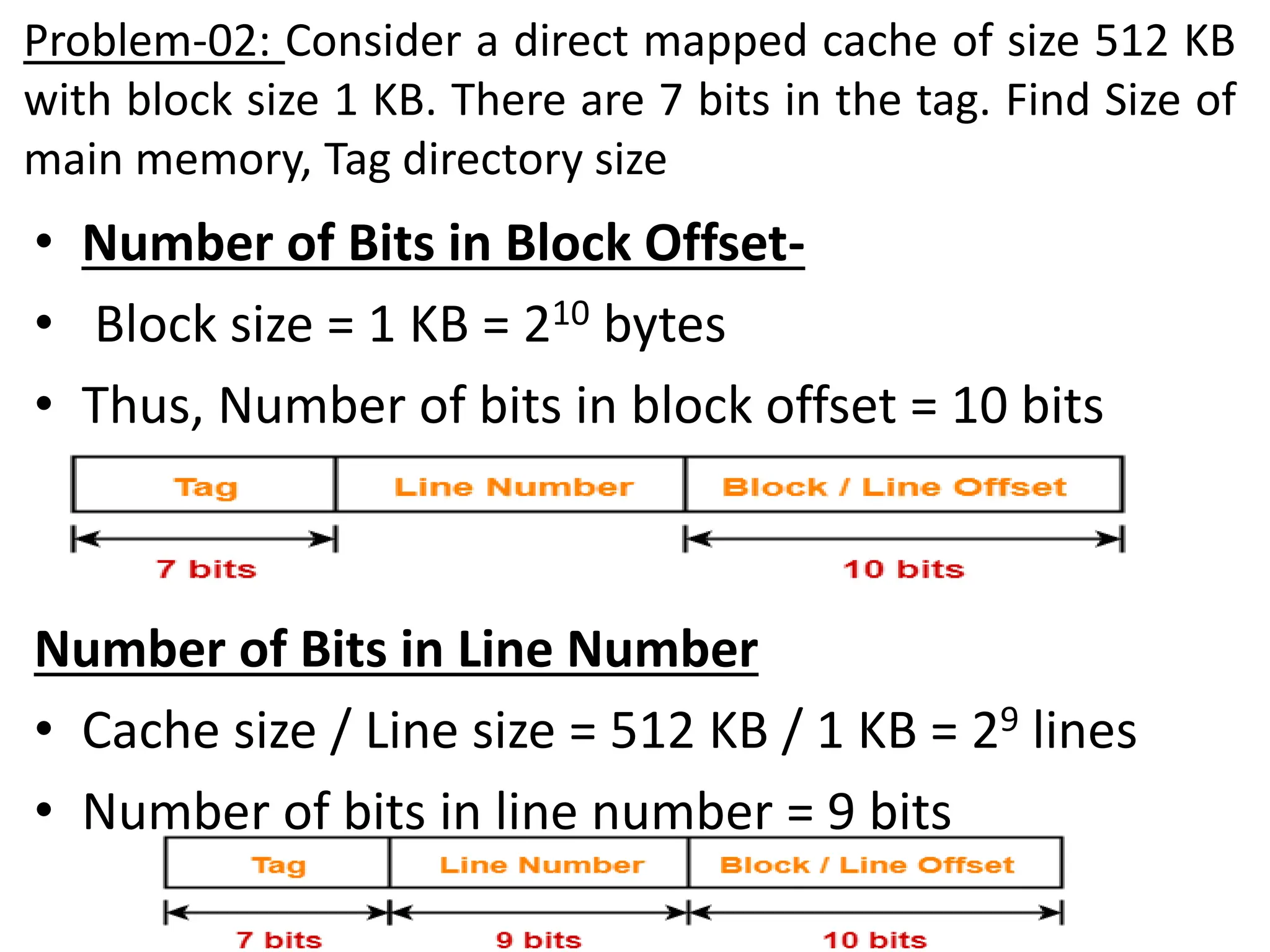
• Number of Bits in Block Offset-
• Block size = 1 KB = 210 bytes
• Thus, Number of bits in block offset = 10 bits
Number of Bits in Line Number
• Cache size / Line size = 512 KB / 1 KB = 29 lines
• Number of bits in line number = 9 bits
Problem-02: Consider a direct mapped cache of size 512 KB
with block size 1 KB. There are 7 bits in the tag. Find Size of
main memory, Tag directory size
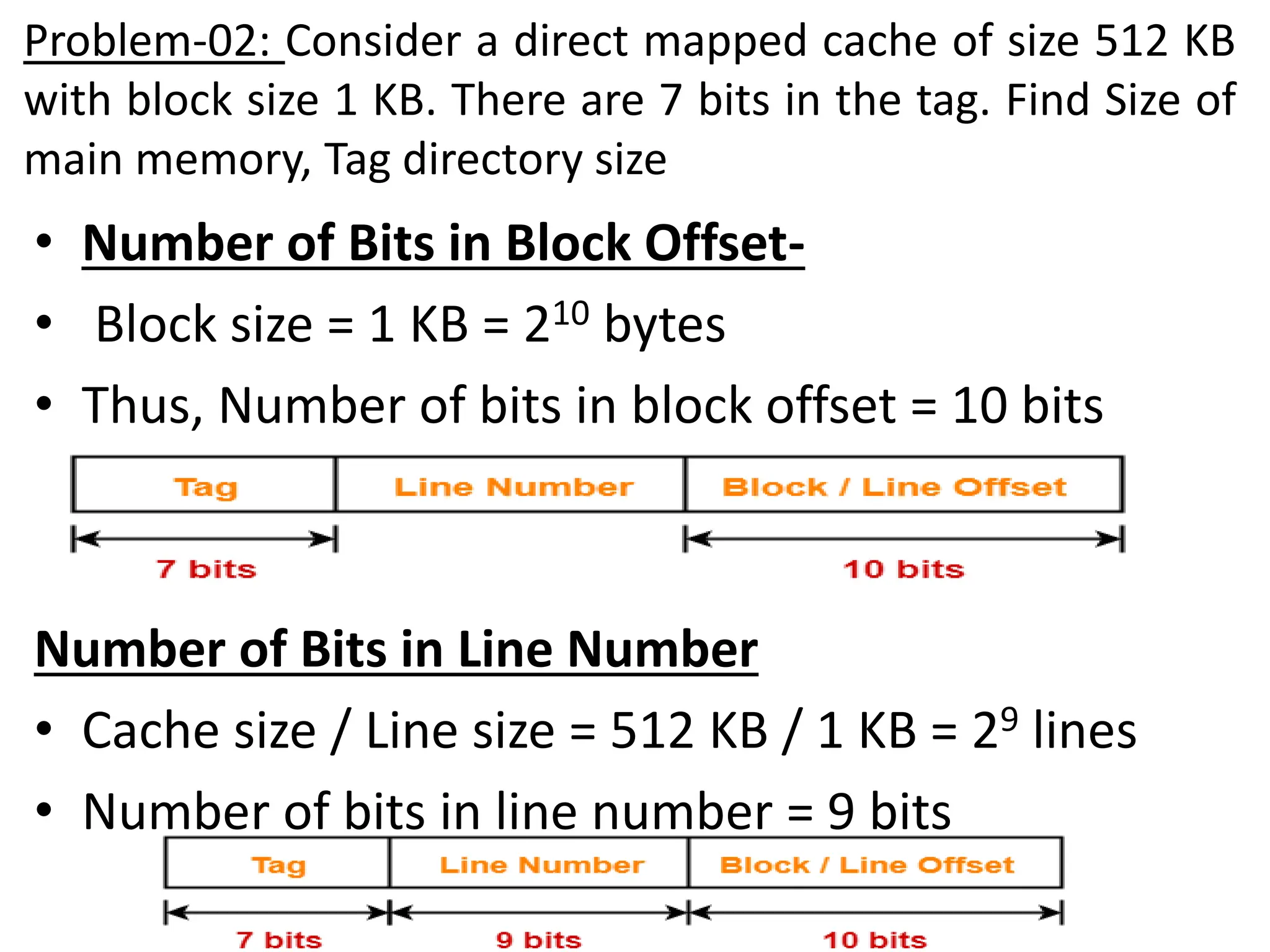
• Number of Bits in Block Offset-
• Block size = 1 KB = 210 bytes
• Thus, Number of bits in block offset = 10 bits
Number of Bits in Line Number
• Cache size / Line size = 512 KB / 1 KB = 29 lines
• Number of bits in line number = 9 bits
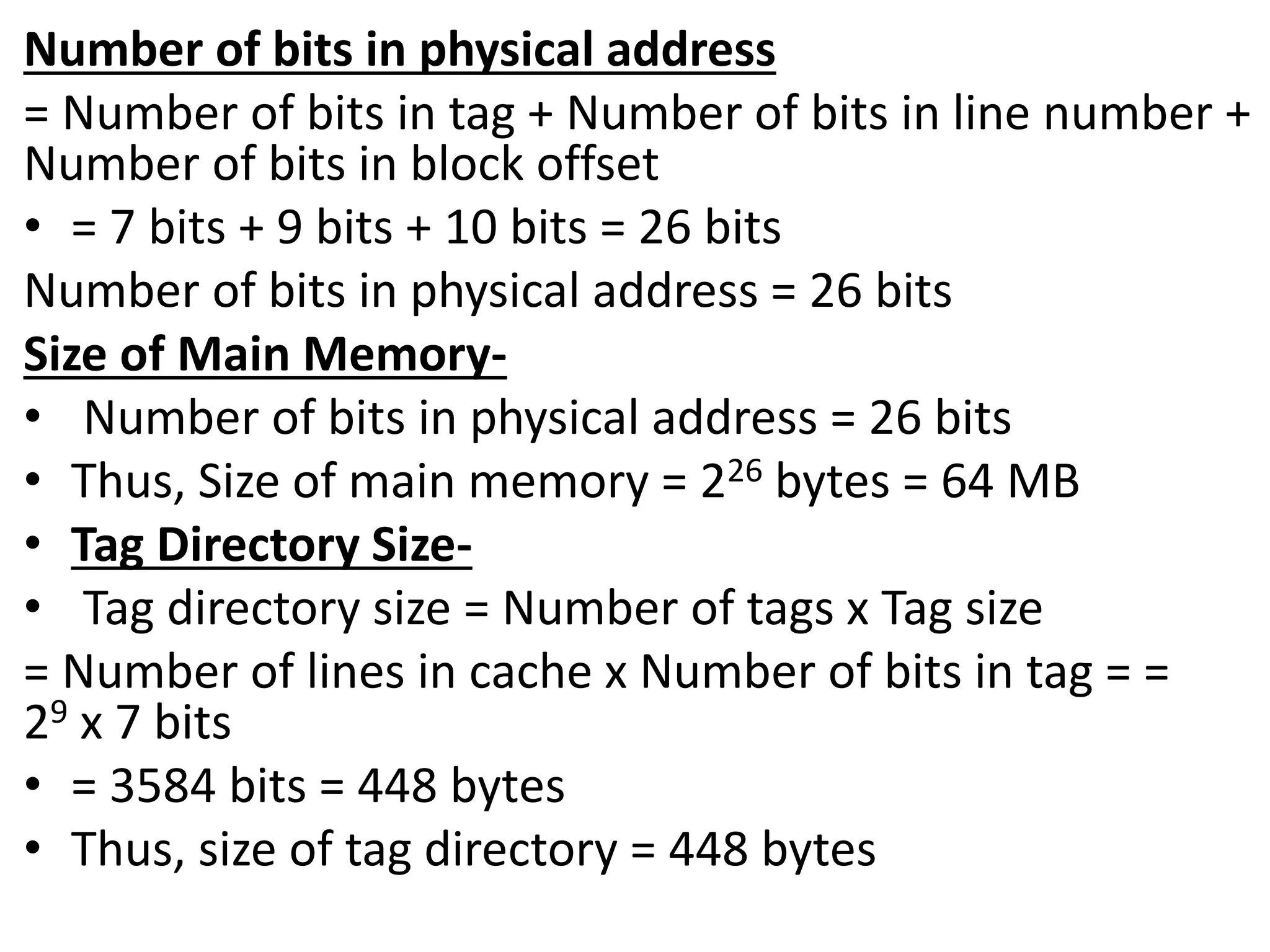
Number of bits in physical address
= Number of bits in tag + Number of bits in line number +
Number of bits in block offset
• = 7 bits + 9 bits + 10 bits = 26 bits
Number of bits in physical address = 26 bits
Size of Main Memory-
• Number of bits in physical address = 26 bits
• Thus, Size of main memory = 226 bytes = 64 MB
• Tag Directory Size-
• Tag directory size = Number of tags x Tag size
= Number of lines in cache x Number of bits in tag = =
29 x 7 bits
• = 3584 bits = 448 bytes
• Thus, size of tag directory = 448 bytes
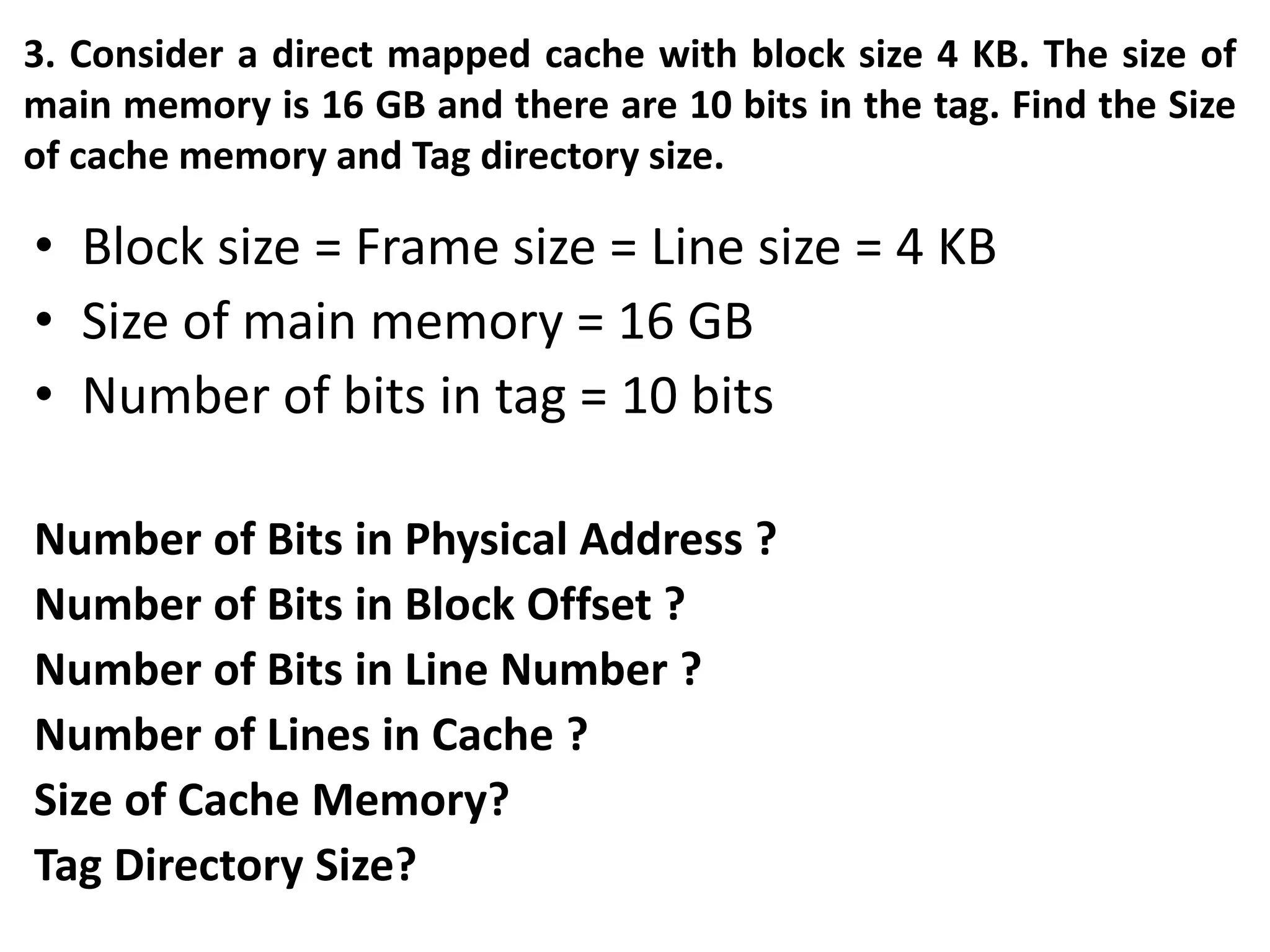
3. Consider a direct mapped cache with block size 4 KB. The size of
main memory is 16 GB and there are 10 bits in the tag. Find the Size
of cache memory and Tag directory size.
• Block size = Frame size = Line size = 4 KB
• Size of main memory = 16 GB
• Number of bits in tag = 10 bits
Number of Bits in Physical Address ?
Number of Bits in Block Offset ?
Number of Bits in Line Number ?
Number of Lines in Cache ?
Size of Cache Memory?
Tag Directory Size?
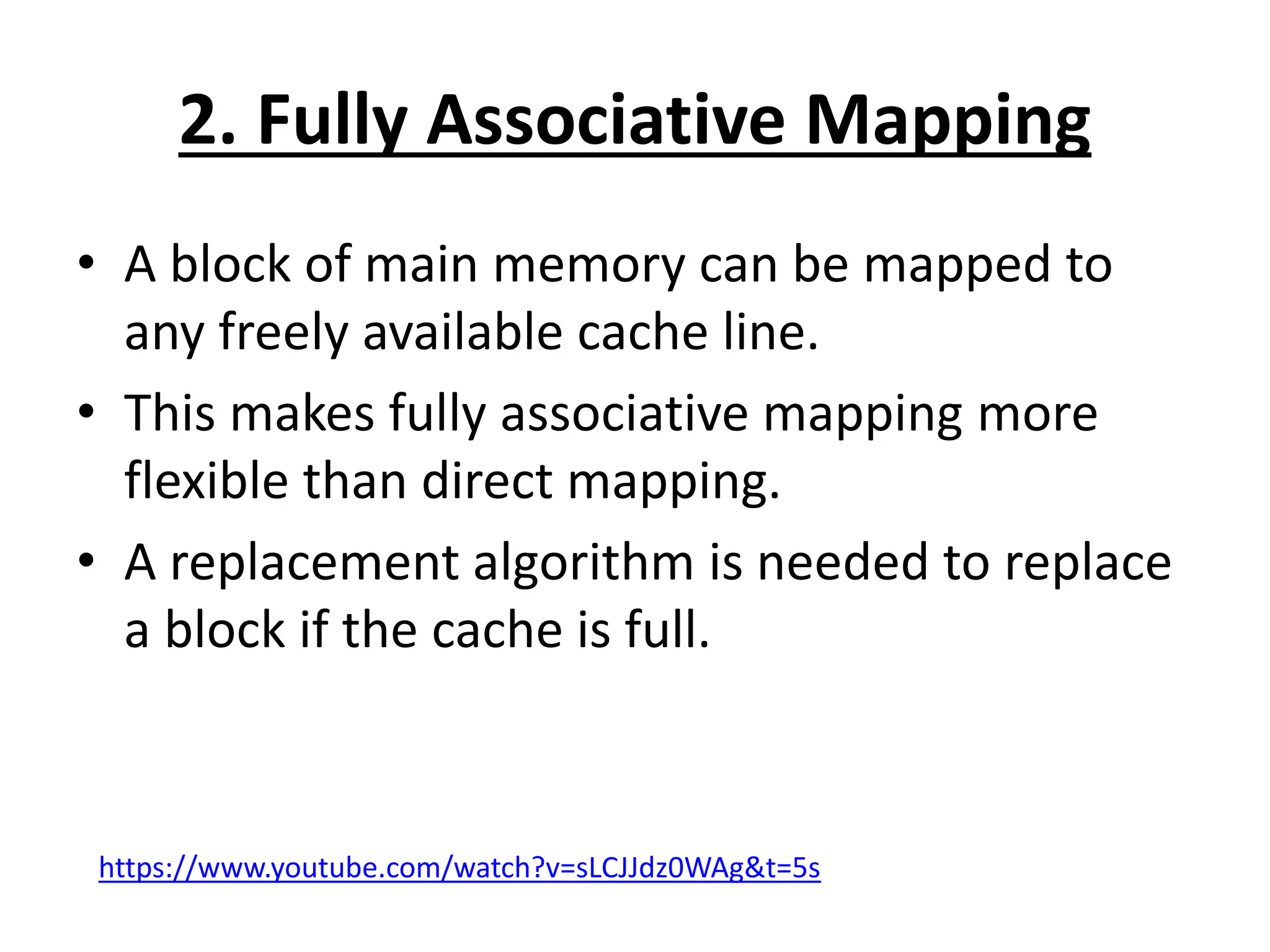
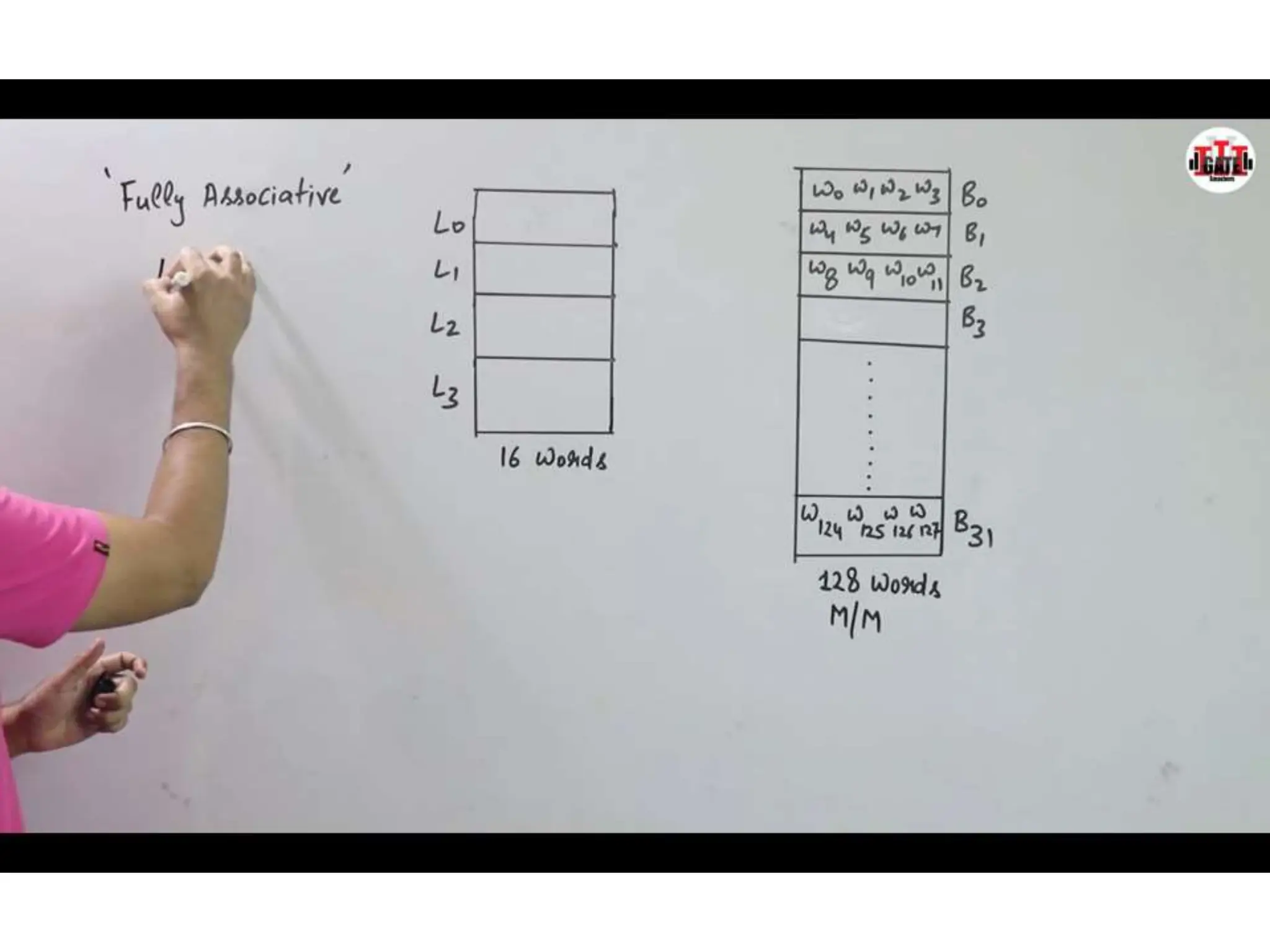
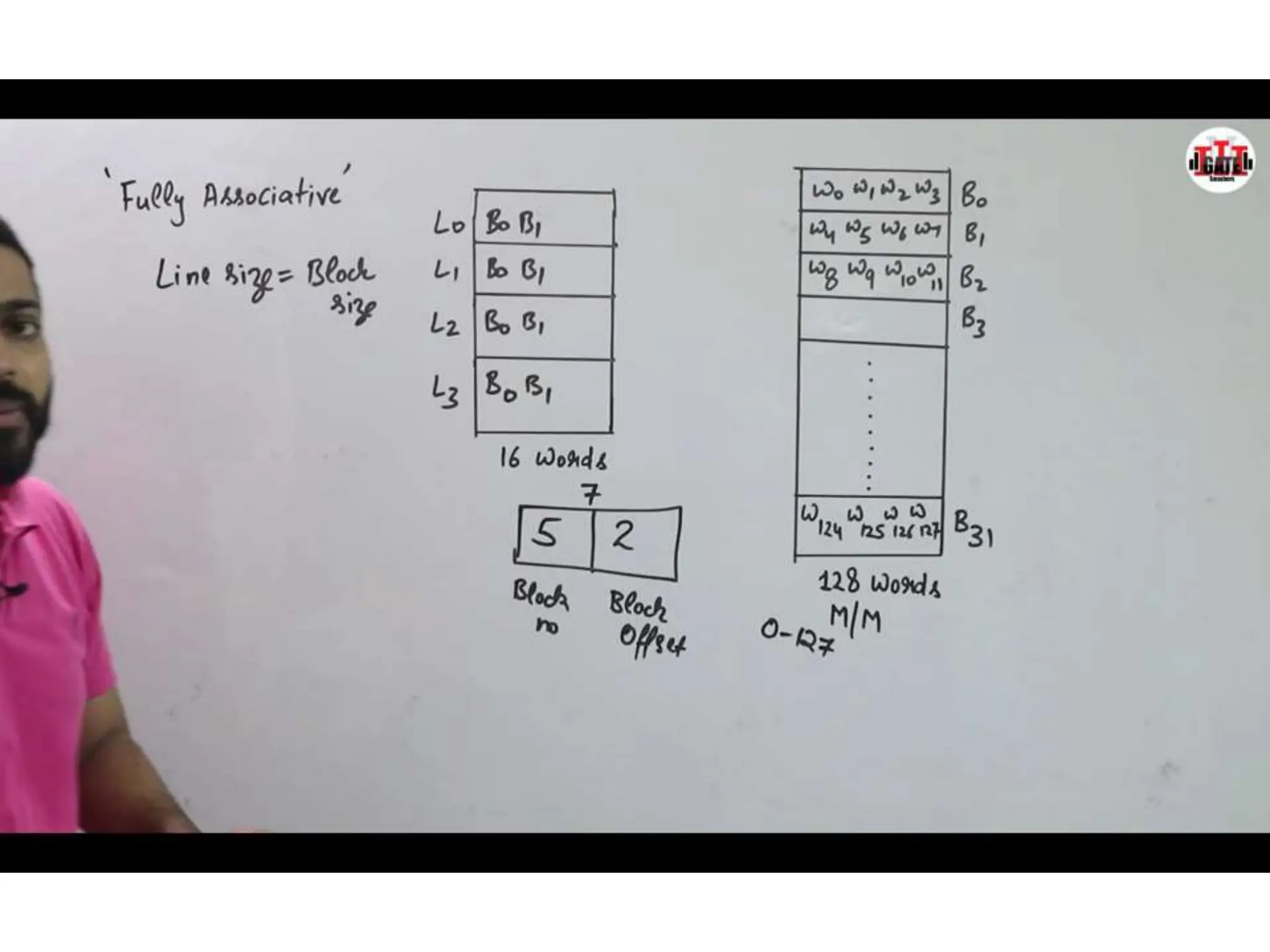
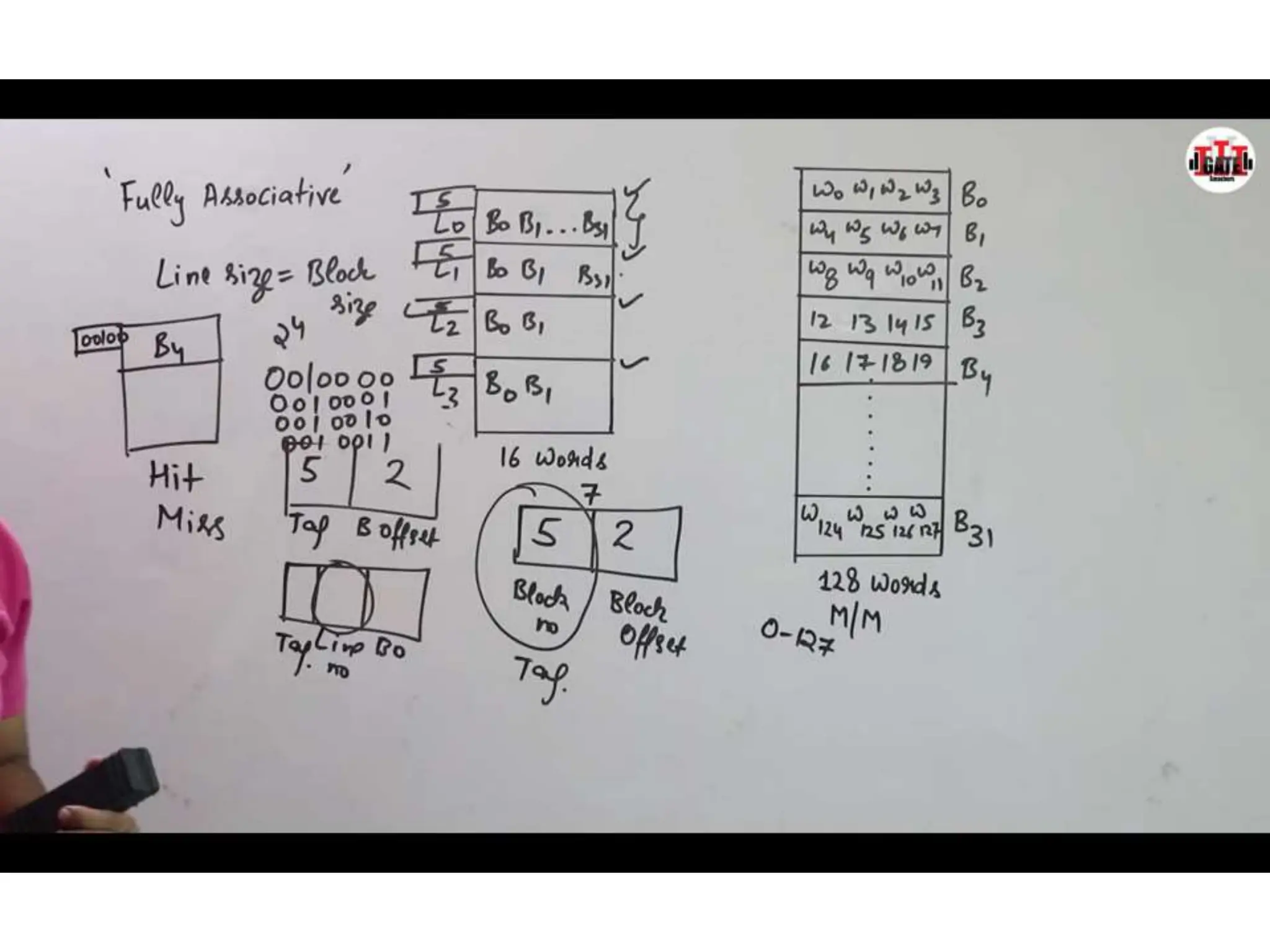
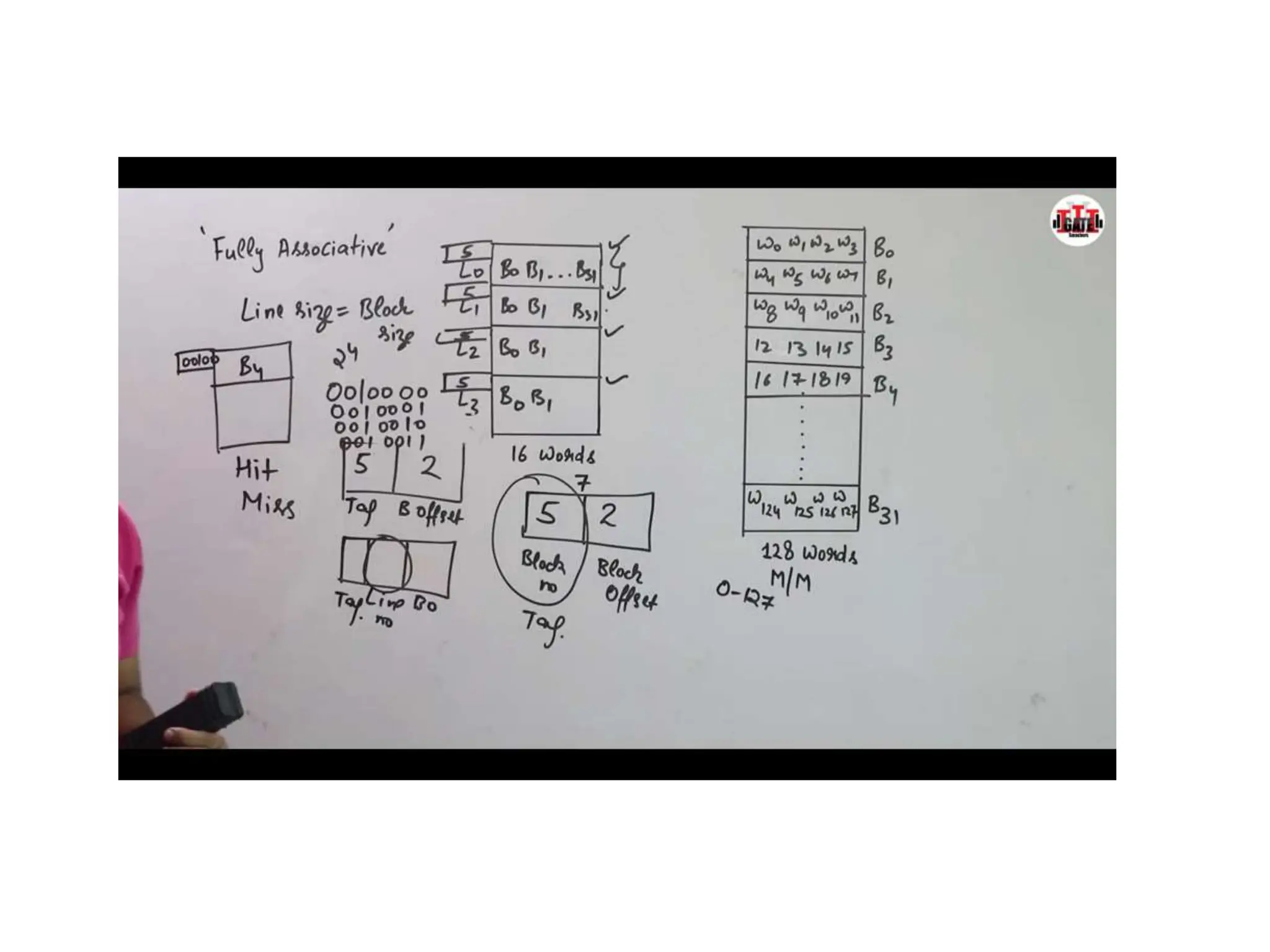
2. Fully Associative Mapping
• A block of main memory can be mapped to
any freely available cache line.
• This makes fully associative mapping more
flexible than direct mapping.
• A replacement algorithm is needed to replace
a block if the cache is full.
https://www.youtube.com/watch?v=sLCJJdz0WAg&t=5s
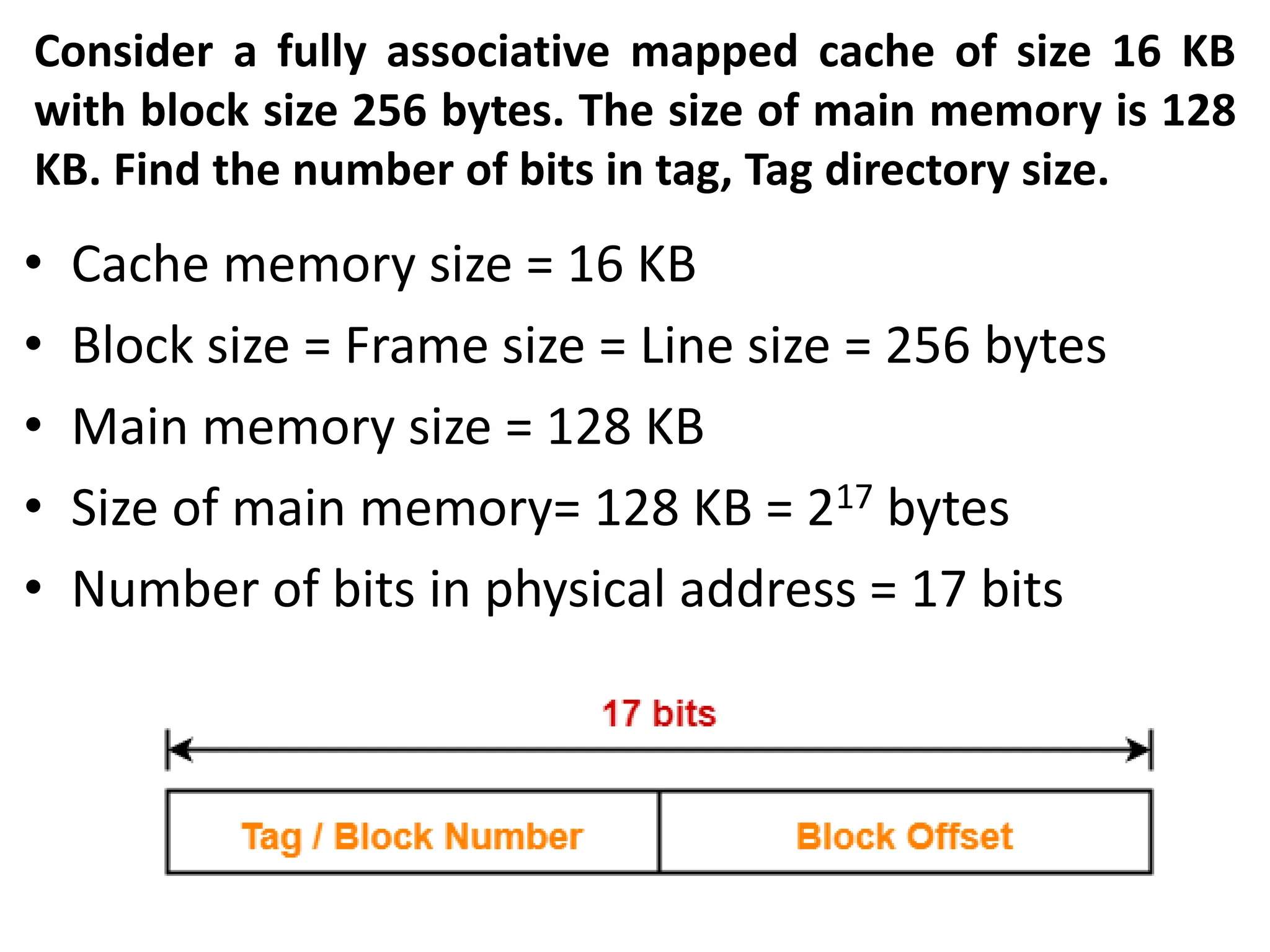
Consider a fully associative mapped cache of size 16 KB
with block size 256 bytes. The size of main memory is 128
KB. Find the number of bits in tag, Tag directory size.
• Cache memory size = 16 KB
• Block size = Frame size = Line size = 256 bytes
• Main memory size = 128 KB
• Size of main memory= 128 KB = 217 bytes
• Number of bits in physical address = 17 bits
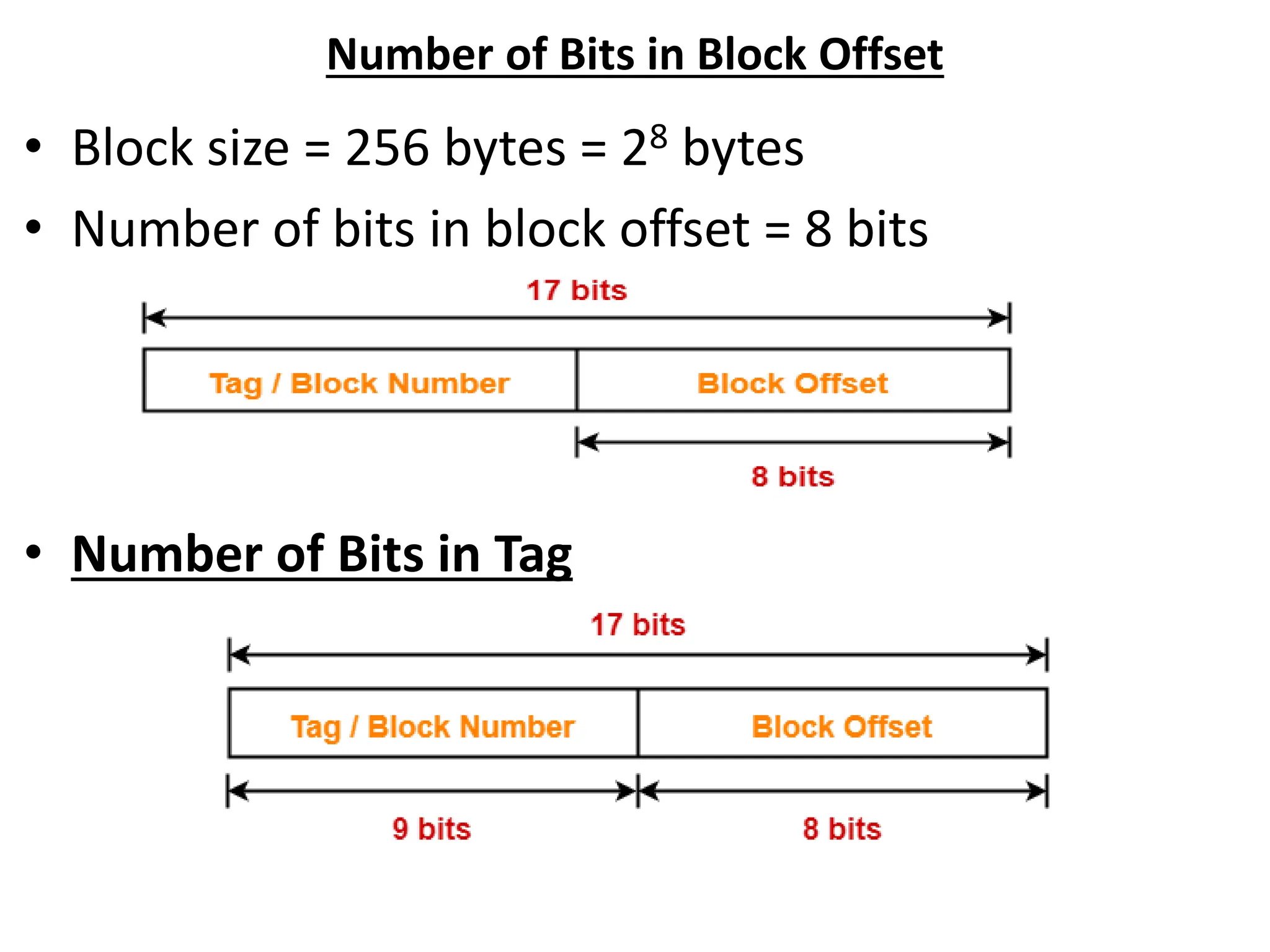
Number of Bits in Block Offset
• Block size = 256 bytes = 28 bytes
• Number of bits in block offset = 8 bits
• Number of Bits in Tag
Number of Lines in Cache
• Total number of lines in cache = Cache size/Line size
• = 16 KB / 256 bytes = 214 bytes / 28 bytes = 26 lines
• Tag Directory Size = Number of tags x Tag size
• = Number of lines in cache x Number of bits in tag
• = 26 x 9 bits = 576 bits = 72 bytes
• Size of tag directory = 72 bytes
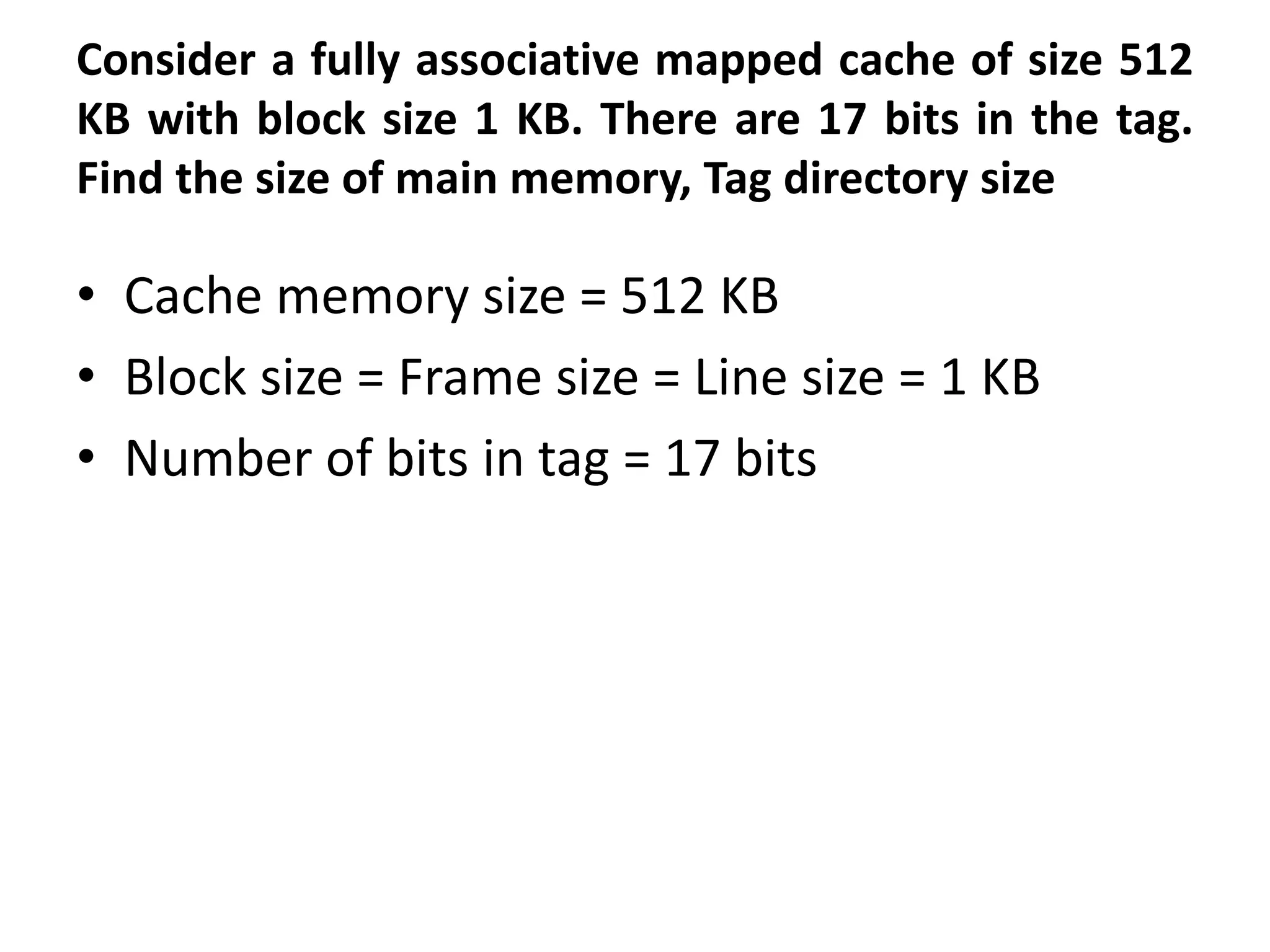
Consider a fully associative mapped cache of size 512
KB with block size 1 KB. There are 17 bits in the tag.
Find the size of main memory, Tag directory size
• Cache memory size = 512 KB
• Block size = Frame size = Line size = 1 KB
• Number of bits in tag = 17 bits
Consider a fully associative mapped cache of size 512
KB with block size 1 KB. There are 17 bits in the tag.
Find the size of main memory, Tag directory size
• Cache memory size = 512 KB
• Block size = Frame size = Line size = 1 KB
• Number of bits in tag = 17 bits
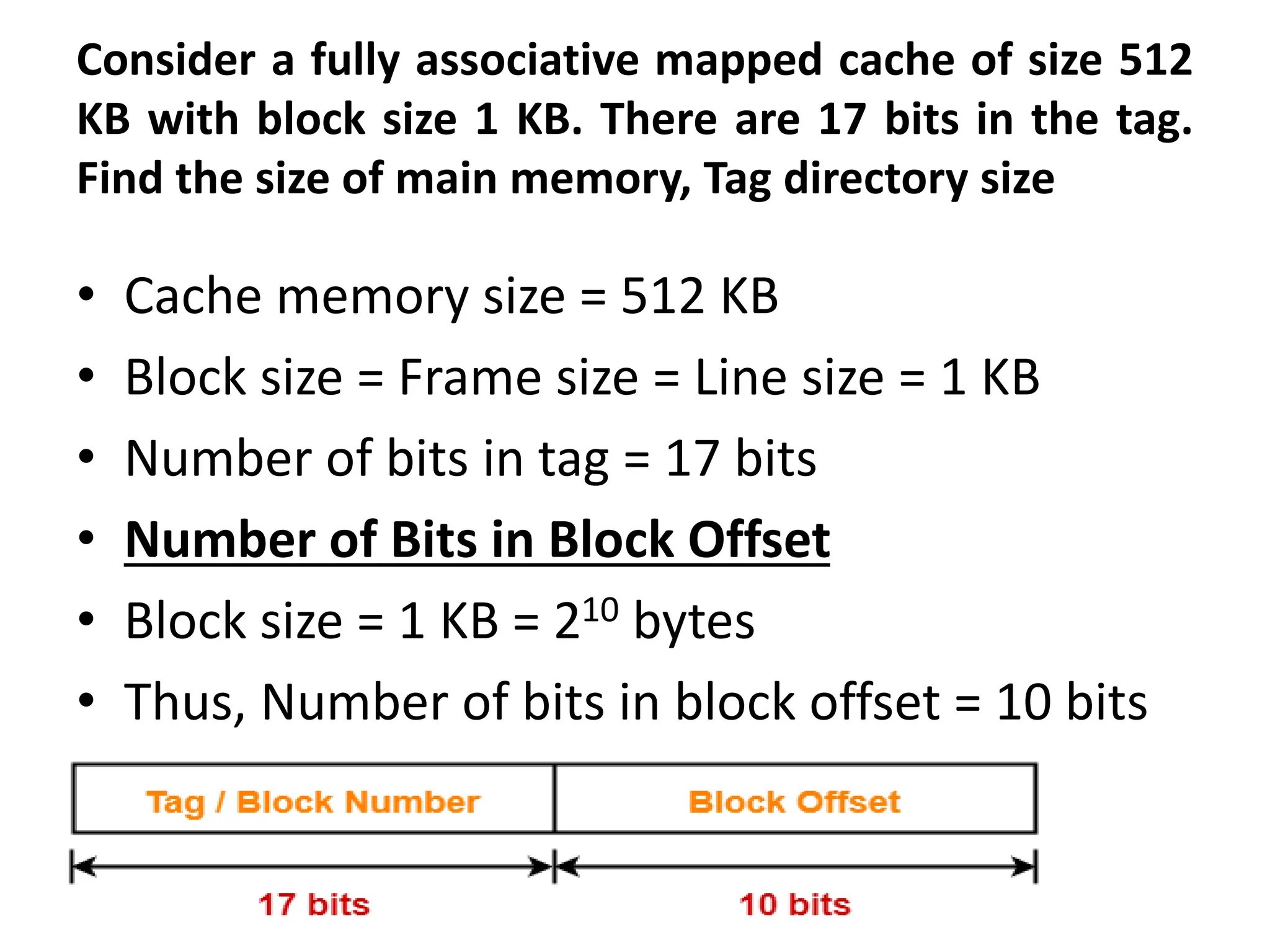
• Number of Bits in Block Offset
• Block size = 1 KB = 210 bytes
• Thus, Number of bits in block offset = 10 bits
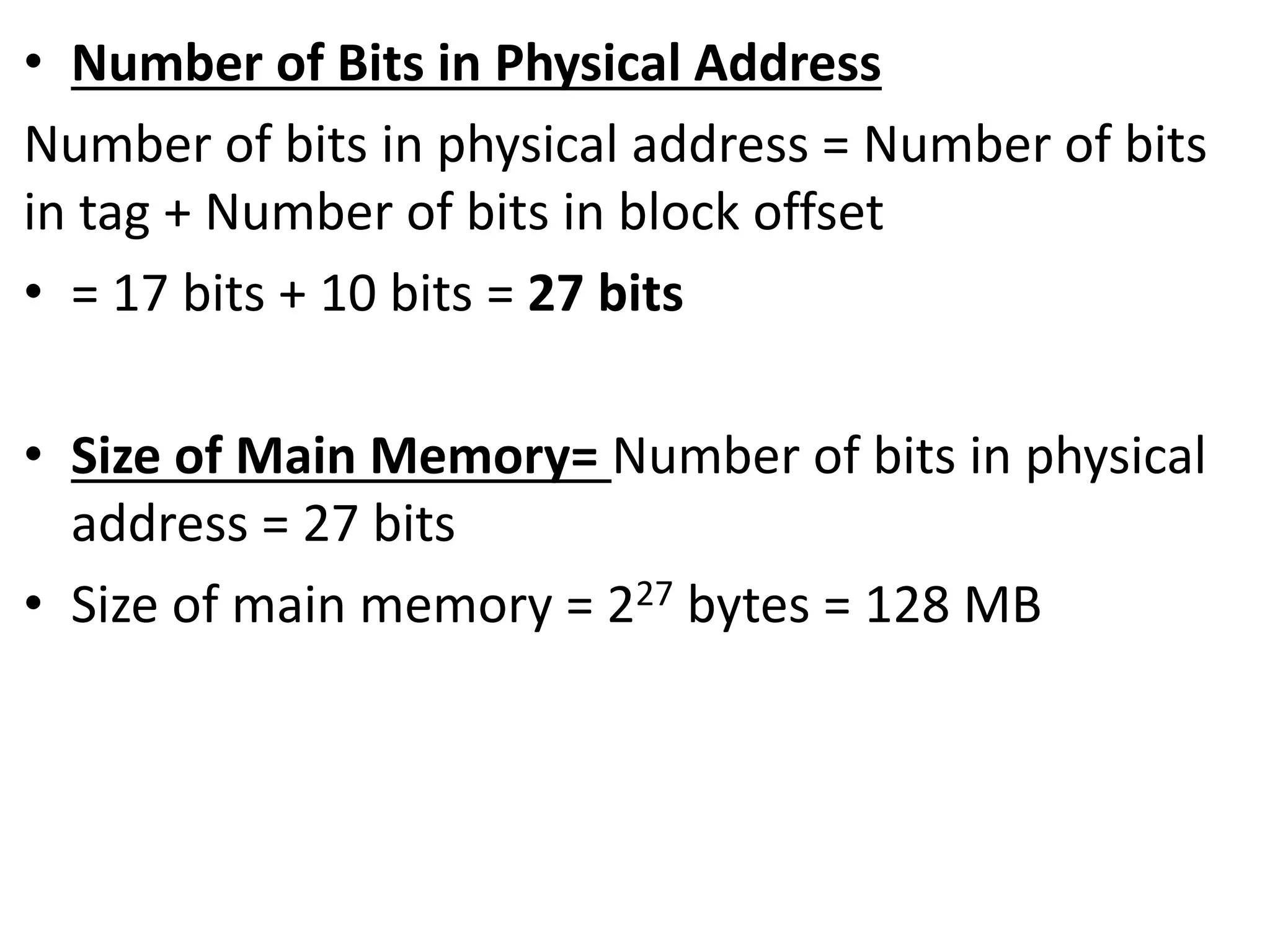
• Number of Bits in Physical Address
Number of bits in physical address = Number of bits
in tag + Number of bits in block offset
• = 17 bits + 10 bits = 27 bits
• Size of Main Memory= Number of bits in physical
address = 27 bits
• Size of main memory = 227 bytes = 128 MB
• Number of Lines in Cache-
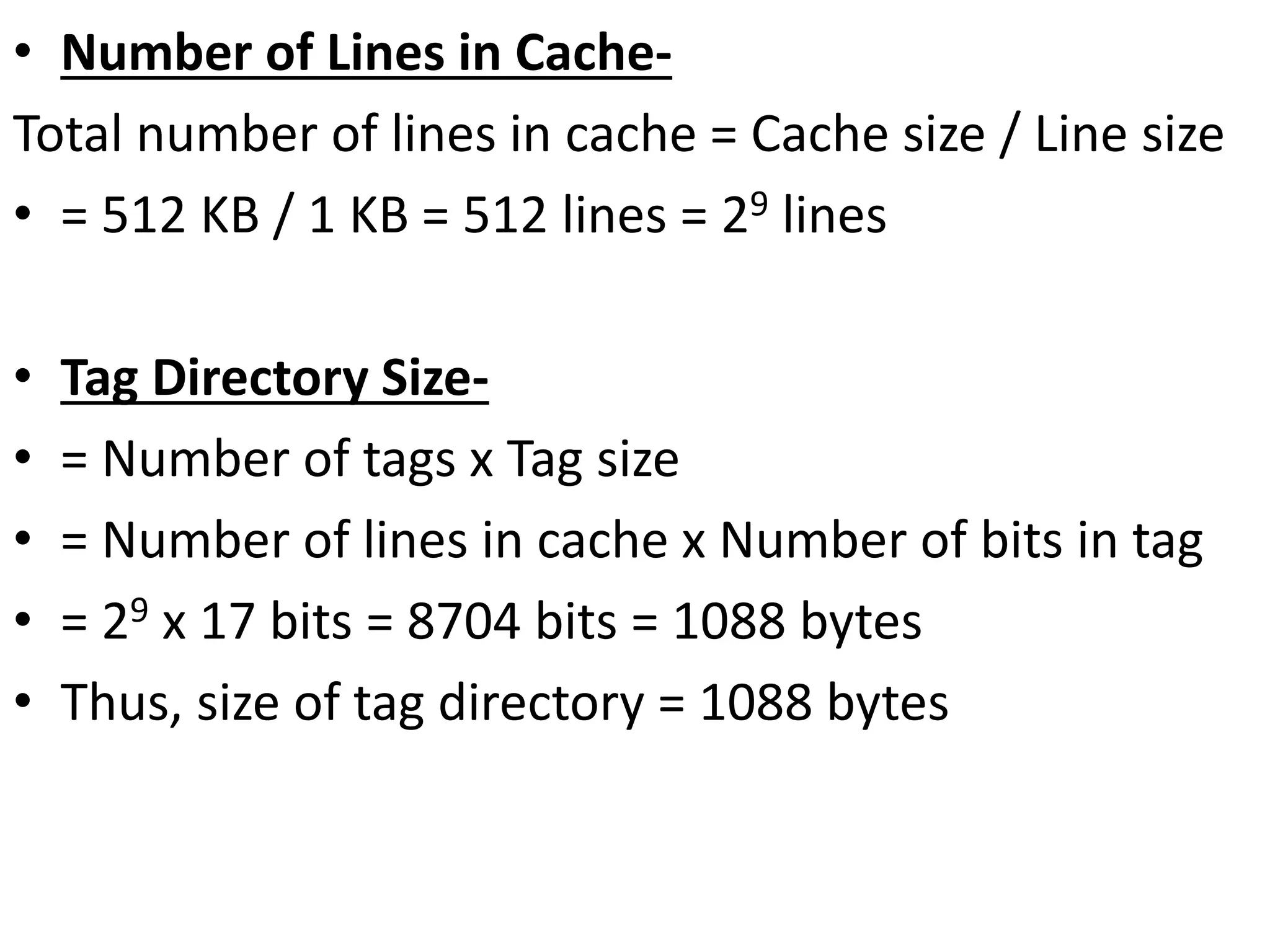
Total number of lines in cache = Cache size / Line size
• = 512 KB / 1 KB = 512 lines = 29 lines
• Tag Directory Size-
• = Number of tags x Tag size
• = Number of lines in cache x Number of bits in tag
• = 29 x 17 bits = 8704 bits = 1088 bytes
• Thus, size of tag directory = 1088 bytes
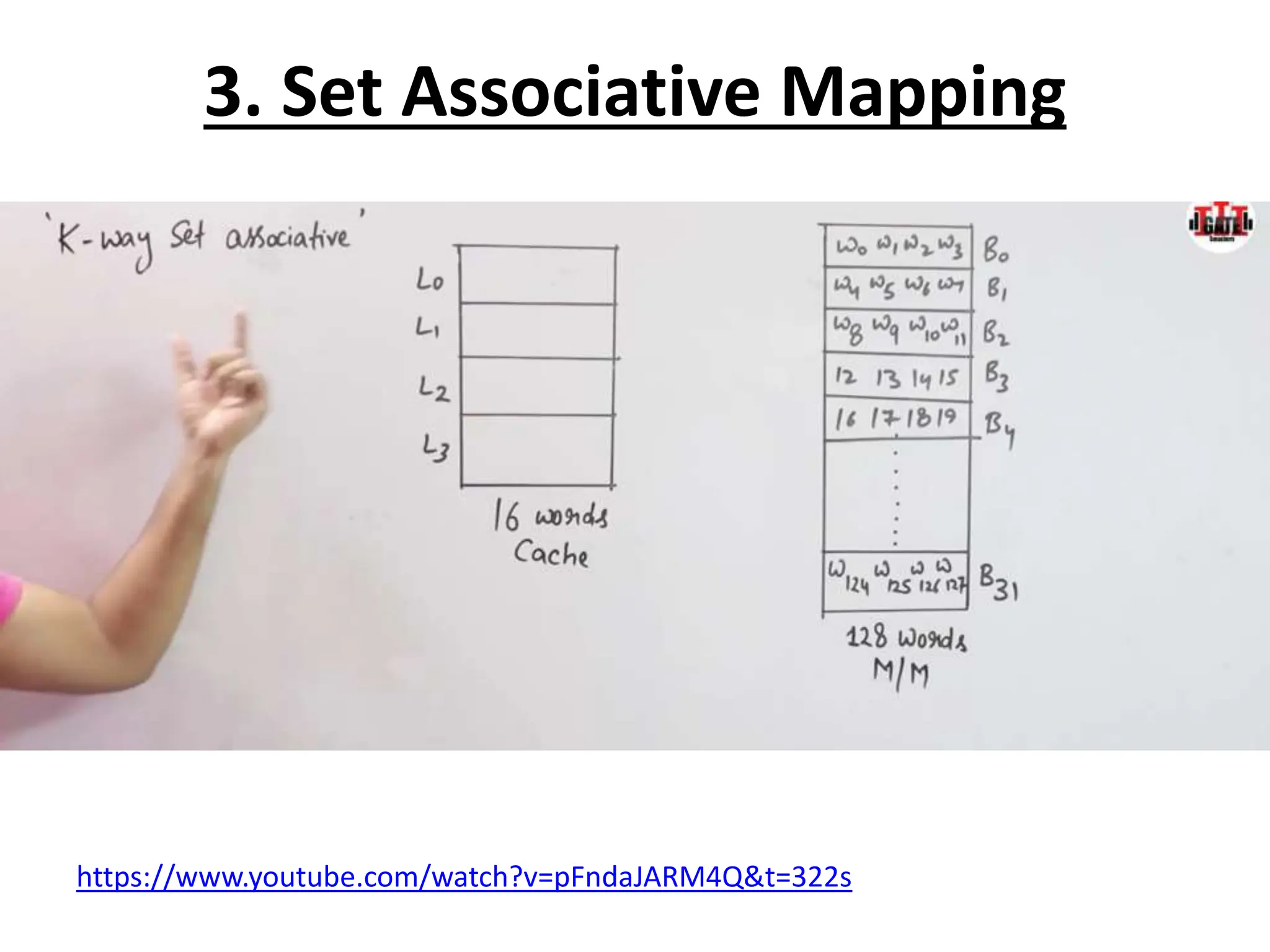
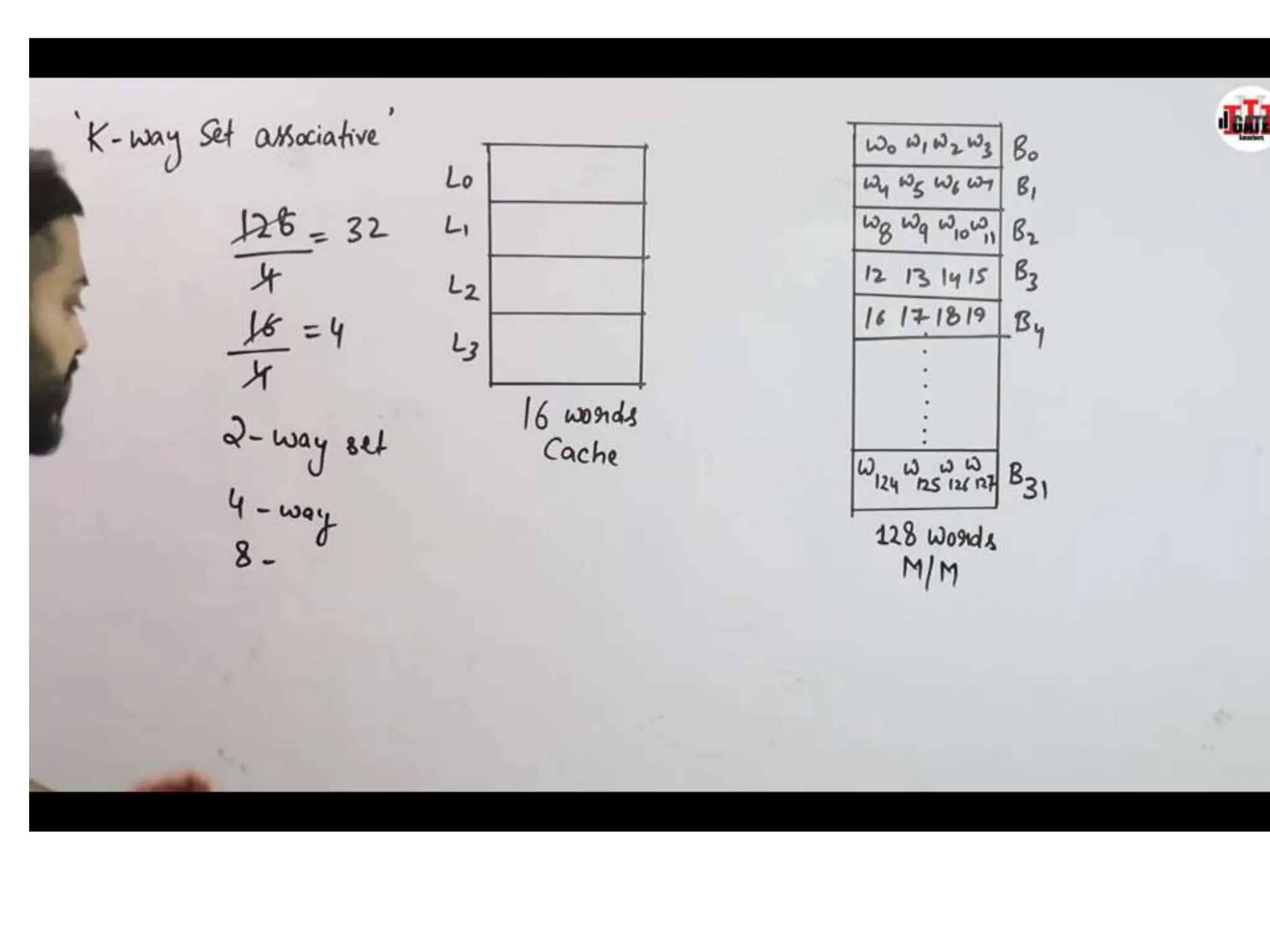
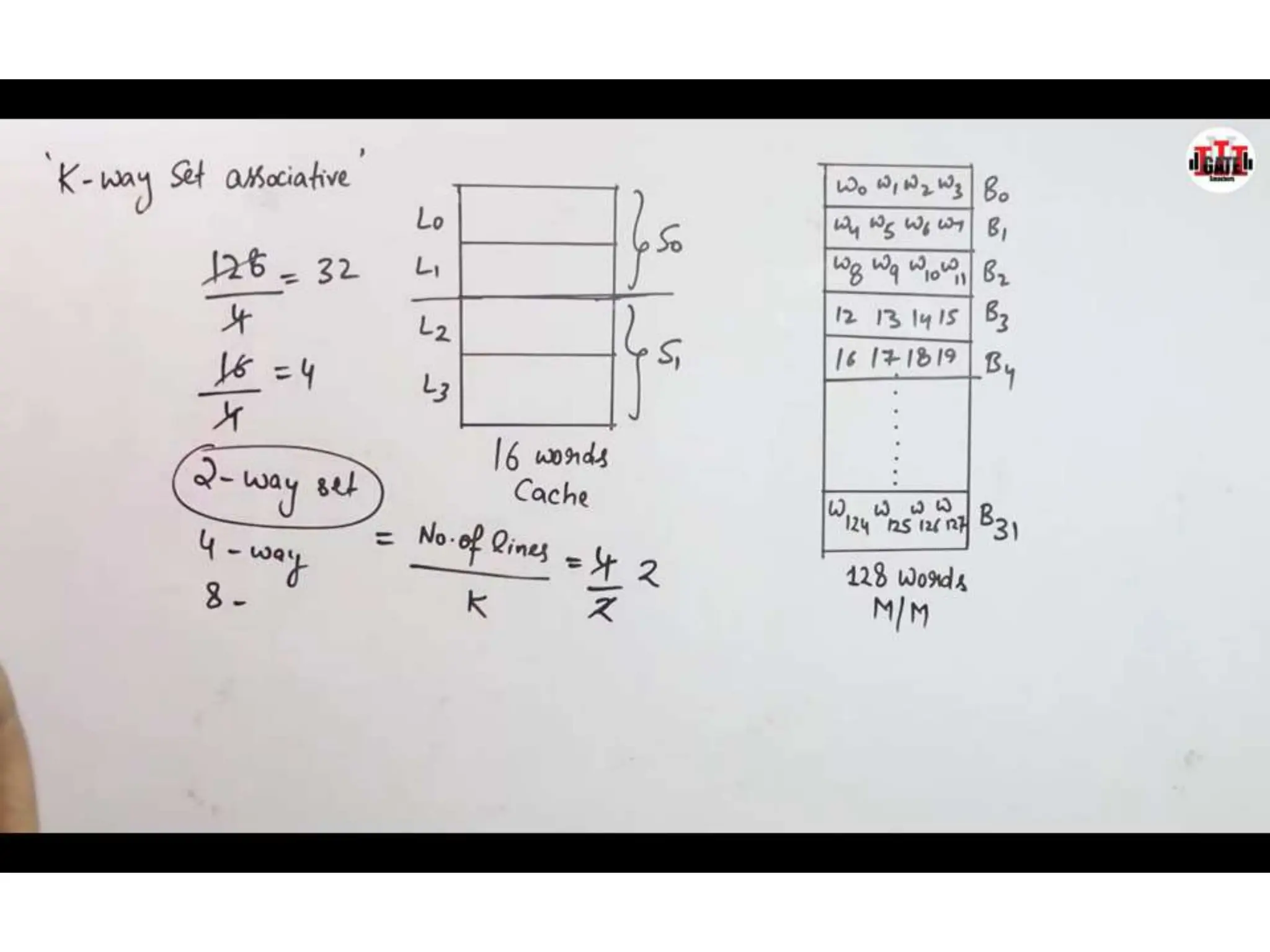
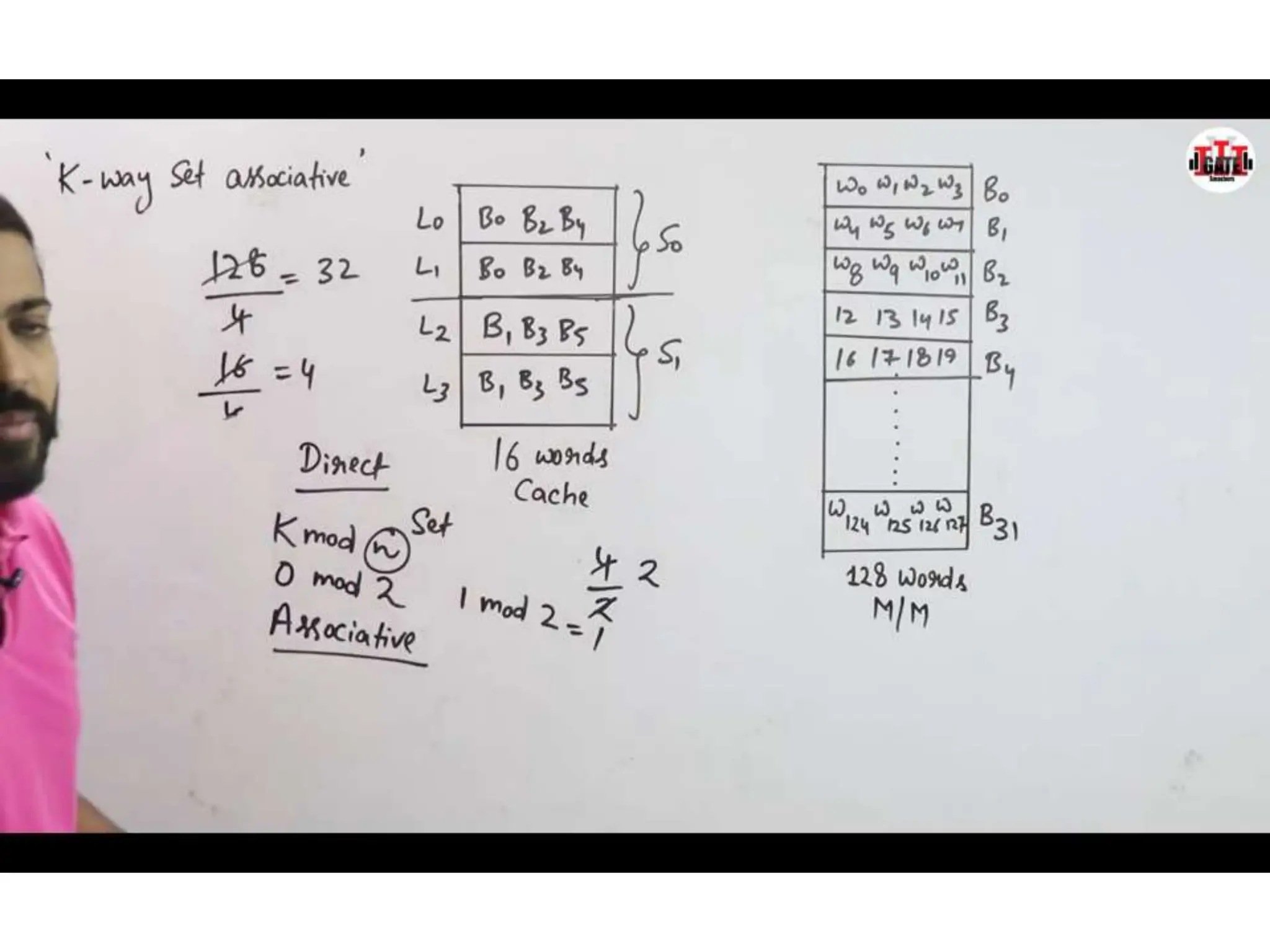
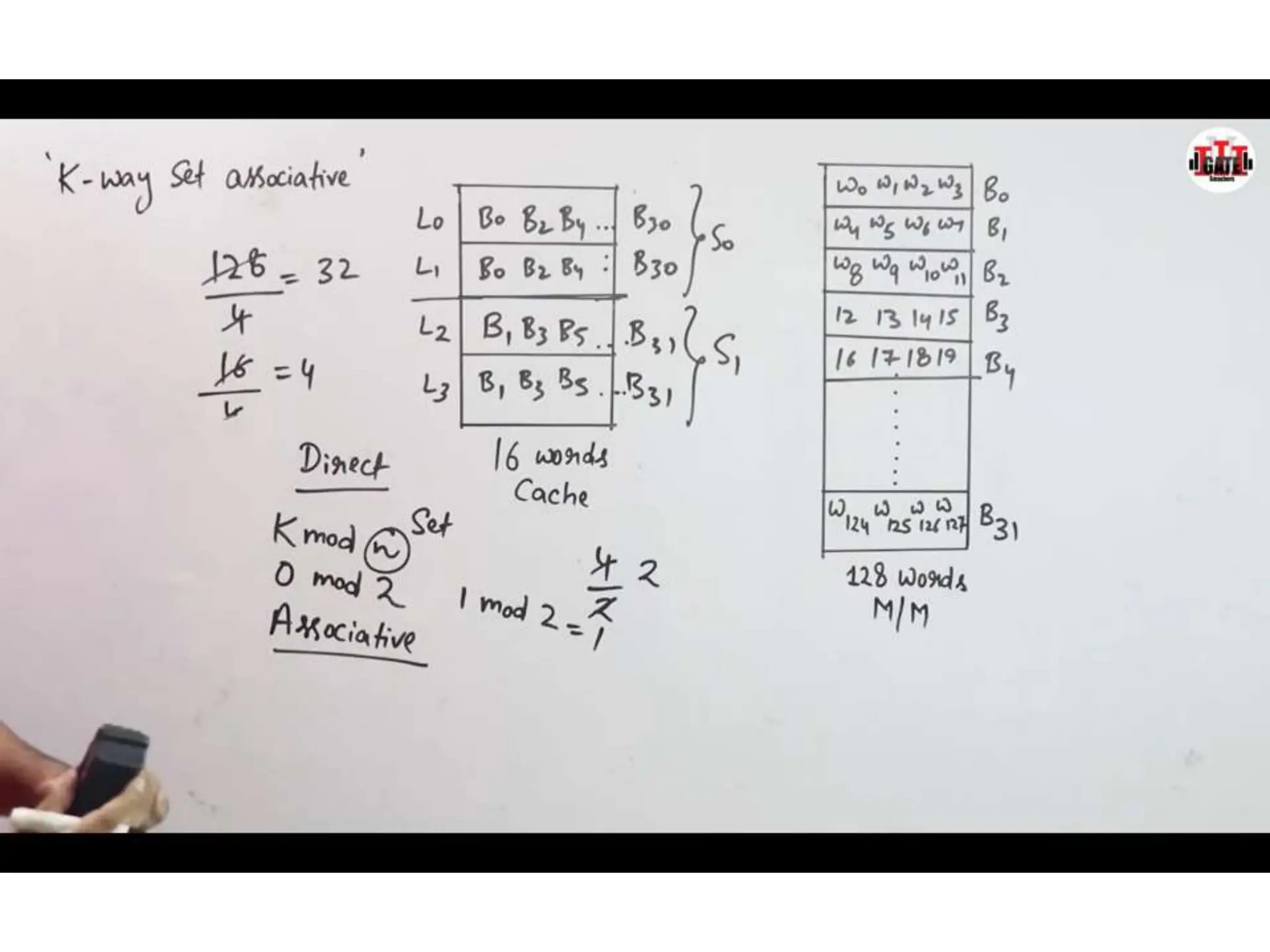
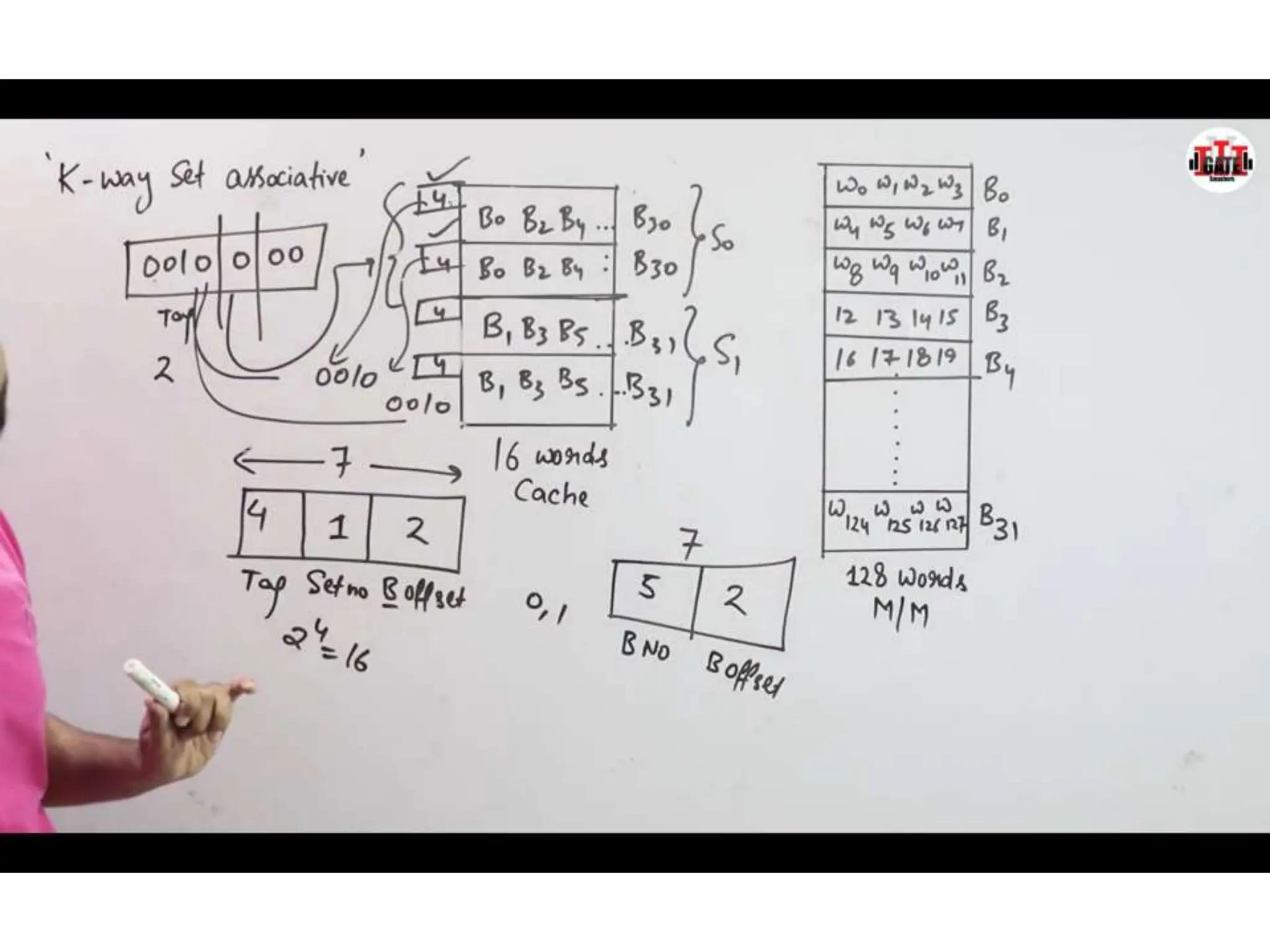
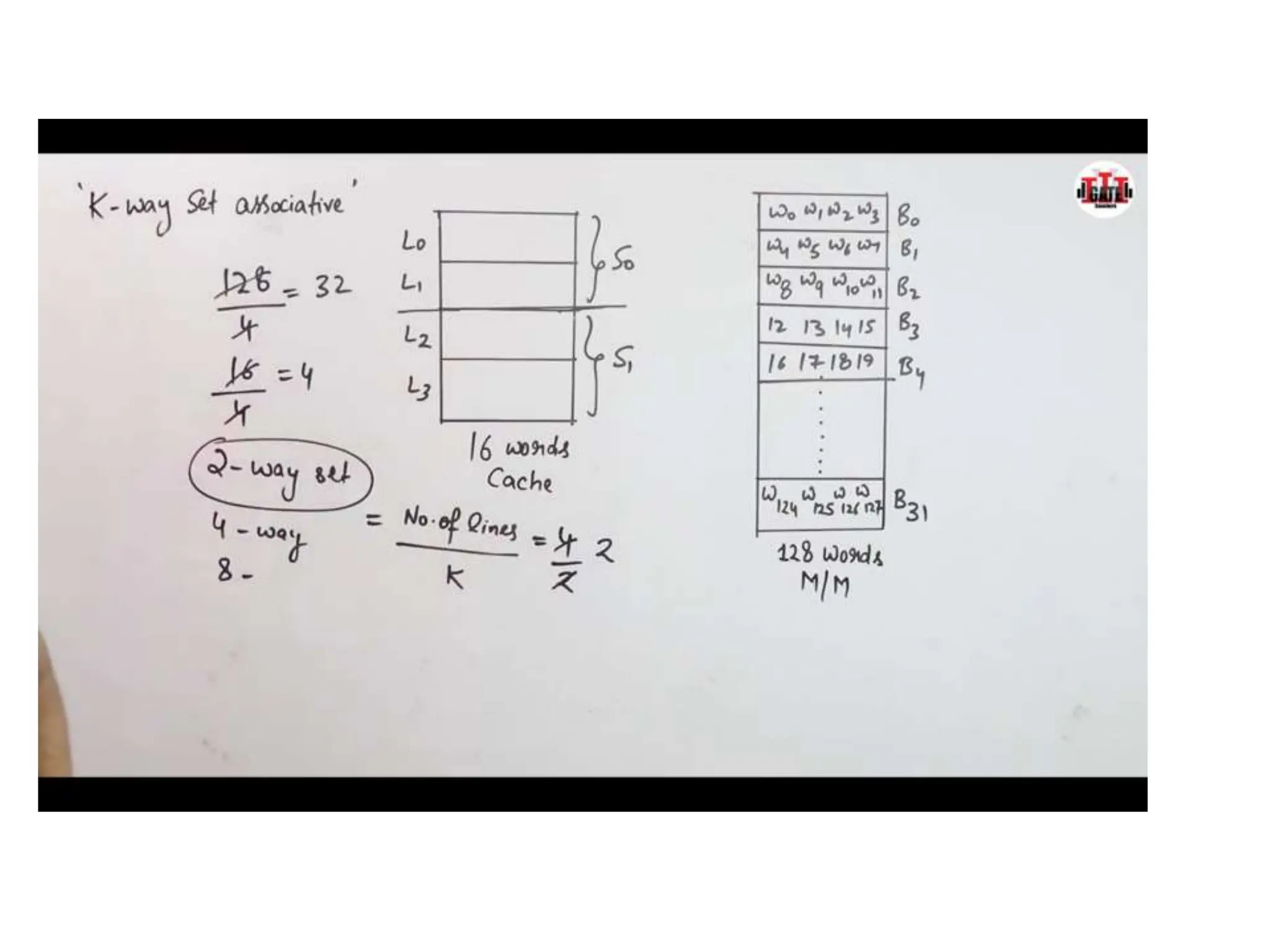
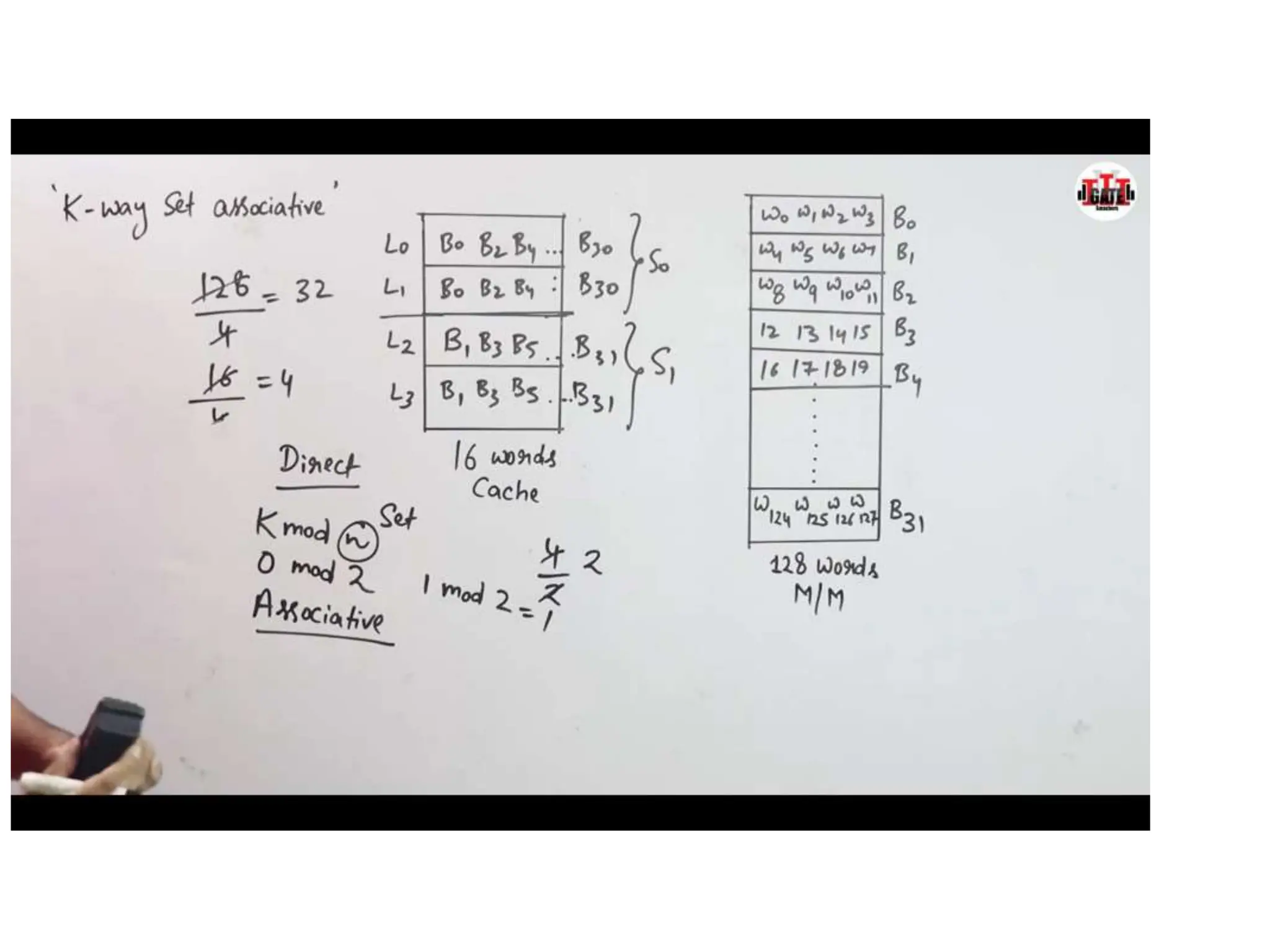
3. Set Associative Mapping
https://www.youtube.com/watch?v=pFndaJARM4Q&t=322s
Set Associative Mapping
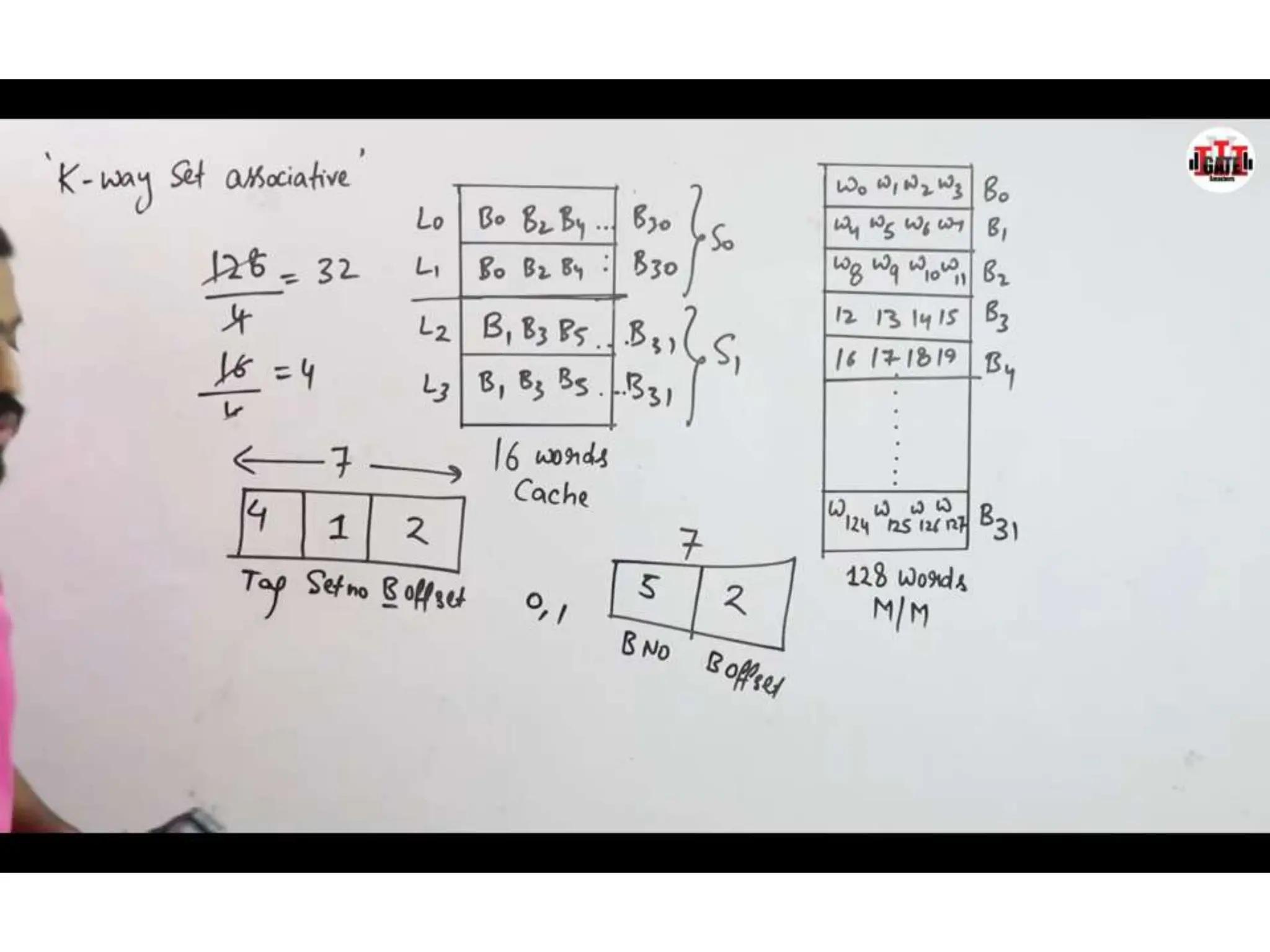
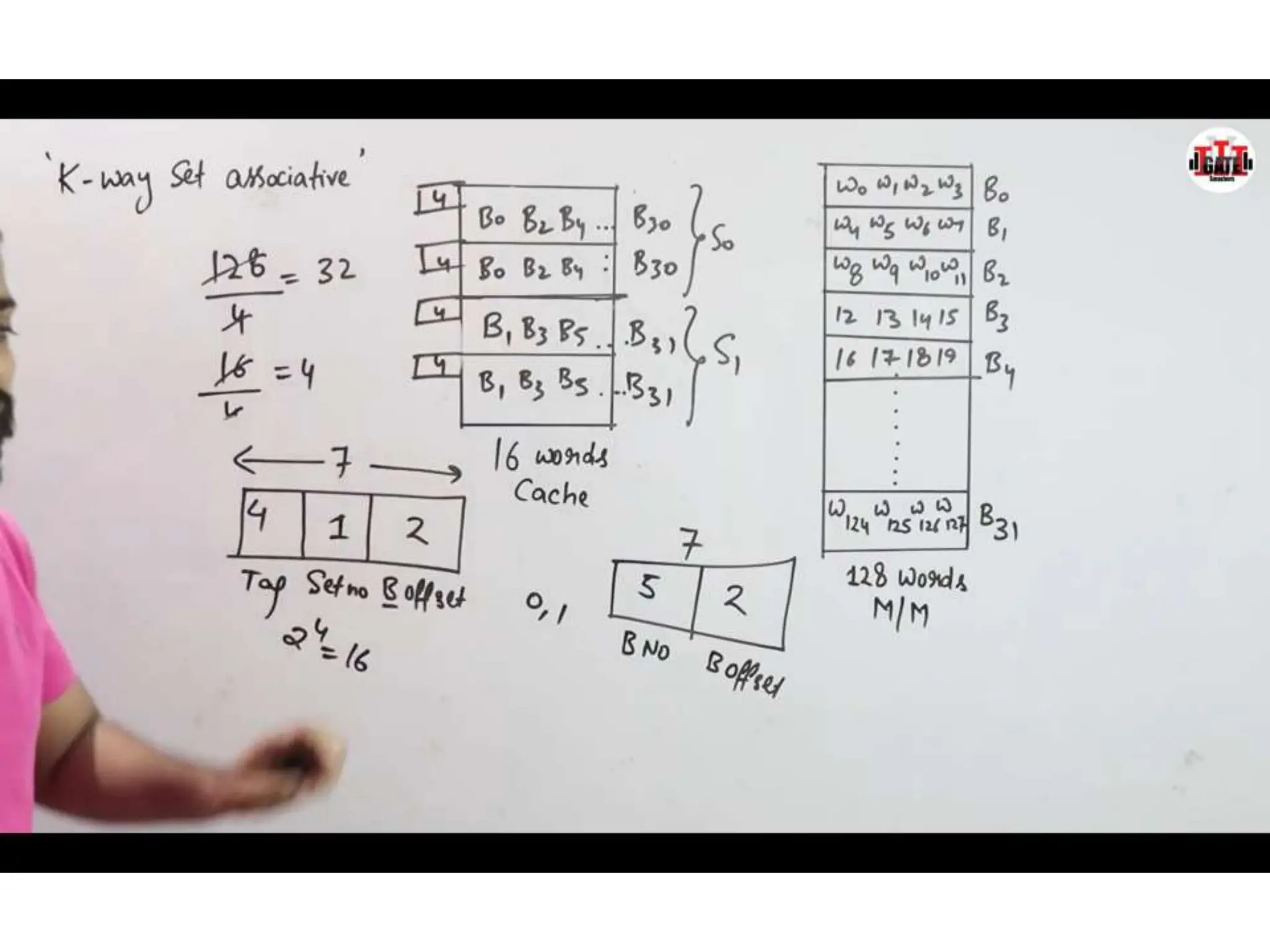
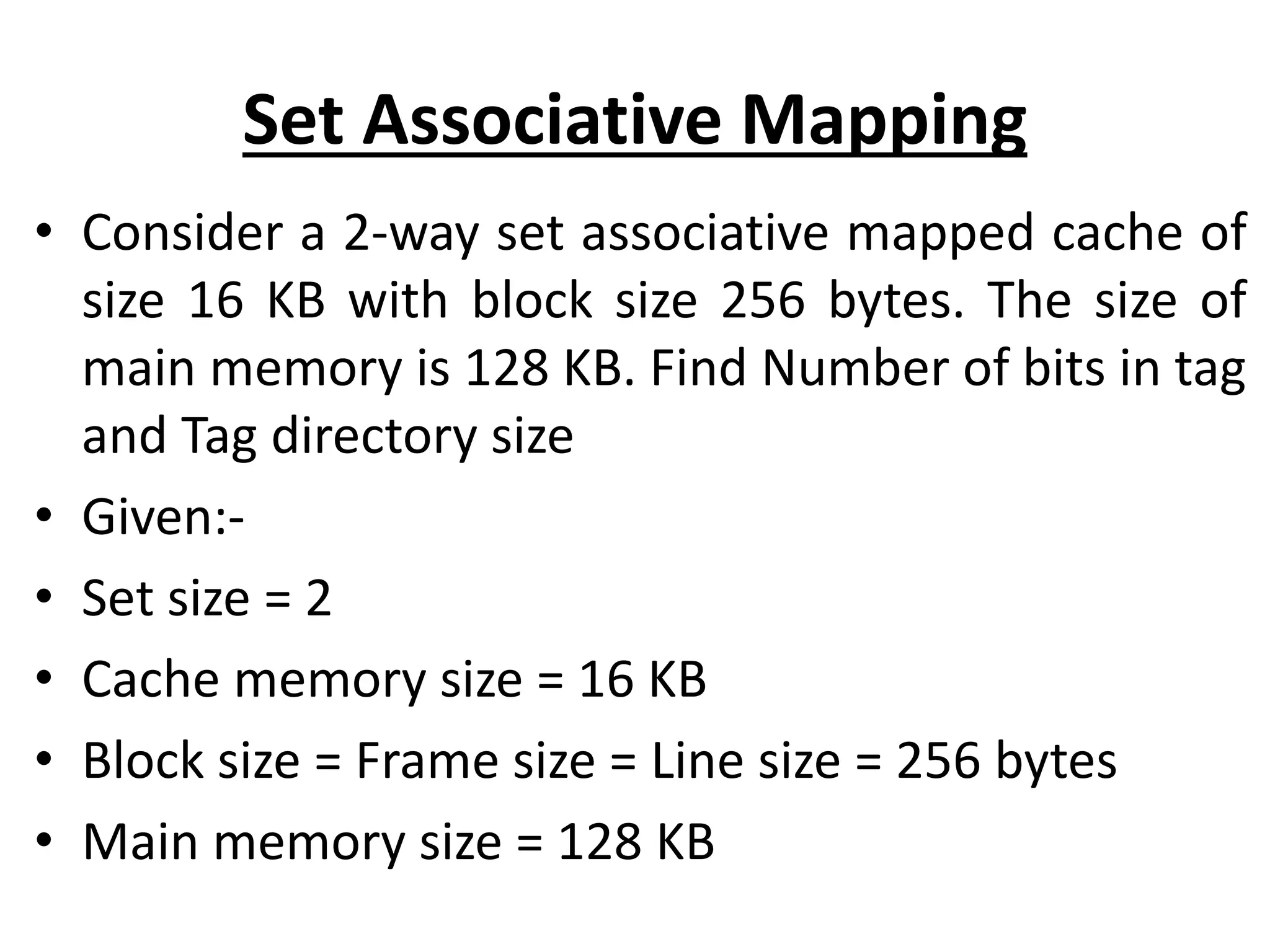
• Consider a 2-way set associative mapped cache of
size 16 KB with block size 256 bytes. The size of
main memory is 128 KB. Find Number of bits in tag
and Tag directory size
• Given:-
• Set size = 2
• Cache memory size = 16 KB
• Block size = Frame size = Line size = 256 bytes
• Main memory size = 128 KB
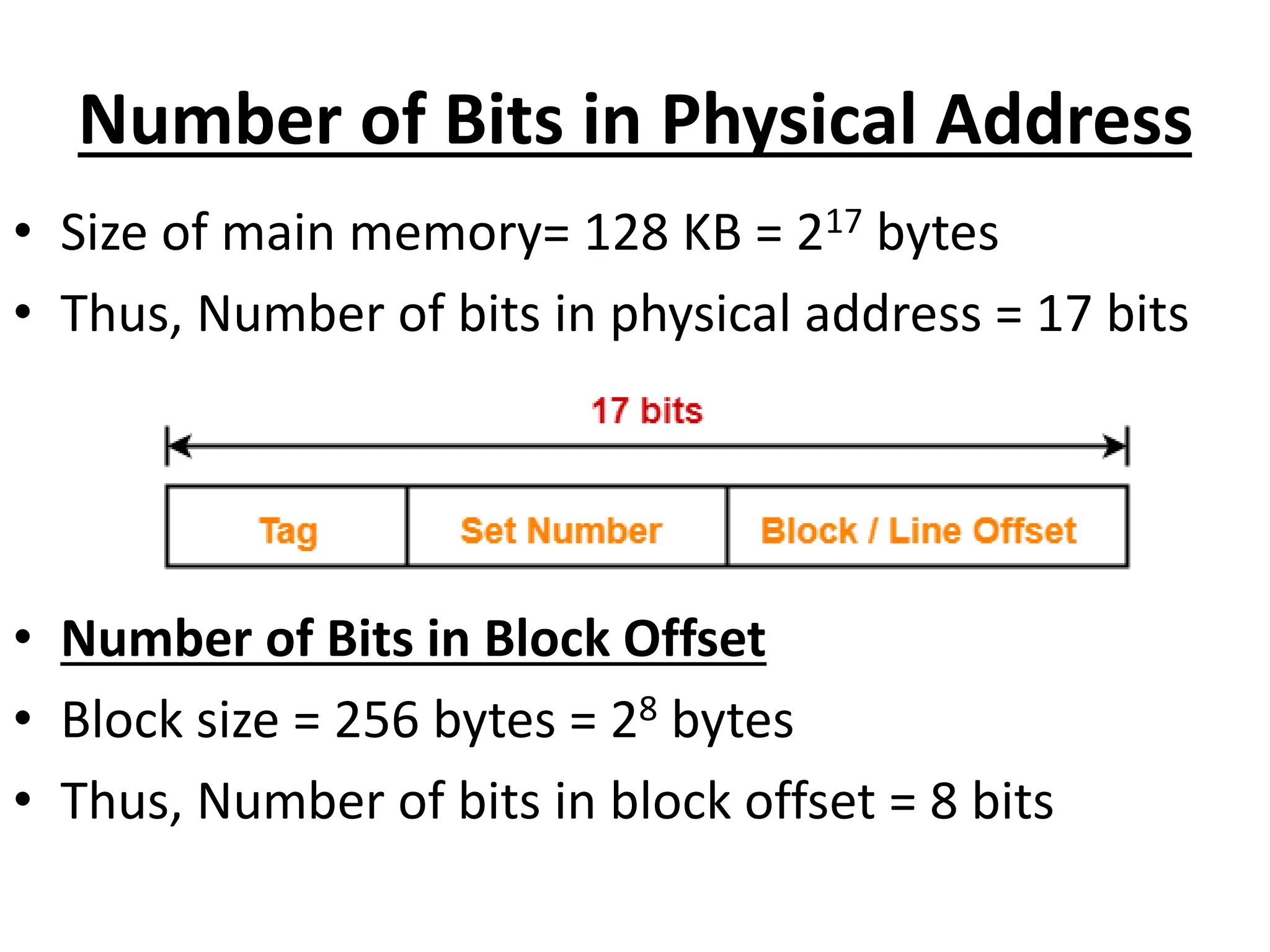
Number of Bits in Physical Address
• Size of main memory= 128 KB = 217 bytes
• Thus, Number of bits in physical address = 17 bits
• Number of Bits in Block Offset
• Block size = 256 bytes = 28 bytes
• Thus, Number of bits in block offset = 8 bits
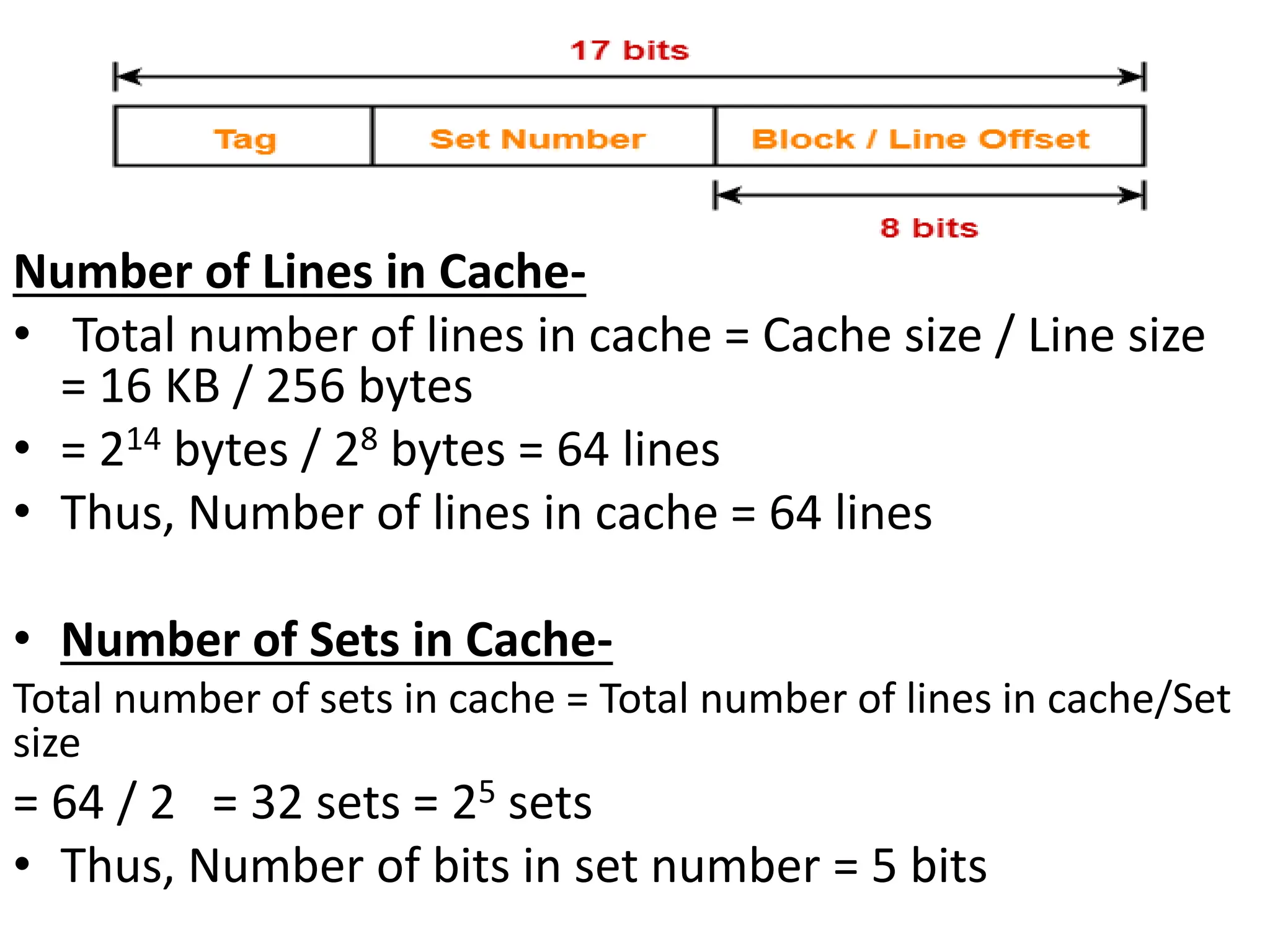
Number of Lines in Cache-
• Total number of lines in cache = Cache size / Line size
= 16 KB / 256 bytes
• = 214 bytes / 28 bytes = 64 lines
• Thus, Number of lines in cache = 64 lines
• Number of Sets in Cache-
Total number of sets in cache = Total number of lines in cache/Set
size
= 64 / 2 = 32 sets = 25 sets
• Thus, Number of bits in set number = 5 bits
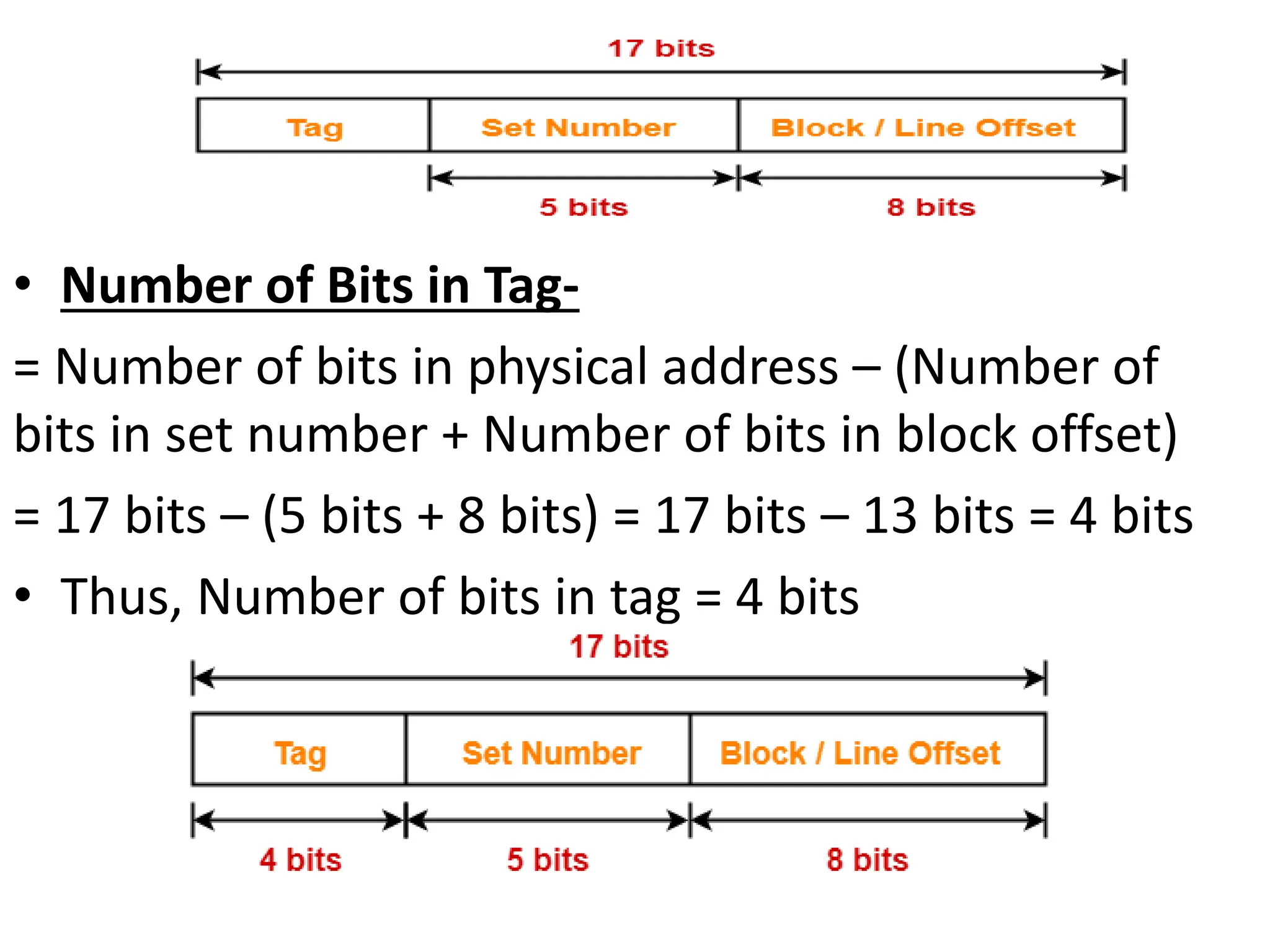
• Number of Bits in Tag-
= Number of bits in physical address – (Number of
bits in set number + Number of bits in block offset)
= 17 bits – (5 bits + 8 bits) = 17 bits – 13 bits = 4 bits
• Thus, Number of bits in tag = 4 bits
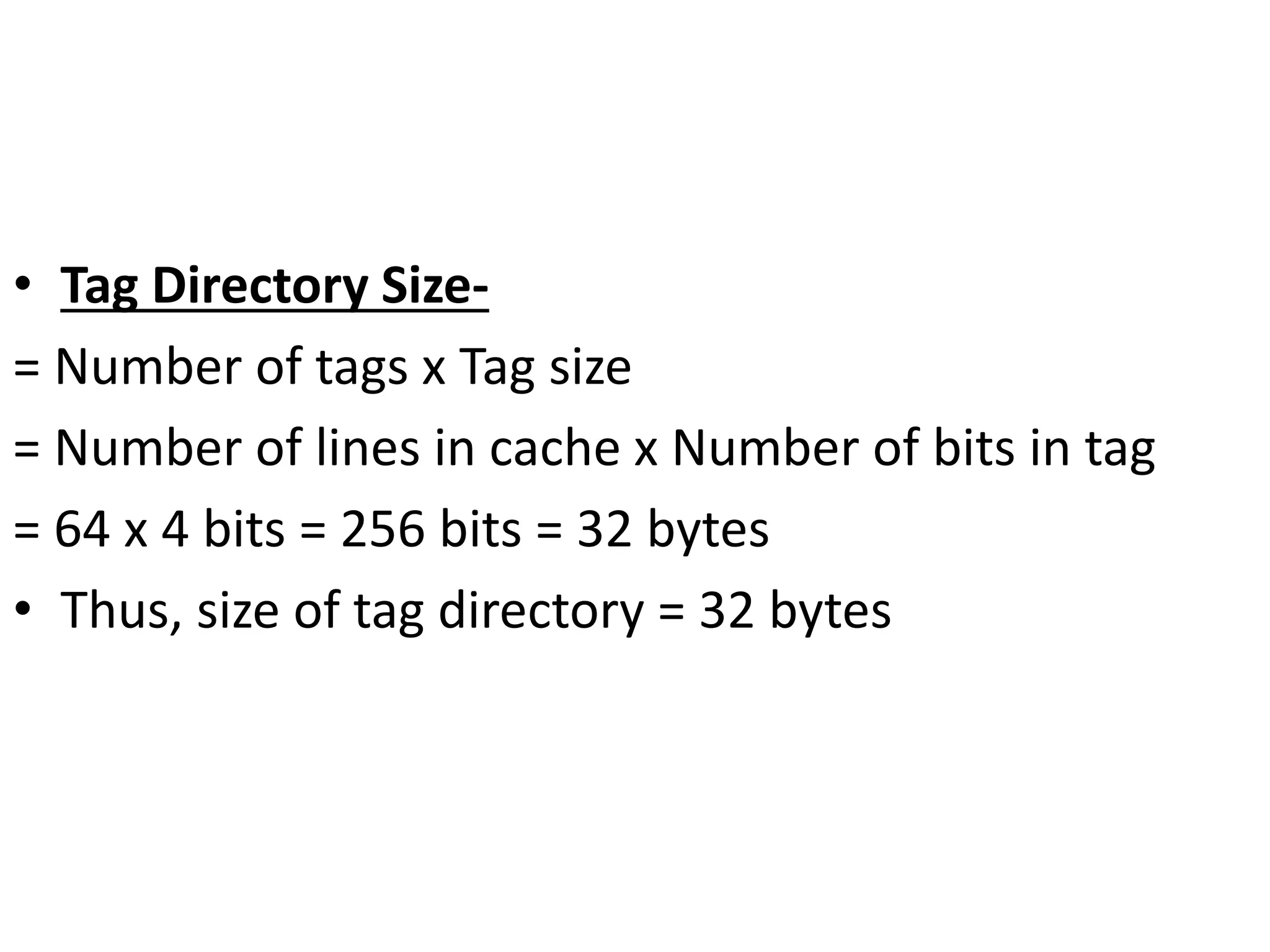
• Tag Directory Size-
= Number of tags x Tag size
= Number of lines in cache x Number of bits in tag
= 64 x 4 bits = 256 bits = 32 bytes
• Thus, size of tag directory = 32 bytes
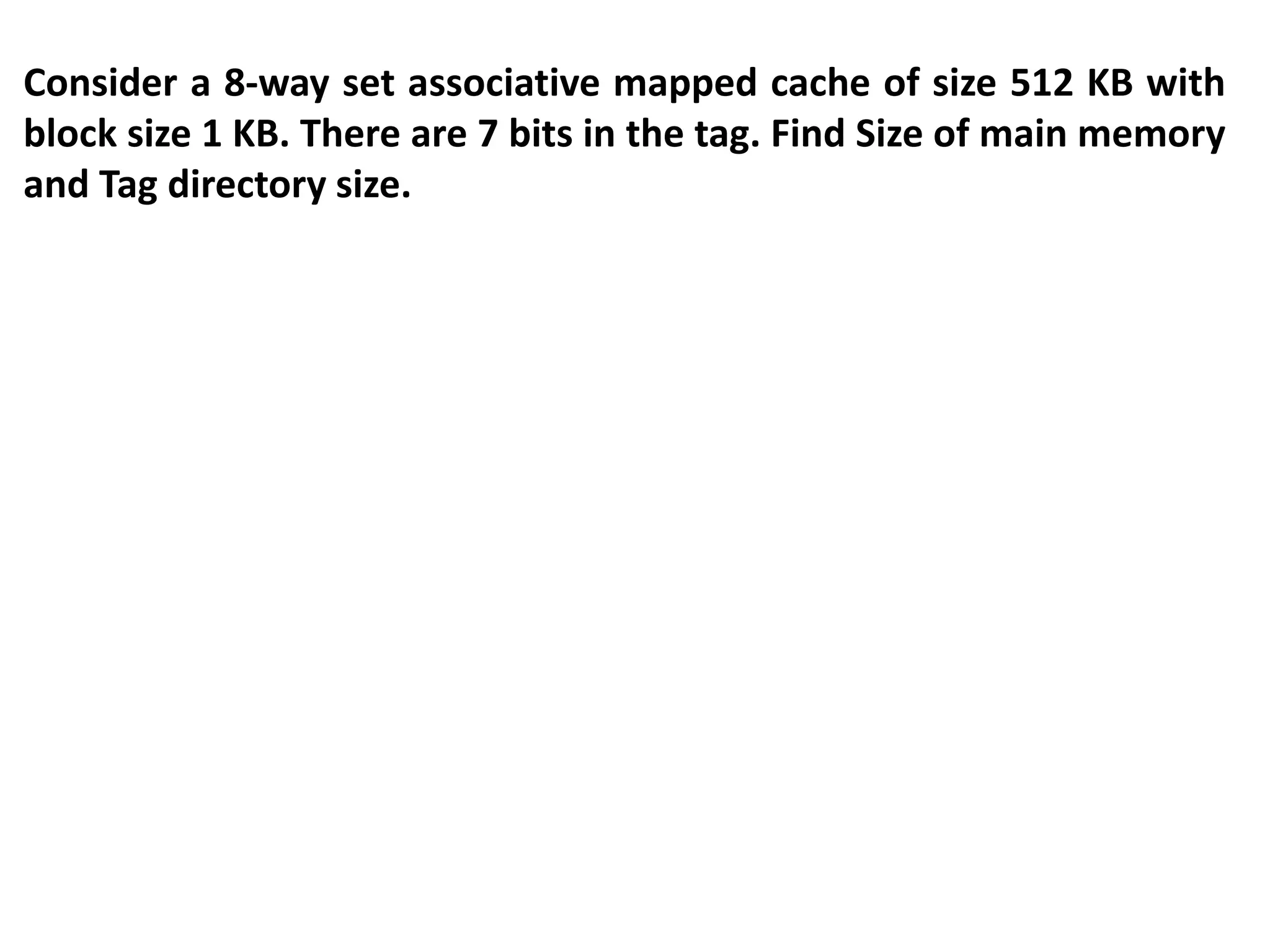
Consider a 8-way set associative mapped cache of size 512 KB with
block size 1 KB. There are 7 bits in the tag. Find Size of main memory
and Tag directory size.
12 bit main memory, Cache and block
size problems
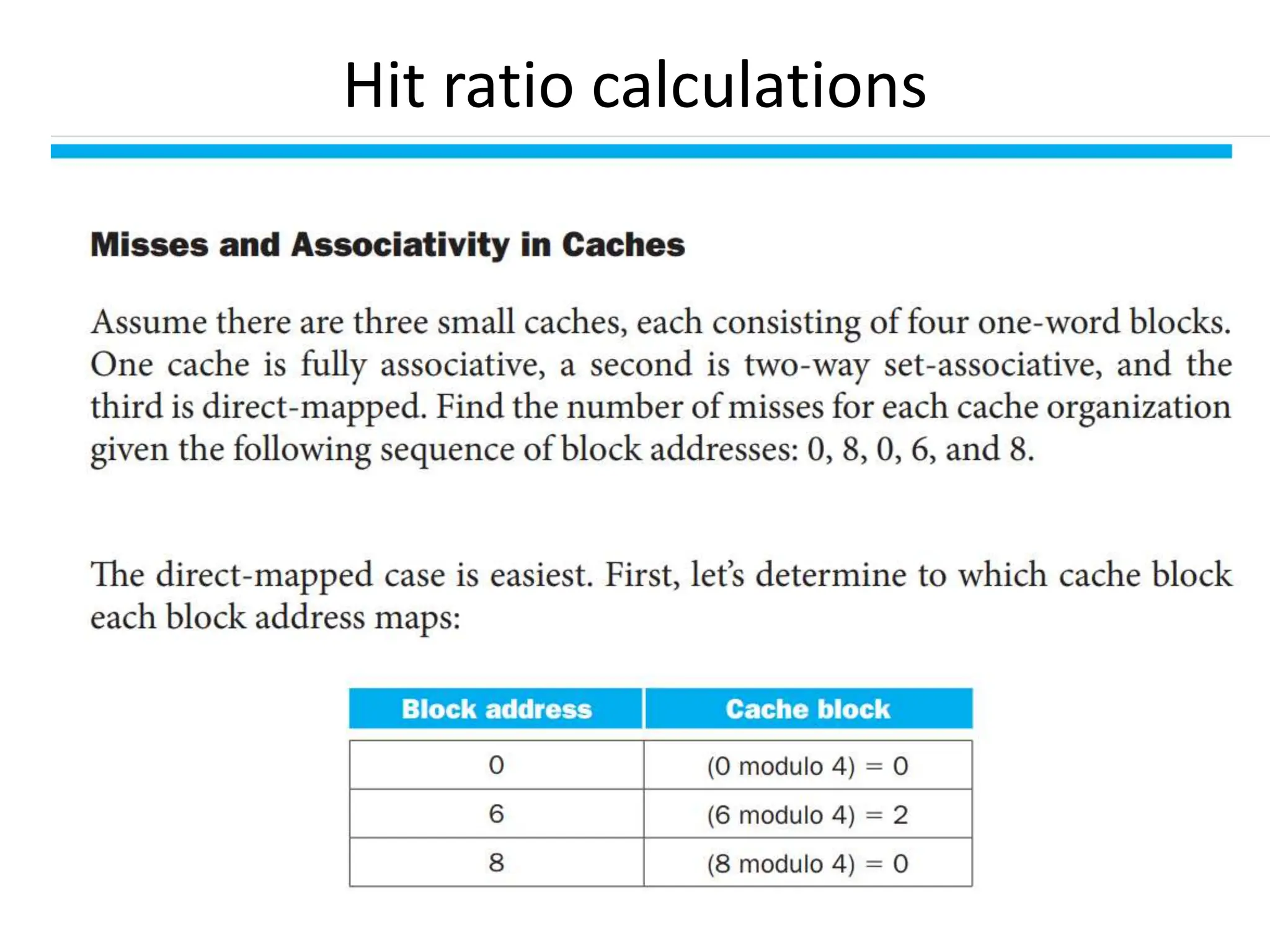
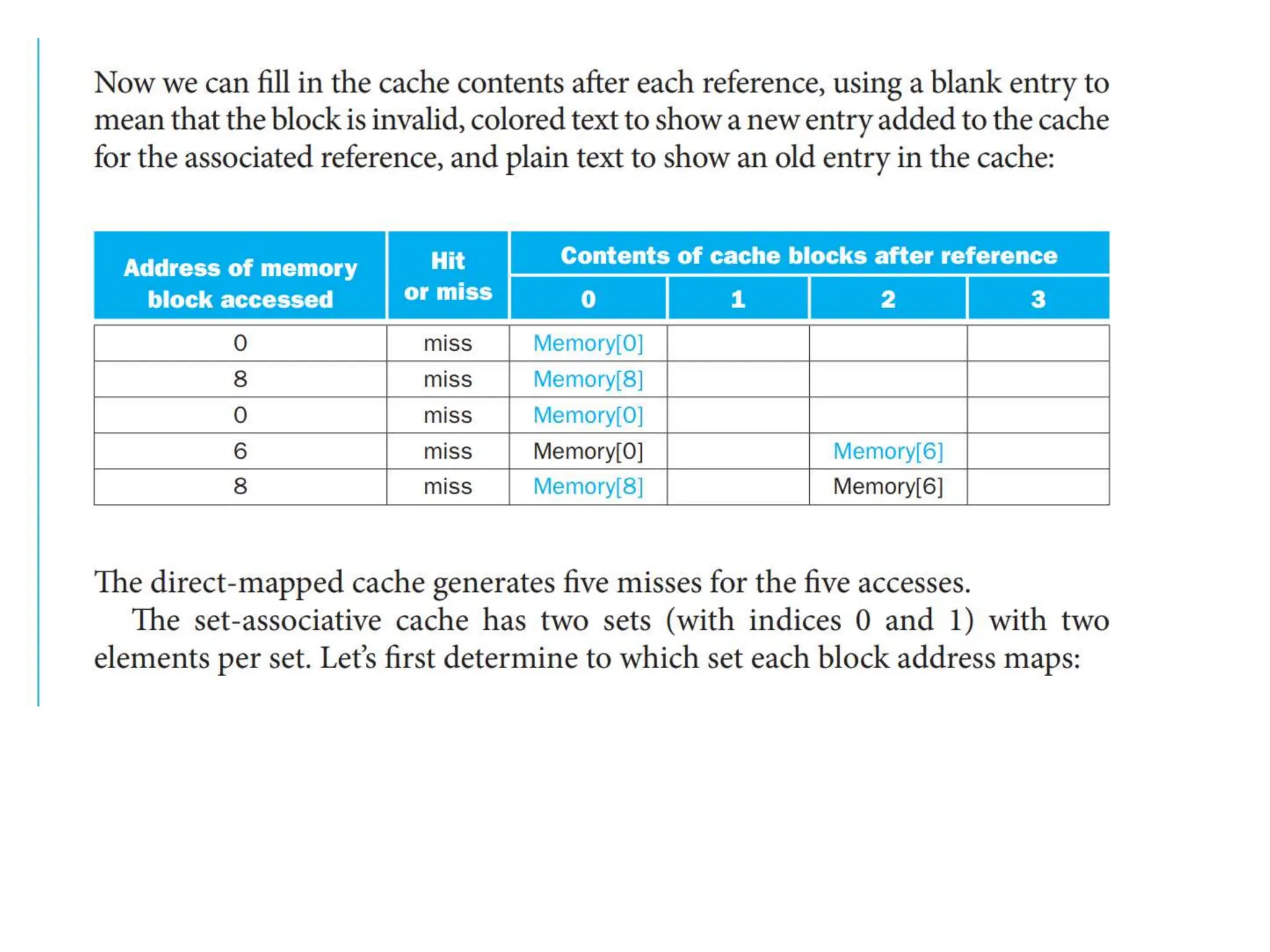
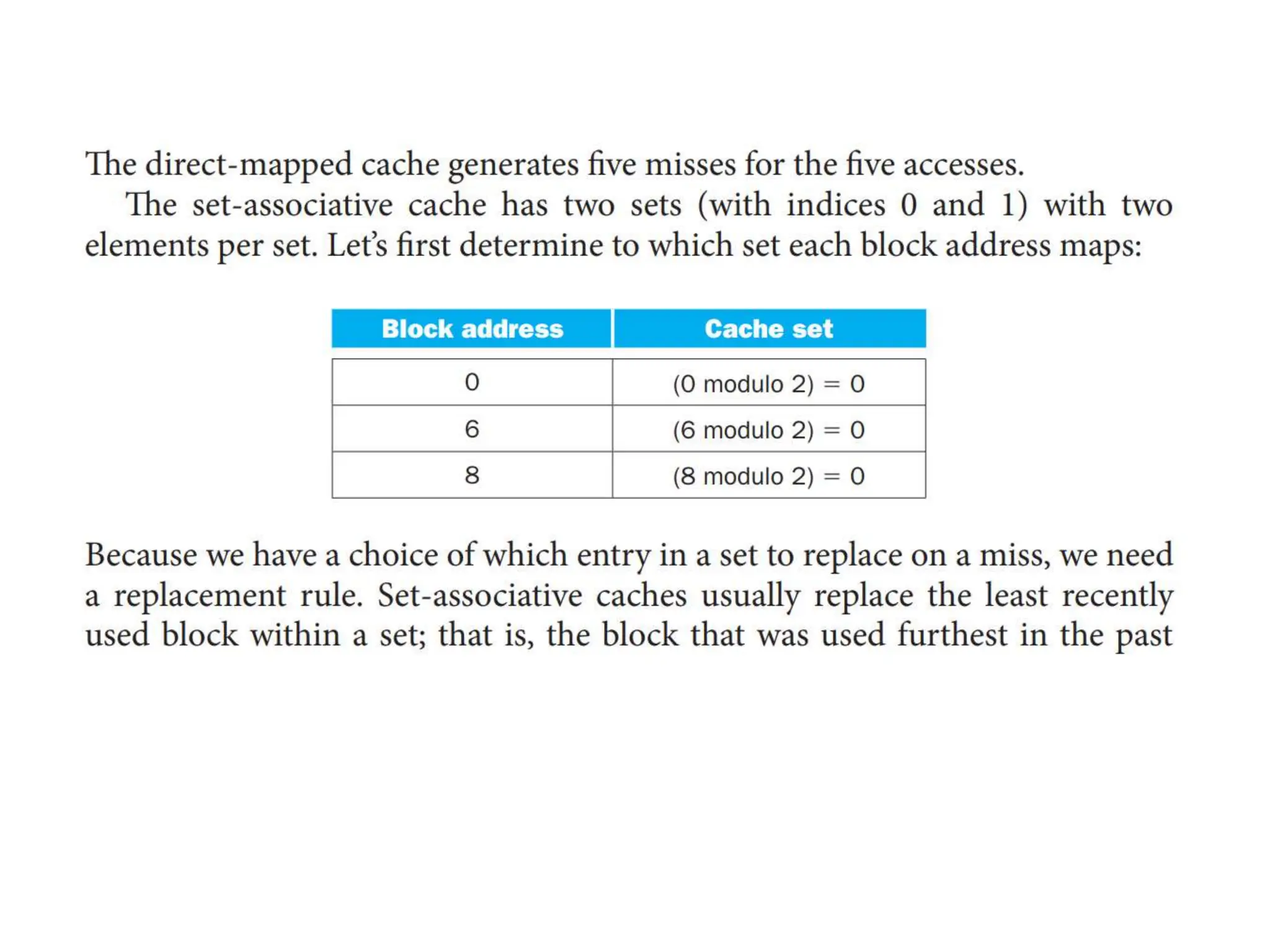
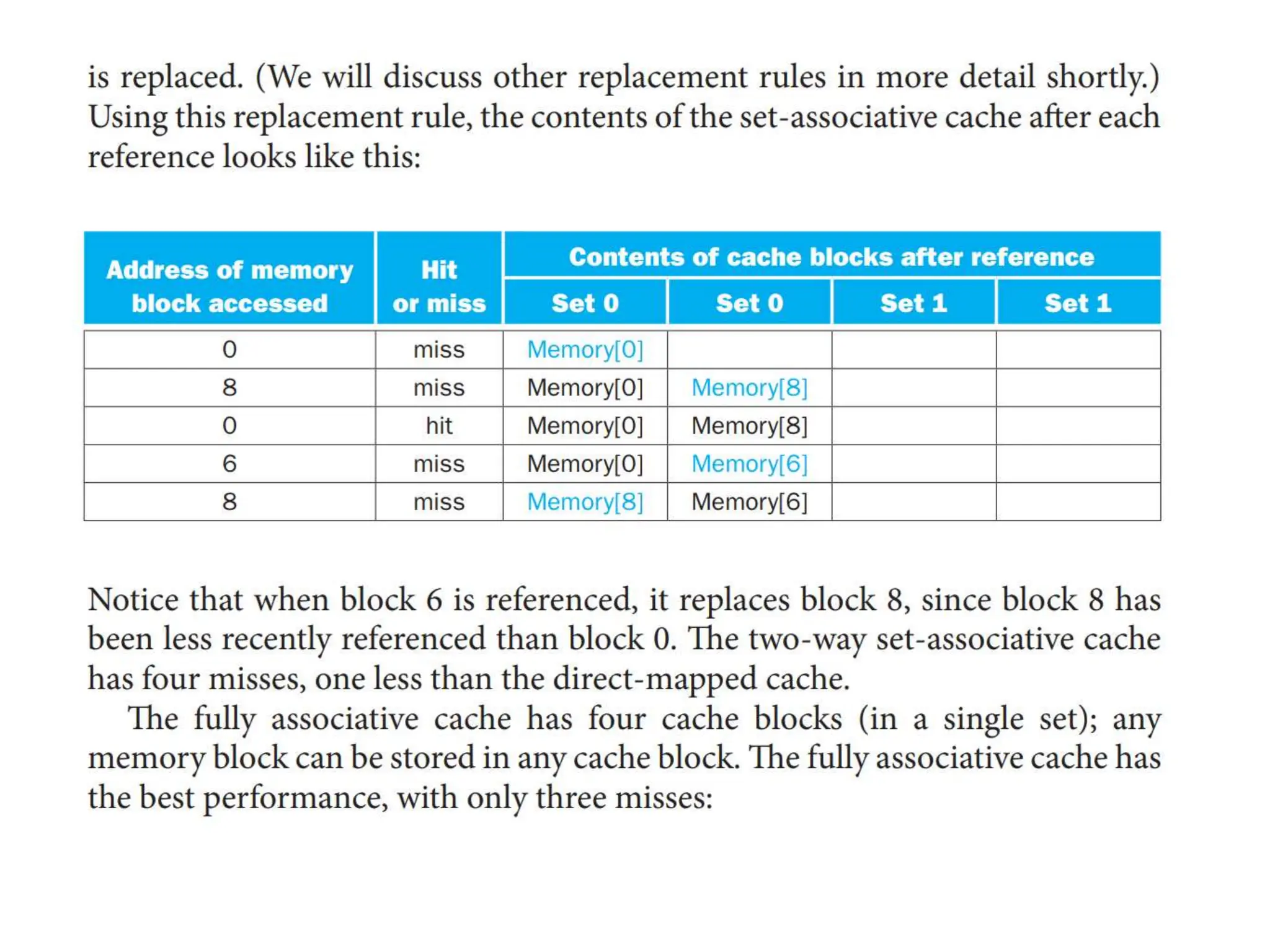
Hit ratio calculations
Model questions
• Single and multi cycle data path and problems
• Equation implementation in 3,2,1,0
Addressing modes
• Qn on Instruction set
• Qn on addressing modes
• Hit ratio calculations
• Bits calculations for Cache mapping
Module-4.pptxMihir pitambareMihir pitambareMihir pitambareMihir pitambareMihir pitambareMihir pitambareMihir pitambareMihir pitambare

Module-4.pptxMihir pitambareMihir pitambareMihir pitambareMihir pitambareMihir pitambareMihir pitambareMihir pitambareMihir pitambare

  • 1.
    Module 4 Memory SystemOrganizationand Architecture
  • 2.
    Overview • Memory systemshierarchy • Main memory organization • Types of Main memory-memory inter- leaving and its characteristics and performance- • Cache memories: address mapping-line size- replacement and policies- coherence- • Virtual memory systems- TLB- Reliability of memory systems- • Error detecting and error correcting systems
  • 3.
    Introduction • Programs andthe data that processor operate are held in the main memory of the computer during execution, and the data with high storage requirement is stored in the secondary memories.
  • 4.
    Characteristics Of MemorySystems • The key characteristics of memory systems are: • Location: The computer memory is placed in three different locations, CPU, Internal and External • Capacity: It is expressed using two terms: Word size and number of words. • Unit of Transfer: It is the maximum number of bits that can be read or written into the memory at a time • Access Method: Sequential access and Random access • Performance: Of the memory system is determined using three parameters, Access time, Memory cycle time and Transfer rate. • Physical Type: Two most common physical types used today are semiconductor memory and magnetic surface memory. • Physical characteristics: Volatile/Nonvolatile and Erasable/ Nonerasable
  • 5.
    Memory Hierarchy /Multilevel Memory
  • 6.
    Memory Hierarchy /Multilevel Memory • Memory unit is essential component of digital computer since it is needed for storing programs and data. • Memory unit that communicates directly with CPU is called Main memory. • Devices that provide backup storage is called auxiliary memory. • Only programs and data currently needed by processor reside in the main memory. • All other information is stored in auxiliary memory and transferred to main memory when needed. Click to add text
  • 8.
    Main Memory • Itis the memory used to store programs and data during the computer operation. • The principal technology is based on semiconductor integrated circuits. • It consists of RAM and ROM chips. • RAM chips are available in two form static and dynamic.
  • 10.
    Main Memory • ROMis uses random access method. • It is used for storing programs that are permanent and the tables of constants that do not change. • ROM store program called bootstrap loader whose function is to start the computer software when the power is turned on. • When the power is turned on, the hardware of the computer sets the program counter to the first address of the bootstrap loader
  • 14.
  • 16.
    Cache Memory • Aspecial very high-speed memory. • Used to speed up and synchronizing with high-speed CPU. • Costlier than main memory or disk memory but economical than CPU registers. • Extremely fast memory type that acts as a buffer between RAM and the CPU. It holds frequently requested data and instructions so that they are immediately available to the CPU when needed. • Used to reduce the average time to access data from the Main memory. • Smaller and faster memory which stores copies of the data from frequently used main memory locations. • Various different independent caches in a CPU, which store instructions and data.
  • 17.
  • 18.
    Terminology • Locality: memoryreferences to cluster • Temporal locality: tendency of the time intervals between references to a given address to be small • Spatial locality: tendency of the distances between consecutive memory references to be small • Memory hierarchy : characteristic of computer design in which a series of storage technologies are used such that the access time is faster as the memory is closer to the processor and the capacity is larger as the memory is further from the processor
  • 19.
    Terminology • Cache: memoryclosest to the processor in a memory hierarchy • Caching: any storage management technique exploiting locality • Upper/lower level: memory closer/further from the processor • Block: unit of memory transfer between two levels in a memory hierarchy. Also called a cache line
  • 20.
    Cache Performance • Cachehit: If the processor finds that the memory location • Cache miss: If the processor does not find the memory location • The performance of cache memory is frequently measured in terms of a quantity called Hit ratio. Hit ratio = hit / (hit + miss)= Number of hits/total accesses • Miss penalty : time to move a block from a lower level in the hierarchy and satisfy the processor’s request
  • 21.
    Cache Access Time Effectiveaccess time is a standard effective average. effective-access-time = hit-rate * cache-access-time + miss-rate * lower-level-access-time Miss penalty is defined as the difference between lower level access time and cache access time. effective-access-time = cache-access-time + miss-rate * miss-penalty
  • 22.
    Lower-Level Traffic Lower-level-traffic =miss-rate * requested traffic
  • 24.
  • 25.
    Cache Memory (Levelsof memory) • Level 1 or Register : Data is stored and accepted that are immediately stored in CPU. Most commonly used registers are accumulator, Program counter, address register etc. • Level 2 or Cache memory: Fastest memory which has faster access time where data is temporarily stored. • Level 3 or Main Memory: Memory on which computer works currently. It is small in size and once power is off data no longer stays in this memory. • Level 4 or Secondary Memory: External memory which is not as fast as main memory but data stays permanently in this memory.
  • 26.
    Cache Mapping • Directmapping, Associative mapping, and Set- Associative mapping
  • 27.
    1. First weconceptually divide the memory into blocks. 2. Cache is also divided into lines. 3. Note that these are conceptual things and they are not divided in physically. 4. Here is how we divide the main memory into blocks and the size of a block is equal to the size of the cache line. 5. In memory smallest addressable unit is called as word. 6. It can be several Bytes but for the sake of the simplicity, I’ll take it a word equals to one Byte. 1. Direct-Mapped cache 1 word = 1 byte (for this examp word https://medium.com/breaktheloop/direct-mapping-map-cache-and-main-memory- d5e4c1cbf73e
  • 28.
    Direct-Mapped cache • Aparticular block of main memory can be mapped to one particular cache line only. • Block ‘j’ of main memory will map to line number (j mod number of cache lines) of the cache. • There is no need of any replacement algorithm.
  • 29.
    https://www.youtube.com/watch?v=eObN3u3eAnU&t=1s Let’s see themain memory. Let’s assume that Cache is 16 words in size and Main memory is 64 words in size. If a block contains the 4 words then number of blocks in the main memory can be calculated like following. Number of blocks in the main memory = 64/4 = 16blocks. That means we have 16 blocks in the main memory and each block has four words in it. This is shown in the following diagram.
  • 30.
    Let’s see thecache memory. If a line contains the 4 words, then number of line in the cache can be calculated like following. Number of lines in the cache memory = 16/4 = 4 lines. That means we have 4 lines in the cache memory and each line has four words in it.
  • 32.
    Cache Mapping: Directmapping • Maps each block of main memory into only one possible cache line. Block address/No Block/word offset
  • 33.
    Consider a directmapped cache of size 16 KB with block size 256 bytes. The size of main memory is 128 KB. Find the number of bits in tag and Tag directory size. • Solution: Given:- – Cache memory size = 16 KB – Block size = Frame size = Line size = 256 bytes – Main memory size = 128 KB • Consider that the memory is byte addressable • Number of Bits in Physical Address- • Size of main memory= 128 KB = 217 bytes • Thus, Number of bits in physical address = 17 bits
  • 34.
    Consider a directmapped cache of size 16 KB with block size 256 bytes. The size of main memory is 128 KB. Find the number of bits in tag and Tag directory size. • Solution: Number of bits in physical address = 17 bits
  • 35.
    Consider a directmapped cache of size 16 KB with block size 256 bytes. The size of main memory is 128 KB. Find the number of bits in tag and Tag directory size. • Number of Bits in Block Offset- • Block size = 256 bytes = 28 bytes • Thus, Number of bits in block offset = 8 bits
  • 36.
    Consider a directmapped cache of size 16 KB with block size 256 bytes. The size of main memory is 128 KB. Find the number of bits in tag and Tag directory size. • Number of Bits in Line Number- Total number of lines in cache = Cache size /Line size • = 16 KB / 256 bytes • = 214 bytes / 28 bytes = = 26 lines • Thus, Number of bits in line number = 6 bits
  • 37.
    • Number ofBits in Tag- • = Number of bits in physical address – (Number of bits in line number + Number of bits in block offset) • = 17 bits – (6 bits + 8 bits) = 17 bits – 14 bits • = 3 bits • Thus, Number of bits in tag = 3 bits
  • 38.
    • Tag DirectorySize • = Number of tags x Tag size • = Number of lines in cache x Number of bits in tag • = 26 x 3 bits • = 192 bits • = 24 bytes • Thus, size of tag directory = 24 bytes
  • 39.
    Problem-02: Consider adirect mapped cache of size 512 KB with block size 1 KB. There are 7 bits in the tag. Find Size of main memory, Tag directory size • Solution • Given: • Cache memory size = 512 KB • Block size = Frame size = Line size = 1 KB • Number of bits in tag = 7 bits • Consider that the memory is byte addressable.
  • 40.
    Problem-02: Consider adirect mapped cache of size 512 KB with block size 1 KB. There are 7 bits in the tag. Find Size of main memory, Tag directory size • Number of Bits in Block Offset- • Block size = 1 KB = 210 bytes • Thus, Number of bits in block offset = 10 bits Number of Bits in Line Number • Cache size / Line size = 512 KB / 1 KB = 29 lines • Number of bits in line number = 9 bits
  • 41.
    Problem-02: Consider adirect mapped cache of size 512 KB with block size 1 KB. There are 7 bits in the tag. Find Size of main memory, Tag directory size • Number of Bits in Block Offset- • Block size = 1 KB = 210 bytes • Thus, Number of bits in block offset = 10 bits Number of Bits in Line Number • Cache size / Line size = 512 KB / 1 KB = 29 lines • Number of bits in line number = 9 bits
  • 42.
    Number of bitsin physical address = Number of bits in tag + Number of bits in line number + Number of bits in block offset • = 7 bits + 9 bits + 10 bits = 26 bits Number of bits in physical address = 26 bits Size of Main Memory- • Number of bits in physical address = 26 bits • Thus, Size of main memory = 226 bytes = 64 MB • Tag Directory Size- • Tag directory size = Number of tags x Tag size = Number of lines in cache x Number of bits in tag = = 29 x 7 bits • = 3584 bits = 448 bytes • Thus, size of tag directory = 448 bytes
  • 43.
    3. Consider adirect mapped cache with block size 4 KB. The size of main memory is 16 GB and there are 10 bits in the tag. Find the Size of cache memory and Tag directory size. • Block size = Frame size = Line size = 4 KB • Size of main memory = 16 GB • Number of bits in tag = 10 bits Number of Bits in Physical Address ? Number of Bits in Block Offset ? Number of Bits in Line Number ? Number of Lines in Cache ? Size of Cache Memory? Tag Directory Size?
  • 45.
    2. Fully AssociativeMapping • A block of main memory can be mapped to any freely available cache line. • This makes fully associative mapping more flexible than direct mapping. • A replacement algorithm is needed to replace a block if the cache is full. https://www.youtube.com/watch?v=sLCJJdz0WAg&t=5s
  • 49.
    Consider a fullyassociative mapped cache of size 16 KB with block size 256 bytes. The size of main memory is 128 KB. Find the number of bits in tag, Tag directory size. • Cache memory size = 16 KB • Block size = Frame size = Line size = 256 bytes • Main memory size = 128 KB • Size of main memory= 128 KB = 217 bytes • Number of bits in physical address = 17 bits
  • 50.
    Number of Bitsin Block Offset • Block size = 256 bytes = 28 bytes • Number of bits in block offset = 8 bits • Number of Bits in Tag
  • 51.
    Number of Linesin Cache • Total number of lines in cache = Cache size/Line size • = 16 KB / 256 bytes = 214 bytes / 28 bytes = 26 lines • Tag Directory Size = Number of tags x Tag size • = Number of lines in cache x Number of bits in tag • = 26 x 9 bits = 576 bits = 72 bytes • Size of tag directory = 72 bytes
  • 52.
    Consider a fullyassociative mapped cache of size 512 KB with block size 1 KB. There are 17 bits in the tag. Find the size of main memory, Tag directory size • Cache memory size = 512 KB • Block size = Frame size = Line size = 1 KB • Number of bits in tag = 17 bits
  • 53.
    Consider a fullyassociative mapped cache of size 512 KB with block size 1 KB. There are 17 bits in the tag. Find the size of main memory, Tag directory size • Cache memory size = 512 KB • Block size = Frame size = Line size = 1 KB • Number of bits in tag = 17 bits • Number of Bits in Block Offset • Block size = 1 KB = 210 bytes • Thus, Number of bits in block offset = 10 bits
  • 54.
    • Number ofBits in Physical Address Number of bits in physical address = Number of bits in tag + Number of bits in block offset • = 17 bits + 10 bits = 27 bits • Size of Main Memory= Number of bits in physical address = 27 bits • Size of main memory = 227 bytes = 128 MB
  • 55.
    • Number ofLines in Cache- Total number of lines in cache = Cache size / Line size • = 512 KB / 1 KB = 512 lines = 29 lines • Tag Directory Size- • = Number of tags x Tag size • = Number of lines in cache x Number of bits in tag • = 29 x 17 bits = 8704 bits = 1088 bytes • Thus, size of tag directory = 1088 bytes
  • 56.
    3. Set AssociativeMapping https://www.youtube.com/watch?v=pFndaJARM4Q&t=322s
  • 64.
    Set Associative Mapping •Consider a 2-way set associative mapped cache of size 16 KB with block size 256 bytes. The size of main memory is 128 KB. Find Number of bits in tag and Tag directory size • Given:- • Set size = 2 • Cache memory size = 16 KB • Block size = Frame size = Line size = 256 bytes • Main memory size = 128 KB
  • 65.
    Number of Bitsin Physical Address • Size of main memory= 128 KB = 217 bytes • Thus, Number of bits in physical address = 17 bits • Number of Bits in Block Offset • Block size = 256 bytes = 28 bytes • Thus, Number of bits in block offset = 8 bits
  • 66.
    Number of Linesin Cache- • Total number of lines in cache = Cache size / Line size = 16 KB / 256 bytes • = 214 bytes / 28 bytes = 64 lines • Thus, Number of lines in cache = 64 lines • Number of Sets in Cache- Total number of sets in cache = Total number of lines in cache/Set size = 64 / 2 = 32 sets = 25 sets • Thus, Number of bits in set number = 5 bits
  • 67.
    • Number ofBits in Tag- = Number of bits in physical address – (Number of bits in set number + Number of bits in block offset) = 17 bits – (5 bits + 8 bits) = 17 bits – 13 bits = 4 bits • Thus, Number of bits in tag = 4 bits
  • 68.
    • Tag DirectorySize- = Number of tags x Tag size = Number of lines in cache x Number of bits in tag = 64 x 4 bits = 256 bits = 32 bytes • Thus, size of tag directory = 32 bytes
  • 69.
    Consider a 8-wayset associative mapped cache of size 512 KB with block size 1 KB. There are 7 bits in the tag. Find Size of main memory and Tag directory size.
  • 74.
    12 bit mainmemory, Cache and block size problems
  • 75.
  • 80.
    Model questions • Singleand multi cycle data path and problems • Equation implementation in 3,2,1,0 Addressing modes • Qn on Instruction set • Qn on addressing modes • Hit ratio calculations • Bits calculations for Cache mapping