Module 3, Topic 3 Notes Solving Literal Equations
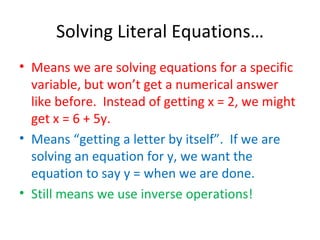
Solving Literal Equations… Means we are solving equations for a specific variable, but won’t get a numerical answer like before.  Instead of getting x = 2, we might get x = 6 + 5y. Means “getting a letter by itself”.  If we are solving an equation for y, we want the equation to say y = when we are done. Still means we use inverse operations!
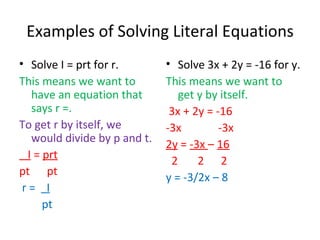
Examples of Solving Literal Equations Solve I = prt for r. This means we want to have an equation that says r =. To get r by itself, we would divide by p and t. I  =  prt pt  pt  r =  I pt  Solve 3x + 2y = -16 for y. This means we want to get y by itself. 3x + 2y = -16 -3x  -3x 2y  =  -3x  –  16 2  2  2 y = -3/2x – 8
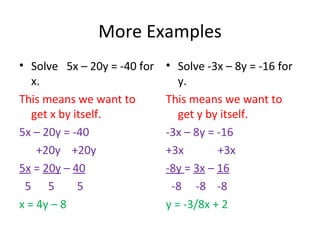
More Examples Solve  5x – 20y = -40 for x. This means we want to get x by itself. 5x – 20y = -40 +20y  +20y 5x  =  20y  –  40 5  5  5 x = 4y – 8  Solve -3x – 8y = -16 for y. This means we want to get y by itself. -3x – 8y = -16 +3x  +3x -8y  =  3x  –  16 -8  -8  -8 y = -3/8x + 2
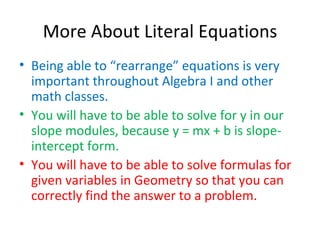
More About Literal Equations Being able to “rearrange” equations is very important throughout Algebra I and other math classes. You will have to be able to solve for y in our slope modules, because y = mx + b is slope-intercept form. You will have to be able to solve formulas for given variables in Geometry so that you can correctly find the answer to a problem.
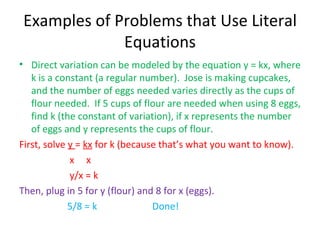
Examples of Problems that Use Literal Equations Direct variation can be modeled by the equation y = kx, where k is a constant (a regular number).  Jose is making cupcakes, and the number of eggs needed varies directly as the cups of flour needed.  If 5 cups of flour are needed when using 8 eggs, find k (the constant of variation), if x represents the number of eggs and y represents the cups of flour. First, solve  y  =  kx  for k (because that’s what you want to know). x  x y/x = k Then, plug in 5 for y (flour) and 8 for x (eggs). 5/8 = k  Done!
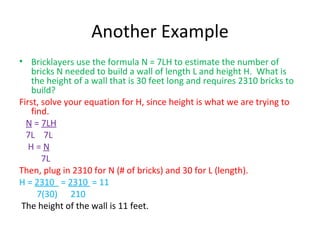
Another Example Bricklayers use the formula N = 7LH to estimate the number of bricks N needed to build a wall of length L and height H.  What is the height of a wall that is 30 feet long and requires 2310 bricks to build? First, solve your equation for H, since height is what we are trying to find. N  =  7LH 7L  7L  H =  N 7L Then, plug in 2310 for N (# of bricks) and 30 for L (length). H =  2310  =  2310  = 11 7(30)  210  The height of the wall is 11 feet.
Some Extra Practice for You! Here’s a website with some examples you can use to check your understanding.  Click the drop-down menus that say “Answer” and you can get helpful hints: http://www.regentsprep.org/Regents/math/ALGEBRA/AE4/litPrac.htm

Module 3, topic 3 notes

  • 1.
    Module 3, Topic3 Notes Solving Literal Equations
  • 2.
    Solving Literal Equations…Means we are solving equations for a specific variable, but won’t get a numerical answer like before. Instead of getting x = 2, we might get x = 6 + 5y. Means “getting a letter by itself”. If we are solving an equation for y, we want the equation to say y = when we are done. Still means we use inverse operations!
  • 3.
    Examples of SolvingLiteral Equations Solve I = prt for r. This means we want to have an equation that says r =. To get r by itself, we would divide by p and t. I = prt pt pt r = I pt Solve 3x + 2y = -16 for y. This means we want to get y by itself. 3x + 2y = -16 -3x -3x 2y = -3x – 16 2 2 2 y = -3/2x – 8
  • 4.
    More Examples Solve 5x – 20y = -40 for x. This means we want to get x by itself. 5x – 20y = -40 +20y +20y 5x = 20y – 40 5 5 5 x = 4y – 8 Solve -3x – 8y = -16 for y. This means we want to get y by itself. -3x – 8y = -16 +3x +3x -8y = 3x – 16 -8 -8 -8 y = -3/8x + 2
  • 5.
    More About LiteralEquations Being able to “rearrange” equations is very important throughout Algebra I and other math classes. You will have to be able to solve for y in our slope modules, because y = mx + b is slope-intercept form. You will have to be able to solve formulas for given variables in Geometry so that you can correctly find the answer to a problem.
  • 6.
    Examples of Problemsthat Use Literal Equations Direct variation can be modeled by the equation y = kx, where k is a constant (a regular number). Jose is making cupcakes, and the number of eggs needed varies directly as the cups of flour needed. If 5 cups of flour are needed when using 8 eggs, find k (the constant of variation), if x represents the number of eggs and y represents the cups of flour. First, solve y = kx for k (because that’s what you want to know). x x y/x = k Then, plug in 5 for y (flour) and 8 for x (eggs). 5/8 = k Done!
  • 7.
    Another Example Bricklayersuse the formula N = 7LH to estimate the number of bricks N needed to build a wall of length L and height H. What is the height of a wall that is 30 feet long and requires 2310 bricks to build? First, solve your equation for H, since height is what we are trying to find. N = 7LH 7L 7L H = N 7L Then, plug in 2310 for N (# of bricks) and 30 for L (length). H = 2310 = 2310 = 11 7(30) 210 The height of the wall is 11 feet.
  • 8.
    Some Extra Practicefor You! Here’s a website with some examples you can use to check your understanding. Click the drop-down menus that say “Answer” and you can get helpful hints: http://www.regentsprep.org/Regents/math/ALGEBRA/AE4/litPrac.htm