Solving Equations—Easy to Difficult
Skill 27 and review of Pre-GED skills 7-8
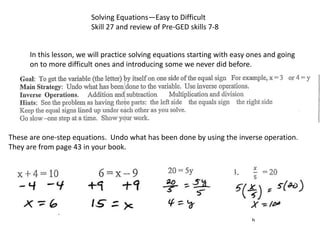
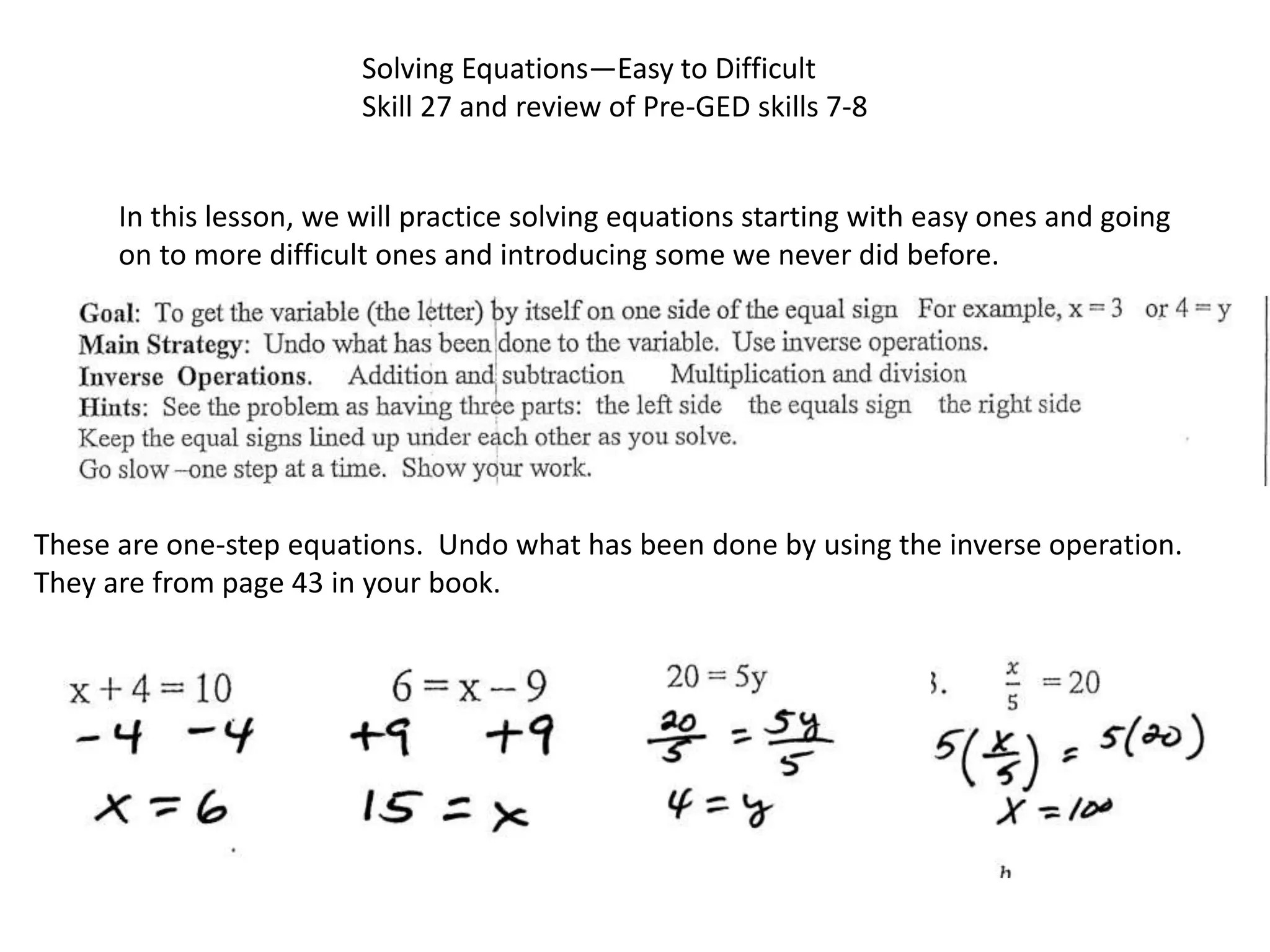
In this lesson, we will practice solving equations starting with easy ones and going
on to more difficult ones and introducing some we never did before.
These are one-step equations. Undo what has been done by using the inverse operation.
They are from page 43 in your book.
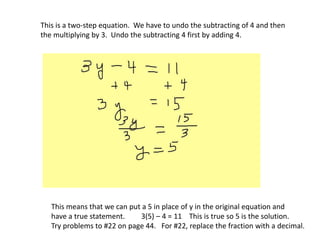
This is a two-step equation. We have to undo the subtracting of 4 and then
the multiplying by 3. Undo the subtracting 4 first by adding 4.
This means that we can put a 5 in place of y in the original equation and
have a true statement. 3(5) – 4 = 11 This is true so 5 is the solution.
Try problems to #22 on page 44. For #22, replace the fraction with a decimal.
There are several ways equations may have extra little things that have to be
simplified before you can just undo the things that have been done to the
variable. These are:
•Adding like terms
•Use the distributive property to multiply out 5(x + 2) to get 5x + 10
•Getting the variables on one side and the numbers on the other side
•Replacing fractions with decimals.
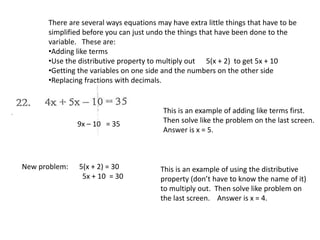
9x – 10 = 35
This is an example of adding like terms first.
Then solve like the problem on the last screen.
Answer is x = 5.
New problem: 5(x + 2) = 30
5x + 10 = 30
This is an example of using the distributive
property (don’t have to know the name of it)
to multiply out. Then solve like problem on
the last screen. Answer is x = 4.
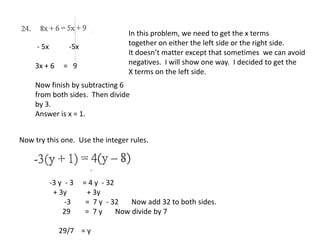
In this problem, we need to get the x terms
together on either the left side or the right side.
It doesn’t matter except that sometimes we can avoid
negatives. I will show one way. I decided to get the
X terms on the left side.
- 5x -5x
3x + 6 = 9
Now finish by subtracting 6
from both sides. Then divide
by 3.
Answer is x = 1.
Now try this one. Use the integer rules.
-3 y - 3 = 4 y - 32
+ 3y + 3y
-3 = 7 y - 32 Now add 32 to both sides.
29 = 7 y Now divide by 7
29/7 = y
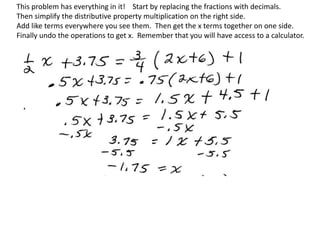
This problem has everything in it! Start by replacing the fractions with decimals.
Then simplify the distributive property multiplication on the right side.
Add like terms everywhere you see them. Then get the x terms together on one side.
Finally undo the operations to get x. Remember that you will have access to a calculator.
Equations with only letters (variables)
It may surprise you that some equations don’t have any numbers in them.
The answer has no numbers too. I call these “literal” equations. They are like
Formulas. I have seen some simple ones on practice tests. See page 141.
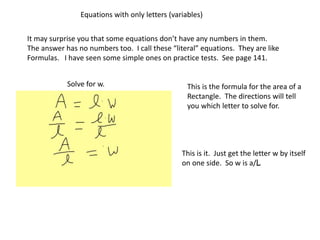
This is the formula for the area of a
Rectangle. The directions will tell
you which letter to solve for.
Solve for w.
This is it. Just get the letter w by itself
on one side. So w is a/L
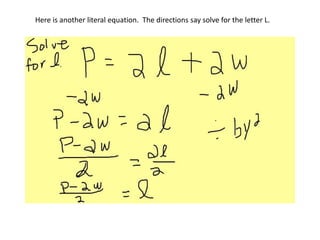
Here is another literal equation. The directions say solve for the letter L.
Look at page 47 for some examples. You may see a very
simple one of these literal equations. Concentrate on
the basic equations to solve. Try page 141a for a few.
Better to try page 141b for equations like the test will
have.

Skill27 solvingequations

  • 1.
    Solving Equations—Easy toDifficult Skill 27 and review of Pre-GED skills 7-8 In this lesson, we will practice solving equations starting with easy ones and going on to more difficult ones and introducing some we never did before. These are one-step equations. Undo what has been done by using the inverse operation. They are from page 43 in your book.
  • 2.
    This is atwo-step equation. We have to undo the subtracting of 4 and then the multiplying by 3. Undo the subtracting 4 first by adding 4. This means that we can put a 5 in place of y in the original equation and have a true statement. 3(5) – 4 = 11 This is true so 5 is the solution. Try problems to #22 on page 44. For #22, replace the fraction with a decimal.
  • 3.
    There are severalways equations may have extra little things that have to be simplified before you can just undo the things that have been done to the variable. These are: •Adding like terms •Use the distributive property to multiply out 5(x + 2) to get 5x + 10 •Getting the variables on one side and the numbers on the other side •Replacing fractions with decimals. 9x – 10 = 35 This is an example of adding like terms first. Then solve like the problem on the last screen. Answer is x = 5. New problem: 5(x + 2) = 30 5x + 10 = 30 This is an example of using the distributive property (don’t have to know the name of it) to multiply out. Then solve like problem on the last screen. Answer is x = 4.
  • 4.
    In this problem,we need to get the x terms together on either the left side or the right side. It doesn’t matter except that sometimes we can avoid negatives. I will show one way. I decided to get the X terms on the left side. - 5x -5x 3x + 6 = 9 Now finish by subtracting 6 from both sides. Then divide by 3. Answer is x = 1. Now try this one. Use the integer rules. -3 y - 3 = 4 y - 32 + 3y + 3y -3 = 7 y - 32 Now add 32 to both sides. 29 = 7 y Now divide by 7 29/7 = y
  • 5.
    This problem haseverything in it! Start by replacing the fractions with decimals. Then simplify the distributive property multiplication on the right side. Add like terms everywhere you see them. Then get the x terms together on one side. Finally undo the operations to get x. Remember that you will have access to a calculator.
  • 6.
    Equations with onlyletters (variables) It may surprise you that some equations don’t have any numbers in them. The answer has no numbers too. I call these “literal” equations. They are like Formulas. I have seen some simple ones on practice tests. See page 141. This is the formula for the area of a Rectangle. The directions will tell you which letter to solve for. Solve for w. This is it. Just get the letter w by itself on one side. So w is a/L
  • 7.
    Here is anotherliteral equation. The directions say solve for the letter L.
  • 8.
    Look at page47 for some examples. You may see a very simple one of these literal equations. Concentrate on the basic equations to solve. Try page 141a for a few. Better to try page 141b for equations like the test will have.