INFECTION PREVENTION & CONTROL
Gradian Health Systems
Basic Principles of Critical Care
BASIC PRINCIPLES OF CRITICAL CARE
Disclaimer
Basic Principles of Critical Care Training I Infection Prevention and Control
Disclaimer: Gradian Health Systems cannot provide formal recommendations or indications
regarding medical care and clinical service delivery. The tables, checklists, and other clinical
documents referenced in this training have not been validated in all settings. These documents are
intended to serve as examples only. We recognize that all clinical training content and activities
must be customized to meet the needs of each facility and its clinical staff, factoring in available
resources, practitioner skill level, and other environmental considerations.
For any questions regarding the contents or applications of this training,
please contact Gradian Health Systems:
40 W 25th St, 6th Floor
New York, NY 10010 USA
+1 212-537-0340
training@gradianhealth.org
Module 1
Gradian Health Systems
Basics Principles of Critical Care
Basic Principles of Critical Care
Module 1: Basic Principles of Critical Care
MODULE OVERVIEW
Lesson 1 I Introduction to ICUs
Lesson 2 I Pain Management and Sedation
Lesson 3 I ICU Admission and Discharge
Lesson 4 I Infection Prevention and Control
Lesson 5 I Total Nursing Care
Basic Principles of Critical Care Training I Infection Prevention and Control
Components of the Gradian CCV SystemLesson 4: Infection Prevention and Control
Lesson Objectives
• Describe the pillars of infection prevention and control (IPC) in the ICU
• Outline the principles of IPC
• Discuss IPC methods
Basic Principles of Critical Care Training I Infection Prevention and Control
Components of the Gradian CCV SystemLesson 4: Infection Prevention and Control
Key Concepts
• IPC pillars
• IPC guidelines
• IPC methods
Basic Principles of Critical Care Training I Infection Prevention and Control
Components of the Gradian CCV SystemInfection Prevention and Control
Why is IPC important?
Hospitalized patients are more prone to infections due to:
• Surgery
• Invasive procedures and devices
• Immunosuppressive drugs
Micro-organisms flourish due to:
• Breaks in the infection prevention practices and procedures
• Weakened patient defense mechanisms
Basic Principles of Critical Care Training I Infection Prevention and Control
Components of the Gradian CCV SystemInfection Prevention and Control
Infection
An infection is an invasion in the body by microorganisms, fungi, etc. It also
refers to the damage of body tissues by microorganisms or by poisonous
substances released by the microorganisms.
Infection Prevention
A collective effort made by healthcare providers and clients to prevent or
minimize the risks of transmitting infections, such as Hepatitis B or HIV/AIDS, to
clients or to other healthcare providers.
Basic Principles of Critical Care Training I Infection Prevention and Control
Components of the Gradian CCV SystemInfection Prevention and Control
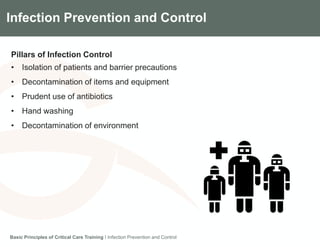
Pillars of Infection Control
• Isolation of patients and barrier precautions
• Decontamination of items and equipment
• Prudent use of antibiotics
• Hand washing
• Decontamination of environment
Basic Principles of Critical Care Training I Infection Prevention and Control
Components of the Gradian CCV SystemInfection Prevention and Control
Hospital Infection Control Program
Aimed at reducing/eliminating risk of infection to patients, visitors and healthcare
personnel. Each person has a specific role in enforcing IPC protocols.
Administrator (senior / assistant)
• Ensures adequate resources are provided to infection control department
Infection Control Doctor (ICD)
• Serves as advisor to ICC
• Assists in drafting plans, policies and long-term programs
• Involved in setting quality standards, surveillance and auditing
Basic Principles of Critical Care Training I Infection Prevention and Control
Components of the Gradian CCV SystemInfection Prevention and Control
Infection Control Nurse (ICN)
• Serves as advisor to ICC
• Assists in drafting plans, policies and long-term programs
• Provides specialist nursing input
• Investigates and monitor infections, hazardous practice and procedures
• Presents educational programs in committees where infection control input is
required
Basic Principles of Critical Care Training I Infection Prevention and Control
Components of the Gradian CCV SystemInfection Prevention and Control
Infection Control Team (ICT)
• Comprised of ICD and ICN
• Responsible for day to day running of infection control programs
• Ensures infection control programs have been planned, coordinated,
implemented and evaluated
• Produces written policies and procedures on infection control
• Participates in audits
Basic Principles ofCritical Care Training I Infection Prevention and Control
Components of the Gradian CCV SystemInfection Prevention and Control
Principles of Infection Prevention
1. Every person considered potentially infectious (patient or staff)
2. Hand washing is the most practical procedure for preventing cross-
contamination
3. Wear gloves before touching anything wet – broken skin, mucous membranes,
blood or other body fluids (secretions or excretions)
4. Use barriers (protective goggles, face masks or aprons) if splashes and spills of
any body fluids (secretions or excretions) are anticipated
5. Use safe work practices (e.g. not recapping or bending needles, proper
instrument processing, and proper disposal of medical waste)
Basic Principles of Critical Care Training I Infection Prevention and Control
Components of the Gradian CCV SystemInfection Prevention and Control
Universal practices
A simple set of effective practices designed to protect health workers and
patients from infection used to break the disease transmission cycle. These
practices are used when caring for all patients, regardless of diagnosis:
• Washing hands
• Decontaminating equipment and devices
• Using and disposing needles and sharps safely (avoid capping, especially
two-handed)
• Wearing protective items
• Promptly cleaning up blood and body fluid spills
• Using safe disposal systems for waste collection and disposal
Basic Principles of Critical Care Training I Infection Prevention and Control
Components of the Gradian CCV SystemInfection Prevention and Control
Universal Infection Prevention Methods
• Hand washing
• Personal Protective Equipment (PPEs)
• Decontamination
• Cleaning
• High-Level Disinfection (HLD)
• Sterilization
• Waste disposal
• Housekeeping
Basic Principles of Critical Care Training I Infection Prevention and Control
Components of the Gradian CCV SystemInfection Prevention and Control
Hand washing is single most important method of prevention of cross
infection in a hospital.
Hand washing basins should be…
• Adequate within the hospital
• Conveniently located, preferably near the entrance for staff
• Large enough to avoid splashing; shallow sinks may cause contamination of
hands by bacteria in the drain system
Basic Principles of Critical Care Training I Infection Prevention and Control
Components of the Gradian CCV SystemInfection Prevention and Control
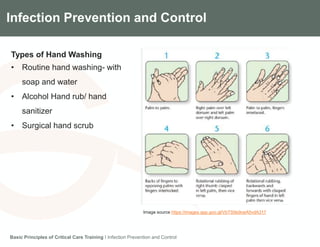
Types of Hand Washing
• Routine hand washing- with
soap and water
• Alcohol Hand rub/ hand
sanitizer
• Surgical hand scrub
Basic Principles of Critical Care Training I Infection Prevention and Control
Image source https://images.app.goo.gl/VbTS9e9oeA5vdA317
Components of the Gradian CCV SystemInfection Prevention and Control
Hand Cleaning Preparations
Soap I both bar and liquid soap are effective in removal of transient
microorganisms
• Bar soap should be small and dried on a rack to promote water drainage
• Liquid soap dispensers should be regularly cleaned
Antiseptics I contain antimicrobial agents applied to living tissue to kill microbes
• Common preps include chlorhexidine, povidone iodine, alcohol, and triclosan
Alcohol-based hand rubs I found to be more effective than soap and
antimicrobial hand washing agents
• Not effective in removing physical dirt or soiling and should be used to
disinfect physically clean hands
Basic Principles of Critical Care Training I Infection Prevention and Control
Components of the Gradian CCV SystemInfection Prevention and Control
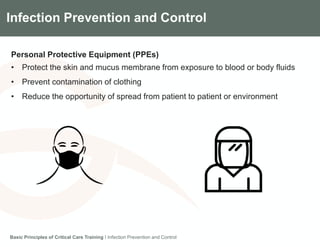
Personal Protective Equipment (PPEs)
• Protect the skin and mucus membrane from exposure to blood or body fluids
• Prevent contamination of clothing
• Reduce the opportunity of spread from patient to patient or environment
Basic Principles of Critical Care Training I Infection Prevention and Control
Components of the Gradian CCV SystemInfection Prevention and Control
Needle Stick Injuries
Common causes of injuries with sharps:
• Recapping hypodermic needles
• Manipulating sharps before disposal
• Accidentally sticking another staff member
• Leaving sharps in areas where they are unexpected
• Surgical procedures with limited visibility or in confined spaces
• Handling or disposing waste
• Unexpected client motion during injections
Basic Principles of Critical Care Training I Infection Prevention and Control
Components of the Gradian CCV SystemInfection Prevention and Control
Basic Principles of Critical Care Training I Infection Prevention and Control
Needle Stick Injuries
To prevent injuries due to sharps:
• Handle all sharps minimally after use
• Use extreme care whenever sharps are handled
• Dispose of sharps in puncture-resistant containers
• Pass sharps using the ‘hands-free technique’
• DO NOT recap needles or use “one hand technique”
Components of the Gradian CCV SystemInfection Prevention and Control
Decontamination & Cleaning
Decontamination
• First step in processing items
• Makes items safer to handle and easier to clean
• Replace solution daily or when it becomes heavily contaminated
Cleaning
• Process of physically removing all organic material (e.g. blood, tissue,
sputum, feces and urine)
Basic Principles of Critical Care Training I Infection Prevention and Control
Components of the Gradian CCV SystemInfection Prevention and Control
Disinfection
• Process of reducing pathogenic organisms from materials so that organisms
no longer pose a disease threat
• A disinfectant is a chemical or physical agent that is applied to inanimate
objects to kill microbes
• Methods of disinfection include boiling and using chemicals
Basic Principles of Critical Care Training I Infection Prevention and Control
Components of the Gradian CCV SystemInfection Prevention and Control
Chemical Disinfectants
• Alcohol
• Chlorine based disinfectants (e.g. sodium or calcium hypochlorite)
• Chlorhexidine
• Iodine
• Aldehydes (e.g., glutaraldehyde, formaldehyde)
• Hydrogen peroxide
Different disinfectants typically have different strengths and weaknesses. If
unsure or ignorant of disinfectant abilities, the best thing to do is to read
the label
Basic Principles of Critical Care Training I Infection Prevention and Control
Components of the Gradian CCV SystemInfection Prevention and Control
Waste Disposal
• To prevent the spread of infection to health service providers
• To prevent the spread of infections to the local community
• To protect those who handle wastes from accidental injury
Types of waste
• General waste: non-hazardous, poses no risk of injury or infection
• Medical waste: material generated in a diagnosis, treatment, and/or immunization
• Hazardous chemical waste: chemicals that are potentially toxic or poisonous
Basic Principles of Critical Care Training I Infection Prevention and Control
Components of the Gradian CCV SystemInfection Prevention and Control
Importance of proper waste disposal
• Minimizes spread of infection to health workers, patients and local community
• Reduces risk of accidental injury to those who handle the waste
• Reduces likelihood of contamination of soil, ground water, etc.
• Reduces attraction of insects and rodents
• Reduces odors
Basic Principles of Critical Care Training I Infection Prevention and Control
Components of the Gradian CCV SystemInfection Prevention and Control
Nosocomial Infections in ICUs
An infection acquired in a health facility while offering or receiving treatment:
• Qualified as newly diagnosed after 48 hours of being in hospital or within 72
hours after discharge
• Prevalence is 10% among hospitalized patients
• Increases the risk of death, duration of hospital stay, and cost of treatment
• Largely a product of advances in medical treatment
• Inclides intravenous, urinary and other catheters, invasive diagnostic tests
and complex surgical procedures
• Intensive use of antibiotics contributes to development of resistant strains of
pathogens
Basic Principles of Critical Care Training I Infection Prevention and Control
Components of the Gradian CCV SystemInfection Prevention and Control
Factors predisposing a patient to infection:
• Poor state of health
• Invasive devices
• Patient’s treatment
Common pathogens
• Escherichia coli
• Enterococcus spp
• Staphylococcus aureus
• Pseudomonas spp
Basic Principles of Critical Care Training I Infection Prevention and Control
Components of the Gradian CCV SystemInfection Prevention and Control
General prevention measures
• Hand washing
• Cleaning, disinfection and sterilization
• Aseptic precautions when carrying out invasive procedures
• Appropriate and rational prescription of antibiotics
• Commitment by staff
Basic Principles of Critical Care Training I Infection Prevention and Control

Module 1.4 Infection Prevention & Control

  • 1.
    INFECTION PREVENTION &CONTROL Gradian Health Systems Basic Principles of Critical Care BASIC PRINCIPLES OF CRITICAL CARE
  • 2.
    Disclaimer Basic Principles ofCritical Care Training I Infection Prevention and Control Disclaimer: Gradian Health Systems cannot provide formal recommendations or indications regarding medical care and clinical service delivery. The tables, checklists, and other clinical documents referenced in this training have not been validated in all settings. These documents are intended to serve as examples only. We recognize that all clinical training content and activities must be customized to meet the needs of each facility and its clinical staff, factoring in available resources, practitioner skill level, and other environmental considerations. For any questions regarding the contents or applications of this training, please contact Gradian Health Systems: 40 W 25th St, 6th Floor New York, NY 10010 USA +1 212-537-0340 training@gradianhealth.org
  • 3.
    Module 1 Gradian HealthSystems Basics Principles of Critical Care Basic Principles of Critical Care
  • 4.
    Module 1: BasicPrinciples of Critical Care MODULE OVERVIEW Lesson 1 I Introduction to ICUs Lesson 2 I Pain Management and Sedation Lesson 3 I ICU Admission and Discharge Lesson 4 I Infection Prevention and Control Lesson 5 I Total Nursing Care Basic Principles of Critical Care Training I Infection Prevention and Control
  • 5.
    Components of theGradian CCV SystemLesson 4: Infection Prevention and Control Lesson Objectives • Describe the pillars of infection prevention and control (IPC) in the ICU • Outline the principles of IPC • Discuss IPC methods Basic Principles of Critical Care Training I Infection Prevention and Control
  • 6.
    Components of theGradian CCV SystemLesson 4: Infection Prevention and Control Key Concepts • IPC pillars • IPC guidelines • IPC methods Basic Principles of Critical Care Training I Infection Prevention and Control
  • 7.
    Components of theGradian CCV SystemInfection Prevention and Control Why is IPC important? Hospitalized patients are more prone to infections due to: • Surgery • Invasive procedures and devices • Immunosuppressive drugs Micro-organisms flourish due to: • Breaks in the infection prevention practices and procedures • Weakened patient defense mechanisms Basic Principles of Critical Care Training I Infection Prevention and Control
  • 8.
    Components of theGradian CCV SystemInfection Prevention and Control Infection An infection is an invasion in the body by microorganisms, fungi, etc. It also refers to the damage of body tissues by microorganisms or by poisonous substances released by the microorganisms. Infection Prevention A collective effort made by healthcare providers and clients to prevent or minimize the risks of transmitting infections, such as Hepatitis B or HIV/AIDS, to clients or to other healthcare providers. Basic Principles of Critical Care Training I Infection Prevention and Control
  • 9.
    Components of theGradian CCV SystemInfection Prevention and Control Pillars of Infection Control • Isolation of patients and barrier precautions • Decontamination of items and equipment • Prudent use of antibiotics • Hand washing • Decontamination of environment Basic Principles of Critical Care Training I Infection Prevention and Control
  • 10.
    Components of theGradian CCV SystemInfection Prevention and Control Hospital Infection Control Program Aimed at reducing/eliminating risk of infection to patients, visitors and healthcare personnel. Each person has a specific role in enforcing IPC protocols. Administrator (senior / assistant) • Ensures adequate resources are provided to infection control department Infection Control Doctor (ICD) • Serves as advisor to ICC • Assists in drafting plans, policies and long-term programs • Involved in setting quality standards, surveillance and auditing Basic Principles of Critical Care Training I Infection Prevention and Control
  • 11.
    Components of theGradian CCV SystemInfection Prevention and Control Infection Control Nurse (ICN) • Serves as advisor to ICC • Assists in drafting plans, policies and long-term programs • Provides specialist nursing input • Investigates and monitor infections, hazardous practice and procedures • Presents educational programs in committees where infection control input is required Basic Principles of Critical Care Training I Infection Prevention and Control
  • 12.
    Components of theGradian CCV SystemInfection Prevention and Control Infection Control Team (ICT) • Comprised of ICD and ICN • Responsible for day to day running of infection control programs • Ensures infection control programs have been planned, coordinated, implemented and evaluated • Produces written policies and procedures on infection control • Participates in audits Basic Principles ofCritical Care Training I Infection Prevention and Control
  • 13.
    Components of theGradian CCV SystemInfection Prevention and Control Principles of Infection Prevention 1. Every person considered potentially infectious (patient or staff) 2. Hand washing is the most practical procedure for preventing cross- contamination 3. Wear gloves before touching anything wet – broken skin, mucous membranes, blood or other body fluids (secretions or excretions) 4. Use barriers (protective goggles, face masks or aprons) if splashes and spills of any body fluids (secretions or excretions) are anticipated 5. Use safe work practices (e.g. not recapping or bending needles, proper instrument processing, and proper disposal of medical waste) Basic Principles of Critical Care Training I Infection Prevention and Control
  • 14.
    Components of theGradian CCV SystemInfection Prevention and Control Universal practices A simple set of effective practices designed to protect health workers and patients from infection used to break the disease transmission cycle. These practices are used when caring for all patients, regardless of diagnosis: • Washing hands • Decontaminating equipment and devices • Using and disposing needles and sharps safely (avoid capping, especially two-handed) • Wearing protective items • Promptly cleaning up blood and body fluid spills • Using safe disposal systems for waste collection and disposal Basic Principles of Critical Care Training I Infection Prevention and Control
  • 15.
    Components of theGradian CCV SystemInfection Prevention and Control Universal Infection Prevention Methods • Hand washing • Personal Protective Equipment (PPEs) • Decontamination • Cleaning • High-Level Disinfection (HLD) • Sterilization • Waste disposal • Housekeeping Basic Principles of Critical Care Training I Infection Prevention and Control
  • 16.
    Components of theGradian CCV SystemInfection Prevention and Control Hand washing is single most important method of prevention of cross infection in a hospital. Hand washing basins should be… • Adequate within the hospital • Conveniently located, preferably near the entrance for staff • Large enough to avoid splashing; shallow sinks may cause contamination of hands by bacteria in the drain system Basic Principles of Critical Care Training I Infection Prevention and Control
  • 17.
    Components of theGradian CCV SystemInfection Prevention and Control Types of Hand Washing • Routine hand washing- with soap and water • Alcohol Hand rub/ hand sanitizer • Surgical hand scrub Basic Principles of Critical Care Training I Infection Prevention and Control Image source https://images.app.goo.gl/VbTS9e9oeA5vdA317
  • 18.
    Components of theGradian CCV SystemInfection Prevention and Control Hand Cleaning Preparations Soap I both bar and liquid soap are effective in removal of transient microorganisms • Bar soap should be small and dried on a rack to promote water drainage • Liquid soap dispensers should be regularly cleaned Antiseptics I contain antimicrobial agents applied to living tissue to kill microbes • Common preps include chlorhexidine, povidone iodine, alcohol, and triclosan Alcohol-based hand rubs I found to be more effective than soap and antimicrobial hand washing agents • Not effective in removing physical dirt or soiling and should be used to disinfect physically clean hands Basic Principles of Critical Care Training I Infection Prevention and Control
  • 19.
    Components of theGradian CCV SystemInfection Prevention and Control Personal Protective Equipment (PPEs) • Protect the skin and mucus membrane from exposure to blood or body fluids • Prevent contamination of clothing • Reduce the opportunity of spread from patient to patient or environment Basic Principles of Critical Care Training I Infection Prevention and Control
  • 20.
    Components of theGradian CCV SystemInfection Prevention and Control Needle Stick Injuries Common causes of injuries with sharps: • Recapping hypodermic needles • Manipulating sharps before disposal • Accidentally sticking another staff member • Leaving sharps in areas where they are unexpected • Surgical procedures with limited visibility or in confined spaces • Handling or disposing waste • Unexpected client motion during injections Basic Principles of Critical Care Training I Infection Prevention and Control
  • 21.
    Components of theGradian CCV SystemInfection Prevention and Control Basic Principles of Critical Care Training I Infection Prevention and Control Needle Stick Injuries To prevent injuries due to sharps: • Handle all sharps minimally after use • Use extreme care whenever sharps are handled • Dispose of sharps in puncture-resistant containers • Pass sharps using the ‘hands-free technique’ • DO NOT recap needles or use “one hand technique”
  • 22.
    Components of theGradian CCV SystemInfection Prevention and Control Decontamination & Cleaning Decontamination • First step in processing items • Makes items safer to handle and easier to clean • Replace solution daily or when it becomes heavily contaminated Cleaning • Process of physically removing all organic material (e.g. blood, tissue, sputum, feces and urine) Basic Principles of Critical Care Training I Infection Prevention and Control
  • 23.
    Components of theGradian CCV SystemInfection Prevention and Control Disinfection • Process of reducing pathogenic organisms from materials so that organisms no longer pose a disease threat • A disinfectant is a chemical or physical agent that is applied to inanimate objects to kill microbes • Methods of disinfection include boiling and using chemicals Basic Principles of Critical Care Training I Infection Prevention and Control
  • 24.
    Components of theGradian CCV SystemInfection Prevention and Control Chemical Disinfectants • Alcohol • Chlorine based disinfectants (e.g. sodium or calcium hypochlorite) • Chlorhexidine • Iodine • Aldehydes (e.g., glutaraldehyde, formaldehyde) • Hydrogen peroxide Different disinfectants typically have different strengths and weaknesses. If unsure or ignorant of disinfectant abilities, the best thing to do is to read the label Basic Principles of Critical Care Training I Infection Prevention and Control
  • 25.
    Components of theGradian CCV SystemInfection Prevention and Control Waste Disposal • To prevent the spread of infection to health service providers • To prevent the spread of infections to the local community • To protect those who handle wastes from accidental injury Types of waste • General waste: non-hazardous, poses no risk of injury or infection • Medical waste: material generated in a diagnosis, treatment, and/or immunization • Hazardous chemical waste: chemicals that are potentially toxic or poisonous Basic Principles of Critical Care Training I Infection Prevention and Control
  • 26.
    Components of theGradian CCV SystemInfection Prevention and Control Importance of proper waste disposal • Minimizes spread of infection to health workers, patients and local community • Reduces risk of accidental injury to those who handle the waste • Reduces likelihood of contamination of soil, ground water, etc. • Reduces attraction of insects and rodents • Reduces odors Basic Principles of Critical Care Training I Infection Prevention and Control
  • 27.
    Components of theGradian CCV SystemInfection Prevention and Control Nosocomial Infections in ICUs An infection acquired in a health facility while offering or receiving treatment: • Qualified as newly diagnosed after 48 hours of being in hospital or within 72 hours after discharge • Prevalence is 10% among hospitalized patients • Increases the risk of death, duration of hospital stay, and cost of treatment • Largely a product of advances in medical treatment • Inclides intravenous, urinary and other catheters, invasive diagnostic tests and complex surgical procedures • Intensive use of antibiotics contributes to development of resistant strains of pathogens Basic Principles of Critical Care Training I Infection Prevention and Control
  • 28.
    Components of theGradian CCV SystemInfection Prevention and Control Factors predisposing a patient to infection: • Poor state of health • Invasive devices • Patient’s treatment Common pathogens • Escherichia coli • Enterococcus spp • Staphylococcus aureus • Pseudomonas spp Basic Principles of Critical Care Training I Infection Prevention and Control
  • 29.
    Components of theGradian CCV SystemInfection Prevention and Control General prevention measures • Hand washing • Cleaning, disinfection and sterilization • Aseptic precautions when carrying out invasive procedures • Appropriate and rational prescription of antibiotics • Commitment by staff Basic Principles of Critical Care Training I Infection Prevention and Control