1
CLOUD COMPUTING
Unit-I
Systems Modeling, Clustering and Virtualization
1.1Distributed System Models And Enabling Technologies
1.1.1Scalable Computing over the Internet
In this section, we assess evolutionary changes in machine architecture, operating system
platform, network connectivity, and application workload. Instead of using a centralized
computer to solve computational problems, a parallel and distributed computing system uses
multiple computers to solve large-scale problems over the Internet. Thus, distributed computing
becomes data-intensive and network-centric. This section identifies the applications of modern
computer systems that practice parallel and distributed computing.
1.1.1.1 The Age of Internet Computing
As a result, supercomputer sites and large data centers must provide high-performance
computing services to huge numbers of Internet users concurrently. Because of this high
demand, the Linpack Benchmark for high-performance computing (HPC)
applications is no longer optimal for measuring system performance. The emergence of
computing clouds instead demands high-throughput computing (HTC) systems built with parallel
and distributed computing technologies . We have to upgrade data centers using fast servers,
storage systems, and high-bandwidth networks.
The Platform Evolution
Computer technology has gone through five generations of development, with each generation
lasting from 10 to 20 years. Successive generations are overlapped in about 10 years. For
instance, from 1950 to 1970, a handful of mainframes, including the IBM 360 and CDC 6400,
were built to satisfy the demands of large businesses and government organizations.
High-Performance Computing
HPC systems emphasize the raw speed performance. The speed of HPC systems has increased
from Gflops in the early 1990s to now Pflops in 2010. This improvement was driven mainly by
the demands from scientific, engineering, and manufacturing communities. For example, the Top
500 most powerful computer systems in the world are measured by floating-point speed in
Linpack benchmark results. However, the number of supercomputer users is limited to less than
10% of all computer users. Today, the majority of computer users are using desktop computers
or large servers when they conduct Internet searches and market-driven computing tasks.
High-Throughput Computing
The development of market-oriented high-end computing systems is undergoing a strategic
change from an HPC paradigm to an HTC paradigm. This HTC paradigm pays more attention to
high-flux computing. The main application for high-flux computing is in Internet searches and
web services by millions or more users simultaneously. The performance goal thus shifts to
measure high throughput or the number of tasks completed per unit of time. HTC technology
needs to not only improve in terms of batch processing speed, but also address the acute
problems of cost, energy savings, security, and reliability at many data and enterprise computing
centers.
Computing Paradigm Distinctions
The high-technology community has argued for many years about the precise definitions of
2
centralized computing, parallel computing, distributed computing, and cloud computing. In
general, distributed computing is the opposite of centralized computing. The field of parallel
computing overlaps with distributed computing to a great extent, and cloud computing overlaps
with distributed, centralized, and parallel computing.
1.1.2 Scalable Computing Trends and New Paradigms
Several predictable trends in technology are known to drive computing applications. In fact,
designers and programmers want to predict the technological capabilities of future systems. For
instance, Jim Gray’s paper, “Rules of Thumb in Data Engineering,” is an excellent example of
how technology affects applications and vice versa. In addition, Moore’s law indicates that
processor speed doubles every 18 months.
1.1.2.1Degrees of Parallelism
most computers were designed in a bit-serial fashion. In this scenario, bit-level parallelism (BLP)
converts bit-serial processing to word-level processing gradually. Over the years, users graduated
from 4-bit microprocessors to 8-,16-, 32-, and 64-bit CPUs. This led us to the next wave of
improvement, known as instruction level parallelism (ILP), in which the processor executes
multiple instructions simultaneously rather than only one instruction at a time. VLIW (very long
instruction word) architectures, and multithreading. ILP requires branch prediction, dynamic
scheduling, speculation, and compiler support to work efficiently.
1.1.2.2 Innovative Applications
Both HPC and HTC systems desire transparency in many application aspects. For example, data
access, resource allocation, process location, concurrency in execution, job replication, and
failure recovery should be made transparent to both users and system management. highlights a
few key applications that have driven the development of parallel and distributed systems over
the years.
1.1.3 The Internet of Things and Cyber-Physical Systems
In this section, we will discuss two Internet development trends: the Internet of Things and
cyber-physical systems. These evolutionary trends emphasize the extension of the Internet to
everyday objects.
1.1.3.1 The Internet of Things
The traditional Internet connects machines to machines or web pages to web pages. The IoT
refers to the networked interconnection of everyday objects, tools, devices, or computers. One
can view the IoT as a wireless network of sensors that interconnect all things in our daily life.
These things can be large or small and they vary
1.2 Computer Clusters for Scalable Parallel Computing
1.2.1Clustering for Massive Parallelism
A computer cluster is a collection of interconnected stand-alone computers which can work
together collectively and cooperatively as a single integrated computing resource pool.
Clustering explores massive parallelism at the job level and achieves high availability (HA)
through stand-alone operations. The benefits of computer clusters and massively parallel
processors (MPPs) include scalable performance, HA, fault tolerance, modular growth, and use
of commodity components.
1.2.1.1 Cluster Development Trends
Support for clustering of computers has moved from interconnecting high-end mainframe
computers
3
to building clusters with massive numbers of x86 engines. Computer clustering started with the
linking of large mainframe computers such as the IBM Sysplex and the SGI Origin 3000.
Originally,this was motivated by a demand for cooperative group computing and to provide
higher availability in critical enterprise applications.
1.2.1.2 Milestone Cluster Systems
Clustering has been a hot research challenge in computer architecture. Fast communication, job
scheduling, SSI, and HA are active areas in cluster research. lists some milestone cluster research
projects and commercial cluster products. Details of these old clusters can be found in. These
milestone projects have pioneered clustering hardware and middleware development over the
past two decades.
1.2.2 DesignObjectives of Computer Clusters
Clusters have been classified in various ways in the literature. We classify clusters using six
orthogonal attributes: scalability, packaging, control, homogeneity, programmability, and
security.
1.2.2.1 Scalability
Clustering of computers is based on the concept of modular growth. To scale a cluster from
hundreds of uniprocessor nodes to a supercluster with 10,000 multicore nodes is a nontrivial
task. The scalability could be limited by a number of factors, such as the multicore chip
technology, cluster topology, packaging method, power consumption, and cooling scheme
applied.
1.2.2.2Packaging
Cluster nodes can be packaged in a compact or a slack fashion. In a compact cluster, the nodes
are closely packaged in one or more racks sitting in a room, and the nodes are not attached to
peripherals (monitors, keyboards, mice, etc.). In a slack cluster, the nodes are attached to their
usual peripherals (i.e., they are complete SMPs, workstations, and PCs), and they may be located
in different rooms, different buildings, or even remote regions.
Control
A cluster can be either controlled or managed in a centralized or decentralized fashion. A
compact cluster normally has centralized control, while a slack cluster can be controlled either
way. In a centralized cluster, all the nodes are owned, controlled, managed, and administered by
a central operator.
1.2.3 Fundamental Cluster Design Issues
In this section, we will classify various cluster and MPP families. Then we will identify the
major design issues of clustered and MPP systems. Both physical and virtual clusters are
covered. These systems are often found in computational grids, national laboratories, business
data centers, supercomputer sites, and virtualized cloud platforms.
1.2.3.1 Scalable Performance
This refers to the fact that scaling of resources (cluster nodes, memory capacity, I/O bandwidth,
etc.) leads to a proportional increase in performance. Of course, both scale-up and scale-down
capabilities are needed, depending on application demand or cost-effectiveness considerations.
1.2.3.2Single-System Image (SSI)
A set of workstations connected by an Ethernet network is not necessarily a cluster. A cluster is a
single system. For example, suppose a workstation has a 300 Mflops/second processor, 512 MB
of memory, and a 4 GB disk and can support 50 active users and 1,000 processes. By clustering
100 such workstations
4
1.2.4 Computer Clusters and MPP Architectures.
Most clusters emphasize higher availability and scalable performance. Clustered systems
evolved from the Microsoft Wolfpack and Berkeley NOW to the SGI Altix Series, IBM SP
Series, and IBM Roadrunner. NOW was a UC Berkeley research project designed to explore new
mechanisms for clustering of UNIX workstations. Most clusters use commodity networks such
as Gigabit Ethernet, Myrinet switches, or InfiniBand networks to interconnect the compute and
storage nodes.
1.2.4.1 Cluster Organization and Resource Sharing
In this section, we will start by discussing basic, small-scale PC or server clusters. We will
discuss how to construct large-scale clusters and MPPs in subsequent sections.
A Basic Cluster Architecture
a simple cluster of computers built with commodity components and fully supported with desired
SSI features and HA capability. The processing nodes are commodity workstations, PCs, or
servers. These commodity nodes are easy to replace or upgrade with new generations of
hardware.
Resource Sharing in Clusters
The shared-nothing architecture is used in most clusters, where the nodes are connected through
the I/O bus. The shared-disk architecture is in favor of small-scale availability clusters in
business applications.
1.2.4.2 Node Architectures and MPP Packaging
large-scale clusters or MPP systems, cluster nodes are classified into two categories:
compute nodes and service nodes. Compute nodes appear in larger quantities mainly used for
large scale searching or parallel floating-point computations. Service nodes could be built with
different processors mainly used to handle I/O, file access, and system monitoring.
1.2.4.3 Cluster System Interconnects
High-Bandwidth Interconnects
The Myrinet and Quadrics perform in between. The MPI latency represents the state of the art in
long-distance message passing. All four technologies can implement any network topology,
including crossbar switches, fat trees, and torus networks. The InfiniBand is the most expensive
choice with the fastest link speed.
Share of System Interconnects over Time
large-scale system interconnects in the Top 500 systems from 2003 to 2008. Gigabit Ethernet is
the most popular interconnect due to its low cost and market readiness. The InfiniBand network
has been chosen in about 150 systems for its high-bandwidth performance.
1.2.4.4 Hardware, Software, and Middleware Support
Realistically, SSI and HA features in a cluster are not obtained free of charge. They must be
supported by hardware, software, middleware, or OS extensions. Any change in hardware design
and OS extensions must be done by the manufacturer. The hardware and OS support could be
cost prohibitive to ordinary users. However, programming level is a big burden to cluster users.
Therefore, the middleware support at the application level costs the least to implement.
1.2.5 GPU Clusters for Massive Parallelism
Commodity GPUs are becoming high-performance accelerators for data-parallel computing.
Modern GPU chips contain hundreds of processor cores per chip.
5
1.2.6 DesignPrinciples of Computer Clusters
Clusters should be designed for scalability and availability. In this section, we will cover the
design principles of SSI, HA, fault tolerance, and rollback recovery in general-purpose
computers and clusters of cooperative computers.
1.2.6.1 Single-System Image Features
SSI does not mean a single copy of an operating system image residing in memory, as in an SMP
or a workstation. Rather, it means the illusion of a single system, single control, symmetry, and
transparency
.Single systemThe entire cluster is viewed by users as one system that has multiple processors.
The user could say, “Execute my application using five processors.” This is different from a
distributed system.
• Single control Logically, an end user or system user utilizes services from one place with a
single interface. For instance, a user submits batch jobs to one set of queues; a system
administrator configures all the hardware and software components of the cluster from one
control point.
1.2.6.2 High Availability through Redundancy
When designing robust, highly available systems three terms are often used together: reliability,
availability, and serviceability (RAS). Availability is the most interesting measure since it
combines the concepts of reliability and serviceability
• Reliability measures how long a system can operate without a breakdown.
• Availability indicates the percentage of time that a system is available to the user, that is, the
percentage of system uptime.
• Serviceability refers to how easy it is to service the system, including hardware and software
maintenance, repair, upgrades, and so on.
Availability and Failure Rate
The failed system is then repaired, and the system returns to normal operation. This operate-
repair cycle then repeats. A system’s reliability is measured by the mean time to failure (MTTF),
which is the average time of normal operation before the system (or a component of the system)
fails.
Availability = MTTF/(MTTF +MTTR)
1.2.6.3 Fault-Tolerant Cluster Configurations
The cluster solution was targeted to provide availability support for two server nodes with three
ascending levels of availability: hot standby, active takeover, and fault-tolerant. In this section,
we will consider the recovery time, failback feature, and node activeness. The level of
availability increases from standby to active and fault-tolerant cluster configurations.
1.3 Virtual Machines and Virtualization of Clusters and Data Centers
The reincarnation of virtual machines (VMs) presents a great opportunity for parallel, cluster,
grid,cloud, and distributed computing. Virtualization technology benefits the computer and IT
industries by enabling users to share expensive hardware resources by multiplexing VMs on the
same set of hardware hosts. This chapter covers virtualization levels, VM architectures, virtual
networking, virtual cluster construction, and virtualized data-center design and automation in
cloud computing.
1.3.1Implementation Levels of Virtualization
Virtualization is a computer architecture technology by which multiple virtual machines (VMs)
are multiplexed in the same hardware machine. The purpose of a VM is to enhance resource
sharing by many users and improve computer performance in terms of resource utilization and
6
application flexibility. Hardware resources (CPU, memory, I/O devices, etc.) or software
resources (operating system and software libraries) can be virtualized in various functional
layers.
1.3.1.1 Levels of Virtualization Implementation
A traditional computer runs with a host operating system specially tailored for its hardware
architecture After virtualization, different user applications managed by their own operating
systems (guest OS) can run on the same hardware, independent of the host OS. This is often
done by adding additional software, called a virtualization layer The main function of the
software layer for virtualization is to virtualize the physical hardware of a host machine into
virtual resources to be used by the VMs, exclusively. This can be implemented at various
operational levels, as we will discuss shortly.
1.3.1.2 VMM DesignRequirements and Providers
As mentioned earlier, hardware-level virtualization inserts a layer between real hardware and
traditional operating systems. This layer is commonly called the Virtual Machine Monitor
(VMM) and it manages the hardware resources of a computing system. Each time programs
access the hardware the VMM captures the process. In this sense, the VMM acts as a traditional
OS. One hardware component, such as the CPU, can be virtualized as several virtual copies.
3.1.3 Virtualization Support at the OS Level
Cloud computing is transforming the computing landscape by shifting the hardware and staffing
costs of managing a computational center to third parties, just like banks. However, cloud
computing has at least two challenges. The first is the ability to use a variable number of physical
machines and VM instances depending on the needs of a problem. For example, a task may need
only a single CPU during some phases of execution but may need hundreds of CPUs at other
times. The second challenge concerns the slow operation of instantiating new VMs.
1.3.2Virtualization Structures/Tools and Mechanisms
the architectures of a machine before and after virtualization. Before virtualization, the operating
system manages the hardware. After virtualization, a virtualization layer is inserted between the
hardware and the operating system. In such a case, the virtualization layer is responsible for
converting portions of the real hardware into virtual hardware. Therefore, different operating
systems such as Linux and Windows can run on the same physical machine, simultaneously.
Depending on the position of the virtualization layer, there are several classes of VM
architectures, namely the hypervisor architecture, paravirtualization, and host-based
virtualization. The hypervisor is also known as the VMM (Virtual Machine Monitor).
1.3.2.1 Hypervisor and Xen Architecture
The hypervisor supports hardware-level virtualization (see Figure 3.1(b)) on bare metal devices
like CPU, memory, disk and network interfaces. The hypervisor software sits directly between
the physical hardware and its OS. This virtualization layer is referred to as either the VMM or
the hypervisor. The hypervisor provides hypercalls for the guest OSes and applications.
Depending on the functionality, a hypervisor can assume a micro-kernel architecture like the
Microsoft Hyper-V.
1.3.2.2 Binary Translation with Full Virtualization
Depending on implementation technologies, hardware virtualization can be classified into two
categories: full virtualization and host-based virtualization. Full virtualization does not need to
modify the host OS. It relies on binary translation to trap and to virtualize the execution of
certain sensitive, nonvirtualizable instructions. The guest OSes and their applications consist of
noncritical and critical instructions.
7
Unit-II
Foundations
2 .1 Introduction To Cloud Computing:
2.1.1 Cloud Computing In A Nutshell
When plugging an electric appliance into an outlet, we care neither how electric
power is generated nor how it gets to that outlet. This is possible because
electricity is virtualized; that is, it is readily available from a wall socket that
hides power generation stations and a huge distribution grid.When extended to
information technologies, this concept means delivering useful functions while
hiding how their internals work. Computing itself, to be considered fully
virtualized, must allow computers to be built from distributed components such
as processing, storage, data, and software resources.
Technologies such as cluster, grid, and now, cloud computing, have all aimed
at allowing access to large amounts of computing power in a fully virtualized
manner, by aggregating resources and offering a single system view. In addition, an important
aim of these technologies has been delivering computing as a utility. Utility computing describes
a business model for on-demand delivery of computing power .
Cloud computing has been coined as an umbrella term to describe a category of sophisticated on-
demand computing services initially offered by commercial providers, such as Amazon, Google,
and Microsoft. It denotes a model on which a computing infrastructure is viewed as a “cloud,”
from which businesses and individuals access applications from anywhere in the world on
demand The main principle behind this model is offering computing, storage, and software “as a
service.” software “as a service.”
2.1.2 Roots Of Cloud Computing
We can track the roots of clouds computing by observing the advancement of several
technologies, especially in hardware (virtualization, multi-core chips), Internet technologies
(Web services, service-oriented architectures, Web 2.0), distributed computing (clusters, grids),
and systems management (autonomic computing, data center automation ).
Some of these technologies have been tagged as hype in their early stages of development;
however, they later received significant attention from academia and were sanctioned by major
industry players. Consequently, a specification and standardization process followed, leading to
maturity and wide adoption. The emergence of cloud computing itself is closely linked to the
maturity of such technologies. We present a closer look at the technologies that form the base of
cloud computing, with the aim of providing a clearer picture of the cloud ecosystem as a whole.
2.1.3 From Mainframes to Clouds
We are currently experiencing a switch in the IT world, from in-house generated computing
power into utility-supplied computing resources delivered
over the Internet as Web services. This trend is similar to what occurred about a
century ago when factories, which used to generate their own electric power,
realized that it is was cheaper just plugging their machines into the newly
formed electric power grid .
8
Computing delivered as a utility can be defined as “on demand delivery of infrastructure,
applications, and business processes in a security-rich, shared, scalable, and based computer
environment over the Internet for a fee ”
Hardw are
Distributed Computing
Systems Management
2.1.4 SOA, Web Services, Web 2.0, and Mashups
The emergence of Web services (WS) open standards has significantly contributed
to advances in the domain of software integration [12]. Web services
can glue together applications running on different messaging product platforms,
enabling information from one application to be made available to
others, and enabling internal applications to be made available over the
Internet.
WS standards have been created on top of existing ubiquitous technologies such as HTTP and
XML, thus providing a common mechanism for delivering services, making them ideal for
implementing a service-oriented architecture(SOA). The purpose of a SOA is to address
requirements of loosely coupled, standards-based, and protocol-independent distributed
computing. In a SOA, software resources are packaged as “services,” which are well-defined,
selfcontained modules that provide standard business functionality and are independent of the
state or context of other services.
2.1.4 Grid Computing
Grid computing enables aggregation of distributed resources and transparently access to them.
Most production grids such as TeraGrid and EGEE seek to share compute and storage resources
distributed across different administrative domains, with their main focus being speeding up a
broad range of scientific applications, such as climate modeling, drug design, and protein
analysis.
2.1.5 Utility Computing
large grid installations have faced new problems, such as excessive spikes in demand for
resources coupled with strategic and adversarial behavior by users. Initially, grid resource
management techniques did not ensure fair and equitable access to resources in many systems.
Utility &
Grid
Computing
SOA
Web 2.0
Web Services
Mashups
Autonomic
Computing
Data Center
Automation
Hardw are
Virtualizatio
n
Multi-core
chips
Cloud
Computi
ng
9
Traditional metrics (throughput, waiting time, and slowdown) failed to capture the more subtle
requirements of users. There were no real incentives for users to be flexible about resource
requirements or job deadlines, nor provisions to accommodate users with urgent work .
2.1.6 Hardware Virtualization
Cloud computing services are usually backed by large-scale data centers composed of thousands
of computers. Such data centers are built to serve many users and host many disparate
applications. For this purpose, hardware virtualization can be considered as a perfect fit to
overcome most operational issues of data center building and maintenance.
.
. Virtual Machine Monitor (Hypeor)
VMWare ESXi. VMware is a pioneer in the virtualization market. Its ecosystem
of tools ranges from server and desktop virtualization to high-level
management tools [24]. ESXi is a VMM from VMWare. It is a bare-metal
hypervisor, meaning that it installs directly on the physical server, whereas
others may require a host operating system.
Xen. The Xen hypervisor started as an open-source project and has served as a
base to other virtualization products, both commercial and open-source. It has
pioneered the para-virtualization concept, on which the guest operating system,
by means of a specialized kernel, can interact with the hypervisor, thus
significantly improving performance.
KVM. The kernel-based virtual machine (KVM) is a Linux virtualization
subsystem. Is has been part of the mainline Linux kernel since version 2.6.20,
thus being natively supported by several distributions. In addition, activities
such as memory management and scheduling are carried out by existing kernel .
2.1.7 Virtual Appliances and the Open Virtualization Format
An application combined with the environment needed to run it (operating
system, libraries, compilers, databases, application containers, and so forth) is
referred to as a “virtual appliance.” Packaging application environments in the
Virtual Machine NVirtual Machine 2Virtual Machine 1
User software User software
Data
Base
Web
Server
Email Server Facebook
App
Java Ruby
on
Rails
User software
App A App X
App B App Y
Windows Linux Guest OS
Virtual Machine Monitor (Hypervisor)
Hardware
10
shape of virtual appliances eases software customization, configuration, and
patching and improves portability. Most commonly, an appliance is shaped as
a VM disk image associated with hardware requirements, and it can be readily
deployed in a hypervisor.
2.1.8 Autonomic Computing
The increasing complexity of computing systems has motivated research onautonomic
computing, which seeks to improve systems by decreasing humaninvolvement in their operation.
In other words, systems should managethemselves, with high-level guidance from humans.
2.2 Migrating Into A Cloud
Cloud computing has been a hotly debated and discussed topic amongst IT professionals and
researchers both in the industry and in academia. There are intense discussions on several blogs,
in Web sites, and in several research efforts. This also resulted in several entrepreneurial efforts
to help leverage and migrate into the cloud given the myriad issues, challenges, benefits, and
limitations and lack of comprehensive understanding of what cloud computing can do. On the
one hand, there were these large cloud computing IT vendors like Google, Amazon, and
Microsoft, who had started offering cloud computing services on what seemed like a
demonstration and trial basis though not explicitly mentioned.
2.2.1 The Promise of the Cloud
Most users of cloud computing services offered by some of the large-scale data centers are least
bothered about the complexities of the underlying systems or their functioning. More so given
the heterogeneity of either the systems or the software running on them. They were most
impressed by the simplicity,uniformity, and ease of use of the Cloud Computing Service
abstractions. In small and medium enterprises, cloud computing usage for all additional cyclical
IT needs has yielded substantial and significant economic savings. Many such success stories
have been documented and discussed on the Internet. This economics and the associated trade-
offs, of leveraging the cloud computing services, now popularly called “cloud economics,” for
satisfying enterprise’s
2.2.2 The Cloud Service Offerings and Deployment Models
Cloud computing has been an attractive proposition both for the CFO and the CTO of an
enterprise primarily due its ease of usage. This has been achieved by large data center service
vendors or now better known as cloud service vendors again primarily due to their scale of
Cloudonomics
Technology
• ‘Pay per use’ – Low er Cost Barriers
• On Demand Resources –Autoscaling
• Capex vs OPEX – No capital expenses (CAPEX) and only operational expenses
OPEX.
• SLA driven operations – Much Low er TCO
• Attractive NFR support: Availability, Reliability
• ‘Infinite’ Elastic availability – Compute/Storage/Bandw idth
• Automatic Usage Monitoring and Metering
• Jobs /Tasks Virtualized and Transparently ‘Movable’
• Integration and interoperability ‘support’ for hybrid ops
• Transparently encapsulated & abstracted IT features.
IaaS
• Abstract Compute/Storage/Bandwidth Resources
• Amazon Web Services[10,9] – EC2, S3, SDB, CDN, CloudWatch
11
operations. Google,1 Amazon, Microsoft,3 and a few others have been the key players apart
from open source Hadoop4 built around the Apache ecosystem.
From a technology viewpoint, as of today, the IaaS type of cloud offerings have been the most
successful and widespread in usage. However, the potential of PaaS has been high: All new
cloud-oriented application development initiatives are based on the PaaS model. The significant
impact of enterprises leveraging IaaS and PaaS has been in the form of services whose usage is
representative of SaaS on the Cloud. Be it search (Google/Yahoo/Bing, etc.) or email
(Gmail/Yahoomail/Hotmail, etc.) or social networking (Facebook/ Twitter/Orkut, etc.), most
users are unaware that much of their on-lineactivities has been supported in one form or the other
by the cloud.
2.2.3 Challenges in the Cloud
While the cloud service offerings present a simplistic view of IT in case of IaaS or a simplistic
view of programming in case PaaS or a simplistic view of resources usage in case of SaaS, the
underlying systems level support challenges are huge and highly complex. These stem from the
need to offer a uniformly consistent and robustly simplistic view of computing while the
underlying systems are highly failure-prone, heterogeneous, resource hogging, and exhibiting
serious security shortcomings. Invariably either in the IaaS or PaaS or SaaS cloud services, one
is proffered features that smack of full network reliability; or having “instant” or “zero” network
latency; or perhaps supporting “infinite” bandwidth; and so on. But then robust distributed
systems are built while keeping mind that are these fallacies6 that must be studiously avoided at
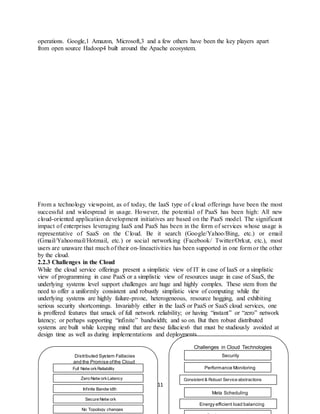
design time as well as during implementations and deployments.
Distributed System Fallacies
and the Promise ofthe Cloud
Challenges in Cloud Technologies
Full Netw orkReliability
Zero Netw orkLatency
Infinite Bandw idth
Secure Netw ork
No Topology changes
Performance Monitoring
Consistent & Robust Service abstractions
Meta Scheduling
Energy efficient load balancing
Security
12
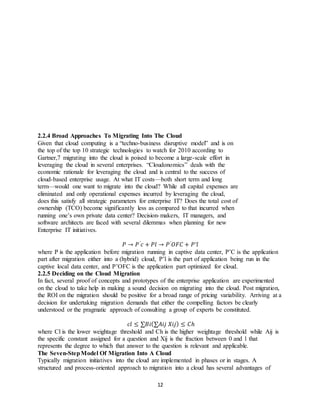
2.2.4 Broad Approaches To Migrating Into The Cloud
Given that cloud computing is a “techno-business disruptive model” and is on
the top of the top 10 strategic technologies to watch for 2010 according to
Gartner,7 migrating into the cloud is poised to become a large-scale effort in
leveraging the cloud in several enterprises. “Cloudonomics” deals with the
economic rationale for leveraging the cloud and is central to the success of
cloud-based enterprise usage. At what IT costs—both short term and long
term—would one want to migrate into the cloud? While all capital expenses are
eliminated and only operational expenses incurred by leveraging the cloud,
does this satisfy all strategic parameters for enterprise IT? Does the total cost of
ownership (TCO) become significantly less as compared to that incurred when
running one’s own private data center? Decision-makers, IT managers, and
software architects are faced with several dilemmas when planning for new
Enterprise IT initiatives.
𝑃 → 𝑃′
𝑐 + 𝑃𝑙 → 𝑃′
𝑂𝐹𝐶 + 𝑃′𝑙
where P is the application before migration running in captive data center, P’C is the application
part after migration either into a (hybrid) cloud, P’l is the part of application being run in the
captive local data center, and P’OFC is the application part optimized for cloud.
2.2.5 Deciding on the Cloud Migration
In fact, several proof of concepts and prototypes of the enterprise application are experimented
on the cloud to take help in making a sound decision on migrating into the cloud. Post migration,
the ROI on the migration should be positive for a broad range of pricing variability. Arriving at a
decision for undertaking migration demands that either the compelling factors be clearly
understood or the pragmatic approach of consulting a group of experts be constituted.
𝑐𝑙 ≤ ∑𝐵𝑖(∑𝐴𝑖𝑗 𝑋𝑖𝑗) ≤ 𝐶ℎ
where Cl is the lower weightage threshold and Ch is the higher weightage threshold while Aij is
the specific constant assigned for a question and Xij is the fraction between 0 and 1 that
represents the degree to which that answer to the question is relevant and applicable.
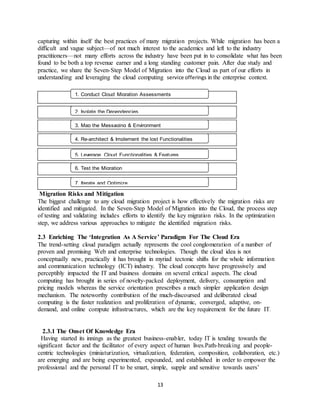
The Seven-StepModel Of Migration Into A Cloud
Typically migration initiatives into the cloud are implemented in phases or in stages. A
structured and process-oriented approach to migration into a cloud has several advantages of
13
capturing within itself the best practices of many migration projects. While migration has been a
difficult and vague subject—of not much interest to the academics and left to the industry
practitioners—not many efforts across the industry have been put in to consolidate what has been
found to be both a top revenue earner and a long standing customer pain. After due study and
practice, we share the Seven-Step Model of Migration into the Cloud as part of our efforts in
understanding and leveraging the cloud computing service offerings in the enterprise context.
Migration Risks and Mitigation
The biggest challenge to any cloud migration project is how effectively the migration risks are
identified and mitigated. In the Seven-Step Model of Migration into the Cloud, the process step
of testing and validating includes efforts to identify the key migration risks. In the optimization
step, we address various approaches to mitigate the identified migration risks.
2.3 Enriching The ‘Integration As A Service’ Paradigm For The Cloud Era
The trend-setting cloud paradigm actually represents the cool conglomeration of a number of
proven and promising Web and enterprise technologies. Though the cloud idea is not
conceptually new, practically it has brought in myriad tectonic shifts for the whole information
and communication technology (ICT) industry. The cloud concepts have progressively and
perceptibly impacted the IT and business domains on several critical aspects. The cloud
computing has brought in series of novelty-packed deployment, delivery, consumption and
pricing models whereas the service orientation prescribes a much simpler application design
mechanism. The noteworthy contribution of the much-discoursed and deliberated cloud
computing is the faster realization and proliferation of dynamic, converged, adaptive, on-
demand, and online compute infrastructures, which are the key requirement for the future IT.
2.3.1 The Onset Of Knowledge Era
Having started its innings as the greatest business-enabler, today IT is tending towards the
significant factor and the facilitator of every aspect of human lives.Path-breaking and people-
centric technologies (miniaturization, virtualization, federation, composition, collaboration, etc.)
are emerging and are being experimented, expounded, and established in order to empower the
professional and the personal IT to be smart, simple, supple and sensitive towards users’
1. Conduct Cloud Migration Assessments
2. Isolate the Dependencies
3. Map the Messaging & Environment
4. Re-architect & Implement the lost Functionalities
5. Leverage Cloud Functionalities & Features
6. Test the Migration
7. Iterate and Optimize
14
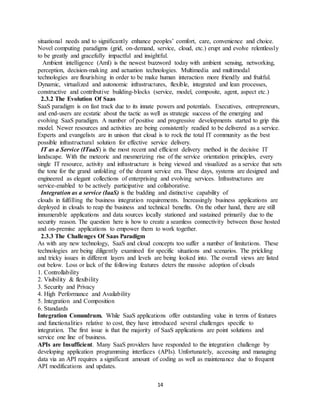
situational needs and to significantly enhance peoples’ comfort, care, convenience and choice.
Novel computing paradigms (grid, on-demand, service, cloud, etc.) erupt and evolve relentlessly
to be greatly and gracefully impactful and insightful.
Ambient intelligence (AmI) is the newest buzzword today with ambient sensing, networking,
perception, decision-making and actuation technologies. Multimedia and multimodal
technologies are flourishing in order to be make human interaction more friendly and fruitful.
Dynamic, virtualized and autonomic infrastructures, flexible, integrated and lean processes,
constructive and contributive building-blocks (service, model, composite, agent, aspect etc.)
2.3.2 The Evolution Of Saas
SaaS paradigm is on fast track due to its innate powers and potentials. Executives, entrepreneurs,
and end-users are ecstatic about the tactic as well as strategic success of the emerging and
evolving SaaS paradigm. A number of positive and progressive developments started to grip this
model. Newer resources and activities are being consistently readied to be delivered as a service.
Experts and evangelists are in unison that cloud is to rock the total IT community as the best
possible infrastructural solution for effective service delivery.
IT as a Service (ITaaS) is the most recent and efficient delivery method in the decisive IT
landscape. With the meteoric and mesmerizing rise of the service orientation principles, every
single IT resource, activity and infrastructure is being viewed and visualized as a service that sets
the tone for the grand unfolding of the dreamt service era. These days, systems are designed and
engineered as elegant collections of enterprising and evolving services. Infrastructures are
service-enabled to be actively participative and collaborative.
Integration as a service (IaaS) is the budding and distinctive capability of
clouds in fulfilling the business integration requirements. Increasingly business applications are
deployed in clouds to reap the business and technical benefits. On the other hand, there are still
innumerable applications and data sources locally stationed and sustained primarily due to the
security reason. The question here is how to create a seamless connectivity between those hosted
and on-premise applications to empower them to work together.
2.3.3 The Challenges Of Saas Paradigm
As with any new technology, SaaS and cloud concepts too suffer a number of limitations. These
technologies are being diligently examined for specific situations and scenarios. The prickling
and tricky issues in different layers and levels are being looked into. The overall views are listed
out below. Loss or lack of the following features deters the massive adoption of clouds
1. Controllability
2. Visibility & flexibility
3. Security and Privacy
4. High Performance and Availability
5. Integration and Composition
6. Standards
Integration Conundrum. While SaaS applications offer outstanding value in terms of features
and functionalities relative to cost, they have introduced several challenges specific to
integration. The first issue is that the majority of SaaS applications are point solutions and
service one line of business.
APIs are Insufficient. Many SaaS providers have responded to the integration challenge by
developing application programming interfaces (APIs). Unfortunately, accessing and managing
data via an API requires a significant amount of coding as well as maintenance due to frequent
API modifications and updates.
15
Data Transmission Security. SaaS providers go to great length to ensure that customer data is
secure within the hosted environment. However, the need to transfer data from on-premise
systems or applications behind the firewall with SaaS applications hosted outside of the client’s
data center poses new challenges that need to be addressed by the integration solution of choice.
It is critical that the integration solution is able to synchronize data bi-directionally from SaaS to
on-premise without opening the firewall.
The Impacts of Clouds. On the infrastructural front, in the recent past, the clouds have arrived
onto the scene powerfully and have extended the horizon and the boundary of business
applications, events and data. That is, business applications, development platforms etc. are
getting moved to elastic, online and on-demand cloud infrastructures. Precisely speaking,
increasingly for business, technical, financial and green reasons, applications and services are
being readied and relocated to highly scalable and available clouds.
2.3.4 Approaching The Saas Integration Enigma
Integration as a Service (IaaS) is all about the migration of the functionality of
a typical enterprise application integration (EAI) hub / enterprise service bus
(ESB) into the cloud for providing for smooth data transport between any
enterprise and SaaS applications. Users subscribe to IaaS as they would do for any other SaaS
application. Due to varying integration requirements and scenarios,
there are a number of middleware technologies and products such as JMScompliant
message queues and integration backbones such as EAI, ESB, EII,
EDB, CEP, etc.
As SaaS are being deposited in cloud infrastructures vigorously, we need to
ponder about the obstructions being imposed by clouds and prescribe proven
solutions. If we face difficulty with local integration, then the cloud integration
is bound to be more complicated. The most probable reasons are
 New integration scenarios
 Access to the cloud may be limited
 Dynamic resources
 Performance
Limited Access. Access to cloud resources (SaaS, PaaS, and the infrastructures) is more limited
than local applications. Accessing local applications is quite simple and faster. Imbedding
integration points in local as well as custom applications is easier. Even with the commercial
applications, it is always possible to slip in database-triggers to raise events and provide hooks
for integration access.
Dynamic Resources. Cloud resources are virtualized and service-oriented. That is, everything is
expressed and exposed as a service. Due to the dynamism factor that is sweeping the whole
could ecosystem, application versioning and infrastructural changes are liable for dynamic
changes. These would clearly impact the integration model.
Performance. Clouds support application scalability and resource elasticity. However the
network distances between elements in the cloud are no longer under our control.
2.3.5 New Integration Scenarios
Before the cloud model, we had to stitch and tie local systems together. With the shift to a cloud
model is on the anvil, we now have to connect local applications to the cloud, and we also have
to connect cloud applications to each other, which add new permutations to the complex
integration channel matrix. It is unlikely that everything will move to a cloud model all at once,
so even the simplest scenarios require some form of local / remote integration.
16
Cloud Integration Scenarios. We have identified three major integration scenarios as discussed
below.
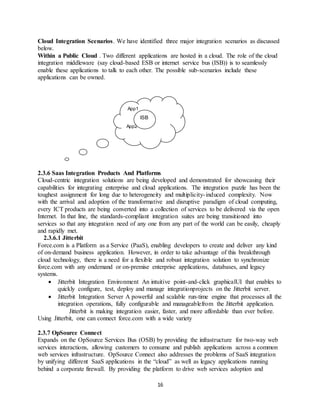
Within a Public Cloud . Two different applications are hosted in a cloud. The role of the cloud
integration middleware (say cloud-based ESB or internet service bus (ISB)) is to seamlessly
enable these applications to talk to each other. The possible sub-scenarios include these
applications can be owned.
2.3.6 Saas Integration Products And Platforms
Cloud-centric integration solutions are being developed and demonstrated for showcasing their
capabilities for integrating enterprise and cloud applications. The integration puzzle has been the
toughest assignment for long due to heterogeneity and multiplicity-induced complexity. Now
with the arrival and adoption of the transformative and disruptive paradigm of cloud computing,
every ICT products are being converted into a collection of services to be delivered via the open
Internet. In that line, the standards-compliant integration suites are being transitioned into
services so that any integration need of any one from any part of the world can be easily, cheaply
and rapidly met.
2.3.6.1 Jitterbit
Force.com is a Platform as a Service (PaaS), enabling developers to create and deliver any kind
of on-demand business application. However, in order to take advantage of this breakthrough
cloud technology, there is a need for a flexible and robust integration solution to synchronize
force.com with any ondemand or on-premise enterprise applications, databases, and legacy
systems.
 Jitterbit Integration Environment An intuitive point-and-click graphicalUI that enables to
quickly configure, test, deploy and manage integrationprojects on the Jitterbit server.
 Jitterbit Integration Server A powerful and scalable run-time engine that processes all the
integration operations, fully configurable and manageablefrom the Jitterbit application.
Jitterbit is making integration easier, faster, and more affordable than ever before.
Using Jitterbit, one can connect force.com with a wide variety
2.3.7 OpSource Connect
Expands on the OpSource Services Bus (OSB) by providing the infrastructure for two-way web
services interactions, allowing customers to consume and publish applications across a common
web services infrastructure. OpSource Connect also addresses the problems of SaaS integration
by unifying different SaaS applications in the “cloud” as well as legacy applications running
behind a corporate firewall. By providing the platform to drive web services adoption and
App1
App2
ISB
17
integration, OpSource helps its customers grow their SaaS application and increase customer
retention.
The Platform Architecture. OpSource Connect is made up of key features
including
 OpSource Services Bus
 OpSource Service Connectors
 OpSource Connect Certified Integrator Program
 OpSource Connect ServiceXchange
 OpSource Web Services Enablement Program.
2.3.8. SnapLogic
SnapLogic is a capable, clean, and uncluttered solution for data integration that can be deployed
in enterprise as well as in cloud landscapes. The free community edition can be used for the most
common point-to-point data integration tasks, giving a huge productivity boost beyond custom
code. SnapLogic professional edition is a seamless upgrade that extends the power of this
solution with production management, increased capacity, and multi-user features at a price that
won’t drain the budget, which is getting shrunk due to the economic slump across the globe.
 Changing data sources. SaaS and on-premise applications, Web APIs, and
RSS feeds
 Changing deployment options. On-premise, hosted, private and public
cloud platforms
 Changing delivery needs. Databases, files, and data services
2.4 The Enterprise Cloud Computing Paradigm
Cloud computing is still in its early stages and constantly undergoing changes as new vendors,
offers, services appear in the cloud market. This evolution of the cloud computing model is
driven by cloud providers bringing new services to the ecosystem or revamped and efficient
exiting services primarily triggered by the ever changing requirements by the consumers.
However, cloud computing is predominantly adopted by start-ups or SMEs so far, and wide-
scale enterprise adoption of cloud computing model is still in its infancy. Enterprises are still
carefully contemplating the various usage models where cloud computing can be employed to
support their business operations.
2.4.1 Background
According to NIST [1], cloud computing is composed of five essential characteristics: on
demand self-service, broad network access, resource pooling, rapid elasticity, and measured
service. The ways in which these characteristics are manifested in an enterprise context vary
according to the deployment model employed.
Relevant Deployment Models for Enterprise Cloud Computing
There are some general cloud deployment models that are accepted by the majority of cloud
stakeholders today, as suggested by the references and and discussed in the following:
 Public clouds are provided by a designated service provider for general public under a
utility based pay-per-use consumption model. The cloud resources are hosted generally
on the service provider’s premises. Popular examples of public clouds are Amazon’s
AWS (EC2, S3 etc.), Rackspace Cloud Suite, and Microsoft’s Azure Service Platform.
 Private clouds are built, operated, and managed by an organization for its internal use
only to support its business operations exclusively. Public, private, and government
18
organizations worldwide are adopting this model to exploit the cloud benefits like
flexibility, cost reduction, agility and so on.
 Virtual private clouds are a derivative of the private cloud deployment model but are
further characterized by an isolated and secure segment of resources, created as an
overlay on top of public cloud infrastructure using advanced network virtualization
capabilities. Some of the public cloud vendors that offer this capability include Amazon
Virtual Private Cloud, OpSource Cloud, and Skytap Virtual Lab .
 Community clouds are shared by several organizations and support a specific
community that has shared concerns (e.g., mission, security requirements, policy, and
compliance considerations). They may be managed by the organizations or a third party
and may exist on premise or off premise . One example of this is OpenCirrus [6] formed
by HP, Intel, Yahoo, and others.
 Managed clouds arise when the physical infrastructure is owned by and/or physically
located in the organization’s data centers with an extension of management and security
control plane controlled by the managed service provider . This deployment model isn’t
widely agreed upon, however, some vendors like ENKI and NaviSite’s NaviCloud offers
claim to be managed cloud offerings.
 Hybrid clouds are a composition of two or more clouds (private, community, or public)
that remain unique entities but are bound together by standardized or proprietary
technology that enables data and application
Adoption and Consumption Strategies
The selection of strategies for enterprise cloud computing is critical for IT
capability as well as for the earnings and costs the organization experiences,
motivating efforts toward convergence of business strategies and IT. Some
critical questions toward this convergence in the enterprise cloud paradigm are
as follows:
 Will an enterprise cloud strategy increase overall business value?
 Are the effort and risks associated with transitioning to an enterprise
cloud strategy worth it?
 Which areas of business and IT capability should be considered for the
enterprise cloud?
 Which cloud offerings are relevant for the purposes of an organization?
 How can the process of transitioning to an enterprise cloud strategy be
piloted and systematically executed?
19
1. Scalability-Driven Strategy. The objective is to support increasing workloads of the
organization without investment and expenses exceeding returns. The conditions are that the
effort, costs (CAPEX and OPEX) and time involved in accessing and installing IT capability on
a CDC are less than going through a standard hardware and software procurement and licensing
process.
2. Availability-Driven Strategy. Availability has close relations to scalability but is more
concerned with the assurance that IT capabilities and functions are accessible, usable and
acceptable by the standards of users. This is hence the objective of this basic enterprise cloud
strategy.
3. Market-Driven Strategy. This strategy is more attractive and viable for small, agile
organizations that do not have (or wish to have) massive investments in their IT infrastructure.
The objective here is to identify and acquire the “best deals” for IT capabilities as demand and
supply change, enabling ongoing reductions in OPEX and CAPEX.
4. Convenience-Driven Strategy. The objective is to reduce the load and need for dedicated
system administrators and to make access to IT capabilities by users easier, regardless of their
location and connectivity (e.g. over the Internet). The expectation is that the cost of obtaining IT
capabilities from a CDC and making them accessible to users is significantly lower than the cost
of having a dedicated administrator.
1. Software Provision. This strategy is relevant when the elasticity requirement is high for
software and low for data, the controllability concerns are low for software and high for data, and
the cost reduction concerns for software are high, while cost reduction is not a priority for data,
given the high controllability concerns for data, that is, data are highly sensitive.
2. Storage Provision. This strategy is relevant when the elasticity requirements
is high for data and low for software, while the controllability of software is more critical than
for data. This can be the case for data intensive applications, where the results from processing in
the application are more critical and sensitive than the data itself.
3. Solution Provision. This strategy is relevant when the elasticity and cost reduction
requirements are high for software and data, but the controllability requirements can be entrusted
to the CDC. It is not the case that controllability is an insignificant requirement; it is rather the
20
case that the organization trusts the CDC sufficiently to manage access and usage control of its
software and data.
4. Redundancy Services. This strategy can be considered as a hybrid enterprise cloud strategy,
where the organization switches between traditional, software, storage or solution management
based on changes in its operational conditions and business demands. The trade-offs between
controllability and cost reduction will therefore vary based on changes in load experienced by the
organization.
2.4.2 ISSUES FOR ENTERPRISE APPLICATIONS ON THE CLOUD
Enterprise Resource Planning (ERP) is the most comprehensive definition of enterprise
application today. The purpose of ERP solutions is to equip enterprises with a tool to optimize
their underlying business processes with a seamless, integrated information flow from suppliers
through to manufacturing and distribution and the ability to effectively plan and control all
resources necessary in the face of growing consumer demands, globalization and competition .
Considering Transactional and Analytical Capabilities
Transactional type of applications or so-called OLTP (On-line Transaction Processing)
applications, refer to a class of systems that manage transactionoriented applications, typically
using relational databases. These applications rely on strong ACID (atomicity, consistency,
isolation, durability) properties
2.4.3 Transition Challenges
The very concept of cloud represents a leap from traditional approach for IT to deliver mission
critical services. With any leap comes the gap of risk and challenges to overcome. These
challenges can be classified in five different categories, which are the five aspects of the
enterprise cloud stages: build, develop, migrate, run, and consume
At the moment, the private and hybrid models appear as most relevant for comprehensive ERP
transitioning and will hence be considered in this discussion of challenges. The first immediate
challenge facing organizations, embarking on this transition, is the understanding of the state of
their own IT assets and what is already, can, and cannot be sublimed (the process of transitioning
from physical to less visible vapor). Based on the information gathered by this audit they need to
evaluate what can be salvaged from the existing infrastructure and how high in the cloud stack
they should venture.
2.4.4 Enterprise Cloud Technology And Market Evolution
This section discusses the potential factors which will influence this evolution of cloud
computing and today’s enterprise landscapes to the enterprise computing paradigm, featuring the
convergence of business and IT and an open, service
Unit-III
Infrastructure As A Service & Platform And Software As A Service (Paas/Iaas)
3.1 Virtual Machines Provisioning And Migration Services
Cloud computing is an emerging research infrastructure that builds on the achievements of
different research areas, such as service-oriented architecture (SOA), grid computing, and
virtualization technology. It offers infrastructure as a service that is based on pay-as-you-use and
on-demand computing models to the end users (exactly the same as a public utility service like
electricity, water, gas, etc.). This service is referred to as Infrastructure as a Service (IaaS). To
provide this cloud computing service, the provisioning of the cloud infrastructure in data centers
is a prerequisite. However, the provisioning for systems and applications on a large number of
21
physical machines is traditionally a time consuming process with low assurance on deployment’s
time and cost.
3.1.1 Background And RelatedWork
In this section, we will have a quick look at previous work, give an overview about virtualization
technology, public cloud, private cloud, standardization efforts, high availability through the
migration, and provisioning of virtual machines, and shed some lights on distributed
management’s tools.
3.1.1.1 Virtualization Technology Overview
Virtualization has revolutionized data center’s technology through a set of techniques and tools
that facilitate the providing and management of the dynamic data center’s infrastructure. It has
become an essential and enabling technology of cloud computing environments. Virtualization
can be defined as the abstraction of the four computing resources (storage, processing power,
memory, and network or I/O). It is conceptually similar to emulation, where a system pretends to
be another system, whereas virtualization is a system pretending to be two or more of the same
system
3.1.1.2 Public Cloud and Infrastructure Services
Public cloud or external cloud describes cloud computing in a traditional mainstream sense,
whereby resources are dynamically provisioned via publicly accessible Web applications/Web
services (SOAP or RESTful interfaces)from an off-site third-party provider, who shares
resources and bills on a fine-grained utility computing basis [3], the user pays only for the
capacity of the provisioned resources at a particular time.
3.1.1.3 Private Cloud and Infrastructure Services
A private cloud aims at providing public cloud functionality, but on private resources, while
maintaining control over an organization’s data and resources to meet security and governance’s
requirements in an organization. Private cloud exhibits a highly virtualized cloud data center
Virtual Machine Virtual Machine
Virtual Machine
Virtual Machine Virtual Machine
Virtualization Layer (VMM or Hypervisor)
Physical Server Layer
Workload
1
Workload
2
Workload
3
Workload
n
Guest OS Guest OS Guest OS Guest OS
22
located inside your organization’s firewall. It may also be a private space dedicated for your
company within a cloud vendor’s data center designed to handle the organization’s workloads.
3.1.1.4 Distributed Management of Virtualization
Virtualization’s benefits bring their own challenges and complexities presented in the need for a
powerful management capabilities. That is why many commercial, open source products and
research projects such as Open Nebul, IBM Virtualization Manager, Joyent, and VMware DRS
are being developed to dynamically provision virtual machines, utilizing the physical
infrastrcture.
3.1.1.5 High Availability
High availability is a system design protocol and an associated implementation that ensures a
certain absolute degree of operational continuity during a given measurement period.
Availability refers to the ability of a user’s community to access the system whether for
submiting new work, updating or altering existing work, or collecting the results of the previous
work. If a user cannot access the system, it is said to be unavailable .
3.1.1.6 Cloud and Virtualization Standardization Efforts
Standardization is important to ensure interoperability between virtualization mangement
vendors, the virtual machines produced by each one of them, and cloud computing. Here, we will
have look at the prevalent standards that make cloud computing and virtualization possible. In
the past few years, virtualization standardization efforts led by the Distributed Management Task
Force (DMTF) have produced standards for almost all the aspects of virtualization technology.
3.1.1.7 OCCI and OGF
Another standardization effort has been initiated by Open Grid Forum (OGF) through organizing
an official new working group to deliver a standard API for cloud IaaS, the Open Cloud
Computing Interface Working Group (OCCIWG). This group is dedicated for delivering an API
specification for the remote management of cloud computing’s infrastructure and for allowing
the development of interoperable tools for common tasks including deployment, autonomic
scaling, and monitoring.
3.1.1.8 Virtual Machines Provisioning And Manageability
In this section, we will have an overview on the typical life cycle of VM and its major possible
states of operation, which make the management and automation of VMs in virtual and cloud
environments easier than in traditional computing environments.
3.1.1.8.1 VM Provisioning Process
Provisioning a virtual machine or server can be explained and illustrated as in Steps to Provision
VM. Here, we describe the common and normal steps of provisioning a virtual server:
 Firstly, you need to select a server from a pool of available servers (physical servers with
enough capacity) along with the appropriate OS template you need to provision the
virtual machine.
 Secondly, you need to load the appropriate software (operating system you selected in
the previous step, device drivers, middleware, and the needed applications for the service
required).
 Thirdly, you need to customize and configure the machine (e.g., IP address, Gateway) to
configure an associated network and storage resources.
 Finally, the virtual server is ready to start with its newly loaded software.
3.1.2 Virtual Machine Migration Services
Migration service, in the context of virtual machines, is the process of moving a virtual machine
from one host server or storage location to another; there are different techniques of VM
23
migration, hot/life migration, cold/regular migration, and live storage migration of a virtual
machine [20]. In this process, all key machines’ components, such as CPU, storage disks,
networking, and memory, are completely virtualized, thereby facilitating the entire state of a
virtual machine to be captured by a set of easily moved data files. We will cover some of the
migration’s techniques that most virtualization tools provide as a feature.
Migrations Techniques
Live Migration and High Availability. Live migration (which is also called hot or real-time
migration) can be defined as the movement of a virtual machine from one physical host to
another while being powered on. When it is properly carried out, this process takes place without
any noticeable effect from the end user’s point of view (a matter of milliseconds). One of the
most significant advantages of live migration is the fact that it facilitates proactive maintenance
in case of failure, because the potential problem can be resolved before the disruption of service
occurs.
Live Migration Anatomy, Xen Hypervisor Algorithm. In this section we will explain live
migration’s mechanism and how memory and virtual machine states are being transferred,
through the network, from one host A to another host B the Xen hypervisor is an example for
this mechanism.
3.1.3 Vm Provisioning And Migration In Action
Now, it is time to get into business with a real example of how we can manage the life cycle,
provision, and migrate a virtual machine by the help of one of the open source frameworks used
to manage virtualized infrastructure. Here, we will use ConVirt (open source framework for the
management of open source virtualization like Xen and KVM , known previously as XenMan).
Deployment Scenario. ConVirt deployment consists of at least one ConVirt workstation, where
ConVirt is installed and ran, which provides the main console for managing the VM life cycle,
managing images, provisioning new VMs, monitoring machine resources, and so on. There are
two essential deployment scenarios for ConVirt: A, basic configuration in which the Xen or
KVM virtualization platform is on the local machine, where ConVirt is already installed; B, an
advanced configuration in which the Xen or KVM is on one or more remote servers. The
scenario in use here is the advanced one.
24
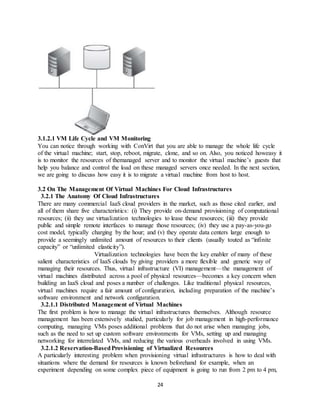
3.1.2.1 VM Life Cycle and VM Monitoring
You can notice through working with ConVirt that you are able to manage the whole life cycle
of the virtual machine; start, stop, reboot, migrate, clone, and so on. Also, you noticed howeasy it
is to monitor the resources of themanaged server and to monitor the virtual machine’s guests that
help you balance and control the load on these managed servers once needed. In the next section,
we are going to discuss how easy it is to migrate a virtual machine from host to host.
3.2 On The Management Of Virtual Machines For Cloud Infrastructures
3.2.1 The Anatomy Of Cloud Infrastructures
There are many commercial IaaS cloud providers in the market, such as those cited earlier, and
all of them share five characteristics: (i) They provide on-demand provisioning of computational
resources; (ii) they use virtualization technologies to lease these resources; (iii) they provide
public and simple remote interfaces to manage those resources; (iv) they use a pay-as-you-go
cost model, typically charging by the hour; and (v) they operate data centers large enough to
provide a seemingly unlimited amount of resources to their clients (usually touted as “infinite
capacity” or “unlimited elasticity”).
Virtualization technologies have been the key enabler of many of these
salient characteristics of IaaS clouds by giving providers a more flexible and generic way of
managing their resources. Thus, virtual infrastructure (VI) management—the management of
virtual machines distributed across a pool of physical resources—becomes a key concern when
building an IaaS cloud and poses a number of challenges. Like traditional physical resources,
virtual machines require a fair amount of configuration, including preparation of the machine’s
software environment and network configuration.
3.2.1.1 Distributed Management of Virtual Machines
The first problem is how to manage the virtual infrastructures themselves. Although resource
management has been extensively studied, particularly for job management in high-performance
computing, managing VMs poses additional problems that do not arise when managing jobs,
such as the need to set up custom software environments for VMs, setting up and managing
networking for interrelated VMs, and reducing the various overheads involved in using VMs.
3.2.1.2 Reservation-BasedProvisioning of Virtualized Resources
A particularly interesting problem when provisioning virtual infrastructures is how to deal with
situations where the demand for resources is known beforehand for example, when an
experiment depending on some complex piece of equipment is going to run from 2 pm to 4 pm,
25
and computational resources must be available at exactly that time to process the data produced
by the equipment. Commercial cloud providers, such as Amazon, have enough resources to
provide the illusion of infinite capacity, which means that this situation is simply resolved by
requesting the resources exactly when needed; if capacity is “infinite,” then there will be
resources available at 2 pm.
3.2.1.3 Provisioning to Meet SLA Commitments
IaaS clouds can be used to deploy services that will be consumed by users other than the one that
deployed the services. For example, a company might depend on an IaaS cloud provider to
deploy three-tier applications (Web front-end, application server, and database server) for its
customers. In this case, there is a distinction between the cloud consumer (i.e., the service owner;
in this case, the company that develops and manages the applications) and the end users of the
resources provisioned on the cloud (i.e., the service user; in this case, the users that access the
applications).
3.2.2 Distributed Management Of Virtual Infrastructures
Managing VMs in a pool of distributed physical resources is a key concern in
IaaS clouds, requiring the use of a virtual infrastructure manager. To address
some of the shortcomings in existing VI solutions, we have developed the open
source OpenNebula1 virtual infrastructure engine. OpenNebula is capable of
managing groups of interconnected VMs—with support for the Xen, KVM,
and VMWare platforms—within data centers and private clouds that involve a
large amount of virtual and physical servers.
3.2.2.1 VM Model and Life Cycle
The primary target of OpenNebula is to manage VMs. Within OpenNebula, a
VM is modeled as having the following attributes:
 A capacity in terms of memory and CPU.
 A set of NICs attached to one or more virtual networks.
 A set of disk images. In general it might be necessary to transfer some of these image
files to/from the physical machine the VM will be running in.
 A state file (optional) or recovery file that contains the memory image of a running VM
plus some hypervisor-specific information.
3.2.2.2 VM Management
OpenNebula manages a VMs life cycle by orchestrating three different management areas:
virtualization by interfacing with a physical resource’s hypervisor, such as Xen, KVM, or
VMWare, to control (e.g., boot, stop, or shutdown) the VM; image management by transferring
the VM images from an image repository to the selected resource and by creating on-the-fly
temporary images; and networking by creating local area networks (LAN) to interconnect the
VMs and tracking the MAC addresses leased in each network.
Virtualization. OpenNebula manages VMs by interfacing with the physical resource
virtualization technology (e.g., Xen or KVM) using a set of pluggable drivers that decouple the
managing process from the underlying technology. Thus, whenever the core needs to manage a
VM, it uses high-level commands such as “start VM,” “stop VM,” and so on, which are
translated by the drivers into commands that the virtual machine manager can understand.
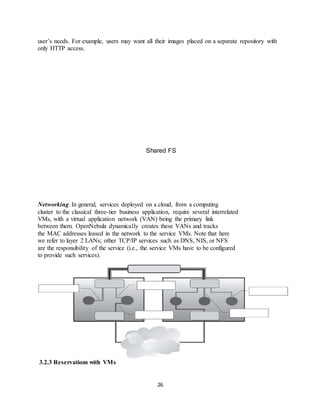
Image Management. VMs are supported by a set of virtual disks or images, which contains the
OS and any other additional software needed by the VM. OpenNebula assumes that there is an
image repository that can be any storage medium or service, local or remote, that holds the base
image of the VMs. There are a number of different possible configurations depending on the
26
user’s needs. For example, users may want all their images placed on a separate repository with
only HTTP access.
Shared FS
Networking. In general, services deployed on a cloud, from a computing
cluster to the classical three-tier business application, require several interrelated
VMs, with a virtual application network (VAN) being the primary link
between them. OpenNebula dynamically creates these VANs and tracks
the MAC addresses leased in the network to the service VMs. Note that here
we refer to layer 2 LANs; other TCP/IP services such as DNS, NIS, or NFS
are the responsibility of the service (i.e., the service VMs have to be configured
to provide such services).
3.2.3 Reservations with VMs
27
As we described earlier, virtualization technologies are a key enabler of many features found in
IaaS clouds. Virtual machines are also an appealing vehicle for implementing efficient
reservation of resources due to their ability to be suspended, potentially migrated, and resumed
without modifying any of the applications running inside the VM.
Preparation Overhead. When using VMs to implement reservations, a VM disk image must be
either prepared on-the-fly or transferred to the physical node where it is needed. Since a VM disk
image can have a size in the order of gigabytes, this preparation overhead can significantly delay
the starting time of leases.
Runtime Overhead. Once a VM is running, scheduling primitives such as checkpointing and
resuming can incur in significant overhead since a VM’s entire memory space must be saved to
disk, and then read from disk. Migration involves transferring this saved memory along with the
VM disk image. Similar to deployment overhead, this overhead can result in noticeable delays.
3.2.4 Leasing Model
We define a lease as “a negotiated and renegotiable agreement between a resource provider and a
resource consumer, where the former agrees to make a set of resources available to the latter,
based on a set of lease terms presented by the resource consumer.” The terms must encompass
the following: the hardware resources required by the resource consumer, such as CPUs,
memory, and network bandwidth; a software environment required on the leased resources; and
an availability period during which a user requests that the hardware and software resources be
available.
 Start time may be unspecified (a best-effort lease) or specified (an advance reservation
lease). In the latter case, the user may specify either a specific start time or a time period
during which the lease start may occur.
 Maximum duration refers to the total maximum amount of time that the leased resources
will be available.
 Leases can be preemptable. A preemptable lease can be safely paused without disrupting
the computation that takes place inside the lease.
3.2.5 Lease Scheduling
Haizea is designed to process lease requests and determine how those requestscan be mapped to
virtual machines, leveraging their suspend/resume/migrate capability, in such a way that the
leases’ requirements are satisfied. The scheduling component of Haizea uses classical backfilling
algorithms ,extended to allow best-effort leases to be preempted if resources have to be freed up
for advance reservation requests. Additionally, to address the preparation and runtime overheads
mentioned earlier, the scheduler allocates resources explicitly for the overhead activities (such as
transferring disk images or suspending VMs) instead of assuming they should be deducted from
the lease’s allocation.
3.3 Enhancing Cloud Computing Environments Using A Cluster As A Service
The emergence of cloud computing has caused a significant change in how IT infrastructures
are provided to research and business organizations. Instead of paying for expensive hardware
and incur excessive maintenance costs, it is now possible to rent the IT infrastructure of other
organizations for a minimal fee.
While the idea of offering resources via Web services is commonplace in cloud
computing, little attention has been paid to the clients themselves specifically, human operators.
Despite that clouds host a variety of resources which in turn are accessible to a variety of clients,
support for human users is minimal.
28
3.3.1 RelatedWork
In this section, four major clouds are examined to learn what is offered to clients in terms of
higher layer abstraction and support for users—in particular, service and resource publication,
discovery, selection, and use. While the focus of this chapter is to simplify the exposure of
clusters as Web services, it is important to learn what problems exist when attempting to expose
any form of resource via a Web service.
3.3.1.1 Amazon Elastic Compute Cloud (EC2)
An IaaS cloud, EC2 offers “elastic” access to hardware resources that EC2 clients use to create
virtual servers. Inside the virtual servers, clients either host the applications they wish to run or
host services of their own to access over the Internet.
3.3.1.2 Google App Engine
Google App Engine is a PaaS cloud that provides a complete Web service environment: All
required hardware, operating systems, and software are provided to clients. Thus, clients only
have to focus on the installation or creation of their own services, while App Engine runs the
services on Google’s servers.
3.3.1.3 Microsoft Windows Azure
Another PaaS cloud, Microsoft’s Azure allows clients to build services using developer libraries
which make use of communication, computational, and storage services in Azure and then
simply upload the completed services.
3.3.1.4 Salesforce
Salesforce is a SaaS cloud that offers customer relations management (CRM) software as a
service. Instead of maintaining hardware and software licenses, clients use the software hosted
on Salesforce servers for a minimal fee. Clients of Salesforce use the software as though it is
their own one and do not have to worry about software maintenance costs.
3.3.2 RVWS DESIGN
While Web services have simplified resource access and management, it is not possible to know
if the resource(s) behind the Web service is (are) ready for requests. Clients need to exchange
numerous messages with required Web services to learn the current activity of resources and thus
face significant overhead loss if most of the Web services prove ineffective.
3.3.2.1 Dynamic Attribute Exposure
There are two categories of dynamic attributes addressed in the RVWS framework: state and
characteristic. State attributes cover the current activity of the service and its resources, thus
indicating readiness. For example, a Web service that exposes a cluster (itself a complex
resource) would most likely have a dynamic state attribute that indicates how many nodes in the
cluster are busy and how many are idle.
3.3.2.2 Stateful WSDL Document Creation
When exposing the dynamic attributes of resources, the RVWS framework allows Web services
to expose the dynamic attributes through the WSDL documents of Web services. The Web
Service Description Language (WSDL) governs a schema that describes a Web service and a
document written in the schema. In this chapter, the term WSDL refers to the stateless WSDL
document. Stateful WSDL document refers to the WSDL document created by RVWS Web
services.
3.3.3 Publication in RVWS
While the stateful WSDL document eliminates the overhead incurred from manually learning
the attributes of the service and its resource(s), the issues behind discovering services are still
unresolved.To help ease the publication and discovery of required services with stateful WSDL
Provider Distributed
29
documents, a Dynamic Broker was proposed . The goal of the Dynamic Broker is to provide an
effective publication and discovery service based on service, resource, and provider dynamic
attributes.
3.3.4 Automatic Discovery and Selection
The automatic service discovery that takes into consideration dynamic attributes
in their WSDL documents allows service (e.g., a cluster) discovery.
When discovering services, the client submits to the Dynamic Broker three
groups of requirements service, resource, and provider.
The Dynamic Broker compares each requirement group on the related data
store . Then, after getting matches, the Broker applies filtering .
3.3.4Cluster As A Service: The Logical Design
Simplification of the use of clusters could only be achieved through higher layer abstraction that
is proposed here to be implemented using the service-based Cluster as a Service (CaaS)
Technology. The purpose of the CaaS Technology is to ease the publication, discovery,
selection, and use of existing computational clusters.
3.3.4.1 CaaS Overview
The exposure of a cluster via a Web service is intricate and comprises several services running
on top of a physical cluster. Figure 7.6 shows the complete CaaS technology.
A typical cluster is comprised of three elements: nodes, data storage, and middleware. The
middleware virtualizes the cluster into a single system image; thus resources such as the CPU
can be used without knowing the organization of the cluster.
3.3.4 Cluster Stateful WSDL Document
As stated in the purpose of the Publisher Webservice is to expose the sdynamic attributes of a
cluster via a stateful WSDL document.the resources section to be added to the WSDL of the
Publisher Web service. Inside the state and characteristic elements, an XML element for each
cluster node was created. The advantage of the XML structuring of our cluster
3.3.5 CaaS Service Design
The CaaS service can be described as having four main tasks: cluster discovery and selection,
result organization, job management, and file management. Based on these tasks, the CaaS
Service has been designed using intercommunicating modules. Each module in the CaaS Service
encapsulates one of the tasks and is able to communicate with other modules to extend its
functionality.
30
Cluster Discovery. Before a client uses a cluster, a cluster must be discovered and selected
first.the workflow on finding a required cluster. To start, clients submit cluster requirements in
the form of attribute values to the CaaS Service Interface. The requirements range from the
number of nodes in the cluster to the installed software (both operating systems and software
APIs).
Job Submission. After selecting a required cluster, all executables and data files have to be
transferred to the cluster and the job submitted to the scheduler for execution. As clusters vary
significantly in the software middleware used to create them, it can be difficult to place jobs on
the cluster. To do so requires knowing how jobs are stored and how they are queued for
execution on the cluster.
Job Monitoring. During execution, clients should be able to view the
execution progress of their jobs. Even though the cluster is not the owned by
the client, the job is. Thus, it is the right of the client to see how the job is
progressing and (if the client decides) terminate the job and remove it from the
cluster. The outlines the workflow the client takes when querying about job execution.
3.3.4 User Interface: CaaS Web Pages
The CaaS Service has to support at least two forms of client: software clients
and human operator clients. Software clients could be other software applications
or services and thus are able to communicate with the CaaS Service
Interface directly.
For human operators to use the CaaS Service, a series of Web pages has been designed. Each
page in the series covers a step in the process of discovering, selecting, and using a cluster.
3.3.5 Proof Of Concept
To demonstrate the RVWS framework and CaaS Technology, a proof of concept was performed
where an existing cluster was published, discovered, selected, and used. It was expected that the
existing cluster could be easily used all through a Web browser and without any knowledge of
the underlying middleware.
3.3.6 CaaS Technology Implementation
Dynamic Broker
Cluster Finder Result Organizer
CaaS Service Interface
Client
31
The CaaS Service was implemented using Windows Communication Foundations (WCF) of
.NET 3.5 that uses Web services. An open source library for building SSH clients in .NET
(sharpSSH) was used to build the Job and File Managers. Because schedulers are mostly
command driven, the commands and outputs were wrapped into aWeb service.
3.4 Secure Distributed Data Storage In Cloud Computing
Cloud computing has gained great attention from both industry and academia since
2007.With the goal of providing users more flexible services in a transparent manner, all services
are allocated in a “cloud” that actually is a collection of devices and resources connected through
the Internet. One of the core services provided by cloud computing is data storage.
In the past decades, data storage has been recognized as one of the main concerns of
information technology. The benefits of network-based applications have led to the transition
from server-attached storage to distributed storage. Based on the fact that data security is the
foundation of information security, a great quantity of efforts has been made in the area of
distributed storage security
One consideration is that the unique issues associated with cloud computing security have
not been recognized. Some researchers think that cloud computing security will not be much
different from existing security practices and that the security aspects can be well-managed using
existing techniques such as digital signatures, encryption, firewalls, and/or the isolation of virtual
environments, and so on. For example, SSL (Secure Sockets Layer) is a protocol that provides
reliable secure communications on the Internet for things such as Web browsing, e-mail, instant
messaging, and other data transfers.
3.4.1Cloud Storage: From Lans To Wans
Cloud computing has been viewed as the future of the IT industry. It will be a revolutionary
change in computing services. Users will be allowed to purchase CPU cycles, memory utilities,
and information storage services conveniently just like how we pay our monthly water and
electricity bills. However, this image will not become realistic until some challenges have been
addressed. In this section, we will briefly introduce the major difference brought by distributed
data storage in cloud computing environment.
3.4.1.1 Moving From LANs to WANs
Most designs of distributed storage take the form of either storage areanetworks (SANs) or
network-attached storage (NAS) on the LAN level, such as the networks of an enterprise, a
campus, or an organization. SANs are constructed on top of block-addressed storage units
connected through dedicated high-speed networks. In contrast, NAS is implemented by attaching
specialized file servers to a TCP/IP network and providing a file-based interface to client
machine .
3.4.1.1 Existing Commercial Cloud Services
Data storage services on the platform of cloud computing are fundamentally provided by
applications/software based on the Internet. Although the definition of cloud computing is not
clear yet, several pioneer commercial implementations have been constructed and opened to the
public, such as Amazon’s Computer Cloud AWS (Amazon Web service), the Microsoft Azure
Service Platform and the Google App Engine (GAE).
Amazon’s Web Service. Amazon provides Infrastructure as a Service (IaaS) with different terms,
such as Elastic Compute Cloud (EC2), SimpleDB, Simple Storage Service (S3), and so on. They
are supposed to ensure the confidentiality, integrity, and availability of the customers’
applications and data. presents one of the data processing methods adopted in Amazon’s AWS,
32
which is used to transfer large amounts of data between the AWS cloud and portable storage
devices.
Microsoft Windows Azure. The Windows Azure Platform (Azure) is an Internet-scale cloud
services platform hosted in Microsoft data centers, which provides an operating system and a set
of developer services that can be used individually or together. The platform also provides
scalable storage service. There are three basic data items: blobs (up to 50 GB), tables, and
queues. In the Azure Storage, based on the blob, table, and queue structures, Microsoft promises
to achieve confidentiality of the users’ data.
Google App Engine (GAE). The Google App Engine (GAE) provides a powerful distributed
data storage service that features a query engine and transactions. An independent third-party
auditor, who claims that GAE can be secure under the SAS70 auditing industry standard, issued
Google Apps an unqualified SAS70 Type II certification.
3.4.1.2 Vulnerabilities in Current Cloud Services
Previous subsections describe three different commercial cloud computing secure data storage
schemes. Storage services that accept a large amount of data (.1 TB) normally adopt strategies
that help make the shipment more convenient, just as the Amazon AWS does. In contrast,
services that only accept a smaller data amount (#50 GB) allow the data to be uploaded or
downloaded via the Internet, just as the Azure Storage Service does.
3.4.2 Bridge the Missing Link
This section presents several simple ideas to bridge the missing link based on
digital signatures and authentication coding schemes. According to whether there is a third
authority certified (TAC) by the user and provider and whether
the user and provider are using the secret key sharing technique (SKS), there
are four solutions to bridge the missing link of data integrity between the uploading and
downloading procedures. Actually, other digital signature technologies can be adopted to fix this
vulnerability with different approaches.
Neither TAC nor SKS.
Uploading Session
1. User: Sends data to service provider with MD5 checksum and MD5 Signature by User(MSU).
2. Service Provider: Verifies the data with MD5 checksum, if it is valid, the service provider
sends back the MD5 and MD5 Signature by Provider (MSP) to user.
3. MSU is stored at the user side, and MSP is stored at the service provider side.
Downloading Session
1. User: Sends request to service provider with authentication code.
2. Service Provider: Verifies the request identity, if it is valid, the service provider sends back the
data with MD5 checksum andMD5 Signature by Provider (MSP) to user.
3. User verifies the data using the MD5 checksum.
With TAC but without SKS.
USER1 USER2
Cloud Service
33
Uploading Session
1. User: Sends data to the service provider along with MD5 checksum and MD5 Signature by
User (MSU).
2. Service Provider: Verifies the data with MD5 checksum, if it is valid, the service provider
sends back the MD5 checksum and MD5 Signature by Provider (MSP) to the user.
3. MSU and MSP are sent to TAC.
Downloading Session
1. User: Sends request to the service provider with authentication code.
2. Service Provider: Verifies the request with identity, if it is valid, the service provider sends
back the data with MD5 checksum.
3. User verifies the data through the MD5 checksum.
With Both TAC and SKS.
Uploading Session
1. User: Sends data to the service provider with MD5 checksum.
2. Service Provider: verifies the data with MD5 checksum.
3. Both the user and the service provider send MD5 checksum to TAC.
4. TAC verifies the two MD5 checksum values. If they match, the TAC distributes MD5 to the
user and the service provider by SKS.
Downloading Session
1. User: Sends request to the service provider with authentication code.
2. Service Provider: Verifies the request identity, if it is valid, the service provider sends back the
data with MD5 checksum.
3. User verifies the data through the MD5 checksum.
3.4.3 Technologies For Data Security In Cloud Computing
This section presents several technologies for data security and privacy in cloud
computing. Focusing on the unique issues of the cloud data storage platform,
this section does not repeat the normal approaches that provide confidentiality,
integrity, and availability in distributed data storage applications. Instead, we
select to illustrate the unique requirements for cloud computing data security
from a few different perspectives:
 Database Outsourcing and Query Integrity Assurance. Researchers have pointed out that
storing data into and fetching data from devices and machines behind a cloud are
essentially a novel form of database outsourcing.
 Data Integrity in Untrustworthy Storage. One of the main challenges that prevent end
users from adopting cloud storage services is the fear of losing data or data corruption. It
is critical to relieve the users’ fear by providing technologies that enable users to check
the integrity of their data.
 Web-Application-Based Security. Once the dataset is stored remotely, a Web browser is
one of the most convenient approaches that end users can use to access their data on
remote services. In the era of cloud computing,Web security plays a more important role
than ever.
 Multimedia Data Security. With the development of high-speed network technologies
and large bandwidth connections, more and more multimedia data are being stored and
34
shared in cyber space. The security requirements for video, audio, pictures, or images are
different from other applications.
3.4.3.1Database Outsourcing and Query Integrity Assurance
database outsourcing has become an important component of cloud computing. Due to the rapid
advancements in network technology, the cost of transmitting a terabyte of data over long
distances has decreased significantly in the past decade. In addition, the total cost of data
management is five to ten times higher than the initial acquisition costs. As a result, there is a
growing interest in outsourcing database management tasks to third parties that can provide these
tasks for a much lower cost due to the economy of scale. This new outsourcing model has the
benefits of reducing the costs for running Database Management Systems (DBMS)
independently and enabling enterprises to concentrate on their main businesses.
queryRewrite(Q)
dataTransform(T)
Query Results
Clients Service Provider Database
Owner
3.4.3.2Data Integrity in Untrustworthy Storage
While the transparent cloud provides flexible utility of network-based resources, the fear of loss
of control on their data is one of the major concerns that prevent end users from migrating to
cloud storage services. Actually it is a potential risk that the storage infrastructure providers
become self-interested, untrustworthy, or even malicious. Actually, before the term “cloud
computing” appears as an IT term, there are several remote data storage checking protocols that
have been suggested .
3.4.3.3 Web-Application-Based Security
In cloud computing environments, resources are provided as a service over the Internet in a
dynamic, virtualized, and scalable way. Through cloud computing services, users access business
applications on-line from a Web browser, while the software and data are stored on the servers.
Therefore, in the era of cloud computing, Web security plays a more important role than ever.
The Web site server is the first gate that guards the vast cloud resources. Since the cloud may
operate continuously to process millions of dollars’ worth of daily on-line transactions, the
impact of any Web security vulnerability will be amplified at the level of the whole cloud.
Authentication. Authentication is the process of verifying a claim that a subject made to act on
behalf of a given principal. Authentication attacks target a Web site’s method of validating the
identity of a user, service, or application, including Brute Force, Insufficient Authentication, and
Weak Password Recovery Validation. Brute Force attack employs an automated process to guess
a person’s username and password by trial and error. In the Insufficient Authentication case,
some sensitive content or functionality are protected by “hiding” the specific location in obscure
string but still remains accessible directly through a specific URL. The attacker could discover
those URLs through a Brute Force probing of files and directories. Many Web sites provide
password recovery service.
PLATFORM AND SOFTWARE AS A SERVICE (PAAS/IAAS)
DB
35
3.5 Aneka
This model of making IT resources available, known as Cloud Computing , opens new
opportunities to small, medium-sized, and large companies. It is not necessary anymore to bear
considerable costs for maintaining the IT infrastructures or to plan for peak demand. Instead,
infrastructure and applications can scale elastically according to the business needs at a
reasonable price. The possibility of instantly reacting to the demandof customers without long-
term planning is one of the most appealing features of cloud computing, and it has been a key
factor in making this trend popular among technology and business practitioners. Private clouds
are virtual distributed systems that rely on a private infrastructure and provide internal users
with dynamic provisioning of computing resources. Differently from public clouds, instead of a
pay-as-you-go model, there could be other schemes in place, which take into account the usage
of the cloud and proportionally bill the different departments or sections of the enterprise.
3.5.1 Technologies And Tools For Cloud Computing
Cloud computing covers the entire computing stack from hardware infrastructure to end-user
software applications. Hence, there are heterogeneous offerings addressing different niches of
the market. In this section we will concentrate mostly on the Infrastructure as a Service (IaaS)
and Platform as a Service (PaaS) implementations of the cloud computing model by first
presenting a subset of the most representative commercial solutions and then discussing the few
research projects and platforms, which attracted considerable attention.
3.5.2Aneka Cloud Platform
Aneka is a software platform and a framework for developing distributed applications on the
cloud. It harnesses the computing resources of a heterogeneous network of workstations and
servers or data centers on demand. Aneka provides developers with a rich set of APIs for
transparently exploiting these resources by expressing the application logic with a variety of
programming abstractions. System administrators can leverage a collection of tools to monitor
and control the deployed infrastructure. This can be a public cloud available to anyone through
the Internet, a private cloud constituted by a set of nodes with restricted access within an
enterprise, or a hybrid cloud where external resources are integrated on demand, thus allowing
applications to scale.
36
3.5.3 Aneka Resource Provisioning Service
The most significant benefit of cloud computing is the elasticity of resources, services, and
applications, which is the ability to automatically scale out based on demand and users’ quality
of service requests. Aneka as a PaaS not only features multiple programming models allowing
developers to easily build their distributed applications, but also provides resource provisioning
facilities in a seamless and dynamic fashion.
Resource Provisioning Scenario
A private enterprise maintains a private cloud,which consists of (a) five physical dedicated
desktops from its engineering department and (b) a small data center managed by Xen
Hypervisor providing virtual machines with the maximum capacity of 12 VMs. In most of the
cases, this setting is able to address the computing needs of the enterprise. In the case of peak
37
computing demand, additional resources can be provisioned by leveraging the virtual public
infrastructure. For example, a mission critical application could require at least 30 resources to
complete within an hour, and the customer is willing to spend a maximum of 5 dollars to achieve
this goal.
3.5.4 Hybrid Cloud Implementation
Currently, there is no widely accepted standard for provisioning virtual infrastructure from
Infrastructure as a Service (IaaS) providers, but each provider exposes its own interfaces and
protocols. Hence, it is not possible to seamlessly integrate different providers into one single
infrastructure. The resource provisioning service implemented in Aneka addresses these issues
and abstracts away the differences of providers’ implementation.
In this section we will briefly review what the desired features of a hybrid cloud implementation
are and then we will give a closer a look at the solution implemented in Aneka together with a
practical application of the infrastructure developed.
Aneka Hybrid Cloud Architecture
The Resource Provisioning Framework represents the foundation on top of which Aneka-based
hybrid clouds are implemented. In this section we will introduce the components that compose
this framework and briefly describe their interactions.
The resource provisioning infrastructure is represented by a collection of resource pools that
provide access to resource providers, whether they are external or internal, and managed
uniformly through a specific component called a resource pool manager.
3.5.6 Visionary Thoughts For Practitioners
The research on the integration of public and private clouds is still at its early stage. Even though
the adoption of cloud computing technologies is still growing, delivering IT services via the
cloud will be the norm in future. The key areas of interest that need to be explored include
security standardization; pricing models; and management and scheduling policies for
heterogeneous environments. At the time of writing, only limited research has been carried out in
these fields.
security is one of the major
concerns in hybrid clouds. While private clouds significantly reduce the security
risks concerned by retaining sensitive information within corporate boundaries,
in the case of hybrid clouds the workload that is delegated to the public portion
of the infrastructure is subject to the same security risks that are prevalent in
public clouds.
38
3.6 Comet cloud
Clouds typically have highly dynamic demands for resources with highly heterogeneous and
dynamic workloads. For example, the workloads associated with the application can be quite
dynamic, in terms of both the number of tasks processed and the computation requirements of
each task. Furthermore, different applications may have very different and dynamic quality of
service (QoS) requirements; for example, one application may require high throughput while
another may be constrained by a budget, and a third may have to balance both throughput and
budget. The performance of a cloud service can also vary based on these varying loads as well as
failures, network conditions, and so on, resulting in different “QoS” to the application.
3.6.1 Comet cloud Architecture
Comet Cloud is an autonomic computing engine for cloud and grid environments. It is based on
the Comet decentralized coordination substrate, and it supports highly heterogeneous and
dynamic cloud/grid infrastructures, integration of public/private clouds, and autonomic
cloudbursts. CometCloud is based on a peer-to-peer substrate that can span enterprise data
centers, grids, and clouds.Resources can be assimilated on-demand and on-the-fly into its peer-
to-peer overlay to provide services to applications.
3.6.1.1CometCloud Layered Abstractions
A schematic overview of the Comet Cloud architecture is presented . The infrastructure layer
uses the Chord self-organizing overlay and the Squid information discovery and content-based
routing substrate built on top of Chord. The routing engine supports flexible content-based
routing and complex querying using partial keywords, wildcards, or ranges. It also guarantees
that all peer nodes with data elements that match a query message will be located. Nodes
providing resources in the overlay have different roles and, accordingly, different access
privileges based on their credentials and capabilities. This layer also provides replication and
load balancing services, and it handles dynamic joins and leaves of nodes as well as node
failures.
3.6.1.2Comet Space
In Comet, a tuple is a simple XML string, where the first element is the tuple’s tag and is
followed by an ordered list of elements containing the tuple’s fields. Each field has a name
followed by its value. The tag, field names, and values must be actual data for a tuple and can
contain wildcards (“*”) for a template tuple. This lightweight format is flexible enough to
represent the information for a wide range of applications and can support rich matching
relationships. Further more, the cross-platform nature of XML makes this format
suitable for information exchange in distributed heterogeneous environments.
39
3.6.2Autonomic Behavior Of Cometcloud
3.6.2.1Autonomic Cloudbursting
The goal of autonomic cloudbursts is to seamlessly and securely integrate private enterprise
clouds and data centers with public utility clouds on-demand, to provide the abstraction of
resizable computing capacity. It enables the dynamic deployment of application components
(which typically run on internal organizational compute resources) onto a public cloud to address
dynamic workloads, spikes in demands, and other extreme requirements. Furthermore,given the
increasing application and infrastructure scales, as well as their cooling, operation, and
management costs, typical over-provisioning strategies are no longer feasible.
CometCloud considers three types of clouds based
on perceived security/trust and assigns capabilities accordingly. The first is a highly trusted,
robust, and secure cloud, usually composed of trusted/secure nodes within an enterprise, which is
typically used to host masters and other key (management, scheduling, monitoring) roles. These
nodes are also used to store states. In most applications, the privacy and integrity of critical data
must be maintained; as a result, tasks involving critical data should be limited to cloud nodes that
have required credentials.
 Load Dynamics. Application workloads can vary significantly. This includes the number
of application tasks as well the computational requirements of a task. The computational
environment must dynamically grow (or shrink) in response to these dynamics while still
maintaining strict deadlines.
 Accuracy of the Analytics. The required accuracy of risk analytics depends on a number
of highly dynamic market parameters and has a direct impact on the computational
demand—for example the number of scenarios in the Monte Carlo VaR formulation. The
computational environment must be able to dynamically adapt to satisfy the accuracy
requirements while still maintaining strict deadlines.
 Collaboration of Different Groups. Different groups can run the same application with
different dataset policies . Here, policy means user’s SLA bounded by their condition
such as time frame, budgets, and economic models. As collaboration groups join or leave
the work, the computational environment must grow or shrink to satisfy their SLA.
 Economics. Application tasks can have very heterogeneous and dynamic
priorities and must be assigned resources and scheduled accordingly.
40
3.6.2.2Autonomic Cloudbridging
Autonomic cloudbridging is meant to connect CometCloud and a virtual cloud
which consists of public cloud, data center, and grid by the dynamic needs of
the application. The clouds in the virtual cloud are heterogeneous and have
different types of resources and cost policies, besides, the performance of each
cloud can change over time by the number of current users.
 Deadline-Based. When an application needs to be completed as soon as possible,
assuming an adequate budget, the maximum required workers are allocated for the job.
 Budget-Based. When a budget is enforced on the application, the number of workers
allocated must ensure that the budget is not violated.
 Workload-Based. When the application workload changes, the number of workers
explicitly defined by the application is allocated or released.
3.6.2.3 Other Autonomic Behaviors
Fault-Tolerance. Supporting fault-tolerance during runtime is critical tokeep the application’s
deadline. We support fault-tolerance in two ways which are in the infrastructure layer and in the
programming layer. The replication substrate in the infrastructure layer provides a mechanism to
keep the same state as that of its successor’s state, specifically coordination space and overlay
information.
Load Balancing. In a cloud environment, executing application requests on underlying grid
resources consists of two key steps. The first, which we call VM Provisioning, consists of
creating VM instances to host each application request, matching the specific characteristics and
requirements of the request. The second step is mapping and scheduling these requests onto
distributed physical resources (Resource Provisioning).
3.6.3Overview Of Comet cloud-Based Applications
In this section, we describe two types of applications which are VaR for measuring the risk level
of a firm’s holdings and image registration for medical informatics. A VaR calculation should be
completed within the limited time, and the computational requirements for the calculation can
change significantly.Besides, the requirement for additional computation happens
irregularly.Hence, for VaR we will focus on how autonomic cloudbursts work for dynamically
changing workloads. Image registration is the process to determine the linear/nonlinear mapping
T between two images of the same object or similar objects that are acquired at different time, or
from different perspectives.
41
3.6.3.1Value at Risk (VaR)
Monte Carlo VaR is a very powerful measure used to judge the risk of portfolios of financial
instruments. The complexity of the VaR calculation stems from simulating portfolio returns. To
accomplish this, Monte Carlo methods are used to “guess” what the future state of the world may
look like.Guessing a large number of times allows the technique to encompass the complex
distributions and the correlations of different factors that drive portfolio returns into a discreet set
of scenarios.
3.6.3.2 Image Registration
Nonlinear image registration is the computationally expensive process to determine the mapping
T between two images of the same object or similar objects acquired at different time, in
different position or with different acquisition parameters or modalities. Both intensity/area
based and landmark based methods have been reported to be effective in handling various
registration tasks.
3.7 T-Systems
T-Systems is one of Europe’s largest ICT service providers. It offers a wide range of IT,
telecommunications, and integrated ICT services, and it boasts extensive experience in managing
complex outsourcing projects. In addition, it is a major provider of desktop and network services.
T-Systems approaches cloud computing from the viewpoint of an organization with an
established portfolio of dynamic, scalable services delivered via networks. The service provider
creates end-to-end offerings that integrate all elements, in collaboration with established
hardware and software vendors.
Cloud computing is an opportunity for T-Systems to leverage its established concept for services
delivered from data centers. Cloud computing entails the industrialization of IT production,
enabling customers to use services and resources on demand. Business, however, cannot adopt
wholesale the principles of cloud computing from the consumer world. Instead, T-Systems aligns
cloud computing with the specific requirements of large enterprises.
3.7.1 Enterprises Demand Of Cloud Computing
Whether operated in-house or by an external provider, ICT is driven by two
key factors cost pressure and market pressure. Both of these call
for increases in productivity.
3.7.1.1 Changing Markets
Today’s markets are increasingly dynamic. Products and skills rapidly become
obsolete, eroding competitiveness. So incumbents need to find and implement
new ideas at an ever faster pace. Also, new businesses are entering the market
more rapidly, and they are extending their portfolios by forging alliances with
other players.
The Internet offers the opportunity to implement new business models and integrate new
stakeholders into processes—at speeds that were previously unimaginable. One excellent
example is the automotive industry, which has brought together OEMs, suppliers, dealers, and
customers on shared Internet platforms. In line with Web 2.0 principles, customers can influence
vehicle development.
3.7.1.2 Increased Productivity
enterprise ICT and business processes are closely interwoven—so that the line between
processes and technology is becoming blurred. As a result, ICT is now a critical success factor: It
significantly influences competitiveness and value creation. The impact of fluctuations in the
42
quality of ICT services (for example, availability) is felt immediately. The nonavailability of
ERP (enterprise resource planning) and e-mail systems brings processes grinding to a halt and
makes collaboration impossible. And the resulting time-to-market delays mean serious
competitive disadvantage.
3.7.1.3Rising Cost Pressure
Globalization opens up new markets. But it also means exposure to greater competition. Prices
for goods and services are falling at the same time that the costs for power, staff, and raw
materials are rising. The financial crisis has aggravated the situation, with market growth
slowing or stagnating. To master these challenges, companies have to improve their cost
structures.
This generally means cutting costs. Staff downsizing and the divestment of loss-making units are
often the preferred options. However, replacing fixed costs with variable costs can also
contribute significantly—without resorting to sensitive measures such as layoffs. This improves
liquidity.
3.7.2 Dynamic Ict Services
Expectations differ considerably, depending on company size and industry. For example, a
pharmaceuticals multinational, a traditional midsize retailer, and a startup will all have very
different ICT requirements, particularly when it comes to certification.
However, they all face the same challenges: the need to penetrate new markets, to launch new
services, to supply sales models, or to make joint offerings with partners. This is where dynamic
ICT delivers tangible benefits.At first sight, it may seem paradoxical to claim that
standardization can create flexibility. In fact, quite the opposite: Industrialization provides the
basis for ICT services that are dynamic, fast, in line with real-world requirements,and secure and
reliable. ICT services of this kind are the foundation of a cloud that provides services on demand.
 Standardization
 Automation
 Modularization
 Integrated creation of ICT services
3.7.2.1Steps Toward Industrialized ICT
Standardization and automation greatly reduce production costs and increase the efficiency and
flexibility of ICT. However, they come at a price: There is less scope for customization. This is
something that everyone with a personal e-mail account from one of the big providers has
encountered. Services of this kind fulfill their purpose, but offer only very stripped-down
functionality and are usually free of charge.
3.7.2.2 Customization through Modularization
Modular production enables ICT to be tailored to customers’ specific requirements—in
conjunction with standardization. Modularization allows providers to pool resources as the basis
for delivering the relevant services. Modularization is essentially a set of standardized individual
modules that can be combined. The resulting combinations give rise to sophisticated applications
tailored to the needs of the specific company.
3.7.2.3 Integrated Creation of ICT Services
Each of the elements outlined above can have significant advantages. But only an integrated
approach to creating ICT services—combining standardization, automation and
modularization—can deliver the entire range of benefits. This gives the provider standardized,
automated production processes and enables the desired services to be delivered to the customer
quickly and flexibly.
43
3.7.3 Importance Of Quality And Security In Clouds
3.7.3.1 Quality (End-to-End SLAs)
Internet or ICT services are unavailable, or data access is slow, the consequences are rarely
serious. But in business, the nonavailability of aservice can have a grave knock-on effect on
entire mission-critical processes bringing production to a standstill, or preventing orders from
being processed.In such instances, quality is of the essence. The user is aware of the performance
of systems as a whole, including network connectivity. In complex software applications,
comprising multiple services and technical components, each individual element poses a
potential risk to the smooth running of processes. Cloud-service providers therefore have to offer
end-to-end availability, backed by clearly defined SLAs.
3.7.3.2Compliance and Security
Compliance and security are increasingly important for cloud-computing
providers. Security has been the subject of extensive media coverage and
debate. And surveys consistently pinpoint it as the greatest obstacle to cloud
computing.
Consumer Cloud Versus Enterprise Cloud. The Internet has given rise to new forms of
behavior, even when concluding contracts on-line. When presented with general terms and
conditions, many consumers simply check the relevant box and click “OK,” often not realizing
that they are entering into a legally binding agreement.
Cloud Computing from an Enterprise Perspective. With this in mind,businesses should insist on
comprehensive, watertight contracts that include provisions for the recovery and return of their
data, even in the event of provider bankruptcy. Moreover, they should establish the country
where servers and storage systems are located .
3.7.4 Dynamic Data Center—Producing Business-Ready,Dynamic Ict Services
3.7.4.1Flexibility Across All Modules
Agility at the infrastructure level alone is not enough to provide fast, flexible ICT services. Other
dynamic levels and layers are also required . Ultimately, what matters to the user is the flexibility
of the system or service as a whole. So service quality is determined by the slowest component.
Adaptable processing and storage resources at the computing level must be supported by agile
LAN and WAN infrastructures. Flexibility is also important when it comes to application
delivery, scalability, and extensibility via functional modules.
T-Systems’ Core Cloud Modules: Computing, Storage
Computing. The computing pool is based on server farms located in different
data centers. Logical server systems are created automatically at these farms.
The server systems comply with predefined standards. They are equipped with
the network interface cards required for communications and integration with
storage systems. No internal hard drives or direct-attached storage systems are
deployed.
Applications Are Also Virtualized. Speed is of the essence for cloud-computing
providers. Decoupling operating systems from applications plays a key role
here, because it reduces both initial and subsequent application-provisioning
time.Making applications available is simply
a matter of mounting them. This approach has other advantages: Applications
can quickly be moved from one server to another, and updates can be managed
independently of operating systems.
44
3.8 Workflow Engine For Clouds
A workflow models a process as consisting of a series of steps that simplifies the complexity of
execution and management of applications. Scientific workflows in domains such as high-energy
physics and life sciences utilize distributed resources in order to access, manage, and process a
large amount of data from a higher level. Processing and managing such large amounts of data
require the use of a distributed collection of computation and storage facilities. These resources
are often limited in supply and are shared among many competing users.
Cloud services vary in the levels of abstraction and hence the type of service they present to
application users. Infrastructure virtualization enables providers such as Amazon1 to offer virtual
hardware for use in compute- and dataintensive workflow applications. Platform-as-a-Service
(PaaS) clouds expose a higher-level development and runtime environment for building and
deploying workflow applications on cloud infrastructures.
3.8.1Background
Over the recent past, a considerable body of work has been done on the use of workflow systems
for scientific applications. Yu and Buyya provide a comprehensive taxonomy of workflow
management systems based on workflow design, workflow scheduling, fault management, and
data movement.They characterize and classify different approaches for building and executing
workflows on Grids.
3.8.2 Workflow Management Systems And Clouds
The primary benefit of moving to clouds is application scalability. Unlike grids,scalability of
cloud resources allows real-time provisioning of resources to meet application requirements at
runtime or prior to execution. The elastic nature of clouds facilitates changing of resource
quantities and characteristics to vary at runtime, thus dynamically scaling up when there is a
greater need for additional resources and scaling down when the demand is low. This enables
workflow management systems to readily meet quality-of-service (QoS) requirements of
applications, as opposed to the traditional approach that required advance reservation of
resources in global multi-user grid environments.
3.8.3 Utilizing Clouds For Workflow Execution
Taking the leap to utilizing cloud services for scientific workflow applications requires an
understanding of the types of clouds services available, the required component changes in
workflow systems for interacting with cloud services, the set of tools available to support
development and deployment efforts, the steps involved in deploying workflow systems and
services on the cloud, and an appreciation of the key benefits and challenges involved. In the
sections to follow, we take a closer look at some of these issues.
Aneka
Aneka is a distributed middleware for deploying platform-as-a-service (PaaS) offerings .
Developed at CLOUDS Lab, University of Melbourne,Aneka is the result of years of research on
cluster, grid, and cloud computing for high-performance computing (HPC) applications. Aneka,
which is both a development and runtime environment, is available for public use (for a cost) can
be installed on corporate networks, or dedicated clusters, or can be hosted on infrastructure
clouds like Amazon EC2. In comparison, similar PaaS services such as Google AppEngine and
Windows Azure are in-house platforms hosted on infrastructures owned by the respective
companies.
Aneka Web Services
Aneka exposes three SOAP Web services for service negotiation, reservation,and task
submission, as depicted. The negotiation and reservation services work in concert, and they
45
provide interfaces for negotiating resource use and reserving them in Aneka for predetermined
timeslots. As such,these services are only useful when Aneka has limited resources to work with
and no opportunities for provisioning additional resources. The task Web service provides a
SOAP interface for executing jobs on Aneka.
3.8.4 Tools for Utilizing Clouds in WfMS
The range of tools and services offered by cloud providers play an important role in integrating
WfMSs with clouds. Such services can facilitate in the deployment, scaling, execution, and
monitoring of workflow systems.This section discusses some of the tools and services offered by
various service providers that can complement and support WfMSs.
A WfMS manages dynamic provisioning of compute and storage resources in the cloud with the
help of tools and APIs provided by service providers. The provisioning is required to
dynamically scale up/down according to application requirements.
3.9.Understanding Scientific Applications For Cloud Environments
Distributed systems and their specific incarnations have evolved significantly over the years.
Most often, these evolutionary steps have been a consequence of external technology trends,
such as the significant increase in network/bandwidth capabilities that have occurred. It can be
argued that the single most important driver for cloud computing environments is the advance in
virtualization technology that has taken place. But what implications does this advance, leading
to today’s cloud environments, have for scientific applications? The aim of this chapter is to
explore how clouds can support scientific applications.
Clouds will have a broad impact on legacy scientific applications, because we anticipate that
many existing legacy applications will adapt to and take advantage of new capabilities. However,
it is unclear if clouds as currently presented are likely to change (many of) the fundamental
reformulation of the development of scientific applications.
3.9.1 Fundamental Issues
In this chapter, we want to consider a set of fundamental questions about
scientific applications on clouds, such as: What kind of scientific applications
are suitable for clouds? Are there assumptions that were made in developing
applications for grids that should consciously be thrown out, when developing
applications for clouds? In other words, from an application’s perspective,
how is a cloud different from a traditional grid? What kind of scientific
applications can utilize both clouds and grids, and under what conditions?
The issue of how applications and environments are developed is a chickenand-
egg situation.
3.9.2 A Classification Of Scientific Applications And Services In The Cloud
Common models of clouds introduce composite hierarchies of different layers, each
implementing a different service model .The services of each layer can be composed from the
services of the layer underneath, and each layer may include one or more services that share the
same or equivalent levels of abstraction. The proposed layers consist of the following:the
Software as a Service (SaaS) layer, the platform as a service (PaaS) layer,and the Infrastructure
as a Service (IaaS) layer. The IaaS layer can be further divided into the computational resources,
storage, and communications sublayers,the software kernel layer, and the hardware/firmware
layer that consists of the actual physical system components.
46
3.9.2.1 Software as a Service (SaaS) Layer
The software as a service layer is the highest layer in the proposed model. SaaS provides ready-
to-run services that are deployed and configured for the user. In general, the user has no control
over the underlying cloud infrastructure with the exception of limited configuration settings.
Regarding scientific applications,such a layer may represent an access point for the end user to
reach a service, like a portal or a visualization tool. Scientific portals have been used by many
grid services.
3.9.2.2Platform as a Service (PaaS) Layer
The Platform as a Service (PaaS) layer provides the capability to deploy custom applications on
the cloud providers infrastructure. These applications are developed using the programming
languages and APIs defined by the cloud provider. Similar to SaaS, the user has only limited
control over the underlying cloud infrastructures: He can deploy and configure applications
created using the vendor’s programming environment.
3.9.2.3 Infrastructure-as-a-Service Layer
The infrastructure-as-a-service (Iaas) layer provides low-level, virtualized resources, such as
storage, networks, and other fundamental computing resources via self services to the user. In
general, the user can deploy and run arbitrary software, which usually includes operating systems
as well as applications. However, the user has no knowledge of the exact location and specifics
of the underlying physical resources.
3.9.2.4 Discussion Of Cloud Models
Several scientific applications from different domains (e.g., life sciences, highenergy physics,
astrophysics, computational chemistry) have been ported to cloud environments. The majority of
these applications rely on IaaS cloud services and solely utilize static execution modes:A
scientist leases some virtual resources in order to deploy their testing services.One may select
different number of instances to run their tests on. An instance of aVMis perceived as a node or a
processing unit.
3.9.3 Saga-BasedScientific Applications That Utilize Clouds
In this chapter we take the scope of “cloud applications” to be those distributed applications that
are able to explicitly benefit from the cloud’s inherent elasticity—where elasticity is a kind of
dynamic execution mode—and from the usage modes provided by clouds. This excludes those
applications that are trivially mapped to a small static set of small resources, which can of course
be provided by clouds but do not really capture the predominant advantages and features of
clouds.
SAGA has been used to develop scientific applications that can utilize an ever-increasing set of
infrastructure, ranging from vanilla clouds such as EC2,to “open source” clouds based upon
Eucalyptus, to regular HPC and HTC grids, as well to a proposed set of emerging “special-
purpose” clouds.
3.9.3.1 MapReduce
MapReduce (MR) is a prominent example for a PaaS: The MR framework allows users to (a)
define their own specific map and reduce algorithms and (b) utilize the respective PaaS
infrastructure with its MR supporting usage modes (elasticity, communication, etc.). With the
emergence of the currently observed broad spectrum of cloud infrastructures, it became,
however, necessary to implement the MR framework for each of them.Furthermore, MR has
traditionally not been heavily used by the scientific computation community, so that efficient
implementations on the “legacy” grid and cluster platforms have been largely missing, which
raises the barrier for adoption of MR for scientific applications.
47
3.9.3.2 SAGA Montage
Montage an astronomical image mosaic king application that is also one of the most commonly
studied workflow applications, has also been studied with SAGA. Montage is designed to take
multiple astronomical images (from telescopes or other instruments) and stitch them together
into a mosaic that appears to be from a single instrument.
Montage initially focused on being scientifically accurate and useful to astronomers, without
being concerned about computational efficiency, and it is being used by many production science
instruments and astronomy projects. Montage was envisioned to be customizable, so that
different astronomers could choose to use all, much, or some of the functionality, and so that
they could add their own code if so desired.
3.9.3.3Ensemble of Biomolecular Simulations
Several classes of applications are well-suited for distributed environments. Probably the best-
known and most powerful examples are those that involve an ensemble of decoupled tasks, such
as simple parameter sweep applications. In the following we investigate an ensemble of (parallel
HPC) MD simulations. Ensemble-based approaches represent an important and promising
attempt to overcome the general limitations of insufficient timescales, as well as specific
limitations of inadequate conformational sampling arising from kinetic trappings. The fact that
one single long-running simulation can be substituted for an ensemble of simulations makes
these ideal candidates for distributed environments.
48
Unit-IV
Monitoring ,Management and Applications
4.1 An Architecture For Federated Cloud Computing
Cloud computing enables companies and individuals to lease resources on demand from a
virtually unlimited pool. The “pay as you go” billing model applies charges for the actually used
resources per unit time. This way, a business can optimize its IT investment and improve
availability and scalability.
4.1.1 A Typical Use Case
As a representative of an enterprise-grade application, we have chosen to analyze SAPt systems
and to derive from them general requirements that such application might have from a cloud
computing provider.
4.1.2 SAP Systems
SAP systems are used for a variety of business applications that differ by version and
functionality [such as customer relationship management (CRM) and enterprise resource
planning (ERP)]. For a given application type, the SAP system components consist of generic
parts customized by configuration and parts custom-coded for a specific installation. Certain
SAP applications are composed of several loosely coupled systems.
4.1.3The Virtualized Data Center Use Case
Consider a data center that consolidates the operation of different types of SAP applications and
all their respective environments (e.g., test, production) using virtualization technology. The
applications are offered as a service to external customers, or, alternatively, the data center is
operated by the IT department of an enterprise for internal users (i.e., enterprise employees). A
special variation that deserves mentioning is when the data center serves an on-demand,
Software as a Service (SaaS) setup, where customers are external and where each customer
(tenant) gets the same base version of the application. However, each tenant configures and
customizes the application to suit his specific needs. It is reasonable to assume that a tenant in
this case is a small or medium business (SMB) tenant.
4.1.4 Independence
Just as in other utilities, where we get service without knowing the internals
of the utility provider and with standard equipment not specific to any provider
(e.g., telephones), for cloud computing services to really fulfill the computing as
a utility vision, we need to offer cloud computing users full independence. Users
should be able to use the services of the cloud without relying on any providerspecific
tool, and cloud computing providers should be able to manage their
infrastructure without exposing internal details to their customers or partners.
4.1.5 Isolation
Cloud computing services are, by definition, hosted by a provider that will simultaneously host
applications from many different users. For these users to move their computing into the cloud,
they need warranties from the cloud computing provider that their stuff is completely isolated
from others. Users must be ensured that their resources cannot be accessed by others sharing the
same cloud and that adequate performance isolation is in place to ensure that no other user may
possess the power to directly effect the service granted to their application. Elasticity One of the
main advantages of cloud computing is the capability to provide, or release, resources on
demand. These “elasticity” capabilities should be enacted automatically by cloud computing
providers to meet demand variations, just as electrical companies are able (under normal
operational circumstances) to automatically deal with variances in electricity consumption levels.
49
Clearly the behavior and limits of automatic growth and shrinking should be driven by contracts
and rules agreed on between cloud computing providers and consumers.
4.2 Sla Management In Cloud Computing
Furthermore, over the course of time, the number of web applications and their complexity have
grown. Therefore, the complexity of managing the data centers also increased. Accordingly,
enterprises realized that it was economical to outsource the application hosting activity to third-
party infrastructure hardware and make it available for application hosting. It necessitated the
enterprises to enter into a legal agreement with the infrastructure service providers to guarantee a
minimum quality of service (QoS)
4.2.1Traditional Approaches To Slo Management
Traditionally, load balancing techniques and admission control mechanisms have been used to
provide guaranteed quality of service (QoS) for hosted web applications. These mechanisms can
be viewed as the first attempt towards managing the SLOs. In the following subsections we
discuss the existing approaches for load balancing and admission control for ensuring QoS.
4.2.1.1Load Balancing
The objective of a load balancing is to distribute the incoming requests onto a set of physical
machines, each hosting a replica of an application, so that the load on the machines is equally
distributed. The load balancing algorithm executes on a physical machine that interfaces with the
clients. This physical machine, also called the front-end node, receives the incoming requests and
distributes these requests to different physical machines for further execution. This set of
physical machines is responsible for serving the incoming requests and are known as the back-
end nodes.
4.2.1.2 Admission Control
Admission control algorithms play an important role in deciding the set of requests that should
be admitted into the application server when the server experiences “very” heavy loads. During
overload situations, since the response time for all the requests would invariably degrade if all
the arriving requests are admitted into the server, it would be preferable to be selective in
identifying a subset of requests that should be admitted into the system so that the overall pay-off
is high
4.2.1.3 Types Of Sla
Service-level agreement provides a framework within which both seller and buyer of a service
can pursue a profitable service business relationship. It outlines the broad understanding between
the service provider and the service consumer for conducting business and forms the basis for
maintaining mutually beneficial relationship.
4.2.1.4 Life Cycle Of Sla
Each SLA goes through a sequence of steps starting from identification of terms and conditions,
activation and monitoring of the stated terms and conditions, and eventual termination of
contract once the hosting relationship ceases to exist. Such a sequence of steps is called SLA life
cycle and consists of the following five phases:
1. Contract definition
2. Publishing and discovery
3. Negotiation
4. Operationalization
5. De-commissioning
50
Contract Definition. Generally, service providers define a set of service offerings and
corresponding SLAs using standard templates. These service offerings form a catalog. Individual
SLAs for enterprises can be derived by customizing these base SLA templates.
Publication and Discovery. Service provider advertises these base service offerings through
standard publication media, and the customers should be able to locate the service provider by
searching the catalog. The customers can search different competitive offerings and shortlist a
few that fulfill their requirements for further negotiation.
Negotiation. Once the customer has discovered a service provider who can meet their application
hosting need, the SLA terms and conditions needs to be mutually agreed upon before signing the
agreement for hosting the application. For a standard packaged application which is offered as
service, this phase could be automated. For customized applications that are hosted on cloud
platforms, this phase is manual.
Operationalization. SLA operation consists of SLA monitoring, SLA accounting, and SLA
enforcement. SLA monitoring involves measuring parameter values and calculating the metrics
defined as a part of SLA and determining the deviations. On identifying the deviations, the
concerned parties are notified. SLA accounting involves capturing and archiving the SLA
adherence for compliance.
De-commissioning. SLA decommissioning involves termination of all activities performed
under a particular SLA when the hosting relationship between the service provider and the
service consumer has ended. SLA specifies the terms and conditions of contract termination and
specifies situations under which the relationship between a service provider and a service
consumer can be considered to be legally ended.
4.2.2 Sla Management In Cloud
SLA management of applications hosted on cloud platforms involves five phases.
1. Feasibility
2. On-boarding
3. Pre-production
4. Production
5. Termination
1.Feasibility Analysis
MSP conducts the feasibility study of hosting an application on their cloud platforms. This study
involves three kinds of feasibility: (1) technical feasibility, (2) infrastructure feasibility, and (3)
financial feasibility. The technical feasibility of an application implies determining the
following:
1. Ability of an application to scale out.
2. Compatibility of the application with the cloud platform being used
within the MSP’s data center.
3. The need and availability of a specific hardware and software required for
hosting and running of the application.
4. Preliminary information about the application performance and whether
they can be met by the MSP.
2.On-Boarding of Application
Once the customer and theMSP agree in principle to host the application based on the findings of
the feasibility study, the application is moved from the customer servers to the hosting platform.
Moving an application to the MSP’s hosting platform is called on-boarding . As part of the on-
boarding activity, the MSP understands the application runtime characteristics using runtime
51
profilers. This helps the MSP to identify the possible SLAs that can be offered to the customer
for that application.
3.Preproduction
Once the determination of policies is completed as discussed in previous phase, the application is
hosted in a simulated production environment. It facilitates the customer to verify and validate
the MSP’s findings on application’s runtime characteristics and agree on the defined SLA. Once
both parties agree on the cost and the terms and conditions of the SLA, the customer sign-off is
obtained. On successful completion of this phase the MSP allows the application to go on-live.
4.Production
In this phase, the application is made accessible to its end users under the agreed SLA. However,
there could be situations when the managed application tends to behave differently in a
production environment compared to the preproduction environment. This in turn may cause
sustained breach of the terms and conditions mentioned in the SLA. Additionally, customer may
request the MSP for inclusion of new terms and conditions in the SLA.
5.Termination
When the customer wishes to withdraw the hosted application and does not wish to continue to
avail the services of the MSP for managing the hosting of its application, the termination activity
is initiated. On initiation of termination, all data related to the application are transferred to the
customer and only the essential information is retained for legal compliance. This ends the
hosting relationship between the two parties for that application, and the customer sign-off is
obtained.
4.2.3 Automated Policy-Based Management
This section explains in detail the operationalization of the “Operational” and“Provisioning”
policies defined as part of the on-boarding activity. The policies specify the sequence of actions
to be performed under different circumstances. Operational policies specify the functional
relationship between the system level infrastructural attributes and the business level SLA goals.
Knowledge of such a relationship helps in identifying the quantum of system resources to be
allocated to the various components of the application for different system attributes at various
workloads, workload compositions, and operating conditions, so that the SLA goals are met.
4.3 Performance Prediction For Hpc On Clouds
High-performance computing (HPC) is one of the contexts in which the adoption of the cloud
computing paradigm is debated. Traditionally, HPC users are accustomed to managing directly
very complex parallel systems and performing a very fine-tuning of their applications on the
target hardware. The matter is to ascertain if it may be convenient to deploy such applications on
a cloud, where users “voluntarily” lose almost all control on the execution environment, leaving
the management of datacenters to the cloud owner. As mentioned above, the most common
solution to exploit cloud power in the context of HPC is to get a pay-per-use infrastructure. But,
unlike other cloud users, most HPC users usually exploit parallel hardware, and so they would
like to get parallel hardware to execute their explicitly-parallel applications. They want to receive
from the cloud a (possibly high) number of powerful machines with fast interconnect that could
resemble a high-performance computing cluster. Stated another way, they exploit the cloud as a
provider of cluster on-demand (CoD) systems.
4.3.1 Grid And Cloud
“Grid vs Cloud” is the title of an incredible number of recent Web blogs and
52
articles in on-line forums and magazines, where many HPC users express their own opinion on
the relationship between the two paradigms [11, 28, 29, 40].
Cloud is simply presented, by its supporters, as an evolution of the grid. Some
consider grids and clouds as alternative options to do the same thing in a different
way. However, there are very few clouds on which one can build, test, or run
compute-intensive applications.
4.3.1.1 Grid and Cloud as Alternatives
Both grid and cloud are technologies that have been conceived to provide users with handy
computing resources according to their specific requirements .Grid was designed with a bottom-
up approach. Its goal is to share a hardware or a software among different organizations by
means of common protocols and policies. The idea is to deploy interoperable services in order to
allow the access to physical resources (CPU, memory, mass storage ,etc.) and to available
software utilities. Users get access to a real machine. Grid resources are administrated by their
owners. Authorized users can invoke grid services on remote machines without paying and
without service level guarantees.
4.3.1.2Grid and Cloud Integration
To understand why grids and clouds should be integrated, we have to start by considering what
the users want and what these two technologies can provide .Then we can try to understand how
cloud and grid can complement each other and why their integration is the goal of intensive
research activities . We know that a supercomputer runs faster than a virtualized resource. For
example, a LU benchmark on EC2 (the cloud platform provided by Amazon) runs slower, and
some overhead is added to start VMs . On the other hand, the probability to execute an
application in fixed time on a grid resource depends on many parameters and cannot be
guaranteed.
 Integration of virtualization into existing e-infrastructures
 Deployment of grid services on top of virtual infrastructures
 Integration of cloud-base services in e-infrastructures
 Promotion of open-source components to build clouds
 Grid technology for cloud federation
4.3.2 Hpc In The Cloud: Performance-Related Issue
This section will discuss the issues linked to the adoption of the cloud paradigm in the HPC
context. In particular, we will focus on three different issues:
1. The difference between typical HPC paradigms and those of current cloud environments,
especially in terms of performance evaluation.
2. A comparison of the two approaches in order to point out their advantages and drawbacks, as
far as performance is concerned.
3. New performance evaluation techniques and tools to support HPC in cloud systems.
In light of the above, it is clear that the typical HPC user would like to know how long his
application will run on the target cluster and which configuration has the highest
performance/cost ratio. The advanced user, on the other hand,would also know if there is a way
to optimize its application so as to reduce the cost of its run without sacrificing performance. The
high-end user, who cares more for performance than for the cost to be sustained, would like
instead to know how to choose the best configuration to maximize the performance of his
application.
4.3.2.1HPC Systems and HPC on Clouds: A Performance Comparison
53
The second step of our analysis is a performance comparison between classical HPC systems and
the new cloud paradigm. This will make it possible to point out the advantages and
disadvantages of the two approaches and will enable us to understand if and when clouds can be
useful for HPC.The performance characterization of HPC systems is usually carried out by
executing benchmarks. However, the only ones that make measurements of virtual clusters at
different levels and provide available results in the literature
The LINPACK benchmark, a so-called kernel benchmark, which aims at measuring the peak
performance (in FLOPSs) of the target environment.
The NAS Parallel Benchmarks (NPB), a set of eight programs designed to help to evaluate the
performance of parallel supercomputers, derived from computational fluid dynamics (CFD)
applications and consisting of five kernels and three pseudo-applications. As performance index,
together with FLOPS, it measures response time, network bandwidth usage, and latency.
mpptest, a micro benchmark that measures the performance of some of the basic MPI message
passing routines in a variety of different conditions. It measures (average) response time,
network bandwidth usage and latency.
4.3.3 Supporting HPC in the Cloud
The above-presented analysis shows how the cloud approach has good chances to be widely
adopted for HPC even if there are limits one should be aware of, before trying to switch to
virtualized systems. Moreover, the differences between “physical computing” and “virtual
computing,” along with their impact on performance evaluation, clearly show that common
performance indexes, techniques, and tools for performance analysis and prediction should be
suitably adapted to comply with the new computing paradigm.
4.4 Best Practices In Architecting Cloud Applications In The Aws Cloud
This chapter is targeted toward cloud architects who are gearing up to move an enterprise-class
application from a fixed physical environment to a virtualized cloud environment. The focus of
this chapter is to highlight concepts, principles, and best practices in creating new cloud
applications or migrating existing applications to the cloud.
4.4.1 Business Benefits of Cloud Computing
There are some clear business benefits to building applications in the cloud. A few of these are
listed here:
Almost Zero Upfront Infrastructure Investment. If you have to build a large scale system, it may
cost a fortune to invest in real estate, physical security, hardware (racks, servers, routers, backup
power supplies), hardware management (power management, cooling), and operations personnel.
Just-in-Time Infrastructure. In the past, if your application became popular and your systems or
your infrastructure did not scale, you became a victim of your own success. Conversely, if you
invested heavily and did not get popular, you became a victim of your failure. By deploying
applications in-the-cloud with just-in-time self-provisioning
4.4.2 Technical Benefits of Cloud Computing
Some of the technical benefits of cloud computing includes:
Automation—“Scriptable Infrastructure”: You can create repeatable build and deployment
systems by leveraging programmable (API-driven) infrastructure.
Auto-scaling: You can scale your applications up and down to match your unexpected demand
without any human intervention. Auto-scaling encourages automation and drives more
efficiency.
54
Proactive Scaling: Scale your application up and down to meet your anticipated demand with
proper planning understanding of your trafficpatterns so that you keep your costs low while
scaling.
4.4.3 Understanding the Amazon Web Services Cloud
The AmazonWeb Services (AWS) cloud provides a highly reliable and scalable infrastructure for
deploying Web-scale solutions, with minimal support and administration costs, and more
flexibility than you’ve come to expect from your own infrastructure, either on-premise or at a
datacenter facility. AWS offers variety of infrastructure services today. The diagram below will
introduce you to the AWS terminology and help you understand how your application can
interact with different Amazon Web Services
4.4.4 Cloud Concepts
The cloud reinforces some old concepts of building highly scalable Internet architectures and
introduces some new concepts that entirely change the way applications are built and deployed.
Hence, when you progress from concept to implementation, you might get the feeling that
“Everything’s changed, yet nothing’s different.” The cloud changes several processes,
patterns,practices, and philosophies and reinforces some traditional service oriented architectural
principles that you have learned because they are even more important than before. In this
section, you will see some of those new cloud concepts and reiterated SOA concepts.
4.4.4.1Building Scalable Architectures
It is critical to build a scalable architecture in order to take advantage of a
scalable infrastructure.
The cloud is designed to provide conceptually infinite scalability. However, you cannot leverage
all that scalability in infrastructure if your architecture is not scalable. Both have to work
together. You will have to identify the monolithic components and bottlenecks in your
architecture, identify the areas where you cannot leverage the on-demand provisioning
capabilities in your architecture, and work to refractor your application in order to leverage the
scalable infrastructure and take advantage of the cloud.
4.5 Building Content Delivery Networks Using Clouds
Numerous “storage cloud” providers (or “Storage as a Service”) have recently emerged that can
provide Internet-enabled content storage and delivery capabilities in several continents, offering
service-level agreement (SLA)-backed performance and uptime promises for their services.
These emerging services have reduced the cost of content storage and delivery by several orders
of magnitude, but they can be difficult to use for nondevelopers, because each service is best
utilized via unique Web services or programmer APIs and have their own unique quirks. Many
Web sites have utilized individual storage clouds to deliver some or all of their content most
notably the New York Times and SmugMug however, there is no general-purpose, reusable
framework to interact with multiple storage cloud providers and leverage their services as a
content delivery network.
4.5.1 Azure Storage Service
Microsoft’s Windows Azure platform offers a comparable storage and delivery platform called
Azure Storage, which provides persistent and redundant storage in the cloud. For delivering files,
the Blob service is used to store files up to 50 GB in size. On a per storage account basis, the
files can be stored and delivered from data centers in Asia (East and South East), the United
States (North Central and South Central), and Europe (North and West).
55
4.5.2 Encoding Services
Video and audio encoding services are also individually available from cloud vendors. Two
notable providers are encoding.com and Nirvanix . The endoing.com service is a cloud-based
video encoding platform that can take a raw video file and generate an encoded file suitable for
streaming. The service supports a number of video output formats that are suitable for
smartphones (e.g., iPhone) right up to high-quality H.264 desktop streaming.
4.5.3 METACDN: Harnessing Storage Clouds For Low-Cost, High-Performance Content
Delivery
In this section we introduce MetaCDN, a system that leverages the existing storage clouds and
encoding services . creating an integrated overlay network that aims to provide a low-cost, high-
performance, easy-to-use content delivery network for content creators and consumers. The
MetaCDN service is presented to end users in two ways. First, it can be presented as aWeb
portal, which was developed using (a) Java Enterprise and Java Server Faces (JSF) technologies,
with a MySQL back-end to store user accounts and deployments, and (b) the capabilities,pricing,
and historical performance of service providers. The Web portal acts as the entry point to the
system and also functions as an application-level load balancer for end users that wish to
download content that has been deployed by MetaCDN. Using the Web portal, users can sign up
for an account on the MetaCDN system and enter credentials for any cloud storage or other
provider they have an account .
4.5.4 Overall Designand Architecture of the System
The MetaCDN service has a number of core components that contain the logic
and management layers required to encapsulate the functionality of different upstream storage
providers and present a consistent, unified view of the services available to end users. These
components include the MetaCDN Allocator, which (a) selects the optimal providers to deploy
content to and (b) performs the actual physical deployment.
The MetaCDN Database stores crucial information needed by the MetaCDN system, such as
MetaCDN user details, their credentials for various storage cloud and other providers, and
information tracking their (origin) content and any replicas made of such content.
4.5.5 Integration of Geo-IP Services and Google Maps
Cloud storage offerings are already available from providers located across the
globe. The principle of cloud computing and storage is that you shouldn’t need
to care where the processing occurs or where your data are stored—the services
are essentially a black box. However, your software and data are subject to the
laws of the nations they are executed and stored in.
4.5.6 Load Balancing via DNS and HTTP
The MetaCDN Load Redirector is responsible for directing MetaCDN end users
(i.e., content consumers) to the most appropriate file replica. When a MetaCDN
user deploys content, they are given a single URL where item_id is aunique key associated with
the deployed content. This provides a single namespace,which is more convenient for both
MetaCDN users (content deployers) and end users (content consumers), and offers automatic and
totally transparent load balancing for the latter.
56
4.6 Resource Cloud Mashups
Cloud systems are thereby by no means introducing a new technology just the opposite in fact,
because many of the initial cloud providers simply opened their existing infrastructure to the
customers and thus exploited their respective proprietary solutions. Implicitly, the offered
services and hence the according API are specific to the service provider and can not be used in
other environments. This, however, poses major issues for customers, as well as for future
providers.
Interoperability and Vendor Lock-In. Since most cloud offerings are proprietary,customers
adopting the according services or adapting their respective applications to these environments
are implicitly bound to the respective provider.
User-Centric Clouds. Most cloud provisioning is user- and context-agnostic; in other words, the
user will always get the same type of service, access route, and so on. As clouds develop into
application platforms (see, e.g., MS Azure and the Google Chrome OS context such as user
device properties or location becomes more and more relevant: Device types designate the
execution capabilities (even if remote), their connectivity requirements and restrictions, and the
location . Each of these aspects has a direct impact on how the cloud needs to handle data and
application location, communication, and so on.
Multimedia Streaming. The tighter the coupling between user and the application/service in the
cloud, the more complicated the maintenance of the data connectivity even more so if data are
combined from different sources so as to build up new information sets or offer enhanced media
experiences. In such cases, not only the location of the user matters in order to ensure availability
of data, but also the combination features offered by a third-party aggregator and its relative
location.
Concepts Of A Cloud Mashup
Cloud mashups can be realized in many different ways, just as they can cover differing scopes,
depending on their actual purpose . Most current considerations thereby assume that the
definition of standard interfaces and protocols will ensure interoperability between providers,
thus allowing consumers to control and use different existing cloud systems in a coherent
fashion.
Intelligent Image Handling
A straightforward cloud environment management system would replicate any hosted system in
a different location the moment the resources become insufficient for example, when too many
users access the system concurrently and execute a load balance between the two locations.
Similarly, an ideal system would down-scale the replicated units once the resource load is
reduced again.
Segmenting the Service. Any process exploiting the capabilities of the cloud essentially consists
of the following parts: the user-specific data (state), the scalable application logic, the not-
scalable underlying engine or supporting logic, the central dataset, and the execution
environment . Notably there may be overlaps between these elements; for example, the engine
and execution environment may be quite identical as is the case with the Internet Information
Service and the typical Windows installation.
Life Cycle of a Segmented Cloud Image. With segmented main services in an IaaS environment,
the system can now scale up and down in a (more) efficient manner across several resource
providers: Any service requires that its base environment is available on the machines it gets
replicated to. In essence, this means the virtual machine image—yet more particularly this
involves all “non scalable” parts, such as execution/hosting engine and central dataset.
57
Unit-V
Governance And Case Studies
5.1 Organizational Readiness And Change Management In The Cloud Age
In order to effectively enable and support enterprise business goals and
strategies, information technology (IT) must adapt and continually change. IT
must adopt emerging technologies to facilitate business to leverage the new
technologies to create new opportunities, or to gain productivity and reduce
cost. Sometimes emerging technology (e.g., cloud computing: IaaS, PaaS, SaaS)
is quite disruptive to the existing business process, including core IT services—
for example, IT service strategy, service design, service transition, service
operation, and continual service improvement—and requires fundamental
re-thinking of how to minimize the negative impact to the business, particularly
the potential impact on morale and productivity of the organization.
The Context
The adaptation of cloud computing has forced many companies to recognize
that clarity of ownership of the data is of paramount importance. The protection
of intellectual property (IP) and other copyright issues is of big concern and
needs to be addressed carefully.
The Take Away
Transition the organization to a desirable level of change management maturity
level by enhancing the following key domain of knowledge and competencies:
Domain 1. Managing the Environment: Understand the organization (people,
process, and culture).
Domain 2. Recognizing and Analyzing the Trends (Business and Technology):
Observe the key driver for changes.
Domain 3. Leading for Results: Assess organizational readiness and architect
solution that delivers definite business values.
5.1.1 Drivers For Changes: A Framework To Comprehend The Competitive Environment
The Framework. The five driving factors for change encapsulated by the framework are:
 Economic (global and local, external and internal)
 Legal, political, and regulatory compliance
 Environmental (industry structure and trends)
 Technology developments and innovation
 Sociocultural (markets and customers)
The five driving factors for change is an approach to investigate, analyze, and forecast the
emerging trends of a plausible future, by studying and understanding the fivecategories of
drivers for change. The results will help the business to make better decisions, and it will also
help shape the short- and long-term strategies of that business.
Economic (Global And Local, External And Internal)
Economic factors are usually dealing with the state of economy, both local and
global in scale. To be successful, companies have to live with the paradox of
having new market and business opportunities globally, and yet no one can be
isolated from the 2008 global financial crisis, because we are all interdependent.
58
Legal, Political, and Regulatory Compliance
This section deals with issues of transparency, compliance, and conformity. The objective is to
be a good corporate citizen and industry leader and to avoid the potential cost of legal threats
from external factors.
Environmental (Industry Structure and Trends)
Environmental factors usually deal with the quality of the natural environment, human health,
and safety. The following are sample questions that could help to provoke further discussion.
Technology Developments and Innovation
Scientific discoveries are seen to be key drivers of economic growth; leading economists have
identified technological innovations as the single most important contributing factor in sustained
economic growth. There are many fronts of new and emerging technologies that could
potentially transform our world.
Sociocultural (Markets and Customers)
Societal factors usually deal with the intimate understanding of the human side of changes and
with the quality of life in general. A case in point: The companies that make up the U.S. defense
industry have seen more than 50%of their market disappear. When the Berlin Wall tumbled, the
U.S. government began chopping major portions out of the defense budget.
5.1.2 Common Change Management Models
Lewin’s Change Management Model
Kurt Lewin, a psychologist by training, created this change model in the 1950s. Lewin observed
that there are three stages of change, which are: Unfreeze, Transition, and Refreeze. It is
recognized that people tend to become complacent or comfortable in this “freeze” or
“unchanging/stable” environment, and they wish to remain in this “safe/comfort” zone.
Rewards and Management System. This management system focuses on how employees are
trained to ensure that they have the right skills and tools to do the job right. It identifies how to
measure employee job performance and how the company compensates them based on their
performance.
Organization and Structures. How the organization is structured is largely influenced by what
the jobs are and how the jobs are performed. The design of the business processes govern what
the jobs are, and when and where they get done.
Skills and Competencies. Specialized skills that become part of the organizational core
competency enable innovation and create a competitive edge.Organizations that invest in
research and development which emphasize investing in people’s training and well-being will
shape a winning strategy.
5.1.3Change Management Maturity Model (Cmmm)
A Change Management Maturity Model (CMMM) helps organizations to (a) analyze,
understand, and visualize the strength and weakness of the firm’s change management process
and (b) identify opportunities for improvement and building competitiveness. The model should
be simple enough to use and flexible to adapt to different situations. The working model is based
on CMM (Capability Maturity Model), originally developed by American Software Engineering
Institute (SEI) in cooperation with Mitre Corporation. CMM is a model of process maturity for
software development, but it has since been adapted to different domains. The CMM model
describes a five-level process maturity continuum .
AML Services Inc.
AML (A Medical Laboratory Services Inc.) is one of the medical laboratory service providers for
a city with a population of one million, and AML is a technology-driven company with 150
59
employees serving the city and surrounding municipalities. Although the barrier to entry is
high—the field requires a lot of startup investment for equipment and technologies (e.g.,
laboratory testing, X ray, MRI, and information technologies), as well as highly skilled staff
there is some competition in this segment of the health care industry.
5.2 Data Security In The Cloud
5.2.1Homo Sapiens And Digital Information
Cloud computing offers individuals and organizations a much more fluid and open way of
communicating information. This is a very positive move forward in communication technology,
because it provides a more accurate mimic of the natural way that information is communicated
between individuals and groups of human beings. Human discourse, including the written word,
is, by nature, an open transaction: I have this snippet of information and I will tell you, verbally
or in written form, what that information is. Cloud computing is a platform for creating the
digital equivalent of this fluid, human-to-human information flow, which is something that
internal computing networks have never quite achieved. Cloud computing is a platform for
creating the digital equivalent of this fluid, human-to-human information flow, which is
something that internal computing networks have never quite achieved.
5.2.2 Cloud Computing And Data Security Risk
The cloud computing model opens up old and new data security risks. By its very definition,
Cloud computing is a development that is meant to allow more open accessibility and easier and
improved data sharing. Data are uploaded into a cloud and stored in a data center, for access by
users from that data center; or in a more fully cloud-based model, the data themselves are created
in the cloud and stored and accessed from the cloud (again via a data center). The most obvious
risk in this scenario is that associated with the storage of that data.
5.2.3Cloud Computing And Identity
Digital identity holds the key to flexible data security within a cloud environment.This is a bold
statement, but nonetheless appears to be the method of choice by a number of industry leaders.
However, as well as being a perceived panacea for the ills of data security, it is also one of the
most difficult technological methods to get right. Identity, of all the components of information
technology, is perhaps the most closest to the heart of the individual. After all, our identity is our
most personal possession and a digital identity represents who we are and how we interact with
others on-line. The current state of the art in digital identity, in particular with reference to cloud
identities, is a work in progress, which by the time you are reading this should hopefully be
entering more maturity.
Identity, Reputation, and Trust
One of the other less considered areas of digital identity is the link between the identity and the
reputation of the individual identity owner. Reputation is a real-world commodity that is a basic
requirement of human-to-human relationships: Our basic societal communication structure is
built upon the idea of reputation and trust.
Identity for Identity’s Sake
An aspect of identity that again is part of our real world and needs to bemimicked in the digital
world is that of “multiple identities,” because in the cloud you may find that you need a different
“identity” or set of identifiers to access resources or perform different tasks.
Content Level Security—Pros And Cons
Much of the substance of this chapter has described a new way of thinking about securing data,
so that data within a cloud can remain fluid, accessible on multiple nodes and yet remain
60
protected throughout its life cycle. The basis of this new security model has been described as
“content or information-centric.”
5.3 Legal Issues In Cloud Computing
5.3.1Definition of Cloud Computing
cloud computing is a model for enabling convenient, on-demand network access to a shared pool
of configurable computing resources (e.g.networks, servers, storage, applications, and services)
that can be rapidly provisioned and released. This cloud model is composed of five essential
characteristics, three service models, and four deployment models.
5.3.2 Overview of Legal Issues
The legal issues that arise in cloud computing are wide ranging. Significant issues regarding
privacy of data and data security exist, specifically as they relate to protecting personally
identifiable information of individuals, but also as they relate to protection of sensitive and
potentially confidential business information either directly accessible through or gleaned from
the cloud systems (e.g., identification of a company’s customer by evaluating traffic across the
network).
5.3.4Data Privacy And Security Issues
Gramm_Leach_Bliley Act: Financial Privacy Rule. The Gramm_Leach_ Bliley Act (GLB)
requires, among other things, that financial institutions implement procedures to ensure the
confidentiality of personal information and to protect against unauthorized access to the
information.
The Role of the FTC: Safeguards Rule and Red Flags Rule. At the United States federal level,
the Federal Trade Commission (FTC) working under the auspices of the FTC Act has been given
authority to protect consumers and their personal information. The Safeguards Rule mandated
by GLB and enforced by the FTC requires that all businesses significantly
Health Insurance Portability and Accountability Act & HITECH Act. The
Health Information Technology for Economic and Clinical Health Act (HITECH ACT) requires
notification of a breach of unencrypted health records (similar to that under state data breach
notification requirements previously discussed) for all covered entitites that are required to
comply with the Health insurance Portability and Accountability.
5.3.5 Cloud Contracting Models
Licensing Agreements Versus Services Agreements
Summary of Terms of a License Agreement. A traditional software license agreement is used
when a licensor is providing a copy of software to a licensee for its use (which is usually non-
exclusive). This copy is not being sold or transferred to the licensee, but a physical copy is being
conveyed to the licensee.The software license is important because it sets forth the terms under
which the software may be used by the licensee.
The Cloud Open-Source Movement
The manifesto’s basic premise is that cloud computing should be as open like other IT
technologies.The manifesto sets forth five challenges that it suggests must be overcome before
the value of cloud computing can be maximized in the marketplace.
Litigation Issues/e-Discovery
This production of ESI is called “e-discovery.” The overall e-discovery process has three basic
components: (1) information management, where a company decides where and how its
information is processed and retained, (2) identifying, preserving, collecting, and processing ESI
61
5.4 Achieving Production Readiness For Cloud Services
Cloud service providers who are planning to build infrastructure to support
cloud services should first justify their plans through a strategic and business
planning process. Designing, building, implementing, and commissioning an
underlying technology infrastructure to offer cloud services to a target market
segment is merely a transformation process that the service provider must
undertake to prepare for supporting the processes, management tools, technology
architectures, and foundation to deliver and support their cloud services.
These foundation elements will be used to produce the cloud service that will be
ready for consumption.
5.4.1Service Management
The term service management has been defined in many ways by analysts and business
practitioners. Based on analysis and research of service management definitions, we define
service management as a set of specialized organizational capabilities for providing value to
customers in the form of services.
5.4.2 Producer_Consumer Relationship
As we contemplate on the new paradigm of delivering services, we can reflect upon the closely
knit underlying concept of the classical producer consumer relationship in the design,
implementation, and production of the service as well as in the consumption of the service. The
producer, also known as cloud service provider, refers to the party who strategizes, designs,
invests, implements, transitions
Business Mindset
From a producer’s perspective, it is critical to understand what would be the right and desired
outcome. Rather than focusing on the production of services, it is important to view from the
customer’s perspective. In order for producers to provide the desired cloud services, some of the
questions that the service provider
Direct Versus Indirect Distribution
the arrow lines depict the cloud services that can be offered by the cloud service provider
through two different distribution channels: direct or indirect. Channel selection is often a choice
and like any other business decisions is highly dependent on the service providers0
strategy,targeted consumers of the service
5.4.3 Cloud Service Life Cycle
The input to the production of a cloud services are all the resources and assets that will compose
the cloud service (i.e., in the form of hardware, software, man power required from developer to
the management level and cost). The outcome of the cloud services production is an acceptable
and marketable cloud service, which will provide a measurable value to the business objectives
and outcomes. The sets of inputs are transformed to derive the outcome by using the cloud
service life cycle.
Service Strategy
Service strategy is the core of the service life cycle. It signifies the birth of the service. This is
the phase where the business defines the strategies, policies, and objectives and establishes an
understanding of the constraints, requirements,
and business values.
Prepared by
Govardhan . M.tech
62

Cloud computing

  • 1.
    1 CLOUD COMPUTING Unit-I Systems Modeling,Clustering and Virtualization 1.1Distributed System Models And Enabling Technologies 1.1.1Scalable Computing over the Internet In this section, we assess evolutionary changes in machine architecture, operating system platform, network connectivity, and application workload. Instead of using a centralized computer to solve computational problems, a parallel and distributed computing system uses multiple computers to solve large-scale problems over the Internet. Thus, distributed computing becomes data-intensive and network-centric. This section identifies the applications of modern computer systems that practice parallel and distributed computing. 1.1.1.1 The Age of Internet Computing As a result, supercomputer sites and large data centers must provide high-performance computing services to huge numbers of Internet users concurrently. Because of this high demand, the Linpack Benchmark for high-performance computing (HPC) applications is no longer optimal for measuring system performance. The emergence of computing clouds instead demands high-throughput computing (HTC) systems built with parallel and distributed computing technologies . We have to upgrade data centers using fast servers, storage systems, and high-bandwidth networks. The Platform Evolution Computer technology has gone through five generations of development, with each generation lasting from 10 to 20 years. Successive generations are overlapped in about 10 years. For instance, from 1950 to 1970, a handful of mainframes, including the IBM 360 and CDC 6400, were built to satisfy the demands of large businesses and government organizations. High-Performance Computing HPC systems emphasize the raw speed performance. The speed of HPC systems has increased from Gflops in the early 1990s to now Pflops in 2010. This improvement was driven mainly by the demands from scientific, engineering, and manufacturing communities. For example, the Top 500 most powerful computer systems in the world are measured by floating-point speed in Linpack benchmark results. However, the number of supercomputer users is limited to less than 10% of all computer users. Today, the majority of computer users are using desktop computers or large servers when they conduct Internet searches and market-driven computing tasks. High-Throughput Computing The development of market-oriented high-end computing systems is undergoing a strategic change from an HPC paradigm to an HTC paradigm. This HTC paradigm pays more attention to high-flux computing. The main application for high-flux computing is in Internet searches and web services by millions or more users simultaneously. The performance goal thus shifts to measure high throughput or the number of tasks completed per unit of time. HTC technology needs to not only improve in terms of batch processing speed, but also address the acute problems of cost, energy savings, security, and reliability at many data and enterprise computing centers. Computing Paradigm Distinctions The high-technology community has argued for many years about the precise definitions of
  • 2.
    2 centralized computing, parallelcomputing, distributed computing, and cloud computing. In general, distributed computing is the opposite of centralized computing. The field of parallel computing overlaps with distributed computing to a great extent, and cloud computing overlaps with distributed, centralized, and parallel computing. 1.1.2 Scalable Computing Trends and New Paradigms Several predictable trends in technology are known to drive computing applications. In fact, designers and programmers want to predict the technological capabilities of future systems. For instance, Jim Gray’s paper, “Rules of Thumb in Data Engineering,” is an excellent example of how technology affects applications and vice versa. In addition, Moore’s law indicates that processor speed doubles every 18 months. 1.1.2.1Degrees of Parallelism most computers were designed in a bit-serial fashion. In this scenario, bit-level parallelism (BLP) converts bit-serial processing to word-level processing gradually. Over the years, users graduated from 4-bit microprocessors to 8-,16-, 32-, and 64-bit CPUs. This led us to the next wave of improvement, known as instruction level parallelism (ILP), in which the processor executes multiple instructions simultaneously rather than only one instruction at a time. VLIW (very long instruction word) architectures, and multithreading. ILP requires branch prediction, dynamic scheduling, speculation, and compiler support to work efficiently. 1.1.2.2 Innovative Applications Both HPC and HTC systems desire transparency in many application aspects. For example, data access, resource allocation, process location, concurrency in execution, job replication, and failure recovery should be made transparent to both users and system management. highlights a few key applications that have driven the development of parallel and distributed systems over the years. 1.1.3 The Internet of Things and Cyber-Physical Systems In this section, we will discuss two Internet development trends: the Internet of Things and cyber-physical systems. These evolutionary trends emphasize the extension of the Internet to everyday objects. 1.1.3.1 The Internet of Things The traditional Internet connects machines to machines or web pages to web pages. The IoT refers to the networked interconnection of everyday objects, tools, devices, or computers. One can view the IoT as a wireless network of sensors that interconnect all things in our daily life. These things can be large or small and they vary 1.2 Computer Clusters for Scalable Parallel Computing 1.2.1Clustering for Massive Parallelism A computer cluster is a collection of interconnected stand-alone computers which can work together collectively and cooperatively as a single integrated computing resource pool. Clustering explores massive parallelism at the job level and achieves high availability (HA) through stand-alone operations. The benefits of computer clusters and massively parallel processors (MPPs) include scalable performance, HA, fault tolerance, modular growth, and use of commodity components. 1.2.1.1 Cluster Development Trends Support for clustering of computers has moved from interconnecting high-end mainframe computers
  • 3.
    3 to building clusterswith massive numbers of x86 engines. Computer clustering started with the linking of large mainframe computers such as the IBM Sysplex and the SGI Origin 3000. Originally,this was motivated by a demand for cooperative group computing and to provide higher availability in critical enterprise applications. 1.2.1.2 Milestone Cluster Systems Clustering has been a hot research challenge in computer architecture. Fast communication, job scheduling, SSI, and HA are active areas in cluster research. lists some milestone cluster research projects and commercial cluster products. Details of these old clusters can be found in. These milestone projects have pioneered clustering hardware and middleware development over the past two decades. 1.2.2 DesignObjectives of Computer Clusters Clusters have been classified in various ways in the literature. We classify clusters using six orthogonal attributes: scalability, packaging, control, homogeneity, programmability, and security. 1.2.2.1 Scalability Clustering of computers is based on the concept of modular growth. To scale a cluster from hundreds of uniprocessor nodes to a supercluster with 10,000 multicore nodes is a nontrivial task. The scalability could be limited by a number of factors, such as the multicore chip technology, cluster topology, packaging method, power consumption, and cooling scheme applied. 1.2.2.2Packaging Cluster nodes can be packaged in a compact or a slack fashion. In a compact cluster, the nodes are closely packaged in one or more racks sitting in a room, and the nodes are not attached to peripherals (monitors, keyboards, mice, etc.). In a slack cluster, the nodes are attached to their usual peripherals (i.e., they are complete SMPs, workstations, and PCs), and they may be located in different rooms, different buildings, or even remote regions. Control A cluster can be either controlled or managed in a centralized or decentralized fashion. A compact cluster normally has centralized control, while a slack cluster can be controlled either way. In a centralized cluster, all the nodes are owned, controlled, managed, and administered by a central operator. 1.2.3 Fundamental Cluster Design Issues In this section, we will classify various cluster and MPP families. Then we will identify the major design issues of clustered and MPP systems. Both physical and virtual clusters are covered. These systems are often found in computational grids, national laboratories, business data centers, supercomputer sites, and virtualized cloud platforms. 1.2.3.1 Scalable Performance This refers to the fact that scaling of resources (cluster nodes, memory capacity, I/O bandwidth, etc.) leads to a proportional increase in performance. Of course, both scale-up and scale-down capabilities are needed, depending on application demand or cost-effectiveness considerations. 1.2.3.2Single-System Image (SSI) A set of workstations connected by an Ethernet network is not necessarily a cluster. A cluster is a single system. For example, suppose a workstation has a 300 Mflops/second processor, 512 MB of memory, and a 4 GB disk and can support 50 active users and 1,000 processes. By clustering 100 such workstations
  • 4.
    4 1.2.4 Computer Clustersand MPP Architectures. Most clusters emphasize higher availability and scalable performance. Clustered systems evolved from the Microsoft Wolfpack and Berkeley NOW to the SGI Altix Series, IBM SP Series, and IBM Roadrunner. NOW was a UC Berkeley research project designed to explore new mechanisms for clustering of UNIX workstations. Most clusters use commodity networks such as Gigabit Ethernet, Myrinet switches, or InfiniBand networks to interconnect the compute and storage nodes. 1.2.4.1 Cluster Organization and Resource Sharing In this section, we will start by discussing basic, small-scale PC or server clusters. We will discuss how to construct large-scale clusters and MPPs in subsequent sections. A Basic Cluster Architecture a simple cluster of computers built with commodity components and fully supported with desired SSI features and HA capability. The processing nodes are commodity workstations, PCs, or servers. These commodity nodes are easy to replace or upgrade with new generations of hardware. Resource Sharing in Clusters The shared-nothing architecture is used in most clusters, where the nodes are connected through the I/O bus. The shared-disk architecture is in favor of small-scale availability clusters in business applications. 1.2.4.2 Node Architectures and MPP Packaging large-scale clusters or MPP systems, cluster nodes are classified into two categories: compute nodes and service nodes. Compute nodes appear in larger quantities mainly used for large scale searching or parallel floating-point computations. Service nodes could be built with different processors mainly used to handle I/O, file access, and system monitoring. 1.2.4.3 Cluster System Interconnects High-Bandwidth Interconnects The Myrinet and Quadrics perform in between. The MPI latency represents the state of the art in long-distance message passing. All four technologies can implement any network topology, including crossbar switches, fat trees, and torus networks. The InfiniBand is the most expensive choice with the fastest link speed. Share of System Interconnects over Time large-scale system interconnects in the Top 500 systems from 2003 to 2008. Gigabit Ethernet is the most popular interconnect due to its low cost and market readiness. The InfiniBand network has been chosen in about 150 systems for its high-bandwidth performance. 1.2.4.4 Hardware, Software, and Middleware Support Realistically, SSI and HA features in a cluster are not obtained free of charge. They must be supported by hardware, software, middleware, or OS extensions. Any change in hardware design and OS extensions must be done by the manufacturer. The hardware and OS support could be cost prohibitive to ordinary users. However, programming level is a big burden to cluster users. Therefore, the middleware support at the application level costs the least to implement. 1.2.5 GPU Clusters for Massive Parallelism Commodity GPUs are becoming high-performance accelerators for data-parallel computing. Modern GPU chips contain hundreds of processor cores per chip.
  • 5.
    5 1.2.6 DesignPrinciples ofComputer Clusters Clusters should be designed for scalability and availability. In this section, we will cover the design principles of SSI, HA, fault tolerance, and rollback recovery in general-purpose computers and clusters of cooperative computers. 1.2.6.1 Single-System Image Features SSI does not mean a single copy of an operating system image residing in memory, as in an SMP or a workstation. Rather, it means the illusion of a single system, single control, symmetry, and transparency .Single systemThe entire cluster is viewed by users as one system that has multiple processors. The user could say, “Execute my application using five processors.” This is different from a distributed system. • Single control Logically, an end user or system user utilizes services from one place with a single interface. For instance, a user submits batch jobs to one set of queues; a system administrator configures all the hardware and software components of the cluster from one control point. 1.2.6.2 High Availability through Redundancy When designing robust, highly available systems three terms are often used together: reliability, availability, and serviceability (RAS). Availability is the most interesting measure since it combines the concepts of reliability and serviceability • Reliability measures how long a system can operate without a breakdown. • Availability indicates the percentage of time that a system is available to the user, that is, the percentage of system uptime. • Serviceability refers to how easy it is to service the system, including hardware and software maintenance, repair, upgrades, and so on. Availability and Failure Rate The failed system is then repaired, and the system returns to normal operation. This operate- repair cycle then repeats. A system’s reliability is measured by the mean time to failure (MTTF), which is the average time of normal operation before the system (or a component of the system) fails. Availability = MTTF/(MTTF +MTTR) 1.2.6.3 Fault-Tolerant Cluster Configurations The cluster solution was targeted to provide availability support for two server nodes with three ascending levels of availability: hot standby, active takeover, and fault-tolerant. In this section, we will consider the recovery time, failback feature, and node activeness. The level of availability increases from standby to active and fault-tolerant cluster configurations. 1.3 Virtual Machines and Virtualization of Clusters and Data Centers The reincarnation of virtual machines (VMs) presents a great opportunity for parallel, cluster, grid,cloud, and distributed computing. Virtualization technology benefits the computer and IT industries by enabling users to share expensive hardware resources by multiplexing VMs on the same set of hardware hosts. This chapter covers virtualization levels, VM architectures, virtual networking, virtual cluster construction, and virtualized data-center design and automation in cloud computing. 1.3.1Implementation Levels of Virtualization Virtualization is a computer architecture technology by which multiple virtual machines (VMs) are multiplexed in the same hardware machine. The purpose of a VM is to enhance resource sharing by many users and improve computer performance in terms of resource utilization and
  • 6.
    6 application flexibility. Hardwareresources (CPU, memory, I/O devices, etc.) or software resources (operating system and software libraries) can be virtualized in various functional layers. 1.3.1.1 Levels of Virtualization Implementation A traditional computer runs with a host operating system specially tailored for its hardware architecture After virtualization, different user applications managed by their own operating systems (guest OS) can run on the same hardware, independent of the host OS. This is often done by adding additional software, called a virtualization layer The main function of the software layer for virtualization is to virtualize the physical hardware of a host machine into virtual resources to be used by the VMs, exclusively. This can be implemented at various operational levels, as we will discuss shortly. 1.3.1.2 VMM DesignRequirements and Providers As mentioned earlier, hardware-level virtualization inserts a layer between real hardware and traditional operating systems. This layer is commonly called the Virtual Machine Monitor (VMM) and it manages the hardware resources of a computing system. Each time programs access the hardware the VMM captures the process. In this sense, the VMM acts as a traditional OS. One hardware component, such as the CPU, can be virtualized as several virtual copies. 3.1.3 Virtualization Support at the OS Level Cloud computing is transforming the computing landscape by shifting the hardware and staffing costs of managing a computational center to third parties, just like banks. However, cloud computing has at least two challenges. The first is the ability to use a variable number of physical machines and VM instances depending on the needs of a problem. For example, a task may need only a single CPU during some phases of execution but may need hundreds of CPUs at other times. The second challenge concerns the slow operation of instantiating new VMs. 1.3.2Virtualization Structures/Tools and Mechanisms the architectures of a machine before and after virtualization. Before virtualization, the operating system manages the hardware. After virtualization, a virtualization layer is inserted between the hardware and the operating system. In such a case, the virtualization layer is responsible for converting portions of the real hardware into virtual hardware. Therefore, different operating systems such as Linux and Windows can run on the same physical machine, simultaneously. Depending on the position of the virtualization layer, there are several classes of VM architectures, namely the hypervisor architecture, paravirtualization, and host-based virtualization. The hypervisor is also known as the VMM (Virtual Machine Monitor). 1.3.2.1 Hypervisor and Xen Architecture The hypervisor supports hardware-level virtualization (see Figure 3.1(b)) on bare metal devices like CPU, memory, disk and network interfaces. The hypervisor software sits directly between the physical hardware and its OS. This virtualization layer is referred to as either the VMM or the hypervisor. The hypervisor provides hypercalls for the guest OSes and applications. Depending on the functionality, a hypervisor can assume a micro-kernel architecture like the Microsoft Hyper-V. 1.3.2.2 Binary Translation with Full Virtualization Depending on implementation technologies, hardware virtualization can be classified into two categories: full virtualization and host-based virtualization. Full virtualization does not need to modify the host OS. It relies on binary translation to trap and to virtualize the execution of certain sensitive, nonvirtualizable instructions. The guest OSes and their applications consist of noncritical and critical instructions.
  • 7.
    7 Unit-II Foundations 2 .1 IntroductionTo Cloud Computing: 2.1.1 Cloud Computing In A Nutshell When plugging an electric appliance into an outlet, we care neither how electric power is generated nor how it gets to that outlet. This is possible because electricity is virtualized; that is, it is readily available from a wall socket that hides power generation stations and a huge distribution grid.When extended to information technologies, this concept means delivering useful functions while hiding how their internals work. Computing itself, to be considered fully virtualized, must allow computers to be built from distributed components such as processing, storage, data, and software resources. Technologies such as cluster, grid, and now, cloud computing, have all aimed at allowing access to large amounts of computing power in a fully virtualized manner, by aggregating resources and offering a single system view. In addition, an important aim of these technologies has been delivering computing as a utility. Utility computing describes a business model for on-demand delivery of computing power . Cloud computing has been coined as an umbrella term to describe a category of sophisticated on- demand computing services initially offered by commercial providers, such as Amazon, Google, and Microsoft. It denotes a model on which a computing infrastructure is viewed as a “cloud,” from which businesses and individuals access applications from anywhere in the world on demand The main principle behind this model is offering computing, storage, and software “as a service.” software “as a service.” 2.1.2 Roots Of Cloud Computing We can track the roots of clouds computing by observing the advancement of several technologies, especially in hardware (virtualization, multi-core chips), Internet technologies (Web services, service-oriented architectures, Web 2.0), distributed computing (clusters, grids), and systems management (autonomic computing, data center automation ). Some of these technologies have been tagged as hype in their early stages of development; however, they later received significant attention from academia and were sanctioned by major industry players. Consequently, a specification and standardization process followed, leading to maturity and wide adoption. The emergence of cloud computing itself is closely linked to the maturity of such technologies. We present a closer look at the technologies that form the base of cloud computing, with the aim of providing a clearer picture of the cloud ecosystem as a whole. 2.1.3 From Mainframes to Clouds We are currently experiencing a switch in the IT world, from in-house generated computing power into utility-supplied computing resources delivered over the Internet as Web services. This trend is similar to what occurred about a century ago when factories, which used to generate their own electric power, realized that it is was cheaper just plugging their machines into the newly formed electric power grid .
  • 8.
    8 Computing delivered asa utility can be defined as “on demand delivery of infrastructure, applications, and business processes in a security-rich, shared, scalable, and based computer environment over the Internet for a fee ” Hardw are Distributed Computing Systems Management 2.1.4 SOA, Web Services, Web 2.0, and Mashups The emergence of Web services (WS) open standards has significantly contributed to advances in the domain of software integration [12]. Web services can glue together applications running on different messaging product platforms, enabling information from one application to be made available to others, and enabling internal applications to be made available over the Internet. WS standards have been created on top of existing ubiquitous technologies such as HTTP and XML, thus providing a common mechanism for delivering services, making them ideal for implementing a service-oriented architecture(SOA). The purpose of a SOA is to address requirements of loosely coupled, standards-based, and protocol-independent distributed computing. In a SOA, software resources are packaged as “services,” which are well-defined, selfcontained modules that provide standard business functionality and are independent of the state or context of other services. 2.1.4 Grid Computing Grid computing enables aggregation of distributed resources and transparently access to them. Most production grids such as TeraGrid and EGEE seek to share compute and storage resources distributed across different administrative domains, with their main focus being speeding up a broad range of scientific applications, such as climate modeling, drug design, and protein analysis. 2.1.5 Utility Computing large grid installations have faced new problems, such as excessive spikes in demand for resources coupled with strategic and adversarial behavior by users. Initially, grid resource management techniques did not ensure fair and equitable access to resources in many systems. Utility & Grid Computing SOA Web 2.0 Web Services Mashups Autonomic Computing Data Center Automation Hardw are Virtualizatio n Multi-core chips Cloud Computi ng
  • 9.
    9 Traditional metrics (throughput,waiting time, and slowdown) failed to capture the more subtle requirements of users. There were no real incentives for users to be flexible about resource requirements or job deadlines, nor provisions to accommodate users with urgent work . 2.1.6 Hardware Virtualization Cloud computing services are usually backed by large-scale data centers composed of thousands of computers. Such data centers are built to serve many users and host many disparate applications. For this purpose, hardware virtualization can be considered as a perfect fit to overcome most operational issues of data center building and maintenance. . . Virtual Machine Monitor (Hypeor) VMWare ESXi. VMware is a pioneer in the virtualization market. Its ecosystem of tools ranges from server and desktop virtualization to high-level management tools [24]. ESXi is a VMM from VMWare. It is a bare-metal hypervisor, meaning that it installs directly on the physical server, whereas others may require a host operating system. Xen. The Xen hypervisor started as an open-source project and has served as a base to other virtualization products, both commercial and open-source. It has pioneered the para-virtualization concept, on which the guest operating system, by means of a specialized kernel, can interact with the hypervisor, thus significantly improving performance. KVM. The kernel-based virtual machine (KVM) is a Linux virtualization subsystem. Is has been part of the mainline Linux kernel since version 2.6.20, thus being natively supported by several distributions. In addition, activities such as memory management and scheduling are carried out by existing kernel . 2.1.7 Virtual Appliances and the Open Virtualization Format An application combined with the environment needed to run it (operating system, libraries, compilers, databases, application containers, and so forth) is referred to as a “virtual appliance.” Packaging application environments in the Virtual Machine NVirtual Machine 2Virtual Machine 1 User software User software Data Base Web Server Email Server Facebook App Java Ruby on Rails User software App A App X App B App Y Windows Linux Guest OS Virtual Machine Monitor (Hypervisor) Hardware
  • 10.
    10 shape of virtualappliances eases software customization, configuration, and patching and improves portability. Most commonly, an appliance is shaped as a VM disk image associated with hardware requirements, and it can be readily deployed in a hypervisor. 2.1.8 Autonomic Computing The increasing complexity of computing systems has motivated research onautonomic computing, which seeks to improve systems by decreasing humaninvolvement in their operation. In other words, systems should managethemselves, with high-level guidance from humans. 2.2 Migrating Into A Cloud Cloud computing has been a hotly debated and discussed topic amongst IT professionals and researchers both in the industry and in academia. There are intense discussions on several blogs, in Web sites, and in several research efforts. This also resulted in several entrepreneurial efforts to help leverage and migrate into the cloud given the myriad issues, challenges, benefits, and limitations and lack of comprehensive understanding of what cloud computing can do. On the one hand, there were these large cloud computing IT vendors like Google, Amazon, and Microsoft, who had started offering cloud computing services on what seemed like a demonstration and trial basis though not explicitly mentioned. 2.2.1 The Promise of the Cloud Most users of cloud computing services offered by some of the large-scale data centers are least bothered about the complexities of the underlying systems or their functioning. More so given the heterogeneity of either the systems or the software running on them. They were most impressed by the simplicity,uniformity, and ease of use of the Cloud Computing Service abstractions. In small and medium enterprises, cloud computing usage for all additional cyclical IT needs has yielded substantial and significant economic savings. Many such success stories have been documented and discussed on the Internet. This economics and the associated trade- offs, of leveraging the cloud computing services, now popularly called “cloud economics,” for satisfying enterprise’s 2.2.2 The Cloud Service Offerings and Deployment Models Cloud computing has been an attractive proposition both for the CFO and the CTO of an enterprise primarily due its ease of usage. This has been achieved by large data center service vendors or now better known as cloud service vendors again primarily due to their scale of Cloudonomics Technology • ‘Pay per use’ – Low er Cost Barriers • On Demand Resources –Autoscaling • Capex vs OPEX – No capital expenses (CAPEX) and only operational expenses OPEX. • SLA driven operations – Much Low er TCO • Attractive NFR support: Availability, Reliability • ‘Infinite’ Elastic availability – Compute/Storage/Bandw idth • Automatic Usage Monitoring and Metering • Jobs /Tasks Virtualized and Transparently ‘Movable’ • Integration and interoperability ‘support’ for hybrid ops • Transparently encapsulated & abstracted IT features. IaaS • Abstract Compute/Storage/Bandwidth Resources • Amazon Web Services[10,9] – EC2, S3, SDB, CDN, CloudWatch
  • 11.
    11 operations. Google,1 Amazon,Microsoft,3 and a few others have been the key players apart from open source Hadoop4 built around the Apache ecosystem. From a technology viewpoint, as of today, the IaaS type of cloud offerings have been the most successful and widespread in usage. However, the potential of PaaS has been high: All new cloud-oriented application development initiatives are based on the PaaS model. The significant impact of enterprises leveraging IaaS and PaaS has been in the form of services whose usage is representative of SaaS on the Cloud. Be it search (Google/Yahoo/Bing, etc.) or email (Gmail/Yahoomail/Hotmail, etc.) or social networking (Facebook/ Twitter/Orkut, etc.), most users are unaware that much of their on-lineactivities has been supported in one form or the other by the cloud. 2.2.3 Challenges in the Cloud While the cloud service offerings present a simplistic view of IT in case of IaaS or a simplistic view of programming in case PaaS or a simplistic view of resources usage in case of SaaS, the underlying systems level support challenges are huge and highly complex. These stem from the need to offer a uniformly consistent and robustly simplistic view of computing while the underlying systems are highly failure-prone, heterogeneous, resource hogging, and exhibiting serious security shortcomings. Invariably either in the IaaS or PaaS or SaaS cloud services, one is proffered features that smack of full network reliability; or having “instant” or “zero” network latency; or perhaps supporting “infinite” bandwidth; and so on. But then robust distributed systems are built while keeping mind that are these fallacies6 that must be studiously avoided at design time as well as during implementations and deployments. Distributed System Fallacies and the Promise ofthe Cloud Challenges in Cloud Technologies Full Netw orkReliability Zero Netw orkLatency Infinite Bandw idth Secure Netw ork No Topology changes Performance Monitoring Consistent & Robust Service abstractions Meta Scheduling Energy efficient load balancing Security
  • 12.
    12 2.2.4 Broad ApproachesTo Migrating Into The Cloud Given that cloud computing is a “techno-business disruptive model” and is on the top of the top 10 strategic technologies to watch for 2010 according to Gartner,7 migrating into the cloud is poised to become a large-scale effort in leveraging the cloud in several enterprises. “Cloudonomics” deals with the economic rationale for leveraging the cloud and is central to the success of cloud-based enterprise usage. At what IT costs—both short term and long term—would one want to migrate into the cloud? While all capital expenses are eliminated and only operational expenses incurred by leveraging the cloud, does this satisfy all strategic parameters for enterprise IT? Does the total cost of ownership (TCO) become significantly less as compared to that incurred when running one’s own private data center? Decision-makers, IT managers, and software architects are faced with several dilemmas when planning for new Enterprise IT initiatives. 𝑃 → 𝑃′ 𝑐 + 𝑃𝑙 → 𝑃′ 𝑂𝐹𝐶 + 𝑃′𝑙 where P is the application before migration running in captive data center, P’C is the application part after migration either into a (hybrid) cloud, P’l is the part of application being run in the captive local data center, and P’OFC is the application part optimized for cloud. 2.2.5 Deciding on the Cloud Migration In fact, several proof of concepts and prototypes of the enterprise application are experimented on the cloud to take help in making a sound decision on migrating into the cloud. Post migration, the ROI on the migration should be positive for a broad range of pricing variability. Arriving at a decision for undertaking migration demands that either the compelling factors be clearly understood or the pragmatic approach of consulting a group of experts be constituted. 𝑐𝑙 ≤ ∑𝐵𝑖(∑𝐴𝑖𝑗 𝑋𝑖𝑗) ≤ 𝐶ℎ where Cl is the lower weightage threshold and Ch is the higher weightage threshold while Aij is the specific constant assigned for a question and Xij is the fraction between 0 and 1 that represents the degree to which that answer to the question is relevant and applicable. The Seven-StepModel Of Migration Into A Cloud Typically migration initiatives into the cloud are implemented in phases or in stages. A structured and process-oriented approach to migration into a cloud has several advantages of
  • 13.
    13 capturing within itselfthe best practices of many migration projects. While migration has been a difficult and vague subject—of not much interest to the academics and left to the industry practitioners—not many efforts across the industry have been put in to consolidate what has been found to be both a top revenue earner and a long standing customer pain. After due study and practice, we share the Seven-Step Model of Migration into the Cloud as part of our efforts in understanding and leveraging the cloud computing service offerings in the enterprise context. Migration Risks and Mitigation The biggest challenge to any cloud migration project is how effectively the migration risks are identified and mitigated. In the Seven-Step Model of Migration into the Cloud, the process step of testing and validating includes efforts to identify the key migration risks. In the optimization step, we address various approaches to mitigate the identified migration risks. 2.3 Enriching The ‘Integration As A Service’ Paradigm For The Cloud Era The trend-setting cloud paradigm actually represents the cool conglomeration of a number of proven and promising Web and enterprise technologies. Though the cloud idea is not conceptually new, practically it has brought in myriad tectonic shifts for the whole information and communication technology (ICT) industry. The cloud concepts have progressively and perceptibly impacted the IT and business domains on several critical aspects. The cloud computing has brought in series of novelty-packed deployment, delivery, consumption and pricing models whereas the service orientation prescribes a much simpler application design mechanism. The noteworthy contribution of the much-discoursed and deliberated cloud computing is the faster realization and proliferation of dynamic, converged, adaptive, on- demand, and online compute infrastructures, which are the key requirement for the future IT. 2.3.1 The Onset Of Knowledge Era Having started its innings as the greatest business-enabler, today IT is tending towards the significant factor and the facilitator of every aspect of human lives.Path-breaking and people- centric technologies (miniaturization, virtualization, federation, composition, collaboration, etc.) are emerging and are being experimented, expounded, and established in order to empower the professional and the personal IT to be smart, simple, supple and sensitive towards users’ 1. Conduct Cloud Migration Assessments 2. Isolate the Dependencies 3. Map the Messaging & Environment 4. Re-architect & Implement the lost Functionalities 5. Leverage Cloud Functionalities & Features 6. Test the Migration 7. Iterate and Optimize
  • 14.
    14 situational needs andto significantly enhance peoples’ comfort, care, convenience and choice. Novel computing paradigms (grid, on-demand, service, cloud, etc.) erupt and evolve relentlessly to be greatly and gracefully impactful and insightful. Ambient intelligence (AmI) is the newest buzzword today with ambient sensing, networking, perception, decision-making and actuation technologies. Multimedia and multimodal technologies are flourishing in order to be make human interaction more friendly and fruitful. Dynamic, virtualized and autonomic infrastructures, flexible, integrated and lean processes, constructive and contributive building-blocks (service, model, composite, agent, aspect etc.) 2.3.2 The Evolution Of Saas SaaS paradigm is on fast track due to its innate powers and potentials. Executives, entrepreneurs, and end-users are ecstatic about the tactic as well as strategic success of the emerging and evolving SaaS paradigm. A number of positive and progressive developments started to grip this model. Newer resources and activities are being consistently readied to be delivered as a service. Experts and evangelists are in unison that cloud is to rock the total IT community as the best possible infrastructural solution for effective service delivery. IT as a Service (ITaaS) is the most recent and efficient delivery method in the decisive IT landscape. With the meteoric and mesmerizing rise of the service orientation principles, every single IT resource, activity and infrastructure is being viewed and visualized as a service that sets the tone for the grand unfolding of the dreamt service era. These days, systems are designed and engineered as elegant collections of enterprising and evolving services. Infrastructures are service-enabled to be actively participative and collaborative. Integration as a service (IaaS) is the budding and distinctive capability of clouds in fulfilling the business integration requirements. Increasingly business applications are deployed in clouds to reap the business and technical benefits. On the other hand, there are still innumerable applications and data sources locally stationed and sustained primarily due to the security reason. The question here is how to create a seamless connectivity between those hosted and on-premise applications to empower them to work together. 2.3.3 The Challenges Of Saas Paradigm As with any new technology, SaaS and cloud concepts too suffer a number of limitations. These technologies are being diligently examined for specific situations and scenarios. The prickling and tricky issues in different layers and levels are being looked into. The overall views are listed out below. Loss or lack of the following features deters the massive adoption of clouds 1. Controllability 2. Visibility & flexibility 3. Security and Privacy 4. High Performance and Availability 5. Integration and Composition 6. Standards Integration Conundrum. While SaaS applications offer outstanding value in terms of features and functionalities relative to cost, they have introduced several challenges specific to integration. The first issue is that the majority of SaaS applications are point solutions and service one line of business. APIs are Insufficient. Many SaaS providers have responded to the integration challenge by developing application programming interfaces (APIs). Unfortunately, accessing and managing data via an API requires a significant amount of coding as well as maintenance due to frequent API modifications and updates.
  • 15.
    15 Data Transmission Security.SaaS providers go to great length to ensure that customer data is secure within the hosted environment. However, the need to transfer data from on-premise systems or applications behind the firewall with SaaS applications hosted outside of the client’s data center poses new challenges that need to be addressed by the integration solution of choice. It is critical that the integration solution is able to synchronize data bi-directionally from SaaS to on-premise without opening the firewall. The Impacts of Clouds. On the infrastructural front, in the recent past, the clouds have arrived onto the scene powerfully and have extended the horizon and the boundary of business applications, events and data. That is, business applications, development platforms etc. are getting moved to elastic, online and on-demand cloud infrastructures. Precisely speaking, increasingly for business, technical, financial and green reasons, applications and services are being readied and relocated to highly scalable and available clouds. 2.3.4 Approaching The Saas Integration Enigma Integration as a Service (IaaS) is all about the migration of the functionality of a typical enterprise application integration (EAI) hub / enterprise service bus (ESB) into the cloud for providing for smooth data transport between any enterprise and SaaS applications. Users subscribe to IaaS as they would do for any other SaaS application. Due to varying integration requirements and scenarios, there are a number of middleware technologies and products such as JMScompliant message queues and integration backbones such as EAI, ESB, EII, EDB, CEP, etc. As SaaS are being deposited in cloud infrastructures vigorously, we need to ponder about the obstructions being imposed by clouds and prescribe proven solutions. If we face difficulty with local integration, then the cloud integration is bound to be more complicated. The most probable reasons are  New integration scenarios  Access to the cloud may be limited  Dynamic resources  Performance Limited Access. Access to cloud resources (SaaS, PaaS, and the infrastructures) is more limited than local applications. Accessing local applications is quite simple and faster. Imbedding integration points in local as well as custom applications is easier. Even with the commercial applications, it is always possible to slip in database-triggers to raise events and provide hooks for integration access. Dynamic Resources. Cloud resources are virtualized and service-oriented. That is, everything is expressed and exposed as a service. Due to the dynamism factor that is sweeping the whole could ecosystem, application versioning and infrastructural changes are liable for dynamic changes. These would clearly impact the integration model. Performance. Clouds support application scalability and resource elasticity. However the network distances between elements in the cloud are no longer under our control. 2.3.5 New Integration Scenarios Before the cloud model, we had to stitch and tie local systems together. With the shift to a cloud model is on the anvil, we now have to connect local applications to the cloud, and we also have to connect cloud applications to each other, which add new permutations to the complex integration channel matrix. It is unlikely that everything will move to a cloud model all at once, so even the simplest scenarios require some form of local / remote integration.
  • 16.
    16 Cloud Integration Scenarios.We have identified three major integration scenarios as discussed below. Within a Public Cloud . Two different applications are hosted in a cloud. The role of the cloud integration middleware (say cloud-based ESB or internet service bus (ISB)) is to seamlessly enable these applications to talk to each other. The possible sub-scenarios include these applications can be owned. 2.3.6 Saas Integration Products And Platforms Cloud-centric integration solutions are being developed and demonstrated for showcasing their capabilities for integrating enterprise and cloud applications. The integration puzzle has been the toughest assignment for long due to heterogeneity and multiplicity-induced complexity. Now with the arrival and adoption of the transformative and disruptive paradigm of cloud computing, every ICT products are being converted into a collection of services to be delivered via the open Internet. In that line, the standards-compliant integration suites are being transitioned into services so that any integration need of any one from any part of the world can be easily, cheaply and rapidly met. 2.3.6.1 Jitterbit Force.com is a Platform as a Service (PaaS), enabling developers to create and deliver any kind of on-demand business application. However, in order to take advantage of this breakthrough cloud technology, there is a need for a flexible and robust integration solution to synchronize force.com with any ondemand or on-premise enterprise applications, databases, and legacy systems.  Jitterbit Integration Environment An intuitive point-and-click graphicalUI that enables to quickly configure, test, deploy and manage integrationprojects on the Jitterbit server.  Jitterbit Integration Server A powerful and scalable run-time engine that processes all the integration operations, fully configurable and manageablefrom the Jitterbit application. Jitterbit is making integration easier, faster, and more affordable than ever before. Using Jitterbit, one can connect force.com with a wide variety 2.3.7 OpSource Connect Expands on the OpSource Services Bus (OSB) by providing the infrastructure for two-way web services interactions, allowing customers to consume and publish applications across a common web services infrastructure. OpSource Connect also addresses the problems of SaaS integration by unifying different SaaS applications in the “cloud” as well as legacy applications running behind a corporate firewall. By providing the platform to drive web services adoption and App1 App2 ISB
  • 17.
    17 integration, OpSource helpsits customers grow their SaaS application and increase customer retention. The Platform Architecture. OpSource Connect is made up of key features including  OpSource Services Bus  OpSource Service Connectors  OpSource Connect Certified Integrator Program  OpSource Connect ServiceXchange  OpSource Web Services Enablement Program. 2.3.8. SnapLogic SnapLogic is a capable, clean, and uncluttered solution for data integration that can be deployed in enterprise as well as in cloud landscapes. The free community edition can be used for the most common point-to-point data integration tasks, giving a huge productivity boost beyond custom code. SnapLogic professional edition is a seamless upgrade that extends the power of this solution with production management, increased capacity, and multi-user features at a price that won’t drain the budget, which is getting shrunk due to the economic slump across the globe.  Changing data sources. SaaS and on-premise applications, Web APIs, and RSS feeds  Changing deployment options. On-premise, hosted, private and public cloud platforms  Changing delivery needs. Databases, files, and data services 2.4 The Enterprise Cloud Computing Paradigm Cloud computing is still in its early stages and constantly undergoing changes as new vendors, offers, services appear in the cloud market. This evolution of the cloud computing model is driven by cloud providers bringing new services to the ecosystem or revamped and efficient exiting services primarily triggered by the ever changing requirements by the consumers. However, cloud computing is predominantly adopted by start-ups or SMEs so far, and wide- scale enterprise adoption of cloud computing model is still in its infancy. Enterprises are still carefully contemplating the various usage models where cloud computing can be employed to support their business operations. 2.4.1 Background According to NIST [1], cloud computing is composed of five essential characteristics: on demand self-service, broad network access, resource pooling, rapid elasticity, and measured service. The ways in which these characteristics are manifested in an enterprise context vary according to the deployment model employed. Relevant Deployment Models for Enterprise Cloud Computing There are some general cloud deployment models that are accepted by the majority of cloud stakeholders today, as suggested by the references and and discussed in the following:  Public clouds are provided by a designated service provider for general public under a utility based pay-per-use consumption model. The cloud resources are hosted generally on the service provider’s premises. Popular examples of public clouds are Amazon’s AWS (EC2, S3 etc.), Rackspace Cloud Suite, and Microsoft’s Azure Service Platform.  Private clouds are built, operated, and managed by an organization for its internal use only to support its business operations exclusively. Public, private, and government
  • 18.
    18 organizations worldwide areadopting this model to exploit the cloud benefits like flexibility, cost reduction, agility and so on.  Virtual private clouds are a derivative of the private cloud deployment model but are further characterized by an isolated and secure segment of resources, created as an overlay on top of public cloud infrastructure using advanced network virtualization capabilities. Some of the public cloud vendors that offer this capability include Amazon Virtual Private Cloud, OpSource Cloud, and Skytap Virtual Lab .  Community clouds are shared by several organizations and support a specific community that has shared concerns (e.g., mission, security requirements, policy, and compliance considerations). They may be managed by the organizations or a third party and may exist on premise or off premise . One example of this is OpenCirrus [6] formed by HP, Intel, Yahoo, and others.  Managed clouds arise when the physical infrastructure is owned by and/or physically located in the organization’s data centers with an extension of management and security control plane controlled by the managed service provider . This deployment model isn’t widely agreed upon, however, some vendors like ENKI and NaviSite’s NaviCloud offers claim to be managed cloud offerings.  Hybrid clouds are a composition of two or more clouds (private, community, or public) that remain unique entities but are bound together by standardized or proprietary technology that enables data and application Adoption and Consumption Strategies The selection of strategies for enterprise cloud computing is critical for IT capability as well as for the earnings and costs the organization experiences, motivating efforts toward convergence of business strategies and IT. Some critical questions toward this convergence in the enterprise cloud paradigm are as follows:  Will an enterprise cloud strategy increase overall business value?  Are the effort and risks associated with transitioning to an enterprise cloud strategy worth it?  Which areas of business and IT capability should be considered for the enterprise cloud?  Which cloud offerings are relevant for the purposes of an organization?  How can the process of transitioning to an enterprise cloud strategy be piloted and systematically executed?
  • 19.
    19 1. Scalability-Driven Strategy.The objective is to support increasing workloads of the organization without investment and expenses exceeding returns. The conditions are that the effort, costs (CAPEX and OPEX) and time involved in accessing and installing IT capability on a CDC are less than going through a standard hardware and software procurement and licensing process. 2. Availability-Driven Strategy. Availability has close relations to scalability but is more concerned with the assurance that IT capabilities and functions are accessible, usable and acceptable by the standards of users. This is hence the objective of this basic enterprise cloud strategy. 3. Market-Driven Strategy. This strategy is more attractive and viable for small, agile organizations that do not have (or wish to have) massive investments in their IT infrastructure. The objective here is to identify and acquire the “best deals” for IT capabilities as demand and supply change, enabling ongoing reductions in OPEX and CAPEX. 4. Convenience-Driven Strategy. The objective is to reduce the load and need for dedicated system administrators and to make access to IT capabilities by users easier, regardless of their location and connectivity (e.g. over the Internet). The expectation is that the cost of obtaining IT capabilities from a CDC and making them accessible to users is significantly lower than the cost of having a dedicated administrator. 1. Software Provision. This strategy is relevant when the elasticity requirement is high for software and low for data, the controllability concerns are low for software and high for data, and the cost reduction concerns for software are high, while cost reduction is not a priority for data, given the high controllability concerns for data, that is, data are highly sensitive. 2. Storage Provision. This strategy is relevant when the elasticity requirements is high for data and low for software, while the controllability of software is more critical than for data. This can be the case for data intensive applications, where the results from processing in the application are more critical and sensitive than the data itself. 3. Solution Provision. This strategy is relevant when the elasticity and cost reduction requirements are high for software and data, but the controllability requirements can be entrusted to the CDC. It is not the case that controllability is an insignificant requirement; it is rather the
  • 20.
    20 case that theorganization trusts the CDC sufficiently to manage access and usage control of its software and data. 4. Redundancy Services. This strategy can be considered as a hybrid enterprise cloud strategy, where the organization switches between traditional, software, storage or solution management based on changes in its operational conditions and business demands. The trade-offs between controllability and cost reduction will therefore vary based on changes in load experienced by the organization. 2.4.2 ISSUES FOR ENTERPRISE APPLICATIONS ON THE CLOUD Enterprise Resource Planning (ERP) is the most comprehensive definition of enterprise application today. The purpose of ERP solutions is to equip enterprises with a tool to optimize their underlying business processes with a seamless, integrated information flow from suppliers through to manufacturing and distribution and the ability to effectively plan and control all resources necessary in the face of growing consumer demands, globalization and competition . Considering Transactional and Analytical Capabilities Transactional type of applications or so-called OLTP (On-line Transaction Processing) applications, refer to a class of systems that manage transactionoriented applications, typically using relational databases. These applications rely on strong ACID (atomicity, consistency, isolation, durability) properties 2.4.3 Transition Challenges The very concept of cloud represents a leap from traditional approach for IT to deliver mission critical services. With any leap comes the gap of risk and challenges to overcome. These challenges can be classified in five different categories, which are the five aspects of the enterprise cloud stages: build, develop, migrate, run, and consume At the moment, the private and hybrid models appear as most relevant for comprehensive ERP transitioning and will hence be considered in this discussion of challenges. The first immediate challenge facing organizations, embarking on this transition, is the understanding of the state of their own IT assets and what is already, can, and cannot be sublimed (the process of transitioning from physical to less visible vapor). Based on the information gathered by this audit they need to evaluate what can be salvaged from the existing infrastructure and how high in the cloud stack they should venture. 2.4.4 Enterprise Cloud Technology And Market Evolution This section discusses the potential factors which will influence this evolution of cloud computing and today’s enterprise landscapes to the enterprise computing paradigm, featuring the convergence of business and IT and an open, service Unit-III Infrastructure As A Service & Platform And Software As A Service (Paas/Iaas) 3.1 Virtual Machines Provisioning And Migration Services Cloud computing is an emerging research infrastructure that builds on the achievements of different research areas, such as service-oriented architecture (SOA), grid computing, and virtualization technology. It offers infrastructure as a service that is based on pay-as-you-use and on-demand computing models to the end users (exactly the same as a public utility service like electricity, water, gas, etc.). This service is referred to as Infrastructure as a Service (IaaS). To provide this cloud computing service, the provisioning of the cloud infrastructure in data centers is a prerequisite. However, the provisioning for systems and applications on a large number of
  • 21.
    21 physical machines istraditionally a time consuming process with low assurance on deployment’s time and cost. 3.1.1 Background And RelatedWork In this section, we will have a quick look at previous work, give an overview about virtualization technology, public cloud, private cloud, standardization efforts, high availability through the migration, and provisioning of virtual machines, and shed some lights on distributed management’s tools. 3.1.1.1 Virtualization Technology Overview Virtualization has revolutionized data center’s technology through a set of techniques and tools that facilitate the providing and management of the dynamic data center’s infrastructure. It has become an essential and enabling technology of cloud computing environments. Virtualization can be defined as the abstraction of the four computing resources (storage, processing power, memory, and network or I/O). It is conceptually similar to emulation, where a system pretends to be another system, whereas virtualization is a system pretending to be two or more of the same system 3.1.1.2 Public Cloud and Infrastructure Services Public cloud or external cloud describes cloud computing in a traditional mainstream sense, whereby resources are dynamically provisioned via publicly accessible Web applications/Web services (SOAP or RESTful interfaces)from an off-site third-party provider, who shares resources and bills on a fine-grained utility computing basis [3], the user pays only for the capacity of the provisioned resources at a particular time. 3.1.1.3 Private Cloud and Infrastructure Services A private cloud aims at providing public cloud functionality, but on private resources, while maintaining control over an organization’s data and resources to meet security and governance’s requirements in an organization. Private cloud exhibits a highly virtualized cloud data center Virtual Machine Virtual Machine Virtual Machine Virtual Machine Virtual Machine Virtualization Layer (VMM or Hypervisor) Physical Server Layer Workload 1 Workload 2 Workload 3 Workload n Guest OS Guest OS Guest OS Guest OS
  • 22.
    22 located inside yourorganization’s firewall. It may also be a private space dedicated for your company within a cloud vendor’s data center designed to handle the organization’s workloads. 3.1.1.4 Distributed Management of Virtualization Virtualization’s benefits bring their own challenges and complexities presented in the need for a powerful management capabilities. That is why many commercial, open source products and research projects such as Open Nebul, IBM Virtualization Manager, Joyent, and VMware DRS are being developed to dynamically provision virtual machines, utilizing the physical infrastrcture. 3.1.1.5 High Availability High availability is a system design protocol and an associated implementation that ensures a certain absolute degree of operational continuity during a given measurement period. Availability refers to the ability of a user’s community to access the system whether for submiting new work, updating or altering existing work, or collecting the results of the previous work. If a user cannot access the system, it is said to be unavailable . 3.1.1.6 Cloud and Virtualization Standardization Efforts Standardization is important to ensure interoperability between virtualization mangement vendors, the virtual machines produced by each one of them, and cloud computing. Here, we will have look at the prevalent standards that make cloud computing and virtualization possible. In the past few years, virtualization standardization efforts led by the Distributed Management Task Force (DMTF) have produced standards for almost all the aspects of virtualization technology. 3.1.1.7 OCCI and OGF Another standardization effort has been initiated by Open Grid Forum (OGF) through organizing an official new working group to deliver a standard API for cloud IaaS, the Open Cloud Computing Interface Working Group (OCCIWG). This group is dedicated for delivering an API specification for the remote management of cloud computing’s infrastructure and for allowing the development of interoperable tools for common tasks including deployment, autonomic scaling, and monitoring. 3.1.1.8 Virtual Machines Provisioning And Manageability In this section, we will have an overview on the typical life cycle of VM and its major possible states of operation, which make the management and automation of VMs in virtual and cloud environments easier than in traditional computing environments. 3.1.1.8.1 VM Provisioning Process Provisioning a virtual machine or server can be explained and illustrated as in Steps to Provision VM. Here, we describe the common and normal steps of provisioning a virtual server:  Firstly, you need to select a server from a pool of available servers (physical servers with enough capacity) along with the appropriate OS template you need to provision the virtual machine.  Secondly, you need to load the appropriate software (operating system you selected in the previous step, device drivers, middleware, and the needed applications for the service required).  Thirdly, you need to customize and configure the machine (e.g., IP address, Gateway) to configure an associated network and storage resources.  Finally, the virtual server is ready to start with its newly loaded software. 3.1.2 Virtual Machine Migration Services Migration service, in the context of virtual machines, is the process of moving a virtual machine from one host server or storage location to another; there are different techniques of VM
  • 23.
    23 migration, hot/life migration,cold/regular migration, and live storage migration of a virtual machine [20]. In this process, all key machines’ components, such as CPU, storage disks, networking, and memory, are completely virtualized, thereby facilitating the entire state of a virtual machine to be captured by a set of easily moved data files. We will cover some of the migration’s techniques that most virtualization tools provide as a feature. Migrations Techniques Live Migration and High Availability. Live migration (which is also called hot or real-time migration) can be defined as the movement of a virtual machine from one physical host to another while being powered on. When it is properly carried out, this process takes place without any noticeable effect from the end user’s point of view (a matter of milliseconds). One of the most significant advantages of live migration is the fact that it facilitates proactive maintenance in case of failure, because the potential problem can be resolved before the disruption of service occurs. Live Migration Anatomy, Xen Hypervisor Algorithm. In this section we will explain live migration’s mechanism and how memory and virtual machine states are being transferred, through the network, from one host A to another host B the Xen hypervisor is an example for this mechanism. 3.1.3 Vm Provisioning And Migration In Action Now, it is time to get into business with a real example of how we can manage the life cycle, provision, and migrate a virtual machine by the help of one of the open source frameworks used to manage virtualized infrastructure. Here, we will use ConVirt (open source framework for the management of open source virtualization like Xen and KVM , known previously as XenMan). Deployment Scenario. ConVirt deployment consists of at least one ConVirt workstation, where ConVirt is installed and ran, which provides the main console for managing the VM life cycle, managing images, provisioning new VMs, monitoring machine resources, and so on. There are two essential deployment scenarios for ConVirt: A, basic configuration in which the Xen or KVM virtualization platform is on the local machine, where ConVirt is already installed; B, an advanced configuration in which the Xen or KVM is on one or more remote servers. The scenario in use here is the advanced one.
  • 24.
    24 3.1.2.1 VM LifeCycle and VM Monitoring You can notice through working with ConVirt that you are able to manage the whole life cycle of the virtual machine; start, stop, reboot, migrate, clone, and so on. Also, you noticed howeasy it is to monitor the resources of themanaged server and to monitor the virtual machine’s guests that help you balance and control the load on these managed servers once needed. In the next section, we are going to discuss how easy it is to migrate a virtual machine from host to host. 3.2 On The Management Of Virtual Machines For Cloud Infrastructures 3.2.1 The Anatomy Of Cloud Infrastructures There are many commercial IaaS cloud providers in the market, such as those cited earlier, and all of them share five characteristics: (i) They provide on-demand provisioning of computational resources; (ii) they use virtualization technologies to lease these resources; (iii) they provide public and simple remote interfaces to manage those resources; (iv) they use a pay-as-you-go cost model, typically charging by the hour; and (v) they operate data centers large enough to provide a seemingly unlimited amount of resources to their clients (usually touted as “infinite capacity” or “unlimited elasticity”). Virtualization technologies have been the key enabler of many of these salient characteristics of IaaS clouds by giving providers a more flexible and generic way of managing their resources. Thus, virtual infrastructure (VI) management—the management of virtual machines distributed across a pool of physical resources—becomes a key concern when building an IaaS cloud and poses a number of challenges. Like traditional physical resources, virtual machines require a fair amount of configuration, including preparation of the machine’s software environment and network configuration. 3.2.1.1 Distributed Management of Virtual Machines The first problem is how to manage the virtual infrastructures themselves. Although resource management has been extensively studied, particularly for job management in high-performance computing, managing VMs poses additional problems that do not arise when managing jobs, such as the need to set up custom software environments for VMs, setting up and managing networking for interrelated VMs, and reducing the various overheads involved in using VMs. 3.2.1.2 Reservation-BasedProvisioning of Virtualized Resources A particularly interesting problem when provisioning virtual infrastructures is how to deal with situations where the demand for resources is known beforehand for example, when an experiment depending on some complex piece of equipment is going to run from 2 pm to 4 pm,
  • 25.
    25 and computational resourcesmust be available at exactly that time to process the data produced by the equipment. Commercial cloud providers, such as Amazon, have enough resources to provide the illusion of infinite capacity, which means that this situation is simply resolved by requesting the resources exactly when needed; if capacity is “infinite,” then there will be resources available at 2 pm. 3.2.1.3 Provisioning to Meet SLA Commitments IaaS clouds can be used to deploy services that will be consumed by users other than the one that deployed the services. For example, a company might depend on an IaaS cloud provider to deploy three-tier applications (Web front-end, application server, and database server) for its customers. In this case, there is a distinction between the cloud consumer (i.e., the service owner; in this case, the company that develops and manages the applications) and the end users of the resources provisioned on the cloud (i.e., the service user; in this case, the users that access the applications). 3.2.2 Distributed Management Of Virtual Infrastructures Managing VMs in a pool of distributed physical resources is a key concern in IaaS clouds, requiring the use of a virtual infrastructure manager. To address some of the shortcomings in existing VI solutions, we have developed the open source OpenNebula1 virtual infrastructure engine. OpenNebula is capable of managing groups of interconnected VMs—with support for the Xen, KVM, and VMWare platforms—within data centers and private clouds that involve a large amount of virtual and physical servers. 3.2.2.1 VM Model and Life Cycle The primary target of OpenNebula is to manage VMs. Within OpenNebula, a VM is modeled as having the following attributes:  A capacity in terms of memory and CPU.  A set of NICs attached to one or more virtual networks.  A set of disk images. In general it might be necessary to transfer some of these image files to/from the physical machine the VM will be running in.  A state file (optional) or recovery file that contains the memory image of a running VM plus some hypervisor-specific information. 3.2.2.2 VM Management OpenNebula manages a VMs life cycle by orchestrating three different management areas: virtualization by interfacing with a physical resource’s hypervisor, such as Xen, KVM, or VMWare, to control (e.g., boot, stop, or shutdown) the VM; image management by transferring the VM images from an image repository to the selected resource and by creating on-the-fly temporary images; and networking by creating local area networks (LAN) to interconnect the VMs and tracking the MAC addresses leased in each network. Virtualization. OpenNebula manages VMs by interfacing with the physical resource virtualization technology (e.g., Xen or KVM) using a set of pluggable drivers that decouple the managing process from the underlying technology. Thus, whenever the core needs to manage a VM, it uses high-level commands such as “start VM,” “stop VM,” and so on, which are translated by the drivers into commands that the virtual machine manager can understand. Image Management. VMs are supported by a set of virtual disks or images, which contains the OS and any other additional software needed by the VM. OpenNebula assumes that there is an image repository that can be any storage medium or service, local or remote, that holds the base image of the VMs. There are a number of different possible configurations depending on the
  • 26.
    26 user’s needs. Forexample, users may want all their images placed on a separate repository with only HTTP access. Shared FS Networking. In general, services deployed on a cloud, from a computing cluster to the classical three-tier business application, require several interrelated VMs, with a virtual application network (VAN) being the primary link between them. OpenNebula dynamically creates these VANs and tracks the MAC addresses leased in the network to the service VMs. Note that here we refer to layer 2 LANs; other TCP/IP services such as DNS, NIS, or NFS are the responsibility of the service (i.e., the service VMs have to be configured to provide such services). 3.2.3 Reservations with VMs
  • 27.
    27 As we describedearlier, virtualization technologies are a key enabler of many features found in IaaS clouds. Virtual machines are also an appealing vehicle for implementing efficient reservation of resources due to their ability to be suspended, potentially migrated, and resumed without modifying any of the applications running inside the VM. Preparation Overhead. When using VMs to implement reservations, a VM disk image must be either prepared on-the-fly or transferred to the physical node where it is needed. Since a VM disk image can have a size in the order of gigabytes, this preparation overhead can significantly delay the starting time of leases. Runtime Overhead. Once a VM is running, scheduling primitives such as checkpointing and resuming can incur in significant overhead since a VM’s entire memory space must be saved to disk, and then read from disk. Migration involves transferring this saved memory along with the VM disk image. Similar to deployment overhead, this overhead can result in noticeable delays. 3.2.4 Leasing Model We define a lease as “a negotiated and renegotiable agreement between a resource provider and a resource consumer, where the former agrees to make a set of resources available to the latter, based on a set of lease terms presented by the resource consumer.” The terms must encompass the following: the hardware resources required by the resource consumer, such as CPUs, memory, and network bandwidth; a software environment required on the leased resources; and an availability period during which a user requests that the hardware and software resources be available.  Start time may be unspecified (a best-effort lease) or specified (an advance reservation lease). In the latter case, the user may specify either a specific start time or a time period during which the lease start may occur.  Maximum duration refers to the total maximum amount of time that the leased resources will be available.  Leases can be preemptable. A preemptable lease can be safely paused without disrupting the computation that takes place inside the lease. 3.2.5 Lease Scheduling Haizea is designed to process lease requests and determine how those requestscan be mapped to virtual machines, leveraging their suspend/resume/migrate capability, in such a way that the leases’ requirements are satisfied. The scheduling component of Haizea uses classical backfilling algorithms ,extended to allow best-effort leases to be preempted if resources have to be freed up for advance reservation requests. Additionally, to address the preparation and runtime overheads mentioned earlier, the scheduler allocates resources explicitly for the overhead activities (such as transferring disk images or suspending VMs) instead of assuming they should be deducted from the lease’s allocation. 3.3 Enhancing Cloud Computing Environments Using A Cluster As A Service The emergence of cloud computing has caused a significant change in how IT infrastructures are provided to research and business organizations. Instead of paying for expensive hardware and incur excessive maintenance costs, it is now possible to rent the IT infrastructure of other organizations for a minimal fee. While the idea of offering resources via Web services is commonplace in cloud computing, little attention has been paid to the clients themselves specifically, human operators. Despite that clouds host a variety of resources which in turn are accessible to a variety of clients, support for human users is minimal.
  • 28.
    28 3.3.1 RelatedWork In thissection, four major clouds are examined to learn what is offered to clients in terms of higher layer abstraction and support for users—in particular, service and resource publication, discovery, selection, and use. While the focus of this chapter is to simplify the exposure of clusters as Web services, it is important to learn what problems exist when attempting to expose any form of resource via a Web service. 3.3.1.1 Amazon Elastic Compute Cloud (EC2) An IaaS cloud, EC2 offers “elastic” access to hardware resources that EC2 clients use to create virtual servers. Inside the virtual servers, clients either host the applications they wish to run or host services of their own to access over the Internet. 3.3.1.2 Google App Engine Google App Engine is a PaaS cloud that provides a complete Web service environment: All required hardware, operating systems, and software are provided to clients. Thus, clients only have to focus on the installation or creation of their own services, while App Engine runs the services on Google’s servers. 3.3.1.3 Microsoft Windows Azure Another PaaS cloud, Microsoft’s Azure allows clients to build services using developer libraries which make use of communication, computational, and storage services in Azure and then simply upload the completed services. 3.3.1.4 Salesforce Salesforce is a SaaS cloud that offers customer relations management (CRM) software as a service. Instead of maintaining hardware and software licenses, clients use the software hosted on Salesforce servers for a minimal fee. Clients of Salesforce use the software as though it is their own one and do not have to worry about software maintenance costs. 3.3.2 RVWS DESIGN While Web services have simplified resource access and management, it is not possible to know if the resource(s) behind the Web service is (are) ready for requests. Clients need to exchange numerous messages with required Web services to learn the current activity of resources and thus face significant overhead loss if most of the Web services prove ineffective. 3.3.2.1 Dynamic Attribute Exposure There are two categories of dynamic attributes addressed in the RVWS framework: state and characteristic. State attributes cover the current activity of the service and its resources, thus indicating readiness. For example, a Web service that exposes a cluster (itself a complex resource) would most likely have a dynamic state attribute that indicates how many nodes in the cluster are busy and how many are idle. 3.3.2.2 Stateful WSDL Document Creation When exposing the dynamic attributes of resources, the RVWS framework allows Web services to expose the dynamic attributes through the WSDL documents of Web services. The Web Service Description Language (WSDL) governs a schema that describes a Web service and a document written in the schema. In this chapter, the term WSDL refers to the stateless WSDL document. Stateful WSDL document refers to the WSDL document created by RVWS Web services. 3.3.3 Publication in RVWS While the stateful WSDL document eliminates the overhead incurred from manually learning the attributes of the service and its resource(s), the issues behind discovering services are still unresolved.To help ease the publication and discovery of required services with stateful WSDL Provider Distributed
  • 29.
    29 documents, a DynamicBroker was proposed . The goal of the Dynamic Broker is to provide an effective publication and discovery service based on service, resource, and provider dynamic attributes. 3.3.4 Automatic Discovery and Selection The automatic service discovery that takes into consideration dynamic attributes in their WSDL documents allows service (e.g., a cluster) discovery. When discovering services, the client submits to the Dynamic Broker three groups of requirements service, resource, and provider. The Dynamic Broker compares each requirement group on the related data store . Then, after getting matches, the Broker applies filtering . 3.3.4Cluster As A Service: The Logical Design Simplification of the use of clusters could only be achieved through higher layer abstraction that is proposed here to be implemented using the service-based Cluster as a Service (CaaS) Technology. The purpose of the CaaS Technology is to ease the publication, discovery, selection, and use of existing computational clusters. 3.3.4.1 CaaS Overview The exposure of a cluster via a Web service is intricate and comprises several services running on top of a physical cluster. Figure 7.6 shows the complete CaaS technology. A typical cluster is comprised of three elements: nodes, data storage, and middleware. The middleware virtualizes the cluster into a single system image; thus resources such as the CPU can be used without knowing the organization of the cluster. 3.3.4 Cluster Stateful WSDL Document As stated in the purpose of the Publisher Webservice is to expose the sdynamic attributes of a cluster via a stateful WSDL document.the resources section to be added to the WSDL of the Publisher Web service. Inside the state and characteristic elements, an XML element for each cluster node was created. The advantage of the XML structuring of our cluster 3.3.5 CaaS Service Design The CaaS service can be described as having four main tasks: cluster discovery and selection, result organization, job management, and file management. Based on these tasks, the CaaS Service has been designed using intercommunicating modules. Each module in the CaaS Service encapsulates one of the tasks and is able to communicate with other modules to extend its functionality.
  • 30.
    30 Cluster Discovery. Beforea client uses a cluster, a cluster must be discovered and selected first.the workflow on finding a required cluster. To start, clients submit cluster requirements in the form of attribute values to the CaaS Service Interface. The requirements range from the number of nodes in the cluster to the installed software (both operating systems and software APIs). Job Submission. After selecting a required cluster, all executables and data files have to be transferred to the cluster and the job submitted to the scheduler for execution. As clusters vary significantly in the software middleware used to create them, it can be difficult to place jobs on the cluster. To do so requires knowing how jobs are stored and how they are queued for execution on the cluster. Job Monitoring. During execution, clients should be able to view the execution progress of their jobs. Even though the cluster is not the owned by the client, the job is. Thus, it is the right of the client to see how the job is progressing and (if the client decides) terminate the job and remove it from the cluster. The outlines the workflow the client takes when querying about job execution. 3.3.4 User Interface: CaaS Web Pages The CaaS Service has to support at least two forms of client: software clients and human operator clients. Software clients could be other software applications or services and thus are able to communicate with the CaaS Service Interface directly. For human operators to use the CaaS Service, a series of Web pages has been designed. Each page in the series covers a step in the process of discovering, selecting, and using a cluster. 3.3.5 Proof Of Concept To demonstrate the RVWS framework and CaaS Technology, a proof of concept was performed where an existing cluster was published, discovered, selected, and used. It was expected that the existing cluster could be easily used all through a Web browser and without any knowledge of the underlying middleware. 3.3.6 CaaS Technology Implementation Dynamic Broker Cluster Finder Result Organizer CaaS Service Interface Client
  • 31.
    31 The CaaS Servicewas implemented using Windows Communication Foundations (WCF) of .NET 3.5 that uses Web services. An open source library for building SSH clients in .NET (sharpSSH) was used to build the Job and File Managers. Because schedulers are mostly command driven, the commands and outputs were wrapped into aWeb service. 3.4 Secure Distributed Data Storage In Cloud Computing Cloud computing has gained great attention from both industry and academia since 2007.With the goal of providing users more flexible services in a transparent manner, all services are allocated in a “cloud” that actually is a collection of devices and resources connected through the Internet. One of the core services provided by cloud computing is data storage. In the past decades, data storage has been recognized as one of the main concerns of information technology. The benefits of network-based applications have led to the transition from server-attached storage to distributed storage. Based on the fact that data security is the foundation of information security, a great quantity of efforts has been made in the area of distributed storage security One consideration is that the unique issues associated with cloud computing security have not been recognized. Some researchers think that cloud computing security will not be much different from existing security practices and that the security aspects can be well-managed using existing techniques such as digital signatures, encryption, firewalls, and/or the isolation of virtual environments, and so on. For example, SSL (Secure Sockets Layer) is a protocol that provides reliable secure communications on the Internet for things such as Web browsing, e-mail, instant messaging, and other data transfers. 3.4.1Cloud Storage: From Lans To Wans Cloud computing has been viewed as the future of the IT industry. It will be a revolutionary change in computing services. Users will be allowed to purchase CPU cycles, memory utilities, and information storage services conveniently just like how we pay our monthly water and electricity bills. However, this image will not become realistic until some challenges have been addressed. In this section, we will briefly introduce the major difference brought by distributed data storage in cloud computing environment. 3.4.1.1 Moving From LANs to WANs Most designs of distributed storage take the form of either storage areanetworks (SANs) or network-attached storage (NAS) on the LAN level, such as the networks of an enterprise, a campus, or an organization. SANs are constructed on top of block-addressed storage units connected through dedicated high-speed networks. In contrast, NAS is implemented by attaching specialized file servers to a TCP/IP network and providing a file-based interface to client machine . 3.4.1.1 Existing Commercial Cloud Services Data storage services on the platform of cloud computing are fundamentally provided by applications/software based on the Internet. Although the definition of cloud computing is not clear yet, several pioneer commercial implementations have been constructed and opened to the public, such as Amazon’s Computer Cloud AWS (Amazon Web service), the Microsoft Azure Service Platform and the Google App Engine (GAE). Amazon’s Web Service. Amazon provides Infrastructure as a Service (IaaS) with different terms, such as Elastic Compute Cloud (EC2), SimpleDB, Simple Storage Service (S3), and so on. They are supposed to ensure the confidentiality, integrity, and availability of the customers’ applications and data. presents one of the data processing methods adopted in Amazon’s AWS,
  • 32.
    32 which is usedto transfer large amounts of data between the AWS cloud and portable storage devices. Microsoft Windows Azure. The Windows Azure Platform (Azure) is an Internet-scale cloud services platform hosted in Microsoft data centers, which provides an operating system and a set of developer services that can be used individually or together. The platform also provides scalable storage service. There are three basic data items: blobs (up to 50 GB), tables, and queues. In the Azure Storage, based on the blob, table, and queue structures, Microsoft promises to achieve confidentiality of the users’ data. Google App Engine (GAE). The Google App Engine (GAE) provides a powerful distributed data storage service that features a query engine and transactions. An independent third-party auditor, who claims that GAE can be secure under the SAS70 auditing industry standard, issued Google Apps an unqualified SAS70 Type II certification. 3.4.1.2 Vulnerabilities in Current Cloud Services Previous subsections describe three different commercial cloud computing secure data storage schemes. Storage services that accept a large amount of data (.1 TB) normally adopt strategies that help make the shipment more convenient, just as the Amazon AWS does. In contrast, services that only accept a smaller data amount (#50 GB) allow the data to be uploaded or downloaded via the Internet, just as the Azure Storage Service does. 3.4.2 Bridge the Missing Link This section presents several simple ideas to bridge the missing link based on digital signatures and authentication coding schemes. According to whether there is a third authority certified (TAC) by the user and provider and whether the user and provider are using the secret key sharing technique (SKS), there are four solutions to bridge the missing link of data integrity between the uploading and downloading procedures. Actually, other digital signature technologies can be adopted to fix this vulnerability with different approaches. Neither TAC nor SKS. Uploading Session 1. User: Sends data to service provider with MD5 checksum and MD5 Signature by User(MSU). 2. Service Provider: Verifies the data with MD5 checksum, if it is valid, the service provider sends back the MD5 and MD5 Signature by Provider (MSP) to user. 3. MSU is stored at the user side, and MSP is stored at the service provider side. Downloading Session 1. User: Sends request to service provider with authentication code. 2. Service Provider: Verifies the request identity, if it is valid, the service provider sends back the data with MD5 checksum andMD5 Signature by Provider (MSP) to user. 3. User verifies the data using the MD5 checksum. With TAC but without SKS. USER1 USER2 Cloud Service
  • 33.
    33 Uploading Session 1. User:Sends data to the service provider along with MD5 checksum and MD5 Signature by User (MSU). 2. Service Provider: Verifies the data with MD5 checksum, if it is valid, the service provider sends back the MD5 checksum and MD5 Signature by Provider (MSP) to the user. 3. MSU and MSP are sent to TAC. Downloading Session 1. User: Sends request to the service provider with authentication code. 2. Service Provider: Verifies the request with identity, if it is valid, the service provider sends back the data with MD5 checksum. 3. User verifies the data through the MD5 checksum. With Both TAC and SKS. Uploading Session 1. User: Sends data to the service provider with MD5 checksum. 2. Service Provider: verifies the data with MD5 checksum. 3. Both the user and the service provider send MD5 checksum to TAC. 4. TAC verifies the two MD5 checksum values. If they match, the TAC distributes MD5 to the user and the service provider by SKS. Downloading Session 1. User: Sends request to the service provider with authentication code. 2. Service Provider: Verifies the request identity, if it is valid, the service provider sends back the data with MD5 checksum. 3. User verifies the data through the MD5 checksum. 3.4.3 Technologies For Data Security In Cloud Computing This section presents several technologies for data security and privacy in cloud computing. Focusing on the unique issues of the cloud data storage platform, this section does not repeat the normal approaches that provide confidentiality, integrity, and availability in distributed data storage applications. Instead, we select to illustrate the unique requirements for cloud computing data security from a few different perspectives:  Database Outsourcing and Query Integrity Assurance. Researchers have pointed out that storing data into and fetching data from devices and machines behind a cloud are essentially a novel form of database outsourcing.  Data Integrity in Untrustworthy Storage. One of the main challenges that prevent end users from adopting cloud storage services is the fear of losing data or data corruption. It is critical to relieve the users’ fear by providing technologies that enable users to check the integrity of their data.  Web-Application-Based Security. Once the dataset is stored remotely, a Web browser is one of the most convenient approaches that end users can use to access their data on remote services. In the era of cloud computing,Web security plays a more important role than ever.  Multimedia Data Security. With the development of high-speed network technologies and large bandwidth connections, more and more multimedia data are being stored and
  • 34.
    34 shared in cyberspace. The security requirements for video, audio, pictures, or images are different from other applications. 3.4.3.1Database Outsourcing and Query Integrity Assurance database outsourcing has become an important component of cloud computing. Due to the rapid advancements in network technology, the cost of transmitting a terabyte of data over long distances has decreased significantly in the past decade. In addition, the total cost of data management is five to ten times higher than the initial acquisition costs. As a result, there is a growing interest in outsourcing database management tasks to third parties that can provide these tasks for a much lower cost due to the economy of scale. This new outsourcing model has the benefits of reducing the costs for running Database Management Systems (DBMS) independently and enabling enterprises to concentrate on their main businesses. queryRewrite(Q) dataTransform(T) Query Results Clients Service Provider Database Owner 3.4.3.2Data Integrity in Untrustworthy Storage While the transparent cloud provides flexible utility of network-based resources, the fear of loss of control on their data is one of the major concerns that prevent end users from migrating to cloud storage services. Actually it is a potential risk that the storage infrastructure providers become self-interested, untrustworthy, or even malicious. Actually, before the term “cloud computing” appears as an IT term, there are several remote data storage checking protocols that have been suggested . 3.4.3.3 Web-Application-Based Security In cloud computing environments, resources are provided as a service over the Internet in a dynamic, virtualized, and scalable way. Through cloud computing services, users access business applications on-line from a Web browser, while the software and data are stored on the servers. Therefore, in the era of cloud computing, Web security plays a more important role than ever. The Web site server is the first gate that guards the vast cloud resources. Since the cloud may operate continuously to process millions of dollars’ worth of daily on-line transactions, the impact of any Web security vulnerability will be amplified at the level of the whole cloud. Authentication. Authentication is the process of verifying a claim that a subject made to act on behalf of a given principal. Authentication attacks target a Web site’s method of validating the identity of a user, service, or application, including Brute Force, Insufficient Authentication, and Weak Password Recovery Validation. Brute Force attack employs an automated process to guess a person’s username and password by trial and error. In the Insufficient Authentication case, some sensitive content or functionality are protected by “hiding” the specific location in obscure string but still remains accessible directly through a specific URL. The attacker could discover those URLs through a Brute Force probing of files and directories. Many Web sites provide password recovery service. PLATFORM AND SOFTWARE AS A SERVICE (PAAS/IAAS) DB
  • 35.
    35 3.5 Aneka This modelof making IT resources available, known as Cloud Computing , opens new opportunities to small, medium-sized, and large companies. It is not necessary anymore to bear considerable costs for maintaining the IT infrastructures or to plan for peak demand. Instead, infrastructure and applications can scale elastically according to the business needs at a reasonable price. The possibility of instantly reacting to the demandof customers without long- term planning is one of the most appealing features of cloud computing, and it has been a key factor in making this trend popular among technology and business practitioners. Private clouds are virtual distributed systems that rely on a private infrastructure and provide internal users with dynamic provisioning of computing resources. Differently from public clouds, instead of a pay-as-you-go model, there could be other schemes in place, which take into account the usage of the cloud and proportionally bill the different departments or sections of the enterprise. 3.5.1 Technologies And Tools For Cloud Computing Cloud computing covers the entire computing stack from hardware infrastructure to end-user software applications. Hence, there are heterogeneous offerings addressing different niches of the market. In this section we will concentrate mostly on the Infrastructure as a Service (IaaS) and Platform as a Service (PaaS) implementations of the cloud computing model by first presenting a subset of the most representative commercial solutions and then discussing the few research projects and platforms, which attracted considerable attention. 3.5.2Aneka Cloud Platform Aneka is a software platform and a framework for developing distributed applications on the cloud. It harnesses the computing resources of a heterogeneous network of workstations and servers or data centers on demand. Aneka provides developers with a rich set of APIs for transparently exploiting these resources by expressing the application logic with a variety of programming abstractions. System administrators can leverage a collection of tools to monitor and control the deployed infrastructure. This can be a public cloud available to anyone through the Internet, a private cloud constituted by a set of nodes with restricted access within an enterprise, or a hybrid cloud where external resources are integrated on demand, thus allowing applications to scale.
  • 36.
    36 3.5.3 Aneka ResourceProvisioning Service The most significant benefit of cloud computing is the elasticity of resources, services, and applications, which is the ability to automatically scale out based on demand and users’ quality of service requests. Aneka as a PaaS not only features multiple programming models allowing developers to easily build their distributed applications, but also provides resource provisioning facilities in a seamless and dynamic fashion. Resource Provisioning Scenario A private enterprise maintains a private cloud,which consists of (a) five physical dedicated desktops from its engineering department and (b) a small data center managed by Xen Hypervisor providing virtual machines with the maximum capacity of 12 VMs. In most of the cases, this setting is able to address the computing needs of the enterprise. In the case of peak
  • 37.
    37 computing demand, additionalresources can be provisioned by leveraging the virtual public infrastructure. For example, a mission critical application could require at least 30 resources to complete within an hour, and the customer is willing to spend a maximum of 5 dollars to achieve this goal. 3.5.4 Hybrid Cloud Implementation Currently, there is no widely accepted standard for provisioning virtual infrastructure from Infrastructure as a Service (IaaS) providers, but each provider exposes its own interfaces and protocols. Hence, it is not possible to seamlessly integrate different providers into one single infrastructure. The resource provisioning service implemented in Aneka addresses these issues and abstracts away the differences of providers’ implementation. In this section we will briefly review what the desired features of a hybrid cloud implementation are and then we will give a closer a look at the solution implemented in Aneka together with a practical application of the infrastructure developed. Aneka Hybrid Cloud Architecture The Resource Provisioning Framework represents the foundation on top of which Aneka-based hybrid clouds are implemented. In this section we will introduce the components that compose this framework and briefly describe their interactions. The resource provisioning infrastructure is represented by a collection of resource pools that provide access to resource providers, whether they are external or internal, and managed uniformly through a specific component called a resource pool manager. 3.5.6 Visionary Thoughts For Practitioners The research on the integration of public and private clouds is still at its early stage. Even though the adoption of cloud computing technologies is still growing, delivering IT services via the cloud will be the norm in future. The key areas of interest that need to be explored include security standardization; pricing models; and management and scheduling policies for heterogeneous environments. At the time of writing, only limited research has been carried out in these fields. security is one of the major concerns in hybrid clouds. While private clouds significantly reduce the security risks concerned by retaining sensitive information within corporate boundaries, in the case of hybrid clouds the workload that is delegated to the public portion of the infrastructure is subject to the same security risks that are prevalent in public clouds.
  • 38.
    38 3.6 Comet cloud Cloudstypically have highly dynamic demands for resources with highly heterogeneous and dynamic workloads. For example, the workloads associated with the application can be quite dynamic, in terms of both the number of tasks processed and the computation requirements of each task. Furthermore, different applications may have very different and dynamic quality of service (QoS) requirements; for example, one application may require high throughput while another may be constrained by a budget, and a third may have to balance both throughput and budget. The performance of a cloud service can also vary based on these varying loads as well as failures, network conditions, and so on, resulting in different “QoS” to the application. 3.6.1 Comet cloud Architecture Comet Cloud is an autonomic computing engine for cloud and grid environments. It is based on the Comet decentralized coordination substrate, and it supports highly heterogeneous and dynamic cloud/grid infrastructures, integration of public/private clouds, and autonomic cloudbursts. CometCloud is based on a peer-to-peer substrate that can span enterprise data centers, grids, and clouds.Resources can be assimilated on-demand and on-the-fly into its peer- to-peer overlay to provide services to applications. 3.6.1.1CometCloud Layered Abstractions A schematic overview of the Comet Cloud architecture is presented . The infrastructure layer uses the Chord self-organizing overlay and the Squid information discovery and content-based routing substrate built on top of Chord. The routing engine supports flexible content-based routing and complex querying using partial keywords, wildcards, or ranges. It also guarantees that all peer nodes with data elements that match a query message will be located. Nodes providing resources in the overlay have different roles and, accordingly, different access privileges based on their credentials and capabilities. This layer also provides replication and load balancing services, and it handles dynamic joins and leaves of nodes as well as node failures. 3.6.1.2Comet Space In Comet, a tuple is a simple XML string, where the first element is the tuple’s tag and is followed by an ordered list of elements containing the tuple’s fields. Each field has a name followed by its value. The tag, field names, and values must be actual data for a tuple and can contain wildcards (“*”) for a template tuple. This lightweight format is flexible enough to represent the information for a wide range of applications and can support rich matching relationships. Further more, the cross-platform nature of XML makes this format suitable for information exchange in distributed heterogeneous environments.
  • 39.
    39 3.6.2Autonomic Behavior OfCometcloud 3.6.2.1Autonomic Cloudbursting The goal of autonomic cloudbursts is to seamlessly and securely integrate private enterprise clouds and data centers with public utility clouds on-demand, to provide the abstraction of resizable computing capacity. It enables the dynamic deployment of application components (which typically run on internal organizational compute resources) onto a public cloud to address dynamic workloads, spikes in demands, and other extreme requirements. Furthermore,given the increasing application and infrastructure scales, as well as their cooling, operation, and management costs, typical over-provisioning strategies are no longer feasible. CometCloud considers three types of clouds based on perceived security/trust and assigns capabilities accordingly. The first is a highly trusted, robust, and secure cloud, usually composed of trusted/secure nodes within an enterprise, which is typically used to host masters and other key (management, scheduling, monitoring) roles. These nodes are also used to store states. In most applications, the privacy and integrity of critical data must be maintained; as a result, tasks involving critical data should be limited to cloud nodes that have required credentials.  Load Dynamics. Application workloads can vary significantly. This includes the number of application tasks as well the computational requirements of a task. The computational environment must dynamically grow (or shrink) in response to these dynamics while still maintaining strict deadlines.  Accuracy of the Analytics. The required accuracy of risk analytics depends on a number of highly dynamic market parameters and has a direct impact on the computational demand—for example the number of scenarios in the Monte Carlo VaR formulation. The computational environment must be able to dynamically adapt to satisfy the accuracy requirements while still maintaining strict deadlines.  Collaboration of Different Groups. Different groups can run the same application with different dataset policies . Here, policy means user’s SLA bounded by their condition such as time frame, budgets, and economic models. As collaboration groups join or leave the work, the computational environment must grow or shrink to satisfy their SLA.  Economics. Application tasks can have very heterogeneous and dynamic priorities and must be assigned resources and scheduled accordingly.
  • 40.
    40 3.6.2.2Autonomic Cloudbridging Autonomic cloudbridgingis meant to connect CometCloud and a virtual cloud which consists of public cloud, data center, and grid by the dynamic needs of the application. The clouds in the virtual cloud are heterogeneous and have different types of resources and cost policies, besides, the performance of each cloud can change over time by the number of current users.  Deadline-Based. When an application needs to be completed as soon as possible, assuming an adequate budget, the maximum required workers are allocated for the job.  Budget-Based. When a budget is enforced on the application, the number of workers allocated must ensure that the budget is not violated.  Workload-Based. When the application workload changes, the number of workers explicitly defined by the application is allocated or released. 3.6.2.3 Other Autonomic Behaviors Fault-Tolerance. Supporting fault-tolerance during runtime is critical tokeep the application’s deadline. We support fault-tolerance in two ways which are in the infrastructure layer and in the programming layer. The replication substrate in the infrastructure layer provides a mechanism to keep the same state as that of its successor’s state, specifically coordination space and overlay information. Load Balancing. In a cloud environment, executing application requests on underlying grid resources consists of two key steps. The first, which we call VM Provisioning, consists of creating VM instances to host each application request, matching the specific characteristics and requirements of the request. The second step is mapping and scheduling these requests onto distributed physical resources (Resource Provisioning). 3.6.3Overview Of Comet cloud-Based Applications In this section, we describe two types of applications which are VaR for measuring the risk level of a firm’s holdings and image registration for medical informatics. A VaR calculation should be completed within the limited time, and the computational requirements for the calculation can change significantly.Besides, the requirement for additional computation happens irregularly.Hence, for VaR we will focus on how autonomic cloudbursts work for dynamically changing workloads. Image registration is the process to determine the linear/nonlinear mapping T between two images of the same object or similar objects that are acquired at different time, or from different perspectives.
  • 41.
    41 3.6.3.1Value at Risk(VaR) Monte Carlo VaR is a very powerful measure used to judge the risk of portfolios of financial instruments. The complexity of the VaR calculation stems from simulating portfolio returns. To accomplish this, Monte Carlo methods are used to “guess” what the future state of the world may look like.Guessing a large number of times allows the technique to encompass the complex distributions and the correlations of different factors that drive portfolio returns into a discreet set of scenarios. 3.6.3.2 Image Registration Nonlinear image registration is the computationally expensive process to determine the mapping T between two images of the same object or similar objects acquired at different time, in different position or with different acquisition parameters or modalities. Both intensity/area based and landmark based methods have been reported to be effective in handling various registration tasks. 3.7 T-Systems T-Systems is one of Europe’s largest ICT service providers. It offers a wide range of IT, telecommunications, and integrated ICT services, and it boasts extensive experience in managing complex outsourcing projects. In addition, it is a major provider of desktop and network services. T-Systems approaches cloud computing from the viewpoint of an organization with an established portfolio of dynamic, scalable services delivered via networks. The service provider creates end-to-end offerings that integrate all elements, in collaboration with established hardware and software vendors. Cloud computing is an opportunity for T-Systems to leverage its established concept for services delivered from data centers. Cloud computing entails the industrialization of IT production, enabling customers to use services and resources on demand. Business, however, cannot adopt wholesale the principles of cloud computing from the consumer world. Instead, T-Systems aligns cloud computing with the specific requirements of large enterprises. 3.7.1 Enterprises Demand Of Cloud Computing Whether operated in-house or by an external provider, ICT is driven by two key factors cost pressure and market pressure. Both of these call for increases in productivity. 3.7.1.1 Changing Markets Today’s markets are increasingly dynamic. Products and skills rapidly become obsolete, eroding competitiveness. So incumbents need to find and implement new ideas at an ever faster pace. Also, new businesses are entering the market more rapidly, and they are extending their portfolios by forging alliances with other players. The Internet offers the opportunity to implement new business models and integrate new stakeholders into processes—at speeds that were previously unimaginable. One excellent example is the automotive industry, which has brought together OEMs, suppliers, dealers, and customers on shared Internet platforms. In line with Web 2.0 principles, customers can influence vehicle development. 3.7.1.2 Increased Productivity enterprise ICT and business processes are closely interwoven—so that the line between processes and technology is becoming blurred. As a result, ICT is now a critical success factor: It significantly influences competitiveness and value creation. The impact of fluctuations in the
  • 42.
    42 quality of ICTservices (for example, availability) is felt immediately. The nonavailability of ERP (enterprise resource planning) and e-mail systems brings processes grinding to a halt and makes collaboration impossible. And the resulting time-to-market delays mean serious competitive disadvantage. 3.7.1.3Rising Cost Pressure Globalization opens up new markets. But it also means exposure to greater competition. Prices for goods and services are falling at the same time that the costs for power, staff, and raw materials are rising. The financial crisis has aggravated the situation, with market growth slowing or stagnating. To master these challenges, companies have to improve their cost structures. This generally means cutting costs. Staff downsizing and the divestment of loss-making units are often the preferred options. However, replacing fixed costs with variable costs can also contribute significantly—without resorting to sensitive measures such as layoffs. This improves liquidity. 3.7.2 Dynamic Ict Services Expectations differ considerably, depending on company size and industry. For example, a pharmaceuticals multinational, a traditional midsize retailer, and a startup will all have very different ICT requirements, particularly when it comes to certification. However, they all face the same challenges: the need to penetrate new markets, to launch new services, to supply sales models, or to make joint offerings with partners. This is where dynamic ICT delivers tangible benefits.At first sight, it may seem paradoxical to claim that standardization can create flexibility. In fact, quite the opposite: Industrialization provides the basis for ICT services that are dynamic, fast, in line with real-world requirements,and secure and reliable. ICT services of this kind are the foundation of a cloud that provides services on demand.  Standardization  Automation  Modularization  Integrated creation of ICT services 3.7.2.1Steps Toward Industrialized ICT Standardization and automation greatly reduce production costs and increase the efficiency and flexibility of ICT. However, they come at a price: There is less scope for customization. This is something that everyone with a personal e-mail account from one of the big providers has encountered. Services of this kind fulfill their purpose, but offer only very stripped-down functionality and are usually free of charge. 3.7.2.2 Customization through Modularization Modular production enables ICT to be tailored to customers’ specific requirements—in conjunction with standardization. Modularization allows providers to pool resources as the basis for delivering the relevant services. Modularization is essentially a set of standardized individual modules that can be combined. The resulting combinations give rise to sophisticated applications tailored to the needs of the specific company. 3.7.2.3 Integrated Creation of ICT Services Each of the elements outlined above can have significant advantages. But only an integrated approach to creating ICT services—combining standardization, automation and modularization—can deliver the entire range of benefits. This gives the provider standardized, automated production processes and enables the desired services to be delivered to the customer quickly and flexibly.
  • 43.
    43 3.7.3 Importance OfQuality And Security In Clouds 3.7.3.1 Quality (End-to-End SLAs) Internet or ICT services are unavailable, or data access is slow, the consequences are rarely serious. But in business, the nonavailability of aservice can have a grave knock-on effect on entire mission-critical processes bringing production to a standstill, or preventing orders from being processed.In such instances, quality is of the essence. The user is aware of the performance of systems as a whole, including network connectivity. In complex software applications, comprising multiple services and technical components, each individual element poses a potential risk to the smooth running of processes. Cloud-service providers therefore have to offer end-to-end availability, backed by clearly defined SLAs. 3.7.3.2Compliance and Security Compliance and security are increasingly important for cloud-computing providers. Security has been the subject of extensive media coverage and debate. And surveys consistently pinpoint it as the greatest obstacle to cloud computing. Consumer Cloud Versus Enterprise Cloud. The Internet has given rise to new forms of behavior, even when concluding contracts on-line. When presented with general terms and conditions, many consumers simply check the relevant box and click “OK,” often not realizing that they are entering into a legally binding agreement. Cloud Computing from an Enterprise Perspective. With this in mind,businesses should insist on comprehensive, watertight contracts that include provisions for the recovery and return of their data, even in the event of provider bankruptcy. Moreover, they should establish the country where servers and storage systems are located . 3.7.4 Dynamic Data Center—Producing Business-Ready,Dynamic Ict Services 3.7.4.1Flexibility Across All Modules Agility at the infrastructure level alone is not enough to provide fast, flexible ICT services. Other dynamic levels and layers are also required . Ultimately, what matters to the user is the flexibility of the system or service as a whole. So service quality is determined by the slowest component. Adaptable processing and storage resources at the computing level must be supported by agile LAN and WAN infrastructures. Flexibility is also important when it comes to application delivery, scalability, and extensibility via functional modules. T-Systems’ Core Cloud Modules: Computing, Storage Computing. The computing pool is based on server farms located in different data centers. Logical server systems are created automatically at these farms. The server systems comply with predefined standards. They are equipped with the network interface cards required for communications and integration with storage systems. No internal hard drives or direct-attached storage systems are deployed. Applications Are Also Virtualized. Speed is of the essence for cloud-computing providers. Decoupling operating systems from applications plays a key role here, because it reduces both initial and subsequent application-provisioning time.Making applications available is simply a matter of mounting them. This approach has other advantages: Applications can quickly be moved from one server to another, and updates can be managed independently of operating systems.
  • 44.
    44 3.8 Workflow EngineFor Clouds A workflow models a process as consisting of a series of steps that simplifies the complexity of execution and management of applications. Scientific workflows in domains such as high-energy physics and life sciences utilize distributed resources in order to access, manage, and process a large amount of data from a higher level. Processing and managing such large amounts of data require the use of a distributed collection of computation and storage facilities. These resources are often limited in supply and are shared among many competing users. Cloud services vary in the levels of abstraction and hence the type of service they present to application users. Infrastructure virtualization enables providers such as Amazon1 to offer virtual hardware for use in compute- and dataintensive workflow applications. Platform-as-a-Service (PaaS) clouds expose a higher-level development and runtime environment for building and deploying workflow applications on cloud infrastructures. 3.8.1Background Over the recent past, a considerable body of work has been done on the use of workflow systems for scientific applications. Yu and Buyya provide a comprehensive taxonomy of workflow management systems based on workflow design, workflow scheduling, fault management, and data movement.They characterize and classify different approaches for building and executing workflows on Grids. 3.8.2 Workflow Management Systems And Clouds The primary benefit of moving to clouds is application scalability. Unlike grids,scalability of cloud resources allows real-time provisioning of resources to meet application requirements at runtime or prior to execution. The elastic nature of clouds facilitates changing of resource quantities and characteristics to vary at runtime, thus dynamically scaling up when there is a greater need for additional resources and scaling down when the demand is low. This enables workflow management systems to readily meet quality-of-service (QoS) requirements of applications, as opposed to the traditional approach that required advance reservation of resources in global multi-user grid environments. 3.8.3 Utilizing Clouds For Workflow Execution Taking the leap to utilizing cloud services for scientific workflow applications requires an understanding of the types of clouds services available, the required component changes in workflow systems for interacting with cloud services, the set of tools available to support development and deployment efforts, the steps involved in deploying workflow systems and services on the cloud, and an appreciation of the key benefits and challenges involved. In the sections to follow, we take a closer look at some of these issues. Aneka Aneka is a distributed middleware for deploying platform-as-a-service (PaaS) offerings . Developed at CLOUDS Lab, University of Melbourne,Aneka is the result of years of research on cluster, grid, and cloud computing for high-performance computing (HPC) applications. Aneka, which is both a development and runtime environment, is available for public use (for a cost) can be installed on corporate networks, or dedicated clusters, or can be hosted on infrastructure clouds like Amazon EC2. In comparison, similar PaaS services such as Google AppEngine and Windows Azure are in-house platforms hosted on infrastructures owned by the respective companies. Aneka Web Services Aneka exposes three SOAP Web services for service negotiation, reservation,and task submission, as depicted. The negotiation and reservation services work in concert, and they
  • 45.
    45 provide interfaces fornegotiating resource use and reserving them in Aneka for predetermined timeslots. As such,these services are only useful when Aneka has limited resources to work with and no opportunities for provisioning additional resources. The task Web service provides a SOAP interface for executing jobs on Aneka. 3.8.4 Tools for Utilizing Clouds in WfMS The range of tools and services offered by cloud providers play an important role in integrating WfMSs with clouds. Such services can facilitate in the deployment, scaling, execution, and monitoring of workflow systems.This section discusses some of the tools and services offered by various service providers that can complement and support WfMSs. A WfMS manages dynamic provisioning of compute and storage resources in the cloud with the help of tools and APIs provided by service providers. The provisioning is required to dynamically scale up/down according to application requirements. 3.9.Understanding Scientific Applications For Cloud Environments Distributed systems and their specific incarnations have evolved significantly over the years. Most often, these evolutionary steps have been a consequence of external technology trends, such as the significant increase in network/bandwidth capabilities that have occurred. It can be argued that the single most important driver for cloud computing environments is the advance in virtualization technology that has taken place. But what implications does this advance, leading to today’s cloud environments, have for scientific applications? The aim of this chapter is to explore how clouds can support scientific applications. Clouds will have a broad impact on legacy scientific applications, because we anticipate that many existing legacy applications will adapt to and take advantage of new capabilities. However, it is unclear if clouds as currently presented are likely to change (many of) the fundamental reformulation of the development of scientific applications. 3.9.1 Fundamental Issues In this chapter, we want to consider a set of fundamental questions about scientific applications on clouds, such as: What kind of scientific applications are suitable for clouds? Are there assumptions that were made in developing applications for grids that should consciously be thrown out, when developing applications for clouds? In other words, from an application’s perspective, how is a cloud different from a traditional grid? What kind of scientific applications can utilize both clouds and grids, and under what conditions? The issue of how applications and environments are developed is a chickenand- egg situation. 3.9.2 A Classification Of Scientific Applications And Services In The Cloud Common models of clouds introduce composite hierarchies of different layers, each implementing a different service model .The services of each layer can be composed from the services of the layer underneath, and each layer may include one or more services that share the same or equivalent levels of abstraction. The proposed layers consist of the following:the Software as a Service (SaaS) layer, the platform as a service (PaaS) layer,and the Infrastructure as a Service (IaaS) layer. The IaaS layer can be further divided into the computational resources, storage, and communications sublayers,the software kernel layer, and the hardware/firmware layer that consists of the actual physical system components.
  • 46.
    46 3.9.2.1 Software asa Service (SaaS) Layer The software as a service layer is the highest layer in the proposed model. SaaS provides ready- to-run services that are deployed and configured for the user. In general, the user has no control over the underlying cloud infrastructure with the exception of limited configuration settings. Regarding scientific applications,such a layer may represent an access point for the end user to reach a service, like a portal or a visualization tool. Scientific portals have been used by many grid services. 3.9.2.2Platform as a Service (PaaS) Layer The Platform as a Service (PaaS) layer provides the capability to deploy custom applications on the cloud providers infrastructure. These applications are developed using the programming languages and APIs defined by the cloud provider. Similar to SaaS, the user has only limited control over the underlying cloud infrastructures: He can deploy and configure applications created using the vendor’s programming environment. 3.9.2.3 Infrastructure-as-a-Service Layer The infrastructure-as-a-service (Iaas) layer provides low-level, virtualized resources, such as storage, networks, and other fundamental computing resources via self services to the user. In general, the user can deploy and run arbitrary software, which usually includes operating systems as well as applications. However, the user has no knowledge of the exact location and specifics of the underlying physical resources. 3.9.2.4 Discussion Of Cloud Models Several scientific applications from different domains (e.g., life sciences, highenergy physics, astrophysics, computational chemistry) have been ported to cloud environments. The majority of these applications rely on IaaS cloud services and solely utilize static execution modes:A scientist leases some virtual resources in order to deploy their testing services.One may select different number of instances to run their tests on. An instance of aVMis perceived as a node or a processing unit. 3.9.3 Saga-BasedScientific Applications That Utilize Clouds In this chapter we take the scope of “cloud applications” to be those distributed applications that are able to explicitly benefit from the cloud’s inherent elasticity—where elasticity is a kind of dynamic execution mode—and from the usage modes provided by clouds. This excludes those applications that are trivially mapped to a small static set of small resources, which can of course be provided by clouds but do not really capture the predominant advantages and features of clouds. SAGA has been used to develop scientific applications that can utilize an ever-increasing set of infrastructure, ranging from vanilla clouds such as EC2,to “open source” clouds based upon Eucalyptus, to regular HPC and HTC grids, as well to a proposed set of emerging “special- purpose” clouds. 3.9.3.1 MapReduce MapReduce (MR) is a prominent example for a PaaS: The MR framework allows users to (a) define their own specific map and reduce algorithms and (b) utilize the respective PaaS infrastructure with its MR supporting usage modes (elasticity, communication, etc.). With the emergence of the currently observed broad spectrum of cloud infrastructures, it became, however, necessary to implement the MR framework for each of them.Furthermore, MR has traditionally not been heavily used by the scientific computation community, so that efficient implementations on the “legacy” grid and cluster platforms have been largely missing, which raises the barrier for adoption of MR for scientific applications.
  • 47.
    47 3.9.3.2 SAGA Montage Montagean astronomical image mosaic king application that is also one of the most commonly studied workflow applications, has also been studied with SAGA. Montage is designed to take multiple astronomical images (from telescopes or other instruments) and stitch them together into a mosaic that appears to be from a single instrument. Montage initially focused on being scientifically accurate and useful to astronomers, without being concerned about computational efficiency, and it is being used by many production science instruments and astronomy projects. Montage was envisioned to be customizable, so that different astronomers could choose to use all, much, or some of the functionality, and so that they could add their own code if so desired. 3.9.3.3Ensemble of Biomolecular Simulations Several classes of applications are well-suited for distributed environments. Probably the best- known and most powerful examples are those that involve an ensemble of decoupled tasks, such as simple parameter sweep applications. In the following we investigate an ensemble of (parallel HPC) MD simulations. Ensemble-based approaches represent an important and promising attempt to overcome the general limitations of insufficient timescales, as well as specific limitations of inadequate conformational sampling arising from kinetic trappings. The fact that one single long-running simulation can be substituted for an ensemble of simulations makes these ideal candidates for distributed environments.
  • 48.
    48 Unit-IV Monitoring ,Management andApplications 4.1 An Architecture For Federated Cloud Computing Cloud computing enables companies and individuals to lease resources on demand from a virtually unlimited pool. The “pay as you go” billing model applies charges for the actually used resources per unit time. This way, a business can optimize its IT investment and improve availability and scalability. 4.1.1 A Typical Use Case As a representative of an enterprise-grade application, we have chosen to analyze SAPt systems and to derive from them general requirements that such application might have from a cloud computing provider. 4.1.2 SAP Systems SAP systems are used for a variety of business applications that differ by version and functionality [such as customer relationship management (CRM) and enterprise resource planning (ERP)]. For a given application type, the SAP system components consist of generic parts customized by configuration and parts custom-coded for a specific installation. Certain SAP applications are composed of several loosely coupled systems. 4.1.3The Virtualized Data Center Use Case Consider a data center that consolidates the operation of different types of SAP applications and all their respective environments (e.g., test, production) using virtualization technology. The applications are offered as a service to external customers, or, alternatively, the data center is operated by the IT department of an enterprise for internal users (i.e., enterprise employees). A special variation that deserves mentioning is when the data center serves an on-demand, Software as a Service (SaaS) setup, where customers are external and where each customer (tenant) gets the same base version of the application. However, each tenant configures and customizes the application to suit his specific needs. It is reasonable to assume that a tenant in this case is a small or medium business (SMB) tenant. 4.1.4 Independence Just as in other utilities, where we get service without knowing the internals of the utility provider and with standard equipment not specific to any provider (e.g., telephones), for cloud computing services to really fulfill the computing as a utility vision, we need to offer cloud computing users full independence. Users should be able to use the services of the cloud without relying on any providerspecific tool, and cloud computing providers should be able to manage their infrastructure without exposing internal details to their customers or partners. 4.1.5 Isolation Cloud computing services are, by definition, hosted by a provider that will simultaneously host applications from many different users. For these users to move their computing into the cloud, they need warranties from the cloud computing provider that their stuff is completely isolated from others. Users must be ensured that their resources cannot be accessed by others sharing the same cloud and that adequate performance isolation is in place to ensure that no other user may possess the power to directly effect the service granted to their application. Elasticity One of the main advantages of cloud computing is the capability to provide, or release, resources on demand. These “elasticity” capabilities should be enacted automatically by cloud computing providers to meet demand variations, just as electrical companies are able (under normal operational circumstances) to automatically deal with variances in electricity consumption levels.
  • 49.
    49 Clearly the behaviorand limits of automatic growth and shrinking should be driven by contracts and rules agreed on between cloud computing providers and consumers. 4.2 Sla Management In Cloud Computing Furthermore, over the course of time, the number of web applications and their complexity have grown. Therefore, the complexity of managing the data centers also increased. Accordingly, enterprises realized that it was economical to outsource the application hosting activity to third- party infrastructure hardware and make it available for application hosting. It necessitated the enterprises to enter into a legal agreement with the infrastructure service providers to guarantee a minimum quality of service (QoS) 4.2.1Traditional Approaches To Slo Management Traditionally, load balancing techniques and admission control mechanisms have been used to provide guaranteed quality of service (QoS) for hosted web applications. These mechanisms can be viewed as the first attempt towards managing the SLOs. In the following subsections we discuss the existing approaches for load balancing and admission control for ensuring QoS. 4.2.1.1Load Balancing The objective of a load balancing is to distribute the incoming requests onto a set of physical machines, each hosting a replica of an application, so that the load on the machines is equally distributed. The load balancing algorithm executes on a physical machine that interfaces with the clients. This physical machine, also called the front-end node, receives the incoming requests and distributes these requests to different physical machines for further execution. This set of physical machines is responsible for serving the incoming requests and are known as the back- end nodes. 4.2.1.2 Admission Control Admission control algorithms play an important role in deciding the set of requests that should be admitted into the application server when the server experiences “very” heavy loads. During overload situations, since the response time for all the requests would invariably degrade if all the arriving requests are admitted into the server, it would be preferable to be selective in identifying a subset of requests that should be admitted into the system so that the overall pay-off is high 4.2.1.3 Types Of Sla Service-level agreement provides a framework within which both seller and buyer of a service can pursue a profitable service business relationship. It outlines the broad understanding between the service provider and the service consumer for conducting business and forms the basis for maintaining mutually beneficial relationship. 4.2.1.4 Life Cycle Of Sla Each SLA goes through a sequence of steps starting from identification of terms and conditions, activation and monitoring of the stated terms and conditions, and eventual termination of contract once the hosting relationship ceases to exist. Such a sequence of steps is called SLA life cycle and consists of the following five phases: 1. Contract definition 2. Publishing and discovery 3. Negotiation 4. Operationalization 5. De-commissioning
  • 50.
    50 Contract Definition. Generally,service providers define a set of service offerings and corresponding SLAs using standard templates. These service offerings form a catalog. Individual SLAs for enterprises can be derived by customizing these base SLA templates. Publication and Discovery. Service provider advertises these base service offerings through standard publication media, and the customers should be able to locate the service provider by searching the catalog. The customers can search different competitive offerings and shortlist a few that fulfill their requirements for further negotiation. Negotiation. Once the customer has discovered a service provider who can meet their application hosting need, the SLA terms and conditions needs to be mutually agreed upon before signing the agreement for hosting the application. For a standard packaged application which is offered as service, this phase could be automated. For customized applications that are hosted on cloud platforms, this phase is manual. Operationalization. SLA operation consists of SLA monitoring, SLA accounting, and SLA enforcement. SLA monitoring involves measuring parameter values and calculating the metrics defined as a part of SLA and determining the deviations. On identifying the deviations, the concerned parties are notified. SLA accounting involves capturing and archiving the SLA adherence for compliance. De-commissioning. SLA decommissioning involves termination of all activities performed under a particular SLA when the hosting relationship between the service provider and the service consumer has ended. SLA specifies the terms and conditions of contract termination and specifies situations under which the relationship between a service provider and a service consumer can be considered to be legally ended. 4.2.2 Sla Management In Cloud SLA management of applications hosted on cloud platforms involves five phases. 1. Feasibility 2. On-boarding 3. Pre-production 4. Production 5. Termination 1.Feasibility Analysis MSP conducts the feasibility study of hosting an application on their cloud platforms. This study involves three kinds of feasibility: (1) technical feasibility, (2) infrastructure feasibility, and (3) financial feasibility. The technical feasibility of an application implies determining the following: 1. Ability of an application to scale out. 2. Compatibility of the application with the cloud platform being used within the MSP’s data center. 3. The need and availability of a specific hardware and software required for hosting and running of the application. 4. Preliminary information about the application performance and whether they can be met by the MSP. 2.On-Boarding of Application Once the customer and theMSP agree in principle to host the application based on the findings of the feasibility study, the application is moved from the customer servers to the hosting platform. Moving an application to the MSP’s hosting platform is called on-boarding . As part of the on- boarding activity, the MSP understands the application runtime characteristics using runtime
  • 51.
    51 profilers. This helpsthe MSP to identify the possible SLAs that can be offered to the customer for that application. 3.Preproduction Once the determination of policies is completed as discussed in previous phase, the application is hosted in a simulated production environment. It facilitates the customer to verify and validate the MSP’s findings on application’s runtime characteristics and agree on the defined SLA. Once both parties agree on the cost and the terms and conditions of the SLA, the customer sign-off is obtained. On successful completion of this phase the MSP allows the application to go on-live. 4.Production In this phase, the application is made accessible to its end users under the agreed SLA. However, there could be situations when the managed application tends to behave differently in a production environment compared to the preproduction environment. This in turn may cause sustained breach of the terms and conditions mentioned in the SLA. Additionally, customer may request the MSP for inclusion of new terms and conditions in the SLA. 5.Termination When the customer wishes to withdraw the hosted application and does not wish to continue to avail the services of the MSP for managing the hosting of its application, the termination activity is initiated. On initiation of termination, all data related to the application are transferred to the customer and only the essential information is retained for legal compliance. This ends the hosting relationship between the two parties for that application, and the customer sign-off is obtained. 4.2.3 Automated Policy-Based Management This section explains in detail the operationalization of the “Operational” and“Provisioning” policies defined as part of the on-boarding activity. The policies specify the sequence of actions to be performed under different circumstances. Operational policies specify the functional relationship between the system level infrastructural attributes and the business level SLA goals. Knowledge of such a relationship helps in identifying the quantum of system resources to be allocated to the various components of the application for different system attributes at various workloads, workload compositions, and operating conditions, so that the SLA goals are met. 4.3 Performance Prediction For Hpc On Clouds High-performance computing (HPC) is one of the contexts in which the adoption of the cloud computing paradigm is debated. Traditionally, HPC users are accustomed to managing directly very complex parallel systems and performing a very fine-tuning of their applications on the target hardware. The matter is to ascertain if it may be convenient to deploy such applications on a cloud, where users “voluntarily” lose almost all control on the execution environment, leaving the management of datacenters to the cloud owner. As mentioned above, the most common solution to exploit cloud power in the context of HPC is to get a pay-per-use infrastructure. But, unlike other cloud users, most HPC users usually exploit parallel hardware, and so they would like to get parallel hardware to execute their explicitly-parallel applications. They want to receive from the cloud a (possibly high) number of powerful machines with fast interconnect that could resemble a high-performance computing cluster. Stated another way, they exploit the cloud as a provider of cluster on-demand (CoD) systems. 4.3.1 Grid And Cloud “Grid vs Cloud” is the title of an incredible number of recent Web blogs and
  • 52.
    52 articles in on-lineforums and magazines, where many HPC users express their own opinion on the relationship between the two paradigms [11, 28, 29, 40]. Cloud is simply presented, by its supporters, as an evolution of the grid. Some consider grids and clouds as alternative options to do the same thing in a different way. However, there are very few clouds on which one can build, test, or run compute-intensive applications. 4.3.1.1 Grid and Cloud as Alternatives Both grid and cloud are technologies that have been conceived to provide users with handy computing resources according to their specific requirements .Grid was designed with a bottom- up approach. Its goal is to share a hardware or a software among different organizations by means of common protocols and policies. The idea is to deploy interoperable services in order to allow the access to physical resources (CPU, memory, mass storage ,etc.) and to available software utilities. Users get access to a real machine. Grid resources are administrated by their owners. Authorized users can invoke grid services on remote machines without paying and without service level guarantees. 4.3.1.2Grid and Cloud Integration To understand why grids and clouds should be integrated, we have to start by considering what the users want and what these two technologies can provide .Then we can try to understand how cloud and grid can complement each other and why their integration is the goal of intensive research activities . We know that a supercomputer runs faster than a virtualized resource. For example, a LU benchmark on EC2 (the cloud platform provided by Amazon) runs slower, and some overhead is added to start VMs . On the other hand, the probability to execute an application in fixed time on a grid resource depends on many parameters and cannot be guaranteed.  Integration of virtualization into existing e-infrastructures  Deployment of grid services on top of virtual infrastructures  Integration of cloud-base services in e-infrastructures  Promotion of open-source components to build clouds  Grid technology for cloud federation 4.3.2 Hpc In The Cloud: Performance-Related Issue This section will discuss the issues linked to the adoption of the cloud paradigm in the HPC context. In particular, we will focus on three different issues: 1. The difference between typical HPC paradigms and those of current cloud environments, especially in terms of performance evaluation. 2. A comparison of the two approaches in order to point out their advantages and drawbacks, as far as performance is concerned. 3. New performance evaluation techniques and tools to support HPC in cloud systems. In light of the above, it is clear that the typical HPC user would like to know how long his application will run on the target cluster and which configuration has the highest performance/cost ratio. The advanced user, on the other hand,would also know if there is a way to optimize its application so as to reduce the cost of its run without sacrificing performance. The high-end user, who cares more for performance than for the cost to be sustained, would like instead to know how to choose the best configuration to maximize the performance of his application. 4.3.2.1HPC Systems and HPC on Clouds: A Performance Comparison
  • 53.
    53 The second stepof our analysis is a performance comparison between classical HPC systems and the new cloud paradigm. This will make it possible to point out the advantages and disadvantages of the two approaches and will enable us to understand if and when clouds can be useful for HPC.The performance characterization of HPC systems is usually carried out by executing benchmarks. However, the only ones that make measurements of virtual clusters at different levels and provide available results in the literature The LINPACK benchmark, a so-called kernel benchmark, which aims at measuring the peak performance (in FLOPSs) of the target environment. The NAS Parallel Benchmarks (NPB), a set of eight programs designed to help to evaluate the performance of parallel supercomputers, derived from computational fluid dynamics (CFD) applications and consisting of five kernels and three pseudo-applications. As performance index, together with FLOPS, it measures response time, network bandwidth usage, and latency. mpptest, a micro benchmark that measures the performance of some of the basic MPI message passing routines in a variety of different conditions. It measures (average) response time, network bandwidth usage and latency. 4.3.3 Supporting HPC in the Cloud The above-presented analysis shows how the cloud approach has good chances to be widely adopted for HPC even if there are limits one should be aware of, before trying to switch to virtualized systems. Moreover, the differences between “physical computing” and “virtual computing,” along with their impact on performance evaluation, clearly show that common performance indexes, techniques, and tools for performance analysis and prediction should be suitably adapted to comply with the new computing paradigm. 4.4 Best Practices In Architecting Cloud Applications In The Aws Cloud This chapter is targeted toward cloud architects who are gearing up to move an enterprise-class application from a fixed physical environment to a virtualized cloud environment. The focus of this chapter is to highlight concepts, principles, and best practices in creating new cloud applications or migrating existing applications to the cloud. 4.4.1 Business Benefits of Cloud Computing There are some clear business benefits to building applications in the cloud. A few of these are listed here: Almost Zero Upfront Infrastructure Investment. If you have to build a large scale system, it may cost a fortune to invest in real estate, physical security, hardware (racks, servers, routers, backup power supplies), hardware management (power management, cooling), and operations personnel. Just-in-Time Infrastructure. In the past, if your application became popular and your systems or your infrastructure did not scale, you became a victim of your own success. Conversely, if you invested heavily and did not get popular, you became a victim of your failure. By deploying applications in-the-cloud with just-in-time self-provisioning 4.4.2 Technical Benefits of Cloud Computing Some of the technical benefits of cloud computing includes: Automation—“Scriptable Infrastructure”: You can create repeatable build and deployment systems by leveraging programmable (API-driven) infrastructure. Auto-scaling: You can scale your applications up and down to match your unexpected demand without any human intervention. Auto-scaling encourages automation and drives more efficiency.
  • 54.
    54 Proactive Scaling: Scaleyour application up and down to meet your anticipated demand with proper planning understanding of your trafficpatterns so that you keep your costs low while scaling. 4.4.3 Understanding the Amazon Web Services Cloud The AmazonWeb Services (AWS) cloud provides a highly reliable and scalable infrastructure for deploying Web-scale solutions, with minimal support and administration costs, and more flexibility than you’ve come to expect from your own infrastructure, either on-premise or at a datacenter facility. AWS offers variety of infrastructure services today. The diagram below will introduce you to the AWS terminology and help you understand how your application can interact with different Amazon Web Services 4.4.4 Cloud Concepts The cloud reinforces some old concepts of building highly scalable Internet architectures and introduces some new concepts that entirely change the way applications are built and deployed. Hence, when you progress from concept to implementation, you might get the feeling that “Everything’s changed, yet nothing’s different.” The cloud changes several processes, patterns,practices, and philosophies and reinforces some traditional service oriented architectural principles that you have learned because they are even more important than before. In this section, you will see some of those new cloud concepts and reiterated SOA concepts. 4.4.4.1Building Scalable Architectures It is critical to build a scalable architecture in order to take advantage of a scalable infrastructure. The cloud is designed to provide conceptually infinite scalability. However, you cannot leverage all that scalability in infrastructure if your architecture is not scalable. Both have to work together. You will have to identify the monolithic components and bottlenecks in your architecture, identify the areas where you cannot leverage the on-demand provisioning capabilities in your architecture, and work to refractor your application in order to leverage the scalable infrastructure and take advantage of the cloud. 4.5 Building Content Delivery Networks Using Clouds Numerous “storage cloud” providers (or “Storage as a Service”) have recently emerged that can provide Internet-enabled content storage and delivery capabilities in several continents, offering service-level agreement (SLA)-backed performance and uptime promises for their services. These emerging services have reduced the cost of content storage and delivery by several orders of magnitude, but they can be difficult to use for nondevelopers, because each service is best utilized via unique Web services or programmer APIs and have their own unique quirks. Many Web sites have utilized individual storage clouds to deliver some or all of their content most notably the New York Times and SmugMug however, there is no general-purpose, reusable framework to interact with multiple storage cloud providers and leverage their services as a content delivery network. 4.5.1 Azure Storage Service Microsoft’s Windows Azure platform offers a comparable storage and delivery platform called Azure Storage, which provides persistent and redundant storage in the cloud. For delivering files, the Blob service is used to store files up to 50 GB in size. On a per storage account basis, the files can be stored and delivered from data centers in Asia (East and South East), the United States (North Central and South Central), and Europe (North and West).
  • 55.
    55 4.5.2 Encoding Services Videoand audio encoding services are also individually available from cloud vendors. Two notable providers are encoding.com and Nirvanix . The endoing.com service is a cloud-based video encoding platform that can take a raw video file and generate an encoded file suitable for streaming. The service supports a number of video output formats that are suitable for smartphones (e.g., iPhone) right up to high-quality H.264 desktop streaming. 4.5.3 METACDN: Harnessing Storage Clouds For Low-Cost, High-Performance Content Delivery In this section we introduce MetaCDN, a system that leverages the existing storage clouds and encoding services . creating an integrated overlay network that aims to provide a low-cost, high- performance, easy-to-use content delivery network for content creators and consumers. The MetaCDN service is presented to end users in two ways. First, it can be presented as aWeb portal, which was developed using (a) Java Enterprise and Java Server Faces (JSF) technologies, with a MySQL back-end to store user accounts and deployments, and (b) the capabilities,pricing, and historical performance of service providers. The Web portal acts as the entry point to the system and also functions as an application-level load balancer for end users that wish to download content that has been deployed by MetaCDN. Using the Web portal, users can sign up for an account on the MetaCDN system and enter credentials for any cloud storage or other provider they have an account . 4.5.4 Overall Designand Architecture of the System The MetaCDN service has a number of core components that contain the logic and management layers required to encapsulate the functionality of different upstream storage providers and present a consistent, unified view of the services available to end users. These components include the MetaCDN Allocator, which (a) selects the optimal providers to deploy content to and (b) performs the actual physical deployment. The MetaCDN Database stores crucial information needed by the MetaCDN system, such as MetaCDN user details, their credentials for various storage cloud and other providers, and information tracking their (origin) content and any replicas made of such content. 4.5.5 Integration of Geo-IP Services and Google Maps Cloud storage offerings are already available from providers located across the globe. The principle of cloud computing and storage is that you shouldn’t need to care where the processing occurs or where your data are stored—the services are essentially a black box. However, your software and data are subject to the laws of the nations they are executed and stored in. 4.5.6 Load Balancing via DNS and HTTP The MetaCDN Load Redirector is responsible for directing MetaCDN end users (i.e., content consumers) to the most appropriate file replica. When a MetaCDN user deploys content, they are given a single URL where item_id is aunique key associated with the deployed content. This provides a single namespace,which is more convenient for both MetaCDN users (content deployers) and end users (content consumers), and offers automatic and totally transparent load balancing for the latter.
  • 56.
    56 4.6 Resource CloudMashups Cloud systems are thereby by no means introducing a new technology just the opposite in fact, because many of the initial cloud providers simply opened their existing infrastructure to the customers and thus exploited their respective proprietary solutions. Implicitly, the offered services and hence the according API are specific to the service provider and can not be used in other environments. This, however, poses major issues for customers, as well as for future providers. Interoperability and Vendor Lock-In. Since most cloud offerings are proprietary,customers adopting the according services or adapting their respective applications to these environments are implicitly bound to the respective provider. User-Centric Clouds. Most cloud provisioning is user- and context-agnostic; in other words, the user will always get the same type of service, access route, and so on. As clouds develop into application platforms (see, e.g., MS Azure and the Google Chrome OS context such as user device properties or location becomes more and more relevant: Device types designate the execution capabilities (even if remote), their connectivity requirements and restrictions, and the location . Each of these aspects has a direct impact on how the cloud needs to handle data and application location, communication, and so on. Multimedia Streaming. The tighter the coupling between user and the application/service in the cloud, the more complicated the maintenance of the data connectivity even more so if data are combined from different sources so as to build up new information sets or offer enhanced media experiences. In such cases, not only the location of the user matters in order to ensure availability of data, but also the combination features offered by a third-party aggregator and its relative location. Concepts Of A Cloud Mashup Cloud mashups can be realized in many different ways, just as they can cover differing scopes, depending on their actual purpose . Most current considerations thereby assume that the definition of standard interfaces and protocols will ensure interoperability between providers, thus allowing consumers to control and use different existing cloud systems in a coherent fashion. Intelligent Image Handling A straightforward cloud environment management system would replicate any hosted system in a different location the moment the resources become insufficient for example, when too many users access the system concurrently and execute a load balance between the two locations. Similarly, an ideal system would down-scale the replicated units once the resource load is reduced again. Segmenting the Service. Any process exploiting the capabilities of the cloud essentially consists of the following parts: the user-specific data (state), the scalable application logic, the not- scalable underlying engine or supporting logic, the central dataset, and the execution environment . Notably there may be overlaps between these elements; for example, the engine and execution environment may be quite identical as is the case with the Internet Information Service and the typical Windows installation. Life Cycle of a Segmented Cloud Image. With segmented main services in an IaaS environment, the system can now scale up and down in a (more) efficient manner across several resource providers: Any service requires that its base environment is available on the machines it gets replicated to. In essence, this means the virtual machine image—yet more particularly this involves all “non scalable” parts, such as execution/hosting engine and central dataset.
  • 57.
    57 Unit-V Governance And CaseStudies 5.1 Organizational Readiness And Change Management In The Cloud Age In order to effectively enable and support enterprise business goals and strategies, information technology (IT) must adapt and continually change. IT must adopt emerging technologies to facilitate business to leverage the new technologies to create new opportunities, or to gain productivity and reduce cost. Sometimes emerging technology (e.g., cloud computing: IaaS, PaaS, SaaS) is quite disruptive to the existing business process, including core IT services— for example, IT service strategy, service design, service transition, service operation, and continual service improvement—and requires fundamental re-thinking of how to minimize the negative impact to the business, particularly the potential impact on morale and productivity of the organization. The Context The adaptation of cloud computing has forced many companies to recognize that clarity of ownership of the data is of paramount importance. The protection of intellectual property (IP) and other copyright issues is of big concern and needs to be addressed carefully. The Take Away Transition the organization to a desirable level of change management maturity level by enhancing the following key domain of knowledge and competencies: Domain 1. Managing the Environment: Understand the organization (people, process, and culture). Domain 2. Recognizing and Analyzing the Trends (Business and Technology): Observe the key driver for changes. Domain 3. Leading for Results: Assess organizational readiness and architect solution that delivers definite business values. 5.1.1 Drivers For Changes: A Framework To Comprehend The Competitive Environment The Framework. The five driving factors for change encapsulated by the framework are:  Economic (global and local, external and internal)  Legal, political, and regulatory compliance  Environmental (industry structure and trends)  Technology developments and innovation  Sociocultural (markets and customers) The five driving factors for change is an approach to investigate, analyze, and forecast the emerging trends of a plausible future, by studying and understanding the fivecategories of drivers for change. The results will help the business to make better decisions, and it will also help shape the short- and long-term strategies of that business. Economic (Global And Local, External And Internal) Economic factors are usually dealing with the state of economy, both local and global in scale. To be successful, companies have to live with the paradox of having new market and business opportunities globally, and yet no one can be isolated from the 2008 global financial crisis, because we are all interdependent.
  • 58.
    58 Legal, Political, andRegulatory Compliance This section deals with issues of transparency, compliance, and conformity. The objective is to be a good corporate citizen and industry leader and to avoid the potential cost of legal threats from external factors. Environmental (Industry Structure and Trends) Environmental factors usually deal with the quality of the natural environment, human health, and safety. The following are sample questions that could help to provoke further discussion. Technology Developments and Innovation Scientific discoveries are seen to be key drivers of economic growth; leading economists have identified technological innovations as the single most important contributing factor in sustained economic growth. There are many fronts of new and emerging technologies that could potentially transform our world. Sociocultural (Markets and Customers) Societal factors usually deal with the intimate understanding of the human side of changes and with the quality of life in general. A case in point: The companies that make up the U.S. defense industry have seen more than 50%of their market disappear. When the Berlin Wall tumbled, the U.S. government began chopping major portions out of the defense budget. 5.1.2 Common Change Management Models Lewin’s Change Management Model Kurt Lewin, a psychologist by training, created this change model in the 1950s. Lewin observed that there are three stages of change, which are: Unfreeze, Transition, and Refreeze. It is recognized that people tend to become complacent or comfortable in this “freeze” or “unchanging/stable” environment, and they wish to remain in this “safe/comfort” zone. Rewards and Management System. This management system focuses on how employees are trained to ensure that they have the right skills and tools to do the job right. It identifies how to measure employee job performance and how the company compensates them based on their performance. Organization and Structures. How the organization is structured is largely influenced by what the jobs are and how the jobs are performed. The design of the business processes govern what the jobs are, and when and where they get done. Skills and Competencies. Specialized skills that become part of the organizational core competency enable innovation and create a competitive edge.Organizations that invest in research and development which emphasize investing in people’s training and well-being will shape a winning strategy. 5.1.3Change Management Maturity Model (Cmmm) A Change Management Maturity Model (CMMM) helps organizations to (a) analyze, understand, and visualize the strength and weakness of the firm’s change management process and (b) identify opportunities for improvement and building competitiveness. The model should be simple enough to use and flexible to adapt to different situations. The working model is based on CMM (Capability Maturity Model), originally developed by American Software Engineering Institute (SEI) in cooperation with Mitre Corporation. CMM is a model of process maturity for software development, but it has since been adapted to different domains. The CMM model describes a five-level process maturity continuum . AML Services Inc. AML (A Medical Laboratory Services Inc.) is one of the medical laboratory service providers for a city with a population of one million, and AML is a technology-driven company with 150
  • 59.
    59 employees serving thecity and surrounding municipalities. Although the barrier to entry is high—the field requires a lot of startup investment for equipment and technologies (e.g., laboratory testing, X ray, MRI, and information technologies), as well as highly skilled staff there is some competition in this segment of the health care industry. 5.2 Data Security In The Cloud 5.2.1Homo Sapiens And Digital Information Cloud computing offers individuals and organizations a much more fluid and open way of communicating information. This is a very positive move forward in communication technology, because it provides a more accurate mimic of the natural way that information is communicated between individuals and groups of human beings. Human discourse, including the written word, is, by nature, an open transaction: I have this snippet of information and I will tell you, verbally or in written form, what that information is. Cloud computing is a platform for creating the digital equivalent of this fluid, human-to-human information flow, which is something that internal computing networks have never quite achieved. Cloud computing is a platform for creating the digital equivalent of this fluid, human-to-human information flow, which is something that internal computing networks have never quite achieved. 5.2.2 Cloud Computing And Data Security Risk The cloud computing model opens up old and new data security risks. By its very definition, Cloud computing is a development that is meant to allow more open accessibility and easier and improved data sharing. Data are uploaded into a cloud and stored in a data center, for access by users from that data center; or in a more fully cloud-based model, the data themselves are created in the cloud and stored and accessed from the cloud (again via a data center). The most obvious risk in this scenario is that associated with the storage of that data. 5.2.3Cloud Computing And Identity Digital identity holds the key to flexible data security within a cloud environment.This is a bold statement, but nonetheless appears to be the method of choice by a number of industry leaders. However, as well as being a perceived panacea for the ills of data security, it is also one of the most difficult technological methods to get right. Identity, of all the components of information technology, is perhaps the most closest to the heart of the individual. After all, our identity is our most personal possession and a digital identity represents who we are and how we interact with others on-line. The current state of the art in digital identity, in particular with reference to cloud identities, is a work in progress, which by the time you are reading this should hopefully be entering more maturity. Identity, Reputation, and Trust One of the other less considered areas of digital identity is the link between the identity and the reputation of the individual identity owner. Reputation is a real-world commodity that is a basic requirement of human-to-human relationships: Our basic societal communication structure is built upon the idea of reputation and trust. Identity for Identity’s Sake An aspect of identity that again is part of our real world and needs to bemimicked in the digital world is that of “multiple identities,” because in the cloud you may find that you need a different “identity” or set of identifiers to access resources or perform different tasks. Content Level Security—Pros And Cons Much of the substance of this chapter has described a new way of thinking about securing data, so that data within a cloud can remain fluid, accessible on multiple nodes and yet remain
  • 60.
    60 protected throughout itslife cycle. The basis of this new security model has been described as “content or information-centric.” 5.3 Legal Issues In Cloud Computing 5.3.1Definition of Cloud Computing cloud computing is a model for enabling convenient, on-demand network access to a shared pool of configurable computing resources (e.g.networks, servers, storage, applications, and services) that can be rapidly provisioned and released. This cloud model is composed of five essential characteristics, three service models, and four deployment models. 5.3.2 Overview of Legal Issues The legal issues that arise in cloud computing are wide ranging. Significant issues regarding privacy of data and data security exist, specifically as they relate to protecting personally identifiable information of individuals, but also as they relate to protection of sensitive and potentially confidential business information either directly accessible through or gleaned from the cloud systems (e.g., identification of a company’s customer by evaluating traffic across the network). 5.3.4Data Privacy And Security Issues Gramm_Leach_Bliley Act: Financial Privacy Rule. The Gramm_Leach_ Bliley Act (GLB) requires, among other things, that financial institutions implement procedures to ensure the confidentiality of personal information and to protect against unauthorized access to the information. The Role of the FTC: Safeguards Rule and Red Flags Rule. At the United States federal level, the Federal Trade Commission (FTC) working under the auspices of the FTC Act has been given authority to protect consumers and their personal information. The Safeguards Rule mandated by GLB and enforced by the FTC requires that all businesses significantly Health Insurance Portability and Accountability Act & HITECH Act. The Health Information Technology for Economic and Clinical Health Act (HITECH ACT) requires notification of a breach of unencrypted health records (similar to that under state data breach notification requirements previously discussed) for all covered entitites that are required to comply with the Health insurance Portability and Accountability. 5.3.5 Cloud Contracting Models Licensing Agreements Versus Services Agreements Summary of Terms of a License Agreement. A traditional software license agreement is used when a licensor is providing a copy of software to a licensee for its use (which is usually non- exclusive). This copy is not being sold or transferred to the licensee, but a physical copy is being conveyed to the licensee.The software license is important because it sets forth the terms under which the software may be used by the licensee. The Cloud Open-Source Movement The manifesto’s basic premise is that cloud computing should be as open like other IT technologies.The manifesto sets forth five challenges that it suggests must be overcome before the value of cloud computing can be maximized in the marketplace. Litigation Issues/e-Discovery This production of ESI is called “e-discovery.” The overall e-discovery process has three basic components: (1) information management, where a company decides where and how its information is processed and retained, (2) identifying, preserving, collecting, and processing ESI
  • 61.
    61 5.4 Achieving ProductionReadiness For Cloud Services Cloud service providers who are planning to build infrastructure to support cloud services should first justify their plans through a strategic and business planning process. Designing, building, implementing, and commissioning an underlying technology infrastructure to offer cloud services to a target market segment is merely a transformation process that the service provider must undertake to prepare for supporting the processes, management tools, technology architectures, and foundation to deliver and support their cloud services. These foundation elements will be used to produce the cloud service that will be ready for consumption. 5.4.1Service Management The term service management has been defined in many ways by analysts and business practitioners. Based on analysis and research of service management definitions, we define service management as a set of specialized organizational capabilities for providing value to customers in the form of services. 5.4.2 Producer_Consumer Relationship As we contemplate on the new paradigm of delivering services, we can reflect upon the closely knit underlying concept of the classical producer consumer relationship in the design, implementation, and production of the service as well as in the consumption of the service. The producer, also known as cloud service provider, refers to the party who strategizes, designs, invests, implements, transitions Business Mindset From a producer’s perspective, it is critical to understand what would be the right and desired outcome. Rather than focusing on the production of services, it is important to view from the customer’s perspective. In order for producers to provide the desired cloud services, some of the questions that the service provider Direct Versus Indirect Distribution the arrow lines depict the cloud services that can be offered by the cloud service provider through two different distribution channels: direct or indirect. Channel selection is often a choice and like any other business decisions is highly dependent on the service providers0 strategy,targeted consumers of the service 5.4.3 Cloud Service Life Cycle The input to the production of a cloud services are all the resources and assets that will compose the cloud service (i.e., in the form of hardware, software, man power required from developer to the management level and cost). The outcome of the cloud services production is an acceptable and marketable cloud service, which will provide a measurable value to the business objectives and outcomes. The sets of inputs are transformed to derive the outcome by using the cloud service life cycle. Service Strategy Service strategy is the core of the service life cycle. It signifies the birth of the service. This is the phase where the business defines the strategies, policies, and objectives and establishes an understanding of the constraints, requirements, and business values. Prepared by Govardhan . M.tech
  • 62.