International Research Journal of Engineering and Technology (IRJET) e-ISSN: 2395-0056
Volume: 04 Issue: 07 | July -2017 www.irjet.net p-ISSN: 2395-0072
© 2016, IRJET | Impact Factor value: 4.45 | ISO 9001:2008 Certified Journal | Page 2381
Modified PREQ in HWMP for Congestion Avoidance in Wireless Mesh
Network
Rahul V. Mane1, Vijaykumar V. Patil2
1 Department of Electronics &Tele-Communication Engineering, K.I.T’s College of Engineering,
Kolhapur, Maharashtra, 416234, India
2 Asst. Prof. Department of Electronics Engineering, K.I.T’s College of Engineering,
Kolhapur, Maharashtra, 416234, India
---------------------------------------------------------------------***---------------------------------------------------------------------
Abstract - Wireless Mesh Network (WMN) have been
visualized as an important solution to the next generation
wireless networking which can be used in transportation
systems, home networking and last-mile wireless internet
access. Modified PREQ in HWMP for Congestion Avoidance
Mechanism is a proposed technique in this paper we
determine congested path using CCNF frame and to provide
the rerouting less congested pathbeforecongestionscenario
to reduce burden on congested node. Additional approachis
to continue packets transmission on congested path until it
gets the rerouting path in congestion scenario. When a
packet transmitted from new path the previous path will be
deleted to avoid any further delay. Also sequence number is
to avoid flooding in the network. We are comparing our
Modified PREQ Mechanism with congestion avoidance
technique to improve throughput and average delay using
NS-3 Simulator.
Key Words: Wireless Mesh Network, HWMP, Congestion
Control, Congestion Avoidance.
1. INTRODUCTION
The IEEE 802.11 standard isa wirelesslocal area network
protocol, which is largely dependentonwiredinfrastructure
for data traffic transmission. This standard was devised to
extend wired network to wireless territory. There are a
series of standards under IEEE 802.11, including a, b, g etc.
which are related to different wireless medium. This
standard specifies frequencies, mode of communication,
modulation techniques and other specification for wireless
mesh networks. This standard entails two different types of
networks including infrastructure mode where a definite
access point is present and ad hoc mode, where no specific
access point is present and two stations connect to each
other on demand. IEEE 802.11s standard is an essential
modification to IEEE 802.11 standard that resolves wired
infrastructure dependency problem of its predecessor. This
standard works in link layer of OSI model and deals with
physical address of the devices ratherthanIPaddress,which
can be useful in layer-2, multi hop communication.
It is conceivable, and in fact quite desirable, that qualityof
service (QoS) guarantees can be offered to customers. If the
network is designed carefully and enoughInternetgateways
are placed at key points, each customer can enjoy
guaranteed bandwidth and/or delay (at least in the access
network). The guarantees enable multimedia applications
such as voice over IP and video on demand. Moreover,
different classes of service (e.g., premium, enhanced, and
basic) can be offered, each with different priorities and
guarantees.
HWMP protocol provides dynamic and less congested
transmission path. The main idea of implementing new
protocol is to communicate devices effectivelywhicharenot
in a communication area to each other i.e. hard area nodes.
This algorithm provides both Reactive and Pro-active
routing in the network. The reactive mode uses on demand
routing i.e. Ad-hoc Distance Vector Routing Protocol. In
Proactive mode uses tree based data structure which has
Root node maintain routing table to keep routes to all
destination.
Congestion Control Mechanism apply when congestion
occur in the network. This mechanism provides limit the
flow of packets when congestion occurs. This comprises
operations which are monitoring, detection and then
controlling of congestion. Only congestion signaling part is
mention in HWMP where rest of congestion control
mechanism is not specified. However, various congestion
control mechanism are proposed in literature to resolvethis
problem but anyway these methods are not sufficient to
derive efficient network performance.
However, congestion avoidance is better than congestion
control because the latter is imposed when the network is
already experiencing congestion. When the volumeof queue
at a specific node reaches to a pre-definedlimit,itperformsa
buffer size check. If the queue size is nearthe bufferlimit,the
node starts broadcasting CCNF signals to its neighbors that
use same path. The neighboring nodes then start searching
alternative paths to send their packets to destination and
avoid the path that is nearly congested as proposed in the
Congestion Avoidance – HWMP (CA-HWMP). Thus, the
congestion is avoided. One of the added advantage of this
mechanism is that it is not only helps avoiding congestion
but also helps in load balancing.
Also In this paper, Modified PREQ in HWMP for
Congestion Avoidance Mechanism is proposed to provide
continuous transmission on a congested path until it
International Research Journal of Engineering and Technology (IRJET) e-ISSN: 2395-0056
Volume: 04 Issue: 07 | July -2017 www.irjet.net p-ISSN: 2395-0072
© 2016, IRJET | Impact Factor value: 4.45 | ISO 9001:2008 Certified Journal | Page 2382
rerouting to a new less congested path. When a packet
transmitted from new path the previous path will bedeleted
to avoid any further delay. This technique ensures
performance in the network which increases the network
throughput, packet delivery fraction. The sequence number
is used to avoid flooding in the network this added
advantage in this algorithm.
2. RELATED WORK
Fawaz A. Khasawneh, Abderrahmane Benmimoune,
Michel Kadoch , Mohammed A. Khasawneh proposed
“Predictive Congestion Avoidance in Wireless Mesh
Network.” In this approach, an Enhanced Congestion
Avoidance-HWMP(ECA-HWMP)isproposedwhichpredicts
the congestion in each link in the network by applying two
statistical analysis methods which are Croston and Holt-
Winter methods. The two methodsrelyonthe historical data
collected in advance to predict the future data. Since
ECAHWMP predicts the congestion before it really happens
in the network, the overhead produced by the congestion
control signaling inHWMPprotocol isreduced.However, the
prediction process has some level ofcertainty(>95%)and in
some cases (<5%) a congestion threshold will be reached
and CCNF signals will be broadcasted. [1]
Kishwer Abdul Khaliqa, Sajjad Hussainb, Amir Qayyuma,
J¨urgen Pannek presented "New data link layer encoding
scheme for multi hop WMN" They use special feature of cut
through switch that reduces delay in the network and also
increases throughput reducing re-transmission in the
network. This algorithm for some scenario not works well.
[2]
Kishwer Abdul Khaliq, Muhammad Sajjad Akbar, Amir
Qayyum, Ehsan Elahi, Amer Zaheer proposed "Congestion
Avoidance Technique for Hybrid Mesh Protocol". In this
approach when a number of packet gets more than specified
queue size level then the CCNF broadcasttoshowcongestion
in network. The neighboring node search the new path to
send packet to destination on receiving the CCNF and to
avoid the path that has already a congestion. Thus, the
congestion is avoided. One of the added advantage of this
mechanism is that it is not only helps avoiding congestion
but also helps in load balancing. This approach gives weak
response for interactive application. [3]
Barbara Staehle, Michael Bahr, Deshang Fu, and Dirk
Staehle, presented “Intra-mesh Congestion Control for IEEE
802.11 s Wireless Mesh Networks.” There are different
algorithm for intramesh congestion solving different issues
using congestionnotification.Total congestioncontrol (TCC),
Link selective congestion control and Path selective
congestion control (PSCC) were proposed which resolved
some scenario but in some issues these algorithm not
working well. In TCC algorithm when congestion at node on
receiving congestion frame then total traffic is blocked. In
LSCC algorithm on congestion scenario it restricts the traffic
for specific link by blocking data packets for specificnode. In
PSCC, congested node broadcast CCNF to limit the traffic for
specific destination. The congested node provides this
information by adding a destination address for a specific
flow into CCNF. For the announcement of specific
destination, this algorithm requires modification in the
standard CCNF. On receiving modified CCNF, a node only
blocks sending data for a specific destination, but it
continuously receives data for that specific node. The
scenario becomes more complicated when CCNF frame is
further broadcast to immediate node in a continuous chain.
These algorithms resolve congestion problems in some
scenarios of multi-hop WMN uses IEEE 802.11s MAC. [4]
Raniwala, A. De, P. Sharma,S.Krishnan,R.Tzi-ckerChiueh,
proposed "Globallyfairradio resourceallocationforwireless
mesh networks," In this approach the protocol determines
the resources distributed among the links under same
collision domain and employs advanced topology discovery
and max-min fair resource allocation technique to ensure
lower congestion in the domain. A max-min fair is a
technique of increasing resource allocation to a new flow by
taking it from an existing flow having already a smaller
share. In a single wireless domain, each link gets a share of
available bandwidth proportional to the number of flows
traversing it. In an asymmetric collision domain, where not
all nodes can see the packets from other nodes,
unnecessarily slows down their flow rate and creates
congestion by reducing channel capacity. The proposed
technique helps nodes in a collision domain estimate the
traffic in the domain perfectly and allocates resources
accordingly. This technique is useful because unlike
symmetric collision domain,insteadofallocatingequal share
of available resources, it distributes it based on queue build
up. If a node sees a queue is building up, it decreases its
channel capacity estimate and lowers its flow rate. On the
other hand, if none of the nodes sees any queue build-up,the
channel capacity estimate increases and flow rate increases.
[7]
3. PROPOSED MECHANISM
Congestion control technique is used when congestion
occurs into the network. Congestion Control has three
operations monitoring, detection of congestion, processing
of congestion control and control the flow of packets. When
congestion occur packet drop from queue due to this
performance of network is reduced and also increases the
burden on a specific node. To avoid this problem they used
Congestion Avoidance algorithm to avoid congestion before
this occur i.e. comparing node queue level with specific
threshold value to broadcast CCNF to its immediate node,
but in congestion sensitive applications it is not a good idea
because of it create extra packet overhead.
In our proposed technique, path selection is performedat
MAC layer; instead of IP layer therefore we utilized new
protocol for congestion avoidance using modified PREQ in
International Research Journal of Engineering and Technology (IRJET) e-ISSN: 2395-0056
Volume: 04 Issue: 07 | July -2017 www.irjet.net p-ISSN: 2395-0072
© 2016, IRJET | Impact Factor value: 4.45 | ISO 9001:2008 Certified Journal | Page 2383
HWMP for Congestion AvoidanceMechanisminthe Wireless
Mesh Network. Our proposed routing protocol Modified
PREQ in HWMP for Congestion Avoidance Mechanism inthe
Wireless Mesh Network is the new approach in the current
mandatory Protocol CA-HWMP for IEEE 802.11s monitor
queue size at congested node. The basic variablesusedinthe
proposed mechanism are same as used in the CA-HWMP i.e.
PREQ, PREP, PERR and RANN. In our Enhance approach
routing protocol when volume ofpacketinthe queueatnode
reaches specified value then it monitor the maximum
threshold value and then broadcast the CCNF frame to its
immediate node. All the immediate nodes, who send data to
Pth node i.e. destination, will send new PREQ to search the
new less congested path to the destination skipping the old
paths through the node P. In current CA-HWMP protocol re-
routing new path from congested path at this scenario
packet will stop transmission on congested link due to this
more delay introduced in the network to route from
congested path to new path. This situation definitely
degrades the throughput so for sensitive application like
crisis and safety management it is inadequate to handle the
congestion scenario. For that our new proposedalgorithm is
to transmit continuously packet on congested path until it
reroute to a new path. When a packet transmitted from new
path the previous path will be deleted to avoid any further
delay. This leads to higher throughput in the network. For
this we utilized sequence number to avoid flooding in the
network. This algorithm enhances capability of network.
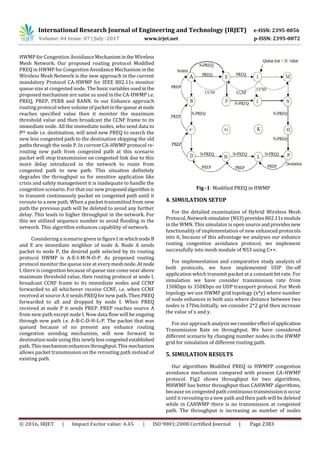
Considering a scenario given in figure1inwhichnodeB
and E are immediate neighbor of node A. Node A sends
packet to node P, the desired path selected by its routing
protocol HWMP is A-E-I-M-N-O-P. As proposed routing
protocol monitor the queue size at everymeshnode.Atnode
I, there is congestion because of queue size come near above
maximum threshold value, then routing protocol at node I,
broadcast CCNF frame to its immediate nodes and CCNF
forwarded to all whichever receive CCNF, i.e. when CCNF
received at source A it sends PREQ for new path. Then PREQ
forwarded to all and dropped by node I. When PREQ
received at node P it sends PREP. PREP reaches source A
from new path except node I. Now data flow will be ongoing
through new path i.e. A-B-C-D-H-L-P. The packet that was
queued because of no present any enhance routing
congestion avoiding mechanism, will now forward to
destination node using this newlylesscongested established
path.This mechanism enhancesthroughput.Thismechanism
allows packet transmission on the rerouting path instead of
existing path.
Fig -1: Modified PREQ in HWMP
4. SIMULATION SETUP
For the detailed examination of Hybrid Wireless Mesh
Protocol, Network simulator (NS3)provides802.11smodule
in the WMN. This simulator is open sourceandprovidesnew
functionality of implementation of new enhanced protocols
into it, because of this advantage we analyses our enhance
routing congestion avoidance protocol, we implement
successfully into mesh module of NS3 using C++.
For implementation and comparative study analysis of
both protocols, we have implemented UDP On-off
application which transmit packet at a constant bit rate. For
simulation we have consider transmission rate from
150Kbps to 350Kbps on UDP transport protocol. For Mesh
topology we use HWMP grid topology (x*y) where number
of node enhances in both axis where distance between two
nodes is 170m.Initially, we consider 2*2 grid then increase
the value of x and y.
For our approachanalysisweconsidereffectofapplication
Transmission Rate on throughput. We have considered
different scenario by changing number nodes in the HWMP
grid for simulation of different routing path.
5. SIMULATION RESULTS
Our algorithms Modified PREQ in HWMPP congestion
avoidance mechanism compared with present CA-HWMP
protocol. Fig2 shows throughput for two algorithms,
MHWMP has better throughput than CAHWMP algorithms,
because on congested path continuoustransmissionisoccur
until it rerouting to a new path and then path will be deleted
while in CAHWMP there is no transmission at congested
path. The throughput is increasing as number of nodes
International Research Journal of Engineering and Technology (IRJET) e-ISSN: 2395-0056
Volume: 04 Issue: 07 | July -2017 www.irjet.net p-ISSN: 2395-0072
© 2016, IRJET | Impact Factor value: 4.45 | ISO 9001:2008 Certified Journal | Page 2384
increases in the MHWMP while in CAHWMP throughput is
degraded as number of nodes increases due to congestion
path cannot deleted in the network.
Fig -2: Throughput
Figure3 shows the average delay. our proposedalgorithm
avoided the congestion and new less congested path is
discovered to maintain the average delay.
6. CONCLUSIONS
In this paper, we have proposed Modified PREQ in HWMP
for Congestion Avoidance Mechanism in the Wireless Mesh
Network. The algorithmproposedcontinuousflowofpackets
in the congested path until it rerouting to a new less
congested path and after that path will be deleted this comes
an advantages of this proposed algorithm. This algorithm
works better as number of nodes increases in the network.
This algorithm outperforms other routing protocol i.e.
CAHWMP in terms of throughput and Average delay.
Fig -3: Average Delay
REFERENCES
[1] Fawaz A. Khasawneh, AbderrahmaneBenmimoune,
Michel Kadoch , Mohammed A. Khasawneh
“Predictive Congestion Avoidance in WirelessMesh
Network,” Future Internet of Things and Cloud
(FiCloud), 2015 3rd International Conference on ,
vol., no., pp.108,112, 24-26 Aug. 2015.
[2] Kishwer Abdul Khaliqa,∗, Sajjad Hussainb, Amir
Qayyuma,1, J¨urgen Pannekc Novel Data Link Layer
Encoding Scheme for Multi-hop Wireless Mesh
Network Procedia Computer Science 52 ( 2015 )
665–669.
[3] Kishwer Abdul Khaliq, Muhammad Sajjad Akbar,
Amir Qayyum, Ehsan Elahi, Amer Zaheer,
Congestion Avoidance Hybrid Wireless Mesh
Protocol (CA-HWMP) for IEEE 802.11s, Procedia
Computer Science, Volume 32, 2014, Pages 229-
236, ISSN 1877-0509.
[4] Barbara Staehle, Michael Bahr, Desheng Fu, and
Dirk Staehle. Intra-mesh Congestion Control for
IEEE 802.11 s Wireless Mesh Networks. In 21st
International Conference on Computer
Communications and Networks (ICCCN), 2012,
pages 1–7. IEEE, 2012.
[5] Mohiuddin Ahmed and KM Arifur Rahman. Novel
Techniques for Fair Rate Control in Wireless Mesh
Networks. International Journal, 3, 2012.
[6] Desheng Fu, Barbara Staehle, Rastin Pries, and Dirk
Staehle. On The Potential of IEEE 802.11 s Intra-
mesh Congestion Control. In Proceedings of the
13th ACM international conference on Modeling,
analysis, and simulation of wireless and mobile
systems, pages 299–306. ACM, 2010.
[7] Raniwala, A.; De, P.; Sharma, S.; Krishnan, R.; Tzi-
cker Chiueh, "Globally fair radio resourceallocation
for wireless mesh networks," Modeling, Analysis &
Simulation of Computer and Telecommunication
Systems, 2009. MASCOTS '09. IEEE International
Symposium on , vol., no., pp.1,10, 21 23 Sept. 2009.
[8] Ren Juan; Xu Hui; Qiu Zhengding, "Cross-Layer
Congestion Control for Multi-Channel Wireless
Mesh Networks," Wireless Communications,
Networking and Mobile Computing, 2009. WiCom
'09. 5th International Conference on , vol., no.,
pp.1,4, 24-26 Sept. 2009.
[9] Gang Feng, Fei Long, and Yide Zhang. Hop-by-Hop
Congestion Control for Wireless Mesh Networks
with Multi-channel MAC. In Global
International Research Journal of Engineering and Technology (IRJET) e-ISSN: 2395-0056
Volume: 04 Issue: 07 | July -2017 www.irjet.net p-ISSN: 2395-0072
© 2016, IRJET | Impact Factor value: 4.45 | ISO 9001:2008 Certified Journal | Page 2385
Telecommunications Conference, 2009.
GLOBECOM 2009. IEEE, pages 1–5. IEEE, 2009.
[10] Nascimento, V.; Gomes, C.; Moreira, W.; Abelem, A.,
"CLM-TCP: TCP Congestion Control Mechanism
Using Cross Layer for Wireless Mesh Networks."
Parallel and Distributed Systems, 2008.ICPADS'08.
14th IEEE International Conference on , vol., no.,
pp.885,890, 8-10 Dec. 2008.
[11] Sumit Rangwala, Apoorva Jindal, Ki-Young Jang,
Konstantinos Psounis, and Ramesh Govindan.
Understanding Congestion Control in Multi-hop
Wireless Mesh Networks.InProceedingsofthe14th
ACM international conference onMobilecomputing
and networking, pages 291–302. ACM, 2008.
[12] Ashish Raniwala, D Pradipta, and Srikant Sharma.
End-to-End Flow Fairness over IEEE 802.11-based
Wireless Mesh Networks. In INFOCOM 2007. 26th
IEEE International Conference on Computer
Communications. IEEE, pages 2361–2365. IEEE,
2007.
[13] Tan, Kun; Qian Zhang; Feng Jiang; Xuemin Shen,
"Congestion control in multi-hop wireless
networks." Sensor andAdHocCommunicationsand
Networks, 2005. IEEE SECON 2005. 2005 Second
Annual IEEE Communications Society Conference
on , vol., no., pp.96,106, 26-29 Sept., 2005.
[14] Mojtaba Seyedzadegan, Mohamed Othman,
Borhanuddin Mohd Ali, and Shamala Subramaniam.
Wireless Mesh Networks: WMN Overview, WMN
Architecture. In International Conference on
Communication Engineering and Networks IPCSIT,
volume 19, 2011.
[15] S Badombena-Wanta and EO Sheybani. Mobile
Communications for Development: Enabling
Strategic and Low-cost e-applications for Rural and
Remote Areas. In Wireless Telecommunications
Symposium (WTS), 2010, pages 1–7. IEEE, 2010.
[16] Abdulrahman Yarali, Babak Ahsant, and Saifur
Rahman. Wireless mesh networking: A key solution
for emergency & rural applications. In Second
International Conference on Advances in Mesh
Networks, 2009. MESH 2009, pages 143–149. IEEE,
2009.
[17] Kai Shi, Yantai Shu, and Juan Feng. A MAC layer
Congestion Control Mechanism in IEEE 802.11
WLANs. In Fourth International Conference on
Communications and Networking in China, 2009.
ChinaCOM 2009, pages 1–5. IEEE, 2009.
[18] Xudong Wang and Azman O Lim. IEEE 802.11 s
Wireless Mesh Networks: Framework and
Challenges. Ad Hoc Networks, 6(6):970–984, 2008.
[19] J Camp and E Knightly. The IEEE 802.11 s Extended
Service Set Mesh Networking Standard.
Communications Magazine, IEEE, 46(8):120–126,
2008.
[20] A Behrouz Forouzan. Data Communications &
Networking (sie). Tata McGraw-Hill Education,
2007.
[21] Hidenori Aoki, Shinji Takeda, Kengo Yagyu, and
Akira Yamada. IEEE 802.11 s Wireless LAN Mesh
Network Technology. NTT DoCoMo Technical
Journal, 8(2):13–21, 2006.
[22] Ian F Akyildiz, Xudong Wang, and Weilin Wang.
Wireless Mesh Networks: A Survey. Computer
networks, 47(4):445–487, 2005.
[23] Mihail L Sichitiu. Wireless Mesh Networks:
Opportunities and Challenges. In Proceedings of
World Wireless Congress, 2005.
[24] Roger Karrer, Ashutosh Sabharwal, and Edward
Knightly. Enabling Large-scaleWirelessBroadband:
The Case for TAPs. ACM SIGCOMM Computer
Communication Review, 34(1):27–32, 2004.

Modified PREQ in HWMP for Congestion Avoidance in Wireless Mesh Network

  • 1.
    International Research Journalof Engineering and Technology (IRJET) e-ISSN: 2395-0056 Volume: 04 Issue: 07 | July -2017 www.irjet.net p-ISSN: 2395-0072 © 2016, IRJET | Impact Factor value: 4.45 | ISO 9001:2008 Certified Journal | Page 2381 Modified PREQ in HWMP for Congestion Avoidance in Wireless Mesh Network Rahul V. Mane1, Vijaykumar V. Patil2 1 Department of Electronics &Tele-Communication Engineering, K.I.T’s College of Engineering, Kolhapur, Maharashtra, 416234, India 2 Asst. Prof. Department of Electronics Engineering, K.I.T’s College of Engineering, Kolhapur, Maharashtra, 416234, India ---------------------------------------------------------------------***--------------------------------------------------------------------- Abstract - Wireless Mesh Network (WMN) have been visualized as an important solution to the next generation wireless networking which can be used in transportation systems, home networking and last-mile wireless internet access. Modified PREQ in HWMP for Congestion Avoidance Mechanism is a proposed technique in this paper we determine congested path using CCNF frame and to provide the rerouting less congested pathbeforecongestionscenario to reduce burden on congested node. Additional approachis to continue packets transmission on congested path until it gets the rerouting path in congestion scenario. When a packet transmitted from new path the previous path will be deleted to avoid any further delay. Also sequence number is to avoid flooding in the network. We are comparing our Modified PREQ Mechanism with congestion avoidance technique to improve throughput and average delay using NS-3 Simulator. Key Words: Wireless Mesh Network, HWMP, Congestion Control, Congestion Avoidance. 1. INTRODUCTION The IEEE 802.11 standard isa wirelesslocal area network protocol, which is largely dependentonwiredinfrastructure for data traffic transmission. This standard was devised to extend wired network to wireless territory. There are a series of standards under IEEE 802.11, including a, b, g etc. which are related to different wireless medium. This standard specifies frequencies, mode of communication, modulation techniques and other specification for wireless mesh networks. This standard entails two different types of networks including infrastructure mode where a definite access point is present and ad hoc mode, where no specific access point is present and two stations connect to each other on demand. IEEE 802.11s standard is an essential modification to IEEE 802.11 standard that resolves wired infrastructure dependency problem of its predecessor. This standard works in link layer of OSI model and deals with physical address of the devices ratherthanIPaddress,which can be useful in layer-2, multi hop communication. It is conceivable, and in fact quite desirable, that qualityof service (QoS) guarantees can be offered to customers. If the network is designed carefully and enoughInternetgateways are placed at key points, each customer can enjoy guaranteed bandwidth and/or delay (at least in the access network). The guarantees enable multimedia applications such as voice over IP and video on demand. Moreover, different classes of service (e.g., premium, enhanced, and basic) can be offered, each with different priorities and guarantees. HWMP protocol provides dynamic and less congested transmission path. The main idea of implementing new protocol is to communicate devices effectivelywhicharenot in a communication area to each other i.e. hard area nodes. This algorithm provides both Reactive and Pro-active routing in the network. The reactive mode uses on demand routing i.e. Ad-hoc Distance Vector Routing Protocol. In Proactive mode uses tree based data structure which has Root node maintain routing table to keep routes to all destination. Congestion Control Mechanism apply when congestion occur in the network. This mechanism provides limit the flow of packets when congestion occurs. This comprises operations which are monitoring, detection and then controlling of congestion. Only congestion signaling part is mention in HWMP where rest of congestion control mechanism is not specified. However, various congestion control mechanism are proposed in literature to resolvethis problem but anyway these methods are not sufficient to derive efficient network performance. However, congestion avoidance is better than congestion control because the latter is imposed when the network is already experiencing congestion. When the volumeof queue at a specific node reaches to a pre-definedlimit,itperformsa buffer size check. If the queue size is nearthe bufferlimit,the node starts broadcasting CCNF signals to its neighbors that use same path. The neighboring nodes then start searching alternative paths to send their packets to destination and avoid the path that is nearly congested as proposed in the Congestion Avoidance – HWMP (CA-HWMP). Thus, the congestion is avoided. One of the added advantage of this mechanism is that it is not only helps avoiding congestion but also helps in load balancing. Also In this paper, Modified PREQ in HWMP for Congestion Avoidance Mechanism is proposed to provide continuous transmission on a congested path until it
  • 2.
    International Research Journalof Engineering and Technology (IRJET) e-ISSN: 2395-0056 Volume: 04 Issue: 07 | July -2017 www.irjet.net p-ISSN: 2395-0072 © 2016, IRJET | Impact Factor value: 4.45 | ISO 9001:2008 Certified Journal | Page 2382 rerouting to a new less congested path. When a packet transmitted from new path the previous path will bedeleted to avoid any further delay. This technique ensures performance in the network which increases the network throughput, packet delivery fraction. The sequence number is used to avoid flooding in the network this added advantage in this algorithm. 2. RELATED WORK Fawaz A. Khasawneh, Abderrahmane Benmimoune, Michel Kadoch , Mohammed A. Khasawneh proposed “Predictive Congestion Avoidance in Wireless Mesh Network.” In this approach, an Enhanced Congestion Avoidance-HWMP(ECA-HWMP)isproposedwhichpredicts the congestion in each link in the network by applying two statistical analysis methods which are Croston and Holt- Winter methods. The two methodsrelyonthe historical data collected in advance to predict the future data. Since ECAHWMP predicts the congestion before it really happens in the network, the overhead produced by the congestion control signaling inHWMPprotocol isreduced.However, the prediction process has some level ofcertainty(>95%)and in some cases (<5%) a congestion threshold will be reached and CCNF signals will be broadcasted. [1] Kishwer Abdul Khaliqa, Sajjad Hussainb, Amir Qayyuma, J¨urgen Pannek presented "New data link layer encoding scheme for multi hop WMN" They use special feature of cut through switch that reduces delay in the network and also increases throughput reducing re-transmission in the network. This algorithm for some scenario not works well. [2] Kishwer Abdul Khaliq, Muhammad Sajjad Akbar, Amir Qayyum, Ehsan Elahi, Amer Zaheer proposed "Congestion Avoidance Technique for Hybrid Mesh Protocol". In this approach when a number of packet gets more than specified queue size level then the CCNF broadcasttoshowcongestion in network. The neighboring node search the new path to send packet to destination on receiving the CCNF and to avoid the path that has already a congestion. Thus, the congestion is avoided. One of the added advantage of this mechanism is that it is not only helps avoiding congestion but also helps in load balancing. This approach gives weak response for interactive application. [3] Barbara Staehle, Michael Bahr, Deshang Fu, and Dirk Staehle, presented “Intra-mesh Congestion Control for IEEE 802.11 s Wireless Mesh Networks.” There are different algorithm for intramesh congestion solving different issues using congestionnotification.Total congestioncontrol (TCC), Link selective congestion control and Path selective congestion control (PSCC) were proposed which resolved some scenario but in some issues these algorithm not working well. In TCC algorithm when congestion at node on receiving congestion frame then total traffic is blocked. In LSCC algorithm on congestion scenario it restricts the traffic for specific link by blocking data packets for specificnode. In PSCC, congested node broadcast CCNF to limit the traffic for specific destination. The congested node provides this information by adding a destination address for a specific flow into CCNF. For the announcement of specific destination, this algorithm requires modification in the standard CCNF. On receiving modified CCNF, a node only blocks sending data for a specific destination, but it continuously receives data for that specific node. The scenario becomes more complicated when CCNF frame is further broadcast to immediate node in a continuous chain. These algorithms resolve congestion problems in some scenarios of multi-hop WMN uses IEEE 802.11s MAC. [4] Raniwala, A. De, P. Sharma,S.Krishnan,R.Tzi-ckerChiueh, proposed "Globallyfairradio resourceallocationforwireless mesh networks," In this approach the protocol determines the resources distributed among the links under same collision domain and employs advanced topology discovery and max-min fair resource allocation technique to ensure lower congestion in the domain. A max-min fair is a technique of increasing resource allocation to a new flow by taking it from an existing flow having already a smaller share. In a single wireless domain, each link gets a share of available bandwidth proportional to the number of flows traversing it. In an asymmetric collision domain, where not all nodes can see the packets from other nodes, unnecessarily slows down their flow rate and creates congestion by reducing channel capacity. The proposed technique helps nodes in a collision domain estimate the traffic in the domain perfectly and allocates resources accordingly. This technique is useful because unlike symmetric collision domain,insteadofallocatingequal share of available resources, it distributes it based on queue build up. If a node sees a queue is building up, it decreases its channel capacity estimate and lowers its flow rate. On the other hand, if none of the nodes sees any queue build-up,the channel capacity estimate increases and flow rate increases. [7] 3. PROPOSED MECHANISM Congestion control technique is used when congestion occurs into the network. Congestion Control has three operations monitoring, detection of congestion, processing of congestion control and control the flow of packets. When congestion occur packet drop from queue due to this performance of network is reduced and also increases the burden on a specific node. To avoid this problem they used Congestion Avoidance algorithm to avoid congestion before this occur i.e. comparing node queue level with specific threshold value to broadcast CCNF to its immediate node, but in congestion sensitive applications it is not a good idea because of it create extra packet overhead. In our proposed technique, path selection is performedat MAC layer; instead of IP layer therefore we utilized new protocol for congestion avoidance using modified PREQ in
  • 3.
    International Research Journalof Engineering and Technology (IRJET) e-ISSN: 2395-0056 Volume: 04 Issue: 07 | July -2017 www.irjet.net p-ISSN: 2395-0072 © 2016, IRJET | Impact Factor value: 4.45 | ISO 9001:2008 Certified Journal | Page 2383 HWMP for Congestion AvoidanceMechanisminthe Wireless Mesh Network. Our proposed routing protocol Modified PREQ in HWMP for Congestion Avoidance Mechanism inthe Wireless Mesh Network is the new approach in the current mandatory Protocol CA-HWMP for IEEE 802.11s monitor queue size at congested node. The basic variablesusedinthe proposed mechanism are same as used in the CA-HWMP i.e. PREQ, PREP, PERR and RANN. In our Enhance approach routing protocol when volume ofpacketinthe queueatnode reaches specified value then it monitor the maximum threshold value and then broadcast the CCNF frame to its immediate node. All the immediate nodes, who send data to Pth node i.e. destination, will send new PREQ to search the new less congested path to the destination skipping the old paths through the node P. In current CA-HWMP protocol re- routing new path from congested path at this scenario packet will stop transmission on congested link due to this more delay introduced in the network to route from congested path to new path. This situation definitely degrades the throughput so for sensitive application like crisis and safety management it is inadequate to handle the congestion scenario. For that our new proposedalgorithm is to transmit continuously packet on congested path until it reroute to a new path. When a packet transmitted from new path the previous path will be deleted to avoid any further delay. This leads to higher throughput in the network. For this we utilized sequence number to avoid flooding in the network. This algorithm enhances capability of network. Considering a scenario given in figure1inwhichnodeB and E are immediate neighbor of node A. Node A sends packet to node P, the desired path selected by its routing protocol HWMP is A-E-I-M-N-O-P. As proposed routing protocol monitor the queue size at everymeshnode.Atnode I, there is congestion because of queue size come near above maximum threshold value, then routing protocol at node I, broadcast CCNF frame to its immediate nodes and CCNF forwarded to all whichever receive CCNF, i.e. when CCNF received at source A it sends PREQ for new path. Then PREQ forwarded to all and dropped by node I. When PREQ received at node P it sends PREP. PREP reaches source A from new path except node I. Now data flow will be ongoing through new path i.e. A-B-C-D-H-L-P. The packet that was queued because of no present any enhance routing congestion avoiding mechanism, will now forward to destination node using this newlylesscongested established path.This mechanism enhancesthroughput.Thismechanism allows packet transmission on the rerouting path instead of existing path. Fig -1: Modified PREQ in HWMP 4. SIMULATION SETUP For the detailed examination of Hybrid Wireless Mesh Protocol, Network simulator (NS3)provides802.11smodule in the WMN. This simulator is open sourceandprovidesnew functionality of implementation of new enhanced protocols into it, because of this advantage we analyses our enhance routing congestion avoidance protocol, we implement successfully into mesh module of NS3 using C++. For implementation and comparative study analysis of both protocols, we have implemented UDP On-off application which transmit packet at a constant bit rate. For simulation we have consider transmission rate from 150Kbps to 350Kbps on UDP transport protocol. For Mesh topology we use HWMP grid topology (x*y) where number of node enhances in both axis where distance between two nodes is 170m.Initially, we consider 2*2 grid then increase the value of x and y. For our approachanalysisweconsidereffectofapplication Transmission Rate on throughput. We have considered different scenario by changing number nodes in the HWMP grid for simulation of different routing path. 5. SIMULATION RESULTS Our algorithms Modified PREQ in HWMPP congestion avoidance mechanism compared with present CA-HWMP protocol. Fig2 shows throughput for two algorithms, MHWMP has better throughput than CAHWMP algorithms, because on congested path continuoustransmissionisoccur until it rerouting to a new path and then path will be deleted while in CAHWMP there is no transmission at congested path. The throughput is increasing as number of nodes
  • 4.
    International Research Journalof Engineering and Technology (IRJET) e-ISSN: 2395-0056 Volume: 04 Issue: 07 | July -2017 www.irjet.net p-ISSN: 2395-0072 © 2016, IRJET | Impact Factor value: 4.45 | ISO 9001:2008 Certified Journal | Page 2384 increases in the MHWMP while in CAHWMP throughput is degraded as number of nodes increases due to congestion path cannot deleted in the network. Fig -2: Throughput Figure3 shows the average delay. our proposedalgorithm avoided the congestion and new less congested path is discovered to maintain the average delay. 6. CONCLUSIONS In this paper, we have proposed Modified PREQ in HWMP for Congestion Avoidance Mechanism in the Wireless Mesh Network. The algorithmproposedcontinuousflowofpackets in the congested path until it rerouting to a new less congested path and after that path will be deleted this comes an advantages of this proposed algorithm. This algorithm works better as number of nodes increases in the network. This algorithm outperforms other routing protocol i.e. CAHWMP in terms of throughput and Average delay. Fig -3: Average Delay REFERENCES [1] Fawaz A. Khasawneh, AbderrahmaneBenmimoune, Michel Kadoch , Mohammed A. Khasawneh “Predictive Congestion Avoidance in WirelessMesh Network,” Future Internet of Things and Cloud (FiCloud), 2015 3rd International Conference on , vol., no., pp.108,112, 24-26 Aug. 2015. [2] Kishwer Abdul Khaliqa,∗, Sajjad Hussainb, Amir Qayyuma,1, J¨urgen Pannekc Novel Data Link Layer Encoding Scheme for Multi-hop Wireless Mesh Network Procedia Computer Science 52 ( 2015 ) 665–669. [3] Kishwer Abdul Khaliq, Muhammad Sajjad Akbar, Amir Qayyum, Ehsan Elahi, Amer Zaheer, Congestion Avoidance Hybrid Wireless Mesh Protocol (CA-HWMP) for IEEE 802.11s, Procedia Computer Science, Volume 32, 2014, Pages 229- 236, ISSN 1877-0509. [4] Barbara Staehle, Michael Bahr, Desheng Fu, and Dirk Staehle. Intra-mesh Congestion Control for IEEE 802.11 s Wireless Mesh Networks. In 21st International Conference on Computer Communications and Networks (ICCCN), 2012, pages 1–7. IEEE, 2012. [5] Mohiuddin Ahmed and KM Arifur Rahman. Novel Techniques for Fair Rate Control in Wireless Mesh Networks. International Journal, 3, 2012. [6] Desheng Fu, Barbara Staehle, Rastin Pries, and Dirk Staehle. On The Potential of IEEE 802.11 s Intra- mesh Congestion Control. In Proceedings of the 13th ACM international conference on Modeling, analysis, and simulation of wireless and mobile systems, pages 299–306. ACM, 2010. [7] Raniwala, A.; De, P.; Sharma, S.; Krishnan, R.; Tzi- cker Chiueh, "Globally fair radio resourceallocation for wireless mesh networks," Modeling, Analysis & Simulation of Computer and Telecommunication Systems, 2009. MASCOTS '09. IEEE International Symposium on , vol., no., pp.1,10, 21 23 Sept. 2009. [8] Ren Juan; Xu Hui; Qiu Zhengding, "Cross-Layer Congestion Control for Multi-Channel Wireless Mesh Networks," Wireless Communications, Networking and Mobile Computing, 2009. WiCom '09. 5th International Conference on , vol., no., pp.1,4, 24-26 Sept. 2009. [9] Gang Feng, Fei Long, and Yide Zhang. Hop-by-Hop Congestion Control for Wireless Mesh Networks with Multi-channel MAC. In Global
  • 5.
    International Research Journalof Engineering and Technology (IRJET) e-ISSN: 2395-0056 Volume: 04 Issue: 07 | July -2017 www.irjet.net p-ISSN: 2395-0072 © 2016, IRJET | Impact Factor value: 4.45 | ISO 9001:2008 Certified Journal | Page 2385 Telecommunications Conference, 2009. GLOBECOM 2009. IEEE, pages 1–5. IEEE, 2009. [10] Nascimento, V.; Gomes, C.; Moreira, W.; Abelem, A., "CLM-TCP: TCP Congestion Control Mechanism Using Cross Layer for Wireless Mesh Networks." Parallel and Distributed Systems, 2008.ICPADS'08. 14th IEEE International Conference on , vol., no., pp.885,890, 8-10 Dec. 2008. [11] Sumit Rangwala, Apoorva Jindal, Ki-Young Jang, Konstantinos Psounis, and Ramesh Govindan. Understanding Congestion Control in Multi-hop Wireless Mesh Networks.InProceedingsofthe14th ACM international conference onMobilecomputing and networking, pages 291–302. ACM, 2008. [12] Ashish Raniwala, D Pradipta, and Srikant Sharma. End-to-End Flow Fairness over IEEE 802.11-based Wireless Mesh Networks. In INFOCOM 2007. 26th IEEE International Conference on Computer Communications. IEEE, pages 2361–2365. IEEE, 2007. [13] Tan, Kun; Qian Zhang; Feng Jiang; Xuemin Shen, "Congestion control in multi-hop wireless networks." Sensor andAdHocCommunicationsand Networks, 2005. IEEE SECON 2005. 2005 Second Annual IEEE Communications Society Conference on , vol., no., pp.96,106, 26-29 Sept., 2005. [14] Mojtaba Seyedzadegan, Mohamed Othman, Borhanuddin Mohd Ali, and Shamala Subramaniam. Wireless Mesh Networks: WMN Overview, WMN Architecture. In International Conference on Communication Engineering and Networks IPCSIT, volume 19, 2011. [15] S Badombena-Wanta and EO Sheybani. Mobile Communications for Development: Enabling Strategic and Low-cost e-applications for Rural and Remote Areas. In Wireless Telecommunications Symposium (WTS), 2010, pages 1–7. IEEE, 2010. [16] Abdulrahman Yarali, Babak Ahsant, and Saifur Rahman. Wireless mesh networking: A key solution for emergency & rural applications. In Second International Conference on Advances in Mesh Networks, 2009. MESH 2009, pages 143–149. IEEE, 2009. [17] Kai Shi, Yantai Shu, and Juan Feng. A MAC layer Congestion Control Mechanism in IEEE 802.11 WLANs. In Fourth International Conference on Communications and Networking in China, 2009. ChinaCOM 2009, pages 1–5. IEEE, 2009. [18] Xudong Wang and Azman O Lim. IEEE 802.11 s Wireless Mesh Networks: Framework and Challenges. Ad Hoc Networks, 6(6):970–984, 2008. [19] J Camp and E Knightly. The IEEE 802.11 s Extended Service Set Mesh Networking Standard. Communications Magazine, IEEE, 46(8):120–126, 2008. [20] A Behrouz Forouzan. Data Communications & Networking (sie). Tata McGraw-Hill Education, 2007. [21] Hidenori Aoki, Shinji Takeda, Kengo Yagyu, and Akira Yamada. IEEE 802.11 s Wireless LAN Mesh Network Technology. NTT DoCoMo Technical Journal, 8(2):13–21, 2006. [22] Ian F Akyildiz, Xudong Wang, and Weilin Wang. Wireless Mesh Networks: A Survey. Computer networks, 47(4):445–487, 2005. [23] Mihail L Sichitiu. Wireless Mesh Networks: Opportunities and Challenges. In Proceedings of World Wireless Congress, 2005. [24] Roger Karrer, Ashutosh Sabharwal, and Edward Knightly. Enabling Large-scaleWirelessBroadband: The Case for TAPs. ACM SIGCOMM Computer Communication Review, 34(1):27–32, 2004.