1
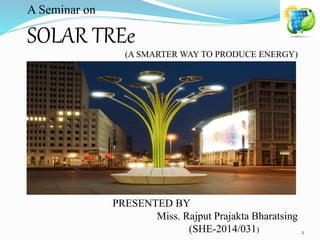
A Seminar on
SOLAR TREe
(A SMARTER WAY TO PRODUCE ENERGY)
PRESENTED BY
Miss. Rajput Prajakta Bharatsing
(SHE-2014/031) 2
CONTENTS
 Introduction
 What is solar tree?
 History
 Why we called it as solar tree?
 Components of solar tree
 Nanowire solar cell
 Working of solar panel
 Working of solar tree
 Solar tree V/S traditional solar
system
 Solar tree in India
 Future scope of solar tree
 Advantages
 Applications
 Conclusions
 References
3
INTRODUCTION
 Energy demand
 Scarcity of land
 Free of cost electricity
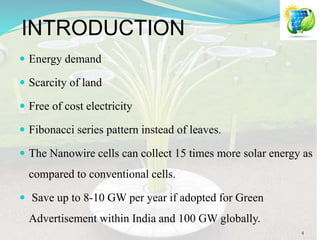
 Fibonacci series pattern instead of leaves.
 The Nanowire cells can collect 15 times more solar energy as
compared to conventional cells.
 Save up to 8-10 GW per year if adopted for Green
Advertisement within India and 100 GW globally.
4
WHAT IS
SOLAR TREE
5
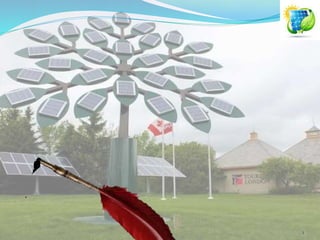
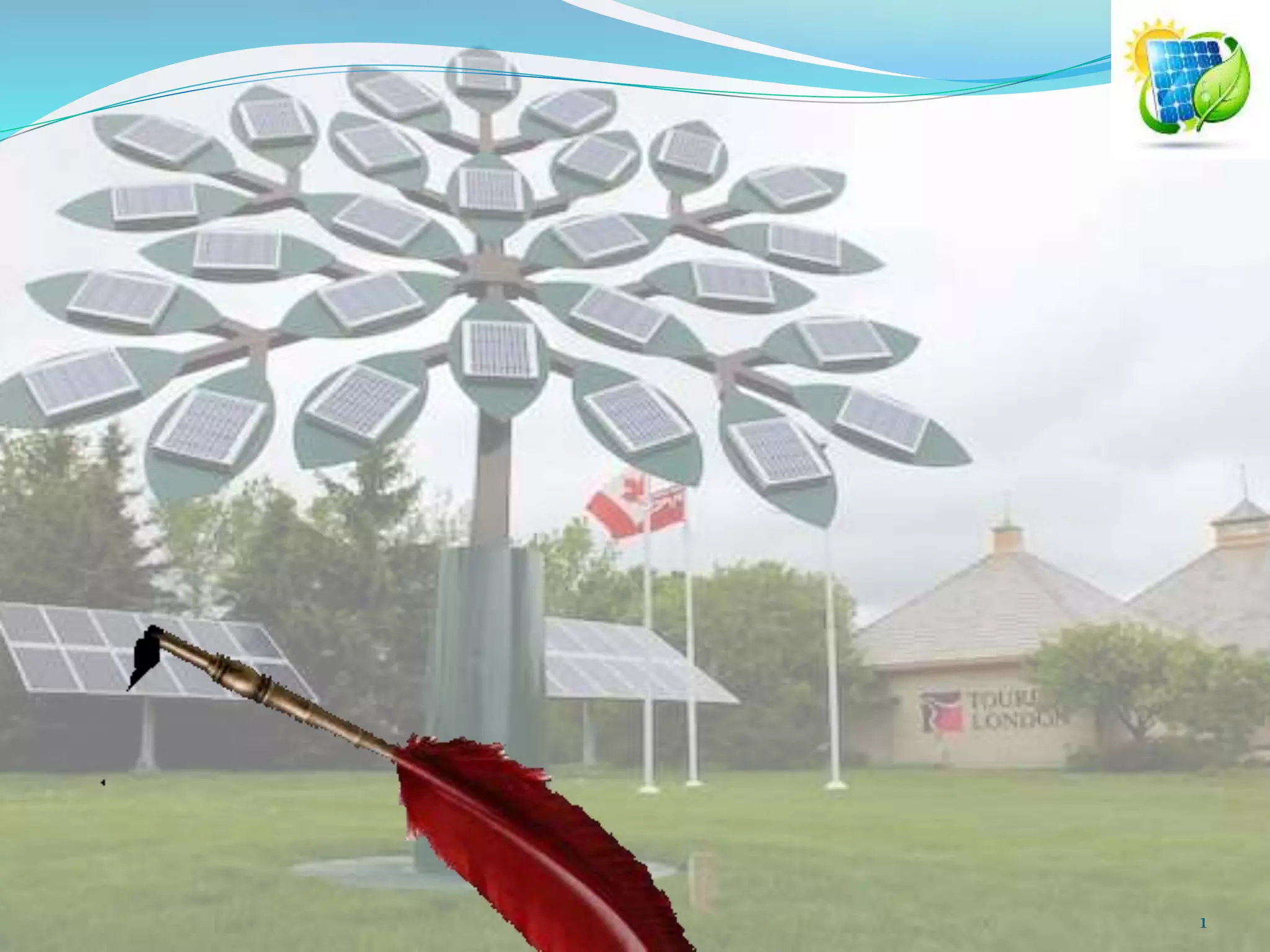
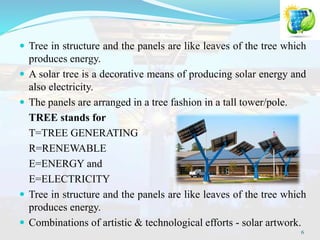
 Tree in structure and the panels are like leaves of the tree which
produces energy.
 A solar tree is a decorative means of producing solar energy and
also electricity.
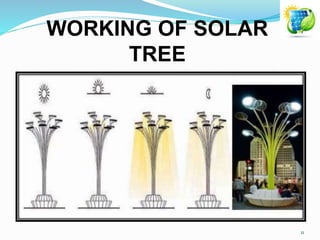
 The panels are arranged in a tree fashion in a tall tower/pole.
TREE stands for
T=TREE GENERATING
R=RENEWABLE
E=ENERGY and
E=ELECTRICITY
 Tree in structure and the panels are like leaves of the tree which
produces energy.
 Combinations of artistic & technological efforts - solar artwork.
6
HISTORY
1. In 1800 solar energy plants developed.
2. In 1839 Alexandre Edmond discovered the
photo voltaic effect.
3. In 1941 Russell ohl invented solar cell.
4. Solar Tree Foundation which began in 2008
by Rein Triefeldt.
5. In 2012 Ross Lovegrove designed the solar
tree.
6. In 2016, CSIR-CMERI Durgapur, West
Bengal, India invented new model of Solar
Tree for its application at villages.
7
WHY WE CALLED IT AS
SOLAR TREE
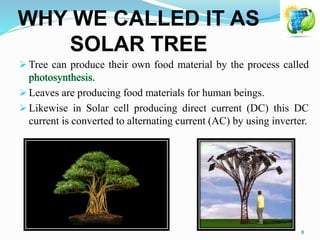
 Tree can produce their own food material by the process called
 Leaves are producing food materials for human beings.
 Likewise in Solar cell producing direct current (DC) this DC
current is converted to alternating current (AC) by using inverter.
8
COMPONENTS OF SOLAR
TREE
9
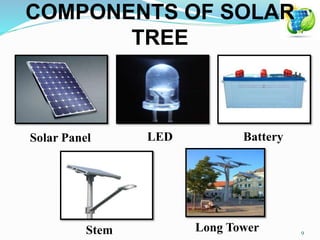
Solar Panel LED Battery
Stem Long Tower
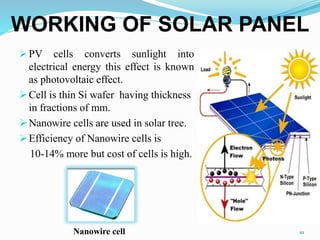
 PV cells converts sunlight into
electrical energy this effect is known
as photovoltaic effect.
Cell is thin Si wafer having thickness
in fractions of mm.
Nanowire cells are used in solar tree.
Efficiency of Nanowire cells is
10-14% more but cost of cells is high.
10
WORKING OF SOLAR PANEL
Nanowire cell
WORKING OF SOLAR
TREE
11
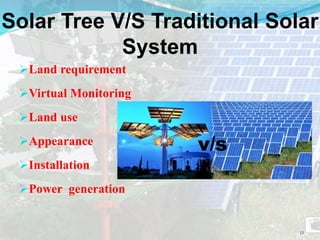
Land requirement
Virtual Monitoring
Land use
Appearance
Installation
Power generation
v/s
12
Solar Tree V/S Traditional Solar
System
SOLAR TREE IN INDIA
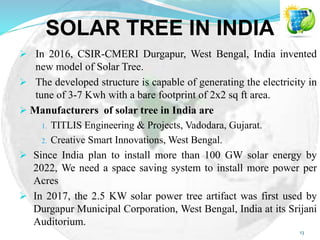
 In 2016, CSIR-CMERI Durgapur, West Bengal, India invented
new model of Solar Tree.
 The developed structure is capable of generating the electricity in
tune of 3-7 Kwh with a bare footprint of 2x2 sq ft area.
 Manufacturers of solar tree in India are
1. TITLIS Engineering & Projects, Vadodara, Gujarat.
2. Creative Smart Innovations, West Bengal.
 Since India plan to install more than 100 GW solar energy by
2022, We need a space saving system to install more power per
Acres
 In 2017, the 2.5 KW solar power tree artifact was first used by
Durgapur Municipal Corporation, West Bengal, India at its Srijani
Auditorium.
13
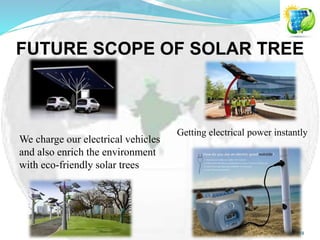
FUTURE SCOPE OF SOLAR TREE
Getting electrical power instantly
We charge our electrical vehicles
and also enrich the environment
with eco-friendly solar trees
14
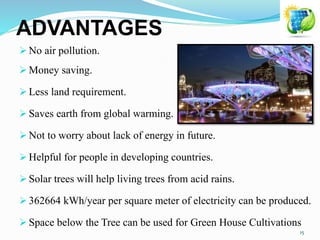
ADVANTAGES
 No air pollution.
 Money saving.
 Less land requirement.
 Saves earth from global warming.
 Not to worry about lack of energy in future.
 Helpful for people in developing countries.
 Solar trees will help living trees from acid rains.
 362664 kWh/year per square meter of electricity can be produced.
 Space below the Tree can be used for Green House Cultivations
15
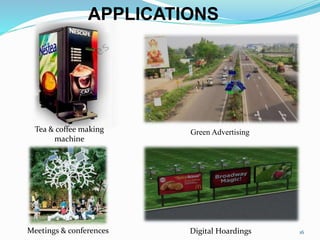
Tea & coffee making
machine
Green Advertising
16Digital HoardingsMeetings & conferences
APPLICATIONS
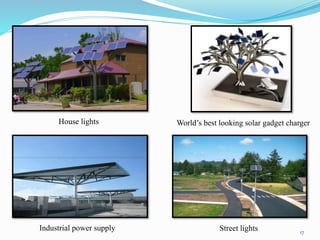
World’s best looking solar gadget chargerHouse lights
Industrial power supply Street lights 17
CONCLUSIONS
 It fulfils the increasing energy demand of the people.
 This can resolve the shortage of power starving areas
and countries without any power cut problem.
 5 times extra land can be saved by using this system.
 Each Solar Tree also become E-car charging facility for
future.
18
REFRENCES
 Patil, D.M.; and S. R. Madiwal, August 2016. Design and
development of solar tree for domestic applications.
International Journal of Engineering Sciences &
Research Technology. 5 (8): 102-111
 Srinivas, A P R. October-2016. Design and Development
of a Solar Tree. International Journal of Engineering
Sciences & Research Technology. 7 (10): 1319-1327
 www.google.com
 https://en.wikipedia.org/wiki/Solar tree
19
20
ANY
QUESTIONS...
21

Solar Tree

  • 1.
  • 2.
    A Seminar on SOLARTREe (A SMARTER WAY TO PRODUCE ENERGY) PRESENTED BY Miss. Rajput Prajakta Bharatsing (SHE-2014/031) 2
  • 3.
    CONTENTS  Introduction  Whatis solar tree?  History  Why we called it as solar tree?  Components of solar tree  Nanowire solar cell  Working of solar panel  Working of solar tree  Solar tree V/S traditional solar system  Solar tree in India  Future scope of solar tree  Advantages  Applications  Conclusions  References 3
  • 4.
    INTRODUCTION  Energy demand Scarcity of land  Free of cost electricity  Fibonacci series pattern instead of leaves.  The Nanowire cells can collect 15 times more solar energy as compared to conventional cells.  Save up to 8-10 GW per year if adopted for Green Advertisement within India and 100 GW globally. 4
  • 5.
  • 6.
     Tree instructure and the panels are like leaves of the tree which produces energy.  A solar tree is a decorative means of producing solar energy and also electricity.  The panels are arranged in a tree fashion in a tall tower/pole. TREE stands for T=TREE GENERATING R=RENEWABLE E=ENERGY and E=ELECTRICITY  Tree in structure and the panels are like leaves of the tree which produces energy.  Combinations of artistic & technological efforts - solar artwork. 6
  • 7.
    HISTORY 1. In 1800solar energy plants developed. 2. In 1839 Alexandre Edmond discovered the photo voltaic effect. 3. In 1941 Russell ohl invented solar cell. 4. Solar Tree Foundation which began in 2008 by Rein Triefeldt. 5. In 2012 Ross Lovegrove designed the solar tree. 6. In 2016, CSIR-CMERI Durgapur, West Bengal, India invented new model of Solar Tree for its application at villages. 7
  • 8.
    WHY WE CALLEDIT AS SOLAR TREE  Tree can produce their own food material by the process called  Leaves are producing food materials for human beings.  Likewise in Solar cell producing direct current (DC) this DC current is converted to alternating current (AC) by using inverter. 8
  • 9.
    COMPONENTS OF SOLAR TREE 9 SolarPanel LED Battery Stem Long Tower
  • 10.
     PV cellsconverts sunlight into electrical energy this effect is known as photovoltaic effect. Cell is thin Si wafer having thickness in fractions of mm. Nanowire cells are used in solar tree. Efficiency of Nanowire cells is 10-14% more but cost of cells is high. 10 WORKING OF SOLAR PANEL Nanowire cell
  • 11.
  • 12.
    Land requirement Virtual Monitoring Landuse Appearance Installation Power generation v/s 12 Solar Tree V/S Traditional Solar System
  • 13.
    SOLAR TREE ININDIA  In 2016, CSIR-CMERI Durgapur, West Bengal, India invented new model of Solar Tree.  The developed structure is capable of generating the electricity in tune of 3-7 Kwh with a bare footprint of 2x2 sq ft area.  Manufacturers of solar tree in India are 1. TITLIS Engineering & Projects, Vadodara, Gujarat. 2. Creative Smart Innovations, West Bengal.  Since India plan to install more than 100 GW solar energy by 2022, We need a space saving system to install more power per Acres  In 2017, the 2.5 KW solar power tree artifact was first used by Durgapur Municipal Corporation, West Bengal, India at its Srijani Auditorium. 13
  • 14.
    FUTURE SCOPE OFSOLAR TREE Getting electrical power instantly We charge our electrical vehicles and also enrich the environment with eco-friendly solar trees 14
  • 15.
    ADVANTAGES  No airpollution.  Money saving.  Less land requirement.  Saves earth from global warming.  Not to worry about lack of energy in future.  Helpful for people in developing countries.  Solar trees will help living trees from acid rains.  362664 kWh/year per square meter of electricity can be produced.  Space below the Tree can be used for Green House Cultivations 15
  • 16.
    Tea & coffeemaking machine Green Advertising 16Digital HoardingsMeetings & conferences APPLICATIONS
  • 17.
    World’s best lookingsolar gadget chargerHouse lights Industrial power supply Street lights 17
  • 18.
    CONCLUSIONS  It fulfilsthe increasing energy demand of the people.  This can resolve the shortage of power starving areas and countries without any power cut problem.  5 times extra land can be saved by using this system.  Each Solar Tree also become E-car charging facility for future. 18
  • 19.
    REFRENCES  Patil, D.M.;and S. R. Madiwal, August 2016. Design and development of solar tree for domestic applications. International Journal of Engineering Sciences & Research Technology. 5 (8): 102-111  Srinivas, A P R. October-2016. Design and Development of a Solar Tree. International Journal of Engineering Sciences & Research Technology. 7 (10): 1319-1327  www.google.com  https://en.wikipedia.org/wiki/Solar tree 19
  • 20.
  • 21.

Editor's Notes

  • #13  For traditional system we require large size of land i.e. To generate 1 MW power from PV module we require 4-5 acres of land. We Only need less than 1 Acre per MW when using Solar Tree Thus in the same space we can install 5-6 times bigger plant. Virtual Monitoring System can monitor each Array thus fault finding is very easy and can be addressed within hours than weeks as compared to Traditional systems. Space below the tree can still be used for Green house farming and other purpose. Since India plan to install more than 100 GW solar energy by 2022, We need a space saving system to install more power per Acres Thus saving Land for future generations as well. Can be used for Effective E-Learning's in remote areas.
  • #14 Council of Scientific & Industrial Research
  • #16 5 times less Land needed for each MW and the Space below the Tree can be used for Green House Cultivations in larger capacities.