Imperial Journal of Interdisciplinary Research (IJIR)
Vol-2, Issue-4, 2016
ISSN: 2454-1362, http://www.onlinejournal.in
Imperial Journal of Interdisciplinary Research (IJIR) Page 1
MODIFIED BITUMINOUS MIX PREPARED USING NATURAL
FIBRE”
Prof. Hitesh A Patel
Department of civil
engineering
UVPCE, Ganpat University
+91 9913749491
E-mail:-
hitesh_jem@yahoo.co.in
Prof. Prashant K. Lalwani
Department of civil
engineering
UVPCE, Ganpat University
+91 999979674460
E-mail:-
prashant.lalwani86@gmail.com
Prof. Chandresh G Patel
Department of civil
engineering
UVPCE, Ganpat University
+91 9825799472
E-mail:-
chandresh.civil@gmail.com
Abstract: The SMA Technical Working Group of
FHWA defined SMA as “A gap graded aggregate
hot mix asphalt that maximizes the binder content
and coarse aggregate fraction and provides a stable
stone-on-stone skeleton that is held together by a
rich mixture of binder, filler and stabilizing
additives”. The present study is carried out with and
without natural fibre. Here, we can use the jute
fibre. Jute is a long, soft, shiny vegetable fibre that
can be spun into coarse, strong threads. It is
produced from plants in the genus Corchorus,
family Malvaceae. Different experiments were
conducted on bitumen with and without using fibre.
The results were analysized with the use of
Marshall Stability test. In addition to it cost analysis
was also done.
1. Introduction
Construction of highway involves huge outlay of
investment. A precise engineering design may save
considerable investment as well a reliable
performance of the in-service highway can be
achieved. SMA was developed in Germany in the
1960s by Zichner of the Straubag-Bau AG central
laboratory, to resist the damage caused by studded
tires.SMA is a gap graded mixture containing 70-
80% coarse aggregate of total aggregate mass, 6-7%
of binder, 8-12% of filler, and about 0.3-0.5% of
fibre or modifier. Brown and Manglorkar (1993)
reported that the traffic loads for SMA are carried by
the coarse aggregate particles instead of the fine
aggregate asphalt-mortar.
2. Objectives of the study
1) To carry out the experiments on bitumen
and aggregate to assess their qualities.
2) Design the bituminous mix with use of
natural fiber and without use of natural
fiber.
3) Conduct the Marshall Stability test for
evaluating properties of Bituminous Mix.
4) Carry out comparative analysis and Select
the best alternative.
5) Use of non-conventional natural fibre as
Coconut fibre and jute fibre instead of other
conventional fibre and to study how they
affect the various properties of mix.
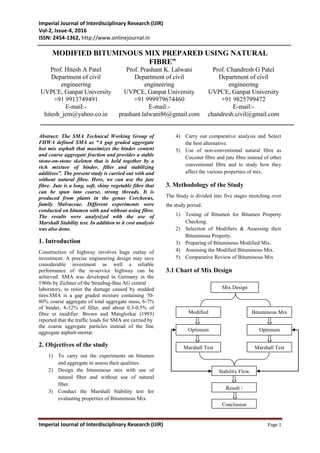
3. Methodology of the Study
The Study is divided into five stages stretching over
the study period.
1) Testing of Bitumen for Bitumen Property
Checking.
2) Selection of Modifiers & Assessing their
Bituminous Property.
3) Preparing of Bituminous Modified Mix.
4) Assessing the Modified Bituminous Mix.
5) Comparative Review of Bituminous Mix
3.1 Chart of Mix Design
Mix Design
Marshall Test
Optimum
Binder Content
Conclusion
Result /
Analysis
Stability Flow
Marshall Test
Optimum
Binder Content
Bituminous MixModified
Bituminous
Mix
Imperial Journal of Interdisciplinary Research (IJIR)
Vol-2, Issue-4, 2016
ISSN: 2454-1362, http://www.onlinejournal.in
Imperial Journal of Interdisciplinary Research (IJIR) Page 2
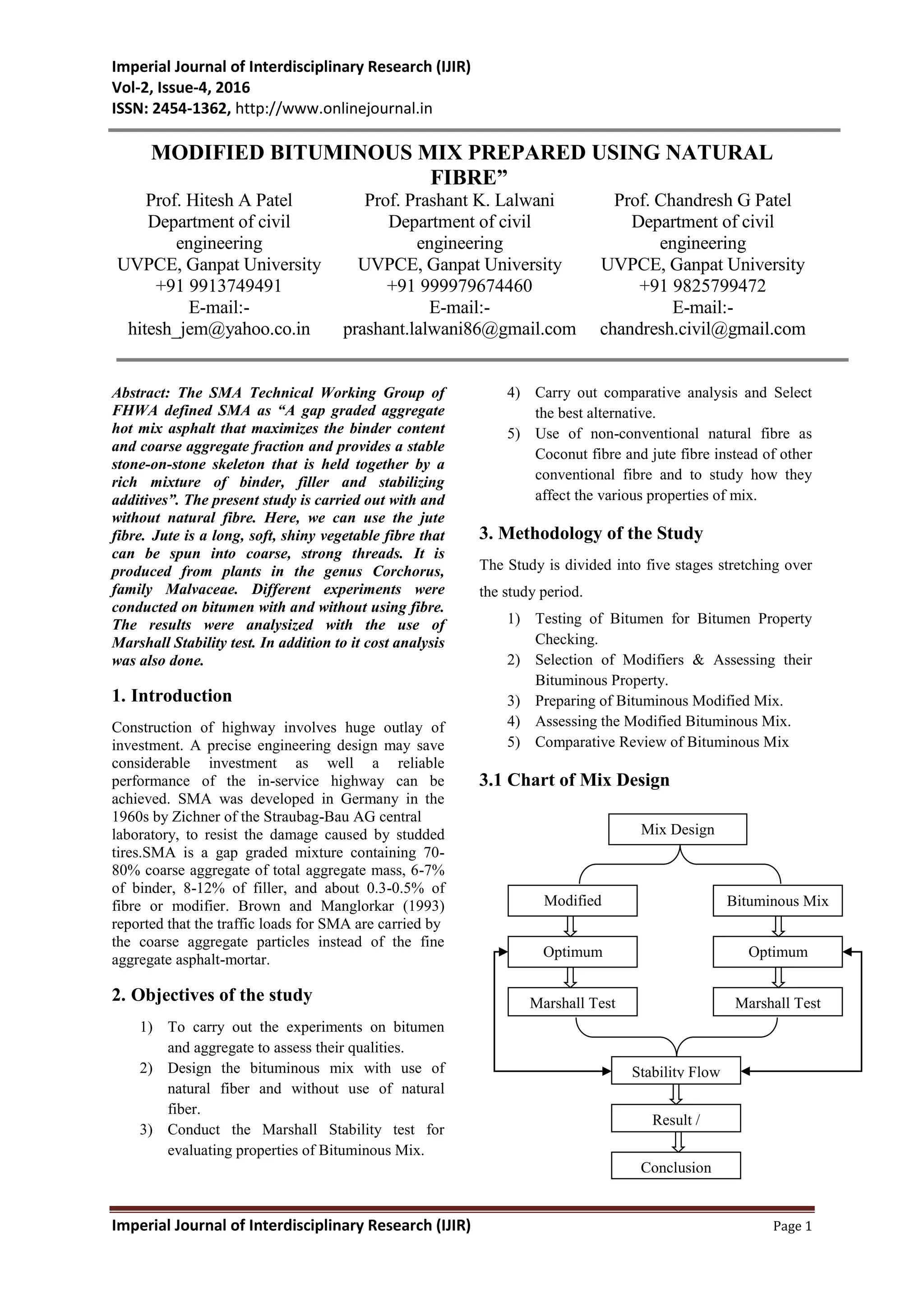
3.2 Methodology for Testing
Bituminous Materials are tested in accordance with
relevant IS codes & aggregates were tested for
suitability in Bituminous concrete show in table 1
and table 2 are as under below.
Table 1. Tests for Bitumen
Types of test Test method
Ductility Test IS: 1208-1978
Softening Point Test IS: 1205-1978
Specific gravity Test IS: 23869(Part III)
Penetration Test IS: 1203-1978
Flash and fire point Test IS: 1209-1978
Viscosity Test IS: 1206-1978
Table 2. Tests for Aggregate
Types of test Test method
Grading / Sieve Analysis IS:2386-1963(PART I)
Specific gravity Test IS:2386-1963(PART III)
Abrasion value Test IS:2386-1963(PART III)
Impact value Test IS:2386-1963(PART IV)
3.3 Marshall Stability Test
Before preparing the specimens for Marshall Test, it
is required that following steps.
Material proposed for use the gradation requirements
of the project specifications.
The blend combinations meet the gradation
requirements of the project specifications.
Therefore use in density and voids analysis the pulse
specific gravity of all aggregate
used in the blend and the specific gravity of asphalt
are determined.
1. Number of Specimen
At least three specimens are prepared for each
combination of aggregates and bitumen content.
2. Preparation of aggregate
Aggregate are dried to temperature at 1050ºC –
1100C and separation by dry sieving into desired size
fractions.
3. Sieve analysis of aggregates
Numbers of trials are done to fix the proportion of
different aggregate by sieve analysis. This portion is
very important in bitumen mix design.
4. Preparation of mixing and compaction
temperature
Bitumen is heated to about 1300C to 1450C so that
the water vapour present in it is evaporated. The
bitumen is mixed thoroughly with aggregates by
manually or mechanically.
5. Preparation of mould and hammer
Specimen mould and compaction hammer are
cleaned thoroughly and mould assembly is heated in
hot air oven to a temperature of about 1500C. A little
grease is applied to the mould before the mix is
placed in the mould.
6. Preparation of Specimen
The amount of each size of fraction required to
produce a mixed aggregate of 1200 Kg. as per
gradation is weighted. The required height of
specimen is 63.5±1 mm. aggregate and bitumen is
heated separately to the require temperatures. Then
bitumen is poured in aggregate as per requirement.
Then mixture is mixed till a uniform coating of
bitumen is obtained on aggregate. This is obtained at
about 1500C.
Compaction of the Specimen
Mould is assembled and a little grease is applied to
it. Mix is transferred into 3 layers and each layer
being tamped with spatula by 25 times. Then 75
blows are applied through manually electrically
operated compactor. Then same numbers of blows
are applied on the other side of mould. Then the
specimen is allowed to cool, once the specimen
comes to room temperature de-mould is carried out.
8. Application of water bath
Before testing mould on Marshall Apparatus, the
moulds are followed to keep in the water bath for 30
minutes at 600C. Mould should be tested within 3 to
4 minutes after taken out from water bath.
Imperial Journal of Interdisciplinary Research (IJIR)
Vol-2, Issue-4, 2016
ISSN: 2454-1362, http://www.onlinejournal.in
Imperial Journal of Interdisciplinary Research (IJIR) Page 3
9. Finalizing the Sample
We made a final sample of the bituminous mix with
and without fibre.
4. Result and Discussion
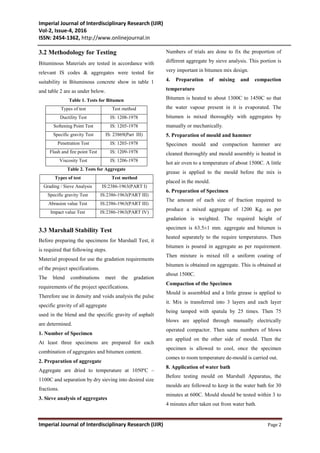
4.1 Optimum Fibre Content
First we find the Optimum fibre content at the 5.5 %
of bituminous mix design of Marshall Stability test
Result. We take the 0.2 %, 0.3 %, 0.4 % fibre and
check the Stability, Density and Flow. In table 4 we
show that we get maximum stability and density at
the 0.3 % adding of Jute fibre. Hence we take 0.3 %
fibre and conducting the test at 5.0 %, 5.5 %, 6.0 %
and 6.5 % bituminous mix design without fibre, with
jute fibre. It is mentioned earlier that one type of
binders, namely 60/70 penetration grade bitumen
binder have been used in the SMA mixes with and
without coconut fibre, and jute fibre in this
investigation. The details result for bitumen test,
aggregate test , optimum fibre content and Marshall
Stability test are given as below.
Table 3. Results for Bitumen
Table 4. Results for Aggregate
Table 5. Results for Aggregate
Figure: - performing the experiment
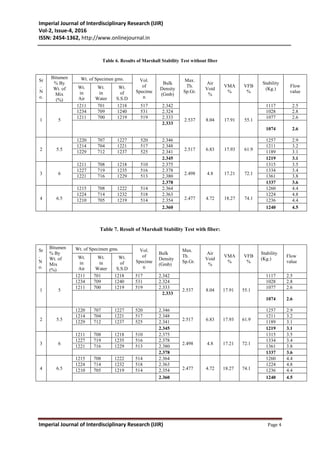
4.2 Marshall Stability Test result
Tests were performed on different bitumen content
like 5%, 5.5%, 6% and 6.5%.
Tests results shown in following tables.
Property Test Value
Penetration 83 mm
Ductility >100 mm
Softening point 48.5
Flash Point 278
Specific Gravity 1.003
Ash content 0.5 - 0.8%
Pectin 0.2 - 0.5%
Property
Test
Value
Specific Gravity 2.65
Abrasion value 14.98
Impact value 14.71
Water absorption 0.5
Flakiness &
Elongation
26.79
S
r
n
o.
Bit
u
mi
no
us
%
Fi
br
e
%
Without fibre With Jute fibre
Stabil
ity
Den
sity
flo
w
Sta
bilit
y
Densit
y
flo
w
1 5.5 0.2 1012 2.32 2.8 118
2
2.34 2.7
2 5.5 0.3 1100 2.35 2.7 130
7
2.36 2.6
3 5.5 0.4 1040 2.33 2.9 122
0
2.35 2.5
Imperial Journal of Interdisciplinary Research (IJIR)
Vol-2, Issue-4, 2016
ISSN: 2454-1362, http://www.onlinejournal.in
Imperial Journal of Interdisciplinary Research (IJIR) Page 4
Table 6. Results of Marshall Stability Test without fiber
Sr
.
N
o.
Bitumen
% By
Wt. of
Mix
(%)
Wt. of Specimen gms. Vol.
of
Specime
n
Bulk
Density
(Gmb)
Max.
Th.
Sp.Gr.
Air
Void
%
VMA
%
VFB
%
Stability
(Kg.)
Flow
value
Wt.
in
Air
Wt.
in
Water
Wt.
of
S.S.D
1 5
1211 701 1218 517 2.342
2.537 8.04 17.91 55.1
1117 2.5
1234 709 1240 531 2.324 1028 2.8
1211 700 1219 519 2.333 1077 2.6
2.333
1074 2.6
2 5.5
1220 707 1227 520 2.346
2.517 6.83 17.93 61.9
1257 2.9
1214 704 1221 517 2.348 1211 3.2
1229 712 1237 525 2.341 1189 3.1
2.345 1219 3.1
3 6
1211 708 1218 510 2.375
2.498 4.8 17.21 72.1
1315 3.5
1227 719 1235 516 2.378 1334 3.4
1221 716 1229 513 2.380 1361 3.8
2.378 1337 3.6
4 6.5
1215 708 1222 514 2.364
2.477 4.72 18.27 74.1
1260 4.4
1224 714 1232 518 2.363 1224 4.8
1210 705 1219 514 2.354 1236 4.4
2.360 1240 4.5
Table 7. Result of Marshall Stability Test with fiber:
Sr
.
N
o.
Bitumen
% By
Wt. of
Mix
(%)
Wt. of Specimen gms. Vol.
of
Specime
n
Bulk
Density
(Gmb)
Max.
Th.
Sp.Gr.
Air
Void
%
VMA
%
VFB
%
Stability
(Kg.)
Flow
value
Wt.
in
Air
Wt.
in
Water
Wt.
of
S.S.D
1 5
1211 701 1218 517 2.342
2.537 8.04 17.91 55.1
1117 2.5
1234 709 1240 531 2.324 1028 2.8
1211 700 1219 519 2.333 1077 2.6
2.333
1074 2.6
2 5.5
1220 707 1227 520 2.346
2.517 6.83 17.93 61.9
1257 2.9
1214 704 1221 517 2.348 1211 3.2
1229 712 1237 525 2.341 1189 3.1
2.345 1219 3.1
3 6
1211 708 1218 510 2.375
2.498 4.8 17.21 72.1
1315 3.5
1227 719 1235 516 2.378 1334 3.4
1221 716 1229 513 2.380 1361 3.8
2.378 1337 3.6
4 6.5
1215 708 1222 514 2.364
2.477 4.72 18.27 74.1
1260 4.4
1224 714 1232 518 2.363 1224 4.8
1210 705 1219 514 2.354 1236 4.4
2.360 1240 4.5
Imperial Journal of Interdisciplinary Research (IJIR)
Vol-2, Issue-4, 2016
ISSN: 2454-1362, http://www.onlinejournal.in
Imperial Journal of Interdisciplinary Research (IJIR) Page 5
5. Cost Estimation
The cost estimation for the under mentioned project
road link (1km) have been calculated based on the
detailed quantities worked out for various items of
work to be executed in the project . The quantity for
preparing unit volume of Binder Course layers have
been worked out along with Rate analysis as per
R&B SOR 2008-09.
We propose the material used in binder course there
is about 2.19 % cost increase in SMA. In SMA using
jute fibre min cost is increase but we increase the
stability and density and decrease the air void.
6. Conclusion:-
It is observed that with increase in binder content the
Marshall Stability value increases up to certain
binder content and then decreases, like conventional
bituminous mixes. In general the Marshall stability is
found to be maximum for in addition of jute fibre as
compared to the without fibre. Marshall Stability also
found adding 0.3 % jute fibre in sample we get
maximum stability as compared to without fibre
mould.
The flow value increases with increase in binder
content and decreases with increase in stiffness of the
binder. When fibre is added to the mix, the flow
value further decreases as compared to normal Mix
without fibre.
The amount of air voids decreases with increase in
binder content in the mix. It also increases or
decreases depending on the percentage of fibre
content in the mix. The mix is observed to have the
lowest air voids at 0.3% fibre content in the mix.
The optimum binder content (OBC) of the mixes,
based on the Marshall test results taking 4% air voids
as the main criterion are observed to increase with
increase in stiffness of the binder.
References
[1] Beena k. S." Coir Fibre as a Stabilizing Additive in
Stone Mastic". International Journal of Earth Sciences and
Engineering. 2011 4 (1), pp. 165-177.
[2] Sayyed Mahdi Abtahi "Hybrid Reinforcement of
Asphalt-Concrete Mixtures. Journal of Engineered Fibers
and Fabric". 2013, 8 (2).
[3] Abdelaziz mahrez "fatigue and deformation properties
of glass fiber reinforced". Journal of the Eastern Asia
Society for Transportation Studies. 6 (-),pp. 997 - 1007.
[4] G.N. Narlule "An experimental study of flexible
pavement by using crumb". International journal of pure.
2013, 1 (8), pp. 141-149.
[5] Ami Gawande "Utilization of waste plastic in
asphalting of roads" Sci. Revs. Chem. Commun. 2012, pp.
147-157.
[6] Bindu C.S. "Waste plastic as a stabilizing additive in".
International Journal of Engineering and Technology. 2
(6), 2010, pp. 379-387
[7] Debashish kar "A Laboratory study of bituminous
mixes using a natural fibre" National Institute of
technology, Rourkela-2012.
Books
S.K., Khanna and C.E. Jasto , Highway Engg.
.Roorkee: Nem chand & Bros publication, 2011.
S.C. Rangwala , Highway Engg , Anand: Charotar
Publication, 2007.

Modified bituminious mix prepared using natural fibre

  • 1.
    Imperial Journal ofInterdisciplinary Research (IJIR) Vol-2, Issue-4, 2016 ISSN: 2454-1362, http://www.onlinejournal.in Imperial Journal of Interdisciplinary Research (IJIR) Page 1 MODIFIED BITUMINOUS MIX PREPARED USING NATURAL FIBRE” Prof. Hitesh A Patel Department of civil engineering UVPCE, Ganpat University +91 9913749491 E-mail:- hitesh_jem@yahoo.co.in Prof. Prashant K. Lalwani Department of civil engineering UVPCE, Ganpat University +91 999979674460 E-mail:- prashant.lalwani86@gmail.com Prof. Chandresh G Patel Department of civil engineering UVPCE, Ganpat University +91 9825799472 E-mail:- chandresh.civil@gmail.com Abstract: The SMA Technical Working Group of FHWA defined SMA as “A gap graded aggregate hot mix asphalt that maximizes the binder content and coarse aggregate fraction and provides a stable stone-on-stone skeleton that is held together by a rich mixture of binder, filler and stabilizing additives”. The present study is carried out with and without natural fibre. Here, we can use the jute fibre. Jute is a long, soft, shiny vegetable fibre that can be spun into coarse, strong threads. It is produced from plants in the genus Corchorus, family Malvaceae. Different experiments were conducted on bitumen with and without using fibre. The results were analysized with the use of Marshall Stability test. In addition to it cost analysis was also done. 1. Introduction Construction of highway involves huge outlay of investment. A precise engineering design may save considerable investment as well a reliable performance of the in-service highway can be achieved. SMA was developed in Germany in the 1960s by Zichner of the Straubag-Bau AG central laboratory, to resist the damage caused by studded tires.SMA is a gap graded mixture containing 70- 80% coarse aggregate of total aggregate mass, 6-7% of binder, 8-12% of filler, and about 0.3-0.5% of fibre or modifier. Brown and Manglorkar (1993) reported that the traffic loads for SMA are carried by the coarse aggregate particles instead of the fine aggregate asphalt-mortar. 2. Objectives of the study 1) To carry out the experiments on bitumen and aggregate to assess their qualities. 2) Design the bituminous mix with use of natural fiber and without use of natural fiber. 3) Conduct the Marshall Stability test for evaluating properties of Bituminous Mix. 4) Carry out comparative analysis and Select the best alternative. 5) Use of non-conventional natural fibre as Coconut fibre and jute fibre instead of other conventional fibre and to study how they affect the various properties of mix. 3. Methodology of the Study The Study is divided into five stages stretching over the study period. 1) Testing of Bitumen for Bitumen Property Checking. 2) Selection of Modifiers & Assessing their Bituminous Property. 3) Preparing of Bituminous Modified Mix. 4) Assessing the Modified Bituminous Mix. 5) Comparative Review of Bituminous Mix 3.1 Chart of Mix Design Mix Design Marshall Test Optimum Binder Content Conclusion Result / Analysis Stability Flow Marshall Test Optimum Binder Content Bituminous MixModified Bituminous Mix
  • 2.
    Imperial Journal ofInterdisciplinary Research (IJIR) Vol-2, Issue-4, 2016 ISSN: 2454-1362, http://www.onlinejournal.in Imperial Journal of Interdisciplinary Research (IJIR) Page 2 3.2 Methodology for Testing Bituminous Materials are tested in accordance with relevant IS codes & aggregates were tested for suitability in Bituminous concrete show in table 1 and table 2 are as under below. Table 1. Tests for Bitumen Types of test Test method Ductility Test IS: 1208-1978 Softening Point Test IS: 1205-1978 Specific gravity Test IS: 23869(Part III) Penetration Test IS: 1203-1978 Flash and fire point Test IS: 1209-1978 Viscosity Test IS: 1206-1978 Table 2. Tests for Aggregate Types of test Test method Grading / Sieve Analysis IS:2386-1963(PART I) Specific gravity Test IS:2386-1963(PART III) Abrasion value Test IS:2386-1963(PART III) Impact value Test IS:2386-1963(PART IV) 3.3 Marshall Stability Test Before preparing the specimens for Marshall Test, it is required that following steps. Material proposed for use the gradation requirements of the project specifications. The blend combinations meet the gradation requirements of the project specifications. Therefore use in density and voids analysis the pulse specific gravity of all aggregate used in the blend and the specific gravity of asphalt are determined. 1. Number of Specimen At least three specimens are prepared for each combination of aggregates and bitumen content. 2. Preparation of aggregate Aggregate are dried to temperature at 1050ºC – 1100C and separation by dry sieving into desired size fractions. 3. Sieve analysis of aggregates Numbers of trials are done to fix the proportion of different aggregate by sieve analysis. This portion is very important in bitumen mix design. 4. Preparation of mixing and compaction temperature Bitumen is heated to about 1300C to 1450C so that the water vapour present in it is evaporated. The bitumen is mixed thoroughly with aggregates by manually or mechanically. 5. Preparation of mould and hammer Specimen mould and compaction hammer are cleaned thoroughly and mould assembly is heated in hot air oven to a temperature of about 1500C. A little grease is applied to the mould before the mix is placed in the mould. 6. Preparation of Specimen The amount of each size of fraction required to produce a mixed aggregate of 1200 Kg. as per gradation is weighted. The required height of specimen is 63.5±1 mm. aggregate and bitumen is heated separately to the require temperatures. Then bitumen is poured in aggregate as per requirement. Then mixture is mixed till a uniform coating of bitumen is obtained on aggregate. This is obtained at about 1500C. Compaction of the Specimen Mould is assembled and a little grease is applied to it. Mix is transferred into 3 layers and each layer being tamped with spatula by 25 times. Then 75 blows are applied through manually electrically operated compactor. Then same numbers of blows are applied on the other side of mould. Then the specimen is allowed to cool, once the specimen comes to room temperature de-mould is carried out. 8. Application of water bath Before testing mould on Marshall Apparatus, the moulds are followed to keep in the water bath for 30 minutes at 600C. Mould should be tested within 3 to 4 minutes after taken out from water bath.
  • 3.
    Imperial Journal ofInterdisciplinary Research (IJIR) Vol-2, Issue-4, 2016 ISSN: 2454-1362, http://www.onlinejournal.in Imperial Journal of Interdisciplinary Research (IJIR) Page 3 9. Finalizing the Sample We made a final sample of the bituminous mix with and without fibre. 4. Result and Discussion 4.1 Optimum Fibre Content First we find the Optimum fibre content at the 5.5 % of bituminous mix design of Marshall Stability test Result. We take the 0.2 %, 0.3 %, 0.4 % fibre and check the Stability, Density and Flow. In table 4 we show that we get maximum stability and density at the 0.3 % adding of Jute fibre. Hence we take 0.3 % fibre and conducting the test at 5.0 %, 5.5 %, 6.0 % and 6.5 % bituminous mix design without fibre, with jute fibre. It is mentioned earlier that one type of binders, namely 60/70 penetration grade bitumen binder have been used in the SMA mixes with and without coconut fibre, and jute fibre in this investigation. The details result for bitumen test, aggregate test , optimum fibre content and Marshall Stability test are given as below. Table 3. Results for Bitumen Table 4. Results for Aggregate Table 5. Results for Aggregate Figure: - performing the experiment 4.2 Marshall Stability Test result Tests were performed on different bitumen content like 5%, 5.5%, 6% and 6.5%. Tests results shown in following tables. Property Test Value Penetration 83 mm Ductility >100 mm Softening point 48.5 Flash Point 278 Specific Gravity 1.003 Ash content 0.5 - 0.8% Pectin 0.2 - 0.5% Property Test Value Specific Gravity 2.65 Abrasion value 14.98 Impact value 14.71 Water absorption 0.5 Flakiness & Elongation 26.79 S r n o. Bit u mi no us % Fi br e % Without fibre With Jute fibre Stabil ity Den sity flo w Sta bilit y Densit y flo w 1 5.5 0.2 1012 2.32 2.8 118 2 2.34 2.7 2 5.5 0.3 1100 2.35 2.7 130 7 2.36 2.6 3 5.5 0.4 1040 2.33 2.9 122 0 2.35 2.5
  • 4.
    Imperial Journal ofInterdisciplinary Research (IJIR) Vol-2, Issue-4, 2016 ISSN: 2454-1362, http://www.onlinejournal.in Imperial Journal of Interdisciplinary Research (IJIR) Page 4 Table 6. Results of Marshall Stability Test without fiber Sr . N o. Bitumen % By Wt. of Mix (%) Wt. of Specimen gms. Vol. of Specime n Bulk Density (Gmb) Max. Th. Sp.Gr. Air Void % VMA % VFB % Stability (Kg.) Flow value Wt. in Air Wt. in Water Wt. of S.S.D 1 5 1211 701 1218 517 2.342 2.537 8.04 17.91 55.1 1117 2.5 1234 709 1240 531 2.324 1028 2.8 1211 700 1219 519 2.333 1077 2.6 2.333 1074 2.6 2 5.5 1220 707 1227 520 2.346 2.517 6.83 17.93 61.9 1257 2.9 1214 704 1221 517 2.348 1211 3.2 1229 712 1237 525 2.341 1189 3.1 2.345 1219 3.1 3 6 1211 708 1218 510 2.375 2.498 4.8 17.21 72.1 1315 3.5 1227 719 1235 516 2.378 1334 3.4 1221 716 1229 513 2.380 1361 3.8 2.378 1337 3.6 4 6.5 1215 708 1222 514 2.364 2.477 4.72 18.27 74.1 1260 4.4 1224 714 1232 518 2.363 1224 4.8 1210 705 1219 514 2.354 1236 4.4 2.360 1240 4.5 Table 7. Result of Marshall Stability Test with fiber: Sr . N o. Bitumen % By Wt. of Mix (%) Wt. of Specimen gms. Vol. of Specime n Bulk Density (Gmb) Max. Th. Sp.Gr. Air Void % VMA % VFB % Stability (Kg.) Flow value Wt. in Air Wt. in Water Wt. of S.S.D 1 5 1211 701 1218 517 2.342 2.537 8.04 17.91 55.1 1117 2.5 1234 709 1240 531 2.324 1028 2.8 1211 700 1219 519 2.333 1077 2.6 2.333 1074 2.6 2 5.5 1220 707 1227 520 2.346 2.517 6.83 17.93 61.9 1257 2.9 1214 704 1221 517 2.348 1211 3.2 1229 712 1237 525 2.341 1189 3.1 2.345 1219 3.1 3 6 1211 708 1218 510 2.375 2.498 4.8 17.21 72.1 1315 3.5 1227 719 1235 516 2.378 1334 3.4 1221 716 1229 513 2.380 1361 3.8 2.378 1337 3.6 4 6.5 1215 708 1222 514 2.364 2.477 4.72 18.27 74.1 1260 4.4 1224 714 1232 518 2.363 1224 4.8 1210 705 1219 514 2.354 1236 4.4 2.360 1240 4.5
  • 5.
    Imperial Journal ofInterdisciplinary Research (IJIR) Vol-2, Issue-4, 2016 ISSN: 2454-1362, http://www.onlinejournal.in Imperial Journal of Interdisciplinary Research (IJIR) Page 5 5. Cost Estimation The cost estimation for the under mentioned project road link (1km) have been calculated based on the detailed quantities worked out for various items of work to be executed in the project . The quantity for preparing unit volume of Binder Course layers have been worked out along with Rate analysis as per R&B SOR 2008-09. We propose the material used in binder course there is about 2.19 % cost increase in SMA. In SMA using jute fibre min cost is increase but we increase the stability and density and decrease the air void. 6. Conclusion:- It is observed that with increase in binder content the Marshall Stability value increases up to certain binder content and then decreases, like conventional bituminous mixes. In general the Marshall stability is found to be maximum for in addition of jute fibre as compared to the without fibre. Marshall Stability also found adding 0.3 % jute fibre in sample we get maximum stability as compared to without fibre mould. The flow value increases with increase in binder content and decreases with increase in stiffness of the binder. When fibre is added to the mix, the flow value further decreases as compared to normal Mix without fibre. The amount of air voids decreases with increase in binder content in the mix. It also increases or decreases depending on the percentage of fibre content in the mix. The mix is observed to have the lowest air voids at 0.3% fibre content in the mix. The optimum binder content (OBC) of the mixes, based on the Marshall test results taking 4% air voids as the main criterion are observed to increase with increase in stiffness of the binder. References [1] Beena k. S." Coir Fibre as a Stabilizing Additive in Stone Mastic". International Journal of Earth Sciences and Engineering. 2011 4 (1), pp. 165-177. [2] Sayyed Mahdi Abtahi "Hybrid Reinforcement of Asphalt-Concrete Mixtures. Journal of Engineered Fibers and Fabric". 2013, 8 (2). [3] Abdelaziz mahrez "fatigue and deformation properties of glass fiber reinforced". Journal of the Eastern Asia Society for Transportation Studies. 6 (-),pp. 997 - 1007. [4] G.N. Narlule "An experimental study of flexible pavement by using crumb". International journal of pure. 2013, 1 (8), pp. 141-149. [5] Ami Gawande "Utilization of waste plastic in asphalting of roads" Sci. Revs. Chem. Commun. 2012, pp. 147-157. [6] Bindu C.S. "Waste plastic as a stabilizing additive in". International Journal of Engineering and Technology. 2 (6), 2010, pp. 379-387 [7] Debashish kar "A Laboratory study of bituminous mixes using a natural fibre" National Institute of technology, Rourkela-2012. Books S.K., Khanna and C.E. Jasto , Highway Engg. .Roorkee: Nem chand & Bros publication, 2011. S.C. Rangwala , Highway Engg , Anand: Charotar Publication, 2007.