Scan of BE cover
Extradosed and cable-stayed
bridges; exploring the
boundaries1
Summary presentation of a paper published in ICE
Proceedings; Bridge Engineering; December 2013.
The full paper can be read at
http://www.icevirtuallibrary.com/content/issue/bren/166/4
Authors
David Collings BSc
CEng FICE

A S Gonzalez BEng
ITOP MSc
Introduction
The extradosed bridge can be thought of
as an intermediate between the girder
and cantilever bridge forms.
The paper 1 explores the boundaries of
this form of bridge to define them more
clearly.
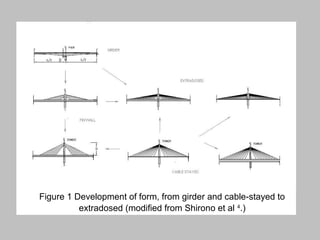
Figure 1 Development of form, from girder and cable-stayed to
extradosed (modified from Shirono et al 4.)
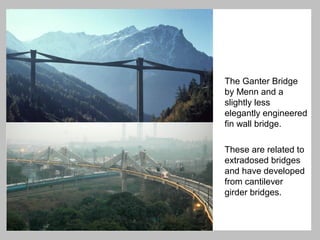
The Ganter Bridge
by Menn and a
slightly less
elegantly engineered
fin wall bridge.
These are related to
extradosed bridges
and have developed
from cantilever
girder bridges.
The study
The paper 1 summarises previous work
on extradosed bridges and then outlines
the author’s findings from their own
parametric study of a bridge at the
boundary between cable stayed and
extradosed.
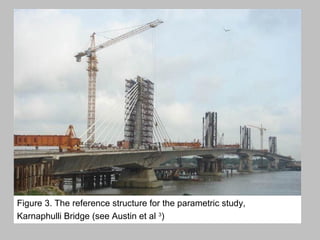
Figure 3. The reference structure for the parametric study,
Karnaphulli Bridge (see Austin et al 3)
Parameters
The key parameters of extradosed
bridges are outlined and compared with
those for girder and cable-stayed
bridges.
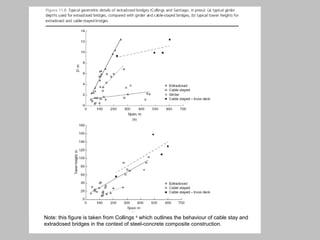
Note: this figure is taken from Collings 4 which outlines the behaviour of cable stay and
extradosed bridges in the context of steel-concrete composite construction.
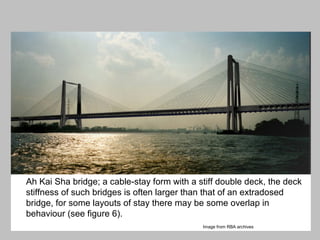
Ahkai Sha Bridge a stiff decked
cable-stayed form

Ah Kai Sha bridge; a cable-stay form with a stiff double deck, the deck
stiffness of such bridges is often larger than that of an extradosed
bridge, for some layouts of stay there may be some overlap in
behaviour (see figure 6).
Image from RBA archives
Parameters (continued)
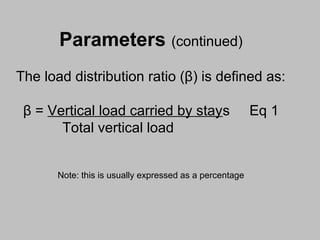
The load distribution ratio (β) is defined as:
β = Vertical load carried by stays
Total vertical load
Note: this is usually expressed as a percentage

Eq 1
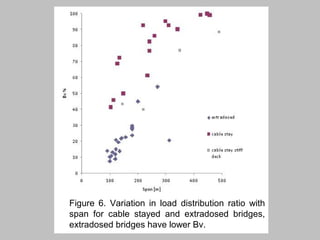
Figure 6. Variation in load distribution ratio with
span for cable stayed and extradosed bridges,
extradosed bridges have lower Bv.
Summary
A clearer definition of an extradosed
bridge is offered based on this work.
Definition
“ … The extradosed bridge is a form of
cable-stayed bridge… ”
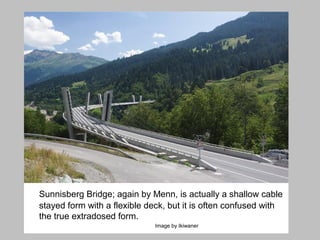
Sunnisberg Bridge; again by Menn, is actually a shallow cable
stayed form with a flexible deck, but it is often confused with
the true extradosed form.
Image by Ikiwaner
Definition (continued)
“ … it has a short tower and a relatively
stiff girder; the arrangement of girder,
tower and stays will have been chosen to
ensure the girder stiffness is significant
compared with that of the cables, such that
the girder carries the majority the live load
(βp + βv ≤ 125).”
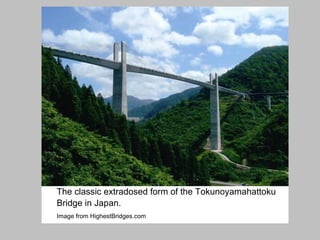
The classic extradosed form of the Tokunoyamahattoku
Bridge in Japan.
Image from HighestBridges.com
Conclusion
 A clearer definition of an extradosed bridge
is offered by the paper 1.
 The extradosed bridge is a form of
cable-stayed bridge.
 The form is best defined using the load
distribution ratio.
 The full paper can be read at
http://www.icevirtuallibrary.com/content/issue/bren/166/4
References
1. Collings D, Santiago A S, Extradosed and cable
stayed Bridges: Exploring the boundaries, Proc ICE BE
166, Dec 2013, pp 231-239.
2. Collings D, (2005), Steel-concrete composite bridges,
Thomas Telford, London.
3. Astin D, Xie H, Gillarduzzi A (2010), Design and
construction of Third Karnaphuli Bridge, Bangladesh,
Proc ICE, BE163, Dec 2010, pp 161-171.
4. Shirono Y, Takuwa I, Kasuga A, Okamoto H (1993),
The design of an extradosed prestressed concrete
bridge – The Odawara Port Bridge, FIP Symposium 93,
Kyoto, Japan, Oct. 17-20, 1993, pp 959– 966
Presentation by CRD and Wolf
productions.
The full paper can be read at
http://www.icevirtuallibrary.com/content/issue/bren/166/4

Extradosed Bridges: Exploring the Boundaries

  • 1.
  • 2.
    Extradosed and cable-stayed bridges;exploring the boundaries1 Summary presentation of a paper published in ICE Proceedings; Bridge Engineering; December 2013. The full paper can be read at http://www.icevirtuallibrary.com/content/issue/bren/166/4
  • 3.
    Authors David Collings BSc CEngFICE A S Gonzalez BEng ITOP MSc
  • 4.
    Introduction The extradosed bridgecan be thought of as an intermediate between the girder and cantilever bridge forms. The paper 1 explores the boundaries of this form of bridge to define them more clearly.
  • 5.
    Figure 1 Developmentof form, from girder and cable-stayed to extradosed (modified from Shirono et al 4.)
  • 6.
    The Ganter Bridge byMenn and a slightly less elegantly engineered fin wall bridge. These are related to extradosed bridges and have developed from cantilever girder bridges.
  • 7.
    The study The paper1 summarises previous work on extradosed bridges and then outlines the author’s findings from their own parametric study of a bridge at the boundary between cable stayed and extradosed.
  • 8.
    Figure 3. Thereference structure for the parametric study, Karnaphulli Bridge (see Austin et al 3)
  • 9.
    Parameters The key parametersof extradosed bridges are outlined and compared with those for girder and cable-stayed bridges.
  • 10.
    Note: this figureis taken from Collings 4 which outlines the behaviour of cable stay and extradosed bridges in the context of steel-concrete composite construction.
  • 11.
    Ahkai Sha Bridgea stiff decked cable-stayed form Ah Kai Sha bridge; a cable-stay form with a stiff double deck, the deck stiffness of such bridges is often larger than that of an extradosed bridge, for some layouts of stay there may be some overlap in behaviour (see figure 6). Image from RBA archives
  • 12.
    Parameters (continued) The loaddistribution ratio (β) is defined as: β = Vertical load carried by stays Total vertical load Note: this is usually expressed as a percentage Eq 1
  • 13.
    Figure 6. Variationin load distribution ratio with span for cable stayed and extradosed bridges, extradosed bridges have lower Bv.
  • 14.
    Summary A clearer definitionof an extradosed bridge is offered based on this work.
  • 15.
    Definition “ … Theextradosed bridge is a form of cable-stayed bridge… ”
  • 16.
    Sunnisberg Bridge; againby Menn, is actually a shallow cable stayed form with a flexible deck, but it is often confused with the true extradosed form. Image by Ikiwaner
  • 17.
    Definition (continued) “ …it has a short tower and a relatively stiff girder; the arrangement of girder, tower and stays will have been chosen to ensure the girder stiffness is significant compared with that of the cables, such that the girder carries the majority the live load (βp + βv ≤ 125).”
  • 18.
    The classic extradosedform of the Tokunoyamahattoku Bridge in Japan. Image from HighestBridges.com
  • 19.
    Conclusion  A clearerdefinition of an extradosed bridge is offered by the paper 1.  The extradosed bridge is a form of cable-stayed bridge.  The form is best defined using the load distribution ratio.  The full paper can be read at http://www.icevirtuallibrary.com/content/issue/bren/166/4
  • 20.
    References 1. Collings D,Santiago A S, Extradosed and cable stayed Bridges: Exploring the boundaries, Proc ICE BE 166, Dec 2013, pp 231-239. 2. Collings D, (2005), Steel-concrete composite bridges, Thomas Telford, London. 3. Astin D, Xie H, Gillarduzzi A (2010), Design and construction of Third Karnaphuli Bridge, Bangladesh, Proc ICE, BE163, Dec 2010, pp 161-171. 4. Shirono Y, Takuwa I, Kasuga A, Okamoto H (1993), The design of an extradosed prestressed concrete bridge – The Odawara Port Bridge, FIP Symposium 93, Kyoto, Japan, Oct. 17-20, 1993, pp 959– 966
  • 21.
    Presentation by CRDand Wolf productions. The full paper can be read at http://www.icevirtuallibrary.com/content/issue/bren/166/4