“RCC DESIGN AND DETAILING AS PER
REVISED
SEISMIC CODES”
presented by
Sangeeta Wij,
Managing Partner,
SD Engineering Consultants LLP
VP North, IAStructE
Important provisions of revised Seismic
Codes affecting RCC design and detailing
• Planning of building Configuration as per definition of Regular
Geometry in BIS:1893 has been revised
• Load Combinations have been revised as Vertical Earthquake
Force(with Sa/g=2.5) is now mandatory for all Zone 4 and 5 buildings.
• Stiffness modifiers have been incorporated (Attn: Software Vendors)
• Flat Slabs, Precast, PT systems to be used only after performing Non
Linear Analysis and adequate experimentation
• Floating/Stub Columns have been completely prohibited
• Open Storeys need to incorporate bracings/RC Shear Walls
• Design eccentricity at every floor has been revised and must be
checked accordingly(Attn: Software vendors)
• Importance Factors have been revised to 1.2 min.for >200 occupancy
buildings and minimum Earthquake Shear specified for all zones
Important provisions of revised
Codes…continued
• Foundations: No Isolated footings to be provided if Nc< 10
• Columns: minimum size to be 20dia(beam reinforcement
passing through the column) or 300mm
• Strong Columns only allowed to participate in resisting
Lateral Loads(check if Column strength >1.4 times Beam
Strength at every joint)
• All other columns to be designed as Gravity columns and
checked for bending/shear induced by R times
displacement.(Attn: Software Vendors)
• Beams: Ductility provisions to be similar to that of columns
and spacing governed by the same formula, maximum
ductile spacing is now 100mm
(Attn: Software Vendors)
Queries for BIS
• Way forward to be mandated for existing/under
construction buildings not conforming to current
provisions, especially Flat Slabs and PT buildings
without Adequate Shear Walls to carry 100% Base
Shear
• Way forward for Irregular Geometries under various
clauses to be clarified as 3D analysis is always carried
out these days for all important Projects, and referring
to specialist literature to correct irregularity cannot be
a Way Forward.
• Non Tower Area Columns’ and retaining Walls’ design
in large high rise developments may be covered in
more detail
S.No IS:13920;1993 IS:13920;2016
1. GENERAL
SPECIFIC
ATION
As per 1.1.2
• The provisions for RC
construction given
herein apply
specifically to
monolithic
reinforced concrete
construction.
• Precast and/or
prestressed concrete
members may be used
only if they can
provide the same level
of ductility as that of a
monolithic reinforced
concrete construction
during or after an
earthquake.
As per 1.1.2
• The provisions for RC construction given
herein apply specifically to monolithic
reinforced concrete construction.
• Precast and/or prestressed concrete
members may be used only if they can
provide the same level of ductility as that
of a monolithic reinforced concrete
construction during or after an
earthquake.
• Likewise, flat slab structures must have a
lateral load resisting systems capable of
providing similar level of performance as
envisioned in this standard and must be
designed for drift compatibility as per 11.
• Specialist literature must be referred to for
design and construction of such structures.
The adequacy of such designs shall be
demonstrated by adequate, appropriate
experimentation and non-linear dynamic
structural analyses.
As per 1.1.3 of IS:13920;2016
 All RC frames, RC walls:
• need not be designed to resists lateral loads.
• The designer can identify the lateral load resisting system based on relative
stiffness and locations in the building and design those members for full lateral
force.
 RC monolithic members are assumed:
• not to participate in the lateral force resisting system
• their effect on the seismic response of the system is accounted for:
 Consequence of failure of structural and non-structural members, not part of the
lateral force resisting system shall also be considered in design.
IS:13920;1993 IS:13920;2016
A) As per clause 5.2
• For all buildings that are more than 3
story's in height, minimum grade of
concrete shall be M20 (fck = 20 MPa).
A) As per clause 5.2:
• Minimum grade of structural
concrete shall be M20, but M25
for buildings more than 15m in
height in Seismic Zones III, IV,
V; and
• But not less than that required
by IS 456 based on exposure
conditions.
• However, CPWD Specs of 2009
clause 5.1.2.1 (ii) states that
structural concrete shall be of
minimum grade M25.
2. FLEXURAL
MEMBERS/BEA
MS
IS 13920;1993 IS 13920;2016
As per clause 6.1.1:
• The factored axial
stress on the member
under earthquake
loading shall not
exceed 0.1 fck.
As per clause 6.1:
a) The factored axial compressive
stress does not exceed 0.08 fck.
As per clause 6.1.3
a) Beams shall not have depth D more
than 1/4th of clear span.
b) This may not apply to the floor
beam of the frame staging of
elevated RC water tank.
IS:13920;2016 FIG-1: BEAM-COLUMN JUNCTION
As per clause 6.1.4:
 Width of the beam bw
shall not exceed the
width of supporting
member c2 plus
distance on either side
of supporting member
equal to the smaller of
a) Width of supporting
member, c2
b) 0.75 times breadth of
supporting member,
c1
3. i) LONGITUDINAL
REINFORCEMENT
IS:13920;1993 IS:13920;2016
As per clause 6.2.1
a) The top as well as
bottom reinforcement
shall consist of at
least two bars
throughout the
member length.
As per clause 6.2.1
a) Beams shall have at
least 12mm diameter
bars each at the top and
bottom faces.
b) The tension steel ratio
on any face, at any
section, shall not be less
than:
ρmin=0.24√fck/f y
Where,
fck and fy are in MPA.
b) Minimum longitudinal
steel ρmin required on any
faceat any section is:
ρmin=0.24√fck/f y
II) SPLICING OF
LONGITUDINAL
BARS
IS: 13920;2016
As per 6.2.6.1
• Not more than
50% of area of
steel bars on
either top or
bottom face shall
be spliced at any
one section
.
III) TRANSVERSE
REINFORCEMENT
As per 6.3.4
 In the calculation
of design shear
force capacity of
RC beams,
contribution of
the following
shall not be
considered:
 Concrete in RC
section.
4. COLUMNS AND
INCLINED
MEMBERS
IS 13920;2016
i) Geometry As per 7.1
 For various shapes of columns like “T”shaped,”X”
shaped etc., appropriate designs and detailing shall be
carried out.
As per 7.1.1
The minimum dimension of a column shall not be less
than,
a) 20db,, or
b) 300mm
BUT FIG. SHOWS 15 Dia bar
 AS SHOWN ON NEXT SLIDE
IS:13920;1993 IS: 13920;2016
As per 7.1.3
• The ratio of the shortest
cross sectional dimension
to the perpendicular
dimension shall preferably
not be less than 0.4.
• E.g. let us assume
(300x400)mm section,
then we have,
b/d=0.66 , i.e. >0.45
Hence ok
As per 7.1.2
1. The cross-section aspect ratio (shall not
be less than ) 0.45.
• E.g. let us assume (200x400)mm section,
then we have, b/d=0.5, i.e. >0.45
• Hence ok
1. Vertical members of RC buildings whose
cross-section aspect ratio is less than 0.4
shall be designed as per requirements of9.
5. IS 13920;2016
AS PER 7.2
Relative Strengths of Beam and
Column at a Joint
As per 7.2.1
 At each beam-column joint of a
moment-resisting frame, the sum
of nominal design strength of
columns meeting at that joint (with
nominal strength calculated for the
factored axial load in the direction of
the lateral force under consideration
so as to give least column nominal
design strength) along each principal
plane shall be at least 1.4 times the
sum of nominal design strength of
beams meeting at that joint in the
same plane.
6. Longitudinal
Reinforcement
IS 13920:1993
As per 7.2.1
1. Lap splices shall be provided only in the central half of
the member length. It should be proportioned as a
tension splice.
1. Hoops shall be provided over the entire splice length at
spacing not exceeding 150 mm center to center. Not
more than 50 percent of the bars shall be spliced at one
section.
IS 13920;2016 As Per 7.3.2.1
Lap Splices
As per 7.3.2
Splicing of
Longitudinal
Reinforcement
1. When adopted, closed links shall be provided over the
entire length over which the longitudinal bars are
spliced. Further:
a) The spacing of these links shall not exceed
100mm.
b) The lap length shall not be less than the
developmental length of the largest longitudinal
reinforcement bar in tension.
c) Lap splices shall be provided only in the central
half of clear column height, and ????????
1) Within a joint, or
2) Within a distance of 2d from face of the beam.
d) Not more than 50 % of area of steel bars shall be
spliced at any one section.
Suggest laps in alternate bars , not consecutive
bars.
a) Lap splices shall not be used for bars of diameter
larger than 32mm for which mechanical splicing
shall be adopted.
IS 13920;1993 IS 13920;2016
As Per 7.2.2
• Any area of a column that extends more
than 100 mm beyond the confined core
due to architectural requirements shall be
detailed in the following manner.
• In case the contribution of this area to
strength has been considered, then it will
have the minimum longitudinal and
transverse reinforcement as per this code.
Transverse
Reinforcement As per 7.3.1
 A rectangular hoop is a closed
stirrup, having a 135° hook with a
10 diameter extension (but not < 75
mm) at each end, that is embedded in
the confined core (see Fig 7A).
As per 7.4.1
 In either case, the
closed link shall
have 135° hook
ends with an
extension of 6
times its diameter
(but not <65mm)
at end, which are
embedded in the
confined core of
the column (see
Fig. 10A).
IS 13920:2016
AS PER 7.4.2
1. When rectangular links are used:
a) the minimum diameter permitted of
transverse reinforcement bars is 8mm,
when diameter of longitudinal bar is
less than or equal to 32mm, and
10mm, when diameter of longitudinal
bar is more than 32mm,
2. A cross- tie shall be provided, if length of
any side of the link exceeds 300mm (see
fig 10B); the cross-section shall be placed
perpendicular to this link exceeds whose
length exceeds 300mm. Alternatively, a pair
of overlapping links may be provided
within the column (see Fig.10C). In either
case, the hook ends of the link and cross –
ties engaging the same longitudinal bars
shall have 90° hooks on opposite sides of
the column. Crossties of the same or
smaller bar.
7. Special Confining
Reinforcement IS 13920;1993 IS 13920;2016
. As per 7.4.5
1. Special confining
reinforcement shall be provided
over the full height of a column,
which has significant variation in
stiffness along its height.
2. This variation in stiffness may
result due to the presence of
bracing, a mezzanine floor or a
R.C.C. wall on either side of the
column that extends only over a
part of the column height (see
Fig. 12).
As per 8.1
1. Flexural Yielding is likely in
beams during strong
earthquake shaking and in
columns when the shaking
intensity exceeds the expected
intensity of earthquake
shaking (see fig 12).
As per 7.4.6
• The spacing of hoops used as
special confining reinforcement
shall not exceed 1/4 of
minimum member dimension
but need not be less than 75
mm nor more than 100 mm.
IS:13920;2016
• The area of cross-section, Ash,
of the bar forming circular
hoops or spiral, to be used as
special confining
reinforcement, shall not be less
than :-
Ash=0.09 SDkfck⁄fy (Ag⁄Ak-
1)
1. This special reinforcement shall,
a) Have a spacing not more than,
1) 1/4 of minimum member
dimension of the beam and
column,
2) 6 times diameter of the smallest
longitudinal reinforcement bars;
and
3) 100mm link
b) Have area Ash of cross section of the
bar forming links or spiral of at least:
1) in circular links or spirals:
Ash=Max of {0.09 Sv DKfck⁄fy Ag⁄Ak-1
{0.024 Sv Dkfckfy
IS 13920;1993 IS 13920;2016
As per 7.4.8
 The area of cross section,
Ash, of the bar forming
rectangular hoop, to be used
as special confining
reinforcement shall not be
less than:
2) In rectangular links:
Ash = 0.18 Sh
fck⁄fy[Ag⁄Ak]
Ash=Max of {0.18 Svh fck⁄fy (Ag⁄Ak-1)
{0.05 Svhfckfy
7. SPECIAL
CONFINING
REINFORCEMENT
IS 13920;1993 IS 13920;2016
As per 8.4
 Special Confining Reinforcement shall
be provided over the full height of a
column, which has significant variation
in stiffness along its height.
 This variation in stiffness may result
due to abrupt changes in cross-section
size, or unintended restraint to the
column provided by stair-slab,
mezzanine floor, plinth or lintel beams
framing into the columns, RC walls or
masonry wall adjoining column and
extending only for partial column height.
As per8.1
 The special confining
reinforcement as required
at the end of column shall
be provided through the
joint as well, unless the
joint is confined as
specified by 8.2.
SOECIAL CONFINING
REINFORCEMENT
IS 13920:1993
As per 8.2
 A joint, which has
beams framing into all
vertical faces of it and
where each beam width
is at least 3/4 of the
column width, may be
provided with half the
special confining
reinforcement required
at the end of the
column.
 The spacing of hoops
shall not exceed 150
mm.
IS13920;2016
8. BEAM
COLUMN
JOINTS OF
MOMENT
RESISITING
FRAMES
Design of Beam
Column Joint for
Distortional
Shear
As per 9.1.1
Shear Strength of Concrete in a joint
NOTE: 1) for joints confined by beams on all four
faces
2) for joints confined by beams on three faces
3) for other joints
Aej, is effective shear area of joint given by bjwj, in
which bj is the effective breadth of joint
perpendicular to the direction of shear force and wj
the effective width of joint bj (see Fig.15) shall be
obtained from following:
Min [bb; bc+0.5hc] if bc<bb
Where
bb=width of beam and bc = width of column
hc= depth of column in considered direction.
τje=1)1.5 Aej √fck
2)1.2 Aej √fck
3)1.0 Aej √fck
As per 9.1.2
Design Shear Stress Demand on a Joint
a) Design shear stress demand acting horizontally along each of the two principal
plan directions of the joint shall be estimated from earthquake shaking
considered along each of these directions, using:
for shaking along plan direction X of Earthquake shaking
for shaking along plan direction Y of earthquake shaking
It shall be ensured that the joint shear capacity of joint concrete estimated using 9.1.1
exceeds both .
b)Design shear force demand VjdX and VjdY acting horizontally on the joint in principal plan
directions X and Y shall be estimated considering that the longitudinal beam bars in tension
reach a stress of 1.25 fy (when over strength plastic moment hinges are formed at beam
ends).
τjdX=VdjX⁄bjwj
τjdY=VdjY⁄bjwj
τjdX and τjdY.
IS 13920;2016
As per 9.1.3
Width of Beam Column
Joint
When beam
reinforcement extends
through beam – column
joint, the minimum
width of the column
parallel to beam shall be
20 ???? or 15 ??? times
of the largest
longitudinal beam bar.
Is 13920;2016
As per 9.2
As Per 9.2.1
 Confining reinforcements in Joints
a) When all four vertical faces of the joint are having beams framing into them
covering at least 75 percent of the width on each face,
b) At least half the special confining reinforcement required as per 8 at the two ends of
columns, shall:
be provided through the joint within the depth of the shallowest beam framing
into it; and
2)When all four vertical faces of the joint are not having beams framing into
them or when all four vertical faces have beams framing into them but do not
cover at least 75 percent of the width on any face,
1) Special Confining reinforcement required as per 8 at the two ends of columns shall be
provided through the joint within the depth of the shallowest beam framing into it, and
2) Spacing of these transverse links shall not exceed 150mm.
As per 9.2.2
 In the exterior and corner joints, all 135-degreehooks of crossties should be along the
outer face of columns.
9. SHEAR
WALLS
IS 13920;1993 IS 13920;2016
As per 9.1.2
• The thickness
of any part of
the wall shall
preferably, not
be less than
150 mm.
As per 10.1.2
• The thickness of any part of the wall shall
preferably, not be less than:
• 150 mm; and
• 300mm for buildings with coupled shear
walls in any seismic zone.
• The minimum thickness provided must
confirm to the fire resistance requirements
based on occupancy as laid down in IS 456.
As per 10.1.4
• Special shear walls shall be classified as
squat, intermediate or slender depending on
the overall height hw to length Lw ratio as
• Squat walls: hw/Lw<l,
• Intermediate walls: l<=hw/Lw<=2,and
• Slender wall: hw/Lw>2
IS 13920;1993 IS 13920;2016
As per 9.1.3
• The effective flange width, to be used
in the design of flanged wall sections,
shall be assumed to extend beyond
the face of the web for a distance
which shall be the smaller of (a) half
the distance to an adjacent shear wall
web, and (b) 1/10 th of the total wall
height.
As per 10.1.5
• In the design of flanged wall sections,
only that part of the flange shall be
considered which extends beyond the
face of the web of the structural wall
at least for a distance equal to smaller
of,
• actual width available
• half the distance to the adjacent
structural wall web; and
• 1/10th of the total wall height.
IS 13920;1993 IS 13920;2016
As per 9.1.4
• Shear walls shall be provided with
reinforcement in the longitudinal and
transverse directions in the plane of the
wall. The minimum reinforcement ratio
shall be 0.002 5 of the gross area in each
direction. This reinforcement shall be
distributed uniformly across the cross
section of the wall.
As per 10.1.7
Special shear walls shall be
provided with uniformly spaced
reinforcement in its cross-section
along vertical and horizontal
directions. At least a minimum area
of reinforcement bars as indicated
in Table1 shall be provided along
vertical and horizontal directions.
IS 13920;1993
As per 9.2.2
The design shear strength of concrete, Ţc, shall be calculated as per Table
13 of IS 456: 1978.
As per 9.2.4
When 𝜏v is less than Ţc shear reinforcement shall be provided in
accordance with 9.1.4, 9.1.5 and 9.1.7.
IS 13920;1993 IS 13920;2016
As per 9.2.5
When Ţv is greater than Ţc , the area of
horizontal shear reinforcement, Ah, to be
provided within a vertical spacing, Sv, is given by:
Where Vus= (Vu– c tw dw ), is the shear force to
be resisted by the horizontal reinforcement.
However, the amount of horizontal
reinforcement provided shall not be less than
the minimum, as per 9.1.4.
As per 9.2.6
The vertical reinforcement that is uniformly
distributed in the wall shall not be less than
the horizontal reinforcement calculated as
per 9.2.5.
As per 9.2.2
The design shear strength of concrete, c,
shall be calculated as per Table 19 of IS
456.
Vus = 0.87fyAhDwSv
IS 13920;2016
As per 10.2.3
When nominal shear stress demand 𝜏v on a wall is:
a) more than 𝜏vmax of concrete (given in Table 20 of IS 456), the wall section shall
be re-designed;
b)less than maximum design shear strength 𝜏cmaxof concrete and more than
design shear strength c of concrete, design horizontal shear reinforcement shall
be provided of area Ah given by:
Which shall not be less than the minimum area of horizontal steel as per
10.1.5;and
c) less than design shear strength of concrete, horizontal shear reinforcement
shall be the minimum area of horizontal steel as per 10.1.5
Ah= Vus⁄0.87 fy{d⁄Sv} integral Vu- τc twdw0.87 fy{d⁄Sv}integral
IS 13920;1993 IS 13920;2016
FLEXURAL
STRENGTH/DESIG
N FOR AXIAL
FORCE AND
BENDING
MOMENT
As per 9.3
• Flexural Strength
• As per 9.3.1
• The moment of resistance, Muv,
of the wall section may be
calculated as for columns
subjected to combined bending
and axial load as per IS 456: 1978.
• The moment of resistance of
slender rectangular shear wall
section with uniformly distributed
vertical reinforcement is given in
Annex A.
As per 10.3
• Design for Axial Force and Bending
Moment
• As per 10.3.1
• Design moment of resistance Mu
of the wall section subjected to
combined bending moment and
compressive axial load shall be
estimated in accordance with
requirements of limit state design
method given in IS 456, using the
principles of mechanics involving
equilibrium equations, strain
compatibility conditions and
consecutive laws.
• The moment of resistance of
slender rectangular structural wall
section with uniformly distributed
vertical reinforcement may be
estimated using expressions given
in Annex A.
• Expressions given in Annex A are
not applicable for structural walls
with boundary elements.
IS 13920;1993 IS 13920;2016
As per9.3.3
• In walls that do not have
boundary elements,
vertical reinforcement shall
be concentrated at the
ends of the wall. Each
concentration shall consist
of a minimum of 4 bars of
12 mm diameter arranged
in at least 2 layers
As per 10.3.3
• In structural walls that do
not have boundary
elements, at least a
minimum of 4 bars of
12mm diameter arranged
in 2 layers, shall be
concentrated as vertical
reinforcement at the ends
of the wall over a length
not exceeding twice the
thickness of RC wall.
IS 13920;1993 IS 13920;2016
As per 10.4.2
• A boundary element shall have adequate axial
load carrying capacity, assuming short column
action, so as to enable it to carry axial
compression arising from factored gravity load
and lateral seismic shaking effects.
As per 9.4.2
• A boundary element shall have adequate axial
load carrying capacity, assuming short column
action, so as to enable it to carry an axial
compression equal to the sum of factored
gravity load on it and the additional
compressive load induced by the seismic force.
The latter may be calculated as:
Where,
Mu = factored design moment on the entire wall section,
Muv = moment of resistance provided by distributed vertical
reinforcement across the wall section, and
Cw = center-to-center distance between the boundary
elements along the two vertical edges of the wall.
As per 10.4.2.1
• The load factored for gravity load shall be taken
as 0.8, if gravity load gives higher axial
compressive strength of the boundary.
As per 10.4.3
• The vertical reinforcement in the boundary
elements shall not be less than 0.8 percent and
not greater than 6 percent; the practical upper
limit would be 4 percent to avoid congestion.
(Mu-Muv)⁄Cw
IS 13920;1993 IS 13920;2016
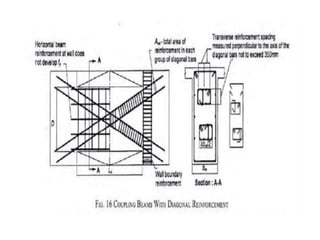
COUPLED
SHEAR
WALLS/COUP
LING BEAMS
As per 9.5
Coupled Shear walls
As per 9.5.1
• Coupled shear walls shall be
connected by ductile coupling
beams. If the earthquake
induced shear stress in the
coupling beam exceeds
• ls is the clear span of the coupling
beam and
• D is its overall depth,
• the entire earthquake induced
shear and flexure shall, preferably,
be resisted by diagonal
reinforcement.
As per 10.5
• Coupling Beams
• As per 10.5.1
• Coplanar special structural walls may be
connected by means of coupling beams.
• As per 10.5.2
• If earthquake induced shear stress Ţve in
coupling beam exceeds
• Where Ls is clear span of coupling beam
and
• D overall depth,
• the entire earthquake –induced shear,
bending moment and axial compression
shall be resisted by diagonal
reinforcement alone.
τve >0.1√fck(Ls⁄D)Ls √fck ⁄ D
IS 13920;1993 IS 13920;2016
As per 9.7
Discontinuous Walls
• Columns supporting
discontinuous walls shall be
provided with special confining
reinforcement, as per 7.4.4
As per 10.5.3
• The diagonal of a coupling beam
shall be anchored in the adjacent
walls with an anchorage length of
1.5 times the development length
in tension
IS 13920;1993 IS 13920;2016
11. Development,
splice and
Anchorage
Requirement
As per 9.92
• Splices in adjacent
bars should be
staggered by a
minimum of 600
mm.
As per 10.8.3
Splices
As per 10.8.3.1
Lap splices
• Closed links shall be provided over the entire
length over which the longitudinal bars are
spliced.
• Further,
• a) The spacing of these links shall not exceed
150mm.
• b) The lap length shall not be less than the
development length of the largest longitudinal
reinforcement bar in tension.
• c) Lap splices shall be provided only in the
central half of clear wall height, and not,
• 1) Within a joint; or
• 2) Within a distance of 2d from location where
yielding of reinforcement is likely to take place.
• d) Not more than 50 percent of area of steel
bars shall be spliced at any one section.
IS 13920;1993
As per9.9.3
shall be provided around lapped spliced bars
that are larger than 16 mm in diameter.
• The diameter of the tie shall not be less than one fourth
that of the spliced bar nor less than 6 mm.
• The spacing of ties shall not exceed 150 mm center to
center.
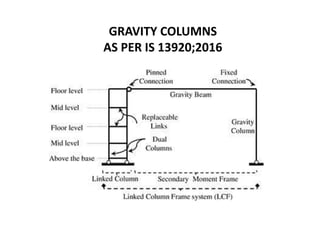
GRAVITY COLUMNS
AS PER IS 13920;2016
GRAVITY COLUMNS IN BUILDINGS
• Gravity columns shall be detailed according to and for Bending moments
when subjected to “R” times the design lateral displacement under the factored
equivalent static design seismic loads given by IS 1893(Part-1).
• As Per 11.1
• The provisions in and shall be satisfied, when induced bending
moments and horizontal shear forces under the said lateral displacement
combined with factored gravity bending moment and shear force do nor exceed
the design moment of resistance and design lateral shear capacity of the columns.
• As per 11.1.1
• Gravity columns shall satisfy , and .
• But, spacing of links along the full column height shall not exceed 6 times diameter
of smallest longitudinal bar or 150mm.
• As per 11.1.2
• Gravity columns with factored gravity axial stress exceeding 0.4 fck
shall satisfy and shall have transverse reinforcements at least
one half of special confining reinforcement required by 8.
• As per 11.2
• When induced bending moments and shear forces under said lateral
displacements combined with factored gravity bending moment and
shear force, exceed design moment and shear strength of the frame,
and shall be satisfied.
• As per Mechanical and Welded splices shall satisfy and
• As per Gravity columns shall satisfy and .

Rcc design and detailing based on revised seismic codes

  • 1.
    “RCC DESIGN ANDDETAILING AS PER REVISED SEISMIC CODES” presented by Sangeeta Wij, Managing Partner, SD Engineering Consultants LLP VP North, IAStructE
  • 2.
    Important provisions ofrevised Seismic Codes affecting RCC design and detailing • Planning of building Configuration as per definition of Regular Geometry in BIS:1893 has been revised • Load Combinations have been revised as Vertical Earthquake Force(with Sa/g=2.5) is now mandatory for all Zone 4 and 5 buildings. • Stiffness modifiers have been incorporated (Attn: Software Vendors) • Flat Slabs, Precast, PT systems to be used only after performing Non Linear Analysis and adequate experimentation • Floating/Stub Columns have been completely prohibited • Open Storeys need to incorporate bracings/RC Shear Walls • Design eccentricity at every floor has been revised and must be checked accordingly(Attn: Software vendors) • Importance Factors have been revised to 1.2 min.for >200 occupancy buildings and minimum Earthquake Shear specified for all zones
  • 3.
    Important provisions ofrevised Codes…continued • Foundations: No Isolated footings to be provided if Nc< 10 • Columns: minimum size to be 20dia(beam reinforcement passing through the column) or 300mm • Strong Columns only allowed to participate in resisting Lateral Loads(check if Column strength >1.4 times Beam Strength at every joint) • All other columns to be designed as Gravity columns and checked for bending/shear induced by R times displacement.(Attn: Software Vendors) • Beams: Ductility provisions to be similar to that of columns and spacing governed by the same formula, maximum ductile spacing is now 100mm (Attn: Software Vendors)
  • 4.
    Queries for BIS •Way forward to be mandated for existing/under construction buildings not conforming to current provisions, especially Flat Slabs and PT buildings without Adequate Shear Walls to carry 100% Base Shear • Way forward for Irregular Geometries under various clauses to be clarified as 3D analysis is always carried out these days for all important Projects, and referring to specialist literature to correct irregularity cannot be a Way Forward. • Non Tower Area Columns’ and retaining Walls’ design in large high rise developments may be covered in more detail
  • 5.
    S.No IS:13920;1993 IS:13920;2016 1.GENERAL SPECIFIC ATION As per 1.1.2 • The provisions for RC construction given herein apply specifically to monolithic reinforced concrete construction. • Precast and/or prestressed concrete members may be used only if they can provide the same level of ductility as that of a monolithic reinforced concrete construction during or after an earthquake. As per 1.1.2 • The provisions for RC construction given herein apply specifically to monolithic reinforced concrete construction. • Precast and/or prestressed concrete members may be used only if they can provide the same level of ductility as that of a monolithic reinforced concrete construction during or after an earthquake. • Likewise, flat slab structures must have a lateral load resisting systems capable of providing similar level of performance as envisioned in this standard and must be designed for drift compatibility as per 11. • Specialist literature must be referred to for design and construction of such structures. The adequacy of such designs shall be demonstrated by adequate, appropriate experimentation and non-linear dynamic structural analyses.
  • 6.
    As per 1.1.3of IS:13920;2016  All RC frames, RC walls: • need not be designed to resists lateral loads. • The designer can identify the lateral load resisting system based on relative stiffness and locations in the building and design those members for full lateral force.  RC monolithic members are assumed: • not to participate in the lateral force resisting system • their effect on the seismic response of the system is accounted for:  Consequence of failure of structural and non-structural members, not part of the lateral force resisting system shall also be considered in design.
  • 7.
    IS:13920;1993 IS:13920;2016 A) Asper clause 5.2 • For all buildings that are more than 3 story's in height, minimum grade of concrete shall be M20 (fck = 20 MPa). A) As per clause 5.2: • Minimum grade of structural concrete shall be M20, but M25 for buildings more than 15m in height in Seismic Zones III, IV, V; and • But not less than that required by IS 456 based on exposure conditions. • However, CPWD Specs of 2009 clause 5.1.2.1 (ii) states that structural concrete shall be of minimum grade M25.
  • 8.
    2. FLEXURAL MEMBERS/BEA MS IS 13920;1993IS 13920;2016 As per clause 6.1.1: • The factored axial stress on the member under earthquake loading shall not exceed 0.1 fck. As per clause 6.1: a) The factored axial compressive stress does not exceed 0.08 fck. As per clause 6.1.3 a) Beams shall not have depth D more than 1/4th of clear span. b) This may not apply to the floor beam of the frame staging of elevated RC water tank.
  • 9.
    IS:13920;2016 FIG-1: BEAM-COLUMNJUNCTION As per clause 6.1.4:  Width of the beam bw shall not exceed the width of supporting member c2 plus distance on either side of supporting member equal to the smaller of a) Width of supporting member, c2 b) 0.75 times breadth of supporting member, c1
  • 10.
    3. i) LONGITUDINAL REINFORCEMENT IS:13920;1993IS:13920;2016 As per clause 6.2.1 a) The top as well as bottom reinforcement shall consist of at least two bars throughout the member length. As per clause 6.2.1 a) Beams shall have at least 12mm diameter bars each at the top and bottom faces. b) The tension steel ratio on any face, at any section, shall not be less than: ρmin=0.24√fck/f y Where, fck and fy are in MPA. b) Minimum longitudinal steel ρmin required on any faceat any section is: ρmin=0.24√fck/f y
  • 11.
    II) SPLICING OF LONGITUDINAL BARS IS:13920;2016 As per 6.2.6.1 • Not more than 50% of area of steel bars on either top or bottom face shall be spliced at any one section . III) TRANSVERSE REINFORCEMENT As per 6.3.4  In the calculation of design shear force capacity of RC beams, contribution of the following shall not be considered:  Concrete in RC section.
  • 12.
    4. COLUMNS AND INCLINED MEMBERS IS13920;2016 i) Geometry As per 7.1  For various shapes of columns like “T”shaped,”X” shaped etc., appropriate designs and detailing shall be carried out. As per 7.1.1 The minimum dimension of a column shall not be less than, a) 20db,, or b) 300mm BUT FIG. SHOWS 15 Dia bar  AS SHOWN ON NEXT SLIDE
  • 13.
    IS:13920;1993 IS: 13920;2016 Asper 7.1.3 • The ratio of the shortest cross sectional dimension to the perpendicular dimension shall preferably not be less than 0.4. • E.g. let us assume (300x400)mm section, then we have, b/d=0.66 , i.e. >0.45 Hence ok As per 7.1.2 1. The cross-section aspect ratio (shall not be less than ) 0.45. • E.g. let us assume (200x400)mm section, then we have, b/d=0.5, i.e. >0.45 • Hence ok 1. Vertical members of RC buildings whose cross-section aspect ratio is less than 0.4 shall be designed as per requirements of9.
  • 14.
    5. IS 13920;2016 ASPER 7.2 Relative Strengths of Beam and Column at a Joint As per 7.2.1  At each beam-column joint of a moment-resisting frame, the sum of nominal design strength of columns meeting at that joint (with nominal strength calculated for the factored axial load in the direction of the lateral force under consideration so as to give least column nominal design strength) along each principal plane shall be at least 1.4 times the sum of nominal design strength of beams meeting at that joint in the same plane.
  • 15.
    6. Longitudinal Reinforcement IS 13920:1993 Asper 7.2.1 1. Lap splices shall be provided only in the central half of the member length. It should be proportioned as a tension splice. 1. Hoops shall be provided over the entire splice length at spacing not exceeding 150 mm center to center. Not more than 50 percent of the bars shall be spliced at one section.
  • 16.
    IS 13920;2016 AsPer 7.3.2.1 Lap Splices As per 7.3.2 Splicing of Longitudinal Reinforcement 1. When adopted, closed links shall be provided over the entire length over which the longitudinal bars are spliced. Further: a) The spacing of these links shall not exceed 100mm. b) The lap length shall not be less than the developmental length of the largest longitudinal reinforcement bar in tension. c) Lap splices shall be provided only in the central half of clear column height, and ???????? 1) Within a joint, or 2) Within a distance of 2d from face of the beam. d) Not more than 50 % of area of steel bars shall be spliced at any one section. Suggest laps in alternate bars , not consecutive bars. a) Lap splices shall not be used for bars of diameter larger than 32mm for which mechanical splicing shall be adopted.
  • 17.
    IS 13920;1993 IS13920;2016 As Per 7.2.2 • Any area of a column that extends more than 100 mm beyond the confined core due to architectural requirements shall be detailed in the following manner. • In case the contribution of this area to strength has been considered, then it will have the minimum longitudinal and transverse reinforcement as per this code. Transverse Reinforcement As per 7.3.1  A rectangular hoop is a closed stirrup, having a 135° hook with a 10 diameter extension (but not < 75 mm) at each end, that is embedded in the confined core (see Fig 7A). As per 7.4.1  In either case, the closed link shall have 135° hook ends with an extension of 6 times its diameter (but not <65mm) at end, which are embedded in the confined core of the column (see Fig. 10A).
  • 19.
    IS 13920:2016 AS PER7.4.2 1. When rectangular links are used: a) the minimum diameter permitted of transverse reinforcement bars is 8mm, when diameter of longitudinal bar is less than or equal to 32mm, and 10mm, when diameter of longitudinal bar is more than 32mm, 2. A cross- tie shall be provided, if length of any side of the link exceeds 300mm (see fig 10B); the cross-section shall be placed perpendicular to this link exceeds whose length exceeds 300mm. Alternatively, a pair of overlapping links may be provided within the column (see Fig.10C). In either case, the hook ends of the link and cross – ties engaging the same longitudinal bars shall have 90° hooks on opposite sides of the column. Crossties of the same or smaller bar.
  • 20.
    7. Special Confining ReinforcementIS 13920;1993 IS 13920;2016 . As per 7.4.5 1. Special confining reinforcement shall be provided over the full height of a column, which has significant variation in stiffness along its height. 2. This variation in stiffness may result due to the presence of bracing, a mezzanine floor or a R.C.C. wall on either side of the column that extends only over a part of the column height (see Fig. 12). As per 8.1 1. Flexural Yielding is likely in beams during strong earthquake shaking and in columns when the shaking intensity exceeds the expected intensity of earthquake shaking (see fig 12). As per 7.4.6 • The spacing of hoops used as special confining reinforcement shall not exceed 1/4 of minimum member dimension but need not be less than 75 mm nor more than 100 mm.
  • 22.
    IS:13920;2016 • The areaof cross-section, Ash, of the bar forming circular hoops or spiral, to be used as special confining reinforcement, shall not be less than :- Ash=0.09 SDkfck⁄fy (Ag⁄Ak- 1) 1. This special reinforcement shall, a) Have a spacing not more than, 1) 1/4 of minimum member dimension of the beam and column, 2) 6 times diameter of the smallest longitudinal reinforcement bars; and 3) 100mm link b) Have area Ash of cross section of the bar forming links or spiral of at least: 1) in circular links or spirals: Ash=Max of {0.09 Sv DKfck⁄fy Ag⁄Ak-1 {0.024 Sv Dkfckfy
  • 23.
    IS 13920;1993 IS13920;2016 As per 7.4.8  The area of cross section, Ash, of the bar forming rectangular hoop, to be used as special confining reinforcement shall not be less than: 2) In rectangular links: Ash = 0.18 Sh fck⁄fy[Ag⁄Ak] Ash=Max of {0.18 Svh fck⁄fy (Ag⁄Ak-1) {0.05 Svhfckfy
  • 24.
    7. SPECIAL CONFINING REINFORCEMENT IS 13920;1993IS 13920;2016 As per 8.4  Special Confining Reinforcement shall be provided over the full height of a column, which has significant variation in stiffness along its height.  This variation in stiffness may result due to abrupt changes in cross-section size, or unintended restraint to the column provided by stair-slab, mezzanine floor, plinth or lintel beams framing into the columns, RC walls or masonry wall adjoining column and extending only for partial column height. As per8.1  The special confining reinforcement as required at the end of column shall be provided through the joint as well, unless the joint is confined as specified by 8.2.
  • 25.
    SOECIAL CONFINING REINFORCEMENT IS 13920:1993 Asper 8.2  A joint, which has beams framing into all vertical faces of it and where each beam width is at least 3/4 of the column width, may be provided with half the special confining reinforcement required at the end of the column.  The spacing of hoops shall not exceed 150 mm.
  • 26.
    IS13920;2016 8. BEAM COLUMN JOINTS OF MOMENT RESISITING FRAMES Designof Beam Column Joint for Distortional Shear As per 9.1.1 Shear Strength of Concrete in a joint NOTE: 1) for joints confined by beams on all four faces 2) for joints confined by beams on three faces 3) for other joints Aej, is effective shear area of joint given by bjwj, in which bj is the effective breadth of joint perpendicular to the direction of shear force and wj the effective width of joint bj (see Fig.15) shall be obtained from following: Min [bb; bc+0.5hc] if bc<bb Where bb=width of beam and bc = width of column hc= depth of column in considered direction. τje=1)1.5 Aej √fck 2)1.2 Aej √fck 3)1.0 Aej √fck
  • 27.
    As per 9.1.2 DesignShear Stress Demand on a Joint a) Design shear stress demand acting horizontally along each of the two principal plan directions of the joint shall be estimated from earthquake shaking considered along each of these directions, using: for shaking along plan direction X of Earthquake shaking for shaking along plan direction Y of earthquake shaking It shall be ensured that the joint shear capacity of joint concrete estimated using 9.1.1 exceeds both . b)Design shear force demand VjdX and VjdY acting horizontally on the joint in principal plan directions X and Y shall be estimated considering that the longitudinal beam bars in tension reach a stress of 1.25 fy (when over strength plastic moment hinges are formed at beam ends). τjdX=VdjX⁄bjwj τjdY=VdjY⁄bjwj τjdX and τjdY.
  • 28.
    IS 13920;2016 As per9.1.3 Width of Beam Column Joint When beam reinforcement extends through beam – column joint, the minimum width of the column parallel to beam shall be 20 ???? or 15 ??? times of the largest longitudinal beam bar.
  • 29.
    Is 13920;2016 As per9.2 As Per 9.2.1  Confining reinforcements in Joints a) When all four vertical faces of the joint are having beams framing into them covering at least 75 percent of the width on each face, b) At least half the special confining reinforcement required as per 8 at the two ends of columns, shall: be provided through the joint within the depth of the shallowest beam framing into it; and 2)When all four vertical faces of the joint are not having beams framing into them or when all four vertical faces have beams framing into them but do not cover at least 75 percent of the width on any face, 1) Special Confining reinforcement required as per 8 at the two ends of columns shall be provided through the joint within the depth of the shallowest beam framing into it, and 2) Spacing of these transverse links shall not exceed 150mm. As per 9.2.2  In the exterior and corner joints, all 135-degreehooks of crossties should be along the outer face of columns.
  • 30.
    9. SHEAR WALLS IS 13920;1993IS 13920;2016 As per 9.1.2 • The thickness of any part of the wall shall preferably, not be less than 150 mm. As per 10.1.2 • The thickness of any part of the wall shall preferably, not be less than: • 150 mm; and • 300mm for buildings with coupled shear walls in any seismic zone. • The minimum thickness provided must confirm to the fire resistance requirements based on occupancy as laid down in IS 456. As per 10.1.4 • Special shear walls shall be classified as squat, intermediate or slender depending on the overall height hw to length Lw ratio as • Squat walls: hw/Lw<l, • Intermediate walls: l<=hw/Lw<=2,and • Slender wall: hw/Lw>2
  • 31.
    IS 13920;1993 IS13920;2016 As per 9.1.3 • The effective flange width, to be used in the design of flanged wall sections, shall be assumed to extend beyond the face of the web for a distance which shall be the smaller of (a) half the distance to an adjacent shear wall web, and (b) 1/10 th of the total wall height. As per 10.1.5 • In the design of flanged wall sections, only that part of the flange shall be considered which extends beyond the face of the web of the structural wall at least for a distance equal to smaller of, • actual width available • half the distance to the adjacent structural wall web; and • 1/10th of the total wall height.
  • 32.
    IS 13920;1993 IS13920;2016 As per 9.1.4 • Shear walls shall be provided with reinforcement in the longitudinal and transverse directions in the plane of the wall. The minimum reinforcement ratio shall be 0.002 5 of the gross area in each direction. This reinforcement shall be distributed uniformly across the cross section of the wall. As per 10.1.7 Special shear walls shall be provided with uniformly spaced reinforcement in its cross-section along vertical and horizontal directions. At least a minimum area of reinforcement bars as indicated in Table1 shall be provided along vertical and horizontal directions.
  • 34.
    IS 13920;1993 As per9.2.2 The design shear strength of concrete, Ţc, shall be calculated as per Table 13 of IS 456: 1978. As per 9.2.4 When 𝜏v is less than Ţc shear reinforcement shall be provided in accordance with 9.1.4, 9.1.5 and 9.1.7.
  • 35.
    IS 13920;1993 IS13920;2016 As per 9.2.5 When Ţv is greater than Ţc , the area of horizontal shear reinforcement, Ah, to be provided within a vertical spacing, Sv, is given by: Where Vus= (Vu– c tw dw ), is the shear force to be resisted by the horizontal reinforcement. However, the amount of horizontal reinforcement provided shall not be less than the minimum, as per 9.1.4. As per 9.2.6 The vertical reinforcement that is uniformly distributed in the wall shall not be less than the horizontal reinforcement calculated as per 9.2.5. As per 9.2.2 The design shear strength of concrete, c, shall be calculated as per Table 19 of IS 456. Vus = 0.87fyAhDwSv
  • 36.
    IS 13920;2016 As per10.2.3 When nominal shear stress demand 𝜏v on a wall is: a) more than 𝜏vmax of concrete (given in Table 20 of IS 456), the wall section shall be re-designed; b)less than maximum design shear strength 𝜏cmaxof concrete and more than design shear strength c of concrete, design horizontal shear reinforcement shall be provided of area Ah given by: Which shall not be less than the minimum area of horizontal steel as per 10.1.5;and c) less than design shear strength of concrete, horizontal shear reinforcement shall be the minimum area of horizontal steel as per 10.1.5 Ah= Vus⁄0.87 fy{d⁄Sv} integral Vu- τc twdw0.87 fy{d⁄Sv}integral
  • 37.
    IS 13920;1993 IS13920;2016 FLEXURAL STRENGTH/DESIG N FOR AXIAL FORCE AND BENDING MOMENT As per 9.3 • Flexural Strength • As per 9.3.1 • The moment of resistance, Muv, of the wall section may be calculated as for columns subjected to combined bending and axial load as per IS 456: 1978. • The moment of resistance of slender rectangular shear wall section with uniformly distributed vertical reinforcement is given in Annex A. As per 10.3 • Design for Axial Force and Bending Moment • As per 10.3.1 • Design moment of resistance Mu of the wall section subjected to combined bending moment and compressive axial load shall be estimated in accordance with requirements of limit state design method given in IS 456, using the principles of mechanics involving equilibrium equations, strain compatibility conditions and consecutive laws. • The moment of resistance of slender rectangular structural wall section with uniformly distributed vertical reinforcement may be estimated using expressions given in Annex A. • Expressions given in Annex A are not applicable for structural walls with boundary elements.
  • 38.
    IS 13920;1993 IS13920;2016 As per9.3.3 • In walls that do not have boundary elements, vertical reinforcement shall be concentrated at the ends of the wall. Each concentration shall consist of a minimum of 4 bars of 12 mm diameter arranged in at least 2 layers As per 10.3.3 • In structural walls that do not have boundary elements, at least a minimum of 4 bars of 12mm diameter arranged in 2 layers, shall be concentrated as vertical reinforcement at the ends of the wall over a length not exceeding twice the thickness of RC wall.
  • 39.
    IS 13920;1993 IS13920;2016 As per 10.4.2 • A boundary element shall have adequate axial load carrying capacity, assuming short column action, so as to enable it to carry axial compression arising from factored gravity load and lateral seismic shaking effects. As per 9.4.2 • A boundary element shall have adequate axial load carrying capacity, assuming short column action, so as to enable it to carry an axial compression equal to the sum of factored gravity load on it and the additional compressive load induced by the seismic force. The latter may be calculated as: Where, Mu = factored design moment on the entire wall section, Muv = moment of resistance provided by distributed vertical reinforcement across the wall section, and Cw = center-to-center distance between the boundary elements along the two vertical edges of the wall. As per 10.4.2.1 • The load factored for gravity load shall be taken as 0.8, if gravity load gives higher axial compressive strength of the boundary. As per 10.4.3 • The vertical reinforcement in the boundary elements shall not be less than 0.8 percent and not greater than 6 percent; the practical upper limit would be 4 percent to avoid congestion. (Mu-Muv)⁄Cw
  • 40.
    IS 13920;1993 IS13920;2016 COUPLED SHEAR WALLS/COUP LING BEAMS As per 9.5 Coupled Shear walls As per 9.5.1 • Coupled shear walls shall be connected by ductile coupling beams. If the earthquake induced shear stress in the coupling beam exceeds • ls is the clear span of the coupling beam and • D is its overall depth, • the entire earthquake induced shear and flexure shall, preferably, be resisted by diagonal reinforcement. As per 10.5 • Coupling Beams • As per 10.5.1 • Coplanar special structural walls may be connected by means of coupling beams. • As per 10.5.2 • If earthquake induced shear stress Ţve in coupling beam exceeds • Where Ls is clear span of coupling beam and • D overall depth, • the entire earthquake –induced shear, bending moment and axial compression shall be resisted by diagonal reinforcement alone. τve >0.1√fck(Ls⁄D)Ls √fck ⁄ D
  • 41.
    IS 13920;1993 IS13920;2016 As per 9.7 Discontinuous Walls • Columns supporting discontinuous walls shall be provided with special confining reinforcement, as per 7.4.4 As per 10.5.3 • The diagonal of a coupling beam shall be anchored in the adjacent walls with an anchorage length of 1.5 times the development length in tension
  • 43.
    IS 13920;1993 IS13920;2016 11. Development, splice and Anchorage Requirement As per 9.92 • Splices in adjacent bars should be staggered by a minimum of 600 mm. As per 10.8.3 Splices As per 10.8.3.1 Lap splices • Closed links shall be provided over the entire length over which the longitudinal bars are spliced. • Further, • a) The spacing of these links shall not exceed 150mm. • b) The lap length shall not be less than the development length of the largest longitudinal reinforcement bar in tension. • c) Lap splices shall be provided only in the central half of clear wall height, and not, • 1) Within a joint; or • 2) Within a distance of 2d from location where yielding of reinforcement is likely to take place. • d) Not more than 50 percent of area of steel bars shall be spliced at any one section.
  • 44.
    IS 13920;1993 As per9.9.3 shallbe provided around lapped spliced bars that are larger than 16 mm in diameter. • The diameter of the tie shall not be less than one fourth that of the spliced bar nor less than 6 mm. • The spacing of ties shall not exceed 150 mm center to center.
  • 45.
  • 46.
    GRAVITY COLUMNS INBUILDINGS • Gravity columns shall be detailed according to and for Bending moments when subjected to “R” times the design lateral displacement under the factored equivalent static design seismic loads given by IS 1893(Part-1). • As Per 11.1 • The provisions in and shall be satisfied, when induced bending moments and horizontal shear forces under the said lateral displacement combined with factored gravity bending moment and shear force do nor exceed the design moment of resistance and design lateral shear capacity of the columns. • As per 11.1.1 • Gravity columns shall satisfy , and . • But, spacing of links along the full column height shall not exceed 6 times diameter of smallest longitudinal bar or 150mm.
  • 47.
    • As per11.1.2 • Gravity columns with factored gravity axial stress exceeding 0.4 fck shall satisfy and shall have transverse reinforcements at least one half of special confining reinforcement required by 8. • As per 11.2 • When induced bending moments and shear forces under said lateral displacements combined with factored gravity bending moment and shear force, exceed design moment and shear strength of the frame, and shall be satisfied. • As per Mechanical and Welded splices shall satisfy and • As per Gravity columns shall satisfy and .