International Research Journal of Engineering and Technology (IRJET) e-ISSN: 2395-0056
Volume: 06 Issue: 07 | July 2019 www.irjet.net p-ISSN: 2395-0072
© 2019, IRJET | Impact Factor value: 7.211 | ISO 9001:2008 Certified Journal | Page 1607
BITUMEN EMULSION FOR PLASTIC HIGHWAY CONSTRUCTION
Madeeha Qazi1, Er. DeepakKumar2
1Student, Department of Civil Engineering, Desh Bhagat University, Mandi Gobindgrah, Punjab.
2External Guide, Department of Civil Engineering, Desh Bhagat University, Mandi Gobindgrah, Punjab
---------------------------------------------------------------------***----------------------------------------------------------------------
Abstract –Bitumen emulsion is a mixture of fine droplets
of bitumen and water has successfully replaced the use of
bitumen which was used before for the construction of
flexible pavement. Bitumen emulsion helps to maintain the
paving temperature of hot mix, so it can be used in colder
regions and is also less toxic as compare to bitumen.
Experiments performed through Marshal Test shows that
bitumen emulsion have high stability value, thereforecanbe
used as binder.
Key Words: Marshall Method, Theoretical specific gravityof
the mix, Bulk specific gravity of mix
1. INTRODUCTION
The modern flexible pavement is generally designed and
constructedinseverallayersfor effective stress distribution
across pavement layers under the heavy traffic loads. The
interlayer bonding of the multi-layered pavement system
plays an important role to achievelongtermperformanceof
pavement. Adequatebondbetweenthelayersmustbe ensured
sothatmultiplelayersperformasa monolithic structure. To
achieve good bond strength, a bituminous emulsion is
usually sprayed in betweenthebituminouspavementlayers.
About740 people of India live in rural area and nearly 40
percent of village peopleofthecountryare not connected by
all- weather roads. Either bituminous mix or concrete is
required to make these earthen roadsintoall-weatherroads.
Concrete is not economicaloneas a pavingmixcomparedto
bituminous mix for rural road construction works. InIndia
majority of road network is occupied by bituminous
pavement as a paving mix from many decades. Howeverthis
bituminous mix is associated with some limitations.These
includeexcessiveemissionof greenhouse gases (e.g. Sulphur
dioxide, nitrogen oxides, carbon monoxides and volatile
organic compounds,shutdownofhotmixplantduring rainy
seasonandthelayingofHMAisdifficult inhillyareasandrural
areas havinglonghauling distances,costof putting up HMA
plantishigh andcomparativebudgetsofsmallsectionsofrural
roadisveryless,etc.As,Indianruralroadnetwork isdeveloping
continuously, paving mix likecoldmix emulsions should be
tried
1.1 MATERIALS AND METHODS
Properties of bitumen emulsions are varied by many
parameters like; source of aggregate, curing condition and
curing time, etc. Hence there is no universally accepted mix
design method for cold mixes. But Marshall Method is
popularlyusedtodesign emulsified mixes. Marshall Method
for emulsified asphalt aggregate design is based on the
researchconductedattheUniversity ofIllinois.Thismethodis
applicabletobase coursemixtureforlowvolumetrafficload.
Coldmixisusedinsurfacecoursealsofor low to mediumtraffic
volume road. The cold mix design is carried out to optimize
water and emulsion content for aggregate in the mix. The
parametersinvolvedinmix designofcoldmixare;
1. Aggregatesselection
2. Emulsionselection
Aggregates Selection
In India aggregates should conform the physical
requirement laid by MoRTH specification (2001). Testing of
aggregatelikesieveanalysis,specific gravity,aggregateimpact
valueandsoundness isnecessary.
Emulsion Selection
Selection of emulsion depends on aggregate type and
aggregate gradation and ability of emulsion to coat the
aggregate.AccordingIS8887:2004specifications,fivegradeof
emulsion;RS-1,RS-2,MS,SS-1andSS-2areusedtopreparecold
mix.Qualitytestsshouldbecarriedoutontheselectedemulsion
according to IS8887:2004
2. PREPARATION OF MARSHALL SPECIMEN
Thecoarseaggregate,fineaggregateandfiller materialare
mixed in such a way that the final mix after blending has the
gradationwithinthe specified range. Grade A aggregate are
used here. The gradations of aggregates for bituminous
concretesurfacecoursearegiven below:
Table 1.Gradation of aggregate
3. Specimen preparation
Approximately 1200 gm of aggregates and filler is heated to
a temperature of 175-190 oC. Bitumen is heated to a
temperatureof121to125deg.
Sieve size
(mm) 19 12.5 9.5 4.7 2 0.42 0.17 0.07
Passing
%
100 86 74 56 38 18 9 6
International Research Journal of Engineering and Technology (IRJET) e-ISSN: 2395-0056
Volume: 06 Issue: 07 | July 2019 www.irjet.net p-ISSN: 2395-0072
© 2019, IRJET | Impact Factor value: 7.211 | ISO 9001:2008 Certified Journal | Page 1608
Bitumen is heated to a temperature of 121 to 125 deg.
with the first trial percentage of bitumen (say 3.5 or 4% by
weight of the mineral aggregates).Theheatedaggregatesand
bitumen are thoroughly mixed at a temperature 154-160 oC.
The mix is placed in a preheated mould and compacted by a
rammer with 50 blows on either sideattemperatureof138oC
to 149oC. The weight of mixed aggregates taken for the
preparation of the specimenmaybesuitablyalteredtoobtain
a compacted thickness of 63.5+/-3 mm. Vary the bitumen
content in the next trial by +0.5% and repeat the above
procedure. Number of trials are predetermined.
4. RESULTS AND DISCUSSIONS
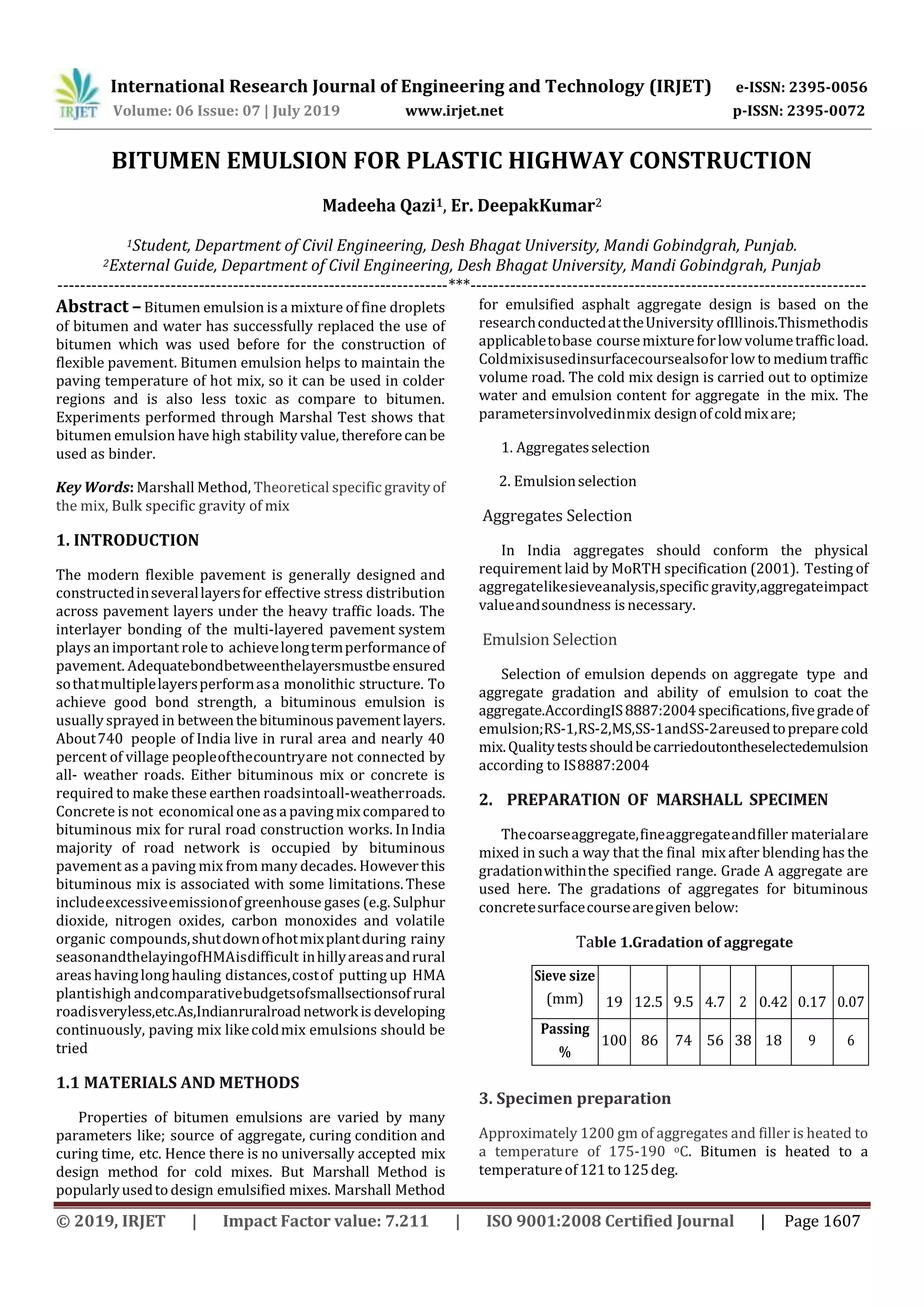
Theoretical specific gravity (Gt) is the specific gravity
without considering air voids, and is given by:
where,W1 is the weight of coarse aggregate in thetotal mix,
W2 is the weight offine aggregate in the total mix, W3 is the
weight of filler in the total mix, Wb is the weight of bitumen
in the total mix,G1 is the apparent specific gravity of coarse
aggregate, G2 is the apparent specific gravity of fine
aggregate,G3 is the apparent specific gravity of fillerandGbis
the apparent specific gravity of bitumen.
4.1 Bulk specific gravity of mix (Gm)
The bulk specific gravity or the actual specific gravity of the
mix Gm is the specific gravity considering air voids and is
found out by:
4.2 Air voids percent
Air voids is the percent of air voids by volume in the
specimen and is given by:
t
mt
v
G
GG
V
100)( 

Where is the theoretical specific gravity of the mix, and
is the bulk or actual specific gravity of the mix.
4.3 Percent volume of bitumen
The volume of bitumen is the percent of volume of
bitumen to the total volume and given by:
where, is the weight of coarse aggregate in the total mix,
is the weight of fine aggregate in the total mix, is the
weight of filler in the total mix, is the weight of bitumen
in the total mix, is the apparent specific gravity of
bitumen, and is the bulk specific gravity of mix .
4.4 Voids in mineral aggregate VMA
Voids inmineral aggregate VMA is the volume of voidsinthe
aggregates, and is the sum of air voids and volume of
bitumen, andis calculated from
Where, is the percent air voids inthe mix and is percent
bitumen content in the mix.
4.5 Voids filled with bitumen VFB
Voids filled
with bitumen
VFB is the voids
in the mineral
aggregateframe
work filled with
the bitumen, and is calculated as:
Where, is percent bitumen content inthe mix, is the
percent voids in the mineral aggregate.
5. Determine Marshall Stability and flow
Marshall Stability of a test specimen is the maximum load
required to produce failure when the specimen is preheated
to a prescribed temperature placed in a special testheadand
the load is applied at a constant strain (5 cm per minute).
While the stability test is in progress dial gauge is used to
International Research Journal of Engineering and Technology (IRJET) e-ISSN: 2395-0056
Volume: 06 Issue: 07 | July 2019 www.irjet.net p-ISSN: 2395-0072
© 2019, IRJET | Impact Factor value: 7.211 | ISO 9001:2008 Certified Journal | Page 1609
measure the vertical deformation of the specimen. The
deformation at the failure point expressed in units of 0.25
mm is called the Marshall Flow value of the specimen.
5.1 Apply stability correction
It is possible while making the specimen the thickness
slightly vary from the standard specification of 63.5 mm.
Therefore, measured stability values need to be corrected to
those which would have been obtained if the specimens had
been exactly 63.5 mm. This is done by multiplying each
measured stability value by an appropriated correlation
factors as given in Table below.
Volume of
specimen
(cm )
Thickness
of specimen
(mm)
Correction
Factor
457 -470 57.1 1.19
471 -482 68.7 1.14
483 -495 60.3 1.09
496 -508 61.9 1.04
509 -522 63.5 1.00
523 -535 65.1 0.96
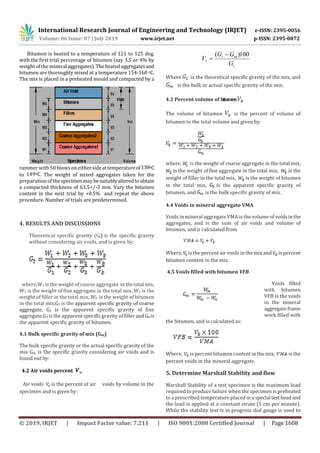
5.2 Prepare graphical plots
The average value of the above properties are determined
for each mix with different bitumen content and the
following graphical plots are prepared:
1. Binder content versus corrected Marshall
Stability.
2. Binder content versus Marshall Flow.
3. Binder content versus percentageof void in the totalmix.
Binder content versus voids filled with bitumen
Determine optimum bitumen content
Determine the optimum binder contentforthemixdesign by
taking average value of the followingthreebitumencontents
found form the graphs obtained in the previous step.
1. Binder content corresponding to maximum stability
2. Binder content corresponding to maximum bulk specific
g r av i ty (Gm)
3. Binder content corresponding tothe medianofdesigned
limitsofpercent air voids (Vv
) in the total mix (i.e. 4%)
International Research Journal of Engineering and Technology (IRJET) e-ISSN: 2395-0056
Volume: 06 Issue: 07 | July 2019 www.irjet.net p-ISSN: 2395-0072
© 2019, IRJET | Impact Factor value: 7.211 | ISO 9001:2008 Certified Journal | Page 1610
CONCLUSION
Cold mix can be laid on low to medium volume road as a
green paving mix. Mixture can be produced by using
conventional plant or by hand. So it can be laid as surface
course or bituminous base course for rural road
construction. Cold mix can be tried for paving mix in north
east region of India. Optimum binder content for mix design
is 10%.Hot mix design have minimum stability value of 300
kg and here in cold mix design, stability value of samples is
greater than 300 kg so it can be used in road construction. It
is economical and high production is possible with low
investment.
References
1. Al-Abdulwahhab, Bayomy, H.F., and Al- Halhouli, A.
“Evaluation of emulsified, asphalt-treated sand for
lowvolume roads and road bases”. Transportation
research record:JournalofTransportationResearch
Board,volume1,issue1106,1987,pp.71- 80.
2. Brown, S. F., and Needham, D. “A Study of Cement
Modified Bitumen Emulsion Mixtures” Annual
Meeting of the Association of Asphalt Paving
Technologists,2000
3. Chavez-Valencia,L.E.,Alonso,E.,Manzano,A.,Perez,J.,
Contreras, M.E., and Signoret, C. “Improving the
compressive strengths of cold-mix asphalt using
asphalt emulsion modified by polyvinyl acetate”.
Construction and Building Materials 21, 2006, pp
583–589.
4. Darter,M.I.,Stevel,R.A.,Patrick,L.W.,andRichardG.W.
“Developmentofemulsifiedasphalt- aggregate cold
mix design procedure”. TransportationEngg.Series
no.22, Illinois Cooperative Highway Research
Program Series No.174,1978.
5. Doyle, T. “Relating laboratory conditioning
temperature to in-situ strength gain for cold mix
pavement in Ireland”. University College Dublin,
Dublin, Ireland. [6] Oruc, S., Celik, F., and Akpinar,
M.V. “Effect of Cement on Emulsified Asphalt
Mixtures”. Journal of Materials Engineering and
Performance,Volume16(5),2007,pp578- 583.
6. Pundhir, N.K.S., Grover, G., and Veeragavan,A.“Cold
mix design of semi dense bituminous concrete”.
Indian Highways,March,2010,pp17-24.
7. Pundhir, N.K.S. “Cold mix technology for road
construction”. Report by Central road research
Institute.
volume-37,
2004, pp365-368.
9. Thanaya, I. N. A., (2002). “Performance of cold
bituminous emulsion mixtures incorporatingwaste
material”. Media teknik no.4, November,ISSN
02163012
10. Thanaya, I. N. A., Zoorob, S., E., and Forth., P. (2009).
“A laboratory study on cold-mix, cold-lay emulsion
mixtures”. Institution of civil engineers Transport
162 February, p 47-55.
11. Asphalt Institute Manual Series No.14 (MS- 14).
“Asphalt cold mix mannual”. Third Edition,
Lexington, KY 40512-4052 USA. PartIV,AppendixF,
pp106-122,1997.
12. Bureau of Indian Standards. Bitumen emulsion for
roads (cationic type)- Specification (Second
Revision). IS 8887:2004, March,2004.
13. Ministry of Road Transport andHighways (MoRTH
2001), “Specifications for Road and Bridge Works
(Fourth Revision)”, Indian Roads Congress, New
Delhi,Section 500,Bituminouscoldmix,Clause519.1.,
pp 227-232.
14. BeneditodeS.Bueno,WanderRdaSilva, Dario C. de
Lima and Enivaldo Minnete (2003), “Engineering
properties of fiber reinforced cold asphalt mixes”.
Journal of EnvironmentalEngineering,Vol.129no.10
October1,2003page952-955
8. Erfass, Poirier, Henrat, and Carbonneau.
“Influence of curing on cold mix mechanical
performances”.Materialsandstructures,

IRJET- Bitumen Emulsion for Plastic Highway Construction

  • 1.
    International Research Journalof Engineering and Technology (IRJET) e-ISSN: 2395-0056 Volume: 06 Issue: 07 | July 2019 www.irjet.net p-ISSN: 2395-0072 © 2019, IRJET | Impact Factor value: 7.211 | ISO 9001:2008 Certified Journal | Page 1607 BITUMEN EMULSION FOR PLASTIC HIGHWAY CONSTRUCTION Madeeha Qazi1, Er. DeepakKumar2 1Student, Department of Civil Engineering, Desh Bhagat University, Mandi Gobindgrah, Punjab. 2External Guide, Department of Civil Engineering, Desh Bhagat University, Mandi Gobindgrah, Punjab ---------------------------------------------------------------------***---------------------------------------------------------------------- Abstract –Bitumen emulsion is a mixture of fine droplets of bitumen and water has successfully replaced the use of bitumen which was used before for the construction of flexible pavement. Bitumen emulsion helps to maintain the paving temperature of hot mix, so it can be used in colder regions and is also less toxic as compare to bitumen. Experiments performed through Marshal Test shows that bitumen emulsion have high stability value, thereforecanbe used as binder. Key Words: Marshall Method, Theoretical specific gravityof the mix, Bulk specific gravity of mix 1. INTRODUCTION The modern flexible pavement is generally designed and constructedinseverallayersfor effective stress distribution across pavement layers under the heavy traffic loads. The interlayer bonding of the multi-layered pavement system plays an important role to achievelongtermperformanceof pavement. Adequatebondbetweenthelayersmustbe ensured sothatmultiplelayersperformasa monolithic structure. To achieve good bond strength, a bituminous emulsion is usually sprayed in betweenthebituminouspavementlayers. About740 people of India live in rural area and nearly 40 percent of village peopleofthecountryare not connected by all- weather roads. Either bituminous mix or concrete is required to make these earthen roadsintoall-weatherroads. Concrete is not economicaloneas a pavingmixcomparedto bituminous mix for rural road construction works. InIndia majority of road network is occupied by bituminous pavement as a paving mix from many decades. Howeverthis bituminous mix is associated with some limitations.These includeexcessiveemissionof greenhouse gases (e.g. Sulphur dioxide, nitrogen oxides, carbon monoxides and volatile organic compounds,shutdownofhotmixplantduring rainy seasonandthelayingofHMAisdifficult inhillyareasandrural areas havinglonghauling distances,costof putting up HMA plantishigh andcomparativebudgetsofsmallsectionsofrural roadisveryless,etc.As,Indianruralroadnetwork isdeveloping continuously, paving mix likecoldmix emulsions should be tried 1.1 MATERIALS AND METHODS Properties of bitumen emulsions are varied by many parameters like; source of aggregate, curing condition and curing time, etc. Hence there is no universally accepted mix design method for cold mixes. But Marshall Method is popularlyusedtodesign emulsified mixes. Marshall Method for emulsified asphalt aggregate design is based on the researchconductedattheUniversity ofIllinois.Thismethodis applicabletobase coursemixtureforlowvolumetrafficload. Coldmixisusedinsurfacecoursealsofor low to mediumtraffic volume road. The cold mix design is carried out to optimize water and emulsion content for aggregate in the mix. The parametersinvolvedinmix designofcoldmixare; 1. Aggregatesselection 2. Emulsionselection Aggregates Selection In India aggregates should conform the physical requirement laid by MoRTH specification (2001). Testing of aggregatelikesieveanalysis,specific gravity,aggregateimpact valueandsoundness isnecessary. Emulsion Selection Selection of emulsion depends on aggregate type and aggregate gradation and ability of emulsion to coat the aggregate.AccordingIS8887:2004specifications,fivegradeof emulsion;RS-1,RS-2,MS,SS-1andSS-2areusedtopreparecold mix.Qualitytestsshouldbecarriedoutontheselectedemulsion according to IS8887:2004 2. PREPARATION OF MARSHALL SPECIMEN Thecoarseaggregate,fineaggregateandfiller materialare mixed in such a way that the final mix after blending has the gradationwithinthe specified range. Grade A aggregate are used here. The gradations of aggregates for bituminous concretesurfacecoursearegiven below: Table 1.Gradation of aggregate 3. Specimen preparation Approximately 1200 gm of aggregates and filler is heated to a temperature of 175-190 oC. Bitumen is heated to a temperatureof121to125deg. Sieve size (mm) 19 12.5 9.5 4.7 2 0.42 0.17 0.07 Passing % 100 86 74 56 38 18 9 6
  • 2.
    International Research Journalof Engineering and Technology (IRJET) e-ISSN: 2395-0056 Volume: 06 Issue: 07 | July 2019 www.irjet.net p-ISSN: 2395-0072 © 2019, IRJET | Impact Factor value: 7.211 | ISO 9001:2008 Certified Journal | Page 1608 Bitumen is heated to a temperature of 121 to 125 deg. with the first trial percentage of bitumen (say 3.5 or 4% by weight of the mineral aggregates).Theheatedaggregatesand bitumen are thoroughly mixed at a temperature 154-160 oC. The mix is placed in a preheated mould and compacted by a rammer with 50 blows on either sideattemperatureof138oC to 149oC. The weight of mixed aggregates taken for the preparation of the specimenmaybesuitablyalteredtoobtain a compacted thickness of 63.5+/-3 mm. Vary the bitumen content in the next trial by +0.5% and repeat the above procedure. Number of trials are predetermined. 4. RESULTS AND DISCUSSIONS Theoretical specific gravity (Gt) is the specific gravity without considering air voids, and is given by: where,W1 is the weight of coarse aggregate in thetotal mix, W2 is the weight offine aggregate in the total mix, W3 is the weight of filler in the total mix, Wb is the weight of bitumen in the total mix,G1 is the apparent specific gravity of coarse aggregate, G2 is the apparent specific gravity of fine aggregate,G3 is the apparent specific gravity of fillerandGbis the apparent specific gravity of bitumen. 4.1 Bulk specific gravity of mix (Gm) The bulk specific gravity or the actual specific gravity of the mix Gm is the specific gravity considering air voids and is found out by: 4.2 Air voids percent Air voids is the percent of air voids by volume in the specimen and is given by: t mt v G GG V 100)(   Where is the theoretical specific gravity of the mix, and is the bulk or actual specific gravity of the mix. 4.3 Percent volume of bitumen The volume of bitumen is the percent of volume of bitumen to the total volume and given by: where, is the weight of coarse aggregate in the total mix, is the weight of fine aggregate in the total mix, is the weight of filler in the total mix, is the weight of bitumen in the total mix, is the apparent specific gravity of bitumen, and is the bulk specific gravity of mix . 4.4 Voids in mineral aggregate VMA Voids inmineral aggregate VMA is the volume of voidsinthe aggregates, and is the sum of air voids and volume of bitumen, andis calculated from Where, is the percent air voids inthe mix and is percent bitumen content in the mix. 4.5 Voids filled with bitumen VFB Voids filled with bitumen VFB is the voids in the mineral aggregateframe work filled with the bitumen, and is calculated as: Where, is percent bitumen content inthe mix, is the percent voids in the mineral aggregate. 5. Determine Marshall Stability and flow Marshall Stability of a test specimen is the maximum load required to produce failure when the specimen is preheated to a prescribed temperature placed in a special testheadand the load is applied at a constant strain (5 cm per minute). While the stability test is in progress dial gauge is used to
  • 3.
    International Research Journalof Engineering and Technology (IRJET) e-ISSN: 2395-0056 Volume: 06 Issue: 07 | July 2019 www.irjet.net p-ISSN: 2395-0072 © 2019, IRJET | Impact Factor value: 7.211 | ISO 9001:2008 Certified Journal | Page 1609 measure the vertical deformation of the specimen. The deformation at the failure point expressed in units of 0.25 mm is called the Marshall Flow value of the specimen. 5.1 Apply stability correction It is possible while making the specimen the thickness slightly vary from the standard specification of 63.5 mm. Therefore, measured stability values need to be corrected to those which would have been obtained if the specimens had been exactly 63.5 mm. This is done by multiplying each measured stability value by an appropriated correlation factors as given in Table below. Volume of specimen (cm ) Thickness of specimen (mm) Correction Factor 457 -470 57.1 1.19 471 -482 68.7 1.14 483 -495 60.3 1.09 496 -508 61.9 1.04 509 -522 63.5 1.00 523 -535 65.1 0.96 5.2 Prepare graphical plots The average value of the above properties are determined for each mix with different bitumen content and the following graphical plots are prepared: 1. Binder content versus corrected Marshall Stability. 2. Binder content versus Marshall Flow. 3. Binder content versus percentageof void in the totalmix. Binder content versus voids filled with bitumen Determine optimum bitumen content Determine the optimum binder contentforthemixdesign by taking average value of the followingthreebitumencontents found form the graphs obtained in the previous step. 1. Binder content corresponding to maximum stability 2. Binder content corresponding to maximum bulk specific g r av i ty (Gm) 3. Binder content corresponding tothe medianofdesigned limitsofpercent air voids (Vv ) in the total mix (i.e. 4%)
  • 4.
    International Research Journalof Engineering and Technology (IRJET) e-ISSN: 2395-0056 Volume: 06 Issue: 07 | July 2019 www.irjet.net p-ISSN: 2395-0072 © 2019, IRJET | Impact Factor value: 7.211 | ISO 9001:2008 Certified Journal | Page 1610 CONCLUSION Cold mix can be laid on low to medium volume road as a green paving mix. Mixture can be produced by using conventional plant or by hand. So it can be laid as surface course or bituminous base course for rural road construction. Cold mix can be tried for paving mix in north east region of India. Optimum binder content for mix design is 10%.Hot mix design have minimum stability value of 300 kg and here in cold mix design, stability value of samples is greater than 300 kg so it can be used in road construction. It is economical and high production is possible with low investment. References 1. Al-Abdulwahhab, Bayomy, H.F., and Al- Halhouli, A. “Evaluation of emulsified, asphalt-treated sand for lowvolume roads and road bases”. Transportation research record:JournalofTransportationResearch Board,volume1,issue1106,1987,pp.71- 80. 2. Brown, S. F., and Needham, D. “A Study of Cement Modified Bitumen Emulsion Mixtures” Annual Meeting of the Association of Asphalt Paving Technologists,2000 3. Chavez-Valencia,L.E.,Alonso,E.,Manzano,A.,Perez,J., Contreras, M.E., and Signoret, C. “Improving the compressive strengths of cold-mix asphalt using asphalt emulsion modified by polyvinyl acetate”. Construction and Building Materials 21, 2006, pp 583–589. 4. Darter,M.I.,Stevel,R.A.,Patrick,L.W.,andRichardG.W. “Developmentofemulsifiedasphalt- aggregate cold mix design procedure”. TransportationEngg.Series no.22, Illinois Cooperative Highway Research Program Series No.174,1978. 5. Doyle, T. “Relating laboratory conditioning temperature to in-situ strength gain for cold mix pavement in Ireland”. University College Dublin, Dublin, Ireland. [6] Oruc, S., Celik, F., and Akpinar, M.V. “Effect of Cement on Emulsified Asphalt Mixtures”. Journal of Materials Engineering and Performance,Volume16(5),2007,pp578- 583. 6. Pundhir, N.K.S., Grover, G., and Veeragavan,A.“Cold mix design of semi dense bituminous concrete”. Indian Highways,March,2010,pp17-24. 7. Pundhir, N.K.S. “Cold mix technology for road construction”. Report by Central road research Institute. volume-37, 2004, pp365-368. 9. Thanaya, I. N. A., (2002). “Performance of cold bituminous emulsion mixtures incorporatingwaste material”. Media teknik no.4, November,ISSN 02163012 10. Thanaya, I. N. A., Zoorob, S., E., and Forth., P. (2009). “A laboratory study on cold-mix, cold-lay emulsion mixtures”. Institution of civil engineers Transport 162 February, p 47-55. 11. Asphalt Institute Manual Series No.14 (MS- 14). “Asphalt cold mix mannual”. Third Edition, Lexington, KY 40512-4052 USA. PartIV,AppendixF, pp106-122,1997. 12. Bureau of Indian Standards. Bitumen emulsion for roads (cationic type)- Specification (Second Revision). IS 8887:2004, March,2004. 13. Ministry of Road Transport andHighways (MoRTH 2001), “Specifications for Road and Bridge Works (Fourth Revision)”, Indian Roads Congress, New Delhi,Section 500,Bituminouscoldmix,Clause519.1., pp 227-232. 14. BeneditodeS.Bueno,WanderRdaSilva, Dario C. de Lima and Enivaldo Minnete (2003), “Engineering properties of fiber reinforced cold asphalt mixes”. Journal of EnvironmentalEngineering,Vol.129no.10 October1,2003page952-955 8. Erfass, Poirier, Henrat, and Carbonneau. “Influence of curing on cold mix mechanical performances”.Materialsandstructures,