Paper Presentation
on
Performance Evaluation of Environmentally Sustainable
Sisal Fiber Reinforced Bituminous Mixes for Roads
PRIYA PARIHAR M-Tech (CTM)
Enrollment No.: 0103CE17MT15
Under the supervision of
ABHAY KUMAR JHA (Associate Professor)
&
BARUN KUMAR (Assistant Professor)
Department of Civil Engineering,
LAKSHMI NARAIN COLLEGE OF TECHNOLOGY
BHOPAL (M.P.)
 , The share of road transport has been continually increasing with a
substantial shift from other modes to road, Over the past four
decades.
 In India Road transportation has become a wider choice among all
the transport systems.
 The materials are required for this study sourced from the local
market and tested to assess their suitability in labotatory.
 It is important to have a better road infrastructure with minimal
possible hindrance to road users by providing regular periodic and
routine maintenance.
 The optimum bitumen content for the control mix and fiber added
mixes were arrived by Various method of mix design.
ABSTRACT
 Transport is a key infrastructure of a country. Further, the country’s
economic status depends on how well the country is served by its
road, railways, airports and ports.
 The growth rate of the country is closely connected to its
development in the transport sector.
 Among the four major modes of transportation (viz. roadways,
railways, waterways and airways), road provides maximum service.
 Road transportation has the maximum flexibility for travel with
reference to route, direction, time, speed and mode of the vehicle.
 The road transport has become a wider choice among all the
transport systems in India, keeping in view of its level of
penetration in to the populated area and its cost effectiveness. Road
transport is a critical infrastructure for the economic development of
a country.
Introduction
 The objectives of this study are to investigate
the effect of sisal fibers on the following
engineering properties of bituminous concrete
mixes and to identify the optimum length and
dosage of sisal fibers in bituminous concrete
mixes for better performance.
 Marshall parameters – stability, flow, air voids,
Voids in Mineral Aggregate (VMA) and Voids
Filled with Bitumen (VFB)
OBJECTIVE
 Remadevi et al. (2014) carried out a study of fibre reinforced bituminous concrete and
studied the effect of Polypropylene Fibres as reinforcement in bituminous mixes.
Polypropylene Fibres of 10mm length were added by employing the wet technique.
Optimum bitumen content was arrived as 4.83% for neat bituminous mix using
Marshall method. At this optimum bitumen content, specimens were prepared with 4
dosages ( 4%, 6%, 8% and 10%) and Marshall properties of bituminous mixes were
tested. Optimum fibre content was arrived by taking the average fibre content
corresponding to maximum stability, maximum unit weight and median of the percent
of air voids in the total mix. The optimum fibre content thus arrived was 5.33% by
weight of bitumen. They concluded that the addition of fibres provided excellent
stability and volumetric properties. The variation in stability and flow values improved
the structural resistance of bituminous concrete and reduced the distresses in the
flexible pavement.
LITERATURE REVIEW
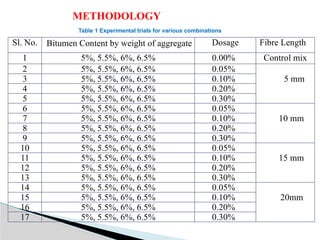
Sl. No. Bitumen Content by weight of aggregate Dosage Fibre Length
1 5%, 5.5%, 6%, 6.5% 0.00% Control mix
2 5%, 5.5%, 6%, 6.5% 0.05%
5 mm
3 5%, 5.5%, 6%, 6.5% 0.10%
4 5%, 5.5%, 6%, 6.5% 0.20%
5 5%, 5.5%, 6%, 6.5% 0.30%
6 5%, 5.5%, 6%, 6.5% 0.05%
10 mm
7 5%, 5.5%, 6%, 6.5% 0.10%
8 5%, 5.5%, 6%, 6.5% 0.20%
9 5%, 5.5%, 6%, 6.5% 0.30%
10 5%, 5.5%, 6%, 6.5% 0.05%
15 mm
11 5%, 5.5%, 6%, 6.5% 0.10%
12 5%, 5.5%, 6%, 6.5% 0.20%
13 5%, 5.5%, 6%, 6.5% 0.30%
14 5%, 5.5%, 6%, 6.5% 0.05%
20mm
15 5%, 5.5%, 6%, 6.5% 0.10%
16 5%, 5.5%, 6%, 6.5% 0.20%
17 5%, 5.5%, 6%, 6.5% 0.30%
METHODOLOGY
Table 1 Experimental trials for various combinations
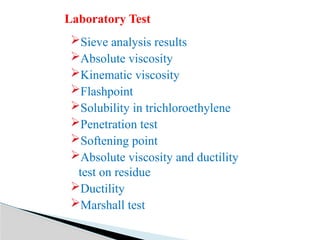
Sieve analysis results
Absolute viscosity
Kinematic viscosity
Flashpoint
Solubility in trichloroethylene
Penetration test
Softening point
Absolute viscosity and ductility
test on residue
Ductility
Marshall test
Laboratory Test
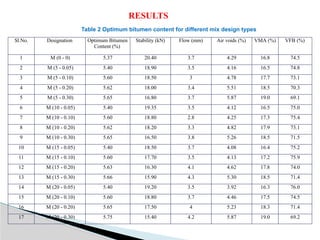
Sl.No. Designation Optimum Bitumen
Content (%)
Stability (kN) Flow (mm) Air voids (%) VMA (%) VFB (%)
1 M (0 - 0) 5.37 20.40 3.7 4.29 16.8 74.5
2 M (5 - 0.05) 5.40 18.90 3.5 4.16 16.5 74.8
3 M (5 - 0.10) 5.60 18.50 3 4.78 17.7 73.1
4 M (5 - 0.20) 5.62 18.00 3.4 5.51 18.5 70.3
5 M (5 - 0.30) 5.65 16.80 3.7 5.87 19.0 69.1
6 M (10 - 0.05) 5.40 19.35 3.5 4.12 16.5 75.0
7 M (10 - 0.10) 5.60 18.80 2.8 4.25 17.3 75.4
8 M (10 - 0.20) 5.62 18.20 3.3 4.82 17.9 73.1
9 M (10 - 0.30) 5.65 16.50 3.8 5.26 18.5 71.5
10 M (15 - 0.05) 5.40 18.50 3.7 4.08 16.4 75.2
11 M (15 - 0.10) 5.60 17.70 3.5 4.13 17.2 75.9
12 M (15 - 0.20) 5.63 16.30 4.1 4.62 17.8 74.0
13 M (15 - 0.30) 5.66 15.90 4.3 5.30 18.5 71.4
14 M (20 - 0.05) 5.40 19.20 3.5 3.92 16.3 76.0
15 M (20 - 0.10) 5.60 18.80 3.7 4.46 17.5 74.5
16 M (20 - 0.20) 5.65 17.50 4 5.23 18.3 71.4
17 M (20 - 0.30) 5.75 15.40 4.2 5.87 19.0 69.2
RESULTS
Table 2 Optimum bitumen content for different mix design types
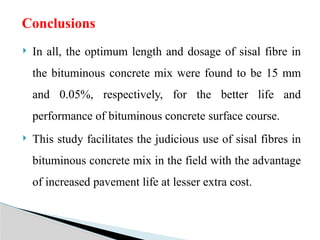
 In all, the optimum length and dosage of sisal fibre in
the bituminous concrete mix were found to be 15 mm
and 0.05%, respectively, for the better life and
performance of bituminous concrete surface course.
 This study facilitates the judicious use of sisal fibres in
bituminous concrete mix in the field with the advantage
of increased pavement life at lesser extra cost.
Conclusions
 American Association of State Highway and Transportation Officials
(AASHTO) 1989, Standard Method of Test for Resistance of Compacted
Bituminous Mixture to Moisture Damage. AASHTO DesignationT283
 American Association of State Highway and Transportation Officials
(AASHTO) 2008, Standard Method of Test for Resistance to Plastic flow
of Bituminous Mixtures using Marshall Apparatus. AASHTO Designation
AASTHO T245.
 American Society for Testing and Materials (ASTM) 2015, Standard Test
Method for Tensile Properties of Yarns by the Single-StrandMethod.
ASTM Designation D 2256 – 02.
REFERENCES

Priya Parihar M.TECH IV SEM structure.pptx

  • 1.
    Paper Presentation on Performance Evaluationof Environmentally Sustainable Sisal Fiber Reinforced Bituminous Mixes for Roads PRIYA PARIHAR M-Tech (CTM) Enrollment No.: 0103CE17MT15 Under the supervision of ABHAY KUMAR JHA (Associate Professor) & BARUN KUMAR (Assistant Professor) Department of Civil Engineering, LAKSHMI NARAIN COLLEGE OF TECHNOLOGY BHOPAL (M.P.)
  • 2.
     , Theshare of road transport has been continually increasing with a substantial shift from other modes to road, Over the past four decades.  In India Road transportation has become a wider choice among all the transport systems.  The materials are required for this study sourced from the local market and tested to assess their suitability in labotatory.  It is important to have a better road infrastructure with minimal possible hindrance to road users by providing regular periodic and routine maintenance.  The optimum bitumen content for the control mix and fiber added mixes were arrived by Various method of mix design. ABSTRACT
  • 3.
     Transport isa key infrastructure of a country. Further, the country’s economic status depends on how well the country is served by its road, railways, airports and ports.  The growth rate of the country is closely connected to its development in the transport sector.  Among the four major modes of transportation (viz. roadways, railways, waterways and airways), road provides maximum service.  Road transportation has the maximum flexibility for travel with reference to route, direction, time, speed and mode of the vehicle.  The road transport has become a wider choice among all the transport systems in India, keeping in view of its level of penetration in to the populated area and its cost effectiveness. Road transport is a critical infrastructure for the economic development of a country. Introduction
  • 4.
     The objectivesof this study are to investigate the effect of sisal fibers on the following engineering properties of bituminous concrete mixes and to identify the optimum length and dosage of sisal fibers in bituminous concrete mixes for better performance.  Marshall parameters – stability, flow, air voids, Voids in Mineral Aggregate (VMA) and Voids Filled with Bitumen (VFB) OBJECTIVE
  • 5.
     Remadevi etal. (2014) carried out a study of fibre reinforced bituminous concrete and studied the effect of Polypropylene Fibres as reinforcement in bituminous mixes. Polypropylene Fibres of 10mm length were added by employing the wet technique. Optimum bitumen content was arrived as 4.83% for neat bituminous mix using Marshall method. At this optimum bitumen content, specimens were prepared with 4 dosages ( 4%, 6%, 8% and 10%) and Marshall properties of bituminous mixes were tested. Optimum fibre content was arrived by taking the average fibre content corresponding to maximum stability, maximum unit weight and median of the percent of air voids in the total mix. The optimum fibre content thus arrived was 5.33% by weight of bitumen. They concluded that the addition of fibres provided excellent stability and volumetric properties. The variation in stability and flow values improved the structural resistance of bituminous concrete and reduced the distresses in the flexible pavement. LITERATURE REVIEW
  • 6.
    Sl. No. BitumenContent by weight of aggregate Dosage Fibre Length 1 5%, 5.5%, 6%, 6.5% 0.00% Control mix 2 5%, 5.5%, 6%, 6.5% 0.05% 5 mm 3 5%, 5.5%, 6%, 6.5% 0.10% 4 5%, 5.5%, 6%, 6.5% 0.20% 5 5%, 5.5%, 6%, 6.5% 0.30% 6 5%, 5.5%, 6%, 6.5% 0.05% 10 mm 7 5%, 5.5%, 6%, 6.5% 0.10% 8 5%, 5.5%, 6%, 6.5% 0.20% 9 5%, 5.5%, 6%, 6.5% 0.30% 10 5%, 5.5%, 6%, 6.5% 0.05% 15 mm 11 5%, 5.5%, 6%, 6.5% 0.10% 12 5%, 5.5%, 6%, 6.5% 0.20% 13 5%, 5.5%, 6%, 6.5% 0.30% 14 5%, 5.5%, 6%, 6.5% 0.05% 20mm 15 5%, 5.5%, 6%, 6.5% 0.10% 16 5%, 5.5%, 6%, 6.5% 0.20% 17 5%, 5.5%, 6%, 6.5% 0.30% METHODOLOGY Table 1 Experimental trials for various combinations
  • 7.
    Sieve analysis results Absoluteviscosity Kinematic viscosity Flashpoint Solubility in trichloroethylene Penetration test Softening point Absolute viscosity and ductility test on residue Ductility Marshall test Laboratory Test
  • 8.
    Sl.No. Designation OptimumBitumen Content (%) Stability (kN) Flow (mm) Air voids (%) VMA (%) VFB (%) 1 M (0 - 0) 5.37 20.40 3.7 4.29 16.8 74.5 2 M (5 - 0.05) 5.40 18.90 3.5 4.16 16.5 74.8 3 M (5 - 0.10) 5.60 18.50 3 4.78 17.7 73.1 4 M (5 - 0.20) 5.62 18.00 3.4 5.51 18.5 70.3 5 M (5 - 0.30) 5.65 16.80 3.7 5.87 19.0 69.1 6 M (10 - 0.05) 5.40 19.35 3.5 4.12 16.5 75.0 7 M (10 - 0.10) 5.60 18.80 2.8 4.25 17.3 75.4 8 M (10 - 0.20) 5.62 18.20 3.3 4.82 17.9 73.1 9 M (10 - 0.30) 5.65 16.50 3.8 5.26 18.5 71.5 10 M (15 - 0.05) 5.40 18.50 3.7 4.08 16.4 75.2 11 M (15 - 0.10) 5.60 17.70 3.5 4.13 17.2 75.9 12 M (15 - 0.20) 5.63 16.30 4.1 4.62 17.8 74.0 13 M (15 - 0.30) 5.66 15.90 4.3 5.30 18.5 71.4 14 M (20 - 0.05) 5.40 19.20 3.5 3.92 16.3 76.0 15 M (20 - 0.10) 5.60 18.80 3.7 4.46 17.5 74.5 16 M (20 - 0.20) 5.65 17.50 4 5.23 18.3 71.4 17 M (20 - 0.30) 5.75 15.40 4.2 5.87 19.0 69.2 RESULTS Table 2 Optimum bitumen content for different mix design types
  • 9.
     In all,the optimum length and dosage of sisal fibre in the bituminous concrete mix were found to be 15 mm and 0.05%, respectively, for the better life and performance of bituminous concrete surface course.  This study facilitates the judicious use of sisal fibres in bituminous concrete mix in the field with the advantage of increased pavement life at lesser extra cost. Conclusions
  • 10.
     American Associationof State Highway and Transportation Officials (AASHTO) 1989, Standard Method of Test for Resistance of Compacted Bituminous Mixture to Moisture Damage. AASHTO DesignationT283  American Association of State Highway and Transportation Officials (AASHTO) 2008, Standard Method of Test for Resistance to Plastic flow of Bituminous Mixtures using Marshall Apparatus. AASHTO Designation AASTHO T245.  American Society for Testing and Materials (ASTM) 2015, Standard Test Method for Tensile Properties of Yarns by the Single-StrandMethod. ASTM Designation D 2256 – 02. REFERENCES