GROUP-4
PHILIPS VERSUS MATSUSHITA CASE ANALYSIS
• Founded in 1892 by Gerard Philips in Eindhoven,
Holland
• Tradition of caring for its workers
• Innovation as a core strength
– One product focus on light-bulbs (initially) + Gerard’s
technological prowess enable significant innovations
• Strong research vital to company’s survival
• Philips built its success on a worldwide portfolio of
responsive national organizations
PHILIPS
• By 2001, it becomes evident that Philips’ best chance of survival was to
outsource even more of its basic manufacturing and become a technology
developer and global marketer
• In 2002, company HQ moved from Eindhoven to Amsterdam
– In a sense, the move to Amsterdam can be considered a return to the company's roots,
because Gerard Philips lived in Amsterdam when he came up with the idea of building a light
bulb factory and also conducted his first experiments in the field of mass production of light
bulbs there
• Philips Lighting, Philips Research, Philips Semiconductors (spun off as
NXP in September 2006) and Philips Design, are still based in Eindhoven
• Philips Healthcare is headquartered in both Best, Netherlands (just
outside Eindhoven) and Andover, Massachusetts (U.S.)
PHILIPS
• Founded in 1918 by Konosuke Matsushita in
Osaka, Japan
• “Seven Spirits of Matushita” and cultural and spiritual
training are key
• First Japanese company to adopt the divisional
structure
– “One-product-one-division”
– Internal competition fostered among divisions
• Matsushita built its success on its centralized, highly
efficient operations in Japan
MATSUSHITA
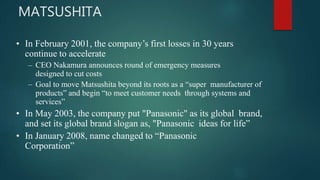
• In February 2001, the company’s first losses in 30 years
continue to accelerate
– CEO Nakamura announces round of emergency measures
designed to cut costs
– Goal to move Matsushita beyond its roots as a “super manufacturer of
products” and begin “to meet customer needs through systems and
services”
• In May 2003, the company put "Panasonic" as its global brand,
and set its global brand slogan as, "Panasonic ideas for life”
• In January 2008, name changed to “Panasonic
Corporation”
MATSUSHITA
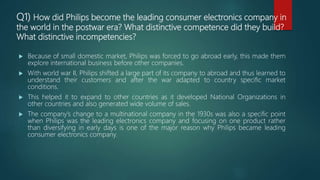
Q1) How did Philips become the leading consumer electronics company in
the world in the postwar era? What distinctive competence did they build?
What distinctive incompetencies?
 Because of small domestic market, Philips was forced to go abroad early, this made them
explore international business before other companies.
 With world war II, Philips shifted a large part of its company to abroad and thus learned to
understand their customers and after the war adapted to country specific market
conditions.
 This helped it to expand to other countries as it developed National Organizations in
other countries and also generated wide volume of sales.
 The company’s change to a multinational company in the 1930s was also a specific point
when Philips was the leading electronics company and focusing on one product rather
than diversifying in early days is one of the major reason why Philips became leading
consumer electronics company.
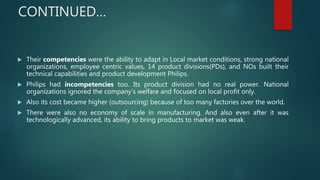
 Their competencies were the ability to adapt in Local market conditions, strong national
organizations, employee centric values, 14 product divisions(PDs), and NOs built their
technical capabilities and product development Philips.
 Philips had incompetencies too. Its product division had no real power. National
organizations ignored the company’s welfare and focused on local profit only.
 Also its cost became higher (outsourcing) because of too many factories over the world.
 There were also no economy of scale in manufacturing. And also even after it was
technologically advanced, its ability to bring products to market was weak.
CONTINUED…
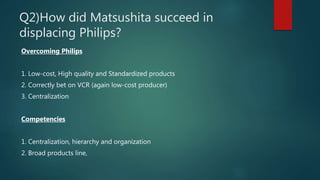
Q2)How did Matsushita succeed in
displacing Philips?
Overcoming Philips
1. Low-cost, High quality and Standardized products
2. Correctly bet on VCR (again low-cost producer)
3. Centralization
Competencies
1. Centralization, hierarchy and organization
2. Broad products line,
Continued..
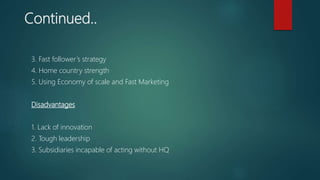
3. Fast follower’s strategy
4. Home country strength
5. Using Economy of scale and Fast Marketing
Disadvantages
1. Lack of innovation
2. Tough leadership
3. Subsidiaries incapable of acting without HQ
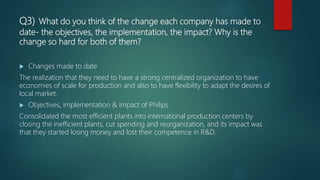
Q3) What do you think of the change each company has made to
date- the objectives, the implementation, the impact? Why is the
change so hard for both of them?
 Changes made to date
The realization that they need to have a strong centralized organization to have
economies of scale for production and also to have flexibility to adapt the desires of
local market.
 Objectives, implementation & impact of Philips
Consolidated the most efficient plants into international production centers by
closing the inefficient plants, cut spending and reorganization, and its impact was
that they started losing money and lost their competence in R&D.
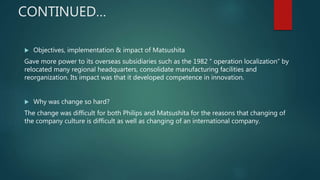
 Objectives, implementation & impact of Matsushita
Gave more power to its overseas subsidiaries such as the 1982 “ operation localization” by
relocated many regional headquarters, consolidate manufacturing facilities and
reorganization. Its impact was that it developed competence in innovation.
 Why was change so hard?
The change was difficult for both Philips and Matsushita for the reasons that changing of
the company culture is difficult as well as changing of an international company.
CONTINUED…
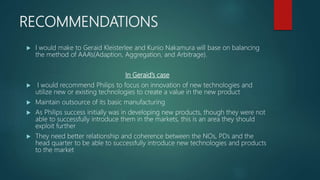
RECOMMENDATIONS
 I would make to Geraid Kleisterlee and Kunio Nakamura will base on balancing
the method of AAA’s(Adaption, Aggregation, and Arbitrage).
In Geraid’s case
 I would recommend Philips to focus on innovation of new technologies and
utilize new or existing technologies to create a value in the new product
 Maintain outsource of its basic manufacturing
 As Philips success initially was in developing new products, though they were not
able to successfully introduce them in the markets, this is an area they should
exploit further
 They need better relationship and coherence between the NOs, PDs and the
head quarter to be able to successfully introduce new technologies and products
to the market
In Kunio’s case
 He radically changed the core structure of Matsushita quickly. Quick change of core strategy of big
company came with unstable structure in which many people would not be able to adapt in short
term and could create a catastrophe.
 We would recommend him to make a small and slow changes or deviations as needed in core
structure
 Kunio shall remain individual product divisions to maintain a focus in innovation of new products
 Shall consolidate or integrate the factories to be capable of building multi-product production
 The new integrated product production can switch the assembly lines quickly from producing less
profit products to high profit products, and eliminate a high cost to maintain less profitable
lines in the old way.
 Matsushita will need to anticipate the globalization of the market so that they could be capable of
sustaining their competitive advantage in low-cost production.
CONTINUED…

Philips versus Matsushita Case ANALYSIS

  • 1.
  • 2.
    • Founded in1892 by Gerard Philips in Eindhoven, Holland • Tradition of caring for its workers • Innovation as a core strength – One product focus on light-bulbs (initially) + Gerard’s technological prowess enable significant innovations • Strong research vital to company’s survival • Philips built its success on a worldwide portfolio of responsive national organizations PHILIPS
  • 3.
    • By 2001,it becomes evident that Philips’ best chance of survival was to outsource even more of its basic manufacturing and become a technology developer and global marketer • In 2002, company HQ moved from Eindhoven to Amsterdam – In a sense, the move to Amsterdam can be considered a return to the company's roots, because Gerard Philips lived in Amsterdam when he came up with the idea of building a light bulb factory and also conducted his first experiments in the field of mass production of light bulbs there • Philips Lighting, Philips Research, Philips Semiconductors (spun off as NXP in September 2006) and Philips Design, are still based in Eindhoven • Philips Healthcare is headquartered in both Best, Netherlands (just outside Eindhoven) and Andover, Massachusetts (U.S.) PHILIPS
  • 4.
    • Founded in1918 by Konosuke Matsushita in Osaka, Japan • “Seven Spirits of Matushita” and cultural and spiritual training are key • First Japanese company to adopt the divisional structure – “One-product-one-division” – Internal competition fostered among divisions • Matsushita built its success on its centralized, highly efficient operations in Japan MATSUSHITA
  • 5.
    • In February2001, the company’s first losses in 30 years continue to accelerate – CEO Nakamura announces round of emergency measures designed to cut costs – Goal to move Matsushita beyond its roots as a “super manufacturer of products” and begin “to meet customer needs through systems and services” • In May 2003, the company put "Panasonic" as its global brand, and set its global brand slogan as, "Panasonic ideas for life” • In January 2008, name changed to “Panasonic Corporation” MATSUSHITA
  • 6.
    Q1) How didPhilips become the leading consumer electronics company in the world in the postwar era? What distinctive competence did they build? What distinctive incompetencies?  Because of small domestic market, Philips was forced to go abroad early, this made them explore international business before other companies.  With world war II, Philips shifted a large part of its company to abroad and thus learned to understand their customers and after the war adapted to country specific market conditions.  This helped it to expand to other countries as it developed National Organizations in other countries and also generated wide volume of sales.  The company’s change to a multinational company in the 1930s was also a specific point when Philips was the leading electronics company and focusing on one product rather than diversifying in early days is one of the major reason why Philips became leading consumer electronics company.
  • 7.
     Their competencieswere the ability to adapt in Local market conditions, strong national organizations, employee centric values, 14 product divisions(PDs), and NOs built their technical capabilities and product development Philips.  Philips had incompetencies too. Its product division had no real power. National organizations ignored the company’s welfare and focused on local profit only.  Also its cost became higher (outsourcing) because of too many factories over the world.  There were also no economy of scale in manufacturing. And also even after it was technologically advanced, its ability to bring products to market was weak. CONTINUED…
  • 8.
    Q2)How did Matsushitasucceed in displacing Philips? Overcoming Philips 1. Low-cost, High quality and Standardized products 2. Correctly bet on VCR (again low-cost producer) 3. Centralization Competencies 1. Centralization, hierarchy and organization 2. Broad products line,
  • 9.
    Continued.. 3. Fast follower’sstrategy 4. Home country strength 5. Using Economy of scale and Fast Marketing Disadvantages 1. Lack of innovation 2. Tough leadership 3. Subsidiaries incapable of acting without HQ
  • 10.
    Q3) What doyou think of the change each company has made to date- the objectives, the implementation, the impact? Why is the change so hard for both of them?  Changes made to date The realization that they need to have a strong centralized organization to have economies of scale for production and also to have flexibility to adapt the desires of local market.  Objectives, implementation & impact of Philips Consolidated the most efficient plants into international production centers by closing the inefficient plants, cut spending and reorganization, and its impact was that they started losing money and lost their competence in R&D.
  • 11.
     Objectives, implementation& impact of Matsushita Gave more power to its overseas subsidiaries such as the 1982 “ operation localization” by relocated many regional headquarters, consolidate manufacturing facilities and reorganization. Its impact was that it developed competence in innovation.  Why was change so hard? The change was difficult for both Philips and Matsushita for the reasons that changing of the company culture is difficult as well as changing of an international company. CONTINUED…
  • 12.
    RECOMMENDATIONS  I wouldmake to Geraid Kleisterlee and Kunio Nakamura will base on balancing the method of AAA’s(Adaption, Aggregation, and Arbitrage). In Geraid’s case  I would recommend Philips to focus on innovation of new technologies and utilize new or existing technologies to create a value in the new product  Maintain outsource of its basic manufacturing  As Philips success initially was in developing new products, though they were not able to successfully introduce them in the markets, this is an area they should exploit further  They need better relationship and coherence between the NOs, PDs and the head quarter to be able to successfully introduce new technologies and products to the market
  • 13.
    In Kunio’s case He radically changed the core structure of Matsushita quickly. Quick change of core strategy of big company came with unstable structure in which many people would not be able to adapt in short term and could create a catastrophe.  We would recommend him to make a small and slow changes or deviations as needed in core structure  Kunio shall remain individual product divisions to maintain a focus in innovation of new products  Shall consolidate or integrate the factories to be capable of building multi-product production  The new integrated product production can switch the assembly lines quickly from producing less profit products to high profit products, and eliminate a high cost to maintain less profitable lines in the old way.  Matsushita will need to anticipate the globalization of the market so that they could be capable of sustaining their competitive advantage in low-cost production. CONTINUED…