Modern vs Postmodern 
Mary Medrana
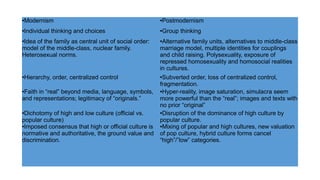
●Modernism ●Postmodernism 
●Individual thinking and choices ●Group thinking 
●Idea of the family as central unit of social order: 
model of the middle-class, nuclear family. 
Heterosexual norms. 
●Alternative family units, alternatives to middle-class 
marriage model, multiple identities for couplings 
and child raising. Polysexuality, exposure of 
repressed homosexuality and homosocial realities 
in cultures. 
●Hierarchy, order, centralized control ●Subverted order, loss of centralized control, 
fragmentation. 
●Faith in “real” beyond media, language, symbols, 
and representations; legitimacy of “originals.” 
●Hyper-reality, image saturation, simulacra seem 
more powerful than the “real”; images and texts with 
no prior “original” 
●Dichotomy of high and low culture (official vs. 
popular culture) 
●Imposed consensus that high or official culture is 
normative and authoritative, the ground value and 
discrimination. 
●Disruption of the dominance of high culture by 
popular culture. 
●Mixing of popular and high cultures, new valuation 
of pop culture, hybrid culture forms cancel 
“high”/”low” categories.
Am I modern or postmodern? 
• I believe that I am a bit of both but more towards postmodern. This is 
because some aspects of modernism such as hierarchy, order, 
centralized control I would agree with. However other aspects of 
modernism such as the idea of the family as central unit of social order: 
model of the middle-class, nuclear family and also heterosexual norms, I 
would not particularly agree with as I believe that there are alternative 
family units and not just one in particular. This is what postmodernists 
believe which I would agree with. Also, I would rather participate in 
group thinking than individual which is what postmodernists would also 
prefer. 
• However, I believe that my own music video will be more modern as it will 
use more “real” media, language, symbols, and representations rather 
than depict a hyper reality and less use of image saturation. 
•

Modern vs postmodern

  • 1.
    Modern vs Postmodern Mary Medrana
  • 2.
    ●Modernism ●Postmodernism ●Individualthinking and choices ●Group thinking ●Idea of the family as central unit of social order: model of the middle-class, nuclear family. Heterosexual norms. ●Alternative family units, alternatives to middle-class marriage model, multiple identities for couplings and child raising. Polysexuality, exposure of repressed homosexuality and homosocial realities in cultures. ●Hierarchy, order, centralized control ●Subverted order, loss of centralized control, fragmentation. ●Faith in “real” beyond media, language, symbols, and representations; legitimacy of “originals.” ●Hyper-reality, image saturation, simulacra seem more powerful than the “real”; images and texts with no prior “original” ●Dichotomy of high and low culture (official vs. popular culture) ●Imposed consensus that high or official culture is normative and authoritative, the ground value and discrimination. ●Disruption of the dominance of high culture by popular culture. ●Mixing of popular and high cultures, new valuation of pop culture, hybrid culture forms cancel “high”/”low” categories.
  • 3.
    Am I modernor postmodern? • I believe that I am a bit of both but more towards postmodern. This is because some aspects of modernism such as hierarchy, order, centralized control I would agree with. However other aspects of modernism such as the idea of the family as central unit of social order: model of the middle-class, nuclear family and also heterosexual norms, I would not particularly agree with as I believe that there are alternative family units and not just one in particular. This is what postmodernists believe which I would agree with. Also, I would rather participate in group thinking than individual which is what postmodernists would also prefer. • However, I believe that my own music video will be more modern as it will use more “real” media, language, symbols, and representations rather than depict a hyper reality and less use of image saturation. •