Post Modernism
• Aconcept originated during 1960s, as more and more ideological
bodies entered the arena, the women, the minorities, people
from the developing world raised voice, and the then conflict
prevailing between Capitalist and Communist/Socialist blocks in
the world.
• The concept of Post Modernism appreciates the ideologies around
and acknowledges that every idea shall be given right to exist.
• Hostility may not be allowed but peaceful coexistence shall.
A tolerant, peaceful co-existence of all ideologies and their followers
is a possibility in a multicultural environment.
4.
•Post Modernism isbased on
learning, that no approach
could eliminate the other,
hence a way to co-existence
shall be discovered.
5.
Criticism on PostModernism
•Opponents of Post Modernism, propagate that it is
confused and lack understanding of mass structuring
of society.
• They say post modernism would lead us nowhere;
rather it’s a threat to prevailing structure in capacity
of a “de-constructionists” approach.
Characteristics of PostModernism
1-There is no absolute truth
•Post modernism questions the absoluteness of already
constructed narratives and practices.
•It argue to examine the standing of perspectives and
knowledge on rationale grounds.
•It also questions the standing of facts arguing that facts
to one may fall as falsehood to another.
8.
2-Frustrated with modernmega-structuring
•Post modernists found criticizing the mega-
structuring of societies and communities
since this was seen as interference and
manipulation of indigenous and domestic
(although mini) structures of communities.
9.
Rationalization is thenorm
•Rationalization—to the domestic reasoning and
logics, shall become the norm in order to stop
intrusion by others into traditional functioning
of communities and societies.
•Circumstances in Pakistan are better
understood by Pakistanis, they better to govern
matters here in realization of their
responsibility towards global community.
10.
Global community ismore important than
nationalism
•Nationalism of any country cannot overtaken
the global discourses and narratives in any
capacity.
•There shall prevail a harmony within nations
with an acute understanding and responsibility
towards the global community.
11.
People less likelyto follow the rigid ideology
•In a post-modern world where ideologies are beings
challenge with research, criticism over their failures, no rigid
idea or ideology should be followed by masses.
• In the post cold war scenario people deemed for a better
and stable world and gradually came out of their rigid
practices and ideologies.
•However, this seems to be fairy tale only since rigid
ideologies are back in business, the American elections are
an example.
12.
Greater pluralism ismodern life
•Pluralism and multiculturalism are key to post
modernists propositions characterizing the way life
would look like. The world has becoming more
pluralistic and multicultural in recent decades
wherein in people from cultures living together
and sharing lot commonalities while sticking to
their communal identities. Communities are being
given voice and their fair share through polls and
all.
13.
Post modernism encouragesthe acceptance
of diversity
•Diversity is taken as advantage and must thing to
be appreciated.
•Diversity should not lead to discrimination…
•by accepting it a more tolerant and harmonious
society can be established.
14.
• in anut shell , Postmodern culture is a new type of thinking where people don’t believe in
one single truth.
• In older times:
• People followed one version of truth
• There were fixed rules
• Society had clear boundaries (e.g., what is art, what is culture, what is good/bad)
• But now, in the postmodern era:
• People say “everyone has their own truth.”
• Everything is mixed: cultures, ideas, fashions
• Nothing is pure or original; everything is copied, remixed, recreated
• Media shapes our reality more than real life does
• This change is mostly because of modern media.
15.
Why is MediaConnected with Postmodern
Culture?
• Because today’s media:
• Gives us too much information
• Shows multiple versions of the same event
• Blends reality with fiction
• Makes us follow trends that come from different cultures
• Lets everyone present a different identity
• Media has become the main source through which people
understand the world.
16.
Characteristics of PostmodernCultured media
1*Hyperreality– Media looks more real than real life its when
media-created images look more real to us than actual reality.
• Examples:
• Girls see beauty filters and start feeling that their real face is not good enough
• Instagram lifestyles make us think everyone else is living a perfect life
• Turkish dramas or Indian serials create a fake idea of love & marriage
• Political narrations on TV/social media create “manufactured truth”
• We start believing the media version more than the real version.
• This is pure postmodern culture.
17.
2*Fragmentation ,Everything isshort, fast, mixed,
scattered
• Our attention span is small.
• TikTok videos (10 seconds)
• Snapchat stories
• Reels
• Meme culture
• News updates every 5 minutes
• Our minds no longer follow long, detailed stories.
• We live in bits and pieces of information.
This is postmodern fragmentation.
Characteristics of Postmodern Cultured media
18.
3*Intertextuality– Everything copiesor references something
else
• Nothing today is “new.”
• Examples:
• Remixes of old songs
• TikTok audios reused thousands of times
• Memes using old dialogues from Pakistani dramas
• Shows like Coke Studio mixing old folk with new pop
• Movies taking inspiration from older movies
• This mixing, copying, referencing = postmodernism.
Characteristics of Postmodern Cultured media
19.
4*Blurring Boundaries– Noline between high culture &
low culture
• Before:
• High culture = classical music, literature, art
• Popular culture = dramas, films, songs, jokes
• Today:
• Faiz Ahmed Faiz poetry used in Instagram quotes
• Heer Waris Shah lines used in TikTok content
• Political debates done with memes
• Serious news presented like entertainment
• Everything is mixed.
• Nothing is above anything else.
Characteristics of Postmodern Cultured media
20.
5*Globalisation & CulturalMixing
• Postmodern media mixes all cultures.
Examples:
• Pakistani youth wearing Korean fashion
• People watching Turkish dramas and adopting their culture
• Hollywood slang used in everyday talk
• Ramadan transmissions copying Indian reality-show style
• Punjabi bhangra mixed with EDM in music
• Cultures are no longer pure.
• Everything is hybrid.
Characteristics of Postmodern Cultured media
21.
6*Identity Play– Peopleshowing different versions of themselves
• In postmodern culture:
• Identity is not fixed
• People can change themselves anytime
• Online presence is different from real presence
• Examples:
• A shy person becomes confident on TikTok
• Filters change appearance instantly
• Gaming avatars and online personas
• People showing “best parts” of their lives online
• Media allows us to create multiple identities.
Characteristics of Postmodern Culture
22.
7*Consumer Culture –Buying symbols, not
products
• Today we buy things not for use, but for the “image.”
• Examples:
• Buying iPhone not for features but for status
• Wearing brands like Gucci/Zara for identity
• Food aesthetics more important than taste
• Influencers selling lifestyle, not actual products
• This is called symbolic consumption.
Characteristics of Postmodern Culture
23.
How Today’s MediaEmbodies These
Postmodern Qualities
• Today’s media:
• Creates hyperreality through filters, staging, editing
• Gives fragmented information through short-form content
• Uses intertextuality through memes, remixes, references
• Mixes high/low culture through social media trends
• Spreads global influences instantly
• Encourages identity switching
• Promotes consumerism through influencers
• Every single part of our media reflects postmodern ideas.
24.
Conclusion
• In today’sworld, media does not just show society…
• It creates society.
• Everything we see around us—our fashion, language, identities, worldview—is shaped through
media content that follows postmodern patterns:
• It mixes, copies, and remixes
• It breaks boundaries
• It creates new realities
• It celebrates diversity and confusion
• It replaces truth with versions of truth
So yes, we can confidently say:
“The media today embodies various aspects of postmodern culture.”
25.
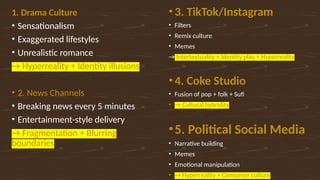
1. Drama Culture
•Sensationalism
• Exaggerated lifestyles
• Unrealistic romance
→ Hyperreality + Identity illusions
• 2. News Channels
• Breaking news every 5 minutes
• Entertainment-style delivery
→ Fragmentation + Blurring
boundaries
• 3. TikTok/Instagram
• Filters
• Remix culture
• Memes
→ Intertextuality + Identity play + Hyperreality
• 4. Coke Studio
• Fusion of pop + folk + Sufi
• → Cultural hybridity
•5. Political Social Media
• Narrative building
• Memes
• Emotional manipulation
• → Hyperreality + Consumer culture