A2 Media Studies
OCR Unit G325: Critical Perspectives in Media
Question 2
Post-modern Media

This guide is aimed at students sitting the OCR exam Paper G325 for A2 Media
Studies. In this section we focus on revising for question 2, focusing on the topic area
post-modern media.

Post-modern Media is one of six topic areas selected by OCR, from which centres
may choose one to prepare their students for the exam. It should be noted that some
centres may choose to prepare their students for 2 topic areas to give the candidate
greater choice. This is, however, up to the individual centre.

Candidates choose one question from a choice of two per topic area. No extra
marks are available to candidates who attempt both questions. Question 2 is worth
50% of the marks for Unit 325 and students should spend approximately one hour
writing a formal essay style response.


Front of Exam Paper
OCR Advanced GCE MEDIA STUDIES
Unit G325: Critical Perspectives in Media


INSTRUCTIONS TO CANDIDATES
Answer both parts of question 1 from section A and one question from section B.


INFORMATION FOR CANDIDATES
The number of marks for each question is given in brackets [ ] at the end of each question or
part of question.

The total number of marks for this paper is 100


Section B: Contemporary Media Issues
Answer one question from section B
In this section you need to write about your knowledge and understanding of Post-
Modern Media. You should answer only one question.
Sample Question Two – Postmodern Media
Choice of two
10 Discuss two or more media texts that you would define as ‘postmodern’
   and explain why you would give them this label. Cover at least two media
   in your answer. [50]


11 Consider the ways in which post-modern media challenge conventional
   relations between audience and text. Refer to at least two media forms
   in your answer. [50]

   Exam Tip: You should only answer one of these questions. They are
   numbered 10 and 11 because they come from a list of 12 questions
   covering six topic areas. You should only attempt the questions in the
   topic area for which you have been prepared. Whichever question you
   choose is worth 50% of you examination and 25% of your A2 grade.
   Unlike questions 1(a) and 1(b) you are not expected to evaluate your
   own productions in relation to the question. However, you may wish to
   comment on your experiences as a media producer to supplement
   wider case studies and examples.


Unpacking the question
Re-read the question and define in your own terms what is meant by the following
words or phrases:

Post-modern _______________________________________________________

__________________________________________________________________

Post-modernity ____________________________________________________

__________________________________________________________________

Conventional relations between audience and text

__________________________________________________________________


__________________________________________________________________


Post-modern relations between audience and text

__________________________________________________________________


__________________________________________________________________
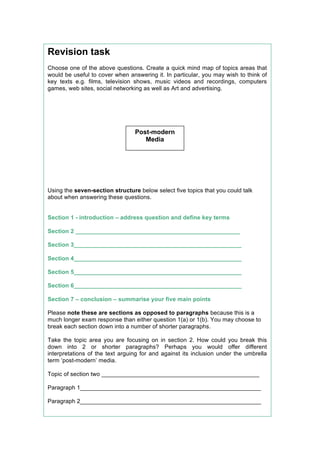
Revision task
Choose one of the above questions. Create a quick mind map of topics areas that
would be useful to cover when answering it. In particular, you may wish to think of
key texts e.g. films, television shows, music videos and recordings, computers
games, web sites, social networking as well as Art and advertising.


                                 Post-modern
                                    Media


Using the seven-section structure below select five topics that you could talk
about when answering these questions.


Section 1 - introduction – address question and define key terms

Section 2 __________________________________________________

Section 3___________________________________________________

Section 4___________________________________________________

Section 5___________________________________________________

Section 6___________________________________________________

Section 7 – conclusion – summarise your five main points

Please note these are sections as opposed to paragraphs because this is a
much longer exam response than either question 1(a) or 1(b). You may choose to
break each section down into a number of shorter paragraphs.

Take the topic area you are focusing on in section 2. How could you break this
down into 2 or shorter paragraphs? Perhaps you would offer different
interpretations of the text arguing for and against its inclusion under the umbrella
term ‘post-modern’ media.

Topic of section two ________________________________________________

Paragraph 1_______________________________________________________

Paragraph 2_______________________________________________________
Generic Mark Scheme for Contemporary Media Issues


Explanation/ analysis/argument (20 marks)
Use of examples (20 marks)
Use of terminology (10 marks)

Explanation/ analysis/argument (16-20 marks)
Candidates adapt their learning to the specific requirements of the question in excellent
fashion. The answer offers a clear, articulate balance of media theories, knowledge of
texts and industries and personal engagement with issues and debates.

Use of examples (16-20 marks)
Examples of texts, industries and theories are clearly connected together in the answer,
with a coherent argument developed in response to the question.

Use of terminology (8-10 marks)
Throughout the answer, material presented is informed by contemporary media theory
and the command of the appropriate theoretical language is excellent.

Complex issues have been expressed clearly and fluently using a style of writing
appropriate to the complex subject matter. Sentences and paragraphs, consistently
relevant, have been well structured, using appropriate technical terminology. There may
be few, if any, errors of spelling, punctuation and grammar


Focus on writing skills

Comparative vocabulary – however, on the one hand, one the other hand, likewise,
similarly, conversely, by the same token, but, never-the-less, although, in contrast.

Paragraphs – should be four to five sentences plus and should be connected by one
thought, idea, point of view or topic.

Topic sentences – useful at beginning of a paragraph, tell the reader what the topic is
and in an exam should refer back to the question e.g. ‘One of the ways in which Social
Networking can be considered an example of post-modern media is that it blurs the
boundaries between the real and the simulated’.

Give examples – in English you’ll have used quotations, in Media Studies you need
concrete factual evidence to support you claims. PEE – Point – Evidence – Explain.
Revision task
The mark-scheme rewards you for accurate and precise use of theoretical terms.
However, that means you need to understand them very thoroughly. Try matching
the theoretical terms with their appropriate definitions.


1. Post-modern                   A To copy something in a humorous and tongue in
                                 cheek way.

                                 B A culture and society in which individual and
2. Post-modernity                collective identity is constructed in material acts of
                                 economic exchange e.g. shopping


3. Parody                        C The semiotic landscape of a society dominated
                                 by consumer culture and information technology


4. Pastiche                      D A copy without an original

                                 E A historical period in Western culture after the
5. Hyper-reality                 Second World in which society became dominated
                                 by information technology

6. Consumer culture              F The knowledge and information that informs
                                 people’s cultural consumption in a post-modern
                                 society

7. Simulacrum
                                 G The basic units of semiotic analysis.

8. Cultural capital
                                 H To copy something without humour, irony or
                                 anything else that communicates difference

9. Signifier and the signified
                                 I The dominant way of thinking about society and
                                 culture enforced by the ruling class.

10. Multi-accentuality
                                 J A system of belief or ideas.

11. Ideology
                                 K The collapse of the distinction between the real
                                 and simulated.

12. Hegemony
                                 L The way in which meaning changes according to
                                 context and over-time.


ANSWERS
1=K 2=E 3=A 4=H 5=C 6=B 7=D 8=F 9=G 10=L 11=J 12=I
Focus on the mark scheme

In addition to the generic mark-scheme, which is used to mark all six topic areas
potentially covered in this unit, the exam board also use descriptors of content that is
indicative of top band answer.

Questions 10 and 11 - Indicative Content
Candidates might consider texts from computer / video games, postmodern cinema, interactive
media, reality TV, music video, advertising, parody and pastiche in media texts or a range of
other applications of postmodern media theory. A high level response will be characterised by
detailed reference to the text and application of definitions of postmodernity.


Selecting your texts for discussion

In your exam response you may only wish to discuss two media format in detail e.g. cinema
and music video. However, it is useful to make reference to a wider range of texts when
discussing generic issues of authorship and the relationship between the producers and
consumers of post-modern media. In particular, in your introduction it can be useful to make
reference to a wider range of texts that cited in the mark scheme. For example, you may
wish to make mention of Post-Modern Fine Art forms and the relationship between
Modernist and Post-Modern cultural forms.

Using the list below select three texts in each category you would feel confident with.
Remember to be specific e.g. don’t just say post-modern Art, say Damien Hirst.
Computer Games
Play Station, Nintendo DS, wii etc, Grand Theft Auto, Mortal Combat, Virtual Football Manager, Warcraft.

1                             2.                            3.

Interactive Media
Internet, Social networking, Facebook, MySpace, YouTube etc.

1                             2.                            3.

Cinema
Blue Velvet, Desperate Living, Videodrome, The Graduate, Clockwork Orange, The Matrix, The Full Monty.

1                             2.                            3.

Television
Reality TV, Big Brother, Singing Detective, Life on Mars, Soap, Sitcom, Mighty Boosh, Flight of the Conchords.

1                             2.                            3.

Music Video
Eisenstein, Hollywood Musicals, Rock ‘n’ roll films, The Beatles, Queen, MTV, Michael Jackson, YouTube,

1                             2.                            3.


Advertising
Compare the Meerkat, Cadbury’s. FHM Sports Driver, viral marketing, niche marketing, multi-platform, interactive.

1                             2.                            3.

Art
Romanticism, Modernism, Post-modernism, Situationism, Surrealism, Pop Art, Saatchi Gallery, Turner Prize.

1                             2.                            3.
Revision Task

Choose five media types from the previous task and select a specific example you are
confident with e.g. cinema/The Matrix. Consider which theoretical perspectives would
be most useful when discussing them and why.

Use this grid to check off to match the example to the theoretical perspective. Try to link
each example to at least three theoretical perspectives.

Once you have completed the grid check if you are missing out any of the theoretical
perspectives covered. Revisit the definitions in the preceding task and think is there any way
you can work these terms into your answer.

                             1              2              3                4                5


1. Post-modern


2. Post-
modernity


3. Parody


4. Pastiche


5. Hyper-reality

6. Consumer
culture

7. Simulacrum


8. Cultural
capital


9. Signifier and
the signified


10.Multi-
accentuality

11. Ideology


12. Hegemony
What it says in the specification

Post-modern Media

Candidates might explore combinations of:

How post-modern media relate to genre and narrative across two media, computer /
video games and new forms of representation, post-modern cinema, interactive media,
reality TV, music video, advertising, post-modern audience theories, aspects of
globalisation, parody and pastiche in media texts or a range of other applications of
post-modern media theory.


The topic areas require understanding of contemporary media texts, industries,
audiences and debates. Candidates must choose one of the following topic areas, in
advance of the examination and, through specific case studies, texts, debates and
research of the candidates’ choice, prepare to demonstrate understanding of the
contemporary issue. This understanding must combine knowledge of at least two
media and a range of texts, industries, audiences and debates, but these are to be
selected by the centre / candidate.

The assessment of the response will be generic, allowing for the broadest possible
range of responses within the topic area chosen. Each topic is accompanied by four
prompt questions, and candidates must be prepared to answer an exam question that
relates to one or more of these four prompts. There should be emphasis on the
historical, the contemporary and the future in relation to the chosen topic, with most
attention on the present. Centres are thus advised to ensure that study materials for
this unit are up to date and relevant.

Exam tip: although students will have studied a range of different texts/media in
class they would be well-advised to consider their own experiences as media
consumers in relation to the theoretical perspectives outlined. In particular,
students may have valuable experience as the consumer of computer games and
the users of social networking that would be extremely useful if framed
appropriately.


Revision task:
Make a list of five media texts with which your are familiar that have not been covered
in your course that fit with the concept of Post-modern Media e.g. film, TV, internet,
music, computer games, social networking, advertising, art, etc.

1

2

3

4

5
The Four Prompt Questions

   1. What are the different versions of post-modernism (historical period, style,
      theoretical approach)?
   2. What are the arguments for and against understanding some forms of media as
      post-modern?
   3. How do post-modern media texts challenge traditional text-reader relations and
      the concept of representation?
   4. In what ways do media audiences and industries operate differently in a post-
      modern world?

   The four prompt questions do not appear in the exam but give an indication
   of the way in which questions will be phrased and theoretical perspectives
   covered. In the proceeding section we offer some suggestions as to how
   students may answer these questions.


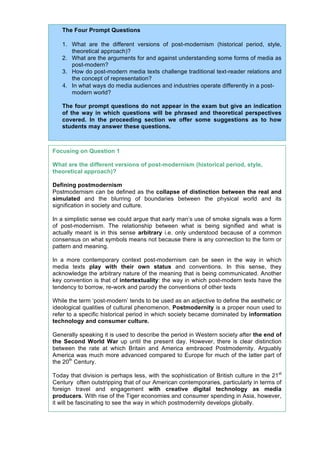
Focusing on Question 1

What are the different versions of post-modernism (historical period, style,
theoretical approach)?

Defining postmodernism
Postmodernism can be defined as the collapse of distinction between the real and
simulated and the blurring of boundaries between the physical world and its
signification in society and culture.

In a simplistic sense we could argue that early man’s use of smoke signals was a form
of post-modernism. The relationship between what is being signified and what is
actually meant is in this sense arbitrary i.e. only understood because of a common
consensus on what symbols means not because there is any connection to the form or
pattern and meaning.

In a more contemporary context post-modernism can be seen in the way in which
media texts play with their own status and conventions. In this sense, they
acknowledge the arbitrary nature of the meaning that is being communicated. Another
key convention is that of intertextuality: the way in which post-modern texts have the
tendency to borrow, re-work and parody the conventions of other texts

While the term ‘post-modern’ tends to be used as an adjective to define the aesthetic or
ideological qualities of cultural phenomenon, Postmodernity is a proper noun used to
refer to a specific historical period in which society became dominated by information
technology and consumer culture.

Generally speaking it is used to describe the period in Western society after the end of
the Second World War up until the present day. However, there is clear distinction
between the rate at which Britain and America embraced Postmodernity. Arguably
America was much more advanced compared to Europe for much of the latter part of
the 20th Century.

Today that division is perhaps less, with the sophistication of British culture in the 21st
Century often outstripping that of our American contemporaries, particularly in terms of
foreign travel and engagement with creative digital technology as media
producers. With rise of the Tiger economies and consumer spending in Asia, however,
it will be fascinating to see the way in which postmodernity develops globally.
Revision Task – discuss the following films.

Mike Nichols - The Graduate (1967)

How does The Graduate depict consumer lifestyle in America during the 1960s?

To what extent does Ben’s relationship with Mrs Robinson reflect changing attitudes in society
towards sex and relationship in the 1960s?

Is Mrs Robinson a post-feminist icon?


John Water’s Desperate Living (1977)

How does John Water’s play with audience expectation of cinema and what makes a good film
in Desperate Living?

To what extent does Desperate Living embody post-modern ideas about identity and the self?


David Cronenberg’s Videodrome (1983)

Fifteen years before the proliferation of the Internet, to what extent does Videodrome anticipate
the problem of a society dominated by information technology?

How does Videodrome blur the boundaries between the real and simulated?


Larry and Andy Wachowski’s The Matrix (1999)

To what extent is The Matrix a metaphor for post-modernism?

What are the limitations of considering The Matrix as exemplary of Post-modernity?


Peter Cattaneo’s The Full Monty (1997)

Watch the opening sequence of the Full Monty, what economic changes in the UK form the
backdrop to the film?

What is impact of society shift from a manufacturing economy to a consumer economy on the
lives of the men and women depicted in the film?


Keenen Ivory Wayan’s Scary Movie (2000)

To what extent does Scary Movie depend upon prior knowledge of the horror film genre?

How does Scary Movie use inter-textual references to other specific films?

Is Scary Movie parody or a pastiche?
Focusing on question 2

What are the arguments for and against understanding some forms of media as post-
modern?


Arguments for

The principal argument for understanding media forms as post-modern is that there is no pre-
postmodern moment in culture i.e. all forms of communication rely upon the suspension of
disbelief and having faith in meanings that are arbitrary. This could be said to apply to early
forms of speech or the cave paintings created by primitive man. Moreover, issues of inter-
textuality and parodic qualities often deemed characteristic of post-modernism has a place in
European culture in the form of the carnival, which goes back to the Middle Ages.

If we trace the development of modern media to the invention of the telephone and the
proliferation of cinema in the 20th century then it is easy to see the way in which these
technologies further blurred the boundaries between what is real and what is simulated. Nobody
questions the meaning of conversation because it takes places on the telephone: its truthfulness
is taken for granted. Likewise the representation of society and culture on the silver screen has
framed and shaped the way in which audiences think about society and culture. In both
instances the everyday use of media technologies that blur the boundaries between the real and
the simulated compound the post-modern experience.

While the early part of the 20th Century was characterised by significant development in media
technology, the accelerated speed with which information technology permeated society and
culture in the West in the second half of the century emphasised this post-modern sensibility. In
addition to this, the advance of consumer culture and decline of heavy industry throughout this
period has seen Britain’s become a more post-modern economy in which workers engage in
creative and information based employment.

The 21st Century has, of course, been characterised by the proliferation of the Internet and the
convergence of media technologies on the PC, laptop and pocket computer. Social networking
has further emphasised the way in which society is dislocated from traditional geographic bound
notions of community. In particular, the success of web 2 has seen user generated content
dominate media consumption, blurring the boundaries further between media producers and
consumers.
Focusing on question 2

What are the arguments for and against understanding some forms of media as post-
modern?

Arguments against

Many of the arguments against understanding media forms as post-modern run parallel to those
arguments that support that viewpoint. Indeed, the very notion that there is no pre-postmodern
moment in culture (i.e. all forms of communication rely upon the suspension of disbelief and
having faith in meanings that are arbitrary) suggests that post-modernism is an inaccurate term.
In this respect, it could be argued that those inter-textual and parodic qualities that are seen as
definitional of the post-modern text would be better served by the pre-Enlightenment term
‘carnivalesque’.

Before we can discount the possibility that a text might be considered post-modern, however, it is
necessary to understand a little bit more about where the term comes from. In this direction the
history of Art is useful starting point. In this sense, when we refer to post-modernism we are quite
literally referring to work that came after Modernism. Modernism in Art is typified by the paintings
of Mondriane or Picasso, whose works experimented with form and structure. Unlike the
preceding Romantic era, Modernism was not concerned with authentic emotional expression but
rather experimentation and innovation in terms of form. One of the arguments against
understanding a media texts as post-modern is that it more accurately fits within definitions of
Romantic or Modernist cultural forms.

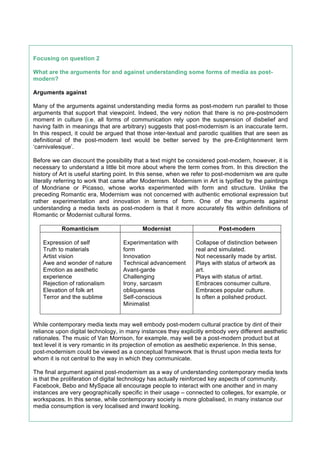
           Romanticism                    Modernist                     Post-modern

   Expression of self              Experimentation with        Collapse of distinction between
   Truth to materials              form                        real and simulated.
   Artist vision                   Innovation                  Not necessarily made by artist.
   Awe and wonder of nature        Technical advancement       Plays with status of artwork as
   Emotion as aesthetic            Avant-garde                 art.
   experience                      Challenging                 Plays with status of artist.
   Rejection of rationalism        Irony, sarcasm              Embraces consumer culture.
   Elevation of folk art           obliqueness                 Embraces popular culture.
   Terror and the sublime          Self-conscious              Is often a polished product.
                                   Minimalist


While contemporary media texts may well embody post-modern cultural practice by dint of their
reliance upon digital technology, in many instances they explicitly embody very different aesthetic
rationales. The music of Van Morrison, for example, may well be a post-modern product but at
text level it is very romantic in its projection of emotion as aesthetic experience. In this sense,
post-modernism could be viewed as a conceptual framework that is thrust upon media texts for
whom it is not central to the way in which they communicate.

The final argument against post-modernism as a way of understanding contemporary media texts
is that the proliferation of digital technology has actually reinforced key aspects of community.
Facebook, Bebo and MySpace all encourage people to interact with one another and in many
instances are very geographically specific in their usage – connected to colleges, for example, or
workspaces. In this sense, while contemporary society is more globalised, in many instance our
media consumption is very localised and inward looking.
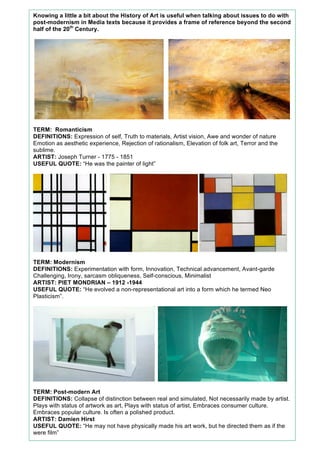
Knowing a little a bit about the History of Art is useful when talking about issues to do with
post-modernism in Media texts because it provides a frame of reference beyond the second
half of the 20th Century.


TERM: Romanticism
DEFINITIONS: Expression of self, Truth to materials, Artist vision, Awe and wonder of nature
Emotion as aesthetic experience, Rejection of rationalism, Elevation of folk art, Terror and the
sublime.
ARTIST: Joseph Turner - 1775 - 1851

USEFUL QUOTE: “He was the painter of light”


TERM: Modernism
DEFINITIONS: Experimentation with form, Innovation, Technical advancement, Avant-garde
Challenging, Irony, sarcasm obliqueness, Self-conscious, Minimalist
ARTIST: PIET MONDRIAN – 1912 -1944
USEFUL QUOTE: “He evolved a non-representational art into a form which he termed Neo
Plasticism”.


TERM: Post-modern Art
DEFINITIONS: Collapse of distinction between real and simulated, Not necessarily made by artist.
Plays with status of artwork as art, Plays with status of artist, Embraces consumer culture.
Embraces popular culture. Is often a polished product.
ARTIST: Damien Hirst
USEFUL QUOTE: “He may not have physically made his art work, but he directed them as if the
were film”


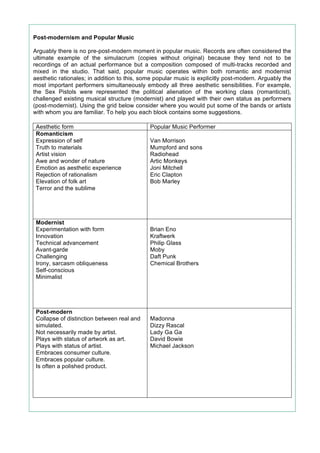
Post-modernism and Popular Music

Arguably there is no pre-post-modern moment in popular music. Records are often considered the
ultimate example of the simulacrum (copies without original) because they tend not to be
recordings of an actual performance but a composition composed of multi-tracks recorded and
mixed in the studio. That said, popular music operates within both romantic and modernist
aesthetic rationales; in addition to this, some popular music is explicitly post-modern. Arguably the
most important performers simultaneously embody all three aesthetic sensibilities. For example,
the Sex Pistols were represented the political alienation of the working class (romanticist),
challenged existing musical structure (modernist) and played with their own status as performers
(post-modernist). Using the grid below consider where you would put some of the bands or artists
with whom you are familiar. To help you each block contains some suggestions.

 Aesthetic form                              Popular Music Performer
 Romanticism
 Expression of self                          Van Morrison
 Truth to materials                          Mumpford and sons
 Artist vision                               Radiohead
 Awe and wonder of nature                    Artic Monkeys
 Emotion as aesthetic experience             Joni Mitchell
 Rejection of rationalism                    Eric Clapton
 Elevation of folk art                       Bob Marley
 Terror and the sublime


 Modernist
 Experimentation with form                   Brian Eno
 Innovation                                  Kraftwerk
 Technical advancement                       Philip Glass
 Avant-garde                                 Moby
 Challenging                                 Daft Punk
 Irony, sarcasm obliqueness                  Chemical Brothers
 Self-conscious
 Minimalist


 Post-modern
 Collapse of distinction between real and    Madonna
 simulated.                                  Dizzy Rascal
 Not necessarily made by artist.             Lady Ga Ga
 Plays with status of artwork as art.        David Bowie
 Plays with status of artist.                Michael Jackson
 Embraces consumer culture.
 Embraces popular culture.
 Is often a polished product.
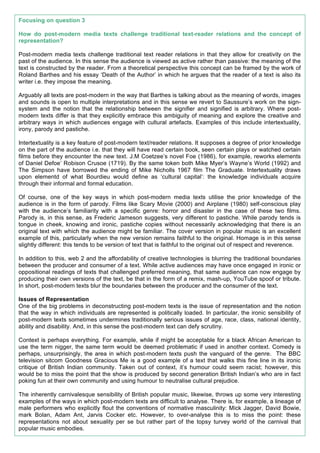
Focusing on question 3

How do post-modern media texts challenge traditional text-reader relations and the concept of
representation?

Post-modern media texts challenge traditional text reader relations in that they allow for creativity on the
past of the audience. In this sense the audience is viewed as active rather than passive: the meaning of the
text is constructed by the reader. From a theoretical perspective this concept can be framed by the work of
Roland Barthes and his essay ‘Death of the Author’ in which he argues that the reader of a text is also its
writer i.e. they impose the meaning.

Arguably all texts are post-modern in the way that Barthes is talking about as the meaning of words, images
and sounds is open to multiple interpretations and in this sense we revert to Saussure’s work on the sign-
system and the notion that the relationship between the signifier and signified is arbitrary. Where post-
modern texts differ is that they explicitly embrace this ambiguity of meaning and explore the creative and
arbitrary ways in which audiences engage with cultural artefacts. Examples of this include intertextuality,
irony, parody and pastiche.

Intertextuality is a key feature of post-modern text/reader relations. It supposes a degree of prior knowledge
on the part of the audience i.e. that they will have read certain book, seen certain plays or watched certain
films before they encounter the new text. J.M Coetzee’s novel Foe (1986), for example, reworks elements
of Daniel Defoe’ Robison Crusoe (1719). By the same token both Mike Myer’s Wayne’s World (1992) and
The Simpson have borrowed the ending of Mike Nicholls 1967 film The Graduate. Intertextuality draws
upon elementd of what Bourdieu would define as ‘cultural capital’: the knowledge individuals acquire
through their informal and formal education.

Of course, one of the key ways in which post-modern media texts utilise the prior knowledge of the
audience is in the form of parody. Films like Scary Movie (2000) and Airplane (1980) self-conscious play
with the audience’s familiarity with a specific genre: horror and disaster in the case of these two films.
Parody is, in this sense, as Frederic Jameson suggests, very different to pastiche. While parody tends is
tongue in cheek, knowing and ironic, pastiche copies without necessarily acknowledging that there is an
original text with which the audience might be familiar. The cover version in popular music is an excellent
example of this, particularly when the new version remains faithful to the original. Homage is in this sense
slightly different: this tends to be version of text that is faithful to the original out of respect and reverence.

In addition to this, web 2 and the affordability of creative technologies is blurring the traditional boundaries
between the producer and consumer of a text. While active audiences may have once engaged in ironic or
oppositional readings of texts that challenged preferred meaning, that same audience can now engage by
producing their own versions of the text, be that in the form of a remix, mash-up, YouTube spoof or tribute.
In short, post-modern texts blur the boundaries between the producer and the consumer of the text.

Issues of Representation
One of the big problems in deconstructing post-modern texts is the issue of representation and the notion
that the way in which individuals are represented is politically loaded. In particular, the ironic sensibility of
post-modern texts sometimes undermines traditionally serious issues of age, race, class, national identity,
ability and disability. And, in this sense the post-modern text can defy scrutiny.

Context is perhaps everything. For example, while if might be acceptable for a black African American to
use the term nigger, the same term would be deemed problematic if used in another context. Comedy is
perhaps, unsurprisingly, the area in which post-modern texts push the vanguard of the genre. The BBC
television sitcom Goodness Gracious Me is a good example of a text that walks this fine line in its ironic
critique of British Indian community. Taken out of context, it’s humour could seem racist; however, this
would be to miss the point that the show is produced by second generation British Indian’s who are in fact
poking fun at their own community and using humour to neutralise cultural prejudice.

The inherently carnivalesque sensibility of British popular music, likewise, throws up some very interesting
examples of the ways in which post-modern texts are difficult to analyse. There is, for example, a lineage of
male performers who explicitly flout the conventions of normative masculinity: Mick Jagger, David Bowie,
mark Bolan, Adam Ant, Jarvis Cocker etc. However, to over-analyse this is to miss the point: these
representations not about sexuality per se but rather part of the topsy turvey world of the carnival that
popular music embodies.
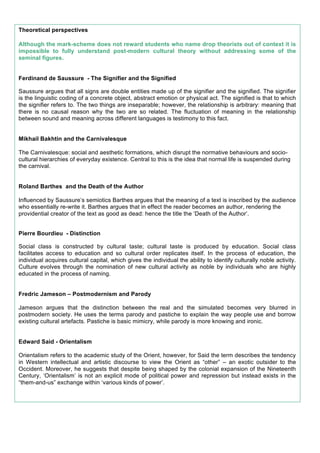
Theoretical perspectives

Although the mark-scheme does not reward students who name drop theorists out of context it is
impossible to fully understand post-modern cultural theory without addressing some of the
seminal figures.


Ferdinand de Saussure - The Signifier and the Signified

Saussure argues that all signs are double entities made up of the signifier and the signified. The signifier
is the linguistic coding of a concrete object, abstract emotion or physical act. The signified is that to which
the signifier refers to. The two things are inseparable; however, the relationship is arbitrary: meaning that
there is no causal reason why the two are so related. The fluctuation of meaning in the relationship
between sound and meaning across different languages is testimony to this fact.


Mikhail Bakhtin and the Carnivalesque

The Carnivalesque: social and aesthetic formations, which disrupt the normative behaviours and socio-
cultural hierarchies of everyday existence. Central to this is the idea that normal life is suspended during
the carnival.


Roland Barthes and the Death of the Author

Influenced by Saussure’s semiotics Barthes argues that the meaning of a text is inscribed by the audience
who essentially re-write it. Barthes argues that in effect the reader becomes an author, rendering the
providential creator of the text as good as dead: hence the title the ‘Death of the Author’.


Pierre Bourdieu - Distinction

Social class is constructed by cultural taste; cultural taste is produced by education. Social class
facilitates access to education and so cultural order replicates itself. In the process of education, the
individual acquires cultural capital, which gives the individual the ability to identify culturally noble activity.
Culture evolves through the nomination of new cultural activity as noble by individuals who are highly
educated in the process of naming.


Fredric Jameson – Postmodernism and Parody

Jameson argues that the distinction between the real and the simulated becomes very blurred in
postmodern society. He uses the terms parody and pastiche to explain the way people use and borrow
existing cultural artefacts. Pastiche is basic mimicry, while parody is more knowing and ironic.


Edward Said - Orientalism

Orientalism refers to the academic study of the Orient, however, for Said the term describes the tendency
in Western intellectual and artistic discourse to view the Orient as “other” – an exotic outsider to the
Occident. Moreover, he suggests that despite being shaped by the colonial expansion of the Nineteenth
Century, ‘Orientalism’ is not an explicit mode of political power and repression but instead exists in the
“them-and-us” exchange within ‘various kinds of power’.
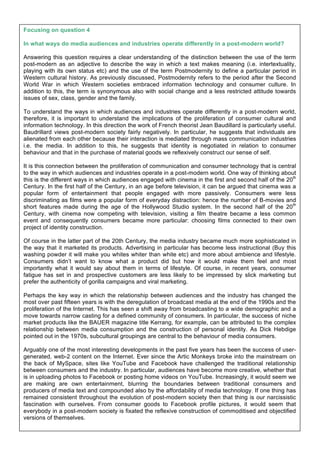
Focusing on question 4

In what ways do media audiences and industries operate differently in a post-modern world?

Answering this question requires a clear understanding of the distinction between the use of the term
post-modern as an adjective to describe the way in which a text makes meaning (i.e. intertextuality,
playing with its own status etc) and the use of the term Postmodernity to define a particular period in
Western cultural history. As previously discussed, Postmodernity refers to the period after the Second
World War in which Western societies embraced information technology and consumer culture. In
addition to this, the term is synonymous also with social change and a less restricted attitude towards
issues of sex, class, gender and the family.

To understand the ways in which audiences and industries operate differently in a post-modern world,
therefore, it is important to understand the implications of the proliferation of consumer cultural and
information technology. In this direction the work of French theorist Jean Baudillard is particularly useful.
Baudrillard views post-modern society fairly negatively. In particular, he suggests that individuals are
alienated from each other because their interaction is mediated through mass communication industries
i.e. the media. In addition to this, he suggests that identity is negotiated in relation to consumer
behaviour and that in the purchase of material goods we reflexively construct our sense of self.

It is this connection between the proliferation of communication and consumer technology that is central
to the way in which audiences and industries operate in a post-modern world. One way of thinking about
this is the different ways in which audiences engaged with cinema in the first and second half of the 20th
Century. In the first half of the Century, in an age before television, it can be argued that cinema was a
popular form of entertainment that people engaged with more passively. Consumers were less
discriminating as films were a popular form of everyday distraction: hence the number of B-movies and
short features made during the age of the Hollywood Studio system. In the second half of the 20 th
Century, with cinema now competing with television, visiting a film theatre became a less common
event and consequently consumers became more particular: choosing films connected to their own
project of identity construction.

Of course in the latter part of the 20th Century, the media industry became much more sophisticated in
the way that it marketed its products. Advertising in particular has become less instructional (Buy this
washing powder it will make you whites whiter than white etc) and more about ambience and lifestyle.
Consumers didn’t want to know what a product did but how it would make them feel and most
importantly what it would say about them in terms of lifestyle. Of course, in recent years, consumer
fatigue has set in and prospective customers are less likely to be impressed by slick marketing but
prefer the authenticity of gorilla campaigns and viral marketing.

Perhaps the key way in which the relationship between audiences and the industry has changed the
most over past fifteen years is with the deregulation of broadcast media at the end of the 1990s and the
proliferation of the Internet. This has seen a shift away from broadcasting to a wide demographic and a
move towards narrow casting for a defined community of consumers. In particular, the success of niche
market products like the BAUER magazine title Kerrang, for example, can be attributed to the complex
relationship between media consumption and the construction of personal identity. As Dick Hebdige
pointed out in the 1970s, subcultural groupings are central to the behaviour of media consumers.

Arguably one of the most interesting developments in the past five years has been the success of user-
generated, web-2 content on the Internet. Ever since the Artic Monkeys broke into the mainstream on
the back of MySpace, sites like YouTube and Facebook have challenged the traditional relationship
between consumers and the industry. In particular, audiences have become more creative, whether that
is in uploading photos to Facebook or posting home videos on YouTube. Increasingly, it would seem we
are making are own entertainment, blurring the boundaries between traditional consumers and
producers of media text and compounded also by the affordability of media technology. If one thing has
remained consistent throughout the evolution of post-modern society then that thing is our narcissistic
fascination with ourselves. From consumer goods to Facebook profile pictures, it would seem that
everybody in a post-modern society is fixated the reflexive construction of commoditised and objectified
versions of themselves.
Post-modernism and Consumer Culture

Jean Baudrillard – Hyper- reality and the Consumer Society

The proliferation of information technology alienates man from real lived social existence, forcing
him to enter a new media induced reality known as hyper-reality: hyper-reality is characterised by
the collapse of the distinction between the real and the simulated and the predominance of the
simulacrum.


Dick Hebdige – Subculture and the Meaning of Style

Central to Hedge’s view of consumer culture is the notion that the individual is active in the
ascription of meaning to consumer goods. Focusing on the punk movement of the mid-1970s he
looks at the ways in which youth-culture borrow and re-work the symbols of preceding youth
groups. In particular his semiotic analysis of the safety pin as a symbol of cultural rebellion has
been particularly influential in framing and shaping the way in which proceeding moments of
cultural resistance have been understood.


Stuart Ewen – The Politics of Style

Style is political: visual signifiers encode systems of belief. While these visual codes are often long
and complex histories their appropriation by consumer culture often dilutes their ideological
potency. The ideological significance of the punk safety pin, example, is diminished when adopted
by mass-produced clothing lines; what is left is in Ewen’s terms ‘cultural waste matter’.


Chris Anderson - The Long Tail

The future of business is selling more of less. The Internet has revolutionised the distribution
possibilities of capitalism. While business structures in the Twentieth Century were chareacterised
by Fordist principals of mass production, businesses that have flourished in the Twenty-First
Century are niche marketing focusing on a defined community of consumers.


Explain what is meant by the following terms:

Hyper-reality


The future of business is selling more of less.


Cultural waste matter


Subculture
Focus on Jean Baudrillard


Baudrillard once said that Disneyland only exists to make Americans believe that the rest of
America is real. What did he mean by this?


Baudrillard has suggested that the whole of modern life is commoditised in ways that are
characteristic of the shopping mall and the modern airport: why do you think he said this?


Baudrillard feels that in a post-modern society human desire and aspiration is restricted to the
desire to possess what other people possess. Do you think he is correct?


Postmodern media

  • 1.
    A2 Media Studies OCRUnit G325: Critical Perspectives in Media Question 2 Post-modern Media This guide is aimed at students sitting the OCR exam Paper G325 for A2 Media Studies. In this section we focus on revising for question 2, focusing on the topic area post-modern media. Post-modern Media is one of six topic areas selected by OCR, from which centres may choose one to prepare their students for the exam. It should be noted that some centres may choose to prepare their students for 2 topic areas to give the candidate greater choice. This is, however, up to the individual centre. Candidates choose one question from a choice of two per topic area. No extra marks are available to candidates who attempt both questions. Question 2 is worth 50% of the marks for Unit 325 and students should spend approximately one hour writing a formal essay style response. Front of Exam Paper OCR Advanced GCE MEDIA STUDIES Unit G325: Critical Perspectives in Media INSTRUCTIONS TO CANDIDATES Answer both parts of question 1 from section A and one question from section B. INFORMATION FOR CANDIDATES The number of marks for each question is given in brackets [ ] at the end of each question or part of question. The total number of marks for this paper is 100 Section B: Contemporary Media Issues Answer one question from section B In this section you need to write about your knowledge and understanding of Post- Modern Media. You should answer only one question.
  • 2.
    Sample Question Two– Postmodern Media Choice of two 10 Discuss two or more media texts that you would define as ‘postmodern’ and explain why you would give them this label. Cover at least two media in your answer. [50] 11 Consider the ways in which post-modern media challenge conventional relations between audience and text. Refer to at least two media forms in your answer. [50] Exam Tip: You should only answer one of these questions. They are numbered 10 and 11 because they come from a list of 12 questions covering six topic areas. You should only attempt the questions in the topic area for which you have been prepared. Whichever question you choose is worth 50% of you examination and 25% of your A2 grade. Unlike questions 1(a) and 1(b) you are not expected to evaluate your own productions in relation to the question. However, you may wish to comment on your experiences as a media producer to supplement wider case studies and examples. Unpacking the question Re-read the question and define in your own terms what is meant by the following words or phrases: Post-modern _______________________________________________________ __________________________________________________________________ Post-modernity ____________________________________________________ __________________________________________________________________ Conventional relations between audience and text __________________________________________________________________ __________________________________________________________________ Post-modern relations between audience and text __________________________________________________________________ __________________________________________________________________
  • 3.
    Revision task Choose oneof the above questions. Create a quick mind map of topics areas that would be useful to cover when answering it. In particular, you may wish to think of key texts e.g. films, television shows, music videos and recordings, computers games, web sites, social networking as well as Art and advertising. Post-modern Media Using the seven-section structure below select five topics that you could talk about when answering these questions. Section 1 - introduction – address question and define key terms Section 2 __________________________________________________ Section 3___________________________________________________ Section 4___________________________________________________ Section 5___________________________________________________ Section 6___________________________________________________ Section 7 – conclusion – summarise your five main points Please note these are sections as opposed to paragraphs because this is a much longer exam response than either question 1(a) or 1(b). You may choose to break each section down into a number of shorter paragraphs. Take the topic area you are focusing on in section 2. How could you break this down into 2 or shorter paragraphs? Perhaps you would offer different interpretations of the text arguing for and against its inclusion under the umbrella term ‘post-modern’ media. Topic of section two ________________________________________________ Paragraph 1_______________________________________________________ Paragraph 2_______________________________________________________
  • 4.
    Generic Mark Schemefor Contemporary Media Issues Explanation/ analysis/argument (20 marks) Use of examples (20 marks) Use of terminology (10 marks) Explanation/ analysis/argument (16-20 marks) Candidates adapt their learning to the specific requirements of the question in excellent fashion. The answer offers a clear, articulate balance of media theories, knowledge of texts and industries and personal engagement with issues and debates. Use of examples (16-20 marks) Examples of texts, industries and theories are clearly connected together in the answer, with a coherent argument developed in response to the question. Use of terminology (8-10 marks) Throughout the answer, material presented is informed by contemporary media theory and the command of the appropriate theoretical language is excellent. Complex issues have been expressed clearly and fluently using a style of writing appropriate to the complex subject matter. Sentences and paragraphs, consistently relevant, have been well structured, using appropriate technical terminology. There may be few, if any, errors of spelling, punctuation and grammar Focus on writing skills Comparative vocabulary – however, on the one hand, one the other hand, likewise, similarly, conversely, by the same token, but, never-the-less, although, in contrast. Paragraphs – should be four to five sentences plus and should be connected by one thought, idea, point of view or topic. Topic sentences – useful at beginning of a paragraph, tell the reader what the topic is and in an exam should refer back to the question e.g. ‘One of the ways in which Social Networking can be considered an example of post-modern media is that it blurs the boundaries between the real and the simulated’. Give examples – in English you’ll have used quotations, in Media Studies you need concrete factual evidence to support you claims. PEE – Point – Evidence – Explain.
  • 5.
    Revision task The mark-schemerewards you for accurate and precise use of theoretical terms. However, that means you need to understand them very thoroughly. Try matching the theoretical terms with their appropriate definitions. 1. Post-modern A To copy something in a humorous and tongue in cheek way. B A culture and society in which individual and 2. Post-modernity collective identity is constructed in material acts of economic exchange e.g. shopping 3. Parody C The semiotic landscape of a society dominated by consumer culture and information technology 4. Pastiche D A copy without an original E A historical period in Western culture after the 5. Hyper-reality Second World in which society became dominated by information technology 6. Consumer culture F The knowledge and information that informs people’s cultural consumption in a post-modern society 7. Simulacrum G The basic units of semiotic analysis. 8. Cultural capital H To copy something without humour, irony or anything else that communicates difference 9. Signifier and the signified I The dominant way of thinking about society and culture enforced by the ruling class. 10. Multi-accentuality J A system of belief or ideas. 11. Ideology K The collapse of the distinction between the real and simulated. 12. Hegemony L The way in which meaning changes according to context and over-time. ANSWERS 1=K 2=E 3=A 4=H 5=C 6=B 7=D 8=F 9=G 10=L 11=J 12=I
  • 6.
    Focus on themark scheme In addition to the generic mark-scheme, which is used to mark all six topic areas potentially covered in this unit, the exam board also use descriptors of content that is indicative of top band answer. Questions 10 and 11 - Indicative Content Candidates might consider texts from computer / video games, postmodern cinema, interactive media, reality TV, music video, advertising, parody and pastiche in media texts or a range of other applications of postmodern media theory. A high level response will be characterised by detailed reference to the text and application of definitions of postmodernity. Selecting your texts for discussion In your exam response you may only wish to discuss two media format in detail e.g. cinema and music video. However, it is useful to make reference to a wider range of texts when discussing generic issues of authorship and the relationship between the producers and consumers of post-modern media. In particular, in your introduction it can be useful to make reference to a wider range of texts that cited in the mark scheme. For example, you may wish to make mention of Post-Modern Fine Art forms and the relationship between Modernist and Post-Modern cultural forms. Using the list below select three texts in each category you would feel confident with. Remember to be specific e.g. don’t just say post-modern Art, say Damien Hirst. Computer Games Play Station, Nintendo DS, wii etc, Grand Theft Auto, Mortal Combat, Virtual Football Manager, Warcraft. 1 2. 3. Interactive Media Internet, Social networking, Facebook, MySpace, YouTube etc. 1 2. 3. Cinema Blue Velvet, Desperate Living, Videodrome, The Graduate, Clockwork Orange, The Matrix, The Full Monty. 1 2. 3. Television Reality TV, Big Brother, Singing Detective, Life on Mars, Soap, Sitcom, Mighty Boosh, Flight of the Conchords. 1 2. 3. Music Video Eisenstein, Hollywood Musicals, Rock ‘n’ roll films, The Beatles, Queen, MTV, Michael Jackson, YouTube, 1 2. 3. Advertising Compare the Meerkat, Cadbury’s. FHM Sports Driver, viral marketing, niche marketing, multi-platform, interactive. 1 2. 3. Art Romanticism, Modernism, Post-modernism, Situationism, Surrealism, Pop Art, Saatchi Gallery, Turner Prize. 1 2. 3.
  • 7.
    Revision Task Choose fivemedia types from the previous task and select a specific example you are confident with e.g. cinema/The Matrix. Consider which theoretical perspectives would be most useful when discussing them and why. Use this grid to check off to match the example to the theoretical perspective. Try to link each example to at least three theoretical perspectives. Once you have completed the grid check if you are missing out any of the theoretical perspectives covered. Revisit the definitions in the preceding task and think is there any way you can work these terms into your answer. 1 2 3 4 5 1. Post-modern 2. Post- modernity 3. Parody 4. Pastiche 5. Hyper-reality 6. Consumer culture 7. Simulacrum 8. Cultural capital 9. Signifier and the signified 10.Multi- accentuality 11. Ideology 12. Hegemony
  • 8.
    What it saysin the specification Post-modern Media Candidates might explore combinations of: How post-modern media relate to genre and narrative across two media, computer / video games and new forms of representation, post-modern cinema, interactive media, reality TV, music video, advertising, post-modern audience theories, aspects of globalisation, parody and pastiche in media texts or a range of other applications of post-modern media theory.
 

 The topic areas require understanding of contemporary media texts, industries, audiences and debates. Candidates must choose one of the following topic areas, in advance of the examination and, through specific case studies, texts, debates and research of the candidates’ choice, prepare to demonstrate understanding of the contemporary issue. This understanding must combine knowledge of at least two media and a range of texts, industries, audiences and debates, but these are to be selected by the centre / candidate. The assessment of the response will be generic, allowing for the broadest possible range of responses within the topic area chosen. Each topic is accompanied by four prompt questions, and candidates must be prepared to answer an exam question that relates to one or more of these four prompts. There should be emphasis on the historical, the contemporary and the future in relation to the chosen topic, with most attention on the present. Centres are thus advised to ensure that study materials for this unit are up to date and relevant. Exam tip: although students will have studied a range of different texts/media in class they would be well-advised to consider their own experiences as media consumers in relation to the theoretical perspectives outlined. In particular, students may have valuable experience as the consumer of computer games and the users of social networking that would be extremely useful if framed appropriately. Revision task: Make a list of five media texts with which your are familiar that have not been covered in your course that fit with the concept of Post-modern Media e.g. film, TV, internet, music, computer games, social networking, advertising, art, etc. 1 2 3 4 5
  • 9.
    The Four PromptQuestions 1. What are the different versions of post-modernism (historical period, style, theoretical approach)? 2. What are the arguments for and against understanding some forms of media as post-modern? 3. How do post-modern media texts challenge traditional text-reader relations and the concept of representation? 4. In what ways do media audiences and industries operate differently in a post- modern world? The four prompt questions do not appear in the exam but give an indication of the way in which questions will be phrased and theoretical perspectives covered. In the proceeding section we offer some suggestions as to how students may answer these questions. Focusing on Question 1 What are the different versions of post-modernism (historical period, style, theoretical approach)? Defining postmodernism Postmodernism can be defined as the collapse of distinction between the real and simulated and the blurring of boundaries between the physical world and its signification in society and culture. In a simplistic sense we could argue that early man’s use of smoke signals was a form of post-modernism. The relationship between what is being signified and what is actually meant is in this sense arbitrary i.e. only understood because of a common consensus on what symbols means not because there is any connection to the form or pattern and meaning. In a more contemporary context post-modernism can be seen in the way in which media texts play with their own status and conventions. In this sense, they acknowledge the arbitrary nature of the meaning that is being communicated. Another key convention is that of intertextuality: the way in which post-modern texts have the tendency to borrow, re-work and parody the conventions of other texts While the term ‘post-modern’ tends to be used as an adjective to define the aesthetic or ideological qualities of cultural phenomenon, Postmodernity is a proper noun used to refer to a specific historical period in which society became dominated by information technology and consumer culture. Generally speaking it is used to describe the period in Western society after the end of the Second World War up until the present day. However, there is clear distinction between the rate at which Britain and America embraced Postmodernity. Arguably America was much more advanced compared to Europe for much of the latter part of the 20th Century. Today that division is perhaps less, with the sophistication of British culture in the 21st Century often outstripping that of our American contemporaries, particularly in terms of foreign travel and engagement with creative digital technology as media producers. With rise of the Tiger economies and consumer spending in Asia, however, it will be fascinating to see the way in which postmodernity develops globally.
  • 10.
    Revision Task –discuss the following films. Mike Nichols - The Graduate (1967) How does The Graduate depict consumer lifestyle in America during the 1960s? To what extent does Ben’s relationship with Mrs Robinson reflect changing attitudes in society towards sex and relationship in the 1960s? Is Mrs Robinson a post-feminist icon? John Water’s Desperate Living (1977) How does John Water’s play with audience expectation of cinema and what makes a good film in Desperate Living? To what extent does Desperate Living embody post-modern ideas about identity and the self? David Cronenberg’s Videodrome (1983) Fifteen years before the proliferation of the Internet, to what extent does Videodrome anticipate the problem of a society dominated by information technology? How does Videodrome blur the boundaries between the real and simulated? Larry and Andy Wachowski’s The Matrix (1999) To what extent is The Matrix a metaphor for post-modernism? What are the limitations of considering The Matrix as exemplary of Post-modernity? Peter Cattaneo’s The Full Monty (1997) Watch the opening sequence of the Full Monty, what economic changes in the UK form the backdrop to the film? What is impact of society shift from a manufacturing economy to a consumer economy on the lives of the men and women depicted in the film? Keenen Ivory Wayan’s Scary Movie (2000) To what extent does Scary Movie depend upon prior knowledge of the horror film genre? How does Scary Movie use inter-textual references to other specific films? Is Scary Movie parody or a pastiche?
  • 11.
    Focusing on question2 What are the arguments for and against understanding some forms of media as post- modern? Arguments for The principal argument for understanding media forms as post-modern is that there is no pre- postmodern moment in culture i.e. all forms of communication rely upon the suspension of disbelief and having faith in meanings that are arbitrary. This could be said to apply to early forms of speech or the cave paintings created by primitive man. Moreover, issues of inter- textuality and parodic qualities often deemed characteristic of post-modernism has a place in European culture in the form of the carnival, which goes back to the Middle Ages. If we trace the development of modern media to the invention of the telephone and the proliferation of cinema in the 20th century then it is easy to see the way in which these technologies further blurred the boundaries between what is real and what is simulated. Nobody questions the meaning of conversation because it takes places on the telephone: its truthfulness is taken for granted. Likewise the representation of society and culture on the silver screen has framed and shaped the way in which audiences think about society and culture. In both instances the everyday use of media technologies that blur the boundaries between the real and the simulated compound the post-modern experience. While the early part of the 20th Century was characterised by significant development in media technology, the accelerated speed with which information technology permeated society and culture in the West in the second half of the century emphasised this post-modern sensibility. In addition to this, the advance of consumer culture and decline of heavy industry throughout this period has seen Britain’s become a more post-modern economy in which workers engage in creative and information based employment. The 21st Century has, of course, been characterised by the proliferation of the Internet and the convergence of media technologies on the PC, laptop and pocket computer. Social networking has further emphasised the way in which society is dislocated from traditional geographic bound notions of community. In particular, the success of web 2 has seen user generated content dominate media consumption, blurring the boundaries further between media producers and consumers.
  • 12.
    Focusing on question2 What are the arguments for and against understanding some forms of media as post- modern? Arguments against Many of the arguments against understanding media forms as post-modern run parallel to those arguments that support that viewpoint. Indeed, the very notion that there is no pre-postmodern moment in culture (i.e. all forms of communication rely upon the suspension of disbelief and having faith in meanings that are arbitrary) suggests that post-modernism is an inaccurate term. In this respect, it could be argued that those inter-textual and parodic qualities that are seen as definitional of the post-modern text would be better served by the pre-Enlightenment term ‘carnivalesque’. Before we can discount the possibility that a text might be considered post-modern, however, it is necessary to understand a little bit more about where the term comes from. In this direction the history of Art is useful starting point. In this sense, when we refer to post-modernism we are quite literally referring to work that came after Modernism. Modernism in Art is typified by the paintings of Mondriane or Picasso, whose works experimented with form and structure. Unlike the preceding Romantic era, Modernism was not concerned with authentic emotional expression but rather experimentation and innovation in terms of form. One of the arguments against understanding a media texts as post-modern is that it more accurately fits within definitions of Romantic or Modernist cultural forms. Romanticism Modernist Post-modern Expression of self Experimentation with Collapse of distinction between Truth to materials form real and simulated. Artist vision Innovation Not necessarily made by artist. Awe and wonder of nature Technical advancement Plays with status of artwork as Emotion as aesthetic Avant-garde art. experience Challenging Plays with status of artist. Rejection of rationalism Irony, sarcasm Embraces consumer culture. Elevation of folk art obliqueness Embraces popular culture. Terror and the sublime Self-conscious Is often a polished product. Minimalist While contemporary media texts may well embody post-modern cultural practice by dint of their reliance upon digital technology, in many instances they explicitly embody very different aesthetic rationales. The music of Van Morrison, for example, may well be a post-modern product but at text level it is very romantic in its projection of emotion as aesthetic experience. In this sense, post-modernism could be viewed as a conceptual framework that is thrust upon media texts for whom it is not central to the way in which they communicate. The final argument against post-modernism as a way of understanding contemporary media texts is that the proliferation of digital technology has actually reinforced key aspects of community. Facebook, Bebo and MySpace all encourage people to interact with one another and in many instances are very geographically specific in their usage – connected to colleges, for example, or workspaces. In this sense, while contemporary society is more globalised, in many instance our media consumption is very localised and inward looking.
  • 13.
    Knowing a littlea bit about the History of Art is useful when talking about issues to do with post-modernism in Media texts because it provides a frame of reference beyond the second half of the 20th Century. TERM: Romanticism DEFINITIONS: Expression of self, Truth to materials, Artist vision, Awe and wonder of nature Emotion as aesthetic experience, Rejection of rationalism, Elevation of folk art, Terror and the sublime. ARTIST: Joseph Turner - 1775 - 1851
 USEFUL QUOTE: “He was the painter of light” TERM: Modernism DEFINITIONS: Experimentation with form, Innovation, Technical advancement, Avant-garde Challenging, Irony, sarcasm obliqueness, Self-conscious, Minimalist ARTIST: PIET MONDRIAN – 1912 -1944 USEFUL QUOTE: “He evolved a non-representational art into a form which he termed Neo Plasticism”. 

 TERM: Post-modern Art DEFINITIONS: Collapse of distinction between real and simulated, Not necessarily made by artist. Plays with status of artwork as art, Plays with status of artist, Embraces consumer culture. Embraces popular culture. Is often a polished product. ARTIST: Damien Hirst USEFUL QUOTE: “He may not have physically made his art work, but he directed them as if the were film” 

  • 14.
    Post-modernism and PopularMusic Arguably there is no pre-post-modern moment in popular music. Records are often considered the ultimate example of the simulacrum (copies without original) because they tend not to be recordings of an actual performance but a composition composed of multi-tracks recorded and mixed in the studio. That said, popular music operates within both romantic and modernist aesthetic rationales; in addition to this, some popular music is explicitly post-modern. Arguably the most important performers simultaneously embody all three aesthetic sensibilities. For example, the Sex Pistols were represented the political alienation of the working class (romanticist), challenged existing musical structure (modernist) and played with their own status as performers (post-modernist). Using the grid below consider where you would put some of the bands or artists with whom you are familiar. To help you each block contains some suggestions. Aesthetic form Popular Music Performer Romanticism Expression of self Van Morrison Truth to materials Mumpford and sons Artist vision Radiohead Awe and wonder of nature Artic Monkeys Emotion as aesthetic experience Joni Mitchell Rejection of rationalism Eric Clapton Elevation of folk art Bob Marley Terror and the sublime Modernist Experimentation with form Brian Eno Innovation Kraftwerk Technical advancement Philip Glass Avant-garde Moby Challenging Daft Punk Irony, sarcasm obliqueness Chemical Brothers Self-conscious Minimalist Post-modern Collapse of distinction between real and Madonna simulated. Dizzy Rascal Not necessarily made by artist. Lady Ga Ga Plays with status of artwork as art. David Bowie Plays with status of artist. Michael Jackson Embraces consumer culture. Embraces popular culture. Is often a polished product.
  • 15.
    Focusing on question3 How do post-modern media texts challenge traditional text-reader relations and the concept of representation? Post-modern media texts challenge traditional text reader relations in that they allow for creativity on the past of the audience. In this sense the audience is viewed as active rather than passive: the meaning of the text is constructed by the reader. From a theoretical perspective this concept can be framed by the work of Roland Barthes and his essay ‘Death of the Author’ in which he argues that the reader of a text is also its writer i.e. they impose the meaning. Arguably all texts are post-modern in the way that Barthes is talking about as the meaning of words, images and sounds is open to multiple interpretations and in this sense we revert to Saussure’s work on the sign- system and the notion that the relationship between the signifier and signified is arbitrary. Where post- modern texts differ is that they explicitly embrace this ambiguity of meaning and explore the creative and arbitrary ways in which audiences engage with cultural artefacts. Examples of this include intertextuality, irony, parody and pastiche. Intertextuality is a key feature of post-modern text/reader relations. It supposes a degree of prior knowledge on the part of the audience i.e. that they will have read certain book, seen certain plays or watched certain films before they encounter the new text. J.M Coetzee’s novel Foe (1986), for example, reworks elements of Daniel Defoe’ Robison Crusoe (1719). By the same token both Mike Myer’s Wayne’s World (1992) and The Simpson have borrowed the ending of Mike Nicholls 1967 film The Graduate. Intertextuality draws upon elementd of what Bourdieu would define as ‘cultural capital’: the knowledge individuals acquire through their informal and formal education. Of course, one of the key ways in which post-modern media texts utilise the prior knowledge of the audience is in the form of parody. Films like Scary Movie (2000) and Airplane (1980) self-conscious play with the audience’s familiarity with a specific genre: horror and disaster in the case of these two films. Parody is, in this sense, as Frederic Jameson suggests, very different to pastiche. While parody tends is tongue in cheek, knowing and ironic, pastiche copies without necessarily acknowledging that there is an original text with which the audience might be familiar. The cover version in popular music is an excellent example of this, particularly when the new version remains faithful to the original. Homage is in this sense slightly different: this tends to be version of text that is faithful to the original out of respect and reverence. In addition to this, web 2 and the affordability of creative technologies is blurring the traditional boundaries between the producer and consumer of a text. While active audiences may have once engaged in ironic or oppositional readings of texts that challenged preferred meaning, that same audience can now engage by producing their own versions of the text, be that in the form of a remix, mash-up, YouTube spoof or tribute. In short, post-modern texts blur the boundaries between the producer and the consumer of the text. Issues of Representation One of the big problems in deconstructing post-modern texts is the issue of representation and the notion that the way in which individuals are represented is politically loaded. In particular, the ironic sensibility of post-modern texts sometimes undermines traditionally serious issues of age, race, class, national identity, ability and disability. And, in this sense the post-modern text can defy scrutiny. Context is perhaps everything. For example, while if might be acceptable for a black African American to use the term nigger, the same term would be deemed problematic if used in another context. Comedy is perhaps, unsurprisingly, the area in which post-modern texts push the vanguard of the genre. The BBC television sitcom Goodness Gracious Me is a good example of a text that walks this fine line in its ironic critique of British Indian community. Taken out of context, it’s humour could seem racist; however, this would be to miss the point that the show is produced by second generation British Indian’s who are in fact poking fun at their own community and using humour to neutralise cultural prejudice. The inherently carnivalesque sensibility of British popular music, likewise, throws up some very interesting examples of the ways in which post-modern texts are difficult to analyse. There is, for example, a lineage of male performers who explicitly flout the conventions of normative masculinity: Mick Jagger, David Bowie, mark Bolan, Adam Ant, Jarvis Cocker etc. However, to over-analyse this is to miss the point: these representations not about sexuality per se but rather part of the topsy turvey world of the carnival that popular music embodies.
  • 16.
    Theoretical perspectives Although themark-scheme does not reward students who name drop theorists out of context it is impossible to fully understand post-modern cultural theory without addressing some of the seminal figures. Ferdinand de Saussure - The Signifier and the Signified Saussure argues that all signs are double entities made up of the signifier and the signified. The signifier is the linguistic coding of a concrete object, abstract emotion or physical act. The signified is that to which the signifier refers to. The two things are inseparable; however, the relationship is arbitrary: meaning that there is no causal reason why the two are so related. The fluctuation of meaning in the relationship between sound and meaning across different languages is testimony to this fact. Mikhail Bakhtin and the Carnivalesque The Carnivalesque: social and aesthetic formations, which disrupt the normative behaviours and socio- cultural hierarchies of everyday existence. Central to this is the idea that normal life is suspended during the carnival. Roland Barthes and the Death of the Author Influenced by Saussure’s semiotics Barthes argues that the meaning of a text is inscribed by the audience who essentially re-write it. Barthes argues that in effect the reader becomes an author, rendering the providential creator of the text as good as dead: hence the title the ‘Death of the Author’. Pierre Bourdieu - Distinction Social class is constructed by cultural taste; cultural taste is produced by education. Social class facilitates access to education and so cultural order replicates itself. In the process of education, the individual acquires cultural capital, which gives the individual the ability to identify culturally noble activity. Culture evolves through the nomination of new cultural activity as noble by individuals who are highly educated in the process of naming. Fredric Jameson – Postmodernism and Parody Jameson argues that the distinction between the real and the simulated becomes very blurred in postmodern society. He uses the terms parody and pastiche to explain the way people use and borrow existing cultural artefacts. Pastiche is basic mimicry, while parody is more knowing and ironic. Edward Said - Orientalism Orientalism refers to the academic study of the Orient, however, for Said the term describes the tendency in Western intellectual and artistic discourse to view the Orient as “other” – an exotic outsider to the Occident. Moreover, he suggests that despite being shaped by the colonial expansion of the Nineteenth Century, ‘Orientalism’ is not an explicit mode of political power and repression but instead exists in the “them-and-us” exchange within ‘various kinds of power’.
  • 17.
    Focusing on question4 In what ways do media audiences and industries operate differently in a post-modern world? Answering this question requires a clear understanding of the distinction between the use of the term post-modern as an adjective to describe the way in which a text makes meaning (i.e. intertextuality, playing with its own status etc) and the use of the term Postmodernity to define a particular period in Western cultural history. As previously discussed, Postmodernity refers to the period after the Second World War in which Western societies embraced information technology and consumer culture. In addition to this, the term is synonymous also with social change and a less restricted attitude towards issues of sex, class, gender and the family. To understand the ways in which audiences and industries operate differently in a post-modern world, therefore, it is important to understand the implications of the proliferation of consumer cultural and information technology. In this direction the work of French theorist Jean Baudillard is particularly useful. Baudrillard views post-modern society fairly negatively. In particular, he suggests that individuals are alienated from each other because their interaction is mediated through mass communication industries i.e. the media. In addition to this, he suggests that identity is negotiated in relation to consumer behaviour and that in the purchase of material goods we reflexively construct our sense of self. It is this connection between the proliferation of communication and consumer technology that is central to the way in which audiences and industries operate in a post-modern world. One way of thinking about this is the different ways in which audiences engaged with cinema in the first and second half of the 20th Century. In the first half of the Century, in an age before television, it can be argued that cinema was a popular form of entertainment that people engaged with more passively. Consumers were less discriminating as films were a popular form of everyday distraction: hence the number of B-movies and short features made during the age of the Hollywood Studio system. In the second half of the 20 th Century, with cinema now competing with television, visiting a film theatre became a less common event and consequently consumers became more particular: choosing films connected to their own project of identity construction. Of course in the latter part of the 20th Century, the media industry became much more sophisticated in the way that it marketed its products. Advertising in particular has become less instructional (Buy this washing powder it will make you whites whiter than white etc) and more about ambience and lifestyle. Consumers didn’t want to know what a product did but how it would make them feel and most importantly what it would say about them in terms of lifestyle. Of course, in recent years, consumer fatigue has set in and prospective customers are less likely to be impressed by slick marketing but prefer the authenticity of gorilla campaigns and viral marketing. Perhaps the key way in which the relationship between audiences and the industry has changed the most over past fifteen years is with the deregulation of broadcast media at the end of the 1990s and the proliferation of the Internet. This has seen a shift away from broadcasting to a wide demographic and a move towards narrow casting for a defined community of consumers. In particular, the success of niche market products like the BAUER magazine title Kerrang, for example, can be attributed to the complex relationship between media consumption and the construction of personal identity. As Dick Hebdige pointed out in the 1970s, subcultural groupings are central to the behaviour of media consumers. Arguably one of the most interesting developments in the past five years has been the success of user- generated, web-2 content on the Internet. Ever since the Artic Monkeys broke into the mainstream on the back of MySpace, sites like YouTube and Facebook have challenged the traditional relationship between consumers and the industry. In particular, audiences have become more creative, whether that is in uploading photos to Facebook or posting home videos on YouTube. Increasingly, it would seem we are making are own entertainment, blurring the boundaries between traditional consumers and producers of media text and compounded also by the affordability of media technology. If one thing has remained consistent throughout the evolution of post-modern society then that thing is our narcissistic fascination with ourselves. From consumer goods to Facebook profile pictures, it would seem that everybody in a post-modern society is fixated the reflexive construction of commoditised and objectified versions of themselves.
  • 18.
    Post-modernism and ConsumerCulture Jean Baudrillard – Hyper- reality and the Consumer Society The proliferation of information technology alienates man from real lived social existence, forcing him to enter a new media induced reality known as hyper-reality: hyper-reality is characterised by the collapse of the distinction between the real and the simulated and the predominance of the simulacrum. Dick Hebdige – Subculture and the Meaning of Style Central to Hedge’s view of consumer culture is the notion that the individual is active in the ascription of meaning to consumer goods. Focusing on the punk movement of the mid-1970s he looks at the ways in which youth-culture borrow and re-work the symbols of preceding youth groups. In particular his semiotic analysis of the safety pin as a symbol of cultural rebellion has been particularly influential in framing and shaping the way in which proceeding moments of cultural resistance have been understood. Stuart Ewen – The Politics of Style Style is political: visual signifiers encode systems of belief. While these visual codes are often long and complex histories their appropriation by consumer culture often dilutes their ideological potency. The ideological significance of the punk safety pin, example, is diminished when adopted by mass-produced clothing lines; what is left is in Ewen’s terms ‘cultural waste matter’. Chris Anderson - The Long Tail The future of business is selling more of less. The Internet has revolutionised the distribution possibilities of capitalism. While business structures in the Twentieth Century were chareacterised by Fordist principals of mass production, businesses that have flourished in the Twenty-First Century are niche marketing focusing on a defined community of consumers. Explain what is meant by the following terms: Hyper-reality The future of business is selling more of less. Cultural waste matter Subculture
  • 19.
    Focus on JeanBaudrillard Baudrillard once said that Disneyland only exists to make Americans believe that the rest of America is real. What did he mean by this? Baudrillard has suggested that the whole of modern life is commoditised in ways that are characteristic of the shopping mall and the modern airport: why do you think he said this? 
 Baudrillard feels that in a post-modern society human desire and aspiration is restricted to the desire to possess what other people possess. Do you think he is correct?