What are Values?

• Values are ideals that guide or qualify
  your personal conduct, interaction with
  others, and involvement in your career.
  Like morals, they
• help you to distinguish what is right
  from what is wrong and
• inform you on how you can conduct
  your life in a meaningful way.
Personal Values
• Personal values are principles that
  define you as an individual.
  Personal values, such as honesty,
  reliability, and trust, determine
  how you will face the world and
  relate with people.
Cultural Values
• Cultural values, like the practice of
  your faith and customs, are
  principles that sustain connections
  with your cultural roots. They help
  you feel connected to a larger
  community of people with similar
  backgrounds.
Beliefs
• A Belief is a conviction in
   the truth of a proposition.
• Beliefs are held without
   recourse to proof
  or evidence.
• Belief Systems often deal
   with issues which
 cannot be explained by
   reason or logic –creation,
   the meaning of life,
   afterlife.
WORLDVIEWS
• An organised and accepted
  set of ideas attempting to
  explain the social, cultural,
  physical and psychological
  world.
• Linked to values and beliefs
• Christian, Jewish and Muslim
  worldviews focus on human
  individuality
• Hindu and Buddhist
  worldviews have a wider
  social perspective.
Symbols are pictures
    representing concepts
•
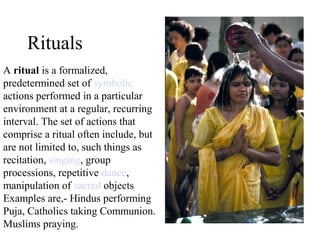
Rituals
A ritual is a formalized,
predetermined set of symbolic
actions performed in a particular
environment at a regular, recurring
interval. The set of actions that
comprise a ritual often include, but
are not limited to, such things as
recitation, singing, group
processions, repetitive dance,
manipulation of sacred objects
Examples are,- Hindus performing
Puja, Catholics taking Communion.
Muslims praying.
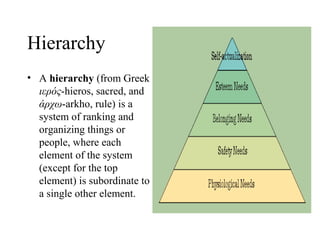
Hierarchy
• A hierarchy (from Greek
  ιερός-hieros, sacred, and
  άρχω-arkho, rule) is a
  system of ranking and
  organizing things or
  people, where each
  element of the system
  (except for the top
  element) is subordinate to
  a single other element.
Ideology
• The body of doctrine,
  myth and symbols of a
  social movement, a social
  class or institution.
• People who adopt
  ideologies often act in
  extreme ways because
  their ideology ( set of
  beliefs) makes them think
  they are special.
• Islamic Fundamentalism,
• Communism, Nazism,
  Zionism are ideologies
PHILOSOPHY
•   1. Love and pursuit of wisdom by
    intellectual means
•   2. Investigation of the nature,
    causes, or principles of reality,
    knowledge, or values, based on
    logical reasoning.
•   3. A system of thought based on or
    involving such inquiry
•   4. The critical analysis of
    fundamental assumptions or
    beliefs.
•   5. The disciplines presented in
    university curriculums of science
    and the liberal arts, except
    medicine, law, and theology.
•   6. The discipline comprising logic,
    ethics, aesthetics, metaphysics, and
    epistemology.
•   7. A set of ideas or beliefs relating
    to a particular field or activity; an
    underlying theory
•   8. A system of values by which one
    lives
MYTHS
• [Webster's]
• a traditional story of
  unknown authorship,
  ostensibly with a
  historical basis, but
  serving usually to
  explain some
  phenomenon of nature,
  the origin of [humanity],
  or the customs,
  institutions, religious
  rites, etc. of a people;
  myths usually involve
  the exploits of gods and
  heroes.
LIFE CYCLE
Language-Communication of thoughts and feelings
through a system of arbitrary signals, eg-voice
sounds, gestures, or written symbols.
Globalisation
  The emergence of a global
   culture brought about by a
   variety of social and cultural
   developments such as: the
   existence of world information
   systems; the emergence of
   global patterns of consumption
   and consumerism; the growth
   of transnational corporations;
   the emergence of global sport
   like World Cup soccer; the
   spread of world tourism and
   the growth of global military
   and economic systems. It
   involves a consciousness of the
   world as a single place.
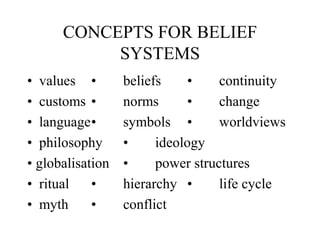
CONCEPTS FOR BELIEF
           SYSTEMS
• values •        beliefs    •     continuity
• customs •       norms      •     change
• language•       symbols •        worldviews
• philosophy      •     ideology
• globalisation   •     power structures
• ritual    •     hierarchy •      life cycle
• myth      •     conflict

Values

  • 2.
    What are Values? •Values are ideals that guide or qualify your personal conduct, interaction with others, and involvement in your career. Like morals, they • help you to distinguish what is right from what is wrong and • inform you on how you can conduct your life in a meaningful way.
  • 3.
    Personal Values • Personalvalues are principles that define you as an individual. Personal values, such as honesty, reliability, and trust, determine how you will face the world and relate with people.
  • 4.
    Cultural Values • Culturalvalues, like the practice of your faith and customs, are principles that sustain connections with your cultural roots. They help you feel connected to a larger community of people with similar backgrounds.
  • 5.
    Beliefs • A Beliefis a conviction in the truth of a proposition. • Beliefs are held without recourse to proof or evidence. • Belief Systems often deal with issues which cannot be explained by reason or logic –creation, the meaning of life, afterlife.
  • 6.
    WORLDVIEWS • An organisedand accepted set of ideas attempting to explain the social, cultural, physical and psychological world. • Linked to values and beliefs • Christian, Jewish and Muslim worldviews focus on human individuality • Hindu and Buddhist worldviews have a wider social perspective.
  • 7.
    Symbols are pictures representing concepts •
  • 8.
    Rituals A ritual isa formalized, predetermined set of symbolic actions performed in a particular environment at a regular, recurring interval. The set of actions that comprise a ritual often include, but are not limited to, such things as recitation, singing, group processions, repetitive dance, manipulation of sacred objects Examples are,- Hindus performing Puja, Catholics taking Communion. Muslims praying.
  • 9.
    Hierarchy • A hierarchy(from Greek ιερός-hieros, sacred, and άρχω-arkho, rule) is a system of ranking and organizing things or people, where each element of the system (except for the top element) is subordinate to a single other element.
  • 10.
    Ideology • The bodyof doctrine, myth and symbols of a social movement, a social class or institution. • People who adopt ideologies often act in extreme ways because their ideology ( set of beliefs) makes them think they are special. • Islamic Fundamentalism, • Communism, Nazism, Zionism are ideologies
  • 11.
    PHILOSOPHY • 1. Love and pursuit of wisdom by intellectual means • 2. Investigation of the nature, causes, or principles of reality, knowledge, or values, based on logical reasoning. • 3. A system of thought based on or involving such inquiry • 4. The critical analysis of fundamental assumptions or beliefs. • 5. The disciplines presented in university curriculums of science and the liberal arts, except medicine, law, and theology. • 6. The discipline comprising logic, ethics, aesthetics, metaphysics, and epistemology. • 7. A set of ideas or beliefs relating to a particular field or activity; an underlying theory • 8. A system of values by which one lives
  • 12.
    MYTHS • [Webster's] • atraditional story of unknown authorship, ostensibly with a historical basis, but serving usually to explain some phenomenon of nature, the origin of [humanity], or the customs, institutions, religious rites, etc. of a people; myths usually involve the exploits of gods and heroes.
  • 13.
  • 14.
    Language-Communication of thoughtsand feelings through a system of arbitrary signals, eg-voice sounds, gestures, or written symbols.
  • 15.
    Globalisation Theemergence of a global culture brought about by a variety of social and cultural developments such as: the existence of world information systems; the emergence of global patterns of consumption and consumerism; the growth of transnational corporations; the emergence of global sport like World Cup soccer; the spread of world tourism and the growth of global military and economic systems. It involves a consciousness of the world as a single place.
  • 16.
    CONCEPTS FOR BELIEF SYSTEMS • values • beliefs • continuity • customs • norms • change • language• symbols • worldviews • philosophy • ideology • globalisation • power structures • ritual • hierarchy • life cycle • myth • conflict