Dynamic Systems and Control
Engineering
Spring Semester
1
Instructor: Prof. Amr Sharawi
TA: Eng. Amira Gaber
Eng. Asmaa Mohamed
Desired Outcomes (Modern Control) 2
Know how to solve the matrix differential equation of a linear time-invariant system
represented by a state variable model in response to the initial conditions and to
standard inputs, especially unit impulse and unit step.
Define the terms zero-state and zero-input response.
Understand and appreciate the role of system controllability and observability in the
analysis and design of feedback control systems using the state space approach.
Apply Matlab and Simulink to compute the zero-state and zero-input response of linear
time invariant systems.
SOLVING THE TIME-INVARIANT STATE
EQUATION 3
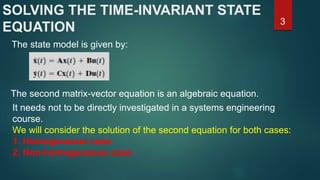
The state model is given by:
The second matrix-vector equation is an algebraic equation.
It needs not to be directly investigated in a systems engineering
course.
We will consider the solution of the second equation for both cases:
1. Homogeneous case
2. Non-homogeneous case
Solution of Homogeneous State
Equations
 Before we solve vector-matrix differential equations, let us review the
solution of the scalar differential equation:
4
To obtain the solution to that equation we apply the Laplace
transform as follows:
Solution of Homogeneous State
Equations
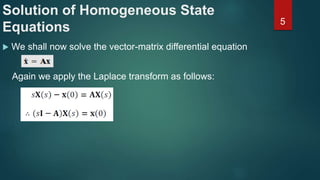
 We shall now solve the vector-matrix differential equation
5
Again we apply the Laplace transform as follows:
Solution of Homogeneous State
Equations 6
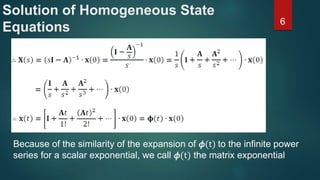
Because of the similarity of the expansion of 𝜙(t) to the infinite power
series for a scalar exponential, we call 𝜙(t) the matrix exponential
Solution of Homogeneous State
Equations
 Thus,
7
 tAAt
eet )(
𝜙(t) is called the state-transition matrix.
(because t is a scalar)
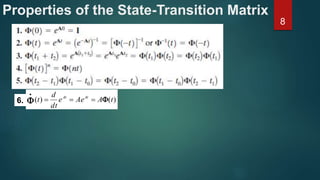
Properties of the State-Transition Matrix
8
)()( tAAee
dt
d
t AtAt
 

6.
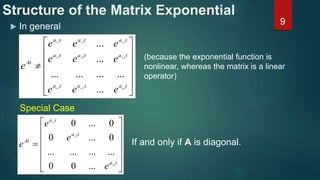
Structure of the Matrix Exponential
9
 In general













tatata
tatata
tatata
At
nnnn
n
n
eee
eee
eee
e
...
............
...
...
21
22221
11211
(because the exponential function is
nonlinear, whereas the matrix is a linear
operator)
Special Case













ta
ta
ta
At
nn
e
e
e
e
...00
............
0...0
0...0
22
11
If and only if A is diagonal.
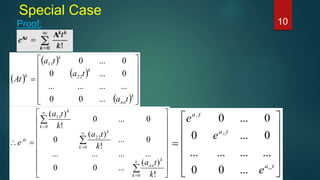
Special Case
10Proof:




























0
0
22
0
11
!
)(
...00
............
0...
!
)(
0
0...0
!
)(
k
k
nn
k
k
k
k
At
k
ta
k
ta
k
ta
e













ta
ta
ta
nn
e
e
e
...00
............
0...0
0...0
22
11
 
 
 
  














k
nn
k
k
k
ta
ta
ta
At
...00
............
0...0
0...0
22
11
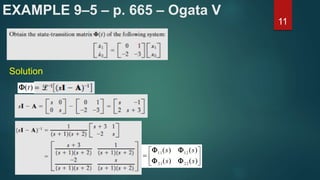
EXAMPLE 9–5 – p. 665 – Ogata V
11
Solution
)(s
)(t







)()(
)()(
2221
1211
ss
ss


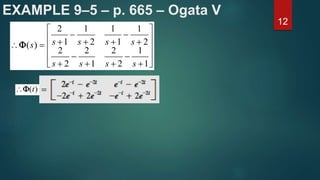
EXAMPLE 9–5 – p. 665 – Ogata V
12



















1
1
2
2
1
2
2
2
2
1
1
1
2
1
1
2
)(
ssss
sssss




















1
1
2
2
1
2
2
2
2
1
1
1
2
1
1
2
)(
ssss
sssss
)(t
Solution of Non-homogeneous State
Equations
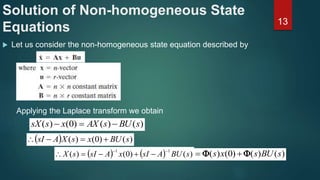
 Let us consider the non-homogeneous state equation described by
13
Applying the Laplace transform we obtain
)()()0()( sBUsAXxssX 
  )()0()( sBUxsXAsI 
    )()0()(
11
sBUAsIxAsIsX

 )()()0()( sBUsxs  
Solution of Non-homogeneous
State Equations 14



  dButxt )()()0()( 
where At
et )(
Since we are speaking of a causal system, we should have
0,0)(  ttu



0
)()()0()()(  dButxttx 
)(*)()0()()( tButxttx  
Solution of Non-homogeneous
State Equations
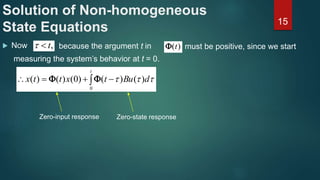
 Now
15
,t because the argument t in )(t must be positive, since we start
measuring the system’s behavior at t = 0.
 
t
dButxttx
0
)()()0()()( 
Zero-input response Zero-state response
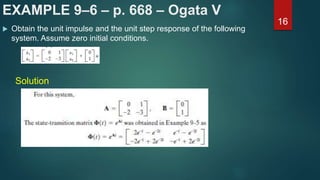
EXAMPLE 9–6 – p. 668 – Ogata V
 Obtain the unit impulse and the unit step response of the following
system. Assume zero initial conditions.
16
Solution
EXAMPLE 9–6 – p. 668 – Ogata V
17
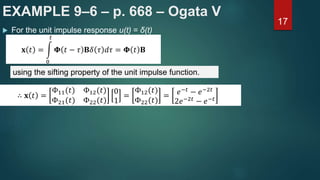
 For the unit impulse response u(t) = δ(t)
𝐱 𝑡 =
0
𝑡
𝚽 𝑡 − 𝜏 𝐁𝛿 𝜏 𝑑𝜏 = 𝚽 𝑡 𝐁
using the sifting property of the unit impulse function.
∴ 𝐱 𝑡 =
Φ11(𝑡) Φ12(𝑡)
Φ21(𝑡) Φ22(𝑡)
0
1
=
Φ12(𝑡)
Φ22(𝑡)
= 𝑒−𝑡 − 𝑒−2𝑡
2𝑒−2𝑡 − 𝑒−𝑡
EXAMPLE 9–6 – p. 668 – Ogata V
18
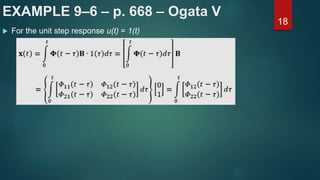
 For the unit step response u(t) = 1(t)
EXAMPLE 9–6 – p. 668 – Ogata V
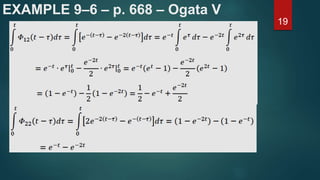
19
EXAMPLE 9–6 – p. 668 – Ogata V
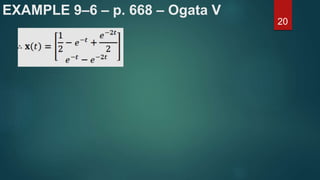
20
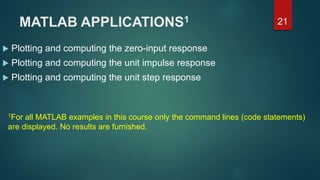
MATLAB APPLICATIONS1
 Plotting and computing the zero-input response
 Plotting and computing the unit impulse response
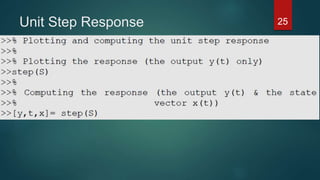
 Plotting and computing the unit step response
21
1For all MATLAB examples in this course only the command lines (code statements)
are displayed. No results are furnished.
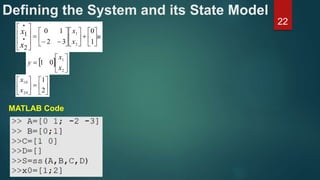
Defining the System and its State Model
22
u
x
x
x
x






























1
0
32
10
2
1
2
1
  






2
1
01
x
x
y












2
1
20
10
x
x
MATLAB Code
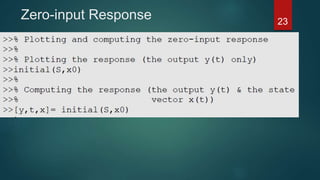
Zero-input Response 23
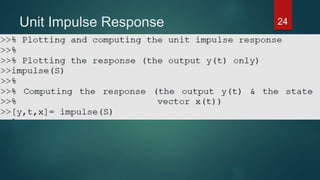
Unit Impulse Response 24
Unit Step Response 25
Simulink Applications
 Zero-input Response
 Unit Impulse Response
 Unit Step Rsponse
26
Simulink Models 27
Unit impulse response
Zero-input & Unit step response
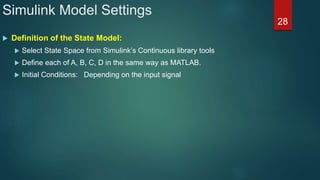
Simulink Model Settings
 Definition of the State Model:
 Select State Space from Simulink’s Continuous library tools
 Define each of A, B, C, D in the same way as MATLAB.
 Initial Conditions: Depending on the input signal
28
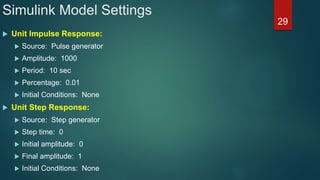
Simulink Model Settings
 Unit Impulse Response:
 Source: Pulse generator
 Amplitude: 1000
 Period: 10 sec
 Percentage: 0.01
 Initial Conditions: None
 Unit Step Response:
 Source: Step generator
 Step time: 0
 Initial amplitude: 0
 Final amplitude: 1
 Initial Conditions: None
29
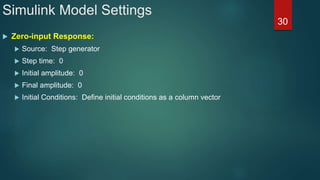
Simulink Model Settings
 Zero-input Response:
 Source: Step generator
 Step time: 0
 Initial amplitude: 0
 Final amplitude: 0
 Initial Conditions: Define initial conditions as a column vector
30
CONTROLLABILITY AND
OBSERVABILITY The concepts of controllability and observability were introduced by Kalman.
 They play an important role in the design of control systems in state space.
 In fact, the conditions of controllability and observability may govern the existence of a
complete solution to the control system design problem.
 The solution to this problem may not exist if the system considered is not controllable.
 Although most physical systems are controllable and observable, systems based upon
mathematical models may not possess the property of controllability and observability.
 Thus, it is necessary to know the conditions under which a system is controllable and
observable.
31
Complete State Controllability
 A system is said to be controllable at time to if it is possible by means of an
unconstrained control vector to transfer the system from any initial state x(to) to any
other state in a finite interval of time, t.
 By unconstrained control vector we understand an input vector u(t) that can draw any
path in the state space during its course from to to t, without there being any boundary
that may limit that path.
 To derive the condition for complete state controllability, we consider the continuous-
time system.
32
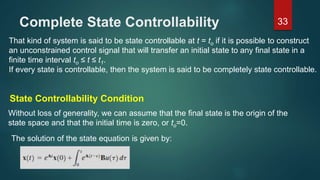
Complete State Controllability 33
That kind of system is said to be state controllable at t = to if it is possible to construct
an unconstrained control signal that will transfer an initial state to any final state in a
finite time interval to ≤ t ≤ t1.
If every state is controllable, then the system is said to be completely state controllable.
State Controllability Condition
Without loss of generality, we can assume that the final state is the origin of the
state space and that the initial time is zero, or to=0.
The solution of the state equation is given by:
Complete State Controllability 34
Applying the definition of complete state controllability just given, we have
Thus
It can be shown that can be written as
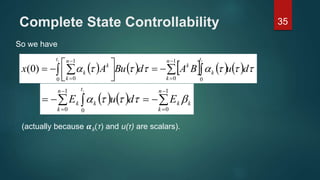
Complete State Controllability 35
So we have
           duBAdBuAx
t
k
n
k
k
t n
k
k
k  









11
0
1
00
1
0
)0(
    k
n
k
k
t
k
n
k
k EduE  





1
00
1
0
1
    k
n
k
k
t
k
n
k
k EduE  





1
00
1
0
1
(actually because 𝜶k(τ) and u(τ) are scalars).
Complete State Controllability 36
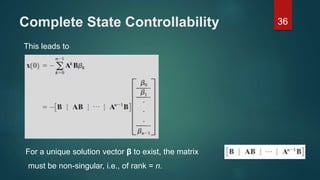
This leads to
For a unique solution vector β to exist, the matrix
must be non-singular, i.e., of rank = n.
Complete State Controllability
37
The result just obtained can be extended to the case where the control vector u is r-
dimensional.
If the system is described by
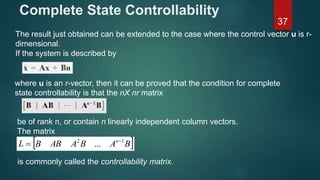
where u is an r-vector, then it can be proved that the condition for complete
state controllability is that the nХ nr matrix
be of rank n, or contain n linearly independent column vectors.
The matrix
 BABAABBL n 12
... 

is commonly called the controllability matrix.
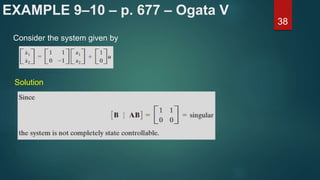
EXAMPLE 9–10 – p. 677 – Ogata V
38
Consider the system given by
Solution
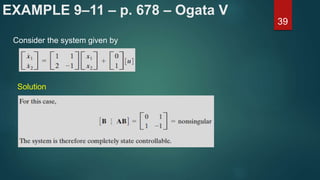
EXAMPLE 9–11 – p. 678 – Ogata V
39
Consider the system given by
Solution
Complete State Controllability in the s-
plane
 The condition for complete state controllability can be stated in terms of transfer
functions or transfer matrices.
 It can be proved that a necessary and sufficient condition for complete state
controllability is that no pole-zero cancellation occur in the transfer function or transfer
matrix.
 If cancellation occurs, the system cannot be controlled in the direction of the canceled
mode.
40
EXAMPLE 9–13 – p. 680 – Ogata V
41
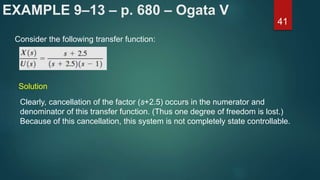
Consider the following transfer function:
Solution
Clearly, cancellation of the factor (s+2.5) occurs in the numerator and
denominator of this transfer function. (Thus one degree of freedom is lost.)
Because of this cancellation, this system is not completely state controllable.
Output Controllability
 In the practical design of a control system, we may want to control the output rather
than the state of the system.
 Complete state controllability is neither necessary nor sufficient for controlling the
output of the system.
 For this reason, it is desirable to define separately complete output controllability.
42
Output Controllability 43
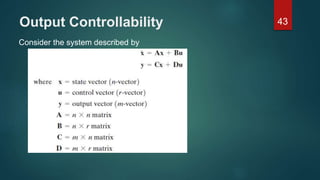
Consider the system described by
Output Controllability
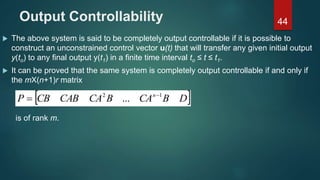
 The above system is said to be completely output controllable if it is possible to
construct an unconstrained control vector u(t) that will transfer any given initial output
y(to) to any final output y(t1) in a finite time interval to ≤ t ≤ t1.
 It can be proved that the same system is completely output controllable if and only if
the mХ(n+1)r matrix
44
 DBCABCACABCBP n 12
... 

is of rank m.
Uncontrollable System
 An uncontrollable system has a subsystem that is physically
disconnected from the input.
45
Stabilizability
 For a partially controllable system, if the uncontrollable modes are stable and the
unstable modes are controllable, the system is said to be stabilizable.
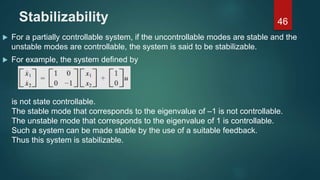
 For example, the system defined by
46
is not state controllable.
The stable mode that corresponds to the eigenvalue of –1 is not controllable.
The unstable mode that corresponds to the eigenvalue of 1 is controllable.
Such a system can be made stable by the use of a suitable feedback.
Thus this system is stabilizable.

Modern control 2

  • 1.
    Dynamic Systems andControl Engineering Spring Semester 1 Instructor: Prof. Amr Sharawi TA: Eng. Amira Gaber Eng. Asmaa Mohamed
  • 2.
    Desired Outcomes (ModernControl) 2 Know how to solve the matrix differential equation of a linear time-invariant system represented by a state variable model in response to the initial conditions and to standard inputs, especially unit impulse and unit step. Define the terms zero-state and zero-input response. Understand and appreciate the role of system controllability and observability in the analysis and design of feedback control systems using the state space approach. Apply Matlab and Simulink to compute the zero-state and zero-input response of linear time invariant systems.
  • 3.
    SOLVING THE TIME-INVARIANTSTATE EQUATION 3 The state model is given by: The second matrix-vector equation is an algebraic equation. It needs not to be directly investigated in a systems engineering course. We will consider the solution of the second equation for both cases: 1. Homogeneous case 2. Non-homogeneous case
  • 4.
    Solution of HomogeneousState Equations  Before we solve vector-matrix differential equations, let us review the solution of the scalar differential equation: 4 To obtain the solution to that equation we apply the Laplace transform as follows:
  • 5.
    Solution of HomogeneousState Equations  We shall now solve the vector-matrix differential equation 5 Again we apply the Laplace transform as follows:
  • 6.
    Solution of HomogeneousState Equations 6 Because of the similarity of the expansion of 𝜙(t) to the infinite power series for a scalar exponential, we call 𝜙(t) the matrix exponential
  • 7.
    Solution of HomogeneousState Equations  Thus, 7  tAAt eet )( 𝜙(t) is called the state-transition matrix. (because t is a scalar)
  • 8.
    Properties of theState-Transition Matrix 8 )()( tAAee dt d t AtAt    6.
  • 9.
    Structure of theMatrix Exponential 9  In general              tatata tatata tatata At nnnn n n eee eee eee e ... ............ ... ... 21 22221 11211 (because the exponential function is nonlinear, whereas the matrix is a linear operator) Special Case              ta ta ta At nn e e e e ...00 ............ 0...0 0...0 22 11 If and only if A is diagonal.
  • 10.
  • 11.
    EXAMPLE 9–5 –p. 665 – Ogata V 11 Solution )(s )(t        )()( )()( 2221 1211 ss ss  
  • 12.
    EXAMPLE 9–5 –p. 665 – Ogata V 12                    1 1 2 2 1 2 2 2 2 1 1 1 2 1 1 2 )( ssss sssss                     1 1 2 2 1 2 2 2 2 1 1 1 2 1 1 2 )( ssss sssss )(t
  • 13.
    Solution of Non-homogeneousState Equations  Let us consider the non-homogeneous state equation described by 13 Applying the Laplace transform we obtain )()()0()( sBUsAXxssX    )()0()( sBUxsXAsI      )()0()( 11 sBUAsIxAsIsX   )()()0()( sBUsxs  
  • 14.
    Solution of Non-homogeneous StateEquations 14      dButxt )()()0()(  where At et )( Since we are speaking of a causal system, we should have 0,0)(  ttu    0 )()()0()()(  dButxttx  )(*)()0()()( tButxttx  
  • 15.
    Solution of Non-homogeneous StateEquations  Now 15 ,t because the argument t in )(t must be positive, since we start measuring the system’s behavior at t = 0.   t dButxttx 0 )()()0()()(  Zero-input response Zero-state response
  • 16.
    EXAMPLE 9–6 –p. 668 – Ogata V  Obtain the unit impulse and the unit step response of the following system. Assume zero initial conditions. 16 Solution
  • 17.
    EXAMPLE 9–6 –p. 668 – Ogata V 17  For the unit impulse response u(t) = δ(t) 𝐱 𝑡 = 0 𝑡 𝚽 𝑡 − 𝜏 𝐁𝛿 𝜏 𝑑𝜏 = 𝚽 𝑡 𝐁 using the sifting property of the unit impulse function. ∴ 𝐱 𝑡 = Φ11(𝑡) Φ12(𝑡) Φ21(𝑡) Φ22(𝑡) 0 1 = Φ12(𝑡) Φ22(𝑡) = 𝑒−𝑡 − 𝑒−2𝑡 2𝑒−2𝑡 − 𝑒−𝑡
  • 18.
    EXAMPLE 9–6 –p. 668 – Ogata V 18  For the unit step response u(t) = 1(t)
  • 19.
    EXAMPLE 9–6 –p. 668 – Ogata V 19
  • 20.
    EXAMPLE 9–6 –p. 668 – Ogata V 20
  • 21.
    MATLAB APPLICATIONS1  Plottingand computing the zero-input response  Plotting and computing the unit impulse response  Plotting and computing the unit step response 21 1For all MATLAB examples in this course only the command lines (code statements) are displayed. No results are furnished.
  • 22.
    Defining the Systemand its State Model 22 u x x x x                               1 0 32 10 2 1 2 1          2 1 01 x x y             2 1 20 10 x x MATLAB Code
  • 23.
  • 24.
  • 25.
  • 26.
    Simulink Applications  Zero-inputResponse  Unit Impulse Response  Unit Step Rsponse 26
  • 27.
    Simulink Models 27 Unitimpulse response Zero-input & Unit step response
  • 28.
    Simulink Model Settings Definition of the State Model:  Select State Space from Simulink’s Continuous library tools  Define each of A, B, C, D in the same way as MATLAB.  Initial Conditions: Depending on the input signal 28
  • 29.
    Simulink Model Settings Unit Impulse Response:  Source: Pulse generator  Amplitude: 1000  Period: 10 sec  Percentage: 0.01  Initial Conditions: None  Unit Step Response:  Source: Step generator  Step time: 0  Initial amplitude: 0  Final amplitude: 1  Initial Conditions: None 29
  • 30.
    Simulink Model Settings Zero-input Response:  Source: Step generator  Step time: 0  Initial amplitude: 0  Final amplitude: 0  Initial Conditions: Define initial conditions as a column vector 30
  • 31.
    CONTROLLABILITY AND OBSERVABILITY Theconcepts of controllability and observability were introduced by Kalman.  They play an important role in the design of control systems in state space.  In fact, the conditions of controllability and observability may govern the existence of a complete solution to the control system design problem.  The solution to this problem may not exist if the system considered is not controllable.  Although most physical systems are controllable and observable, systems based upon mathematical models may not possess the property of controllability and observability.  Thus, it is necessary to know the conditions under which a system is controllable and observable. 31
  • 32.
    Complete State Controllability A system is said to be controllable at time to if it is possible by means of an unconstrained control vector to transfer the system from any initial state x(to) to any other state in a finite interval of time, t.  By unconstrained control vector we understand an input vector u(t) that can draw any path in the state space during its course from to to t, without there being any boundary that may limit that path.  To derive the condition for complete state controllability, we consider the continuous- time system. 32
  • 33.
    Complete State Controllability33 That kind of system is said to be state controllable at t = to if it is possible to construct an unconstrained control signal that will transfer an initial state to any final state in a finite time interval to ≤ t ≤ t1. If every state is controllable, then the system is said to be completely state controllable. State Controllability Condition Without loss of generality, we can assume that the final state is the origin of the state space and that the initial time is zero, or to=0. The solution of the state equation is given by:
  • 34.
    Complete State Controllability34 Applying the definition of complete state controllability just given, we have Thus It can be shown that can be written as
  • 35.
    Complete State Controllability35 So we have            duBAdBuAx t k n k k t n k k k            11 0 1 00 1 0 )0(     k n k k t k n k k EduE        1 00 1 0 1     k n k k t k n k k EduE        1 00 1 0 1 (actually because 𝜶k(τ) and u(τ) are scalars).
  • 36.
    Complete State Controllability36 This leads to For a unique solution vector β to exist, the matrix must be non-singular, i.e., of rank = n.
  • 37.
    Complete State Controllability 37 Theresult just obtained can be extended to the case where the control vector u is r- dimensional. If the system is described by where u is an r-vector, then it can be proved that the condition for complete state controllability is that the nХ nr matrix be of rank n, or contain n linearly independent column vectors. The matrix  BABAABBL n 12 ...   is commonly called the controllability matrix.
  • 38.
    EXAMPLE 9–10 –p. 677 – Ogata V 38 Consider the system given by Solution
  • 39.
    EXAMPLE 9–11 –p. 678 – Ogata V 39 Consider the system given by Solution
  • 40.
    Complete State Controllabilityin the s- plane  The condition for complete state controllability can be stated in terms of transfer functions or transfer matrices.  It can be proved that a necessary and sufficient condition for complete state controllability is that no pole-zero cancellation occur in the transfer function or transfer matrix.  If cancellation occurs, the system cannot be controlled in the direction of the canceled mode. 40
  • 41.
    EXAMPLE 9–13 –p. 680 – Ogata V 41 Consider the following transfer function: Solution Clearly, cancellation of the factor (s+2.5) occurs in the numerator and denominator of this transfer function. (Thus one degree of freedom is lost.) Because of this cancellation, this system is not completely state controllable.
  • 42.
    Output Controllability  Inthe practical design of a control system, we may want to control the output rather than the state of the system.  Complete state controllability is neither necessary nor sufficient for controlling the output of the system.  For this reason, it is desirable to define separately complete output controllability. 42
  • 43.
    Output Controllability 43 Considerthe system described by
  • 44.
    Output Controllability  Theabove system is said to be completely output controllable if it is possible to construct an unconstrained control vector u(t) that will transfer any given initial output y(to) to any final output y(t1) in a finite time interval to ≤ t ≤ t1.  It can be proved that the same system is completely output controllable if and only if the mХ(n+1)r matrix 44  DBCABCACABCBP n 12 ...   is of rank m.
  • 45.
    Uncontrollable System  Anuncontrollable system has a subsystem that is physically disconnected from the input. 45
  • 46.
    Stabilizability  For apartially controllable system, if the uncontrollable modes are stable and the unstable modes are controllable, the system is said to be stabilizable.  For example, the system defined by 46 is not state controllable. The stable mode that corresponds to the eigenvalue of –1 is not controllable. The unstable mode that corresponds to the eigenvalue of 1 is controllable. Such a system can be made stable by the use of a suitable feedback. Thus this system is stabilizable.