Model United Nations
Guide
Made by: Giovana Rabello & Luiza Gutterres
RJMSMUN 2021 Under-Secretaries-General
1
RJMSMUN | MUN Guide
CONTENTS
Model United Nations…...……..…………………………….3
Parliamentary Procedure…………………………...………...3
Common Rules​………………………....………………….3
Points…………………....…………………………………....4
Motions…………………….………………………….….….5
Position Paper Writing…………………………………….....6
Structure​…………………..……………………………...6
Resolution Writing…………………………………………..7
2
RJMSMUN | MUN Guide
MODEL UNITED NATIONS
The Model United Nations, otherwise known as MUN, is an imitation of a UN
conference where diverse committees and agencies come together to introduce matters of
global concern and propose solutions to tackle the subjects at hand. The many representatives
of each nation are familiarized with their country’s point of view, involvement and
connection with the topic being discussed in order to thoroughly portray their country’s views
and opinions throughout the debate. Within the conference, delegates are required not only to
communicate and cooperate with other delegations but also to negotiate, compromise and
settle for a grand solution that will favour their country and support what their nation believes
in, whilst considering the resolution's impact towards the international community. The
Model United Nations is an incredible activity that helps you develop into a more globally
aware citizen capable of fighting until the very end for what you believe is right.
PARLIAMENTARY PROCEDURE
The Parliamentary procedure is a set of regulations used in formal gatherings,
meetings and throughout an MUN Conference in order to replicate as closely as possible the
formality present within the UN.
COMMON RULES
1. All delegates present within the committee sessions and throughout the conference as a whole should
avoid the usage of personal pronouns in order to convey an idea or when representing their country’s
views.
a. For example: “I believe that…”contains personal pronouns, making it quite informal, and isn’t
permitted throughout the committee sessions. Instead approach this phrase by utilizing the
word “Delegate”, such as: “The delegate believes that…”. This phrase is now much more
appropriate and suits the formality that a MUN committee session contains.
2. Throughout the committee sessions, the chairs have almost all of the authority to implement any
strategies they wish will enhance the flow of debate and engage even more their delegates. With the
chair containing virtually all the power during committee sessions, it is expected that delegates are only
to speak and entertain their points or motions when chairs recognize them.
3. The chairs play a key role in mediating not only the debate but any formal conversation in regards to
the topics entertained, therefore, no direct conversations between two delegates are to be tolerated.
3
RJMSMUN | MUN Guide
POINTS
❖ ​Point of Information: ​​This should be posed as a question from a delegate to another.
Points of information can be entertained if the delegate who has the floor declares they are
open to points of information (after concluding the speech). If the delegate is, then the other
delegates thereby present may raise their placards to ask questions, and requests for
follow-ups to points of information may be entertained depending on how lenient are time
constraints.
❖ ​Point of Clarification: ​This type of point is used by delegates to clarify previously
wrongly stated facts. Points of clarification can be raised at any time by delegates, as long as
these do not interrupt speakers. Please bear in mind that points of clarification should be
essentially based on factual recall, and are not to be perceived as a means to express a
delegation's opinion.
❖ ​Point of Personal Privilege: ​As stated by its very name, this point is entertained as a
way to make delegates more comfortable with the debate. Points of personal privilege vary
from a request to change the AC's temperature to a request for a delegate to speak louder or
in a clearer manner. This point can be raised at any time and is the only type of point that can
rightfully interrupt a speech.
❖ ​Right of Reply: ​This point is used by a delegate who claims to be offended by a
statement made by a fellow delegate, and therefore commonly demands for a formal apology.
This should be directed to the chairs, and at their discretion, the delegate may be required to
apologise.
❖​Point of Parliamentary Procedure: ​This point should be raised whenever
delegates have a doubt concerning procedural rules. Points of parliamentary procedure should
be posed as questions to the dais so that they explain to the delegates how a certain rule or
aspect of parliamentary procedure works.
❖​Point of Inquiry: ​Despite being similar to the point of parliamentary procedure, the
point of inquiry should also be a question to the chairs but that does not concern any aspects
of parliamentary procedure, hence being used to clarify any doubts other than those related to
procedural rules. These can vary from information concerning the conference's schedule and
other logistic queries to doubts in regard to the topic at-hand, which in this committee's case
essentially cannot be found on the internet.
❖​Point of Order: ​This can be raised at any time by delegates, when they notice that a
mistake has been made and hence want to remind the committee about it, ranging from
procedural errors to lack of respect or bad behaviour from fellow delegates.
4
RJMSMUN | MUN Guide
MOTIONS
Definition:​ ​The Motions are a mechanism that may be used by delegates in order for them to stir the debate in
the direction that they feel like will be even more interesting and that will benefit them as well.
❖ Motion for a Moderated Caucus: ​Throughout a Moderated Caucus the speaker’s
list is set aside and delegates will be called by the chairs to voice their opinions in regards to a
certain issue, for example. When delegates conduct this motion, they should specify the
amount of time they wish the Moderated Caucus lasts for.
❖ Motion for an Unmoderated Caucus: ​By implementing the Motion for an
Unmoderated Caucus, delegates can directly refer to other delegates and chat freely amongst
themselves. Usually, the Motion for an Unmoderated Caucus is used for the drafting and
development of resolutions and, just like the Moderated Caucus, delegates should specify the
amount of time they wish the Unmoderated Caucus lasts for.
❖ Motion to Move Into Voting Procedure: ​When delegates feel like the resolution
or amendments were greatly discussed and that the house is ready to vote on the resolution or
amendments as a whole, delegates can use this motion to skip directly to voting procedures.
Once the motion is entertained, all delegations present must second it so that this motion
passes.
❖ Motion to Suspend Debate: ​When the committee session is almost coming to a
close, delegates may entertain this motion so that the debate is suspended. This motion passes
if there are no objections by the delegations present.
❖ Motion To Move Into Time Against: ​If delegates feel like the debate has
introduced various one sided points and its becoming quite monotonous, the delegates can
implement this motion. The Motion To Move Into Time Against must be seconded by all
delegations present in order to pass.
❖ Motion to Appeal to The Chair’s Decision: ​If a delegate feels as though the
chairs have committed an error in judgement or in procedure throughout the committee
sessions, this motion can be entertained. The motion is proposed in writing to the Chair and
the Co-Chair will understand the situation from the delegate’s perspective.
❖ Motion to Adopt Without a Vote: ​If a delegate is certain that the whole house
supports a resolution or an amendment into passing and the debate is becoming quite dull, the
delegate may entertain this motion. This motion passes if there are no objections.
5
RJMSMUN | MUN Guide
POSITION PAPER WRITING
The Position Paper is a document submitted prior to the conference in which outlines
the topic being entertained, your nation’s involvement in the situation and some solutions that
were or are being proposed by your country to tackle the issue at hand. For each topic you
should develop a one page long essay, consisting of three paragraphs, and carefully reflect on
your delegation's perspective on the matter. These papers are designed to describe the issue
being introduced in the perspective of your country whilst also outlining some of the main
solutions or approaches your nation has placed forward to efficiently tackle the situation.
Depending on which committee or agency you are involved in, the requirements for the
position paper can vary.
STRUCTURE
1. First Paragraph: ​The first paragraph should be dedicated to the history and
background information of the topic to be discussed in your country’s own views.
This paragraph should not feature what the study guide has already discussed, it
should contain even more information that was found independently.
2. Second Paragraph: ​The second paragraph should be composed of the historical
background and involvement of your nation in regards to the topic at hand. It should
include detailed examples and information on how your country contributed,
influenced or acted in the face of the issue.
3. Third Paragraph: ​The third paragraph should introduce and propose solutions to the
situation that your country agrees with or that they have already implemented
previously in order to solve the problem that is being addressed.
6
RJMSMUN | MUN Guide
RESOLUTION WRITING
Resolutions are the main means by which the United Nations takes action or makes a policy.
Traditional MUN resolutions are written in groups of allied countries (known as blocs in MUN
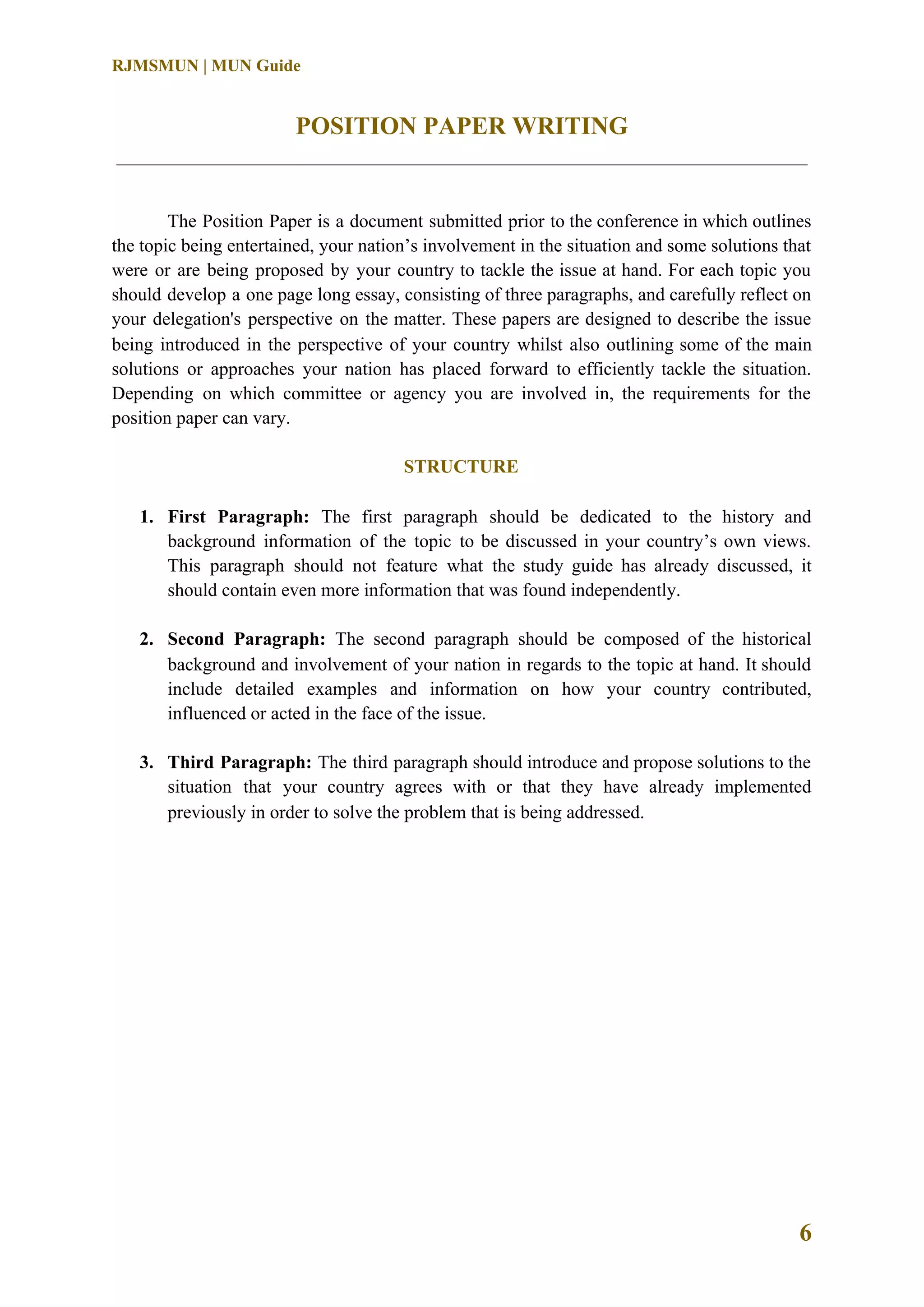
terminology) during unmoderated caucuses and are divided into two types of clauses; preambulatory
and operative clauses. The former are not read aloud when the resolution is presented to the house and
only serve as an introduction to the resolution's proposed courses of action, not actually
recommending action and yet only providing a background account of the issue.
Sample
Preambulatory Clause Beginners
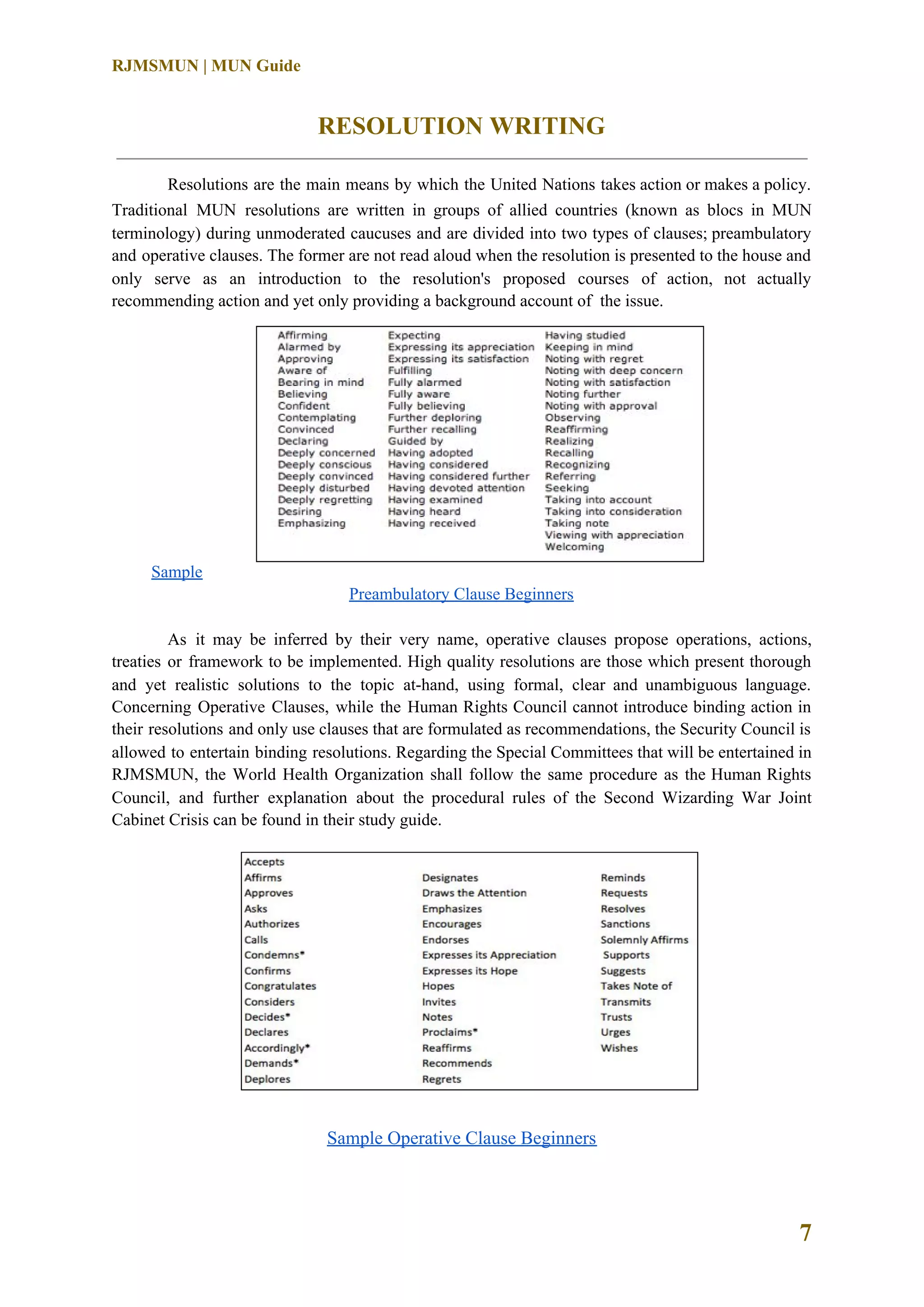
As it may be inferred by their very name, operative clauses propose operations, actions,
treaties or framework to be implemented. High quality resolutions are those which present thorough
and yet realistic solutions to the topic at-hand, using formal, clear and unambiguous language.
Concerning Operative Clauses, while the Human Rights Council cannot introduce binding action in
their resolutions and only use clauses that are formulated as recommendations, the Security Council is
allowed to entertain binding resolutions. Regarding the Special Committees that will be entertained in
RJMSMUN, the World Health Organization shall follow the same procedure as the Human Rights
Council, and further explanation about the procedural rules of the Second Wizarding War Joint
Cabinet Crisis can be found in their study guide.
Sample Operative Clause Beginners
7

MUN Guide

  • 1.
    Model United Nations Guide Madeby: Giovana Rabello & Luiza Gutterres RJMSMUN 2021 Under-Secretaries-General 1
  • 2.
    RJMSMUN | MUNGuide CONTENTS Model United Nations…...……..…………………………….3 Parliamentary Procedure…………………………...………...3 Common Rules​………………………....………………….3 Points…………………....…………………………………....4 Motions…………………….………………………….….….5 Position Paper Writing…………………………………….....6 Structure​…………………..……………………………...6 Resolution Writing…………………………………………..7 2
  • 3.
    RJMSMUN | MUNGuide MODEL UNITED NATIONS The Model United Nations, otherwise known as MUN, is an imitation of a UN conference where diverse committees and agencies come together to introduce matters of global concern and propose solutions to tackle the subjects at hand. The many representatives of each nation are familiarized with their country’s point of view, involvement and connection with the topic being discussed in order to thoroughly portray their country’s views and opinions throughout the debate. Within the conference, delegates are required not only to communicate and cooperate with other delegations but also to negotiate, compromise and settle for a grand solution that will favour their country and support what their nation believes in, whilst considering the resolution's impact towards the international community. The Model United Nations is an incredible activity that helps you develop into a more globally aware citizen capable of fighting until the very end for what you believe is right. PARLIAMENTARY PROCEDURE The Parliamentary procedure is a set of regulations used in formal gatherings, meetings and throughout an MUN Conference in order to replicate as closely as possible the formality present within the UN. COMMON RULES 1. All delegates present within the committee sessions and throughout the conference as a whole should avoid the usage of personal pronouns in order to convey an idea or when representing their country’s views. a. For example: “I believe that…”contains personal pronouns, making it quite informal, and isn’t permitted throughout the committee sessions. Instead approach this phrase by utilizing the word “Delegate”, such as: “The delegate believes that…”. This phrase is now much more appropriate and suits the formality that a MUN committee session contains. 2. Throughout the committee sessions, the chairs have almost all of the authority to implement any strategies they wish will enhance the flow of debate and engage even more their delegates. With the chair containing virtually all the power during committee sessions, it is expected that delegates are only to speak and entertain their points or motions when chairs recognize them. 3. The chairs play a key role in mediating not only the debate but any formal conversation in regards to the topics entertained, therefore, no direct conversations between two delegates are to be tolerated. 3
  • 4.
    RJMSMUN | MUNGuide POINTS ❖ ​Point of Information: ​​This should be posed as a question from a delegate to another. Points of information can be entertained if the delegate who has the floor declares they are open to points of information (after concluding the speech). If the delegate is, then the other delegates thereby present may raise their placards to ask questions, and requests for follow-ups to points of information may be entertained depending on how lenient are time constraints. ❖ ​Point of Clarification: ​This type of point is used by delegates to clarify previously wrongly stated facts. Points of clarification can be raised at any time by delegates, as long as these do not interrupt speakers. Please bear in mind that points of clarification should be essentially based on factual recall, and are not to be perceived as a means to express a delegation's opinion. ❖ ​Point of Personal Privilege: ​As stated by its very name, this point is entertained as a way to make delegates more comfortable with the debate. Points of personal privilege vary from a request to change the AC's temperature to a request for a delegate to speak louder or in a clearer manner. This point can be raised at any time and is the only type of point that can rightfully interrupt a speech. ❖ ​Right of Reply: ​This point is used by a delegate who claims to be offended by a statement made by a fellow delegate, and therefore commonly demands for a formal apology. This should be directed to the chairs, and at their discretion, the delegate may be required to apologise. ❖​Point of Parliamentary Procedure: ​This point should be raised whenever delegates have a doubt concerning procedural rules. Points of parliamentary procedure should be posed as questions to the dais so that they explain to the delegates how a certain rule or aspect of parliamentary procedure works. ❖​Point of Inquiry: ​Despite being similar to the point of parliamentary procedure, the point of inquiry should also be a question to the chairs but that does not concern any aspects of parliamentary procedure, hence being used to clarify any doubts other than those related to procedural rules. These can vary from information concerning the conference's schedule and other logistic queries to doubts in regard to the topic at-hand, which in this committee's case essentially cannot be found on the internet. ❖​Point of Order: ​This can be raised at any time by delegates, when they notice that a mistake has been made and hence want to remind the committee about it, ranging from procedural errors to lack of respect or bad behaviour from fellow delegates. 4
  • 5.
    RJMSMUN | MUNGuide MOTIONS Definition:​ ​The Motions are a mechanism that may be used by delegates in order for them to stir the debate in the direction that they feel like will be even more interesting and that will benefit them as well. ❖ Motion for a Moderated Caucus: ​Throughout a Moderated Caucus the speaker’s list is set aside and delegates will be called by the chairs to voice their opinions in regards to a certain issue, for example. When delegates conduct this motion, they should specify the amount of time they wish the Moderated Caucus lasts for. ❖ Motion for an Unmoderated Caucus: ​By implementing the Motion for an Unmoderated Caucus, delegates can directly refer to other delegates and chat freely amongst themselves. Usually, the Motion for an Unmoderated Caucus is used for the drafting and development of resolutions and, just like the Moderated Caucus, delegates should specify the amount of time they wish the Unmoderated Caucus lasts for. ❖ Motion to Move Into Voting Procedure: ​When delegates feel like the resolution or amendments were greatly discussed and that the house is ready to vote on the resolution or amendments as a whole, delegates can use this motion to skip directly to voting procedures. Once the motion is entertained, all delegations present must second it so that this motion passes. ❖ Motion to Suspend Debate: ​When the committee session is almost coming to a close, delegates may entertain this motion so that the debate is suspended. This motion passes if there are no objections by the delegations present. ❖ Motion To Move Into Time Against: ​If delegates feel like the debate has introduced various one sided points and its becoming quite monotonous, the delegates can implement this motion. The Motion To Move Into Time Against must be seconded by all delegations present in order to pass. ❖ Motion to Appeal to The Chair’s Decision: ​If a delegate feels as though the chairs have committed an error in judgement or in procedure throughout the committee sessions, this motion can be entertained. The motion is proposed in writing to the Chair and the Co-Chair will understand the situation from the delegate’s perspective. ❖ Motion to Adopt Without a Vote: ​If a delegate is certain that the whole house supports a resolution or an amendment into passing and the debate is becoming quite dull, the delegate may entertain this motion. This motion passes if there are no objections. 5
  • 6.
    RJMSMUN | MUNGuide POSITION PAPER WRITING The Position Paper is a document submitted prior to the conference in which outlines the topic being entertained, your nation’s involvement in the situation and some solutions that were or are being proposed by your country to tackle the issue at hand. For each topic you should develop a one page long essay, consisting of three paragraphs, and carefully reflect on your delegation's perspective on the matter. These papers are designed to describe the issue being introduced in the perspective of your country whilst also outlining some of the main solutions or approaches your nation has placed forward to efficiently tackle the situation. Depending on which committee or agency you are involved in, the requirements for the position paper can vary. STRUCTURE 1. First Paragraph: ​The first paragraph should be dedicated to the history and background information of the topic to be discussed in your country’s own views. This paragraph should not feature what the study guide has already discussed, it should contain even more information that was found independently. 2. Second Paragraph: ​The second paragraph should be composed of the historical background and involvement of your nation in regards to the topic at hand. It should include detailed examples and information on how your country contributed, influenced or acted in the face of the issue. 3. Third Paragraph: ​The third paragraph should introduce and propose solutions to the situation that your country agrees with or that they have already implemented previously in order to solve the problem that is being addressed. 6
  • 7.
    RJMSMUN | MUNGuide RESOLUTION WRITING Resolutions are the main means by which the United Nations takes action or makes a policy. Traditional MUN resolutions are written in groups of allied countries (known as blocs in MUN terminology) during unmoderated caucuses and are divided into two types of clauses; preambulatory and operative clauses. The former are not read aloud when the resolution is presented to the house and only serve as an introduction to the resolution's proposed courses of action, not actually recommending action and yet only providing a background account of the issue. Sample Preambulatory Clause Beginners As it may be inferred by their very name, operative clauses propose operations, actions, treaties or framework to be implemented. High quality resolutions are those which present thorough and yet realistic solutions to the topic at-hand, using formal, clear and unambiguous language. Concerning Operative Clauses, while the Human Rights Council cannot introduce binding action in their resolutions and only use clauses that are formulated as recommendations, the Security Council is allowed to entertain binding resolutions. Regarding the Special Committees that will be entertained in RJMSMUN, the World Health Organization shall follow the same procedure as the Human Rights Council, and further explanation about the procedural rules of the Second Wizarding War Joint Cabinet Crisis can be found in their study guide. Sample Operative Clause Beginners 7