DISPLAYING 3D
POLYGON ANIMATIONS
API
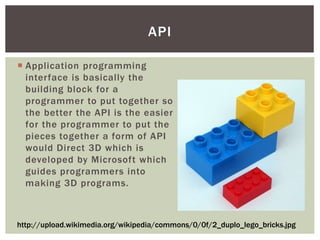
 Application programming
interface is basically the
building block for a
programmer to put together so
the better the API is the easier
for the programmer to put the
pieces together a form of API
would Direct 3D which is
developed by Microsoft which
guides programmers into
making 3D programs.

http://upload.wikimedia.org/wikipedia/commons/0/0f/2_duplo_lego_bricks.jpg
DIRECT 3D
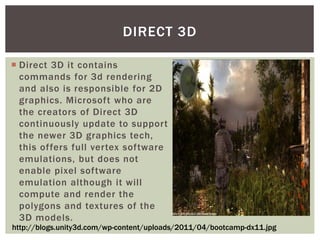
 Direct 3D it contains
commands for 3d rendering
and also is responsible for 2D
graphics. Microsoft who are
the creators of Direct 3D
continuously update to support
the newer 3D graphics tech,
this offers full vertex software
emulations, but does not
enable pixel software
emulation although it will
compute and render the
polygons and textures of the
3D models.
http://blogs.unity3d.com/wp-content/uploads/2011/04/bootcamp-dx11.jpg
OPENGL
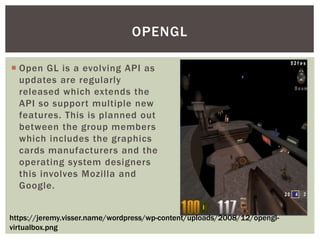
 Open GL is a evolving API as
updates are regularly
released which extends the
API so support multiple new
features. This is planned out
between the group members
which includes the graphics
cards manufacturers and the
operating system designers
this involves Mozilla and
Google.
https://jeremy.visser.name/wordpress/wp-content/uploads/2008/12/openglvirtualbox.png
GRAPHICS PIPELINE
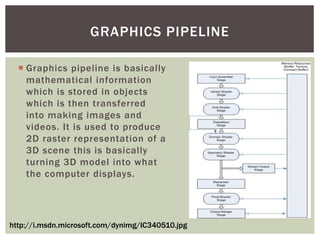
 Graphics pipeline is basically
mathematical information
which is stored in objects
which is then transferred
into making images and
videos. It is used to produce
2D raster representation of a
3D scene this is basically
turning 3D model into what
the computer displays.

http://i.msdn.microsoft.com/dynimg/IC340510.jpg
3D GEOMETRIC PRIMITIVES
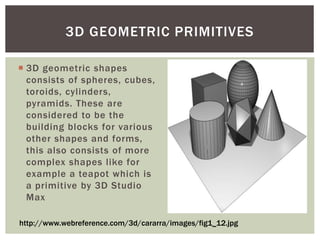
 3D geometric shapes
consists of spheres, cubes,
toroids, cylinders,
pyramids. These are
considered to be the
building blocks for various
other shapes and forms,
this also consists of more
complex shapes like for
example a teapot which is
a primitive by 3D Studio
Max
http://www.webreference.com/3d/cararra/images/fig1_12.jpg
MODELLING AND TRANSFORM
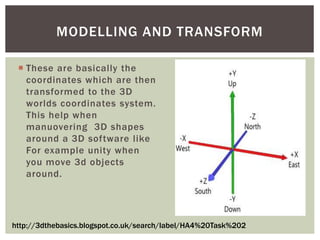
 These are basically the
coordinates which are then
transformed to the 3D
worlds coordinates system.
This help when
manuovering 3D shapes
around a 3D software like
For example unity when
you move 3d objects
around.

http://3dthebasics.blogspot.co.uk/search/label/HA4%20Task%202
CAMERA TRANSFORMATION
 Transforms 3D world
coordinates into 3D
camera coordinates with
camera as the origin which
is used effectively in Unity
as you can position the
camera a different angles
and positions.

http://3dthebasics.blogspot.co.uk/search/label/HA4%20Task%202
LIGHTING
 Illuminate areas following to the reflectance and lighting
for example If a cube is a clear white colour but in a dark
room the camera sees it as a black object. In this stage
the effect of lighting and reflection are measured.
PROJECTION TRANSFORMATION
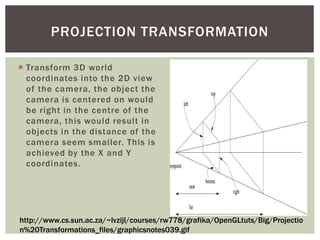
 Transform 3D world
coordinates into the 2D view
of the camera, the object the
camera is centered on would
be right in the centre of the
camera, this would result in
objects in the distance of the
camera seem smaller. This is
achieved by the X and Y
coordinates.

http://www.cs.sun.ac.za/~lvzijl/courses/rw778/grafika/OpenGLtuts/Big/Projectio
n%20Transformations_files/graphicsnotes039.gif
CLIPPING
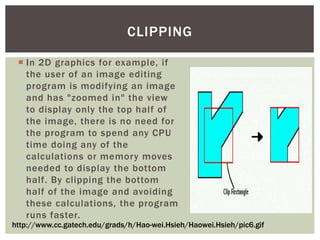
 In 2D graphics for example, if
the user of an image editing
program is modifying an image
and has "zoomed in" the view
to display only the top half of
the image, there is no need for
the program to spend any CPU
time doing any of the
calculations or memory moves
needed to display the bottom
half. By clipping the bottom
half of the image and avoiding
these calculations, the program
runs faster.
http://www.cc.gatech.edu/grads/h/Hao-wei.Hsieh/Haowei.Hsieh/pic6.gif
SCAN CONVERSION OR RASTERIZATION
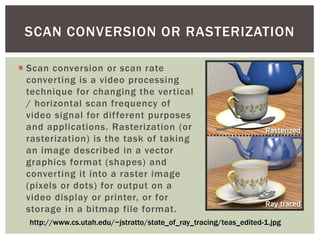
 Scan conversion or scan rate
converting is a video processing
technique for changing the vertical
/ horizontal scan frequency of
video signal for different purposes
and applications. Rasterization (or
rasterization) is the task of taking
an image described in a vector
graphics format (shapes) and
converting it into a raster image
(pixels or dots) for output on a
video display or printer, or for
storage in a bitmap file format.
http://www.cs.utah.edu/~jstratto/state_of_ray_tracing/teas_edited-1.jpg
TEXTURING, FRAGMENT SHADING
 At this part of the pipeline pre pixels are assigned a
colour based values extracted from the vertices
during rasterization.
DISPLAY
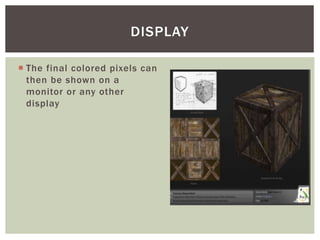
 The final colored pixels can
then be shown on a
monitor or any other
display

Task 2

  • 1.
  • 2.
    API  Application programming interfaceis basically the building block for a programmer to put together so the better the API is the easier for the programmer to put the pieces together a form of API would Direct 3D which is developed by Microsoft which guides programmers into making 3D programs. http://upload.wikimedia.org/wikipedia/commons/0/0f/2_duplo_lego_bricks.jpg
  • 3.
    DIRECT 3D  Direct3D it contains commands for 3d rendering and also is responsible for 2D graphics. Microsoft who are the creators of Direct 3D continuously update to support the newer 3D graphics tech, this offers full vertex software emulations, but does not enable pixel software emulation although it will compute and render the polygons and textures of the 3D models. http://blogs.unity3d.com/wp-content/uploads/2011/04/bootcamp-dx11.jpg
  • 4.
    OPENGL  Open GLis a evolving API as updates are regularly released which extends the API so support multiple new features. This is planned out between the group members which includes the graphics cards manufacturers and the operating system designers this involves Mozilla and Google. https://jeremy.visser.name/wordpress/wp-content/uploads/2008/12/openglvirtualbox.png
  • 5.
    GRAPHICS PIPELINE  Graphicspipeline is basically mathematical information which is stored in objects which is then transferred into making images and videos. It is used to produce 2D raster representation of a 3D scene this is basically turning 3D model into what the computer displays. http://i.msdn.microsoft.com/dynimg/IC340510.jpg
  • 6.
    3D GEOMETRIC PRIMITIVES 3D geometric shapes consists of spheres, cubes, toroids, cylinders, pyramids. These are considered to be the building blocks for various other shapes and forms, this also consists of more complex shapes like for example a teapot which is a primitive by 3D Studio Max http://www.webreference.com/3d/cararra/images/fig1_12.jpg
  • 7.
    MODELLING AND TRANSFORM These are basically the coordinates which are then transformed to the 3D worlds coordinates system. This help when manuovering 3D shapes around a 3D software like For example unity when you move 3d objects around. http://3dthebasics.blogspot.co.uk/search/label/HA4%20Task%202
  • 8.
    CAMERA TRANSFORMATION  Transforms3D world coordinates into 3D camera coordinates with camera as the origin which is used effectively in Unity as you can position the camera a different angles and positions. http://3dthebasics.blogspot.co.uk/search/label/HA4%20Task%202
  • 9.
    LIGHTING  Illuminate areasfollowing to the reflectance and lighting for example If a cube is a clear white colour but in a dark room the camera sees it as a black object. In this stage the effect of lighting and reflection are measured.
  • 10.
    PROJECTION TRANSFORMATION  Transform3D world coordinates into the 2D view of the camera, the object the camera is centered on would be right in the centre of the camera, this would result in objects in the distance of the camera seem smaller. This is achieved by the X and Y coordinates. http://www.cs.sun.ac.za/~lvzijl/courses/rw778/grafika/OpenGLtuts/Big/Projectio n%20Transformations_files/graphicsnotes039.gif
  • 11.
    CLIPPING  In 2Dgraphics for example, if the user of an image editing program is modifying an image and has "zoomed in" the view to display only the top half of the image, there is no need for the program to spend any CPU time doing any of the calculations or memory moves needed to display the bottom half. By clipping the bottom half of the image and avoiding these calculations, the program runs faster. http://www.cc.gatech.edu/grads/h/Hao-wei.Hsieh/Haowei.Hsieh/pic6.gif
  • 12.
    SCAN CONVERSION ORRASTERIZATION  Scan conversion or scan rate converting is a video processing technique for changing the vertical / horizontal scan frequency of video signal for different purposes and applications. Rasterization (or rasterization) is the task of taking an image described in a vector graphics format (shapes) and converting it into a raster image (pixels or dots) for output on a video display or printer, or for storage in a bitmap file format. http://www.cs.utah.edu/~jstratto/state_of_ray_tracing/teas_edited-1.jpg
  • 13.
    TEXTURING, FRAGMENT SHADING At this part of the pipeline pre pixels are assigned a colour based values extracted from the vertices during rasterization.
  • 14.
    DISPLAY  The finalcolored pixels can then be shown on a monitor or any other display