A COMPARISON
of two occupational therapy models
WHAT DOES THE WORLD
LOOK LIKE?
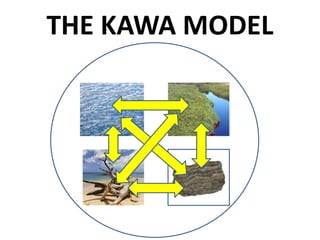
THE KAWA MODEL
PAST
PRESENT
FUTURE
THE KAWA MODEL
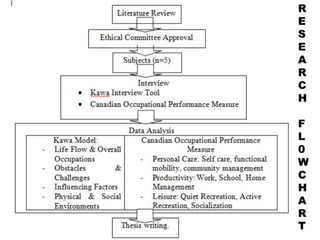
Tools
Who?
• Malay, Muslim
• Female, 20s
• Single,
• works at SBM, Brickfields
• from Kelantan,
• living in Wangsa Maju.
• Chinese, Christian
• Male, 30s
• Single,
• works at SBM, Brickfields.
• from Segambut, KL.
• living in Segambut w/ family.
• Chinese, Christian
• Female, 50s
• Single,
• works as telephone operator,
• from Pahang,
• living in Brickfields w/ friends
• Chinese, Christian
• Male, 40s
• Widowed,
• works as telephone operator.
• from Kepong, KL.
• living in Brickfields w/ friends.
• Chinese, Free Thinker
• Male, 60s
• Married, one daughter (sighted)
• Massage parlour biz with wife.
• from Johor.
• Living & working in Brickfields.
LIFE FLOW: PAST
Narrative focus more on experiences that
contributed in forming identity.
Not much mention of impairment.
Focus a lot on school / career.
Focus more on persons and relationships
than activities.
LIFE FLOW: PRESENT
Narratives focus more on activities.
Concerns on engagement.
Not focused on the “how”, but the “why”
(what they get out of the experience).
Leisure, work, time for loved ones.
LIFE FLOW: FUTURE
Connected to age.
20s-30s: aspirations, achievement.
40s-50s: peace and contentment with
present, not focused on future.
60s: aging.
PHYSICAL AND SOCIAL ENVIRONMENTS
Big influence on performance.
Influences decisions about activities and
participation.
Relationships within environment can be
more important to them than occupations.
Church and blind organisations.
INFLUENCING FACTORS
“Live in the present” – good for emotional
wellbeing, negative long term consequences.
Emotional Challenges
-Sense of dignity
- Bible
-Look for silver lining
Improve Performance
-Value success
- Patience
- Determination
- Personality traits
OBSTACLES AND CHALLENGES
Negative attitudes, perceptions, beliefs
about impairment
- Self
- Employers
- Family
Work demands
Health, finances (lack of forward planning)
Self Care: Personal Care
Adapted well.
-Change form of activity
- Change attitudes
Self Care:
Functional Mobility
White cane
Safety concerns
Practice
Learn from mistakes
Self Care: Community Management
* Only from the COPM
Challenge: Crowds
Challenge: Large spaces
Challenge:
Motorbikes on
pavements
Challenge: Construction /
Road Works / Bad Roads
Current Solutions?
Telephone banking.
Online shopping.
Friends.
Shop assistants.
Orientation & familiarisation.
Pickup arrangements.
Productivity: Work
Narratives tend to only
focus on descriptions of
tasks at work.
Productivity: Education
Responses vary according to individual /
which framework was used first.
School experiences at
corresponding life stage.
(COPM first).
Things he did in school.
(COPM first)
Productivity: Education
Ongoing informal education /
Continuous learning (Kawa first)
Most memorable
school experiences.
(Kawa first)
Generation / age gap?
Productivity: Home Management
Typically outsourced:
Family members
Paid help
Otherwise develop
compensatory
strategies.
Leisure Activities
Categories inadequate
Creative Pursuits
Music
Singing
Deejaying
Literary Activities (Reading)
Technology-enhanced
Blogs / online news
Listening to international radio stations
Active
Recreation
Outings & Travelling
Jalan-jalan Cari Makan
Guide dogs are not
welcome in Malaysia.
But the presidential
security dog?
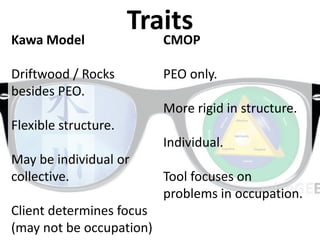
Traits
Kawa Model
Driftwood / Rocks
besides PEO.
Flexible structure.
May be individual or
collective.
Client determines focus
(may not be occupation)
CMOP
PEO only.
More rigid in structure.
Individual.
Tool focuses on
problems in occupation.
User’s POV: Kawa (Pros)
Easy to understand.
Covers wider spectrum due to lack of
fixed structure.
Gives insight not only problems, but
also traits that could help / hinder
progress.
User’s POV: Kawa (Cons)
Loose, flexible structure may be
challenging for new users.
Strong emotional impact of narratives
may be uncomfortable for interviewees
to start off with.
User’s POV: CMOP (Pros)
Structure of COPM elicits narratives which clients
may not consider as important enough to talk
about, but can generate helpful insights.
Eg. Community Management
Focus on occupations, more impersonal
good platform to start relationship
building before moving on to more
personal matters.
User’s POV: CMOP (Cons)
What is “affective”? “Spirituality”? Institutional”?
Only provides guidelines for occupations /
occupational performance (COPM)
Due to COPM, easily focusing
entirely on occupations, may
neglect “person” and “environment”.
Occupations may not fit categories.
Conclusion
What is important to people with visual impairments:
Not just activities that they want and need to do everyday.
But also dynamic interactions that influence decision
making process and motivations behind actions.
Influences: physical and social environments, values,
beliefs, attitudes, principles, past experiences etc.
Conclusion
Kawa Model acknowledges and captures dynamic
interactions.
COPM focuses exclusively on performance of activities.
In order for occupational therapy to be truly relevant and
applicable to a specific client population, we must
consider holistically their life perspectives embedded
within the context surrounding them.
Ideally both frameworks can be used complementary to
one another for a more overall comprehensive
approach.
The End
Like this? Fb.com/KawaModel

A comparison of two occupational therapy models