CAREGIVER
BURNOUT
JONATHAN BRODY
TAMG HEALTHCARE
2015
The Challenges that Face Caregivers and Some
Recommended “Burnout” Mitigation Strategies
DEFINING BURNOUT
Merriam-Webster’s dictionary defines burnout as:
“exhaustion of physical or emotional strength usually as a result of
prolonged stress or frustration”.
Web MD has their own customized definition for caregiver:
“Caregiver burnout is a state of physical, emotional, and mental
exhaustion that may be accompanied by a change in attitude --
from positive and caring to negative and unconcerned.”
The most complete definition I found (Zarit):
“The extent to which caregivers perceive that
caregiving has an adverse effect on their emotional ,
social, financial, physical and spiritual functioning”
SEPARATING THE
PROFESSIONAL FROM
LAY CAREGIVERS
Both professional and
lay caregivers
experience burnout.
The professional in senior
care can easily become
overwhelmed by the number
of patients, chronic/acute
conditions and the fact that as
the patients age, they are
fighting a losing battle.
However, as professionals
they are (should) be better
able to prepare and when the
work day ends….
Family and Friends are not as well
prepared….
• Taking care of the aging puts a vast
array of stressors on the caregiver
• They rarely have a clear “endpoint”
and are filled with emotions
This presentation focuses on
those who provide unpaid,
often untrained, assistance
(both medical and non) to a
loved one with a chronic
illness.
SOME KEY STATS
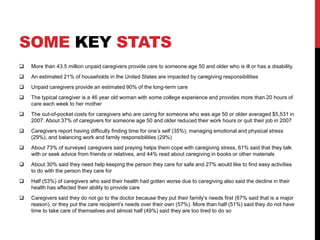
 More than 43.5 million unpaid caregivers provide care to someone age 50 and older who is ill or has a disability
 An estimated 21% of households in the United States are impacted by caregiving responsibilities
 Unpaid caregivers provide an estimated 90% of the long-term care
 The typical caregiver is a 46 year old woman with some college experience and provides more than 20 hours of
care each week to her mother
 The out-of-pocket costs for caregivers who are caring for someone who was age 50 or older averaged $5,531 in
2007. About 37% of caregivers for someone age 50 and older reduced their work hours or quit their job in 2007
 Caregivers report having difficulty finding time for one’s self (35%), managing emotional and physical stress
(29%), and balancing work and family responsibilities (29%)
 About 73% of surveyed caregivers said praying helps them cope with caregiving stress, 61% said that they talk
with or seek advice from friends or relatives, and 44% read about caregiving in books or other materials
 About 30% said they need help keeping the person they care for safe and 27% would like to find easy activities
to do with the person they care for
 Half (53%) of caregivers who said their health had gotten worse due to caregiving also said the decline in their
health has affected their ability to provide care
 Caregivers said they do not go to the doctor because they put their family’s needs first (67% said that is a major
reason), or they put the care recipient’s needs over their own (57%). More than half (51%) said they do not have
time to take care of themselves and almost half (49%) said they are too tired to do so
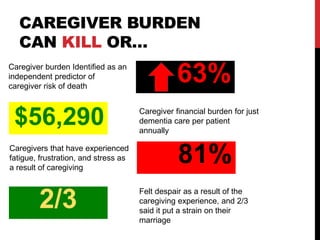
CAREGIVER BURDEN
CAN KILL OR…
63%Caregiver burden Identified as an
independent predictor of
caregiver risk of death
Caregiver financial burden for just
dementia care per patient
annually
$56,290
81%Caregivers that have experienced
fatigue, frustration, and stress as
a result of caregiving
Felt despair as a result of the
caregiving experience, and 2/3
said it put a strain on their
marriage
2/3
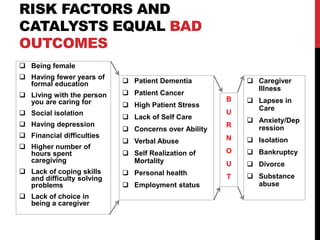
RISK FACTORS AND
CATALYSTS EQUAL BAD
OUTCOMES
 Being female
 Having fewer years of
formal education
 Living with the person
you are caring for
 Social isolation
 Having depression
 Financial difficulties
 Higher number of
hours spent
caregiving
 Lack of coping skills
and difficulty solving
problems
 Lack of choice in
being a caregiver
 Patient Dementia
 Patient Cancer
 High Patient Stress
 Lack of Self Care
 Concerns over Ability
 Verbal Abuse
 Self Realization of
Mortality
 Personal health
 Employment status
B
U
R
N
O
U
T
 Caregiver
Illness
 Lapses in
Care
 Anxiety/Dep
ression
 Isolation
 Bankruptcy
 Divorce
 Substance
abuse
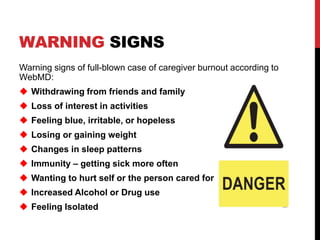
WARNING SIGNS
Warning signs of full-blown case of caregiver burnout according to
WebMD:
 Withdrawing from friends and family
 Loss of interest in activities
 Feeling blue, irritable, or hopeless
 Losing or gaining weight
 Changes in sleep patterns
 Immunity – getting sick more often
 Wanting to hurt self or the person cared for
 Increased Alcohol or Drug use
 Feeling Isolated
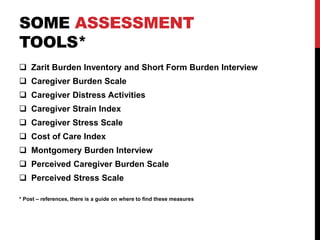
SOME ASSESSMENT
TOOLS*
 Zarit Burden Inventory and Short Form Burden Interview
 Caregiver Burden Scale
 Caregiver Distress Activities
 Caregiver Strain Index
 Caregiver Stress Scale
 Cost of Care Index
 Montgomery Burden Interview
 Perceived Caregiver Burden Scale
 Perceived Stress Scale
* Post – references, there is a guide on where to find these measures
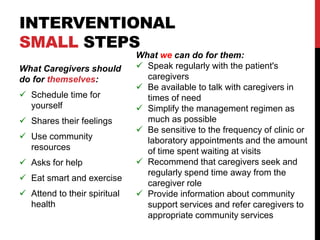
INTERVENTIONAL
SMALL STEPS
What Caregivers should
do for themselves:
 Schedule time for
yourself
 Shares their feelings
 Use community
resources
 Asks for help
 Eat smart and exercise
 Attend to their spiritual
health
What we can do for them:
 Speak regularly with the patient's
caregivers
 Be available to talk with caregivers in
times of need
 Simplify the management regimen as
much as possible
 Be sensitive to the frequency of clinic or
laboratory appointments and the amount
of time spent waiting at visits
 Recommend that caregivers seek and
regularly spend time away from the
caregiver role
 Provide information about community
support services and refer caregivers to
appropriate community services
1.Adelman. R, Lyubov L. et al Caregiver BurdenAClinical Review (2014) JAMAvolume 311, number 10 1052-9
2.Braun KL, Browne CV. Perceptions of dementia, caregiving, and help seeking amongAsian and Pacific Islander
Americans. Health Soc Work1998;23(4):262-74;
3. Brown LJ,Potter JF, Foster BG. Caregiver burden should be evaluated during geriatric assessment.JAm
Geriatr Soc 1990;38(4): 455-60;
4. Dean M.Alaw thatwould care for the carers.Lancet 1995; 345(8957):1101;
5. McDowellA. “Managing Geriatric Health Services” (2013) 225-226
6. Robinson BC. Validation of a Caregiver Strain Index. J Gerontol 1983;38(3):344-8
7. Stone R, CafferataGL, Sangl J.Caregivers of the frail elderly: a national profile. Gerontologist1987;27(5):616-26;
8. Stuckey JC, Neundorfer MM, Smyth KA. Burden or well-being: the same coin or related currency? Gerontologist
1996;36(5):686-93;
9. Zarit, SH et al. Relatives of the impaired elderly; correlates of feelings of burden. (1980)
10. Caregiverslibrary.org
11. WebMD.com
12.Agingcare.com
13. Mayoclinic.com
REFERENCES AND RESOURCES
ASSESSMENT TOOL DIRECTORY
 Zarit Burden Inventory and Short Form Burden Interview - http://rgps.on.ca/giic/GiiC/pdfs/Appendix%201%20-
%20Zarit%20Burden%20Interview.pdf Zarit, S. H., Reever, K.E., & Bach-Peterson, J. (1980). Relatives of the
impaired elderly: Correlates of feelings of burden. The Gerontologist, 20, 649-655
 Caregiver Burden Scale - http://www.fullcirclecare.org/caregiverissues/health/burden.html Novak, M., &
Guest, C. (1989). Application of a multidimensional Caregiver Burden Inventory. The Gerontologist, 29,
798-803.
 Caregiver Distress Activities - Pearlin, L. I., Mullan, J. T., Semple, S. J., & Skaff, M. M. (1990). Caregiving
and the stress process: An overview of concepts and their measures. The Gerontologist, 30(5), 583-594
 Caregiver Strain Index - http://consultgerirn.org/uploads/File/Caregiver%20Strain%20Index.pdf Robinson,
B. C. (1983). Validation of a caregiver strain index. Journal of Gerontology, 38, 344-348
 Caregiver Stress Scale - Pearlin, L. I., Mullan, J. T., Semple, S. J., & Skaff, M. M. (1990). Caregiving and the
stress process: An overview of concepts and their measures. The Gerontologist, 30(5), 583-594
 Cost of Care Index - Kosberg, J. I., & Cairl, R. E. (1986). The cost of care index: A case management tool for
screening informal care providers. The Gerontologist, 26, 273-278
 Montgomery Burden Interview - Montgomery, R., Gonyea, J. G., & Hooyman, N. R. (1985). Caregiving and
the experience of subjective and objective burden. Family Relations, 34, 19-26. & Montgomery, R., Stull, D.
E., & Borgatta, E. F. (1985). Measurement and the analysis of burden. Research on Aging, 7, 329-361.
 Perceived Caregiver Burden Scale- Stommel, M., Given, C. W., & Given, B. (1990). Depression as an
overriding variable explaining caregiver burdens. Journal of Aging and Health, 2, 81-102
 Perceived Stress Scalehttp://www.memic.unimaas.nl:8888/daisy/SMILE-CMS/300-
SMILE/version/1/part/6/data/perceived_stress_scale.pdf?branch=main&language=default Cohen, S.,
Kamarck, T., & Mermelstein, R. (1983). A global measure of perceived stress. Journal of Health and Social
Behavior, 24, 385-396

Caregiver Burnout slideshare

  • 1.
    CAREGIVER BURNOUT JONATHAN BRODY TAMG HEALTHCARE 2015 TheChallenges that Face Caregivers and Some Recommended “Burnout” Mitigation Strategies
  • 2.
    DEFINING BURNOUT Merriam-Webster’s dictionarydefines burnout as: “exhaustion of physical or emotional strength usually as a result of prolonged stress or frustration”. Web MD has their own customized definition for caregiver: “Caregiver burnout is a state of physical, emotional, and mental exhaustion that may be accompanied by a change in attitude -- from positive and caring to negative and unconcerned.” The most complete definition I found (Zarit): “The extent to which caregivers perceive that caregiving has an adverse effect on their emotional , social, financial, physical and spiritual functioning”
  • 3.
    SEPARATING THE PROFESSIONAL FROM LAYCAREGIVERS Both professional and lay caregivers experience burnout. The professional in senior care can easily become overwhelmed by the number of patients, chronic/acute conditions and the fact that as the patients age, they are fighting a losing battle. However, as professionals they are (should) be better able to prepare and when the work day ends…. Family and Friends are not as well prepared…. • Taking care of the aging puts a vast array of stressors on the caregiver • They rarely have a clear “endpoint” and are filled with emotions This presentation focuses on those who provide unpaid, often untrained, assistance (both medical and non) to a loved one with a chronic illness.
  • 4.
    SOME KEY STATS More than 43.5 million unpaid caregivers provide care to someone age 50 and older who is ill or has a disability  An estimated 21% of households in the United States are impacted by caregiving responsibilities  Unpaid caregivers provide an estimated 90% of the long-term care  The typical caregiver is a 46 year old woman with some college experience and provides more than 20 hours of care each week to her mother  The out-of-pocket costs for caregivers who are caring for someone who was age 50 or older averaged $5,531 in 2007. About 37% of caregivers for someone age 50 and older reduced their work hours or quit their job in 2007  Caregivers report having difficulty finding time for one’s self (35%), managing emotional and physical stress (29%), and balancing work and family responsibilities (29%)  About 73% of surveyed caregivers said praying helps them cope with caregiving stress, 61% said that they talk with or seek advice from friends or relatives, and 44% read about caregiving in books or other materials  About 30% said they need help keeping the person they care for safe and 27% would like to find easy activities to do with the person they care for  Half (53%) of caregivers who said their health had gotten worse due to caregiving also said the decline in their health has affected their ability to provide care  Caregivers said they do not go to the doctor because they put their family’s needs first (67% said that is a major reason), or they put the care recipient’s needs over their own (57%). More than half (51%) said they do not have time to take care of themselves and almost half (49%) said they are too tired to do so
  • 5.
    CAREGIVER BURDEN CAN KILLOR… 63%Caregiver burden Identified as an independent predictor of caregiver risk of death Caregiver financial burden for just dementia care per patient annually $56,290 81%Caregivers that have experienced fatigue, frustration, and stress as a result of caregiving Felt despair as a result of the caregiving experience, and 2/3 said it put a strain on their marriage 2/3
  • 6.
    RISK FACTORS AND CATALYSTSEQUAL BAD OUTCOMES  Being female  Having fewer years of formal education  Living with the person you are caring for  Social isolation  Having depression  Financial difficulties  Higher number of hours spent caregiving  Lack of coping skills and difficulty solving problems  Lack of choice in being a caregiver  Patient Dementia  Patient Cancer  High Patient Stress  Lack of Self Care  Concerns over Ability  Verbal Abuse  Self Realization of Mortality  Personal health  Employment status B U R N O U T  Caregiver Illness  Lapses in Care  Anxiety/Dep ression  Isolation  Bankruptcy  Divorce  Substance abuse
  • 7.
    WARNING SIGNS Warning signsof full-blown case of caregiver burnout according to WebMD:  Withdrawing from friends and family  Loss of interest in activities  Feeling blue, irritable, or hopeless  Losing or gaining weight  Changes in sleep patterns  Immunity – getting sick more often  Wanting to hurt self or the person cared for  Increased Alcohol or Drug use  Feeling Isolated
  • 8.
    SOME ASSESSMENT TOOLS*  ZaritBurden Inventory and Short Form Burden Interview  Caregiver Burden Scale  Caregiver Distress Activities  Caregiver Strain Index  Caregiver Stress Scale  Cost of Care Index  Montgomery Burden Interview  Perceived Caregiver Burden Scale  Perceived Stress Scale * Post – references, there is a guide on where to find these measures
  • 9.
    INTERVENTIONAL SMALL STEPS What Caregiversshould do for themselves:  Schedule time for yourself  Shares their feelings  Use community resources  Asks for help  Eat smart and exercise  Attend to their spiritual health What we can do for them:  Speak regularly with the patient's caregivers  Be available to talk with caregivers in times of need  Simplify the management regimen as much as possible  Be sensitive to the frequency of clinic or laboratory appointments and the amount of time spent waiting at visits  Recommend that caregivers seek and regularly spend time away from the caregiver role  Provide information about community support services and refer caregivers to appropriate community services
  • 10.
    1.Adelman. R, LyubovL. et al Caregiver BurdenAClinical Review (2014) JAMAvolume 311, number 10 1052-9 2.Braun KL, Browne CV. Perceptions of dementia, caregiving, and help seeking amongAsian and Pacific Islander Americans. Health Soc Work1998;23(4):262-74; 3. Brown LJ,Potter JF, Foster BG. Caregiver burden should be evaluated during geriatric assessment.JAm Geriatr Soc 1990;38(4): 455-60; 4. Dean M.Alaw thatwould care for the carers.Lancet 1995; 345(8957):1101; 5. McDowellA. “Managing Geriatric Health Services” (2013) 225-226 6. Robinson BC. Validation of a Caregiver Strain Index. J Gerontol 1983;38(3):344-8 7. Stone R, CafferataGL, Sangl J.Caregivers of the frail elderly: a national profile. Gerontologist1987;27(5):616-26; 8. Stuckey JC, Neundorfer MM, Smyth KA. Burden or well-being: the same coin or related currency? Gerontologist 1996;36(5):686-93; 9. Zarit, SH et al. Relatives of the impaired elderly; correlates of feelings of burden. (1980) 10. Caregiverslibrary.org 11. WebMD.com 12.Agingcare.com 13. Mayoclinic.com REFERENCES AND RESOURCES
  • 11.
    ASSESSMENT TOOL DIRECTORY Zarit Burden Inventory and Short Form Burden Interview - http://rgps.on.ca/giic/GiiC/pdfs/Appendix%201%20- %20Zarit%20Burden%20Interview.pdf Zarit, S. H., Reever, K.E., & Bach-Peterson, J. (1980). Relatives of the impaired elderly: Correlates of feelings of burden. The Gerontologist, 20, 649-655  Caregiver Burden Scale - http://www.fullcirclecare.org/caregiverissues/health/burden.html Novak, M., & Guest, C. (1989). Application of a multidimensional Caregiver Burden Inventory. The Gerontologist, 29, 798-803.  Caregiver Distress Activities - Pearlin, L. I., Mullan, J. T., Semple, S. J., & Skaff, M. M. (1990). Caregiving and the stress process: An overview of concepts and their measures. The Gerontologist, 30(5), 583-594  Caregiver Strain Index - http://consultgerirn.org/uploads/File/Caregiver%20Strain%20Index.pdf Robinson, B. C. (1983). Validation of a caregiver strain index. Journal of Gerontology, 38, 344-348  Caregiver Stress Scale - Pearlin, L. I., Mullan, J. T., Semple, S. J., & Skaff, M. M. (1990). Caregiving and the stress process: An overview of concepts and their measures. The Gerontologist, 30(5), 583-594  Cost of Care Index - Kosberg, J. I., & Cairl, R. E. (1986). The cost of care index: A case management tool for screening informal care providers. The Gerontologist, 26, 273-278  Montgomery Burden Interview - Montgomery, R., Gonyea, J. G., & Hooyman, N. R. (1985). Caregiving and the experience of subjective and objective burden. Family Relations, 34, 19-26. & Montgomery, R., Stull, D. E., & Borgatta, E. F. (1985). Measurement and the analysis of burden. Research on Aging, 7, 329-361.  Perceived Caregiver Burden Scale- Stommel, M., Given, C. W., & Given, B. (1990). Depression as an overriding variable explaining caregiver burdens. Journal of Aging and Health, 2, 81-102  Perceived Stress Scalehttp://www.memic.unimaas.nl:8888/daisy/SMILE-CMS/300- SMILE/version/1/part/6/data/perceived_stress_scale.pdf?branch=main&language=default Cohen, S., Kamarck, T., & Mermelstein, R. (1983). A global measure of perceived stress. Journal of Health and Social Behavior, 24, 385-396