![
© itemis AG
AUTOSAR (AUTomotive Open System Architecture)
Architectural modeling standard and reference architecture
2
Application Layer
Runtime Environment
Actuator
Software
Component
Sensor
Software
Component
Application
Software
Component
AUTOSAR
Interface
AUTOSAR
Interface
AUTOSAR
Interface
Application
Software
Component
AUTOSAR
Interface
Complex
Drivers
Microcontroller
Drivers
Memory Drivers I/O Drivers
I/O Hardware
Abstraction
Memory
Hardware
Abstraction
Memory ServicesSystem Services
Onboard Device
Abstraction
Communication
Drivers
Communication
Hardware
Abstraction
Communication
Services
Microcontroller
Composed of images from: [http://www.autosar.org/download/conferencedocs/03_AUTOSAR_Tutorial.pdf]](https://image.slidesharecdn.com/embeddedworld2013talk-150121060516-conversion-gate01/75/Model-based-Automotive-Software-Development-using-Autosar-UML-and-Domain-Specific-Languages-2-2048.jpg)
![
© itemis AG
„The software architecture of a program or
computing system is the structure or structures of
the system, which comprise software components,
the externally visible properties of those
components, and the relationships among them.“
What is Software Architecture?
[Bass, Clements, Kazman (1997): Software Architecture in Practice]
3](https://image.slidesharecdn.com/embeddedworld2013talk-150121060516-conversion-gate01/75/Model-based-Automotive-Software-Development-using-Autosar-UML-and-Domain-Specific-Languages-3-2048.jpg)
![
© itemis AG
• Structure or structures of a system
• Structural aspects: Decomposition, Uses, Layered, Modules
• Behavioral aspects: Processes, Concurrency, Shared Data
• Allocation aspects: Deployment, Artifacts, Work assignment
• Externally visible properties
• „Assumptions other components can make of a component, such as its
provided services, performance characteristics, fault handling, shared
resource usage, and so on.“
What is Software Architecture?
[Bass, Clements, Kazman (1997): Software Architecture in Practice]
4](https://image.slidesharecdn.com/embeddedworld2013talk-150121060516-conversion-gate01/75/Model-based-Automotive-Software-Development-using-Autosar-UML-and-Domain-Specific-Languages-4-2048.jpg)
![
© itemis AG
Implications of Software Architecture Definition
[Bass, Clements, Kazman (1997): Software Architecture in Practice]
5
“Every computing system with software has a
software architecture. […] It does not necessarily
follow that the architecture is known to anyone.”
“Unfortunately, an architecture can exist
independently of its description or specification.”
“The behavior of each element is part of the
architecture.”
The architecture has to be properly documented.
The documentation has to be consistent.
The documentation has to cover all relevant aspects.](https://image.slidesharecdn.com/embeddedworld2013talk-150121060516-conversion-gate01/75/Model-based-Automotive-Software-Development-using-Autosar-UML-and-Domain-Specific-Languages-5-2048.jpg)
![
© itemis AG
SW-C & Autosar Graphical Notation
Example: Specifying interfaces of SW-C
11
Source: [Specification of Virtual Functional Bus, V2.2.0, R4.0 Rev.3; www.autosar.org/download/R4.0/AUTOSAR_EXP_VFB.pdf]](https://image.slidesharecdn.com/embeddedworld2013talk-150121060516-conversion-gate01/75/Model-based-Automotive-Software-Development-using-Autosar-UML-and-Domain-Specific-Languages-11-2048.jpg)
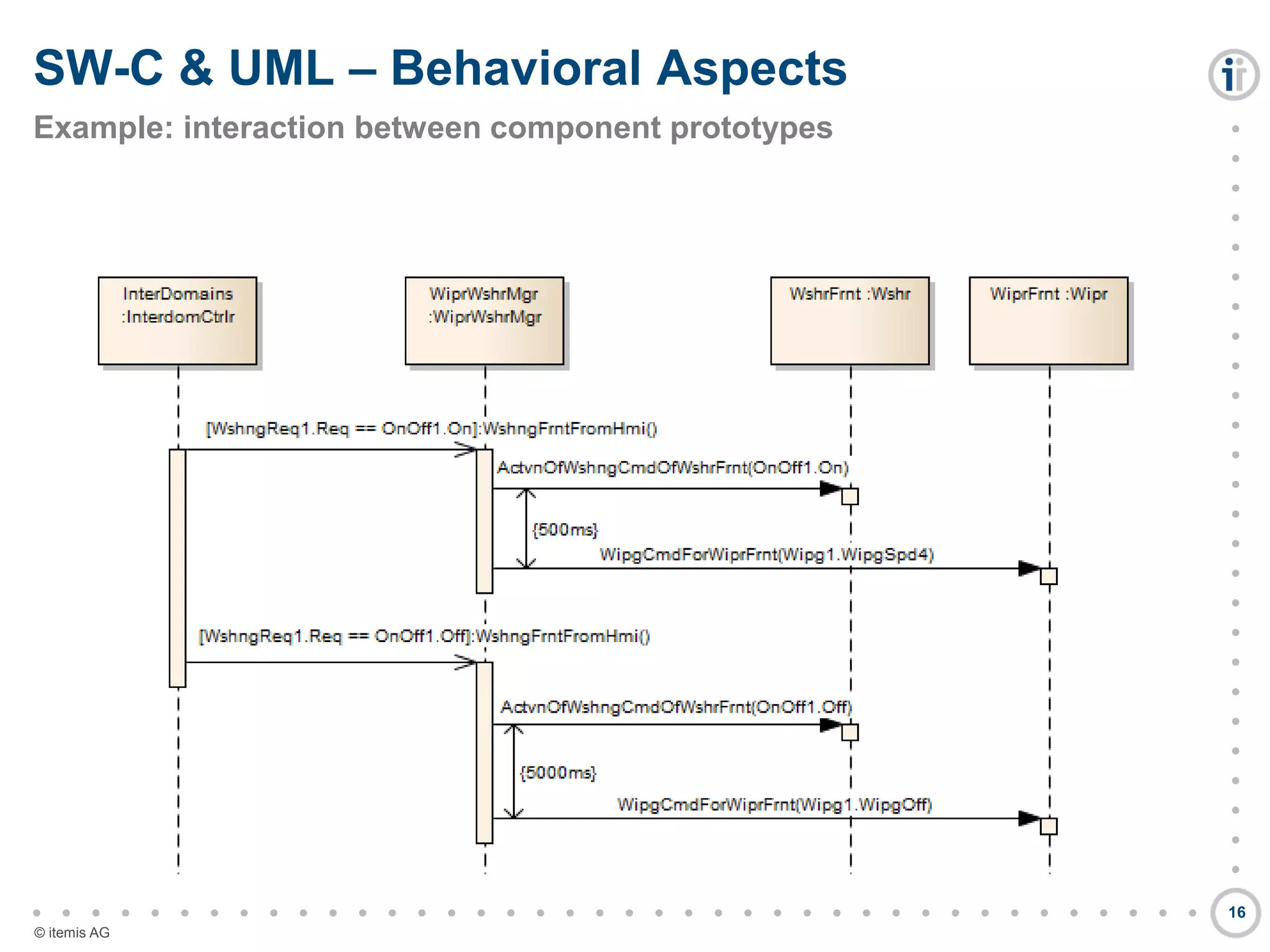


The document discusses model-based automotive software development using the AUTOSAR standard, UML modeling language, and domain-specific languages. It provides an overview of the AUTOSAR architecture and its separation of basic software and application software components. The AUTOSAR standard proposes different modeling approaches for basic software (using UML) and application software components (using an AUTOSAR graphical notation). The document also notes that while AUTOSAR specifies structural aspects, it does not address behavioral aspects in detail, and these still need to be modeled, such as using UML interactions and state machines.
Introduction to model-based automotive software development using AUTOSAR, UML, and DSLs.
Introduction to the AUTOSAR architecture including the software component layers, memory drivers, and communication drivers.
Definition of software architecture, highlighting structure, externally visible properties, and importance of documentation.
The necessity of documentation for architecture, its behavior, and the independence of architecture from its specification.
Description of the specifications for Basic Software (BSW) and Software Component (SW-C) in AUTOSAR.
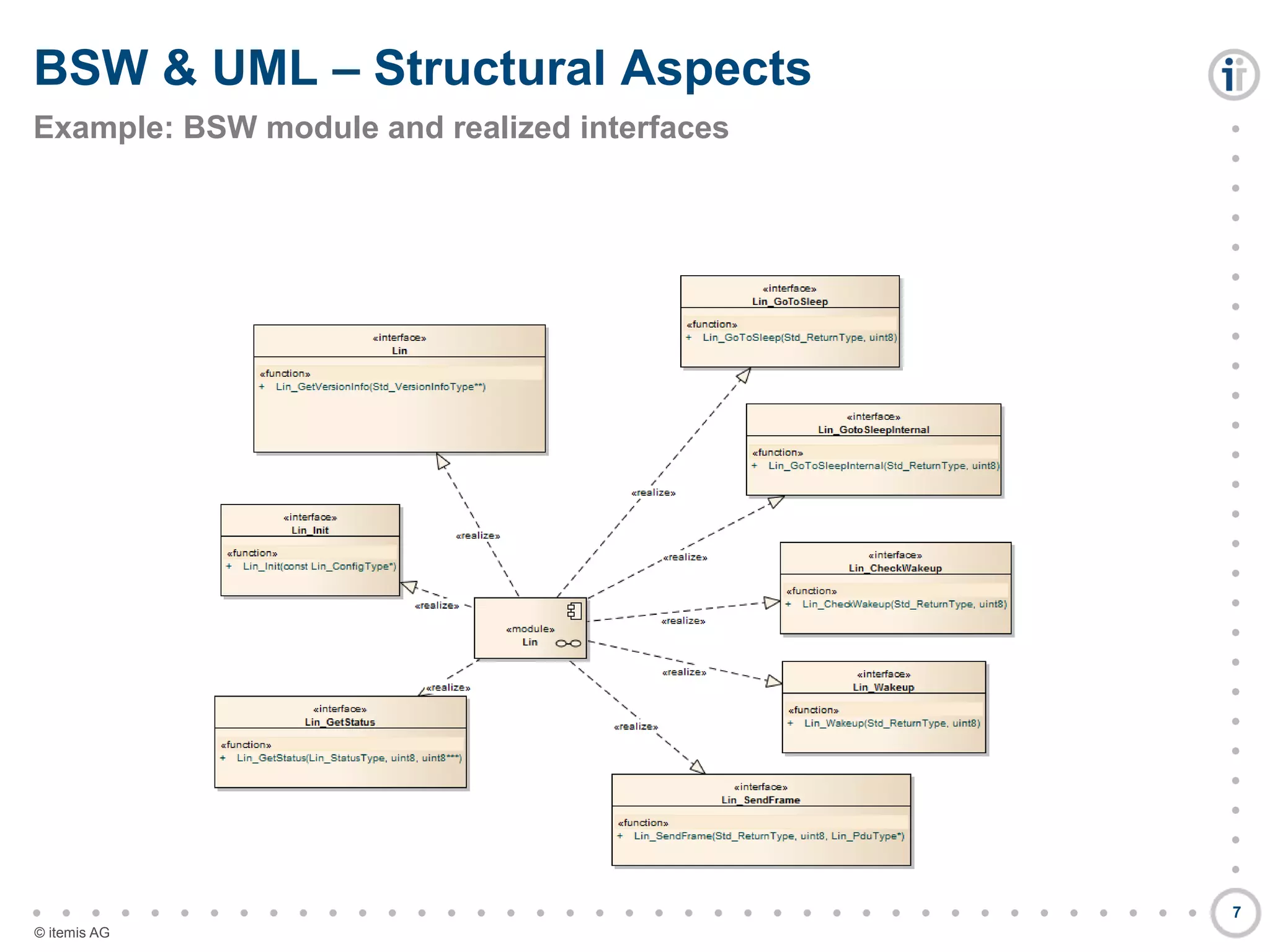
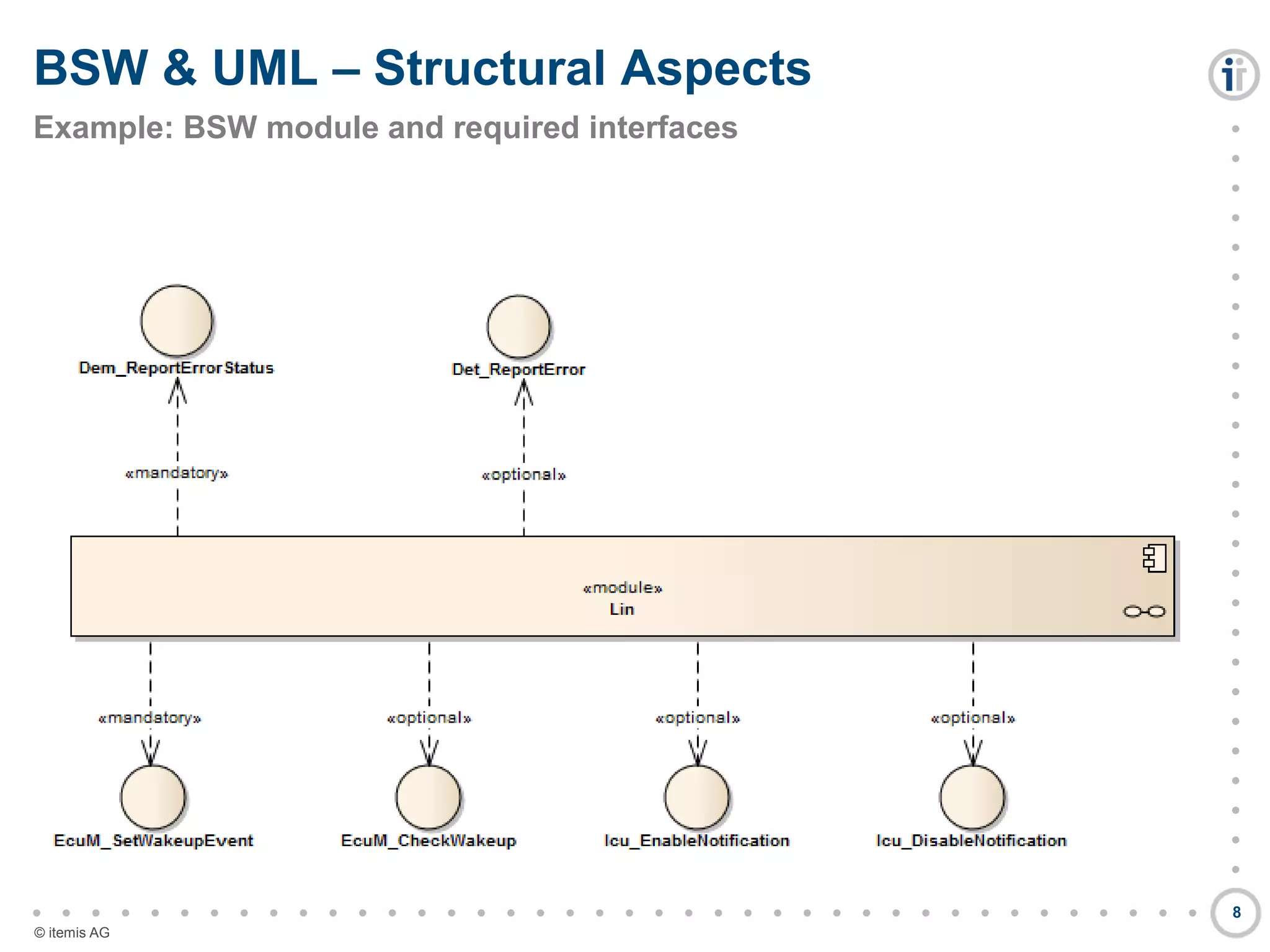
Examples of BSW modules detailing realized and required interfaces, focusing on structural aspects.
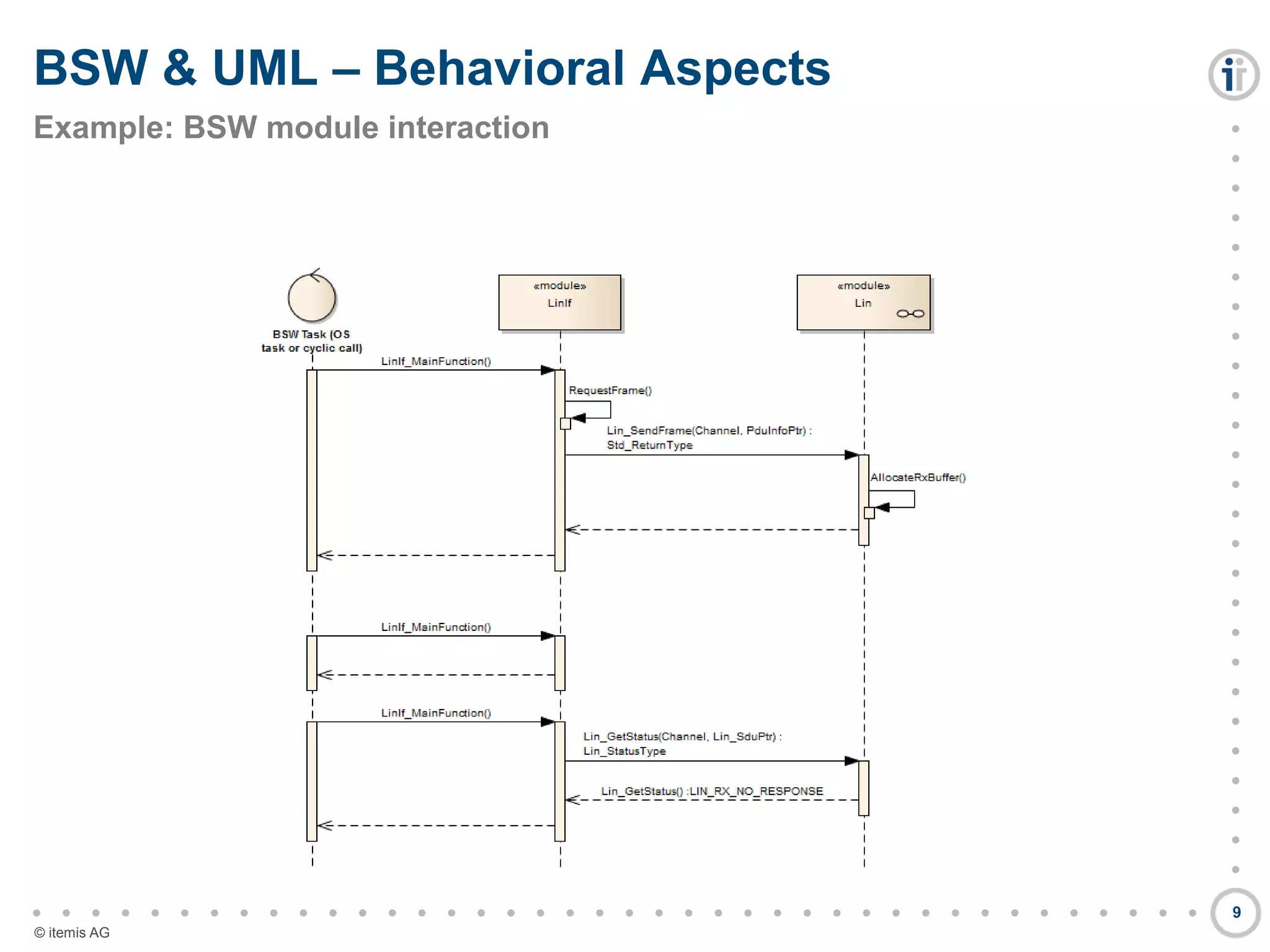
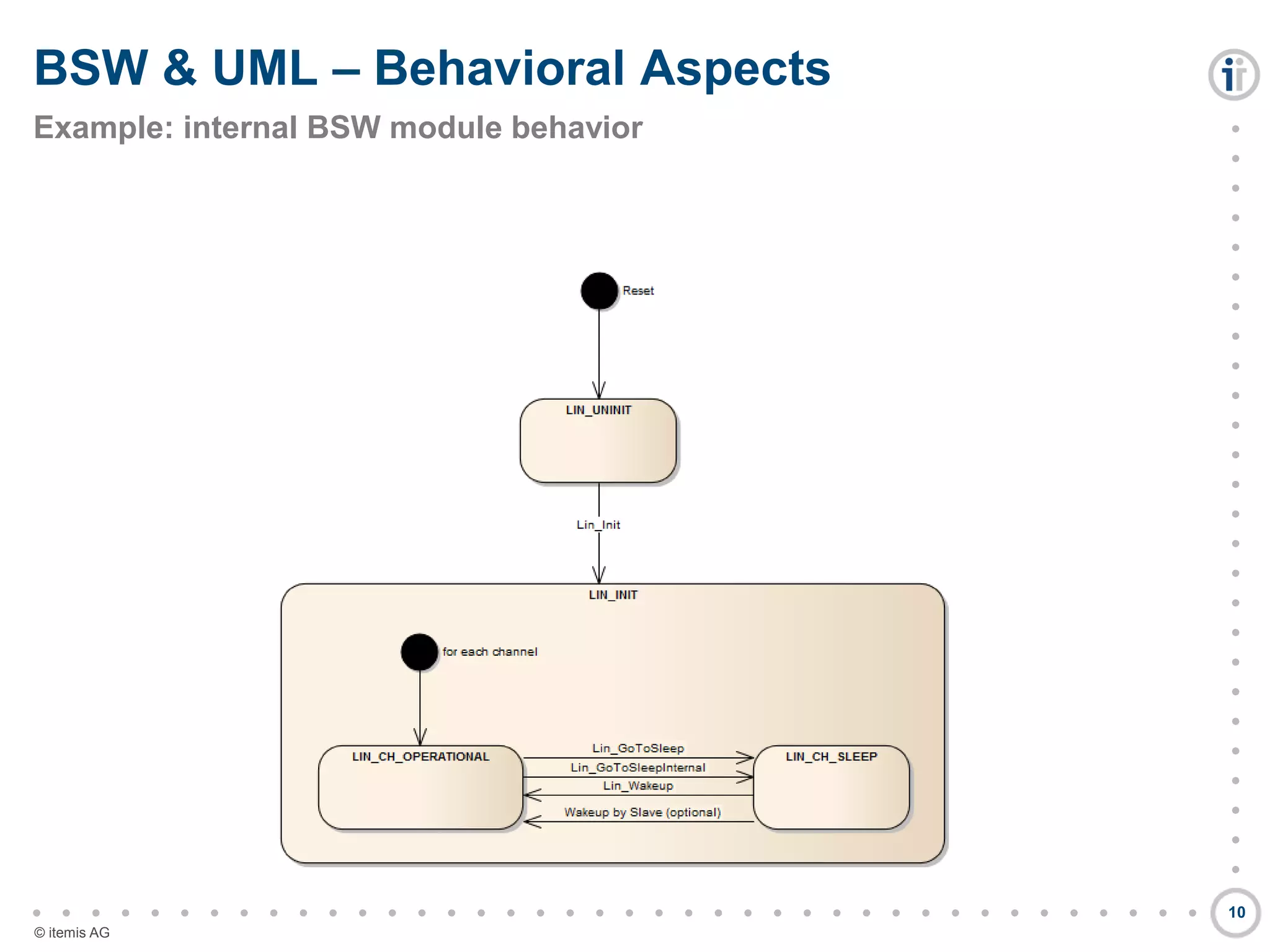
Behavioral aspects of BSW modules, detailing module interactions and internal behaviors.
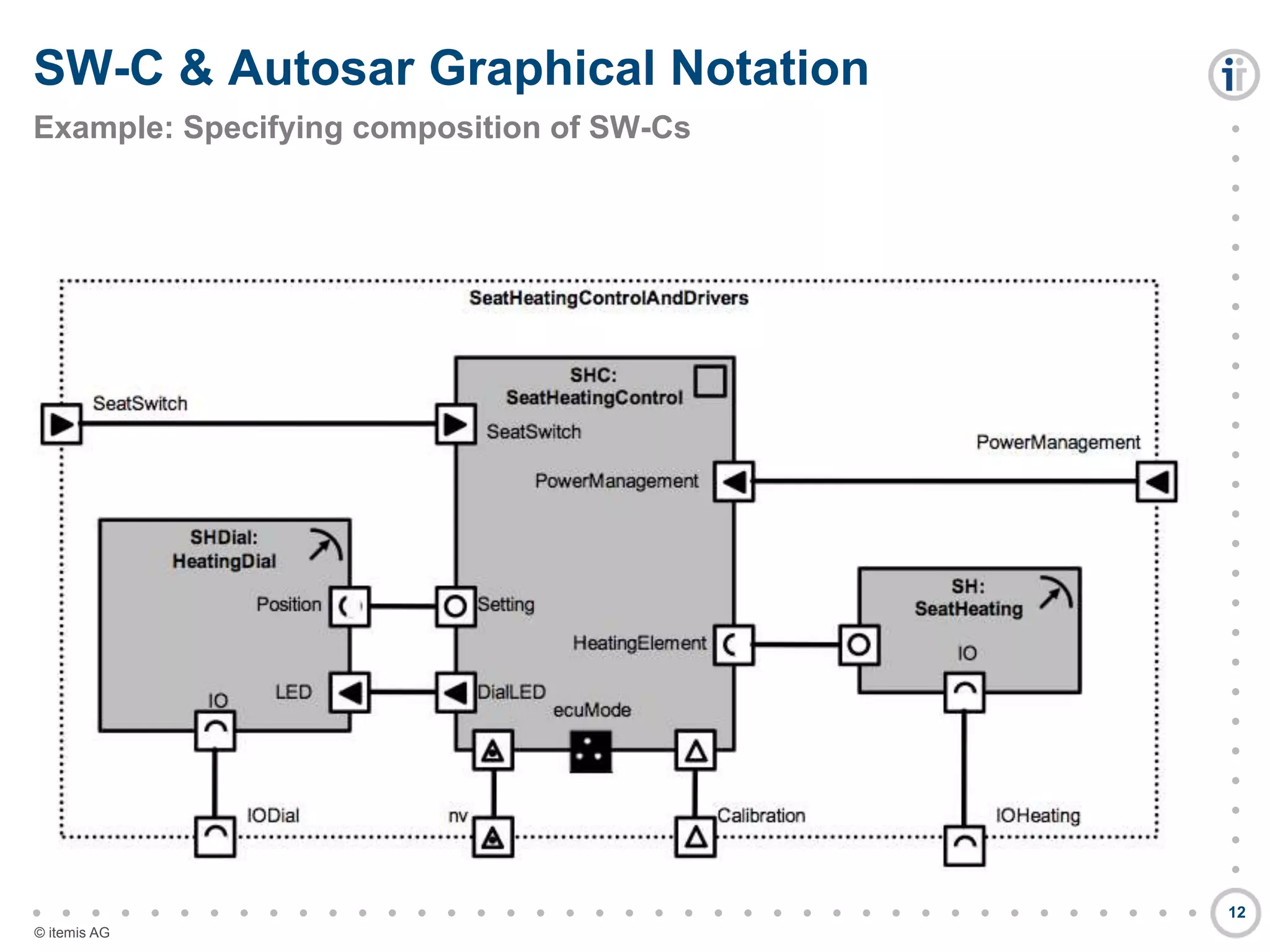
Examples of specifying interfaces and compositions of Software Components (SW-Cs) using Autosar graphical notation.
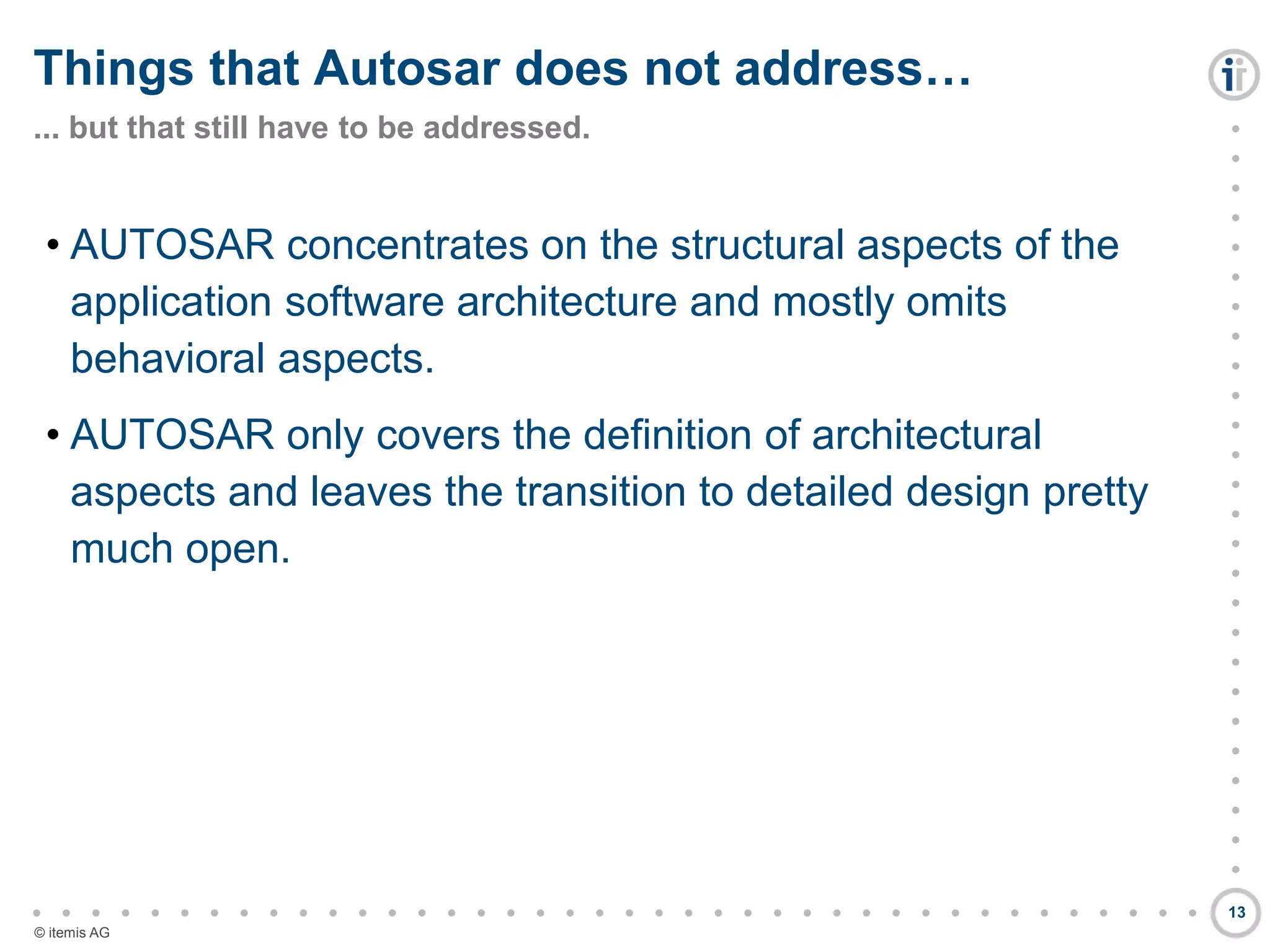
Discussion about AUTOSAR's focus on structural aspects while ignoring behavioral aspects, requiring further design considerations.
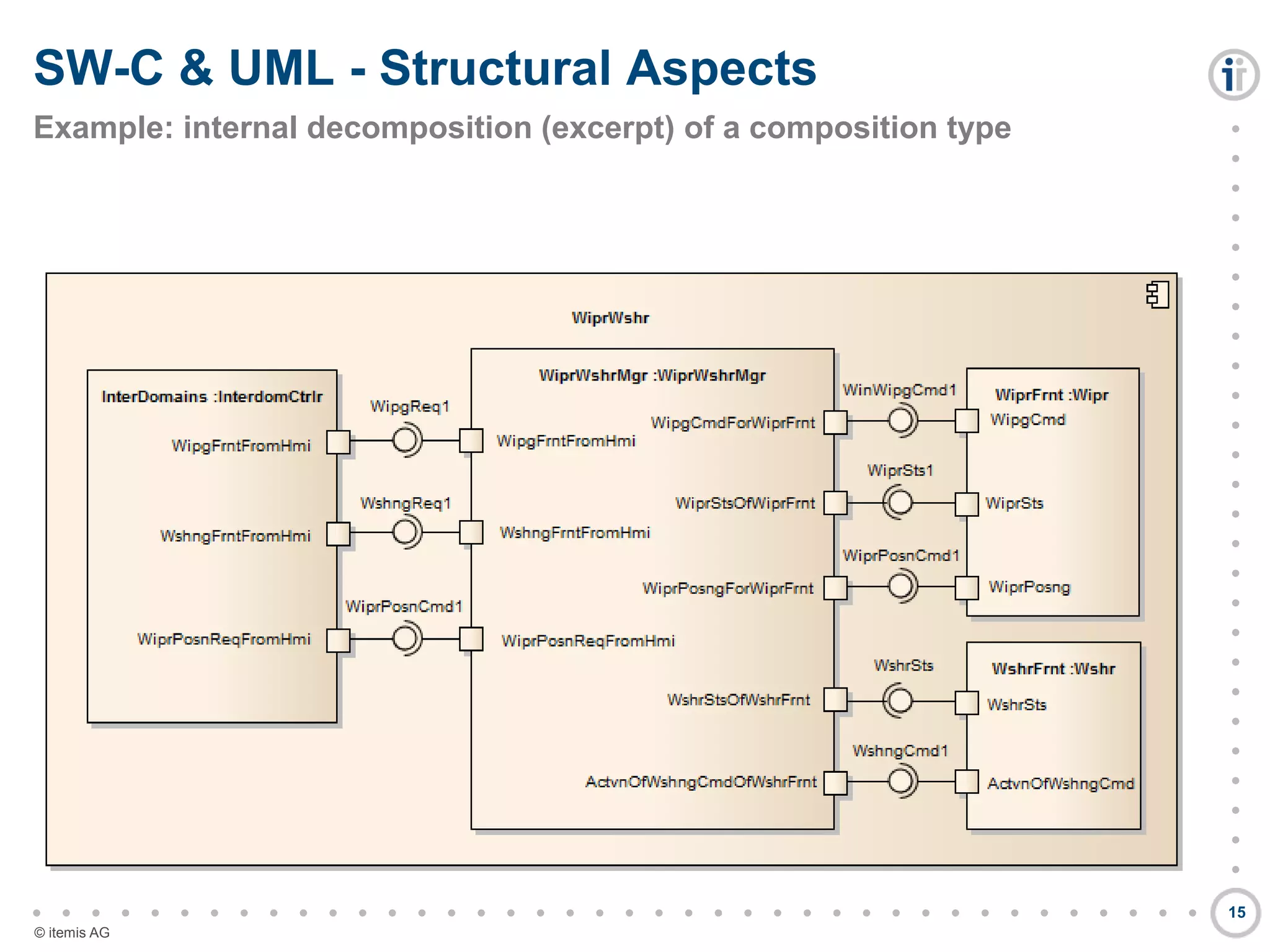
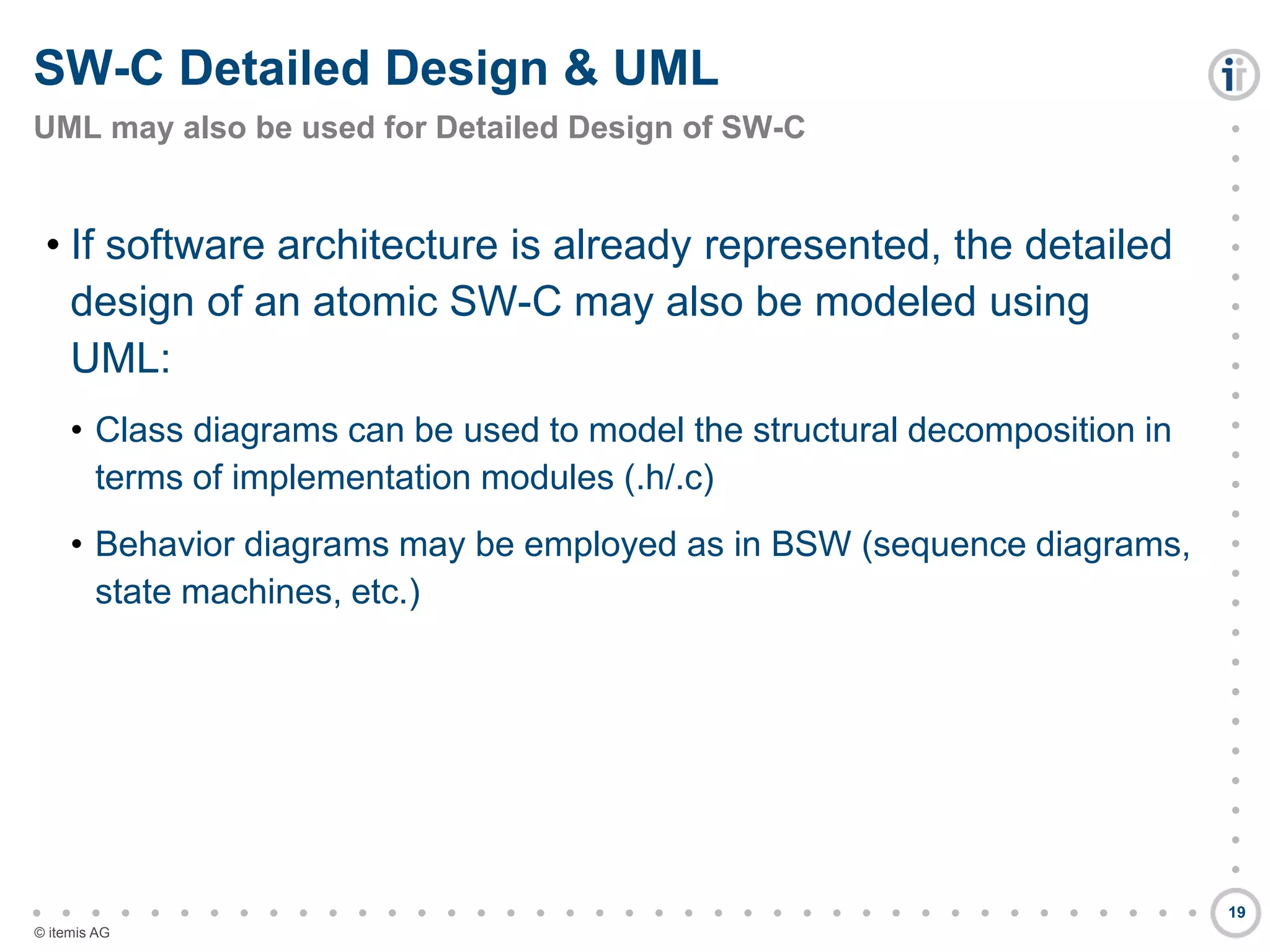
Using UML to augment AUTOSAR models with behavioral details and to represent structural decomposition.
Importance of UML in detailed design of Software Components, including examples of modeling internal decompositions.
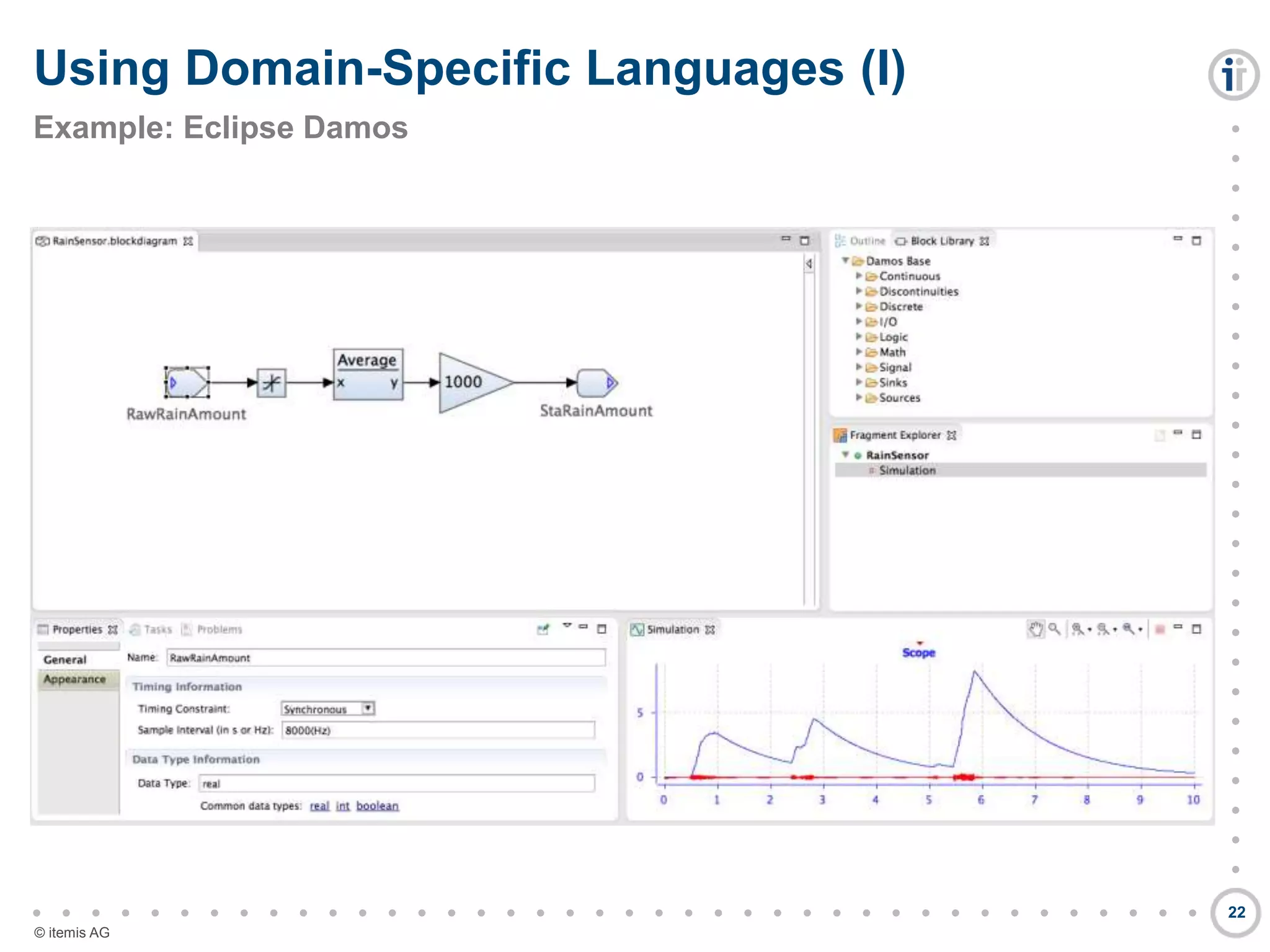
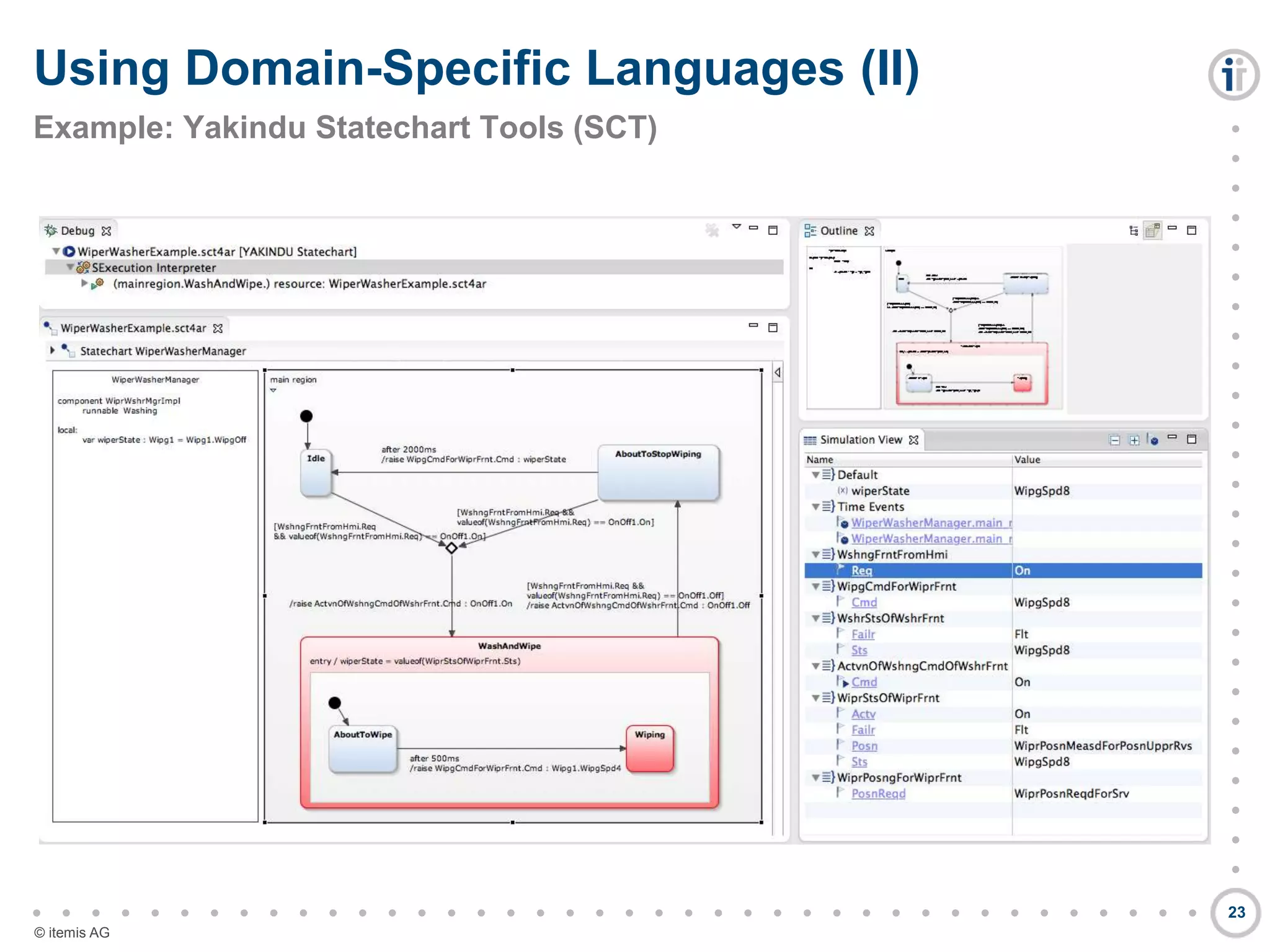
The use cases for DSLs in automating modeling processes and their applications in UML and AUTOSAR.
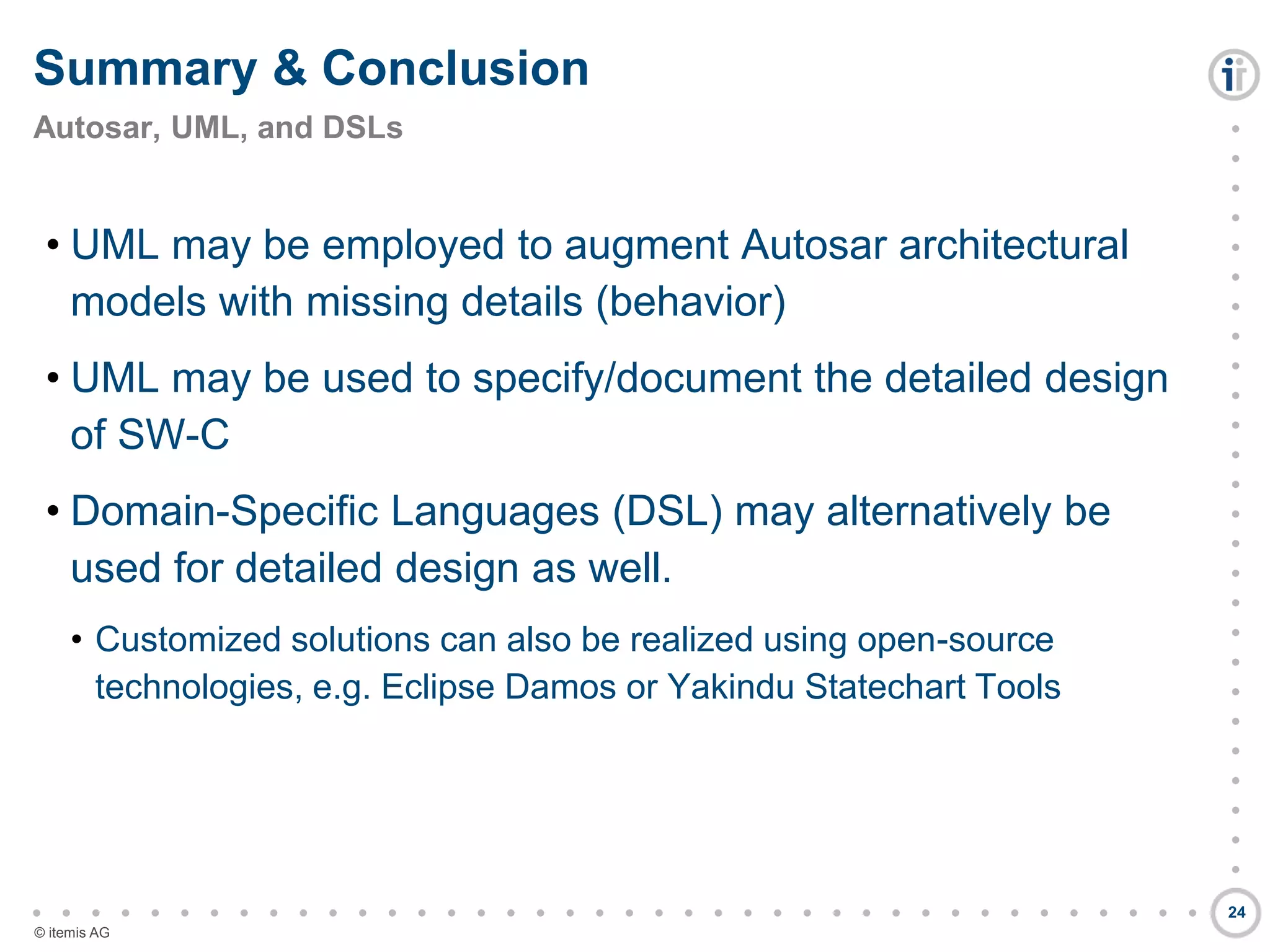
Summary of the tools and methods used in automotive system architecture including AUTOSAR, UML, and DSL.


