Automotive Embedded System
Development in AUTOSAR
2
Contents
What is AUTOSAR
AUTOSAR from a Technical Point of View
Example AUTOSAR System
Automotive Embedded System Development in AUTOSAR
3
What is AUTOSAR
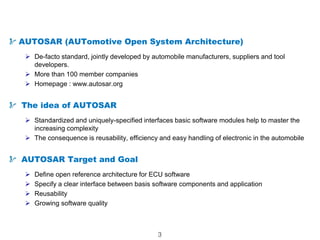
AUTOSAR (AUTomotive Open System Architecture)
 De-facto standard, jointly developed by automobile manufacturers, suppliers and tool
developers.
 More than 100 member companies
 Homepage : www.autosar.org
The idea of AUTOSAR
 Standardized and uniquely-specified interfaces basic software modules help to master the
increasing complexity
 The consequence is reusability, efficiency and easy handling of electronic in the automobile
AUTOSAR Target and Goal
 Define open reference architecture for ECU software
 Specify a clear interface between basis software components and application
 Reusability
 Growing software quality
4
What is AUTOSAR
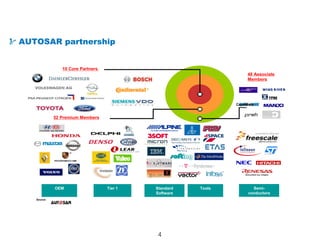
AUTOSAR partnership
10 Core Partners
48 Associate
Members
52 Premium Members
OEM Tier 1 Standard
Software
Tools Semi-
conductors
CapeWare
Source:
5
What is AUTOSAR
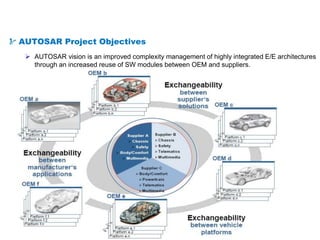
AUTOSAR Project Objectives
 AUTOSAR vision is an improved complexity management of highly integrated E/E architectures
through an increased reuse of SW modules between OEM and suppliers.
6
What is AUTOSAR
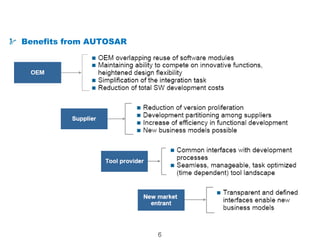
Benefits from AUTOSAR
7
ECU-Hardware
AUTOSAR Runtime Environment (RTE)
Actuator
Software
Component
AUTOSAR
Interface
Application
Software
Component
Sensor
Software
Component
Application
Software
Component
..............
AUTOSAR
Software
Basic Software
Standardized
Interface
AUTOSAR
Interface
AUTOSAR
Interface
AUTOSAR
Interface
Microcontroller
Abstraction
AUTOSAR
Software
Component
Interface
ECU
Firmware
Standard
Software
Standardized
AUTOSAR
Interface
Services
Standardized
Interface
ECU
Abstraction
AUTOSAR
Interface
Standardized
Interface
Complex
Device
Drivers
AUTOSAR
Interface
API 2
VFB & RTE
relevant
Standardized
Interface
Communication
Standardized
Interface
Standardized
Interface
Operating
System
API 1
RTE
relevant
API 0
Standardized
Inteface
API 3 Private
Interfaces inside
Basic Software
possible
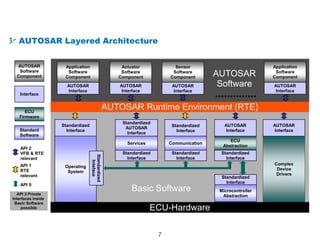
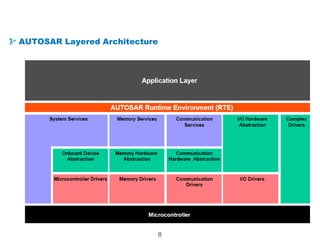
AUTOSAR Layered Architecture
AUTOSAR from a Technical Point of View
8
AUTOSAR from a Technical Point of View
AUTOSAR Layered Architecture
9
AUTOSAR from a Technical Point of View
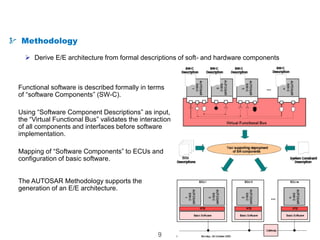
Methodology
 Derive E/E architecture from formal descriptions of soft- and hardware components
Functional software is described formally in terms
of “software Components” (SW-C).
Using “Software Component Descriptions” as input,
the “Virtual Functional Bus” validates the interaction
of all components and interfaces before software
implementation.
Mapping of “Software Components” to ECUs and
configuration of basic software.
The AUTOSAR Methodology supports the
generation of an E/E architecture.
10
AUTOSAR from a Technical Point of View
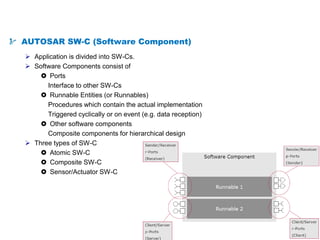
AUTOSAR SW-C (Software Component)
 Application is divided into SW-Cs.
 Software Components consist of
 Ports
Interface to other SW-Cs
 Runnable Entities (or Runnables)
Procedures which contain the actual implementation
Triggered cyclically or on event (e.g. data reception)
 Other software components
Composite components for hierarchical design
 Three types of SW-C
 Atomic SW-C
 Composite SW-C
 Sensor/Actuator SW-C
11
AUTOSAR from a Technical Point of View
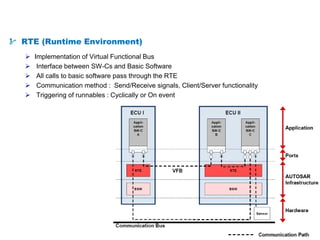
RTE (Runtime Environment)
 Implementation of Virtual Functional Bus
 Interface between SW-Cs and Basic Software
 All calls to basic software pass through the RTE
 Communication method : Send/Receive signals, Client/Server functionality
 Triggering of runnables : Cyclically or On event
12
AUTOSAR from a Technical Point of View
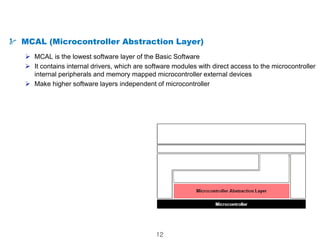
MCAL (Microcontroller Abstraction Layer)
 MCAL is the lowest software layer of the Basic Software
 It contains internal drivers, which are software modules with direct access to the microcontroller
internal peripherals and memory mapped microcontroller external devices
 Make higher software layers independent of microcontroller
13
AUTOSAR from a Technical Point of View
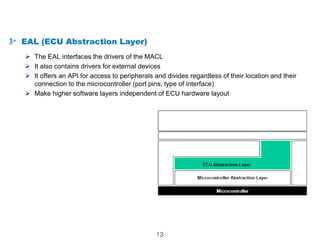
EAL (ECU Abstraction Layer)
 The EAL interfaces the drivers of the MACL
 It also contains drivers for external devices
 It offers an API for access to peripherals and divides regardless of their location and their
connection to the microcontroller (port pins, type of interface)
 Make higher software layers independent of ECU hardware layout
14
AUTOSAR from a Technical Point of View
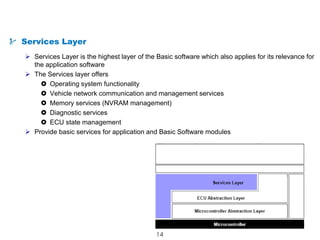
Services Layer
 Services Layer is the highest layer of the Basic software which also applies for its relevance for
the application software
 The Services layer offers
 Operating system functionality
 Vehicle network communication and management services
 Memory services (NVRAM management)
 Diagnostic services
 ECU state management
 Provide basic services for application and Basic Software modules
15
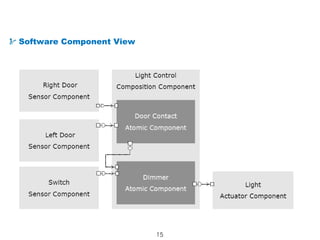
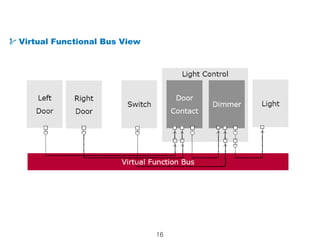
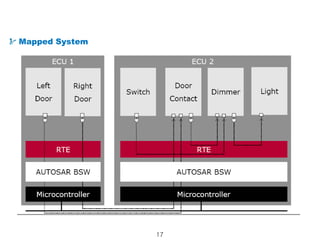
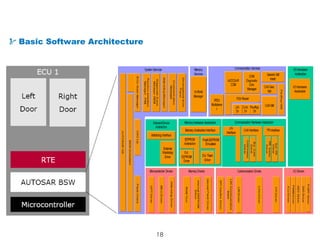
Example AUTOSAR System : Lighting System
Software Component View
16
Example AUTOSAR System : Lighting System
Virtual Functional Bus View
17
Example AUTOSAR System : Lighting System
Mapped System
18
Example AUTOSAR System : Lighting System
Basic Software Architecture

fdocuments.in_automotive-embedded-system-development-in-autosar-56ecec1fda1bb.ppt

  • 1.
  • 2.
    2 Contents What is AUTOSAR AUTOSARfrom a Technical Point of View Example AUTOSAR System Automotive Embedded System Development in AUTOSAR
  • 3.
    3 What is AUTOSAR AUTOSAR(AUTomotive Open System Architecture)  De-facto standard, jointly developed by automobile manufacturers, suppliers and tool developers.  More than 100 member companies  Homepage : www.autosar.org The idea of AUTOSAR  Standardized and uniquely-specified interfaces basic software modules help to master the increasing complexity  The consequence is reusability, efficiency and easy handling of electronic in the automobile AUTOSAR Target and Goal  Define open reference architecture for ECU software  Specify a clear interface between basis software components and application  Reusability  Growing software quality
  • 4.
    4 What is AUTOSAR AUTOSARpartnership 10 Core Partners 48 Associate Members 52 Premium Members OEM Tier 1 Standard Software Tools Semi- conductors CapeWare Source:
  • 5.
    5 What is AUTOSAR AUTOSARProject Objectives  AUTOSAR vision is an improved complexity management of highly integrated E/E architectures through an increased reuse of SW modules between OEM and suppliers.
  • 6.
  • 7.
    7 ECU-Hardware AUTOSAR Runtime Environment(RTE) Actuator Software Component AUTOSAR Interface Application Software Component Sensor Software Component Application Software Component .............. AUTOSAR Software Basic Software Standardized Interface AUTOSAR Interface AUTOSAR Interface AUTOSAR Interface Microcontroller Abstraction AUTOSAR Software Component Interface ECU Firmware Standard Software Standardized AUTOSAR Interface Services Standardized Interface ECU Abstraction AUTOSAR Interface Standardized Interface Complex Device Drivers AUTOSAR Interface API 2 VFB & RTE relevant Standardized Interface Communication Standardized Interface Standardized Interface Operating System API 1 RTE relevant API 0 Standardized Inteface API 3 Private Interfaces inside Basic Software possible AUTOSAR Layered Architecture AUTOSAR from a Technical Point of View
  • 8.
    8 AUTOSAR from aTechnical Point of View AUTOSAR Layered Architecture
  • 9.
    9 AUTOSAR from aTechnical Point of View Methodology  Derive E/E architecture from formal descriptions of soft- and hardware components Functional software is described formally in terms of “software Components” (SW-C). Using “Software Component Descriptions” as input, the “Virtual Functional Bus” validates the interaction of all components and interfaces before software implementation. Mapping of “Software Components” to ECUs and configuration of basic software. The AUTOSAR Methodology supports the generation of an E/E architecture.
  • 10.
    10 AUTOSAR from aTechnical Point of View AUTOSAR SW-C (Software Component)  Application is divided into SW-Cs.  Software Components consist of  Ports Interface to other SW-Cs  Runnable Entities (or Runnables) Procedures which contain the actual implementation Triggered cyclically or on event (e.g. data reception)  Other software components Composite components for hierarchical design  Three types of SW-C  Atomic SW-C  Composite SW-C  Sensor/Actuator SW-C
  • 11.
    11 AUTOSAR from aTechnical Point of View RTE (Runtime Environment)  Implementation of Virtual Functional Bus  Interface between SW-Cs and Basic Software  All calls to basic software pass through the RTE  Communication method : Send/Receive signals, Client/Server functionality  Triggering of runnables : Cyclically or On event
  • 12.
    12 AUTOSAR from aTechnical Point of View MCAL (Microcontroller Abstraction Layer)  MCAL is the lowest software layer of the Basic Software  It contains internal drivers, which are software modules with direct access to the microcontroller internal peripherals and memory mapped microcontroller external devices  Make higher software layers independent of microcontroller
  • 13.
    13 AUTOSAR from aTechnical Point of View EAL (ECU Abstraction Layer)  The EAL interfaces the drivers of the MACL  It also contains drivers for external devices  It offers an API for access to peripherals and divides regardless of their location and their connection to the microcontroller (port pins, type of interface)  Make higher software layers independent of ECU hardware layout
  • 14.
    14 AUTOSAR from aTechnical Point of View Services Layer  Services Layer is the highest layer of the Basic software which also applies for its relevance for the application software  The Services layer offers  Operating system functionality  Vehicle network communication and management services  Memory services (NVRAM management)  Diagnostic services  ECU state management  Provide basic services for application and Basic Software modules
  • 15.
    15 Example AUTOSAR System: Lighting System Software Component View
  • 16.
    16 Example AUTOSAR System: Lighting System Virtual Functional Bus View
  • 17.
    17 Example AUTOSAR System: Lighting System Mapped System
  • 18.
    18 Example AUTOSAR System: Lighting System Basic Software Architecture