Share and Enjoy!
Alexander Nyßen
itemis AG
4
Continue to
GEF 3.x / Zest 1.x
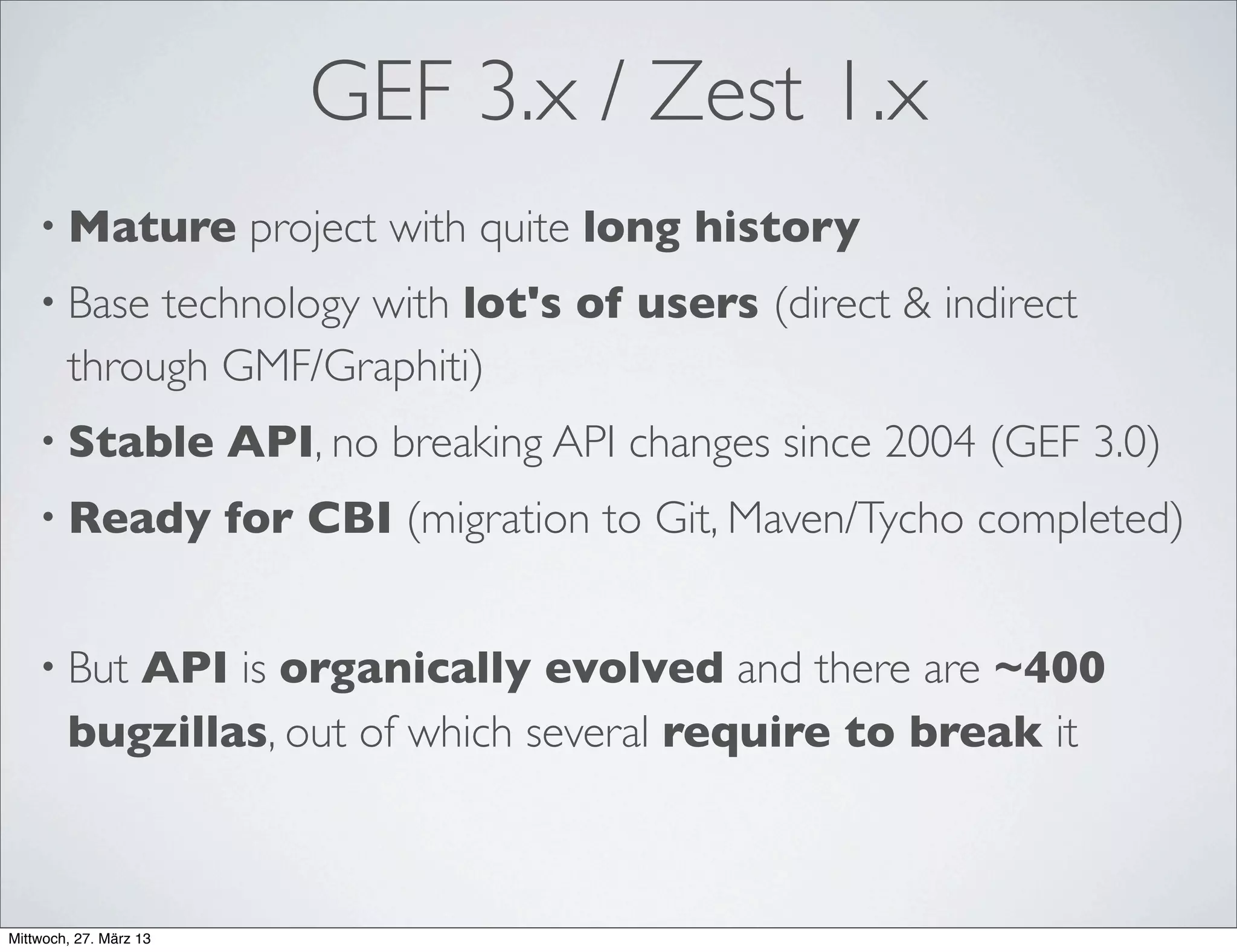
• Mature project with quite long history
• Base technology with lot's of users (direct & indirect through
GMF/Graphiti)
• Stable API, no breaking API changes since 2004 (GEF 3.0)
• Ready for CBI (migration to Git, Maven/Tycho completed)
• But API is organically evolved and there are ~400
bugzillas, out of which several require to break it
SomeTopics for a Renewal
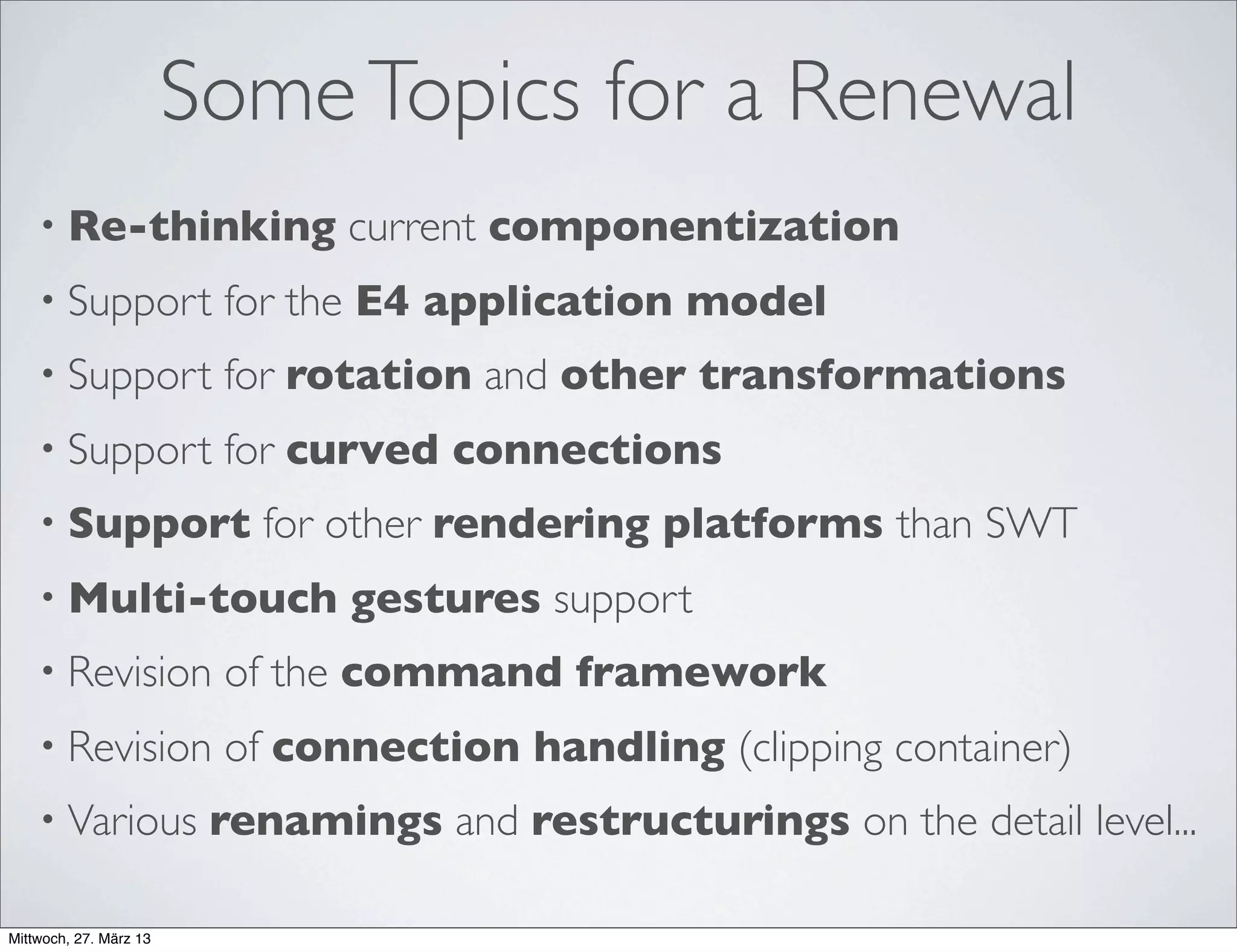
• Re-thinking current componentization
• Support for the E4 application model
• Support for rotation and other transformations
• Support for curved connections
• Support for other rendering platforms than SWT
• Multi-touch gestures support
• Revision of the command framework
• Revision of connection handling (clipping container)
• Various renamings and restructurings on the detail level...
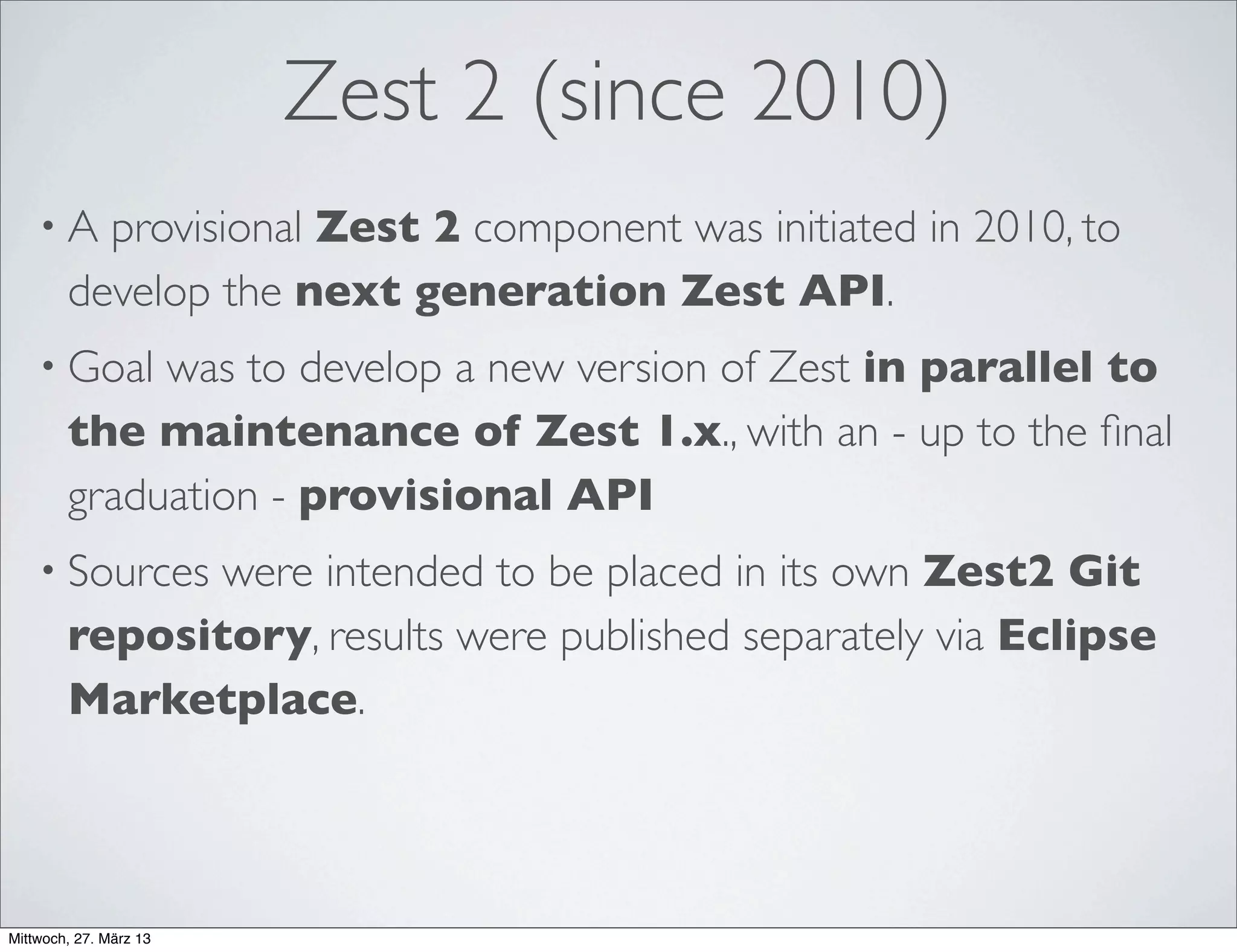
Zest 2 (since 2010)
• A provisional Zest 2 component was initiated in 2010, to
develop the next generation Zest API.
• Goal was to develop a new version of Zest in parallel to the
maintenance of Zest 1.x., with an - up to the final
graduation - provisional API
• Sources were intended to be placed in its own Zest2 Git
repository, results were published separately via Eclipse
Marketplace.
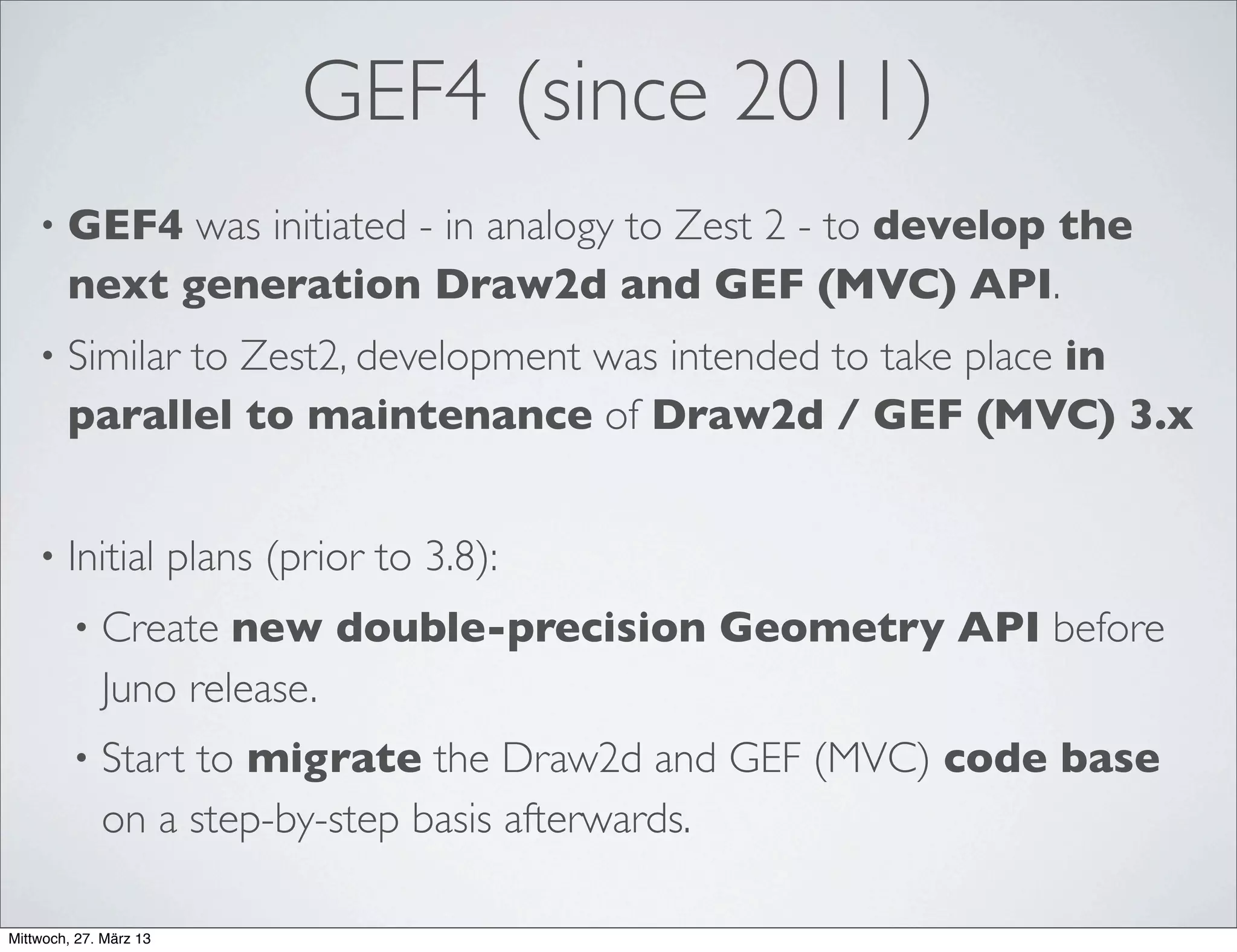
GEF4 (since 2011)
• GEF4 was initiated - in analogy to Zest 2 - to develop the next
generation Draw2d and GEF (MVC) API.
• Similar to Zest2, development was intended to take place in
parallel to maintenance of Draw2d / GEF (MVC) 3.x
• Initial plans (prior to 3.8):
• Create new double-precision Geometry API before Juno
release.
• Start to migrate the Draw2d and GEF (MVC) code base on a
step-by-step basis afterwards.
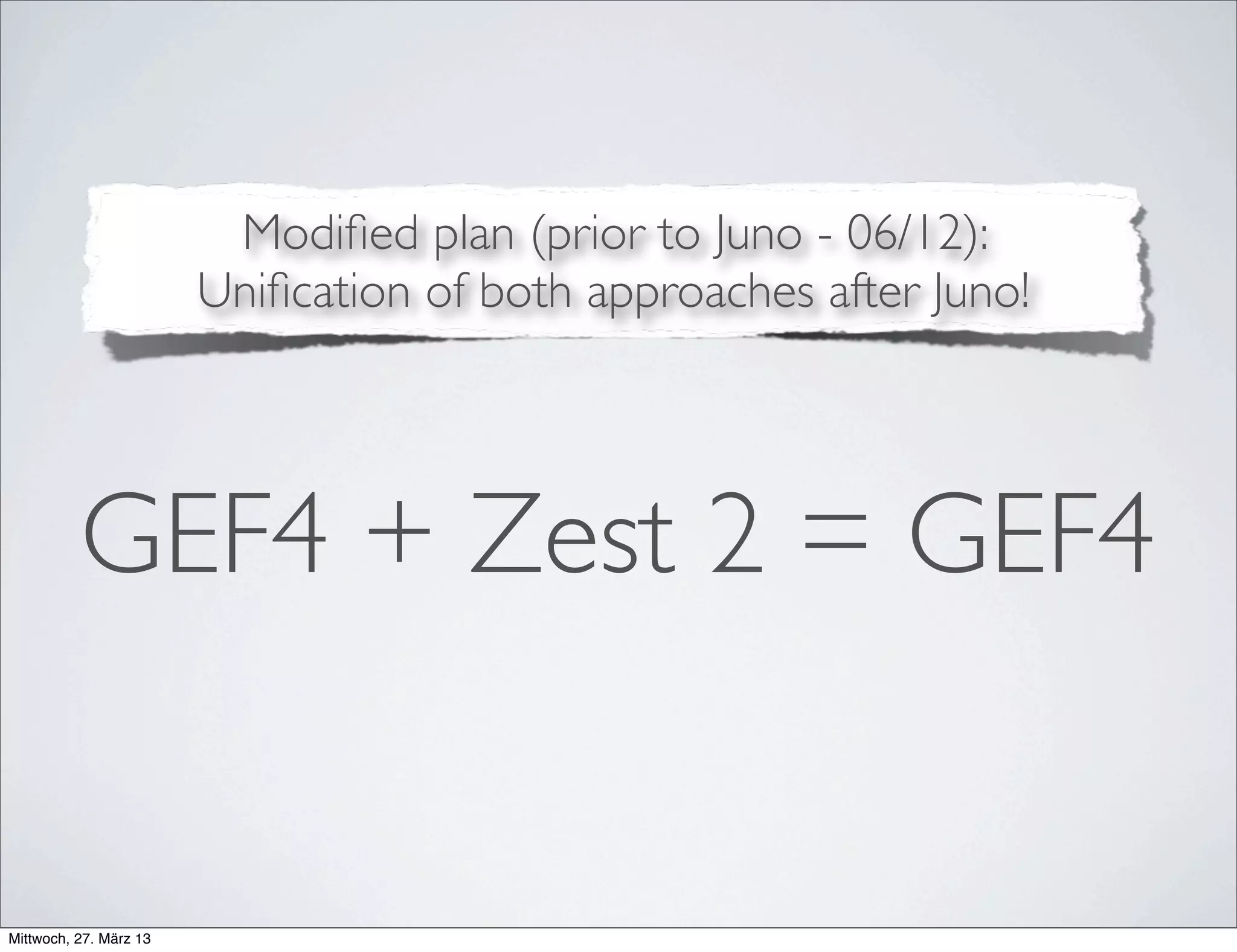
GEF4 + Zest 2 = GEF4
Modified plan: 

Unification of both approaches after Juno!
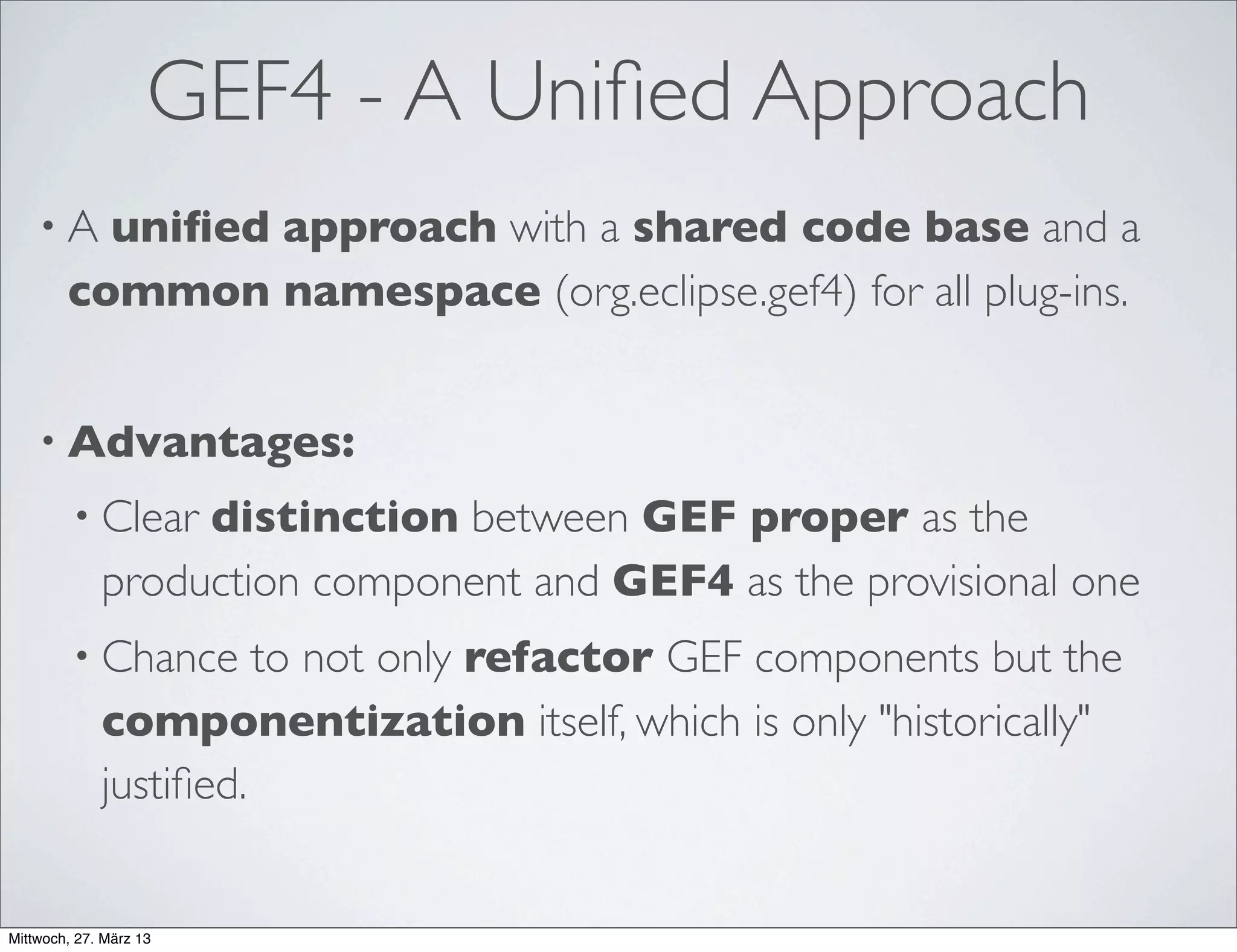
GEF4 - A Unified Approach
• A unified approach with a shared code base and a
common namespace (org.eclipse.gef4) for all plug-ins.
• Advantages:
• Clear distinction between GEF proper as the production
component and GEF4 as the provisional one
• Chance to not only refactor GEF components but the
componentization itself, which is only "historically" justified.
GEF4 - Status Quo
• GEF4 Geometry component was initiated in 2011, work has been
finalized with the Juno release:
• Functionally complete (at least for now)
• 344 JUnit tests, ~77% instruction coverage
• GEF4 Graphics component was initiated directly after Juno and is
currently under work:
• Functionally nearly complete for SWT/AWT, intended JavaFX adoption
about to start
• Still limited tests and quite a bit of adjustment needed w.r.t. "platform-
specific" issues of SWT
GEF4 - Status Quo (continued)
• GEF4 Zest was transferred to Git repository (and update-
site) but not yet adopted:
• Zest2 plug-ins were renamed to org.eclipse.gef4.zest.*
• Dependencies on Draw2d 3.x still have to be factored out
GEF4 Geometry
• No distinction in low and high precision, but just a single double-precision
API (with built-in imprecision for comparisons).
• Different geometric abstractions for different purposes:
• Euclidean (Vector, Straight,Angle)
• Projective (Vector3D, Straight3D)
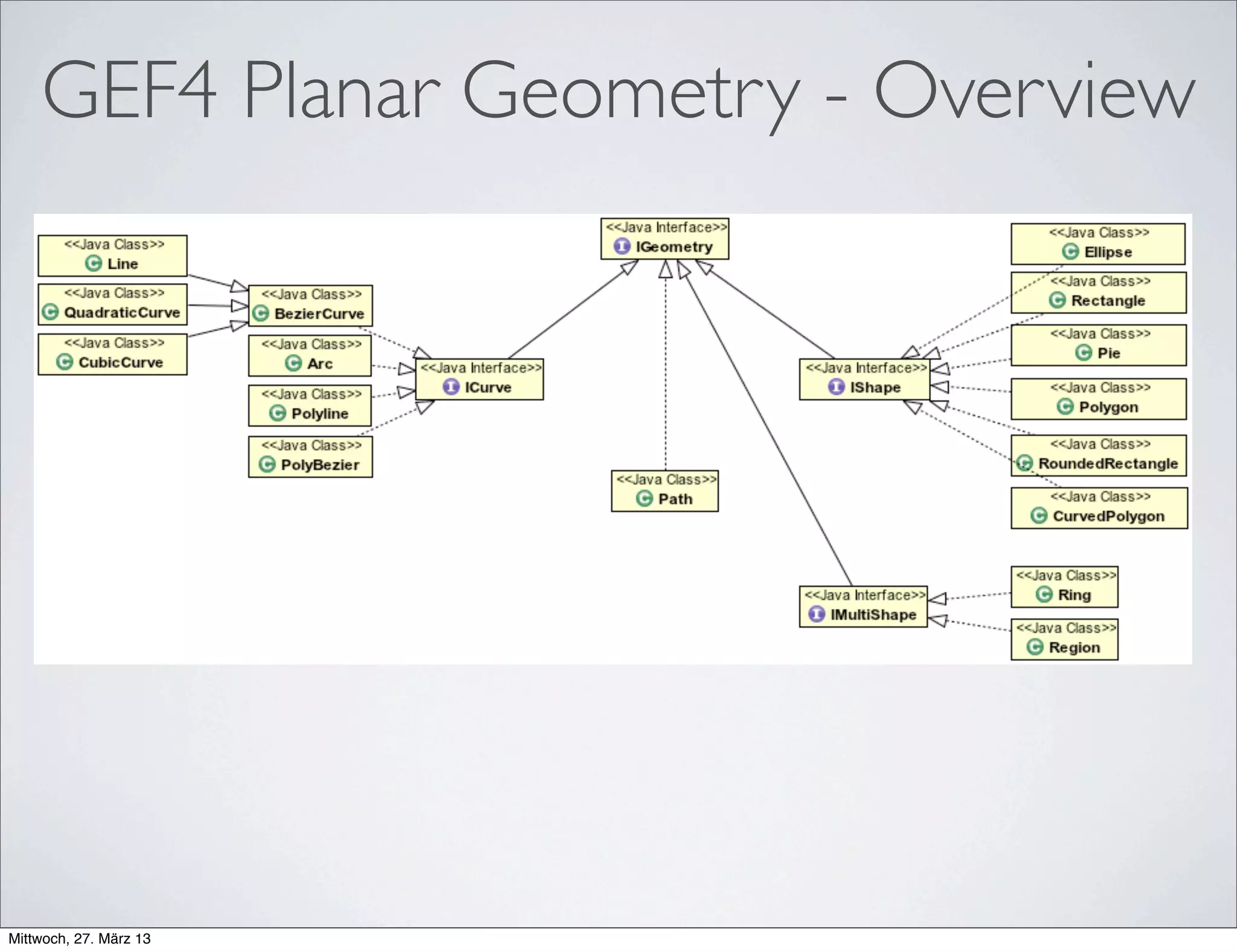
• Planar (Point, Dimension, Line, QuadraticCurve, CubicCurve,
BezierCurve, Polyline, PolyBezier, Ellipse, Rectangle, Pie,Arc, Polygon,
CurvedPolygon, RoundedRectangle, Ring, Region, Path)
• Conversions to/from AWT and SWT (and between them)
GEF4 Planar Geometry - Features
• Support for "non-standard" geometries:
• Arbitrary Bezier curves, curved polygons
• Approximation via BezierCurves & Interpolation via PolyBeziers
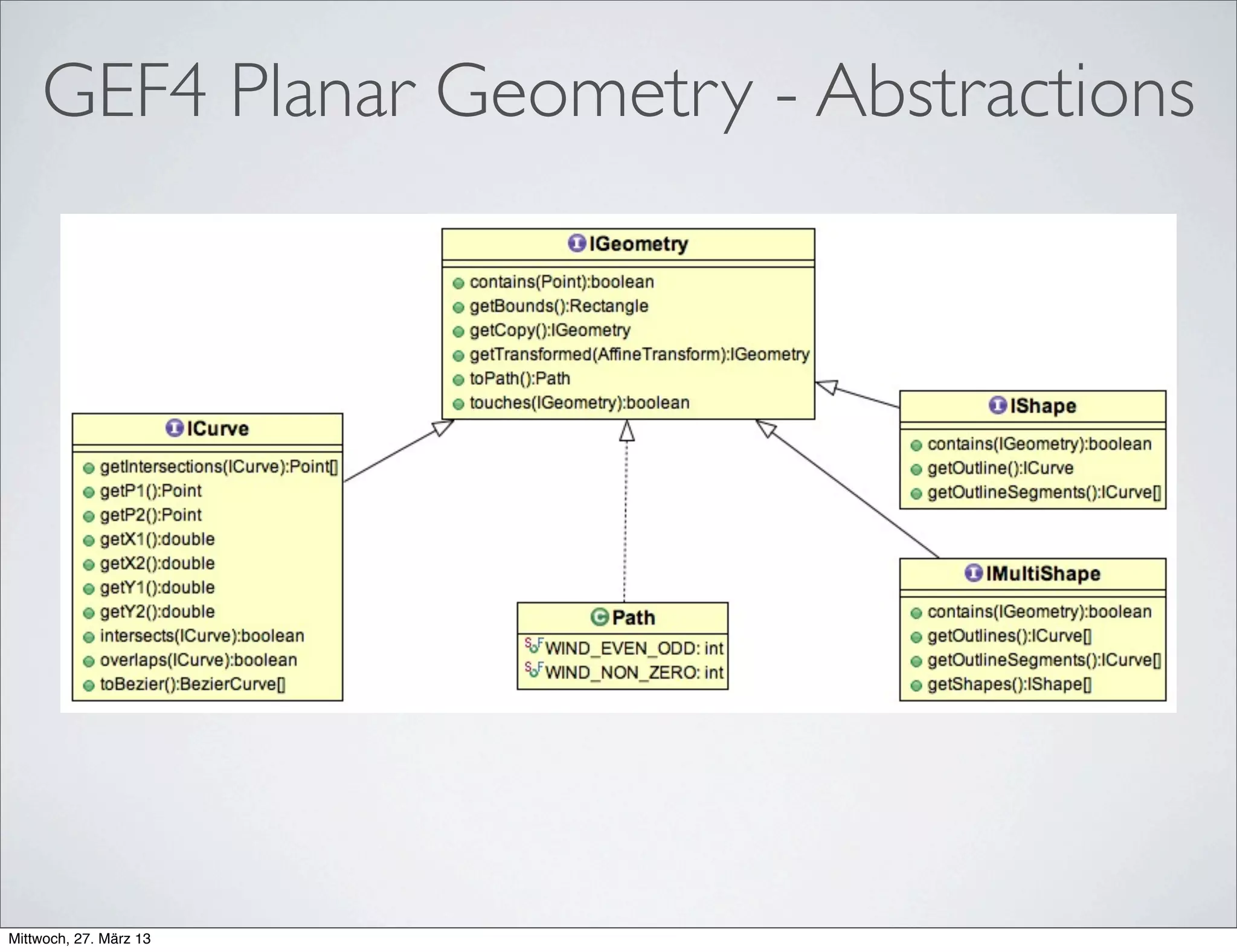
• Characteristics-related core abstractions (IGeometry, ICurve, IShape,
IMultiShape)
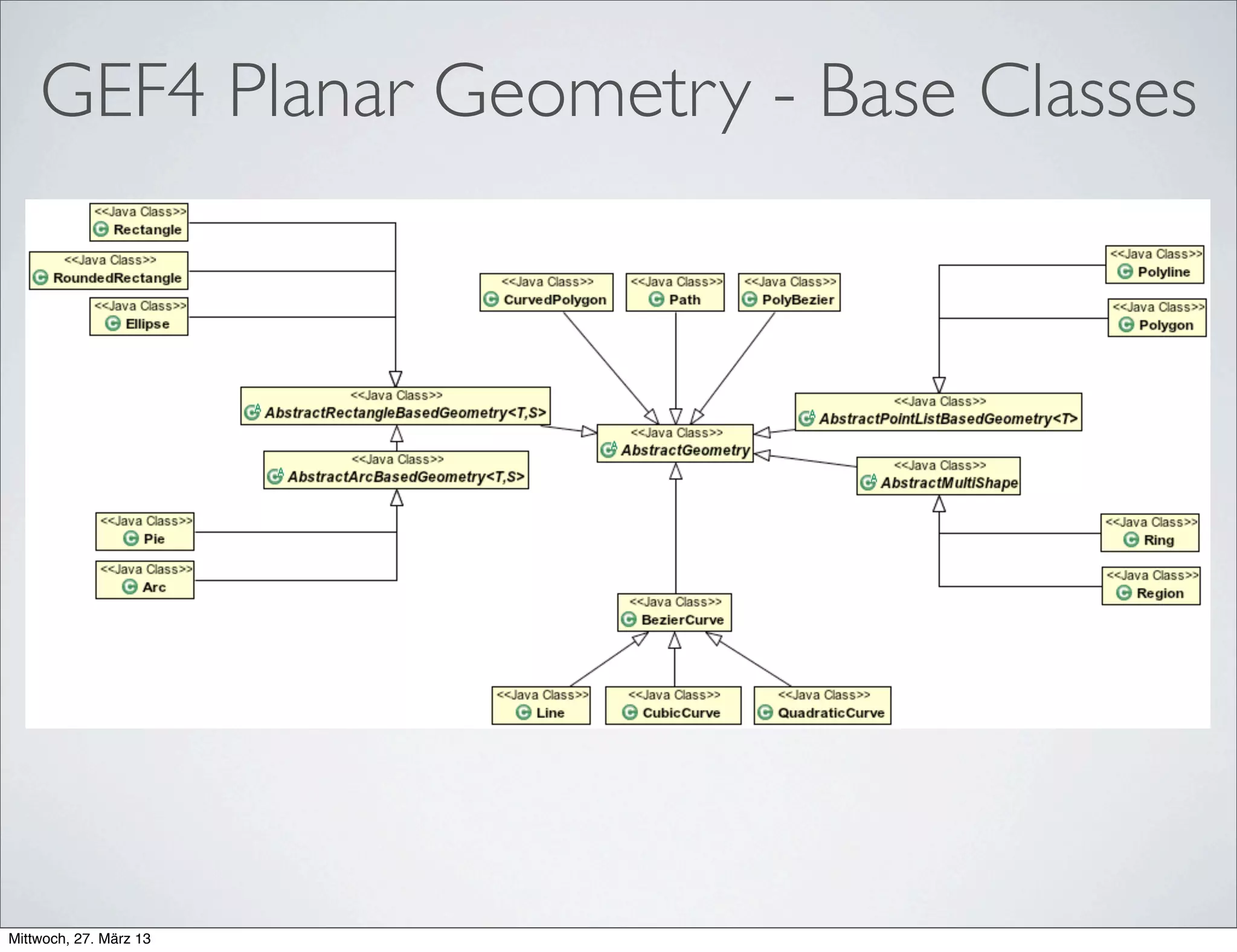
• Construction-related base-classes (AbstractRectangleBased-
Geometry,AbstractPointListBasedGeometry,...)
• Direct support for affine transformations (ITranslatable, IScalable,
IRotatable)
• No direct SWT dependencies (SWT-related conversions bundled in
optional plug-in)
GEF4 Planar Geometry - Overview
GEF4 Planar Geometry - Abstractions
GEF4 Planar Geometry - Base Classes
GEF4 Geometry - Examples
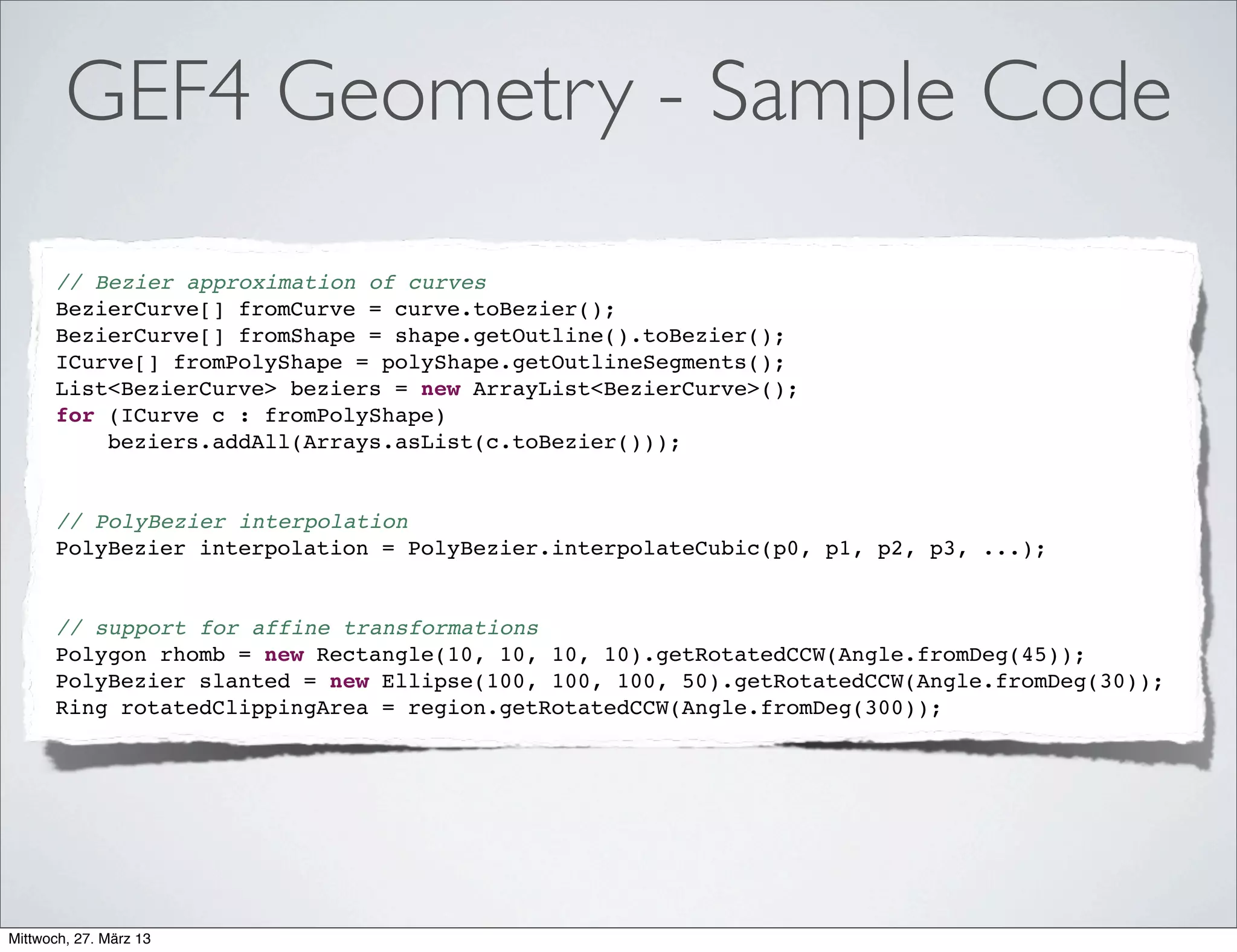
GEF4 Geometry - Sample Code
// Bezier approximation of curves
BezierCurve[] fromCurve = curve.toBezier();
BezierCurve[] fromShape = shape.getOutline().toBezier();
ICurve[] fromPolyShape = polyShape.getOutlineSegments();
List<BezierCurve> beziers = new ArrayList<BezierCurve>();
for (ICurve c : fromPolyShape)
beziers.addAll(Arrays.asList(c.toBezier()));
// PolyBezier interpolation
PolyBezier interpolation = PolyBezier.interpolateCubic(p0, p1, p2, p3, ...);
// support for affine transformations
Polygon rhomb = new Rectangle(10, 10, 10, 10).getRotatedCCW(Angle.fromDeg(45));
PolyBezier slanted = new Ellipse(100, 100, 100, 50).getRotatedCCW(Angle.fromDeg(30));
Ring rotatedClippingArea = region.getRotatedCCW(Angle.fromDeg(300));
GEF4 Graphics
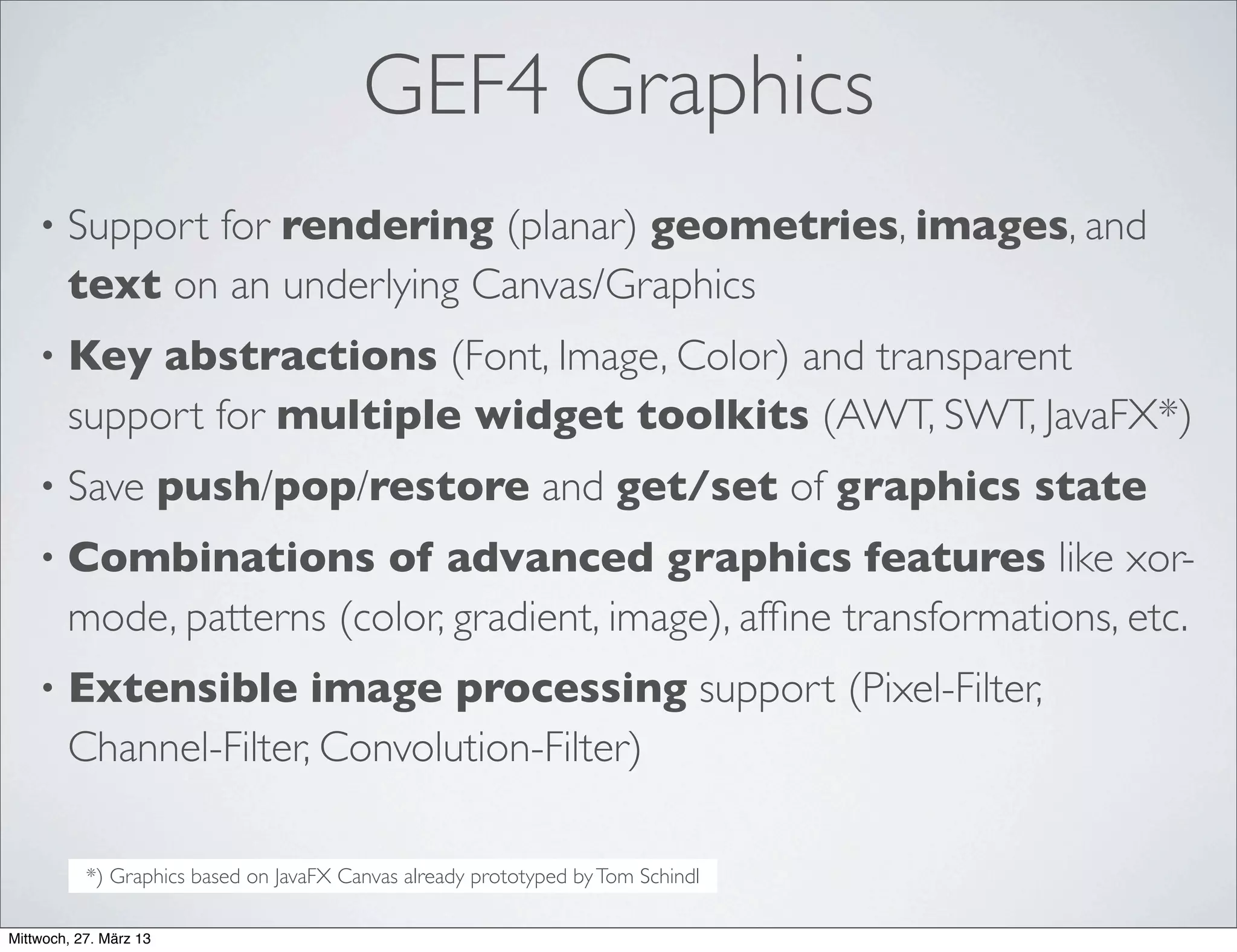
• Support for rendering (planar) geometries, images, and text
on an underlying Canvas/Graphics
• Key abstractions (Font, Image, Color) and transparent
support for multiple widget toolkits (SWT,AWT, JavaFX*)
• Save push/pop/restore and get/set of graphics state
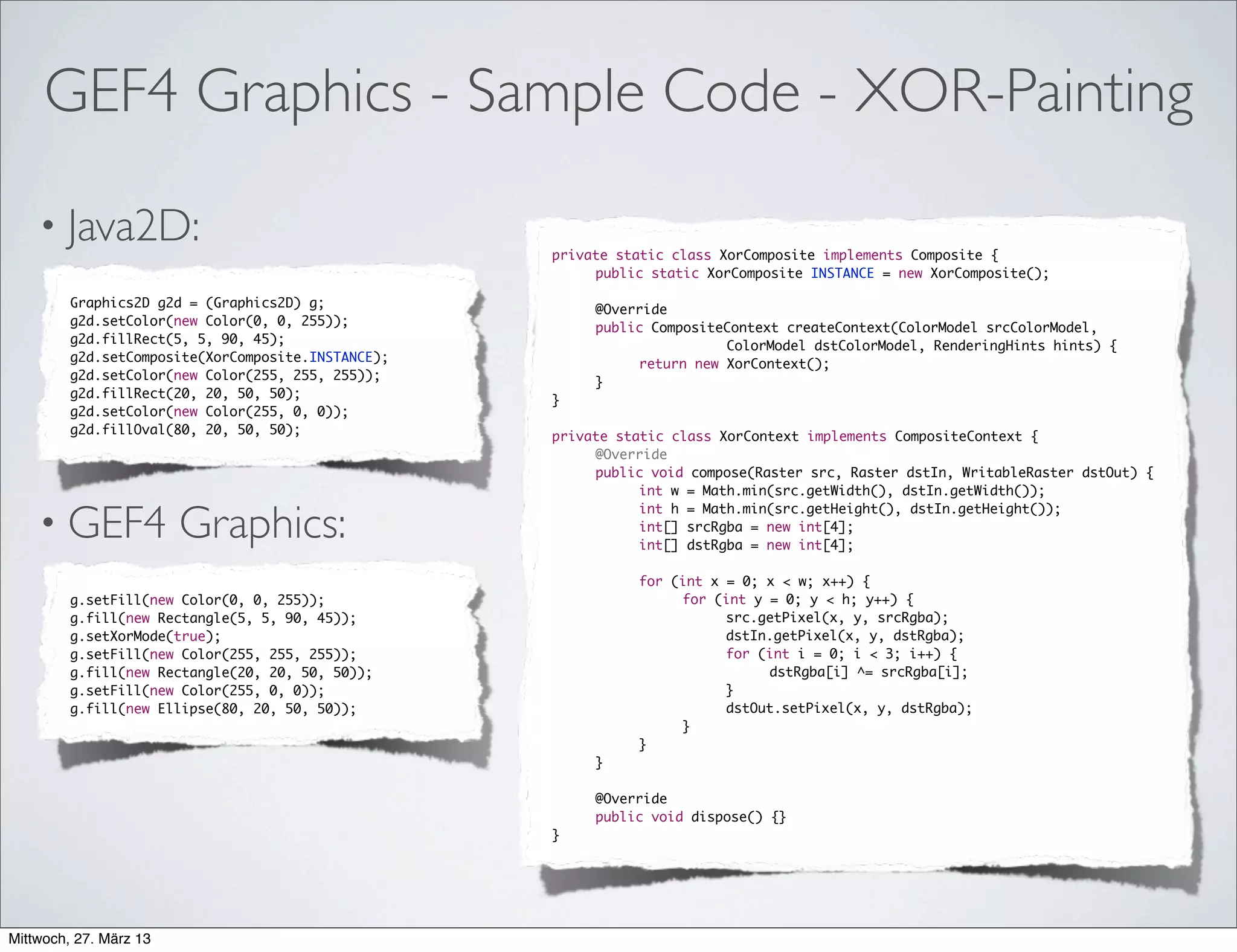
• Combinations of advanced graphics features like xor-mode,
patterns (color, gradient, image), affine transformations, etc.
• Extensible image processing support (Pixel-Filter, Channel-
Filter, Convolution-Filter)
*) Graphics based on JavaFX Canvas API already prototyped byTom Schindl
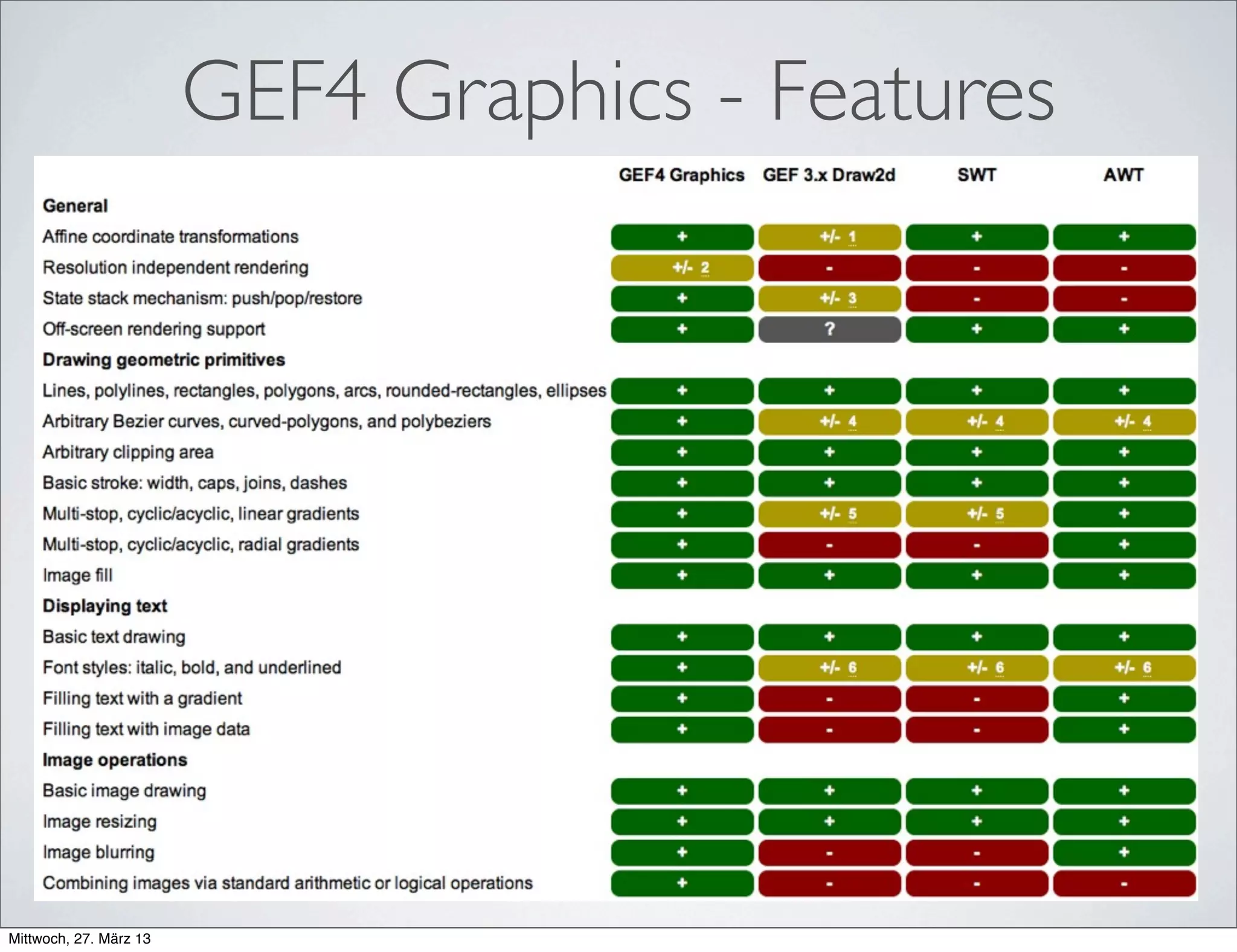
GEF4 Graphics - Features
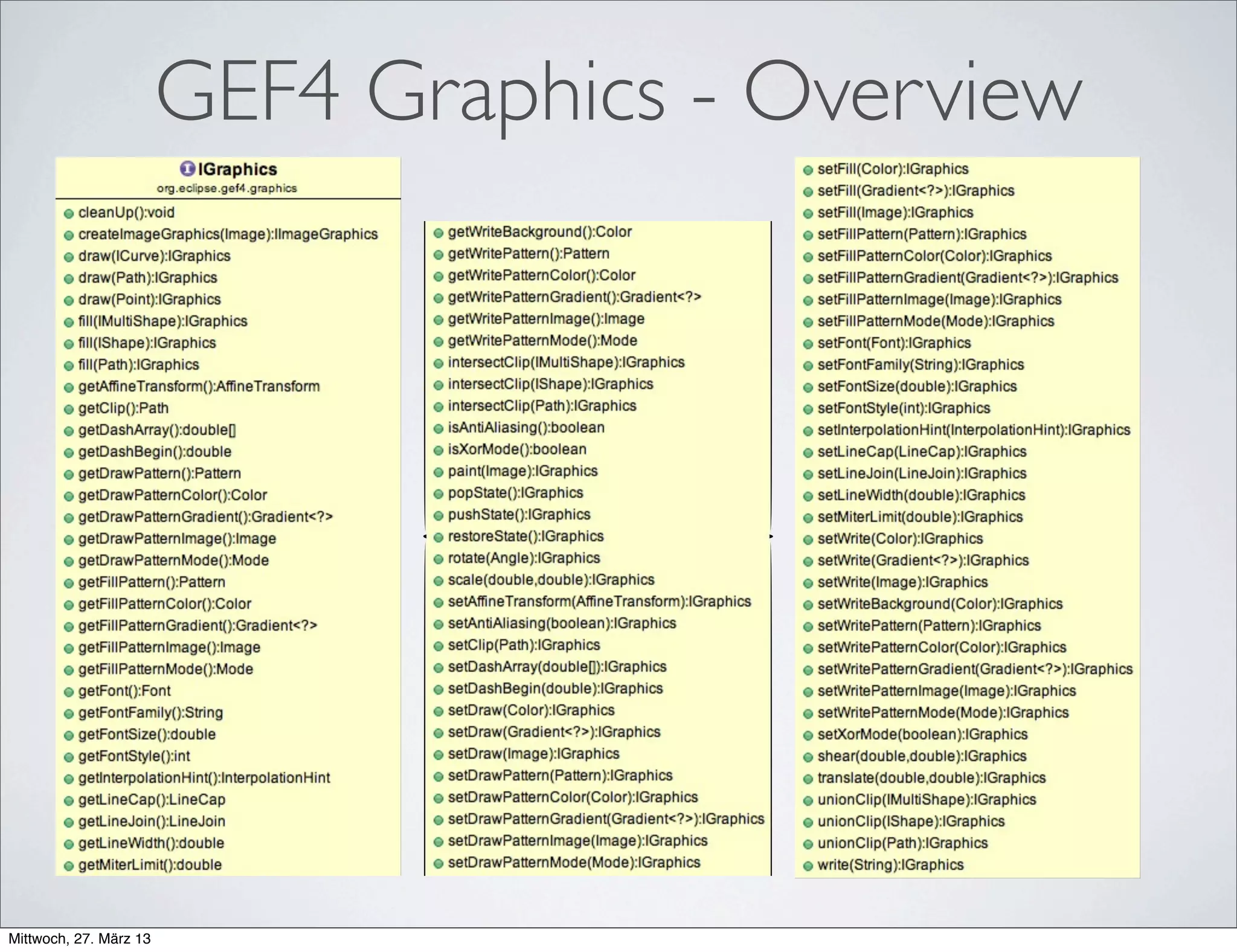
GEF4 Graphics - Overview
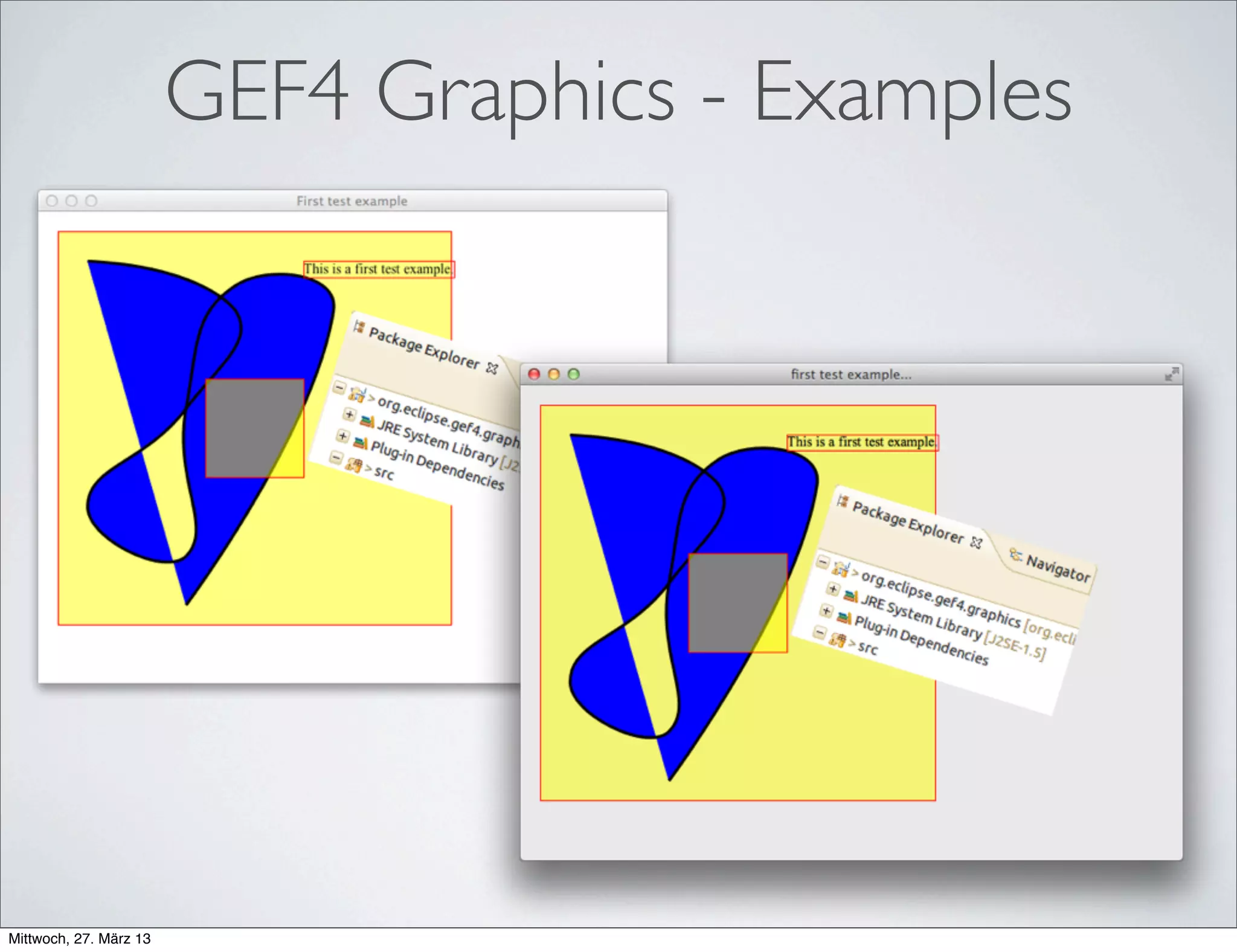
GEF4 Graphics - Examples
GEF4 Graphics - Sample Code
// prepare geometries
final Ellipse ellipse = new Ellipse(50, 50, 350, 200);
final Rectangle rectangle = new Rectangle(100, 160, 125, 220);
final Polygon triangle = new Polygon(260, 170, 190, 300, 330, 300);
// prepare colors
final Color red = new Color(255, 0, 0);
final Color darkRed = new Color(128, 0, 0);
final Color blue = new Color(0, 0, 255);
final Color green = new Color(0, 255, 0);
final Color darkGreen = new Color(0, 128, 0);
g.setLineWidth(4);
g.pushState(); // save the current set of properties on the stack
g.setFill(red).setDraw(darkRed).setDashArray(25, 10);
g.fill(ellipse).draw(ellipse.getOutline());
g.restoreState(); // restore the previously saved properties
g.setFill(blue).setLineJoin(LineJoin.ROUND).setLineCap(LineCap.ROUND);
g.fill(rectangle).draw(rectangle.getOutline());
g.popState(); // removes the previously saved properties from the stack
// and enables the properties that were set in advance
g.setFill(green).setDraw(darkGreen).setLineJoin(LineJoin.MITER);
g.fill(triangle).draw(triangle.getOutline());
GEF4 Graphics - More Sample Code
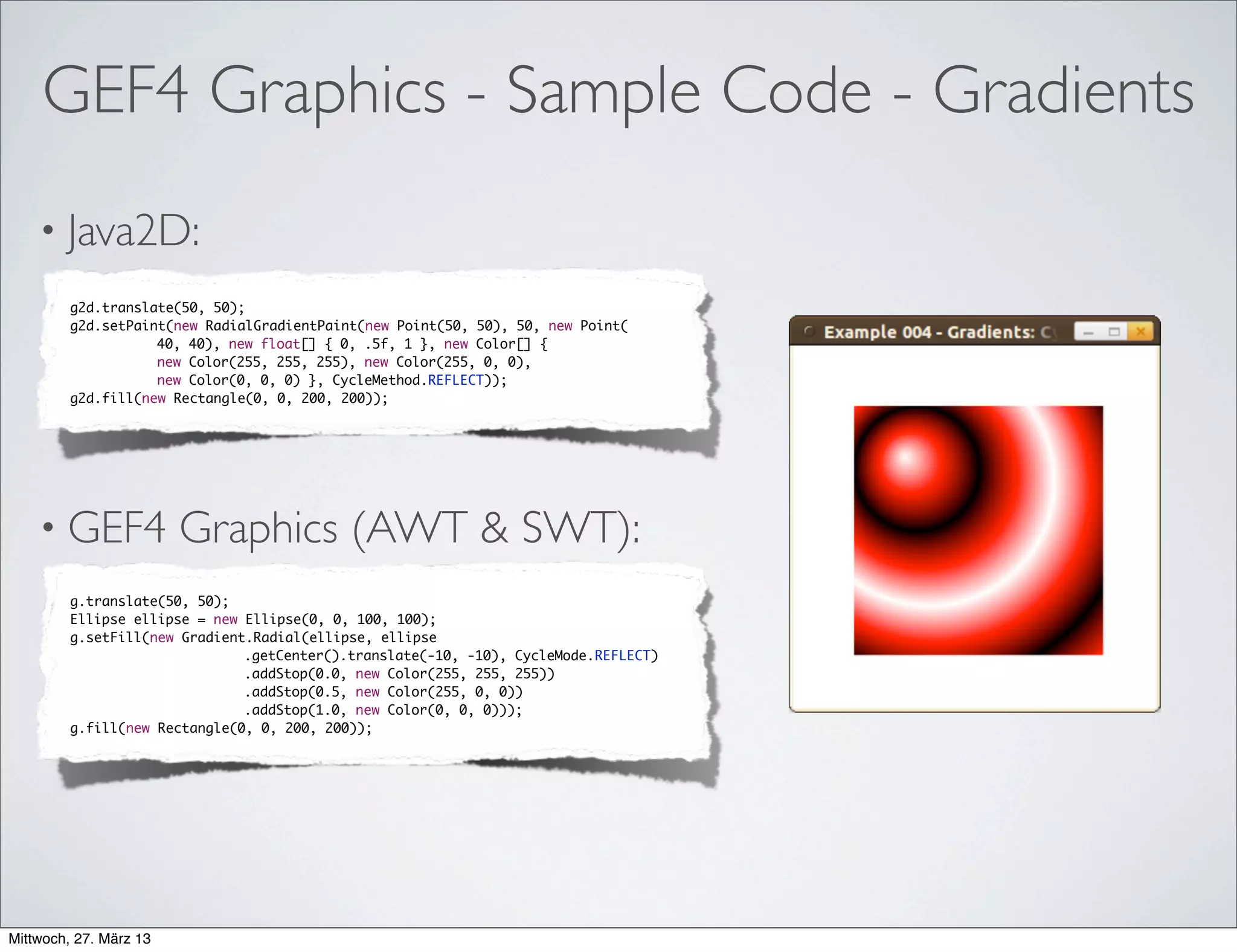
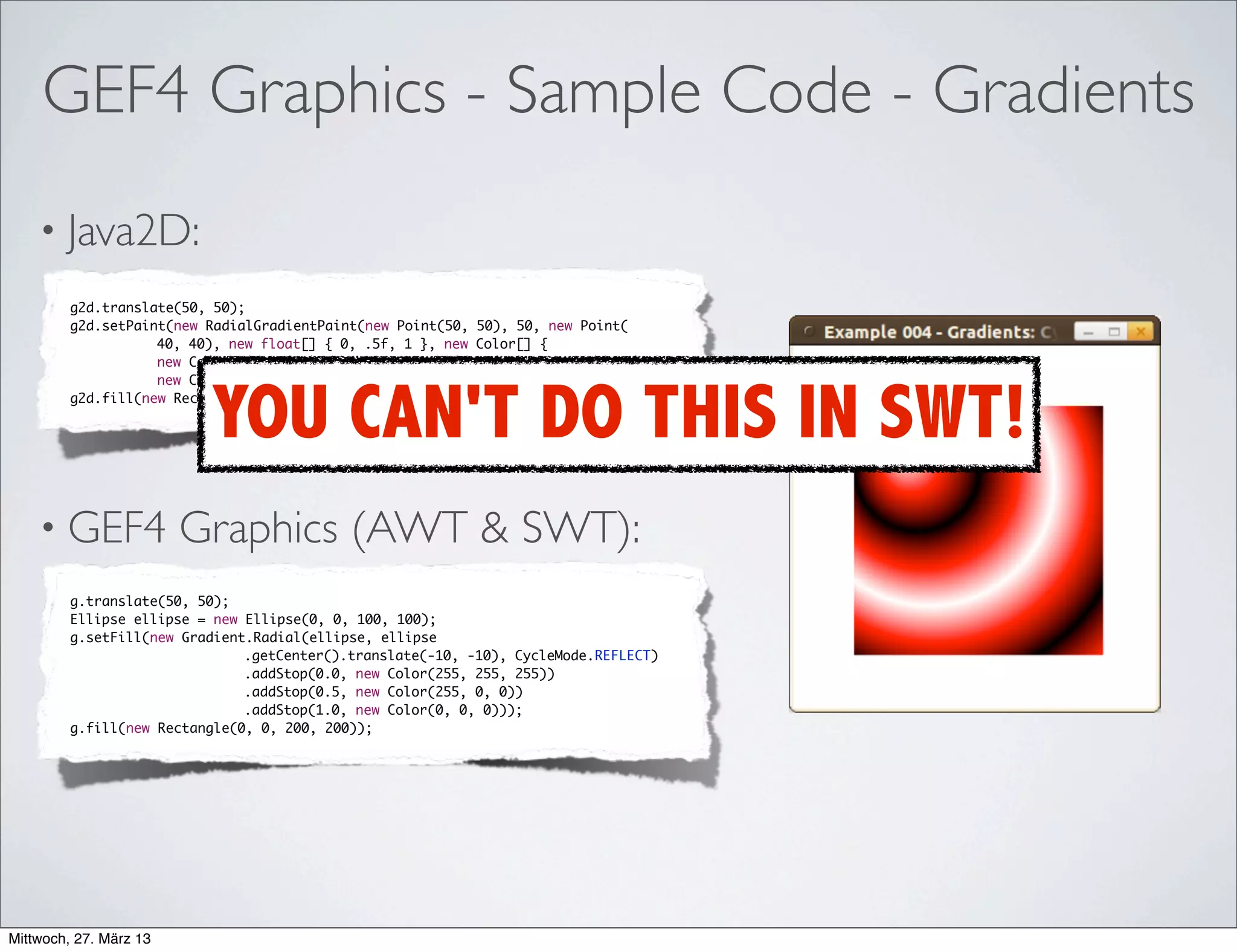
• Java2D:
• GEF4 Graphics (Java2D & SWT):
g2d.translate(50, 50);
g2d.setPaint(new RadialGradientPaint(new Point(50, 50), 50, new Point(
40, 40), new float[] { 0, .5f, 1 }, new Color[] {
new Color(255, 255, 255), new Color(255, 0, 0),
new Color(0, 0, 0) }, CycleMethod.REFLECT));
g2d.fill(new Rectangle(0, 0, 200, 200));
g.translate(50, 50);
Ellipse ellipse = new Ellipse(0, 0, 100, 100);
g.setFill(new Gradient.Radial(ellipse, ellipse
.getCenter().translate(-10, -10), CycleMode.REFLECT)
.addStop(0.0, new Color(255, 255, 255))
.addStop(0.5, new Color(255, 0, 0))
.addStop(1.0, new Color(0, 0, 0)));
g.fill(new Rectangle(0, 0, 200, 200));
GEF4 - Outlook (Mid-Term)
• GEF4 Layouts is planned:
• Data model for layout computations (based on Draw2d/
Zest DirectedGraphLayout)
• Set of layout algorithms based on it (Draw2d & Zest)
• GEF4 'Glyphs' is planned:
• Figures/Shapes abstractions inspired by Draw2d, SVG, and
JavaFX (SceneGraph)
• Intended as replacement of Draw2d 'core'
GEF4 - Outlook (Long-Term)
• Adoption of migrated Zest components to new GEF4
Geometry, Graphics, Canvas, Layouts components
• Migration of remaining Draw2d/GEF (MVC) code base,
including re-modularization and adoption
Share & Enjoy - Please get involved!
• Evaluate and Provide Feedback!
• Try out early snapshots!
• Report bugs, report enhancement requests!
• Contribute!
• Participate in discussions (bugzilla, mailing list)
• Supply patches
ThankYou! Questions?
http://wiki.eclipse.org/GEF/GEF4

GEF4 - Continue to Share and Enjoy!

  • 1.
    Share and Enjoy! AlexanderNyßen itemis AG 4 Continue to
  • 2.
    GEF 3.x /Zest 1.x • Mature project with quite long history • Base technology with lot's of users (direct & indirect through GMF/Graphiti) • Stable API, no breaking API changes since 2004 (GEF 3.0) • Ready for CBI (migration to Git, Maven/Tycho completed) • But API is organically evolved and there are ~400 bugzillas, out of which several require to break it
  • 3.
    SomeTopics for aRenewal • Re-thinking current componentization • Support for the E4 application model • Support for rotation and other transformations • Support for curved connections • Support for other rendering platforms than SWT • Multi-touch gestures support • Revision of the command framework • Revision of connection handling (clipping container) • Various renamings and restructurings on the detail level...
  • 4.
    Zest 2 (since2010) • A provisional Zest 2 component was initiated in 2010, to develop the next generation Zest API. • Goal was to develop a new version of Zest in parallel to the maintenance of Zest 1.x., with an - up to the final graduation - provisional API • Sources were intended to be placed in its own Zest2 Git repository, results were published separately via Eclipse Marketplace.
  • 5.
    GEF4 (since 2011) •GEF4 was initiated - in analogy to Zest 2 - to develop the next generation Draw2d and GEF (MVC) API. • Similar to Zest2, development was intended to take place in parallel to maintenance of Draw2d / GEF (MVC) 3.x • Initial plans (prior to 3.8): • Create new double-precision Geometry API before Juno release. • Start to migrate the Draw2d and GEF (MVC) code base on a step-by-step basis afterwards.
  • 6.
    GEF4 + Zest2 = GEF4 Modified plan: 
 Unification of both approaches after Juno!
  • 7.
    GEF4 - AUnified Approach • A unified approach with a shared code base and a common namespace (org.eclipse.gef4) for all plug-ins. • Advantages: • Clear distinction between GEF proper as the production component and GEF4 as the provisional one • Chance to not only refactor GEF components but the componentization itself, which is only "historically" justified.
  • 8.
    GEF4 - StatusQuo • GEF4 Geometry component was initiated in 2011, work has been finalized with the Juno release: • Functionally complete (at least for now) • 344 JUnit tests, ~77% instruction coverage • GEF4 Graphics component was initiated directly after Juno and is currently under work: • Functionally nearly complete for SWT/AWT, intended JavaFX adoption about to start • Still limited tests and quite a bit of adjustment needed w.r.t. "platform- specific" issues of SWT
  • 9.
    GEF4 - StatusQuo (continued) • GEF4 Zest was transferred to Git repository (and update- site) but not yet adopted: • Zest2 plug-ins were renamed to org.eclipse.gef4.zest.* • Dependencies on Draw2d 3.x still have to be factored out
  • 10.
    GEF4 Geometry • Nodistinction in low and high precision, but just a single double-precision API (with built-in imprecision for comparisons). • Different geometric abstractions for different purposes: • Euclidean (Vector, Straight,Angle) • Projective (Vector3D, Straight3D) • Planar (Point, Dimension, Line, QuadraticCurve, CubicCurve, BezierCurve, Polyline, PolyBezier, Ellipse, Rectangle, Pie,Arc, Polygon, CurvedPolygon, RoundedRectangle, Ring, Region, Path) • Conversions to/from AWT and SWT (and between them)
  • 11.
    GEF4 Planar Geometry- Features • Support for "non-standard" geometries: • Arbitrary Bezier curves, curved polygons • Approximation via BezierCurves & Interpolation via PolyBeziers • Characteristics-related core abstractions (IGeometry, ICurve, IShape, IMultiShape) • Construction-related base-classes (AbstractRectangleBased- Geometry,AbstractPointListBasedGeometry,...) • Direct support for affine transformations (ITranslatable, IScalable, IRotatable) • No direct SWT dependencies (SWT-related conversions bundled in optional plug-in)
  • 12.
  • 13.
    GEF4 Planar Geometry- Abstractions
  • 14.
    GEF4 Planar Geometry- Base Classes
  • 15.
  • 16.
    GEF4 Geometry -Sample Code // Bezier approximation of curves BezierCurve[] fromCurve = curve.toBezier(); BezierCurve[] fromShape = shape.getOutline().toBezier(); ICurve[] fromPolyShape = polyShape.getOutlineSegments(); List<BezierCurve> beziers = new ArrayList<BezierCurve>(); for (ICurve c : fromPolyShape) beziers.addAll(Arrays.asList(c.toBezier())); // PolyBezier interpolation PolyBezier interpolation = PolyBezier.interpolateCubic(p0, p1, p2, p3, ...); // support for affine transformations Polygon rhomb = new Rectangle(10, 10, 10, 10).getRotatedCCW(Angle.fromDeg(45)); PolyBezier slanted = new Ellipse(100, 100, 100, 50).getRotatedCCW(Angle.fromDeg(30)); Ring rotatedClippingArea = region.getRotatedCCW(Angle.fromDeg(300));
  • 17.
    GEF4 Graphics • Supportfor rendering (planar) geometries, images, and text on an underlying Canvas/Graphics • Key abstractions (Font, Image, Color) and transparent support for multiple widget toolkits (SWT,AWT, JavaFX*) • Save push/pop/restore and get/set of graphics state • Combinations of advanced graphics features like xor-mode, patterns (color, gradient, image), affine transformations, etc. • Extensible image processing support (Pixel-Filter, Channel- Filter, Convolution-Filter) *) Graphics based on JavaFX Canvas API already prototyped byTom Schindl
  • 18.
  • 19.
  • 20.
  • 21.
    GEF4 Graphics -Sample Code // prepare geometries final Ellipse ellipse = new Ellipse(50, 50, 350, 200); final Rectangle rectangle = new Rectangle(100, 160, 125, 220); final Polygon triangle = new Polygon(260, 170, 190, 300, 330, 300); // prepare colors final Color red = new Color(255, 0, 0); final Color darkRed = new Color(128, 0, 0); final Color blue = new Color(0, 0, 255); final Color green = new Color(0, 255, 0); final Color darkGreen = new Color(0, 128, 0); g.setLineWidth(4); g.pushState(); // save the current set of properties on the stack g.setFill(red).setDraw(darkRed).setDashArray(25, 10); g.fill(ellipse).draw(ellipse.getOutline()); g.restoreState(); // restore the previously saved properties g.setFill(blue).setLineJoin(LineJoin.ROUND).setLineCap(LineCap.ROUND); g.fill(rectangle).draw(rectangle.getOutline()); g.popState(); // removes the previously saved properties from the stack // and enables the properties that were set in advance g.setFill(green).setDraw(darkGreen).setLineJoin(LineJoin.MITER); g.fill(triangle).draw(triangle.getOutline());
  • 22.
    GEF4 Graphics -More Sample Code • Java2D: • GEF4 Graphics (Java2D & SWT): g2d.translate(50, 50); g2d.setPaint(new RadialGradientPaint(new Point(50, 50), 50, new Point( 40, 40), new float[] { 0, .5f, 1 }, new Color[] { new Color(255, 255, 255), new Color(255, 0, 0), new Color(0, 0, 0) }, CycleMethod.REFLECT)); g2d.fill(new Rectangle(0, 0, 200, 200)); g.translate(50, 50); Ellipse ellipse = new Ellipse(0, 0, 100, 100); g.setFill(new Gradient.Radial(ellipse, ellipse .getCenter().translate(-10, -10), CycleMode.REFLECT) .addStop(0.0, new Color(255, 255, 255)) .addStop(0.5, new Color(255, 0, 0)) .addStop(1.0, new Color(0, 0, 0))); g.fill(new Rectangle(0, 0, 200, 200));
  • 23.
    GEF4 - Outlook(Mid-Term) • GEF4 Layouts is planned: • Data model for layout computations (based on Draw2d/ Zest DirectedGraphLayout) • Set of layout algorithms based on it (Draw2d & Zest) • GEF4 'Glyphs' is planned: • Figures/Shapes abstractions inspired by Draw2d, SVG, and JavaFX (SceneGraph) • Intended as replacement of Draw2d 'core'
  • 24.
    GEF4 - Outlook(Long-Term) • Adoption of migrated Zest components to new GEF4 Geometry, Graphics, Canvas, Layouts components • Migration of remaining Draw2d/GEF (MVC) code base, including re-modularization and adoption
  • 25.
    Share & Enjoy- Please get involved! • Evaluate and Provide Feedback! • Try out early snapshots! • Report bugs, report enhancement requests! • Contribute! • Participate in discussions (bugzilla, mailing list) • Supply patches
  • 26.